Abstract: The current reading crisis, the “science of reading” (SoR) movement, is a subset of the perpetual education crisis begun under Ronald Reagan with A Nation at Risk. Ultimately, “crisis” education reform is a sort of industry that works as a distraction and erasure. Consequently, marginalized and minoritized students, often significant populations within Urban education, are never directly served in education reform grounded in accountability instead of equity. The SoR movement, through legislation and policy, is working indirectly to drive book censorship, book bans, and the whitewashing of texts in classrooms and libraries.
Every white person in this country—and I do not care what he or she says—knows one thing. They may not know, as they put it, “what I want,” but they know they would not like to be black here. If they know that, then they know everything they need to know, and whatever else they say is a lie.
And then, just a few years later, there is Margaret Atwood’s The Handmaid’s Tale, specifically the closing “Historical Notes” where readers learn about the context behind how Gilead comes about.
At a satirical symposium in Gileadean studies dated June 25, 2195, the keynote, Professor James Darcy Pieixoto, explains that context:
Men highly placed in the regime [of Gilead] were thus able to pick and choose among women who had demonstrated their reproductive fitness by having produced one or more healthy children, a desirable characteristic in an age of plummeting Caucasian birthrates, a phenomenon observable not only in Gilead but in most northern Caucasian societies of the time.
The reasons for the decline are not altogether clear to us. Some of the failure to reproduce can undoubtedly be traced to the widespread availability of birth control of various kinds, including abortion, in the immediate pre-Gilead period. Some infertility, then, was willed, which may account for the differing statistics among Caucasians and non-Caucasians.
…But whatever the causes, the effects were noticeable, and the Gilead regime was not the other one to react to them at the time. Rumania, for instance, had anticipated Gilead in the eighties by banning all forms of birth control, imposing compulsory pregnancy tests on the female population, and linking promotion and wage increases to fertility.
What are these texts from over four decades ago telling us about the current political and cultural state of the US during the era of Trump/MAGA?
White Americans, notably the white political and cultural leaders, are openly concerned about the low birthrate among white people. And thus, restricting and banning abortion have swept much of the country after the overturning of Roe v. Wade. [1]
Not that long ago, mainstream thinkers believed Roe v. Wade and abortion rights were safe in the US; people raising concerns were considered alarmists.
Now, as Republicans and conservatives seem to be coming after birth control next, we cannot hesitate as we did before the dismantling of women’s rights came as we should have known it would.
In the passage from the “Historical Notes,” we have a key point about the birthrates of white people falling against the rise of birthrates about other races.
And thus, the connection to Baldwin’s confronting “every white person in this country—and I do not care what he or she says—knows one thing. … [T]hey would not like to be [B]lack here.”
Not to speak for or over Baldwin, but to help us tease out this connection in 2025, white fear in the US is fear not singularly grounded in race but ultimately fueled by the fear of becoming a minority.
We must next consider fully Baldwin’s recognition that for white people, Black people and the consequences of their minority status in the US are a mirror for who white people are—more so than any commentary on Black people themselves.
For all the histrionics denying white privilege, white people know one thing—that white people as the majority, that white people with the balance of power, used that majority status and power to the detriment of any and all minorities.
If and when white people become the minority, they fear that they will then suffer the same consequences of minority status that white people have imposed on other races in the US.
White people cannot fathom a world in which majority and minority statuses do not result in some winning because others are losing.
The Great Whitewashing is upon us—one foreseen by Baldwin and Atwood.
One that is coming to fruition before our eyes.
What every white person knows may destroy everything for everyone.
What each white person does now will tell everyone everything we need to know.
It is hard for me to overemphasize the profound impact discovering irreverent humor had on me as a young human in the 1970s.
The list is long—George Carlin, Richard Pryor, The Firesign Theater, National Lampoon, Monty Python, Saturday Night Live, and so many films.
I was 13 when Blazing Saddles (1974) was released, now celebrating its 50th year anniversary. I came to love all of Mel Brooks’s films, but Blazing Saddles found a spot not only in my consciousness but also among my mother’s side of the family.
For many years our gatherings were punctuated with quotes from the movie followed by outbursts of laughter.
But witnessing how people have responded to the film over the years raises an important question: How can anything so misunderstood also be so beloved and enduring?
Just as conservatives and anti-woke warriors have misrepresented and dishonored George Carlin, claiming that the film could not be made today because of the woke mob completely misses that Blazing Saddles is a woke film (ironically, suggesting otherwise erases the brilliance of Black contributions to the film by Cleavon Little and Ricard Pryor).
And this leads to another question: When are misrepresentations of racism racism and when are they anti-racism?
We have ample literary evidence of this problem, also recently center stage in the rise of rightwing censorship: Adventures of Huckleberry Finn and To Kill a Mockingbird are excellent examples of representations of racism that offer extremely complicated ways to understand the texts and their appropriateness for exploring racism.
Both novels suffer from centering white characters, and TKAM is likely a poor text for examining racism since it perpetuates the white savior myth.
The reignited but jumbled public debate about Blazing Saddles comes in the wake of my first audiobook experience, Yellowface by R.F. Kuang.
Soon after that listening, I also sat mostly listening to a book club discussion among almost exclusively women.
One of the points brought up, and one of my central reactions, overlaps strongly with the Blazing Saddles/ Huck Finn/ TKAM issues noted above: How does a work become popular while being either misunderstood or not fully understood?
Broadly, I read Yellowface as a scathing satire of the publishing industry (and the insider’s view of MFA and creative writing programs) and a cautionary tale about the corrosive influence of capitalism/The Market on literary quality (sort of the myth that publishing is a meritocracy) as well as DEI commitments among publishers (the novel unmasks DEI as mostly marketing and tokenism).
I mentioned to my partner that I think much of that insider satire has to be lost on many readers in the same way I think Jeffrey Eugenides’s sort of English major perspective is missed by the average reader.
Regardless, Yellowface is incredibly rich and complex in terms of what we are experiencing and how readers might best navigate the storytelling.
First, I think storytelling is central to this work about writers, of course, but Kuang—like Twain and Lee—chooses to center a white character and her white voice (often one we find hard to feel any sympathy for) in order to interrogate storytelling and even story ownership in the context of race and racism.
Here, two important elements come to mind—the use of the unreliable narrator and the overlap between Yellowface and The Handmaid’s Tale by Margaret Atwood.
“Many of Edgar Allan Poe’s works include obsessed narrators who are plagued by their unconscious in order to discover their true selves,” Rachel McCoppin writes. And this description in many ways perfectly describes June Hayward, narrator of Yellowface.
June is relentlessly plagued by her Self to the exclusion of others and ultimately, it seems, to the exclusion of the Self she seems to be seeking.
Here, I must highlight Atwood’s The Handmaid’s Tale since, similar to Yellowface, the novel centers a white woman and her voice while also repeatedly disorienting the reader’s perception of that storytelling.
The narrator in HMT often tells an event and then confesses that version is wrong, only to tell it differently. Then, in the Historical Notes, we discover this story is a transcript recreated by a scholar from audio recordings.
Yellowface also significantly challenges the storytelling while also directly raising questions about who tells the stories as well as who should.
Does the scholar in HMT own the story simply by discovering the tapes? Does June have a right to Athena Liu’s manuscript that is also Liu’s retelling (claiming?) of the stories of Chinese laborers in WWI?
Whether intentional or not, I am also struck not only by the many names by which June Heyward goes (June Hayward, Juniper Song, Junie) but also how that mirrors the imposed name of June on the narrator of HMT:
When I first began “The Handmaid’s Tale” it was called “Offred,” the name of its central character. This name is composed of a man’s first name, “Fred,” and a prefix denoting “belonging to,” so it is like “de” in French or “von” in German, or like the suffix “son” in English last names like Williamson. Within this name is concealed another possibility: “offered,” denoting a religious offering or a victim offered for sacrifice.
Why do we never learn the real name of the central character, I have often been asked. Because, I reply, so many people throughout history have had their names changed, or have simply disappeared from view. Some have deduced that Offred’s real name is June, since, of all the names whispered among the Handmaids in the gymnasium/dormitory, “June” is the only one that never appears again. That was not my original thought but it fits, so readers are welcome to it if they wish.
Atwood and Kuang invite readers to consider the importances of names, and these works are complex dramatizations of the complexity of not only storytelling but also the storyteller.
I have been a teacher and a literary critic for many decades so after my initial urge to connect Kuang’s novel to Poe’s unreliable narrator (and his foundational role in genre fiction such as horror), I was drawn to the many wonderful referential aspects of Yellowface.
Kuang masterfully blends and fictionalizes high-profile controversies in literature and publishing. [1]
Two are linked to Oprah Winfrey’s book club: A Million Little Pieces and American Dirt.
A Million Little Piecessparked a public debate about the nature of genre since James Frey was accused of bogus claims in his published memoir (which began as a novel).
I use this debate often with students as a way to interrogate what we mean by genre, by fiction versus nonfiction, and by modes of expression. Among writers, teachers, and literary scholars, these lines are blurred, not distinct. But in the general public, there is little patience for anything other than black and white.
American Dirt, mentioned in the novel, is a recent and key publication that raised the questions many are exploring because of reading Yellowface—who has the right to a story and what constitutes appropriation (Jeanine Cummins’s novel was criticized as “brownface”).
The third reference is one of the most effective turns of Yellowface, when June discloses that Athena had co-opted a sexual assault situation experienced by June. This parallels the short story controversy around “Cat Person.”
While I struggle to feel compassion for June (or frankly any characters in the novel), the storytelling gradually reveals that Athena (and maybe all writers?) traffic in claiming other people’s stories as her own. One later scene involves June talking with Athena’s ex-boyfriend who directly confronts Athena’s willingness to use other people for her literary gain.
As I have continued to think and talk about Yellowface, I am more and more certain about what I don’t know for sure.
The end of the novel includes a revengeful character eventually (maybe?) bringing June’s charade to light, only to parlay that into her own book, Yelllowface.
Kuang has directly noted: “Who has the right to tell a story? It’s the wrong question to ask.”
For me, I am more fascinated by the storytelling than the storyteller. And Yellowface—again, like HMT—forces us through so many twist and turns that we are left unsure what story is true, or even if anything like the truth can exist.
The reform paradigm includes rhetoric of “crisis” and “miracle,” and the reform itself tends to be legislation-based and in-school only with the focus of reform centered on students, teachers, curriculum/standards, tests, and instruction.
The SOR reform movement is essentially conservative (a subset of the accountability era best represented by education reform under George W. Bush [Texas, NCLB] and Jeb Bush [Florida]) and another “bad teacher” narrative.
The most troubling irony of the SOR movement and the resulting legislation is that despite claims among SOR advocates that the reading crisis disproportionately impacts minoritized and marginalized students (a historical fact of all aspects of education in the US for over a century), evidence is showing SOR-based mandates and programs are even worse for that very population, or as Oscar Wilde eloquently puts it, “their remedies are part of the disease.”
Consider the following posts and also recent research and analyses addressing how SOR is failing social justice and equity goals for the students who need that most:
My Posts and Scholarship
Thomas, P.L. (2023). The “Science of Reading,” Education Faddism, and the Failure to Honor the Intellectual Lives of All Children: On Deficit Lenses and Ignoring Class and Race Stereotyping. Voices in the Middle, 30(3), 17-21. https://library.ncte.org/journals/vm/issues/v30-3/32439
Amanda Rigell, Arianna Banack, Amy Maples, Judson Laughter, Amy Broemmel, Nora Vines & Jennifer Jordan (2022) Overwhelming whiteness: a critical analysis of race in a scripted reading curriculum, Journal of Curriculum Studies, 54:6, 852-870. 10.1080/00220272.2022.2030803
“Whatever You Want to Call It”: Science of Reading Mythologies in the Education Reform Movement, Elena Aydarova, Harvard Educational Review (2023) 93 (4): 556–581. https://doi.org/10.17763/1943-5045-93.4.556
Grounded in the federal mandate for “scientifically based” instruction in No Child Left Behind (NCLB, 2001), anchored by the misrepresented National Reading Panel (NRP) report, the more recent “science of reading” (SOR) movement has successfully erased segments of the reading program market (Units of Study) and mandated as well as banned instructional practices in nearly every state of the US.
At the core of this SOR era of education reform is an orchestrated agenda to impose scripted curriculum onto reading instruction, often called “structured literacy”:
At its July 1st meeting, the IDA Board of Directors made a landmark decision designed to help market our approach to reading instruction. The board chose a name that would encompass all approaches to reading instruction that conform to IDA’s Knowledge and Practice Standards. That name is “Structured Literacy.”…
If we want school districts to adopt our approach, we need a name that brings together our successes. We need one name that refers to the many programs that teach reading in the same way. A name is the first and essential step to building a brand….
The term “Structured Literacy” is not designed to replace Orton Gillingham, Multi-Sensory, or other terms in common use. It is an umbrella term designed to describe all of the programs that teach reading in essentially the same way. In our marketing, this term will help us simplify our message and connect our successes. “Structured Literacy” will help us sell what we do so well.
Literacy scholars, however, have issued strong and research-based warnings about how structured literacy often devolves into scripted curriculum:
We recognize that some teachers using structured literacy approaches will find ways to respond to the interests, experiences, and literacy abilities of individual students; however, we are concerned about the indiscriminate and unwarranted implementation of the following practices:
Directive and/or scripted lessons that tell teachers what to say and do and the implementation of lesson sequences, often at a predetermined pace (Hanford, 2018)
Privileging of phonemic awareness and phonics as primary decoding skills (Hanford, 2018, 2019; IDA, 2019; Paige, 2020; Pierson, n.d.; Spear-Swerling, 2019)
Use of decodable texts that do not engage multiple dimensions of reading (Hanford, 2018; IDA, 2019; Paige, 2020; Spear-Swerling, 2019)
Specialized forms of reading instruction designed for particular groups of students as core literacy instruction for all students and teacher educators (Hanford, 2018; Hurford et al., 2016; IDA, 2019; Pierson, n.d.)
Mandating structured literacy programs despite the lack of clear empirical evidence to support these programs
Privileging the interest of publishers and private education providers over students.
Compton-Lilly, C.F., Mitra, A., Guay, M., & Spence, L.K. (2020). A confluence of complexity: Intersections among reading theory, neuroscience, and observations of young readers. Reading Research Quarterly, 55(S1), S185-S195. https://doi.org/10.1002/rrq.348
Compton-Lilly, et al.’s warnings are now being confirmed, notably in terms of bullet points 1 and 4 above as well as in terms of different reading programs now being mandated:
Overwhelming whiteness: a critical analysis of race in a scripted reading curriculum Amanda Rigell, Arianna Banack, Amy Maples, Judson Laughter, Amy Broemmel, Nora Vines & Jennifer Jordan (2022) Overwhelming whiteness: a critical analysis of race in a scripted reading curriculum, Journal of Curriculum Studies, 54:6, 852-870, DOI: 10.1080/00220272.2022.2030803
Scripted curriculum not only de-professionalizes teachers, but also whitewashes the curriculum, confirming the significant overlap of conservative education reform agendas addressing bans and censorship along with the SOR movement.
As I have noted here and here, the SOR movement is a significant part of dismantling the social justice movement.
While the outsized attacks on some reading programs—those by Calkins along with those by Fountas and Pinnell—have been uncritically embraced by the media and politicians despite no evidence of a reading crisis or failure linked to those programs, there is little logic in claims that structured literacy programs are the solution to a manufactured crisis.
In fact, the move to structured literacy as scripted curriculum is demonstrably a shift in the wrong direction if we care at all about reading proficiency, our increasingly diverse population of K-12 students in the US, or our beleaguered teaching profession.
As a teacher for forty years and a teacher educator for more than half of that career, I have always struggled with the tendency to oversell teacher quality and instructional practice.
Does teacher quality matter? Of course.
Does instructional practice matter? Again, of course.
But both teacher quality and instruction (pedagogy) are dwarfed by teaching and learning conditions within schools and more significantly by the conditions of any child’s life.
As I have noted recently, the peak era of focusing on teacher quality, the value-added movement (VAM) occurring mostly under the Obama administration, instead of identifying high-quality teachers as a driver for improving student achievement found out something much different than intended:
VAMs should be viewed within the context of quality improvement, which distinguishes aspects of quality that can be attributed to the system from those that can be attributed to individual teachers, teacher preparation programs, or schools. Most VAM studies find that teachers account for about 1% to 14% of the variability in test scores, and that the majority of opportunities for quality improvement are found in the system-level conditions. Ranking teachers by their VAM scores can have unintended consequences that reduce quality.
Teacher quality necessarily includes two types of knowledge by a teacher—content knowledge and pedagogical knowledge.
Yet the VAM experiment revealed something we have known for decades—standardized tests of student learning mostly reflect the student’s relative privilege or inequity outside of school.
Despite the refrain of Secretary Duncan under Obama, schools have never in fact been “game changers.”
While neoliberal/conservative education reforms leveraged the “soft bigotry of low expectations” and unsubstantiated claims that the Left uses poverty as an excuse, people all along the ideological spectrum are over-focused on instructional practices. And that overemphasis is used to keep everyone looking at teachers, students, and instruction instead of those more impactful out-of-school (OOS) influences on student learning.
A companion to the cult of pedagogy in education reform is the “miracle” school claim, but “miracle” schools rarely (almost never) exist once the claim is interrogated, and even if a “miracle” school exists, it is by definition an outlier and essentially offers no guidance for scaling outward or upward.
The paradox of the cult of pedagogy in education reform is that until will directly address OOS factor we will never have the context for better teasing out the importance of teacher quality and instructional practices.
The current education reform trapped in the cult of pedagogy is the “science of reading” (SOR) movement which oversells the blame for student reading achievement as well as oversells the solutions in the form of different reading programs, reading instructional practice, and teacher preparation and professional development.
The “miracle” of the day in the SOR propaganda is Mississippi, which is very likely a mirage based on manipulating the age of students being tested at grade level and not on teacher quality and instructional practices.
Not a single education reform promise since the 1980s has succeeded, and the US remains in a constant cycle of crisis and reform promises.
Yet, the evidence is overwhelming that many OOS factors impact negatively student learning and that social reform would pay huge dividends in educational outcomes if we simply would move beyond the cult of pedagogy in education reform.
Okano, K., Kaczmarzyk, J.R., Dave, N. et al. Sleep quality, duration, and consistency are associated with better academic performance in college students. npj Sci. Learn.4, 16 (2019). https://doi.org/10.1038/s41539-019-0055-z
My entire career has existed within the neoliberal accountability era of education reform that oversells education as a “game changer” and oversells teacher quality and instructional practices.
Like time-share frauds, we are being duped, and teachers and students need us to move beyond the cult of pedagogy in education reform and focus on the much larger influences on students being able to learn and teachers being able to show that their quality and instruction can matter.
One of the many ways that Florida has been dismantling education in their state and influencing similar actions across the country is whitewashing Black history.
Below is a reader addressing this assault on history, Black people, and efforts to create a more equitable democracy:
In 2002, I left my career as a high school English teacher for 18 years and entered higher education full time.
I genuinely loved teaching high school, specifically teaching teenagers. But that part of my career had significant personal costs because I was always an extreme outlier in terms of ideologies among my peers.
Faculty were overwhelmingly religious and most of my colleagues voted Republican (this was South Carolina in the 1980s and 1990s).
As I entered higher education, I must admit now, I had an idealistic view of academia that was shaped by the standard view that colleges and professors are liberal.
However, once in the halls of academia, I recognized that once again I was an outlier.
Higher education is populated by performative progressivism; yes, many if not most professors are moderate to progressive on social issues.
But in their professional roles, college professors are overwhelmingly conservative and traditional. The normative culture of higher education is firmly conservative.
Also, despite what the public thinks, many professors are ideologically conservative about teaching and knowledge and conduct their classes and research in highly conservative ways because those traditional norms are expected and rewarded.
How should a professor teach? With an objective pose that simply exposes students to a wide range of (normative) perspectives.
How should a professor conduct research? Experimental/quasi-experimental studies are by far the most rewarded, quantitative and objective.
Should a professor conduct public work or activism? Not no, but hell no.
Professors that conform to and perpetuate the most conservative views on disciplinary content (seminal works, classic thinkers, essential knowledge), the most conservative research (scientific), and the most conservative teaching practices (objective, not political) have the easiest paths to full professor and also have the highest prestige in the university, holding key chair positions on the committees that drive the university—Faculty Status, Curriculum, etc.
“Conservative” is grounded in having normal established and endorsed; the entire basis of scientific research is normative, finding generalizable conclusions from randomized data.
The implication is always that normal is right, and being outside that norm, abnormal, is wrong.
Of course, the key problem with generalizable research is that it excludes outliers, perpetuating the idea that everyone, even those outliers, should conform to that norm.
The marginalized (lesser status) approach to research is descriptive, qualitative, and allows there to be value is simply exploring one event or person. The non-normative approach to research is open to possibilities that what has been scientifically determined to be “normal” may in fact not be right (or even true beyond a scientific truth), at least for some.
Research and science helped create the norm, for example, that humans are sexually straight and that gender is binary. That sexuality and gender may be fluid, and that we are considering that because of the life stories of individual people, challenges not only our norms about sex and gender, but our scientific norms.
Science has proven the superiority of races, the frailty of women, and even designated homosexuality as a mental illness.
To think that the scientific norm of higher education isn’t conservative takes a great deal of mental gymnastics.
We are currently witnessing how any challenge to what has been determined as normal, especially under the guise of science, is viewed in melodramatic ways.
As a cultural example, despite the US overwhelmingly being Christian, Christians often claim to be oppressed, notably each season fighting a manufactured War on Christmas.
Somehow uttering “happy holidays” threatens the very fabric of the largest cultural holiday in the US celebrated by the overwhelming majority, Christians, while non-Christians are compelled to join in with the ubiquitous acknowledgement of Christmas from Halloween through the New Year.
The much protesting we are seeing from conservative academics is exactly like the performative crisis espoused by Christians each Christmas holiday season.
Academia is extremely conservative—scientific research, objective teaching, authorized disciplinary knowledge—and that conservative norm has allowed for many decades mediocre people (mostly white, mostly men) to thrive and even excel.
And yet, Neanderthal academia has been reanimated (not revived, because it never died).
Conservative academics are shouting that they have been canceled.
Conservative academics bemoan their university’s “woke” curriculum.
Conservative academics cry that they are being threatened by “woke mobs” of students.
This, you see, is all theater, melodrama, by people who are not really relevant and are fighting desperately to be relevant in a world continuing to question what is normal
In fact, the fight against woke agendas is clearly a manufactured drama in which these Neanderthal academics have cast themselves in leading roles with predictable lines:
“Marketplace of ideas!”
“Scientific!”
“Objectivity!”
“Classic!”
“Seminal texts!”
It is genuinely embarrassing when people with the most power shed so many tears into the chilling effect of their histrionics that the result is a blizzard that will soon leaves us all snow blind.
I have spent 39 years as an extreme ideological minority within my profession, and frankly, most situations of my life. Yet, you will not see me crying “cancel culture!” or “woke mob!” because I can see clearly from the margins.
Neanderthal academia is not just alive and well, but it is reanimated in ways it hasn’t seen since the glory days at mid-twentieth century when minoritized people “knew their place,” being contentedly white-man adjacent if not subservient.
The US is in its fifth decade of high-stakes accountability education reform.
A cycle of education crisis has repeated itself within those decades, exposing a very clear message: We are never satisfied with the quality of our public schools regardless of the standards, tests, or policies in place.
The sixteen years of the George W. Bush and Barack Obama administrations were a peak era of education reform, culminating with a shift from holding students (grade-level testing and exit exams) and schools (school report cards) accountable to holding teachers accountable (value-added methods [VAM] of evaluation).
The Obama years increased education reform based on choice and so-called innovation (charter schools) and doubled-down on Michelle Rhee’s attack on “bad” teachers and Bill Gates’s jumbled reform-of-the-moment approaches (in part driven by stack ranking to eliminate the “bad” teachers and make room for paying great teachers extra to teach higher class sizes). [1]
Like Rhee and Gates, crony appointee Secretary of Education Arne “Game Changer” Duncan built a sort of celebrity status (including playing in the NBA All-Star celebrity games) on the backs of the myth of the bad teacher, charter schools, and arguing that education reform would transform society.
None the less, by the 2010s, the US was right back in the cycle of shouting education crisis, pointing fingers at bad teachers, and calling for science-based reform, specifically the “science of reading” movement.
Reading legislation reform began around 2013 and then the media stoked the reading crisis fire starting in 2018. However, this new education crisis is now paralleled by the recent culture war fought in schools with curriculum gag orders and book bans stretching from K-12 into higher education.
Education crisis, teacher bashing, public school criticism, and school-based culture wars have a very long and tired history, but this version is certainly one of the most intense, likely because of the power of social media.
The SOR movement, however, exposes once again that narratives and myths have far more influence in the US than data and evidence.
Let’s look at a lesson we have failed to learn for nearly a century.
Secretary Duncan was noted (often with more than a dose of satire) for using “game changer” repeatedly in his talks and comments, but Duncan also perpetuated a myth that the teacher is the most important element in a child’s learning.
As a teacher for almost 40 years, I have to confirm that this sounds compelling and I certainly believe that teachers are incredibly important.
Yet decades of research reveal a counter-intuitive fact that is also complicated:
But in the big picture, roughly 60 percent of achievement outcomes is explained by student and family background characteristics (most are unobserved, but likely pertain to income/poverty). Observable and unobservable schooling factors explain roughly 20 percent, most of this (10-15 percent) being teacher effects. The rest of the variation (about 20 percent) is unexplained (error). In other words, though precise estimates vary, the preponderance of evidence shows that achievement differences between students are overwhelmingly attributable to factors outside of schools and classrooms (see Hanushek et al. 1998; Rockoff 2003; Goldhaber et al. 1999; Rowan et al. 2002; Nye et al. 2004).
Measurable student achievement is by far more a reflection of out-of-school factors (OOS) such as poverty, parental education, etc., than of teacher quality, school quality, or even authentic achievement by students. Historically, for example, SAT data confirm this evidence:
Test-score disparities have grown significantly in the past 25 years. Together, family income, education, and race now account for over 40% of the variance in SAT/ACT scores among UC applicants, up from 25% in 1994. (By comparison, family background accounted for less than 10% of the variance in high school grades during this entire time) The growing effect of family background on SAT/ACT scores makes it difficult to rationalize treating scores purely as a measure of individual merit or ability, without regard to differences in socioeconomic circumstance.
Let’s come back to this, but I want to frame this body of scientific research (what SOR advocates demand) with the SOR movement claims [2] that teachers do not teach the SOR (because teacher educators failed to teach that) and student reading achievement is directly linked to poor teacher knowledge and instruction (specifically the reliance on reading programs grounded in balanced literacy).
This media and politically driven SOR narrative is often grounded in a misrepresentation of test-based data, NAEP:
First, the SOR claims do not match grade 4 data on NAEP in terms of claiming we have a reading crisis (NAEP scores immediately preceding the 2013 shift in reading legislation were improving), that SOR reading policies and practices are essential (NAEP data have been flat since 2013 with a Covid drop in recent scores), and that 65% of students aren’t proficient at reading.
On that last point, the misinformation and misunderstanding of NAEP are important to emphasize:
1. Proficient on NAEP does not mean grade level performance. It’s significantly above that. 2. Using NAEP’s proficient level as a basis for education policy is a bad idea.
Now if we connect the SOR narrative with NAEP data and the research noted above about what standardized test scores are causally linked to, we are faced with very jumbled and false story.
Teacher prep, instructional practices, and reading programs would all fit into that very small impact of teachers (10-15%), and there simply is no scientific research that shows a causal relationship between balanced literacy and low student reading proficiency. Added to the problem is that balanced literacy and the “simple view” of reading (SVR) have been central to how reading is taught for the exact same era (yet SOR only blames balanced literacy and aggressively embraces SVR as “settled science,” which it isn’t).
One of the worst aspects of the SOR movement has been policy shifts in states that allocate massive amount of public funds to retraining teachers, usually linked to one professional development model, LETRS (which isn’t a scientifically proven model [3]).
Once again, we are mired in a myth of the bad teacher movement that perpetuates the compelling counter myth that the teacher is the most important element in a child’s education.
However, the VAM era flamed out, leaving in its ashes a lesson that we are determined to ignore:
VAMs should be viewed within the context of quality improvement, which distinguishes aspects of quality that can be attributed to the system from those that can be attributed to individual teachers, teacher preparation programs, or schools. Most VAM studies find that teachers account for about 1% to 14% of the variability in test scores, and that the majority of opportunities for quality improvement are found in the system-level conditions. Ranking teachers by their VAM scores can have unintended consequences that reduce quality.
Let me emphasize: “the majority of opportunities for quality improvement are found in the system-level conditions,” and not through blaming and retraining teachers.
The counterintuitive part in all this is that teachers are incredibly important at the practical level, but isolating teaching impact at the single-teacher or single-moment level through standardized testing proves nearly impossible.
The VAM movement failed to transform teacher quality and student achievement because, as the evidence form that era proves, in-school only education reform is failing to address the much larger forces at the systemic level that impact measurable student achievement.
Spurred by the misguided rhetoric and policies under Obama, I began advocating for social context reform as an alternative to accountability reform.
The failure of accountability, the evidence proves, is that in-school only reform never achieves the promises of the reformers or the reforms.
Social context reform calls for proportionally appropriate and equity-based reforms that partner systemic reform (healthcare, well paying work, access to quality and abundant food, housing, etc.) with a new approach to in-school reform that is driven by equity metrics (teacher assignment, elimination of tracking, eliminating punitive policies such as grade retention, fully funded meals for all students, class size reduction, etc.).
The SOR movement is repeating the same narrative and myth-based approach to blaming teachers and schools, demanding more (and earlier) from students, and once again neglecting to learn the lessons right in front of us because the data do not conform to our beliefs.
I have repeated this from Martin Luther King Jr. so often I worry that there is no space for most of the US to listen, but simply put: “We are likely to find that the problems of housing and education, instead of preceding the elimination of poverty, will themselves be affected if poverty is first abolished.”
While it is false or at least hyperbolic messaging to state that 65% of US students are not proficient readers, if we are genuinely concerned about the reading achievement of our students, we must first recognize that reading test scores are by far a greater reflection of societal failures—not school failures, not teacher failures, not teacher education failures.
And while we certainly need some significant reform in all those areas, we will never see the sort of outcomes we claim to want if we continue to ignore the central lesson of the VAM movement; again: “the majority of opportunities for quality improvement are found in the system-level conditions.”
The SOR movement is yet another harmful example of the failures of in-school only education reform that blames teachers and makes unrealistic and hurtful demands of children and students.
The science from the VAM era contradicts, again, the narratives and myths we seem fatally attracted to; if we care about students and reading, we’ll set aside false stories, learn our evidence-based lessons, and do something different.
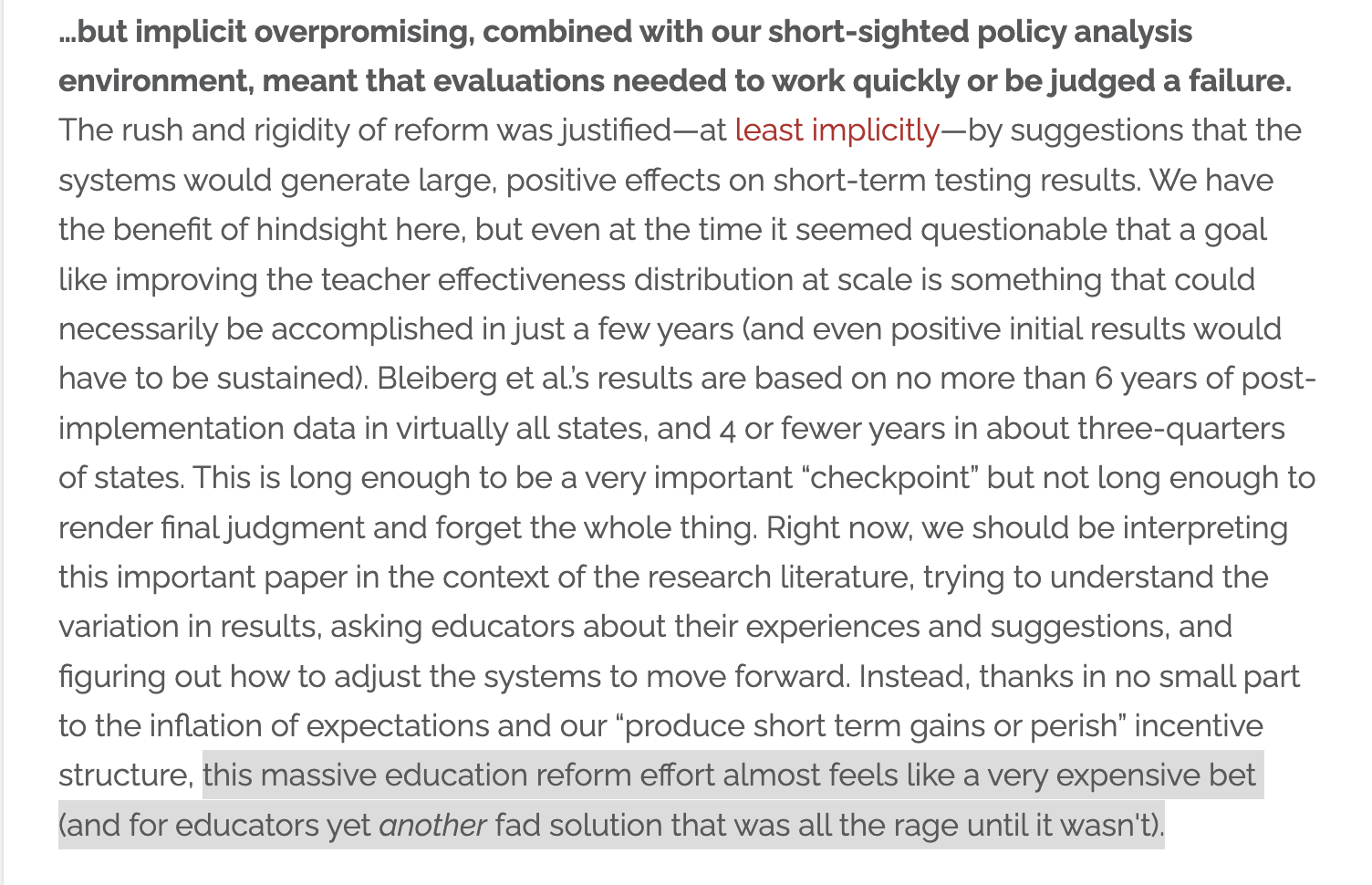
[1] TAKING TEACHER EVALUATION TO SCALE: THE EFFECT OF STATE REFORMS ON ACHIEVEMENT AND ATTAINMENT
Joshua Bleiberg Eric Brunner Erica Harbatkin Matthew A. Kraft Matthew G. Springer Working Paper 30995 http://www.nber.org/papers/w30995
ABSTRACT
Federal incentives and requirements under the Obama administration spurred states to adopt major reforms to their teacher evaluation systems. We examine the effects of these reforms on student achievement and attainment at a national scale by exploiting the staggered timing of implementation across states. We find precisely estimated null effects, on average, that rule out impacts as small as 0.015 standard deviation for achievement and 1 percentage point for high school graduation and college enrollment. We also find little evidence that the effect of teacher evaluation reforms varied by system design rigor, specific design features or student and district characteristics. We highlight five factors that may have undercut the efficacy of teacher evaluation reforms at scale: political opposition, the decentralized structure of U.S. public education, capacity constraints, limited generalizability, and the lack of increased teacher compensation to offset the non-pecuniary costs of lower job satisfaction and security.
[2] I recommend the following research-based analysis of the SOR movement claims:
Hoffman, J.V., Hikida, M., & Sailors, M. (2020). Contesting science that silences: Amplifying equity, agency, and design research in literacy teacher preparation. Reading Research Quarterly, 55(S1), S255–S266. Retrieved July 26, 2022, from https://doi.org/10.1002/rrq.353
Part of the problem in debates about schools and education is the relentless use of “teacher quality” as a proxy for understanding “teaching quality”. This focuses on the person rather than the practice.
This discourse sees teachers blamed for student performance on NAPLAN and PISA tests, rather than taking into account the systems and conditions in which they work.
While teaching quality might be the greatest in school factor affecting student outcomes, it’s hardly the greatest factor overall. As Education Minister Jason Clare said last month:
“I don’t want us to be a country where your chances in life depend on who your parents are or where you live or the colour of your skin.”
We know disadvantage plays a significant role in educational outcomes. University education departments are an easy target for both governments and media.















 dr. p.l. (paul) thomas