In an analysis of how media represents teachers and education, Silvia Edling argues, “Newspapers do not just write about education, they also represent to their readers what education is ‘about.’”
Edling notes that teachers and education are often characterized by stereotypes, focusing on “four inter-related propensities”:
Viewing education as being in more or less permanent crisis
Taking the role as a spokesperson for teachers and on behalf of the field of education
Excluding the knowledge and experiences of teacher(s), educators and/or educational researchers in the public press
Simplifying the notion of being a good teacher through stereotypes and dualistic frameworks that overlook task and relational complexity.
At the core of effective journalism is the importance of compelling stories. However, one truism offers a problem with relying on narratives without ensuring that the broader evidence supports the anecdote: “a lie can travel halfway around the world while the truth is still putting on its shoes.”
For media coverage of education, the softer version may be that an exciting story can attain a status of fact before educational research can confirm or refute the narrative as an outlier or misinformation.
One challenge is, of course, that journalism works much more quickly than scientific research, and this is compounded by the inherent complexity of conducting education research and then applying that evidence to the real world.
For about a decade now, education reform has mostly invested in an expanding “science of” movement that began with the “science of reading” and now includes an international focus on the “science of learning” as well as a parallel “science of math” movement.
As I have detailed, the Mississippi “miracle” and reading crisis narratives generated and perpetuated by the media are missing one key ingredient—scientific evidence for the hyperbolic claims and narratives.
In fact, the current “science of” movements fail all four of Edling’s concerns by presenting a crisis absent research to support the claims; creating non-education reading “experts” among journalists and advocates for commercial programs; cherry-picking teacher voices while also misrepresenting teacher expertise through stereotypes and caricatures; and framing both the crisis and solutions in simplistic either/or rhetoric along ideological lines (progressive v. traditional framed as vibe-based v. scientific).
While the most recent wave, for example, of reading reform reaches back to 2012, the tipping point was Mississippi’s 2019 grade 4 reading scores. Since Mississippi has a long history of unfairly being cast as “last in the nation in education,” that these grade 4 scores suddenly rocketed into the top 25% of state scores certainly qualifies as a compelling story.
It also doesn’t hurt that the appearance that Mississippi had proven that “poverty is an excuse” adds fuel to the hyperbole fire.
Quickly, a “science of” narrative erupted, resulting in copy-cat legislation and the same unverified story about a reading crisis and the Mississippi miracle across local, regional, and national media.
The “science of” story has, in fact, traveled around the world several times at this point, but the key element remains missing—the science.
For example, The Reading League and the 95 Percent Group have become powerful advocacy organizations that make narrow and absolute claims about the need for science-only reading instruction linked to the promise that 95% of student will become proficient readers.
Again, ironically, neither of these positions (or the advocacy of the organizations) is grounded in the science.
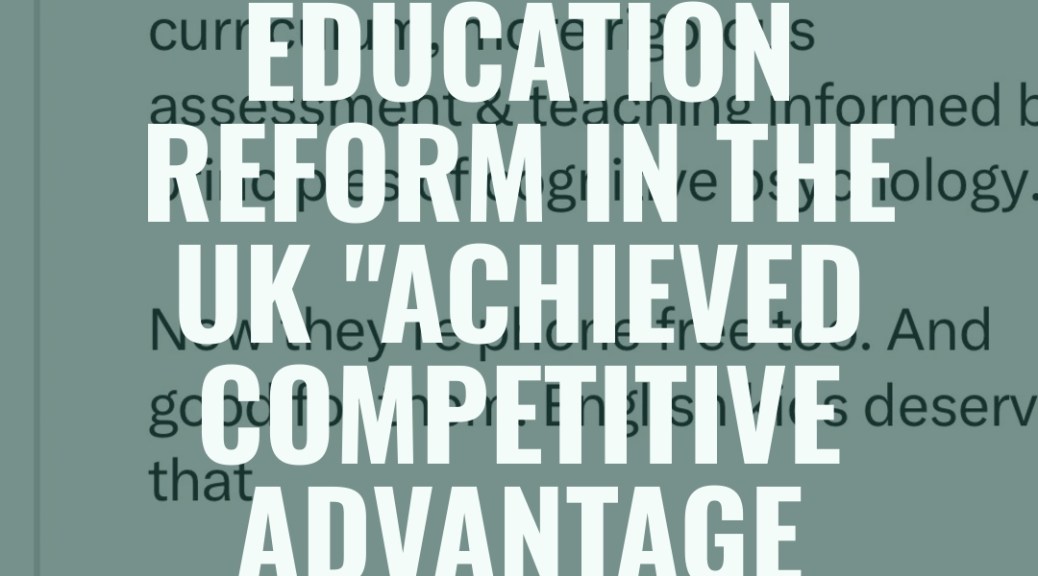
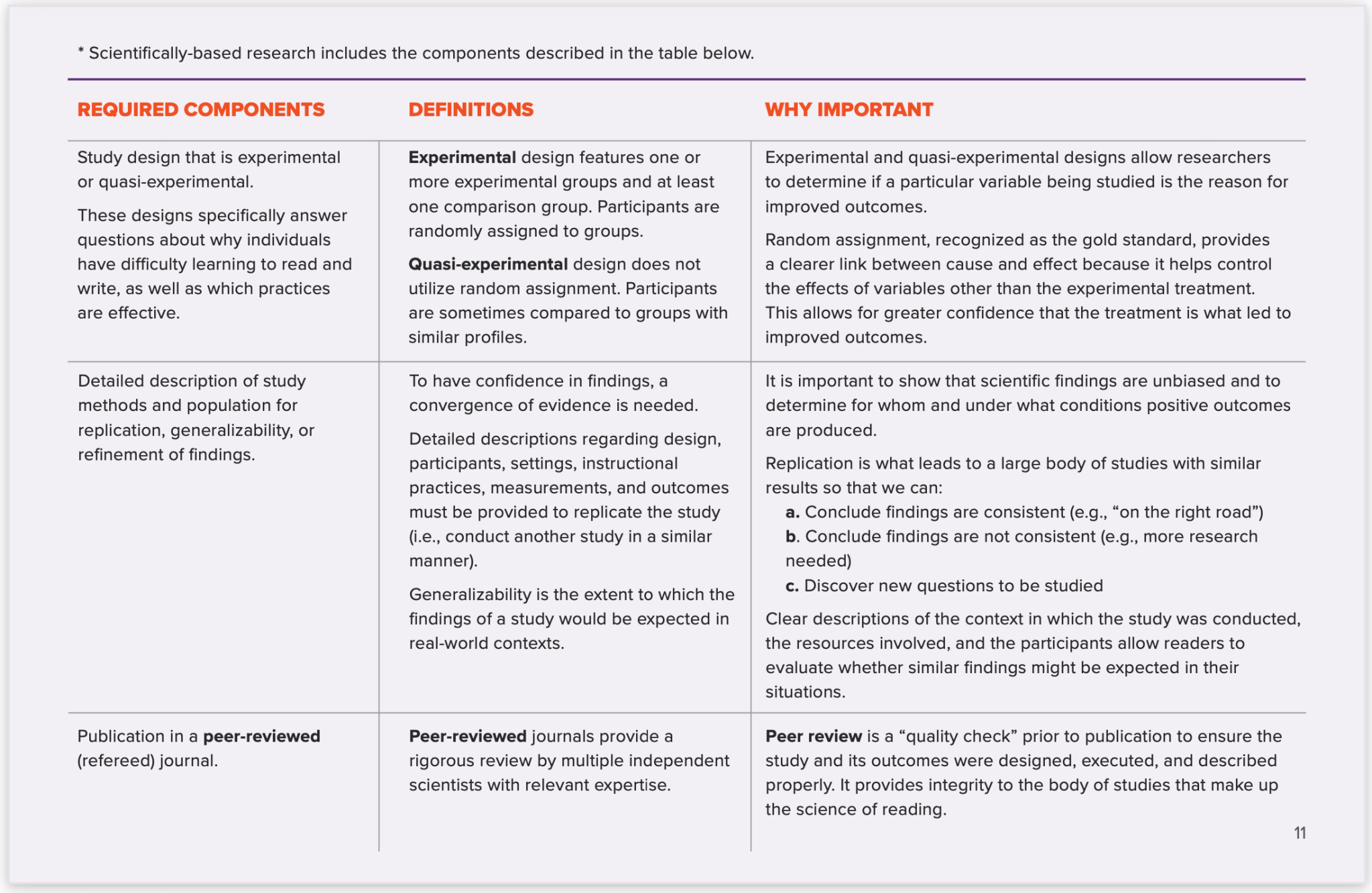
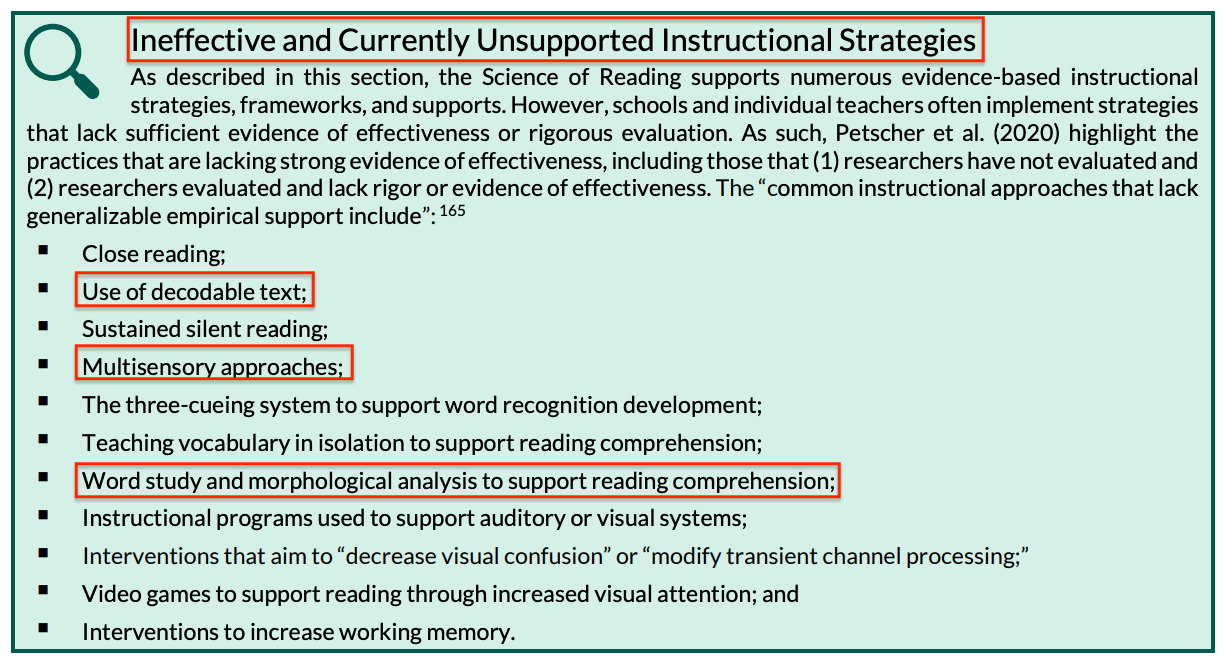
First, The Reading League simultaneously demands only scientific evidence (first image) while advocating for practices and programs (for example, decodable texts and O-G phonics) that literature reviews on the current state of reading science refute (second image):
And, even more problematic, the 95% claim is not a scientific fact, but a very weakly supported and likely aspirational argument with only a few research studies behind the over-sized claim. As I have noted, the only evidence I have found is a a blog post cited by NCTQ, who twisted the stat to 90% and issued a report on teacher education that failed to match claims with the science.
Recently, the science is now catching up with the Mississippi story—although education journalism has remained silent on the current body of research that contradicts the story.
First, if we stick to the science and not the story, poverty is not an excuse when considering reading proficiency; in fact, over 60% of measurable student achievement is causally linked to “social capital family income variables that influence the development of background knowledge. Background knowledge is a known predictor of standardized test results. Family income variables are immutable by schools. Only public policies, outside the control of school personnel, can influence family income.”
In fact, these researchers reject continuing to base education reform on testing data such as NAEP:
Policy makers and education leaders should rethink the current reliance on standardized test results as the deciding factor to make decisions about student achievement, teacher quality, school effectiveness, and school leader quality. In effect, policies that use standardized test results to evaluate, reward, and sanction students and school personnel are doing nothing more than rewarding schools that serve advantaged students and punishing schools that serve disadvantaged students.
In the broader study, Westall and Cummings found that only states with grade retention in their reading reform achieved increased reading proficiency scores, and those increases faded from elementary to middle school (paralleling the drop from top 25% to bottom 25% of states in NAEP from grade 4 to grade 8 by Mississippi and Florida).
They, however, drew no conclusions about why retention appears to result in higher scores.
Now, however, Howard Wainer, Irina Grabovsky and Daniel H. Robinson offer a conclusive connection between retention and reading scores:
But it was the second component of the Mississippi Miracle, a new retention policy, perhaps inspired by New Orleans’ Katrina disaster a decade earlier, that is likely to be the key to their success….
Prior to 2013, a higher percentage of third-graders moved on to the fourth grade and took the NAEP fourth-grade reading test. After 2013, only those students who did well enough in reading moved on to the fourth grade and took the test.
It is a fact of arithmetic that the mean score of any data set always increases if you delete some of the lowest scores (what is technically called “left truncation of the score distribution”)….
It is disappointing, but not surprising, that the lion’s share of the effects of the “Mississippi miracle” are yet another case of gaming the system. There is no miracle to behold. There is nothing special in Mississippi’s literacy reform model that should be replicated globally. It just emphasises the obvious advice that, if you want your students to get high scores, don’t allow those students who are likely to get low scores to take the test. This message is not a secret….
The science now suggests that reading proficiency score gains do not equate with improved reading proficiency due to classroom teaching learning reform. Mississippi reform is a statistical veneer for a harmful policy.
[T]hird-grade retention significantly reduces annual earnings at age 26 by $3,477 (19%). While temporarily improving test scores, retention increases absenteeism, violent behavior, and juvenile crime, and reduces the likelihood of high school graduation. Moreover, retained students exhibit higher community college enrollment but lower public university attendance, though neither estimate is statistically significant.
We are left with a significant problem and a question that must be answered: Since, as Edling shows, media controls what most people know and believe about education, teachers, and students, why are journalists committed to a story not grounded in evidence while also ignoring the science that seems essential for creating an authentic “science of” education reform movement?
My entire career in education, begun in the fall of 1984, has been during the accountability era of education that is primarily characterized by one reality—perpetual reform.
The template has been mind-numbingly predictable, a non-stop cycle of crisis>reform>crisis>reform, etc.
Another constant of that cycle is that the crisis-of-the-moment has almost always been overblown or nonexistent, leading to reforms that fall short of the promised outcomes. Reforms, ironically, just lead to another crisis.
But one of the most powerful and damning elements in the crisis/reform cycle has been the education miracle. [1]
Two problems exist with basing education reform on education miracles. First, and overwhelmingly, education miracles are almost always debunked as misinformation, misunderstanding of data, or outright fraud. Research has shown that statistically education miracles are so incredibly rare that they essentially do not exist.
Second, even when an education miracle is valid, it is by definition an outlier, and thus, the policies and practices of how the miracle occurred are likely not scalable and certainly should not be used as a template for universal reform.
Those core problems with education miracles have prompted the attention of Howard Wainer, Irina Grabovsky and Daniel H. Robinson, who have analyzed the reading reform miracle claims linked to Mississippi:
In 1748, famed Scot David Hume defined nature. He elaborated such a law as “a regularity of past experience projected by the mind to future cases”. He argued that the evidence for a miracle is rarely sufficient to suspend rational belief because a closer look has always revealed that what was reported as a miracle was more likely false, resulting from misperception, mistransmission, or deception….
A careful examination confirms that enthusiasm to emulate Mississippi should be tempered with scepticism….
In short, the authors followed a key point of logic: If something seems too good to be true, then it is likely not true.
In their analysis, On education miracles in general (and those in Mississippi in particular), they focused on two of the key problems with the story about Mississippi’s outlier grade 4 reading scores (in the top quartile of state scores) on NAEP: What is the cause of the score increases? And, why are Mississippi’s grade 8 reading scores remaining in the bottom quartile of state scores?
They found, notably, that Mississippi’s instructional reform, teacher retraining, additional funding, and reading program changes were not the cause of the score increases, concluding:
But it was the second component of the Mississippi Miracle, a new retention policy, perhaps inspired by New Orleans’ Katrina disaster a decade earlier, that is likely to be the key to their success….
Prior to 2013, a higher percentage of third-graders moved on to the fourth grade and took the NAEP fourth-grade reading test. After 2013, only those students who did well enough in reading moved on to the fourth grade and took the test.
It is a fact of arithmetic that the mean score of any data set always increases if you delete some of the lowest scores (what is technically called “left truncation of the score distribution”)….
In short, Mississippi has inflated grade 4 NAEP scores, but that is unlikely evidence that student reading proficiency has improved. This is not a story about reading reform, but about “gaming the system”:
It is disappointing, but not surprising, that the lion’s share of the effects of the “Mississippi miracle” are yet another case of gaming the system. There is no miracle to behold. There is nothing special in Mississippi’s literacy reform model that should be replicated globally. It just emphasises the obvious advice that, if you want your students to get high scores, don’t allow those students who are likely to get low scores to take the test. This message is not a secret….
Wainer, Grabovsky and Robinson’s analysis also needs to be put in context of two other studies.
First, their analysis puts a finer point on the findings by Westall and Cummings, whose comprehensive review of contemporary reading reform found the following: Third grade retention (required by 22 states) is the determining factor for increased test scores (states such as Florida and Mississippi, who both have scores plummet in grade 8), but those score increases are short-term.
Next is a recent study on grade retention. Jiee Zhong concluded:
[T]hird-grade retention significantly reduces annual earnings at age 26 by $3,477 (19%). While temporarily improving test scores, retention increases absenteeism, violent behavior, and juvenile crime, and reduces the likelihood of high school graduation. Moreover, retained students exhibit higher community college enrollment but lower public university attendance, though neither estimate is statistically significant.
Grade retention masquerading as reading reform, then, is fool’s gold for inflating test scores, but it is also harming the very students the reform purports to be helping.
The evidence now suggests that reading reform should not be guided by miracle claims; that no states should be looking to a miracle state for reading reform templates; that the so-called “science of reading” movement is mostly smoke and mirrors, and should be recognized as the “science of retention”; and that grade retention policies are distorting test scores at the expense of our most vulnerable students in life changing ways.
In 1961, scholar Jacques Barzun declared “we who run businesses, carry on professions, work for the government, or engage in teaching itself are forced to admit that illiteracy is still with us” (xii-xiii).
In 1961, Jacques Barzun in Tomorrow’s Illiterates declared “illiteracy is still with us.” Charles Child Walcutt added: “[N]o further ‘research’ into methods of reading instruction is necessary.” This session examines reading crisis/reform cycles to reconsider the stories told about reading and offer a new approach for reform that serves the needs of students and supports teacher professionalism.
I am currently reading two engaging and often challenging novels—Roberto Bolano’s huge 2666 and Ahmed Saadawi’s Frankenstein in Bagdad.
As an avid reader, writer, and teacher of literacy for over 42 years, I am deeply moved by stories, and both of these novels are engaging because they weave stories together while also forcing the reader to critically engage with the act of story telling itself (especially in Saadawi’s monstrous recreation of the Frankenstein myth).
As a writing teacher I seek to foster in my students not only an awareness of the power of story—the importance of vivid details and the narrative mode—but also the ethical implications of the stories we choose to tell as well as the stories we choose to ignore.
In public discourse, however, we are at the mercy of how traditional and social media portray complex and important topics.
Media creators who are successful are vividly aware of the power of story, and my fields of education and literacy, regretfully, suffer the brunt of compelling but misleading stories across all types of media. For media creators, compelling stories often trump accurate and credible stories.
Ironically, at the foundation of the current reading crisis labeled the “science of reading” (SOR) is a podcast, Sold a Story, that research is gradually exposing for being the mechanism for selling a story that is not credible and is in turn causing more harm than good (except for those profiting off the story).
Here are three relatively recent open-access publications that highlight SOR failing equity, teacher autonomy, and social media discourse:
JaNiece Elzy-Palmer, Alexandra Babino, Tee Hubbard
Abstract
The Science of Reading (SoR) movement is positioned as a pathway to equity in literacy development, yet little is known about how equity is defined and enacted within SoR scholarship. This systematic review examined 36 peer-reviewed studies published between 2014 and 2024 that addressed both SoR and equity. Using a framework of nine equity dimensions, we analyzed how equity was conceptualized and operationalized across this body of research. Findings reveal that only 17% of screened articles (36/211) engaged with equity dimensions in substantive ways. Analysis showed that equity was primarily conceptualized through access (n = 69) and opportunity (n = 83), with most studies giving limited attention to race, power structures, and the systems that uphold inequities. SoR research primarily focused on three student groups: emergent bilinguals, “struggling” readers without disabilities, and students from low socioeconomic backgrounds, while largely employing race-evasive language such as “diverse” or “struggling students.” By contrast, actual uptakes of equity, though limited, were most often found in international contexts where inclusion and representation were embedded through culturally and linguistically responsive adaptations. These findings highlight a persistent disconnect between SoR’s equity claims and its research base, underscoring the need to integrate transformative justice approaches so that equity efforts move beyond access and opportunity toward systemic change in literacy development.
Allison Ward Parsons, Kristin Conradi Smith, Margaret Vaughn, Holly Klee, Leslie La Croix, Jane Core Yatzeck
Abstract
Reading in elementary school is central to supporting student reading development. However, a gap exists in current research regarding the types of texts that teachers select for reading instruction and the instructional contexts in which that reading occurs. Teachers’ autonomy to select texts and activities for reading instruction is complex and not well understood. In this exploratory study, we surveyed a stratified sample of elementary teachers (n = 1250) in the United States to understand their perceptions of autonomy surrounding text use. Chi-squared analysis results raise questions of autonomy, access, and equity, particularly regarding digital text usage in younger grades and schools with fewer economic resources. Discussion highlights the differences in teacher autonomy regarding text use across school demographics and instructional contexts. Implications for practice and future research are discussed.
Lindsey W. Rowe, Sarah Jerasa, Heather Dunham, C. C. Bates, Tobi Pirolla, Meghan J. Malloy
Abstract
The Science of Reading (SOR) has become a public discourse with educational stakeholders, impacting legislative policy, reading content, curricula, and pedagogy across schools. Public engagement in this movement has transpired on social media, including TikTok, where viral content often promotes narrow or binary viewpoints through an authoritative discourse. Using a digital ethnography and walkthrough method, we collected and examined 156 TikTok videos on #ScienceofReading to address the following research questions: (1) What categories of SOR content are present on TikTok? (2) What are the common narrative trends and bodies of knowledge used to promote the SOR conversation on TikTok? Analyses found that SOR-related TikToks fell into four categories: (1) professional content knowledge, (2) direct demonstration, (3) resources and materials, and (4) identity formation. Furthermore, close analysis of all videos related to professional content knowledge gave insight into the narrative trends used by content creators to convey claims (plain speak, stop/start, brain research, rhetorical question, I used to… now I…), as well as the bodies of knowledge content creators drew on to make these claims (research, SOR, theory or scholar, deep personal experience, no source). Finally, implications are discussed for how this public discourse can shape policies that will ultimately impact schools, classrooms, and literacy instruction.
Thomas, P.L. (2025, July 28). There is no literacy crisis in the U.S. Here’s what’s really happening. The Washington Post. https://wapo.st/474j758
Thomas, P.L. (2025). Navigating (another) reading crisis as an administrator: Rethinking the “science of reading” movement. Journal of School Administration, Research and Development, 10(1), 38-48. https://ojed.org/JSARD/article/view/6706
Compton-Lilly, C., Spence, L.K., Thomas, P.L. & Decker, S.L. (2023). Stories grounded in decades of research: What we truly know about the teaching of reading. Reading Teacher, 77(3), 392-400. https://doi.org/10.1002/trtr.2258
This “Southern surge” narrative tends to center Mississippi but also includes Florida, Alabama, and Louisiana (the most recent “miracle” state based on an incomplete or misleading use of NAEP scores).
Like many media manufactured narratives, the “Southern surge” in reading falls apart when the data are carefully examined.
While I give the Chalkbeat article some credit for admitting that the so-called “surge” is not fully understood, Barnum—as Hanford did when christening Mississippi a “miracle” in 2019 (“What’s up in Mississippi? There’s no way to know for sure what causes increases in test scores”)—gives the “surge” narrative nearly complete credibility even with the headline hedge and a couple points made then glossed over (“Eighth grade results have been less impressive for these Southern exemplars, though”).
Here are the (likely fatal) flaws in the “surge” narrative:
Although Barnum cites an important and comprehensive analysis of reading reform, he fails to acknowledge its most important findings: States adopting reading reform (often popularly associated with Mississippi’s model even when states explicitly do not mimic those reform policies, such as California) has seen short-term test score gains in reading (note that score gains are not necessarily higher reading proficiency); however, while Barnum lists several reading policy components (“third grade retention, phonics-based curriculum, and statewide teacher training”), this study directly states that only retention is associated with higher scores (with the researchers noting their study did not identify why).
Barnum notes the drop by Southern states’ grade 8 reading scores, but fails to acknowledge that this data point may suggest that retention is inflating scores, not increasing reading proficiency. Notably states such as Florida and Mississippi have had these reform for over one to two decades without the “surge” appearing in grade 8 data.
The retention component also is troubling since these states continue to retain students as high rates. If the other policies were working, we should expect retention numbers to decrease significantly, but they have not.
Possibly the most damning ignored data from NAEP, however: Across all states, but including the so-called “surge” states, the race and poverty gaps remain persistent, typically the same as in 1998.
There are statistical realities also being ignored in the “surge” narrative.
Test scores for the lowest performing students are easier to improve that top-scoring students, for example.
But likely more significant is that early literacy test scores are strongly correlated with student biological age (England has almost twenty years of data on phonics checks that show this); therefore, when grade retention removes the lowest scoring students from the testing population (grade 3 retention laws impact grade 4 NAEP testing) and reintroduces them when they are biologically older, the possibility is that scores are being artificially inflated.
Reading “crisis/miracle” narratives and the phonics gambit should be dead horses; these unfounded claims have existed in the US well back into the 1940s, recurring decade after decade.
At best, “we don’t fully understand it yet,” and at worst, too many people profit off this zombie narrative, and children, teachers, and schools will continue to be sacrificed instead of putting these stories in the ground where they belong.
The “reading wars” that raged in American schools for decades finally seem to be ending. The victor is clear: Phonics is the best way to teach kids how to read.
California is the latest state to re-embrace the tried-and-true teaching method, in which kids learn the sounds that each letter makes and then use them as building blocks for words and sentences. Gov. Gavin Newsom (D) on Thursday signed reforms into law that will encourage schools to turn away from other unsupported teaching methods, despite resistance from teacher unions….
Momentum for re-embracing phonics started in Mississippi, which long had a reputation for sitting at the bottom of national education rankings. In 2013, state officials decided to enforce adoption of the old-school instruction method that is often referred to as the “science of reading.” The state explicitly discouraged methods such as cueing and started aggressively holding back third-graders who didn’t meet reading standards, angering many parents.
There are a few problems, however.
First, and most damning, California did not just pass Science of Reading legislation modeled on Mississippi, as detailed by Martha Hernandez:
The bill has been described in the media as California’s new “science of reading” bill, but this shorthand fails to accurately reflect the legislation’s comprehensive scope and intention.
Let’s be clear, AB 1454 is not about narrowing literacy instruction to one approach. Rather, it’s about realizing California’s long-standing, comprehensive vision for literacy that meets the needs of all students — including our state’s 1.1 million English learners.
Phonics and foundational skills are essential for teaching students to read, and they always have been. But effective literacy instruction is not just about sounding out words. Children also need strong oral language, vocabulary, background knowledge, writing and comprehension skills to thrive as readers.
AB 1454 accounts for this reality. At its core, it aligns with California’s English Language Arts/English Language Development (ELA/ELD) Framework, adopted in 2014. This framework is nationally recognized for weaving together multiple strands of research — including phonics and decoding — alongside research on how children learn a second language, how their home language knowledge supports English learning, and how their cultures and life experiences shape how they use and understand language.
For a comprehensive overview of how California’s new reading legislation does not conform to the Mississippi model, please see this excellent overview by Jill Kerper Mora, Edgar Lampkin, Barbara Flores, and Anita Flemington: Pushing back against Science of Reading mandates: The California story.
Next, the Editorial Board perpetuates the whole language Urban Legend about failure in California, a state that saw literacy test scores drop after a decrease in funding and an influx of multilingual learners in the late 1980s into the 1990s (in fact, Linda Darling Hammond found a positive correlation between whole language and higher NAEP scores in the 1990s).
And finally, but not surprisingly, the Editorial Board falls for the Mississippi “miracle” narrative.
There currently is no research showing SOR instruction has succeeded in MS; in fact, research shows only grade retention is associated with some short-term test score increases. MS grade 8 scores remain in the bottom 25% of score in the US, the state continues to retain about 9000 K-3 students each year, and the race/poverty gap is the same as 1998.











 dr. p.l. (paul) thomas