In an analysis of how media represents teachers and education, Silvia Edling argues, “Newspapers do not just write about education, they also represent to their readers what education is ‘about.’”
Edling notes that teachers and education are often characterized by stereotypes, focusing on “four inter-related propensities”:
Viewing education as being in more or less permanent crisis
Taking the role as a spokesperson for teachers and on behalf of the field of education
Excluding the knowledge and experiences of teacher(s), educators and/or educational researchers in the public press
Simplifying the notion of being a good teacher through stereotypes and dualistic frameworks that overlook task and relational complexity.
At the core of effective journalism is the importance of compelling stories. However, one truism offers a problem with relying on narratives without ensuring that the broader evidence supports the anecdote: “a lie can travel halfway around the world while the truth is still putting on its shoes.”
For media coverage of education, the softer version may be that an exciting story can attain a status of fact before educational research can confirm or refute the narrative as an outlier or misinformation.
One challenge is, of course, that journalism works much more quickly than scientific research, and this is compounded by the inherent complexity of conducting education research and then applying that evidence to the real world.
For about a decade now, education reform has mostly invested in an expanding “science of” movement that began with the “science of reading” and now includes an international focus on the “science of learning” as well as a parallel “science of math” movement.
As I have detailed, the Mississippi “miracle” and reading crisis narratives generated and perpetuated by the media are missing one key ingredient—scientific evidence for the hyperbolic claims and narratives.
In fact, the current “science of” movements fail all four of Edling’s concerns by presenting a crisis absent research to support the claims; creating non-education reading “experts” among journalists and advocates for commercial programs; cherry-picking teacher voices while also misrepresenting teacher expertise through stereotypes and caricatures; and framing both the crisis and solutions in simplistic either/or rhetoric along ideological lines (progressive v. traditional framed as vibe-based v. scientific).
While the most recent wave, for example, of reading reform reaches back to 2012, the tipping point was Mississippi’s 2019 grade 4 reading scores. Since Mississippi has a long history of unfairly being cast as “last in the nation in education,” that these grade 4 scores suddenly rocketed into the top 25% of state scores certainly qualifies as a compelling story.
It also doesn’t hurt that the appearance that Mississippi had proven that “poverty is an excuse” adds fuel to the hyperbole fire.
Quickly, a “science of” narrative erupted, resulting in copy-cat legislation and the same unverified story about a reading crisis and the Mississippi miracle across local, regional, and national media.
The “science of” story has, in fact, traveled around the world several times at this point, but the key element remains missing—the science.
For example, The Reading League and the 95 Percent Group have become powerful advocacy organizations that make narrow and absolute claims about the need for science-only reading instruction linked to the promise that 95% of student will become proficient readers.
Again, ironically, neither of these positions (or the advocacy of the organizations) is grounded in the science.
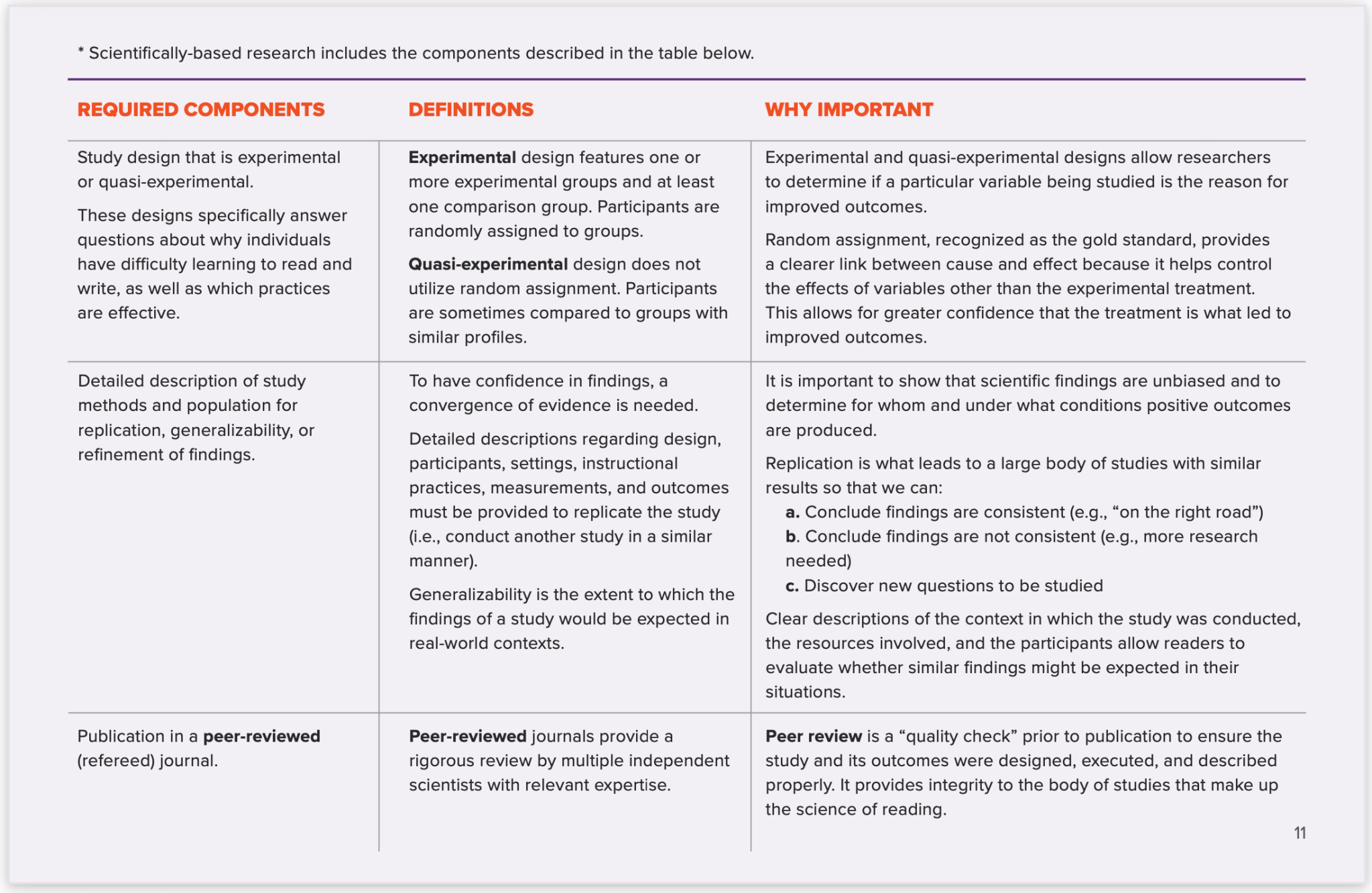
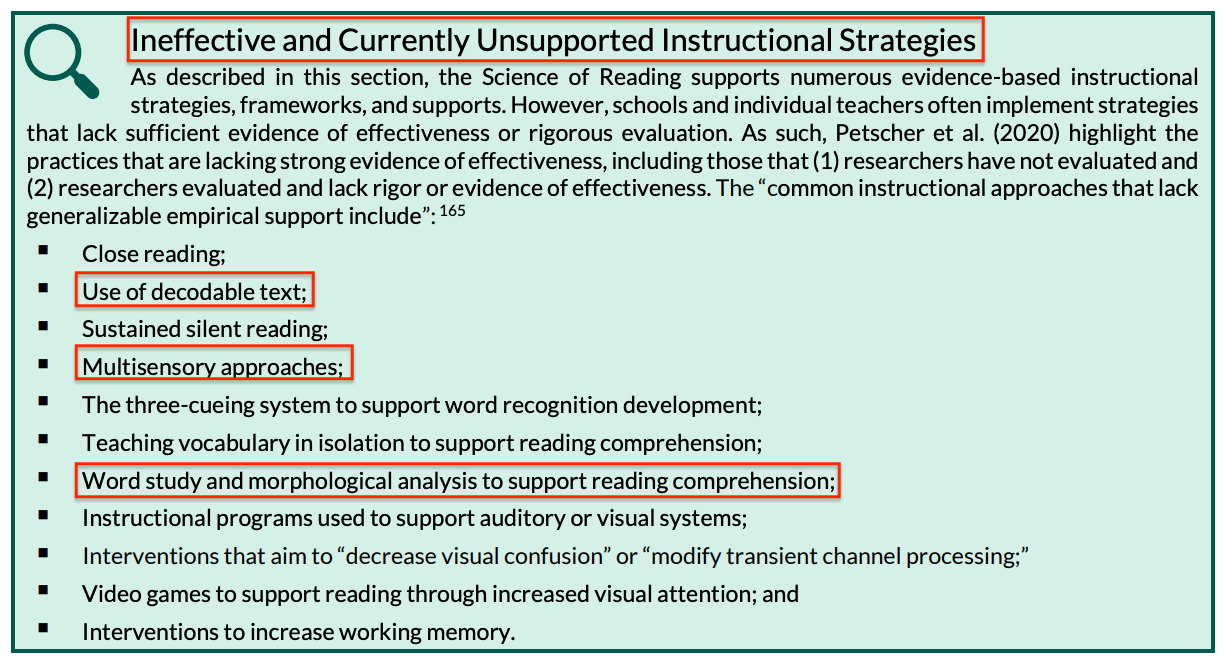
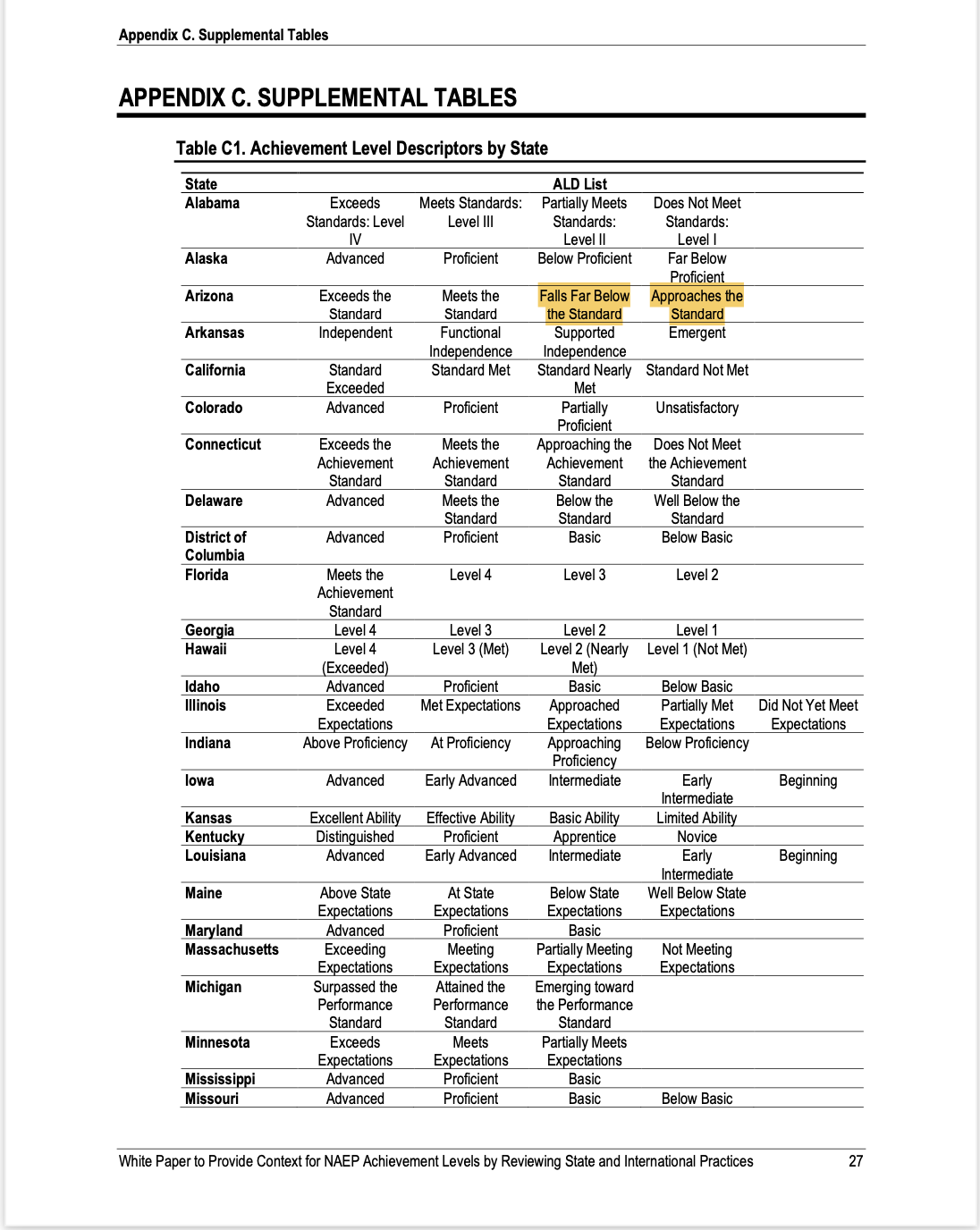
First, The Reading League simultaneously demands only scientific evidence (first image) while advocating for practices and programs (for example, decodable texts and O-G phonics) that literature reviews on the current state of reading science refute (second image):
And, even more problematic, the 95% claim is not a scientific fact, but a very weakly supported and likely aspirational argument with only a few research studies behind the over-sized claim. As I have noted, the only evidence I have found is a a blog post cited by NCTQ, who twisted the stat to 90% and issued a report on teacher education that failed to match claims with the science.
Recently, the science is now catching up with the Mississippi story—although education journalism has remained silent on the current body of research that contradicts the story.
First, if we stick to the science and not the story, poverty is not an excuse when considering reading proficiency; in fact, over 60% of measurable student achievement is causally linked to “social capital family income variables that influence the development of background knowledge. Background knowledge is a known predictor of standardized test results. Family income variables are immutable by schools. Only public policies, outside the control of school personnel, can influence family income.”
In fact, these researchers reject continuing to base education reform on testing data such as NAEP:
Policy makers and education leaders should rethink the current reliance on standardized test results as the deciding factor to make decisions about student achievement, teacher quality, school effectiveness, and school leader quality. In effect, policies that use standardized test results to evaluate, reward, and sanction students and school personnel are doing nothing more than rewarding schools that serve advantaged students and punishing schools that serve disadvantaged students.
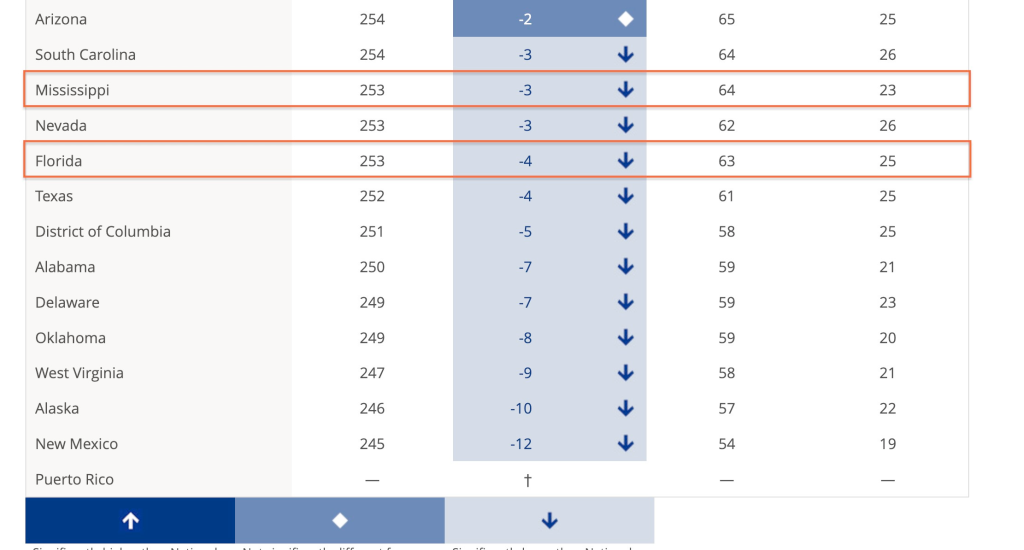
In the broader study, Westall and Cummings found that only states with grade retention in their reading reform achieved increased reading proficiency scores, and those increases faded from elementary to middle school (paralleling the drop from top 25% to bottom 25% of states in NAEP from grade 4 to grade 8 by Mississippi and Florida).
They, however, drew no conclusions about why retention appears to result in higher scores.
Now, however, Howard Wainer, Irina Grabovsky and Daniel H. Robinson offer a conclusive connection between retention and reading scores:
But it was the second component of the Mississippi Miracle, a new retention policy, perhaps inspired by New Orleans’ Katrina disaster a decade earlier, that is likely to be the key to their success….
Prior to 2013, a higher percentage of third-graders moved on to the fourth grade and took the NAEP fourth-grade reading test. After 2013, only those students who did well enough in reading moved on to the fourth grade and took the test.
It is a fact of arithmetic that the mean score of any data set always increases if you delete some of the lowest scores (what is technically called “left truncation of the score distribution”)….
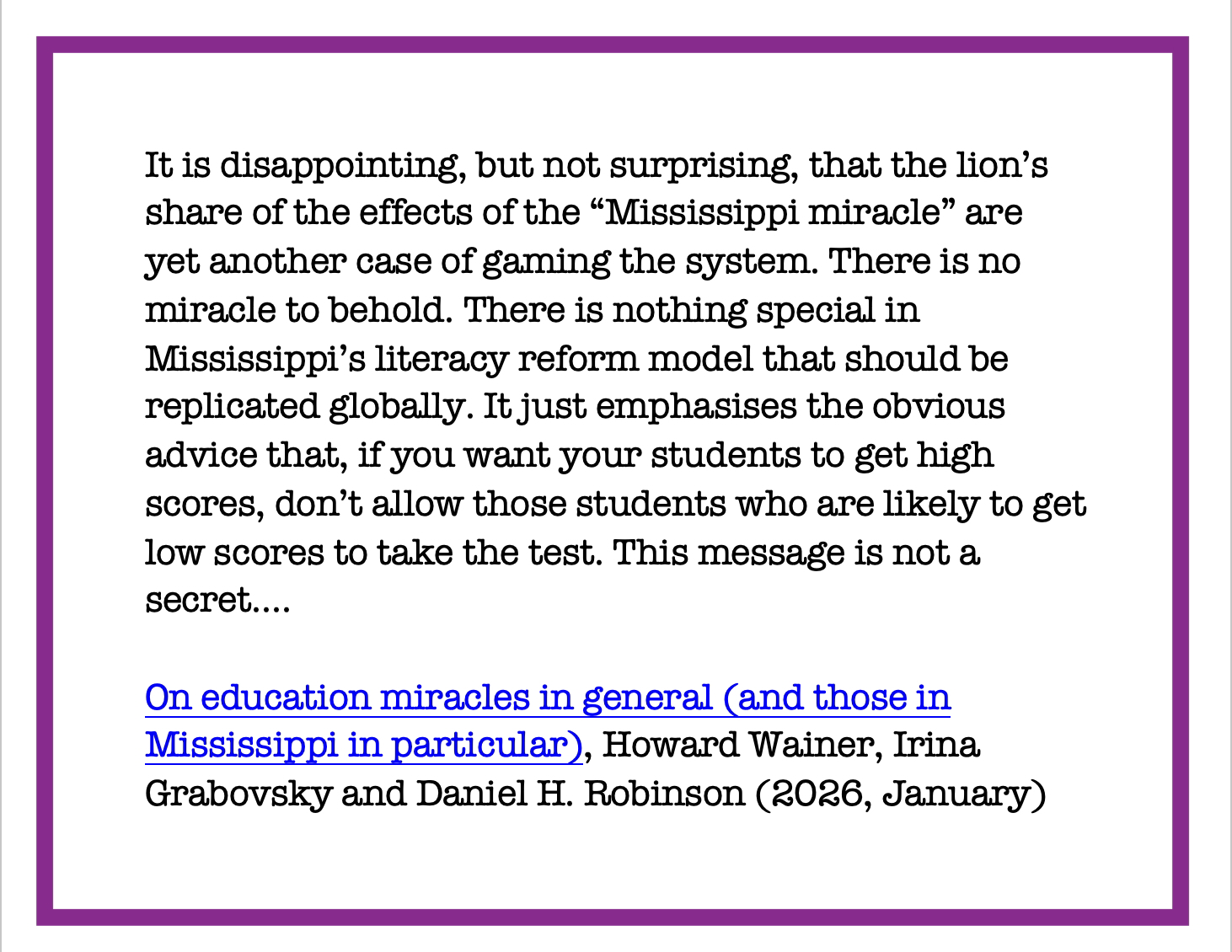
It is disappointing, but not surprising, that the lion’s share of the effects of the “Mississippi miracle” are yet another case of gaming the system. There is no miracle to behold. There is nothing special in Mississippi’s literacy reform model that should be replicated globally. It just emphasises the obvious advice that, if you want your students to get high scores, don’t allow those students who are likely to get low scores to take the test. This message is not a secret….
The science now suggests that reading proficiency score gains do not equate with improved reading proficiency due to classroom teaching learning reform. Mississippi reform is a statistical veneer for a harmful policy.
[T]hird-grade retention significantly reduces annual earnings at age 26 by $3,477 (19%). While temporarily improving test scores, retention increases absenteeism, violent behavior, and juvenile crime, and reduces the likelihood of high school graduation. Moreover, retained students exhibit higher community college enrollment but lower public university attendance, though neither estimate is statistically significant.
We are left with a significant problem and a question that must be answered: Since, as Edling shows, media controls what most people know and believe about education, teachers, and students, why are journalists committed to a story not grounded in evidence while also ignoring the science that seems essential for creating an authentic “science of” education reform movement?
For example, third-grade retention states such as Mississippi and Florida had exceptional NAEP reading scores among fourth-graders but scores fell back into the bottom 25 percent of all states among eighth-graders
Here are the highlights, although I recommend reading the entire piece:
In 1748, famed Scot David Hume defined nature. He elaborated such a law as “a regularity of past experience projected by the mind to future cases”. He argued that the evidence for a miracle is rarely sufficient to suspend rational belief because a closer look has always revealed that what was reported as a miracle was more likely false, resulting from misperception, mistransmission, or deception….
A careful examination confirms that enthusiasm to emulate Mississippi should be tempered with scepticism….
This provides a boost of about $111.63 of extra funding annually for each pupil. Comparing this amount to what are annual contemporary per pupil expenditures nationally, we have to agree that if such small expenditures can make a visible difference in student performance it truly is a miracle – a Mississippi version of St. John’s loaves and fishes.
But it was the second component of the Mississippi Miracle, a new retention policy, perhaps inspired by New Orleans’ Katrina disaster a decade earlier, that is likely to be the key to their success….
Prior to 2013, a higher percentage of third-graders moved on to the fourth grade and took the NAEP fourth-grade reading test. After 2013, only those students who did well enough in reading moved on to the fourth grade and took the test.
It is a fact of arithmetic that the mean score of any data set always increases if you delete some of the lowest scores (what is technically called “left truncation of the score distribution”)….
Strangely though, for the eighth-grade literacy test, the state’s rank dropped to a tie for 42nd place!…
(Note that this works especially well for student height, for after retaining the shortest third-graders for an extra year they will likely be taller when they are measured again a year later. It would be nice if the same were true for students struggling in academic subjects.)…
Were we to do this we would find that most of Mississippi’s gains are due to the retention rate.
It is disappointing, but not surprising, that the lion’s share of the effects of the “Mississippi miracle” are yet another case of gaming the system. There is no miracle to behold. There is nothing special in Mississippi’s literacy reform model that should be replicated globally. It just emphasises the obvious advice that, if you want your students to get high scores, don’t allow those students who are likely to get low scores to take the test. This message is not a secret….
Find a way to prevent the lowest test scorers from taking the exam and the average score will increase….
Second, besides weak empirical data, educational reformers like Patrinos should have given greater weight to the extant literature on the Mississippi Miracle. The miracle had already been convincingly debunked.10 Fourth-grade gains had vanished by the time the students reached eighth grade.
Question 1: Why is Mississippi retaining about 9000-12,000 K-3 students annually since 2014?
One of the key assertions of the “science of reading” (SOR) movement is that students across the US are mostly not proficient readers because teachers rely on balanced literacy to teach reading.
Certainly, a decade is enough time to reach the 95% rate of proficiency, and thus, retention numbers should have dropped dramatically or be near 0.
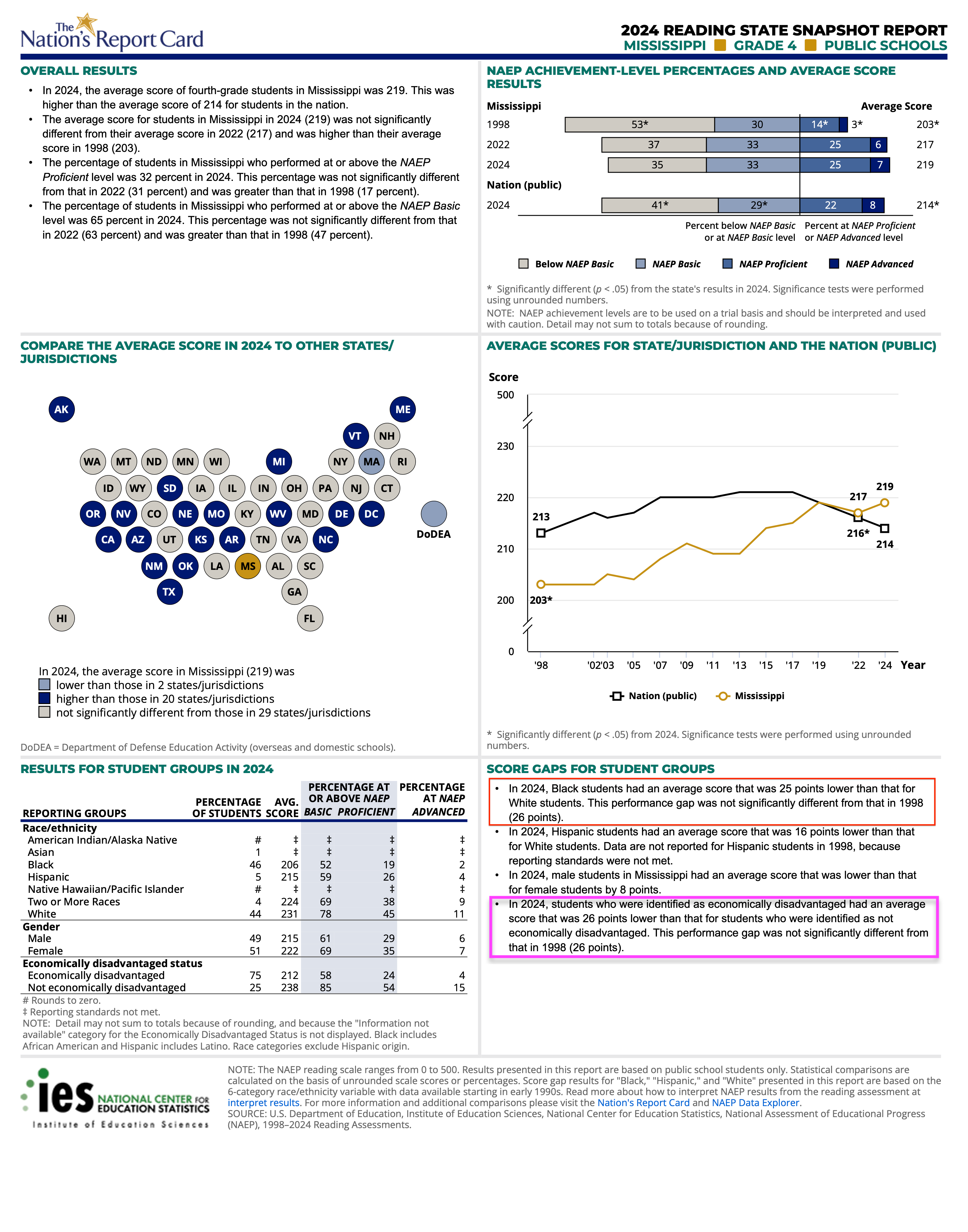
Question 2: How is Mississippi a “miracle” if the achievement gap for race and socioeconomic status is the same as 1998?
As shown in MS’s 2024 NAEP reading scores for grade 4:
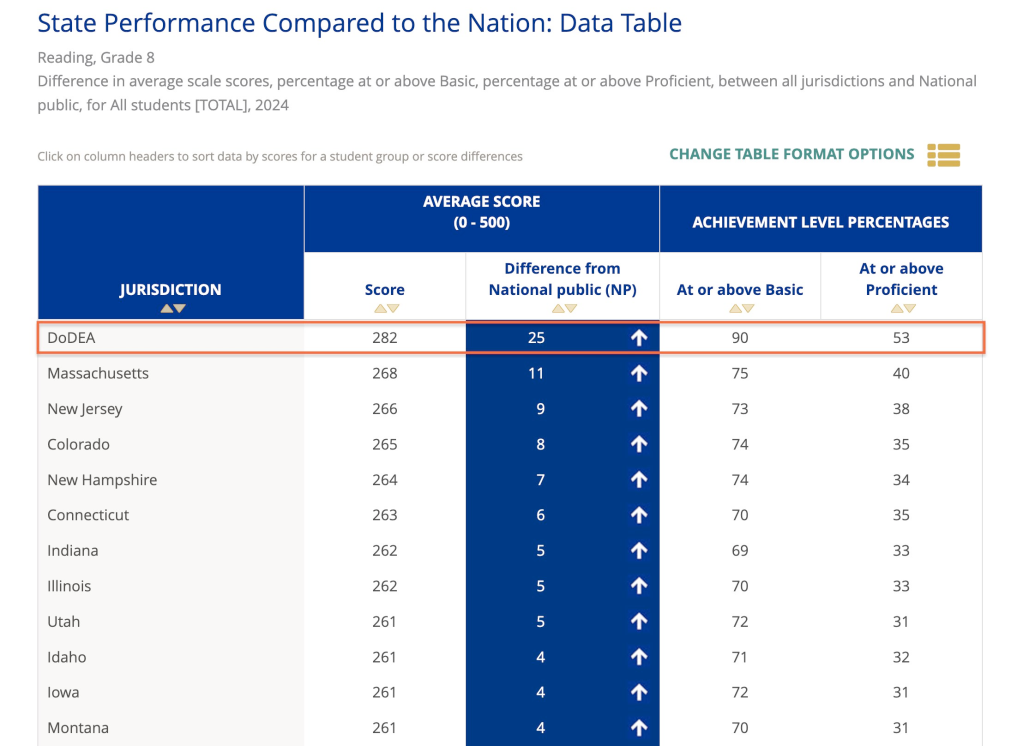
Question 3: Why has Mississippi’s grade 8 NAEP scores remained in the bottom 25% of states despite the grade 4 NAEP scores jumping into the top 25%?
For 2024, MS NAEP grade 8 reading scores drop to eleventh from the bottom of state scores:
An analysis of reading reform found that states with comprehensive reform that includes grade retention have experienced short-term increases in test scores.
However, the analysis does not identify why these comprehensive reforms (including grade retention) are correlated with those short-term scores increases.
Research on education “miracles” have found that virtually none exist, and even when a school or program appears to be “high flying” there is little evidence those can be scaled up meaningfully.
Mississippi’s grade 4 NAEP scores in reading, then, raise questions that must be answered; instead, it is now politically cool to adopt copy-cat legislation from the state without proper evidence that there is valid success or a solid understanding of what is happening and why.
Regretfully, Kids Count shows more about how good intentions are not enough and that our public and political focus on education remains grounded in deficit ideology and misinformation linked to NAEP testing.
And then, note the deficit perspective for ranking states based on NAEP proficiency:
Imagine if this report focused first on NAEP “basic” and above? And then identified students at or above basic?
Kids Count is yet another part of the manufactured crisis in education that serves negative portrayals of students, teachers, and public schools—and ultimately the education reform industry.
Yet, this report and its negative as well as misleading use of data must make us ask: If kids count, why do we persist in ranking and vilifying those children and the people spending their lives serving them in our schools?
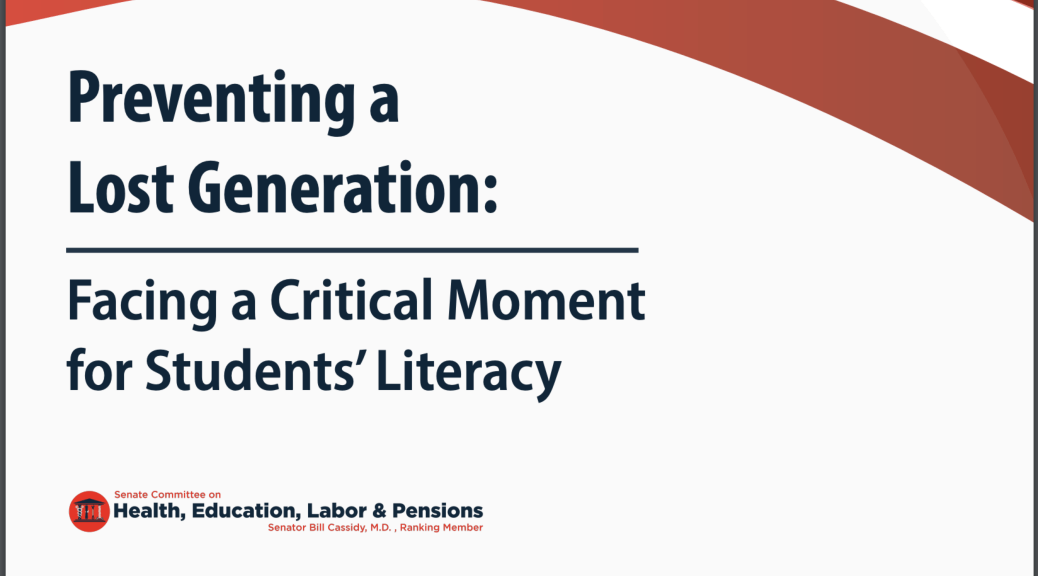
U.S. Senator Bill Cassidy, M.D. (R-LA) has released a report on literacy that opens with yet another example of misrepresenting NAEP reading scores to manufacture a reading crisis for political gain: “Two-thirds of America’s fourth and eighth graders are not proficient in reading.”
The report is an embarrassing recycling of the media misinformation campaign about reading in the US.
In fact, most of the footnotes cite news articles (including the Washington Times, a conservative outlet that lacks credibility) and conservative think tanks (ExcelinEd, Fordham). [1]
Notably missing are citations to scientific research on reading or credible analyses of NAEP data.
Responses are needed and can be sent to Literacy@help.senate.gov by April 5, 2024.
Good intentions are not enough and government policy on education has done more harm than good since A Nation at Risk. We can do better, and we should. But we must start with accurate claims and credible solutions.
A school for students with dyslexia continues to stay open despite two F grades from the BESE, Louisiana’s Board of Elementary and Secondary Education. The Louisiana Key Academy is run by Senator Bill Cassidy (R-LA) and his wife, Laura. Both are physicians. Neither are specialists in reading disorders, although they have a child with dyslexia.
Some Big Lies of Education start with journalists (even at the biggest of media outlets).
“One of the most bearish statistics for the future of the United States is this: Two-thirds of fourth graders in the United States are not proficient in reading,” wrote Nicholas Kristof in The New York Times.
Kristof’s piece in 2023 can be traced back to a similar claim by Emily Hanford in 2018: “More than 60 percent of American fourth-graders are not proficient readers, according to the National Assessment of Educational Progress, and it’s been that way since testing began in the 1990s,” including a surprisingly ineffective graphic:
The student reading proficiency Big Lie grounded in misrepresenting or misunderstanding NAEP is likely one of the most complicated Big Lies of Education.
In media and political rhetoric, first, the terms “reading proficiency” and “grade level reading” are commonly jumbled and used inappropriately as synonyms.
Achievement levels such as “basic” and “proficient,” used in NAEP for reading, are misleading and complicated for most people not familiar with technical terminology.
NAEP “basic” is approximately grade level (although even that claim is problematic since no standard exists in the US for “proficient” or “grade level”), and “proficient” on NAEP is high:
Rosenberg, B. (2004, May). What’s proficient? The No Child Left Behind Act and the many meanings of proficiency. Washington, DC: American Federation of Teachers. https://files.eric.ed.gov/fulltext/ED497886.pdf
NAEP testing and data are normative, measuring what a general population is achieving (not individual students), and as noted above, NAEP “proficient” is aspirational.
Hanford’s and Kristof’s Big Lie, then, is a combination of blurring NAEP achievement levels with grade level reading achievement and manufacturing a reading crisis with that misinformation.
Ironically, NAEP grade 4 reading scores for a decade show that 2/3 of students are reading at or above grade level, the inverse of the false crisis claims of the media:
The Big Lie about reading proficiency and NAEP help perpetuate the Big Lie about educational crisis, but it also masks the more complicated truths: the US has no standard metric for assessing the national reading achievement of students, and focusing on manufactured reading crises distracts reformers from addressing what we can identify—inequitable access to reading proficiency among minoritized and marginalized populations of students.
I recommend the following to understand the essential failure, the Big Lie, of using NAEP to manufacture a crisis around reading proficiency in the US:
Rosenberg, B. (2004, May). What’s proficient? The No Child Left Behind Act and the many meanings of proficiency. Washington, DC: American Federation of Teachers. https://files.eric.ed.gov/fulltext/ED497886.pdf















 dr. p.l. (paul) thomas