After about a decade blogging on other open sites and dabbling in social media as part of my public work, I committed to blogging at WordPress in 2013, and to date, had my highest traffic year in 2014.
Between my Twitter presence and blog, I always expected to have a greater reach at Twitter, but by 2022, I have just short of 8000 followers on Twitter and over 10,000 at this blog.
As part of my current fall sabbatical, I revised and redesigned this blog to make it more appealing and (I hope) to better present the work as professional (blogs continue to be discounted and marginalized despite the vast majority of my posts being heavily cited).
I am on track for 2022 to be the third or second best year:
And here are my top 10 posts of 2022 (eight original to this year):
While the “science of reading” dominated my work, I am quite proud of my comic book posts throughout 2022, notably my series on Black Widow and my frequent posts on my collecting Daredevil.
I also want to highlight two of my scholarly projects:
Primarily, I am a writer and writing is who I am so blogging is a wonderful way to write and draft, a way to think through important issues while also contributing to the public discourse that drives not only what people think but actual policy.
Also, blogs are accessible (essentially free to anyone who have internet access), and I feel far more valuable and effective than traditional scholarship that sits behind paywalls.
I have been an educator for almost 40 years, shouting the entire time that we mostly do this thing called education badly because we are thinking wrong or simply stuck in a rut of doing things only one way (for education, that way is “Crisis!> reform > Crisis! > reform, etc.).
Yet, I think we can do better, and I know we should.
Thank you for reading because that is the thing we writers are mostly seeking—those genuinely and sincerely engaged in the ideas we are drawn to interrogate and explore.
Let us hope for a better, more kind and peaceful 2023.
The word “theory” is a technical term in the sciences that doesn’t mean “guessing.” “Theory” is not “hypothesis,” even as “hypothesis” isn’t really guessing either (maybe it is an educated guess).
Yet, average people tend to use “theory” as just a guess. That tension between laypeople and scientists is central to many problem with attempting to create evidence-based (“scientific”) policy in the context of media, public, and political debate that is mostly among laypeople.
Reading theory is rarely labeled “theory” in those debates among laypeople. Popular labels, such as “whole language,” often lose their theory origin and become teacher practice.
About a decade into teaching high school English, I taught a group of tenth graders with whom I immediately bonded (and was fortunate to teach again as seniors). Many of these students, now well into their 40s, remain friends of mine.
This class was very bright and genuinely eager to learn, but they were also driven to be “pleasers.” I worked hard to help them become more independent thinkers (instead of being incredibly compliant).
The worst way that urge to do the right thing hindered these students is reading. Early in the course, they pleaded with me that they could not read the assigned texts as fast as I wanted. This seemed odd because no class had ever complained about that, and the amount was quite manageable.
We set aside a class period to discuss how they read and such. What I learned was that these students in the early 1990s had been taught (or learned) that reading is done letter-by-letter to create words and word-by-word to create complete thoughts.
And there was their problem with reading speed.
I shared with them an epiphany I had in my MEd program during a course on early literacy. In that class we discusses how proficient and fast readers actually read. The process is much closer to what many would call skimming (“reading” large chunks at a time) and includes skipping as well as continually reading faster until the reader senses a loss of meaning before circling back.
My epiphany was that this described me perfectly as a reader, but I had always thought I was doing something wrong for not sticking to letter-by-letter and then word-by-word.
The discussion freed many of these students from a perception of reading that simply wasn’t accurate.
That explanation of highly proficient readers is also a story about reading as guessing and why reading theory remains a debate and not settled science.
The current “science of reading” movement depends heavily on melodramatic anecdotes to drive a narrative about reading and teaching reading that is overly simplistic and often simply wrong (see Media Coverage of SOR HERE).
One of those anecdotes portrays a teacher prompting a student struggling to read simply to guess at the words instead of using any sort of decoding strategy (what most people would call “sounding it out”).
So a key issue in the current reading debate is “guessing.”
To understand how “guessing” is part of the debate, we have to return to “theory.”
Whole language is a reading theory that is strongly associated with scholar Ken Goodman (see Whole Language HERE). In the 1960s, Goodman published Reading: A Psycholinguistic Guessing Game.
Goodman’s stated purpose in the piece is as follows:
Simply stated, the common sense notion I seek here to refute is this:
“Reading is a precise process. It involves exact, detailed, sequential perception and identification of letters, words, spelling patterns and large language units.”
In phonic centered approaches to reading, the preoccupation is with precise letter identification. In word centered approaches, the focus is on word identifications. Known words are sight words, precisely named in any setting.
And his alternative, where the issue with “guessing” has its roots:
In place of this misconception, I offer this: Reading is a selective process. It involves partial use of available minimal language cues selected from perceptual input on the basis of the reader’s expectation. As this partial information is processed, tentative decisions are made to be confirmed, rejected, or refined as reading progresses.
More simply stated, reading is a psycholinguistic guessing game. It involves an interaction between thought and language. Efficient reading does not result from precise perception and identification of all elements, but from skill in selecting the fewest, most productive cues necessary to produce guesses which are right the first time. The ability to anticipate that which has not been seen, of course, is vital in reading, just as the ability to anticipate what has not yet been heard is vital in listening.
While Goodman noted later that “guessing” may have not been the best choice, whole language proposed a theory of reading that valued meaning over accurately reading every word. And while the pervasiveness of whole language in K-12 education, I think, is greatly overstated, elements of holistic and workshop approaches certainly impacted practice and informed what would later be called “balanced literacy.”
The problem with “guessing” is the same as the problem with “theory”; both have very specific meanings in science and quite different (and often negative) meanings in day-to-day use.
And when theory is translated into practice, it is entirely possible, even likely, that some practitioners misunderstand and misuse “guessing.”
But it is quite a huge leap, as the “science of reading” movement has done, to announce that we have a unique reading crisis now that can be traced to teacher education teaching “guessing” and a couple reading programs that rely exclusively on “guessing.”
That “guessing” is also being identified (and even banned by some states) as “three cueing.”
So there are a few things to note about Goodman’s “guessing.”
First, that essay and idea is well over forty years ago; Goodman himself noted that he would later in his career have written a much different piece.
Next, the line between Goodman’s theorizing and the use of “guessing” or “three cueing” is complicated and extremely long.
Finally, it is much better to have a debate about reading theory and practice if we all agree to use important terms accurately. Here is a great and well cited overview of “multiple cueing”:
In some cases, proponents of structured literacy approaches have denigrated instructional practices that attend to multidimensional aspects of reading. For example, Spear-Swerling (2019) argued against encouraging students to attend to multiple-cueing systems when reading. Arguing that explicit teaching of decoding/phonics skills should dominate reading instruction, she warned against coaching students to use “meaning in conjunction with print cues and having students ‘problem-solve’ with teacher guidance (e.g., Burkins & Croft, 2010)” (p. 205). Spear- Swerling cited two reports (Foorman et al., 2016; National Institute of Child Health and Human Development, 2000) to argue that “research on students’ reading development… has conclusively disproven the multiple-cuing-systems model” (p. 206), although neither of these reports directly addressed or tested that model.
This rally against multiple-cueing systems models has been reiterated by scholars (Paige, 2020) and journalists (Hanford, 2018, 2019, 2020). Although it may be true that as readers become more proficient, they attend less to illustrations, this does not negate the role that illustrations play in helping young students learn to attend to meaning while reading. In short, drawing students’ attention to illustrations is one means of helping them attend to the stories and information presented in texts. Learning to attend to meanings that emerge while reading is essential for understanding both the simple and increasingly complicated texts that students encounter as they become skilled readers. Describing multiple-cueing systems models as having students draw on “partial visual cues to guess at words (Adams, 1998; Rayner & Pollatsek, 1989; Solman & Stanovich, 1992; Stanovich, 1986)” (Paige, 2020, p. 13) misrepresents these models and ignores the important role of illustrations as tools for learning to access and monitor meaning construction.
Compton-Lilly, C.F., Mitra, A., Guay, M., & Spence, L.K. (2020). A confluence of complexity: Intersections among reading theory, neuroscience, and observations of young readers. Reading Research Quarterly, 55(S1), S185-S195. Retrieved July 26, 2022, from https://doi.org/10.1002/rrq.348
In 2022, scholars of literacy have moved beyond Goodman’s initial theories of whole language, but they have also moved on from the “simple” view of reading (yet, SOR continues to blame whole language and balanced literacy while endorsing the “simple” view).
And the current state of reading theory remains a debate, not settled science. And that debate has those who focus on letters, sounds, words, and meaning versus those who envision proficient readers who scan text and create meaning through dozens of strategies, many of which aren’t grounded in letters and words.
This is more of a theory than a guess, but our only hope of not continuing the cycle of reading crisis, reform, reading crisis, reform, etc., we must begin to understand the complexities of reading and teaching reading instead of declaring winners and losers in order to play the blame game.
This is the story of a religiously and politically conservative couple who committed to changing how children are taught in the U.S. (see HERE or HERE):
The Gablers’ views are straight-forward and comprehensive. They believe that the purpose of education is “the imparting of factual knowledge, basic skills and cultural heritage” and that education is best accomplished in schools that emphasize a traditional curriculum of reading, math, and grammar, as well as patriotism, high moral standards, dress codes, and strict discipline, with respect and courtesy demanded from all students. They feel the kind of education they value has all but disappeared, and they lay the blame at the feet of that all-purpose New Right whipping boy, secular humanism, which they believe has infiltrated the school at every level but can be recognized most easily in textbooks.
Though they have gained most of their notoriety for protests that reflected ultra-conservative political and religious views, the Gablers have consistently — and rightly, in my view — stressed basic academic skills, with particular attention to the use of intensive phonics to teach reading. Their handbook on phonics is a helpful collection of articles and references that thoroughly documents the superiority of the phonetic over the “look-say” method of reading instruction, a method whose wide use in American schools seems to me not only to negate the chief advantage of an alphabet over pictographs but also to deserve much of the blame for the depressingly high rate of functional illiteracy in this country.
But the Gablers also feel that even those students who learn to read through intensive phonics, memorize their “times tables,” diagram sentences perfectly, and win spelling bees and math contests must still cope with an educational system that is geared to undermining their morals, their individuality, their pride in America, and their faith in God and the free enterprise system. Much of this corrosive work is accomplished through textbooks in history, social sciences, health, and homemaking.
First, this is from 1982 and concerns the Gablers’ activism reaching back two decades before this news article:
Norma and Mel Gabler entered the field of textbook reform twenty years ago, after their son Jim came home from school disturbed at discrepancies between the 1954 American history text his eleventh-grade class was using and what his parents had taught him. The Gablers compared his text to history books printed in 1885 and 1921 and discovered differences. “Where can you go to get the truth?” Jim asked.
Second, the religious and conservative crusade of the Gablers represents that reading wars emphasizing the lack of phonics and the need for systematic phonics as well as conservative censorship of what students can read and learn are historical patterns found over many decades in the U.S.
The “science of reading” movement and the anti-CRT/book banning movements of the 2020s are nothing new in 20th- or 21st-century America.
And third, most controversially, phonics-centric reading wars and censorship have deep overlaps as conservative movements—as I have noted about the current literacy movements.
Compare this graphic from the 1982 article to the reading war and censorship today:
The rhetoric used by the Gablers sounds disturbingly familiar. They justified their censorship by calling for textbooks that are “‘fair, objective and patriotic'” (although these terms are contradictory). And they were unapologetically “protective of Christianity.”
The Gablers also fought for traditional (unequal) gender roles, again based on their Christian beliefs: “When texts note that the desire of women to earn pay equal to that of men, the Gablers complain that such equality could come only if women ‘abandon their highest profession— as mothers molding young lives.'”
Eerily similar to the attitudes of journalists and parents in the “science of reading” movement, the Gablers were expert at erasing actual expertise:
Norma says she has read so many textbooks that “I figure I know enough to be a Ph.D.” It is clear, however, that they have little appreciation or understanding of the life of the mind as it is encouraged and practiced in many institutions of learning. They tend to cite the Reader’s Digest as if it were the New England Journal of Medicine and to regard a single conversation with a police chief or a former drug user as an incontrovertible refutation of some point they oppose.
The Gablers were also early versions of conservatives who frame being privileged as an oppressed group: “‘When we try to get changes made,’ Norma said, ‘it’s called censorship. When minorities and feminists do the same thing, nobody complains.'”
As we reach the end of 2022, if we care about universal public education and academic freedom as essential for a free people, we need to recognize that the essentially conservative and ideological elements of the “science of reading” and anti-CRT/censorship movements are antithetical to those foundational principles.
Reading wars and culture wars fought over education are often driven by misinformation, melodramatic narratives, and the erasure of expertise and historical context; and ultimately, these movements are destined to do far more harm than good, regardless of anyone’s sincerity or intentions.
A powerful but often harmful relationship exists among research/science, mainstream media, and public policy.
One current example of that dynamic is the “science of reading” (SOR) movement that is driving reading legislation and policy in more than 30 states (see HERE and HERE).
Mauren Aukerman, who has posted two of three planned posts on media coverage of SOR (HERE and HERE), identifies in that second post a key failure of media: Error of Insufficient Understanding 3: Spurious Claims that One Approach is Settled Science.
For example, Aukerman details with citations to high-quality research/science: “In short, there is insufficient evidence to conclude that any single approach, including the particular systematic phonics approach often elided with ‘the science of reading,’ is most effective.” And therefore, Aukerman recommends: “Be skeptical of ‘science of reading’ news that touts ‘settled science,’ especially if such claims are used to silence disagreement.“
What makes media a dangerous mechanism for translating research/science into policy is that journalists routinely oversimplify and misrepresent research/science as “settled” when, in reality, most research/science is an ongoing conversation with data that presents varying degrees of certainty about whatever questions that research/science explores.
In education, research/science seeks to identify what instruction leads best to student learning—such as in the reading debate.
The other problem with media serving as a mechanism between research/science and policy is that journalists are often trapped in presentism and either perpetuate or are victims of fadism.
Despite no settled research/science supporting media’s coverage of the current reading “crisis,” the initial “science of reading” narrative created by Emily Hanford has now become standard media narratives without any effort to check for validity (again, I highly recommend Aukerman’s first post).
Regretfully, education (and students, teacher, parents, and society) is regularly the victim of fadism at the expense of research/science. The list of recent edu-fads that were promoted uncritically by media only to gradually lose momentum because, frankly, they simply never were valid policies is quite long: charter schools (notably no-excuses models), value-added methods for evaluating/paying teachers, school choice, Common Core, etc.
Two fads that represent well how the misuse of “science” helps this failed cycle in education are “grit” and growth mindset. Both gained their introduction to mainstream education because media portrayed the concepts are research/science-based (even justified, as “grit” was, by the Genius grant).
While schools fell all over themselves, uncritically, to embrace and implement “grit” and growth mindset, the research community gradually revealed that both concepts have some important research and ideological problems. Scholars have produced research/science that complicates claims about “grit” and growth mindset, and many critical scholars continue to call for interrogating the racist/classist groundings of both concepts.
Growth mindset has been in the news again (and discussed on social media) because two recent meta-analyses reach different conclusions; see this Twitter thread for details:
Does growth mindset work? Join me for a tale of two meta-analyses. @chrisjb1
The issue raised about meta-analyses parallels the exact problem with media coverage of research/science—scientific methodologies that fail due to oversimplification. See this Tweet, for example, about meta-analyses:
Perhaps it is wise to remember what the founder of meta-analysis said about computing average treatment effects for education interventions: pic.twitter.com/LLhTyW39PG
Especially in education, when individual student needs greatly impact what is “best” for teaching and learning in any given moment, Tipton’s final Tweet cannot be over-emphasized:
And please, can we stop with the “either/or”, “good/bad”, “yes/no” thinking about interventions? I’m tired of writing commentaries.
The use of “science” in research is necessarily limiting (see HERE) when that “science” is restricted to experimental/quasi-experimental designs seeking proof of cause (does instructional approach X cause students to learn better than instructional approach Y).
While causal conclusions and research methods that address populations and controls are the Gold Standard for high-quality research/science, this type of “science” is often less valuable for the practical day-to-day messiness of teaching and learning.
Educators are better served when research/science is used to inform practice, not to mandate one-size-fits-all practice (see HERE).
The media and journalists more often than not turn research/science into oversimplified truisms that then are used as baseball bats to beat policy advocates into submission. The conversation and nuance are sacrificed along with effective policy.
The public and policymakers are left with a challenge, a way to be critical and careful when either the media or researchers present research/science.
As Aukerman warns, if journalists or researchers start down the “simple, settled” path, then they are likely not credible (or they have an agenda) because the real story is far more complicated.
Here is a teacher voice that resonates with me in my work as a literacy teacher and scholar:
A brief consideration will indicate reasons for the considerable gap between the research currently available and the utilization of that research in school programs and methods.
It is not strange, in view of the extensive literature on language, that the teacher tends to fall back upon the textbook as authority, unmindful of the fact that the writer of the text may himself be ignorant of the basis for his study. …
This is not the time for the teacher of any language to follow the line of least resistance, to teach without the fullest possible knowledge of the implications of his medium. Before we…experiment with methods of doing specific things or block out a curriculum, let us spend some time with the best scholars in the various fields of language study to discover what they know, what they believe uncertain and in need of study. Let us go to the best sources, and study the answers thoughtfully.
This voice in many ways parallels a dominant narrative in the media about teaching reading in the US:
From how much of the media tells it, a war rages in the field of early literacy instruction. The story is frequently some version of a conflict narrative relying on the following problematic suppositions:
a) science has proved that there is just one way of teaching reading effectively to all kids – using a systematic, highly structured approach to teaching phonics;
b) most teachers rely instead on an approach called balanced literacy, spurred on by shoddy teacher education programs;
c) therefore, teachers incorporate very little phonics and encourage kids to guess at words;
d) balanced literacy and teacher education are thus at fault for large numbers of children not learning to read well.
The opening teacher voice is from Lou LaBrant, published in 1947 in the journal that would become Language Arts (NCTE). LaBrant was a classroom literacy teacher and teacher educator over a 65-year career.
The second passage is by Maren Aukerman, a scholarly analysis of the current media coverage of the “science of reading” (SOR).
Although 77 years apart, these voices and claims about teaching reading seem to suggest that concerns about reading achievement have been similar for many, many decades, and thus, placing blame for current reading achievement on specific aspects of teacher preparation and teacher practice today seems if not baseless at least misguided.
For a couple years now, I have also heard from dozens and dozens of teachers, some of whom send me real-time DMs documenting teacher PD they are receiving in SOR; these teachers identify misinformation in that PD as well as misunderstanding about reading and teaching reading by their administrators.
Often these are LETRS training sessions, or similar programs designed to emphasize phonics for teachers of reading.
Many teachers have contacted me about being reprimanded and threatened for simply asking questions about the training or pointing out the misinformation.
What is important to stress here is that these teachers—often veteran teachers who have a high level of expertise—do not have a podcast or a Facebook page amplifying their stories.
To be blunt, in today’s SOR climate, these reading teachers’ voices do not matter.
But other points need to be stressed also.
First, is the media narrative that teacher education does not include SOR or phonics instruction true?
No, and in fact, there is research that teacher education is grounded in science, but there also is an absence of research on these exact concerns (again, identical to LaBrant’s reference to the “gap” above):
It is clear that the repeated critiques of literacy teacher preparation expressed by the SOR community do not employ the same standards for scientific research that they claimed as the basis for their critiques. However, to dismiss these critiques as unimportant would ignore the reality of consequences, both current and foreseen, for literacy teacher preparation….
In contrast to the claims made by the SOR community, research in literacy teacher preparation has been extensive, scientific, and useful for guiding reform efforts….
Despite the political and media attention given to the SOR and the tools on which the SOR community relies, there is no body of evidence that reflects the SOR perspective on literacy teacher preparation by members of the literacy teacher preparation research community.
Hoffman, J.V., Hikida, M., & Sailors, M. (2020). Contesting science that silences: Amplifying equity, agency, and design research in literacy teacher preparation. Reading Research Quarterly, 55(S1), S255–S266. Retrieved July 26, 2022, from https://doi.org/10.1002/rrq.353
Next, and really important, if we are demanding scientific research inform practice, currently the research base on LETRS simply does not show that the training improves teaching or learning to read by students:
A growing number of U.S. states have funded and encourage and/or require teachers to attend professional development using Moats’s commercial LETRS program, including Alabama, Arkansas, Kansas, Mississippi, Missouri, Oklahoma, Rhode Island, and Texas. This is despite the fact that an Institute of Education Sciences study of the LETRS intervention found almost no effects on teachers or student achievement (Garet et al., 2008).
Hoffman, J.V., Hikida, M., & Sailors, M. (2020). Contesting science that silences: Amplifying equity, agency, and design research in literacy teacher preparation. Reading Research Quarterly, 55(S1), S255–S266. Retrieved July 26, 2022, from https://doi.org/10.1002/rrq.353
We are confronted, then, with an increasingly harmful pattern: The media continues to make unsupported claims about reading failures by teachers, teacher educators, and students, leading to parental and political responses that have resulted in very harmful policies and practices (see HERE, HERE, and HERE).
And these questions remain:
Should we reform how reading is taught in the US? Of course.
Should we reform teacher education, notably focusing on literacy instruction? Absolutely.
However, the current SOR movement is doing the same thing once again while expecting different results.
And the SOR movement isn’t playing by the rules advocates and policy makers are demanding for everyone else.
If we are disqualifying reading programs popular throughout the US because of personal and corporate profit (a key claim in one podcast episode), then we must hold people and programs being implemented in their place to the same standards.
Media and journalists are making money off a false narrative, shouting “science” while using cherry-picked anecdotes to sell their story.
Corporations and program designers are making huge amounts of money off PD that isn’t supported by science at all. My home state of SC, like many states, just allocated $15 million for LETRS training.
If we are disqualifying anything that isn’t “scientific” (notably the exact same call as was codified in No Child Left Behind in 2001), then we cannot use anecdotes (especially cherry-picked anecdotes) to demand reform and cast blame.
Yet, the media continue to drive a narrative by including only voices that make that story seem true.
We could easily fill a podcast episode with teachers who have suffered through really flawed LETRS training, and at least several episodes of teachers who have had their professional autonomy stripped from them because of administrators holding them accountable for implementing a program and not teaching students (which is exactly what is happening with structured literacy as a replacement for so-called failed programs):
We recognize that some teachers using structured literacy approaches will find ways to respond to the interests, experiences, and literacy abilities of individual students; however, we are concerned about the indiscrim- inate and unwarranted implementation of the following practices:
• Directive and/or scripted lessons that tell teachers what to say and do and the implementation of les- son sequences, often at a predetermined pace (Hanford, 2018)
• Privileging of phonemic awareness and phonics as primary decoding skills (Hanford, 2018, 2019; IDA, 2019; Paige, 2020; Pierson, n.d.; Spear-Swerling, 2019)
• Use of decodable texts that do not engage multiple dimensions of reading (Hanford, 2018; IDA, 2019; Paige, 2020; Spear-Swerling, 2019)
• Specialized forms of reading instruction designed for particular groups of students as core literacy instruction for all students and teacher educators (Hanford, 2018; Hurford et al., 2016; IDA, 2019; Pierson, n.d.)
• Mandating structured literacy programs despite the lack of clear empirical evidence to support these programs
• Privileging the interest of publishers and private education providers over students.
Compton-Lilly, C.F., Mitra, A., Guay, M., & Spence, L.K. (2020). A confluence of complexity: Intersections among reading theory, neuroscience, and observations of young readers. Reading Research Quarterly, 55(S1), S185-S195. https://doi.org/10.1002/rrq.348
Throughout my forty-year career as a K-12 teacher and a university professor/teacher educator, I have a clear record advocating for students (1a) and teachers (1b).
The current megaphone allowed teachers and parents who see failure and feel failed is certainly valuable while also being anecdotes, not science, and more problematic, cherry-picked anecdotes.
I have heard much different voices, and I also know they are being ignored or often silenced with threats.
I suspect there are far more reading teachers who need better teaching and learning conditions so that their expertise can be more effective with students than those who need retraining.
Or at least if we addressed teaching and learning conditions, we would have a better context in which to decide who needs PD.
That story isn’t what sells , however.
The SOR movement has pitted teachers against teachers, teachers against administrators, and teachers against teacher educators. Those conflicts serve the interests of commercial programs, not students and teachers.
So, finally, if we drop the “science” bullying and admit that teacher voices matter, then we must hand that megaphone to all voices, not just the ones that serve the market interests of those who see the SOR movement as an opportunity to cash in (again).
In the first of a series of posts, Maren Aukerman, The University of Calgary, details the dominant media “narrative [that] distorts the picture [of reading] to the point that readers are easily left with a highly inaccurate understanding of the so-called ‘science of reading.'”
As literacy scholars and teachers have noted since the beginning of media coverage of the “science of reading,” Aukerman explains how the coverage often misinforms through oversimplification and switching between claims of “research” and simple anecdotes:
I examine how well-intentioned journalism about the “science of reading” is frequently biased and inadequately research-based, ultimately making the case that such reporting has damaging consequences for the teaching of early reading.
Mainstream media, in fact, remain selective in what and how they report on education and reading; for example, the daily email from the New York Times sends a different message about reading than their articles on the “science of reading” (notably by Goldstein and Hanford):
More recently, the national test results capture both the initial academic declines and any recovery, and they offer some nuance. While there was a notable correlation between remote learning and declines in fourth-grade math, for example, there was little to no correlation in reading. Why the discrepancy? One explanation is that reading skills tend to be more influenced by parents and what happens at home [emphasis added], whereas math is more directly affected by what is taught in school.
So remote learning does not explain the whole story. What else does? In a sophisticated analysis of thousands of public school districts in 29 states, researchers at Harvard and Stanford Universities found that poverty played an even bigger role in academic declines during the pandemic [emphasis added].
“The poverty rate is very predictive of how much you lost,” Sean Reardon, an education professor at Stanford who helped lead the analysis, told me.
NYT “Behind the declines” daily email (28 November 2022)
Below, then, are sources from scholarly and public publications/posts examining the patterns and bias identified by Aukerman:
Hoffman, J.V., Hikida, M., & Sailors, M. (2020). Contesting science that silences: Amplifying equity, agency, and design research in literacy teacher preparation. Reading Research Quarterly, 55(S1), S255-S266. https://doi.org/10.1002/rrq.353
Johnston, P., & Scanlon, D. (2021). An examination of dyslexia research and instruction with policy implications. Literacy Research: Theory, Method, and Practice, 70(1), 107. https://doi.org/10.1177/23813377211024625
MacPhee, D., Handsfield, L.J., & Paugh, P. (2021). Conflict or conversation? Media portrayals of the science of reading. Reading Research Quarterly, 55(S1), S145-S155. https://doi.org/10.1002/rrq.384
My nephew realized during our texting the other day that he had failed to tell me about a sudden memory.
While eating gummy bears, he wasn’t paying attention as he popped one after the other into his mouth until he really liked one. He stopped chewing and checked the half-eaten gummy, a clear one.
That triggered the memory of my mother (his grandmother who mostly raised him) telling him that those were my favorite gummies.
We then texted a while about how and why we have such vivid memories as humans as well as how we know things.
In short, our memories and bodies of knowledge are swirling with many elements of our experiences. I mentioned to my nephew that I usually ask classes of students if they recall the first time visiting a friend’s house and thinking it smelled weird (or even bad).
Virtually everyone immediately perks up because this experience is so vivid in our memories.
My goal in that brief exercise is to help students confront how we associate “different” with “bad,” and as critical educators, we must move past that judgmental state.
I am resistant to and very rarely fly—not because I am afraid of flying (yes, I am rational enough to know flying is far safer than driving), but because almost all of the experiences around flying trigger my anxiety.
Flying is a series of first experiences (a nightmare for me), racing to meet schedules beyond your control (including sudden gate changes and flight delays, etc.), and worst of all, a toxic soup of cramped spaces and loud noises.
Last week, I attended and presented at two conferences requiring me to fly from Upstate SC to Detroit (Troy, MI) and then to LA (Anaheim) before returning to the Greenville/Spartanburg SC area. That trip involved 6 plane flights and three hotels over just five days.
The very worst part of the trip was finally arriving at LAX from Detroit, a segment of the journey that began just after lunch EST and involved me walk-running through the Houston airport and having no food from noon EST until midnight PST.
As noted above, I struggle with my anxiety in any new situations and securing an Uber at LAX was my very first Uber experience—which nearly drained me as finding a way to secure a ride through the App wasn’t working in the airport and then took 1.5 hours to complete after reaching the pick up area outside the airport.
I found myself standing at my hotel around midnight being told that they were completely full, and despite my having a reservation, they were moving me to another hotel.
That other hotel was just on the opposite side of the convention center from the hotel where I stood, but the manager gave me the wrong directions leaving me wandering around Anaheim near Disney, again, after midnight.
Sweating, exhausted, and starving, I opened my Google App and discovered I should have turned left instead of the right I was told.
I dropped into bed, still no food, completely exhausted about 1 PM PST, where I stayed only about 4 hours before being up to (finally) eat some food, make my move to the original hotel, and make my major roundtable by 12:30.
Most of this trip felt like standing in line or being packed into seats far too small for humans and everything—every thing—costing far too much—with human choice cast to the ditch all along the way.
As we stood packed together for one of the flights home, I had a sudden memory like my nephew.
I thought “lemmings.”
My adolescence was spent in the 1970s. I recall vividly discovering the new music of The Police when waking up one morning in my childhood bedroom. The song was “Roxanne,” and The Police would become one of those foundational parts of my music-crush history.
Concurrent with my introduction to reading and collecting comic books along with being a closeted science fiction novel fan, I was increasingly drawn to popular music lyrics.
Pink Floyd, The Police, Eagles, Billy Joel, and others provided for me some of the first places that I recognized purposeful writing—of course this genesis of my own love for reading and writing poetry.
Standing in line, mindlessly herded, I thought “lemming,” and also that I learned the word from “Synchonicity II” on The Police’s Synchronicity. That album and song title also led me to explore the word “synchronicity.”
My earliest memory of learning words from popular music is “Bohemian Rhapsody” by Queen, a song that drove me to both the dictionary and the Bible.
Toward the end of my year 61, I am also fascinated by my experience with the word “lemming” because like “coyote,” it provides a wonderful example of how idiosyncratic reading, learning to read, and knowledge are for us humans.
The Police were using “lemming” to evoke the song’s message about the dehumanizing aspects of modern life:
Another working day has ended Only the rush hour hell to face Packed like lemmings Into shiny metal boxes Contestants in a suicidal race.
When I heard this song 40 years ago, I had no real access or inclination to check the association being made with lemmings, what turns out to be a fabricated story of animals who are suicidal:
So why is the myth of mass lemming suicide so widely believed? For one, it provides an irresistible metaphor for human behavior. Someone who blindly follows a crowd—maybe even toward catastrophe—is called a lemming. Over the past century, the myth has been invoked to express modern anxieties about how individuality could be submerged and destroyed by mass phenomena, such as political movements or consumer culture.
But the biggest reason the myth endures? Deliberate fraud. For the 1958 Disney nature film White Wilderness, filmmakers eager for dramatic footage staged a lemming death plunge, pushing dozens of lemmings off a cliff while cameras were rolling. The images—shocking at the time for what they seemed to show about the cruelty of nature and shocking now for what they actually show about the cruelty of humans—convinced several generations of moviegoers that these little rodents do, in fact, possess a bizarre instinct to destroy themselves.
So here is the complicated reality about “lemmings” and how I came to know the word.
First, I hear Sting’s British pronunciation any time I think of the word. My Southern version is quite different, but I know the word in a layer of subtle ways to say the word aloud.
Next, I now know not only the flawed but enduring meaning of “lemming” (the metaphor for mindless human obedience that is self-defeating), but also the fascinating and disturbing back story to how an Urban Legend and cultural myth come to be.
To read with comprehension, we humans certainly need a complex toolbox of decoding, word recognition, and knowledge; however, how that toolbox is formed remains mostly idiosyncratic and very difficult to prescribe.
I imagine many of my teachers were given credit by proximity for my developing (and often) advanced literacy throughout my junior high and high school years.
Yet, my word recognition and knowledge base were overwhelmingly fostered out of school—reading comics and science fiction, listening for hours while staring at liner notes in pop music.
Also in my seventh decade on this planet, I watch my grandchildren blossom with literacy that is grounded in video games, YouTube, and cartoons. Their knowledge base, like mine, comes disproportionately from their hobbies, the things they love.
Our literacy, if allowed, is inextricable from our passions.
Here is the great and sad irony: Formal schooling and the teaching of reading are all too often the perfect context for evoking the enduring by inaccurate association we all have with lemmings.
We have a faction of people who persist in “all students must” approaches to very small children coming to know the world and the enchanting beauty of language.
Like the commuters packed like lemmings/sardines in their cars, like all the travelers with me marched through boarding and then packed into those planes, children pre-K through grade 12 are marched through schooling and taught that reading is not in fact beautiful but a way to create the sort of workers The Police recognized: “He doesn’t think to wonder why.”
We are marching together to the end of 2022, a year when literacy and literature are under assault, and thus, our children and our freedom are under assault.
We will goose step into 2023 with “lemmings” being the perfect mascot for who were are, thoughtlessly on a suicide march that was manufactured in a Disney studio.
Since around 2013 and then increasingly since 2018, states have been adopting new or revised reading legislation often prompted by or identified as the “science of reading” (SOR).
As a result districts, schools, and teachers are experiencing major changes to reading programs and materials. Some states and districts have banned and removed materials that teachers have been using for decades, and many reading teachers are required to attend new PD as well as training in new reading programs.
This upheaval is not only common in K-12 education, but also highly disruptive to teaching as well as learning by students.
At a fundamental level, this cycle of crisis and reform has never worked, and only serves to de-professionalize educators and, once again, fails to address the individual literacy needs of all students.
In this policy brief, I offer an overview of the current SOR movement and recommend a different approach to reading policy and practices, including:
On a more local level, school- and district-level policymakers should do the following:
• Develop teacher-informed reading programs based on the population of students served and the expertise of faculty serving those students, avoiding lockstep implementation of commercial reading programs and ensuring that instructional materials support—rather than dictate—teacher practice.
• Provide students struggling to read and other at-risk students with certified, experienced teachers and low student-teacher ratios to support individualized and differentiated instruction.
Thomas, P.L. (2022). The Science of Reading movement: The never-ending debate and the need for a different approach to reading instruction. Boulder, CO: National Education Policy Center. http://nepc.colorado.edu/publication/science-of-reading
In order to achieve my recommendations, local districts and schools must have access to high-quality research and resources in order to support well informed teachers who can then be tasked with developing the sort of reading programs that match the unique and individual needs of the student populations they serve.
Additionally, journalists and mainstream media have been recycling the original claims (see Aukerman below) made by Hanford’s Hard Word, despite a lack of science behind those claims.
Therefore, below I am providing a resource collection by topic that matches the current media, parent, and political pressure that educators, schools, and districts are facing.
Links to resources are being provided for PD and educational purposes only and anyone accessing these resources are asked to respect fair use of scholarship. Further, I am available for educators or journalists who want to investigate the “science of reading” movement critically.
Betts, E., Dolch, E., Gates, A., Gray, W., Horn, E., LaBrant, L., . . . Witty, P. (1942). What shall we do about reading today?: A symposium. The Elementary English Review, 19(7), 225-256. http://www.jstor.org/stable/41382636
Seidenberg, M.S., Cooper Borkenhagen, M., & Kearns, D.M. (2020). Lost in translation? Challenges in connecting reading science and educational practice. Reading Research Quarterly, 55(S1), S119-S130. Retrieved July 26, 2022, from https://doi.org/10.1002/rrq.341
Yaden, D.B., Reinking, D., & Smagorinsky, P. (2021). The trouble with binaries: A perspective on the science of reading. Reading Research Quarterly, 56(S1), S119-S129. Retrieved July 26, 2022, from https://doi.org/10.1002/rrq.402
Johnston, P., & Scanlon, D. (2021). An examination of dyslexia research and instruction with policy implications. Literacy Research: Theory, Method, and Practice, 70(1), 107. Retrieved July 26, 2022, from https://doi.org/10.1177/23813377211024625
Stevens, E. A., Austin, C., Moore, C., Scammacca, N., Boucher, A. N., & Vaughn, S. (2021). Current state of the evidence: Examining the effects of Orton-Gillingham reading interventions for students with or at risk for word-level reading disabilities. Exceptional Children, 87(4), 397–417. https://doi.org/10.1177/0014402921993406
Hall, C., et al. (2022, September 13). Forty years of reading intervention research for elementary students with or at risk for dyslexia: A systematic review and meta-analysis. Reading Research Quarterly. Retrieved October 17, 2022, from https://doi.org/10.1002/rrq.477
[UPDATE]
Odegard, T. N., Farris, E. A., Middleton, A. E., Oslund, E., & Rimrodt-Frierson, S. (2020). Characteristics of Students Identified With Dyslexia Within the Context of State Legislation. Journal of Learning Disabilities, 53(5), 366–379. https://doi.org/10.1177/0022219420914551
Hoffman, J.V., Hikida, M., & Sailors, M. (2020). Contesting science that silences: Amplifying equity, agency, and design research in literacy teacher preparation. Reading Research Quarterly, 55(S1), S255–S266. Retrieved July 26, 2022, from https://doi.org/10.1002/rrq.353
Hoffman, J.V., Hikida, M., & Sailors, M. (2020). Contesting science that silences: Amplifying equity, agency, and design research in literacy teacher preparation. Reading Research Quarterly, 55(S1), S255–S266. Retrieved July 26, 2022, from https://doi.org/10.1002/rrq.353
MacPhee, D., Handsfield, L.J., & Paugh, P. (2021). Conflict or conversation? Media portrayals of the science of reading. Reading Research Quarterly, 55(S1), S145-S155. Retrieved July 26, 2022, from https://doi.org/10.1002/rrq.384
Compton-Lilly, C.F., Mitra, A., Guay, M., & Spence, L.K. (2020). A confluence of complexity: Intersections among reading theory, neuroscience, and observations of young readers. Reading Research Quarterly, 55(S1), S185-S195. Retrieved July 26, 2022, from https://doi.org/10.1002/rrq.348
Simple View of Reading (SVR) and Structured Literacy [access materials HERE]
Compton-Lilly, C.F., Mitra, A., Guay, M., & Spence, L.K. (2020). A confluence of complexity: Intersections among reading theory, neuroscience, and observations of young readers. Reading Research Quarterly, 55(S1), S185-S195. https://doi.org/10.1002/rrq.348
Duke, N.K. & Cartwright, K.B. (2021). The science of reading progresses: Communicating advances beyond the simple view of reading. Reading Research Quarterly, 56(S1), S25-S44. https://doi.org/10.1002/rrq.411
Filderman, M.J., Austin, C.R., Boucher, A.N., O’Donnell, K., & Swanson, E.A. (2022). A meta-analysis of the effects of reading comprehension interventions on the reading comprehension outcomes of struggling readers in third through 12th grades. Exceptional Children, 88(2), 163-184. https://doi.org/10.1177/00144029211050860
Barber, A.T., Cartwright, K.B., Hancock, G.R., & Klauda, S.L. (2021). Beyond the simple view of reading: The role of executive functions in emergent bilinguals’ and English monolinguals’ reading comprehension. Reading Research Quarterly, 56(S1), S45-S64. https://doi.org/10.1002/rrq.385
Cervetti, G.N., Pearson, P.D., Palincsar, A.S., Afflerbach, P., Kendeou, P., Biancarosa, G., Higgs, J., Fitzgerald, M.S., & Berman, A.I. (2020). How the reading for understanding initiative’s research complicates the simple view of reading invoked in the science of reading. Reading Research Quarterly, 55(S1), S161-S172. https://doi.org/10.1002/rrq.343
Burns, M. K., Duke, N. K., & Cartwright, K. B. (2023). Evaluating components of the active view of reading as intervention targets: Implications for social justice. School Psychology, 38(1), 30–41. https://doi.org/10.1037/spq0000519
[UPDATE]
Reading a philosophical investigation, Andrew Davis
Bowers, J.S. (2020). Reconsidering the evidence that systematic phonics is more effective than alternative methods of reading instruction. Educational Psychology Review, 32(2020), 681-705. https://link.springer.com/article/10.1007%2Fs10648-019-09515-y
Wyse, D., & Bradbury, A. (2022). Reading wars or reading reconciliation? A critical examination of robust research evidence, curriculum policy and teachers’ practices for teaching phonics and reading. Review of Education, 10(1), e3314. https://doi.org/10.1002/rev3.3314
Bowers, J.S. Yes Children Need to Learn Their GPCs but There Really Is Little or No Evidence that Systematic or Explicit Phonics Is Effective: a response to Fletcher, Savage, and Sharon (2020). Educ Psychol Rev33, 1965–1979 (2021). https://doi.org/10.1007/s10648-021-09602-z
Connor C. M. (2016). A Lattice Model of the Development of Reading Comprehension. Child development perspectives, 10(4), 269–274. https://doi.org/10.1111/cdep.12200
Flanigan, K., Solic, K., & Gordon, L. (2022). The “P” Word Revisited: 8 Principles for Tackling Today’s Questions and Misconceptions about Phonics Instruction. The Reading Teacher, 76, 73– 83. https://doi.org/10.1002/trtr.2101
[UPDATE}
Bowers, J. S. (2023, September 29). There is still little or no evidence that systematic phonics is more effective than common alternative methods of reading instruction: Response to Brooks (2023). https://doi.org/10.31234/osf.io/5ut7x
As a career educator for about 40 years, including almost two decades in K-12 teaching, I am advocating for teacher autonomy and professionalism to serve the individual needs of students.
Therefore, I think curriculum and instruction must be driven by classroom teachers—not media narratives, parental advocacy, or political mandate.
Regretfully, media, parental, and political pressure for policy and practice are too often oversimplified and misleading, but honored over teacher experience and expertise.
I am not a high-profile journalist with platforms at APM, Education Week, and the New York Times.
So I have to imagine that hearing from teachers and parents raising concerns about how the “science of reading” (SOR) movement isn’t representing them and even silencing and bullying them is only a fraction of those experiencing the same thing.
Of course, I too have regularly experienced the visceral anger and bullying coming from SOR and dyslexia zealots (a substantial percentage of the entire SOR movement).
Here, then, I want to focus on how the SOR parental rights bullying has a current and parallel cousin—the anti-CRT, curriculum ban, and book censorship movement driven by conservative culture warriors.
The overlap, in fact, between the SOR movement and the culture war linked to education and attacks on marginalized groups is becoming more and more direct:
[House Speaker] Renner [FL – R] also lodged attacks against measures conservatives and DeSantis have derided as “woke” movements. Ideologues are pushing their politics as a religion and at the expense of education, he said.
“They spend more time defending drag queen story time than promoting phonics and the science of reading,” Renner continued. “In this election, moms and dads sent a clear message to these ideologues: our children are not your social experiment.”
First, a typical pattern I experience on social media is that when I post research that challenges and contradicts SOR talking points the bullying begins. That bullying tends to gravitate to asking why I want to ignore (or accusing me of ignoring/discounting) the voices of parents and teachers who are being elevated by Emily Hanford’s articles and podcast.
Well, I have to be clear here that I understand that parents and teachers have quite valid concerns, and I would never silence or ignore those concerns. But the SOR movement isn’t limited to raising their voices; the movement is using those voices to bully and to ram through policies and practices that ironically deny other parents and teachers their voices and concerns.
As I have pointed out numerous times, there is a singular message to Hanford’s work; she has never covered research that contradicts that singular message.
And not a peep about schools having success with one of Hanford’s favorite reading programs to demonize.
At the root of this problem, also, is that Hanford has a habit of switching back and forth between claiming “science” and “research” while depending on anecdote:
Hanford critiqued approaches named as balanced literacy and whole language without citing any evidence around these claims. She continued with anecdotes on how a focus on the SOR has improved student performance, but there is not a single citation of evidence in support of this claim.
Hoffman, J.V., Hikida, M., & Sailors, M. (2020). Contesting science that silences: Amplifying equity, agency, and design research in literacy teacher preparation. Reading Research Quarterly, 55(S1), S255-S266. Retrieved July 26, 2022, from https://doi.org/10.1002/rrq.353
And thus:
It is clear that the repeated critiques of literacy teacher preparation expressed by the SOR community do not employ the same standards for scientific research that they claimed as the basis for their critiques.
Hoffman, J.V., Hikida, M., & Sailors, M. (2020). Contesting science that silences: Amplifying equity, agency, and design research in literacy teacher preparation. Reading Research Quarterly, 55(S1), S255-S266. Retrieved July 26, 2022, from https://doi.org/10.1002/rrq.353
The fundamental concern I have is not that Hanford and the SOR movement is elevating the concerns of parents and teachers, but that far too many SOR advocates are misrepresenting and oversimplifying reading science and then using that bully pulpit to mandate “all students must” policy and practice
Simply stated, reading science is not settled, brain research on reading isn’t fully formed in ways that can or should inform practice, and mandating universal policies erases the need to hear all voices and serve the individual needs of students.
For example, many SOR advocates call for systematic phonics for all students (regardless of need), universal dyslexia screening (which isn’t supported by research), and specific practices that also are not supported by research—Orton-Gillingham (see here and here), LETRS (see here), grade retention (see here), and both structured literacy (see here) and the “simple view” of reading (SVR) (see here and here).
It is entirely different to call for the needs of your child or the needs of yourself as an educator than to demand that all students and teachers need what you are demanding from your singular although shared experiences. [1]
Teachers across the US are being bullied and silenced through LETRS training and by administrators for simply asking questions about SOR or correctly pointing out that SOR is being misunderstood and misused (see how Gov. Youngkin (R – VA) frames SOR as phonics).
Where is the podcast for those educators?
Where is the podcast for parents thrilled by the education their children have received through Reading Recovery, Units of Study, or Fountas and Pinnell?
Missionary zeal and righteous anger are cancers for productive discourse and effective systemic reform (such as addressing reading policy needs).
Not all beginning readers are the same.
Not all struggling readers are the same.
Not all children labeled with dyslexia are the same (although dyslexia may be most strongly associated with out-of-school factors, which SOR advocates fail to acknowledge).
Therefore, policy must not demand that teachers conform to scripted approaches as if individual students are not being served.
Let’s then add the parallel dynamic occurring with anti-CRT movements, curriculum bans, and book censorship.
Republicans are (like Hanford) only reaching out and elevating a narrow type of parental voices, those righteously angry about what teachers teach, what students learn, and what anyone can read.
Censorship and bans that are universal erase the rights of those parents who want those lessons and those books for their children.
It is one thing to request that a child not be assigned a book or not have access to materials, but it is quite another thing to demand that no child can be assigned a book or have access to materials because a loud parent or parental group is offended.
Not a single recent bill (just as there is no podcast) protects the rights of parents and students to have access through the publicly funded school system curriculum and books that someone else may find offensive.
The SOR movement and the anti-CRT/curriculum and book ban movement are ultimately not about parental rights, student needs, or reading and literature as well as academic freedom.
They are ideological bullying that forefronts a narrow set of mandates at the expense of what likely is the silenced majority of parents and teachers who want children taught as individuals and teaching and learning to honor the sacred foundation of academic freedom.
Parental rights is not being honored when some parents have rights and a voice that deny other parents their rights and voices.
[1] A trap and flaw of the SOR movement is shouting “Science!” and then using anecdote. I want to be clear that (1) anecdotes are not science, and (2) I actually think we should drop the “science” tyranny and spend more time on anecdotes because qualitative data are quite valuable in education.
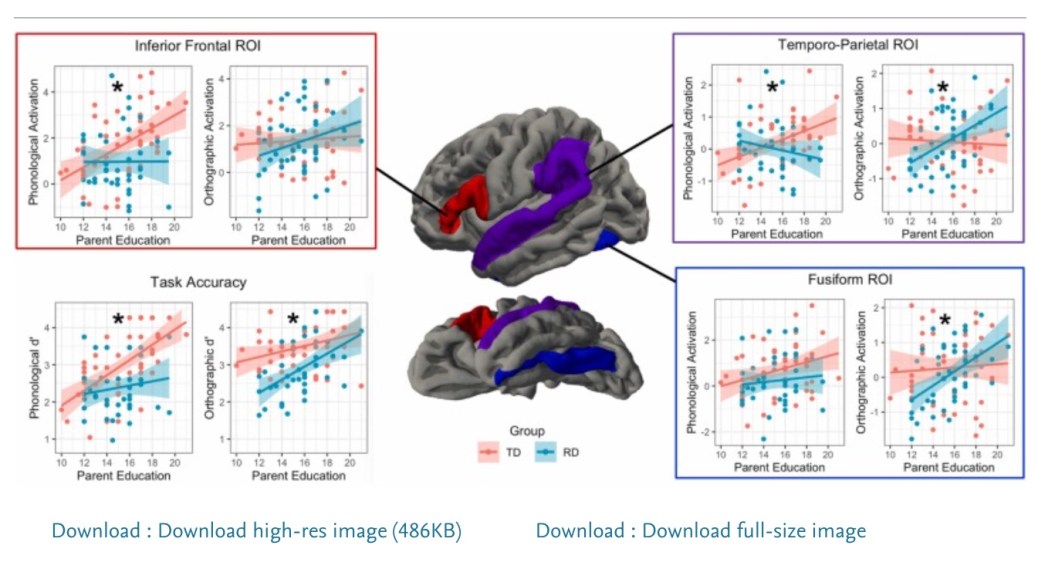
Socioeconomic status (SES) moderates which deficits explain reading disorders (RDs).
RD in higher-SES children is best explained by reduced phonological skills.
These children exhibit reduced activation in phonological processing brain regions.
Instead, RD in lower-SES children is best explained by reduced rapid naming skills.
These children exhibit reduced activation in orthographic processing brain regions.
Abstract
Childhood socioeconomic status (SES) strongly predicts disparities in reading development, yet it is unknown whether early environments also moderate the cognitive and neurobiological bases of reading disorders (RD) such as dyslexia, the most prevalent learning disability. SES-diverse 6–9-year-old children (n = 155, half with RD) completed behavioral and functional magnetic resonance imaging (fMRI) tasks engaging phonological and orthographic processing, which revealed corresponding double-dissociations in neurocognitive deficits. At the higher end of the SES spectrum, RD was most strongly explained by differences in phonological skill and corresponding activation in left inferior frontal and temporoparietal regions during phonological processing—widely considered the “core deficit” of RD. However, at the lower end of the SES spectrum, RD was most strongly explained by differences in rapid naming skills and corresponding activation in left temporoparietal and fusiform regions during orthographic processing. Findings indicate that children’s early environments systematically moderate the neurocognitive systems underlying RD, which has implications for assessment and treatment approaches to reduce SES disparities in RD outcomes. Further, results suggest that reliance on high-SES convenience samples may mask critical heterogeneity in the foundations of both typical and disordered reading development.
educator, public scholar, poet&writer – academic freedom isn't free















 dr. p.l. (paul) thomas