American Public Media Group announced in June “that APM Reports has been targeted for an unspecified reorganization.” Those of us in literacy, specifically the field of reading, have been highlighting since 2018 that APM Reports (specifically the work of Emily Hanford) has been misrepresenting both the problems around reading achievement and how to teach reading.
Hanford and APM Reports are ground zero for the deeply flawed “science of reading” (SoR) movement that now pervades mainstream media.
Ironically, the SoR mantra has been very valuable for mainstream media and several journalists, like Hanford, who have beat the same drum for four years, regardless of ample evidence that their messages are oversimplified, misleading, cherry picked, and lacking the very scientific evidence they demand from teachers.
Yet, it appears APM Reports is shifting its SoR propaganda cashcow to podcasts, and the next one, Sold a Story, will launch even more attacks, focusing on reading programs.
Here is the short version: Don’t buy it.
While not only APM Reports (the SoR messaging has been uniformly misleading across mainstream media), a tremendous amount of the misinformation can be attributed to the messaging there and then journalists such as Hanford getting platforms at the New York Times, for example, which is a key representation of the misinformation.
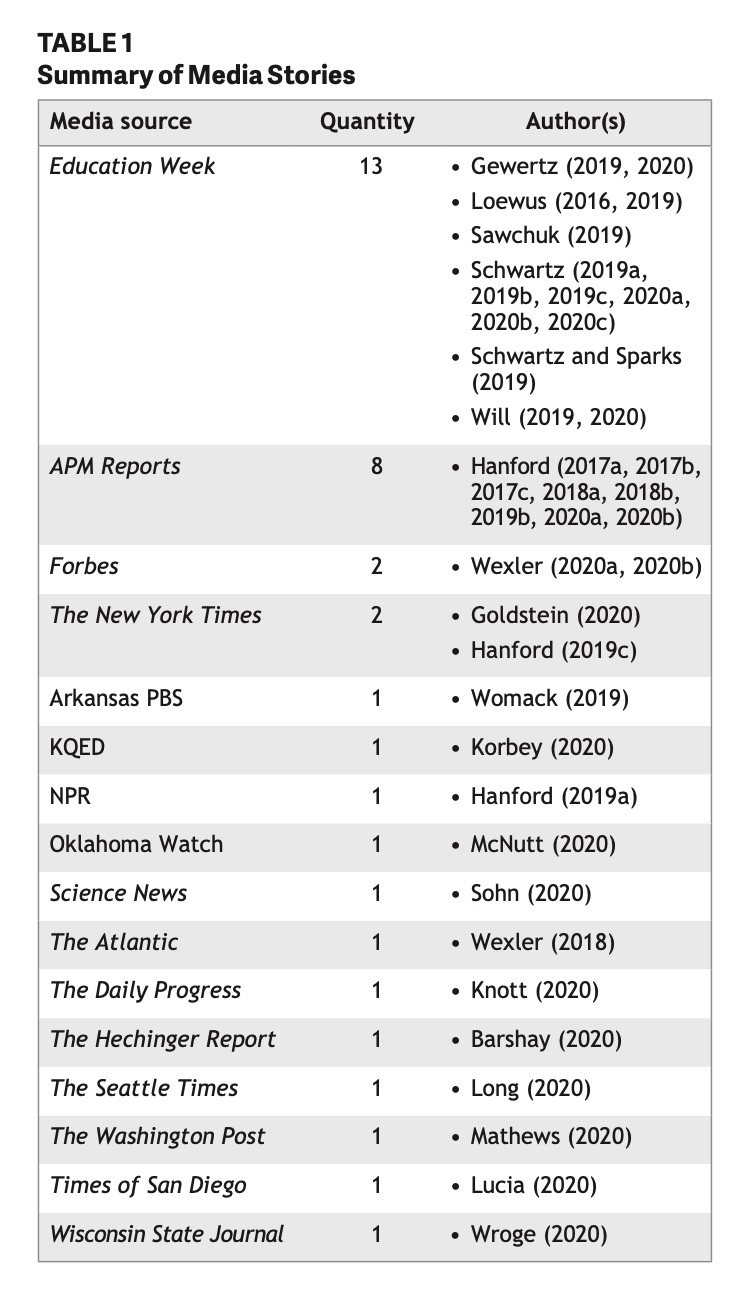
The media coverage at APM Reports (and Education Week) has been so deeply flawed, scholars have detailed the problems; I recommend this:
Hoffman, J.V., Hikida, M., & Sailors, M. (2020). Contesting science that silences: Amplifying equity, agency, and design research in literacy teacher preparation. Reading Research Quarterly, 55(S1), S255-S266. https://doi.org/10.1002/rrq.353
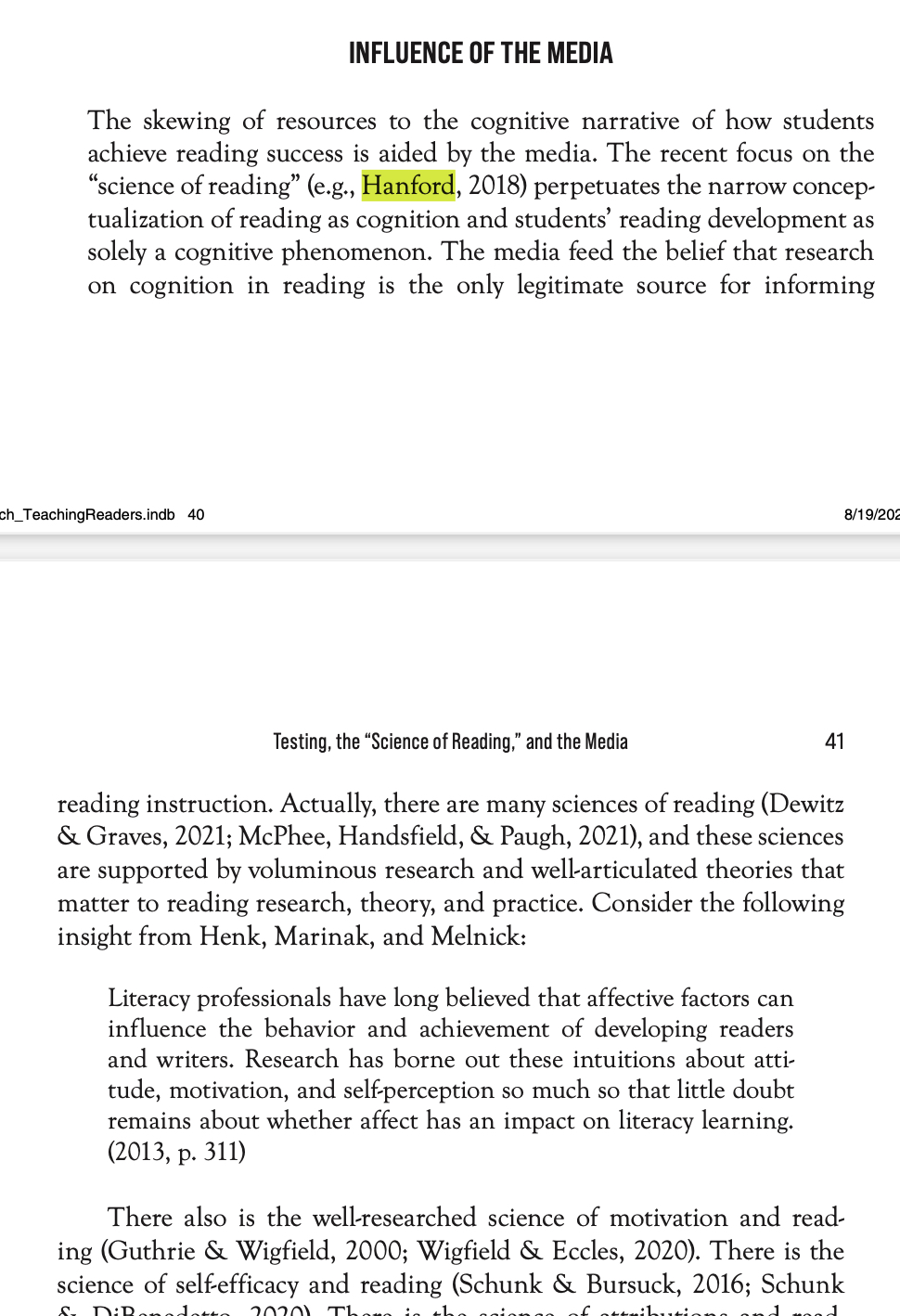
The passage addressing media is here:
I also recommend this book:
Afflerbach, P. (2022). Teaching readers (not reading): Moving beyond skills and strategies to reader-focused instruction. The Guilford Press.
The passage addressing media is here:
While the podcasts do not drop until October, I predict they will be more of the same misinformation, a good bit of projecting (is profit really a disclaimer in the U.S.?), and another example of a key criticism offered by Hoffman, Hikida, and Sailors (2020) in Reading Research Quarterly: “the SOR community do not employ the same standards for scientific research that they claimed as the basis for their critiques.”
And thus, again, don’t buy it.
Recommended
Thomas, P.L. (2022). The Science of Reading movement: The never-ending debate and the need for a different approach to reading instruction. Boulder, CO: National Education Policy Center. Retrieved [date] from http://nepc.colorado.edu/publication/science-of-reading
States across the U.S. continue to revise and introduce new reading legislation. As well, states are updating reading standards—all of which is being strongly influenced by the “science of reading” (SoR) movement.
While the SoR movement maintains that powerful influence over policy and classroom practice, I have strongly criticized the media and marketing aspects because of central concepts that are overly simplistic and ultimately harmful for teaching and learning reading. Those key fatal flaws are a commitment to the “simple view” of reading (SVR) [1] and practicing phonics-first with beginning readers (systematic phonics for all students in K-2 that is often without context or isolated from comprehension goals).
Recently on social media, a literacy educator raised concern that proposed revised state standards in K-2 ELA do not include comprehension in foundational skills. As I commented, this is the exact problem I have been criticizing and expecting as a result of embracing SVR, an out-of-date and simplistic theory of reading (see note 1 below).
Many, if not most, SoR advocates endorse intensive systematic phonics for all students before they are expected to demonstrate comprehension; some argue K-2 students can’t comprehend. Begun several years ago, this aspect of the SoR movement has re-energized the use of DIBELS, an assessment tool that evaluates student ability to pronounce nonsense words in isolation. This nonsense is often presented as “reading,” even though simply decoding (pronunciation) words in isolation is not reading.
As I will explain later, saying students pronouncing nonsense words is reading proficiency is the same as saying children riding bicycles with training wheels are cyclists.
In short, commitments to SVR and phonics first are a distortion of goals in reading instruction, replacing the authentic goal (critical comprehension) with measuring if students have acquired the entire set of phonics rules. Phonics instruction and emphasizing decoding must remain some of the means and not the ends of instruction; however, the SoR movement too often has created that fatal flaw.
I want to examine here why these commitments are not reading science, but more significantly, why these commitments are harmful to students.
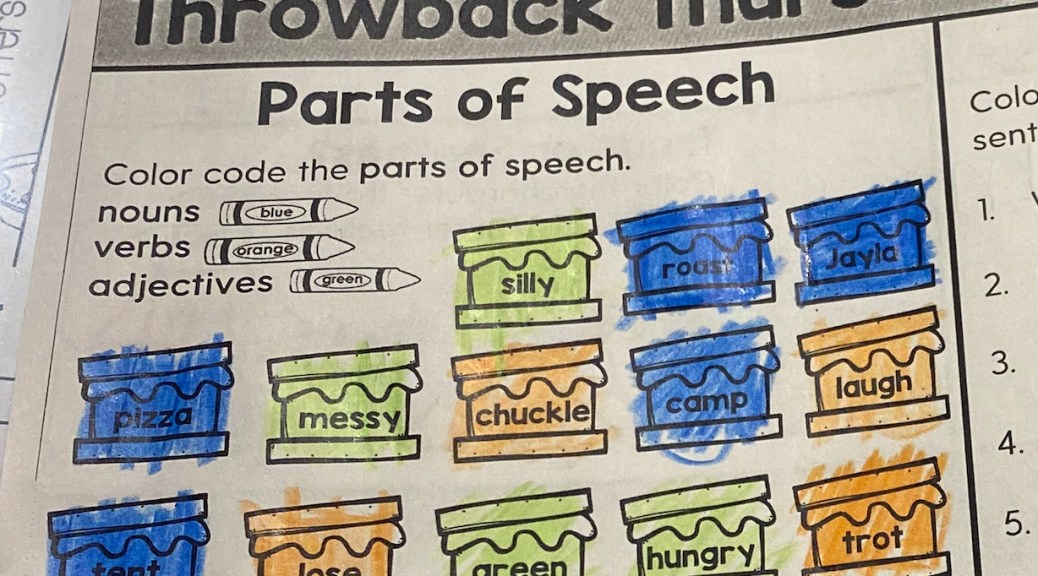
First, recently I was helping my granddaughter, Skylar, with her homework on parts of speech. See the exercise here:
I had to smile and encourage her as I quietly bled internally. This can only be described by the first word—”silly.” Not only is this isolated activity nonsense, I am certain it is ultimately harmful to emerging readers and writers.
Many of these words can function as several parts of speech once in the context of actual usage; for example, “camp” as in “We camp,” “The camp,” “A camp site,” etc.
Setting aside that many aspects of grammar and usage are intuited by proficient and expert readers (we drive our cars without being able to name all the engine parts, without having to know how to disassemble the engine, etc.), even when there is some instructional value in explicit instruction in grammar and usage, that has been shown for a century to be effective only in holistic and contextual ways.
If parts of speech matter (I suspect they don’t), help young readers and writers interrogate that in the reading of authentic texts and in their own original writing.
This essential problem is analogous to misrepresenting and overemphasizing phonics and decoding—especially when the instruction is isolated and not firmly anchored to the real goal of reading instruction, critical comprehension.
So let’s circle back to the bicycling analogy.
Using training wheels to teach children to ride a bicycle is a traditional and deeply misguided approach, one that is grounded in misreading what riding a bicycle is at its core—not the pedaling but the balancing. Therefore, balance bicycles are the better way to start.
Keep in mind one can coast on a bicycle and still be riding if the person has mastered balancing—as well as several other skills that include braking, holding a straight line, turning, and of course pedaling.
Reading is not dependent on decoding, and a child is only reading if they are making meaning from text. Just as someone can ride a bicycle by coasting, a child can read text for meaning purely by using sight word knowledge.
Yes, to be a cyclist one must eventually (and soon) master pedaling, and yes, no one reads entirely by sight word recognition (although expert readers depend on many comprehension strategies, and likely rarely use phonics rules to accomplish understanding).
And as I noted above, both proficient cyclists and proficient readers exhibit a huge array of skills simultaneously, intuitively, and independently—the ultimate goal of any instruction.
For reading instruction with beginning readers, then, systematic phonics instruction in a phonics-first setting that prioritizes pronouncing nonsense words is misguided and harmful practice.
As Stephen Krashen has shown, both systematic phonics for all students and no phonics instruction are harmful; instead, beginning readers need basic phonics combined with many other reading strategies that are all targeting critical comprehension.
Let’s think more deeply about decoding and phonics in ways I asked us to do with parts of speech. Consider asking students to pronounce “dove” and “wind” out of context, and now consider these sentences:
The dovedove out of the tree and scared Brees.
Because of the fog, you can watch the windwind through the valley.
Phonics first fails in the same way as using training wheels to teach bicycling. Phonics rules provide only one skill in the complex journey to critical comprehension. And phonics is not even foundational or essential when a text includes sight words recognized by the reader.
Finally, again like riding a bicycle, becoming an independent, eager, and expert reader—one who has a large vocabulary and a complex toolbox for making meaning (including phonics)—mostly comes from doing the authentic thing—not from isolated skills instruction as a prerequisite to doing the real thing.
[1] SVR, at best, is one of the major reading theories of the late twentieth century; in my view, it is not even the most compelling. But current theories of reading have moved beyond SVR; for example, (1) according to Duke and Cartwright (2021), current theories have supplanted SVR in three ways: (a) by identifying additional reasons for struggling readers, (b) by demonstrating that rather than being sequential, pronunciation and comprehension overlap, and (c) by stressing the importance of “active self-regulation” in learning to read, and (2) according to Filderman, et al., (2022) SVR is inadequate for teaching students comprehension.
Duke, N.K., & Cartwright, K.B. (2021). The science of reading progresses: Communicating advances beyond the simple view of reading. Reading Research Quarterly, 56(S1), S25–S44. https://doi.org/10.1002/rrq.411
Filderman, M. J., Austin, C. R., Boucher, A. N., O’Donnell, K., & Swanson, E. A. (2022). A meta-analysis of the effects of reading comprehension interventions on the reading comprehension outcomes of struggling readers in third through 12th grades. Exceptional Children, 88(2), 163–184. https://doi.org/10.1177/00144029211050860
In 2019, Richard Allington [1] confronted the outsized influence of state chapters of Decoding Dyslexia on state legislation and classroom practices related to not only dyslexia but also teaching beginning readers.
Ultimately, despite the good intentions of this advocacy and despite the need to address any and all students struggling to read (disproportionately among marginalized and vulnerable populations), Decoding Dyslexia advocacy has caused more harm than good, Allington and others assert.
This dynamic should give all of us pause because the same pattern is now occurring with The Reading League, a national advocacy organization promoting the “science of reading” through an expanding number of state-level affiliates.
The Reading League implores people to “join the movement” and has issued a Defining Guide on the “science of reading,” available as a book or a downloadable PDF (if you fill out a form and share a good deal of your information):
The cover page of the ebook (formatted throughout like a PowerPoint presentation) sets the stage for what proves to be more advocacy that “science” despite the emphasis on “defining” and “science.”
This 40-page ebook is a disturbing but perfect illustration of the core problems among “science of reading” advocates. As other literacy scholars have noted, all across the different factions of “science of reading” advocates, the arguments and claims are riddled with contradictions, oversimplifications, cherry-picking, and casual lapses into anecdote [2].
Similar to many other advocacy organizations masquerading as a (We Don’t) Think Tank (for example, NCTQ), The Reading League uses slick PDF creation and the veneer of scholarly citation (as well as an inordinate number of brain images) to mask the many ways this ebook fails to meet the standard they themselves set for the teaching of reading.
All must beware of The Reading League and its growing influence because this “movement” fails in the exact ways confronted by Hoffman, Hikida, and Sailors (2020) in Reading Research Quarterly: “the SOR community do not employ the same standards for scientific research that they claimed as the basis for their critiques” (S259). [3]
Here I will detail a few of the essential failures of The Reading League’s “movement” in their “Defining Guide.”
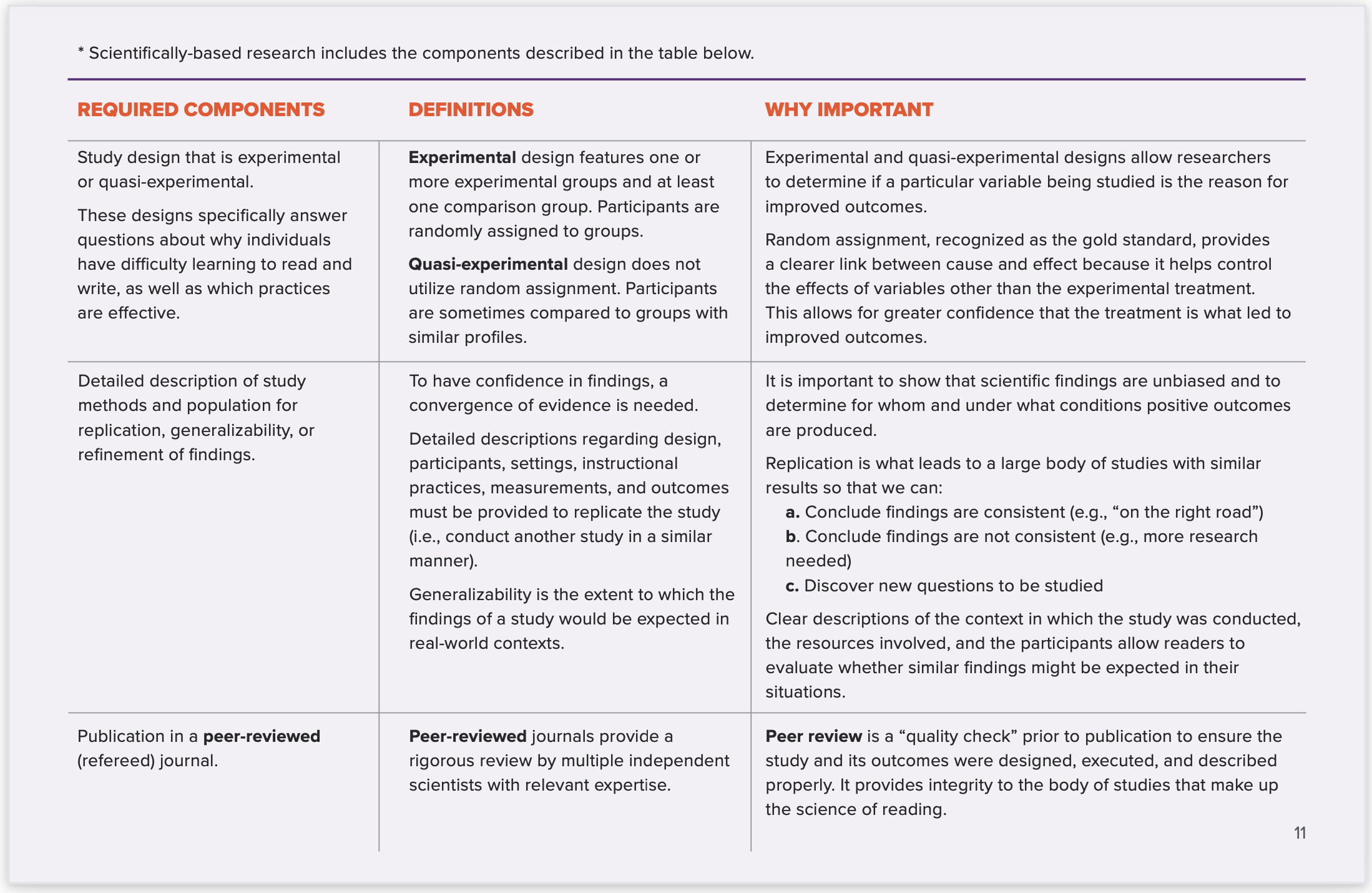
The organization advocates for a “common” definition of the “science of reading” and offers one on page 6 with a note to see further justifications for the limited (and limiting) parameters of that definition on page 11. In short, The Reading League is recycling the “scientifically-based” mantra of the National Reading Panel (NRP) and limiting the “science of reading” to experimental/quasi-experimental research.
While this is a popular and politically enticing approach, that limitation has been refuted for a couple decades now. Let me share just a couple reasons (see endnotes for sources) for why excluding evidence outside that parameter is wrong for education and wrong for guiding reading instruction:
Problems with the reports issued by the NRP and the difficulty of implementing that evidence have been widely documented by a number of literacy scholars. [4] Repeating the errors of the NRP is bad policy, bad advocacy, and bad thinking.
Educational practice requires a wide range of evidence, not a limited view of what counts as science. Many scholars has addressed the tyranny of using “science” as a weapon, a distortion of both the essence of “science” and the on-going nature of inquiry (hint: the science of any field, including reading science, is not settled). [5]
Another element of the limited and limiting parameters for what counts as reading “science” is an over-reliance on brain research. The defining guide implies a diversity of disciplinary sources for defining reading “science,” but their little list suggests otherwise:
The limited parameters are grounded in psychology, and brain research.
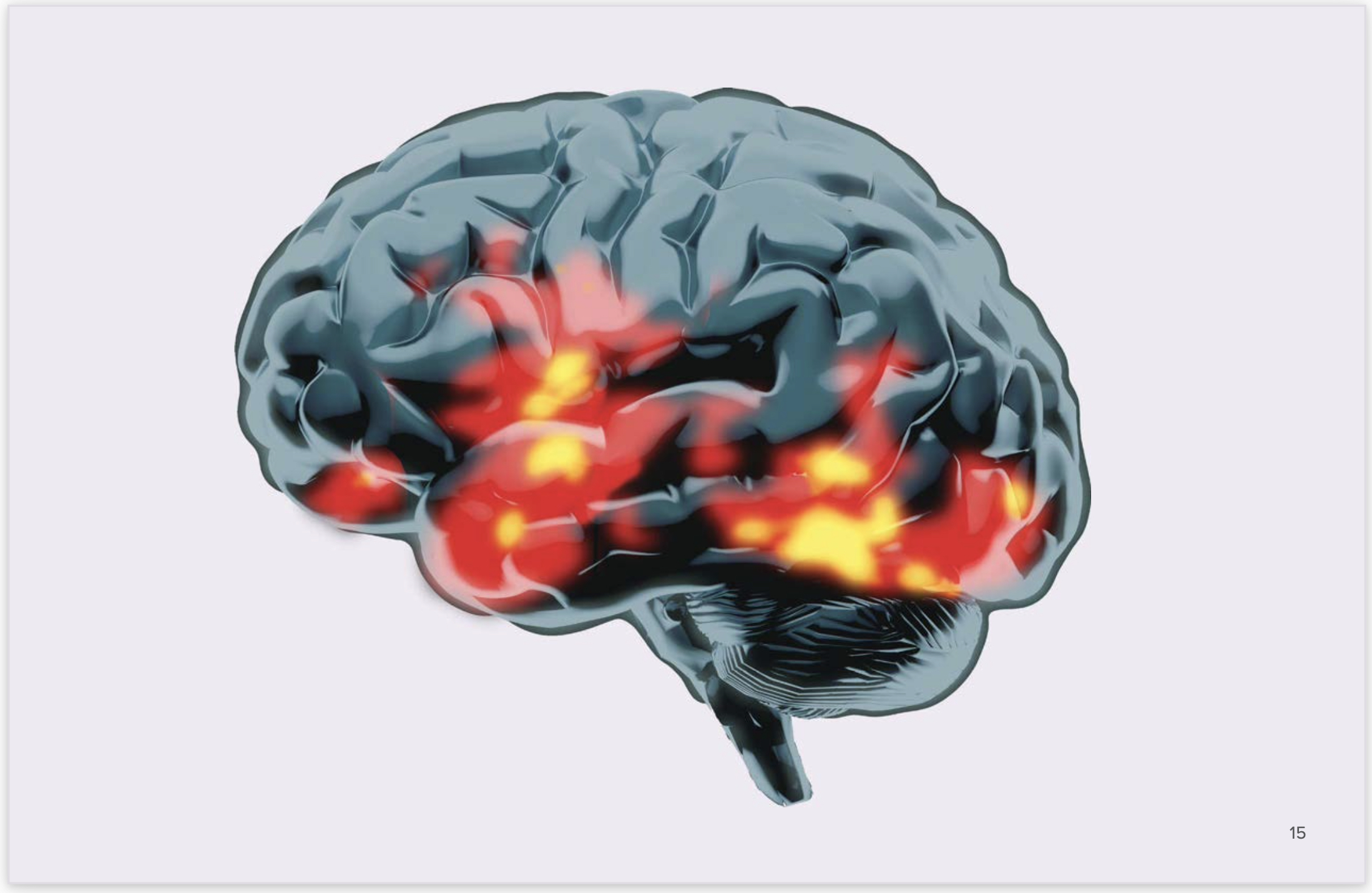
If you dont get the focus on “brain research,” the guide is there to make it clear:
Oddly, this image has no text, no citation, leaving me to wonder what the hell this is for (except this is how my brain feels when I have to engage with “science of reading” nonsense).
Here is an extremely important point: Scholars have challenged the conclusions being drawn from brain research:
Within the neurosciences, however, serious critiques of brain-imaging methods have emerged. Many researchers in neurobiology (e.g., Elliott et al., 2020; Hickok, 2014; Lyon, 2017) have voiced alarming concerns about the validity and preciseness of brain imaging techniques such as functional magnetic resonance imaging (fMRI) to detect reliable biomarkers in processes such as reading and in the diagnosis of other mental activity….
However, Elliott et al.’s (2020) statement “that commonly used task-fMRI measures lack the minimal reliability standards” (p. 801) for identifying abnormal brain activity should raise serious caveats in interpreting any imaging study as applicable to classroom applications. [6]
Yaden, D.B., Reinking, D., & Smagorinsky, P. (2021). The trouble with binaries: A perspective on the science of reading. Reading Research Quarterly, 56(S1), S119–S129. https://doi.org/10.1002/rrq.402
And Mark Seidenberg, a key neuroscientist cited by the “science of reading” movement, offers a serious caution about the value of brain research: “Our concern is that although reading science is highly relevant to learning in the classroom setting, it does not yet speak to what to teach, when, how, and for whom at a level that is useful for teachers [emphasis added].” [7]
Finally, the ultimate failure of the guide and the “science of reading” movement promoted by The Reading League is the reliance of the “simple view” of reading (SVR) and peppering the guide itself with surprisingly old sources (scroll through for cutting edge scholarship from the 1980s, for example).
About SVR, well, there are a number of problems addressed by leading scholars in the field of literacy. [8]
Notably, Duke and Cartwright explains that the filed of literacy has moved beyond SVR:
The simple view of reading is commonly presented to educators in professional development about the science of reading. The simple view is a useful tool for conveying the undeniable importance—in fact, the necessity—of both decoding and linguistic comprehension for reading. Research in the 35 years since the theory was proposed has revealed additional understandings about reading. In this article, we synthesize research documenting three of these advances: (1) Reading difficulties have a number of causes, not all of which fall under decoding and/or listening comprehension as posited in the simple view; (2) rather than influencing reading solely independently, as conceived in the simple view, decoding and listening comprehension (or in terms more commonly used in reference to the simple view today, word recognition and language comprehension) overlap in important ways; and (3) there are many contributors to reading not named in the simple view, such as active, self-regulatory processes, that play a substantial role in reading. We point to research showing that instruction aligned with these advances can improve students’ reading. We present a theory, which we call the active view of reading, that is an expansion of the simple view and can be used to convey these important advances to current and future educators. We discuss the need to lift up updated theories and models to guide practitioners’ work in supporting students’ reading development in classrooms and interventions.
Duke, N.K., & Cartwright, K.B. (2021). The science of reading progresses: Communicating advances beyond the simple view of reading. Reading Research Quarterly, 56(S1), S25–S44. https://doi.org/10.1002/rrq.411
And, possibly more significantly, Filderman, et al., conclude:
Theoretical models, such as the simple view of reading (Gough & Tunmer, 1986), the direct and inferential mediation (DIME) model (Cromley et al., 2010; Cromley & Azevedo, 2007), and the cognitive model (McKenna & Stahl, 2009) inform the constructs and skills that contribute to reading comprehension. The simple view of reading (Gough & Tunmer, 1986) describes reading comprehension as the product of decoding and language comprehension. The simple view of reading is often used to underscore the critical importance of decoding on reading comprehension; however, evidence suggests that the relative importance of decoding and language comprehension changes based on students’ level of reading development and text complexity (Lonigan et al., 2018). Cross-sectional and longitudinal studies demonstrate that decoding has the largest influence on reading comprehension for novice readers, whereas language comprehension becomes increasingly important as students’ decoding skills develop and text becomes more complex (e.g., Catts et al., 2005; Gough et al., 1996; Hoover & Gough, 1990; Proctor et al., 2005; Tilstra et al., 2009). However, the simple view of reading does not comprehensively explain all skills that influence reading comprehension, nor does it inform what comprehension instruction requires. [emphasis added]
Filderman, M. J., Austin, C. R., Boucher, A. N., O’Donnell, K., & Swanson, E. A. (2022). A meta-analysis of the effects of reading comprehension interventions on the reading comprehension outcomes of struggling readers in third through 12th grades. Exceptional Children, 88(2), 163–184. https://doi.org/10.1177/00144029211050860
The Reading League “movement” is not a comprehensive view of reading and how to teach reading; it certainly isn’t settled (or even compelling) science.
Beware The Reading League because it is an advocacy movement that is too often little more than cherry-picking, oversimplification, and a thin veneer for commercial interests in the teaching of reading.
Johnston, P., & Scanlon, D. (2021). An examination of dyslexia research and instruction with policy implications. Literacy Research: Theory, Method, and Practice, 70(1), 107. https://doi.org/10.1177/23813377211024625
Hoffman, J.V., Hikida, M., & Sailors, M. (2020). Contesting science that silences: Amplifying equity, agency, and design research in literacy teacher preparation. Reading Research Quarterly, 55(S1), S255–S266. https://doi.org/10.1002/rrq.353
Johnston, P., & Scanlon, D. (2021). An examination of dyslexia research and instruction with policy implications. Literacy Research: Theory, Method, and Practice, 70(1), 107. https://doi.org/10.1177/23813377211024625
MacPhee, D., Handsfield, L.J., & Paugh, P. (2021). Conflict or conversation? Media portrayals of the science of reading. Reading Research Quarterly, 55(S1), S145—S155. doi:10.1002/rrq.384
[3] Hoffman, J.V., Hikida, M., & Sailors, M. (2020). Contesting science that silences: Amplifying equity, agency, and design research in literacy teacher preparation. Reading Research Quarterly, 55(S1), S255–S266. https://doi.org/10.1002/rrq.353
[4] Bowers, J.S. (2020).Reconsidering the evidence that systematic phonics is more effective than alternative methods of reading instruction. Educational Psychology Review, 32(2020), 681–705. https://link.springer.com/article/10.1007%2Fs10648-019-09515-y
Collet, V.S., Penaflorida, J., French, S., Allred, J., Greiner, A., & Chen, J. (2021). Red flags, red herrings, and common ground: An expert study in response to state reading policy. Educational Considerations, 47(1). https://doi.org/10.4148/0146-9282.2241
Garan, E. M. (2001, March). Beyond smoke and mirrors: A critique of the National Reading Panel report on phonics. Phi Delta Kappan, 82(7), 500–506. https://doi.org/10.1177/003172170108200705
Seidenberg, M.S., Cooper Borkenhagen, M., & Kearns, D.M. (2020). Lost in translation? Challenges in connecting reading science and educational practice. Reading Research Quarterly, 55(S1), S119–S130. https://doi.org/10.1002/rrq.341
Shanahan, T. (2005). The National Reading Panel report: Practical advice for teachers. Learning Point Associates. Retrieved June 7, 2022, from https://files.eric.ed.gov/fulltext/ED489535.pdf Shanahan, T. (2003, April). Research-based reading instruction: Myths about the National Reading Panel report. The Reading Teacher, 56(7), 646–655.
[5] Compton-Lilly, C.F., Mitra, A., Guay, M., & Spence, L.K. (2020). A confluence of complexity: Intersections among reading theory, neuroscience, and observations of young readers. Reading Research Quarterly, 55(S1), S185–S195. https://doi.org/10.1002/rrq.348
Seidenberg, M. (2018). Language at the speed of sight: How we read, why so many can’t, and what can be done about it. Basic Books.
Seidenberg, M.S., Cooper Borkenhagen, M., & Kearns, D.M. (2020). Lost in translation? Challenges in connecting reading science and educational practice. Reading Research Quarterly, 55(S1), S119–S130. https://doi.org/10.1002/rrq.341
Willingham, D.T. (2017). The reading mind: A cognitive approach to understanding how the mind reads. Jossey-Bass.
Yaden, D.B., Reinking, D., & Smagorinsky, P. (2021). The trouble with binaries: A perspective on the science of reading. Reading Research Quarterly, 56(S1), S119–S129. https://doi.org/10.1002/rrq.402
[6] Yaden, D.B., Reinking, D., & Smagorinsky, P. (2021). The trouble with binaries: A perspective on the science of reading. Reading Research Quarterly, 56(S1), S119–S129. https://doi.org/10.1002/rrq.402
[7] Seidenberg, M.S., Cooper Borkenhagen, M., & Kearns, D.M. (2020). Lost in translation? Challenges in connecting reading science and educational practice. Reading Research Quarterly, 55(S1), S121. https://doi.org/10.1002/rrq.341
See also:
Compton-Lilly, C.F., Mitra, A., Guay, M., & Spence, L.K. (2020). A confluence of complexity: Intersections among reading theory, neuroscience, and observations of young readers. Reading Research Quarterly, 55(S1), S185–S195. https://doi.org/10.1002/rrq.348
[8] Compton-Lilly, C.F., Mitra, A., Guay, M., & Spence, L.K. (2020). A confluence of complexity: Intersections among reading theory, neuroscience, and observations of young readers. Reading Research Quarterly, 55(S1), S185–S195. https://doi.org/10.1002/rrq.348
Duke, N.K., & Cartwright, K.B. (2021). The science of reading progresses: Communicating advances beyond the simple view of reading. Reading Research Quarterly, 56(S1), S25–S44. https://doi.org/10.1002/rrq.411
Filderman, M. J., Austin, C. R., Boucher, A. N., O’Donnell, K., & Swanson, E. A. (2022). A meta-analysis of the effects of reading comprehension interventions on the reading comprehension outcomes of struggling readers in third through 12th grades. Exceptional Children, 88(2), 163–184. https://doi.org/10.1177/00144029211050860
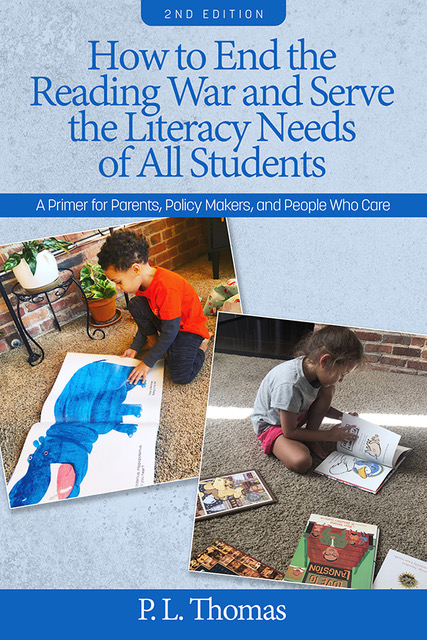
The twenty-first century Reading War is, in fact, nothing new, but some of the details are unique to our current culture driven by social media. This volume seeks to examine the current Reading War in the context of the historical recurrence of public and political debates around student reading abilities and achievement.
Grounded in a media fascination with the “science of reading” and fueled by a rise in advocates for students with dyslexia, the current Reading War has resulted in some deeply troubling reading policy, grade retention and intensive phonics programs.
This primer for parents, policy makers, and people who care confronts some of the most compelling but misunderstood aspects of teaching reading in the U.S. while also offering a way toward ending the Reading War in order to serve all students, regardless of their needs.
The revised/expanded 2nd edition adds developments around the “science of reading,” including the expanding impact on state policy and legislation as well as robust additions to the research base around teaching students to read.
CONTENTS Introduction: Parent Advocacy and the New (but Still Misguided) Phonics Assault on Reading. Acknowledgments. CHAPTER 1: A Historical Perspective of the Reading War: 1940s and 1990s Editions. CHAPTER 2: The 21st Century Reading War: “The Science of Reading,” Dyslexia, and Misguided Reading Policy. CHAPTER 3: Misreading Reading: The Good, the Bad, and the Ugly. CHAPTER 4: How to End the Reading War and Serve the Literacy Needs of All Students: Shifting Our Deficit Gaze, Asking Different Questions About Literacy. CHAPTER 5: The “Science of Reading” in 2022, and Beyond: Not Simple, Not Settled. Conclusion: The Science of Literacy—A 5-Decades Journey and Counting. Appendix A: Recommended Reading. Appendix B: Fact Checking the “Science of Reading”—A Quick Guide for Teachers.
One of the most important aspects of understanding any issue or field of knowledge, I think, is to have nuanced historical perspective. That is vividly true about education and especially reading.
The current reading crisis, often referred to as the “science of reading” movement, and the incredibly chilling impact of curriculum bans, book censorship, and attacks on teaching and learning are not, I regret to emphasize, all that new (except the degree of the bans are in many ways unprecedented).
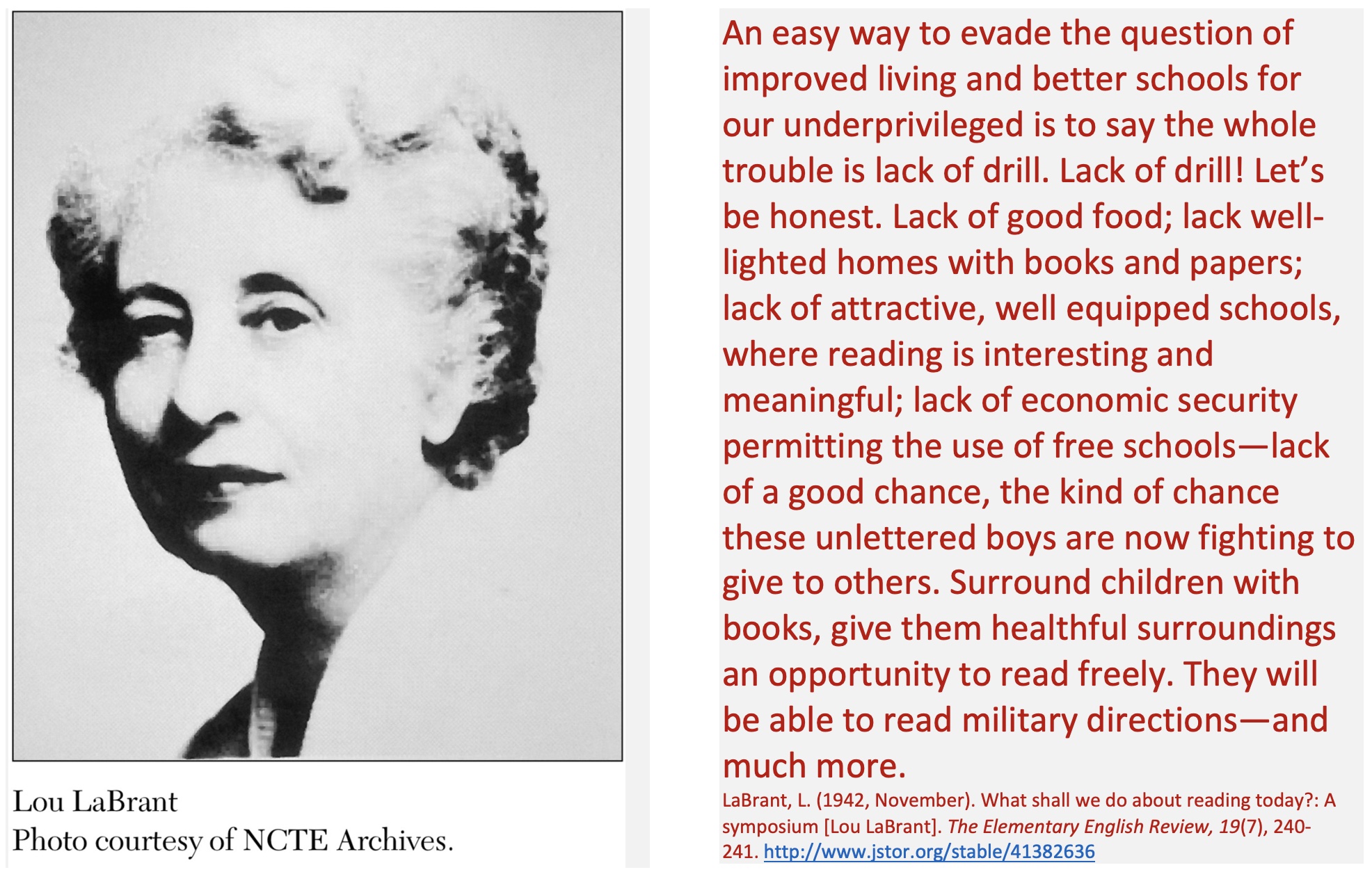
I am currently working on completing my online annotated bibliography of Lou LaBrant, and offer below some historical perspective on teaching reading and why censorship is always wrong for education and democracy.
Access my blog post on each work by clicking the hyperlink in the essay titles; many of her publications can also be accessed through JSTOR (links at end of bibliographies when available). I am including memes of key passages from LaBrant with the recommended works below.
Back to school 2022 looks different than any of my many years as a student and even more as a teacher. “Back to school” now means curriculum bans for teachers and censorship for students.
It’s the Upside Down of the American Dream and academic freedom.
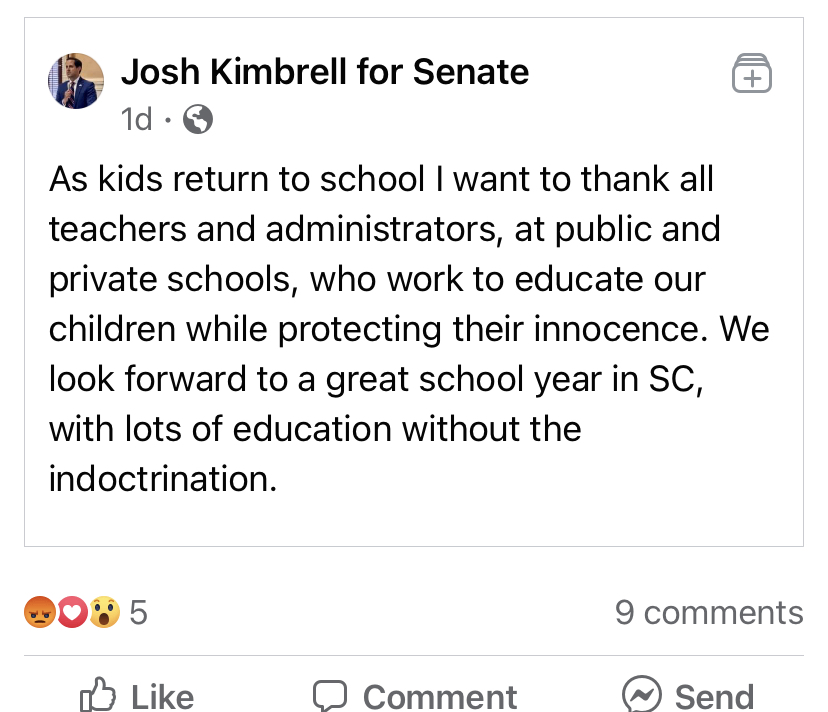
One recurring (and misleading) justification by Republicans banning curriculum and censoring books is a manufactured crisis around “age-appropriate” content; however, several Republicans have also directly begun including in their claims that the role of school and teachers is to protect childhood innocence:
As a parent, grandparent, and almost 40-years a teacher, I want to emphasize that the role any adult plays in mentoring, parenting, or teaching children is not to protect their innocence (more on why later), but to provide support and guidance as children mature and come to know the full, complicated, and often disturbing real world.
To keep a child or teen innocent is to deny them their full humanity and autonomy.
As a reader and teacher of literature, I am aware of the power and allure of idealizing innocence.
Setting aside for a moment the tremendous problems with author J.D. Salinger, his career was built on a nearly fawning adoration of his central motif, the “catcher in the rye” imagery of Holden Caulfield’s quest to protect his sister’s (and all children’s) innocence because he clearly has been traumatized by his entry into the adult world.
Author Eudora Welty praised Salinger as a writer in her review of Nine Stories in 1953:
The stories concern children a good deal of the time, but they are God’s children. Mr. Salinger’s work deals with innocence, and starts with innocence: from there it can penetrate a full range of relationships, follow the spirit’s private adventure, inquire into grave problems gravely–into life and death and human vulnerability and into the occasional mystical experience where age does not, after a point, any longer apply. Mr. Salinger’s world urban, suburban, family, mostly of the Eastern seaboard is never a clue to the way he will treat it: he seems to write without preconception of shackling things.
Like Salinger (and nearly as problematic as a human), e.e. cummings idealized childhood and seemed to lament adulthood: “children guessed(but only a few/and down they forgot as up they grew.” Like many writers and artists throughout history, cummings portrayed childhood innocence as being closer to God (or the Universe); adulthood is a forgetting.
Both of these authors were attractive to me as a young writer, teacher, and even scholar, but the most compelling work about innocence was always William Blake, who complicated the innocence/experience dynamic. Blake’s work shows the necessary duality of life without idealizing innocence—even as he detailed the darkness of experience.
What is innocence?
It is a lack of awareness, a lack of knowledge, the absence of living life that is idealized not only in literature but in Christianity—the fall from grace, eating the fruit of the Tree of Knowledge, being cast out of the idyllic innocence of the Garden of Eden.
But innocence is extremely dangerous, and the innocent are easily manipulated, easily controlled.
And here is the truth about curriculum bans and book censorship: Republicans, conservatives, and Christian fundamentalists are primarily concerned about control—especially controlling women and children.
There is no crisis in our schools concerning exposing children and teens to content and books that are not age appropriate. If anything, traditional schooling still coddles children and teens—and especially young adults.
Protecting the innocence of children is not a valid goal for teachers or schooling; protecting the innocence of children is cruel and dehumanizing, in fact.
But that is not what Republicans are concerned about.
This is pure and simple a power grab, a way to control minds and impose a worldview on others.
The media have a long and muddled fascination with children and students reading, especially declaring that we are experiencing a reading crisis. However, even more concerning that this misguided click-bait approach to journalism is that the media more often than not promote crisis rhetoric with misinformation.
[UPDATES IV and V below]
I. Education Week
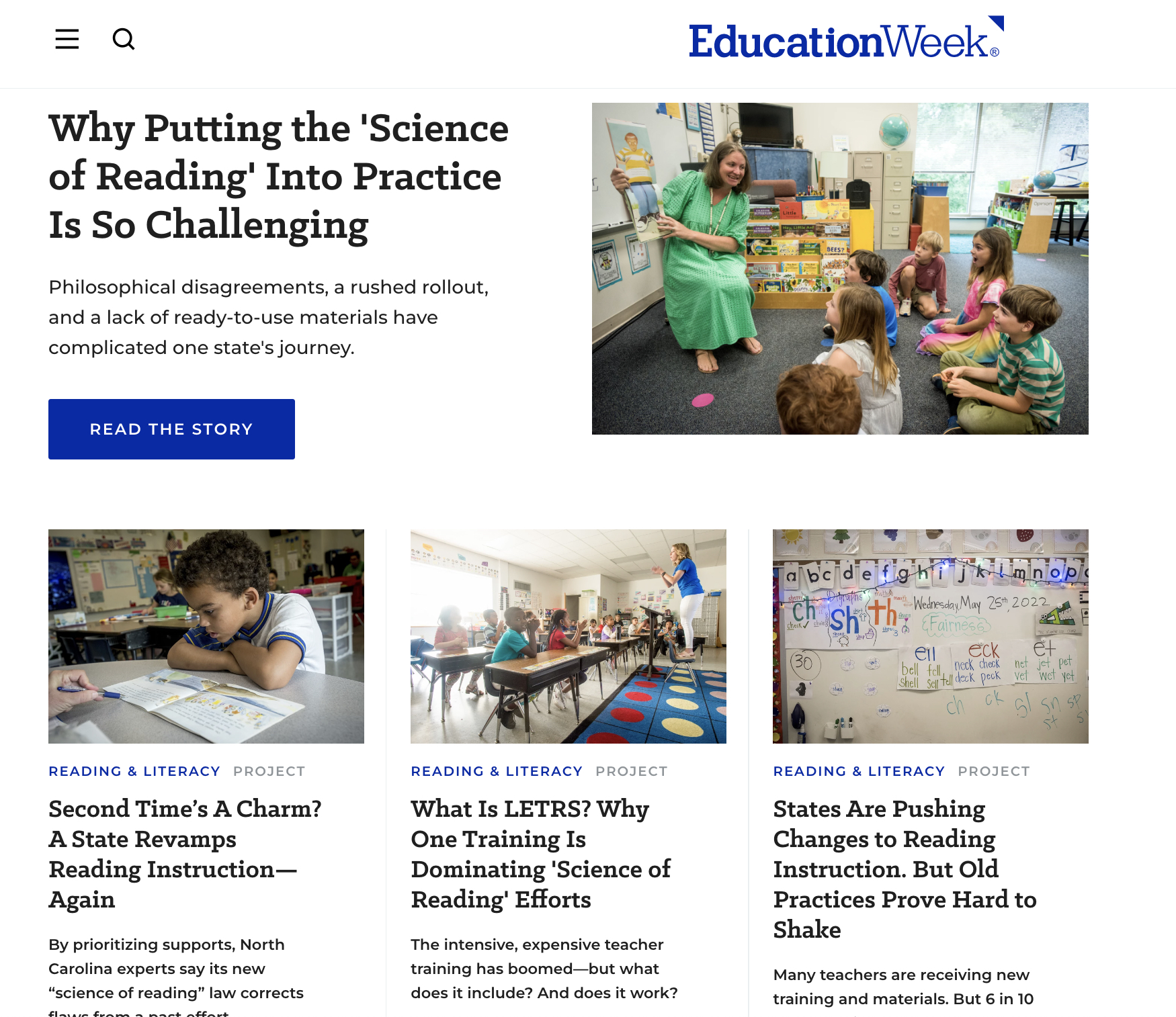
Possibly the most (un)impressive example of this is from Education Week. In just the last few weeks, EdWeek has posted a catalogue of misinformation about their favorite topic—the science of reading:
Here are a few reminders about the nonsense and misinformation that EdWeek will not set aside:
Published in the Newsweek Expert Forum, an “invitation-only network of influential leaders, experts, executives and entrepreneurs.” (This response was not invited.) Forsa cannot be reached by email or telephone. She is the president of Savvas, formerly Pearson K12.
It is widely believed that failure at grade 3 predicts school failure later on in school (Forsa, “A love to read by three,” 7/25/22).
If true, we should study what factors predict success by the end of grade 3.
In Lao, Lee, McQuillan and Krashen (2021), we summarized the results of three studies of ten -year old children on a test of reading comprehension, the PIRLS test, 10 year olds in 45 countries in 2006, in 57 countries in 2011 and in 61 countries in 2016.
The number of children tested ranged from 3349 to 18,245 and was administered in the national language of the country.
In agreement with Forsa’s recommendation, the best predictor was access to reading material, represented here as the presence of a school library). High levels of poverty meant lower levels of reading competence, as did the amount of reading instruction in school and whether children had developed some reading competence before starting school.
The clear winner: access to books. There was the most popular recommendation among the public, direct instruction in reading, was not a strong predictor. There is plenty of support for this predictor from other studies, see especially the work of Keith Curry Lance. https://keithcurrylance.com and S. Krashen (2004).
Krashen, S. 2004. The Power of Reading. Libraries Unlimited.
Lao, C., Lee, S-Y., McQuillan, J., and Krashen, S. 2021. Predicting reading ability among ten-year olds: Poverty (negative), school libraries (positive), instruction (zero), early literacy (zero). Language Magazine 20,10: 20-21. https://tinyurl.com/cn3nekc4
It is important to connect the dots and recall that states have banned reading programs, as reported here:
The Arkansas Division of Secondary and Elementary Education announced in October 2019 that any curriculum that utilizes cueing strategies won’t be approved for use in the state, meaning that Calkins’ materials and another popular program, Fountas and Pinnell Classroom, are effectively banned. Colorado released a list of approved core reading curriculum, and Calkins’ programs weren’t on the list. A group outside St. Louis sent a letter signed by 216 parents, students and taxpayers to the school board asking that Calkins, and Fountas and Pinnell be dropped. The Oakland Unified School District, whose use of Calkins’ products was highlighted in the 2019 APM Reports story, announced it was forming a committee to consider adopting new curriculum. And Student Achievement Partners, a nonprofit consulting group, published a review that concluded Calkins’ curriculum materials are “unlikely to lead to literacy success for all of America’s public schoolchildren.”
Republican legislation has begun to erode academic freedom among previously respected academic publishers, such as Heinemann. The combination of politics and the market is bad news for teachers, bad news for education, and bad news for students.
The expansive piece follows a now old and tired pattern of misrepresenting nearly everything about reading and teaching reading. In fact, the article almost comically fails the fact checking guidelines I developed years ago.
The post opens with a garbled defense of the reading program Open Court, blaming (of course) teachers for abandoning the program (and characterizing those teachers as driven by wokeness, not concern for students). Here is what is left out: Open Court was at the center of the Reading First scandal, and careful reviews of the program have shown that it simply does not meet the exact standards the science of reading movement calls for. (See McQuillan’s review and the review at phonics-friendlyEdReports.)
Misinformation by omission.
Luscombe offers yet another, and somewhat breezy, inaccurate portrayal of whole language:
There are many schools of thought on how best to aid this process, but the main contretemps has been about whether kids need to be taught how to sound out words explicitly or whether, if you give them enough examples and time, they’ll figure out the patterns. The latter theory, sometimes known as whole language, says teaching phonics is boring and repetitive, and a large percentage of English words diverge from the rules. (Hello there, though,thought, through, trough and tough!) But if you immerse children in beautiful stories, they’ll be motivated to crack the code, to recognize each word. The counterargument is that reading is as connected to hearing as it is to sight. It begins, phonics advocates say, with speech. This understanding, and the data that supports it, has become known as the science of reading.
The goal is to frame whole language (and balanced literacy; see later in the article) as nothing more than a whim and elevate the real “science of reading.” See here for a full and accurate understanding of whole language, and here and here for balanced literacy.
Of course misinformation articles on reading must cite and greatly misrepresent the National Reading Panel (NRP). Once again, the NRP reports were deeply flawed since the panel was underfunded and understaffed; the panel also lacked any teachers and limited their review of research to narrow quantitative studies. See a fuller examination of NRP here.
The piece builds as expected to focusing on dyslexia and making a pretty huge (and inaccurate) claim:
Just as most children, no matter how many times they’ve been in a car, still need to be taught to drive, most readers benefit from being explicitly taught how sounds and letters go together. This is true not just for dyslexics (who represent about 10% of all learners) but for the majority of readers.
One of the worst aspects of the “science of reading” movement and the state legislation it has prompted is that all students are being treated as if they are dyslexic, or struggling. Not only are the movement and parent advocate misrepresenting the research on dyslexia, they are pathologizing all reading. See here and here for a more nuanced and complex understanding of dyslexia and addressing struggling readers.
And no misinformation piece on reading is complete now with the “Mississippi Miracle” propaganda. To be brief, there is no credible research showing Mississippi improved NAEP scores by using the “science of reading”; in fact, it is likely the score bumps come from excessive grade retention. See a full analysis of Mississippi’s NAEP scores here.
Part of the Mississippi and “science of reading” propaganda relies on general readers simply accepting that everything being endorsed is, well, “scientific”; however, once again, the article champions the power of LETRS, a program to train teachers in phonics and reading instruction. Another example of misinformation by omission since:
A growing number of U.S. states have funded and encourage and/or require teachers to attend professional development using Moats’s commercial LETRS program, including Alabama, Arkansas, Kansas, Mississippi, Missouri, Oklahoma, Rhode Island, and Texas. This is despite the fact that an Institute of Education Sciences study of the LETRS intervention found almost no effects on teachers or student achievement (Garet et al., 2008). (p. S259)
Hoffman, J.V., Hikida, M., & Sailors, M. (2020). Contesting science that silences: Amplifying equity, agency, and design research in literacy teacher preparation. Reading Research Quarterly, 55(S1), S255-S266. https://doi.org/10.1002/rrq.353
The article ends by praising Emily Hanford and trashing teacher education—the former has no credibility and the latter is simply more misinformation. See just one example on Hanford here, and here for teacher education.
Just like cries of reading “crisis,” the Time article offers nothing new by traveling down a well-worn path of misinformation that now seems the only direction mainstream media can see.
V. The New York Times (Again) [UPDATED]
Let’s end 2022 with some context.
I recommend this scholarly analysis of media coverage of SOR by MacPhee, Handsfield, & Paugh (2021):
MacPhee, D., Handsfield, L.J., & Paugh, P. (2021). Conflict or conversation? Media portrayals of the science of reading. Reading Research Quarterly, 55(S1), S145-S155. https://doi.org/10.1002/rrq.384
I also recommend the series of blogs posts from Aukerman addressing media coverage of SOR (HERE, HERE, and HERE).
This latest coverage of reading by Sarah Mervosh almost reads like parody now since the mainstream media is recycling over and over the initial and inaccurate coverage by Emily Hanford (see the links above), but this time suggesting this false narrative applies to high school.
What does this newest article get predictably wrong?
First, the uncritical acceptance of the “science of reading” movement and then of course the mischaracterization of balanced literacy:
The program in Memphis is an extension of a growing national movement to change the way younger children are taught to read, based on what has become known as “the science of reading.” And it is a sign of how sharply the pendulum has swung in the decades-long, contentious debate over reading instruction, moving away from a flexible “balanced literacy” approach that has put less emphasis on sounding out words, and toward more explicit, systematic teaching of phonics.
Next a quick reference (no citation) to “brain research” and then a hyperlink to the out-dated and (again) misrepresented NRP report:
Brain science has shown that reading is not automatic, and longstanding research supports the need for sequenced sound-it-out instruction, along with books that build vocabulary and knowledge.
I recommend seeing the recent and much more complex research base on brain research and phonics instruction HERE.
Tennessee like many other states have turned to retraining teachers, a market boom for education business (again):
Tennessee has aggressively pushed for statewide change. Last year, the state’s Republican legislature and governor, Bill Lee, passed a law that required all elementary schoolteachers be trained in a phonics-based approach, with optional literacy training for middle and high school teachers. More than 40,000 teachers have participated in the training so far, according to the state’s education department.
The article returns to misrepresenting balanced literacy by linking to Hanford, a discredited article by Goldstein in the NYT, and Education Week, which routinely repackages Hanford’s narrative:
In the early to mid-2010s, when high schoolers today were in elementary school, many schools practiced — and still practice — “balanced literacy,” which focuses on fostering a love of books and storytelling. Instruction may include some phonics, but also other strategies, like prompting children to use context clues — such as pictures — to guess words, a technique that has been heavily criticized for turning children away from the letters themselves.
The article ends by mimicking Hanford’s original article and her misleading coverage of Mississippi; here the implied “miracle” is Tennessee.
As Coles exposed in Hanford’s original coverage of Pennsylvania, don’t buy it.
The great irony facing us now is that the very worst place to read about reading is mainstream media—unless you are prepared to do the hard work journalists are not doing and interrogate the tired and relentless misinformation at the center of all the misguided crisis rhetoric around reading.
During my first 18 years as an educator, I was a high school English teacher in rural South Carolina, my hometown in fact. I never imagined doing anything else, but I did attain my doctorate in 1998, still planning to be Dr. Thomas, high school teacher, for my entire career.
It is 2022, and I just completed 20 years in higher education, where I am a full professor in education and (fortunately) also teach first-year and upper-level writing. This fall I am taking my first ever sabbatical.
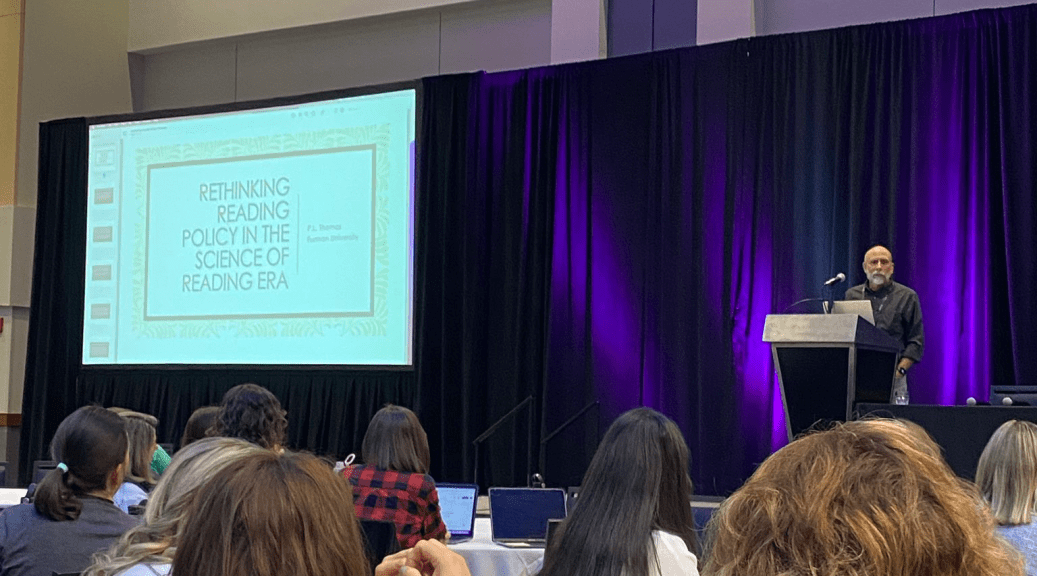
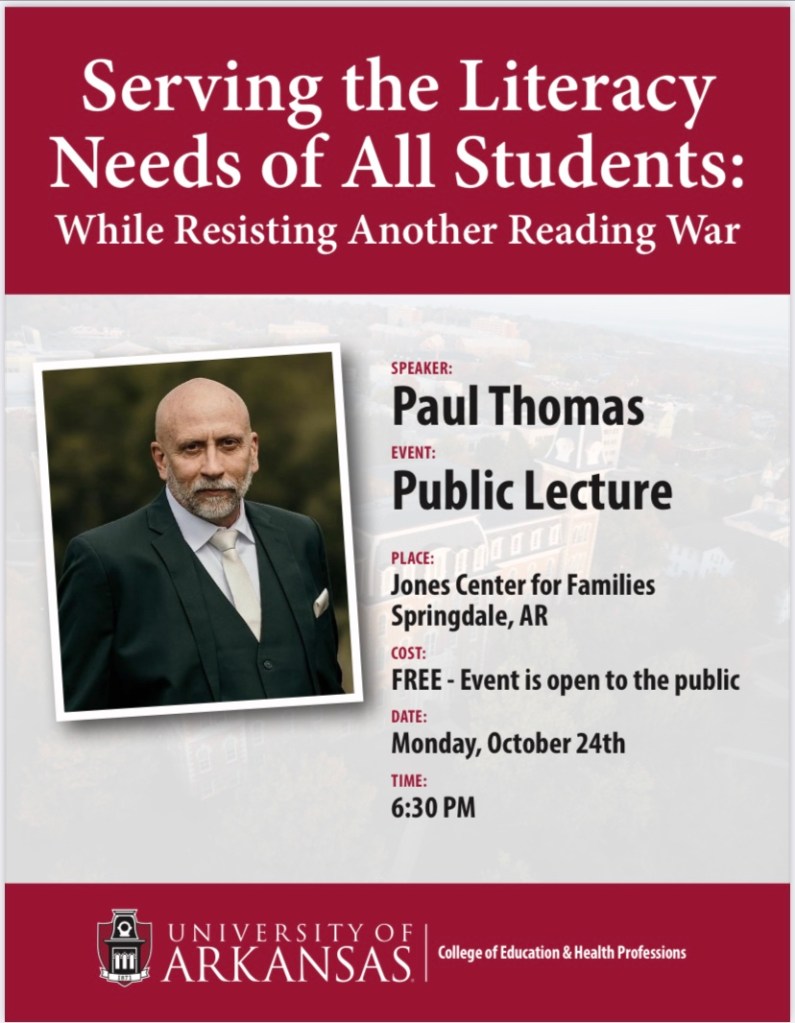
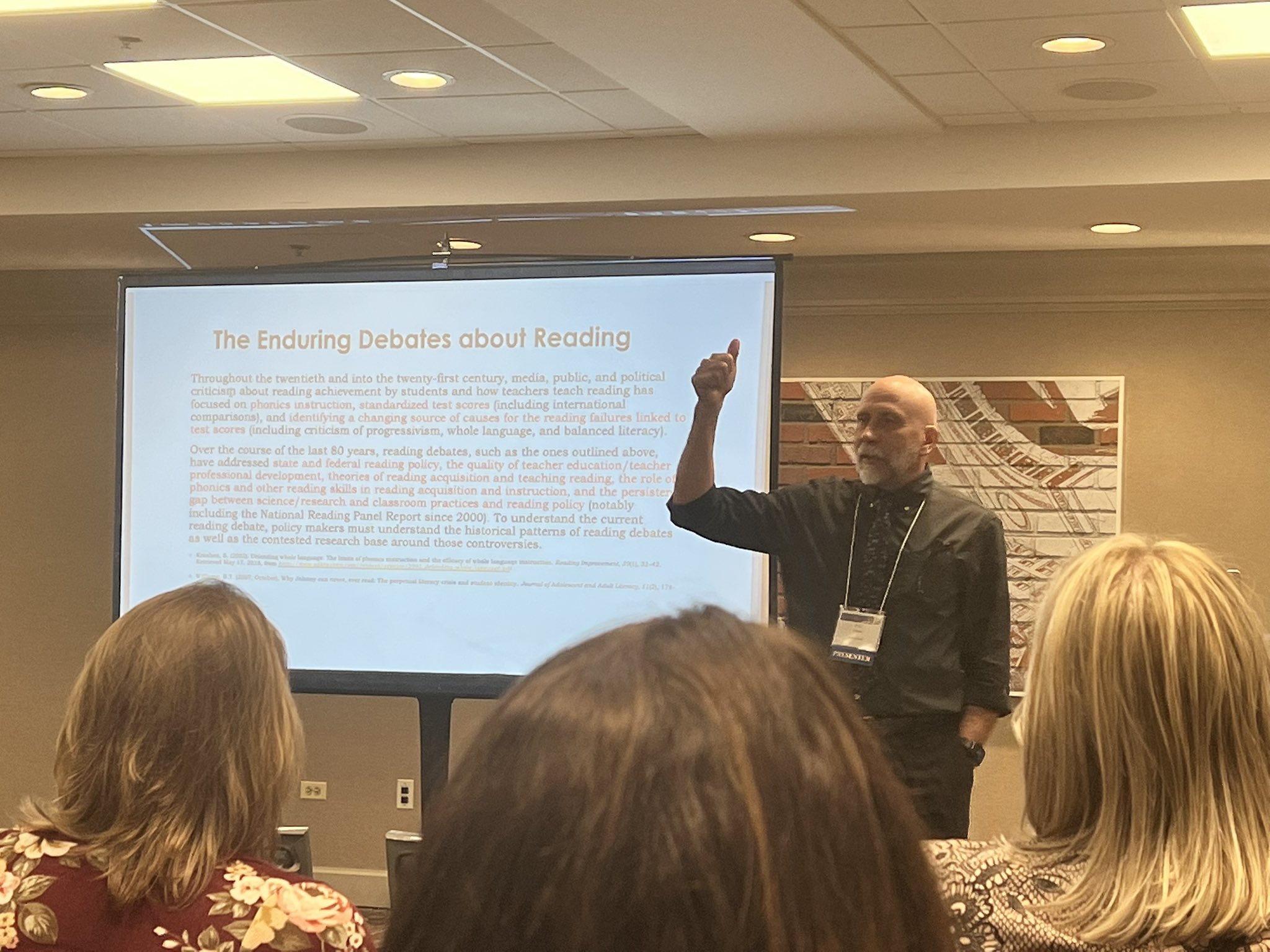
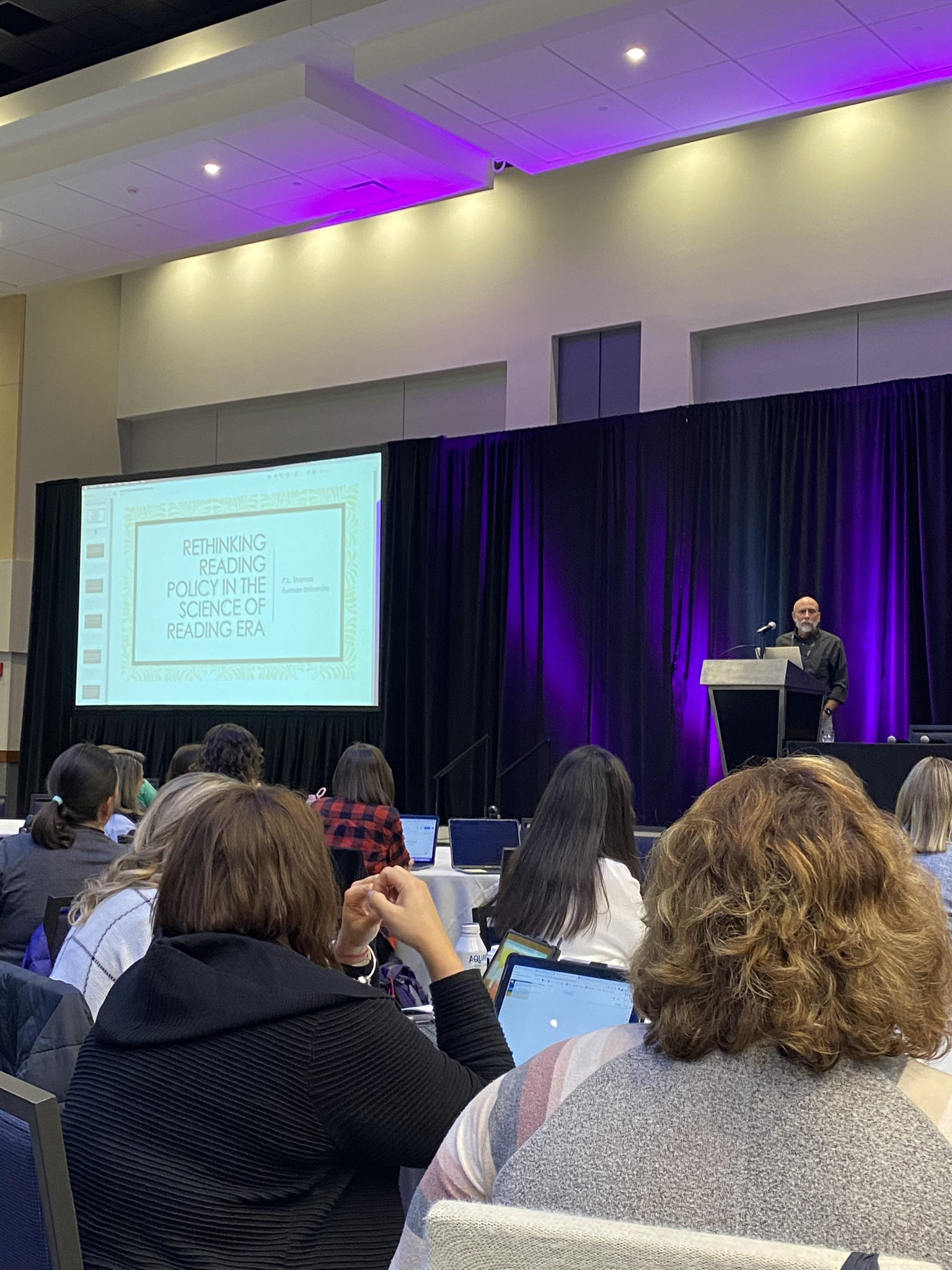
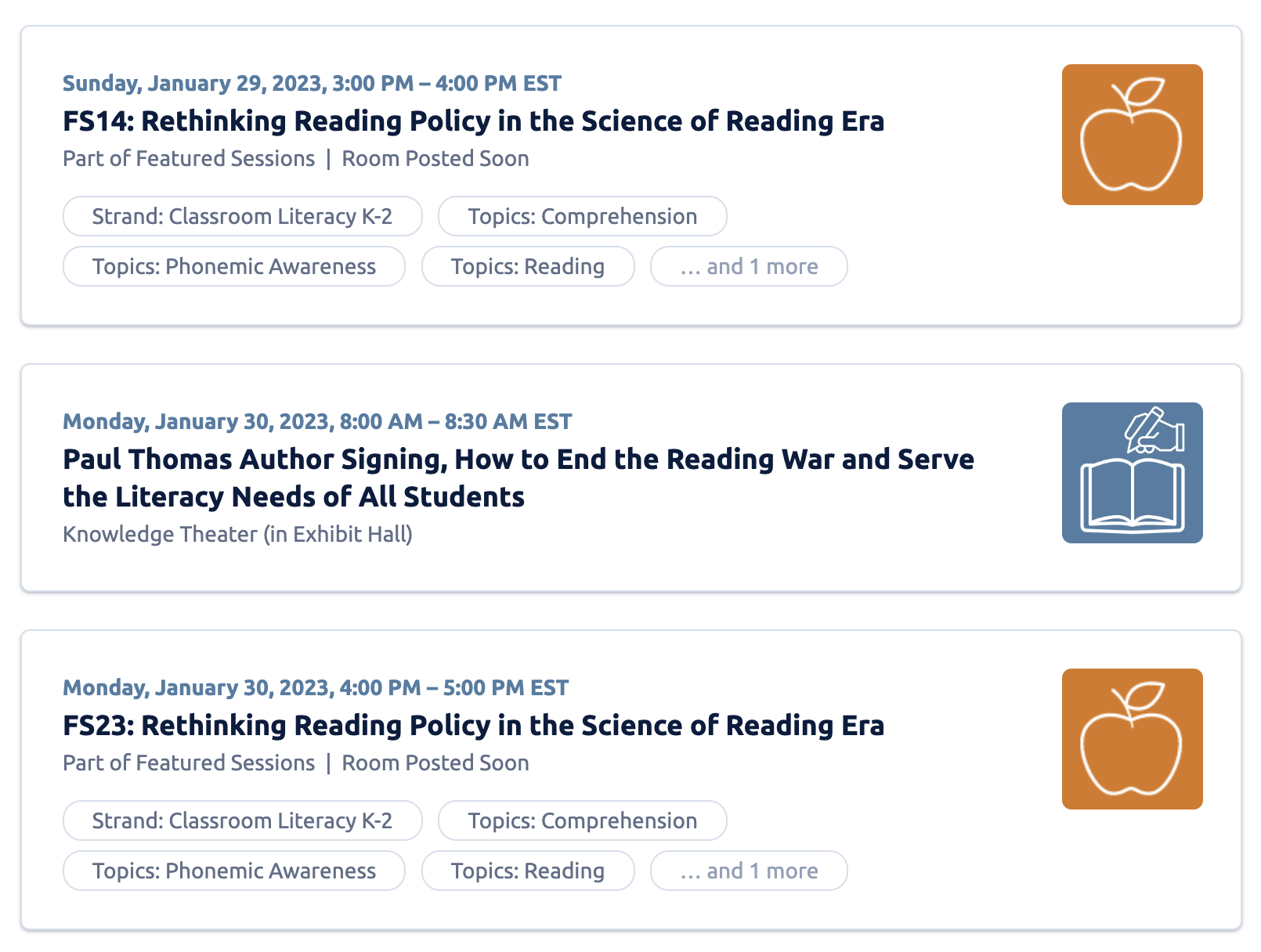
However, if anything, my scholarly schedule is more packed than at any time in my career. If you are interested in my work, I invite you to join me at the following presentations/keynotes and/or look for my upcoming publications.
Thomas, P.L. (2022). The Science of Reading movement: The never-ending debate and the need for a different approach to reading instruction. Boulder, CO: National Education Policy Center. Retrieved [date] from http://nepc.colorado.edu/publication/science-of-reading
Unpacking Reading Science to Inform a Different Path to Literacy
The “Science of Reading” movement that began in 2018 has gained momentum and has had outsized influence on state reading policy and classroom practice. However, the SoR movement presents two negative impacts on long-term literacy education—a commitment to the “simple view” of reading (SVR) and mandates for phonics-first instruction for all beginning readers. In this webinar, Paul Thomas, Ed.D. (Professor of Education, Furman University, and author of How to End the Reading War and Serve the Literacy Needs of All Students) places the SoR movement in the context of the robust but complex current state of reading science. Come join us on October 20, 2022, at 4 p.m. as we explore what’s next in literacy education.
Before anyone can, or should, answer “Do you support/reject the ‘science of reading’?” we must first clarify exactly what the term means. I detail the three ways the phrase currently exists since it entered mainstream media during 2018. “Science of reading” as discourse, as marketing, and as a research base.
Let me start with a caveat: Don’t debate “science of reading” advocates on social media. However, if you enter into a social media or real-life debate, you must keep your focus on informing others who may read or hear that debate, and be prepared with credible and compelling evidence.
Teaching Literacy in a Time of Science of Reading and Censorship
The key elements of the science of reading (SOR) movement as well as the current move the ban books and censor curriculum are outlined against historical and research-based contexts. The unique challenges facing literacy educators iden/fied with considera/on of how literacy teachers can maintain professional autonomy in the classroom and prac/ce ac/vism in pursuit of a more nuanced understanding of “science” and research as well as in support of academic freedom.
90-minute breakout sessions
Academic Freedom Isn’t Free: Teachers as Activists – 9:15 – 10:45 CT January 20, 2023
The US is experiencing one of the most significant waves of book bans and educational gag orders impacting academic freedom, access to diverse voices and history, and the safety of teachers and students. Teachers are historically required to be apolitical and avoid advocacy in and out of the classroom. This session examines the politics of calling for no politics among educators, and explore with participants both the need to advocate for their professional autonomy and academic freedom as well as for academic freedom.
Unpacking the “Science” in the Science of Reading for a Different Approach to Policy and Practice – 11:30 – 1:00 CT January 20, 2023
The science of reading (SOR) movement and the use of the “science of reading” in marketing literacy programs have had a significant impact on reading policy and practice across the US since 2018. Policy and practice related to dyslexia, adopting reading programs, teaching reading (and the role of phonics instruction), however, have too often been guided by a misleading and overly simplistic version of SOR portrayed in the media and advocated by parents and politicians. This session examines the contradictions between claims made by SOR advocates and the current research base.
Since 2018, states have been revising or adopting new reading legislation prompted by the science of reading movement. Placed in the context of several reading crises over the last 100 years, however, this movement is deja vu all over again, destined to fail and be replaced by another reading crisis in the near future. This session explains why and offers a new approach to reading policy at the state, district, and school levels.
Creating Worlds of Possibility: Closing Our Opportunity Gaps Through Recognizing the Sciences of Literacy and Learning
Expert Panel Discussion with Dr. Annalee Good, Dr. Lara Handsfield, Dr. Carol Lee, Dr. Paul Thomas, Dr. Don Vu
Thursday, February 9, 2:00-3:15C08
Banning Books Is Un-American
The U.S. is experiencing a wave of book censorship and educational gag orders. This session examines the historical context of censorship as it impacts the teaching of literacy and literature by focusing on writer Kurt Vonnegut’s response to censors. The session will include powerful policy and position statements supporting the rights of teachers to teach and students to learn, including The Students’ Right to Read (NCTE), Freedom to Teach: Statement against Banning Books (NCTE), and Educators’ Right and Responsibilities to Engage in Antiracist Teaching (NCTE). Participants will have an opportunity to discuss and explore how and why educators must and can seek ways to defend academic freedom and thew right to teach and learn.
Friday, February 10, 9:45-11:00A10
The “Science of Reading” Multiverse
Since early 2018, the phrase “science of reading” has entered and often dominated media, public/parental, and political discourse around the teaching and learning of reading in the U.S. Before anyone can, or should, answer “Do you support/reject the ‘science of reading’?” we must first clarify exactly what the term means; therefore, in this session, then, I want to detail the three ways the phrase currently exists since it entered mainstream use in the media during 2018. The session will cover the research base around the SoR movement for context. Participants will be invited to discuss their experiences with these three versions as well.
Marriott Hilton Head Resort and Spa, Hilton Head Island, South Carolina
Friday, February 24, 2023, 8:00 – 9:00
Invited Speaker: Rethinking Reading Science: Beyond the Simple View of Reading, Paul Thomas
Focusing on reading science published since 2018 addressing reading, dyslexia, and phonics, this session details a complex but robust state of reading science. Media and think-tank messaging parents, political leaders, and the public are receiving about the “science of reading” are oversimplified, cherry-picked, and contradictory to that current state of reading science. Classroom teachers deserve the autonomy to interrogate reading science, understand the individual needs of all their students, and then the teaching and learning conditions to serve those students with evidence-based practice.
Saturday, February 25, 2023, 10:15 -11:15
Panel: Carving a Path Forward: Equity, Neuroscience, Policy Mandates and Literacy Education
Peter Greene, former teacher and one of the best public thinkers about education today, found this Tweet “familiar” as a veteran of education reform debates:
Thinking one can just stride into a field and quickly solve/dismiss problems really smart people have thought long and hard about for years takes extraordinary hubris & often fails to honestly acknowledge the multiple forces that led to one’s own success 2/2
Greene and I share long careers in education and the mind-numbing experience of rebuking education reform claims and policies over the last few decades. Education reform, in fact, has followed the exact path Richard Sever warns against in his Tweet.
While some of the larger aspects of the education reform movement that began after A Nation at Risk was released under Ronald Reagan have sputtered—charter schools, Teach For America, standards and high-stakes testing, stack ranking and value-added methods for teacher evaluation—the reform du jour is focused on reading.
Since the mid- to late 2010s—specifically 2018—the science of reading (SOR) movement has been driven by media and parental advocacy, resulting in new or revised reading legislation in dozens of states across the U.S. [1]
The problem is that political leaders are disproportionately influenced by inexpert advocacy such as Emily Hanford’s journalism and parent organizations for dyslexia (Decoding Dyslexia).
Journalists and parents often share missionary zeal for topics, especially issues related to education, but lack historical, disciplinary, and statistical expertise to see clearly both the very real failures in education and the complex solutions that are needed.
Are too many students being mis-served as emerging readers in our schools, as media claim? Yes!
Is the current education system failing to identify and serve students with reading challenges, including dyslexia, as parents claim? Yes!
None the less, media and parental evidence, claims, and demands for solutions are mostly jumbled, misleading, and not scientific.
And the really bad news is that political leaders and the public receive almost exclusively the misleading messaging from media and parent advocates, but not the high-quality scholarship that debunks the claims and offers more credible and needed solutions.
For example, Hanford’s “Hard Words” and Decoding Dyslexia’s advocacy are both compelling on the surface, especially to the general public and political leaders with no background in education or literacy.
Hanford triggered the SOR movement by highlighting the claimed outlier success of schools in Bethlehem, Pennsylvania linked to a phonics-intensive program and increased test scores, for example:
This arguments fits into the larger education reform narrative started decades ago—that poverty is an excuse (and thus the “no excuses” reform movement) and that simply changing how we teach students can increase achievement (in-school only reform absent social change).
As those of us in education have witnessed since the 1980s, this argument is very compelling to the public and political leaders, and it is completely false.
“Miracle” schools, in fact, do not exist. [2]
The problem with media covering education miracles is that the basic evidence is both accurate and deeply misleading.
Because of pressures to raise test scores during the accountability era of education, many educators and policy makers have found ways to raise scores, but those test score gains are mostly weak forms of assessment (do they really measure what they claim?) and those gains often disappear over time (see the Florida model that uses grade retention to raise scores [3]).
To the first concern—are the test scores measuring reading?—those of us in the field of literacy recognized that the test data is from DIBELS, a phonics-intensive program that teaches and then measures students’ ability to pronounce real and nonsense words.
In other words, this test defines reading as “pronunciation”—not comprehension, which intensive phonics instruction does not increase [4] and which, in most cases, is what we mean when we are concerned about “reading.”
Therefore, yes, these schools did raise pronunciation test scores among high-poverty students, but no, this is not a reading miracle.
And to the second concern—are increased test scores real, sustained learning over time?—Gerald Coles investigated and discovered:
As I noted above, follow-up studies on the effects of early phonics programs have failed to find long-term benefits on reading achievement. Therefore, I wrote to two administrators in the Bethlehem schools, asking for information about the students’ reading ability in later grades. Neither replied to my request. Consequently, I used the publicly available Pennsylvania reading/language arts tests results, which provided scores for Bethlehem schools. By these measures, the reading achievement for students in SBSL early-reading program either stayed the same as students who had not used the program in previous years or else made only very modest improvement….
[T]here is Hanover Elementary school, where only 15.6 percent of students qualify for free or discounted lunch. There the impact of students’ economic circumstances was clearly in the opposite direction: About 85 percent of its students—virtually the same percentage as lunch standards—met the reading/language arts standards both before and after the introduction of SBSL program. Similar parallels between the beginning reading skills program and literacy outcomes can be found for all other Bethlehem schools.
Like almost all the “miracle” claims before this—often among charter school advocates—Bethlehem, PA is a mirage, not a miracle.
But this misrepresentation is typical of media coverage of SOR in that journalists advocate for “science” but use “anecdotes” as their evidence. In short, Hoffman, Hikida, and Sailors conclude: “the SOR community do not employ the same standards for scientific research that they claimed as the basis for their critiques.”[5]
Parental advocacy has the same problems as media advocacy, as represented by the Decoding Dyslexia movement. Richard Allington has detailed that Decoding Dyslexia is both highly effective in advocating for dyslexia legislation while also being misinformed about the complexity of dyslexia, a highly contested diagnosis within the fields of literacy and special needs.
Parents advocating for struggling readers is grounded in a valid concern. However, recent overviews of the research on dyslexia and the International Literacy Association (ILA) have clearly detailed the following: (1) no clear definition for identifying dyslexia exists, (2) no one instructional approach is appropriate for all students identified with dyslexia (including Orton-Gillingham phonics or systematic phonics for all students), (3) universal screen for dyslexia is likely to cause more harm than good, and (4) teacher expertise and autonomy are essential for teaching any students struggling to read.
Yet, parents advocating for dyslexia endorse policy and practices counter to that research while also likely greatly overestimating the number of students who should be identified as dyslexic.
The irony of the SOR movement promoted by media and parental advocacy is that it is significantly out of touch with the evidence, the research, and the science.
The media and parents certainly can and should play a role in monitoring how well our education system teaches reading and serves the needs of all students. But neither the media or parents are credible advocates for identifying either the problems or the solutions around reading achievement.
Media and parents demonstrate both the hubris Richard Sever warned about in his Tweet and the tragic flaw of hubris portrayed in literature for eons. The expertise and humility that come with understanding the complexity of science and research, it seems, is far more important than good intentions and the sort of arrogance that comes from never having thought long and deeply about an issue.
[1] Cummings, A. (2021). Making early literacy policy work in Kentucky: Three considerations for policymakers on the “Read to Succeed” act. Boulder, CO: National Education Policy Center. Retrieved May 18, 2023, from https://nepc.colorado.edu/publication/literacy
Cummings, A., Strunk, K.O., & De Voto, C. (2021). “A lot of states were doing it”: The development of Michigan’s Read by Grade Three law. Journal of Educational Change. Retrieved April 28, 2022, from https://link.springer.com/article/10.1007/s10833-021-09438-y
Collet, V.S., Penaflorida, J., French, S., Allred, J., Greiner, A., & Chen, J. (2021). Red flags, red herrings, and common ground: An expert study in response to state reading policy. Educational Considerations, 47(1). https://doi.org/10.4148/0146-9282.2241
Huddleston, A. P. (2014). Achievement at whose expense? A literature review of test-based grade retention policies in U.S. school. Education Policy Analysis Archives, 22(18). http://dx.doi.org/10.14507/epaa.v22n18.2014
Jasper, K., Carter, C., Triscari, R., & Valesky, T. (2017, January 9). The effects of the mandated third grade retention on standard diploma acquisition and student outcome over time: A policy analysis of Florida’s A+ Plan. Policy Analysis.
[4] From Coles:
Based on the research on phonics in previous decades, cited in the Report of the National Reading Panel, these results should not be surprising. The conclusions of one study on phonics and similar word-level training represents the overall findings on intensive phonics instruction: Benefits for “reading comprehension were not significant” (Reading the Naked Truth, 92). A recent analysis by literacy researcher Jeff McQuillin drew similar conclusions from a large-scale study in England.20 Once again, “phonics instruction has a modest effect on initial literacy levels, but little to no impact on reading achievement in later grades.”
[5] Hoffman, J.V., Hikida, M., & Sailors, M. (2020). Contesting science that silences: Amplifying equity, agency, and design research in literacy teacher preparation. Reading Research Quarterly, 55(S1), S259. https://doi.org/10.1002/rrq.353