A core aspect of George W. Bush’s No Child Left Behind (NCLB) legislation in 2001 was the report from the National Reading Panel (NRP) [1].
The NRP report represents a key feature of NCLB that isn’t being interrogated fully during the current “science of reading” (SOR) movement: NCLB mandated that instructional practices must be scientifically based (similar to the call for reading instruction to be “scientific” today).
If federal legislation already mandated reading instruction must be research-based two decades ago, why are we experiencing yet another Chicken Little moment claiming that teachers and teacher educators do not know or simply refuse to implement the SOR?
First, the NRP demonstrates key problems with identifying the research base along with then finding practical ways to inform day-to-day classroom instruction with that evidence.
The best way to describe the results of the NRP, then, is that it was a highly contested report that claimed to identify the then-current state of scientific research on how children acquire reading and how best to teach reading.
When the report was issued, Joanne Yatvin, a panel member, challenged the panel for lacking classroom teachers, protested the narrow definition of “scientific” the panel used to review the then-current state of evidence on reading, and predicted (accurately) that the panel findings would be misrepresented.
See Yatvin’s work here:
Yatvin, J. (2002). Babes in the woods: The wanderings of the National Reading Panel. The Phi Delta Kappan,83(5), 364-369
The NRP findings also were challenged by scholars such as Elaine Garan; see here:
Garan, E. M. (2001, March). Beyond smoke and mirrors: A critique of the National Reading Panel report on phonics. Phi Delta Kappan, 82(7), 500– 506. https://doi.org/10.1177/003172170108200705
The NRP report and the debates prompted by the report are a stark lesson in the problems surrounding establishing the “science” of anything in education, but the report also demonstrates the essential problem with politicizing both research and educational policy/practice.
The NRP was a political vehicle similar to Reagan’s A Nation at Risk, and the result is not a dispassionate overview of research on reading but a distorted report driven by internal and external ideological biases.
That political element, in fact, brought the promises of the NRP and scientifically-based reading practices to its ultimate demise—a Reading First scandal grounded in federal funding and textbook adoption.
When the NRP was released and throughout the 2000s, then, the only fair way to describe the findings of the NRP was that the report was contested within the field of literacy, overly narrow, and ultimately derailed by political and ideological bias.
None the less, the NRP introduced a framework, the five pillars of reading, that remains influential today: Phonemic Awareness, Phonics, Fluency, Vocabulary, and Comprehension.
However, as Yatvin warned, what the NRP found is typically misrepresented, especially related to phonics; one extremely useful source for understanding what the NRP concluded is a teacher’s guide created by Diane Stephens in 2008:
Here, paraphrased, are the key points highlighted by Stephens (herself quoting directly from the report):
Phonemic Awareness: PA is a “means rather than an end”; doesn’t increase comprehension; only one of many elements needed to read independently.
Phonics: Minimal value in kindergarten; no conclusion about phonics beyond grade 1 for “normally developing readers”; systematic phonics instruction in grades 2-6 with struggling readers has a weak impact on reading text and spelling; systematic phonics instruction has a positive effect in grade 1 on reading (pronouncing) real and nonsense words but not comprehension; at-risk students benefit from whole language instruction, Reading Recovery, and direct instruction.
Fluency: The ability of students to make sense of text grammatically and with understanding of punctuation.
Vocabulary: Vocabulary is acquired many ways by readers; number of words acquired cannot be accomplished through direct instruction. About 1/3 of vocabulary learning in grades 3 – 8 linked to reading.
Comprehension: Weak evidence in report on comprehension. Emphasizes need for SBRR (scientifically based reading research) and “putting teachers in positions where their minds are the most valued educational resource.”
A short but accurate point to emphasize here is that the NRP did not (even discounting its contested process) find that systematic phonics instruction was essential for all students throughout the early years of schooling.
NRP in 2018-2022
The SOR movement has resurrected not only the NRP report and findings but also the zombie politics of misrepresenting the NRP findings.
A consistent aspect of the media messaging about the SOR has been citing NRP findings as proof that all students need systematic phonics instruction—from Hanford’s “Hard Words,” ground zero of the movement, to a recent critical piece by Goldstein on Lucy Calkins (the only research cited is the NRP report [2]).
One of the important ironies and contradictions of the SOR movement is that findings from the NRP are now twenty years old, and a robust body of research has both expanded and contested those findings. Notably, since SOR advocates often cite the NRP, many scholars have revisited and carefully detailed the flaws and misunderstandings surrounding the report
Seidenberg, M.S., Cooper Borkenhagen, M., & Kearns, D.M. (2020). Lost in translation? Challenges in connecting reading science and educational practice. Reading Research Quarterly, 55(S1), S119– S130. https://doi.org/10.1002/rrq.341
Bowers, J.S. (2020).Reconsidering the evidence that systematic phonics is more effective than alternative methods of reading instruction. Educational Psychology Review, 32(2020), 681–705. https://link.springer.com/article/10.1007%2Fs10648-019-09515-y
Collet, V.S., Penaflorida, J., French, S., Allred, J., Greiner, A., & Chen, J. (2021). Red flags, red herrings, and common ground: An expert study in response to state reading policy. Educational Considerations, 47(1). https://doi.org/10.4148/0146-9282.2241
Important to note is that even Seidenberg (a cognitive scientist strongly endorsing the SOR) concludes with Borkenhagen and Kearns: “[T]he main point is that the report was not a sufficient basis for designing an effective reading curriculum, but that is how it is frequently taken—today.”
Further, Bowers offers a solid clarification about drawing conclusions from the NRP reports on phonics:
In sum, rather than the strong conclusions emphasized the executive summary of the NRP (2000) and the abstract of Ehri et al. (2001), the appropriate conclusion from this meta-analysis should be something like this:
“Systematic phonics provides a small short-term benefit to spelling, reading text, and comprehension, with no evidence that these effects persist following a delay of 4–12 months (the effects were not reported nor assessed). It is unclear whether there is an advantage of introducing phonics early, and there are no short- or long-term benefit for majority of struggling readers above grade 1 (children with below average intelligence). Systematic phonics did provide a moderate short-term benefit to regular word and pseudoword naming, with overall benefits significant but reduced by a third following 4–12 months.”
Bowers, J.S. (2020).Reconsidering the evidence that systematic phonics is more effective than alternative methods of reading instruction. Educational Psychology Review, 32(2020), 681–705. https://link.springer.com/article/10.1007%2Fs10648-019-09515-y
Since policy and classroom practice were significantly impacted after the NRP was released, and the NRP again is significantly influencing policy and practice today because of the SOR movement, if we genuinely are dedicating ourselves to scientific research to inform classroom practice, then we must no longer cite the NRP since it is both a politically flawed report carefully contested by literacy scholars for twenty years and since the current understanding of that science is better represented by recent scholarship (including those cited above).
Ultimately, the NRP report is merely an artifact in the history of the long and tedious reading debate that recurs every decade or so, negatively impacts classroom practices, and then recycles itself like scenes in Groundhog Day.
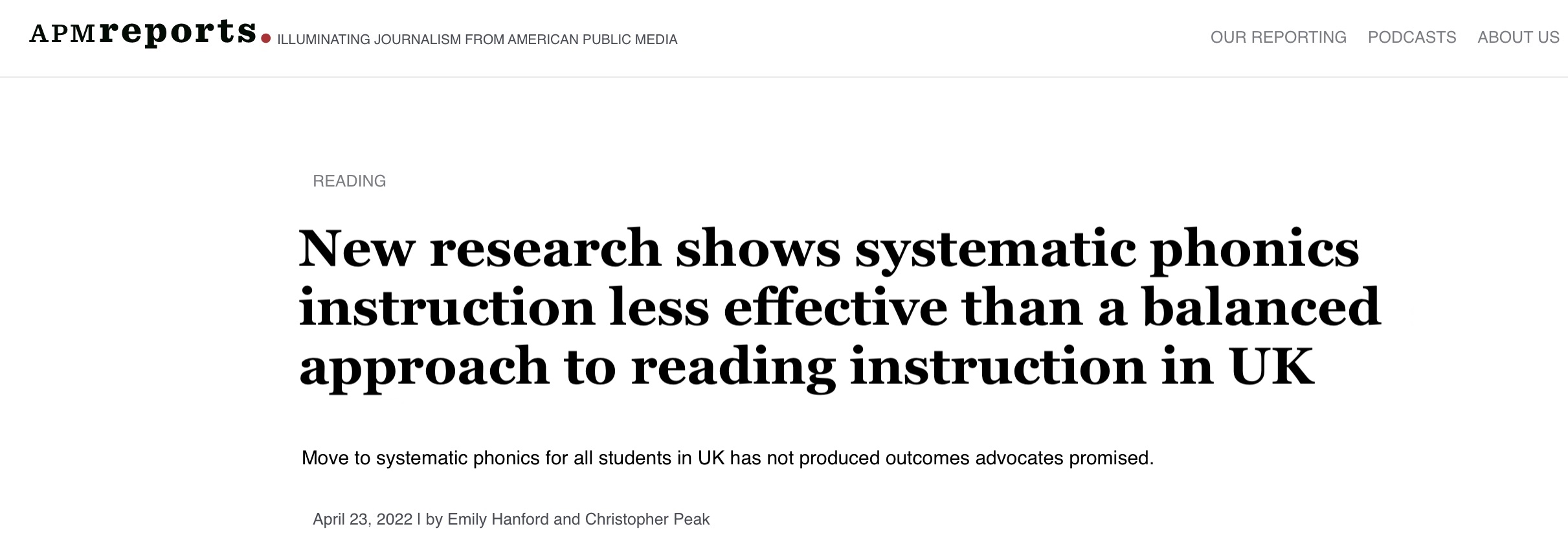
The media, advocates for reading, and political leaders would be better served focusing on current evidence available about how to teach reading and the complicated place of phonics instruction in that process. For example, England implemented systematic phonics mandates in 2006, and recent research has challenged that policy, concluding, once again, a need for balanced approaches to reading instruction that are student-centered and driven by teacher autonomy and expertise.
In 2022, citing the NRP is nothing more than zombie politics that erodes the credibility of anyone who continues to use those reports as proof of the SOR.
But in recent years, parents and educators who champion the “science of reading” have fiercely criticized Professor Calkins and other supporters of balanced literacy. They cite a half-century of research that shows phonics — sound it out exercises that are purposefully sequenced — is the most effective way to teach reading, along with books that build vocabulary and depth.
Margaret Thornton (Princeton) offered on Twitter the essential problem with this mainstream media coverage:
Some thoughts on @danagoldstein’s piece on reading instruction today. Lucy Calkin’s work is really questionable for the same reason the “science of reading” is: The research doesn’t say what proponents often want it to say.
— Margaret Thornton, Ph.D. (she/her/hers) (@MaggieEThornton) May 22, 2022
Goldstein’s uncritical use of “science of reading” propaganda fits into a pattern of mainstream media, particularly the work of Emily Hanford, that weaponizes “science” while trafficking in anecdote and grand misrepresentations. Hoffman, Hikida, and Sailors explain:
Hanford critiqued approaches named as balanced literacy and whole language without citing any evidence around these claims. She continued with anecdotes on how a focus on the SOR has improved student performance, but there is not a single citation of evidence in support of this claim. … It is clear that the repeated critiques of literacy teacher preparation expressed by the SOR community do not employ the same standards for scientific research that they claimed as the basis for their critiques.
Hoffman, J.V., Hikida, M., & Sailors, M. (2020). Contesting Science That Silences: Amplifying Equity, Agency, and Design Research in Literacy Teacher Preparation. Reading Research Quarterly, 55(S1), S255-S266. https://doi.org/10.1002/rrq.353
The NYT’s article on Calkins has several significant problems. First, since the bar in journalism for citing evidence is much lower than in academia, the piece itself oversimplifies and misrepresents complex and important issues about reading and teaching reading, often with no citation or by cherry-picking (and misrepresenting) a single link to evidence.
Next, the fundamental problem with the article is the continued uncritical acceptance by mainstream media of the “science of reading” movement and marketing. This last point, the marketing aspect of the “science of reading,” must not be ignored since phonics-heavy programs are committed to taking market share away from current popular reading programs such as those by Calkins and Fountas and Pinnell.
And finally, the framing of the article fails to recognize, as Thornton does (as well as Hoffman, Hikida, and Sailors), that both Calkins’s programs and the “science of reading” deserve critical interrogations against research and best practice.
Goldstein’s lede begins in misrepresentation and without citation: “For decades, Lucy Calkins has determined how millions of children learn to read. An education professor, she has been a pre-eminent leader of ‘balanced literacy,’ a loosely defined teaching philosophy.”
“Balanced literacy” (BL) is not “loosely defined,” and even so, that definition is quite accessible and important to this discussion:
A balanced approach to literacy development is a decision-making approach through which the teach makes thoughtful choices each day about the best way to help each child become a better reader and writer. A balanced approach is not constrained by or reactive to a particular philosophy. It is responsive to new issues while maintaining what research has already shown to be effective. It is an approach that requires and frees a teacher to be a reflective decision maker and to fine tune and modify what he or she is doing each day in order to meet the needs of the child.
Spiegel, D. (1998). Silver bullets, babies, and bath water: Literature response groups in a balanced literacy program. The Reading Teacher,52(2), 114-124. www.jstor.org/stable/20202025
That definition, in fact, directly contradicts the “science of reading” propaganda that phonics is rejected by BL advocates and programs. Goldstein reports without context: “But in recent years, parents and educators who champion the ‘science of reading’ have fiercely criticized Professor Calkins and other supporters of balanced literacy.”
Yes, there are critics of BL, but more often than not, those critics are simply misinformed and that criticism is misguided.
However, the false representation of BL is matched only by the skewed misrepresentation of teaching phonics: “They cite a half-century of research that shows phonics — sound it out exercises that are purposefully sequenced — is the most effective way to teach reading, along with books that build vocabulary and depth.
This link, a rare citation, refers readers to the National Reading Panel (NRP), which raises two problems. The NRP was widely discredited (see Garan) when it was released as a cornerstone of NCLB, and since that release, the findings of the NRP have been repeatedly misrepresented (See Yatvin).
The NRP found that systematic phonics was effective in grade 1 only, and that effectiveness was linked to pronunciation, and not comprehension (see Stephens).
Since the inception of “science of reading” movement, the persistent misrepresentation of systematic phonics for all students (and students with dyslexia [see ILA, 2016 and Johnston and Scanlon, 2021) is discredited by a number of studies:
Bowers, J.S. (2020). Reconsidering the evidence that systematic phonics is more effective than alternative methods of reading instruction. Educational Psychology Review, 32(2020), 681–705. https://link.springer.com/article/10.1007%2Fs10648-019-09515-y
Davis, A. (2013, December 13). To read or not to read: Decoding synthetic phonics. IMPACT No. 20. Philosophical Perspectives on Education Policy. https://doi.org/10.1111/2048-416X.2013.12000.x
Filderman, M. J., Austin, C. R., Boucher, A. N., O’Donnell, K., & Swanson, E. A. (2022). A meta-analysis of the effects of reading comprehension interventions on the reading comprehension outcomes of struggling readers in third through 12th grades. Exceptional Children, 88(2), 163–184. https://doi.org/10.1177/00144029211050860
Wyse, D., & Bradbury, A. (2022). Reading wars or reading reconciliation? A critical examination of robust research evidence, curriculum policy and teachers’ practices for teaching phonics and reading. Review of Review of Education, 10(1), e3314. https://doi.org/10.1002/rev3.3314
The last study, in fact, examines the systematic phonics mandate begun in 2006 throughout England (synthetic phonics); Wyse and Bradbury concluded:
Our findings from analysis of tertiary reviews, systematic reviews and from the SQMS do not support a synthetic phonics orientation to the teaching of reading: they suggest that a balanced instruction approach is most likely to be successful….
In addition to the importance of contextualised reading teaching as an evidence-based orientation to the teaching of reading we hypothesise the following pedagogical features that are likely to be effective. Phonics teaching is most likely to be effective for children aged five to six. Phonics teaching with children younger than this is not likely to be effective. A focus on whole texts and reading for meaning, to contextualise the teaching of other skills and knowledge, should drive pedagogy. Classroom teachers using their professional judgement to ensure coherence of the approach to teaching phonics and reading with other relevant teaching in their classroom is most likely to be effective. Insistence on particular schemes/ basals, scripted lessons, and other inflexible approaches is unlikely to be optimal. Well-trained classroom assistants, working in collaboration with their class teachers, could be a very important contribution to children’s reading development.
Wyse, D., & Bradbury, A. (2022). Reading wars or reading reconciliation? A critical examination of robust research evidence, curriculum policy and teachers’ practices for teaching phonics and reading. Review of Review of Education, 10(1), e3314. https://doi.org/10.1002/rev3.3314
The most recent research, then, on national mandates for systematic phonics instruction concludes the need for “balance,” and pedagogical practices that strongly match Spiegel’s original definition for BL.
One other claim lacking any link to evidence focuses on the narrow view of “science” being promoted by the “science of reading” movement: “With brain science steadily adding to that evidence, there is a sense — at least for many in the education establishment — that the debate over early reading instruction may be ebbing. Phonics is ascendant.”
Several problems exist with invoking “brain science,” as explained by Yaden, Reinking, and Smagorinsky
[W]e specifically address four limitations that we believe raise questions about the assumptions underlying, and thus conclusions reached, when the SOR is limited to the nature side of the binary and the experimental methods that typically accompany that view: (1) too heavy a reliance on a narrow conception of science claimed to be authoritative and monolithic, (2) too little accounting for environmental factors that complicate the idea that the brain functions identically across the whole of the human population, (3) an exclusive view that experimental designs and replicability are the gold standard of scientific research when other approaches have generated many useful insights, and (4) dismissal of all other conceptions of reading as unscientific and, therefore, of marginal value in generating knowledge about reading and how to teach it.
Yaden, D.B., Reinking, D., & Smagorinsky, P. (2021). The trouble with binaries: A perspective on the science of reading. Reading Research Quarterly, 56(S1), S119– S129. https://doi.org/10.1002/rrq.402
This article misreads Calkins/Units of Study and the “science of reading,” and thus, readers do not get the central message: This shift by Calkins is a market response to state legislation banning the adoption of Units of Study; this shift is not a concession that the “science of reading” is right.
Further, the result of this extended critique of Calkins and Units of Study is that the reasonable and needed challenges to this or any reading program is reduced to a propaganda vehicle for the “science of reading.”
As I have examined before, the problem with Calkins’s Units of Study and BL is how the program is implemented. Many teachers find the prescriptive and silver-bullet approaches to any program or ideology as de-professionalizing and harmful to students.
Too often, teachers are being held accountable for implementing the program, covering the standards, and preparing students for (awful) high-stakes tests.
If we need a reading revolution, and we do, the blunt solution is that we must stop teaching programs, stop teaching reading ideologies, and stop teaching reading to children.
As some prominent authors of a reading program lamented recently, hit pieces on reading programs, grandstanding about the “science of reading,” and passing prescriptive and misguided reading legislation is all about the adults trying to one-up each other—and not about the students.
NYC Mayor Eric Adams is proving to be an unreliable source on just about anything he mentions. Adams seems more interested in crying false “crisis” for political gain than doing the hard work of political leadership.
First, crime:
On @fox5ny, @NYCMayor Adams says "I have never in my professional career, have never witnessed crime at this level," which is a very strange thing to say for someone who came up in the NYPD in the '80s and '90s.
Mayor Eric Adams announced Thursday the details of a plan to turn around a literacy crisis in New York City and, in particular, to serve thousands of children in public schools who may have dyslexia, an issue deeply personal to the mayor, who has said his own undiagnosed dyslexia hurt his academic career.
Unfortunately, neither Adams nor the NYT will receive the sort of public correcting for the nonsense in this article, but Lola Fadulu’s coverage of Adams’s dyslexia program is just as much political fearmongering as Adams’s misrepresentation of crime.
In fact, media, parents, and political leaders have been following a similar and misleading playbook for several years now—one that Fadulu and Adams demonstrate so perfectly it could read as parody:
Currently, there is a well-organized and active contingent of concerned parents and educators (and others) who argue that dyslexia is a frequent cause of reading difficulties, affecting approximately 20% of the population, and that there is a widely accepted treatment for such difficulties: an instructional approach relying almost exclusively on intensive phonics instruction. Proponents argue that it is based on “settled science,” which they refer to as “the science of reading” (SOR). The approach is based on a narrow view of science and a restricted range of research focused on word learning and, more recently, neurobiology, but pays little attention to aspects of literacy like comprehension and writing or dimensions of classroom learning and teacher preparation.
“School officials plan to screen nearly all students for dyslexia.” Universal screening for dyslexia is a crisis response to a false crisis. Johnston and Scanlon explain: “Good first instruction and early intervention for children with a slow start in the word reading aspect of literacy reduces the likelihood they will encounter serious difficulty. Thus, early screening with assessments that can inform instruction is important. Screening for dyslexia, particularly with instructionally irrelevant assessments, offers no additional advantage [emphasis added].”
“School leaders are requiring school principals to pivot to a phonics-based literacy curriculum, which literacy experts say is the most effective way to teach reading to most children.” Systematic phonics for all students, and specifically for students identified with dyslexia, is an old and false solution for students struggling with reading, per Johnston and Scanlon: “Evidence does not justify the use of a heavy and near-exclusive focus on phonics instruction, either in regular classrooms or for children experiencing difficulty learning to read (including those classified as dyslexic [emphasis in original].”
“New York is facing a literacy crisis: Fewer than half of all third to eighth graders and just 36 percent of Black and Latino students were proficient on the state reading exams administered in 2019, the most recent year for which there is data.” The NYT helped fuel the newest round of “reading crisis” in the U.S. with an over-reaction to 2019 NAEP reading scores, but the cold hard truth is that marginalized students have never been equitably served in NYC schools or anywhere in the U.S. as any point in history. (See how the reading crisis around NAEP is misrepresented HERE.)
“It is difficult to say how many children have dyslexia in the city because the department hasn’t been able to systematically identify them, said Carolyne Quintana, the deputy chancellor for teaching and learning. But she noted that national figures estimate that one in five children have dyslexia.” Dyslexia advocacy and political responses to dyslexia are misrepresenting dyslexia by overstating how common dyslexia is (some credible experts suggest dyslexia isn’t even a credible label for reading, in fact), and are ignoring that no common definition for dyslexia exists. “Definitions of dyslexia vary widely, and none offer a clear foundation—biological, cognitive, behavioral, or academic—for determining whether an individual experiencing difficulty with developing word reading skill should be classified as dyslexic,” Johnston and Scanlon conclude.
“Naomi Peña said she has four children with dyslexia, and is one of several parents who helped launch the Literacy Academy Collective, an advocacy group.” Parental advocacy groups addressing dyslexia have had direct impact on reading and dyslexia policy across the U.S.; however, that impact has overwhelmingly prompted misguided legislation and policy. Writing about similar political responses to dyslexia in Tennessee, Allington raises a key concern: “What I find most disturbing about the recent Tennessee dyslexia law is the absence of any input from the Literacy Association of Tennessee (LAT) as well as the absence of members of the Dyslexia Advisory Council drawn from the membership of LAT.”
“The additional support includes more intensive instruction steeped in the Orton-Gillingham approach [1], which teaches reading with more hands-on methods that break down words into smaller, more digestible parts.” While the larger push for systematic phonics instruction for all students is misguided, advocates for dyslexia often focus on Orton-Gillingham specifically. Yet, as the International Literacy Association (ILA) shows: “As yet, there is no certifiably best method for teaching children who experience reading difficulty (Mathes et al., 2005). For instance, research does not support the common belief that Orton-Gillingham–based approaches are necessary for students classified as dyslexic (Ritchey & Goeke, 2007; Turner, 2008; Vaughn & Linan-Thompson, 2003).”
“Under the new plan, school officials will require principals, who can choose their curriculums, shift toward a reading program that is based in reading science. Many currently use one developed by Lucy Calkins, an academic at Teachers College, Columbia University, that has repeatedly come under fire.” The dyslexia movement is part of a larger “science of reading” movement that overemphasizes the role of systematic phonics but also attacks popular reading programs across the U.S. See How to Navigate Social Media Debates about the “Science of Reading” [UPDATED] for a thorough examination of the flaws with misusing the term “science.” See also A Response to EdReports’ Assessment of Units of Study for Teaching Reading, Writing and Phonics.
Media and political leaders as well as parent advocates are trapped in a false belief about reading and dyslexia—paralleling the public misunderstanding about crime rates.
Do students struggling to read, especially marginalized students, deserve to be better served in our schools? Absolutely, whether they are diagnosed with dyslexia or not.
But NYC’s plan is political fearmongering, not good policy or practice.
Political leaders would be well served to heed Johnston and Scanlon’s guidelines, including these:
Although there are likely heritable dimensions to reading and language difficulties, there is no way to translate them into implications for instructional practice….
Legislation (and district policies) aligned with the SOR perspectives on dyslexia will necessarily require tradeoffs in the allocation of resources for teacher development and among children having literacy learning difficulties. These tradeoffs have the potential to privilege students experiencing some types of literacy learning difficulties while limiting instructional resources for and attention available to students whose literacy difficulties are not due (exclusively) to word reading difficulties.
[1] Current research does not support O-G as more effective than other, and less expensive, methods; see here and these recent studies/overviews:
Johnston, P., & Scanlon, D. (2021). An examination of dyslexia research and instruction with policy implications. Literacy Research: Theory, Method, and Practice, 70(1), 107. Retrieved July 26, 2022, from https://doi.org/10.1177/23813377211024625
Hall, C., et al. (2022, September 13). Forty years of reading intervention research for elementary students with or at risk for dyslexia: A systematic review and meta-analysis. Reading Research Quarterly. Retrieved October 17, 2022, from https://doi.org/10.1002/rrq.477
Stevens, E. A., Austin, C., Moore, C., Scammacca, N., Boucher, A. N., & Vaughn, S. (2021). Current state of the evidence: Examining the effects of Orton-Gillingham reading interventions for students with or at risk for word-level reading disabilities. Exceptional Children, 87(4), 397–417. https://doi.org/10.1177/0014402921993406
Both studies (not-yet peer reviewed reading recovery study here, and peer-reviewed UK study here), by the way, are extremely important to anyone genuinely concerned about reading instruction. As a matter of fact, Reading Recovery has issued a thoughtful response to the research in the second, real, headline.
Since Emily Hanford established herself as the “science of reading” journalist in 2018, one would imagine that she would be fully invested in the full story of research on teaching reading. And of course, one would be wrong.
When people complain about bias, one aspect of bias often ignored is that all media determine what to cover and what not to cover (Hanford covers anything that seems to further the “science of reading” propaganda, and ignores anything that challenges it). In the case above, the research on reading recovery is easy to twist into the “science of reading” agenda, but the research from the UK is a whole different matter.
To be fair, both studies raise some important questions, but probably do not prove any agenda conclusively. Why is reading achievement in the UK stagnant despite mandating systematic phonics for all students since 2006? Why do students receiving reading recovery intervention seem to score lower than other students over time (in similar ways to grade retention outcomes) in longitudinal studies?
These are damn good questions. And simply asking them is a step in the right direction—recognizing there are no simple answers to teaching or learning how to read.
Yet, they are questions that media and political leaders are unlikely to ask much less answer. Because too many people are invested in the “science of reading” propaganda machine, including Hanford.
One is that if you have to lie or distort, you may not have a credible argument (see Hanford’s “science of reading” propaganda).
But a more valuable lesson is that we must have a much more nuanced and complex awareness about what it means to teach and learn reading. While I think many reading recovery teachers are doing important and effective work, we cannot have a simplistic faith that something with the “reading recovering” stamp is universally perfect.
As much as we would hope otherwise, there is no silver bullet.
That realization, however, should temper our understanding of the “science of reading” movement, an agenda that is paralyzed by its missionary zeal—and its persistent misinformation campaign that puts its agenda ahead of real concerns about effective teaching and learning.
Media advocates for the “science of reading,” Hanford and Natalie Wexler, for example, are doing far more harm than good because of their blind advocacy.
Journalists and politicians should not be determining how children learn to read. However, the public is often mislead by sensationalistic media coverage, such as that by Hanford—Mississippi Miracle! (well, “There’s no way to know for sure”), and Reading Recovery is a failure! (but … who knows?).
Here is a lesson: Don’t believe everything you read.
Here is a much harder lesson: Worry about what you don’t get to read.
When I saw this piece from 2019 pop up on my social media feed this week, I immediately noticed the subheading: “Scaling back small-group instruction would have dramatic improvements in literacy.”
Since Schmoker’s article fell solidly in the current “science of reading” crisis rhetoric and misguided reading policy being passed across the U.S., it certainly was poised to create even more harmful classroom level decisions for students and teachers.
Two aspects of this argument are compelling and misguided—the standard but false appeal to “third grade reading proficiency” and the prioritizing of “efficiency” for making instructional decisions.
Of course there are well documented correlations between third grade reading achievement and later negative educational outcomes for students (low reading achievement correlated with dropping out and low overall academic achievement, for example), but the traditional response to those correlations has resulted in over-reactions that do far more harm than good.
One of the worst over-reactions has been states adopting grade retention based on third grade reading assessments—despite grade retention having a causal relationship with students dropping out.
Doubling down on practices that increase students dropping out to address misunderstanding the research on third grade reading achievement is a profound failure in logic.
Some of the motivation for making these policy mistakes is that U.S. cultural norms are too often grounded in punishment. Many affluent and privileged people embrace the concept of grade retention as a way to insure that children are taught lessons about achievement and effort, but they also embrace punitive measures because they suspect grade retention, for example, will only impact “other people’s children.”
There is more than a little bit of racism and classism in the urge to embrace punitive schools and aggressive policing and legal systems.
But another source of making terrible policy decisions, especially about reading, is the core of Schmoker’s argument—determining instructional practices by prioritizing efficiency.
Although an enduring Urban Legend criticizes U.S. public education as essentially progressive (which it isn’t, and has never been), scholar Herb Kliebard detailed that by the early twentieth century U.S. public education had become driven by efficiency.*
One powerful example of that commitment is the use of standardized testing, primarily multiple choice tests that can be quickly scored, such as the SAT and most state-level accountability testing.
Despite decades of research showing that standardized testing is often a weak measure of learning, is most strongly correlated with status (socioeconomic, racial, gender), and creates inequity, standardized testing has persisted in the U.S. because it is more efficient than what we tend to call authentic assessment—essays, performances, projects, etc.
In fact, our blind commitment to efficiency is so strong that when we do use authentic assessment we now demand highly structured rubrics to insure that the grading is efficient (which erases the authentic nature of the assignment).
Formal education in the U.S. has structures that, of course, create the need for “efficiency”—grade levels around biological age and courses provided through a format that requires one teacher to serve the largest number of students possible (in K-12, typically 1 to 25-35, but university-level ratios can be 1 to hundreds of students).
Although universal education is a public good, we are bound by market forces when providing education for all children.
I do recognize that efficiency must be one concern for instructional practices, but I have witnessed across five decades of teaching since the 1980s that we overemphasize efficiency, especially in literacy instruction.
For 18 years as a high school English teacher, I struggled within a system demanding efficiency while attempting to teach writing authentically—a workshop method requiring students to write multiple drafts that I provided ample feedback on throughout the process.
This experience was physically and mentally exhausting; I left K-12 education with my right wrist in a brace from writing on about 4000+ essays per year for almost two decades.
Could I have implemented something identified as writing instruction more efficiently (and less taxing for me)? Of course.
But that would have been a lie (many efficient approaches, such as direct grammar instruction, is simply not writing instruction) and would have cheated my students.
Teaching first-year writing at the college level has further cemented my awareness that efficiency is extremely harmful for writing instruction effectiveness.
For example, teaching 100-125 students at a time (more efficient and the reality of high school English teaching) is far less effective than my current obligation to classes as small as 5 students and semester loads including no more than 3 or 4 dozen students (less efficient, more effective).
So this brings me back to the misguided “scaling back small-group instruction.”
As long as we are committed to current teacher/student ratios (one-on-one tutoring/mentoring is, of course, the ideal teaching/learning context), the best instructional approach to managing effectiveness and efficiency is balancing the whole-class, small-group, and individual instructional practices.
If anything, most K-12 teachers need to reduce whole-class instruction and increase small-group and individual instruction.
Why? Whole-class instruction is often the least effective of the three, particularly with writing instruction. For example, my first-year writing students continue to struggle with whole-class assignments and instruction but thrive in our face-to-face conferencing (even in comparison to the individualized instruction they receive from my comments on their essays).
But also, small-group and individualized instruction can often be, ironically, more efficient because that instruction is targeting identified need and allows student choice (instead of the teacher making all decisions for students).
Even the best whole-class instruction is addressing only some students’ needs. And another irony of whole-class instruction is that it tends to more effective after students have submitted authentic artifacts of learning that they are then required to revise (as opposed to giving great deal of instruction up front before students perform).
The ugly truth about prioritizing efficiency is that we are valuing coverage of prescribed instruction over student need or student learning.
Finally, we must acknowledge that teaching conditions are learning conditions. Current teacher/student ratios of 1/25-35 are cheating teachers and students. Yes, we should address those teaching/learning conditions.
But until that political commitment occurs, we must support teachers managing well the tension between effective and efficient. The trick, despite Schmoker’s claim, is maintaining our commitments to small-group and individualized instruction that targets identified student needs.
In fact, we we pull aside the curtain of efficiency, we discover that whole-class instruction as effective is a mirage.
Recommended
Callahan, R. E. (1962). Education and the cult of efficiency: A study of the social forces that have shaped the administration of the public schools. Chicago: The University of Chicago Press.
*NOTE: From Fallace and Fantozzi: “For Callahan (1962) and Kliebard (1995), social efficiency educators diverted progressive education away from the democratic ideas of John Dewey and Harold Rugg” (p. 145). As a critical scholar of the history of education (curriculum and instruction), I think we must make distinctions between the scholarly world (philosophy and theory) and the “real world” of day-to-day education. While I agree with the claim above, I also understand that nuanced and complex philosophy/theory often finds its way into practice in reductive and distorted ways (consider “behaviorism,” “whole language,” “progressivism,” etc.). My argument here is not about the actual social efficiency movement, but that some of the elements of that movement have manifested themselves in powerful and enduring ways (consciously and unconsciously) in how we “do” education in the U.S., one of which is prioritizing “efficiency” in harmful ways. My best example, again, is standardized, multiple-choice testing.
It seems almost quaint now, except for the racism, but in 2009, Representative Joe Wilson (R-SC) shouted “You lie” at Barack Obama. Post-Obama, the issue of political lies intensified dramatically, however, with Donald Trump building his presidential campaign on an extreme practice of lies that was well outside the norm of the sorts of lies people tend to expect from politicians.
In the wake of Trump, political lies have maintained the new low bar set by Trump; however, as I have detailed, there is a long history now of political leaders building their political careers on education reform, recently reading legislation, and that strategy in part depends on politicians, not educators, having the power to mandate standards, high-stakes testing, and most important of all, what counts as “proficiency” for reading achievement (currently, by the way, “proficiency” is set by each state with no federal oversight [see explanation here]—despite the stated goals of the Common Core movement to address that).
Many elements of the education reform movement begun in the early 1980s have served a similar political function, especially charter schools; the Obama administration, for example, solidified charter school expansion as a bi-partisan political strategy.
Since the release of the 2019 NAEP data on reading and after high-profile media coverage, a key example of politicians using reading achievement as political capital is Mississippi. The so-called “Mississippi Miracle” (a haunting cousin of the “Texas” and “Harlem” miracles that proved to be lies) is easily unmasked as a mirage (a lie) once the data is contextualized.
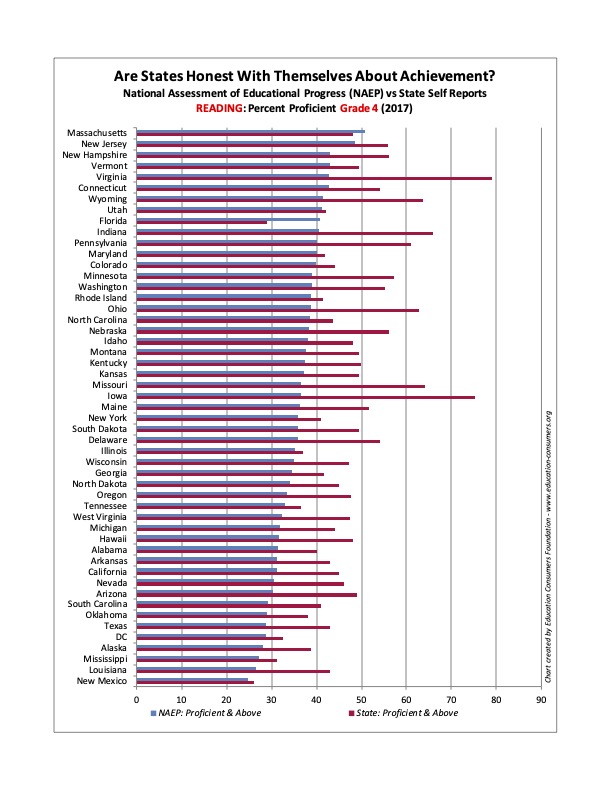
While Mississippi’s 2019 NAEP reading scores for 4th grade were heralded as an aspirational outlier, Mississippi is not alone in its effective political game of smoke and mirrors using reading proficiency scores; see the following comparison of state proficiency scores compared to national NAEP data:
Most states have some degree of lower standards for proficiency than NAEP, but the issue is not that NAEP is a credible measure of reading (it isn’t); the issue is that state-level reading proficiency is a political tool of elected officials.
As the scatterplot suggests, Mississippi has a fairly normal strong correlation between socioeconomic status and reading achievement (low poverty correlated with high scores and high poverty correlated with low scores). Yes, Mississippi has had a long pattern of raising reading scores since the 1998 while not closing key achievement “gaps” (see NAEP longitudinal data), but the state is not somehow miraculously serving high-poverty students (because of the “science of reading”) in a way that is superior to other states (whose failures are being falsely attributed to an absence of the “science of reading”).
While a perverse way to say it, Mississippi reading achievement isn’t a “miracle” (and there currently is no scientific evidence that reading achievement gains are caused by a switch to the so-called “science of reading”) but is mostly “normal” in terms of producing measurable student achievement that is more a reflection of socioeconomic status (and race) that actual achievement.
In short, if you look at the data from all states, you will find a pattern of political hype (lies) not matching the data.
Similar to Mississippi, my home state of South Carolina tends toward that normal, but since this tool allows adding charter schools, please note how charter school (red dots) achievement (as I have documented before) mostly matches traditional publics schools (TPS), with a few outperforming and several underperforming when compared based on similar demographics:
The key to charter school analysis is to compare charter and traditional public schools with similar demographics (in the scatterplot above, that is the vertical axis); note that most charter schools cluster with TPS, but several fall lower on achievement when compared to TPS.
None the less, a great deal of political capital has been and is currently being spent on claiming the “science of reading” has created “miracles” (a lie) and that charter schools save children in poverty and Black/brown students (another lie).
Reading achievement is once again a hot media and political topic, but that discourse and legislation coming from it, are mostly lies that are serving the needs of political leaders and not students.
LaBrant served as president of NCTE in the 1950s, and along with being an active and influential literacy scholar, LaBrant was a practitioner over a staggering 65 years of teaching.
LaBrant made two incisive claims in this article:
A brief consideration will indicate reasons for the considerable gap between the research currently available and the utilization of that research in school programs and methods. (p. 87)
It is not strange, in view of the extensive literature on language, that the teacher tends to fall back upon the textbook as authority, unmindful of the fact that the writer of the text may himself be ignorant of the basis for his study. (pp. 88-89)
Having written an educational biography of LaBrant for my doctoral dissertation, I am vividly aware that LaBrant taught and wrote as a complex progressive who used the term “research” in broad Deweyan terms that included everything from gold-standard experimental research to the daily observations made by classroom teachers.
I cite her because as a practitioner and scholar I also embrace a very complicated understanding of “research,” “evidence,” and the word of the moment, “science.” I am also deeply skeptical of textbooks and programs.
Since early 2018, the phrase “science of reading” has entered and often dominated media, public/parental, and political discourse around the teaching and learning of reading in the U.S.
Almost for as long—I discovered the movement a few months after it began—I have been waving a red flag, advocating for skepticism and extreme caution about that discourse, the media, public/parental, and political rhetoric. For that reason, I persist in placing the phrase in quote marks since I am specifically criticizing the discourse.
If anything, my criticism is having far too little impact on the consequences of the “science of reading” discourse that is driving many states to adopt new reading legislation. And on social media, I am routinely attacked, often quite aggressively, as a science denier and someone intent on hurting children (although I have been a life-long educator across five decades as both a K-12 classroom teacher and a college professor).
I am also often discredited and told that journalists, parents, and politicians understand my own field better than I do.
Part of the problem with debating the “science of reading” movement is the term itself, one that has at least three different meanings, a multiverse if you will (although absent, darn it, Doctor Strange or Wanda).
Before anyone can, or should, answer “Do you support/reject the ‘science of reading’?” we must first clarify exactly what the term means; therefore, here, then, I want to detail the three ways the phrase currently exists since it entered mainstream use in the media during 2018.
“Science of Reading” as Media, Public/Parental, and Political Discourse. Beginning with Emily Hanford and then perpetuated by mainstream media (Education Week and the New York Times, notably), the “science of reading” is a narrative that claims teachers are not teaching students to read using the “science of reading” because teacher educators have failed to teach the “science of reading” in teacher prep programs. Concurrently, this discourse also blames low student reading achievement on the dominance of balanced literacy reading programs (often erroneously) since, as advocates claim, balance literacy is not grounded in the “science of reading.” This version of the “science of reading” maintains that primarily (or even only) cognitive science research is the “science” that counts and that the “simple view” of reading is the one valid theory of reading supported by the “science of reading.” [Note: This is the version of the “science of reading” that most of my scholarly and public writing challenges as misguided and harmful; see here, here, and here.]
“Science of Reading” as Marketing and Branding. Since the “science of reading” advocacy identified above has been extremely effective, states are adopting new reading legislation, some of which directly bans popular reading programs and then narrowly mandates the use of materials and programs that meet the narrow characterization above. This means education companies, especially ones focusing on literacy, have begun to brand and rebrand their materials as programs with the “science of reading.” For example:
As a market response to legislation, as well, some popular reading programs have responded to this version of the phrase. This marketing dynamic is very common in education. Many years ago, I attended a state-level literacy conference where Smokey Daniels spoke. Daniels is one of the top literacy scholars associated with the term “best practice”; however, he warned then that the term had been quickly co-opted by textbook publishers and that there was no mechanism for insuring that something labeled “best practice” was, in fact, demonstrating those concepts (the same problem exists for “whole language” and “balanced literacy”).
“Science of Reading” as Shorthand for the Research Base for Teaching Reading. This is what LaBrant referred to as the “research currently available” in 1947. The irony in this use of the phrase is that many people have been using some form of this phrase for a century—”research,” “science,” “evidence.” And of course, scholars and practitioners are often aware of and practicing many aspects of that “science”—even though science, research, and evidence are all necessarily in a state of flux (and thus, LaBrant’s nod to “currently available”). To be blunt, no reasonable or informed person would reject this use of the “science of reading.” However, I must note that this use is almost entirely absent in public discourse; it remains used almost exclusively among researchers and some practitioners. Another irony, in fact, is that the first use of the phrase above is itself a gross mischaracterization of this complex and broad use.
Because of these different and often conflicting uses of the “science of reading,” we are experiencing incredibly jumbled and even nonsensical outcomes such as teachers being required to attend training in programs that are not supported by research (LETRS) and states adopting reading legislation that implement practices that are not supported by research (grade retention).
So, if you return to LaBrant’s claims above, you may notice an eerie similarity between her valid assertions and the current “science of reading” discourse that is not credible even as it is highly effective.
The problem is that teaching, learning, and literacy are extremely complex human behaviors that resist simple labels or explanations—and also defy efforts to prescribe templates that will magically fulfill the urge for “all students must.”
That’s according to a new study by the testing group Amplify, based on data from more than 400,000 students in kindergarten through 5th grades who participated in the Dynamic Indicators of Basic Early Literacy Skills, which Amplify administers. The research, released late Wednesday, shows that though students have begun to recover lost academic ground in the last year, big holes remain in students’ fundamental reading skills.
Researchers compared students’ reading achievement from 2019 through 2022 on DIBELS, one of the most commonly used diagnostic assessments for reading.
That’s right Amplify and DIBELS have found that students urgently need … their products.
Imagine a publication called Medical Week in decades long ago when the tobacco industry did “research” and found no link between smoking and cancer. Imagine MedWeek publishing pro-smoking articles grounded in the tobacco industry’s “research.”
Well, you don’t have to imagine with EdWeek.
EdWeek and mainstream media have been complicit for almost four years now in the SoR marketing scam that uses “science” like a baseball bat to disorient the public and political leaders so non-scientific products and policies are slipped into the education system.
SoR cites NCTQ, an organization that releases “reports” that are not peer-reviewed (and third-party reviews discredit all of them). [1]
SoR legislation overwhelmingly includes grade retention, a practice refuted by decades of research for being harmful to students.
And SoR is in bed with phonic-intensive programs that are not supported by science; for example, phonics-heavy training for teachers, LETRS:
A growing number of U.S. states have funded and encourage and/or require teachers to attend professional development using Moats’s commercial LETRS program, including Alabama, Arkansas, Kansas, Mississippi, Missouri, Oklahoma, Rhode Island, and Texas. This is despite the fact that an Institute of Education Sciences study of the LETRS intervention found almost no effects on teachers or student achievement (Garet et al., 2008). (p. S259)
Hoffman, J.V., Hikida, M., & Sailors, M. (2020). Contesting science that silences: Amplifying equity, agency, and design research in literacy teacher preparation. Reading Research Quarterly, 55(S1), S255-S266. https://doi.org/10.1002/rrq.353
DIBELS is a widelyrefutedscreening tool that narrowly defines reading around decoding (including an emphasis on nonsense words, which are completely absent comprehension measures).
The public and political leaders must resist the marketing scam being promoted by mainstream media around reading. But there is a common thread.
The metaphors of literature as windows and mirrors have become standard ways to advocate for diversity in the texts we invite our students to read [1]. Texts that are windows provide students opportunities to witness and understand people, lives, and cultures unlike their own; texts that are mirrors reflect people, lives, and culture similar to their own.
As an educator, I have been compelled by Walter Dean Myers and Christopher Myers, who both make incredibly powerful and personal cases for mirrors in the reading and lives of minoritized and marginalized students as well as how those texts provide windows for students with race and gender privilege.
My journey as a reader and human has been profoundly impacted by texts as windows; particularly during my undergraduate years when my ideology was transformed by Langston Hughes, Alice Walker, Ralph Ellison, Richard Wright, and other Black writers and thinkers.
The importance of windows and mirrors extends beyond the texts included in our classrooms, however, and must be a commitment to the curriculum of all courses our students navigate.
In 2022, curriculum, instruction, and text/book selection are under assault. State legislators are proposing and passing legislation banning curriculum and texts/books; further, additional legislation seeks to expand the role of parents in not only having access to curriculum and instruction, but also to review and over-ride teacher autonomy in curriculum and instruction.
The most extreme example of the latter is a mandate for teachers to submit a year of lesson plans by mid-summer for review and approval.
At their core, these partisan bills reveal a fundamental misunderstanding about lesson plans, instruction, curriculum, and the complexity of teaching and learning.
The curriculum/text/book bans as well as the parental rights bills are rooted in a White backlash, a fear that White students are being taught in w ays that cause them harmful discomfort.
A few aspects of this must be unpacked.
First, why have these same advocates not raised concerns about the discomfort of girls/young women confronted for decades by texts and curriculum that are male-centric and often portray negative messages about women; why no concern about the discomfort of Black and Brown students who must read texts that include racist language and hateful stereotypes; why no concern for LGBTQ+ students who must navigate texts and curriculum almost entirely populated by people unlike them (or worse, presented with narratives that suggest simplistic views of gender and sexuality)?
Second is the broader failure to recognize the need for curriculum as windows and mirrors for all students to instill self-awareness and empathy—and the related need for learning to be, at time, uncomfortable.
Discomfort is an essential element with changing and growing.
Intellectual and ideological discomfort is distinct from discomfort due to emotional, psychological, or physical discomfort grounded in fear. Education requires the former and is corrupted by the latter.
Despite the White backlash against a more diverse curriculum, a backlash that believes the Whiteness of that curriculum has disappeared, evidence shows that marginalized and minoritized students remain under-represented:
Findings from the report suggest there is disparity in representation of characters from different racial, ethnic, and gender groups. When portrayals of these groups are present, they tend to be affirming and authentic portrayals. However stereotypes, limited roles and inaccurate information are still present and tend to be unique to specific communities. Based on the review, the results indicate a need for educational materials that create a sense of belonging, develop cultural authenticity, and recognize nuanced identity in different characters.
Current education legislation de-professionalizes teaching, but that legislation is also suggesting solutions to problems that simply do not exist (such as banning CRT, which isn’t present or even relevant to K-12 education).
In 2014, Christopher Myers confronted the “apartheid of literature,” how Blackness remained mostly absent or misrepresented in the texts published and thus the texts students read. He addresses the value of texts as windows, but deems that inadequate; Myers argues:
Academics and educators talk about self-esteem and self-worth when they think of books in this way, as mirrors that affirm readers’ own identities. I believe that this is important, but I wonder if this idea is too adult and self-concerned, imagining young readers as legions of wicked queens asking magic mirrors to affirm that they are indeed “the fairest of them all.”…
The children I know … see books less as mirrors and more as maps. They are indeed searching for their place in the world, but they are also deciding where they want to go. They create, through the stories they’re given, an atlas of their world, of their relationships to others, of their possible destinations.
We must acknowledge that the curriculum and book/text bans are coming in a time of U.S. public education when over half of students are Black/Brown while teachers remain overwhelming White (and mostly women). What possibilities are Black/Brown students witnessing daily simply by being students in schools?
And, more broadly, we must accept that whoever decides what students can or cannot read or learn is also deciding who students can become.
At the core of teaching, our commitments should be grounded in what we teach (curriculum) and how we teach (instruction) as that serves who we teach (students).
All students deserve, then, curriculum as windows and mirrors that will serve them in building the map of who they become.
[1] Sims Bishop, R. (1990). Mirrors, windows, and sliding glass doors. Perspectives, 1(3), ix–xi.
Let me start with a caveat: Don’t debate “science of reading” (SoR) advocates on social media.
Ok, so I suspect some of you will enter the fray, and I must caution that you are not going to change the minds of SoR advocates; therefore, if you enter into a social media debate, you must keep your focus on informing others who may read that debate, others who genuinely want a discussion and are looking to be better informed (SoR advocates are not open to debate and do not want an honest discussion).
First, expect to be attacked and swarmed.
Next, keep focused on the claims made by SoR advocates, and you can anticipate those pretty easily (see below). An important way to hold SoR advocates accountable is to point out the contradictions between calling for a narrow view of “science” and then referring to reports that are released with no peer review (not scientific), such as reports released by NCTQ, and also misrepresenting challenged reports, such as the reports from the National Reading Panel (NRP) under George W. Bush.
Finally, I recommend making evidence-based challenges to the two broad claims of SoR advocacy—that the “science of reading” is simple and settled.
Your best approach is to counter with “not simple, not settled.”
Here, then, let me offer the main claims you will likely confront and resources for responding (also see resources linked after the post).
SoR Claim: Dyslexia is under-diagnosed and students with dyslexia need intensive systematic phonics (likely Orton-Gillingham–based approaches).
Counter: Research does not support one way to address or diagnose dyslexia, there isn’t a strong consensus on what constitutes dyslexia (no unifying definition), and research does not support O-G phonics for all dyslexia issues.
As yet, there is no certifiably best method for teaching children who experience reading difficulty (Mathes et al., 2005). For instance, research does not support the common belief that Orton-Gillingham–based approaches are necessary for students classified as dyslexic (Ritchey & Goeke, 2007; Turner, 2008; Vaughn & Linan-Thompson, 2003). Reviews of research focusing solely on decoding interventions have shown either small to moderate or variable effects that rarely persist over time, and little to no effects on more global reading skills. Rather, students classified as dyslexic have varying strengths and challenges, and teaching them is too complex a task for a scripted, one-size-fits-all program (Coyne et al., 2013; Phillips & Smith, 1997; Simmons, 2015). Optimal instruction calls for teachers’ professional expertise and responsiveness, and for the freedom to act on the basis of that professionalism.
Currently, there is a well-organized and active contingent of concerned parents and educators (and others) who argue that dyslexia is a frequent cause of reading difficulties, affecting approximately 20 percent of the population, and that there is a widely-accepted treatment for such difficulties: an instructional approach relying almost exclusively on intensive phonics instruction. Proponents argue that it is based on “settled science” which they refer to as “the science of reading” (SOR). The approach is based on a narrow view of science, and a restricted range of research, focused on word learning and, more recently, neurobiology, but paying little attention to aspects of literacy like comprehension and writing, or dimensions of classroom learning and teacher preparation. Because the dyslexia and instructional arguments are inextricably linked, in this report, we explore both while adopting a more comprehensive perspective on relevant theory and research.
JOHNSTON, P., & SCANLON, D. (2021). AN EXAMINATION OF DYSLEXIA RESEARCH AND INSTRUCTION WITH POLICY IMPLICATIONS. LITERACY RESEARCH: THEORY, METHOD, AND PRACTICE, 70(1), 107–128. HTTPS://DOI.ORG/10.1177/23813377211024625
Johnston and Scanlon answer 12 questions and then offer these important policy implications (quoted below):
There is no consistent and widely accepted basis – biological, cognitive, behavioral, or academic – for determining whether an individual experiencing difficulty with developing word reading skill should be classified as dyslexic. (Questions 1 and 10).
Although there are likely heritable and biological dimensions to reading and language difficulties, there is no way to translate them into implications for instructional practice. (Questions 2 and 11).
Good first instruction and early intervention for children with a slow start in the word reading aspect of literacy, reduces the likelihood they will encounter serious difficulty. Thus, early screening with assessments that can inform instruction, is important. Screening for dyslexia, particularly with instructionally irrelevant assessments offers no additional advantage. (Questions 5 and 6).
Research supports instruction that purposely develops children’s ability to analyze speech sounds (phonological/phonemic awareness), and to relate those sounds to patterns of print (phonics and orthographics), in combination with instruction to develop comprehension, vocabulary, fluency, and a strong positive and agentive relationship with literacy. (Questions 7 and 12).
Evidence does not justify the use of a heavy and near-exclusive focus on phonics instruction, either in regular classrooms, or for children experiencing difficulty learning to read (including those classified as dyslexic). (Questions 7, 8 and 12).
Legislation (and district policies) aligned with the SOR perspectives on dyslexia will necessarily require tradeoffs in the allocation of resources for teacher development and among children having literacy learning difficulties. These tradeoffs have the potential to privilege students experiencing some types of literacy learning difficulties while limiting instructional resources for and attention available to students whose literacy difficulties are not due (exclusively) to word reading difficulties. (Question 12).
SoR Claim: SoR advocates rely on a narrow definition of “science,” emphasizing cognitive science and brain research over a broad range of research covering a century in literacy.
Counter: A complex and full understanding of the term “science,” and recognizing evidence on teaching reading must include more than cognitive science and brain research.
Hoffman, J.V., Hikida, M., & Sailors, M. (2020). Contesting Science That Silences: Amplifying Equity, Agency, and Design Research in Literacy Teacher Preparation. Reading Research Quarterly, 55(S1), S255-S266. https://doi.org/10.1002/rrq.353
Abstract:
In this article, we argue that the “science of reading” (SOR) construct is being used to shape the future of literacy teacher preparation and silence the voices and work of literacy teacher education researchers to the detriment of quality science, quality teaching, and quality teacher preparation. First, we briefly inspect the SOR movement in terms of its historical roots in experimental psychology. Next, we examine the claims being made by SOR advocates regarding the absence of attention to the SOR literature in teacher preparation programs, and the related claims for the negative consequences that occur when these so-called underprepared teachers enter the workforce. Then, we present literature reviews, drawn from a large and dynamic database of research on literacy teacher preparation (over 600 empirical studies that were published between 1999 and 2018); the studies in the database have been excluded from the SOR. Finally, we conclude with a discussion of equity, agency, and design as a pathway forward in improving literacy teacher preparation. (p. S255)
Hoffman, J.V., Hikida, M., & Sailors, M. (2020). Contesting Science That Silences: Amplifying Equity, Agency, and Design Research in Literacy Teacher Preparation. Reading Research Quarterly, 55(S1), S255-S266. https://doi.org/10.1002/rrq.353
Note also about the lack of science behind LETRS:
A growing number of U.S. states have funded and encourage and/or require teachers to attend professional development using Moats’s commercial LETRS program, including Alabama, Arkansas, Kansas, Mississippi, Missouri, Oklahoma, Rhode Island, and Texas. This is despite the fact that an Institute of Education Sciences study of the LETRS intervention found almost no effects on teachers or student achievement (Garet et al., 2008). (p. S259)
Hoffman, J.V., Hikida, M., & Sailors, M. (2020). Contesting Science That Silences: Amplifying Equity, Agency, and Design Research in Literacy Teacher Preparation. Reading Research Quarterly, 55(S1), S255-S266. https://doi.org/10.1002/rrq.353
See also:
Specifically, we address limitations of the science of reading as characterized by a narrow theoretical lens, an abstracted empiricism, and uncritical inductive generalizations derived from brain-imaging and eye movement data sources….
Unfortunately, we believe that in many cases, the cloak of science has been employed to elevate the stature of SOR work and to promote the certainty and force of its advocates’ preferred explanations for what reading is and how it should be taught (e.g., Gentry & Ouellette, 2019; Schwartz & Sparks, 2019). What we suggested in this article is that the SOR, when so used in the reading wars, is not science at all in its fullest sense. It neglects an entire domain that influences and shapes human experience. It does so with an unmitigated confidence that evidence from one side of a binary can establish a final truth and that such a truth creates a single prescription for all instruction. Taking that stance, however, is outside the pale of science and dismisses work that has both merit on its own terms and a critical role in advancing the aims motivating reading research and instruction.
Yaden, D.B., Reinking, D., & Smagorinsky, P. (2021). The Trouble With Binaries: A Perspective on the Science of Reading. Read Res Q, 56(S1), S119– S129. https://doi.org/10.1002/rrq.402
When it comes to reading instruction, an “all or nothing” approach is actually unscientific.
Every January, my social media feeds fill with ads, free trials, and coupons from the diet and wellness industry, promising to help me with my (presumed) resolutions to be better, faster, leaner, and healthier. Every diet program claims some type of relationship to science.
The same is true with reading instruction. Most programs or approaches claim to be based on “science.” But consider the many possible meanings of this claim. Some approaches to reading instruction are developed as part of rigorous, peer-reviewed research and are continuously evaluated and refined. Others are designed by practitioners who draw on experience, and whose insights are validated by inquiry after development. Many are based on well-known principles from research or assumptions about learning in general, but haven’t themselves been tested. Some “research-based” instructional tools and practices have been shared, explained, interpreted, misinterpreted, and re-shared so many times that they bear little resemblance to the research on which they were based (Gabriel, 2020). Others rack up positive evidence no matter how many times they’re studied. Then there are practices that have no evidence behind them but are thought to be scientific—because they’ve always been assumed to be true.
SoR Claim: SoR advocates attack misrepresentations of balanced literacy and whole language.Neither WL nor BL can credibly be called “failures” in any distinct way from other philosophies or practices in literacy.And claiming WL or BL does not include teaching of phonics is false (see Krashen farther below on types of phonics).
Counter: Detail strong historical context and accurate definitions of BL and WL; also note that programs labeled as “BL” may not be BL, and may be implemented poorly.
In this historical analysis, we examine the context of debates over the role of phonics in literacy and current debates about the science of reading, with a focus on the work and impact of the late literacy scholar Jeanne Chall. We open by briefly tracing the roots of the enduring debates from the 19th and 20th centuries, focusing on beginning reading, decoding, and phonics. Next, we explore insights drawn from the whole language movement as understood by Kenneth Goodman and Yetta Goodman, as well as a synthesis of key ideas from Chall’s critique of the whole language approach. We then analyze the shifts across the three editions of Chall’s Learning to Read: The Great Debate and summarize major ideas from her body of work, such as the stage model of reading development. We suggest that reading instruction should be informed by a broader historical lens in looking at the “science of reading” debates and should draw on a developmental stage model to teaching reading, such as the six-stage model provided by Chall. We describe implications for educators, textbook publishers, researchers, and policymakers that address the current reading debates and provide considerations of what Chall might say about learning to read in a digital era given the pressures on teacher educators and teachers to align their practice with what is deemed to be the science of reading.
Semingson, P., & Kerns, W. (2021). Where Is the Evidence? Looking Back to Jeanne Chall and Enduring Debates About the Science of Reading. Read Res Q, 56(S1), S157– S169. https://doi.org/10.1002/rrq.405
SoR Claim:Reading programs, such as those by Lucy Calkins, and Fountas and Pinnell, have failed students because they rely on balanced literacy.(SoR advocates tend to rely on reviews by EdReports, which has been challenged for biased analyses skewed by the interests of publishers.)
Counter: The problem is strict and misguided dependence on any reading program. After NCLB and the National Reading Program required schools to adopt “scientifically-based reading programs,” evidence shows that scripted, phonics-intensive programs such as Open Court “failed.”
See:
This means teachers did actually implement the program as it was intended, so we can’t blame the results on teachers not doing what they were supposed to do. The randomized design helps ensure (but not guarantee, of course) that the results are due to the treatment and not some other factor. Random assignment is sometimes called the “gold standard” in research design….
This is the key finding: no “main” effects means that the overall impact of the program on reading scores during the first year of the study was zero, nada. By year two of the program, it was slightly negative. Oops.
SoR Claim:SoR advocates support the “simple” view of reading as “settled science.”
Counter: “[T]he simple view of reading does not comprehensively explain all skills that influence reading comprehension, nor does it inform what comprehension instruction requires” (see Filderman, et al., 2022).
The simple view of reading is commonly presented to educators in professional development about the science of reading. The simple view is a useful tool for conveying the undeniable importance—in fact, the necessity—of both decoding and linguistic comprehension for reading. Research in the 35 years since the theory was proposed has revealed additional understandings about reading. In this article, we synthesize research documenting three of these advances: (1) Reading difficulties have a number of causes, not all of which fall under decoding and/or listening comprehension as posited in the simple view; (2) rather than influencing reading solely independently, as conceived in the simple view, decoding and listening comprehension (or in terms more commonly used in reference to the simple view today, word recognition and language comprehension) overlap in important ways; and (3) there are many contributors to reading not named in the simple view, such as active, self-regulatory processes, that play a substantial role in reading. We point to research showing that instruction aligned with these advances can improve students’ reading. We present a theory, which we call the active view of reading, that is an expansion of the simple view and can be used to convey these important advances to current and future educators. We discuss the need to lift up updated theories and models to guide practitioners’ work in supporting students’ reading development in classrooms and interventions.
Duke, N.K., & Cartwright, K.B. (2021). The Science of Reading Progresses: Communicating Advances Beyond the Simple View of Reading. Read Res Q, 56(S1), S25– S44. https://doi.org/10.1002/rrq.411
Theoretical models, such as the simple view of reading (Gough & Tunmer, 1986), the direct and inferential mediation (DIME) model (Cromley et al., 2010; Cromley & Azevedo, 2007), and the cognitive model (McKenna & Stahl, 2009) inform the constructs and skills that contribute to reading comprehension. The simple view of reading (Gough & Tunmer, 1986) describes reading comprehension as the product of decoding and language comprehension. The simple view of reading is often used to underscore the critical importance of decoding on reading comprehension; however, evidence suggests that the relative importance of decoding and language comprehension changes based on students’ level of reading development and text complexity (Lonigan et al., 2018). Cross-sectional and longitudinal studies demonstrate that decoding has the largest influence on reading comprehension for novice readers, whereas language comprehension becomes increasingly important as students’ decoding skills develop and text becomes more complex (e.g., Catts et al., 2005; Gough et al., 1996; Hoover & Gough, 1990; Proctor et al., 2005; Tilstra et al., 2009). However, the simple view of reading does not comprehensively explain all skills that influence reading comprehension, nor does it inform what comprehension instruction requires.
Filderman, M. J., Austin, C. R., Boucher, A. N., O’Donnell, K., & Swanson, E. A. (2022). A Meta-Analysis of the Effects of Reading Comprehension Interventions on the Reading Comprehension Outcomes of Struggling Readers in Third Through 12th Grades. Exceptional Children, 88(2), 163–184. https://doi.org/10.1177/00144029211050860
Reading a philosophical investigation, Andrew Davis
SoR Claim: SoR advocates argue SoR-based reading policies will accomplish what no other programs or standards have (consider NCLB and Common Core, both of which claimed “scienticfic”).[SoR advocates will reference Mississippi and the 2019 NAEP scores as “proof” of this.]
Counter:State legislation and policy are often deeply flawed, and prone to failure.No research has been conducted on 2019 reading scores on NAEP for MS, but the likely cause of the score bump is grade retention:
In many U.S. states, legislation seeks to define effective instruction for beginning readers, creating an urgent need to turn to scholars who are knowledgeable about ongoing reading research. This mixed-methods study considers the extent to which recognized literacy experts agreed with recommendations about instruction that were included on a state’s reading initiative website. Our purpose was to guide implementation and inform policy-makers. In alignment with the initiative, experts agreed reading aloud, comprehension, vocabulary, fluency, phonological awareness, and phonics all deserve a place in early literacy instruction. Additionally, they agreed some components not included on the website warranted attention, such as motivation, oral language, reading volume, writing, and needs-based instruction. Further, experts cautioned against extremes in describing aspects of early reading instruction. Findings suggest that experts’ knowledge of the vast body of ongoing research about reading can be a helpful guide to policy formation and implementation.
Collet, Vicki S.; Penaflorida, Jennifer; French, Seth; Allred, Jonathan; Greiner, Angelia; and Chen, Jingshu (2021) “Red Flags, Red Herrings, and Common Ground: An Expert Study in Response to State Reading Policy,” Educational Considerations: Vol. 47: No. 1. https://doi.org/10.4148/0146-9282.2241
Recommended:
Cummings, A. (2021). Making early literacy policy work in Kentucky: Three considerations for policymakers on the “Read to Succeed” act. Boulder, CO: National Education Policy Center. https://nepc.colorado.edu/publication/literacy
To make his case, Reeves — much like the Mississippi Department of Education itself — is chronically selective in his statistics, telling only part of the story and leaving out facts that would show that many of these gains are either illusory or only seem to be impressive because the state started so far behind most of the rest of the nation.
SoR Claim: All students should receive intensive systematic phonics instruction.
Counter: Research does not support intensive systematic phonics for all students. Research does support basic phonics (see Krashen below) and a balanced approach to literacy instruction (see Wyse & Bradbury).
Intensive Systematic Phonics
[abstract] The aims of this paper are: (a) to provide a new critical examination of research evidence relevant to effective teaching of phonics and reading in the con-text of national curricula internationally; (b) to report new empirical findings relating to phonics teaching in England; and (c) examine some implications for policy and practice. The paper reports new empirical findings from two sources: (1) a systematic qualitative meta-synthesis of 55 experimental trials that included longitudinal designs; (2) a survey of 2205 teachers. The paper concludes that phonics and reading teaching in primary schools in England has changed significantly for the first time in modern history, and that compared to other English dominant regions England represents an outlier. The most robust research evidence, from randomised control trials with longitudinal designs, shows that the approach to phonics and reading teaching in England is not sufficiently under-pinned by research evidence. It is recommended that national curriculum policy is changed and that the locus of political control over curriculum, pedagogy and assessment should be re-evaluated.
[from the full report] Our findings from analysis of tertiary reviews, systematic reviews and from the SQMS do not support a synthetic phonics orientation to the teaching of reading: they suggest that a balanced instruction approach is most likely to be successful.
Wyse, D., & Bradbury, A. (2022). Reading wars or reading reconciliation? A critical examination of robust research evidence, curriculum policy and teachers’ practices for teaching phonics and reading. Review of Education, 10, e3314. https://doi.org/10.1002/rev3.3314
It will help to distinguish three different views of phonics: (1) intensive, or heavy phonics, (2) basic, or light phonics, and (3) zero phonics. Basic phonics appears to have some use, but there are good reasons why intensive phonics is not the way to improve reading.
Intensive Phonics. This position claims that we learn to read by first learning the rules of phonics, and that we read by sounding out what is on the page, either out-loud or to ourselves (decoding to sound). It also asserts that all rules of phonics must be deliberately taught and consciously learned.
Basic Phonics. According to Basic Phonics, we learn to read by actually reading, by understanding what is on the page. Most of our knowledge of phonics is subconsciously acquired from reading (Smith, 2004: 152).
Conscious knowledge of some basic rules, however, can help children learn to read by making texts more comprehensible. Smith (2004) explains how this can happen (p. 152): The child is reading the sentence ‘The man was riding on the h____’ and cannot read the final word. Given the context and recognition of h, the child can make a good guess as to what the final word is: the reader will know that the word is not donkey and mule. This won’t work every time (some readers might think the missing word was ‘Harley’), but some knowledge of phonics can restrict the possibilities of what the unknown words are.
Basic Phonics is the position of the authors of Becoming a Nation of Readers, a book widely considered to provide strong support for phonics instruction: ‘…phonics instruction should aim to teach only the most important and regular of letter-to-sound relationships … once the basic relationships have been taught, the best way to get children to refine and extend their knowledge of letter-sound correspondences is through repeated opportunities to read. If this position is correct, then much phonics instruction is overly subtle and probably unproductive’ (Anderson et al., 1985: 38).
Zero Phonics. This view claims that direct teaching is not necessary or even helpful. I am unaware of any professional who holds this position.
There is a widespread consensus in the research community that reading instruction in English should first focus on teaching letter (grapheme) to sound (phoneme) correspondences rather than adopt meaning-based reading approaches such as whole language instruction. That is, initial reading instruction should emphasize systematic phonics. In this systematic review, I show that this conclusion is not justified based on (a) an exhaustive review of 12 meta-analyses that have assessed the efficacy of systematic phonics and (b) summarizing the outcomes of teaching systematic phonics in all state schools in England since 2007. The failure to obtain evidence in support of systematic phonics should not be taken as an argument in support of whole language and related methods, but rather, it highlights the need to explore alternative approaches to reading instruction.
A focus on synthetic phonics comes at a high cost. Not only in terms of the money it costs to purchase these huge, labor-intensive packages that take many hours of time for struggling readers and their teachers to complete and then test, but also in terms of being relevant to contemporary lifeworlds in which meaning-making and comprehension are critical to successfully navigating everyday life in diverse contexts. They are reductionist, simplistic, and do not provide emerging readers with the functional strategies to make meaning from multimodal texts. It elevates one aspect of our language acquisition above all others when in contemporary times we need to be able to interconnect the meaning forms (text, image, space, object, sound, and speech) and not consider them as separate entities.
A final point: While SoR advocates will rarely acknowledge the harmful consequences of their advocacy in terms of state policy being adopted that is refuted by research, anyone venturing into social media debates about SoR should emphasize that SoR is often linked with grade-retention legislation, even though grade retention has been discredited by decades of research.
See:
Short-term gains produced by test-based retention policies fade over time with students again falling behind but with a larger likelihood of dropping out of school. These unintended consequences are most prevalent among ethnic minority and impoverished students.