Category Archives: reading

Checklist: Media Coverage of the “Science of Reading”

Several years ago while preparing the first edition (2013) of De-testing and De-grading Schools: Authentic Alternatives to Accountability and Standardization, I came to know Peter DeWitt as a highly praised principal who wrote in that volume about no testing week at his school.

His work and career have shifted since then, but I have remained in contact through his public writing. Coinciding with a mostly fruitless Twitter debate about how the media continues to misrepresent the challenges and realities of teaching reading, then, I was strongly drawn to DeWitt’s 3 Reasons I Do Not Engage In Twitter Debates.

Much of his examination of the paradox that is social media is extremely compelling to me; his three reasons, in fact, resonate powerfully: They’re rarely about common understanding, they make you look really crazy to onlookers, and he’s not good at them.

When I find myself crossing (foolishly) DeWitt’s pointed line, I try to justify the effort by this (mostly idealistic and probably misguided) justification: Making a nuanced and detailed case, even through the limitations of Twitter, will likely not persuade the Twitter thread members, but can provide a platform for learning to those observing the discussion.

However, I find DeWitt’s conclusions hold fast, and thus, offering here the details and the nuance has a better, although also limited, potential for changing the dialogue and reaching more understanding.

Instead of providing yet another discrediting of yet another media misrepresentation of the “science of reading” (see some of that work listed below), I want to offer here a checklist for those who want to navigate the media coverage in an informed and critical way.

Mainstream media education journalism is routinely bad because of some broad problems inherent in journalism: journalists tend to be generalists and media assume a journalist can and should cover specialized fields, journalism remains bound to a “both sides” coverage of topics that misrepresents the actual balance of evidence in those specialized fields, and as I outline below, mainstream media tend to be trapped in a sort of presentism that lacks historical context.

Below with additional sources to support and illuminate the problems is a checklist for navigating mainstream media’s coverage of the “science of reading”:

Mainstream media’s errors in science of reading include the following:

[ ] Misrepresenting balanced literacy (BL), whole language (WL) to discredit them. To evaluate media coverage of reading instruction, know that reading ideologies such as balanced literacy and whole language suffer very complex realities. First, as links below detail, even when teachers or schools claim to be implementing BL or WL, there is ample evidence that traditional and more isolated practices are actually in place. Second, and extremely important to the current and historical versions of the reading wars, both BL and WL recognize and endorse a significant place for phonics instruction in early literacy; as Stephen Krashen explains pointedly: “Zero Phonics. This view claims that direct teaching is not necessary or even helpful. I am unaware of any professional who holds this position.”

Resources:

Defending Whole Language: The Limits of Phonics Instruction and the Efficacy of Whole Language Instruction, Stephen Krashen

Whole Language and the Great Plummet of 1987-92, Stephen Krashen

Literacy at the Crossroads: Crucial Talk About Reading, Writing, and Other Teaching Dilemmas, Regie Routman

Facts: On the nature of whole language education

Attack on “Balanced Literacy” Is Attack on Professional Teachers, Research

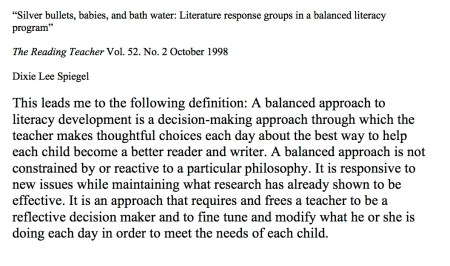
Silver Bullets, Babies, and Bath Water: Literature Response Groups in a Balanced Literacy Program, Dixie Lee Spiegel
[ ] Misrepresenting the complex role of phonics in reading in order to advocate for phonics programs. Related to the first point above, phonics advocacy tends to suggest falsely that some literacy experts support no phonics instruction and that all children must receive systematic intensive phonics instruction; these extreme polarities distort, ironically, what the broad and complex research base does show about how children learn to read as well as the role of phonics in that process.

Resources:

To read or not to read: decoding Synthetic Phonics, Andrew Davis

Stephen Krashen: Literacy: Phonemic Awareness and Phonics

The Literacy Crisis False Claims Real Solutions, Jeff McQuillan

[ ] Lacking historical context about the recurring “reading wars” and the false narratives of failing to teach children to read. The media, the public, and political leaders have chosen a crisis narrative for teaching reading throughout the twentieth and into the twenty-first century. That framing as crisis has mostly obscured both the problems that do stunt effective reading instruction and the complex nature of teaching reading as well as the current research base on teaching and literacy development.

Resources:

What Shall We Do About Reading Today?: Looking Back to See Now More Clearly

What Shall We Do About Reading Today?: A Symposium

Research in Language (1947), Lou LaBrant

Hooked on Phonics Redux

[ ] Overemphasizing/ misrepresenting National Reading Panel (NRP) value, ignoring it as a narrow and politically skewed report. A central component of No Child Behind was the NRP; however, as a key member of the panel has detailed, that report was neither a comprehensive and valid overview of the then-current state of research on teaching reading nor a foundational tool for guiding reading practices or policy. Yet, media coverage routinely references the NRP as gold-standard research and laments its lack of impact (although the NRP report did spawn a disturbing scandal concerning federal funding and textbook adoptions).

Resources:

Babes in the Woods: The Wanderings of the National Reading Panel, Joanne Yatvin

Did Reading First Work?, Stephen Krashen

My Experiences in Teaching Reading and Being a Member of the National Reading Panel, Joanne Yatvin

I Told You So! The Misinterpretation and Misuse of The National Reading Panel Report, Joanne Yatvin

The Enduring Influence of the National Reading Panel (and the “D” Word)

[ ] Citing bogus reports from discredited think tanks such as NCTQ. Well over a decade ago, Gerald Bracey warned about the growing influence of agenda-driven think tanks aggressively promoting reports before they are peer reviewed; since the mainstream media and most journalists are under-funded and overworked, press-release journalism has become more and more common, especially regarding education and often in terms of how so-called research is framed for the public. With the recent focus on the “science of reading,” the scapegoat of the day is teacher education; the narrative goes that teachers today do not know the science of reading because teacher education programs do not teach the science of reading. Often as proof, the mainstream media resorts to anecdote (they talk to a teacher or two who claims not to have been taught the science of reading) and citing bogus reports masquerading as research—notably the work of NCTQ, a think-tank that has aggressively and falsely attacked teacher education in report after report using slip-shod methods and devious processes to gather the data claim to analyze.

Resources:

NEPC Review: 2018 Teacher Prep Review (National Council on Teacher Quality, April 2018)

Review of Learning about Learning: What Every New Teacher Needs to Know

GUEST POST by Peter Smagorinsky: Response to the new NCTQ Teacher Prep Review

[ ] Scapegoating teacher education while ignoring two greatest influences on reading: poverty and reading programs adopted to comply with standards and high-stakes testing. There is ample room to criticize teacher education, particularly focusing on the problems with credentialing and the flaws inherent in the accreditation process, but the current media urge to blame teacher education for either how reading is taught or the errors in how reading is taught distracts from some hard facts about measurable reading achievement: first, standardized testing of all kinds are more strongly correlated with socio-economic and out-of-school factors than either teacher, teaching, or school quality; and this blame-teacher-education narrative glosses over that almost all reading instruction in U.S. public schools is mandated by standards, high-stakes testing, and adopted reading programs regardless of what teachers learned in their certification program.

Resources:

In Schools, Teacher Quality Matters Most

Teachers Matter, But So Do Words | Shanker Institute

Teaching Reading and Children: Reading Programs as “Costume Parties”

Masquerading (1931), Lou LaBrant

[ ] Conflating needs of students with special needs and needs of general population of students. The genesis of the most recent version of the reading wars that focuses on the “science of reading” appears to be grounded in a growing advocacy for children either not diagnosed or misdiagnosed for issues related to dyslexia. Parents of those children have been very politically active, and while their concerns for children with special needs are valid, the media and politicians have overreacted to that narrow issue and over-generalized the needs of those students to all students. This advocacy has also run roughshod over the actual and more nuanced research base on dyslexia itself. In short, parents advocating for their children should be honored and heard, but parents should not be driving reading instruction or reading policy.

Resource:

Parent Advocacy and the New (But Still Misguided) Phonics Assault on Reading

[ ] Emphasizing voices of cognitive scientists over literacy professionals. Two common patterns in media coverage of education and specifically reading are that journalists perpetuate both a gender and a discipline bias in whose voices are highlighted; notably, mostly men who are cognitive scientists are used to drive the agenda while women who are literacy practitioners and scholars are either ignored, marginalized as “critics,” or scapegoated as misguided advocates of BL or WL.

Resources:

NPR Fails Journalism and Education (Again)

What’s Wrong with Education as a Discipline?: Unpacking the Reading Wars (Again)

[ ] Trusting silver-bullet, one-size-fits-all claims about teaching and learning. Fundamentally, the historical and current flaw in the reading wars, even one framed as the “science of reading,” is that phonics advocacy reaches for “all students must have systematic intensive phonics programs,” buoyed recently by “but intensive phonics programs won’t hurt any students.” However, all teaching and learning proves to be far more complex that these claims. If we return to BL as a reading philosophy, we can emphasize that each child (not all children) should receive the type and amount of direct phonics instruction they need to begin and then grow as readers; that type and amount is difficult to prescribe, and often children are mis-served when systematic phonics programs are adopted because fidelity to the program typically trumps the actual goal of reading instruction, eager and autonomous readers. When a child is mandated to complete a phonics program, regardless of that child’s needs, that time would have been much better spent with the child reading by choice; therefore, systematic phonics do in fact harm students when they are implemented as “all students must.”

Resources:

Navigating the Scylla and Charybdis of Research in Education

Teaching Students, Not Standards or Programs

[ ] Feeding a false narrative blaming teachers and teacher educators both of whom are deprofessionalized /powerless in accountability structures. There are some dirty little secrets about education that discredit much of how media cover teaching and learning: as noted above, measurable teacher impact on student learning is quite small; teachers are mostly complying with mandates, and not making instructional or assessment decisions; and teacher educators have very little impact on how teachers implement teaching once they are in the classroom and required to conform to the mandates linked to standards and high-stakes testing.

Resources:

Pre-Service Teacher Education vs. the World

Verboden!: Autonomy and Critical Thinking in Education

Autonomy Must Precede Accountability

See Also


Hooked on Phonics Redux

The commercial reading program Hooked on Phonics, with iconic over-the-top commercials for those of us of a certain generation, had to abandon those ads in 1994:

Under an agreement disclosed this week between the makers of the reading program Hooked on Phonics and the Federal Trade Commission, the manufacturer must abandon its advertising campaign or conduct far more research into the program’s effectiveness–and disclose any evidence of failure.

Anyone paying even slight attention to current media fascination with the “science of reading” and dyslexia may benefit from revisiting the problem with Hooked on Phonics and their outlandish claims:

Orange County-based Gateway Educational Products, maker of Hooked on Phonics, agreed to a settlement that bars the parent company from making unsubstantiated claims about the program’s ability to teach people to read. The settlement, which was signed Aug. 29, was made public Wednesday by the commission.

The FTC had charged that Gateway was making sweeping, unproven promises that the program could teach anyone to read, regardless of their limitations. Gateway admitted no wrongdoing in the settlement, and will pay no penalty, said Christian S. White, acting director of the commission’s bureau of consumer protection.

“They offered a one-size-fits-all solution–you have reading problems, this is the product,” White said. “Gateway’s evidence just doesn’t back up these broad, sweeping claims.”

The claims, according to the commission, included statements that Hooked on Phonics can teach even those with reading problems, such as dyslexia; that the product improves users’ reading levels and classroom grades significantly; that it can teach reading at home, without a tutor; that it teaches comprehension of the meaning of words, and that it has helped almost 1 million people learn to read at home.

The commission also said that testimonials by people who have taken the program are used misleadingly in commercials and do not prove that their experiences were typical of the average user, which is a violation of federal law.

Although this happened 25 years ago, currently driven by overzealous dyslexia advocacy, the mainstream media is promoting essentially the same misguided and overstated arguments about teaching reading.

For the full and complicated story about teaching reading that the mainstream media refuses to acknowledge, see this reader below:

Found in Translation

Charlotte: I just don’t know what I’m supposed to be.

Lost in Translation (2003)

Trans 2
Recent reading heavily skewed by translation as well as works by women.

So what do Charlotte (Scarlett Johansson) and Bob Harris (Bill Murray) have in common as the central characters in Sophia Coppola’s Lost in Translation (2003)?

Quite a great deal despite the significant age difference—disillusionment about marriage (Charlotte young and newly married while Bob is much older and married 25 years), being American as well as white and privileged, and possibly most importantly, feeling deeply out of kilter with their own separate lives.

Viewers watch as these two develop both an occasionally predictable and often unpredictable relationship while visiting Japan—and thus, the title’s play on the location and these two being lost and also possibly finding themselves while visiting a land foreign to them.

As a many-decades voracious reader, I can attest to the power of literature for offering the same sort of different context that being in Japan provides Charlotte and Bob. In fact, I have experienced deep and powerful affection for authors from countries outside the U.S.—from Milan Kundera to Haruki Murakami—and am drawn to the literary qualities but also their distinctly different world views and cultural experiences from my own.

Kundera and Murakami, for example, have forced me often to step away from my assumptions and re-see the world and many of the ideals I hold precious. From Kundera’s philosophical musings on sex and relationships along with his narrative unpacking of history and geography in the shaping of society and individuals to Murakami’s confrontations of reality and the awkwardness that is self-awareness as human sexuality—these works I have experienced in translation with an affection beyond most other writers I also love and cherish.

By comparison, I love the work of Margaret Atwood and value the Canadian and gendered elements of her writing, but she composes in my shared language of English.

While I have long been fascinated by writing in translation—reaching back to my high school English teaching days when we wrestled with literary analysis of non-English language authors such as Franz Kafka, Albert Camus, and Henrik Ibsen—I have recently slipped into a trend of reading several new non-English language authors (see recent reading below).

The love of fiction often includes both an affection for the narrative (characters, plot, tension, etc.) as well as how that narrative is told, the weaving together of words and sentences. It is about both the what and how.

With traditional works in the canon of English-language fiction, and the dominance of New Criticism’s emphasis on textual analysis (echoed in the Common Core’s arguments about the four corners of the page), readers have been conditioned to consider rhetorical devices and literary technique as purposeful and singular tools of the author.

Here is where translation poses a problem of language—especially in translations of works by Murakami, Kim, and Kang, for example—and who makes those choices of language.

Zero K by Don DeLillo represents the most traditional sort of white male writing among the works I have read recently; this work overtly makes a case for language and words, represented by the narrator’s obsession with language:

Once, when they were still married, my father called by mother a fishwife. This may have been a joke but it sent me to the dictionary to look up the word. Coarse woman, a shrew. I had to look up shrew. A scold, a nag, from Old English for shrewmouse. The book sent me back to shrew, sense 1. A small insectivorous mammal. I had to look up insectivorous. The book said it meant feeding on insects, from Latin insectus, for insect, plus Latin vora, for vorous. I had to look up vorous. (p. 25)

With works in translation, however, the translator becomes another factor in the meaning as well as the compelling nature of the narrative. In Signs Preceding the End of the World by Yuri Herrera, the Translator’s Note offers a window into that process.

Lisa Dillman, translator, explains that “Herrera’s prose…exhibits…non-standard language,” for example, posing challenges for her work. Dillman adds “[t]o prepare for the project, as many translators do, I first read widely. I read for theme; I read for tone; I read for style” (pp. 109, 110).

Interestingly, Dillman focused on the prose of Cormac McCarthy as a guide for this novel’s translation. Also compelling is her decisions with word choice, notably “the novel’s most talked-about neologism: jachar” (p. 112). Dillman eventually chose “to verse” as the translation, capturing the word’s meaning (“essentially, ‘to leave'”) and carrying an odd, quirky sense found in the original.

Herrera’s fiction offers beyond concerns about language, and translation, insight into how culture and even geography impact genre, as investigated by Marcelo Rioseco:

Two subjects seem inescapable for a Mexican author who works with the space of the border: immigration, drug trafficking, and, consequently, the violence associated with these two phenomena. Nonetheless, this swift and simplifying identification can be deceiving in the effort to create a taxonomy of border literature, especially in the case of a writer like Yuri Herrera, born in Actopan in the Mexican state of Hidalgo.

Herrera’s case appears more problematic, precisely because, since his first novel, Kingdom Cons (2005), Herrera has been seen by critics as a border writer and, indirectly, as a natural representative of a subgenre of border literature: the narconovela.

Reading the three novels listed below by Hererra were genre bending and genre expanding; these works in translation, then, are about narrative and language but in ways for me as someone with a different first language than the author that I cannot experience with DeLillo—or Kurt Vonnegut and Atwood.

Just as Charlotte and Bob find something between them while out of context, for them, in Japan, I have found myself anew in these translations often because of disorientation and lack of context that forces me to think and rethink the world.


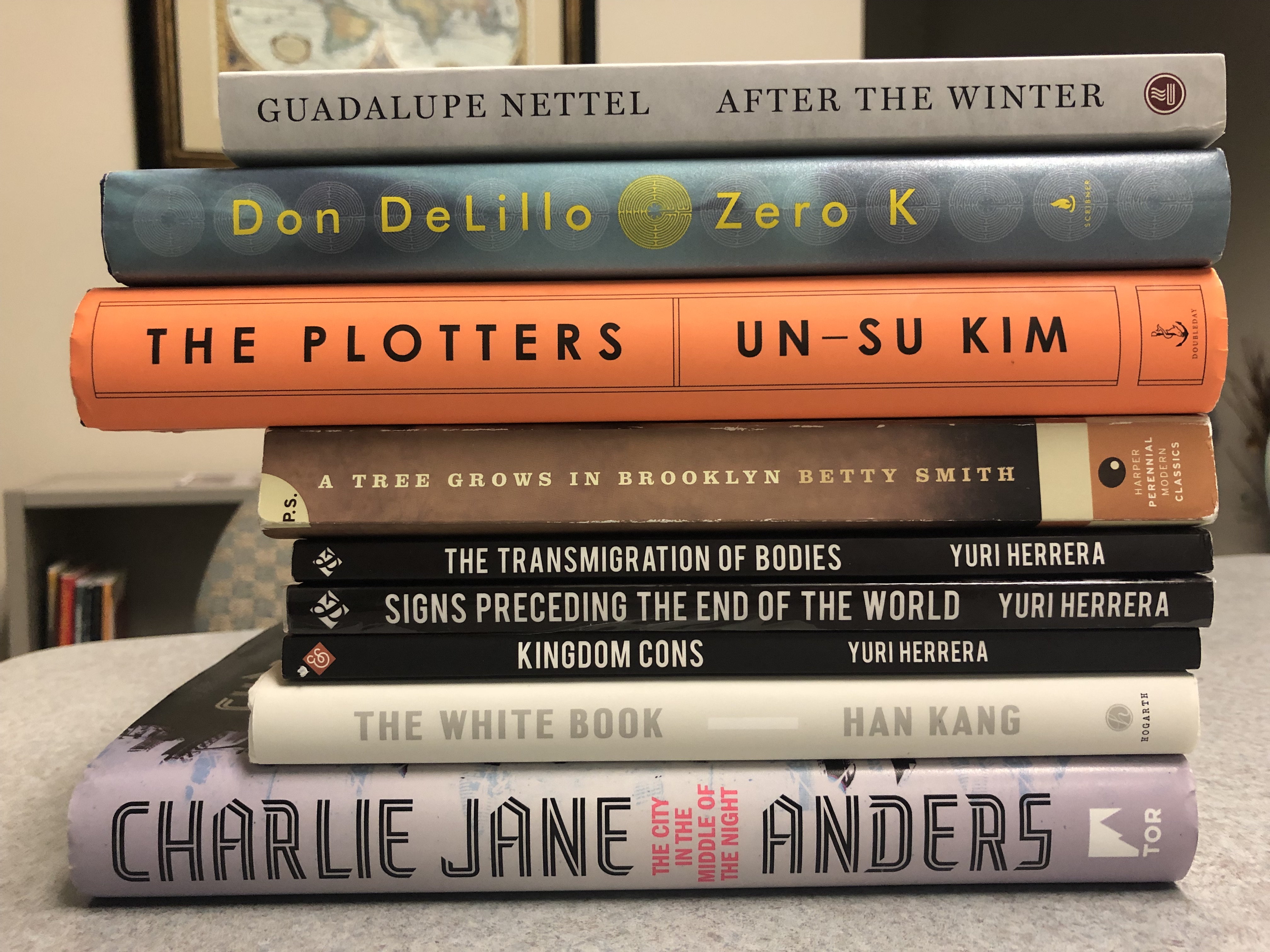
Recent Reading

After the Winter, Guadalupe Nettel*

Zero K, Don DeLillo

The Plotters, Un-su Kim*

A Tree Grows in Brooklyn, Betty Smith

The Transmigration of Bodies, Yuri Herrera*

Signs Preceding the End of the World, Yuri Herrera*

Kingdom Cons, Yuri Herrera*

The White Book, Han Kang*

The City in the Middle of the Night, Charlie Jane Anders

* In translation

URGENT: Media Misreading the Reading Crisis Yet Again
Media Misreading the Reading Crisis Yet Again

By Katie Kelly and P.L. Thomas

Photo by Nathaniel Shuman on Unsplash

Several news articlesvideosreports on new state legislation, and commentaries across mainstream media have built a false narrative about a Reading Crisis. That story includes several key elements: Teachers do not know, and thus do not practice, the science of reading because teacher education has failed them.

Not only have the mainstream media offered only one narrative, but also, for example, the Education Writers Association chose one of the most prominent misleading articles for a Public Service, small staff award: Emily Hanford’s “Hard Words.”

In 2019, the Reading Wars have begun anew but with different language: Phonics advocates have simplified “the science of reading” to “all students need systematic phonics,” for example. And this round has resulted in dramatic changes in state reading policies.

As literacy educators and scholars, however, we contend that these messages are misrepresenting the Reading Crisis and the science of reading — both of which are far more complicated than being presented by much of the media, dyslexia advocates, and political leaders.

Those Who Ignore History: A Look Back at Reading Crises

The newest misdiagnosed Reading Crisis begs for a truism: “Those who cannot remember the past are condemned to repeat it” (George Santayana).

For example, the November 1942 issue of The Elementary English Review(National Council of Teachers of English) included a provocative piece, What Shall We Do About Reading Today?: A Symposium, prompted by the high rate of illiteracy among men drafted into WWII.

This symposium offers answers to the titular question from leading literacy experts of the time, including Lou LaBrant (former president of NCTE). Represented by assembled experts on literacy, this Reading Crisis foreshadows these debates are misguided and driven by ideology instead of evidence.

While we recommend reading the symposium responses in full, let’s focus on LaBrant: “Nevertheless, we hear many persons saying that the present group of near-illiterates are results of ‘new methods,’ ‘progressive schools,’ or any deviation from the old mechanical procedures. They say we must return to drill and formal reciting from a text book” (p. 240).

However, LaBrant discredits that blame because the recruits identified as illiterate or semi-literate “…are drop-outs, who have not completed elementary school, come from poorly taught and poorly equipped schools, and actually represent the most conservative and backward teaching in the United States [emphasis in original]” (pp. 240–241).

Next, in the 1980s/1990s, the media announced a Reading Crisis in California blamed on whole language. Literacy scholar Stephen Krashen, and others, debunked that claim, noting although whole language was the official reading approach of the state, teachers almost never implemented whole language. Further, the reading score plummet correlated with whole language being the official policy, but the causes of those lower scores were a large influx of non-native speakers of English and reduced educational funding.

Throughout much of the 20th century, reading instruction in practice remained skills-based, perpetuating a simple view of reading. That criticism of whole language, however, prompted a call for more scientific approaches to teaching reading, which meant mandated scripted instruction with an emphasis on phonics instruction. This was also driven by the high stakes accountability era of No Child Left Behind.

Contrasting thoughtful literacy, scripted reading programs narrow curriculum focusing on skills instruction and test preparation through teacher-directed learning (Kozol, 2005; Lipman, 2004). In this context, students serve as vessels with teachers depositing knowledge. This back-to-basics model of instruction encourages replication and regurgitation of information with little emphasis on comprehension instruction, critical thinking, and rich discussion of text (Comber & Nichols, 2004Durkin, 1981Leland, Harste, & Huber, 2005Shannon, 2007Taberski, 2011).

Being a good word caller does not equate to being a good reader, but can produce a false-positive on narrow types of reading tests. This unbalanced approach to teaching literacy is not only problematic, but also dangerous.

Misreading the Reading Crisis Yet Again

Despite the value of a more student-centered curriculum that fosters critical thinking, some advocate for a return to skills-based systematic phonics instruction, framed as the “science of reading,” and claim another Reading Crisis. With a new push for phonics as a single pathway to literacy, the role of the meaning making process in reading will again be neglected.

In her seminal study, Delores Durkin found an overemphasis on testing comprehension rather than teaching comprehension. Reading is a complex cognitive process mediated by social and cultural practices requiring instruction and interaction with text and others to construct meaning. Therefore, we must shift our view of literacy beyond decoding to include constructing meaning and reading texts critically by expanding instructional practices and the ways we assess reading.

The so-called science of reading is, in fact, balanced literacy, which includes a focus on multiple components of literacy including phonics, comprehension, and writing: “A balanced approach will privilege authentic texts and tasks, a heavy emphasis on writing, literature, response, and comprehension, but it will also call for an ambitious program of explicit instruction for phonics, word identification, comprehension, spelling, and writing” (Pearson, 2004, p. 243).

While phonics is an essential component of reading instruction in the primary grades, “it should be noted that phonics is one element of a comprehensive literacy program that must also include practice in comprehension, fluency, vocabulary, writing, and thinking” (ILA, 2018).

No Crisis, But We Are Failing Our Students

Crisis rhetoric misreads not only how we currently teach and historically have taught reading, but also misrepresents the causes of low student achievement in reading while perpetuating some of the worst possible policies and legislation such as grade retention based on high-stakes testing.

This Reading Crisis ignores that focusing on narrow standards and high-stakes testing combined with the de-professionalization of teaching and under-funding education has resulted in overcrowded classrooms where teachers and students conform to mechanical reading programs privileging the wealthy and overemphasize test scores.

As teacher educators, we can attest that regardless of what we teach about reading and literacy, most teachers feel pressured to implement programs and raise test scores.

Rather than blaming students and teachers for the opportunity gap entrenched in formal schooling, consider the achievement debt due to inequitable funding, poor healthcare, and a lack of political courage. With increasingly diverse student populations, we have a responsibility to address this debt by serving all students through culturally relevant teaching practices.

We must, then, disrupt the misguided narrative of crisis that disguises the sociocultural historical and political factors that influence reading instruction as a disease that simply needs a vaccination in the form of systematic phonics.

Katie Kelly is an Associate Professor of Education at Furman University. A former elementary teacher and literacy coach, Katie teaches courses in literacy methods and assessment at the undergraduate and graduate levels. She is the coauthor of Reading to Make a Difference: Using Literature to Help Students Speak Freely, Think Deeply, and Take Action (Heinemann). Follow her work at bookbuzz.blog and @ktkelly14.

P. L. Thomas, Professor of Education (Furman University), taught high school English for 18 years in South Carolina before moving to teacher education and teaching first-year writing. He is author of Teaching Writing as Journey, Not Destination: Essays Exploring What “Teaching Writing” Means (IAP). Follow his work at https://radicalscholarship.wordpress.com/ and @plthomasEdD.

A Meditation on Stringing Words Together: The National’s “Roman Holiday”

I’m still standing in the same place where you left me standing

“I Am Easy to Find,” The National

For those of us who love words and fall deeply in love with authors and pop music performers, few things are as exciting as new works. I listened for the first time to The National’s I Am Easy to Find on the release day during a long drive.

The first song, “You Had Your Soul with You,” had already been released so my rush happened on the second song, “Quiet Light,” when I felt the urge to cry before the lyrics even began.

And by the seventh song, the titular “I Am Easy to Find,” I could hold back no longer, crying steadily as I drove. There is something uniquely powerful about the combination of beautiful music and beautiful words strung together in a way that make your heart ache.

As an English teacher for about two decades during the first half of my career, I was always searching for an effective way to teach poetry well. Students tended not to like poetry but also had very narrow and mistaken associations with poetry—poetry rhymes, for example, and being overly concerned with what poems mean.

It probably seems trite, but I did find that investigating poetry—asking, what makes poetry, poetry?—combined with starting with pop music song lyrics helped allay student antagonism toward what I consider a beautiful and powerful form of human expression.

Throughout the 1980s and 1990s, I grounded my poetry unit in the music of R.E.M. Although I now mainly teach education and writing courses, I continue to think as an English teacher—especially in terms of applying reading like a writer to text such as song lyrics to inform how we read and write well.

Especially with the rise of close reading, driven by the mostly now defunct Common Core, many formal lessons focusing on analyzing text remains trapped in false notions that meaning is restricted to the parameters of the text, words strung together on the page.

“I’m your hospital, I’m your silver cross,” opens The National’s “Roman Holiday,” preparing the listener for how to unpack these metaphors, but also confronting the arguments of close reading that meaning is a mechanical process bound to text only.

In the opening verse as well, “Patti wasn’t lonely, Robert wasn’t lost” establishes the factual basis of the song, explained by the primary lyricist, Matt Berninger:

I am a huge fan of that book [Patti Smith’s memoir Just Kids], but I was actually looking at Judy Linn’s book of Patti Smith photos. A lot of the imagery in it is of Patti Smith and Robert Mapplethorpe when they were really young, just hanging out in their apartment: dressing up, taking pictures of each other, looking cool. It’s such a beautiful portrait of pals, such a romance. And then there’s also a line I took from Patti Smith’s Instagram, a comment she sent to somebody who had just lost someone to suicide: “Please think the best of him.” I found it incredibly moving. I was just obsessed with her kindness and her wisdom in the face of so many sad things.

Carin Besser, Berninger’s wife and co-lyricist on The National lyrics for several of the recent albums, adds how being a lyricist is similar to poetry in an interview:

You have a background in poetry and as a writer and editor. How is lyric writing similar or different than what you’ve done in the past?

I think I probably like the same thing about poems and song lyrics. When I read poems or listen to a song I love, I get very hung up on certain lines, especially lines I both don’t and do understand. I love that. But it’s not that impressive. It’s like being attracted to sequins. I don’t really understand story or plot well, but I love a way of finding that compressed or cock-eyed way of saying the thing, so that you can kind of re-hear the thing, or so that you can hear the feeling of thought on its way.

Any kind of language on the way to an idea, I tend to like. It’s mysterious enough to me that I stay interested. I also love songs where the singer is rambling on and almost doesn’t seem to hear what the song is doing. Or when a vocal melody slides around in order to make a point. I also sometimes feel like with song-making, there are all these bags of fireworks laying around, so many ways in a song with a singer and against the backdrop of all the musical ideas, so many ways to try to make an impression.

As a foundational text to investigate poetry—genre, mode, form—”Roman Holiday” is a powerful experience for students. Typically, using pop music, I ask students to listen to the song once without any lyrics; I then do a second listening with the lyric before the students.

Without context, “Roman Holiday” may be read a number of valid ways, focusing on unpacking the technique (metaphor, rhyme/half-rhyme, sound devices, imagery, motifs) in a traditional process (think New Criticism and close reading).

The half-rhymes are engaging (cross/lost, rains/shame, him/museum) and sounds help give the lyrics cohesion (please/police). But analyzing “Roman Holiday” decontextualized ultimately fails the song and the reading; better is to place the song in a text set including:

Technique and craft of the lyrics and the entire song are effective and powerful, but they are vehicles for the much larger discourse between a variety of texts and modes of expression, including photography, memoir, and social media.

If close reading guides coming to understand “Roman Holiday,” we are having an incomplete experience. This song depends on history, controversy, and two influential artists, Patti Smith and Robert Mapplethorpe.

How Smith, specifically, has resonated as an artist and thinker while Mapplethorpe died much younger builds along with Smith’s response to suicide (“Please, think the best of him”) to something both grounded in these two lives and the greater and more complex human condition.

While reading and interpreting text remains concepts misunderstood and misrepresented in the media and by the public, this sort of rich and complex unpacking of “Roman Holiday” speaks to how NCTE defines reading:

Reading is a complex and purposeful sociocultural, cognitive, and linguistic process in which readers simultaneously use their knowledge of spoken and written language, their knowledge of the topic of the text, and their knowledge of their culture to construct meaning with text. Each of these types of knowledge impacts the sense that readers construct through print. Readers easily comprehend text with familiar language but are less successful at comprehending text with unfamiliar language. Readers easily comprehend text on familiar topics but are less successful at comprehending texts on unfamiliar topics. At the same time, the interpretations readers construct with texts as well as the types of texts they read are influenced by their life experiences.

Without a knowledge of the topic of this song (Smith and Mapplethorpe’s relationship), a close reading misses a great deal. Yes, there is really compelling craft here, but there is also history and deep emotion.

Pop songs, like poetry, lend them selves to re-listening/rereading. Meaning grows, even blossoms with each experience because we are always a different person each time we re-listen/reread.

The meaning of any text is never fixed, never simply trapped in the stringing together of words.

For me, “There are police in the museum/She said please” stays with me after hearing the song; the use of “police/please” haunts me.

I am uncertain I can articulate why, but it certainly has meaning—and that meaning is more than intellect, enriched by emotion.


See Also

Florence Welch on Sobriety, Embracing Loneliness and Loving Patti Smith

Florence + The Machine – Patricia

The Enduring Influence of the National Reading Panel (and the “D” Word)

What do the National Reading Panel (NRP) report (2000), A Nation at Risk (1983), and the seminal “word gap” study by Hart and Risley (1992/1995) have in common?

First, each of these has become a recurring citation in mainstream media when addressing reading (NRP), school accountability (A Nation at Risk), and literacy (“word gap”).

Next, and quite troubling to those of us in education and literacy, all of these have been debunked.

A wide array of scholars have called into question Hart and Risley’s methods, conclusions, and assumptions. Gerald Bracey and Gerald Holton have unmasked A Nation at Risk as a false political crisis. And NRP panelist Joanne Yatvin as well as Stephen Krashen have significantly refuted the validity of the NRP report and process.

Recently, the reading wars have been rebooted across mainstream media; concurrent with that has been a rash of new reading legislation in several states.

In both cases, a common phrase is “the science of reading,” a thin veil for renewed emphasis on systematic phonics—in part driven by advocates for children with dyslexia.

News articles across Education Week, NPR, PBS, and other outlets have praised this so-called need for the science of reading while almost uniformly referring to the NRP as the primary research base for that “science.”

One journalist, Emily Hanford, who won an EWA award for her “science of reading” article, discounted my charged the NRP had been debunked with “One member expressing a minority view does not equal ‘debunked.'”

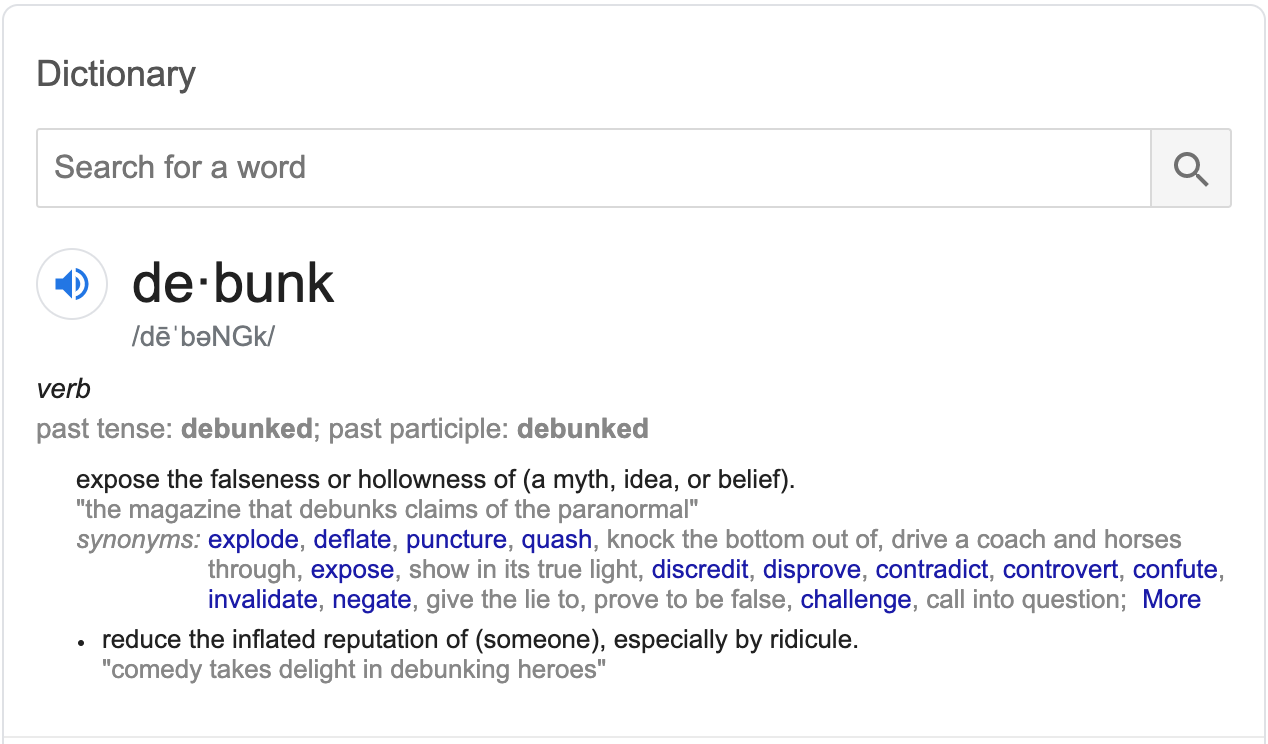
Here, I want to note that I have discovered many people react strongly to the term “debunk,” seemingly because they interpret its meaning simplistically; however, note the nuance of the term:

debunk

In the case of the NRP report, I contend it has been debunked because, specifically, a member of the committee who protested that the panel included no genuine teacher of reading has carefully shown that the report is inadequate and also predicted it would be misused in the following ways:

FALSE: The National Reading Panel was a diverse and balanced group of reading experts.

TRUE: Congress asked for a balanced panel, but that’s not what it got….

FALSE: The panel carried out a comprehensive analysis of the entire field of reading research.

TRUE: Only a small fraction of the field was considered, and only a few hundred studies were actually analyzed….

FALSE: The panel determined that there are five essentials of reading instruction.

TRUE: Although the NRP reported positive results for five of the six instructional strategies it investigated, it never claimed that these five were the essential components of reading….

FALSE: The panel endorsed only explicit, systematic instruction. [a]

TRUE: Only in the phonics subgroup report is “explicit, systematic” instruction called essential….

FALSE: The panel identified certain comprehensive commercial reading programs as being research-based, and concluded that teachers need one of these programs, or a comparable program, to teach children effectively.

TRUE: No comprehensive reading programs were investigated by the panel. The panel had nothing to say about whether teachers need a commercial program or can develop their own….

FALSE: The panel identified phonics as the most important component of reading instruction throughout the elementary grades. [a]

TRUE: The panel made no such determination….

FALSE: The panel found that phonics should be taught to all students throughout the elementary grades. [a]

TRUE: The panel found no evidence to justify teaching phonics to normally progressing readers past 1st grade….

FALSE: The panel’s findings repudiate whole language as an approach to teaching reading.

TRUE: The panel did not investigate whole language as a topic and did not draw any conclusions about it as an approach to teaching reading….

ALSE: The panel found research evidence indicating how teachers should be trained to teach reading. [a]

TRUE: The panel found no such evidence….

I stand fast that even though Yatvin technically is a minority opinion, she has the greatest expertise of the panel and her clarifications have proven accurate.

Yatvin’s skeptical first-hand account has also been reinforced by Elaine M. Garan’s critique of the phonics report. Anyone citing the NRP must keep in mind Garan’s (2001) conclusion:

If Teaching Children to Read were a typical research study, published in an education journal and destined to be read only by other researchers, then I could simply end my analysis by saying that the panel’s own words have established that the research base in its report on phonics is so flawed that the results do not even matter. However, as we have seen, this study has clout. It has a public relations machine behind it that has already promulgated the results throughout a very wide, very public arena as representing unbiased scientific “truth.” (p. 506)

Almost 20 years ago, Garan had the same cocnerns as Yatvin, both of which have come disturbingly true:

The conclusions of this study as reported in the Summary have generated headlines not only in education publications, such as Education Week and Reading Today, but also in such newspapers as USA Today, the Cleveland Plain Dealer, and the Indianapolis Star. It is, perhaps, too late to mitigate the effects of this widely distributed, widely publicized project. However, I can hope that this analysis will provide a tool for others who will want to delve more deeply into the findings of the NRP report before accepting or rejecting it on the basis of the philosophical hot topics that the research addresses. If our instructional methods are to be dictated by research, then shouldn’t that research be sound? (p. 506)

Now, we should be answering that question with a definitive “yes” even as that resists the misguided call of the “science of reading.”

But there is more reason to reject the NRP report as sacrosanct guidance for how to teach reading; it was at the center of the politically corrupt Reading First scandal that exposed relationships between government officials and Open Court textbooks.

It is not mere speculation that there is a problematic relationship between phonics advocacy and for-profit organizations serving education.

The short version about the fact of the NRP being debunked is that it was a politically skewed panel from the beginning, and then its process was also deeply flawed, manipulating what research was considered in order to favor a systematic phonics message that wasn’t supported by the actual science of reading available then, and now.

To reference the NRP report as credible is to overstate its value, to misrepresent not only the report but the field of teaching reading.

Yet, journalists with no expertise in literacy and no background in the history of reading or teaching reading are falling prey to alluring language, “the science of reading,” and fulfilling the warnings offered by Yatvin and Garan nearly two decades ago.


[a] Note that in the current media coverage of “the science of reading,” this is exactly how references to the NRP are being misused.

Parent Advocacy and the New (But Still Misguided) Phonics Assault on Reading

“School days were eagerly anticipated by Francie,” a central character in Betty Smith’s A Tree Grows in Brooklyn (p. 143). The novel often is a powerful fictional account of poverty among white working class people at the turn of the twentieth century.

But Francie Nolan is also a girl who loves books, libraries, and an idealized view of what formal schooling will be. Yet, “[b]efore school, there had to be vaccination,” the narrator explains. “That was the law”:

When the health authorities tried to explain to the poor and illiterate that vaccination was  a giving of the harmless form of smallpox to work up immunity against the deadly form, the parents didn’t believe it. … Some foreign-born parents refused to permit their children to be vaccinated. They were not allowed to enter school. Then the law got after them for keeping the children out of school. A free country? they asked. (pp. 143-144)

Left alone by their working mother, Francie and her brother, Neeley, must go for their vaccinations, prodded only by a neighbor who rouses them from playing in the dirt and mud. Francie suffers through not only the shot itself, but also the doctor’s insensitive and classist criticism: “‘Filth, filth, filth, from morning to night. I know they’re poor but they could wash. Water is free and soap is cheap. Just look at that arm nurse'” (p. 146).

Despite the trauma of the vaccinations and the class-shaming by the doctor, “Francie expected great things from school” (p. 151). However, “Brutalizing is the only adjective for the public schools of that district around 1908 and ’09. Child psychology had not been heard of in Williamsburg in those days” (p. 153).

That “brutalizing” included:

The cruelest teachers were those who had come from homes similar to those of the poor children. It seemed that in their bitterness towards those unfortunate little ones, they were somehow exorcizing their own fearful backgrounds. (p. 153)

A decade past a century since this novel, and I must acknowledge there is a disturbing series of patterns that remain, including the anti-vaccination movement as well as a significant portion of parents who find public schools unresponsive to the needs of specific populations of students.

Since I am currently reading Smith’s novel, I was drawn to some comparisons when I encountered, once again, the media’s misguided fascination with the “science of reading”: What parents of dyslexic children are teaching schools about literacy from PBS News Hour.

I cannot help asking if mainstream media would ever run this story: What anti-vaccination parents are teaching doctors about disease.

And then, while the new (but still misguided) phonics assault on reading has been spreading for a few years now, Education Week once again piles onto the bandwagon driven by parents advocating for their children with dyslexia: Stephen Sawchuk’s Battle Over Reading: Parents of Children With Dyslexia Wage Curriculum War and College of Education Now Prepares Teachers in the Science of Reading.

Sawchuk’s piece recycles both misinformation about dyslexia (1 in 10 children are diagnosed, according to Dyslexia International, but many sources suggest the exact percentage ranges from 5% to 17%) and resorts once again to citing the National Reading Panel as a credible report on reading (it has been thoroughly debunked). In fact, intensive, systematic phonics for all students has also been discredited.

Yet as Andrew Davis acknowledges: “The zeal with which synthetic phonics is championed by its advocates has been remarkably effective in pushing it to the top of the educational agenda; but we should not mistake zeal for warrant.”

As I examined and unpacked concerning school choice, we must resist idealizing parental choice, even in regard to those parents’ children. The anti-vaccination movement occurring now is grounded in both those parents wanting what is best (in their view) for their children’s health and a garbled misunderstanding of vaccinations driven by one deeply flawed study that makes those parents believe they have science on their side:

Lacking the scientific background, in an attempt to protect their children, parents contemplating the risk of vaccine are vulnerable to omission biases by which they are more likely to take the risk of inaction than the risk of action….

The anti-vaccine movement appears to be part of a larger trend of discontent and distrust in the established preeminence of scientific evidence over impressions and opinions. A corollary to the discontent is the democratization of health-related decision making, by which stakeholders have an increasingly stronger voice over experts, as well as the dethroning of the Expert. While democratization of health care decision making is cheered by liberals and conservatives alike, its benefits are still to be proven. Decisions in the area of disease prevention require knowledge of the medical field involved and an understanding of statistics, in the absence of which no amount of communication skills and efforts would do any good.

This, I think, is a powerful harbinger of how the new (but still misguided) phonics assault on reading is being perpetuated by rhetoric (“the science of reading”) and zeal among parents who seek to democratize the teaching of reading, and as a result, the expertise of literacy educators is erased and replaced by parent will and political caveat.

Here are some essential facts being ignored by the avalanche of zeal among mostly parents of children with dyslexia:

  • No student, regardless of special needs such as dyslexia, should be mis-served by our public education system. Parents of children advocating for best practices in the service of their children must be heard, and public schools must respond, attended to, however, by special needs educators and scholars, not the policy demands of the parents or political leaders. “My child must be served” is different than “This is how you will serve my child.”
  • Reading needs of the general population of students must not be held hostage to the needs of unique subsets of students—especially when the zeal of a few is allowed to overwhelm the expertise of educators and literacy scholars.
  • Historically, reading instruction has been a victim of false crisis rhetoric, and current calls for “the science of reading” is yet another round of phonic-only propaganda that cannot serve students well.
  • The research base on reading instruction (the actual science of reading) has never rejected phonics instruction (including whole language and balanced literacy), but each student needs varying degrees of direct phonics instruction, only enough so that the student begins reading and develops as a reader through holistic experiences such as reading by choice and being read to.
  • There has never been a time in the history of formal education in the U.S. that some have not claimed we have a reading crisis. Never. That crisis rhetoric has always been misguided and driven by those with some ulterior agenda or no expertise in literacy.
  • Most of the ways that formal schooling now fails students in terms of reading instruction can be connected to the accountability movement—focusing on ever-changing standards and high-stakes testing as well as imposing prescriptive reading programs onto teachers and students.

Parental zeal in the anti-vaccination movement has spurred measles outbreaks, proving that parental zeal must not be allowed to trump medical expertise.

Parental zeal for public schools properly serving students with dyslexia must not be allowed to drive reading policy for all children; this is just as unwarranted even as the consequences may not be so easily exposed.


“A case for why both sides in the ‘reading wars’ debate are wrong — and a proposed solution” Is 50% Wrong

In her The Answer Sheet, Valerie Strauss offers yet another post about the current Reading War/Crisis: A case for why both sides in the ‘reading wars’ debate are wrong — and a proposed solution.

Strauss explains before offering the long post:

This is an unusual post about the “reading wars,” that seemingly never-ending battle about how to best teach reading to students — systematic phonics or whole language. This argues that both sides have it wrong, and the authors, two brothers who are literacy experts, suggest a new way.

While this is a provocative, often nuanced, and compelling, it makes a fatal flaw common in the seemingly never-ending false war between phonics and whole language by misdefining whole language and then failing to take care when citing research that seems to show neither systematic phonics nor whole language are more effective than the other.

First, let me offer an example of this type of failure in a slightly different context, the powerful and complicated work of Lisa Delpit.

Delpit has made for many years a strong case about the inequity of educational opportunities that cheat black students (as well as many other vulnerable populations). At times, Delpit’s work has been co-opted by traditional advocates for education—notably those calling for intensive phonics and isolated grammar instruction.

Here, Delpit make a very direct refuting of that sort of co-opting:

I do not advocate a simplistic ‘basic skills’ approach for children outside of the culture of power. It would be (and has been) tragic to operate as if these children were incapable of critical and higher-order thinking and reasoning. Rather, I suggest that schools must provide these children the content that other families from a different cultural orientation provide at home. This does not mean separating children according to family background, but instead, ensuring that each classroom incorporate strategies appropriate for all the children in its confines.

However, the sources of why Delpit came to confront how formal education often cheats black students is an important window into why many continue to misrepresent the Reading War/Crisis by defining incorrectly whole language (or balanced literacy).

As Delpit explains:

A doctoral student of my acquaintance was assigned to a writing class to hone his writing skills. The student was placed in the section led by a white professor who utilized a process approach, consisting primarily of having the students write essays and then assemble into groups to edit each other’s papers. That procedure infuriated this particular student. He had many angry encounters with the teacher about what she was doing. …

When I told this gentleman that what the teacher was doing was called a process method of teaching writing, his response was, ‘Well, at least now I know that she thought she was doing something. I thought she was just a fool who couldn’t teach and didn’t want to try.’ This sense of being cheated can be so strong that the student may be completely turned off to the educational system.

Yes, this teacher and experience had clearly failed that doctoral student, but if we are careful to note the details of that failure, what we discover is that the teacher had also failed process (or workshop) writing instruction.

Process or workshop writing instruction is far more that peer conferencing; it entails drafting and student choice of topics and text form, conferences with peers and the instructor, explicit instruction of all aspects of composing (including grammar, mechanics, and usage) based on the needs of the students revealed in their original essay drafts (typically called mini-lessons), careful and varied reading-like-a-writer experiences with rich texts, and producing final authentic artifacts or writing.

To be brief here, Delpit is correct that “other people’s children” are disproportionately cheated by reduced curriculum and inadequate instruction, but it is misleading to lay that blame at the feet of process/workshop methods since the student example shows this is not what was implemented.

Now, let’s circle back to the “both sides are wrong” claim by Jeffrey S. Bowers and Peter N. Bowers.

Bowers and Bowers discredit systematic phonics fairly carefully and fairly,  I think. But when they turn to the research on whole language, they make no effort to verify if the research cited in fact confirmed that whole language was being implemented with any level of fidelity.

As I have noted often in the 1980s/1990s, the media announced a Reading Crisis in California blamed on whole language. Literacy scholar Stephen Krashen, and others, debunked that claim [1], noting although whole language was the official reading approach of the state, teachers almost never implemented whole language.

As well, Bowers and Bowers make an odd choice about defining what whole language is by citing and defining as follows:

According to foundational theory for whole language, learning to read is just like learning to speak (Goodman, 1967). Given that virtually everyone from every culture learns to speak without any formal instruction in a context of being exposed to meaningful speech, it is concluded that children should learn to read in the same way, naturally, by reading meaningful text. The fact that not all verbal children learn to read with whole language should be a first clue that something is wrong with this theory.

This dramatically over-simplifies Goodman’s work, but also ignores decades of refinement of what whole language became, and then how many have embraced balanced literacy.

When we are referring to whole language, however, the fundamental problem with discounting whole language often rests with not understanding what it is: “Whole language is not a program, package, set of materials, method, practice, or technique; rather, it is a perspective on language and learning that leads to the acceptance of certain strategies, methods, materials, and techniques.—Dorothy Watson, 1989.”

And a failure to acknowledge that “… [w]hole language…builds on the view that readers and writers integrate all available information in authentic literacy events as they make sense of print. Whole language teachers don’t reject phonics; they put it in its proper place [emphasis added]” (K. Goodman, Phonics Phacts, p. 108).

Let me put this directly: Whole language does reject the need for systematic phonics for all children, but the language philosophy endorses entirely that some phonics is needed, that each child should receive the amount and type of phonics instruction needed to read independently—not to comply with a reading program, to cover a set of universal standards, or to raise test scores.

The argument posed by Bowers and Bowers is correct only if we misdefine whole language and fail to critically examine research that claims to be measuring whole language effectiveness or if whole language was even implemented with any sort of fidelity.

As it sits now, the Bowers and Bowers’s argument is 50% wrong.


[1] Note that the reading test score decreases (the reason for the claim of a reading crisis) were caused mostly by a large influx of non-native English speaking students and drastic budget cuts for education. The ways in which students were being taught to read are correlations at best with those scores.

For Further Reading

Defending Whole Language: The Limits of Phonics Instruction and the Efficacy of Whole Language Instruction, Stephen Krashen, Reading Improvement 39 (1): 32-42, 2002.

Facts: On the nature of whole language education (Heinemann)

To read or not to read: decoding Synthetic Phonics, Andrew Davis

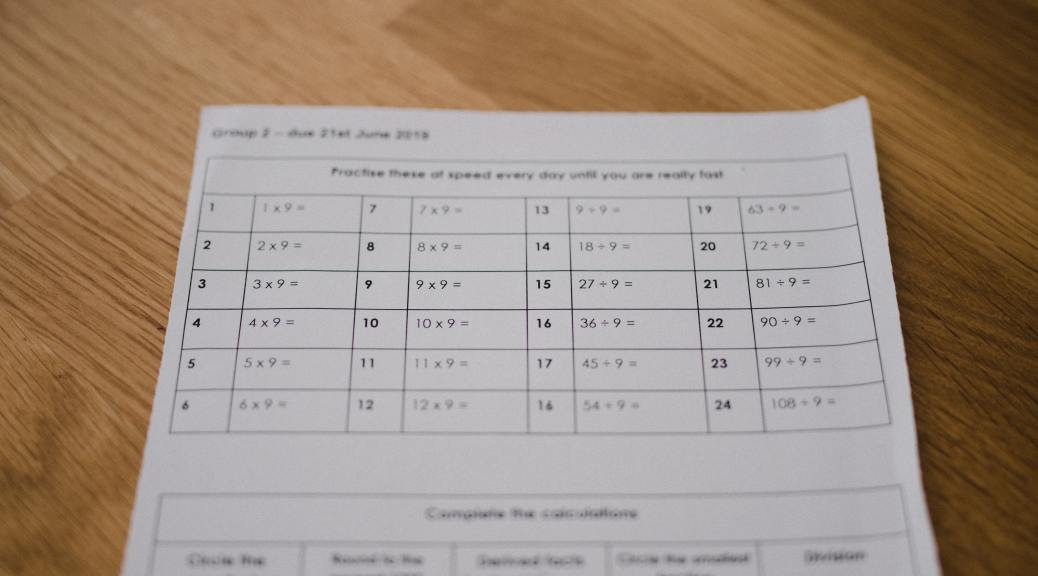
Worksheets? We Talking about Worksheets

A few days ago, I had an Allen Iverson moment on Twitter:

1. Take any normal worksheet with review questions.

2. Cut the sheet into slips.

3. Hide those slips in plastic eggs.

4. Toss the eggs in a trash can.

5. Stop wasting your time and your students’ time with worksheets. https://t.co/B5CeDNAT9A

— Paul Thomas (@plthomasEdD) March 22, 2019

Iverson, among many other athletic and pop culture accomplishments, is notorious for this rant:

“We sitting in here — I’m supposed to be the franchise player, and we in here talking about practice. I mean, listen: We talking about practice. Not a game. Not a game. Not a game. We talking about practice. Not a game. Not the game that I go out there and die for and play every game like it’s my last. Not the game. We talking about practice, man.”

What resonates with me, after I posted the retweet above, is that Iverson was almost entirely misunderstood, and received a fair among of negative feedback and is often still misrepresented by his outburst.

Once I realized that my critical list had gained a momentum of its own—many people responding positively to my intent, but a few creeping into viewing my Tweet as a burn—I noticed that some people found the Tweet to be unprofessional in tone and misread my point as somehow being against students having fun or oversimplifying the problem with worksheets.

To attempt to set the record straight, and try to calm the piling on that I did not intend, I posted a thread navigating the misunderstandings and concerns about my tone and points.

For the record, I am firmly against worksheets (although what that label means needs some interrogation, I admit), and for authentic (even fun) engagement by students with whole and real learning and artifacts of learning. But that is really complicated.

A former student and then early-career teacher, who has now left teaching, had a disturbing experience with why this position of mine is complicated. She taught in a school grounded in project-based learning (PBL). Her course was also team-taught.

As an English teacher, however, she was frustrated that she was required to prepare lessons and activities for students that were a series of different projects; notable in that requirement is that reading and writing were excluded from being the only sorts of projects students could complete.

She found herself in the sort of dilemma Lou LaBrant rejected in 1931, in one of the earliest rounds of PBL mis-attributed to John Dewey:

The cause for my wrath is not new or single. It is of slow growth and has many characteristics. It is known to many as a variation of the project method; to me, as the soap performance. With the project, neatly defined by theorizing educators as “a purposeful activity carried to a successful conclusion,” I know better than to be at war. With what passes for purposeful activity and is unfortunately carried to a conclusion because it will kill time, I have much to complain. To be, for a moment, coherent: I am disturbed by the practice, much more common than our publications would indicate, of using the carving of little toy boats and castles, the dressing of quaint dolls, the pasting of advertising pictures, and the manipulation of clay and soap as the teaching of English literature. (p. 245)

LaBrant’s anger lead her to this conclusion:

That the making of concrete models will keep interested many pupils who would otherwise find much of the English course dull may be granted. The remedy would seem to be in changing the reading material rather than in turning the literature course into a class in handcraft. (p. 246)

When I saw the original Tweet about hiding worksheets cut into strips inside Easter eggs, I immediately thought of my former student and LaBrant.

I am certain that I could create a Jeopardy!-style game to engage students in, for example, grammar activities. I think the game itself and student engagement could likely be exciting, and anyone observing that lesson would be fairly impressed with the energy.

I may even concede that students could learn grammar during the activity—although I am skeptical of the likelihood that a one-shot activity would produce genuine and deep understanding.

Here, however, let me return to LaBrant, who wrote in 1947: “We have some hundreds of studies now which demonstrate that there is little correlation (whatever that may cover) between exercises in punctuation and sentence structure and the tendency to use the principles illustrated in independent writing” (p. 127).

While the Jeopardy!-style game may be successful in being fun and engaging students, I am certain that whatever grammar students may learn, we remain faced with the same reality LaBrant confronted 80-plus years ago: Isolated grammar instruction does not transfer into student practice as writers.

Therefore, we must evaluate the Jeopardy!-style grammar game based on our instructional purposes. If we are teaching grammar-for-grammar’s sake, the game may be a valid instructional strategy (compared to completing grammar worksheets, for example).

But if our goal is writing instruction, even though the game is fun and engaging, it is a waste of instructional time better spent by students drafting, conferencing, and engaging in explicit instruction covering grammar, usage, and mechanics in the context of their original writing.

For those who see the teaching of English as more than writing and reading, we may be compelled to find engaging and fun ways to bring students to literature as well.

What if I designed a Thoreau-like nature walk for students to commune with nature and come to a better understanding of American transcendentalism espoused by Ralph Waldo Emerson and Henry David Thoreau?

Again, this nature walk to an outside observer may appear to be very engaging and even fun for the students. But hiking in nature is not the domain of literature study; mining text for meaning, however, is what literature study entails.

Crouching in the woods or wading into a pond, like Thoreau, may help students with appreciating nature, but it is time better spent reading, discussing, and critically unpacking the essays written by Emerson and Thoreau, while also contrasting those texts with others written by their contemporaries, such as Nathaniel Hawthorne and Edgar Allan Poe.

Once again, as LaBrant argued throughout her career, writing is learned by writing, and reading is learned by reading.

Let me circle back, now, briefly, to the worksheet.

The decade’s long appeal of PBL comes, I think, from a realization that worksheets, workbooks, and static, silent students are elements of traditional schooling most of us want to avoid.

When I think “worksheet,” I am reminded of my early days of teaching high school English and being compelled to teach context clues because our students scored low on that subset of reading skills during state testing.

As part of our mandated test-prep, we were issued workbooks with worksheets dedicated to isolated reading skills. The context clues worksheet identified four or five types of context clues and then tested students with dozens of sample sentences requiring students to identify the type of context clue strategy needed to define the unknown vocabulary.

To be honest, this approach could likely raise student test scores since the worksheets were designed to prepare students for test-reading; the worksheets and tests involve the same sort of mechanical and inauthentic process and test a manufactured set of content designated as “context clues.”

Here’s the problem: Writers don’t write implementing context clues; writers just use words to form sentences and paragraphs. Context clues strategies work on worksheets and tests, but not so much in real-world reading.

Vocabulary acquisition is incredibly important for literacy development, but most people have the how of that acquisition backward: Students don’t need words (or context clues strategies) crammed into them so they can read better; reading more and more makes them better readers, in part, because that is how we acquire more words.

My concern and caution, then, are much broader than the worksheet since both worksheets and PBL (seemingly antithetical to each other) can be flawed practice if we are not careful to match our instructional strategies to our intended learning outcomes and artifacts of learning.

At first blush, this may seem tedious, even dull, but teaching English is mostly about reading and writing. These are often engaging and fun, but some times they are also challenging and rewarding even as they are tedious.

None the less, let’s not lose sight of what we are doing in the name of fun when that pursuit, in fact, avoids the real work that we should attend to and seeks as well to insure that students are engaged and, yes, often having fun.

What Shall We Do About Reading Today?: Looking Back to See Now More Clearly

The November 1942 issue of The Elementary English Review (National Council of Teachers of English) included a provocative piece: What Shall We Do About Reading Today?: A Symposium.

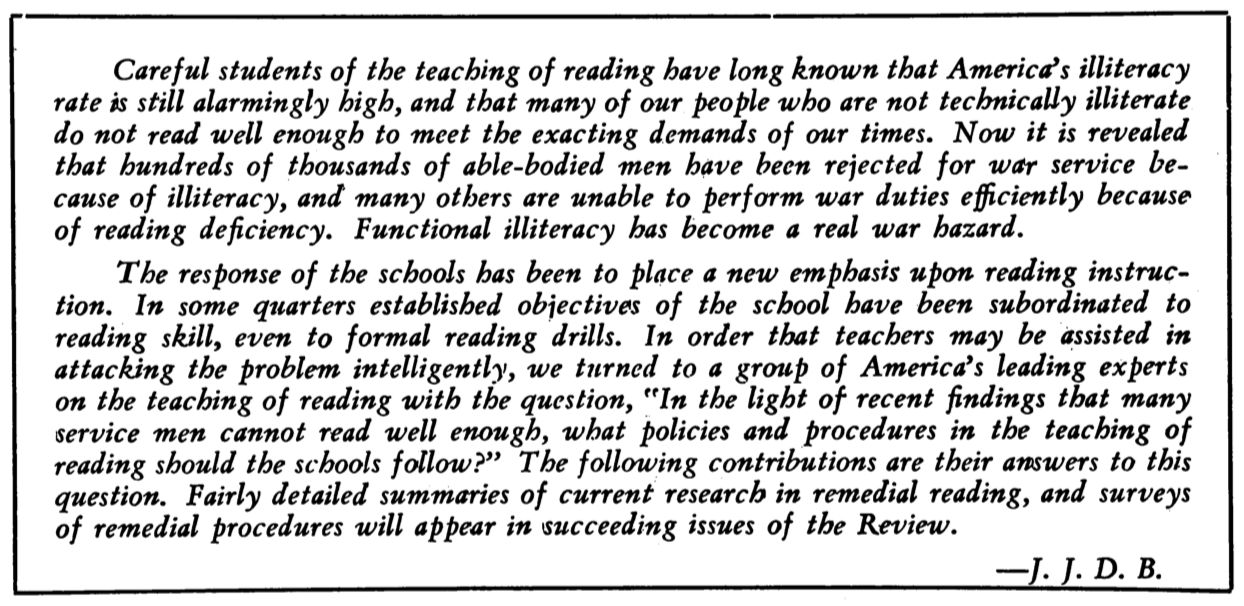
The opening editorial comment frames the need for the question:

Editorial blurb 1942.png

This symposium offers answers to the titular question from leading literacy experts of the time: Emmett A. Betts, E.W. Dolch, Arthur I. Gates, William S. Gray (first IRA president), Ernest Horn, Lou LaBrant (former president of NCTE and focus of my dissertation, an educational biography), Holland Roberts, Dora V. Smith (former NCTE president), Nila Banton Smith, and Paul Witty (key figure in the career and life of LaBrant).

Unlike most cries of educational “crisis,” this national focus on reading was nested in World War II—a genuine crisis. But, according to the assembled experts on literacy, this 1942 version of the Reading Wars was a harbinger of how these debates are mostly misinformed, misguided, and driven by ideology instead of evidence.

Betts, in the opening piece, notes an important fact drawn from a report by First Lady Eleanor Roosevelt: “One of the students had only four months of schooling, another was foreign born, some came from sections of the country where educational opportunities were meager, and so on. In short, the First Lady’s report emphasized the lack of educational opportunity [emphasis added] rather than the questionable quality of instruction” (p. 225).

Before detailing the problems and the possible solutions—including recognizing shortages and shifts in teacher availability—Betts makes a powerful claim: “In a democracy, the people get the kind of schools they want….In a democracy, the quantity and quality of educational opportunity is a product of what people want, and what they want is to no small degree conditioned by the educational leadership they have elected to follow” (pp. 225-226).

While I recommend reading the symposium responses in full, I focus below on two key answers from Gray and LaBrant.

Gray offers a solid framing of the debate spurred by claims of illiteracy among those called to serve, including this:

Gray second attitude.png

Along with refuting these standard false charges, Gray builds to a powerful closing argument:

A common error on the part of those who modify their reading programs is to adopt one or more reforms, such as the provision of much free reading, and neglect other aspects of reading that are in need of specific attention…

If the discussion thus far has achieved its purpose, it should be clear that current deficiencies in reading are not the product of “pseudo-scientific fumbling” or the use of progressive reforms, as some would have us believe. They are due in large measure either to the continued use of traditional patterns of teaching or to failure to provide a well-balanced [emphasis in original] program of reading activities that harmonize with progressive trends. (pp. 236-237)

LaBrant, in her typical style, takes a much more direct approach:

Within the past ten years we have made great strides in the teaching of purposeful reading, reading for understanding (the kind of reading, incidentally, which the army and navy want). Nevertheless, we hear many persons saying that the present group of near-illiterates are results of “new methods,” “progressive schools,” or any deviation from the old mechanical procedures. They say we must return to drill and formal reciting from a text book. (p. 240)

However, LaBrant completely discredits that blame:

1. Not many men in the army now have been taught by these newer methods [emphasis in original]. Those few come for the most part from private or highly privileged schools, are among those who have completed high school or college, and have no difficulty with reading.

2. While so-called “progressive” schools may have their limitations, and certainly do allow their pupils to progress at varied rates, above the second grade their pupils consistently show superior ability in reading. Indeed, the most eager critics have complained that these children read everything they can find, and consequently do not concentrate on a few facts. Abundant data now testify to the superior results of purposeful, individualized reading programs [emphasis in original].

3. The reading skills required by the military leaders are relatively simple, and cause no problem for normal persons who have remained in school until they are fourteen or fifteen. Unfortunately the large group of non-readers are drop-outs, who have not completed elementary school, come from poorly taught and poorly equipped schools, and actually represent the most conservative and backward teaching in the United States [emphasis in original]. (pp. 240-241)

In her conclusion, LaBrant is passionate and unyielding:

lack of drill

Within five years, LaBrant penned what would become a refrain of her six-plus decades as an educator: “A brief consideration will indicate reasons for the considerable gap between the research currently available and the utilization of that research in school programs and methods” (p. 87).

The question about reading raised in the 1940s suffered from the same failures to recognize the problem in order to shape effective and credible answers that we are confronting in 2019.

The fumbling today of the Reading Wars is yet another snapshot of a tired truism: “Those who cannot remember the past are condemned to repeat it” (George Santayana).