Category Archives: reading

“A case for why both sides in the ‘reading wars’ debate are wrong — and a proposed solution” Is 50% Wrong

In her The Answer Sheet, Valerie Strauss offers yet another post about the current Reading War/Crisis: A case for why both sides in the ‘reading wars’ debate are wrong — and a proposed solution.

Strauss explains before offering the long post:

This is an unusual post about the “reading wars,” that seemingly never-ending battle about how to best teach reading to students — systematic phonics or whole language. This argues that both sides have it wrong, and the authors, two brothers who are literacy experts, suggest a new way.

While this is a provocative, often nuanced, and compelling, it makes a fatal flaw common in the seemingly never-ending false war between phonics and whole language by misdefining whole language and then failing to take care when citing research that seems to show neither systematic phonics nor whole language are more effective than the other.

First, let me offer an example of this type of failure in a slightly different context, the powerful and complicated work of Lisa Delpit.

Delpit has made for many years a strong case about the inequity of educational opportunities that cheat black students (as well as many other vulnerable populations). At times, Delpit’s work has been co-opted by traditional advocates for education—notably those calling for intensive phonics and isolated grammar instruction.

Here, Delpit make a very direct refuting of that sort of co-opting:

I do not advocate a simplistic ‘basic skills’ approach for children outside of the culture of power. It would be (and has been) tragic to operate as if these children were incapable of critical and higher-order thinking and reasoning. Rather, I suggest that schools must provide these children the content that other families from a different cultural orientation provide at home. This does not mean separating children according to family background, but instead, ensuring that each classroom incorporate strategies appropriate for all the children in its confines.

However, the sources of why Delpit came to confront how formal education often cheats black students is an important window into why many continue to misrepresent the Reading War/Crisis by defining incorrectly whole language (or balanced literacy).

As Delpit explains:

A doctoral student of my acquaintance was assigned to a writing class to hone his writing skills. The student was placed in the section led by a white professor who utilized a process approach, consisting primarily of having the students write essays and then assemble into groups to edit each other’s papers. That procedure infuriated this particular student. He had many angry encounters with the teacher about what she was doing. …

When I told this gentleman that what the teacher was doing was called a process method of teaching writing, his response was, ‘Well, at least now I know that she thought she was doing something. I thought she was just a fool who couldn’t teach and didn’t want to try.’ This sense of being cheated can be so strong that the student may be completely turned off to the educational system.

Yes, this teacher and experience had clearly failed that doctoral student, but if we are careful to note the details of that failure, what we discover is that the teacher had also failed process (or workshop) writing instruction.

Process or workshop writing instruction is far more that peer conferencing; it entails drafting and student choice of topics and text form, conferences with peers and the instructor, explicit instruction of all aspects of composing (including grammar, mechanics, and usage) based on the needs of the students revealed in their original essay drafts (typically called mini-lessons), careful and varied reading-like-a-writer experiences with rich texts, and producing final authentic artifacts or writing.

To be brief here, Delpit is correct that “other people’s children” are disproportionately cheated by reduced curriculum and inadequate instruction, but it is misleading to lay that blame at the feet of process/workshop methods since the student example shows this is not what was implemented.

Now, let’s circle back to the “both sides are wrong” claim by Jeffrey S. Bowers and Peter N. Bowers.

Bowers and Bowers discredit systematic phonics fairly carefully and fairly,  I think. But when they turn to the research on whole language, they make no effort to verify if the research cited in fact confirmed that whole language was being implemented with any level of fidelity.

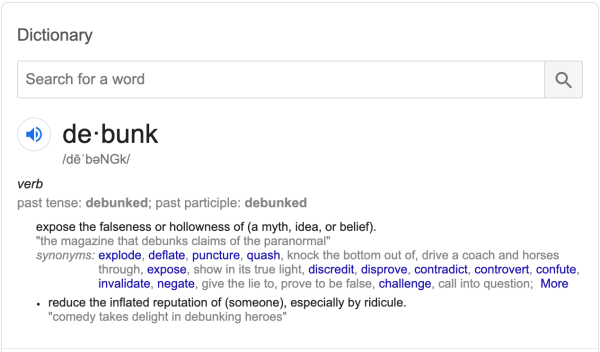
As I have noted often in the 1980s/1990s, the media announced a Reading Crisis in California blamed on whole language. Literacy scholar Stephen Krashen, and others, debunked that claim [1], noting although whole language was the official reading approach of the state, teachers almost never implemented whole language.

As well, Bowers and Bowers make an odd choice about defining what whole language is by citing and defining as follows:

According to foundational theory for whole language, learning to read is just like learning to speak (Goodman, 1967). Given that virtually everyone from every culture learns to speak without any formal instruction in a context of being exposed to meaningful speech, it is concluded that children should learn to read in the same way, naturally, by reading meaningful text. The fact that not all verbal children learn to read with whole language should be a first clue that something is wrong with this theory.

This dramatically over-simplifies Goodman’s work, but also ignores decades of refinement of what whole language became, and then how many have embraced balanced literacy.

When we are referring to whole language, however, the fundamental problem with discounting whole language often rests with not understanding what it is: “Whole language is not a program, package, set of materials, method, practice, or technique; rather, it is a perspective on language and learning that leads to the acceptance of certain strategies, methods, materials, and techniques.—Dorothy Watson, 1989.”

And a failure to acknowledge that “… [w]hole language…builds on the view that readers and writers integrate all available information in authentic literacy events as they make sense of print. Whole language teachers don’t reject phonics; they put it in its proper place [emphasis added]” (K. Goodman, Phonics Phacts, p. 108).

Let me put this directly: Whole language does reject the need for systematic phonics for all children, but the language philosophy endorses entirely that some phonics is needed, that each child should receive the amount and type of phonics instruction needed to read independently—not to comply with a reading program, to cover a set of universal standards, or to raise test scores.

The argument posed by Bowers and Bowers is correct only if we misdefine whole language and fail to critically examine research that claims to be measuring whole language effectiveness or if whole language was even implemented with any sort of fidelity.

As it sits now, the Bowers and Bowers’s argument is 50% wrong.


[1] Note that the reading test score decreases (the reason for the claim of a reading crisis) were caused mostly by a large influx of non-native English speaking students and drastic budget cuts for education. The ways in which students were being taught to read are correlations at best with those scores.

For Further Reading

Defending Whole Language: The Limits of Phonics Instruction and the Efficacy of Whole Language Instruction, Stephen Krashen, Reading Improvement 39 (1): 32-42, 2002.

Facts: On the nature of whole language education (Heinemann)

To read or not to read: decoding Synthetic Phonics, Andrew Davis

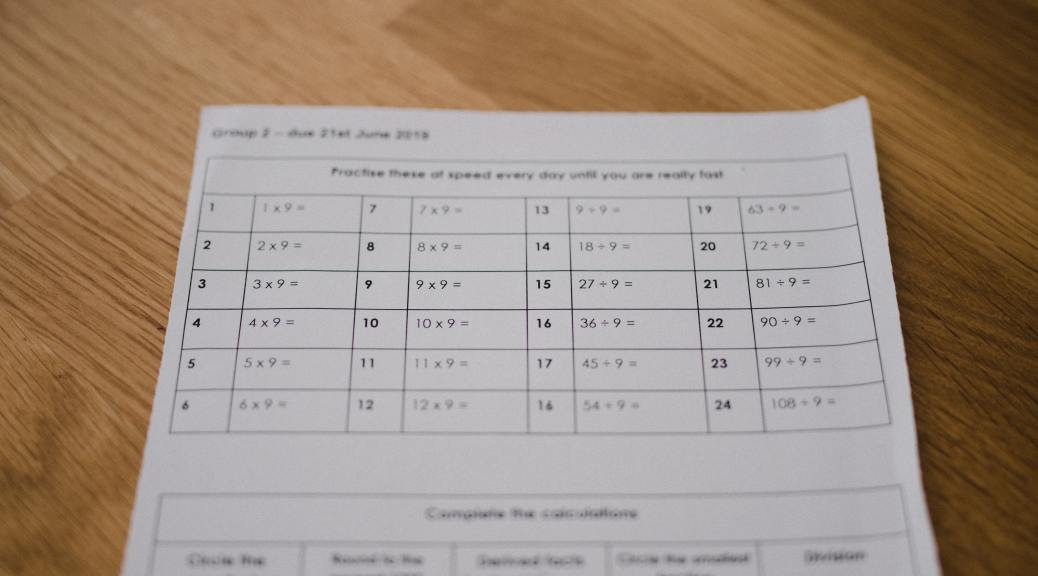
Worksheets? We Talking about Worksheets

A few days ago, I had an Allen Iverson moment on Twitter:

1. Take any normal worksheet with review questions.

2. Cut the sheet into slips.

3. Hide those slips in plastic eggs.

4. Toss the eggs in a trash can.

5. Stop wasting your time and your students’ time with worksheets. https://t.co/B5CeDNAT9A

— Paul Thomas (@plthomasEdD) March 22, 2019

Iverson, among many other athletic and pop culture accomplishments, is notorious for this rant:

“We sitting in here — I’m supposed to be the franchise player, and we in here talking about practice. I mean, listen: We talking about practice. Not a game. Not a game. Not a game. We talking about practice. Not a game. Not the game that I go out there and die for and play every game like it’s my last. Not the game. We talking about practice, man.”

What resonates with me, after I posted the retweet above, is that Iverson was almost entirely misunderstood, and received a fair among of negative feedback and is often still misrepresented by his outburst.

Once I realized that my critical list had gained a momentum of its own—many people responding positively to my intent, but a few creeping into viewing my Tweet as a burn—I noticed that some people found the Tweet to be unprofessional in tone and misread my point as somehow being against students having fun or oversimplifying the problem with worksheets.

To attempt to set the record straight, and try to calm the piling on that I did not intend, I posted a thread navigating the misunderstandings and concerns about my tone and points.

For the record, I am firmly against worksheets (although what that label means needs some interrogation, I admit), and for authentic (even fun) engagement by students with whole and real learning and artifacts of learning. But that is really complicated.

A former student and then early-career teacher, who has now left teaching, had a disturbing experience with why this position of mine is complicated. She taught in a school grounded in project-based learning (PBL). Her course was also team-taught.

As an English teacher, however, she was frustrated that she was required to prepare lessons and activities for students that were a series of different projects; notable in that requirement is that reading and writing were excluded from being the only sorts of projects students could complete.

She found herself in the sort of dilemma Lou LaBrant rejected in 1931, in one of the earliest rounds of PBL mis-attributed to John Dewey:

The cause for my wrath is not new or single. It is of slow growth and has many characteristics. It is known to many as a variation of the project method; to me, as the soap performance. With the project, neatly defined by theorizing educators as “a purposeful activity carried to a successful conclusion,” I know better than to be at war. With what passes for purposeful activity and is unfortunately carried to a conclusion because it will kill time, I have much to complain. To be, for a moment, coherent: I am disturbed by the practice, much more common than our publications would indicate, of using the carving of little toy boats and castles, the dressing of quaint dolls, the pasting of advertising pictures, and the manipulation of clay and soap as the teaching of English literature. (p. 245)

LaBrant’s anger lead her to this conclusion:

That the making of concrete models will keep interested many pupils who would otherwise find much of the English course dull may be granted. The remedy would seem to be in changing the reading material rather than in turning the literature course into a class in handcraft. (p. 246)

When I saw the original Tweet about hiding worksheets cut into strips inside Easter eggs, I immediately thought of my former student and LaBrant.

I am certain that I could create a Jeopardy!-style game to engage students in, for example, grammar activities. I think the game itself and student engagement could likely be exciting, and anyone observing that lesson would be fairly impressed with the energy.

I may even concede that students could learn grammar during the activity—although I am skeptical of the likelihood that a one-shot activity would produce genuine and deep understanding.

Here, however, let me return to LaBrant, who wrote in 1947: “We have some hundreds of studies now which demonstrate that there is little correlation (whatever that may cover) between exercises in punctuation and sentence structure and the tendency to use the principles illustrated in independent writing” (p. 127).

While the Jeopardy!-style game may be successful in being fun and engaging students, I am certain that whatever grammar students may learn, we remain faced with the same reality LaBrant confronted 80-plus years ago: Isolated grammar instruction does not transfer into student practice as writers.

Therefore, we must evaluate the Jeopardy!-style grammar game based on our instructional purposes. If we are teaching grammar-for-grammar’s sake, the game may be a valid instructional strategy (compared to completing grammar worksheets, for example).

But if our goal is writing instruction, even though the game is fun and engaging, it is a waste of instructional time better spent by students drafting, conferencing, and engaging in explicit instruction covering grammar, usage, and mechanics in the context of their original writing.

For those who see the teaching of English as more than writing and reading, we may be compelled to find engaging and fun ways to bring students to literature as well.

What if I designed a Thoreau-like nature walk for students to commune with nature and come to a better understanding of American transcendentalism espoused by Ralph Waldo Emerson and Henry David Thoreau?

Again, this nature walk to an outside observer may appear to be very engaging and even fun for the students. But hiking in nature is not the domain of literature study; mining text for meaning, however, is what literature study entails.

Crouching in the woods or wading into a pond, like Thoreau, may help students with appreciating nature, but it is time better spent reading, discussing, and critically unpacking the essays written by Emerson and Thoreau, while also contrasting those texts with others written by their contemporaries, such as Nathaniel Hawthorne and Edgar Allan Poe.

Once again, as LaBrant argued throughout her career, writing is learned by writing, and reading is learned by reading.

Let me circle back, now, briefly, to the worksheet.

The decade’s long appeal of PBL comes, I think, from a realization that worksheets, workbooks, and static, silent students are elements of traditional schooling most of us want to avoid.

When I think “worksheet,” I am reminded of my early days of teaching high school English and being compelled to teach context clues because our students scored low on that subset of reading skills during state testing.

As part of our mandated test-prep, we were issued workbooks with worksheets dedicated to isolated reading skills. The context clues worksheet identified four or five types of context clues and then tested students with dozens of sample sentences requiring students to identify the type of context clue strategy needed to define the unknown vocabulary.

To be honest, this approach could likely raise student test scores since the worksheets were designed to prepare students for test-reading; the worksheets and tests involve the same sort of mechanical and inauthentic process and test a manufactured set of content designated as “context clues.”

Here’s the problem: Writers don’t write implementing context clues; writers just use words to form sentences and paragraphs. Context clues strategies work on worksheets and tests, but not so much in real-world reading.

Vocabulary acquisition is incredibly important for literacy development, but most people have the how of that acquisition backward: Students don’t need words (or context clues strategies) crammed into them so they can read better; reading more and more makes them better readers, in part, because that is how we acquire more words.

My concern and caution, then, are much broader than the worksheet since both worksheets and PBL (seemingly antithetical to each other) can be flawed practice if we are not careful to match our instructional strategies to our intended learning outcomes and artifacts of learning.

At first blush, this may seem tedious, even dull, but teaching English is mostly about reading and writing. These are often engaging and fun, but some times they are also challenging and rewarding even as they are tedious.

None the less, let’s not lose sight of what we are doing in the name of fun when that pursuit, in fact, avoids the real work that we should attend to and seeks as well to insure that students are engaged and, yes, often having fun.

What Shall We Do About Reading Today?: Looking Back to See Now More Clearly

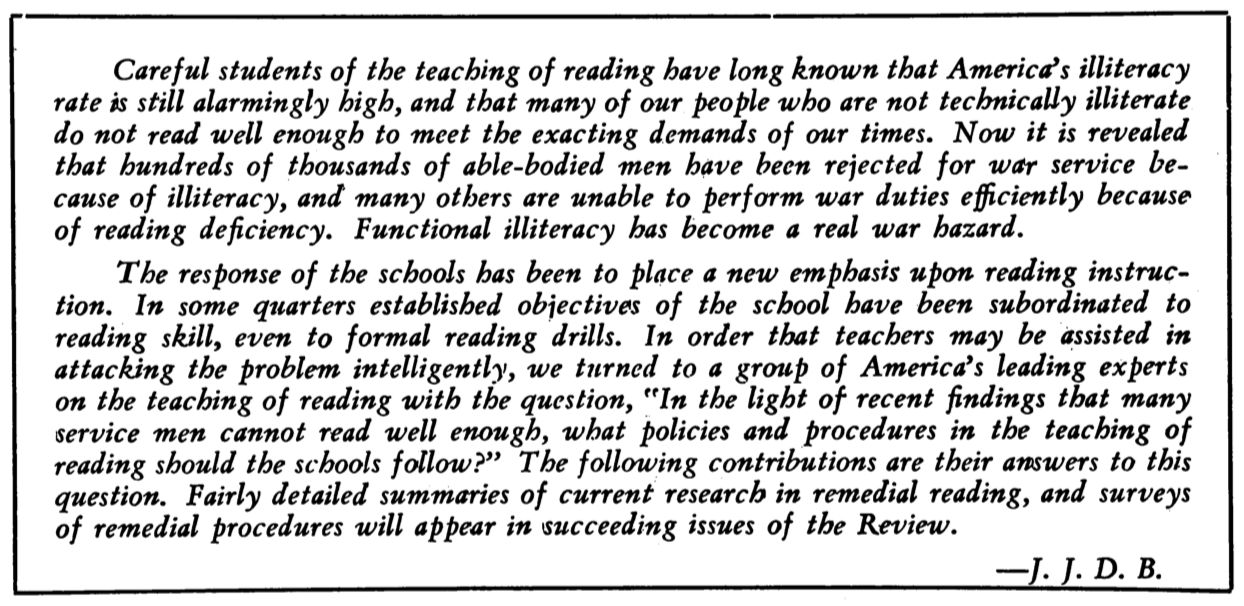
The November 1942 issue of The Elementary English Review (National Council of Teachers of English) included a provocative piece: What Shall We Do About Reading Today?: A Symposium.

The opening editorial comment frames the need for the question:

Editorial blurb 1942.png

This symposium offers answers to the titular question from leading literacy experts of the time: Emmett A. Betts, E.W. Dolch, Arthur I. Gates, William S. Gray (first IRA president), Ernest Horn, Lou LaBrant (former president of NCTE and focus of my dissertation, an educational biography), Holland Roberts, Dora V. Smith (former NCTE president), Nila Banton Smith, and Paul Witty (key figure in the career and life of LaBrant).

Unlike most cries of educational “crisis,” this national focus on reading was nested in World War II—a genuine crisis. But, according to the assembled experts on literacy, this 1942 version of the Reading Wars was a harbinger of how these debates are mostly misinformed, misguided, and driven by ideology instead of evidence.

Betts, in the opening piece, notes an important fact drawn from a report by First Lady Eleanor Roosevelt: “One of the students had only four months of schooling, another was foreign born, some came from sections of the country where educational opportunities were meager, and so on. In short, the First Lady’s report emphasized the lack of educational opportunity [emphasis added] rather than the questionable quality of instruction” (p. 225).

Before detailing the problems and the possible solutions—including recognizing shortages and shifts in teacher availability—Betts makes a powerful claim: “In a democracy, the people get the kind of schools they want….In a democracy, the quantity and quality of educational opportunity is a product of what people want, and what they want is to no small degree conditioned by the educational leadership they have elected to follow” (pp. 225-226).

While I recommend reading the symposium responses in full, I focus below on two key answers from Gray and LaBrant.

Gray offers a solid framing of the debate spurred by claims of illiteracy among those called to serve, including this:

Gray second attitude.png

Along with refuting these standard false charges, Gray builds to a powerful closing argument:

A common error on the part of those who modify their reading programs is to adopt one or more reforms, such as the provision of much free reading, and neglect other aspects of reading that are in need of specific attention…

If the discussion thus far has achieved its purpose, it should be clear that current deficiencies in reading are not the product of “pseudo-scientific fumbling” or the use of progressive reforms, as some would have us believe. They are due in large measure either to the continued use of traditional patterns of teaching or to failure to provide a well-balanced [emphasis in original] program of reading activities that harmonize with progressive trends. (pp. 236-237)

LaBrant, in her typical style, takes a much more direct approach:

Within the past ten years we have made great strides in the teaching of purposeful reading, reading for understanding (the kind of reading, incidentally, which the army and navy want). Nevertheless, we hear many persons saying that the present group of near-illiterates are results of “new methods,” “progressive schools,” or any deviation from the old mechanical procedures. They say we must return to drill and formal reciting from a text book. (p. 240)

However, LaBrant completely discredits that blame:

1. Not many men in the army now have been taught by these newer methods [emphasis in original]. Those few come for the most part from private or highly privileged schools, are among those who have completed high school or college, and have no difficulty with reading.

2. While so-called “progressive” schools may have their limitations, and certainly do allow their pupils to progress at varied rates, above the second grade their pupils consistently show superior ability in reading. Indeed, the most eager critics have complained that these children read everything they can find, and consequently do not concentrate on a few facts. Abundant data now testify to the superior results of purposeful, individualized reading programs [emphasis in original].

3. The reading skills required by the military leaders are relatively simple, and cause no problem for normal persons who have remained in school until they are fourteen or fifteen. Unfortunately the large group of non-readers are drop-outs, who have not completed elementary school, come from poorly taught and poorly equipped schools, and actually represent the most conservative and backward teaching in the United States [emphasis in original]. (pp. 240-241)

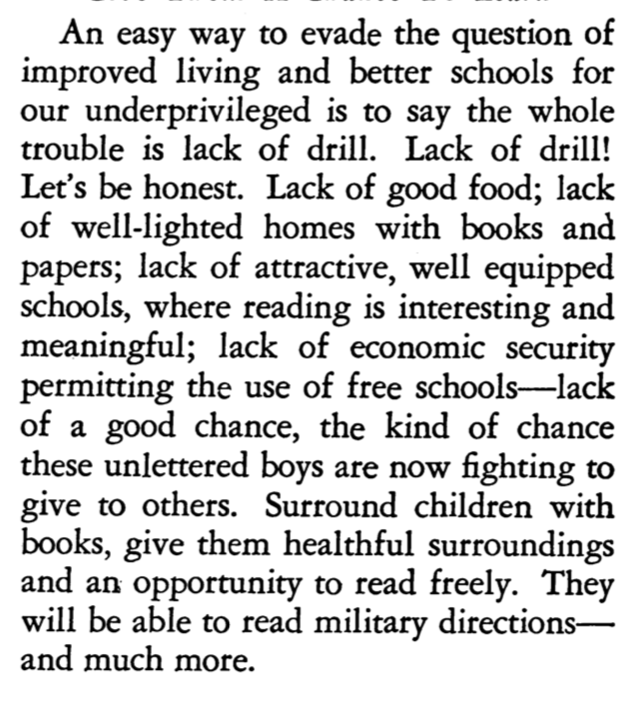
In her conclusion, LaBrant is passionate and unyielding:

lack of drill

Within five years, LaBrant penned what would become a refrain of her six-plus decades as an educator: “A brief consideration will indicate reasons for the considerable gap between the research currently available and the utilization of that research in school programs and methods” (p. 87).

The question about reading raised in the 1940s suffered from the same failures to recognize the problem in order to shape effective and credible answers that we are confronting in 2019.

The fumbling today of the Reading Wars is yet another snapshot of a tired truism: “Those who cannot remember the past are condemned to repeat it” (George Santayana).

Two Threads on Reading

I may tease these ideas more fully in blogs but for now, see two threads of mine below from Twitter.

What are teachers taught about reading in teacher education? “It just doesn’t matter.” [Click the Twitter bird in the upper right of the image for the thread.]

When advocacy for one student oversteps into what every student needs: The reading edition. [Click the Twitter bird in the upper right of the image for the thread.]

The Big Lie about the “Science of Reading” (Updated)

While too often inordinately dangerous* for the most vulnerable, social media can be a powerful window into how we think about and judge education. Recently, the reading wars have been once again invigorated; this time driven often by parents and advocates for students with special needs and accompanied by a very familiar refrain, the “science of reading.”

One problem with public debate about education is that political and public voices often lack experience and expertise in education as well as any sort of historical context.

First, those who have studied the history of education, and specifically the ever-recurring reading wars, know that there has never been a decade in the last 100+ years absent political and public distress about a reading crisis.

However, one doesn’t need a very long memory to recognize that if we currently are (finally?) having a reading crisis, it comes in the wake of almost two decades (nested in a larger four decades of accountability birthed under Ronald Reagan) dedicated to scientifically-based education policy, specifically reading policy driven by the National Reading Panel (NRP).

The NRP was touted as (finally?) a clearing house of high-quality evidence on teaching children to read (although it proved itself to be partisan hokum).

This is all quite fascinating in the context of the current media blitz about the reading crisis and a need (yes, once again) to focus on the science of reading. Concurrent with that media fail is a move within the academia to shift reading away from literacy experts and into the purview of special needs, treating all reading instruction as something like remediation or a learning disability.

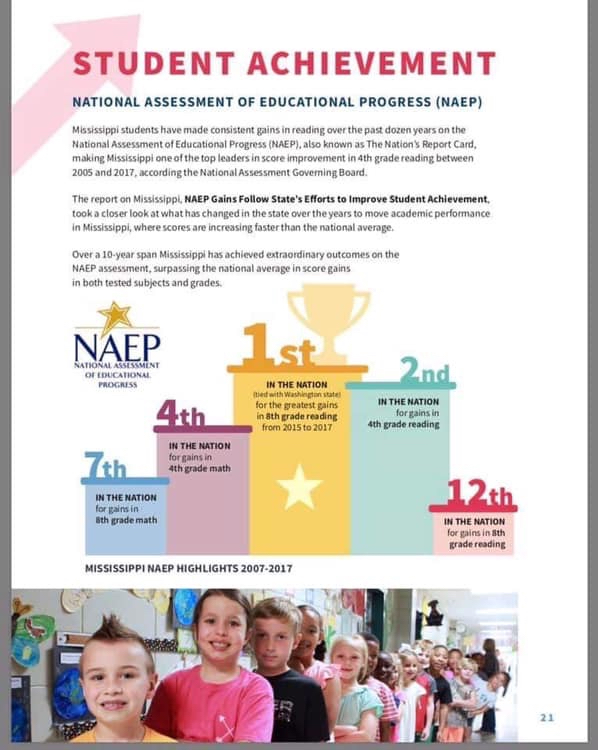
For example, I noticed a very odd dynamic on social media: a post on a community Facebook page for advocates of education that was linked to a dyslexia Facebook page promoting this from Mississippi:

MS gains propaganda

The message included dramatic arguments: Mississippi has somehow found the science of reading and is excelling in ways South Carolina refuses to do.

Knowing standardized test scores, and NAEP specifically, well, I was immediately skeptical of these claims.

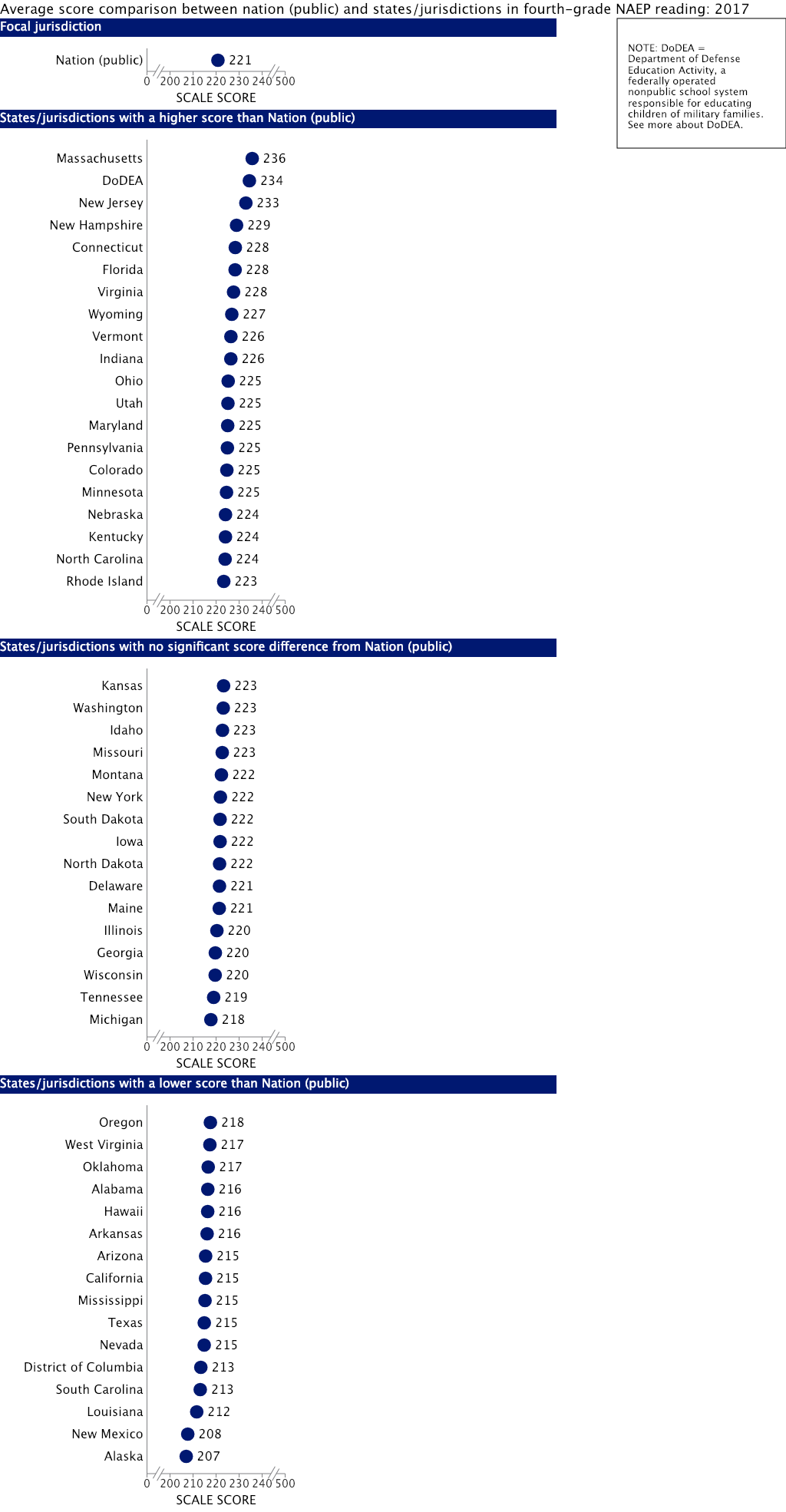
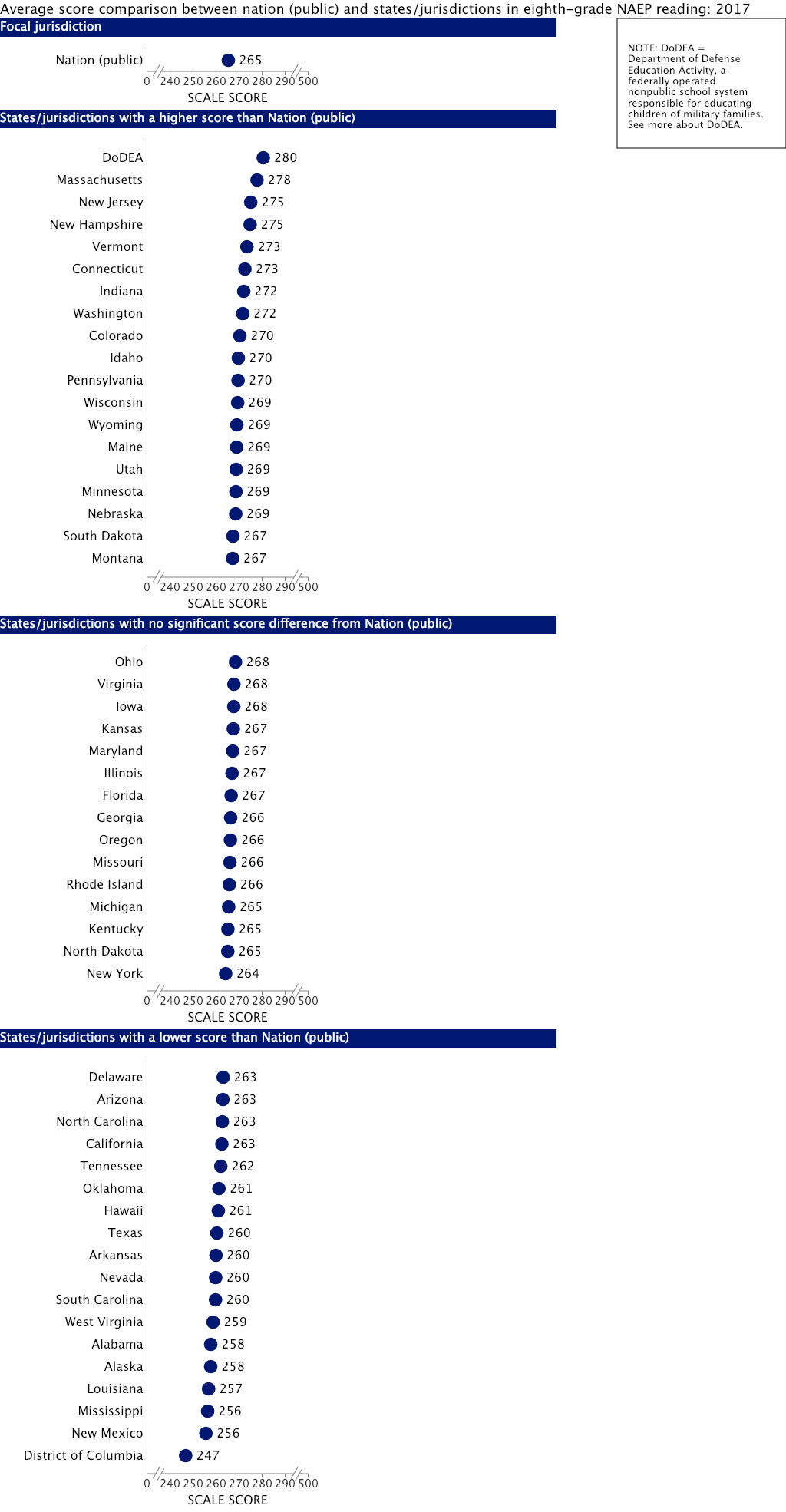
Here is the short version: In 2017 NAEP data, MS is slightly ahead of SC in 4th-grade reading (both states remain near the bottom and below the national average), but SC is slightly ahead of MS in 8th-grade reading (again, both near the bottom and below the national average):

4th reading 2017

8th reading 2017

While Mississippi is promoting gains (accurately), the data remain clear that high-poverty states tend to score low on standardized testing while more affluent states tend to score higher.

What is extremely important to note is that some traditionally low scoring states have found methods (test-prep, reading programs focused on raising test scores, and grade retention) that increase test scores short term (making for political propaganda), but those gains have proven to be a mirage, disappearing in the span between 3rd/4th- grade tests to 8th-grade tests and then high school (see, for example, research on Florida).

So we sit here with some real problems and questions: Is there a reading crisis in the U.S. and my home state of SC? And if so, is that crisis somehow the result of refusing to implement the science of reading?

Well, first, I need to note that the “science of reading” is code for intensive phonics and is intended as an antidote to the current evil in reading, balanced literacy.

Now, consider this: In the late 1980s and early 1990s, a similar event happened when people started shouting about the reading crisis in California spawned by whole language (now, people claim balanced literacy and whole language are the same thing, and thus, equally evil).

Literacy scholar Stephen Krashen, and others, unmasked that round of the reading wars, noting that although CA claimed whole language as the official reading approach of the state, teachers were almost never practicing whole language.

Further, the reading score plummet of those years did correlate with whole language being the official policy, but the causes of those lower scores were a large influx of non-native speakers of English and significant decreases in educational funding (larger classes specifically negatively impacting achievement).

This isn’t particularly simple or compelling but let’s detail why this recent round of the reading wars is way off base:

  • Standardized tests of reading are only proxies of reading, typically they reduce reading to a series of discrete skills that test designers claim add up to reading. This is at least inadequate, if not misleading. No standardized test measures eagerness and joy for reading, as well; nearly none address critical literacy.
  • Making raising reading test scores your primary or exclusive goal is actually cheating all students. Period. And this is what many states are doing, including MS.
  • Achieving test score gains when you are low scoring is much easier that making gains when you are high achieving.
  • Adopting, implementing, and staying focused on any reading program—these are also very common practices, and completely flawed approaches to literacy. Access to books in the home and choice reading remain the strongest predictors of increased reading and reading achievement.
  • Ultimately, if we insist on using reading test scores to judge the quality of teaching reading in any state or the country, we must acknowledge that how students are being taught is both almost impossible to identify and completely impossible to characterize as one clear practice (teachers are very likely to shut their doors and do as they please, regardless of policies).
  • And most important is the fact that standardized test scores of reading are a reflection of a large number of factors, with teaching practices only one (probably small) causal factor.

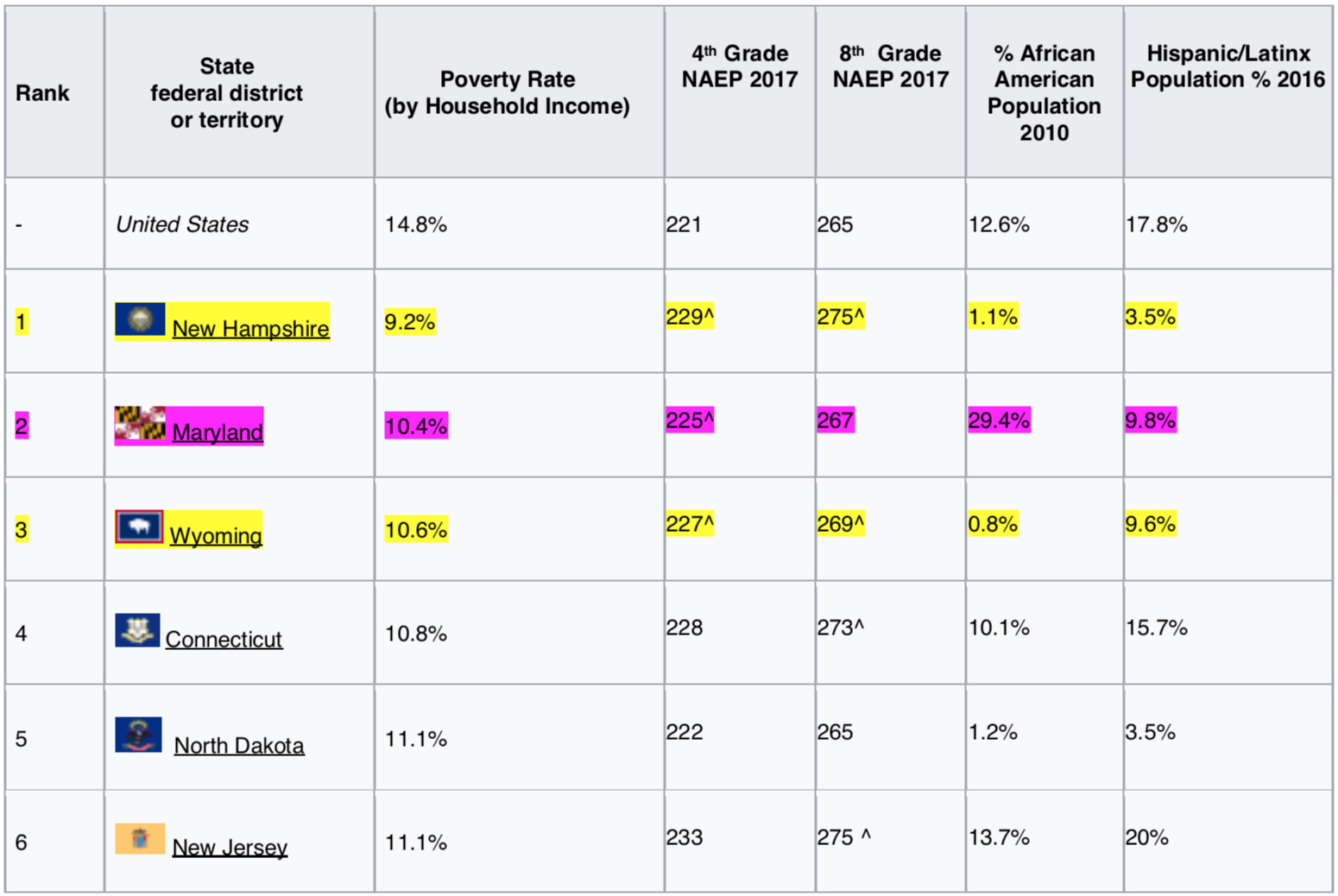
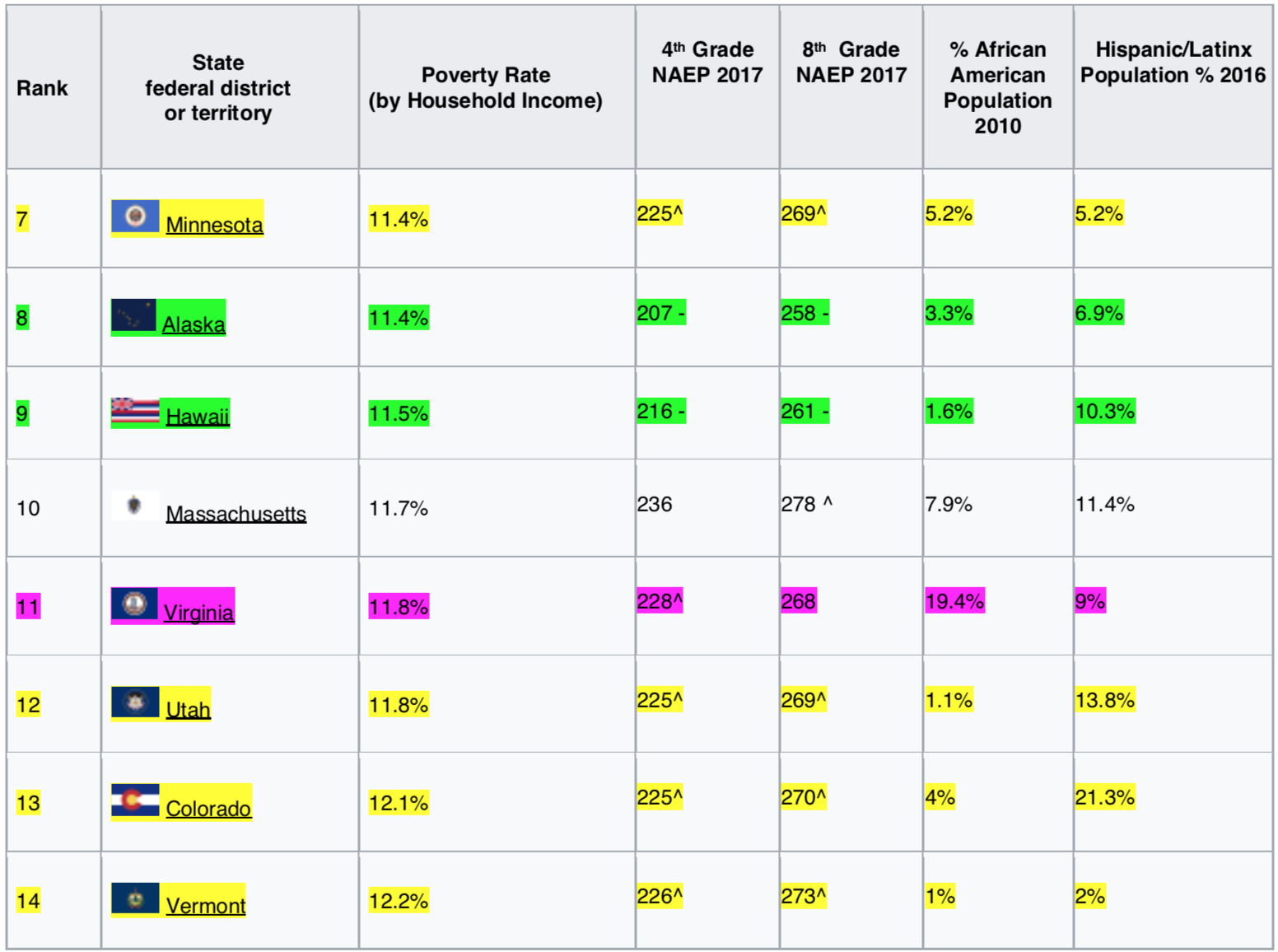
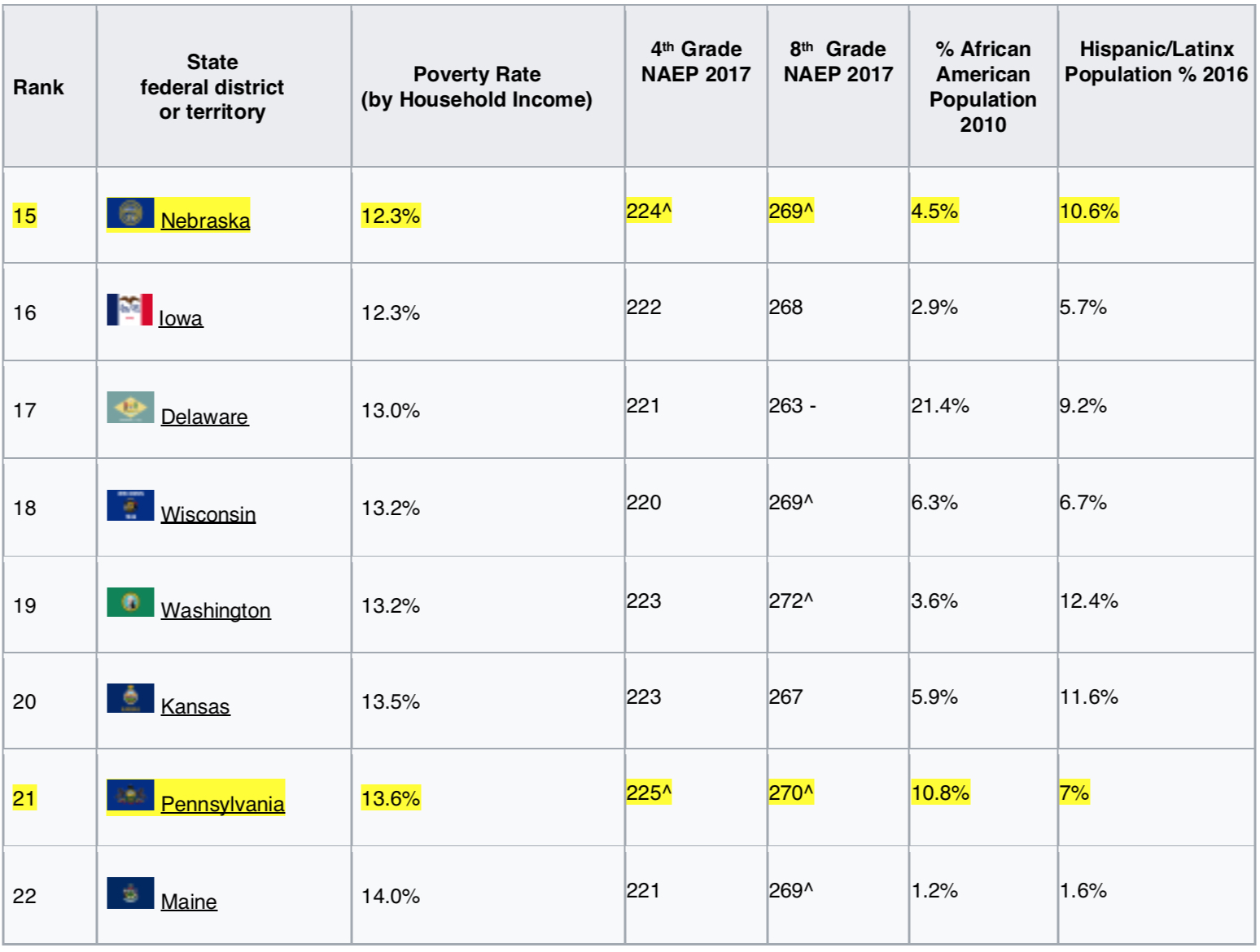
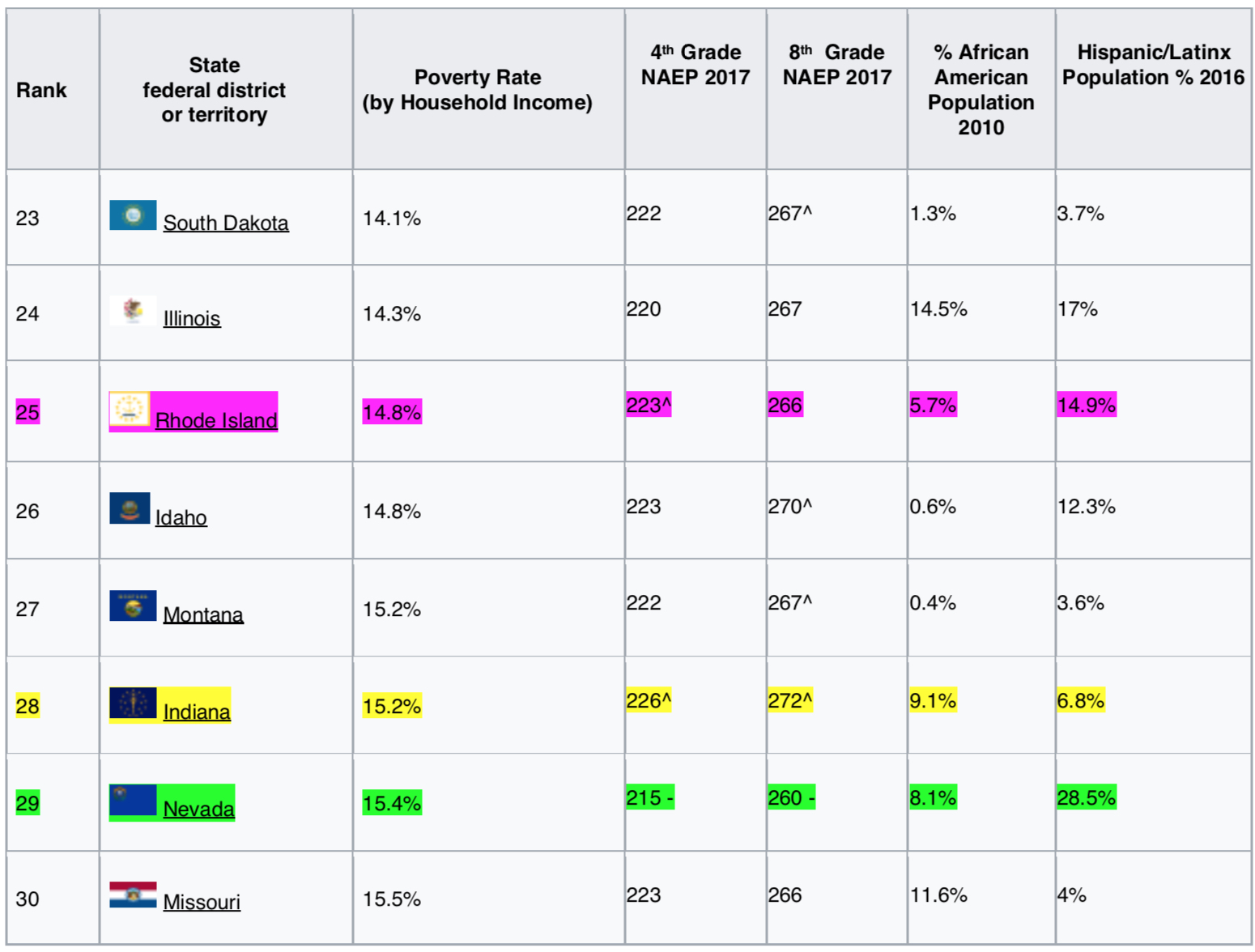
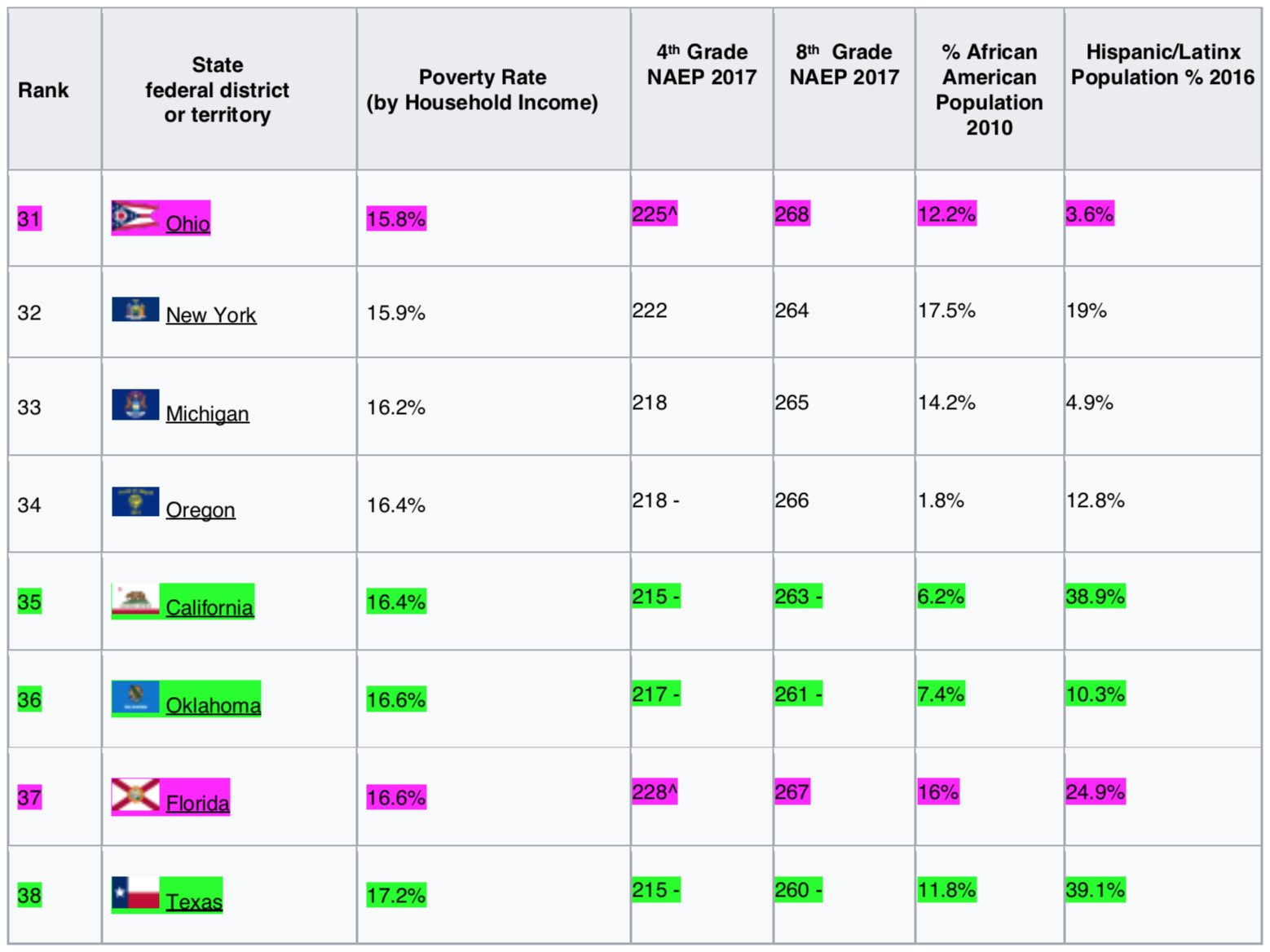
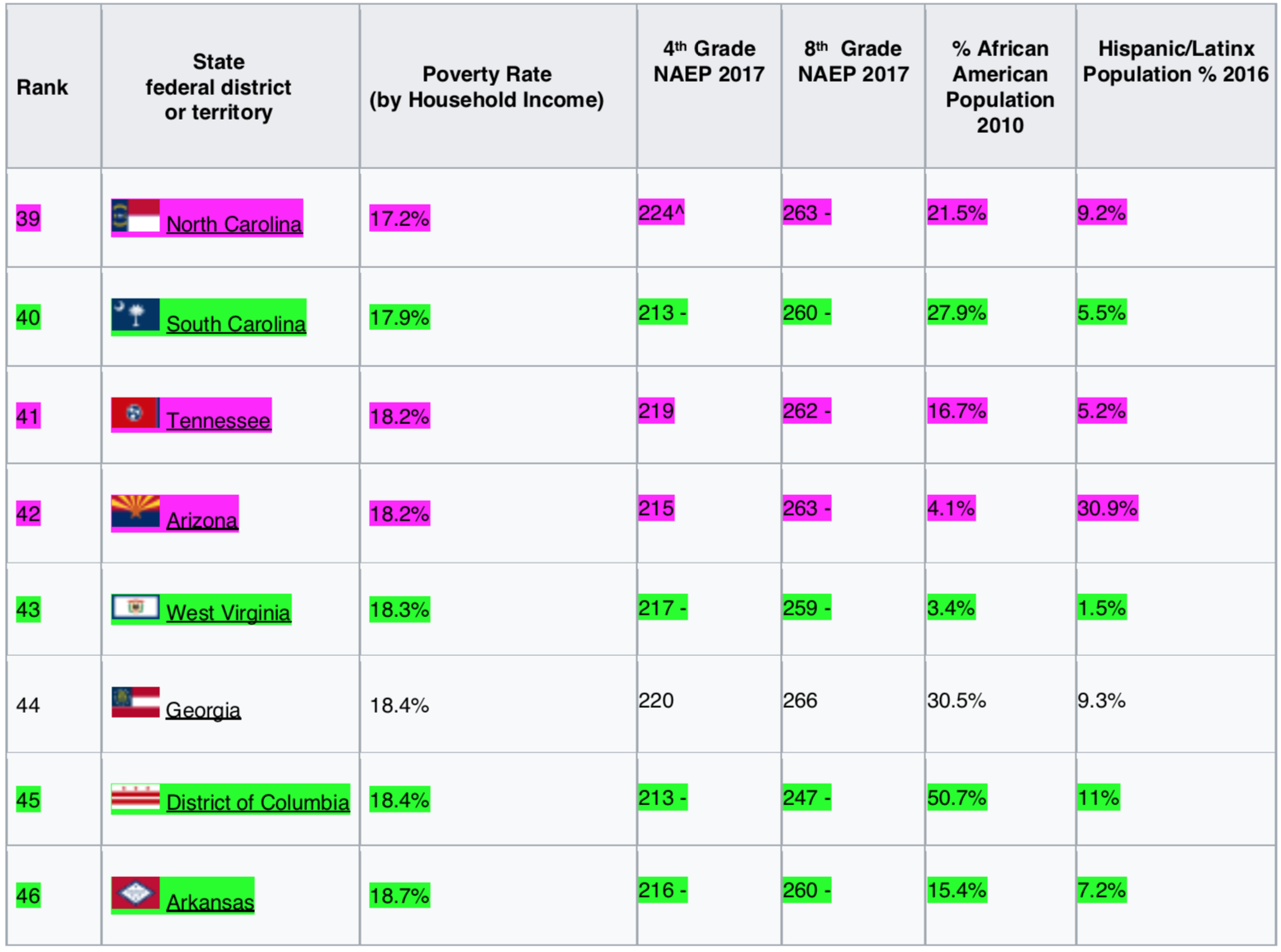
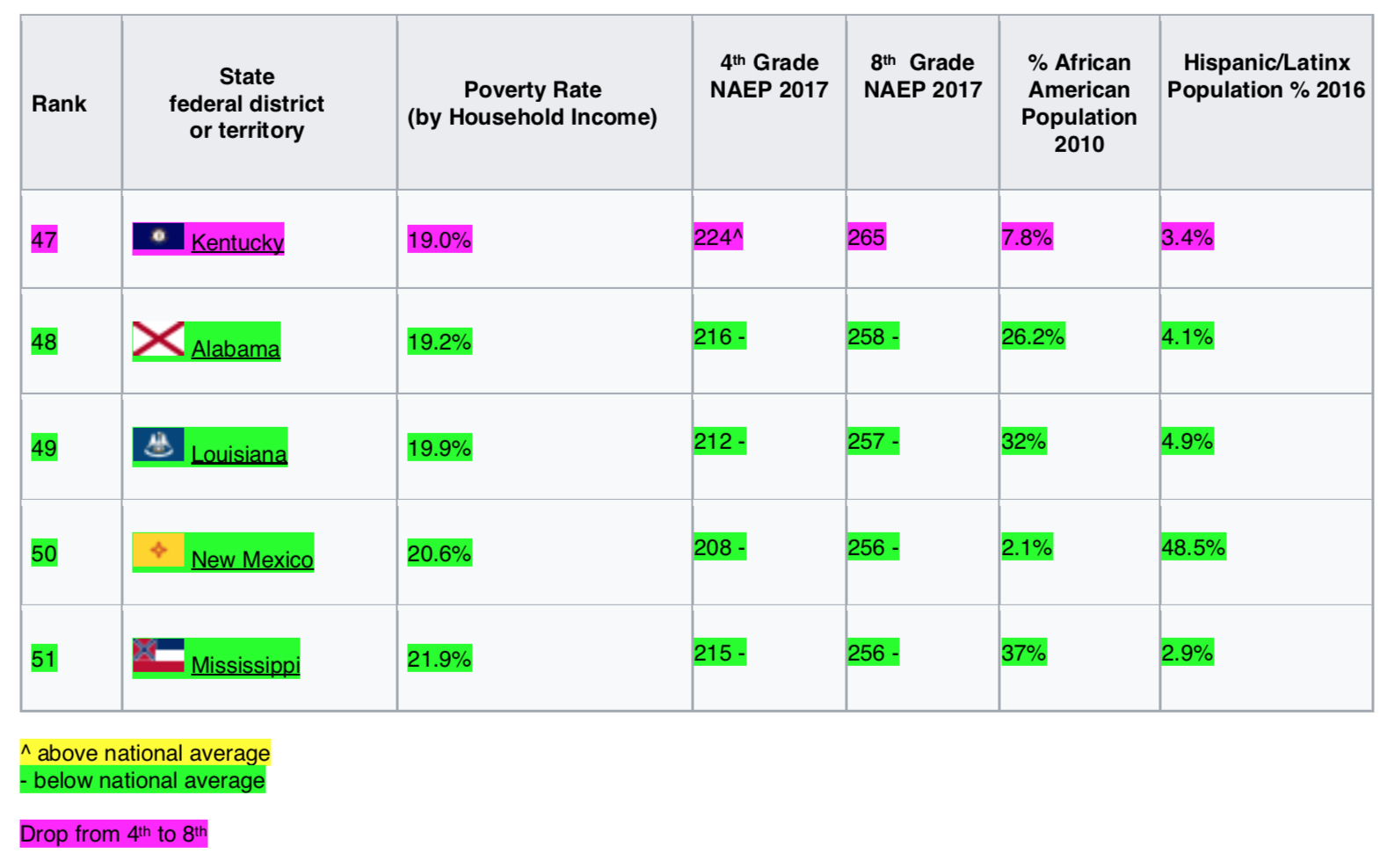
To that last point, consider this matrix of 2017 NAEP reading scores (4th/8th) along with the poverty in each state, the African American population percentage, and the Hispanic/Latinx population percentage. These data portray a much more complex picture of the reading problem, and resist the distraction that how students are being taught reading is cheating students, who could be saved by the “science of reading” (which, by the way, is balanced literacy—o, irony):

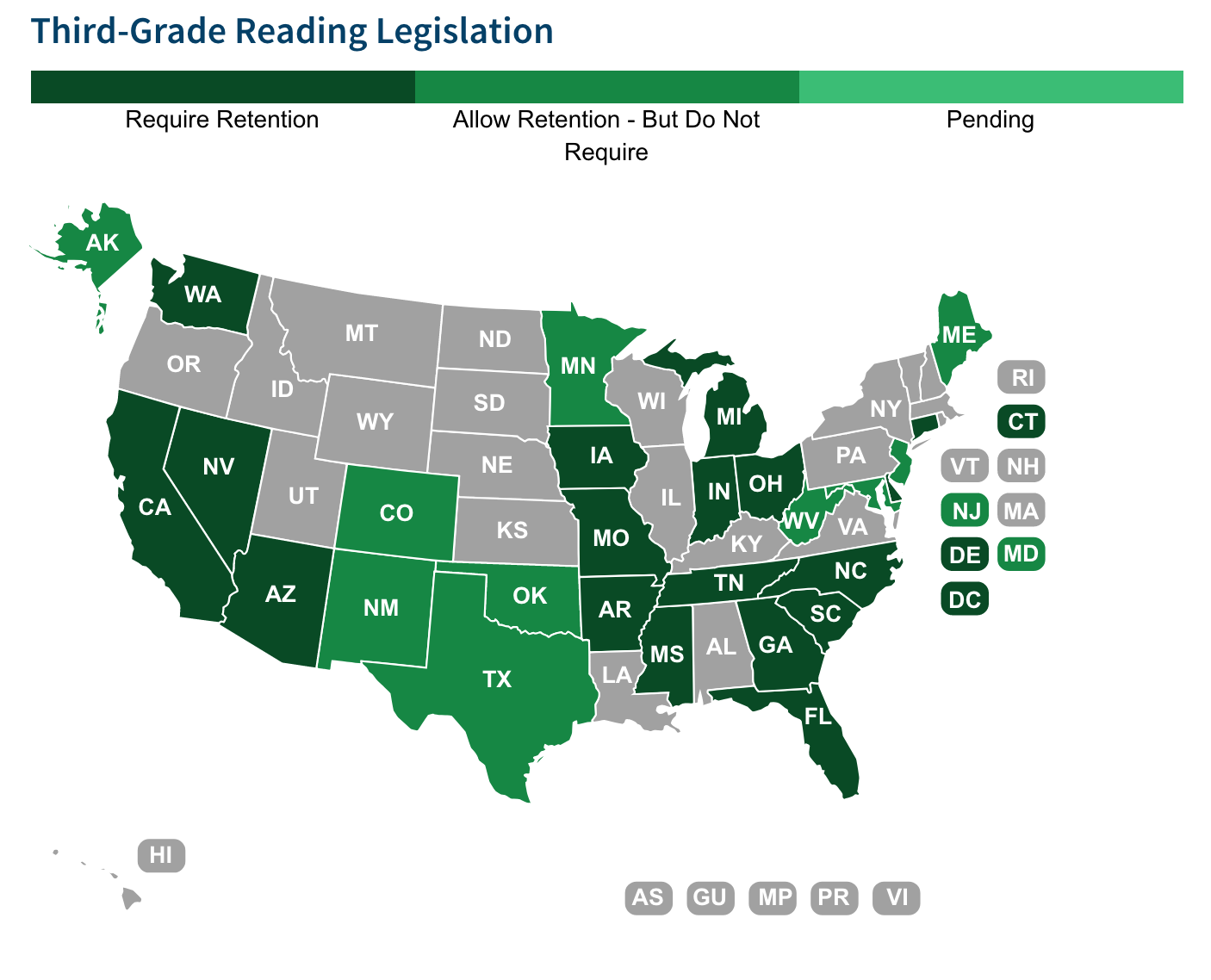
[Click links above each chart for expanded charts with grade retention legislation identified.]

Poverty NAEP 4 8 2017 grade retention 1

NAEP reading 2017 1

Poverty NAEP 4 8 2017 grade retention 2

NAEP reading 2017 2

Poverty NAEP 4 8 2017 grade retention 3

NAEP reading 2017 3

Poverty NAEP 4 8 2017 grade retention 4

NAEP reading 2017 4

Poverty NAEP 4 8 2017 grade retention 5

NAEP reading 2017 5

Poverty NAEP 4 8 2017 grade retention 6

NAEP reading 2017 6

Poverty NAEP 4 8 2017 grade retention 7

NAEP reading 2017 7

The “science of reading” mantra is a Big Lie, but it is also a huge and costly distraction from some real problems.

Relatively affluent states still tend to score above average or average on reading tests; relatively poor states tend to score below average on reading tests.

Some states that historically scored low, under the weight of poverty and the consequences of conservative political ideology that refuses to address that poverty, have begun to implement harmful policies to raise test scores (see the magenta highlighting) in the short-term for political points.

It is 2019. There is no reading crisis in the way the “science of reading” advocates are claiming.

It is 2019. Balanced literacy is the science of reading, but it is not the most common way teachers are teaching reading because schools are almost exclusively trying to raise scores, not students who are eager, joyful, and critical readers.

It is 2019. Political and public efforts to do anything—often the wrong thing—so no one addresses poverty remain the American Way.

It is 2019. It is still mostly about poverty when people insist it is about reading and reading policy.


* This opening has been revised because I made a careless error by making an analogy using the “Wild West,” seeking an engaging opening but making a culturally insensitive comparison instead. I regret this use of phrasing, but also appreciate being kindly informed of my carelessness in private. I try to listen to such concerns, and kindness, and am learning every day to be a better person, and writer.


Third-Grade Reading Legislation

3rd grade retention legislation

Evidence v. Advocacy in Teaching Reading: “We Should Not Mistake Zeal for Warrant”

There is a certain karmic irony to the rise of public intellectuals who start to drive outside their lane—actually who take over all the lanes—only to prove that, in fact, they do not know everything.

Current bloviator-know-nothings include Jordan Peterson and Steven Pinker, the latter who has squandered intellectual capital he had built in psycholinguistics.

Both are experts in the field of psychology, a discipline apt to include far too many scholars with delusions of grandeur (only surpassed in arrogance by scholars in economics and about on par with scholars in political science for knowing everything).

Those of us who are scholars, practitioners, or both in the field of education have suffered a long history of being marginalized as both not really an academic discipline (education as “teacher training”) and merely classroom teachers.

As someone with experience and expertise as a practitioner (high school English teacher for 18 years) and researcher in education, I often find I hold no sway in issues related to education in my public work or with my scholarly impact. Imagine if I held forth in book form on psychology, economic, or politics? Think the New York Times would scramble to hang on my every word as they did for a psychologist claiming to be an expert in teaching reading?

(These are rhetorical questions.)

There exists another layer to education that often remains unexamined: K-12 public education is almost exclusively run along partisan political lines through bureaucracy and legislation that is not created by practitioners or educational researchers.

Practitioners who teach literacy/reading and literacy/reading scholars are currently under assault again by a new round of the reading wars. As has been common in these periodic skirmishes, there really is no war because the so-called factions do not have anywhere near equal power.

As a self-proclaimed reading expert, Daniel Willingham, psychology professor, represents what is essentially wrong with the entire framing of debates about teaching reading as a war.

Stated perfectly by Andrew Davis in his careful debunking of intensive/synthetic phonics advocacy, “The zeal with which synthetic phonics is championed by its advocates has been remarkably effective in pushing it to the top of the educational agenda; but we should not mistake zeal for warrant.”

During the current media blitz once again hand-wringing that children are not being taught to read because teachers are not prepared properly in teacher education and students are not receiving intensive phonics instruction, Willingham held forth on his blog to answer: Just how polarized are we about reading instruction?

His post doesn’t answer the question very well, but in another moment of karmic irony, Willingham reveals why “we should not mistake zeal for warrant.”

Affecting a tone of being fair and balanced, Willingham offers 6 positions on reading:

  1. The vast majority of children first learn to read by decoding sound. The extent to which children can learn to read in the absence of systematic phonics instruction varies (probably as a bell curve), depending on their phonemic awareness and other oral language skills when they enter school; the former helps a child to figure out decoding on her own, and the latter to compensate for difficulty in decoding.
  2. Some children—an extremely small percentage, but greater than zero—teach themselves to decode with very minimal input from adults. Many more need just a little support.
  3. The speed with which most children learn to decode will be slower if they receive haphazard instruction in phonics than it would be with systematic instruction. A substantial percentage will make very little progress without systematic phonics instruction.
  4. Phonics instruction is not a literacy program. The lifeblood of a literacy program is real language, as experienced in read-alouds, children’s literature, and opportunities to speak, listen, and to write. Children also need to see teachers and parents take joy in literacy.
  5. Although systematic phonics instruction seems like it might bore children, researchers examining the effect of phonics instruction on reading motivation report no effect.
  6. That said, there’s certainly the potential for reading instruction to tilt too far in the direction of phonics instruction, a concern Jean Chall warned about in her 1967 report. Classrooms should devote much more time to the activities listed in #4 above than to phonics instruction.

He then claims the reading wars problem is that factions take either the side of the even or the odd numbered claims—although he argues “I think all of the six statements above are true.”

The problem is a sneaky one because most of Willingham’s audience, like Willingham, has no literacy expertise or practical experience teaching children to read. For a lay audience, it is unfair to expect anyone to notice that Willingham has misrepresented the so-called factions in the reading war.

One of the leading literacy experts in the U.S. is Stephen Krashen; in his relentless analysis of research on teaching reading, he notes that the pro-phonics research often is deeply flawed because it presents either garbled or false definitions of whole language (or balanced literacy) in order to make claims of intensive phonics being more effective.

Willingham’s claims about reading instruction and the failures of teaching, teachers, and teacher education can only stand on completely misrepresenting the field of literacy and the so-called debate itself.

Let me frame a different approach to understanding the problem pro-phonics advocates fumble.

Here is the real dynamic concerning the teaching of reading in U.S. K-12 education: Teaching reading practices are guided primarily by legislation (with no assurance that legislation is grounded in anything more than zeal at the expense of warrant) and then driven by the combination of textbook companies appealing to that legislation and accountability structures (most significantly the mandate to raise reading test scores without investigating if those scores are credible proxies for reading growth or—god forbid—reading eagerness).

That is almost the entire real-world power structure governing how students are taught to read.

Well outside this dynamic stand teacher education and literacy/reading researchers, practitioners, and advocates—all of whom have almost no power, yet are the scapegoats when psychology-professors-turned-reading-experts hold forth in book form or in the NYT.

I should note, as well, that an even smaller and less powerful group often not acknowledged is literacy experts with a historical perspective, a group that I strongly identify with.

The teaching of reading and the public debate about reading have always been characterized by overblown histrionics and a nearly complete failure to implement what we know about learning to read in K-12 public schools because of partisan political bureaucracy, textbook companies, the massive and growing testing industry, and the misguided influence of non-educators posing as reading and literacy experts.

I realize there is nothing sexy about this—there is no war, or crisis—and this message once again will fall on deaf ears because I do not currently hold a position in a psychology department or an elected position where I could pander to an uninformed electorate.


Recommended

To read or not to read: decoding Synthetic Phonics, Andrew Davis

What is wrong with NPR’s “why millions of children can’t read” (NPR Morning Report, Jan 2 and Feb 6, 2019), Stephen Krashen

Defending Whole Language: The Limits of Phonics Instruction and the Efficacy of Whole Language Instruction, Stephen Krashen

Misreading Cause and Effect in Literacy Instruction: Vocabulary Edition

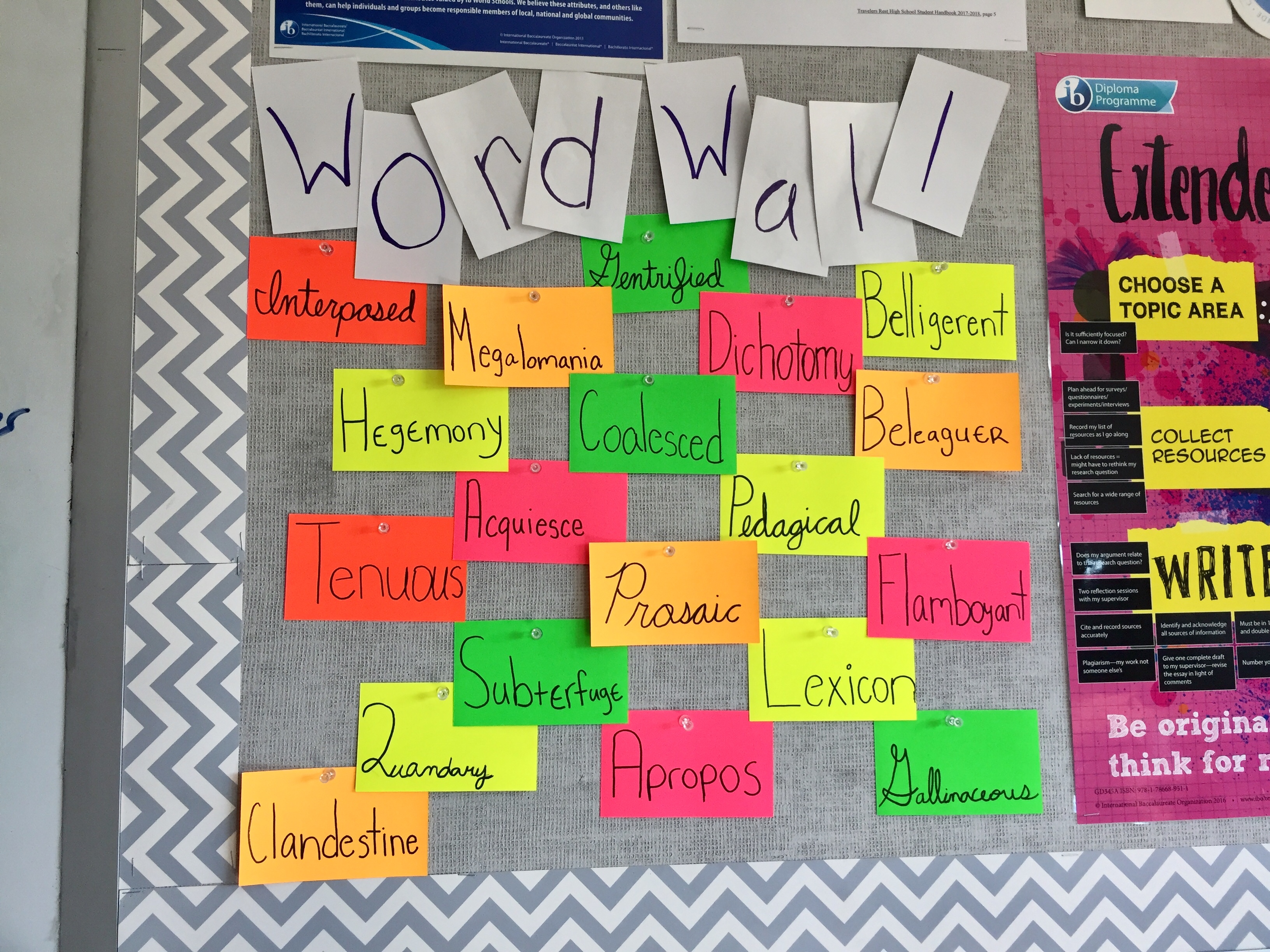
A former student of mine in teacher education, who was an English major and is in her third year of teaching, excitedly shared with me that her high school English students have spontaneously begun maintaining a vocabulary list.

What is interesting about this vocabulary list? Students are cataloguing the words they are learning simply by hearing this teacher use the language of a highly literate and well-educated person.

Marakoff word wall
Word wall created and maintained by students at Travelers Rest High School (South Carolina).

I take no credit for this, but this real-world, spontaneous, and rich environment for literacy growth does reflect (although in a more effective way) what I share with my teacher candidates about my 18 years teaching high school English.

Eventually, I ended the practice in my English department of issuing grammar textbooks and vocabulary workbooks to all students. Teachers were given sets of both and allowed to use as they pleased. In my classes, neither were used in any way.

As the example above from my former student’s class shows, I would model for my students how to discuss literature (texts), films, and popular music, often restating their comments in more sophisticated and complex ways.

Gradually, and spontaneously, my students began to mimic the language and terminology in their discussions and writing.

Coincidentally, my former student’s excitement over her students’ vocabulary activities preceded by a couple days a post on NCTE Connects asking about effective vocabulary instruction. I immediately responded:

Like grammar instruction, vocabulary instruction is deeply misguided when it is in isolation and vocabulary-for-vocabulary’s sake. People are confused and tend to invert erroneously what people with high literacy and large vocabularies mean. Vocabulary is a consequence of rich and extended literacy experiences; cramming vocabulary INTO students is not how you make someone highly literate. In short, if you care about vocabulary, reduce dramatically time and energy spent on vocabulary instruction and focus on rich literacy experiences, notably reading by choice and vibrant discussion. One early-career teacher I know has witnessed her students initiating a vocabulary list of words she teaches them simply through her own expression (her talking to the classes and students); they hear new words almost daily, ask her about them, and are engaged in authentic vocabulary attainment. Also fyi: Power of Common Core to Reshape Vocabulary Instruction Reaches Back to 1944!

This comment is brief so I want to elaborate on some of the key points.

First, the traditional urge to teach literacy skills—grammar, mechanics, usage, and vocabulary, for example—in isolation and sequentially to build toward some ideal whole is deeply engrained but also deeply flawed.

I find this to be the result of uncritical assumptions about the power and effectiveness of analysis. Education has embraced a truism that likely isn’t true: working from part to whole is easier and better for all learning.

How many of us have uttered or been told, kindly, “Let me break this down for you”?

Let me pause here and ask you to do a thought experiment (or maybe just focus on a very specific memory).

Have you ever purchased something you had to assemble? Furniture, a swing set, the hellscape that is anything from Little Tikes?

These items come with detailed instructions, guiding you from part to whole to construct whatever you have purchased. Have you ever been compelled to dutifully follow those directions, laying out the parts as directed and then meticulously beginning your project?

And do you recall that moment when you were mostly lost because you couldn’t really decipher the directions? What did you do? Maybe you grabbed the box and began comparing your Frankenstein’s monster scattered on the floor with the whole thing depicted in the picture on the box?

This urge, some brain research suggests, may be rooted in that only about 1 in 4 people are predisposed to part-to-whole thinking—while 3 in 4 of us work naturally whole-to-part*.

Here is a powerful example of how norms and assumptions can create ineffective practices. Literacy instruction may not be more efficient or effective for most of our students in traditional approaches grounded in skills instruction because literacy is wholistic.

Next, this flawed set of assumptions is also driven by flipping—and misreading—cause and effect in literacy growth.

Yes, highly literate people and sophisticated uses of language are often characterized, for example, by large and complex vocabularies. However, this characteristic is an outcome, an effect.

The mistake too many make in literacy instruction is viewing targeted vocabulary expansion as a cause for rich literacy; thus, extensive vocabulary lists, workbooks, and tests (including nearly fanatical instruction in prefixes, root words, and suffixes) that waste time and energy better spent in the real cause of literacy growth—rich literacy experiences such as reading often and deeply by choice and having complex discussions grounded in those rich experiences with a wide variety of texts.

Here is a relatively simple and more accurate truism, then: A large and nimble vocabulary is an effect of rich literacy experiences—not the cause of literacy development.

So here is a final thought experiment: Imagine taking those vocabulary workbooks out of your students’ hands (and backpacks) and then lead them to the school library, introducing them to the greatest vocabulary books available lining the shelves all around them.


* My argument about the relationship between part and whole, after almost four decades of teaching and spending much of that studying intently the research on literacy acquisition and growth, is that part and whole are symbiotic, working together in ways that defy a linear/sequential model. So I am not really rejecting part-to-whole for whole-to-part, but arguing for whole-part-whole-part … something not easy to express in words or a diagram.

In Brief: Drafting Absent Correctness and Universal Literature

Student Drafting without the Tyranny of Correctness

After I blogged about navigating the trivial in writing instruction, I shared the post with two first-year writing seminars. I then asked them a few questions about several of the claims I had made.

Several of the students quickly confirmed that most of their writing experiences before entering college and my class were driven by concerns about being correct and then efforts to correct their work when given an opportunity to revise.

From that, I asked if their experiences with drafting in my class had been different. Interestingly, in both classes, several students shared that they felt much more free to draft because I do not grade, I give them detailed feedback on their drafts and in conferences, and they know they will be able to address correctness later in the drafting process once they develop a draft worth editing.

The discussion did confirm that many of the students have begun to shift from focusing on the trivial and working more directly on the substantive—engaging and focused openings, specific openings and closings that help frame the essay, and maintaining the focus (thesis) throughout the essay.

I stressed to these students that I was aware we could accomplish only so much in one semester, but I felt over the next few years many would make great strides and attribute some of that to what we have established in these seminars.

On balance I feel confident many of my approaches to teaching writing have fostered healthy attitudes about language and writing in my students.

Rethinking Universal Literature: Unpacking Whiteness and Allegory

In her opening talk at NCTE’s 2018 national convention in Houston, Texas, Chimamanda Ngozi Adichie shared a disturbing story about a white male cab driver quickly saying he would not be interested in her writing. The subtext of his response was that he assumed her work to be for women and blacks, only.

Adichie added that she never discounted white male writers in that way; in fact, she said she loved some dead white men writers.

Combined with a Saturday morning roundtable, Teaching the Canon in 21st Century Classrooms, experiences at the conference have begun to help me push against what literature we call “universal,” and how whiteness and maleness tend to hide beneath a cloak of allegory in ways that mask the racial and gendered elements in those works.

In my young adult literature class, we are exploring the film Pleasantville as text and how different media and expanding what counts as text can create diverse literature units.

Pleasantville demonstrates in film many of the characteristics we ask students to examine in print texts; it also expects close reading of technique by the viewer.

But one powerful aspect of the film is its investigation of race by using black-and-white against color and then exploring racism with a white cast (the segregation is between those in black-and-white and those in color):

Using this film can help students interrogate what we use to determine universality in literature, and then to consider if allegory allows whiteness and maleness to be normalized, and thus unacknowledged in ways that blackness and femaleness are not allowed to be unacknowledged or universal.


See Also

Cormac McCarthy’s Mostly White, Male Mythology: Rethinking the Canon

Toni Morrison, the White Gaze, Race, and Writing

Dear Media, Stop Misrepresenting Reading Instruction, Please

From Education Week to the Hechinger Report to The Answer Sheet (the latter two typically good sources for education journalism), the media simply cannot resist publishing misguided takes on how we do and should teach reading.

Citing the National Reading Panel as credible (it isn’t), misrepresenting whole language and balanced literacy (as somehow anti-phonics), hand-wringing about third-grade reading ability, and taking broad uneven swipes at teacher education—these are the hallmarks of bad journalism and garbled takes (usually with ulterior motives) on the reading wars.

Since I simply cannot continue to make the same points over and over, I suggest below a bit of actual reading to clarify why the media continually misrepresents the reading wars:

Here is a final note worth emphasizing: Phonics-intense and phonics-only reading instruction is a gold mine for textbook publishers, reading program shills, and the testing industry.

Consider carefully the who and why of public commentaries screeching about reading instruction, especially when the arguments are full of easily identifiable holes in their credibility and logic.