Category Archives: reading

Media Fail, 10,000 hours, and Grit: The Great Media-Disciplines Divide, pt. 2

In his The Danger of Delegating Education to Journalists: Why the APS Observer Needs Peer Review When Summarizing New Scientific Developments [1], K. Anders Ericsson makes several key points about how the mainstream media present disciplinary knowledge to the public, focusing on Malcolm Gladwell’s misleading but popular 10,000 hour rule.

Ericsson’s key point includes:

Although I accept that the process of writing an engaging popular article requires considerable simplification, I think it is essential that the article does not contain incorrect statements and misinformation. My primary goal with this review is to describe several claims in Jaffe’s article that were simply false or clearly misleading and then discuss how APS might successfully develop successful methods for providing research summaries for non-specialists that are informative and accurately presents the major views of APS members and Fellows. At the very least they should not contain factually incorrect statements and avoid reinforcing existing misconceptions in the popular media.

Through the Gladwell/10,000 hour rule example, Ericsson provides an important argument relevant to the current (and historical) public debate about school quality, teaching and learning, and education reform.

Much in the same way Gladwell has misrepresented research (which is typical within the media), and how that has been uncritically embraced by the media and public (as well as many if not most practitioners), a wide array of issues have received the same fate: learning styles, “grit,” collaborative learning, progressive education, charter schools, school choice, language gap, and so on.

Even when a claim or practice has a kernel of research at its source, popular oversimplification (often by journalists, but practitioners as well) and then commercialization/politicizing (creating programs and policies through publishers, “star” advocates, and legislation) significantly distort that research.

Education Has Failed Research, Historically

John Dewey represents an odd paradox in that he is possibly the most mentioned educator in the U.S. (either as the source of all that is wrong in education or idealistically cited as all that is right about how school could be), despite the reality that Dewey is mostly misunderstood and misrepresented; and thus his philosophy, progressivism, remains mostly absent in U.S. public schools.

Dewey can be blamed, in part, for this reality because he refused on principle to allow his experiments in education to be carefully catalogued because he believed no educational practice should be come a template for others.

Throughout much of the twentieth century, Lou LaBrant, a vigilant progressive educator, spent much of her career practicing and advocating for progressive literacy instruction, but LaBrant also confronted the many instances of how progressivism was misrepresented.

Broadly, and early, LaBrant recognized the public confusion about progressivism:

Two adults speak of “progressive education.” One means a school where responsibility, critical thinking, and honest expression are emphasized; the other thinks of license, lack of plans, irresponsibility. They argue fruitlessly about being “for” or “against” progressive education. (LaBrant, 1944, pp. 477-478)

But she also confronted how progressivism was mostly distorted in its application. LaBrant’s criticisms still reflect why education has failed research, and why research has not failed education.

Credible educational research-based philosophy, theory, and pedagogy are often corrupted by oversimplification.

In 1931, LaBrant published a scathing criticism of the popularity of the project method, an oversimplification of Dewey that resulted in students doing crafts in English class instead of reading or writing:

The cause for my wrath is not new or single. It is of slow growth and has many characteristics. It is known to many as a variation of the project method; to me, as the soap performance. With the project, neatly defined by theorizing educators as “a purposeful activity carried to a successful conclusion,” I know better than to be at war. With what passes for purposeful activity and is unfortunately carried to a conclusion because it will kill time, I have much to complain. To be, for a moment, coherent: I am disturbed by the practice, much more common than our publications would indicate, of using the carving of little toy boats and castles, the dressing of quaint dolls, the pasting of advertising pictures, and the manipulation of clay and soap as the teaching of English literature. (p. 245)

Credible educational research is often corrupted by commercialization/politicizing, reducing that research to misguided programs/legislation.

“[L]anguage behavior can not be reduced to formula,” LaBrant (1947) argued (p. 20)—emphasizing that literacy growth was complicated but flourished when it was child-centered and practical (for example, in the ways many privileged children experience in their homes because one or more of the parents are afforded the conditions within which to foster their children’s literacy).

By mid-twentieth century, LaBrant (1949) had identified the central failure of teaching reading: “Our language programs have been set up as costume parties and not anything more basic than that” (p. 16).

For at least 80-plus years since LaBrant fought this fight, the same patterns of media, political, public, and practitioners failing educational research have continued

Oversimplification, Commercialization/Politicizing: Recovering the Evidence

The list is incredibly long, too long to be exhaustive here, but consider the following: sloganism (“Work hard. Be nice.”), silver-bullet ideologies (“grit,” 10,000-hour rule), miracle schools (KIPP), evidence-based programs (Dibbles, 4-block, 6-traits), common sense claims and policy absent evidence (Common Core), and trendy legislation (3rd-grade retention policies as reading policy, merit pay) as well as politicized government reports (National Reading Panel).

Each of these can be traced to some kernel of research (sometimes robust bodies of research, and sometimes cherry-picked research), but all of these represent a current and historical fact: Education has failed research, but research has not failed education.

When educational research is reduced to scripts or programs/legislation, that knowledge base is invariably distorted, corrupted—as Ericsson details well above.

Journalists, politicians, and commercial education entities have all played a fundamental and crippling role in this reality; thus, as Ericsson argues, educators, scholars and researchers must not allow the fate of educational research to remain primarily in the wrong hands.

We have a public and professional obligation to confront these oversimplifications as well as the commercialization/politicizing of educational research. And we must do this through our public work that speaks to those failures and the public simultaneously.

As LaBrant and Ericsson reveal, unless we take that call seriously, we too are part of the reason education continues to fail research.

References

LaBrant, L. (1949). A genetic approach to language. Unpublished manuscript, Institute of General Semantics, Lakeville, CT.

LaBrant, L. (1947). Um-brel-la has syllables three. The Packet, 2(1), 20-25.

LaBrant, L. (1944, November). The words they know. The English Journal, 33(9), 475-480.

LaBrant, L. (1931, March). MasqueradingThe English Journal, 20(3), pp. 244-246.

For Further Reading

U.S. and Education Reform Need a Critical Free Press

My Open Letter to Journalists: A Critical Free Press, pt. 2

NPR Whitewashes “Grit” Narrative

Shiny Happy People: NPR, “Grit,” and “Myths that Deform” pt. 2

How I Learned to Distrust the Media (about Education)

My (Often Painful) Online Education

[1] See original and downloadable link to the paper here.

Our Enduring Deficit Gaze: Misreading Poverty (Again)

In Why important education research often gets ignored, Dennis Hayes notes that “[t]eachers’ professional development is ‘fragmented, occasional and insufficiently informed by research'” in the UK, concluding (with some snark), “It will come as no surprise then that this report is likely to be ignored, like much of the research available to teachers.”

“A brief consideration will indicate reasons for the considerable gap between the research currently available and the utilization of that research in school programs and methods,” wrote Lou LaBrant, although her point was made about education in the U.S.—and in 1947.

Little appears to have changed, then, since LaBrant’s recognition of the “considerable gap” also examined by Hayes, but complicating the failure of research to reach the classroom is how research is distorted by the media, which disproportionately covers think-tank reports (often not peer-reviewed) compared to more rigorous university-based research (see Molnar and Yettick).

One enduring failure of research and reporting on research is the persistent claims about the language deficit among the poor. However, even when that claim is challenged in the mainstream press, the source of that misconception continues to be embraced as credible.

For example, Douglas Quenqua reports in The New York Times:

It has been nearly 20 years since a landmark education study found that by age 3, children from low-income families have heard 30 million fewer words than more affluent children, putting them at an educational disadvantage before they even began school. The findings led to increased calls for publicly funded prekindergarten programs and dozens of campaigns urging parents to get chatty with their children.

Now, a growing body of research is challenging the notion that merely exposing poor children to more language is enough to overcome the deficits they face. The quality of the communication between children and their parents and caregivers, the researchers say, is of much greater importance than the number of words a child hears.

That “landmark study” is by Hart and Risley from 1995, but despite the newer research highlighted by Quenqua, this article remains uncritical of Hart and Risley’s claim that children in poverty can be distinguished from the wealthier peers by the quantity of language they are exposed to in their homes.

Two significant problems are revealed in Quenqua’s article: Hart and Risley’s research maintains its credibility and the new research remains within a deficit perspective, one that marginalizes people in poverty while keeping the gaze of judgment on the impoverished.

Absent in Quenqua (or any media consideration of language acquisition by the poor) is that Dudley-Marling and Lucas have discredited Hart and Risley for perpetuating stereotypes and overgeneralizing claims from a skewed perspective.

Inevitably, when the media and educators address language acquisition and children in poverty (and often minority students), Hart and Risley is cited directly, and a deficit view of language and poverty is presented as fact—despite those claims being baseless stereotyping and debunked mischaracterizations of language, as Dudley-Marling and Lucas stress:

[Hart and Risley] are establishing a norm thoroughly biased in favor of middle- and upper-middle-class children. This common-sense rendering of the data pathologizes the language and culture of poor families, reflecting harmful, long-standing stereotypes that hold the poor primarily responsible for their economic and academic struggles (Nunberg, 2002). (p. 367)

This brings us to the second problem with Quenqua’s piece on shifting from quantity to quality of language when teaching children in poverty. While this newer study seems to refute Hart and Risley, the broader assumptions remain trapped in the same deficit gaze that places all the focus and blame on impoverished children’s parents.

We, then, are faced with a shift from “quantity” to “quality” as no real change at all because the message persists that impoverished parents lack something that is thus passed on to their children, who must have that lack filled (once it was more words, now it is higher quality words).

In other words, we are not willing to turn our deficit gaze away from the victims of poverty and toward the systemic conditions creating that poverty—and consequences such as differences in language among social classes that reflect not failed people but a failed society.

Yes, education seems too often implementing practices in the classroom without proper attention to research, but we also must admit that our education system is just as prone to falling for research claims as long as they conform to our stereotypes, those “common-sense renderings” exposed by Dudley-Marling and Lucas—a much more damning concern we must confront if research is ever to matter in the schooling and lives of children.

Teaching English as “the most intimate subject in the curriculum”

On Twitter, John Warner offered a few reviews of his new book of short stories, Tough Day for the Army, followed by this Tweet:

Warner’s comment is grounded in his being a writer, but I suspect also in his being a reader and a teacher. I want to stress his #agoodthing and use this brief but insightful moment to push further against the mostly dispassionate academy where New Criticism has flourished and laid the foundation for its cousin “close reading.”

With a sort of karmic synergy, I read Warner’s Tweet above just as I was diving into a new Haruki Murakami short story, “Scheherazade,” and the companion interview with Murakami about the story.

“Scheherazade” is classic Murakami—odd, awkward, and then ultimately an unmasking of the human condition. As a writer myself (my creative, expressive writing exclusively now poetry), I was laid bare as a reader and writer toward the end of the story:

It was also possible that he would, at some point, be deprived of his freedom entirely, in which case not only Scheherazade but all women would disappear from his life. Never again would he be able to enter the warm moistness of their bodies. Never again would he feel them quiver in response. Perhaps an even more distressing prospect for Habara than the cessation of sexual activity, however, was the loss of the moments of shared intimacy. What his time spent with women offered was the opportunity to be embraced by reality, on the one hand, while negating it entirely on the other. That was something Scheherazade had provided in abundance—indeed, her gift was inexhaustible. The prospect of losing that made him saddest of all.

A recurring motif of my creative self is confronting exactly what Murakami states directly: “Perhaps an even more distressing prospect for Habara than the cessation of sexual activity, however, was the loss of the moments of shared intimacy.”

And it is this type of lucidity in stories, novels, poems, and films when I often cry because I am filled too full of feeling deeply what the author has both expressed and felt (I assume), what I know as well.

If we turn to the interview by Deborah Treisman, however, we can see Warner’s point above clearly since Murakami repeatedly deflects Treisman’s efforts to mine meaning from the story; for example, Murakami replies to two separate questions with:

Sorry, but I don’t know the exact circumstances that brought about the situation, either….Because what’s important isn’t what caused Habara’s situation but, rather, how we ourselves would act in similar circumstances….

I don’t know, but things certainly don’t look very good for Habara….

What matters to Treisman as a reader (and interviewer) appears insignificant to Murakami.

These exchanges highlight that text has both author intent and reader inference (think Rosenblatt’s reader, writer, text triangle)—but the exchanges also allow us to consider (or reconsider) that text meaning often depends on a power dynamic that involves who decides what matters and how.

Murakami’s “Scheherazade” focuses on an unnamed character (called “Scheherazade” by Habara, the other character in the story) who is a source of both sex and storytelling for Habara, who is mysteriously restricted to his house:

Habara didn’t know whether her stories were true, invented, or partly true and partly invented. He had no way of telling. Reality and supposition, observation and pure fancy seemed jumbled together in her narratives. Habara therefore enjoyed them as a child might, without questioning too much. What possible difference could it make to him, after all, if they were lies or truth, or a complicated patchwork of the two?

Whatever the case, Scheherazade had a gift for telling stories that touched the heart. No matter what sort of story it was, she made it special. Her voice, her timing, her pacing were all flawless. She captured her listener’s attention, tantalized him, drove him to ponder and speculate, and then, in the end, gave him precisely what he’d been seeking. Enthralled, Habara was able to forget the reality that surrounded him, if only for a moment. Like a blackboard wiped with a damp cloth, he was erased of worries, of unpleasant memories. Who could ask for more? At this point in his life, that kind of forgetting was what Habara desired more than anything else.

As readers, we share with Habara a brief journey through Scheherazade’s episodic tales of her own adventures, leading to the end where Murakami appears to suggest that her storytelling is more intimate for Habara, and thus more important, than the sex she shares.

Just as Murakami’s interview reveals the range of what matters in text, that Habara “enjoyed [Scheherazade’s stories] as a child might, without questioning too much” (and we might add, as Treisman does in the interview) speaks against the dispassionate ways in which formal schooling frames text and dehumanizes the reading experience for and with children and young adults (hence, New Criticism, close reading, and the enduring “evidence hunt” of reducing text to what can—or should—be mined from that text).

In her “Language Teaching in a Changing World,” Lou LaBrant (1943) warned:

Too frequently we give children books which have enough value that we call them “good,” forgetting that there are other, perhaps more important values which we are thereby missing. It is actually possible that reading will narrow rather than broaden understanding. Some children’s books, moreover, are directed toward encouraging a naive, simple acceptance of externals which we seem at times to hold as desirable for children….Let us have no more of assignments which emphasize quantity, place form above meaning, or insist on structure which is not the child’s. (p. 95)

LaBrant, then, builds to her key point: “Teachers should consider carefully what they are doing with the most intimate subject in the curriculum” (p. 97).

Teaching English as “the most intimate subject in the curriculum” is connected to, as LaBrant explains in “The Place of English in General Education” (1940), the essential element of being human: “Language is a most important factor in general education because it is a vital, intimate way of behaving. It is not a textbook, a set of rules, or a list of books” (p. 364).

Seven decades since LaBrant made these arguments, we must ask—especially in the context of Warner’s Tweet and Murakami’s story and interview—why do we persist in reducing text to the dispassionate responses demanded in the academy, whether that sits within the mechanistic processes of New Criticism or the decontextualized demands of close reading? Where in formal schooling is there room to “[enjoy] [text] as a child might, without questioning too much”?

In the answer-driven classrooms that have traditionally and currently mis-served both the text being analyzed and the students evaluated by how they analyze those texts, Murakami sends a much different message:

Habara is a man who has experienced an irrevocable turning point in his life. Was the turning point moral, or legal, or was it a metaphorical, symbolic, psychological kind of thing? Did he turn the corner voluntarily, or did someone force him? Is he satisfied with the results or not? I don’t know the answers to any of these questions. The instant he turned that corner, though, he became a “desert island.” Things can’t go back to the way they were, no matter what he does. I think that is the most important aspect of this story.

As author of this story, Murakami is interested in the questions raised, what is left unknown to him: “I don’t know. Scheherazade is a riddle to me, as well—what she is thinking, what she is looking for.”

Fiction and poetry seek the mysteries of the human condition, the unknown, the unanswerable. As LaBrant and Murakami tell us, language and teaching are about the intimacy of being human—not about the dispassionate calculation of meaning, the objective pose that is both misleading and efficient as well as manageable.

Unlike Habara, we are not in fact trapped in the house of such dispassion; we have chosen to remain there. Instead we should step outside, to enjoy text “as a child might, without questioning too much.”

Florida Retention Policy a Blight on Literacy, Children across US

The New York Times headline suggests we are finally poised to read a positive story about education: A Summer of Extra Reading and Hope for Fourth Grade.

But education reporter Motoko Rich’s examination of third-grade retention policies based on the Florida model and sweeping across the U.S. is not about “hope,” but about a disturbing resistance by political leaders, the media, and the public to confront the overwhelming evidence that grade-retention is a harmful policy and that the Florida model has been discredited.

Rich opens with one of the misleading Urban Legends driving flawed reading policies: “Educators like to say that third grade is the year when students go from ‘learning to read’ to ‘reading to learn.'”

However, as Anya Kamenetz reports for NPR:

“The theory of the fourth-grade shift had been based on behavioral data,” says the lead author of the study, Donna Coch. She heads the Reading Brains Lab at Dartmouth College.

The assumption teachers make: “In a nutshell,” Coch says, “by fourth grade you stop learning to read and start reading to learn. We’re done teaching the basic skills in third grade, and you go use them starting in the fourth.”

But, Coch’s team found, that assumption may not be true. The study involved 96 participants, divided among third-, fourth-, and fifth-graders as well as college students. All average readers, the subjects wore noninvasive electrode caps that could swiftly pick up electrical activity in the brain.

Narrow and distorted assumptions about reading (and literacy broadly) have plagued reading instruction for over a century in the U.S. (review the work of Lou LaBrant to see how this has played out over much of the 20th century). A superficial view of reading and writing (often reduced to phonics, or simple pronunciation, and grammar, or “correctness”) is compounded by our testing culture that further skews how we teach and perceive reading and writing; how we test reading and writing (disproportionately multiple-choice formats seeking the “right” answers or correct “rules”) becomes what counts as reading and writing.

Rich’s article doesn’t present hope for students struggling to read, but does provide a a picture of how the Florida model is sweeping the U.S.:

Fourteen states in 2012 enacted policies either mandating or strongly recommending that schools hold back students who could not read properly by third grade. Districts in Arizona and Colorado also offered summer school for struggling third-grade readers for the first time this year, then will consider whether to hold back some of them before the new school year begins.

While the summer courses are likely to make some difference, teachers here and around the country say the third-grade laws are another example of lofty educational goals paired with insufficient resources. A six-week course, they say, cannot possibly make up for what Anthony and the others need: the extra help and focus should start in preschool.

Is the problem with 3rd-grade retention policies based on high-stakes reading tests simply “insufficient resources”?

While too often policy is crippled by a failure to provide resources matching the rhetoric, the problem here is that both grade retention and the Florida model have been refuted by 40 years of research (grade retention) and reviews of the Florida model (see HERE and HERE).

The rise of grade retention policies is further evidence of the failures associated with accountability based on high-stakes testing, another subset of the entire accountability model that we persist to re-package despite the growing record of its failure (see HERE and HERE).

Instead of building reading (and all literacy) policies and practices on accountability models, we must make the following changes to achieve the hope mislabeled in the opening headline:

  • Grade retention and extended school days/years are likely to be viewed by students as punishment as well as markers for their own failures. Measurable reading achievement and high-stakes test scores are primarily markers for the relative affluence or poverty of children; thus, punitive policies are punishing children for the accidents of their birth. Let’s instead seek policies that address directly the poverty that deny our children hope in the first place. As Stephen Krashen has shown, access to books in a child’s home is one of the most powerful ways to support childhood literacy development. Shifting from the punitive (grade retention, extended days/years) to a restorative model (providing books for children) is a powerful first step toward real hope.
  • Literacy is a life-long journey, and not a sequential/linear human behavior that can be “finished.” We must set aside reductive views of reading and writing, embracing instead policies and practices that provide all students extended opportunities to read and write daily in school. Children need to read and write by choice and with expert direct guidance for hundreds and thousands of hours over many, many years. Literacy has no shortcut, in fact, and we continue to misread strong literacy among affluent children as something other than the rich experiences they are afforded by the accidents of the births. That misreading results in a corrosive deficit view of children in poverty. All children need and deserve rich experiences, extended rich experiences with literacy; grade-retention and high-stakes tests are not rich experiences with texts.
  • Childhood literacy is strongly associated with the literacy of the adults in children’s lives—their parents, siblings, and teachers. Investing in a wide-range of policies addressing adult and family literacy, then, is investing in each child’s literacy: well-funded public libraries, well-funded and staffed school libraries, community reading initiatives, book drives and free books for families, rich teacher and librarian staffing and in-service related to literacy growth.

In Louise DeSalvo’s memoir, Vertigo, the Virginia Wolff scholar details how as a child and teenager she finds solace in the library and relationships with kind teachers (notably a physics teacher who chooses to honor her love of reading while encouraging the young DeSalvo to stop ignoring his course; see pp. 168-169), while coming to recognize the power of her passion for reading. DeSalvo’s life story—as with Ray Bradbury, Neil Gaiman, and Margaret Atwood—is a vivid narrative about the hope found in reading, and a stark antidote to reading policy driven by misreading literacy and research, misreading our children and childhood.

Rich documents a failure of credible literacy policy trapped in political ideology:

In Florida, one of the pioneers in holding back third graders because of inadequate reading skills, all teachers are required to assess children’s reading levels starting in kindergarten and to offer extra support for children who have trouble learning to read.

But this is not reason to celebrate, but a call to change course.

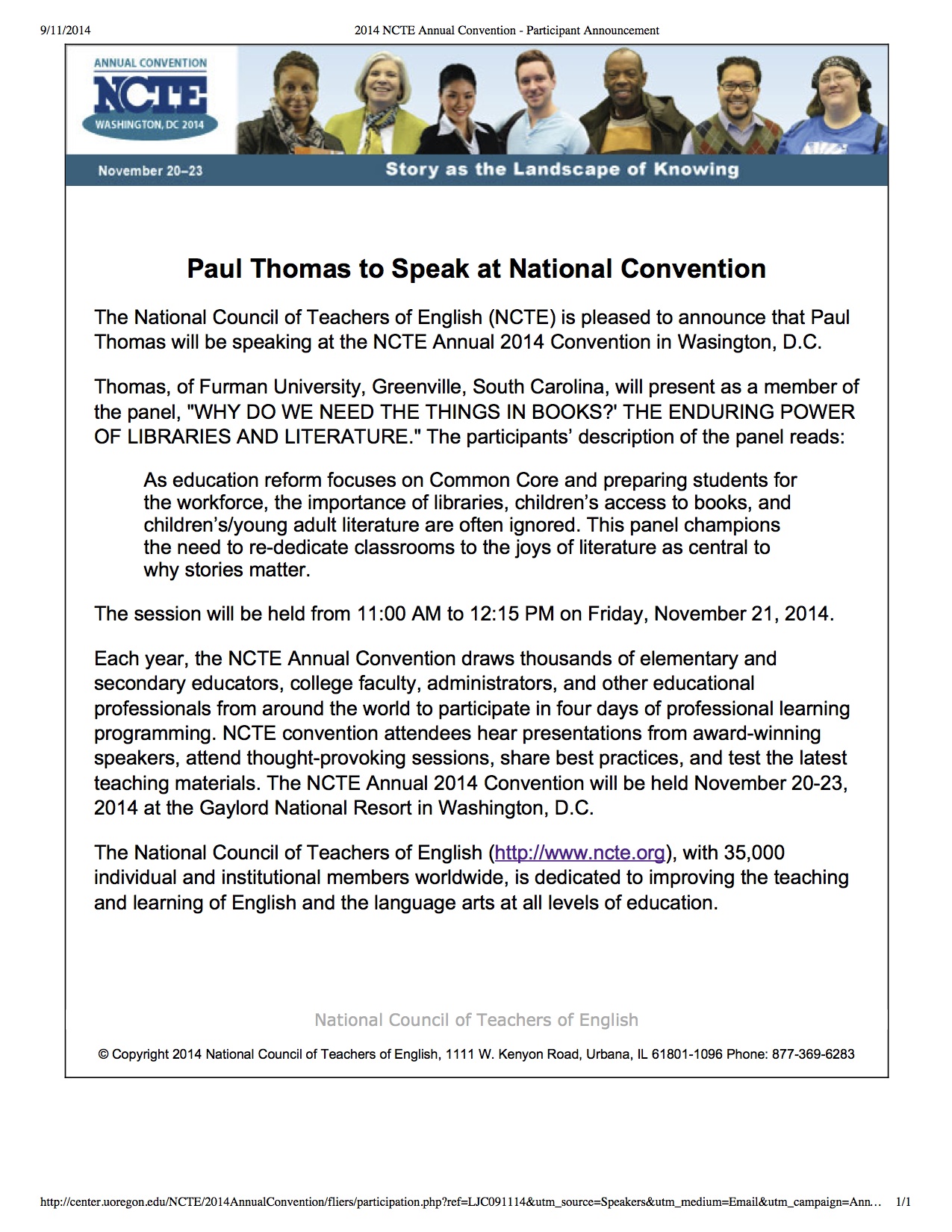
NCTE 2014: “Why do we need the things in books?”: The Enduring Power of Libraries and Literature

[At the 2014 National Council of Teachers of English Annual convention—themed Story As the Landscape of Knowing and held November 20-23, 2014, in Washington DC—Renita Schmidt (University of Iowa), Sean Connors (University of Arkansas), and I will be presenting as detailed below; I offer our proposal as a preview and hope you can join us as we need to raise our voices for both libraries and literature.]

“Why do we need the things in books?”: The Enduring Power of Libraries and Literature

Panel presentation, 75 mins

2014 NCTE Annual Convention - Participant Announcement copy

Teaching Reading and Children: Reading Programs as “Costume Parties”*

P. L. Thomas, Furman University

“[L]anguage behavior can not be reduced to formula,” Lou LaBrant (1947) argued (p. 20)—emphasizing that literacy growth was complicated but flourished when it was child-centered and practical (for example, in the ways many privileged children experience in their homes because one or more of the parents are afforded the conditions within which to foster their children’s literacy). Also, LaBrant (1949) identified the central failure of teaching reading: “Our language programs have been set up as costume parties and not anything more basic than that” (p. 16). This opening talk of the panel will focus on the importance of access to books and libraries as an antidote to “costume parties”—highlighting the work of LaBrant and Stephen Krashen as well as the speeches and writings of Neil Gaiman and Ray Bradbury as life-long proponents of libraries.

The More Books the Better!: Library Books as Boundary Objects To Build Strong Girls

Nita Schmidt, University of Iowa

Libraries provide stories for helping us understand who we are and who we might become. Sometimes, those stories take us to places we cannot imagine and we need more stories to resolve the tension. Libraries provide the books that become boundary objects or, as Akkerman and Baker (2011) describe, artifacts that work as mediators during times of discontinuity. Drawing on sociocultural theories of learning (Gee, 1996; Wenger, 1998; Vygotsky, 1978), this paper will discuss the ways an after school book club works with 4th – 6th grade girls to consider new perspectives. Book club members visit the library every month, read books with strong female protagonists, discuss topics in the books that relate to the real lives of the girls, and help the girls start their own personal libraries to encourage girls to begin to see themselves as successful young women in a complex global world. A bibliography will be provided.

Speaking Back to Power: Teaching YA Literature in an Age of CCSS

Sean Connors, University of Arkansas

If, as the narrator of John Green’s (2009) Paper Towns suggests, imagination is the machine that kills fascists, then literature, as English teachers and librarians know, is the engine that drives it. Despite the current education reform movement’s insistence on reducing the study of literature to a set of narrowly defined, measurable skills, and arguments which associate “close reading” and “textual complexity” with canonical literature, educators who value Young Adult fiction know that, like literature for adults, it is capable of creating a space for readers to examine complex issues related to race, class, gender, etc. This presentation calls on educators to recast arguments for teaching YA fiction in an age of CCSS by foregrounding its ability to encourage critical thinking. The presenter will share examples of (and guidelines for producing) student created digital book trailers that, rather than promoting books, instead “speak back” to oppressive ideologies featured in them.

*Portions adapted from the following blog posts:

Teaching Reading and Children: Reading Programs as “Costume Parties”

Common Core in the Real World: Destroying Literacy through Standardization (Again)

“Fahrenheit 451” 60 Years Later: “Why do we need the things in books?”

Neil Gaiman Should Be U.S. Secretary of Education: “Things can be different”

References

Akkerman, S.F. & Baker, A. (2011). Boundary crossing and boundary objects. Review of Educational Research, 81(2), 132-169.

Bradbury, R.  Fahrenheit 451, 60th anniversary edition.

Fahrenheit 451: 60th Anniversary Edition

Neil Gaiman lecture in full: Reading and obligation — http://readingagency.org.uk/news/blog/neil-gaiman-lecture-in-full.html

Gee, J.P. (1996). Social linguistics and literacies: Ideology in discourse. New York: Routledge.

Green, J. (2009). Paper towns. New York: Speak.

Krashen, S. (2014, January 4). The Spectacular Role of Libraries in Protecting Students from the Effects of Poverty. http://skrashen.blogspot.com/2014/01/the-spectacular-role-of-libraries-in.html?m=1

LaBrant, L. (1949). A genetic approach to language. Unpublished manuscript, Institute of General Semantics, Lakeville, CT.

LaBrant, L. (1947). Um-brel-la has syllables three. The Packet, 2(1), 20-25.

LaBrant, L. (1944, November). The words they know. The English Journal, 33(9), 475-480.

LaBrant, L. (1940, February). Library teacher or classroom teacher? The Phi Delta Kappan, 22(6), pp. 289-291.

LaBrant, L. (1931, March). Masquerading. The English Journal, 20(3), pp. 244-246.

Wenger, E. (1998). Communities of practice, learning, meaning and identity. Cambridge: Cambridge University Press.

Vygotsky, L. (1978). Mind and Society: The development of higher psychological processes. Cambridge, MA: President and Fellows of Harvard College.

Attack on “Balanced Literacy” Is Attack on Professional Teachers, Research

The allusion in Robert Pondiscio’s Why Johnny won’t learn to read accomplishes something different than intended. Pondiscio’s uninformed swipe at balanced literacy actually reveals that, once again, ideology trumps teacher professionalism and literacy research.

The reading wars are about almost everything except reading, but the most important lesson from this newest version of the same old thing is that if we start with what balanced literacy is, we begin to see just what those who attack balanced literacy believe:

Spiegel 3

Spiegel’s definition shows that the term “balanced literacy” is about the professional autonomy of the teacher, the wide range of research on how children acquire literacy, and honoring individual student needs (those who need direct instruction and those who do not).

Like “whole language,” balanced literacy does not reject any practice that is needed or effective, and does not prescribe practices either.

When Pondiscio and others, then, reject balanced literacy, they reject teacher autonomy and professionalism, research-based practices in literacy, and student needs.

For Further Reading

Teaching Reading and Children: Reading Programs as “Costume Parties”

Free Reading Redux

A book must be the axe for the frozen sea within us.

Franz Kafka, Letter to Oskar Pollak 1904

Paul Horton at Anthony Cody’s blog has offered a third installment of his defense of reading, recommending:

David Mikics, a Professor of English at the University of Houston, has recently written a very good book on this issue, Slow Reading in a Hurried Age (2013).

As reading and English teachers grapple with teaching literacy to prepare students for PARCC tests across the country, they should read this book very slowly to attempt to maintain a semblance of sanity: Slow Reading in a Hurried Age describes what you know you should be doing and want to do in your classes: reading to open minds rather than prescribed literacy drills that closes them.

Horton’s defense speaks to two important points I want to add here.

First, over 31 years as a teacher primarily concerned with literacy, I can attest that one of the most powerful forces that stands between students and a life-long love of reading is formal schooling.

For example, virtually all children (who are healthy, safe, and well fed) are eager and excited about both learning to read and reading. By 9th or 10th grade, however, a solid majority of students respond to reading somewhere between ambivalence and dread.

What do all those students have in common? Years of formal schooling in which their reading has overwhelmingly been assigned and then the purpose of text has almost exclusively been reduced to mining those assigned texts for the information teachers or test creators want those students to identify (up next, the hell that will be “close reading”—or “how to destroy the love of reading in one easy step”).

Teaching at the university level and working closely with English majors have presented me with another powerful phenomenon: College students who lament that their formal education keeps them from pleasure reading and who feel relief and excitement at the possibility of returning to reading by choice once they graduate.

Second, Horton’s series on reading speaks to the work of Lou LaBrant, who spent most of her 65 years as a formal educator calling for free reading—including her foundational “The Content of a Free Reading Program” (1937).

And thus, to the term “free reading.”

Directly, advocacy for free reading is an evidence-based argument that reading is essential for human agency and empowerment, but the quest for reading among the young must be couched in recognizing the tension between the ability to read (so-called reading skills such as decoding, comprehension, etc.) and the proclivity to read (appreciating the value of reading as well as simply wanting to read).

If teaching children to read makes them non-readers, what’s is the point?

That leads to the secondary implication of the term “free reading”—we must find ways in which to free reading from the historical and current policies and practices that destroy the love of reading all children need and deserve.

And here is what we know (from the earliest years of LaBrant’s work to the continued scholarship and advocacy of Stephen Krashen):

  • Choice is one of the most powerful conditions for all literacy growth, especially when students are allowed choice in the context of the guidance of expert readers and writers (including but not exclusively teachers).
  • Access to books and texts is central to literacy development, especially abundant access to texts in the home and in schools (such as well-funded libraries with professional librarians).

The ways in which many of us come to love reading have been identified and confirmed again and again by teachers and researchers, but also among writers. Read Neil Gaiman on libraries and books, or Ray Bradbury, or Walter Dean Myers.

That list, in fact, is nearly endless, but we fail to listen to teachers, researchers, writers, and worst of all, students.

There is a wonderful and powerfully subtle remembrance in Lousie DeSalvo’s Vertigo in which she shares a moment from her high school experience. DeSalvo’s physics teacher confronts the young Louise about her ignoring his lectures by reading novels not-so-covertly in the back of room (otherwise, Louise notes that she is a good student in that class).

Mr. Horton, the teacher, does not respond in the way we expect. He takes her book, Fyodor Dostoevsky’s The Possessed, in his hand and then offers her a deal: He wants her to stop ignoring his lectures, but he offers to read the books she is reading and then talking with her about them (pp. 168-169).

For me, this teacher asks that DeSalvo respect the course by acknowledging his respect for those things that matter to her. It is an elegant and gracious compromise found all too rarely in schools.

If we are to take seriously the value in reading, as Horton does, we must come to terms with the paradox: Free reading is the path to free reading from the failures of demanding and teaching reading in our schools.

In 1937, LaBrant reached a conclusion that holds true today:

The theory that in a free or extensive reading program designed to utilize interest and to serve individual needs there will be fruitless reading of light fiction gains no evidence from this study. The report does, however, point to the possibility that the adolescent has much greater power to read and to think intelligently about reading than the results of our conventional program have led us to believe. (p. 34)

DeSalvo’s physics teacher ends his deal offer by noting that Louise has the key quality needed for a teacher: “‘A passionate interest in your subject'” (p. 169).

Moments such as this must become the norm of schooling, not the rare recollection found in a memoir—a memoir, by the way, that is a beautiful and incisive read, an “axe for the frozen sea within us.”

For Further Reading

How an economics professor taught me a life-changing lesson — in literature

Reading Out of Context: “But there was something missing,” Walter Dean Myers

ac·a·dem·icadjective \a-kə-ˈde-mik\ having no practical importance; not involving or relating to anything real or practical.

###

Currently, I have three seniors on track to certify as secondary English teachers doing extended field experiences in local schools—one is placed in an eighth-grade ELA class and another is teaching college-bound students in a high school.

While observing at the middle school, I arrived early one day while the full-time teacher was finishing a discussion of Walter Dean Myers’s Monster. The teacher had to cut the read aloud short, and one student begged for him to continue reading. The teacher asked for the books to be passed forward, prompting that same student to ask to hold on to his copy so he could keep reading (the teacher arranged for the student to retrieve a copy later, by the way).

In the high school class, the teacher-to-be has been teaching poetry by Adrienne Rich and Sylvia Plath—I observed a wonderful discussion of Plath’s “Metaphors”—but the full-time teacher has stressed that students not be offered biographical background information so students could focus on reading the texts cold—in part, as preparation for Advanced Placement Literature testing.

###

An essential element in the ELA Common Core standards is “close reading,” endorsed by David Coleman (now president of the College Board, home of AP and SAT testing):

Close reading, as it appears in the Common Core, requires readers to emphasize “what lies within the four corners of the text” and de-emphasize their own perspective, background, and biases in order to uncover the author’s meaning in the text.

Although “close reading” is a relatively new term, I have noted that its foundational elements are essentially perpetuating the dominant literary analysis focus of public education throughout the 20th and into the 21st centuries, New Criticism.

As Ferguson explains, “close reading” is only part of the literacy approach needed by students:

Critical reading, in contrast, concerns itself with those very differences between what does and does not appear in the text. Critical reading includes close reading; critical reading is close reading of both what lies within and outside of the text. For Paulo Freire, critical reading means that “reading the world always precedes reading the word, and reading the word implies continually reading the world.”…

Critical literacy argues that students’ sense of their own realities should never be treated as outside the meaning of a text. To do so is to infringe on their rights to literacy. In other words, literacy is a civil and human right; having your own experiences, knowledge, and opinions valued is a right as well. Despite praise for King’s rhetoric, Coleman promotes a system that creates outsiders of students in their own classrooms.

“Close reading,” then, is reading out of context—and ultimately, it isn’t reading at all because the reader and the world are rendered irrelevant.

###

Prompted by an analysis of people of color in children’s books (what Christopher Myers calls “[t]his apartheid of literature”), Walter Dean Myers examines his own journey as a reader and then a writer in Where Are the People of Color in Children’s Books?

Myers recalls finding books and reading in his mother’s lap, which led to comic books and eventually what many would consider classic literature:

But by then I was beginning the quest for my own identity. To an extent I found who I was in the books I read. I was a person who felt the drama of great pain and greater joys, whose emotions could soar within the five-act structure of a Shakespearean play, or find quiet comfort in the poems of Gabriela Mistral. Every book was a landscape upon which I was free to wander.

The first part of Myers’s story appears nearly idyllic, and could have served as an argument for requiring all students to read the canon, the Great Books argument. But when Myers’s family experienced “dark times,” he concludes:

But there was something missing. I needed more than the characters in the Bible to identify with, or even the characters in Arthur Miller’s plays or my beloved Balzac. As I discovered who I was, a black teenager in a white-dominated world, I saw that these characters, these lives, were not mine. I didn’t want to become the “black” representative, or some shining example of diversity. What I wanted, needed really, was to become an integral and valued part of the mosaic that I saw around me.

And although Myers struggled against his own personal “dark times”—”My post-Army days became dreadful, a drunken stumble through life, with me holding on just enough to survive”—he did discover James Baldwin:

Then I read a story by James Baldwin: “Sonny’s Blues.” I didn’t love the story, but I was lifted by it, for it took place in Harlem, and it was a story concerned with black people like those I knew. By humanizing the people who were like me, Baldwin’s story also humanized me. The story gave me a permission that I didn’t know I needed, the permission to write about my own landscape, my own map.

Ultimately, Myers’s journey is a story itself, a story about the context of reading, the humanity of reading, the inescapable web of reader, writer, text, and world:

Books transmit values. They explore our common humanity. What is the message when some children are not represented in those books? Where are the future white personnel managers going to get their ideas of people of color? Where are the future white loan officers and future white politicians going to get their knowledge of people of color? Where are black children going to get a sense of who they are and what they can be?

###

Late to the party, I finally read 1Q84 a few years ago, setting off a passionate love affair with the writing of Haruki Murakami.

I have read all of his books and am now awaiting the English translation of Colorless Tsukuru Tazaki and His Years of Pilgrimage. As I typically do, Murakami has a bit of a shrine on my office book shelf:

Murakami books

Until I began reading What I Talk About When I Talk About Running, however, I was missing a very important element in my love of Murakami’s work. Unlike Myers’s recognition of himself in his discovery of James Baldwin, I did not think about my Self in Murakami, who is Japanese and a generation removed from me about halfway between my father and me.

Since Running is part memoir, I began to see comments by Murakami about his essential nature—claims of his true Self that speak very much to me as well as about me. Murakami, despite the details of our races and our histories, share many traits that I am convinced are at the root of my love for his fiction.

###

I was also late to the Breaking Bad party, and coincidentally, I was reading Murakami’s Running while I was just getting to Season 3 of Breaking Bad. So I was taken aback when the character Gale Boetticher shared with the main character, Walter White, how he came to cook meth—a journey of rejecting the merely academic world of science for the magic of the lab.

To fully explain his reasons, and despite his embarrassment about his being a self-proclaimed nerd, Boetticher quotes Walt Whitman:

When I Heard the Learn’d Astronomer

Walt Whitman

When I heard the learn’d astronomer,
When the proofs, the figures, were ranged in columns before me,
When I was shown the charts and diagrams, to add, divide, and measure them,
When I sitting heard the astronomer where he lectured with much applause in the lecture-room,
How soon unaccountable I became tired and sick,
Till rising and gliding out I wander’d off by myself,
In the mystical moist night-air, and from time to time,
Look’d up in perfect silence at the stars.

###

I am reading Murakami’s Running and pausing again and again as his confessions of his true Self are ones I too could make—confessions about solitude, about assuming others will not like him.

But I am also struck by Murakami’s comments about formal education:

I never disliked long-distance running. When I was at school I never much cared for gym class, and always hated Sports Day. This was because these were forced on me from above. I never could stand being forced to do something I didn’t want to do at a time I didn’t want to do it. Whenever I was able to do something I liked to do, though, when I wanted to do it, and the way I wanted to do it, I’d give it everything I had….

If you’ll allow me to take a slight detour from running, I think I can say the same thing about me and studying. From elementary school up to college I was never interested in things I was forced to study….I only began to enjoy studying after I got through the educational system and became a so-called member of society….

I always want to advise teachers not to force all junior and senior high school students to run the same course, but I doubt anybody’s going to listen to me. That’s what schools are like. The most important thing we ever learn at school is the fact that the most important things can’t be learned at school. (pp. 34-35, 45)

###

It is 1943, and English educator Lou LaBrant is deeply concerned about the teaching of language in a world combating Hitler:

Today in a world of hyperbole, it is easy to make sweeping statements and to have them accepted. We must therefore be cautious when thinking of our work. Teachers are, by the nature of their work, largely outside immediate war activities. They spend their days with children, whose greatest contribution will be made after the war….

Far too often as a people we are led astray by orators or writers whose words sound fine and smooth, but whose meanings are false, shallow, or misleading. We make their path easy when we approve essays, stories, or poems which are imitations or are full of words used for the sake of sound. (pp. 93, 95)

It is 2014, and I am deeply concerned that LaBrant’s warnings are as significant today as teachers of English face the “sweeping statements” of “orators or writers whose words sound fine and smooth” in regards to Common Core and “close reading.”

And I am certain her criticism of how books are assigned rings true today:

Too frequently we give children books which have enough value that we call them “good,” forgetting that there are other, perhaps more important values which we are thereby missing. It is actually possible that reading will narrow rather than broaden understanding. Some children’s books, moreover, are directed toward encouraging a naive, simple acceptance of externals which we seem at times to hold as desirable for children. (p. 95)

###

Close reading of books assigned to children, books in which children cannot find themselves, is reading out of context, it is merely academic, and without the magic—”I was lifted by it,” Walter Dean Myers says about Baldwin—our students will likely “bec[o]me tired and sick,/Till rising and gliding out [they will wander] off by [themselves],” concluding that teachers, schools, and books have no meaning for them.

Close reading and de-contextualizing books will, I fear, contribute to more of Christopher Myers’s denounced “apartheid of literature”; instead, he asserts:

The children I know, the ones I meet in school visits, in juvenile detention facilities like the Cheltenham Youth Facility in Maryland, in ritzy private schools in Connecticut, in cobbled-together learning centers like the Red Rose School in Kibera, Nairobi — these children are much more outward looking. They see books less as mirrors and more as maps. They are indeed searching for their place in the world, but they are also deciding where they want to go. They create, through the stories they’re given, an atlas of their world, of their relationships to others, of their possible destinations.

We adults — parents, authors, illustrators and publishers — give them in each book a world of supposedly boundless imagination that can delineate the most ornate geographies, and yet too often today’s books remain blind to the everyday reality of thousands of children. Children of color remain outside the boundaries of imagination. The cartography we create with this literature is flawed….

So now to do my part — because I can draw a map as well as anybody. I’m talking with a girl. She’s at that age where the edges of the woman she will become are just starting to press against her baby-round face, and I will make a fantastic world, a cartography of all the places a girl like her can go, and put it in a book. The rest of the work lies in the imagination of everyone else along the way, the publishers, librarians, teachers, parents, and all of us, to put that book in her hands.

“Hunting Scapegoats”: WWII Literacy Crisis and Current Education Reform

[Header Photo by Christian Chomiak on Unsplash]

“Historians often mention World War II as a time when expectations for schooling and literacy really took off,” explains Deborah Brandt [1], “when what was considered an adequate level of education moved from fourth grade to twelfth grade in a matter of a few years” (p. 485).

National concerns about literacy can be traced to literacy tests for soldiers in WWI, when 25% of recruits were deemed illiterate. While this data appear to have prompted a greater focus on literacy in U.S. public schools, WWII data on literacy again suggested far too many people in the U.S. struggled with basic literacy. As Brandt notes:

Even more profoundly, though, World War II changed the rationale for mass literacy. Literacy was irrevocably transformed from a nineteenth-century moral imperative into a twentieth-century production imperative—transformed from an attribute of a “good” individual into an individual “good,” a resource or raw material vital to national security and global competition. In the process, literacy was turned into something extractable, something measurable, some-thing rentable, and thereby something worthy of rational investment. (p. 485)

From the early to mid-twentieth century, then, a powerful dynamic was created among racial integration, military-based measurement of IQ and literacy, and changing expectations for public education.

Brandt sees those relationships in current education reform ideologies and claims:

We can find eerie parallels between the selective service system of the mid-twentieth century and the public educational system of the early twenty-first century. There is the atmosphere of high anxiety around literacy, rapidly changing standards, an imposition of those standards onto more and more people, a search (largely futile) for reliable testing, a context of quick technological development, a heightened concern for world dominance, and a linking of literacy with national security, productivity, and total quality control. This is what happens when literacy links up with competition, with the need to win the war. It is this competition that justifies the strip mining of literacy, the ranking of skill, the expendability of human potential, and the production of just-in-time literacy. It is the blueprint for the Knowledge Economy. (p. 499)

Calls of a literacy crisis during WWII are roots of similar cries of education crisis spanning from the early 1980s until today. And throughout either era, the complexities of the problems are ignored in order to force agendas that have less to do with education than with serving larger social and political goals—often ones benefitting the privileged at the expense of the impoverished and marginalized.

In 1942, Lou LaBrant confronted the misleading conclusions drawn about low literacy rates among WWII draftees:

The induction of American youth into the armed forces, and the attendant examinations and classifications have called attention to a matter long of concern to those who teach reading or who are devoted to the cause of democracy: the fact that in a land which purports to offer universal education we have a considerable number of youth who cannot read intelligently. We are disturbed now because we want these men to be able to read military directions, and they cannot. A greater tragedy is that they are and have been unable to read with sufficient understanding to be constructive peace-time citizens.

As is to be expected, immediate explanations have been forthcoming, and immediate pointing-of-fingers has begun. Most of the explanations and pointing have come from those who have had least to do with teaching reading, and who are least conversant with the real problem. Moreover, as is again to be expected, the diagnosis is frequently in terms of prejudice or pet complaint, and could be used in other situations as logically. Many are hunting scapegoats; there are scores of “I-told-you-so’s.” It is best to look at the situation critically. (p. 240)

LaBrant recognized, as a teacher and scholar of literacy, that public blame for the low literacy rates suffered from both a lack of expertise about literacy and a number of complicating factors. For example, the standard for literacy changed from generation to generation, and WWII experienced an expanded pool of recruits due to integration, which of course included African Americans and impoverished men who had been systematically denied educational opportunities.

The political and public response to low literacy rates among the military in WWII included blaming progressive education and calling for a back-to-basics focus, as LaBrant addressed:

Within the past ten years we have made great strides in the teaching of purposeful reading, reading for understanding (the kind of reading, incidentally, which the army and navy want) . Nevertheless, we hear many persons saying that the present group of near-illiterates are results of “new methods,” “progressive schools,” or any deviation from the old mechanical procedures. They say we must return to drill and formal reciting from a text book. (p. 240)

The pattern identified by LaBrant foreshadows the rise of high-quality writing instruction in the 1970s-1980s that was blunted by the accountability era’s focus on standards and high-stakes testing.

But, as LaBrant outlined, public and political blame placed on progressivism was misguided, and ultimately misleading:

Before we jump to such an absurd conclusion, let’s take a minute to think of a few things:

1. Not many men in the army now have been taught by these newer methods. Those few come for the most part from private or highly privileged schools, are among those who have completed high school or college, and have no difficulty with reading.

2. While so-called “progressive” schools may have their limitations, and certainly do allow their pupils to progress at varied rates, above the second grade their pupils consistently show superior ability in reading. Indeed, the most eager critics have complained that these children read everything they can find, and consequently do not concentrate on a few facts. Abundant data now testify to the superior results of purposeful, individualized reading programs.

3. The reading skills required by the military leaders are relatively simple, and cause no problem for normal persons who have remained in school until they are fourteen or fifteen. Unfortunately the large group of non-readers are drop-outs, who have not completed elementary school, come from poorly taught and poorly equipped schools, and actually represent the most conservative and back- ward teaching in the United States. (pp. 240-241)

Again, consider the pattern: Implement new and developing tests (literacy tests during WWII), identify a problem related to education, create a scapegoat, and then call for a return to traditional drill-based education. Does this sound familiar?

Now add what was not being addressed in 1942, as detailed by LaBrant:

An easy way to evade the question of improved living and better schools for our underprivileged is to say the whole trouble is lack of drill. Lack of drill! Leťs be honest. Lack of good food; lack of well-lighted homes with books and papers; lack of attractive, well equipped schools, where reading is interesting and meaningful; lack of economic security permitting the use of free schools—lack of a good chance, the kind of chance these unlettered boys are now fighting to give to others. Surround children with books, give them healthful surroundings and an opportunity to read freely. They will be able to read military directions—and much more. (p. 241)

Seven-plus decades ago, public and political outrage was willing to attack a straw man, a scapegoat—progressive education—but was unwilling to confront inequity, poverty, and the linger scar of racial segregation.

Again, sound familiar?

Note

[1] Brandt, D. (2004). Drafting U.S. Literacy. College English, 66(5), 485–502. https://doi.org/10.2307/4140731 [https://www.jstor.org/stable/4140731]

Lack 1942

Retain to Impede: When Reading Legislation Fails (Again)

I remember vividly during one of Bill Clinton’s State of the Union addresses watching the president state that he was seeking education policy that would ensure that all third graders would be able to read; he did the emphatic fist with thumb slightly extended to prove he was serious.

I also remember thinking—and possibly saying aloud to the TV—”No, they won’t.”

It is a silly political thing to pretend that the teaching of reading is somehow determined by political policy. It is a ridiculous thing to think that naming that political policy something clever matters as well.

But it also a silly and ridiculous thing that seemingly will never end.

In South Carolina, the state senate is considering Read to Succeed, a reading policy built in part on the Florida formula (Just Read, Florida!) that has a great deal of political support but has been unmasked as yet another misleading education “miracle” that wasn’t.

The most flawed aspect of Read to Succeed is that it mimics Florida’s third-grade retention policy that will retain third graders based on standardized test scores.

The Education Oversight Committee (EOC) has examined the Read to Succeed act, and offers an At a Glance on retention and lessons learned from Florida.

While the At a Glance appears research-based and comprehensive, the Read to Succeed act and the EOC support actually represent what Matthew DiCarlo has identified as a central problem with policy built on a misuse of data:

The recent release of the National Assessment of Educational Progress (NAEP) and the companion Trial Urban District Assessment (TUDA) was predictably exploited by advocates to argue for their policy preferences. This is a blatant misuse of the data for many reasons that I have discussed here many times before, and I will not repeat them….

But they are not policy evidence. Period….

But, as I’ve said before, there’s a very large group of us out here who are willing to applaud any high-level leader who refuses to misuse evidence, whether or not we happen to agree with their substantive policy positions. I’m sure there are leaders like that out there, and I wish they were more visible.

In the exact same way as DiCarlo details above about misusing NAEP data for political gain, the EOC is failing in its support of Read to Succeed directly and third-grade retention inclusive.

The EOC’s At a Glance cites only four sources, one of which, Greene and Winters, has been reviewed, concluding:

The report reviewed here concludes that Florida’s recently instituted policy of test-based retention has helped academically struggling elementary school students improve their reading. According to the review, the report overstates the effect of retention on student achievement.

Further, the At a Glance fails to identify a strong body of research that refutes the claims made about the Florida formula and a four-decades body of research that rejects grade retention (See Sources below).

Reading problems are not primarily in our schools. Reading and all literacy problems are overwhelmingly reflections of larger social problems related to inequity and poverty.

Reading and literacy solutions, then, are not to be found in legislation and clever program names—especially when those policies are built on partial and politically manipulated evidence, and especially when those name serve to mislead.

SC is considering using partial evidence a reading policy better named Retain to Impede.

Recommended

Commentary: When our students are living in a book desert:

But Xavier wanted a different life; he wanted to be a doctor. He wanted to write about his experiences. What should he read?

I compiled a list of my favorite books, making sure to include teen favorites, books about the medical profession and topics that might speak to a kid growing up in a high-poverty neighborhood. When I gave him the list, he contemplated it with his usual care, made a small check mark next to the books that looked interesting, and looked up. “Where can I get them?” he asked.

And that’s where our story stalls out. Because that’s when I realized that Xavier was living in a book desert.

SOURCES

“Florida Miracle” 

Review of Closing the Racial Achievement Gap, Madhabi Chatterji

Water into Wine?, Julian Vasquez Heilig

Lurking in the Bushes, Julian Vasquez Heilig

Parsing the Florida “Miracle,” Diane Ravitch

The Test-Based Evidence on the “Florida Formula,” Matthew Di Carlo

Editorial: Florida needs no advice from Jeb Bush on education policy, Jac Versteeg

Review of Getting Farther Ahead by Staying Behind, Derek C. Briggs

Grade Retention

Hold Back to Move Forward? Early Grade Retention and Student Misbehavior, Umut Özek

Test-based accountability has become the new norm in public education over the last decade. In many states and school districts nation-wide, student performance in standardized tests plays an important role in high-stakes decisions such as grade retention. This study examines the effects of grade retention on student misbehavior in Florida, which requires students with reading skills below grade level to be retained in the 3rd grade. The regression discontinuity estimates suggest that grade retention increases the likelihood of disciplinary incidents and suspensions in the years that follow. The findings also suggest that these adverse effects are concentrated among economically disadvantaged students

Retaining Students in Grade A Literature Review of the Effects of Retention on Students’ Academic and Nonacademic Outcomes, Nailing Xia, Sheila Nataraj Kirby (2009)

Our review of these 91 studies indicates that grade retention is associated with gender, race, SES, age for grade, student mobility, family and parental characteristics, prior academic achievement, prior behavioral and socioemotional development, and student health. Converging evidence suggests that grade retention alone is not an effective intervention strategy for improving academic and longer-term life outcomes. In general, retention does not appear to benefit students academically. Although some studies have found academic improvement in the immediate years after retention, these gains are usually short-lived and tend to fade over time. Past research has consistently shown that retained students are at significantly increased risk of dropping out of school. Although only a few studies have examined the effects of retention on postsecondary outcomes, the available evidence suggests negative effects on enrollment in postsecondary education and on employment outcomes in adulthood. Overall, the literature indicates mixed findings on attitudinal, socioemotional, and behavioral outcomes among the retained students….Our review found fruitful avenues of research, most notably the impact of supportive interventions (such as early identification of at-risk students, academic instructional services provided in and out of school, and different types of intervention strategies) on proximal and future student outcomes.

The Spillover Effects of Grade-Retained Classmates: Evidence from Urban Elementary Schools, Michael A. Gottfired, American Journal of Education 119 (May 2013)

Retention, Social Promotion, and Academic Redshirting: What Do We Know and Need to Know?, Nancy Frey, Remedial and Special Education, volume 26, number 6, November/December 2005, pages 332-346

The evidence gathered in the last 30 years on the practice of retention suggests that it is academically ineffective and is potentially detrimental to children’s social and emotional health. The seeds of failure may be sown early for students who are retained, as they are significantly more likely to drop out of high school. Furthermore, the trajectory of adverse outcomes appears to continue into young adulthood, when wages and postsecondary educational opportunities are depressed.

Dropout Rates after High-Stakes Testing in Elementary School: A Study of the Contradictory Effects of Chicago’s Efforts to End Social Promotion, Elaine M. Allensworth, Educational Evaluation and Policy Analysis, Vol. 27, No. 4 (Winter, 2005), pp. 341-364

Alternative to Grade Retention, Jimerson, Pletcher, and Kerr (2005)

Given the accumulating evidence that grade retention is an ineffective and possibly harmful intervention, it is imperative that school administrators advocate for “promotion plus” policies that depend on effective, evidence-based interventions. The issue for secondary school educators is twofold. Not only must educators determine whether retention is appropriate for a given student, they also need to address the negative academic, social, and emotional consequences for students who were retained in earlier grades. Very often the student’s original difficulties persist, or more likely worsen, as their school career progresses.

Winning the Battle and Losing the War, Jimerson, Anderson, and Whipple (Psychology in the Schools, Vol. 39(4), 2002)

Considering the results of this review of research examining the association between grade retention and high school dropout and other reviews of research addressing the efficacy of grade retention (Holmes, 1989; Jimerson, 2001a, 2001b; Smith & Shepard, 1987, 1988), we must move beyond the use of grade retention as an intervention strategy and attempt to implement those strategies research has demonstrated to be effective (Jimerson, 2001a). Educational professionals, researchers, parents, and policymakers would be remiss to overlook the implications of research that demonstrate the association between grade retention and school dropout. Furthermore, a new imperative has emerged, where the onus is on programs training future educational professionals to disseminate the results of the recent research presented in this review. It is crucial that we transcend limited solutions and begin to consider student developmental and achievement trajectories in order to reinforce and strengthen pathways that promote social and cognitive competence and lead to academic success.

Does Retention (Repeating a Grade) Help Struggling Learners?

Some stakeholders in Florida believe that the “hard line in the sand” created by mandatory, test-based retention created a motivational difference in teachers and parents…, since it is thought that many of the same learning supports were being provided to struggling students prior to the policy. This may be the case for test score gains close to the retention year, but given the well-known longer-term negative effect of retention on drop-out rates (e.g., Allensworth, 2005) as well as the assured delayed entry into the workforce, Florida’s evidence falls far short of even suggesting that retention is the only or best way to motivate a real positive difference for struggling students, nor has it contradicted the overwhelming evidence against retention prior and since.

What Doesn’t Work, Smith and Shepard (Phi Delta Kappan, October 1987)

The Lesson of the Cupcakes: Fixing Schools by Resisting Gimmicks and Heeding Evidence, Kevin Welner

Exploring the Association Between Grade Retention and Dropout, Jimerson, et al. (The California School Psychologist, Vol. 7, pp. 51-62, 2002)

Ultimately, the research is unequivocal in identifying that grade retention does not appear to address the needs of these students at risk of academic failure. Findings from this study should not be misinterpreted as an indication that retention was an effective intervention strategy for the retained students who did not drop out of high school. There is a need for further research comparing the retained students who completed high school with matched comparison groups of similarly low achieving but socially promoted students. This study highlights the association of early socio-emotional and behavioral adjustment and high school dropout among a group of retained students. These findings have direct implications for school psychologists and other educational professionals. In particular, rather than focusing on the unsupported academic intervention of grade retention, it is time to implement prevention and intervention programs that have been empirically demonstrated to meet the needs of these students in facilitating both positive academic success and socio-emotional adjustment.

Grade Retention: A Flawed Education Strategy, Xia and Glennia (part 1)

Decades of research suggest that grade retention does not work as a panacea for poor student performance. The majority of research fails to find compelling evidence that retention improves long-term student achievement. An overwhelmingly large body of studies have consistently demonstrated negative academic effects of retention. Contrary to popular belief, researchers have almost unanimously found that early retention during kindergarten to grade three is harmful, both academically and emotionally. [1] Many studies find that retention does not necessarily lead to increased work effort among students as predicted.

Cost-Benefit Analysis of Grade Retention, Xia and Glennia (part 2)

Grade Retention: The Gap Between Research and Practice, Xia and Glennia (part 3)

The majority of published studies and decades of research indicate that there is usually little to be gained, and much harm that may be done through retaining students in grade. Yet, many educators continue to use retention as a way to improve student achievement and claim that it produces positive results. The consequence is while a growing body of studies show that retention does not improve academic performance and has a number of negative side effects, more and more states and school districts have adopted retention policy in an effort to enhance the educational accountability.

Synthesis of Research on Grade Retention, Shepard and Smith (Educational Leadership, May 1990)

Grade Retention [a synthesis]

Social Promotion – In Comparison to Grade Retention, Advantages and Disadvantages, Different Perspectives, Jere Brophy

Meta-analysis of Grade Retention Research: Implications for Practice in the 21st Century, Shane R. Jimerson (School Psychology Review, 2001, Volume 30, No. 3, pp. 420-437)

A Synthesis of Grade Retention Research: Looking Backward and Moving Forward, Shane R. Jimerson (The California School Psychologist, Vol. 6, pp. 47-59, 2001)

In looking backwards at the retention research and previous reviews and meta-analyses, a consistent theme emerges—grade retention is not an empirically supported intervention. As reflected in the results of the three meta-analyses described above, the confluence of results from research during the past century fails to demonstrate achievement, socioemotional, or behavioral advantages of retaining students. Moreover, the research consistently demonstrates that students who are retained are more likely to drop out of high school.

Evaluating Kindergarten Retention Policy, Hong and Raudenbush (September 2006)

First, Do No Harm, Jay P. Heubert (Educational Leadership, December 2002/January 2003)

The Facts on Education: Should Students Be Allowed to Fail Grades?

[1] See Krashen, S. (2013, May). Need Children Read ‘Proficiently’ by Grade Three? Language Magazine; Deborah A. Byrnes, and Kaoru Yamamoto, 1985, “Academic Retention of Elementary Pupils: An Inside Look,” Education, 106(2), 208-14; Peg Dawson, 1998, “A Primer on Student Grade Retention: What the Research Says,” NASP Communique, 26(8); Shane R. Jimerson et al., 1997, “A Prospective, Longitudinal Study of the Correlates and Consequences of Early Grade Retention,” Journal of School Psychology, 35(1), 3-25; Panayota Y. Mantzicopoulos, 1997, “Do Certain Groups of Children Profit from Early Retention? A Follow-Up Study of Kindergartners with Attention Problems,” Psychology in the Schools, 34(2), 115-27; Samuel J. Meisels and Fong-Ruey Liaw, 1993, “Failure in Grade: Do Retained Students Catch Up?” Journal of Educational Research, 87(2), 69-77; Judy Temple, Arthur Reynolds and Suh-Ruu Ou, 2001, “Grade Retention and School Dropout: Another Look at the Evidence,” The CEIC Review, 10(5), 5-6 & 21; Charles L. Thompson and Elizabeth K. Cunningham, 2000, “Retention and Social Promotion: Research and Implications for Policy,” Eric Clearinghouse on Urban Education Digest, 161, 1-5; Deneen M. Walters and Sherry B. Borgers, 1995, “Student Retention: Is It Effective?” School Counselor, 42(4).