Category Archives: reading

Beware Grade-Level Reading and the Cult of Proficiency

[Header Photo by Chidy Young on Unsplash}

Few issues in education seem more important or more universally embraced (from so-called progressive educators to right-wing politicians such as Jeb Bush) than the need to have all children reading on grade level—specifically by that magical third grade:

Five years ago, communities across the country formed a network aimed at getting more of their students reading proficiently by the end of 3rd grade. States, cities, counties, nonprofit organizations, and foundations in 168 communities, spread across 41 states and the District of Columbia, are now a part of that initiative, the Campaign for Grade-Level Reading.

However, advocating that all students must read at grade level—often defined as reading proficiency—rarely acknowledges the foundational problems with those goals: identifying text by a formula claiming “grade level” and then identifying children as readers by association with those readability formulas.

This text, some claim, is a fifth-grade text, and thus children who can “read” that text independently are at the fifth-grade reading level.

While all this seems quite scientific and manageable, I must call hokum—the sort of technocratic hokum that daily ruins children as readers, under-prepares children as literate and autonomous humans, and further erodes literacy as mostly testable literacy.

So who does this grade-level reading and proficiency benefit?

First, lets consider what anyone means by “reading.” For the sake of discussion, this is oversimplified, but I think, not distorting to the point of misleading. Reading may be essentially decoding, pronouncing words, phrases, and clauses with enough fluency to give the impression of understanding. Reading may be comprehension, strategies and then behaviors or artifacts by a reader that mostly represent (usually in different and fewer words) an accurate or mostly accurate, but unqualified, restating of the original text.

But reading may also (I would add should) be critical literacy, the investigating of text that moves beyond comprehension and places both text and “meaning” in the dynamic of reader, writer, and text (Rosenblatt) as well as how that text is bound by issues of power while also working against the boundaries of power, history, and the limitations of language.

In that framing, then, grade-level reading and proficiency are trapped mostly at decoding and comprehension, promoting the argument that all meaning is in the text only (a shared but anemic claim of New Criticism).

This narrow and inadequate view of text and reading (and readers) serves authoritarian approaches to teaching and mechanistic structures of testing, and more broadly, reducing text and reading to mere technical matters serves mostly goals of surveillance and control.

Consider first the allure of formula that masks the arbitrary nature of formula. Plug “The Red Wheelbarrow” by William Carlos Williams into a readability calculator—first in its poetic format of lines and stanzas, and then as a grammatical sentence.

As a poem, apparently, the text is about 4th grade, but as a sentence, nearly 9th grade.

The problem is that readability formulas and claims of “grade level” are entirely the function of the limitations of math (the necessity to quantify and then the byproduct of honoring only that which can be quantified)—counting word syllables, number of words in sentences.

Reducing text to numbers, reducing students to numbers—both perpetuate a static and thus false view of text and reading. “Meaning” is not static, but temporal, shifting, and more discourse or debate than pronouncement.

“The Red Wheelbarrow” is really “easy” to read, both aloud and to comprehend. But readability formulas address nothing about genre or form, nothing about the rich intent of the writer (for example, poetry often presents only a small fraction of the larger context), nothing about all that that various readers bring to the text.

And to the last point, when we confront reading on grade level or reading proficiency, we must begin to unpack how and why any reader is investigating a text.

As I have detailed, we can take a children’s picture book—which by all technical matters is at primary or elementary grade levels—and add complex lenses of analysis, rendering the same text extremely complex—with a meaning that is expanding instead of static and singular.

Text complexity, readers’ grade level, and concurrent hokum such as months or years of learning are the grand distractions of technocrats: “it is a tale/Told by an idiot, full of sound and fury,/Signifying nothing” (The Tragedy of Macbeth, 5, 5).

Grand pronouncements about grade-level reading and proficiency, then, benefit politicians, textbook companies, and the exploding testing industry. But not children, not literacy, and not democracy.

Leveled books, labeled children, and warped education policy (grade retention based on high-stakes testing) destroy reading and the children advocates claim to be serving.

Thus, alas, there is simply no reading crisis and no urgency to have students on grade level, by third or any grade.

The cult of proficiency and grade-level reading is simply the lingering “cult of efficiency” that plagues formal education in the U.S.—quantification for quantification’s sake, children and literacy be damned.


See Also

CQ Researcher:  Does Common Core help students learn critical thinking? No.

21st Century Literacy If We Are Scripted, Are We Literate?, Schmidt and Thomas

Callahan, R. E. (1962). Education and the cult of efficiency: A study of the social forces that have shaped the administration of the public schools. Chicago: The University of Chicago Press.

Confirmed: SC Implementing Retain to Impede

Residents of South Carolina have yet more evidence of the state’s inept history with education reform: The rush to model SC’s reading legislation on Florida’s failed policies has begun to fulfill my warning that Read to Succeed is better labeled Retain to Impede.

Nathaniel Clary, reporting for The Greenville News, has detailed, Read to Succeed fails its 1st test. What are the failures?

Clary ticks off the list:

And while communication lapses, missing training programs and a flubbed statewide test marked the first few months of the statewide Read to Succeed program championed by Gov. Nikki Haley last year, the threat still looms that third-graders could be held back starting in the 2017-2018 school year if they don’t measure up to the state’s reading standards.

These first failures include flawed implementation on top of the essential failures of replicating the discredited Florida model as well as ignoring a powerful body of research refuting grade retention.

Since SC passed reading legislation built on grade retention, the National Council of Teachers of English (NCTE), the largest organization of English teachers in the U.S., has taken a strong policy stand against the use of retention and high-stake testing in reading legislation:

Resolved, that the National Council of Teachers of English strongly oppose legislation mandating that children, in any grade level, who do not meet criteria in reading be retained.

And be it further resolved that NCTE strongly oppose the use of high-stakes test performance in reading as the criterion for student retention.

The evidence, then, is mounting that Read to Succeed is being implemented badly, but that does not justify this nod to optimism about the intent of the legislation and the election of a new state superintendent of education, Molly Spearman:

The intent of Read to Succeed is good, said Burke Royster, Greenville County Schools superintendent.

The tenor of Read to Succeed has changed significantly since Molly Spearman replaced Mick Zais as state superintendent of education, Royster said.

“I feel very positive that they’re going to address many of those issues,” he said.

We should all know the wise warning about good intentions, and at best, Spearman can oversee doing the wrong thing the right way—and that does not serve students or the state well.

Here, we are facing watershed moments, lessons that must be heeded if we are to shift directions in education policy. Those lessons include:

  • Education policy must be divorced from political compromise (a compromise between partisan political ideology and evidence-based policy is corrupted policy). Reading legislation built on grade retention and high-stakes tests is a testament to the failure of partisan politics in forming education policy, but SC’s legislation (as well as Florida’s) is also a story of how compromise cannot work since many sincerely supporting good literacy practice in the state simply relinquished on the grade retention element in order to secure more funding for reading. We must ask: How many children’s lives are we willing to ruin to gain more state funding of programs?
  • Intent behind education policy and even the details of education policy are irrelevant when that policy is actually implemented. This debacle with Read to Succeed is just a small version of the larger Common Core train wreck. To ask Superintendent Spearmen to right the implementation ship of this policy is falling well short of the need to scrap it, and then draft genuinely effective and credible reading policy for the state of SC.
  • Professional educators must stop sitting on the sidelines, stop hiding behind resisting being political, and then start flexing our professional muscle. There is no excuse for professionals to implement harmful policy that is not supported by research. Literacy educators need to stand up for best practice in literacy and their students.

Retaining children impedes their possibilities.

Decades of research on literacy and grade retention have shown us that fact, but partisan politics trumps evidence in education policy.

With these facts before us, what will we do?

Middle-Class Assumptions Fail Literacy Instruction

My doctoral work was anchored significantly in John Dewey—highlighted, I recall, by discovering that Dewey had claimed we need not teach children to read because reading was something that naturally developed in children (and since he could not recall being taught explicitly to read).

I was struck by such a tremendous failure in a great thinker, one that exposes the dangers of assuming “my” experiences prove a generalization, especially when “my” experiences are ones of privilege.

When I posted Encouraging Students to Read: A Reader, this odd fact about Dewey came back to me when Peter Smagorinsky called me out, appropriately, for failing to acknowledge the middle-class assumptions beneath endorsing holistic approaches to teaching reading, ones that far too often have failed students who struggle to develop literacy due to class, race, gender, and other challenges.

I have noted before that progressivism, whole language, and balanced literacy have been misunderstood by politicians, the media, and the public, but we must also confront that practitioners have misunderstood and then implemented progressive and holistic approaches to literacy instruction in ways that have been extremely harmful to the exact students most in need of formal schooling.

The Dewey Paradox

Two aspects of Dewey’s progressive education philosophy are key in that context: (i) Dewey’s progressivism is steeped in idealism, leaning precariously on the edge of naturalistic views of children and learning (one that may be true if a child lives in privilege), and thus (ii) Dewey’s progressivism has mostly been misinterpreted and implemented in ways that do not reflect Dewey’s foundational commitments or serve many students well.

Not to be an apologist for Dewey, but to help clarify what many of us who stand on Dewey’s shoulders embrace (noting that I am a critical educator, and not a progressive), I recommend Dewey’s Experience and Education as well as Alan Ryan’s biography of Dewey (specifically his Chapter Four: The Pedagogue as Prophet).

For me, Dewey provided the seed for critical pedagogy to grow out of the soil of progressivism:

It is not too much to say that an educational philosophy which professes to be based on the idea of freedom may become as dogmatic as ever was the traditional education which is reacted against. For any theory and set of practices is dogmatic which is not based upon critical examination of its own underlying principles. (Experience and Education, p. 22)

In the reading wars, then, dogmatic commitments to either whole language or isolated phonics instruction instead of addressing the needs of each individual student to become a reader is the great failure Dewey himself would have acknowledged.

Misreading Dewey, however, has a long tradition itself. Lou LaBrant, a fervent Dewey progressive, wrote in 1931 a scathing attack on the project method, which claimed to be in the Dewey tradition:

The cause for my wrath is not new or single. It is of slow growth and has many characteristics. It is known to many as a variation of the project method; to me, as the soap performance. With the project, neatly defined by theorizing educators as “a purposeful activity carried to a successful conclusion,” I know better than to be at war. With what passes for purposeful activity and is unfortunately carried to a conclusion because it will kill time, I have much to complain. To be, for a moment, coherent: I am disturbed by the practice, much more common than our publications would indicate, of using the carving of little toy boats and castles, the dressing of quaint dolls, the pasting of advertising pictures, and the manipulation of clay and soap as the teaching of English literature. (p. 245)

Ryan’s biography achieves a manageable and complex picture of Dewey—one that Dewey failed to express clearly. But in that picture, we see the idealism noted above as well as a level of sophistication (for example, seeking to honor both the individual and community, instead of bowing to either/or thinking) that made Dewey hard for a general public and often inaccessible for practitioners who want the practical and not his pragmatic [1].

However, “Dewey himself argued that it was not enough to repudiate traditional education,” Ryan explains, adding:

It was not enough for progressive teachers to throw out everything the old schools had done, to replace discipline by chaos, a rigid syllabus with no syllabus. And Dewey was inclined to think that many schools had done exactly that and had used his name to justify it. The difficulty was to give an account of the educational experience that would elicit a kind of discipline, an approach to the syllabus and to the authority of the teacher in the classroom that would grow out of experience itself. (p. 282)

And it is here that I can speak directly to the great paradox of progressive and critical commitments in education, especially in terms of teaching literacy, as expressed by Dewey himself:

What avail is it to win prescribed amounts of information about geography and history, to win ability to read and write, if in the process the individual loses his own soul: loses his appreciation of things worth while, of the values to which these things are relative; if he loses desire to apply what he has learned and, above all, loses the ability to extract meaning from his future experiences as they occur? (Experience and Education, p. 49)

Teaching for over thirty years while attempting to avoid prescription and indoctrination, to foster joy and pleasure in learning, and to provide all students with the content they deserve and need has often lead to paralysis since those commitments are overwhelming in their contradictions. I have never settled for decoding or even comprehension in any student—always demanding we rise to include critical literacy that requires that students have the decoding and comprehension as well.

Despite Dewey’s warning, dogmatism is easier, and as Ryan warned, Dewey’s progressivism demands more of teachers than traditional approaches. And thus, when faced with the most challenging populations of students, we too often take the path of least resistance, mis-serving those students along the way.

Enter Delpit: Middle-Class Assumptions Fail Literacy Instruction

What appears to have happened in formal education throughout the U.S. is that literacy education has increased the gaps among social classes and racial subgroups because too often than not we have failed to honor the balance between fostering a love and joy for language with the necessary skills to read and write—and the students who suffer the most in that failure have been racial minorities and impoverished children.

Affluent students are allowed to relish in the joy of language (reaping the advantages of their privilege, which includes a literacy growth that seems transparent to them, as it did to Dewey) in formal schooling, while struggling students (disproportionately children of color and impoverished) are sentenced to drudgery masquerading as literacy instruction, further disadvantaging them.

Middle-class norms drive a great deal of practice in formal schooling since the wider U.S. society is trapped in those middle-class norms (ones that include not only socioeconomic but also racial [read “white”] expectations) and since the teacher workforce in the U.S. is itself a middle-class profession dominated by white females.

These middle-class blinders can be observed in the misguided embracing of Ruby Payne’s stereotypes about poverty, the nearly universal acceptance of the “word gap,” and the “grit” narrative as a veneer for white privilege.

Just as Dewey’s progressivism needed a critical re-imagining from Paulo Freire and others, Freire’s critical pedagogy needed bell hooks and others to confront Freire’s paternalism.

Then, enter Lisa Delpit, who provides the confrontation of the failures of misunderstood progressivism and holistic approaches to literacy instruction—the failures that often misrepresent whole language but exist under that terminology (see Ryan’s point about Dewey’s complaints above).

Writing in 1996 about Delpit, Debora Viadero explains:

But Delpit is best-known for the bombs she has lobbed at some of contemporary education’s most sacred cows.

A decade ago, Delpit started penning a series of eloquent, plain-spoken essays in the Harvard Educational Review that questioned the validity of some popular teaching strategies for African-American students. The essays were spun off into a book, Other People’s Children: Cultural Conflict in the Classroom, that was published last year by The New Press.

The problem, Delpit says in those writings, is not that whole-language reading instruction techniques or the process-writing approach to teaching writing are inherently bad. They work for some students–possibly most. They just do not work for everybody. And often the people they do not work for are children who, like Delpit herself, were born black and disenfranchised. What is more, these strategies might not work for children of any group that has strong, distinctive cultural roots and that stands on society’s perimeter peering in.

And while some continue to misrepresent Delpit in similar ways to how Dewey was/is misrepresented, Delpit offers to me the best understanding of achieving the balance Dewey sought.

The powerful phrase “other people’s children” comes from the work of Delpit, who confronts the inequity of educational opportunities for minority and impoverished children. Delpit highlights that marginalized students receive disproportionately test-prep and worksheet-driven instruction, unlike their white and affluent peers. While some have claimed her as a champion of traditional practice because her criticisms have included failures by progressives, Delpit counters:

I do not advocate a simplistic “basic skills” approach for children outside of the culture of power. It would be (and has been) tragic to operate as if these children were incapable of critical and higher-order thinking and reasoning. Rather, I suggest that schools must provide these children the content that other families from a different cultural orientation provide at home. This does not mean separating children according to family background [emphasis added], but instead, ensuring that each classroom incorporate strategies appropriate for all the children in its confines.

And I do not advocate that it is the school’s job to attempt to change the homes of poor and nonwhite children to match the homes of those in the culture of power [emphasis added]. That may indeed be a form of cultural genocide. I have frequently heard schools call poor parents “uncaring” when parents respond to the school’s urging, saying, “But that’s the school’s job.” What the school personnel fail to understand is that if the parents were members of the culture of power and lived by its rules and codes, then they would transmit those codes to their children. In fact, they transmit another culture that children must learn at home in order to survive in their communities.

And Monique Redeaux clarifies:

When Delpit began her work on “other people’s children” she predicted that her purpose would be misunderstood. People criticized her for “vindicating” teachers who subjected students of color to isolated, meaningless, sub-skills day after day. However, what she was actually advocating when she referred to “skills-based instruction” was the “useful and usable knowledge that contributes to a student’s ability to communicate effectively in standard, generally acceptable literary forms” and she proposed that this was best learned in meaningful contexts. In other words, Delpit argued that both technical skills and critical thinking are essential: a person of color who has no critical thinking skills becomes the “trainable, low-level functionary of the dominant society, simply the grease that keeps the institutions which orchestrate his or her oppression running smoothly.” At the same time, those who lack the technical skills demanded by colleges, universities, and employers will be denied entry into these institutions. Consequently, they will attain financial and social success only within the “disenfranchised underworld.”

Like my progressive muse LaBrant, I remain convinced that reading programs—including prescriptive, systematic phonics programs—are “costume parties” that fail our students—and waste a tremendous amount of funding and instructional time, money and time better spent with authentic texts.

But when I endorse choice, independent reading, and access to books, like Delpit, I am not excusing those who idealize those commitments (through middle-class lenses) and then fail to teach reading (or writing) based on the needs of each student, some of whom will flourish with little guidance and some of whom need intensive and direct instruction.

It is no petty thing to acknowledge that a hungry or abused or frightened child will not find joy in reading when allowed choice, independent reading, and access to books because those do not address the burdens denying them that joy and learning opportunity. It is no petty thing either to note that taking struggling students and simply demanding they ignore their life’s inequities and complete phonics worksheets will not work as well.

As Dewey would stress, either/or thinking and dogmatism serve no one well when we are teaching children to read and write. Too often, that dogmatism has its roots in our middle-class privilege that, as with Dewey, blinds us to what our students need most from our teaching.

[1] As Ryan explains: “Dewey spent a great deal of his adult life explaining that ‘pragmatic’ did not mean ‘practical’ in a merely utilitarian and down-to-earth sense” (p. 225).

Encouraging Students to Read: A Reader

Valerie Strauss has dedicated two blog posts (here and here) to a new report, Kids & Family Reading Report.

One key finding deserves highlighting (and a caveat):

Additional factors that predict children ages 12–17 will be frequent readers include reading a book of choice independently in school, ereading experiences, a large home library, having been told their reading level and having parents involved in their reading habits.

First, the caveat: Beware concerns about reading levels, which are the flawed domain of the technocrat. (See 21st Century Literacy, co-authored with Renita Schmidt.)

But more important is that (yet again) choice, independent reading, and access to books are all vital to supporting eager and sophisticated readers among children and students.

Note that eager readers are not the result of reading programs, worksheets, intense phonics instruction, or assigning classic reading lists (although all of those have some role to play if not abused, overemphasized).

“It is important that we do not set up in our class-rooms prejudices or snobberies which will make our students less instead of better able to understand, enjoy, and use this language,” argued Lou LaBrant, former NCTE president, in 1943, adding

Too frequently we give children books which have enough value that we call them “good,” forgetting that there are other, perhaps more important values which we are thereby missing. It is actually possible that reading will narrow rather than broaden understanding.Some children’s books, moreover, are directed toward encouraging a naive, simple acceptance of externals which we seem at times to hold as desirable for children….Let us have no more of assignments which emphasize quantity, place form above meaning, or insist on structure which is not the child’s. (p. 95)

See then:

LaBrant, L. (1937, February 17). The content of a free reading programEducational Research Bulletin, 16(2), 29–34.

LaBrant, L. (1941). English in the American scene. The English Journal, 30(3), 203–209.

LaBrant, L. (1943). Language teaching in a changing world. The Elementary English Review, 20(3), 93–97.

Stephen Krashen: Literacy: Free Voluntary Reading

Setting Free the Books: On Stepping Aside as Teaching

Progressivism and Whole Language: A Reader

Attack on “Balanced Literacy” Is Attack on Professional Teachers, Research

Reading Out of Context: “But there was something missing,” Walter Dean Myers

Beware the Technocrats: More on the Reading Wars

Since it is Academy Awards season, let me start with film as context.

Whiplash has received a great deal of Oscars buzz with five significant nominations. But that film praise is interesting to frame against a review that considers how the film’s topic, jazz, is portrayed:

The mediocre jazz in Damien Chazelle’s new film, “Whiplash,” the story (set in the present day) of a young drummer (Miles Teller) under the brutal tutelage of a conservatory professor (J. K. Simmons), isn’t itself a problem. The problem is with the underlying idea. The movie’s very idea of jazz is a grotesque and ludicrous caricature.

“Mediocre,” “grotesque,” and “ludicrous caricature” are certainly not the stuff of Oscars, one would think, but this contrast of responses to the film represents well my problem with the Mt. Rushmore of technocrats who are cited with missionary zeal whenever you spend much time in the reading wars (see the comments here): Daniel Willingham, John Hattie, E.D. Hirsch, and Grant Wiggins.

With some qualifications for Wiggins (who taught high school and coached for 14 years, but has focused primarily on assessment since then), these often cited men are primarily quantitative researchers who are not within the field of literacy (Hirsch’s background is literature, not literacy) and have created cottage industries out of their names/work: Willingham as a psychologist, Hattie as a researcher/consultant, Hirsch as a core knowledge advocate, and Wiggins as proponent of understanding by design and consultant.

As I have noted before, most of my concern here is how certain advocates for phonics and direct instruction in literacy use the Mt. Rushmore of technocrats to close the door on the reading wars—not with any of these men or their work specifically (except Hattie [1]).

Therefore, I must offer, Beware the technocrats, because of the following:

  • Beware the seductive allure of statistics, numbers, and “scientific” research. As I have detailed more often than I would have liked, a perfect example of this concern is the prevalence of the Hart and Risley research on the “word gap,” which persists despite many concerns being raised about not only the research itself, but also the deficit ideology that drives the conclusions. Of course, high-quality experimental and quasi-experimental research matters, but many aspects of teaching and learning require and lend themselves to other research paradigms—notably qualitative action research conducted by classroom teachers with the real populations they teach.
  • Beware the momentum of cottage industry gurus. Hattie, Hirsch, and Wiggins have created entire careers for themselves—books, workshops, consultations. I remain deeply skeptical of such ventures (see also Nancie Atwell and a whole host of gurus on the “softer” side of research and within literacy as well). Even the best people with the best intentions can find themselves victims of “‘filthy lucre,'” but just as the higher the quality of scientific research, the more likely it means less to real-world teaching, the urge to reduce an evidence base or best practice to a program means that evidence and practice are mostly ruined.

In the reading wars, then, I witness time and again that the advocates for intensive phonics, phonics programs, and direct instruction grounded in prescribed content are either not within the field of literacy [2] or themselves invested in programs that benefit from those positions (the Common Core debate represents the same issue since most advocates stand to benefit from Common Core being implemented, some politically and some financially).

Which brings me back to Whiplash. If you know little or nothing about jazz, the film likely appears more wonderful than if you do.

I have a thirty-plus year career in literacy, including teaching literacy (mostly writing) and scholarship addressing literacy. That context for me renders the Mt. Rushmore of technocrats not insignificant, but certainly less credible than a century of research and practice by literacy practitioners and researchers that informs my practice.

There is a tyranny to certainty among those who wield the work of Willingham, Hattie, Hirsch, and Wiggins in ways that end the conversation, that shut the door on a broader basis of evidence to inform, not mandate, practice. There is a greater tyranny of commerce lurking here also, using “scientific” as a mask for commercialization.

Both serve to further de-professionalize teachers, and both often result in classroom practices that may raise test scores but create nonreaders.

And thus, when Hattie is cited (yet again) during the reading wars, for example:

I posted a question in Pamela and Alison’s article last week, but didn’t get a response from anyone. My question is: if the “effect size” of synthetic phonics (according to Hattie’s research) is 0.54, and that of whole language learning is 0.06, does that mean:

  1. That whole language actually does have an effect; and
  2. Should we therefore use the two approaches in the ratio of 1:9 (i.e. the difference in their effect sizes)? (scroll to the comment from John Perry, who, I must add, is being reasonable here)

I share the exasperation Richard Brody expresses at the end of his review of a jazz film that uses Buddy Rich as the icon for the film’s protagonist: John Hattie. John Visible Learning Hattie.

In terms of evidence, that has the opposite effect intended.

See Also

Education ‘experts’ may lack expertise, study finds

Taming the Wild West of Educational Research, Simon P. Walker

[1] Those who rush to use Hattie are proof of solid research fail to note that his work has been challenged for quality, even within the quantitative paradigm; see:

[2] Since many people continue to refer to the National Reading Panel report, please examine Joanne Yatvin’s minority view, starting about page 444, including:

In the end, the work of the NRP is not of poor quality; it is just unbalanced and, to some extent, irrelevant. But because of these deficiencies, bad things will happen. Summaries of, and sound bites about, the Panel’s findings will be used to make policy decisions at the national, state, and local levels. Topics that were never investigated will be misconstrued as failed practices. Unanswered questions will be assumed to have been answered negatively. Unfortunately, most policymakers and ordinary citizens will not read the full reviews. They will not see the Panel’s explanations about why so few topics were investigated or its judgments that the results of research on some of the topics are inconclusive. They will not hear the Panel’s calls for more and more fine-tuned research. Ironically, the report that Congress intended to be a boon to the teaching of reading will turn out to be a further detriment.

As an educator with more than 40 years of experience and as the only member of the NRP who has lived a career in elementary schools [emphasis added], I call upon Congress to recognize that the Panel’s majority report does not respond to its charge nor meet the needs of America’s schools.

Collateral Damage from the Never-Ending Reading Wars

Education is an admirable thing, but it is well to remember from time to time that nothing that is worth knowing can be taught.

Oscar Wilde

Let’s start broadly with literacy by acknowledging that speaking and listening are essentially natural while writing and reading are artificial (and thus benefit greatly from direct, formal instruction).

Now let’s consider some aspects of literacy and the assumptions many (including educators) hold about writing and reading.

One of the traditional/essential elements of reading is vocabulary. As I have noted, educators, the media, and the public tend to mis-associate the quantity of words a child knows or uses with the literacy of the child.

In part, that process is efficient, albeit misguided.

Therefore, remaining within that paradigm, a typical high school graduate knows/uses about 60,000 words. If direct vocabulary instruction (a traditional instructional strategy) successfully teaches students about 10 words a week for the entire 12 years of formal schooling (an unlikely feat), teaching vocabulary to increase reading has contributed only about 4000 words.

As an effective strategy, then, direct vocabulary instruction fails against the mostly non-instructional ways in which children acquire about 90% of their words.

This also highlights a significant problem with confusing cause and effect: Increasing vocabulary does not cause good readers, but being an avid reader results in an extensive vocabulary.

Something I learned as a high school English teacher: Dump the inordinate amount of time spent assigning vocabulary, covering vocabulary homework, and testing vocabulary while replacing that time with free and frequent reading.

In the professional and public debates about teaching literacy, along with this cause/effect issue related to confusing discrete literacy skills for the holistic acts of literacy (vocabulary = literacy, grammar = writing, phonics = reading) is the issue of direct and formal instruction.

Linguists often examine children acquiring language [1], often before formal schooling, and have noted that virtually all English speaking children utter “goed” at some point, although no adults use that construction (language acquisition appears not to be mimicry) and that children (and adults) tend to construct “might not have been seen” in this grammatically correct order of wording, having never been taught the rule (which is nearly incomprehensible) and never being able to explain the rule.

Before I move on to the reading wars, I want to emphasize that I am not endorsing a “natural” theory of language or of teaching language in which children are left alone by adults and expected simply to acquire writing and reading abilities—the sort of (false) charge typically leveled at whole language scholars and practitioners.

But I do want to emphasize that the narrow reading war and the larger, varied literacy wars (including teaching grammar as part of writing, for example) have some fundamental areas of tension that must be confronted before the substantive debate(s) itself/themselves can be understood. Those tensions are between:

  • Incrementalists who hold fast to building discrete literacy skills in sequential and formulaic order versus those honoring the holistic nature of literacy.
  • Technocrats and quantitative researchers versus qualitative researchers and practitioners.
  • Missionary zeal (all students must have phonics!) versus inspiration (modeling a love for reading).

In that context, the reading war itself, I believe, results in collateral damage that is the real problem: children who are non-readers (some left without the ability to read, but even more left without the desire to read).

My life as a student included Dick and Jane readers; direct phonics instruction; year after year of vocabulary books, homework, and tests; and years of diagramming sentences. To this day I am a terrible speller (thanks phonics), and a highly literate adult who came to that despite my formal and highly structured and traditional literacy instruction (isolated and discrete phonics, isolated and intensive grammar).

My life of literacy was spurred by late adolescent comic book collecting, which led to science fiction novel reading.

That life story proves nothing, but it has made me skeptical of ways in which formal schooling will steamroll over students in order to implement this or that program.

That life story is why I am deeply skeptical of the phonics and grammar crowds, filled with missionary zeal and all too often bound to programs and structure at the expense of their students.

No credible person in literacy is against phonics or grammar instruction, by the way. That is a heinous straw man.

And all literacy ideologies or strategies are immediately ruined once they are codified (see California or New York) or reduced to a publisher’s program (see 4-block, reading/writing workshop programs, or literature circles).

“[L]anguage behavior can not be reduced to formula,” Lou LaBrant (1947) argued (p. 20)—emphasizing that literacy growth was complicated but flourished when it was child-centered and practical (for example, in the ways many privileged children experience in their homes because one or more of the parents are afforded the conditions within which to foster their children’s literacy).

By mid-twentieth century, LaBrant (1949) had identified the central failure of teaching reading: “Our language programs have been set up as costume parties and not anything more basic than that” (p. 16).

Writing and reading acquisition is always messy and unpredictable at the individual person level. Always.

That is why whole language and balanced literacy, for example, are philosophical constructs that create a space for the professional decision making of the teacher in the context of her class, a teaching and learning context that is always in flux.

All instructional strategies are on the table as long as the ultimate goals of literacy are being addressed for each student. And this is much more demanding of teachers as literacy professionals than scripted programs of any ideology.

Similarly, teaching and testing phonics and grammar, for example, ask less of students as well—including that acquiring discrete phonics and grammar knowledge (knowing the rules) is essentially merely academic, unlike being able and willing to read and write.

As early as the 1940s, hundreds of studies had revealed that isolated and direct grammar instruction failed to transfer to students’ original writing—a research base oddly ignored by the technocratic crowd.

However, the missionary zeal for Version X of phonics instruction is often built on a circular claim about “research”—failing to note that discrete phonemic instruction lends itself to multiple choice testing and measurement in a way that means a narrow view of research will always show phonics to be “better” than messier (and more authentic) literacy strategies that are not easily quantified or isolated at any point in time.

Our goals as literacy teachers include fostering children who are both capable and willing writers and readers.

Being an evangelist for phonics likely will not accomplish either of those—just as being an evangelist for whole language will not either.

Vocabulary books, homework, and tests are all very manageable, and continuing them all will likely cause not a ripple in your life as a teacher. But that process has mistaken “vocabulary” for literacy, and thus, does not achieve the larger goals of literacy while often insuring students will come to hate ELA class, reading, and writing.

The reading wars as a subset of the larger literacy wars are petty, I think, but that isn’t the real problem—the real problem being the collateral damage: children who are non-readers (some left without the ability to read, but even more left without the desire to read).

[1] Acknowledging the controversies around linguistic theories, I highly recommend Steven Pinker’s The Language Instinct and Words and Rules—not to endorse Pinker/Chomsky linguistics, but as rich avenues to understanding better language and the debates about language acquisition.

References

LaBrant, L. (1949). A genetic approach to language. Unpublished manuscript, Institute of General Semantics, Lakeville, CT.

LaBrant, L. (1947). Um-brel-la has syllables three. The Packet, 2(1), 20-25.

See Also

Teaching Reading and Children: Reading Programs as “Costume Parties”

More on Evidence-Based Practice: The Tyranny of Technocrats

Depending on your historical and literary preferences, spend a bit of time with Franz Kafka or Dilbert and you should understand the great failure of the standards movement in both how we teach and how we certify teachers—bureaucracy.

Bureaucracy tends to be inadequate because bureaucrats themselves are often lacking professional or disciplinary credibility or experience, depending, however, on the status of their authority to impose mandates. For education, Arne Duncan serves well as the face of the bureaucrat, an appointee who has only the bully pulpit of his appointment to hold forth on policy.

However, as corrosive to education—and ultimately to evidence-based practice—is the technocrat.

Technocrats, unlike bureaucrats, are themselves credible, although narrowly so. For technocrats, “evidence” is only that which can be measured, and data serve to draw generalizations from randomized samples.

In short, technocrats have no interest in the real world, but in the powerful narcotic of the bell-shaped curve.

As a result, a technocrat’s view often fails human decency (think Charles Murray and Richard Herrnstein) and certainly erases the very human reality of individual outliers.

The face of the technocrat—in fact, the technocrat’s technocrat—is Daniel Willingham, whose work is often invoked as if handed down by the hand on God, chiseled on tablets. [1] [Note: If you sense snark here, I am not suggesting Willingham’s work is flawed or unimportant (I would say important but narrow), but am being snarky about how others wield the technocratic hammer in his name.]

And it is here I want to return to a few points I have made recently:

  • Even the gold standard of experimental research fails the teacher in her day-to-day work because her classroom is not a random sampling of students, because her work is mostly with outliers.
  • And in the teaching moment, what counts as evidence becomes that teacher’s experience couched in that teacher’s content and teaching knowledge as all of that happens against the on-going evidence of the act of teaching.

Stewart Riddle, offering yet another effort in the reading war, is essentially speaking for evidence-based practice while raising a red flag against the tyranny of the technocrat, embodied by the systematic phonics crowd (those who wave the Willingham flag, for example).

On Twitter, in response to my piece on evidence-based policy and practice, Nick Kilstein raised a great point:

My ultimate response (prompting this blog):

My thoughts here, building on the bullet points above, are that having our practice informed by a wide range of evidence (including important evidence from technocrats, but also from other types of evidence, especially qualitative research [2] that can account for outliers, nuance, and the unexpected) is much different than having our practice mandated by evidence (think intensive, systematic phonics for all children regardless of needs or fluency because that is the program the school has adopted).

For day-to-day teaching, the tensions of the disciplines remain important: what we can measure against what measuring cannot address.

When Willingham proclaims that a certain type of research does not support the existence of learning styles, for example, teachers should use that to be very skeptical of the huge amount of oversimplified and misguided “teacher guides” and programs that espouse learning styles templates, practices, and models. [3]

But day-to-day teaching certainly reveals that each of our students is different, demanding from us some recognition of those differences in both what and how we teach them.

It is in the face of a single child that technocrats fail us—as Simon P. Walker notes:

Some educational researchers retreat to empiricist methods. Quantitative studies are commissioned on huge sample sizes. Claims are made, but how valid are those claims to the real-life of the classroom? For example, what if one study examines 5,000 students to see if they turn right rather than left after being shown more red left signs. Yes, we now with confidence know students turn left when shown red signs. But so what?  What can we extrapolate from that?  How much weight can that finding bear when predicting human behaviour in complex real world situations where students make hundreds of decisions to turn left and right moment by moment? The finding is valid but is it useful?

If that child needs direct phonics or grammar instruction, then I must offer them. If that child is beyond direct phonics and grammar instruction or if that direct instruction inhibits her/his learning to read and write, then I must know other strategies (again, this is essentially what whole language supports).

The tyranny of the bureaucrats is easy to refute, but the tyranny of the technocrat is much more complicated since that evidence is important, it does matter—but again, evidence of all sorts must inform the daily work of teaching, not mandate it.

Professional and scholarly teachers are obligated to resist the mandates by being fully informed; neither compliance nor ignorance serves us well as a profession.

[1] For more on worshipping technocrats, explore this, notably the cult of John Hattie and that those who cite his work never acknowledge the serious concerns raised about that work (see the bottom of the post).

[2] Full disclosure, I wrote a biography for my EdD dissertation (published here), and also have written a critical consideration of quantitative data.

[3] See, for example, how evidence (Hart and Risley) functions to limit and distort practice in the context of the “word gap.” The incessant drumbeat of the “Hart and Risley” refrain is the poster child of the tyranny of technocrats.

The “Word Gap”: A Reader [Updated]

[Header Photo by Leonhard Niederwimmer on Unsplash}

The AMC series, based on the iconic graphic series The Walking Dead, has finally included Rick admitting, “We are the walking dead” (Season 5, Episode 10).

Viewers witness the inevitable lethargy of living always under the threat of zombies, a reduced existence in which even stabbing a zombie in the brain is executed with a resignation that borders on macabre camp:

Maggie is confronted with death—and the walking dead—throughout the episode. We open to her weeping, as a walker shambles up behind her. She casually stands, and knifes the zombie in the skull. Later she finds a walker tied up and gagged in the trunk of a car. She must have been tied that way when she was alive, and starved to death before turning. It’s a horrible thought. Glenn kills that one for her. At the barn, she finds a third walker, this one apparently camped out there before she died.


I have explored the power of zombie narratives to examine the weight of living in poverty and the paralysis of anxiety, but here I want to add that one study and the term “word gap” are also yet more proof of the zombie apocalypse.

The “Word Gap” That Will Not Die

Like Maggie, I am nearly numb, having spent over thirty years in education mostly having to refute constantly misguided policy and misinformed media.

The most resilient and disturbing among those experiences is the term “word gap” and the single study that will not die—this time from Elizabeth Gilbert:

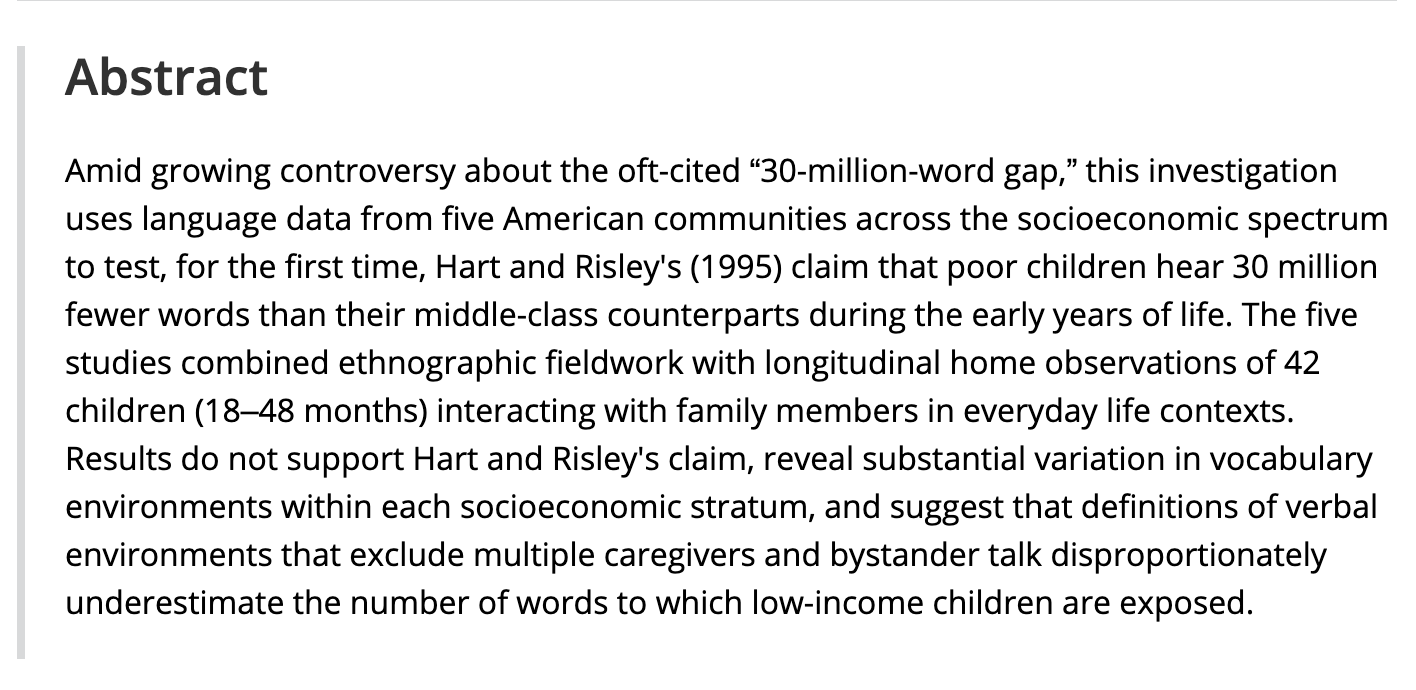
The term “word gap” was first coined in the 1995 Hart/Risley study that found low-income children are exposed to 30 million fewer words than their higher-income peers before age 3. This study and others have linked poor early literacy skills to lifelong academic, social and income disparities. Word gap initiatives primarily target low-income parents to help them understand the effect they have on their children’s cognitive development. Unfortunately, this misses another important part of the problem.


The deficit view perpetuated by Hart and Risley (not the credibility of the study or its claims) is as contagious as the zombie virus infecting everyone in The Walking Dead universe.

And while it would be easier just to lie down, give in, I remain steadfast against the “word gap” throng; thus, please take the time to consider the following reader:

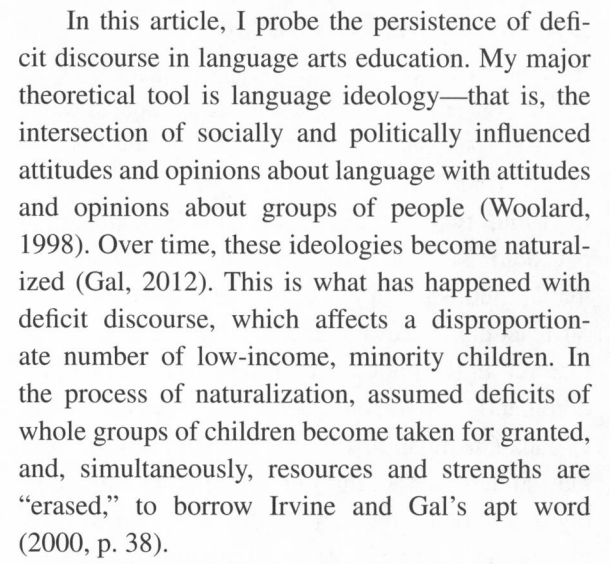
In this article, we argue that strong claims about language deficiencies in poor children and their families based on the Hart and Risley study are unwarranted. Further, we argue that the uncritical acceptance of Hart and Risley’s findings is emblematic of a trend among some educators, educational policy makers, and educational researchers to readily embrace a deficit stance that pathologizes the language and culture of poor students and their families (Dudley-Marling, 2007; Foley, 1997). We hope that this critique will help teachers resist “research-based” policies that aim to fi x the language and culture of poor and minority students with whom they work.

  • Dyson, A. H. (2015). Research and Policy: The Search for Inclusion: Deficit Discourse and the Erasure of Childhoods. Language Arts92(3), 199-207. http://www.jstor.org/stable/24575568

Hart and Risley, Meaningful Differences in the Everyday Experience of Young American Children—Google it and in .15 seconds you get over 100,000 hits. Hart and Risley’s book Meaningful Differences (1995) is the most-cited piece of academic work that attempts to explain what goes wrong with poor kids, with grand extrapolations and claims (which you’ll see that I argue are totally unsubstantiated) about how poor children will fare in school and later life—based on their early home experiences with language. The book purports to demonstrate (with what I will call pseudo-scientific elegance) that poor children (in their study six families, all black, all on welfare) are doomed before they enter school because 1) their parents don’t talk to them as much as upper middle class parents (13 upper SES, “professional” families—where the parents were predominantly professors, all white except one); and 2) poor children don’t experience as many “quality” features in the talk with their parents.

Because of the severe methodological flaws in the study, these conclusions are unwarranted. To truly investigate the relationship between quantity of interaction and vocabulary growth, we need at least two completely independent measures — (1) a measure of quantity of interaction such as that used by Hart and Risley, and (2) a measure of vocabulary size such as a vocabulary size test.

The differences are striking….

Neither the approach of concerted cultivation or the accomplishment of natural growth is without flaws. Both have strengths and weaknesses [emphasis added]. Middle-class children, for example, are often exhausted, have vicious fights with siblings, and do not have as much contact with their extended families as working-class and poor children. But when children enter institutions such as schools and health care settings, the strategy of middle-class child rearing of concerted cultivation is far more in compliance with the current standards of professionals than is the approach of the accomplishment of natural growth. There are signs that middle-class children gain advantages, including potentially in the world of work, from the experience of concerted cultivation. Working-class and poor children do not gain this benefit.

Update

Unlike fatalism in The Walking Dead, World War Z is a zombie narrative offered after the apocalypse, a tale told with a dark optimism since humans have survived the rise of the living dead.

There are lessons in this version as well, particularly about the possibility of an antidote—about choosing to see the world differently in order to make a different world.

Let us put the term “word gap” to rest, permanently, along with the nearly compulsive urge to cite Hart and Risley.

Related and Recommended

Why we need to smash up the concept of the achievement gap in tiny little pieces, Andre Perry

What Are Evidence-Based Practices and Policies in Education?

The best laid schemes o’ Mice an’ Men
Gang aft agley,
An’ lea’e us nought but grief an’ pain,
For promis’d joy!

“To a Mouse,” Robert Burns

If John Steinbeck’s Of Mice and Men offers a fictional dramatization of Scottish poet Robert Burn’s dire warning in poetry, above, then the mangled federal education policy popularly known as No Child Left Behind (NCLB) may be a top candidate for real-world proof of Burns continuing to be right 230 years later.

Heralded as bi-partisan and bold, NCLB has been unable to manage its central directive: scientifically based policy and practice in education.

The wider accountability paradigm of education reform driven by standards and high-stakes tests and NCLB have proven to be failures, but with the reauthorization of ESEA (NCLB) now on the table, those failures provide ample evidence for how to move forward with education reform and policy.

A policy memo from NEPC now stresses the importance of making evidence-based decisions during reauthorization:

Kevin Welner and William Mathis discuss the broad research consensus that standardized tests are ineffective and even counterproductive when used to drive educational reform. Yet the debates in Washington over the reauthorization of the Elementary and Secondary Education Act largely ignore the harm and misdirection of these test-focused reforms. As a result, the proposals now on the table simply gild a demonstrably ineffective strategy, while crowding out policies with proven effectiveness. Deep-rooted trends of ever-increasing social and educational needs, as well as fewer or stagnant resources, will inevitably lead to larger opportunity gaps and achievement gaps. Testing will document this, but it will do nothing to change it. Instead, the gaps will only close with sustained investment and improvement based on proven strategies that directly increase children’s opportunities to learn.

First, to heal the damage done, we must admit those clear failures. Next, we must change course away from accountability, standards, and high-stakes tests. Finally, we must clearly identify the reasons for educational struggles and failures in order to embrace the best policies and practices to prompt genuine and effective reform.

That reauthorization process, the new reform agenda, and then the daily practice of running schools and teaching students must re-embrace evidence-based policies and practices, but not without clarifying exactly what that means.

Two powerful lessons about creating evidence-based policy and practice can be drawn from the NCLB era: (1) simply codifying and mandating policy and practice must be evidence-based do not make that occur, and (2) the National Reading Panel’s procedures and outcomes highlight that “evidenced-based” when politicized is just as subject to human whims and corruption as anything else.

The inevitable train wreck of the Common Core (doing the same thing over and over while expecting different results) can be avoided now if we learn from NCLB; otherwise, we continue a long history identified by Lou LaBrant, former president of NCTE, in 1947: “A brief consideration will indicate reasons for the considerable gap between the research currently available and the utilization of that research in school programs and methods.”

What Are Evidence-Based Practices and Policies in Education?

What counts as evidence has been the basis of stringent debate within the disciplines throughout the history of organized disciplines. In fact, that tension is how disciplines continue to seek knowledge, define themselves, and thus crawl closer and closer to the ultimate goal of Truth.

The two lessons noted above, however, show that once partisan politics are the process for mandating what counts as evidence, the credibility of that evidence is essentially destroyed.

Along with the National Reading Panel (NRP), A Nation at Risk demonstrated as a process how partisan political goals corrupt evidenced-based conclusions. The panel creating A Nation at Risk and the NRP had conclusions dictated first and then selected the evidence to reach those conclusions. Codifying what counts as evidence through a political process corrupts knowledge (and thus policy and practice) while forcing disciplinary debate about what counts as evidence to remain on the sidelines (and thus ineffective).

Briefly (and at the risk of oversimplification), the debates within fields over what counts as evidence tend to be between those embracing quantification and generalizability and those who who embrace qualitative data in order to raise and pursue essential questions.

In most disciplines, experimental and quasi-experimental (and thus quantitative) research has historically (and still currently) dominated those debates. The rise of qualitative research, however, has both expanded the disciplines and forced quantitative analysis of the world to address that reducing phenomena to numbers is both limited and limiting.

So the first problem with codifying what counts as evidence through the political process is that mandates (through legislation and funding) narrow and render static a process that must remain vibrant and organic in order to be effective.

For education as a discipline, then, the added political layer (again, think A Nation at Risk, NRP, or the USDOE) is the problem that mutes the already existing and rich professional organizations that have the needed knowledge base and guidelines for both how to teach students the disciplines and what to teach students within the disciplines.

Since it is difficult to clearly separate policy and practice in education, let me end with some concrete examples in order to give the bones of the question what counts as evidence flesh: corporal punishment, grade retention, and teaching reading.

Corporal punishment remains relatively common in parenting in the U.S., but it also lingers in schools in about a third of states. The American Psychological Association (APA), however, has a clear stand against corporal punishment based on over 60 years of evidence.

This represents one level of the needed relationship between government mandates and the disciplines as that informs education: When a professional field has a clear understanding of an issue, policy should reflect that stance. In other words, corporal punishment should be banned in public schools—not because some partisan political committee has studied the issue, but because the APA has done so and over a long period of time, while taking into consideration a wide and varied body of evidence.

A second level of the needed relationship between government mandates and the disciplines as that informs education is grade retention. Like corporal punishment research, grade retention research is robust and suggests that grade retention is mostly harmful. But at this second level, how the political process fails is strongly highlighted. Currently, states are mandating the opposite of what the research reveals (embracing high-stakes testing as a trigger for grade retention).

At this second level, based on the disciplinary evidence over a long period of time and built on a wide and varied body of evidence, grade retention must not be mandated, but not banned either. In cases such as grade retention, policy should caution against the practice, but allow that, as the research shows, some children may benefit from the practice, but professionals closest to those case are best for making that decision.

A third level involves daily classroom teaching of the disciplines; I’ll focus here on reading by highlighting whole language and balanced literacy.

Reading policy and practice are possibly the most debated areas of partisan political agendas. Everyone believes children need to learn to read—and almost everyone thinks s/he knows how that should happen.

Whole language has been codified (see California) and banned (see NRP), and balanced literacy has also been codified (see New York).

Complicating this third level is that politicians, the media, parents and the public, and even practitioners often misunderstand practices such as whole language and balanced literacy. In the cases of California and New York, whole language and balanced literacy did not fail; the political and implementation processes failed them.

Whole language commercialized (textbooks, programs), tested in high-stakes contexts, and prescribed (standards, curriculum and pacing guides) ultimately is not whole language (or best practice).

The lesson at this third level is that political policy always corrupts classroom practice because classroom practice is never as simplistic as policy. Even the gold standard of experimental research fails the teacher in her day-to-day work because her classroom is not a random sampling of students, because her work is mostly with outliers.

At this third level, the political mandate must address only that teachers are provided the opportunity to decide for each student and during each teaching moment what counts as evidence. And in the teaching moment, what counts as evidence becomes that teacher’s experience couched in that teacher’s content and teaching knowledge as all of that happens against the on-going evidence of the act of teaching—which is exactly what balanced literacy is:

Spiegel 3

The third level, then, is the arena of professionalism. A reading teacher must come to class equipped with the knowledge of her field of literacy (one powerfully informed by whole language and balanced literacy, for example, but also a field in constant tension due to the debates about what literacy is and how to teach it), and then, capable of providing different students different approaches in order to provide the learning needed in the pursuit of each child’s literacy.

The evidenced-based real world of teaching reading is messy, chaotic, and cumulative over a period of time that cannot be predicted for any individual child.

Simply put, no politician or political committee in DC or any state house has any business or ability to mandate the daily teaching of children. The political job is to ensure professionals have the opportunity to be professionals—and to create a process of transparency so that tax payers know that professionals are provided for children and doing their work as experts in the disciplines.

Federal and state policies are misguided when they are prescriptions that supersede the complex and on-going knowledge of the disciplines.

As the NEPC memo above notes, what counts as evidence now in education reform is the political disaster that is NCLB. The grand lesson of that evidence is that political mandates in education—detailed in three levels above—are creating problems, not solving them—and at tremendous expense.

In education reform, we need political humility and a new era of recognizing both the existing power of the disciplines and the the professional possibilities of teaching.

We do not need a commission of a wide range of stakeholders to fumble badly again what, for example, the field of literacy has been carefully examining for decades, what the field of literacy could easily and quickly provide every teacher in the U.S.—the wide range of strategies for ensuring each child becomes an eager and empowered reader.

If our goal is truly evidence-based practices and policies in education, the evidence suggests we must first have partisan politics step aside.

The Real Education Crisis?

For Education Week‘s Quality Counts 2015, Christina A. Samuels opens a piece on early reading with the following:

Children who are not reading proficiently by 3rd grade are widely seen as being in academic crisis. Educators are increasingly looking for actions they can take in the younger grades—even as early as preschool—to head off failure later in a child’s school career.

Framing 3rd-grade reading proficiency as a crisis is about as enduring (and suspect) as the uncritical belief in the literacy deficit among children raised in poverty.

Later in the article, Samuels notes that many states have implemented grade retention policies based on high-stakes tests in 3rd grade, adding:

Student retention as a part of a strategy to support early literacy has vocal critics as well as supporters. But no one is arguing against the importance of ensuring that children are reaching reading milestones throughout the early grades.

Modeling once again the central flaw of education journalism, Samuels represents grade retention as nothing more than a tug-of-war between “vocal critics” and “supporters”—with word choices that clearly skew the reader toward the more reasonable “supporters.”

Despite the intentions of this piece about the importance of early literacy in children, we must acknowledge that the real crisis in education is both how the media covers education and how politicians design and implement policy.

First, “crisis” is the worst possible description of any educational condition since a state of crisis forces urgency when deliberation and patience are warranted. Think about the differences between emergency rooms and doctors’ offices. (See a discussion of crisis here also.)

Impoverished children have overwhelming life conditions that inhibit their ability to learn at the same rates and in the same ways as their more affluent peers. Children in poverty do not need harsh and intense educational experiences (harsh and intense often characterize their lives, and are thus the conditions muting their learning); they do not need high-stakes tests and punitive consequences.

And that leads to the ultimate education crisis: Confusing grade retention with reading policy.

That is not only a crisis, but inexcusable since there is no debate about grade retention, despite the breezy framing above.

Decades of research show that grade retention is often harmful and other strategies are always more effective (Note: the evidence-based alternative to grade retention is not “social promotion,” the great ugliness tossed out by all who embrace grade retention).

I suppose the great irony here is that it appears many in the media and most political leaders are not capable of reading the research and have a really limited vocabulary themselves.

So let me make this simple: There is no crisis in reading, and grade retention hurts children.

Now let’s address and fully fund rich and evidence-based reading for all children throughout their formal education in our public schools and make genuine commitments to the lives of all children so those policies can work.

For Further Reading

NCTE: Resolution on Mandatory Grade Retention and High-Stakes Testing

Florida Retention Policy a Blight on Literacy, Children across US

Grade Retention Research

Retain to Impede: When Reading Legislation Fails (Again)

First, Do No Harm: That Includes the Media

Just Say No to Just Read, Florida, South Carolina

Keeping children back a year doesn’t help them read better