

I want to defy
The logic of all sex laws“Sexx Laws,” Beck
I recently cited Bertrand Russell, a philosopher who I read during college. But I also came back to read a biography of Russell in the 1990s during my doctoral program, when I was writing an educational biography for my dissertation.
I was in my mid-30s by then and had left my early 20s search for what I believed mostly behind. As I discovered by becoming a biographer, unmasking any person is quite shocking, and Russell seemed much frailer, less resolute once I saw the whole man.
Russell, you see, had espoused a free love ideology, but putting his beliefs into practice proved much different than advocating for those beliefs.
I think Russell was lurking there in my mind when I saw this graffiti recently:

I snapped a picture with my phone and posted a snarky “Free love or anger?” caption across social media.
Sexual liberation, free love, polyamory, etc., are all fascinating to me because I find these concepts both powerfully compelling and (as witnessed in Russell’s own life) incredibly difficult to realize in lived experiences.
Too often, I think, what should be issues of sexual liberation—more needed by women—is a tactic by men to leverage some space or justification for men’s infidelity; further, these progressive ideas about love and sex tend to hit a wall with men’s inability to be possessive in relationships.
Another interesting example is the creator of DC’s Wonder Woman, William Moulton Marston, who is featured in Jill Lepore’s The Secret History of Wonder Woman.
Marston is often credited with weaving feminist ideals into Wonder Woman, and he also practiced polyamory—living and having children with his wife Elizabeth Holloway Marston and partner Olive Byrne, an arrangement that also included Marjorie Wilkes Huntley from time to time.
Again, the reality behind the ideal revealed that these women made much of Marston’s work possible, and likely did some significant amount of that work.
Who did these progressive ideas about women, sex, and relationships benefit?
Marston reminded me of another foundational author in my life, D.H. Lawrence who expressed and portrayed in his fiction a belief that men needed a woman for his intellectual partner and another for his sexual partner.
These are, of course, just a few examples of how the real world manufactures normal, how individuals navigate that normal or find ways to forge their own normal.
And thus, that blunt graffiti two-words also sit just as I was reading and finishing Sayaka Murata’s Vanishing World.
Sayaka Murata’s Vanishing World: Another Examination of Normal
Like Haruki Murakami, Sayaka Murata is a Japanese writer who draws me in with what reads like literary fiction but is heavily tinged with something like science fiction, or fantasy, or magical realism.
Murata’s works, such as her newest novel Vanishing World, falls into what Margaret Atwood calls speculative fiction. Both Murata and Atwood include elements that are speculative science, but much of these created other worlds seem disturbingly normal, or at least not so much different from the world we live in now.
And similar to her Convenience Store Woman and Earthlings, Vanishing World draws the reader into another engaging and surprising examination of normal.
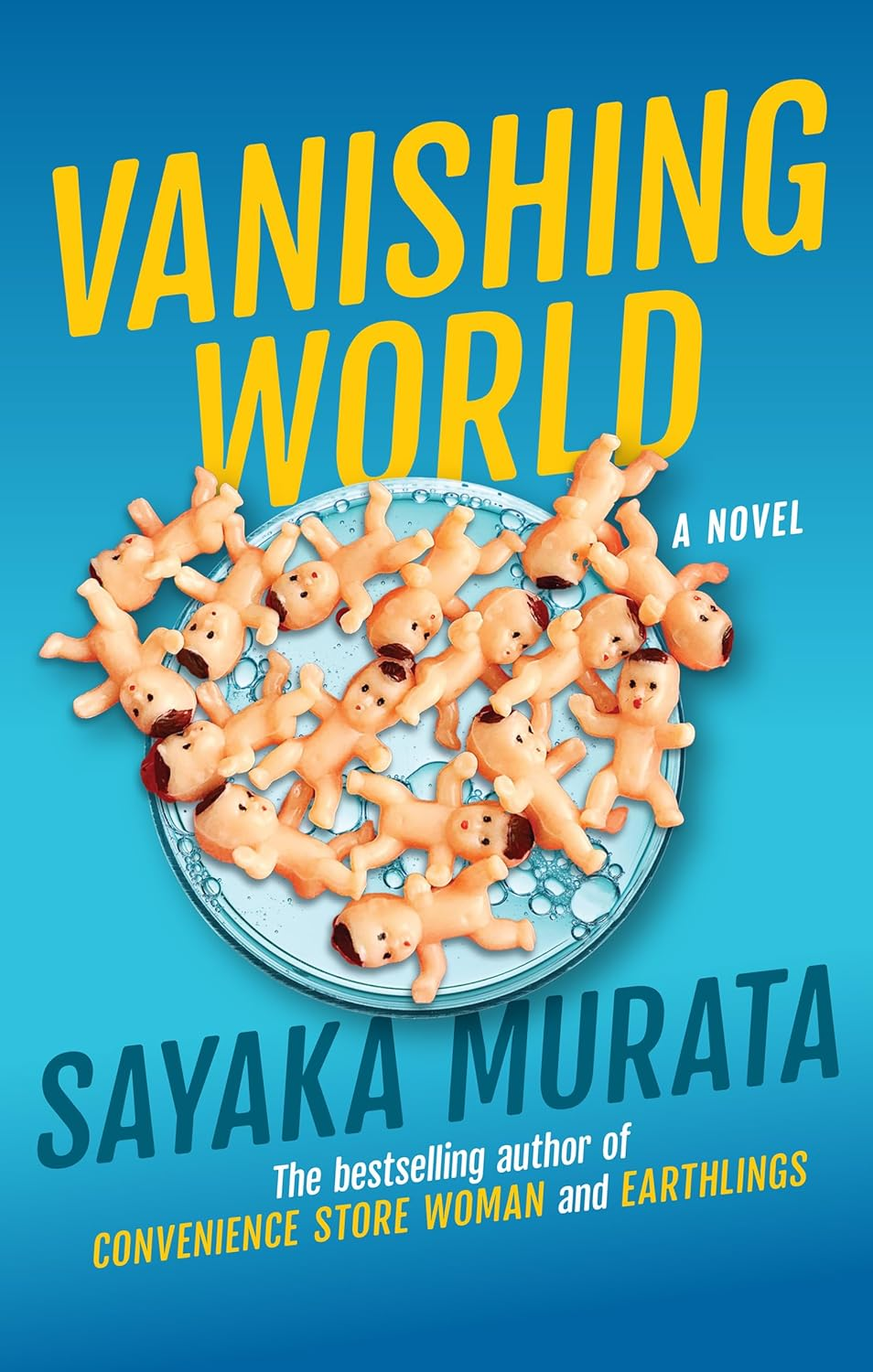
Amane, the main character, lives in the cusp of an old world where procreation is achieved through intercourse (her parents, to Amane’s discomfort, produce Amane through sex), and the brave new world of procreation only through artificial insemination.
In fact, the new normal is that husband and wife are family, and thus, any sexual contact is deemed incest, taboo.
There are some surprises, twists, and disturbing developments, but all in all, Murata forces the reader to think deeply about sex and gender roles, what makes normal “normal.”
The end is disorienting and powerful (similar to Earthlings), bringing the entire work into stark focus.
“Men and women were now all the same,” Amane acknowledges, “all wombs in service of the human race.”
And just pages from the end, Amane argues with her mother: “‘And you aren’t brainwashed, Mom? Is there any such thing as a brain that hasn’t been washed? If anything, it’s easier to go insane in the way best suited for your world?'”
This speculative world of Murata is about humans making normal “fuck nobody,” a sort of extreme puritanical alternate world that renders human nature unnatural—or at least, no longer normal.
 dr. p.l. (paul) thomas