Pluribus is a science fiction series that moves very slowly, often beautifully, and echoes other post-apocalyptic films.
While we were watching S1E7, The Gap, my partner recognized parallels with I Am Legend (and that sparked for me The Omega Man).
The series fits into my favorite type of science fiction, often films that dramatize the existential dread of the human condition through stark settings and extreme isolation—The Andromeda Strain and 2001: A Space Odyssey, for example.
The Gap, for me, solidifies the core motifs of the series through Carol Sturka’s simmering rage against her painful loneliness. But the focus in S1E7 on Manousos intensifies the existential motif through his stubbornly self-defeating trek—a quasi-Sisyphean pilgrimage (with a clever twist on Chekhov’s gun).
My journey to existentialism has an unusual origin (a seed planted in the rich soil of my childhood introduction to science fiction films by my mother)—Billy Joel’s “The Stranger” and “My Life.”
Carol’s loss of her partner, her excruciating loneliness in the wake of that loss, and then her growing attraction to Zocia reminded me of Joel’s songs that deeply impacted my teen years before I started reading and studying existential philosophy on my own in college:
Did you ever let your lover See the stranger in yourself?
And:
They will tell you you can’t sleep alone in a strange place Then they’ll tell you you can’t sleep with somebody else Ah, but sooner or later, you sleep in your own space Either way, it’s okay, you wake up with yourself.
Carol and Manousos are desperately clinging to their humanity while simultaneously experiencing and dramatizing the most horrifying aspects of that humanity—precarity.
Creators of science fiction often have to remind people that post-apocalyptic narratives are less warnings of what may come to be and more slightly exaggerated reflections of how things are.
Like Carol and without the impact of an alien virus, we humans are all completely alone—we always wake up with ourselves—and we long for being with others, often a special other, a monogamous other.
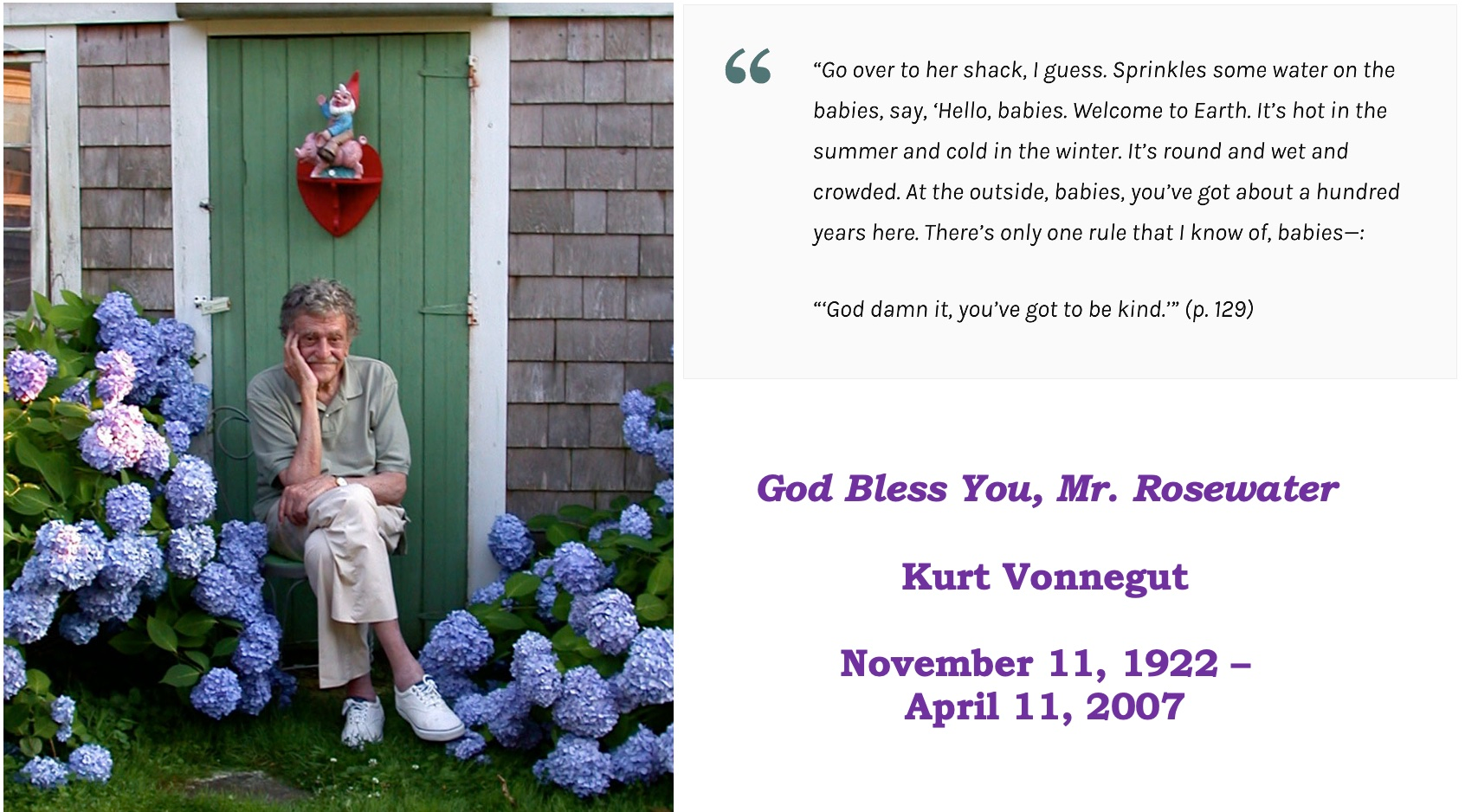
One of my favorite authors bristled at being called a science fiction writer, Kurt Vonnegut, but his works often did include key elements of science fiction such as aliens, time travel, total destruction of humanity, and yes, those existential elements of human loneliness and even fatalism.
But Vonnegut offers an interesting tension in his thematic grounding; he used his fiction to advocate for our potential to embrace our full humanity, our kindness, and the need to form and cultivate communities, extended families.
Vonnegut’s humanism and socialism sit just beneath the surface of his narratives that tend to darkly satirize the dehumanizing systems that people both create and tolerate. Player Piano is a brutal satire of corporate America decades before The Office or Office Space.
Some aspects of human precarity are inevitable, our bodies are prone to disease and they age inevitably to death.
And, yes, we often find our anxieties picking at the scab of our mortality.
But in Pluribus, death is at the edges in many ways (Helen dies and that sparks Carol’s intense loneliness). The focus of the story, however, is the fierce anger and determination of Carol to maintain and save her and everyone’s humanity, a determination seen in Manousos turned up a few notches.
Then there is the other precarity, the one created by systems, the one those systems need so that precarity is cultivated in horrible and dehumanizing ways.
Our Sisyphean existence in the US is dutifully and daily playing our roles as workers, and that role is carefully constructed to be a precarious one.
If we don’t work, we don’t eat.
If we lose our jobs, we lose healthcare, retirement, and frankly, our humanity.
Most people in capitalism cannot define themselves without their jobs. And few things bring more shame that losing a job.
It is subtle, but in S1E8, Charm Offensive, Carol and Zocia become lovers; the next morning, Carol writes again, returning to her job as a writer.
Few things are wasted in Pluribus—Manousos is warned about the spikes on the trees, and Zocia tells Carol “we” are excited she is writing again when Carol lies that she is.
Nothing is wasted, like the title of S1E1, We Is Us.
The paradox of the human condition, our precarity, e pluribus unum.
Frankenstein was planted in my psyche by the classic 1931 film starring Boris Karloff and then bolstered by TV’s The Munsters (1964-1966) and one of my most formative fascinations, Young Frankenstein from 1974.
But the most powerful aspect of Frankenstein for my life as a reader and my fascination with pop culture (films, music, and comic books) was how it fits into my fandom for multi-genre works, the blending of science fiction and horror rooted in not just Karloff’s portrayal of The Monster but the original version of The Fly (1958) with Vincent Price.
There is a straight line from those early- and mid-twentieth century horror/SF classics to my favorite works of SF, Alien (1979) and Blade Runner (1982).
I am now preparing a new first-year writing seminar grounded in the question raised by Frankenstein, From Frankenstein to WandaVision: What counts as “human”?
That course preparation is focusing on how to make sure students see the value not only in Frankenstein as cultural myth but also the ways in which humans have sought to create life or some facsimile of human (such as artificial intelligence).
“More human than human” is the branding of the Tyrell Corporation in Blade Runner (1982), and I daily watch people continue to debate on Facebook aspects of replicants—and which characters are or are not replicants—some forty years after the film was released.
But those elements also triggered how Frankenstein and creating artificial life pervades my comic book world—The Vision (thus WandaVision ), Wolverine (specifically Weapon X), and Deathlok (a character that has blurred with another multi-genre pop culture phenomenon, RoboCop [1987]).
In other words, the text focus on this first-year writing seminar (which is primarily a composition and not a literature course), then, is seeking ways to be provocative and engaging in ways that matter to almost twenty-somethings in 2024; and with the rise of ChatGPT as well as Frankenstein still right in the center of pop culture, I think I have hit the jackpot for an enduring and rich question about what counts as human.
A not exhaustive list so far of potential texts for students to examine include the following:
Comic book characters: Wolverine (Marvel), Cybrog (DC), The Vision (Marvel), Deathlok (Marvel)
Frankenstein’s Monster and Images of Race in Nineteenth-Century Britain, H. L. Malchow, Past & Present, No. 139 (May, 1993), pp. 90-130 (41 pages). https://www.jstor.org/stable/651092
Anne K. Mellor (2001) Frankenstein, racial science, and the yellow peril, Nineteenth-Century Contexts, 23:1, 1-28. 10.1080/08905490108583531
The annotated Frankenstein and Frankenbook share seven relatively brief and accessible essays that allow anyone (and my students) to interrogate the Frankenstein myth in ways that focus on why that myth and questions about what constitutes being human continue to haunt us.
For a composition course, the essays also provide some context for asking students to rethink the essay itself, especially essays written at the college level and for scholarly purposes.
One goal of my first-year writing seminars is to have students rethink essay openings (set aside one-paragraph “introduction” for multiple-paragraph “opening”) and move past the one-sentence overstated thesis (preferring to focus readers in a full paragraph and use questions instead of statements).
With that, Doctorow provides not just a thoughtful essay, but a wonderfully engaging opening paragraph:
When it comes to predicting the future, science fiction writers are Texas marksmen: they fire a shotgun into the side of a barn, draw a target around the place where the pellets hit, and proclaim their deadly accuracy to anyone who’ll listen. They have made a lot of “predictions,” before and after Mary Shelley wrote her “modern Prometheus” story about a maker and his creature. Precious few of those predictions have come true, which is only to be expected: throw enough darts, and you’ll get a bull’s eye eventually, even if you’re wearing a blindfold.
Academics, scholars, and students, I argue, can not only write clearly but also well, incorporating techniques often associated with fiction or so-called creative writing; Doctorow’s first sentence soars with technique but also establishes a very important point about how SF is typically misread: “Science fiction does something better than predict the future: it influences it.”
And thus Frankenstein as enduring myth and enduring question about what counts as human.
Another straight line from Shelley’s The Monster to Marvel’s The Vision (and the glorious multi-genre adventure of WandaVision).
The initial reason I thought a first-year writing seminar centering on the Frankenstein myth and the question of what counts as human was the rise of ChatGPT and debates about whether the writing produced by AI is in any way “good,” or to put it more directly, like a human would write.
But I know I needed more, and the essay by Kate MacCord and Jane Maienschein provides two incredibly important contexts.
First, they interrogate whether The Monster is human using a framework from Aristotle, a doorway into helping students confront the value of classic texts and classic thought (something that helps challenge the Urban Legend that higher ed is all Marxism and no classics)
Like Doctorow’s essay as a model for reconsidering the essay opening, MacCord and Maienschein serve as a powerful example of the engaging closing (again a challenge to the vapid traditional guideline that the conclusion should repeat the introduction);
To look more concretely at a topic of current interest, some people claim that embryos have personhood and should be given the legal rights of a human being. In the sense of humanity or personhood explained here, this definition would be an inaccurate assessment of embryos. Embryos are materially of the human type, but they have not yet gone through the process of development and are not yet persons in this sense. Some people like to suggest that embryos are potential persons in that they might, under the right circumstances, become persons. Or to put it biologically, perhaps an embryo or a “monster” that is not a fully formed human might be taken as having the potential to become a human being. But potential is not actual. Most of us have many potentials that we never put into action. It does not make sense to act as if every one of us is already an Olympic star or concert pianist or math genius just because we may each have the potential to become these things. It is the actual that matters. The creature is not an actual human in that he has not developed fully. Even after two centuries, Victor and his not-human creature help inform our understanding of human nature.
From a classical examination of whether The Monster is human (they say not) to the very real and current on-going struggle in the US over body autonomy and human agency at the center of the abortion debate—this is the promise of asking students to interrogate what counts as human through the Frankenstein myth.
First-year writing seminars must be about thinking better and more deeply by writing better and more deeply.
I am excited for this course in the spring as my students and I can contribute even more the enduring myth of Frankenstein.
My poem The 451 App (22 August 2022) is a science fiction/dystopian musing about the possibility of technology providing a comforting veneer to the creeping rise of totalitarianism—a simple App appearing on everyone’s smartphone before erasing all our books.
The point of the poem is less about technology and a dystopian future (alluding of course to Fahrenheit 451) and more about another work of literature: “The best lack all conviction, while the worst/Are full of passionate intensity” (“The Second Coming,” William Butler Yeats).
For me, this unmasking of the human condition has always been haunting; it also has become disturbingly relevant in the Trump/post-Trump present in which we live.
Real life is always far more mundane than speculative fiction—and far more shocking.
The “worst,” “full of passionate intensity,” launched an assault on academic freedom in the final months of the Trump administration. The initial wave seemed poised at The 1619 Project and a manufactured Critical Race Theory scare.
By January of 2022, a report found that educational gag orders passed in states across the U.S. were having a significant and chilling effect:
We found that at least 894 school districts, enrolling 17,743,850 students, or 35% of all K–12 students in the United States, have been impacted by local anti “CRT” efforts. Our survey and interviews demonstrate how such restriction efforts have been experienced inside schools as well as districts. We found that both state action and local activity have left many educators afraid to do their work.
As bills have increased since this report, the number of teachers and students impacted are certainly higher.
Concurrent with educational gag order legislation, book banning has increased dramatically, as reported by PEN America:
• In total, for the nine-month period represented, the Index lists 1,586 instances of individual books being banned, affecting 1,145 unique book titles. This encompasses different types of bans, including removals of books from school libraries, prohibitions in classrooms, or both, as well as books banned from circulation during investigations resulting from challenges from parents, educators, administrators, board members, or responses to laws passed by legislatures. These numbers represent a count of cases either reported directly to PEN America and/or covered in the media; there may be other cases of bans that have not been reported and are thus not included in this count.
• The Index lists bans on 1,145 titles by 874 different authors, 198 illustrators, and 9 translators, impacting the literary, scholarly, and creative work of 1,081 people altogether.
• The Index lists book bans that have occurred in 86 school districts in 26 states. These districts represent 2,899 schools with a combined enrollment of over 2 million students.
Republicans and conservatives have steadily created an environment of fear around teaching and learning, which is being detailed now by teachers experiencing that fear (with many leaving the field):
Last year, I was quoted in an article in the School Library Journal about how I discussed toxic masculinity with my high school students when we read Shakespeare’s “Romeo and Juliet”together. Within days, far-right publications twisted my words to denounce “woke liberal indoctrination in schools.”
Strangers sent me messages on social media accusing me of indoctrinating students, of being unprofessional and unintelligent. I received a handwritten letter addressed to me at school. The letter accused me of being a “low-life, pseudo-intellectual, swallow-the-lib/woke/b—s— koolaid a — h—-.” [The hyphens were added to replace letters because of Washington Post style and not in the original].
This movement is driven by lies and fear mongering, but it depends on the missionary zeal of the liars and fear mongers as well as the passivity of “the best” among us.
My childhood and adolescence were profoundly shaped by books and movies—often the science fiction loved by my mother.
There is a profound darkness and fatalism in these works, but in Fahrenheit 451, I was struck by the optimism and power of the individuals who walked around repeating the books they had become.
These people, the best among us, seem to suggest Bradbury held on to some sliver of hope.
It seems overwhelming to consider that as sentient creatures we are doomed to not recognize that things matter until they have been taken from us—taken from us with almost no resistance, with almost no recognition of the book being gently slipped from our hands and then our minds.
Academic freedom isn’t free, but without free minds—freedom to teach, freedom to learn, freedom to read and consider—we are no longer fully human.
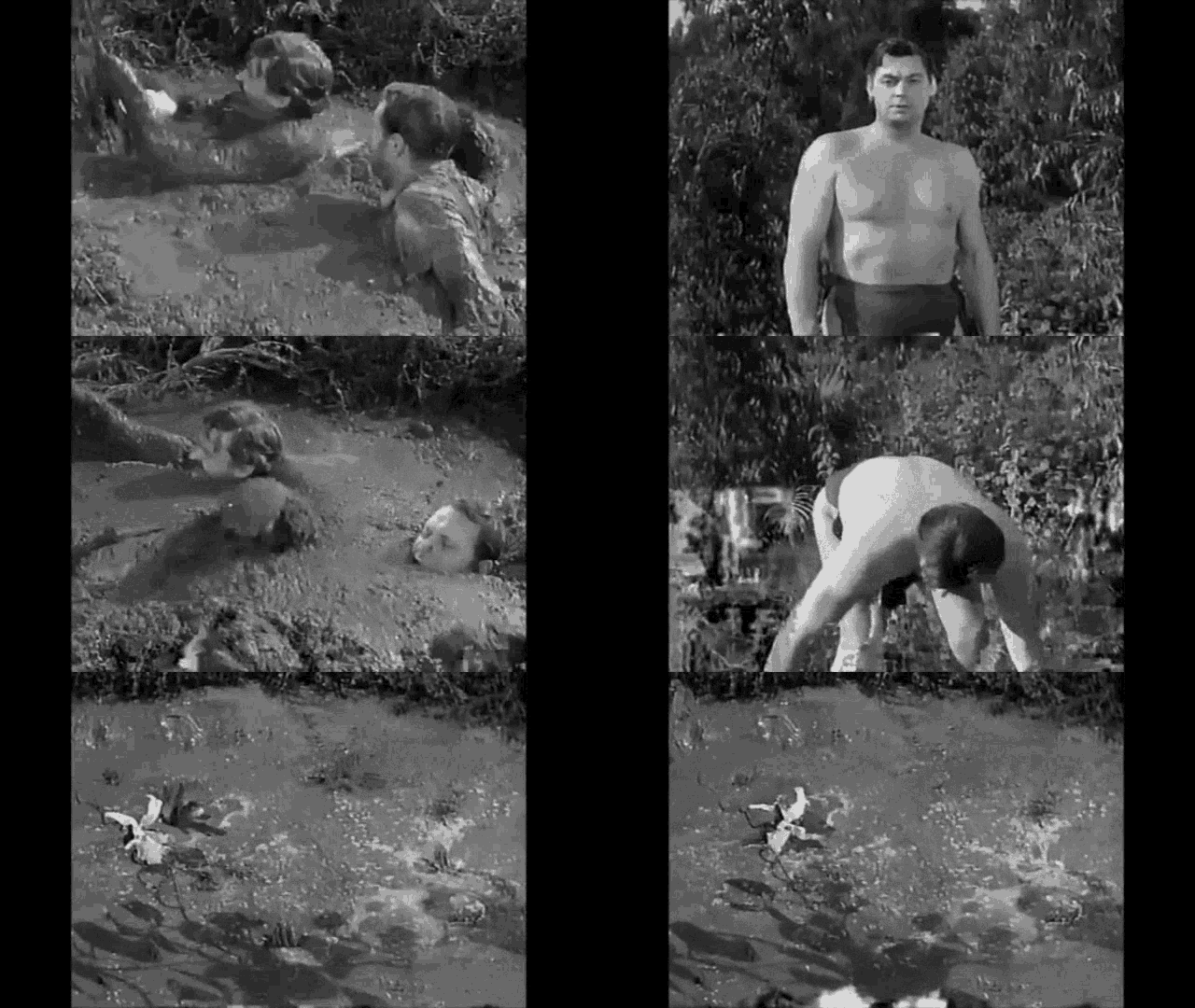
Apparently if you are of a certain age—at 60, I am at the end of the Boomer generation—you were convinced by pop culture that one of the great (and even reasonable) fears of being a human was finding yourself trapped in quicksand.
How did I, a redneck living and growing up in the foothills of South Carolina during the 1960s and 1970s, come to fear the ubiquitous dangers of quicksand?
Of course this was nonsense—despite my childhood forages in the woods seeking (and trying to avoid) the dreaded quicksand.
I also inherited from my mother a life-long love of science fiction and a toxic cocktail of anxiety, depression, and hypochondria (the latter three all fueled by the pop culture we were consuming).
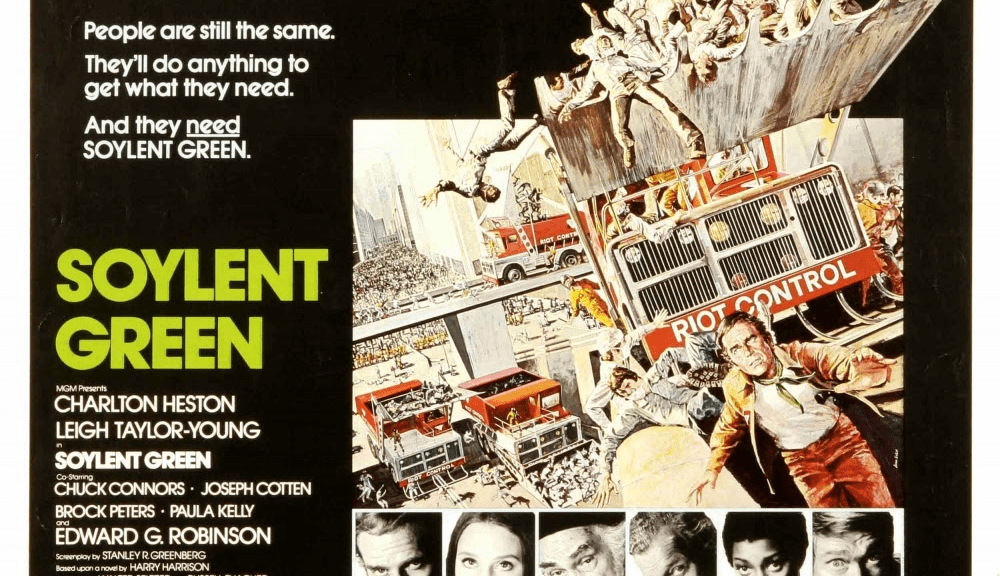
Pop culture science fiction created in mid- to late twentieth century was often set in the world we inhabit today; notably, we recently passed the setting of Blade Runner, 2019, and are now days into the setting of Soylent Green:
Of course, in 2019, many lamented that, once again, science had not delivered on the promises of science fiction, the flying car, and artificial intelligence remained far behind the “more human than human” refrain evoked in Ridley Scott’s adaptation of Philp K. Dick’s Do Androids Dream of Electric Sheep?
And as far as we know, we are not being fed each other in 2022 because overpopulation has finally threatened the existence of humanity (another fear perpetuated in my childhood).
Since we must resist reading science fiction as prediction—most science fiction is a cautionary tale about any present time and our enduring human weaknesses—I think we should note the brief text of the promotional poster: “It’s the year 2022…People are still the same. They’ll do anything to get what they need. And they need SOYLENT GREEN.”
Humanity hasn’t experienced the sort of scarcity dramatized in the film, but we are in the midst of two years of scarcity and death because of a pandemic. And we are witnessing a truism that is chilling, “People are still the same. They’ll do anything to get what they need.”
And we have learned that “need” can be an ugly, distorting concept.
While the irrational and pervasive fear and anxiety some of us live with as a part of our humanity are often difficult to discern from the fear and anxiety fostered by media, pop culture, and political manipulation, it seems that we as humans need to manage better our irrational fears (quicksand) and fantastical hopes (flying cars) so that we can focus on the real daily threats before us, “People are still the same. They’ll do anything to get what they need.”
No, our food source is not be the Big Reveal of the film:
And it isn’t quicksand lurking around the next corner that may kill us; but the thing to fear is people, each other.
We are a selfish species, and our own worst enemies.
Not as vividly as today, slipping toward my last month at the age of 60, but in high school I was aware that I existed in different worlds, worlds that really did not overlap.
Those worlds, in fact, were documented in two films of my youth, Animal House and Revenge of the Nerds. And the worlds, of course, are the tensions between nerds and jocks in formal schooling.
From about 1975 into the early 1980s, I was a compulsive comic book collector, and throughout junior and senior high school, I was on the schools’ basketball teams; I also was a serious golfer and ran track my senior year.
Wearing my father’s number 3, I spent much of my adolescence trying to be the athlete I believed he wanted me to be.
With 7000+ comic books safely ensconced in my comic book room at my home, where I could control who knew about my mostly closeted life, I graduated 8th in my class and more distraught that I had failed to secure a letterman’s jacket than proud of my academic achievements.
My school had arcane rules for lettering, the jacket only awarded to those who lettered in their junior year, the only year I failed to letter in basketball after lettering my sophomore year and in two sports my senior year. I wore my father’s letterman’s jacket occasionally—him a four-sport letterman and co-captain of the school’s first state championship football team.
I clung to the jock life desperately in high school, but the nerd life was who I was, who I am.
Although I became a serious cyclist a few years after high school, and continue today as a fairly accomplished recreational cyclist, I learned quite quickly that the embarrassment of being an outcast that came with being a nerd in school, suddenly flipped throughout college and into adulthood.
Oddly, to be honest, much of my nerd impulses are satisfied by my adult sports obsession, cycling. The two worlds seamlessly merged, and with little conflict—unlike the satirical clashes in the films of my youth.
From the science fiction obsession I adopted from my mother to the comic book collecting and compulsive efforts to be a comic book artist, I slowly throughout college morphed into being a writer and a teacher, followed by graduate school and the life of a scholar, which pulls everything into one neat and stable nerd pile.
In my 40s, I moved to higher education and found the space to merge all of my nerd life into my career, including doing comic book scholarship and blogging. Over the next two decades, with age, I returned to my nerd center, beginning again to collect comics just as the world has embraced all that nerdom in the form of comic books being adapted to film and series on streaming services.
I grew up with campy Batman (a wonderful work around to shift comic books to live-action), The Green Hornet, The Incredible Hulk, and The Amazing Spider-Man, the latter two a hint of the possibility of comic books as TV series that were far ahead of their time in terms of the technology needed to make that work.
Most of that pop culture/comic book/super hero world was simply only stuff that nerds could appreciate, love. While there was some momentum to these as well as popular success, this was still mostly the nerd world.
Young adulthood, career, graduate school, marriage, and fatherhood pushed my nerd life aside while pop culture continued to tip-toe toward today’s nonstop nerdvana seen in Marvel and Disney+.
In 2012, despite being a lifelong SF nerd, I came to the original The Matrix trilogy 13 years late; I found all three films on my cable package, and immediately consumed them with nerd-glee, baffled why and how I had allowed life to distract me from them when they were commanding pop culture.
I soon wrote a poem about this experience, alluding the Revenge of the Nerds and beginning then to think seriously about what it means to be a nerd.
The value and consequences for being a nerd shift throughout childhood and adolescence into adulthood because at its core being a nerd is about being fully human, passionately and nakedly fully human. While we are children, and especially teens, to being transparent is terrifying, and the result is many simply hide their passions, who they are, and resort to shaming and bullying those few among us willing to live the nerd life even as we know it costs during those delicate years of growing up.
Of course, we have always found each other, sought refuge in small gatherings, but I grew up before comic book stores and Dungeons and Dragons, well before gaming really took hold.
Nerdom was isolating for me—until it simply was my life, my passions finding their way into my careers.
I will find ways to bask in 12-22-21, this nerdvana. After I complete this blog post, I can head to my local comic book store, opening at 11 am. I will go cycling this afternoon, and we have committed to watching The Matrix Resurrections tonight. I am fretting over how to fit in Hawkeye, as I also fret over how and when Daredevil comes to the MCU (hints and leaks swirling around me).
Being a nerd is an attempt at being fully human, allowing our souls and our minds to care deeply, to love and embrace these other worlds imagined and brought into our real lives.
12-22-21 is also the first day after the Winter Solstice, daylight once again promising to expand and bring us another spring, hope and sunshine and warmth.
Nerdom is the human heart joining with the human mind and pretending we have souls, souls that can and will occasionally join hands, all creatures good and one.
“Am I normal?” Vin asks his sister Viv as they lift off the ground to leave school for home. Vin and Viv are the synthezoid teenagers of Virginia and Vision, the superhero associated with Marvel’s Avengers. This question comes after Vin is confronted during class in the first issue of Vision:
This rendition of Vision (vol. 2, 2016), award-winning and critically acclaimed, sits behind the Disney+ series WandaVision by providing important and substantial backstories for Wanda and Vision but also because the Disney+ series and the twelve-issue comic book series share a framing: The normal American Family.
While WandaVision expands the stereotypical nuclear family trope through pastiche, Tom King (writer) and artists Gabriel Hernandez Walta (issues 1-6, 8-12) and Michael Walsh (issue 7) ground the philosophical questions running through the narrative around Vision’s synthezoid family living in Arlington, VA with the children attending Alexander Hamilton High in Fairfax, VA in the traditional family trope.
Visions entire family, not just Vin, are obsessed to the point of existential dread with their goal of being a normal family (see also Normality in Sayaka Murata). King repeats motifs and phrases around normalcy and the conditions of being a family member—such as Virginia’s proclivity for crying:
Vision is much more than source material for WandaVision, however; this work also offers a powerful addition to science fiction’s enduring questions about what it means to be human—often explored through androids and artificial intelligence—as well as unpacking the essence of love, justice, and the frailty of life (or sentience). [1]
Visions of the Future (Issue 1)
One of the most effective elements of Vision is the use of narrators as well as the color-coding of narrative and dialogue balloons. The first page of the series is all narrator of panels, establishing the normal family trope as well as introducing the framing element for the entire series: “They made compromises that are necessary to raise a family” returns in Issue 12 after the death and destruction that is foretold in this first issue.
Virginia and Vision have a philosophical debate about “nice” and “kind” after awkwardly meeting some neighbors; the entire series is a similar contemplation of core concepts for humanity. Here, readers also see Virginia in the role of the sad housewife (a pattern that continues throughout the work; see the panel above): “She was fascinated by how often she found something that made her cry.”
Along with the focus on “normal” as well as the nature of love (Vision “caught in a state of dread” in tension with “This is my wife. I love her. I must love her”), readers discover that this synthezoid family is living lives quite far from normal; The Grim Reaper kills Viv, and then, Virginia brutally kills the Grim Reaper, prompting one of the darkest uses of dark human in that the issue ends with a parody of normal family life, Virginia saying “Don’t tell your father.”
We can almost hear the laugh track overlaying, as if this were an episode of WandaVision.
Everything Slips through Their Fingers (Issue 2)
Gruesome.
The first two pages are wordless except for the mangled body of Viv muttering “Mother” over and over.
Virginia becomes more than a wife/mother trope with her violent outbursts (again, repeated throughout), but she also introduces a important theme of the narrative—how storytelling shapes reality and truth. When faced with Vision, Virginia fabricates a version of her killing the Grim Reaper because she fears that the truth will harm or destroy their efforts to be a normal family.
Ironically, after Virginia tells her white lie, the couple sits on the couch, her head leaning on Vision’s shoulder (a trope of TV sitcoms repeated throughout WandaVision) with her fear already coming to fruition despite the lie: “These are the noises of their every day. The banal background to their new home. // They used to sound so pleasant.”
In this issue, Vin succumbs to violence also in the absence of his sister, offering a stinging critique of schooling with lunchroom and principal’s office scenes.
In and Out (Issue 3)
The mutant universe has long been used as a metaphor for discrimination and bigotry. One of the key aspects of the theme of normalcy and the nuclear family in Vision is that the synthezoids are very distinctly the Other. Issue 3 opens with a deft confrontation of racial slurs: “Go home, socket lovers” painted on the Visions’ garage door by local teens because as the narrator explains: “Whatever shade of skin a person had, wherever a person was from, whatever god a person worshipped, there was a word for that person.”
This vandalism sparks another act of violence by Virginia.
With the help of Tony Stark, Vision is able to repair Viv—one of many moments in this series where life/sentience is lost and either regained or permanent. When Stark reports back to Captain America’s asking “How it all went,” he oddly frames this miraculous event: “‘Fine,’ Iron Man said. ‘Normal, I mean. Everything was normal.'”
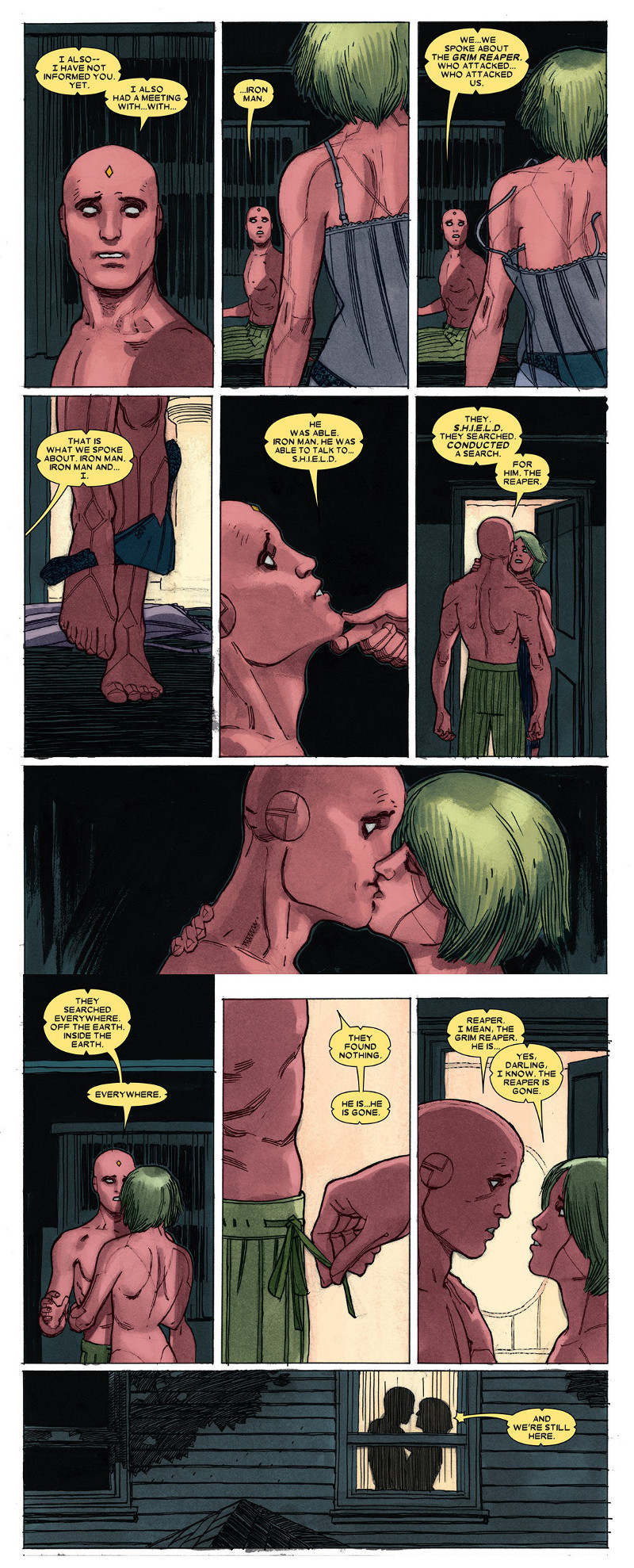
Later, juxtaposed to the very abnormal “normal” return if Viv, readers witness a seduction scene between Virginia and Vision, including the negligee and a brilliant close up of Virginia’s fingers pulling at the string of Vision’s pajama bottoms:
Normal synthezoid romance? Or androids playing the roll of human?
Balls in the Air (Issue 4)
Racial slurs return in this issue, highlighted by a full page close up of Vision holding a football from the high school with the ex-team mascot and image, “Fighting Redskins.” Set in Virginia, this takes direct aim at the former Redskins NFL team in Washington DC.
That offensive logo returns at the end of the issue where Virginia confronts the man who saw her bury the Grim Reaper, who happens t be the father of the teen attacked by Vin and who had begun to flirt with Viv.
When Virginia enters the man’s house, the Redskins logo is in the background, and later, as he pulls a gun on her, the bloody and tragic events unfold (the man shoots his own son and Virginia delivers a skull crushing blow to the man) with the logo bloodied on the wall, highlighted in a single panel ending the issue.
The Villainy You Teach Me (Issue 5)
The Merchant of Venice by William Shakespeare becomes an obsession for Vin, and lines from the play structure the first several pages of this issue, which turns some of the focus to justice and fairness.
While Vision is at the police station answering questions about the shooting, Virginia and the children talk; Virginia repeats “Everything is normal” eve as she explodes and destroys the kitchen table. Viv storms away crying, but Vin remains his inquisitive self, asking, “If you prick me, do I bleed?”
Issue 5 includes two repeated scenes. First, Vision tells Detective Lin, as he did the principal, that he has saved the world 37 times just before Vision (as Virginia did to him) decides to embellish his own version of the night of the shooting: “And all of it cannot redeem him from this, this small moment when he crossed to the other side, when he entered into the madness that was soon to come. // This small moment. // This small lie.”
P vs. NP (Issue 6)
One of the most philosophical issues is this one, a prolonged opening about the problems easily solved and “problems which, practically speaking, you cannot simply solve.”
This musing carries over four pages as the reader watches a problem not easily solved literally unearthed—the remains of the Grim Reaper that Virginia wanted to remain her secret. The issue is filled with off-panel destruction and a blood-splattered Vision dismembering a dog.
The result is a synthezoid green dog built by Vision for the perfect nuclear family. Despite the truth being revealed and despite Virginia’s greatest fear, “the answer, for Vision, was yes. He would continue”:
He would fix what had been broken. He would hide what he could not fix.
He would make his family.
The easy explanation of his answer would be that he, who longed to be human, recognized that this was the human decision.
That every day all men and women make this same choice. To go on even though they cannot possibly go on. …
Indeed, in considering the situation, it was clear:
With one-shot artist Walsh, King interrupts the narrative of the Visions for a flashback that details the fracture between Vision and Wanda.
This issue is particularly important for WandaVision, but readers also learn (or return to) about the tragic family of Wanda and Vision as well as Vision’s own destruction and resurrection(s). Wanda, too, is reset as Vision explains:
You will not remember my words today.
Just as you will not remember losing Thomas and William to the devil from whom you stole their souls.
To protect you, Agatha will take the memories away, destroy your children as easily as you created them.
Virginia, it is revealed, is built from the brain patterns of Wanda: “In the end, we begin again. // And everything is new and different.”
Victorious (Issue 8)
“Life is but a dream,” Virginia intones as she plays the piano. The dream motif stands in contrast to the nightmare unfolding with the arrival of Vision’s android brother, Victor.
Victor and Virginia bond over her trying to play the piano but finding it unsatisfying because “When when I simply access the notes and play play play them well … I seem to feel that I am not playing them.”
Perfect, a synthezoid is thus alienated from being human.
Victor, as readers eventually discover, is ingratiating himself with the family at the behest of the Avengers, but even as he expresses envy for Vision’s “greta family,” Victor cannot avoid yet another tragedy, the death of Vin at his own hands.
They Will Die in the Flames (Issue 9)
Victor is revealed as a paradoxical character; he seeks to avoid his fate (another Ultron plot of destruction) but cannot avoid being the agent of death. This issue reaches back to a line from Issue 7 after Wanda and Vision discuss the future: “Tomorrow always comes,” Vision assures Wanda.
The death of Vin brings not only the inevitable tomorrow but forces the issues of justice that have been on the lips of Vin reciting Shakespeare.
Rage reserved for Virginia now simmers in Vision.
All Will Return to Normal (Issue 10)
Vision cycles through “a great number” of “philosophical and religious traditions,” deciding “I must therefore conclude that it is not just. And what is not just must be addressed.”
Recognizing the inevitability of revenge, Vision is none the less given pause: “I am the Vision of the Avengers. I saved the world 37 times.”
As the opening of the issue establishes, here Vision confronts both philosophy and religion with his daughter Viv, who is kneeling beside her bed about to pray when he comes to talk with her.
“I do not know if there is a god. It seems unlkely,” Viv says after she explains that she is “praying for Vin’s soul to be at rest.
“Yes. It does seem unlikely,” Vision adds, before they agree to pray that there is a god, that Vin has a soul, and that “god [allows] Vin’s soul to rest.”
Our narrator assures us there is a god: “Someone to greet our souls when we leave this life. // Someone to tell us that we have done enough, that we have done what we could. // That, now, finally we may rest.”
You and I Were Born for Better Things (Issue 11)
In this penultimate issue, Vision must fight through the Avengers in order to avenge his son’s death by killing Victor. Simultaneously, Virginia confesses her role in the death of Viv’s potential human boyfriend, resulting in Viv smashing the table as Virginia has, a foreshadowing of sorts.
In a blurring of violent scenes (Vision fighting the Avengers and Virgnia killing the dog), the normal nuclear family motif returns. The narrator retells of Vision creating Virginia and details:
He explained to her that she was a good person.
That she was made to be a good person with a free will of her own.
Now, should she so desire, she could join him on his quest to live a good life.
Vision faces Wanda last; she greets him with “The future is here.” Her plea fails as Vision says, “I do not think that you understand. That you ever understood. // I want to be like everyone else.”
Revenge, however, is at the hands of Virginia, who kills Victor.
Spring (Issue 12)
The last issue is a final retelling, a revision of truth.
Virginia tells Detective Linn another embellished story of Victor’s death before committing suicide. As Vision is dressing before seeing Virginia in her final moments, the opening narration is repeated, ending ominously as on the first page of issue 1: “They made the compromises that are necessary to raise a family.”
The final scene is the darkest version of the happy married couple on the couch, including Virginia again resting her head on Vision’s shoulder. And she dies: “Virginia did the right thing. // Or she did the wrong thing. // Or she just did what everyone does —”
Although the final panels are ambiguous, that the last issue is “Spring” and we are left with Vision, his daughter Viv, and what seems to be the likelihood that Vision is rebuilding Virginia, I recognize the ending to Franz Kafka’s The Metamorphosis, a misunderstood work of dark humor and hope: “And it was something of a confirmation of their new dreams and good intentions when at the end of their journey the daughter first lifted herself up and stretched her young body.”
Vision is smiling and singing, “Life is but a dream.”
My closest reading friend is a young woman in her 20s, an English major and high school English teacher. Recently, she asked me with a chilling earnestness, “What happens if we have to move because it becomes too hostile here for women?”
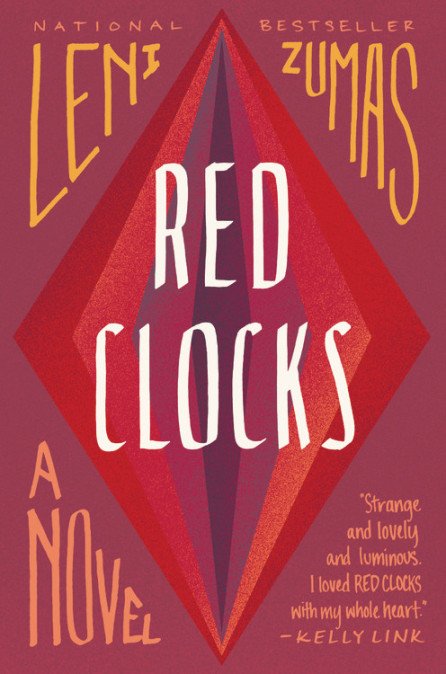
Zumas’s novel has drawn comparison’s to Margaret Atwood’s The Handmaid’s Tale because of its powerful but disturbing near-future speculative fiction rendering of the U.S. post-Roe v. Wade.
Red Clocks tests readers’ comfort with near in her speculation about the life of women after a complete abortion ban in the U.S., including a Pink Wall that denies those women access to abortion in Canada.
Zumas has Atwood’s gift for incisive language—along with Pink Wall, the Personhood Amendment and the Every Child Needs Two law—and setting the novel in Oregon seems an allusion to Ursula K. Le Guin, who famously sparred with Atwood about labels such as “science fiction” (which Kurt Vonnegut wrestled with and against), “speculative fiction,” and “fantasy.”
Once I finished reading, I felt the most compelling aspect of the work is Zumas’s deft blending of allegory (the central characters and rotating limited narration through the Biographer, the Mender, the Daughter, and the Wife, reminding me of Jeff VanderMeer’s techniques in his Souther Reach Trilogy) with stark relevance to now.
Zumas includes as well a recurring fifth key, although tangential, woman to the narrative, “[t]he polar explorer Eivor Minervudottir”—both a sparsely detailed would-be subject of the Biographer and a representative of the lost women of science (her great work of research eventually published under a man’s name because Sir George Gabriel Stokes in a rejection letter explains it is “a paper which, it is patently clear, you did not write”).
Ultimately, as a reader, I wondered if this prescient work of fiction had presented too sharp a blade for exposing the historical and current burden of simply being a woman, a burden inextricably tied to being sexual and reproductive beings.
Along with supporting the politics of the narrative and the work’s relatively overt nudges toward activism, I found the novel a rich and excellent work of speculative fiction because the more I read, the more I was drawn to keep reading. That compulsion was firmly grounded in the characters, flawed often but always sympathetic in a wide range of ways linked to both their unique personal qualities and how they share as well as highlight the many ways the world (and U.S.) remains hostile to their simply being women.
When I stumbled in my reading of this novel, it was the limited third-person narrative that drifts into a sort of stream of consciousness and (like in Atwood’s work) a thin whiteness to the focus that makes me nervous the work can too easily be discounted as the sort of work some white women do that is hyper-feminist to the exclusion of admitting that race and racism cannot be separated from the fight for gender equality.
Zumas and her novel, I think, easily rise above these concerns, again because the politics and prescience are incisive and the narrative and characters are expertly wrought. Above all else, I wanted to remain with these characters because I genuinely cared for their lives and their dilemmas, often intertwined directly but always shared by their womanhood.
[spoiler alert]
The Wife, for example, pulls togethermany of the feminist thematic elements in the novel. She frets about her labia, her empty marriage, the possibility of suicide, and her personal ennui grounded in forgoing her law career to be a mother—all while she positions herself to have an affair with a colleague of her husband.
While the affair never materializes (at the pivotal moment when she thinks it will happen, she has to confront, “He does not want her”), the Wife does finally initiate leaving her husband and her marriage, a scene that ends ominously:
The wife kneels on the path.
…She reaches for the black earth.
Her body yearns, inexplicably, to taste it.
Brings a handful to her lips. The minerals sizzle on her tongue, rich with the gists of flower and bone.
…Bright minerals. Powdered feathers. Ancient shells.
And then there is the guilt of being her own Self as well as a member of the tribe of women, the allegiances to both in conflict. While attending the trial of the Mender, represented by a former friend of the Wife from her law school days, she confronts that guilt:
Has the wife become a person who believes all accounts?
Sort of, yes, she has.
She has been too tired to care.
The Personhood Amendment, the overturning of Roe v. Wade, the calls for abortion providers to face the death penalty—the person she planned to be would care about this mess, would bother to be furious.
Too tired to be furious.
This Brave New World closing in on the Mender, the Daughter, and the Biographer in direct and terrifying ways has, to the Wife, mostly not been about her directly, a wife and mother of two living rent-free in a family home.
Navigating the Wife in this novel was parallel to the bitter pill of a majority of white women voters choosing Trump—sacrificing the good of women for the perceived personal comfort they have in their own lives.
However, the Wife’s fear of change is only nearly paralyzing since she ultimately, it seems, takes the initiative toward a new life, one less secure and more directly jeopardized by the erasure of women’s rights.
“I’m an optimist,” the decorated Canadian author explained by phone to Wired.com during a tour for her most recent book, The Year of the Flood, published in September. “Anyone who writes this kind of stuff probably is. If you weren’t, you wouldn’t waste your time writing the books.”
I am afraid, none the less, and haunted by my reading friend’s question: “What happens if we have to move because it becomes too hostile here for women?”
What will any of us do? What are any of us doing now?
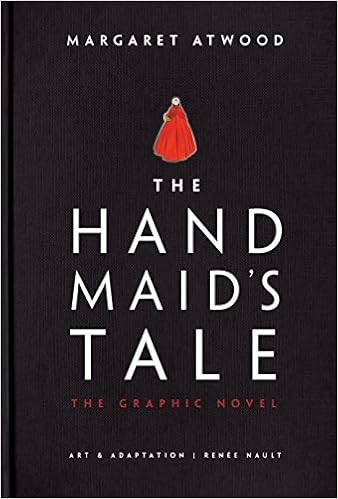
The enduring power of reading and teaching Margaret Atwood’s The Handmaid’s Tale lies in both her gifts for storytelling and her love for language revealed in her playing with words.
Regardless of the genre or form, Atwood loves to make us flinch with the turn of a phrase:
When I was teaching Advanced Placement Literature for high school students in the rural South, I found one of the best lessons revolved around Atwood’s investigation of graphic language during The Ceremony in Chapter 16:
My red skirt is hitched up to my waist, though no higher. Below it the Commander is fucking. What he is fucking is the lower part of my body. I do not say making love, because this is not what he’s doing. Copulating too would be inaccurate, because it would imply two people and only one is involved. Nor does rape cover it: nothing is going on here that I haven’t signed up for. There wasn’t a lot of choice but there was some, and this is what I chose. (p. 94)
My students and I also found the wordplay throughout the novel as engaging as the characters and narratives, notably the scene when the Commander ushers Offred to his room for a rendezvous that turns out to be a surprising form of infidelity, Scrabble:
“I’d like you to play a game of Scrabble with me,” he says.
I hold myself absolutely rigid. I keep my face unmoving. So that’s what’s in the forbidden room! Scrabble! I want to laugh, shriek with laughter, fall off my chair….
Now of course it’s something different. Now it’s forbidden, for us. Now it’s dangerous. Now it’s indecent. Now it’s something he can’t do with his Wife. Now it’s desirable. Now he’s compromised himself. It’s as if he’s offered me drugs….
What does [Nick] get for it, his role as page boy? How does he feel, pimping in this ambiguous way for the Commander? Does it fill him with disgust, or make him want more of me, want me more? Because he has no idea what really goes on in there, among the books. Acts of perversion, for all he knows. The Commander and me, covering each other with ink, licking it off, or making love on stacks of forbidden newsprint. Well, he wouldn’t be far off at that….
Caught in the act, sinfully Scrabbling. Quick, eat those words. (pp. 138-139, 181)
This language-rich element of Atwood’s fiction as well as her wordplay poses a challenge for adapting this novel to film and more recently a series. Adaptation, however, allows a seminal work to grow, expand, and even change, as the series now moves beyond the original narrative in ways similar to The Walking Dead.
Atwood’s interest in blending and breaking genre and her work in graphic media suggest that the latest adaptation fits perfectly into the expanding body of work drawn from The Handmaid’s Tale:
As part of the adaptation process from novel to graphic novel, Renée Nault notes that she did not watch the Hulu series, but the process entailed:
Nault worked first-hand with Atwood to pare down the story — about a dystopian future where America has become a brutal theocracy and fertile women are the property of powerful men — then bring it to life on the page.
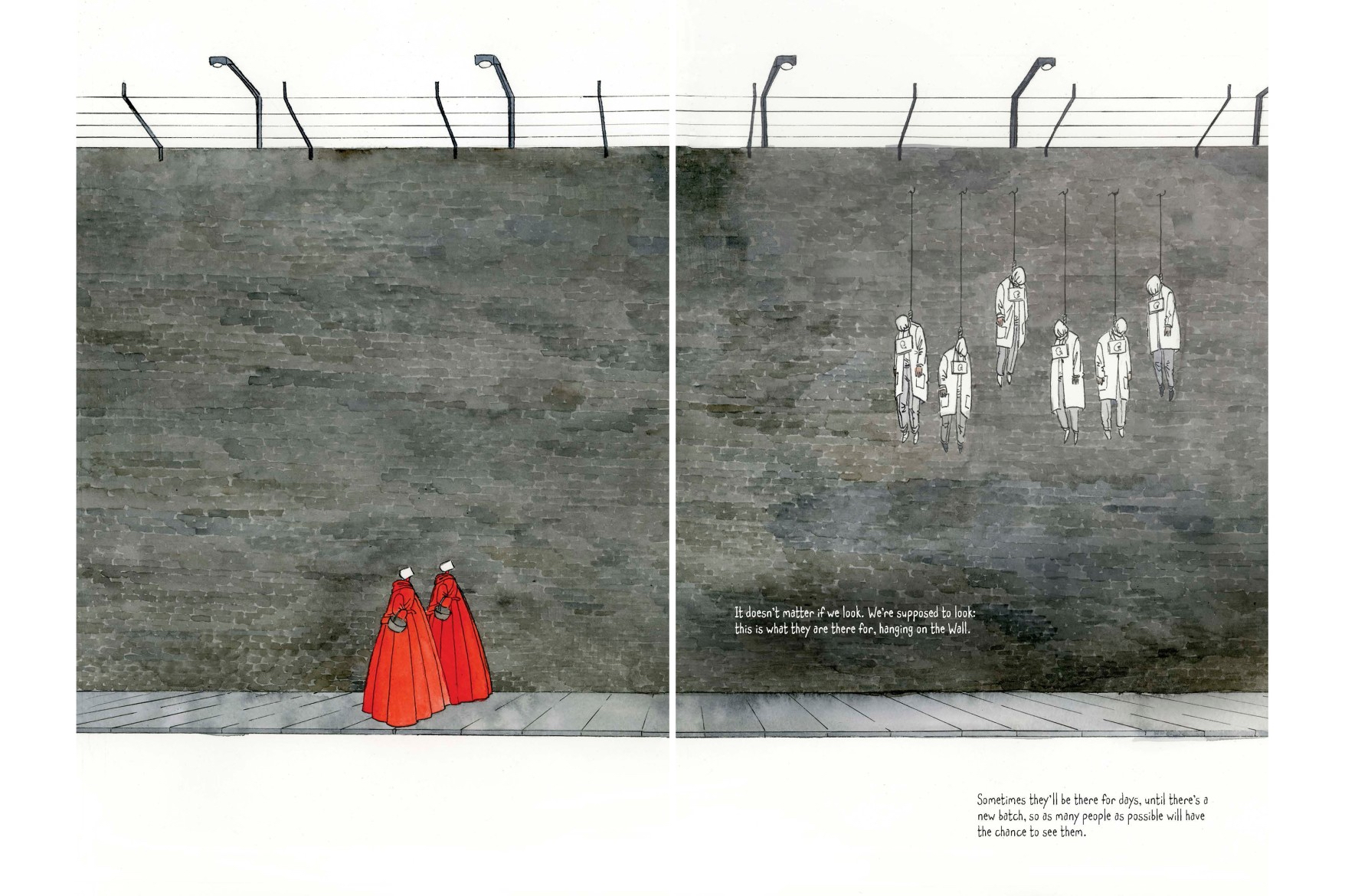
The resulting tome…is 240 pages of arresting watercolor illustrations, depicting the novel’s grim world in muted grays and browns with shocks of red from the handmaids’ distinctive red cloaks.
“Some books would be very hard to adapt in this way, but ‘The Handmaid’s Tale’ is awash in visual symbolism — partly because women in it are not allowed to read,” the 79-year-old author said.
They were also able to convey some things that text — and even a TV show — never could.
My love for Atwood’s work and comic books/graphic novels informed my reading of this adaptation. Yet, I was initially concerned about how I would feel since much of the adaptation involves the loss of Atwood’s rich language, although the artwork is stunning in its place:
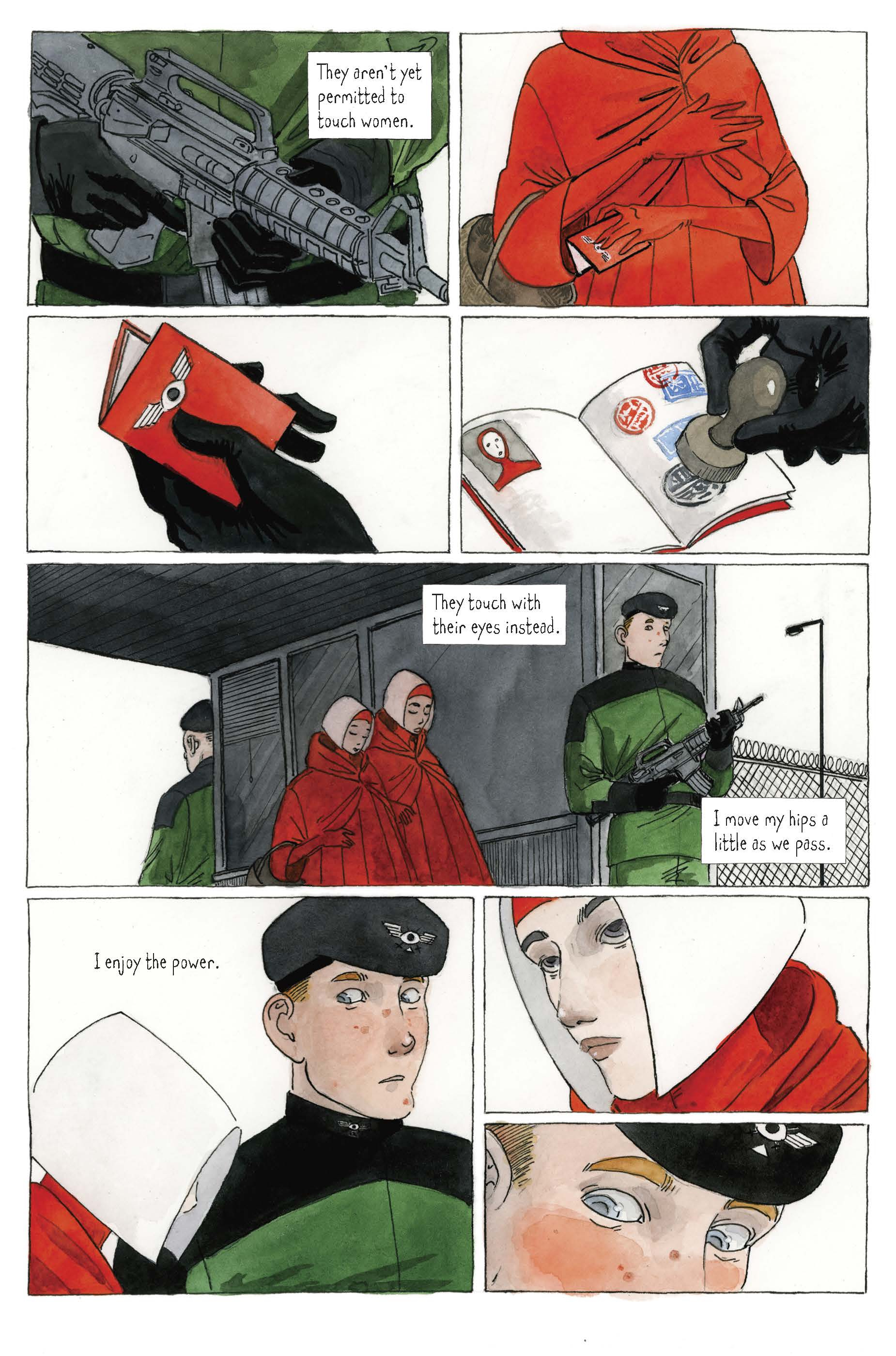
Language does not suffer, however, since Nault’s use of language includes a judicious series of decisions about when to be sparse and when to swim in Atwood’s language. As well, the graphic adaptation allows a diversity of fonts and word placement, notably in the Scrabble scene, that amplifies the power of language.
This graphic adaptation adds diversity of narrative pace and framing through Nault’s choices about page layouts, even, at time, conforming to fairly standard comic book panels:
One of the earliest versions of a first-year writing seminar I taught was grounded in works that are in multiple forms of adaptation, such as a novel to a film (from Do Androids Dream of Electric Sheep? to Blade Runner, for example). Often we examined the fidelity of the adaptation—the novel and film of World War Z come to mind—but we also tried to work toward evaluating adaptations on their own merits, not just “Is this a good adaptation in terms of remaining true to the original?”
My strongest quibble of the graphic adaption is that the Historical Notes section feels far too clipped, but in many ways, in the novel, it serves to reinforce much of the language and academic elements of the story. Noting this small weakness also highlights that the graphic novel tends to lose the humor, albeit very dark, weaved throughout by Atwood.
Ultimately, as a reader and a teacher, I think this graphic adaptation soars as a work on its own and as an introduction or companion to Atwood’s original work. Reading or teaching these works separately or together still leads to the final and haunting line: “Are there any questions?”
Thirty-plus years since Atwood raised this ominous question, we are finding ever-new and disturbing ways to shake our heads and wrestle with hard questions and maybe some answers that help us overcome our current nightmares depicted off kilter by speculative fiction, text-only or graphic, and avoid some Other World that feels just over the horizon.
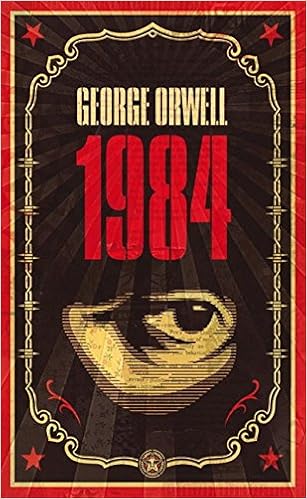
The yin and yang of dystopian speculative/science fiction, George Orwell’s dark 1984 and Aldous Huxley’s light Brave New World, share a common motif about the consequences of both any contemporary and future human cultures: Love is so dangerous to power that power always seeks ways to eradicate love.
In Orwell’s other world, fascism simply bans love, and for Winston and Julia, their love is an act of rebellion. Huxley’s brilliant alternative is incredibly disturbing in its prescience since love is sacrificed on the alter of distraction—monogamy is taboo and recreational promiscuity is the norm along with the ever-present soma.
As a result, Orwell’s warning feels speculative, and Huxley’s reads chilling because we can more easily see his fiction in our recent history (the sexual revolution of the 1960s) and in every single “right now” we encounter.
In 2018, citizens of the U.S. are nearly eternally distracted—the sexless and loveless virtual other world of our devices—mired as we are in our consumerism and the Social Darwinism of capitalism.
While I was thinking directly about Orwell’s 1984 when I wrote “fascism”—”fascism always comes for love/fascists know that lovers always win every battle”—and the risk taken by Winston and Julia “in quest of rendezvous or tobetogether,” I am more compelled by Huxley Brave New World—not as some dire warning about a possible future, but a very powerful analysis of what we face today.
As Margaret Atwood argues in her Introduction to Brave New World:
Surely it’s time to look again at Brave New World and to examine its arguments for and against the totally planned society it describes, in which ‘everybody is happy now’. What sort of happiness is on offer, and what is the price we might pay to achieve it?
I am drawn to Atwood’s word choice, “pay,” and it is there I ask, Wherefore capitalism?
I am struggling with a sub-question to that as well: Did humans create capitalism or has capitalism created a brave new world, a new inhumane humanity, one perilously close to having our most precious gift next to life, love, erased?
Has the Western world (a code for “America”) so pervaded the entire world that no place remains unscathed from this consumerism/capitalism that consumes us?
In 1891, Oscar Wilde protested: “It is immoral to use private property in order to alleviate the horrible evils that result from the institution of private property. It is both immoral and unfair.”
And Wilde concluded about the materialism of capitalism: “But their remedies do not cure the disease: they merely prolong it. Indeed, their remedies are part of the disease.”
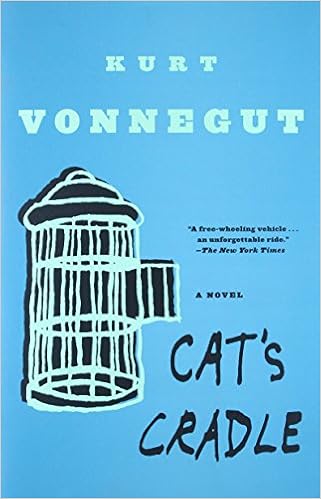
So it is another work of speculative/science fiction, a label rejected by the author, that speaks directly to the corrosive power of capitalism as the enemy of love, Kurt Vonnegut’s Cat’s Cradle. A brilliant satire of religion and politics, the novel includes a scene in which John fails to understand that Mona, the woman he claims to love, “adored her promiscuity”; in Vonnegut’s faux-religion, Bokononism, promiscuity is the full embracing of love, unlike promiscuity as a distraction from love in Huxley.
And they argue:
“As your husband, I’ll want all your love for myself.”
She stared at me with widening eyes. “A sin-wat!”
“What was that?”
“A sin-wat!” she cried. “A man who wants all of somebody’s love. That’s very bad.”
…”Bokonon tells us it is very wrong not to love everyone exactly the same. What does your religion say?”
Resting beneath this exchange are the central tenets of Christianity expressed by Jesus as two simple commandments: Love God and love your neighbor as yourself.
Resting beneath this exchange is the implicit message that the Western world worships capitalism and consumerism, that Westerners who claim to be Christians do so only in word, not action.
John can express his claim of love for Mona only in his ownership of Mona, a commodification of affection as if love is a finite thing to be obtained.
As we “scuttl[e] across the floors of silent seas” toward Valentine’s Day, then, we cannot ignore the distractions before us as good consumers and very marginal lovers—as disconnected from all sorts of unconditional love, familial and romantic, as the well-conditioned cast in Huxley’s Brave New World.
I was first introduced to the idea that god did not create humans, but humans created god through reading Karl Marx as a naive college student, a redneck who made mostly As.
I am compelled now many decades later to lament that humans may have created capitalism, but capitalism has created a not-so-brave new humanity. And in the process, while we have been distracted by fear-mongering about fascism, capitalism did its job.
Hindsight gives those of us with writerly instincts the fodder of a script—as if everything is packaged with intent that falls together like a play or a film with a twist.
It was nearly impossible for me to avoid falling in love with science fiction—first, the blended SF/horror films of the first half of the twentieth century, and then, SF novels, often prompted by films—because of my mother’s influence.
That boyhood romance with a genre blurred into my teenage addiction to comic books, Marvel superheroes; I was mostly unaware that this fascination branched into reading, drawing, and the most powerful heroine of all, collecting.
And then by college, I found myself often sitting alone for hours, in the library or my dorm room, reading existential philosophy.
To me now, approaching 60, that all makes perfect sense, although it likely doesn’t to many others.
Insecurity and low self-esteem mixed generously with searing anxiety—this was my cocktail for a frantic pursuit of who I was since mostly I felt an acute awareness that I was unlike most people, most humans.
Crawling out of the heaping ignorance that was my upbringing, simply the facts of my culture and home norms, I consumed SF, comic books, and then philosophy uncritically. In some ways, this allowed me to fall in love without the pressure of acknowledging all the problems I would come to recognize in these seemingly unrelated texts that shaped me.
Let me work backwards.
Existentialism immediately resonated with me; again, in my ignorance, in my true state of being unlike most humans, I never read existential philosophy as some negative or dark portrayal of the human condition.
In fact, existential explanations for the human condition were a tremendous relief since they echoed how I mostly viewed the world (although in a much cruder way).
To feel passion is to suffer; and thus, to seek a life without suffering is to seek a life without passion. As Sartre dramatized, then, hell is other people.
To love deeply is necessarily to hurt deeply, and this math of being fully human, for me, reinforced my commitment to seek passion and love, to resist the urge to avoid suffering (since it is unavoidable).
Sartre’s No Exit as well as Camus’s “The Myth of Sisyphus” and The Stranger remains powerful texts for what being human means to me.
SF and comic books, I realize now, prepared me for this as they both had been salve for my own struggles with questions about the human condition.
It seems fitting, then, that one of the seminal SF loves of my life was Blade Runner (1982). I was 21, and still naive enough to fall in love with its SF brilliance while not yet critical enough to recognize that, like most SF and comic books (and pop culture or literature), the film presented some real problems about whether or not the work reflected or endorsed sexism, racism, and other regrettable norms of the modern human condition.
I saw Blade Runner in the theater, alone and during the day. Nearly everyone else who attended left during the film, but I sat entranced. I have watched it dozens of times since.
And now, finally, I just viewed Blade Runner 2049, a much delayed sequel.
Both films remain grounded in the ideas of Philip K. Dick without remaining strictly true to Dick’s characters and plot found in Do Android’s Dream of Electric Sheep?
The two basic topics which fascinate me are “What is reality?” and “What constitutes the authentic human being?” Over the twenty-seven years in which I have published novels and stories I have investigated these two interrelated topics over and over again.
Like the original, Blade Runner 2049 depends a great deal on atmosphere, which may allow the casual viewer to ignore some real problems, or at least questions that need to be answered.
“Blade Runner 2049 has a women problem,” cried the internet this weekend, as the critically praised sci-fi sequel hit cinemas. Tweets and blogs cited the fact that female characters were treated as sex objects, and that the narrative was almost entirely driven by men, including Ryan Gosling’s replicant-hunter K and his predecessor Rick Deckard (Harrison Ford). Outrage quickly spread, including from those who had not yet seen the film.
Smith later concedes that the film at the very least presents a mixed message:
And, indeed, there are a number of [female] characters. Robin Wright is terrific but underused as K’s slick, strong, black-clad boss, Lieutenant Joshi, and Sylvia Hoeks’s icy baddie Luv is great fun, but in thrall to her male boss (sinister replicant-creator Wallace, played by Jared Leto). Mackenzie Davis’s Mariette shows initial promise as a strong character who can give as good as she gets, but she is also a sex worker who is literally used as a puppet. Visually, sexualised images of women dominate the stunning futuristic cityscapes, from pirouetting ballerinas to giant statues of naked women in heels looming over K as he goes on his journey. Of course, one of the themes of Blade Runner 2049 is a world littered with artifice, from replicants to sexbots – but these mainly seem to cater to heterosexual males. A hint of a woman considering a “pleasure model” is brief and unexplored. Meanwhile Wright’s Joshi appears attracted to K, but she is not permitted to use him for her sexual pleasure. Where is her holographic lover, her Joi?
In the original film, Deckard (Harrison Ford) falls in love with a replicant (and may be one himself); and the sequel introduces “K” (Ryan Gossling) with a hologram girlfriend (one who hires a prostitute, Mariette [Mackenzie Davis], so the hologram and “K” can experience “real” sex).
So these works of SF use android women to make a commentary about idealizing and objectifying women? Or are these works themselves idealizing and objectifying women?
Evidence for the former may be that two women utter directly some of the essential Dick themes of the film:
Freysa: Dying for the right cause. It’s the most human thing we can do.
Blade Runner 2049 continues the debate about what counts as real and what makes humans human. The sequel includes the rise of replicants, fighting against their slavery in a quest to be “[m]ore human than humans,” and teases out the possibility of androids reproducing.
I recognize this time around the problems with the sequel, ones that occur in the original, but I will come back to this film again and again. I must find a way to resolve for myself why I flinched when “K”‘s hologram girlfriend is destroyed—although I suspect we all want love, and see in those who have it a thing to be treasured.
But this film, and all its existential meanderings, comes as I myself am struggling with an existential itch, trying to reassemble a puzzle that I once held dear, a puzzle scattered and I feared permanently ruined.
After about 13 months of self-exile from one of my passions, road cycling, I am now able to stand back and realize the loss that comes with trying to find ways to avoid suffering.
In the last week, I have ventured back onto the road with my cycling friends. Despite the rides being relatively brief (a couple hours each) and typical winter casual rides, I felt the same elation I may have allowed myself to ignore after thirty-plus years riding, may have been unable to recall after the accident that shook me into admitting I was done with road cycling.
Certainly, life provides no guarantees, and we can seek a life as free of unnecessary suffering as possible; we should be making that true for others (and here Blade Runner 2049 does makes a case for how unnecessarily awful the world is for children and women).
Deckard tells “K,” “Sometimes to love someone, you got to be a stranger,” a confession or justification for never seeing his child with Rachael, his replicant lover.
Later when Deckard is being used to find that child, Niander Wallace offers a key point about Deckard’s quest to avoid his own suffering and the suffering of those he loved: “It was very clever to keep yourself empty of information, and all it cost you was everything.”
To live is to risk everything. To avoid risk is to avoid life. And love.
Maybe few things are more fully human than our need to be reminded of this over and over as long as we are fortunate enough to have the options.
educator, public scholar, poet&writer – academic freedom isn't free










 dr. p.l. (paul) thomas