Although the “science of reading” (SOR) is now essentially the law of the land in the US—nearly every state has passed some form of reading legislation grounded in SOR—the Education Writers Association (EWA) has decided to double down on the media misinformation campaign about reading: Covering How Students Learn to Read: Tips to Get Started.
Not surprisingly, this brief overview for journalists relies heavily on the work of Emily Hanford (whose career was significantly boosted by EWA’s support for her relentless coverage of SOR) and repeats a number of claims in the SOR movement that have been discredited by scholars of literacy (see below).
The SOR education reform movement, however, is yet another neoliberal reform movement grounded in the “bad teacher” narrative (see the second excerpt below).
Education reform since the 1980s is mostly about creating churn and crisis for the benefit of media (sensational stories attract an audience for floundering outlets such as APM), the education marketplace (out with the old and in with the new—the same entities make money off Heinemann and the “new” structured literacy programs), and political grandstanding (despite none of the education reforms ever working).
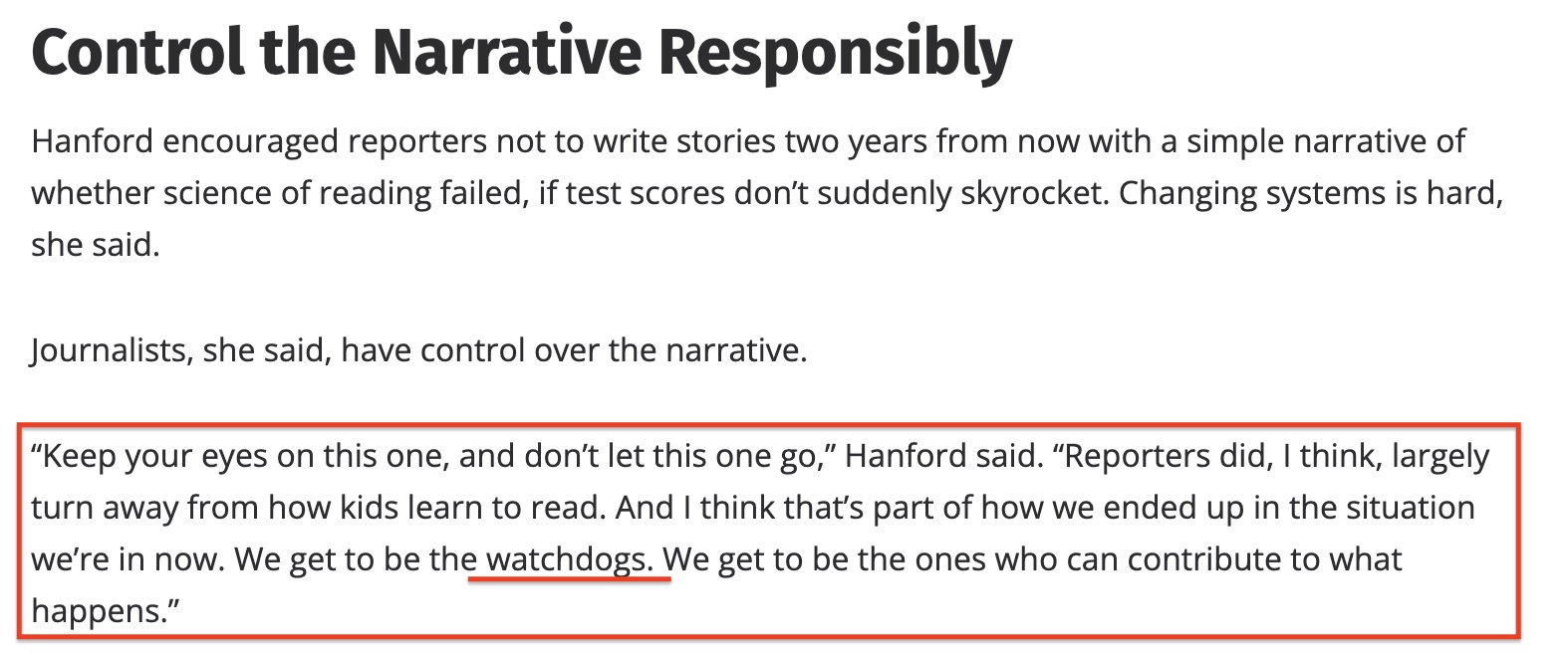
Let me draw your attention to two passages from EWA and then offer a reader that dismantles the false stories and offers the full picture of what we know (and don’t know) about teaching reading):
The research on reading is not in fact settled (see here) and this last passage exposes the fundamentally negative attitude (“watchdogs”) about teachers at the core of the SOR movement and its public and political appeal.
The media has been and seems determined to be irresponsible with their reporting about reading, students, and teachers.
For the full and complicated story, here are alternative texts:
Thomas, P.L. (2022). The Science of Reading movement: The never-ending debate and the need for a different approach to reading instruction. Boulder, CO: National Education Policy Center. http://nepc.colorado.edu/publication/science-of-reading
ILEC Vision: To promote literacy learning practices that enable all children and youth to realize their full potential as literate, thinking human beings.
The report asserts: “Minnesota is in dire need of comprehensive literacy reform,” raising reading crisis claims from the “science of reading” (SOR) movement. Framing reading achievement as “alarming,” the report offers an ambitious body of data related to reading programs in the state, correlations of reading achievement and curricula, assessments used for screening and monitoring, and interventions implemented.
This report on Minnesota provides a needed model for understanding reading instruction and achievement in all states, but is seriously compromised by bias related to an uncritical acceptance of SOR stories. Claims made fail standards for “scientific,” and the report relies on media stories and surveys, and selected evidence while making a narrow case for “scientific” reading preparation and instruction.
Positive Aspects of the Report:
Data gathered on key aspects of reading instruction should be a model for all states.
The report highlights the significant inequity challenges represented by reading achievement data.
ILEC Concerns:
The report makes sweeping inaccurate claims using “crisis” rhetoric and repeating stories from the SOR movement not supported by research, specifically misrepresenting reading programs and instructional practices (such as three cueing)[1] as ineffective or not supported by SOR.
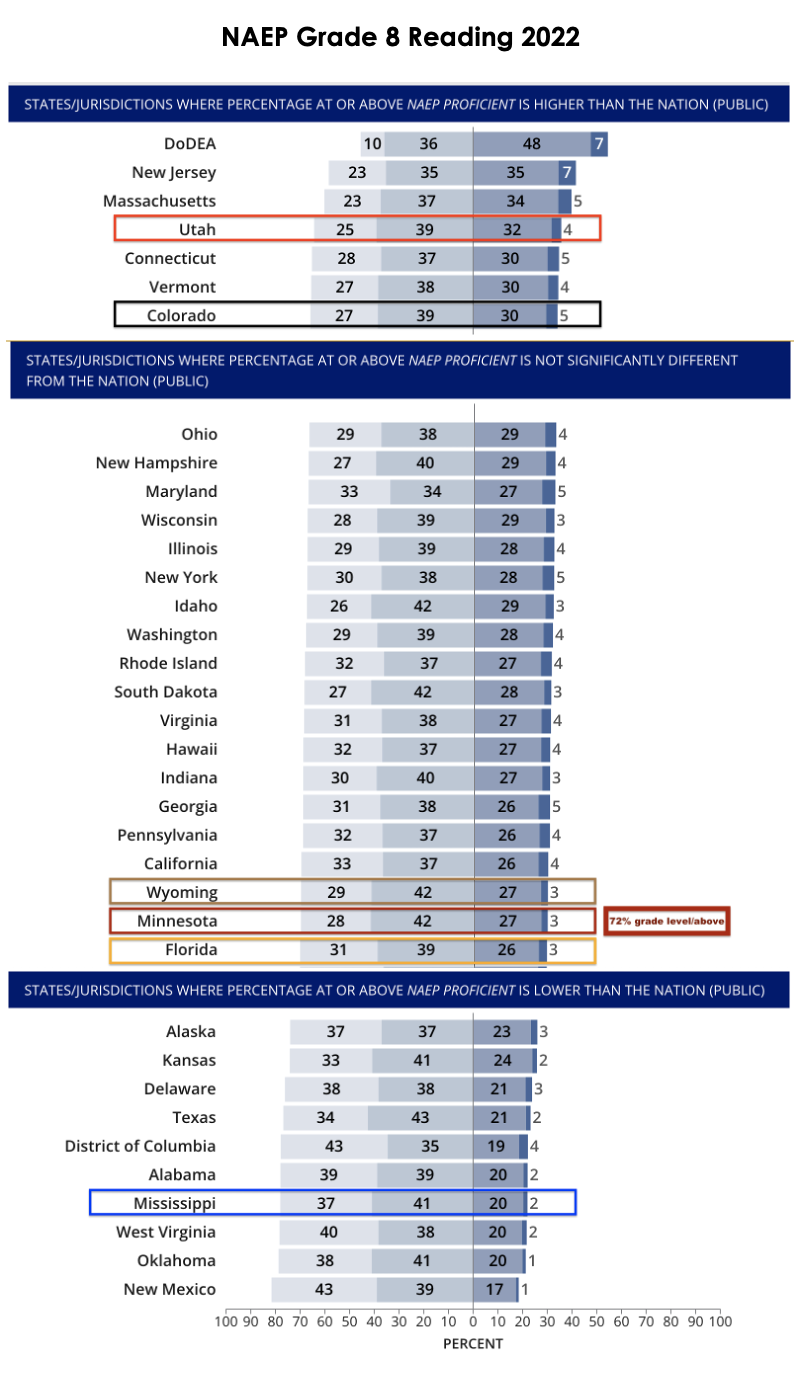
The report notes MN’s stellar ACT scores and ignores that MN’s grade 8 NAEP reading scores (72% at/above grade level) are above Mississippi and comparable to FL, CO, UT, and WY while perpetuating SOR “miracle” myths. [See NAEP data below]
Evidence in the report cites non-scientific sources (media) and cherry-picked research while making claims of a settled body of reading science that is never cited fully.[2]
Analyses throughout the report treat correlation as causation, and thus, the analysis distorts the ambitious gathering of data through ideological claims.
The report relies on outdated evidence (NRP) and endorses programs not supported by research (LETRS), for example, and thus does not practice the same standards the report expects of state reading policy decisions.
Recommendations in the report are recycled approaches states have attempted for four decades without success, specifically calling for identifying effective reading programs and focusing on in-school-only reforms.
ILEC Vision: To promote literacy learning practices that enable all children and youth to realize their full potential as literate, thinking human beings.
ILEC Response: Mainstream media coverage of reading proficiency, teachers of reading, NAEP scores, and teacher preparation
Mainstream media such as Education Week, the New York Times[1], APM, and Forbes persist in recycling a compelling but misleading story about reading proficiency, teachers of reading, NAEP scores, and teacher preparation that is not supported by the full body of evidence. As Aukerman explains:
From how much of the media tells it, a war rages in the field of early literacy instruction. The story is frequently some version of a conflict narrative relying on the following problematic suppositions:
a) science has proved that there is just one way of teaching reading effectively to all kids – using a systematic, highly structured approach to teaching phonics;
b) most teachers rely instead on an approach called balanced literacy, spurred on by shoddy teacher education programs;
c) therefore, teachers incorporate very little phonics and encourage kids to guess at words;
d) balanced literacy and teacher education are thus at fault for large numbers of children not learning to read well.[2]
In fact, Reinking, Hruby, and Risko concluded, “there is no indisputable evidence of a national crisis in reading, and even if there were a crisis, there is no evidence that the amount of phonics in classrooms is necessarily the cause or the solution.”
ILEC Concerns:
Hoffman, Hikida, and Sailors note that “the SOR community do[es] not employ the same standards for scientific research that they claimed as the basis for their critiques.” While individual stories of parents and students are compelling, anecdotes are not scientific and do not provide valid evidence for generalizations about reading proficiency or reading instruction.
Longitudinal and recent NAEP scores on reading are misrepresented by mainstream media. “Proficiency” on NAEP is well above grade level, and “basic” is a closer measure of grade level (Loveless, 2023; Loveless, 2016).
Any claim of “crisis” or “miracle” in education is misleading. Specifically, the Mississippi “miracle” does not have scientific evidence to show NAEP increases are caused by instructional reform, but appear linked (as with Florida) to punitive uses of grade retention that disproportionately impact minoritized students.[3]
Mainstream media misrepresents teacher education, reading programs, reading instructional practices, brain research, and the complex body of reading research to promote a compelling story that is melodramatic and anecdotal.
Citing NCTQ, NRP, and surveys fails to meet the level of “scientific” that SOR advocacy requires of teachers.
Fall sessions of a new school year have begun or are soon beginning across the US.
Just as predictable as a new academic year, the media maintains its constant negative drumbeat about schools, education, students, and teachers. Below is a reader of some of the issues and coverage of education, including the rise in censorship and curriculum bans as well as the tired arguments about a reading crisis.
Notable is Susan Ohanians piece about the NYT, but this reader includes both samples of really bad journalism and excellent coverage of key education issues:
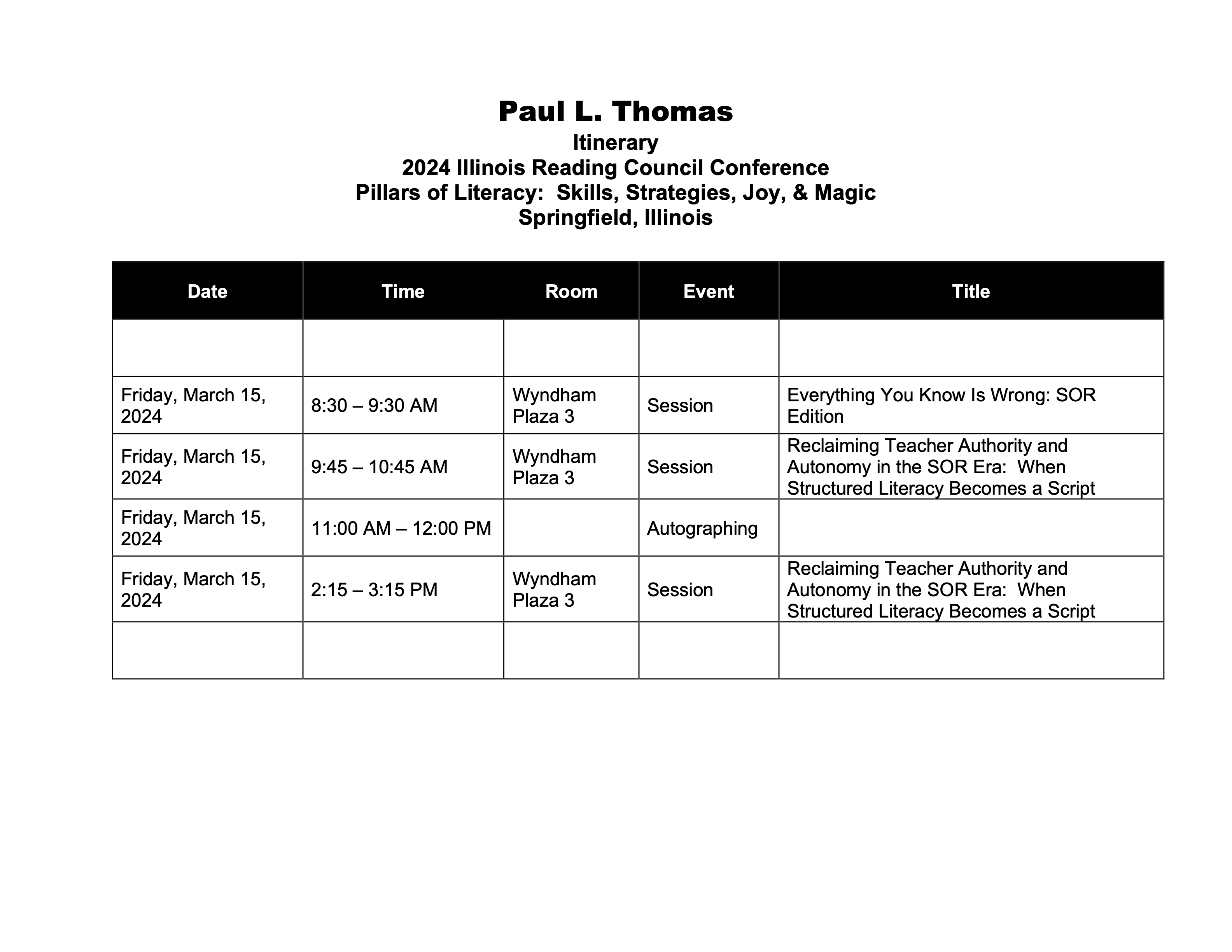
Below I will keep an updated listing of presentations and other public work for Fall 2023 through Spring 2024.
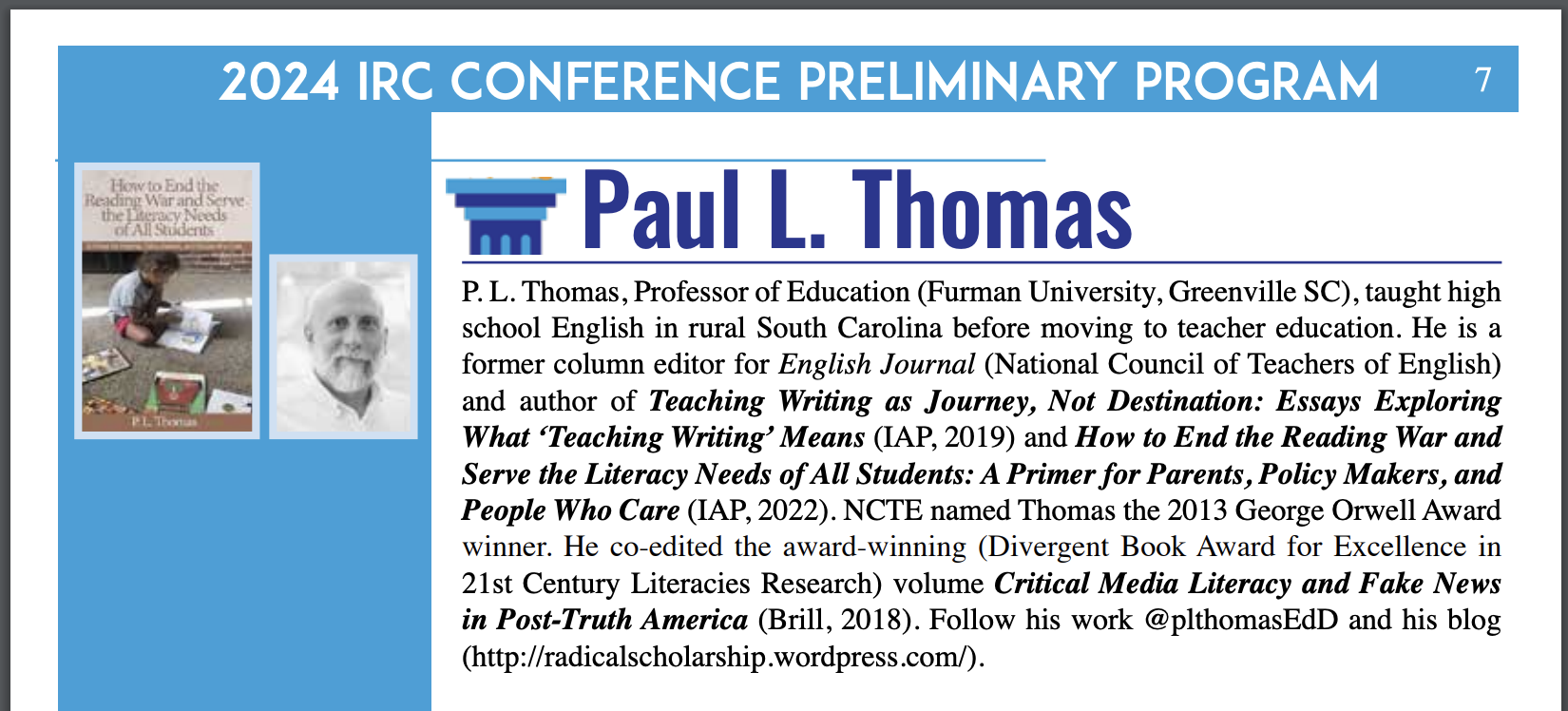
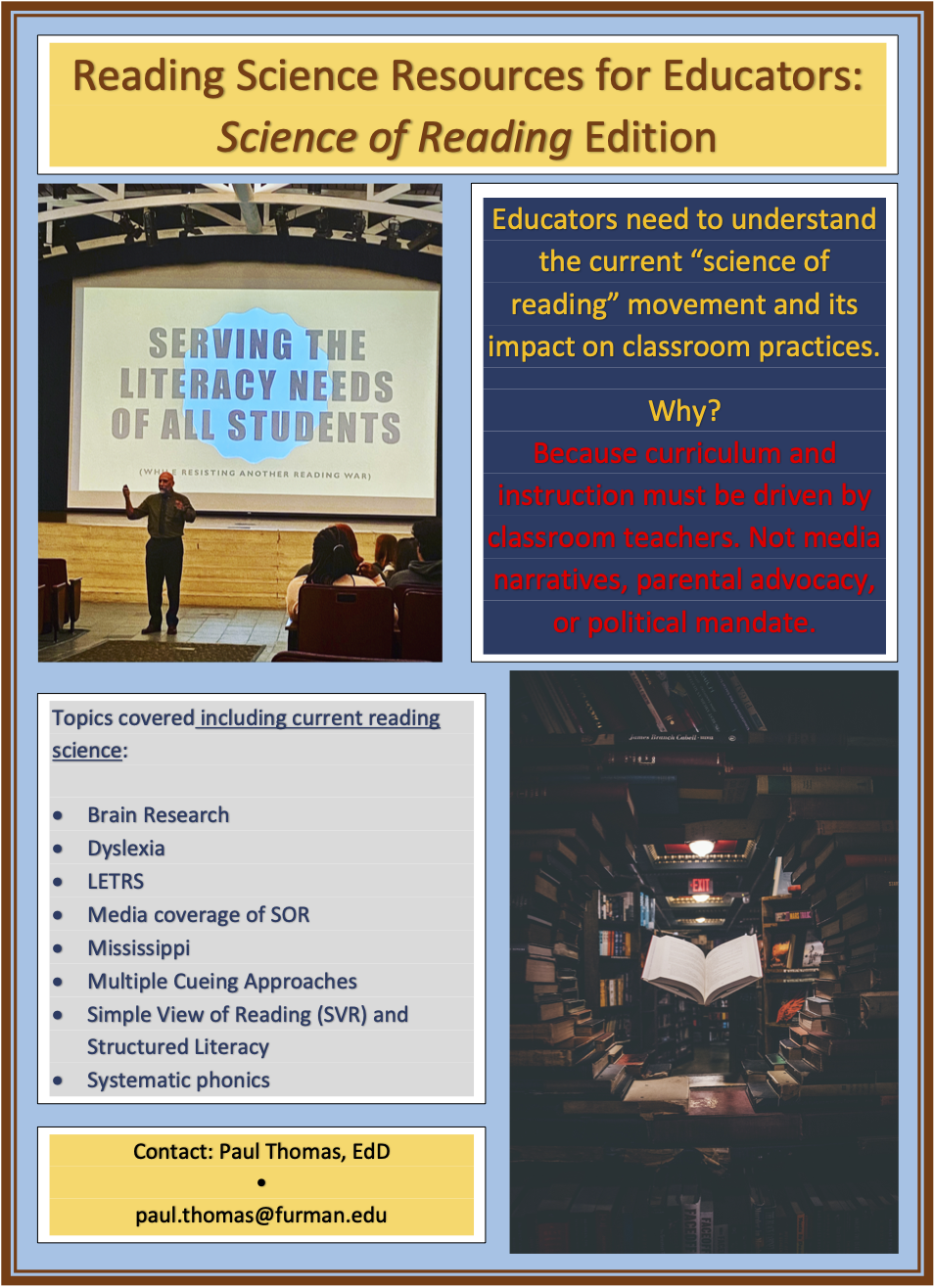
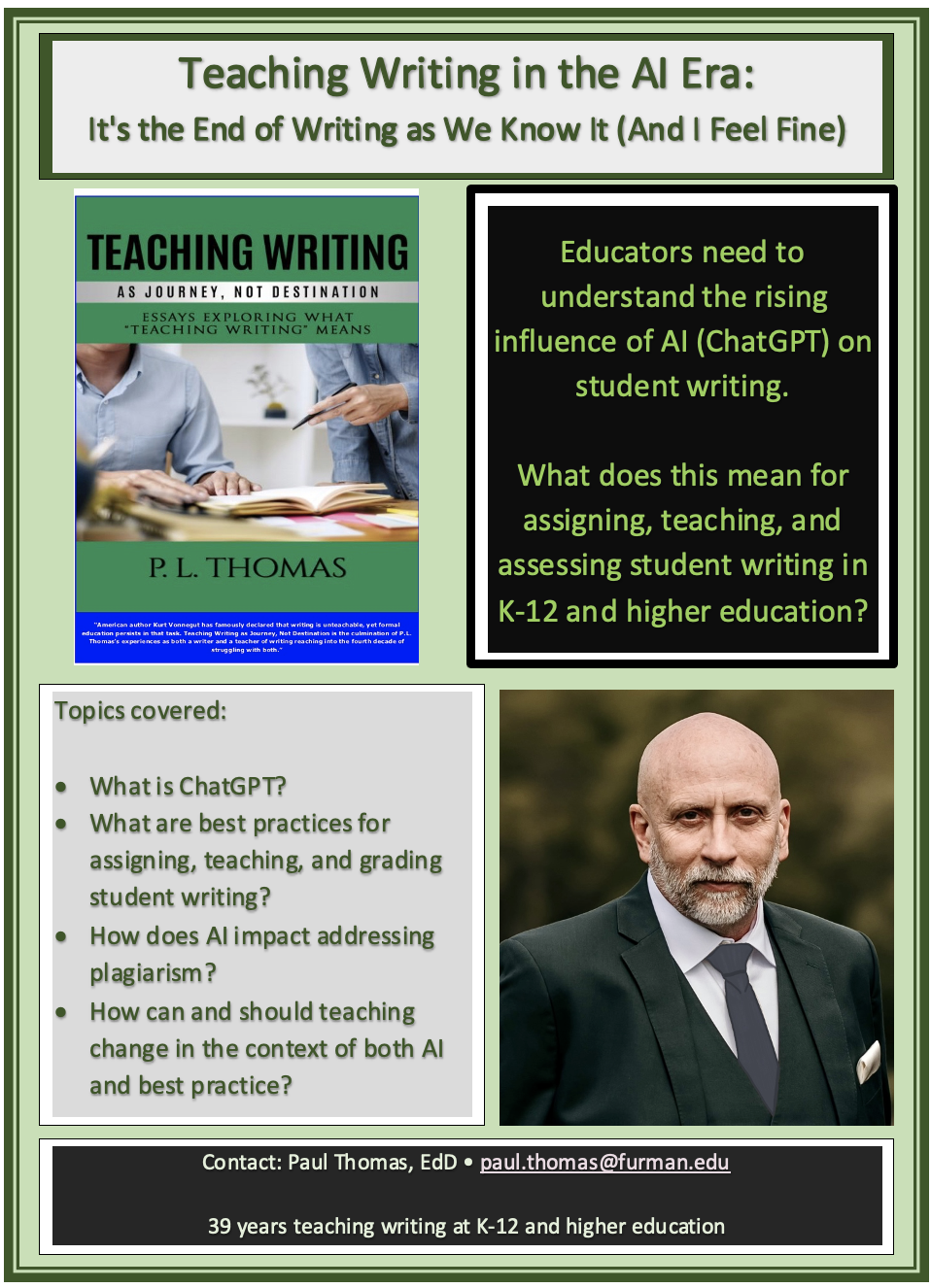
I am available for webinars, podcasts, presentations, white papers, blog posts, etc., on a number of education and literacy topics (browse my blog posts for topics):
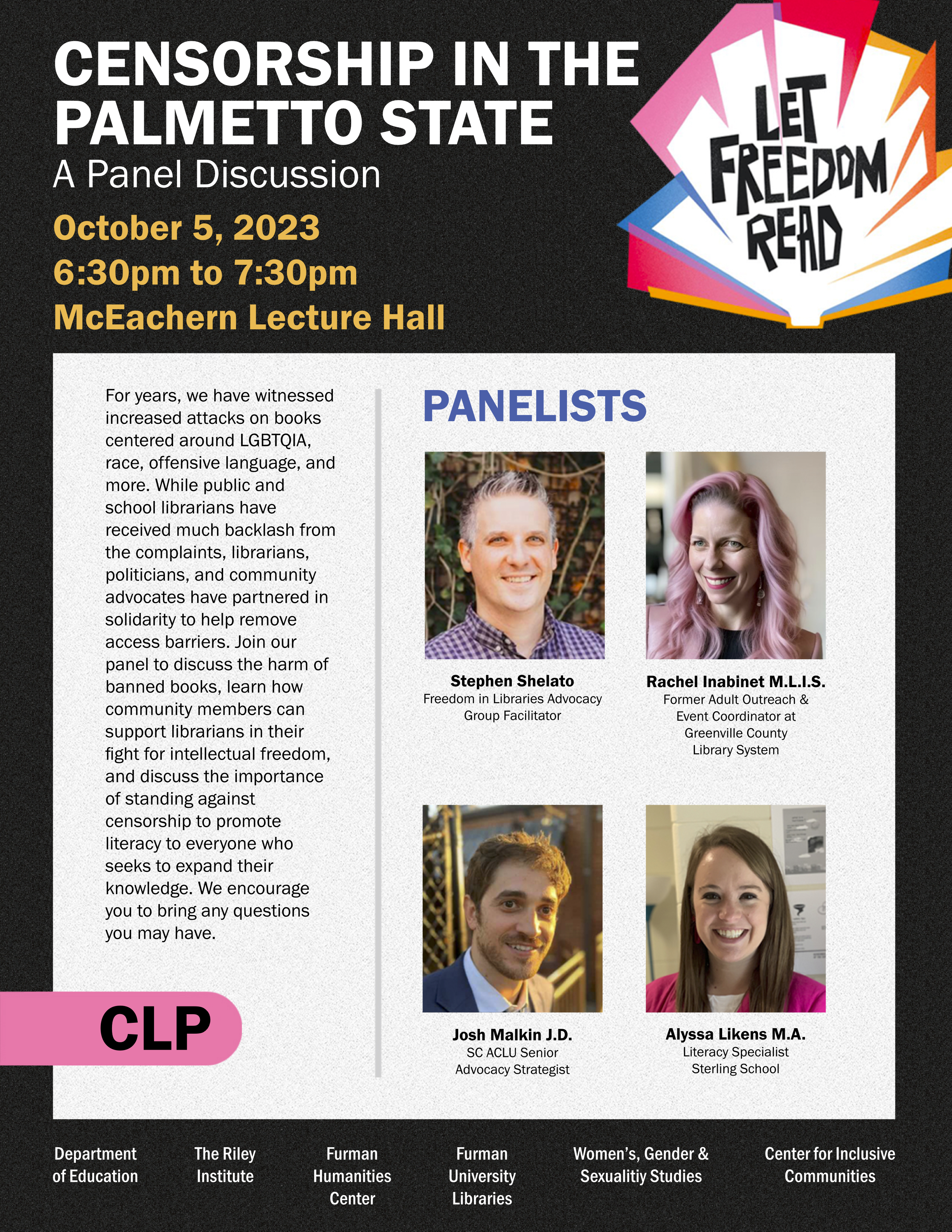
Title: Censorship in the Palmetto State: A Panel Discussion
Date: October 5
Time: 6:30 PM
Location: McEachern Lecture Hall – Furman Hall 214
Description: For years, we have witnessed increased attacks on books centered around LGBTQIA, race, offensive language, and more. While public and school librarians have received much backlash from the complaints, librarians, politicians, and community advocates have partnered in solidarity to help remove access barriers. Join our panel to discuss the harm of banned books, learn how community members can support librarians in their fight for intellectual freedom, and discuss the importance of standing against censorship to promote literacy to everyone who seeks to expand their knowledge. We encourage you to bring any questions you may have.
Title: Libraries are Worthwhile: Why We Need Them and How We Will Keep Them
Date: October 10
Time: 7:00 PM
Location: Hartness Pavilion
Description: Emily Drabinski, interim chief librarian at The Graduate Center, City University of New York and the 2023-2024 president of the American Library Association (ALA) will give a talk on the importance of libraries and librarians and how we can protect them in the face of ongoing censorship attempts.
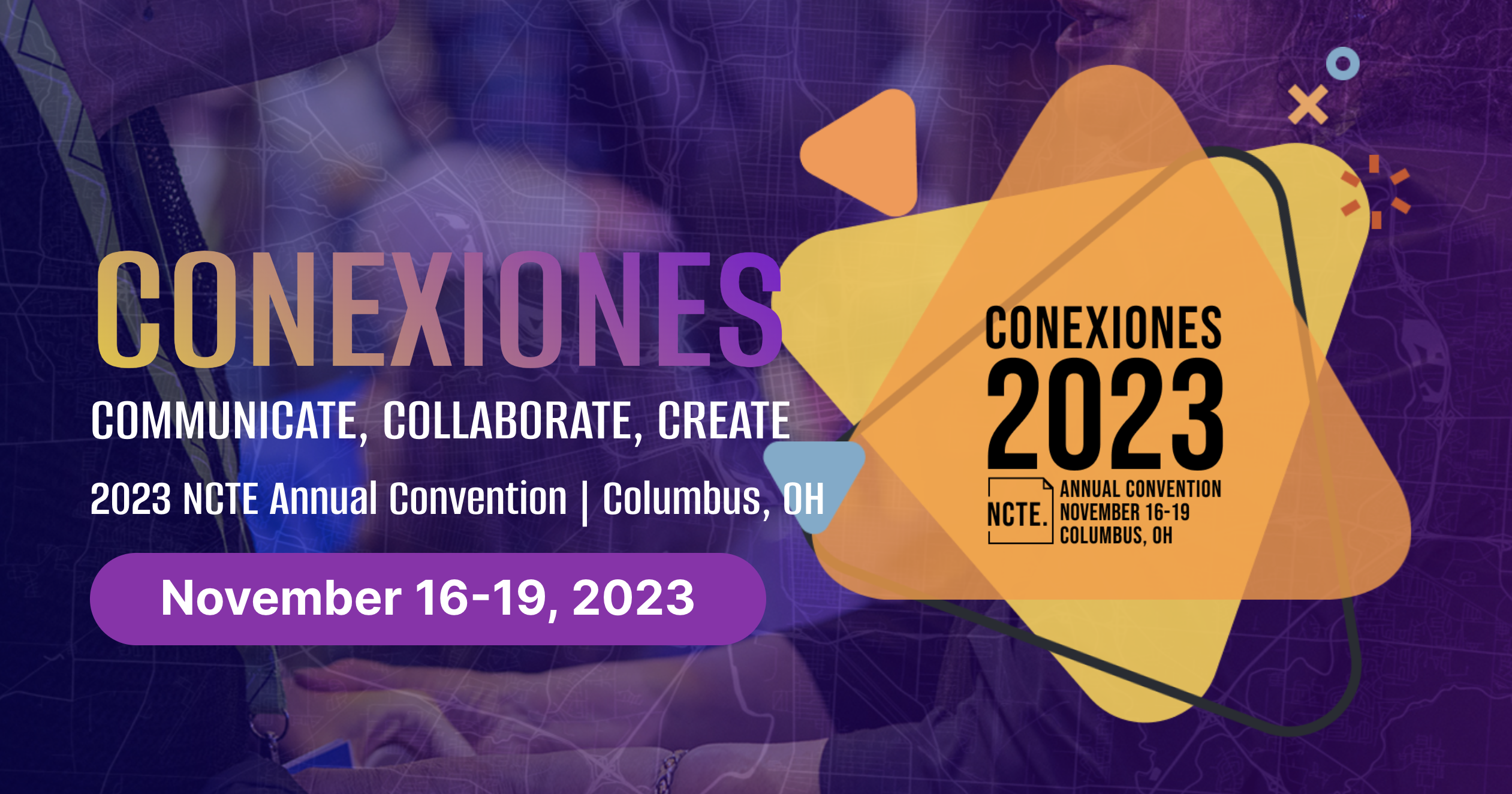
Keep on Reading for a Free World: Reconnecting through Literacy and Literature (Roundtable) – 11/17/2023 12:30 – 1:45; Aminah Robinson Grand Ballroom B [Reading Wars and Censorship: A Long and Shared History click for PDF]
Over the last decade, states have passed new or revised reading legislation, often grounded in the “science of reading” (SOR) movement. The SOR movement has perpetuated many oversimplified and misleading stories that portray teachers negatively. This featured session will prioritize teacher autonomy by exploring the following topics: reading crisis, NAEP reading data, reading programs, teacher training and LETRS, dyslexia, and the complicated full body of reading research.
The “science of reading” (SOR) movement has shifted from media stories to state legislation and instructional policy. This workshop invites teachers to critically examine media claims about reading, teachers of reading, and teacher educators against the full body of reading science. The topics will include history of reading crises, the simple view of reading, NAEP, the Mississippi “miracle,” balanced literacy and reading programs, dyslexia, three cueing, brain science, and an overview of reading science.
2024 COE Winter Education Forum
6:30 – 8:00 EST
Buyer Beware: Avoiding the Unintended (But Predictable) Consequences of SOR Legislation [access PDF here]
The “science of reading” movement has perpetuated several compelling and highly influential stories about reading; however, much of those claims are misleading or even completely false. This session will examine some of those stories and claims in the context of the full body of evidence. Topics include NAEP reading data, grade retention, the Mississippi “miracle,” phonics research, dyslexia, teacher education (NCTQ), multiple cueing, and reading programs and theories (balanced literacy).
Reclaiming Teacher Authority and Autonomy in the SOR Era: When Structured Literacy Becomes a Script
Increasingly since 2013, states have adopted reading legislation identified as the “science of reading.” Since curriculum and instruction should be driven by classroom teachers, not media narratives, parental advocacy, or political mandate, this session examines key reading topics framed with current research to support teacher authority and autonomy.
ILEC Vision: To promote literacy learning practices that enable all children and youth to realize their full potential as literate, thinking human beings.
ILEC Response: Reading Reform Across America (The Albert Shanker Institute, July 2023), Susan Neuman, Esther Quintero, and Kayla Reist
The report asserts, “Our goal is to provide a basic yet systematic description of states’ efforts to improve reading instruction.” And is grounded in the following:
Furthermore, legislative efforts have at times been criticized widely, but our analysis reveals significant variation among states, rendering blanket characterizations unhelpful….Whether we see the current state of American students’ reading achievement as a new crisis or as part of a stable trend, the truth remains that more than one-third (37 percent) of the nation’s fourth-graders performed below the National Assessment of Educational Progress (NAEP) “Basic” level in 2022. Because there is no achievement-level description for below “Basic,” it is difficult to make full sense of this statistic. (p. 1)
While the report is ambitious, the increase in reading legislation is framed as a positive reform effort motivated by “answering teachers’ calls for better support with regard to reading.” This positive spin ignores the media, market, and political influences on another reading war and avoids confronting how many states are passing legislation that mandates and bans reading practices based on advocacy and not the full body of reading science.[1]
Positive Aspects of the Report:
The report makes a strong case for reading achievement being significantly inequitable among marginalized groups of students.
The report acknowledges the concerns raised about grade retention policy.
ILEC Concerns:
State reading legislation is not a response to teachers, but to an orchestrated political reform movement grounded in misinformation about reading achievement, teacher expertise, and teacher education.
The report fails to fully engage with patterns of extreme measures in several states’ legislation that bans three cueing, reading programs, balanced literacy, etc., as well as legislation that mandates universal dyslexia screening, structured literacy programs, etc.—both of which are based on advocacy and not the full body of research.
The report does not address the contradiction of calling for scientific practice while mandating and funding programs and practices not fully supported by research; for example, mandating LETRS training for all teachers of reading.
Posing the current reading legislation movement as positive is idealistic bordering on irresponsible.
The report concedes “legislative efforts have at times been criticized widely,” but chooses to applaud the “science of reading” (SOR) movement without considering the considerable scholarly criticism raising cautions about claims of a reading crisis and mandates in that legislation.
While the report lacks critical grounding, it also offers a couple key points to consider. First:
There are no quick fixes: The path to improvement will require time, consistent investment and a holistic approach to reform. The magnitude of the task should motivate us to persevere and collaborate more effectively. Yet, we are concerned about the polarizing rhetoric surrounding reading and hope that this review can foster a more measured dialogue about the strengths and limitations of state efforts and reading improvement more broadly.
The emphasis on avoiding one-size-fits all solutions is important and supported by many critics of the SOR movement. And certainly the “polarizing rhetoric” of the SOR debate is harmful; yet, this report’s positive spin on harmful legislation is certain to trigger, not ameliorate that caustic debate.
Valid criticism isn’t any more “polarizing” than idealistic endorsements.
Next, and more importantly for this post:
Whether we see the current state of American students’ reading achievement as a new crisis or as part of a stable trend, the truth remains that more than one-third (37 percent) of the nation’s fourth-graders performed below the National Assessment of Educational Progress (NAEP) “Basic” level in 2022. Because there is no achievement-level description for below “Basic,” it is difficult to make full sense of this statistic.
Here is the central problem with the SOR movement as well as nine decades of reading wars: The truth is that we know very little empirically about reading proficiency in the US because we have no stable or unified metric or assessment to understand what proficiency is or how well students are developing as readers.
There simply has never been a single day in the US since at least the 1940s that the media, public, and political leaders have declared reading proficiency adequate.
What does it mean to have been in a continual reading crisis in the US for almost a century and yet the country has experienced no major or catastrophic decline?
What does it mean to have been in a continual reading crisis in the US for almost a century because we claim reading is essential for student and societal success and yet the dooms day messaging never materializes?
That leads us to this: What do we really know about reading proficiency in the US?
As the report notes, one aspect of reading proficiency in the US is quite clear and easy to document with multiple data points: Reading proficiency data expose a significant inequity among marginalized groups of students—notably Black and brown students, students in poverty, multi-lingual learners (whom the report advocates for admirably), and special needs students.
Yet this fact about reading is replicated in all other educational measurements, and thus, is not a unique reality about reading proficiency, suggesting something other than reading legislation (or any educational legislation) is needed in the US.
Also, it seems fair and supported by the evidence that we have to note that reading progress by students (how well any students gains reading proficiency in relationship with their peers) is a strong marker for educational progress in general.
While over-emphasizing reading proficiency at grade 3 is problematic, no one suggests that early reading progress should be ignored. Yet, many states persist in adopting harmful grade 3 retention that has been shown to correlate strongly with negative consequences.
The report does concede about grade retention: “Consequently, there are reasons to be cautious about the policy.”
Beyond these two points, however, claims about reading proficiency are at best speculation and at worst ideological assertions without empirical support.
The latter, regretfully, is the crux of most reading wars for decades.
So here is what we don’t have but urgently need in order to address reading in ways that are supportive of students and teachers and avoids the “polarizing rhetoric” with which the report seems deeply concerned:
A standardized definition of “proficiency” that is age-based and not grade-based.
A comprehensive documentation of reading programs and instructional practices implemented in the US over the last decade.
A set of diverse assessments grounded in a standardized definition of “proficiency.”
Patience and a willingness to admit that human behaviors occur on a spectrum; not all students learn at the same rates.
Reading legislation that neither mandates nor bans practices or policies, but provides a funding framework that supports educators as autonomous professionals.
The polarization in public and political debates about reading is in part driven by all that we do not know and do not have regarding reading proficiency, allowing too many people (some without good intentions) to make melodramatic claims that reinforce political, media, and market interests, not student achievement or teacher/teaching quality.
Ultimately, this current trend in reading legislation is far more dangerous than promising since the decisions being made for teachers and students are not grounded evidence-based claims.
The inequity exposed in data on reading achievement is itself enough to justify that we do something, but continuing to do the same thing over and over while expecting different results is a tremendous political and educational mistake.
We simply do not know what we need to know about reading proficiency, but we do know that reading achievement is not uniquely inequitable; and thus, education reform broadly has failed for decades, and we are far past time to re-evaluate political educational reform.
This report eagerly endorsing more of the same political educational reform; therefore, it fails in its central mission.
Cliches become cliches often because they do capture a truth, and “fish don’t know they are in water” may sound trite, but the saying captures well our five decades of education reform in the US.
Since A Nation at Risk under Ronald Reagan and then reinforced and expanded under George W. Bush (with Rod Paige and Margaret Spelling as Secretaries of Education), education reform in the US has been grounded in neoliberal ideology, the foundational beliefs of Republicans and conservatives.
“Neoliberalism” is a challenging term. First, it is hard to define, and second, the use of the word “liberal” has two contrasting meanings in the US—”liberal” as in “classic liberalism” is “conservative” or politically “right,” yet in common usage “liberal” is typically associate with “progressive” or politically “left.”
However, to simplify, in education reform, we can fairly interchange “neoliberal” with “conservative” and “Republican”—even though, as I want to discuss here, it is incredibly important to understand that neoliberal education reform is embraced and perpetuated by both Republicans and Democrats.
Look at the education reform landscape since the 1980s to understand.
A Nation at Risk established the neoliberal education reform playbook: manufacture an education crisis; declare that students, teachers, and public schools are failing; and mandate accountability policies to “fix” students, teachers, and schools (in-school reform only).
Insiders exposed that Reagan gave marching orders to the committee that created A Nation at Risk; Reagan wanted the US to embrace school choice (neoliberalism is a market ideology) and to “put prayer back in schools” (although voluntary prayer has always been allowed in public education, Reagan and Republicans depended on culture wars).
A key component of neoliberal education reform is the buy-in of the media. Until decades later, after numerous scholars discredited the report as a “manufactured crisis,” the media uncritically declared US education—teachers and students—failures.
And thus we set out on several cycles of the same accountability reform grounded in new standards, new tests, and new political mandates.
Governors scrambled to show they took education seriously, and George W. Bush in Texas turned his role as education reform governor into a launching pad for the White House.
Here is another key element.
Although Bush claimed a Texas “miracle,” again as with A Nation at Risk, after the political success and media as well as public buy-in, scholars showed that the “miracle” was a “mirage” (or better yet, a lie).
None the less, Bush took Paige into his administration and No Child Left Behind (NCLB) was modeled in the Texas “miracle”/”mirage”—and just as Democrats rushed to embraced Reagan’s lie, Democrats joyfully made NCLB one of the most prominent federal bi-partisan accomplishments in recent US history.
Few things show how pervasive neoliberal (Republican/conservative) education reform has become the water to the fish (education) than the Barack Obama/Arne Duncan education era.
Instead of ushering in a progressive or critical response to the Bush education policy, Obama/Duncan doubled down—fueling the draconian value-added method era of teacher evaluation, launching the deceptive and austere education career of Michelle Rhee, and supercharging the charter school movement (a “school-choice lite” movement that fulfills the market beliefs of neoliberalism).
At 40 years since A Nation at Risk, all we have to show for the constant reform in education is a series of claims of “crisis” and a smattering of “miracles”—both of which are always manufactured.
SOR has its roots firmly in NCLB and the National Reading Panel (SOR cites the NRP report as much or more than any other evidence)—the peak of neoliberal education reform.
SOR was also fueled throughout the 2000s by the Florida model, which depends heavily on grade retention and laser-focusing on grade 3 reading.
Around 2013, states began to revisit or reimagine reading legislation, but in 2018, the media supercharged the SOR movement, echoing the “manufactured crisis” approach of A Nation at Risk.
Notably, the “manufactured crisis” of the SOR movement is firmly grounded in NAEP testing; first, the media misrepresents NAEP data, and second, NAEP is purposefully designed (the test is a neoliberal tool) to create the veneer of failure by students, teachers, and schools.
NAEP allows media and political leaders to shout that 2/3 of students are not proficient in reading even though that claim isn’t what most people think.
Therefore, at its core, the SOR movement is another neoliberal education reform movement, a tool of Republican/conservative ideology and politics.
SOR has the student/teacher/school failure rhetoric, the “miracle” that is a “mirage,” the eager and uncritical compliance of the media, and the compelling use of standardized tests data (NAEP). But most importantly to understand how SOR is neoliberal education reform, the policies are repackaging Jeb Bush’s Florida model, emphasizing punitive reading policies such as grade retention.
However just like all the other neoliberal education reform since the 1980s, it will not work because it isn’t designed to work.
We are only 20 years since NCLB/NRP which mandated scientifically based reading instruction, yet there is a reading crisis?
Here is the dirty little secret about neoliberal education reform: It is a distraction for political gain.
Neoliberalism keeps the public’s gaze on individuals (students, teachers) and away from systemic forces; SOR wants people to believe that a couple reading programs are to blame for reading failures instead of poverty and inequity.
And the neoliberal attacks in SOR on people are yet another swipe at progressive and critical educators.
Like fish, many educators cannot see they are willing participants in neoliberal education reform; almost all Democrats cannot see they are willing participants in neoliberal education reform.
Fish don’t know they are in water, but with the SOR movement (and whatever crisis comes next), the better analogy may be lobsters in a slowing boiling pot.
educator, public scholar, poet&writer – academic freedom isn't free














 dr. p.l. (paul) thomas