Category Archives: Science of Reading

How to Navigate Social Media Debates about the “Science of Reading” [UPDATED]

[Download a PDF here.]

[Download PP here.]

Let me start with a caveat: Don’t debate “science of reading” (SoR) advocates on social media.

Ok, so I suspect some of you will enter the fray, and I must caution that you are not going to change the minds of SoR advocates; therefore, if you enter into a social media debate, you must keep your focus on informing others who may read that debate, others who genuinely want a discussion and are looking to be better informed (SoR advocates are not open to debate and do not want an honest discussion).

First, expect to be attacked and swarmed.

Next, keep focused on the claims made by SoR advocates, and you can anticipate those pretty easily (see below). An important way to hold SoR advocates accountable is to point out the contradictions between calling for a narrow view of “science” and then referring to reports that are released with no peer review (not scientific), such as reports released by NCTQ, and also misrepresenting challenged reports, such as the reports from the National Reading Panel (NRP) under George W. Bush.

Finally, I recommend making evidence-based challenges to the two broad claims of SoR advocacy—that the “science of reading” is simple and settled.

Your best approach is to counter with “not simple, not settled.”

Here, then, let me offer the main claims you will likely confront and resources for responding (also see resources linked after the post).


SoR Claim: Dyslexia is under-diagnosed and students with dyslexia need intensive systematic phonics (likely Orton-Gillingham–based approaches).

Counter: Research does not support one way to address or diagnose dyslexia, there isn’t a strong consensus on what constitutes dyslexia (no unifying definition), and research does not support O-G phonics for all dyslexia issues.

As yet, there is no certifiably best method for teaching children who experience reading difficulty (Mathes et al., 2005). For instance, research does not support the common belief that Orton-Gillingham–based approaches are necessary for students classified as dyslexic (Ritchey & Goeke, 2007; Turner, 2008; Vaughn & Linan-Thompson, 2003). Reviews of research focusing solely on decoding interventions have shown either small to moderate or variable effects that rarely persist over
time, and little to no effects on more global reading skills. Rather, students classified as dyslexic have varying strengths and challenges, and teaching them is too complex a task for a scripted, one-size-fits-all program (Coyne et al., 2013; Phillips & Smith, 1997; Simmons, 2015). Optimal instruction calls for teachers’ professional expertise and responsiveness, and for the freedom to act on the basis of that professionalism.

Research Advisory: Dyslexia (ILA, 2016)

See also:

Currently, there is a well-organized and active contingent of concerned parents and educators (and others) who argue that dyslexia is a frequent cause of reading difficulties, affecting approximately 20 percent of the population, and that there is a widely-accepted treatment for such difficulties: an instructional approach relying almost exclusively on intensive phonics instruction. Proponents argue that it is based on “settled science” which they refer to as “the science of reading” (SOR). The approach is based on a narrow view of science, and a restricted range of research, focused on word learning and, more recently, neurobiology, but paying little attention to aspects of literacy like comprehension and writing, or dimensions of classroom learning and teacher preparation. Because the dyslexia and instructional arguments are inextricably linked, in this report, we explore both while adopting a more comprehensive perspective on relevant theory and research.

JOHNSTON, P., & SCANLON, D. (2021). AN EXAMINATION OF DYSLEXIA RESEARCH AND INSTRUCTION WITH POLICY IMPLICATIONS. LITERACY RESEARCH: THEORY, METHOD, AND PRACTICE70(1), 107–128. HTTPS://DOI.ORG/10.1177/23813377211024625

Johnston and Scanlon answer 12 questions and then offer these important policy implications (quoted below):

  1. There is no consistent and widely accepted basis – biological, cognitive, behavioral, or academic – for determining whether an individual experiencing difficulty with developing word reading skill should be classified as dyslexic. (Questions 1 and 10).
  2. Although there are likely heritable and biological dimensions to reading and language difficulties, there is no way to translate them into implications for instructional practice. (Questions 2 and 11).
  3. Good first instruction and early intervention for children with a slow start in the word reading aspect of literacy, reduces the likelihood they will encounter serious difficulty. Thus, early screening with assessments that can inform instruction, is important. Screening for dyslexia, particularly with instructionally irrelevant assessments offers no additional advantage. (Questions 5 and 6).
  4. Research supports instruction that purposely develops children’s ability to analyze speech sounds (phonological/phonemic awareness), and to relate those sounds to patterns of print (phonics and orthographics), in combination with instruction to develop comprehension, vocabulary, fluency, and a strong positive and agentive relationship with literacy. (Questions 7 and 12).
  5. Evidence does not justify the use of a heavy and near-exclusive focus on phonics instruction, either in regular classrooms, or for children experiencing difficulty learning to read (including those classified as dyslexic). (Questions 7, 8 and 12).
  6. Legislation (and district policies) aligned with the SOR perspectives on dyslexia will necessarily require tradeoffs in the allocation of resources for teacher development and among children having literacy learning difficulties. These tradeoffs have the potential to privilege students experiencing some types of literacy learning difficulties while limiting instructional resources for and attention available to students whose literacy difficulties are not due (exclusively) to word reading difficulties. (Question 12).

SoR Claim: SoR advocates rely on a narrow definition of “science,” emphasizing cognitive science and brain research over a broad range of research covering a century in literacy.

Counter: A complex and full understanding of the term “science,” and recognizing evidence on teaching reading must include more than cognitive science and brain research.

Hoffman, J.V., Hikida, M., & Sailors, M. (2020). Contesting Science That Silences: Amplifying Equity, Agency, and Design Research in Literacy Teacher Preparation. Reading Research Quarterly, 55(S1), S255-S266. https://doi.org/10.1002/rrq.353

Abstract:

In this article, we argue that the “science of reading” (SOR) construct is being used to shape the future of literacy teacher preparation and silence the voices and work of literacy teacher education researchers to the detriment of quality science, quality teaching, and quality teacher preparation. First, we briefly inspect the SOR movement in terms of its historical roots in experimental psychology. Next, we examine the claims being made by SOR advocates regarding the absence of attention to the SOR literature in teacher preparation programs, and the related claims for the negative consequences that occur when these so-called underprepared teachers enter the workforce. Then, we present literature reviews, drawn from a large and dynamic database of research on literacy teacher preparation (over 600 empirical studies that were published between 1999 and 2018); the studies in the database have been excluded from the SOR. Finally, we conclude with a discussion of equity, agency, and design as a pathway forward in improving literacy teacher preparation. (p. S255)

Hoffman, J.V., Hikida, M., & Sailors, M. (2020). Contesting Science That Silences: Amplifying Equity, Agency, and Design Research in Literacy Teacher Preparation. Reading Research Quarterly, 55(S1), S255-S266. https://doi.org/10.1002/rrq.353

Note also about the lack of science behind LETRS:

A growing number of U.S. states have funded and encourage and/or require teachers to attend professional development using Moats’s commercial LETRS program, including Alabama, Arkansas, Kansas, Mississippi, Missouri, Oklahoma, Rhode Island, and Texas. This is despite the fact that an Institute of Education Sciences study of the LETRS intervention found almost no effects on teachers or student achievement (Garet et al., 2008). (p. S259)

Hoffman, J.V., Hikida, M., & Sailors, M. (2020). Contesting Science That Silences: Amplifying Equity, Agency, and Design Research in Literacy Teacher Preparation. Reading Research Quarterly, 55(S1), S255-S266. https://doi.org/10.1002/rrq.353

See also:

Specifically, we address limitations of the science of reading as characterized by a narrow theoretical lens, an abstracted empiricism, and uncritical inductive generalizations derived from brain-imaging and eye movement data sources….

Unfortunately, we believe that in many cases, the cloak of science has been employed to elevate the stature of SOR work and to promote the certainty and force of its advocates’ preferred explanations for what reading is and how it should be taught (e.g., Gentry & Ouellette, 2019; Schwartz & Sparks, 2019). What we suggested in this article is that the SOR, when so used in the reading wars, is not science at all in its fullest sense. It neglects an entire domain that influences and shapes human experience. It does so with an unmitigated confidence that evidence from one side of a binary can establish a final truth and that such a truth creates a single prescription for all instruction. Taking that stance, however, is outside the pale of science and dismisses work that has both merit on its own terms and a critical role in advancing the aims motivating reading research and instruction.

Yaden, D.B., Reinking, D., & Smagorinsky, P. (2021). The Trouble With Binaries: A Perspective on the Science of Reading. Read Res Q, 56(S1), S119– S129. https://doi.org/10.1002/rrq.402

See The Sciences of Reading Instruction, Rachael Gabriel (Educational Leadership):

When it comes to reading instruction, an “all or nothing” approach is actually unscientific.

Every January, my social media feeds fill with ads, free trials, and coupons from the diet and wellness industry, promising to help me with my (presumed) resolutions to be better, faster, leaner, and healthier. Every diet program claims some type of relationship to science.

The same is true with reading instruction. Most programs or approaches claim to be based on “science.” But consider the many possible meanings of this claim. Some approaches to reading instruction are developed as part of rigorous, peer-reviewed research and are continuously evaluated and refined. Others are designed by practitioners who draw on experience, and whose insights are validated by inquiry after development. Many are based on well-known principles from research or assumptions about learning in general, but haven’t themselves been tested. Some “research-based” instructional tools and practices have been shared, explained, interpreted, misinterpreted, and re-shared so many times that they bear little resemblance to the research on which they were based (Gabriel, 2020). Others rack up positive evidence no matter how many times they’re studied. Then there are practices that have no evidence behind them but are thought to be scientific—because they’ve always been assumed to be true.

THE SCIENCES OF READING INSTRUCTION – EDUCATIONAL LEADERSHIP MAY 2021, PP. 58-64

Recommended: The Problem with “Show Me the Research” Thinking, Rick Wormeli


SoR Claim: SoR advocates attack misrepresentations of balanced literacy and whole language. Neither WL nor BL can credibly be called “failures” in any distinct way from other philosophies or practices in literacy. And claiming WL or BL does not include teaching of phonics is false (see Krashen farther below on types of phonics).

Counter: Detail strong historical context and accurate definitions of BL and WL; also note that programs labeled as “BL” may not be BL, and may be implemented poorly.

In this historical analysis, we examine the context of debates over the role of phonics in literacy and current debates about the science of reading, with a focus on the work and impact of the late literacy scholar Jeanne Chall. We open by briefly tracing the roots of the enduring debates from the 19th and 20th centuries, focusing on beginning reading, decoding, and phonics. Next, we explore insights drawn from the whole language movement as understood by Kenneth Goodman and Yetta Goodman, as well as a synthesis of key ideas from Chall’s critique of the whole language approach. We then analyze the shifts across the three editions of Chall’s Learning to Read: The Great Debate and summarize major ideas from her body of work, such as the stage model of reading development. We suggest that reading instruction should be informed by a broader historical lens in looking at the “science of reading” debates and should draw on a developmental stage model to teaching reading, such as the six-stage model provided by Chall. We describe implications for educators, textbook publishers, researchers, and policymakers that address the current reading debates and provide considerations of what Chall might say about learning to read in a digital era given the pressures on teacher educators and teachers to align their practice with what is deemed to be the science of reading.

Semingson, P., & Kerns, W. (2021). Where Is the Evidence? Looking Back to Jeanne Chall and Enduring Debates About the Science of Reading. Read Res Q, 56(S1), S157– S169. https://doi.org/10.1002/rrq.405

Recommended: Whole Language and the Great Plummet of 1987-92: An Urban Legend from California, Stephen Krashen, and Defending Whole Language: The Limits of Phonics Instruction and the Efficacy of Whole Language Instruction, Stephen Krashen


SoR Claim: Reading programs, such as those by Lucy Calkins, and Fountas and Pinnell, have failed students because they rely on balanced literacy. (SoR advocates tend to rely on reviews by EdReports, which has been challenged for biased analyses skewed by the interests of publishers.)

Counter: The problem is strict and misguided dependence on any reading program. After NCLB and the National Reading Program required schools to adopt “scientifically-based reading programs,” evidence shows that scripted, phonics-intensive programs such as Open Court “failed.”

See:

This means teachers did actually implement the program as it was intended, so we can’t blame the results on teachers not doing what they were supposed to do. The randomized design helps ensure (but not guarantee, of course) that the results are due to the treatment and not some other factor. Random assignment is sometimes called the “gold standard” in research design….

This is the key finding: no “main” effects means that the overall impact of the program on reading scores during the first year of the study was zero, nada. By year two of the program, it was slightly negative. Oops.

Closing the Books on Open Court Reading

SoR Claim: SoR advocates support the “simple” view of reading as “settled science.”

Counter: “[T]he simple view of reading does not comprehensively explain all skills that influence reading comprehension, nor does it inform what comprehension instruction requires” (see Filderman, et al., 2022).

The simple view of reading is commonly presented to educators in professional development about the science of reading. The simple view is a useful tool for conveying the undeniable importance—in fact, the necessity—of both decoding and linguistic comprehension for reading. Research in the 35 years since the theory was proposed has revealed additional understandings about reading. In this article, we synthesize research documenting three of these advances: (1) Reading difficulties have a number of causes, not all of which fall under decoding and/or listening comprehension as posited in the simple view; (2) rather than influencing reading solely independently, as conceived in the simple view, decoding and listening comprehension (or in terms more commonly used in reference to the simple view today, word recognition and language comprehension) overlap in important ways; and (3) there are many contributors to reading not named in the simple view, such as active, self-regulatory processes, that play a substantial role in reading. We point to research showing that instruction aligned with these advances can improve students’ reading. We present a theory, which we call the active view of reading, that is an expansion of the simple view and can be used to convey these important advances to current and future educators. We discuss the need to lift up updated theories and models to guide practitioners’ work in supporting students’ reading development in classrooms and interventions.

Duke, N.K., & Cartwright, K.B. (2021). The Science of Reading Progresses: Communicating Advances Beyond the Simple View of Reading. Read Res Q, 56(S1), S25– S44. https://doi.org/10.1002/rrq.411

Theoretical models, such as the simple view of reading (Gough & Tunmer, 1986), the direct and inferential mediation (DIME) model (Cromley et al., 2010; Cromley & Azevedo, 2007), and the cognitive model (McKenna & Stahl, 2009) inform the constructs and skills that contribute to reading comprehension. The simple view of reading (Gough & Tunmer, 1986) describes reading comprehension as the product of decoding and language comprehension. The simple view of reading is often used to underscore the critical importance of decoding on reading comprehension; however, evidence suggests that the relative importance of decoding and language comprehension changes based on students’ level of reading development and text complexity (Lonigan et al., 2018). Cross-sectional and longitudinal studies demonstrate that decoding has the largest influence on reading comprehension for novice readers, whereas language comprehension becomes increasingly important as students’ decoding skills develop and text becomes more complex (e.g., Catts et al., 2005; Gough et al., 1996; Hoover & Gough, 1990; Proctor et al., 2005; Tilstra et al., 2009). However, the simple view of reading does not comprehensively explain all skills that influence reading comprehension, nor does it inform what comprehension instruction requires.

Filderman, M. J., Austin, C. R., Boucher, A. N., O’Donnell, K., & Swanson, E. A. (2022). A Meta-Analysis of the Effects of Reading Comprehension Interventions on the Reading Comprehension Outcomes of Struggling Readers in Third Through 12th Grades. Exceptional Children88(2), 163–184. https://doi.org/10.1177/00144029211050860
Reading a philosophical investigation, Andrew Davis

SoR Claim: SoR advocates argue SoR-based reading policies will accomplish what no other programs or standards have (consider NCLB and Common Core, both of which claimed “scienticfic”). [SoR advocates will reference Mississippi and the 2019 NAEP scores as “proof” of this.]

Counter: State legislation and policy are often deeply flawed, and prone to failure. No research has been conducted on 2019 reading scores on NAEP for MS, but the likely cause of the score bump is grade retention:

(USDOE/Office of Civil Rights) – Data 2017-2018

Sources

See Also:

Abstract

In many U.S. states, legislation seeks to define effective instruction for beginning readers, creating an urgent need to turn to scholars who are knowledgeable about ongoing reading research. This mixed-methods study considers the extent to which recognized literacy experts agreed with recommendations about instruction that were included on a state’s reading initiative website. Our purpose was to guide implementation and inform policy-makers. In alignment with the initiative, experts agreed reading aloud, comprehension, vocabulary, fluency, phonological awareness, and phonics all deserve a place in early literacy instruction. Additionally, they agreed some components not included on the website warranted attention, such as motivation, oral language, reading volume, writing, and needs-based instruction. Further, experts cautioned against extremes in describing aspects of early reading instruction. Findings suggest that experts’ knowledge of the vast body of ongoing research about reading can be a helpful guide to policy formation and implementation.

Collet, Vicki S.; Penaflorida, Jennifer; French, Seth; Allred, Jonathan; Greiner, Angelia; and Chen, Jingshu (2021) “Red Flags, Red Herrings, and Common Ground: An Expert Study in Response to State Reading Policy,” Educational Considerations: Vol. 47: No. 1. https://doi.org/10.4148/0146-9282.2241

Recommended:

Cummings, A. (2021). Making early literacy policy work in Kentucky: Three considerations for policymakers on the “Read to Succeed” act. Boulder, CO: National Education Policy Center. https://nepc.colorado.edu/publication/literacy

Opinion: Reeves’ Education Mirage

Key point:

To make his case, Reeves — much like the Mississippi Department of Education itself — is chronically selective in his statistics, telling only part of the story and leaving out facts that would show that many of these gains are either illusory or only seem to be impressive because the state started so far behind most of the rest of the nation.

Reeves’ Education Mirage

SoR Claim: SoR advocates return to the misrepresentation of the NRP, particularly in terms of what the NRP revealed about phonics instruction.

Counter: The NRP was a politically flawed process, and the reports received strong challenges from literacy scholars.

See this analysis of what the NRP report identified about phonics:

Recommended: Beyond the Smoke and Mirrors: A Critique of the National Reading Panel Report on Phonics, Elaine M. Garan


SoR Claim: All students should receive intensive systematic phonics instruction.

Counter: Research does not support intensive systematic phonics for all students. Research does support basic phonics (see Krashen below) and a balanced approach to literacy instruction (see Wyse & Bradbury).

Intensive Systematic Phonics

[abstract] The aims of this paper are: (a) to provide a new critical examination of research evidence relevant to effective teaching of phonics and reading in the con-text of national curricula internationally; (b) to report new empirical findings relating to phonics teaching in England; and (c) examine some implications for policy and practice. The paper reports new empirical findings from two sources: (1) a systematic qualitative meta-synthesis of 55 experimental trials that included longitudinal designs; (2) a survey of 2205 teachers. The paper concludes that phonics and reading teaching in primary schools in England has changed significantly for the first time in modern history, and that compared to other English dominant regions England represents an outlier. The most robust research evidence, from randomised control trials with longitudinal designs, shows that the approach to phonics and reading teaching in England is not sufficiently under-pinned by research evidence. It is recommended that national curriculum policy is changed and that the locus of political control over curriculum, pedagogy and assessment should be re-evaluated.

[from the full report] Our findings from analysis of tertiary reviews, systematic reviews and from the SQMS do not support a synthetic phonics orientation to the teaching of reading: they suggest that a balanced instruction approach is most likely to be successful.

Wyse, D., & Bradbury, A. (2022). Reading wars or reading reconciliation? A critical examination of robust research evidence, curriculum policy and teachers’ practices for teaching phonics and reading. Review of Education, 10, e3314. https://doi.org/10.1002/rev3.3314

Recommended: What is the best age to learn to read? [update]

Range of views of phonics:

It will help to distinguish three different views of phonics: (1) intensive, or heavy phonics, (2) basic, or light phonics, and (3) zero phonics. Basic phonics appears to have some use, but there are good reasons why intensive phonics is not the way to improve reading.

Intensive Phonics. This position claims that we learn to read by first learning the rules of phonics, and that we read by sounding out what is on the page, either out-loud or to ourselves (decoding to sound). It also asserts that all rules of phonics must be deliberately taught and consciously learned.

Basic Phonics. According to Basic Phonics, we learn to read by actually reading, by understanding what is on the page. Most of our knowledge of phonics is subconsciously acquired from reading (Smith, 2004: 152).

Conscious knowledge of some basic rules, however, can help children learn to read by making texts more comprehensible. Smith (2004) explains how this can happen (p. 152): The child is reading the sentence ‘The man was riding on the h____’ and cannot read the final word. Given the context and recognition of h, the child can make a good guess as to what the final word is: the reader will know that the word is not donkey and mule. This won’t work every time (some readers might think the missing word was ‘Harley’), but some knowledge of phonics can restrict the possibilities of what the unknown words are.

Basic Phonics is the position of the authors of Becoming a Nation of Readers, a book widely considered to provide strong support for phonics instruction: ‘…phonics instruction should aim to teach only the most important and regular of letter-to-sound relationships … once the basic relationships have been taught, the best way to get children to refine and extend their knowledge of letter-sound correspondences is through repeated opportunities to read. If this position is correct, then much phonics instruction is overly subtle and probably unproductive’ (Anderson et al., 1985: 38).

Zero Phonics. This view claims that direct teaching is not necessary or even helpful. I am unaware of any professional who holds this position.

Does Phonics Deserve the Credit for Improvement in PIRLS?, Stephen Krashen. In Margaret Clark (Ed) Teaching Initial Literacy. Birmingham: Glendale Education 2017.

Recommended:

Abstract

There is a widespread consensus in the research community that reading instruction in English should first focus on teaching letter (grapheme) to sound (phoneme) correspondences rather than adopt meaning-based reading approaches such as whole language instruction. That is, initial reading instruction should emphasize systematic phonics. In this systematic review, I show that this conclusion is not justified based on (a) an exhaustive review of 12 meta-analyses that have assessed the efficacy of systematic phonics and (b) summarizing the outcomes of teaching systematic phonics in all state schools in England since 2007. The failure to obtain evidence in support of systematic phonics should not be taken as an argument in support of whole language and related methods, but rather, it highlights the need to explore alternative approaches to reading instruction.

Reconsidering the Evidence That Systematic Phonics Is More Effective Than Alternative Methods of Reading Instruction, Jeffrey S. Bowers

See also:

A focus on synthetic phonics comes at a high cost. Not only in terms of the money it costs to purchase these huge, labor-intensive packages that take many hours of time for struggling readers and their teachers to complete and then test, but also in terms of being relevant to contemporary lifeworlds in which meaning-making and comprehension are critical to successfully navigating everyday life in diverse contexts. They are reductionist, simplistic, and do not provide emerging readers with the functional strategies to make meaning from multimodal texts. It elevates one aspect of our language acquisition above all others when in contemporary times we need to be able to interconnect the meaning forms (text, image, space, object, sound, and speech) and not consider them as separate entities.

Phoney Phonics: How Decoding Came to Rule and Reading Lost Meaning, Nicola Yelland

A final point: While SoR advocates will rarely acknowledge the harmful consequences of their advocacy in terms of state policy being adopted that is refuted by research, anyone venturing into social media debates about SoR should emphasize that SoR is often linked with grade-retention legislation, even though grade retention has been discredited by decades of research.

See:

Short-term gains produced by test-based retention policies fade over time with students again falling behind but with a larger likelihood of dropping out of school. These unintended consequences are most prevalent among ethnic minority and impoverished students. 

Achievement at Whose Expense? A Literature Review of Test-Based Grade Retention Policies in U.S. Schools, Andrew P. Huddleston

Recommended: NCTE: Resolution on Mandatory Grade Retention and High-Stakes Testing


Resources

Dismantling the “Science of Reading” and the Harmful Reading Policies in its Wake [UPDATED]

Fact Checking the “Science of Reading”: A Quick Guide for Teachers

Thomas, P.L. (2020). How to end the Reading War and serve the literacy needs of all students: A primer for parents, policy makers, and people who careCharlotte, NC: Information Age Publishing.

What Are the Real Problems with Teaching Reading and Reading Achievement among Students in the U.S.?

We are now in Year 4 of the “science of reading” (SoR) movement.

The SoR movement has directly influenced many states introducing new or revising existing reading legislation. However, the SoR movement is characterized by mostly misinformed, misleading, and over-simplified claims.

Similar to the larger accountability movement begun in the 1980s, the SoR influence on reading legislation and instruction is doomed to fail because it misidentifies the problems with teaching reading and learning to read.

Here, then, briefly, I outline the real problems with teaching reading and reading achievement among students in the U.S.:

  • The greatest barriers to all formal learning are out-of-school (OOS) factors such as household poverty, parental job security, food security, access to healthcare, and access to books/texts in the home. Decades of research have shown that about 60%-80+% of measurable student achievement is casually related to OOS factors; this holds true for reading achievement as well.
  • In-school barriers to reading achievement include teaching/learning conditions (class size, teacher expertise and experience) and inequitable access to learning (tracking, gate-keeping for so-called advanced programs—gifted and talented, Advanced Placement, International Baccalaureate, etc.).
  • Teacher education being bound to accountability mandates for accreditation and then teachers being held accountable for standards and high-stakes test scores are powerful barriers to individual student reading achievement.
  • The most important negative instructional barrier to reading achievement is holding teachers accountable for implementing reading programs instead of providing teachers support for addressing individual student needs.
  • Because of many of the barriers noted above, reading instruction is standards- and program-centered, not student-centered, and thus, many unique and complex needs of students are not addressed (special needs such as dyslexia, for example).
  • A significant cultural barrier to reading achievement is the ahistorical “crisis” rhetoric around student reading achievement; for well over a century, media, public, and political narratives have claimed that students are failing to read. We have never paused to ask why there is not one single year in which we declared reading achievement adequate.
  • Another conceptual barrier to reading achievement is a blind faith in grade-level reading. We have failed to recognize that decades of flat high-stakes test scores and a wide variety of rates among students for reading development refute a narrow technocratic view of reading development occurring in a prescribed sequence and conforming to biological age.

Similar to several Reading War movements reaching back to the 1940s, the current SoR movement is misidentifying barrier to teaching reading and reading achievement, and thus, the proposed changes to instruction and legislation are misguided, ultimately causing far more harm than good.

Science Supports Balance, Not Intensive Phonics, for Teaching Reading

[Header Photo by Piret Ilver on Unsplash]

See published version here: The Statehouse Report


For about three years, states across the U.S., including South Carolina, have been adopting new reading legislation. This recent movement has been driven by a media fascination with the “science of reading.”

Proponents of the “science of reading” have made some dramatic claims: teachers are not teaching reading based on the current research base because teacher educators have failed to prepare those teachers, and students are struggling to read because of those failures.

The “science of reading” movement has also taken aim at popular reading programs—notably those by Lucy Calkins and Fountas and Pinnell—arguing that they lack the support of research.

As a result, we are now in the midst of yet another Reading War, pitting systematic intensive phonics (supported by the “science of reading” advocates) against balanced literacy (which has its roots in the whole language movement).

While public education certainly has an obligation to focus on literacy for all students, especially students living in poverty as well as those struggling to read, the “science of reading” movement is causing far more harm than good.

Reading Wars and debates over the proper place of systematic intensive phonics happen in English-speaking countries all over the world, including England where a shift to systematic intensive phonics occurred almost two decades ago. Dominic Wyse and Alice Bradbury detail the transition:

Prior to 2006 the teaching of reading in most classrooms in England is best described as balanced instruction, in which some phonics teaching has always been part of the teaching of reading typically for children in the infant years (aged five to seven) although not necessarily ‘systematic phonics’ instruction…. However in 2006 the Rose Report recommended that there should be even more emphasis on phonics teaching….

This was followed by the increased emphasis on discrete teaching of phonics recommended by the Rose Report and the PNS from 2006 onwards. Further intensification of synthetic phonics teaching was seen in England’s national curriculum of 2014, along with a range of other measures to ensure teacher compliance with the prescribed method of teaching reading, including the use of the PSC; the vetting of phonics teaching schemes; and the use of the inspectorate to focus on outcomes in statutory reading assessments as a prime focus in school inspections.

https://doi.org/10.1002/rev3.3314

In other words, England shifted away from balanced literacy and toward systematic intensive phonics—the goal of the “science of reading” movement—about 16 years ago.

Therefore, Wyse and Bradbury’s analysis of this shift is a powerful message for the current call to drop balanced literacy for systematic intensive phonics (what advocates call the “science of reading”).

Wyse and Bradbury use a meta-synthesis of experimental research (the “science of reading”) and a survey of 2205 teachers to draw the following conclusions: “Our findings from analysis of tertiary reviews, systematic reviews and from the SQMS do not support a synthetic phonics orientation to the teaching of reading: they suggest that a balanced instruction approach is most likely to be successful.”

The “science of reading,” in fact, supports balanced literacy and not prioritizing systematic intensive phonics.

Further, Wyse and Bradbury offer important recommendations:

In addition to the importance of contextualised reading teaching as an evidence-based orientation to the teaching of reading we hypothesise the following pedagogical features that are likely to be effective. Phonics teaching is most likely to be effective for children aged five to six. Phonics teaching with children younger than this is not likely to be effective. A focus on whole texts and reading for meaning, to contextualise the teaching of other skills and knowledge, should drive pedagogy. Classroom teachers using their professional judgement to ensure coherence of the approach to teaching phonics and reading with other relevant teaching in their classroom is most likely to be effective. Insistence on particular schemes/ basals, scripted lessons, and other inflexible approaches is unlikely to be optimal. Well-trained classroom assistants, working in collaboration with their class teachers, could be a very important contribution to children’s reading development.

https://doi.org/10.1002/rev3.3314

Another key problem with the “science of reading” movement is state’s adopting prescriptive phonics training for teachers (such as LETRS), a move doomed to failure as this study confirms.

Although too many states have jumped on the “science of reading” bandwagon already, this important research from England is an opportunity to pause, readjust, and not waste another decade or two making the same mistake England made in 2006.

RECOMMENDED: The Language of Literacy Education (Brill, 2021)

Public and media debate as well as public policy driven by those debates is too often driven by misuse and misunderstanding of key terms and concepts, especially for the field of education.

Two such terms—Critical Race Theory and the “science of reading” (SoR)—have demonstrated that phenomenon over the past few years.

SoR debates have resulted in many states adopting harmful reading policy (often including practices not supported by research, such as grade retention and citing discredited sources such as the National Reading Panel and NCTQ).

With reading and literacy a high-priority focus of the media and state-level legislation, understanding and using terms and concepts around reading and literacy correctly and clearly are urgently needed. Therefore, I strongly recommend a new volume, Language of Literacy Education, edited by Vicki S. Collet, Associate Director, NWA Writing Project, and Associate Professor, CIED, University of Arkansas.

The volume offers research-based explanations for literacy terms [1], such as SoR, the simple view of reading, etc., that often contrast with the way these terms are used in public and media discourse as well as in state-level legislation debates and policy.

For example, the volume’s definition for SoR is how the term should be used and understood:

Science of reading, broadly defined, is research results from a variety of fields and methodologies, including basic and applied science, related to reading and reading instruction. The science of reading is supported by ongoing research with a “dynamic interplay among methods, theories, and findings” (Pearson, 2020). Examining this full range of science “can be a helpful policy guide to initiatives that seek to improve students’ reading ability and appetite” (Collet et al., 2021)….

Because of the complexity of reading and the differences among learners and contexts, no single instructional approach has been found to be effective in teaching all students to read (Compton-Lily et al, 2020; International Dyslexia Association, 2018; Malloy et al., 2019).

Collet, V.S. (2021). Science of reading. In V.S. Collet (Ed.), The language of literacy education (p. 66).  Brill Publishers.

While I strongly endorse the full definition provided here for a nuanced and robust understanding of SoR and how people learn to read over their entire lifetime, I find the inclusion of the current problems with the misuse of SoR as compelling:

Some instantiations of the “science of reading” are narrowly construed to emphasize basic research from cognitive psychology, neuroscience, and linguistics that describe how the brain learns to read in the early years. Public discourse sometimes focuses on the alphabet principle (Liberman et al., 1989) and a simple view of reading (Gough & Tunmer, 1986). This overly-restrictive view “is being used to shape public policy and silence other perspectives” (Hoffman et al., 2020, p. S258) and to narrow curricula (Compton-Lily et al., 2020; Vaughn et al., 2020) and should not be confused with the body of scientific studies of reading, which includes an interdisciplinary store of knowledge about “reading-related skills, processes, antecedents, and outcomes” (Alexander, 2020, p. S90). A “cautionary disposition to avoid drawing unwarranted inferences about the efficacy of pedagogical alternatives that have not themselves been rigorously examined” (Cervetti et al., 2020, p. S168) is needed. In contrast, research on reading instruction and the preparation of literacy teachers is robust, extensive, and useful for guiding reform efforts (Hoffman et. al, 2020).

Collet, V.S. (2021). Science of reading. In V.S. Collet (Ed.), The language of literacy education (p. 66).  Brill Publishers.

Ultimately, Collett reaches an important conclusion that should be driving our understanding of reading, teaching reading, and reading policy: “At times controversial, the science of reading is an ongoing body of research, ‘an area for inquiry rather than a foregone conclusion’ (Woulfin et al., 2020, p. S111).”

Parents, the media, politicians, and anyone advocating for better literacy instruction must have this volume at their side in order to navigate this debate in ways that could benefit our teachers and their students.

Misinformation and misusing terms result in harmful debates and ultimately extremely harmful educational policy.


See Also

Thomas, P.L. (2020). How to end the Reading War and serve the literacy needs of all students: A primer for parents, policy makers, and people who careCharlotte, NC: Information Age Publishing.
Fact Checking the “Science of Reading”: A Quick Guide for Teachers

Policy Statement on the “Science of Reading” (NEPC)

Making Early Literacy Policy Work: Three Considerations for Policymakers Based on Kentucky’s “Read to Succeed” Act (NEPC)

Red Flags, Red Herrings, and Common Ground: An Expert Study in Response to State Reading Policy

[1] Terms included:

Annotation
Argumentative Writing
Assessment
Background Knowledge
Biliteracy
Close Reading
Comprehension
Comprehension Strategies
Comprehensive Literacy Instruction
Construction-Integration (CI) Model
Context
Contextual Reading Model
Critical Literacy and Critical Media Literacy
Cueing Systems
Culturally Responsive Instruction
Decoding
Diffferentiation
Digital Literacies
Direct Instruction
Disciplinary Literacy
Discourse Analysis
Discussion
Dyslexia
Embodied Literacies
Emergent Literacy
Fluency
Four-Part Mental Processor
Genre
Gradual Release of Responsibility
Grammar and Mechanics
Graphic Organizers
Guided Reading/Writing
Independent Reading/Writing
Informational text Integrated Instruction
Intervention
Language Development
Learning Progressions
Literacy/Literacies
Literary Devices
Mentor Texts
Miscue Analysis
Modeling
Morphology
Motivation
Multicultural Literature
Multimodality
Narrative Text
New Literacies
Peer Response
Perspective and Point of View
Phonics
Phonological and Phonemic Awareness
Pragmatic Knowledge
Question Answer Relationship
Read Aloud
Readability
Reading Recovery
Reading-Writing Relationships
Reciprocal Teaching
Rhetorical Factors and Devices
Running Record
Scafffolding
Science of Reading
Semantics
Sentence Frames
Shared Reading/Writing
Sight Words
Simple View of Reading
Small-Group Instruction
Sociocultural Perspective
Standards
Story Elements/Story Grammar
Text Structures and Text Features
Theme
Thesis
Think Aloud
Transactional Theory
Translanguaging
Understanding
Vocabulary Instruction
Voice
Workshop (Reading & Writing)
Writing Process
Zone of Proximal Development

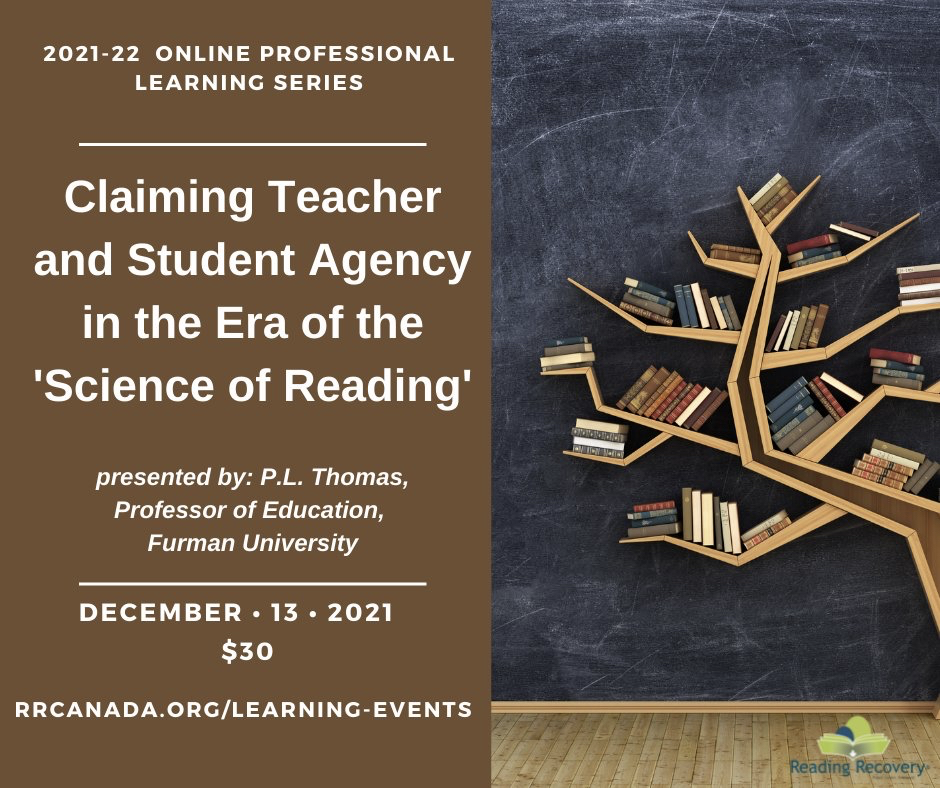
Claiming Teacher and Student Agency in the Era of the “Science of Reading” (RRC)

Reading Recovery Canada

Claiming Teacher and Student Agency in the Era of the “Science of Reading” –  presented by Dr. P L Thomas, Professor of Education
December 13 2021 – 6:30pm (eastern time) – session will be recorded for repeat viewing until August 31, 2022

The “science of reading” movement has direct roots in a U.S. media narrative starting about 2018, but the Science of Reading now drives reading and education decisions in many states and provinces. The decisions and legislation often includes policies and practices not supported by research (for example, grade retention) and further de-professionalizes teachers. This session places the Science of Reading movement in historical context and disrupts the “evidence-based” claims of Science of Reading advocates. The goal of the session is to provide teachers the evidence and support needed to assert their professional autonomy in support of their students’ needs and agency.

Access presentation PP HERE

Moving from “All Students Must” to “Each Student Deserves”

Since publishing my book, How to End the Reading War and Serve the Literacy Needs of All Students, that examines the current “science of reading” (SoR) version of the Reading War, I have given several interviews and presentations on that work.

I have also continued to blog about the movement, and in all of these experiences, I am forced to rethink and think more complexly through what I know and understand about the SoR movement as well as how to teach reading and literacy.

The most recent interview, by literacy expert Sam Bommarito, proved to be an enlightening experience on several levels.

First, Sam’s experience and expertise in the field of literacy were a welcomed change from being interviewed by generalists and journalists because his questions dove directly into the core of the issues surrounding SoR and those questions challenged me to think more deeply and carefully.

Our exchange between people with similar levels of expertise on the subject allowed (or even required) us to focus on how best to offer any viewers nuanced but clear explanations of a deeply complex topic; as I noted (and emphasize often now), the evidence on teaching reading is not simple, and not settled.

But the larger take-away for me after the interview was that Sam’s third question—Does it make any sense to effectively ban selected practices found in balanced approaches to reading, e.g., reading recovery, workshop teaching or guided reading?—prompted me to explain in greater detail a core concept that grounds a fundamental reason I reject the SoR movement.

Whether I am addressing literacy specifically or teaching pedagogy broadly, I have relied for many years on the best practice concepts expressed by Zemelman, Daniels, and Hyde.

Each chapter in their book (now in its fourth edition) ends with a chart that suggests instructional practices that teachers should increase or decrease; for example, on writing instruction (download sample here):

Key to note is that best practice is grounded in broad and diverse bodies of research on teaching and learning, and that best practice philosophy neither requires nor bans any specific instructional approach; whether a teacher uses any pedagogy is directly linked to student need (not a prescription form some authority such as standards or an adopted program).

When SoR advocates call for “all students must” (for example, systematic intensive phonics for all students and universal screening for dyslexia), they are misrepresenting what we know about teaching and learning: There is no universal silver bullet for “all students.”

Best practice structures promote research and evidence as a spectrum, a range of practices for every teacher’s toolbox; best practice also recommends that instruction begin with individual students, their demonstrated known, unknown, and misconceptions.

If we think carefully about decoding and direct instruction in phonics and phonemic awareness, teachers will face a wide diversity of students in any class in terms of where they are in their reading development; in short, there simply is no situation where “all students must” serves students well.

Literacy is not simple, and literacy development is not linear, sequential, or systematic.

For example, most people do not accumulate vocabulary in order to be able to read, but develop their vocabulary by reading.

Context (in terms of so-called literacy skills) and engagement are extremely important when students are developing their literacy; regretfully, many misguided movements during the history of the Reading War have eroded an essential aspect of literacy that must be honored—literacy as holistic.

Here, we must address a fundamental paradox in the SoR movement.

Several different kinds of advocacy are fueling the SoR movement—from parents advocating for greater awareness of dyslexia to Black and poor parents advocating for under-/un-served populations of students to advocates for the needs of emerging bilingual students.

The common denominator here is a genuine concern for the under-/un-served student, a pervasive belief that for a number of reasons, too many students are being failed by the system itself (although some elements of the SoR movement are also directly blaming teachers and teacher educators for those failures).

The paradox is that the aggressive advocacy behind the SoR movement is driving an all-or-nothing silver-bullet approach to teaching reading, which will mis-serve students as much or more than the current conditions of teaching and learning in U.S. public schools.

So this leads me to Sam’s effort to bridge the divisions in the Reading War (something I am far more skeptical about, as I address in Sam’s question 5: Cambourne and Crouch recently said we should stop using the Reading Wars metaphor and replace it with the metaphor of the Reading Quilt- with different “sides” adding different pieces to the quilt. Do you see any hope for that point of view? Do you see hope for an end to the divisive discourse?  Do you see hope for ending the reading wars? [13:20]).

I am no fan of compromise (as I explain in the interview) but I think we do have common ground in terms of two beliefs: (1) Far too many students are being under-/un-served in our current K-12 public school system (notably in their literacy), and (2) the under-/un-served are disproportionately marginalized and vulnerable populations of students (Black students, poor students, emerging bilinguals, students with special needs).

Not a compromise, but my modest proposal is that all of us concerned with reading and literacy among K-12 students need to set aside the “all students must” mandate and commit instead to “each student deserves.”

“All students must” be screened for dyslexia is a guaranteed disaster for students (consider the over-diagnosing of ADHD as one example), but “each student deserves” access to ample books and other texts in their homes and schools fulfills what we know about literacy development without being overly simplistic or harmful.

Each student deserves whatever teaching and learning experiences they need and want in order to grow and develop at the rate unique to them (not some manufactured and artificial “grade level” proficiency).

This commitment shifts our instruction and assessment gaze away from compliance to a reading program or to a set of prescribed standards and toward the demonstrated needs and wants of each student who enters any classroom.

The ultimate irony here is that the whole language (WL), reading/writing workshop, and balanced literacy (BL) movements (all falsely demonized since the 1990s) offer that exact commitment along with very high standards for teacher expertise (each of us in charge of any student must have a very complex toolbox for teaching and also must be prepared to individualized instruction).

Again, as I stated in the interview, WL, workshops, and BL did not fail our students, but we have certainly failed the core commitment of those movements—serving the learning needs of each student.

What we know about teaching reading is not simple or settled, but I think we can and must all agree that instead of falling prey to the overly simplistic and harmful “all students must,” a better way forward is a resolute commitment to “each student deserves.”


LitCon 2022: The State of the Reading War: Not Simple, Not Settled [UPDATE]

Announcement

LitCon: National K-8 Literacy & Reading Recovery Conference (January 29 – February 5, 2022, Columbus, OH)

Session Type: Spotlight Continued Engagement Session

Schedule:  Thurday, February 3, 2022, 4:00 pm – 4:45 pm est

Session Strand:  Reading Recovery

Session Title:  TBD

Description:  

Topics: 

Presenters:  Sam Bommarito and Paul Thomas


Featured Speaker

The State of the Reading War: Not Simple, Not Settled

Download PP HERE

P.L. Thomas

Session Type: Featured Session

Schedule:  Thursday, February 3, 2022, 5:00 pm – 6:00 pm est

Session Strand:  Leadership in Literacy

Session Title:  FS21 – The State of the Reading War: Not Simple, Not Settled

Description:  A new round of the Reading War embraces the “simple” view of reading, arguing that the “science of reading” is settled. This session interrogates the “science of reading” movement by placing it in historical context and refuting its central claims based on a more complex view of reading and science.

Topics: Equity in Education, Literacy Leadership, Reading

Presenters:  Paul Thomas

Recommended Reading

Science Supports Balance, Not Intensive Phonics, for Teaching Reading

Fact Checking the “Science of Reading”: A Quick Guide for Teachers [Updated]

How to Navigate Social Media Debates about the “Science of Reading”

Reading as Comprehension and Engagement: On the Limitations of Decoding

Podcast: Educational Movements and Trends

Talking Points: A Conversation with Paul Thomas

The “Science of Reading”: A Reader for Educators

How Do We Know?: Not Simple, Not Settled

Dismantling the “Science of Reading” and the Harmful Reading Policies in its Wake [UPDATED]

Understanding the “Science of Reading” Movement and Its Consequences: A Reader

Policy Statement on the “Science of Reading” (NEPC)

How to End the Reading War and Serve the Literacy Needs of All Students

Reading as Comprehension and Engagement: On the Limitations of Decoding

About a year ago, a friend and I introduced my grandchildren to gaming; soon after I bought them a Nintendo Switch.

My granddaughter, Skylar, was immediately drawn to Animal Crossing because she loved that the game allows players to visit each other’s world. But the game also requires a great deal of reading so her initial experiences meant she had to play with someone who could read with comprehension to help and guide her.

Today, Skylar is starting second grade.

Happy for day 1 of grade 2.

Recently, when Skylar was visiting, she immediately wanted to play Animal Crossing with my friend. As they played, Skylar was reading aloud incredibly well, only occasionally stumbling over words that would typically be classified as “above her grade level” (a concept I reject).

Despite Skylar’s ability to decode with speed and accuracy, we noticed something really important.

After reading through the text, Skylar would pause and ask my friend what she was supposed to do. Of course, the text in the game is designed to guide what the player does so my friend patiently explained that Skylar needed to re-read but pay attention to meaning (comprehension).

With that guidance and attention to the need to decode with comprehension and purpose, Skylar began to play the game with more agency (a few days later, she Facetimed my friend to continue having someone to mentor and guide her; in other words, she didn’t magically become an independent reader).

Skylar is 7 years old, my grandson, Brees, is 4 (about to turn 5 in a few weeks).

Watching them navigate gaming as well as learning to read is fascinating for several reasons.

First, Skylar clearly prefers communal gaming. Even as she is developing the ability to read with comprehension and engagement independently, she desperately wants to play the game with someone else.

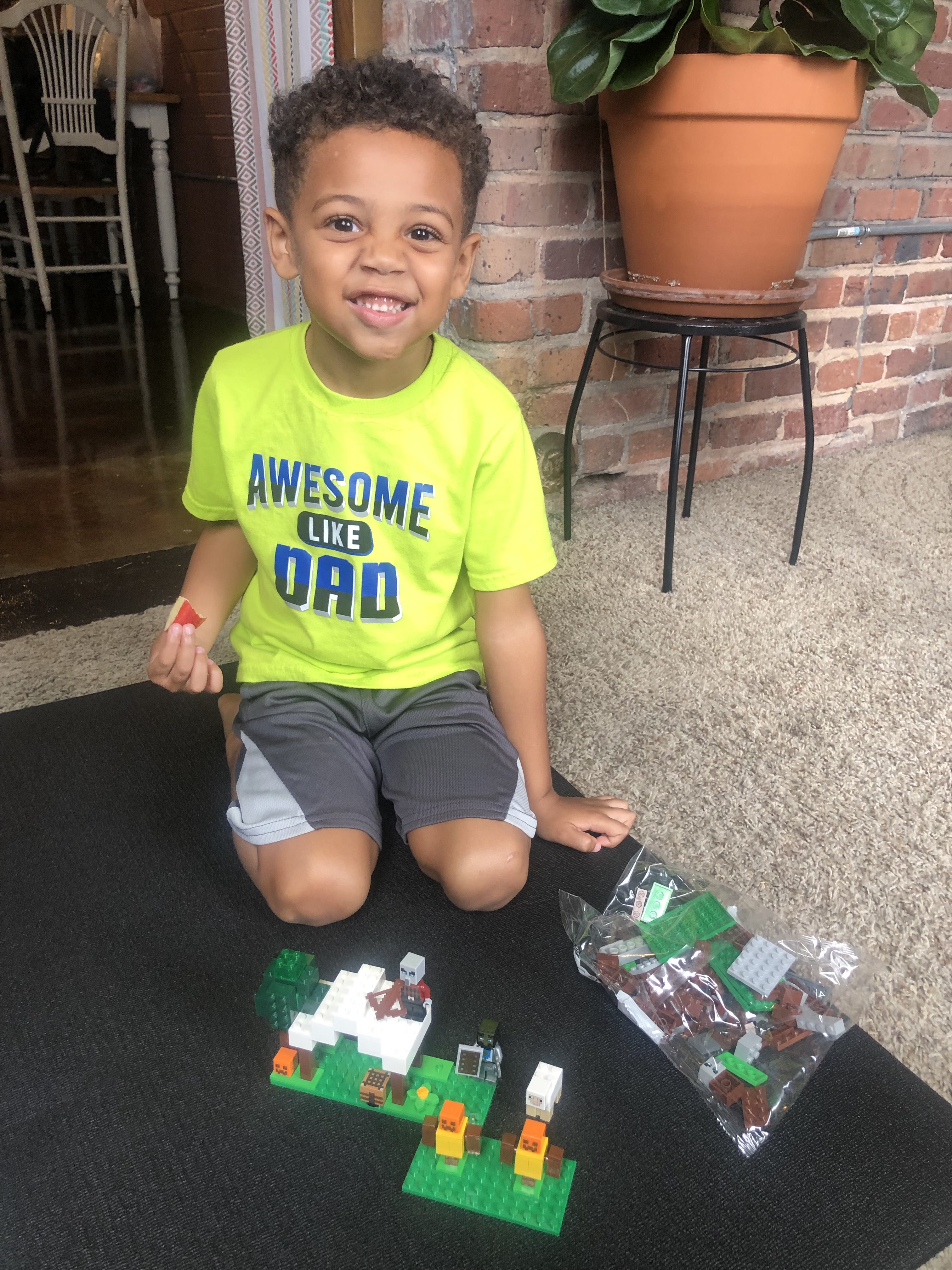
Brees, who has chosen Minecraft [1] as his go-to gaming, is a solitary gamer. While they were over for a pool day, Brees took a break and happily lay on a lounge chair playing Minecraft on his iPad.

Minecraft mania extends to Lego as well.

Second, Skylar’s gaming and reading journey dramatically reveals the limitations of decoding—notably the danger of assuming that proficiency at reading aloud (words pronounced quickly and clearly) results in comprehension and engagement.

Here I want to stress that without Animal Crossing and an expert mentor (both at the game and reading), Skylar could well have remained at the level of “going through the motions” of reading aloud.

She didn’t hesitate to re-read and work toward comprehension so that she could fully engage in the game.

In other words, literacy is ultimately about autonomy, but it is also a profoundly important aspect of community.

During the Facetime session, Skylar was seeking a mentor to confirm the decisions she was making. Even though she was decoding with comprehension, she kept asking for confirmation that she was navigating the game the right way (or more accurately, a right way).

Before I go further, I want to stress that Skylar clearly has acquired some very powerful decoding strategies based in what most people call “phonics,” but when she is in the real world of gaming, she often comes to situations when those blunt decoding skills are not only inadequate but distracting from the flow of the complicated act of reading and acting on the comprehension.

I also want to stress that watching a 7-year-old play a reading-intensive video game complicates the simplistic and misleading faith placed in “grade level” texts. Like almost all real-world texts, Animal Crossing simply uses words (no concern for “grade level” and no “context clues”), often very common words mixed in with exact vocabulary that is uncommon.

Overly simplistic views of reading and vocabulary tend to conflate the “easy/hard” binary for vocabulary with “common/uncommon.”

Uncommon words that Skylar could not decode, and often has never encountered before, were not “hard” since with a mentor to pronounce and explain the word, Skylar very quickly adapted and with repetition in the game, those words became common to her (and thus, “easy”).

Finally, this experience with my grandchildren, at different stages of development and reading, helps personify some of the significant problems with the “science of reading” (SoR) movement that advocates for the “simple view” of reading and for systematic intensive phonics for all students.

Decoding is a necessary but small aspect of the reading, which ultimately must be an act of comprehension with engagement.

But the SoR movement also will fail our students because it centers systematic programs, silver-bullet thinking, and a misguided emphasis on decoding (and blunt decoding strategies).

However, what all students need and deserve are real-world experiences with and reasons to read.

Those experiences include activities too many people still stigmatize as “bad” for children—comic books, gaming, and even Lego.

Skylar as an emerging independent reader has had some wonderful traditional school experiences, and loving teachers. But her journey to reading is much larger than that, including her current fascination with Animal Crossing.

My beautiful and eager grandchildren are powerful examples that when it comes to teaching reading, nothing is settled and nothing is simple.

Reading is comprehensions and engagement, and as Skylar demonstrates, reading is about community, a shared purpose that is filled with pleasure and the joy of creating without a finish line.


[1] Writing as a Minecrafter: Exploring How Children Blur Worlds of Play in the Elementary English Language Arts Classroom

by Cassie J. Brownell – 2021

Background/Context: Educators have considered how Minecraft supports language and literacy practices in the game and in the spaces and circumstances immediately surrounding gameplay. However, it is still necessary to develop additional conceptualizations of how children and youth’s online and offline worlds and experiences are blurred by and through the games. In this study, I take up this call and examine how the boundaries of the digital were blurred by one child as he wrote in response to a standardized writing prompt within his urban fourth-grade classroom.

Purpose/Objective/Research Question/Focus of Study: Through snapshots of Jairo’s writing, I illuminate how he muddled the lines between his physical play experiences and those he had in the virtual world of Minecraft. In doing so, I argue that he carried over his personal interest as a fan of Minecraft into the writing curriculum through creative language play. As Jairo “borrowed” his physical play experiences in the virtual world of Minecraft to complete an assigned writing task, he exemplified how children blur playworlds of physical and digital play in the elementary ELA classroom.

Research Design: Drawing on data generated in an 18-week case study, I examine how one child, Jairo, playfully incorporated his lived experiences in the virtual world of Minecraft into mandated writing tasks.

Conclusions/Recommendations: My examination of his writing is meant to challenge writing scholars, scholars of play, and those engaged in rethinking media’s relation to literacy. I encourage a rethinking of what it means for adults to maintain clear lines of what is digital play and what is not. I suggest adults might have too heavy a hand in bringing play into classrooms. Children already have experiences with play—both physical and digital. We must cultivate a space for children to build on what was previously familiar to them by offering scaffolds to bridge these experiences between what we, as adults, understand as binaries. Children do not necessarily see distinctions between “reality” and play worlds, or between digital and physical play. For children, play worlds and digital worlds are perhaps simply worlds; it is we as adults who harbor a desire for clear boundaries.

Teachers College Record Volume 123 Number 3, 2021, p. –
https://www.tcrecord.org ID Number: 23622, Date Accessed: 9/18/2021 7:46:35 AM

See Also

Misreading the Main Idea about Reading

Podcast: Educational Movements and Trends

Educational Movements and Trends

How can historical perspective help direct teaching and learning?

​When trying to solve problems, humans are prone to looking for a “silver bullet” which often bypasses the learning process. Educational trends prove this theory. The hot teaching movement today may not have solid research behind it. History shows us that we are not good at being patient students throughout life’s journey.​

Our guests Dr. Michele Dufresne, President and founder of Pioneer Valley Books and Dr. Paul Thomas at Furman University share that while K-12 education may be a basic right, not everyone has equal access to it. If every child is capable of learning and no one progresses at the same rate, then how can teachers better support student growth? Having an educated society impacts all facets of our communities.

Episode 1

Educational Trends part 2