Category Archives: Science of Reading
The “Science of Reading”: A Reader for Educators
Fact Checking the “Science of Reading”: A Quick Guide for Teachers
Historical Context
What Shall We Do About Reading Today?: A Symposium ( November 1942, The Elementary English Review, National Council of Teachers of English)
LaBrant, L. (1947, January). Research in language. Elementary English, 24(1), 86-94. Stable URL: http://www.jstor.org/stable/41383425
Doing What Matters Most: Investing in Quality Teaching, Linda Darling Hammond (1997)
Whole Language and the Great Plummet of 1987-92: An Urban Legend from California, Stephen Krashen
Silver Bullets, Babies, and Bath Water: Literature Response Groups in a Balanced Literacy Program, Dixie Lee Spiegel (The Reading Teacher, 1998)
Literacy Crises: False Claims and Real Solutions, Jeff McQuillan
National Reading Panel (NRP)
The Federal Government Wants Me to Teach What?: A Teacher’s Guide to the National Reading Panel Report, Diane Stephens (NCTE, 2008)
Beyond the Smoke and Mirrors: A Critique of the National Reading Panel Report on Phonics, Elaine M. Garan (2001) https://journals.sagepub.com/doi/abs/10.1177/003172170108200705
Babes in the Woods: The Wanderings of the National Reading Panel, Joanne Yatvin, The Phi Delta Kappan, Vol. 83, No. 5 (Jan., 2002), pp. 364-369 https://www.jstor.org/stable/20440142
I Told You So! The Misinterpretation and Misuse of The National Reading Panel Report, Joanne Yatvin (Education Week)
My Experiences in Teaching Reading and Being a Member of the National Reading Panel
“Science of Reading”
Policy Statement on the “Science of Reading” (NEPC)
Perspective | Is there really a ‘science of reading’ that tells us exactly how to teach kids to read?
The Trouble With Binaries: A Perspective on the Science of Reading, David B. Yaden Jr., David Reinking, and Peter Smagorinsky
Where Is the Evidence? Looking Back to Jeanne Chall and Enduring Debates About the Science of Reading, Peggy Semingson and William Kerns
The Sciences of Reading Instruction, Rachael Gabriel (Educational Leadership)
The Science of Reading Progresses: Communicating Advances Beyond the Simple View of Reading, Nell Duke and Kelly B. Cartwright
Science of Reading Advocates Have a Messaging Problem, Claude Goldenberg (Education Week)
MacPhee, D., Handsfield, L.J., & Paugh, P. (2021). Conflict or conversation? Media portrayals of the science of reading. Reading Research Quarterly, TBD. https://doi.org/10.1002/rrq.384
Bowers, J. S., & Bowers, P. N. (2021, January 22). The science of reading provides little or no support for the widespread claim that systematic phonics should be part of initial reading instruction: A response to Buckingham. https://doi.org/10.31234/osf.io/f5qyu
Reading Policy
Red Flags, Red Herrings, and Common Ground: An Expert Study in Response to State Reading Policy
Phonics
Phoney Phonics: How Decoding Came to Rule and Reading Lost Meaning (TCR)
The Phonics Debate: 2004, Stephen Krashen
Defending Whole Language: The Limits of Phonics Instruction and the Efficacy of Whole Language Instruction, Stephen Krashen
Does Phonics Deserve the Credit for Improvement in PIRLS?, Stephen Krashen
Reconsidering the Evidence That Systematic Phonics Is More Effective Than Alternative Methods of Reading Instruction, Jeffrey S. Bowers (2020)
To read or not to read: decoding Synthetic Phonics, Andrew Davis
Cryonics Phonics: Inequality’s Little Helper, Gerald Coles
Grade Retention
UPDATED: Grade Retention Research https://radicalscholarship.wordpress.com/2014/09/04/grade-retention-research/
Grade Retention:
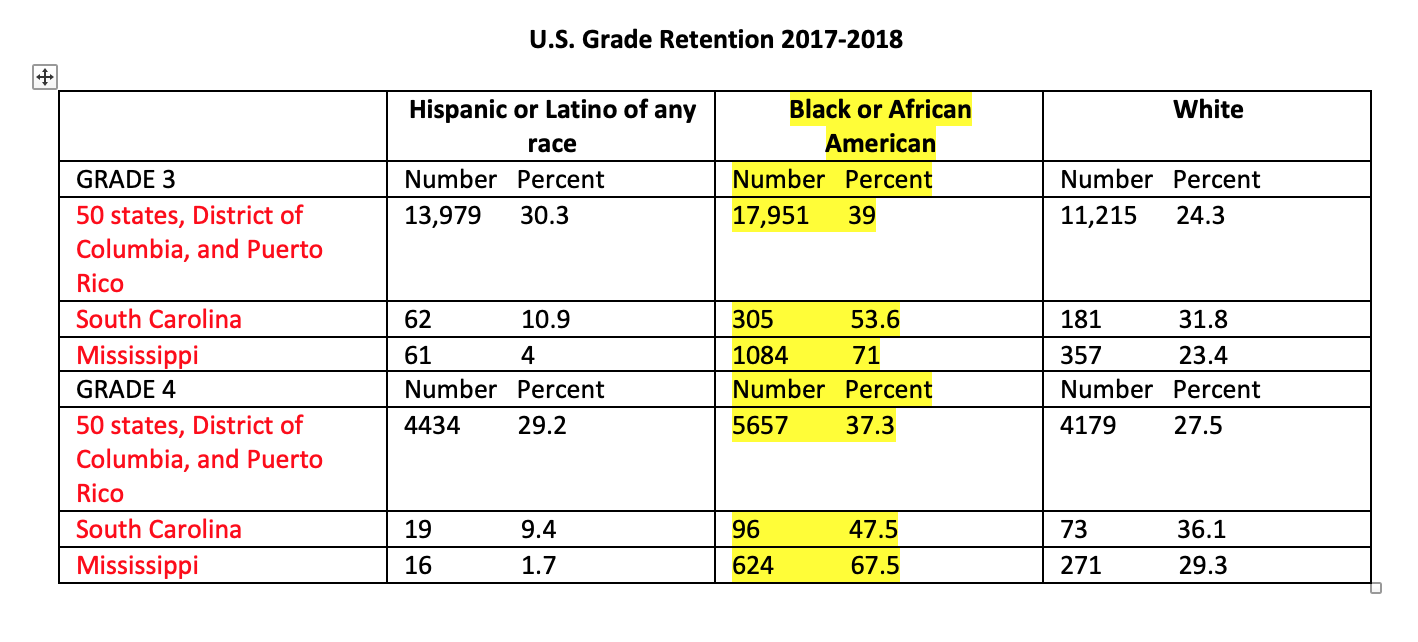
Black students disproportionately retained (grades 3 and 4)
(USDOE/Office of Civil Rights) – Data 2017-2018
Dyslexia
An Examination of Dyslexia Research and Instruction, with Policy Implications, Peter Johnston and Donna Scanlon
Research Advisory: Dyslexia (ILA) (2016)
Emerging Bilinguals
Caught in the Crosshairs: Emerging Bilinguals and the Reading Wars (NEPC)
NCTQ
NCTQ on States’ Teacher Evaluation Systems’ Failures, Again
Mississippi
UPDATED: Mississippi Miracle or Mirage?: 2019 NAEP Reading Scores Prompt Questions, Not Answers
Mississippi rising? A partial explanation for its NAEP improvement is that it holds students back
Chicken Little Journalism Fails Education (Again and Again): Up Next, the Science of Science?
Often education journalism is disturbing in its “deja vu all over again“: Why Other Countries Keep Outperforming Us in Education (and How to Catch Up).
Criticizing U.S. public education through international comparisons is a long-standing tradition in the U.S. media, reaching back at least into the mid-twentieth century.
This is one of many crisis approaches to covering education—Chicken Little journalism—that makes false and misleading claims about the quality of U.S. education (always framed as a failure) and that because of the low status of the U.S. in international comparisons of education, the country is doomed, economically and politically.
Oddly enough, as international rankings of education have fluctuated over 70-plus years, some countries have risen and fallen in economic and political status (even inversely proportional to their education ranking) while the U.S. has remained in most ways the or one of the most dominant countries—even as we perpetually wallow in educational mediocrity.
Yet, this isn’t even remotely surprising as Gerald Bracey (and many others) detailed repeatedly that international comparisons of educational quality are essentially hokum—the research is often flawed (apples to oranges comparisons) and the conclusions drawn are based on false assumptions (that education quality directly causes economic quality).
Media coverage, however, will not (cannot?) reach for a different playbook; U.S. public education is always in crisis and the sky is falling because schools (and teachers) are failing.
Next up? I am betting on the “science of science.”
Why? You guessed it: The Latest Science Scores Are Out. The News Isn’t Good for Schools. As Sarah D. Sparks reports:
Fewer than 1 in 4 high school seniors and a little more than a third of 4th and 8th graders performed proficiently in science in 2019, according to national test results out this week.
The results are the latest from the National Assessment of Educational Progress in science. Since the assessment, known as “the nation’s report card,” was last given in science in 2015, 4th graders’ performance has declined overall, while average scores have been flat for students in grades 8 and 12.
“The 4th grade scores were concerning,” said Peggy Carr, the associate commissioner of the National Center for Education Statistics, which administers NAEP. “Whether we’re looking at the average scores or the performance by percentiles, it is clear that many students were struggling with science.”
The Latest Science Scores Are Out. The News Isn’t Good for Schools
And it seems low tests scores mean that schools once again are failing to teach those all-important standards:
Carr said the test generally aligned with the Next Generation Science Standards, on which 40 states and the District of Columbia have based their own science teaching standards. Georgia, Massachusetts, and New Hampshire are developing new science assessments under a federal pilot program.
But it is even worse than we thought: “These widening gaps between the highest- and lowest-performing students, particularly in grade 4, mirror similar trends seen in national and global reading, math, and social studies assessments.”
Yep, U.S. students suck across all the core disciplines compared to the rest of the world!
And what makes this really upsetting, it seems, is we know how to teach science (you know, the “science of science”) because there is research: Effective Science Learning Means Observing and Explaining. There’s a Curriculum for That. Not only is there research, but also there are other countries doing it better and there are, again, those standards:
Organizing instruction around phenomena is a key feature of many reforms aimed at meeting the Next Generation Science Standards, an ambitious set of standards adopted or adapted by 44 states in 2013. Phenomena are also an organizing feature of instructional reforms in countries outside the United States, like high-performing Finland. But what is phenomenon-based learning, and what evidence is there that it works?…
Our study found that students exposed to the phenomenon-based curriculum learned more based on a test aligned with the Next Generation standards than did students using the textbook. Importantly, the results were similar across students of different racial and ethnic backgrounds.
William R. Penuel
Up next, of course, is the media trying to understand why science scores are so abysmal (like reading and math), assigning blame (schools, teachers, teacher education), and proposing Education Reform. What should we expect?
Well, since fourth-grade scores are in the dumpster, we need high-stakes science testing of all third-grade students and to impose grade retention on all those students who do not show proficiency in that pivotal third-grade year.
We also should start universal screening of 4K students for basic science knowledge (or maybe use “science” to screen fetuses in utero).
Simultaneously, states must adopt legislation mandating that all science curricula are based on research, the “science of science.”
Of course, teachers need to be retrained in the “science of science” because, you know, all teacher education programs have failed to teach the “science of science” [insert NCTQ report not yet released].
And while we are at it, are we sure Next Generation Science Standards are cutting it? Maybe we need Post-Next Generation Science Standards just to be safe?
Finally, we must give all this a ride, wait 6-7 or even 10 years, and then start the whole process over again.
The magical thing about Chicken Little journalism is that since the sky never falls, we can always point to the heavens and shout, “The sky is falling!”
How Do We Know?: Not Simple, Not Settled
In the early to mid-1980s, I entered the world of serious recreational cycling. I had been an athlete throughout my childhood and teen years, but found myself sedentary and out of shape in the first few years of my career as a high school English teacher.
Road cycling wasn’t the most inviting of sports, being both an individual and group endeavor. I quickly discovered, in fact, that cycling is deeply tradition-bound and steeped in ritual and conformity.
Ultimately, it is also an orchestra of Social Darwinism; you must be strong enough and skilled enough to ride with a group regardless of anything else (such as the right bicycle or the proper kit).
Early on, I had to focus on fitness—riding more often and longer, but always alone—and finding ways I could afford ever-better bicycles (see Rule 12). Gradually, I began shaving my legs and made the most daunting commitment facing me, using toe clips on my pedals.

Toe clips were a must among serious cyclists, but they involved literally reaching down and tightening a leather or nylon strap around your feet. The monumental learning curve was reaching down to tighten the straps and always reaching down to flick the release when coming to a stop.
At the time, I lived only a couple miles from my bicycle shop so I rode my bicycle there to buy my first toe clips. They installed the clips to my pedals and went over how to tighten and release.
Filled with glee about my next step toward being a real cyclist, I rolled out of the shop parking lot and promptly came to a stop at a red light where I fell over fairly dramatically beside several cars—having completely forgotten to reach down to loosen the straps.
Just as I had to learn how to shift gears (old-school down-tube friction shifting), I learned to tighten and release the toe clips along with dozens of other behaviors necessary to ride in tight packs of cyclists at high intensity and to near exhaustion.
High-paced group cycling is a mix of many precise behaviors in incredibly tense contexts—from being dropped from the group to being in or causing a serious accident.
That was three decades ago, and today (after many changes to pedals and shifting) I function on a bicycle in ways that seem entirely natural, requiring essentially no thought.

Cycling for me is automatic behavior; I also have acquired an incredible amount of knowledge about bicycles (I do bicycle maintenance and build bicycles) and the history of the sport.
I often think of this journey in learning of mine, which was again prompted by a few exchanges on Twitter:
These comments about what we know and how we know it are common, but, I think, trapped in a misunderstanding about, for example, “rote memorization.”
Memorization and automatic behavior are not about “bad” or “good.” In fact, memorization and automatic behavior are inevitable for most humans, even essential.
The trap can be exposed by considering a behavior most of us have in common—assembling something from parts such as a TV stand or entertainment unit, or a children’s toy.
Do you recall opening the box, spreading out the parts, laying out the directions, and then beginning to assemble? Was there a moment (or several) while assembling when you turned from the directions to look on the box at the image of the fully assembled item?
So here is my point: The Twitter exchange above is trapped in viewing learning in a reductive way based on part-to-whole, easier-to-harder, sequential perceptions of learning.
This singular and reductive view is the trap.
Since most of the items we assemble are a one-time event, that assembly is both learning to assemble and assembling at the same time. (I once assembled a TV stand, badly, and then my in-laws wanted the same stand. The second assembly was a near-euphoric experience since I was able to apply what I had learned from doing the whole thing one time before.)
My journey in cycling and my assembly example here reveal that learning resulting in memorization and automatic behavior is extremely complex and is in fact an interplay between part and whole, not a step-by-step journey from part to whole.
“Breaking it down” is not always easier or clearer for some students, in some learning activities.
Many people learning to use toe straps, for example, would go into a grass field, strap in, and (as I did publicly) fall down repeatedly. Learning the real thing required doing the whole and real thing relatively badly until they improved (motivated by real consequences).
There is no debate, then, about the good or bad in memorization or automatic behavior. The real tension is about how and why we come to memorize or behave automatically.
Despite misleading claims that memorization is a foundation, we often come to know something, have it memorized, after (not before) we have rich and complex experiences with the knowledge or behavior.
In my doctoral program, I had to perform from memory in two intense settings—written comps and dissertation defense. I studied for neither because I had engaged with the material for so long and in such intense situations (course work, numerous papers, a full dissertation) that I had much of the material in recall.
Twenty-five-plus years later, much of that dissertation work remains in recall for me.
Like with cycling, my final doctoral work felt natural, as much a part of me as pedaling with my hands off the handlebars while I remove my cycling vest and stuff it into a rear pocket while sitting at the back of a high-paced group.
The quests for silver-bullets and simple step-by-step paths to learning and automatic behavior are at the core of many educational debates, in fact, including the incessant reading debate.
The complexity of cycling reminds me of the complexity in reading—the many interconnected behaviors and knowledge required to do both automatically and well.
Reading, learning to read, and teaching someone to read—like all learning—are not simple and how we come to know is just not settled.
In fact, learning will never be simple or settled because human beings are far too complex.
The paradox, of course, is that how we know is simple to explain: It is some type of interplay between doing the whole thing we want to learn and coming to know the many intricate parts that make up that whole thing.
How do we know?
It is a journey—not simple, not settled.
Dismantling the “Science of Reading” and the Harmful Reading Policies in its Wake [UPDATED]
[Header Photo by Nick Fewings on Unsplash]
After emailing me about new reading legislation being proposed in North Carolina—next door to my home state of South Carolina that also has jumped on the “science of reading” bandwagon—Ann Doss Helms of WFAE (NPR, Charlotte, NC) interviewed me by phone.
I have given dozens of interviews about education over the last 15 to 20 years, and they all have a similar pattern; the journalist tosses out predictable questions and then becomes somewhat disoriented by my answers. Typically, the journalist at some point notes they didn’t know or had never heard the information I offered, the context and complications I raised about the topic.
My conversation with Helms was no different as we gradually peeled back the layers of the onion that is the “science of reading” as well as the very harmful reading policies that are being proposed and adopted in its wake.
Over the past couple years, I have blogged almost nonstop and written a book on the “science of reading” media narrative and how it is oversimplified and misleading but very compelling and harmful since state after state is adopting deeply flawed reading legislation (often, as Helms noted, to mimic Mississippi).
As I explained, the “science of reading” movement is grounded in the media and parent advocacy (specifically focusing on dyslexia)—advocates who have no expertise or background in literacy—but is essentially a thinly veiled resurrection of the tired intensive phonics versus holistic approaches to teaching reading.
Part of our conversation also confronted the contradiction in the “science of reading” movement that forefronts the debunked claim of “settled science” around how to teach reading and then supports actions and policies that have no scientific support—notably grade retention and using Mississippi as a justification for polices absent any research behind the claimed NAEP improvements by that state.
Further, the “science of reading” movement and those using the “science of reading” to promote state-level reading policy also rely on discredited (read “bad science”) sources such as NCTQ or misrepresent contested sources such as the National Reading Panel (see here).
The “science of reading” movement is deja vu all over again since the movement looks essentially like many other education reform patterns that have all failed (as many of us said they would) because they misunderstand the problem and grasp for silver-bullet solutions—all wrapped in a media and political frenzy that is almost impossible to stop. The trash heap of failure includes Teach for America, charter schools, accountability driven by standards and high-stakes testing, the NRP and Reading First, value-added methods of teacher evaluation and merit pay, and many others.
States adopting truly awful reading policy driven by the “science of reading” slogan will not change reading in the U.S., and in time, very soon, in fact, the media and political leaders will be, once again, lamenting a reading crisis.
While it may be too little, too late since states are racing to pass essentially the same reading legislation across the U.S., many scholars are carefully dismantling the “science of reading” movement in ways that support my claims over the past two years.
Here, then, are three I recommend for anyone needing further proof that the “science of reading” is yet another bandwagon we should avoid:
An Examination of Dyslexia Research and Instruction, with Policy Implications, Peter Johnston and Donna Scanlon
Currently, there is a well-organized and active contingent of concerned parents and educators (and others) who argue that dyslexia is a frequent cause of reading difficulties, affecting approximately 20 percent of the population, and that there is a widely-accepted treatment for such difficulties: an instructional approach relying almost exclusively on intensive phonics instruction. Proponents argue that it is based on “settled science” which they refer to as “the science of reading” (SOR). The approach is based on a narrow view of science, and a restricted range of research, focused on word learning and, more recently, neurobiology, but paying little attention to aspects of literacy like comprehension and writing, or dimensions of classroom learning and teacher preparation. Because the dyslexia and instructional arguments are inextricably linked, in this report, we explore both while adopting a more comprehensive perspective on relevant theory and research.
Johnston, P., & Scanlon, D. (2021). An Examination of Dyslexia Research and Instruction With Policy Implications. Literacy Research: Theory, Method, and Practice, 70(1), 107–128. https://doi.org/10.1177/23813377211024625
Johnston and Scanlon answer 12 questions and then offer these important policy implications (quoted below):
- There is no consistent and widely accepted basis – biological, cognitive, behavioral, or academic – for determining whether an individual experiencing difficulty with developing word reading skill should be classified as dyslexic. (Questions 1 and 10).
- Although there are likely heritable and biological dimensions to reading and language difficulties, there is no way to translate them into implications for instructional practice. (Questions 2 and 11).
- Good first instruction and early intervention for children with a slow start in the word reading aspect of literacy, reduces the likelihood they will encounter serious difficulty. Thus, early screening with assessments that can inform instruction, is important. Screening for dyslexia, particularly with instructionally irrelevant assessments offers no additional advantage. (Questions 5 and 6).
- Research supports instruction that purposely develops children’s ability to analyze speech sounds (phonological/phonemic awareness), and to relate those sounds to patterns of print (phonics and orthographics), in combination with instruction to develop comprehension, vocabulary, fluency, and a strong positive and agentive relationship with literacy. (Questions 7 and 12).
- Evidence does not justify the use of a heavy and near-exclusive focus on phonics instruction, either in regular classrooms, or for children experiencing difficulty learning to read (including those classified as dyslexic). (Questions 7, 8 and 12).
- Legislation (and district policies) aligned with the SOR perspectives on dyslexia will necessarily require tradeoffs in the allocation of resources for teacher development and among children having literacy learning difficulties. These tradeoffs have the potential to privilege students experiencing some types of literacy learning difficulties while limiting instructional resources for and attention available to students whose literacy difficulties are not due (exclusively) to word reading difficulties. (Question 12).
The Trouble With Binaries: A Perspective on the Science of Reading, David B. Yaden Jr., David Reinking, and Peter Smagorinsky
In this article, we critique the science of reading when it is positioned within the reading wars as settling disagreements about reading and how it should be taught. We frame our argument in terms of troublesome binaries, specifically between nature and nurture. We interpret that binary in relation to Overton’s distinction between split and relational metatheories, with the latter suggesting a more integrative view of nature and nurture. Focusing on the nature side of the binary, which predominates when the science of reading is promoted in the reading wars, we argue that its singular focus limits the range of scientific inquiry, interpretation, and application to practice. Specifically, we address limitations of the science of reading as characterized by a narrow theoretical lens, an abstracted empiricism, and uncritical inductive generalizations derived from brain‐imaging and eye movement data sources. Finally, we call for a relational metatheoretical stance and offer emulative examples of that stance in the field.
Yaden, D.B., Reinking, D., & Smagorinsky, P. (2021). The Trouble With Binaries: A Perspective on the Science of Reading. Read Res Q, 56(S1), S119– S129. https://doi.org/10.1002/rrq.402
Note the strong conclusion to this piece:
Unfortunately, we believe that in many cases, the cloak of science has been employed to elevate the stature of SOR work and to promote the certainty and force of its advocates’ preferred explanations for what reading is and how it should be taught (e.g., Gentry & Ouellette, 2019; Schwartz & Sparks, 2019). What we suggested in this article is that the SOR, when so used in the reading wars, is not science at all in its fullest sense. It neglects an entire domain that influences and shapes human experience. It does so with an unmitigated confidence that evidence from one side of a binary can establish a final truth and that such a truth creates a single prescription for all instruction. Taking that stance, however, is outside the pale of science and dismisses work that has both merit on its own terms and a critical role in advancing the aims motivating reading research and instruction.
Where Is the Evidence? Looking Back to Jeanne Chall and Enduring Debates About the Science of Reading, Peggy Semingson and William Kerns
In this historical analysis, we examine the context of debates over the role of phonics in literacy and current debates about the science of reading, with a focus on the work and impact of the late literacy scholar Jeanne Chall. We open by briefly tracing the roots of the enduring debates from the 19th and 20th centuries, focusing on beginning reading, decoding, and phonics. Next, we explore insights drawn from the whole language movement as understood by Kenneth Goodman and Yetta Goodman, as well as a synthesis of key ideas from Chall’s critique of the whole language approach. We then analyze the shifts across the three editions of Chall’s Learning to Read: The Great Debate and summarize major ideas from her body of work, such as the stage model of reading development. We suggest that reading instruction should be informed by a broader historical lens in looking at the “science of reading” debates and should draw on a developmental stage model to teaching reading, such as the six‐stage model provided by Chall. We describe implications for educators, textbook publishers, researchers, and policymakers that address the current reading debates and provide considerations of what Chall might say about learning to read in a digital era given the pressures on teacher educators and teachers to align their practice with what is deemed to be the science of reading.
Semingson, P., & Kerns, W. (2021). Where Is the Evidence? Looking Back to Jeanne Chall and Enduring Debates About the Science of Reading. Read Res Q, 56(S1), S157– S169. https://doi.org/10.1002/rrq.405
UPDATE 1
From the very beginning of the “science of reading” movement, media coverage, parental advocacy, and political policy have been misleading and grounded in misunderstanding. As the examples above show, there continues to be a steady dismantling of all that even as policy has been adopted and is being considered, policy that is fundamentally not “scientific” and will prove to be ineffective and even harmful.
Below are some additional examples of the dismantling that I highly recommend:
Some NC Leaders Say Mississippi’s Model Charts The Way To Helping Kids Read, Ann Doss Helms (WFAE)
The Sciences of Reading Instruction, Rachael Gabriel (Educational Leadership)
When it comes to reading instruction, an “all or nothing” approach is actually unscientific.
Every January, my social media feeds fill with ads, free trials, and coupons from the diet and wellness industry, promising to help me with my (presumed) resolutions to be better, faster, leaner, and healthier. Every diet program claims some type of relationship to science.
The same is true with reading instruction. Most programs or approaches claim to be based on “science.” But consider the many possible meanings of this claim. Some approaches to reading instruction are developed as part of rigorous, peer-reviewed research and are continuously evaluated and refined. Others are designed by practitioners who draw on experience, and whose insights are validated by inquiry after development. Many are based on well-known principles from research or assumptions about learning in general, but haven’t themselves been tested. Some “research-based” instructional tools and practices have been shared, explained, interpreted, misinterpreted, and re-shared so many times that they bear little resemblance to the research on which they were based (Gabriel, 2020). Others rack up positive evidence no matter how many times they’re studied. Then there are practices that have no evidence behind them but are thought to be scientific—because they’ve always been assumed to be true.
The Sciences of Reading Instruction – Educational Leadership May 2021, pp. 58-64
The Science of Reading Progresses: Communicating Advances Beyond the Simple View of Reading, Nell Duke and Kelly B. Cartwright
ABSTRACT
The simple view of reading is commonly presented to educators in professional development about the science of reading. The simple view is a useful tool for conveying the undeniable importance—in fact, the necessity—of both decoding and linguistic comprehension for reading. Research in the 35 years since the theory was proposed has revealed additional understandings about reading. In this article, we synthesize research documenting three of these advances: (1) Reading difficulties have a number of causes, not all of which fall under decoding and/or listening comprehension as posited in the simple view; (2) rather than influencing reading solely independently, as conceived in the simple view, decoding and listening comprehension (or in terms more commonly used in reference to the simple view today, word recognition and language comprehension) overlap in important ways; and (3) there are many contributors to reading not named in the simple view, such as active, self-regulatory processes, that play a substantial role in reading. We point to research showing that instruction aligned with these advances can improve students’ reading. We present a theory, which we call the active view of reading, that is an expansion of the simple view and can be used to convey these important advances to current and future educators. We discuss the need to lift up updated theories and models to guide practitioners’ work in supporting students’ reading development in classrooms and interventions.
Duke, N.K., & Cartwright, K.B. (2021). The Science of Reading Progresses: Communicating Advances Beyond the Simple View of Reading. Read Res Q, 56(S1), S25– S44. https://doi.org/10.1002/rrq.411
NOTE: The short version of the Duke and Cartwright essay should be: The “science of reading” is not so simple and not so settled.
Science of Reading Advocates Have a Messaging Problem, Claude Goldenberg (Education Week)
What is happening in this new stage of the reading wars is there for all to see in North Carolina’s and others’ use of the phrase. Instead of spelling out what they mean, “science of reading” advocates wrap themselves in the protective mantel of science, as if invoking science is all that anyone needs to be credible and persuade others to join them. Anyone disagreeing is anti-science, i.e., ignorant.
This is not a great persuasion strategy. Not surprisingly, those from a different vantage point argue that no one has a right to define science in a way that conveniently fits their perspective.
The Politics of Phonics: How a skill becomes a law, David Waters
UPDATE 2
VI. Recommendations
The “Read to Succeed” Act ultimately did not pass during Kentucky’s 2021 legislative session. However, given that state legislators have introduced early literacy bills multiple times in recent years, it is likely that the state may see similar proposals in coming years. Further, given the rapid spread of these policies across states in recent decades, the considerations discussed here will be relevant to policymakers in other states interested in third-grade literacy legislation. Though many states have already enacted early literacy legislation, policymakers need not adhere to a one-size-fits-all approach to improving third-grade literacy achievement. State policymakers can learn from the research, described above, that has been conducted to this point about these policies. I offer three specific recommendations for policymakers to consider as they strive to ensure the efficacy of third-grade literacy policies moving forward:
• Instead of limiting the legislation to the “Big Five” components of reading, include a set of instructional best practices in literacy.
• Ensure initial, ongoing, and targeted professional development in literacy for K-3 teachers.
• Show educators that their expertise is valued by involving them in the development of the policy. This can be done by soliciting feedback through an open online comment period, conducting focus groups with a representative group of K-3 educators, and/or involving educators in the creation of various components of the policy.
Cummings, A.. (2021). Making early literacy policy work in Kentucky: Three considerations for policymakers on the “Read to Succeed” act. Boulder, CO: National Education Policy Center. https://nepc.colorado.edu/publication/literacy
Red Flags, Red Herrings, and Common Ground: An Expert Study in Response to State Reading Policy
Abstract
In many U.S. states, legislation seeks to define effective instruction for beginning readers, creating an urgent need to turn to scholars who are knowledgeable about ongoing reading research. This mixed-methods study considers the extent to which recognized literacy experts agreed with recommendations about instruction that were included on a state’s reading initiative website. Our purpose was to guide implementation and inform policy-makers. In alignment with the initiative, experts agreed reading aloud, comprehension, vocabulary, fluency, phonological awareness, and phonics all deserve a place in early literacy instruction. Additionally, they agreed some components not included on the website warranted attention, such as motivation, oral language, reading volume, writing, and needs-based instruction. Further, experts cautioned against extremes in describing aspects of early reading instruction. Findings suggest that experts’ knowledge of the vast body of ongoing research about reading can be a helpful guide to policy formation and implementation.
Collet, Vicki S.; Penaflorida, Jennifer; French, Seth; Allred, Jonathan; Greiner, Angelia; and Chen, Jingshu (2021) “Red Flags, Red Herrings, and Common Ground: An Expert Study in Response to State Reading Policy,” Educational Considerations: Vol. 47: No. 1. https://doi.org/10.4148/0146-9282.2241
UPDATE 3
Marissa J. Filderman, Christy R. Austin, Alexis N. Boucher, Katherine O’Donnell, Elizabeth A. Swanson
Abstract
Informed by theories of reading comprehension and prior reviews of reading comprehension intervention, this meta-analysis uniquely contributes to the literature because it describes the relative effects of various approaches to comprehension intervention for struggling readers in Grades 3 through 12. Findings from 64 studies demonstrate significant positive effects of reading comprehension intervention on comprehension outcomes (g = .59, p < .001, 95% confidence interval [CI] [0.47, 0.74], τ2 = .31). A metaregression model indicated significantly higher effects associated with researcher-developed measures, background knowledge instruction, and strategy instruction, and significantly lower effects associated with instructional enhancements. Grade level, metacognitive approaches, and study quality did not moderate effects. Findings support the use of background knowledge instruction and strategy instruction to support comprehension of struggling readers in upper elementary and beyond.
Theoretical models, such as the simple view of reading (Gough & Tunmer, 1986), the direct and inferential mediation (DIME) model (Cromley et al., 2010; Cromley & Azevedo, 2007), and the cognitive model (McKenna & Stahl, 2009) inform the constructs and skills that contribute to reading comprehension. The simple view of reading (Gough & Tunmer, 1986) describes reading comprehension as the product of decoding and language comprehension. The simple view of reading is often used to underscore the critical importance of decoding on reading comprehension; however, evidence suggests that the relative importance of decoding and language comprehension changes based on students’ level of reading development and text complexity (Lonigan et al., 2018). Cross-sectional and longitudinal studies demonstrate that decoding has the largest influence on reading comprehension for novice readers, whereas language comprehension becomes increasingly important as students’ decoding skills develop and text becomes more complex (e.g., Catts et al., 2005; Gough et al., 1996; Hoover & Gough, 1990; Proctor et al., 2005; Tilstra et al., 2009). However, the simple view of reading does not comprehensively explain all skills that influence reading comprehension, nor does it inform what comprehension instruction requires.
The DIME model of reading (Cromley et al., 2011; Cromley & Azevedo, 2007) and cognitive model (McKenna & Stahl, 2009) build upon the simple view of reading as component-based models. The relationship between five variables—background knowledge, inference, strategies, vocabulary, and word reading—are hypothesized to result in reading comprehension according to the DIME model. Word reading, vocabulary, and background knowledge each have direct effects on reading comprehension. However, the effect of word reading, vocabulary, and background knowledge on reading comprehension is also mediated by other variables. Indirectly, background knowledge and vocabulary are needed to use comprehension strategies or to draw inferences (Ahmed et al., 2016). The cognitive model (McKenna & Stahl, 2009) also breaks reading comprehension into its component parts. According to the cognitive model, reading comprehension is made possible by automatic word recognition, language comprehension, and strategic knowledge. The model further delineates specific skills contributing to each of these components of reading comprehension. For successful language comprehension to occur, vocabulary, background knowledge, and knowledge of text structures are needed. General purposes for reading, specific purposes for reading, and knowledge of strategies contribute to strategic knowledge. In summary, both the DIME model and the cognitive model provide greater insight into specific constructs and skills required for reading comprehension that can be targeted instructionally in comprehension intervention.
Filderman, M. J., Austin, C. R., Boucher, A. N., O’Donnell, K., & Swanson, E. A. (2022). A Meta-Analysis of the Effects of Reading Comprehension Interventions on the Reading Comprehension Outcomes of Struggling Readers in Third Through 12th Grades. Exceptional Children, 88(2), 163–184. https://doi.org/10.1177/00144029211050860
UPDATE 4
Focus on phonics to teach reading is ‘failing children’, says landmark study
Reading wars or reading reconciliation? A critical examination of robust research evidence, curriculum policy and teachers’ practices for teaching phonics and reading, Dominic Wyse and Alice Bradbury
Abstract
Teaching children to read is one of the most fundamental goals of early years and primary education worldwide, and as such has attracted a large amount of research from a range of academic disciplines. The aims of this paper are: (a) to provide a new critical examination of research evidence relevant to effective teaching of phonics and reading in the con-text of national curricula internationally; (b) to report new empirical findings relating to phonics teaching in England; and (c) examine some implications for policy and practice. The paper reports new empirical findings from two sources: (1) a systematic qualitative meta-synthesis of 55 experimental trials that included longitudinal designs; (2) a survey of 2205 teachers. The paper concludes that phonics and reading teach-ing in primary schools in England has changed significantly for the first time in modern history, and that compared to other English dominant regions England represents an outlier. The most robust research evidence, from randomised control trials with longitudinal designs, shows that the approach to phonics and reading teaching in England is not sufficiently under-pinned by research evidence. It is recommended that national curriculum policy is changed and that the locus of political control over curriculum, pedagogy and assessment should be re-evaluated.
Wyse, D., & Bradbury, A. (2022). Reading wars or reading reconciliation? A critical examination of robust research evidence, curriculum policy and teachers’ practices for teaching phonics and reading. Review of Education, 10, e3314. https://doi.org/10.1002/rev3.3314
Key points:
The key question that we address in this paper is whether robust research evidence sup-ports this historically significant change in reading pedagogy. Our findings from analysis of tertiary reviews, systematic reviews and from the SQMS do not support a synthetic phonics orientation to the teaching of reading: they suggest that a balanced instruction approach is most likely to be successful. They also suggest the need for a new more careful consideration of the strengths and weaknesses of whole language as an orientation to teaching reading. The reading wars have often resulted in some very dismissive attitudes to whole language, a position that is not underpinned by the research. Although there remains no doubt that phonics teaching in general is one important component in the teaching of reading, the research certainly does not suggest the complete exclusion of whole language teaching….
In addition to the importance of contextualised reading teaching as an evidence-based orientation to the teaching of reading we hypothesise the following pedagogical features that are likely to be effective. Phonics teaching is most likely to be effective for children aged five to six. Phonics teaching with children younger than this is not likely to be effective. A focus on whole texts and reading for meaning, to contextualise the teaching of other skills and knowledge, should drive pedagogy. Classroom teachers using their professional judgement to ensure coherence of the approach to teaching phonics and reading with other relevant teaching in their classroom is most likely to be effective. Insistence on particular schemes/basals, scripted lessons, and other inflexible approaches is unlikely to be optimal. Well-trained classroom assistants, working in collaboration with their class teachers, could be a very important contribution to children’s reading development. Although the most relevant studies in the SQMS showed approaches that were effective usually from between 9.1 h and 60 h of teaching time, we hypothesise that effective teaching of the alphabetic code could be delivered in 30 h or less of instruction time. If so, this would mean that greater emphasis on aspects such as reading comprehension could begin much earlier in England’s national curriculum programmes of study than in the current national curriculum of 2014.
DOI: 10.1002/rev3.3314
Is Synthetic Phonics Instruction Working in England? (Updated)

Citation and Credibility: Three Lessons
In my three courses this fall, students are now all working on scholarly essays that incorporate high-quality sources (focusing on peer-reviewed journal articles). Since the work lies primarily in the field of education, students are using APA style guides.
Often when teaching students citation, we focus our lessons on (the drudgery of) formatting and idiosyncratic citation structures (APA’s annoying lowercase/upper case peculiarities, for example, in bibliographies) as well as the challenges of finding and evaluating a reasonable amount of valid sources to support the claims of the essay.
Students often struggle with evaluating sources for bias, and honestly, they are not well equipped to recognize flawed or ideologically skewed reports that appear to be in credible journals and are themselves well cited.
Part of the problem has been well documented by Gerald Bracey; citing Paul Krugman, Bracey confronts the rise of think tanks that promote their agendas through the veneer of scholars and scholarly reports. Then, Bracey notes, “[t]he media don’t help much. By convention, they present, at best, ‘balanced’ articles, not critical investigative pieces” (p. xvi). This is what I have labeled “both sides” journalism.
While scholarly writing and citation can often slip into a circus of minutia, one lesson needing greater care is helping students (and anyone making a research-based claim) recognize that their credibility and authority is built on the validity and quality of the sources they incorporate.
Here, I want to present three lessons illuminating that dynamic—all pulled from current issues.
Lesson One: The “Science of Reading”
One of the best examples of the problems with ideological think tank reports and media coverage occurred (again) at Education Week, a major publication covering education that has abandoned “critical investigative pieces” for simply reporting (crossing the Big Foot line) and “‘balanced’ articles.”
Ideological think tanks, as Bracey warned, are well organized and very aggressive, systematically alerting media and providing press releases so detailed that journalists have to do little work (except, of course, evaluating the credibility of the report to begin with).
Media routinely cover that think tanks release reports, and journalists have argued it isn’t their job to determine if those reports are valid or not.
For example, Education Week is so invested in the “science of reading” narrative and movement, that they eagerly present reports from NCTQ because their reports reinforce that narrative—even though, NCTQ itself has been repeatedly criticized for not meeting even the basic guidelines for scientific research.
Sarah Schwartz ignores that NCTQ is not a credible source for making claims about teacher training in reading. But with just a brief Google search, anyone can find that NCTQ has had numerous reports reviewed, finding a disturbing patterns: “Although NCTQ reports have been critiqued for their limited use of research and highly questionable research methodology, this report employs the same approaches as earlier NCTQ reports,” explain Stillman and Schultz in one of the most recent reviews (also concurrent to the report cited in EdWeek).
Students, like journalists, are often not expert in the topics they are addressing, and well-formatted reports can seem credible, but often fail the basic expectations of peer-review (NCTQ releases their reports without peer review and receive media coverage while the discrediting reviews tend to receive no media coverage).
The lesson here for students (and journalists) is that any claim is only as good as the sources used to support that claim.
If the “science of reading” is a valid narrative (and, in fact, it isn’t), citing sources that fail the basic test of being scientific certainly erodes if not discredits the initial claim.
Lesson Two: Gun Violence/Control
Since school shootings are a subset of the larger pattern of mass shootings unique to the U.S., I have been researching gun violence and school safety for many years. These topics have robust research bases that tend to contradict public and media assumptions about both.
I had just recently covered school shootings and safety with my educational foundations course when the highly publicized mass shootings near Atlanta, GA and in Boulder, CO erupted. So I returned to research on gun violence in two classes, having some students challenge what I was sharing. Those comments tend to echo typical pro-gun talking points and the common, but weak, arguments supporting gun ownership found in mainstream media.
Here’s the essential problem with research on school safety and gun violence/control: Gun advocates are ideologically driven and use compelling but false arguments to promote their gun agenda.
In other words, standard arguments for school safety (armed police on campuses, surveillance cameras, metal detectors, active shooter drills, etc.) and access to and ownership of guns (Second Amendment) are dramatically different than findings in existing research. Making this dynamic worse is that gun advocates have powerful organizations such as the NRA and even high-profile scholars offering discredited but popular arguments and research.
For example, John Lott is an economist and author of a high-profile pro-gun book; he also publishes research on gun violence that in many ways looks to students, the public, and the media like high-quality research.
Again, simply reporting on Lott’s research or citing that research in academic writing proves to be misguided since his work has been widely discredited once reviewed (see above).
The lesson here for students is that not all published scholarship is credible, and, possibly even more importantly, students need to seek out a body of research, never relying on only one study or the work of one scholar.
Lott is discredited but his work is also a distinct outlier; academic and scholarly writing loses credibility when relying on cherry picking (outlier research) in order to support a claim.
Lesson Three: Identity Politics
Another aspect of academic and scholarly writing grounded in sources is the importance of terminology—using disciplinary or technical terms in valid and accurate ways.
Recently, Barbara Smith took Megan McCain to task for McCain’s misuse of “identity politics”:
As one of three Black women who coined “identity politics,” Smith offers an incredibly important lesson for students because her Twitter thread offers credible sources for her claim, How We Get Free: Black Feminism and the Combahee River Collective and What Liberals Get Wrong About Identity Politics, the latter of which leads us to the seminal text itself, Combahee River Collective Statement.
The lesson for students here is the need to clarify terms in valid ways, including finding the primary source for scholarly language.
In some frustrating ways, citation formats and structures are both tedious and powerful aspects of building a student’s or scholar’s credibility. But a far more important task for students in terms of establishing their credibility is finding bodies of evidence that are verified by the field itself, most often peer reviewed and sitting within the bounds of many similar studies.
Since the space for scholarship and evidence continues to expand, students need to be better equipped for the difficult task of determining when sources are valid and when they are mere ideological distraction.
Unfortunately, as I show above, we have ample evidence around us daily of the great divide among research, the media, and the public—a divide often manipulated by powerful organizations with ideological agendas.
Letter to the Editor: Tennessee Poised to Fail Students
In response to Third grade retention law causing suburban superintendents angst, I submitted the following letter to the editor (published HERE):
While it is increasingly popular across the US to pass third-grade retention laws as part of larger reading policies, often under the guise of the “science of reading,” there are decades of research showing that grade retention is extremely harmful to children, especially minoritized students and students living in poverty.
The National Council of Teachers of English (NCTE), the largest organization of English teachers in the US, “oppose[s] legislation mandating that children, in any grade level, who do not meet criteria in reading be retained” and “oppose[s] the use of high-stakes test performance in reading as the criterion for student retention.”
As well, the National Education Policy Center (Boulder, CO) has issued a policy brief warning that states “[s]hould not adopt ‘ends justify the means’ policies aimed at raising reading test scores in the short term that have longer-term harms (for example, third-grade retention policies).” Further, states “[s]hould not prescribe a narrow definition of ‘scientific’ or ‘evidence-based’ that elevates one part of the research base while ignoring contradictory high-quality research.”
Tennessee must not fall prey to trendy political gimmicks that harm children and do not address the needs of those children learning to read.
Understanding the “Science of Reading” Movement and Its Consequences: A Reader
MacPhee, D., Handsfield, L.J., & Paugh, P. (2021). Conflict or conversation? Media portrayals of the science of reading. Reading Research Quarterly, TBD. https://doi.org/10.1002/rrq.384
Abstract
In this article, we contend that in media stories on the science or reading, journalists have relied on strategic metaphorical framing to present reading education as a public crisis with a narrow and settled solution. Drawing on data from a critical metaphor analysis of 37 media stories, we demonstrate how frames used in recent media reporting have intensified the reading wars, promoting conflict and hampering conversation among stakeholders and across research paradigms and methodologies. The media have asserted a direct connection between basic research and instructional practice that, without sufficient translational research that attends to a variety of instructional contexts and student populations, may perpetuate inequities. We end with an example of collaboration and a challenge to reframe reading education in ways that center collaboration and conversation rather than conflict.
Conflict or conversation? Media portrayals of the science of reading
Bowers, J. S., & Bowers, P. N. (2021, January 22). The science of reading provides little or no support for the widespread claim that systematic phonics should be part of initial reading instruction: A response to Buckingham. https://doi.org/10.31234/osf.io/f5qyu
Abstract
It is widely claimed that the science of reading supports the conclusion that systematic phonics should be part of initial reading instruction. Bowers (2020) challenged this conclusion after reviewing all the main evidence, and Buckingham (2020a) provided a detailed response where she argues that the evidence does indeed support systematic phonics and criticizes an alternative form of instruction called “Structured Word Inquiry” or (SWI). Here we show that every substantive criticism Buckingham makes is factually incorrect or reflects a fundamental mischaracterization. There is nothing in her article that challenges the conclusions that Bowers (2020) draws regarding systematic phonics, and nothing that challenges the claims we have made in the past regarding SWI. This should not be used to support whole language or balanced literacy, but it should motivate researchers to consider alternative methods that are well motivated on theoretical grounds, such as SWI.
Bowers and Bowers (2021)
Caught in the Crosshairs: Emerging Bilinguals and the Reading Wars (NEPC)
After a relatively quiet phase, the “reading wars” reignited in 2018 in the wake of a flurry of news media coverage sparked by a public radio documentary that argued that students across America were receiving inadequate phonics instruction. More than a dozen states—including Florida, Texas and North Carolina—rushed to react, passing laws requiring pre-service and current teachers to place a greater emphasis on phonics.
Now researchers who study Culturally and Linguistically Diverse (CLD) students are raising questions about the potential impact of these efforts on such students, including emerging bilinguals. …
Continue reading HERE
See Also
Policy Statement on the “Science of Reading” (NEPC)
Perspective | Is there really a ‘science of reading’ that tells us exactly how to teach kids to read?
The “Science of Reading”: A Movement Anchored in the Past
One of the defining moments of my first-year writing seminar is my reading aloud the first few paragraphs from A Report from Occupied Territory by James Baldwin.
This essay in The Nation from July 11, 1966, offers students dozens of powerful examples of compelling and purposeful writing, Baldwin at his best. But the circumstances of the essay are what first strike my students.
“There was a great commotion in the streets, which, especially since it was a spring day, involved many people, including running, frightened, little boys,” Baldwin writes. “They were running from the police.”
We note that Baldwin uses “police[men]” five times in the first paragraph, which focuses on people in the Harlem “in terror of the police” because “two of the policemen were beating up a kid.”
Students immediately noted that Baldwin was addressing exactly the same racism grounded in policing that has been the source of social unrest in the U.S. throughout 2020.
In other words, racism in policing in the U.S. is not a recent crisis, but a historically systemic fact of policing.
The more things change, we noted, the more they stay the same.
The history of education in the U.S. is often fascinating and surprising, but it also is like being Phil (Bill Murray) in Groundhog Day—especially when it comes to bandwagons and political and public cries of “crisis.”
Fews aspects of education represent this pattern more than reading, suffering the “science of reading” (SoR) movement since early 2018.
The SoR movement is nothing new, a movement anchored in the past.
But as David Reinking, Victoria J. Risko and George G. Hruby note at The Answer Sheet (The Washington Post), “More worrisome, a majority of states have enacted, or are considering, new laws mandating how reading must be taught and setting narrow criteria for labeling students as reading disabled.”
Reading was declared a crisis in the 1940s because of literacy tests of WWII recruits, throughout the 1950s and 1960s because of Rudolf Flesch’s Why Johnny Can’t Read, in the 1990s because of handwringing over NAEP scores, during the George W. Bush presidency with the National Reading Panel and No Child Left Behind, and, as noted above, over the last couple years because of the SoR movement prompted by the journalism of Emily Hanford.
As my students came to recognize about racism and policing in the U.S., anyone who examines the history and current bandwagon of reading will see that schools, teachers, and students have, like Phil, lived the same day over and over—reading is in crisis and here is the silver-bullet for all students to read.
One must wonder why we never pause to confront that this formula has never resulted in anything other than the same crisis.
And one must acknowledge that something cannot be a movement if it is anchored in doing the same thing over and over while expecting different results.
Take for example The Science of Reading: A Defining Movement.
The Coalition Members include a strong connection to The Reading League, formed in 2016.
Both the website and the League represent the very worst of missionary zeal and good intentions; and they both fail the fact check necessary for claims about a reading crisis and the bandwagon of SoR.
First, The Reading League grounds their concerns in a misguided and false red flag about whole language, as reported on Syracuse.com: “Murray is referring to the large base of research and knowledge that proves scientifically-grounded methodology in teaching reading is more effective than the ‘whole language’ approach most curriculum takes.”
This argument has two significant flaws. First, whole language has been replaced by balanced literacy for decades. And second, the 1990s revealed a discredited assault on whole language and an ignored analysis of by Darling-Hammond that showed a positive correlation between higher NAEP scores and students being in whole language classrooms.
The website, The Science of Reading: A Defining Movement, is complicated to fact check because there seems to be a purposeful effort to appear to be different than the SoR bandwagon by rejecting the term as a “buzzword” and demanding “We must preserve the integrity of reading science.”
Further, in the Preamble to their The Science of Reading: A Defining Guide, one sentence stands out: “We know that our children can be taught to read properly the first time.”
“The first time”?
Literacy and reading are lifelong learning experiences, and this claim raises a genuine red flag about this movement.
But the biggest reveal about the so-called SoR movement is in the definition, where there is a narrow parameter set for “scientifically-based”: experimental/quasi-experimental study design, replication or refinement of findings, and peer-reviewed journal publication.
If that sounds familiar, you have simply awakened to the same day some twenty years ago when the National Reading Panel made the exact same claim—and proved to be a deeply flawed report while the policy implications not only did not improve reading but also became mired in funding corruption with Reading First.
The SoR movement is a bandwagon with its wheels mired in the same muddle arguments that have never been true and silver-bullet solutions that have never worked.
Like Phil, we find ourselves waking up to the same day in reading.
This is no crisis, but it certainly is a tired, old story that needs to be left behind through some other vehicle than a bandwagon.
See Also
Greenville News (SC): SC should not “jump on bandwagon” of “science of reading” movement
Open Letter to SC House and Senate Concerning Bill 3613 [UPDATED]
How to End the Reading War and Serve the Literacy Needs of All Students
The State (SC): Read to Succeed bill would fail reading again in South Carolina
Read to Succeed bill would fail reading again in South Carolina (hyperlink version below and link to The State in title)
Currently, I am in year 37 of teaching in SC, serving as a high school English teacher at Woodruff High for 18 years before moving to teacher education at Furman University for the past 19 years. I entered education in SC in 1984, the first days of the accountability movement in our state.
Despite political leaders changing standards and high-stakes testing multiple times over the past four decades, political and public perception remains convinced that our students are, once again, failing to learn to read.
Bill 3613 is making the same mistake political leaders have been making since the 1980s, tinkering with punitive legislation aimed at our students and teachers while ignoring the overwhelming negative impact of inequity in our students’ homes and communities as well as the harmful negative learning and teaching conditions that persist in our schools.
Read To Succeed, which Bill 3613 seeks to amend, misreads both how students learn to read and how best to teach reading. Reading growth is not simple, and test scores are a stronger measure of poverty and social inequities than the state of student learning or the quality of teaching.
This proposed legislation is yet another example of SC jumping on a flawed educational bandwagon (this time copying Mississippi), the “science of reading” movement that has resulted in harmful educational policy such as increased grade retention, over-screening for dyslexia, and prescribing “one-size-fits all” instruction for students.
The National Council of Teachers of English (NCTE), the largest professional organization for English teachers in the U.S., has issued a strong policy statement rejecting third-grade retention supported by decades of research showing grade retention remains harmful for students. Dorothy C. Suskink also recently posted at NCTE that the “science of reading” movement is deeply misleading in its use of the term “science,” misrepresentation of the National Reading Panel, dependence on discredited reports from the National Council on Teacher Quality, and claims of crisis from NAEP scores.
Prominent literacy scholars David Reinking, Victoria J. Risko and George G. Hruby have also challenged the many flaws in the “science of reading” movement that are now included in Bill 3613. “When the teaching of reading is framed as a war, nuance and common areas of agreement are casualties,” they conclude, adding: “But worse, our children can become innocent victims caught in a no man’s land between those more interested in winning a conflict than in meeting individual needs.”
As has been proven by Read to Succeed so far, the most vulnerable students in our state will be harmed by the policies in this bill the most while political leaders in the state continue to lack the political will and courage to address the root causes of educational challenges across SC—poverty and racial inequity.
I urge political leaders in SC to think differently about our students, our teachers, and our schools; notably, I strongly recommend that we seek ways to create homes, communities, and schools that allow our students to grow and excel in the literacy development.
Continuing to tinker with prescriptive and punitive reading legislation is a dereliction of political and ethical duty; we can and must do better, by doing differently.