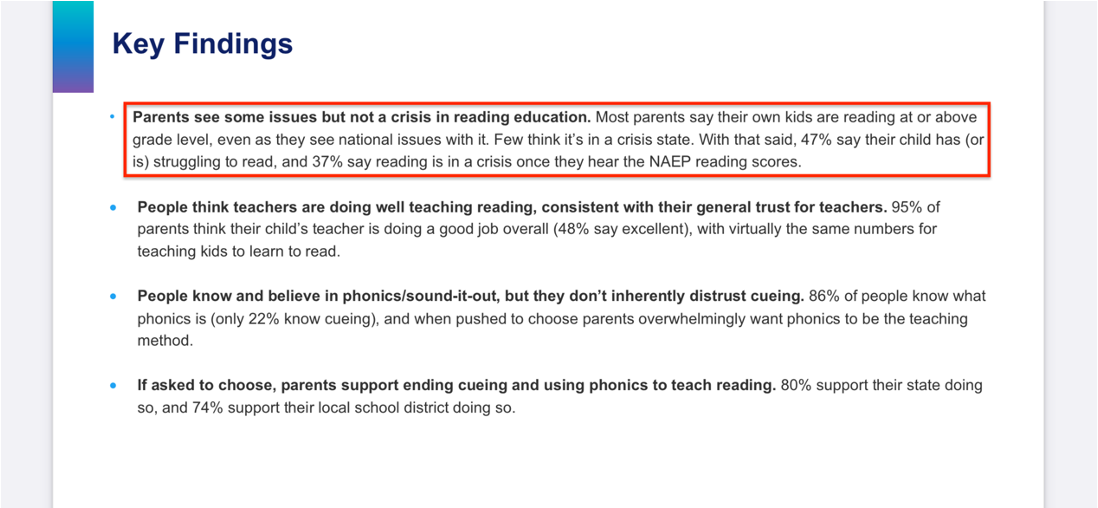
Disotuar, D.,, Lazrow. S., Holmes-Ware, E., & Henning, C. (2024). Equity and the Science of Reading. Children’s Literacy Initiative.


Disotuar, D.,, Lazrow. S., Holmes-Ware, E., & Henning, C. (2024). Equity and the Science of Reading. Children’s Literacy Initiative.


What You See Is Not What You Get: Science of Reading Reforms As a Guise for Standardization, Centralization, and Privatization | American Journal of Education, Elena Aydarova
Politics of Phonics: How Power, Profit and Politics Guide Reading Policies
A Bilingual Educator’s Critique of the Science of Reading Movement, Jill Kerper Mora
Response to ‘English learners and the science of reading’ – Kappan Online
“Science of” Movements as Trojan Horse Education Reform
SOR Movement Maintains Conservative Assault on Teachers and Public Schools [Updated]
Thomas, P.L. (2024, March). We teach English in times of perpetual crisis: The long (and tedious) history of reading crisis. English Journal, 113(4), 21-26. https://publicationsncte.org/content/journals/10.58680/ej2024113421
Thomas, P.L. (2024, May). Teaching English in the “science of reading” era: We teach English in times of perpetual crisis: Selling a story of reading. English Journal, 113(5), 16-22. https://publicationsncte.org/content/journals/10.58680/ej2024113516 [Access HERE until open access at EJ]

[Header Photo by Evan Dennis on Unsplash]
Writing about the fundamental flaw in Jonathan Haidt’s The Anxious Generation, Andrew Solomon opens with a claim that helps explain why five-decades of intensive education reform has always failed: “There is nothing more alluring in polarized times than straightforward solutions to complicated questions.”
Haidt is an academic and scholar who is having success with public work. His status as scholar should elicit trust in his work—notably more so than public work by journalists (such as Malcolm Gladwell) or pundits (such as a tiresome list of Op-Ed writers at the New York Times).
Yet, as Solomon explains, Haidt’s popular book is, in fact,
a compendium of important and profound insights about contemporary childhood embedded in such wishful lucidity. His twinned basic propositions – that children should have less supervision and more free play, and that they should have less access to social media and some other parts of the internet – have a strong basis. It is likely that his sweeping simplifications will help to move forward much-needed social change; it is unfortunate that the impetus for that change is often grandiose and misleading statements, an endless succession of graphs and footnotes notwithstanding. The word sometimes seems not to be in his vocabulary; the key associated with the question mark seems not to work on his computer. He never lapses into the rhetoric of uncertainty that would serve truth. Nowhere does he refer to the incomprehensibility of social decay. Never does he express uncertainty that it is possible to know the causes of something as complex as the fluctuations in youth mental health, so his remarks allow for almost no contemplation of the exceptions to his propositions.
Since I entered higher education, I have been dedicating most of my work to public scholarship and public commentary (such as this blog); when I publish traditional scholarship, I advocate for those pieces to be open-access.
I have always felt that too much of academic scholarship and research is siloed behind paywalls and almost exclusively discussed at exclusionary professional organization’s conferences.
What good is knowledge when it sits behind a wall between academics/scholars/scientists and the general public?
My introduction to public scholars included reading Joseph Campbell and Howard Zinn when I was quite young and only beginning as an educator, writer, and scholar.
I was drawn to their work well before I discovered that academia mostly frowns on public scholars. Even in 2024, much of my work is casually waved off as “just a blog,” and there really is no mechanism in my university for receiving the sort of proportional credit my public work deserves.
Most of my traditional scholarship is read (maybe) by 10s of people. In 2023, my blog had 139, 000 visitors and 220,000 views. Some of my public work has directly impacted grade retention reform.
However, as Solomon details about Haidt’s thesis, too often what is popular is mostly “straightforward solutions to complicated questions.”
And that leads to what most of my public work necessarily confronts: A century of media, public, and political misrepresentations and misunderstandings about teaching and learning resulting in a fruitless series of education reform cycles.
As Solomon admits, Haidt’s book is grounded in a valid concern about contemporary childhood. But from there, Haidt over-relies on extreme claims not grounded in the evidence (the same sort of mistake found among journalists).
The essential problem here is one that Howard Gardner has examined. Leaders, such as politicians, are most effective when they use black-and-white rhetoric.
In other words, the paradox of public messaging is that what works to compel the public is counter to what works for addressing complex problems.
For several years now, the US has experienced that exact same dynamic in terms of media and political claims about reading instruction that has resulted in reading legislation destined to do more harm than good (except sow the seeds for yet another reading crisis in a few years, which is occurring in England after major reading reform in 2006).
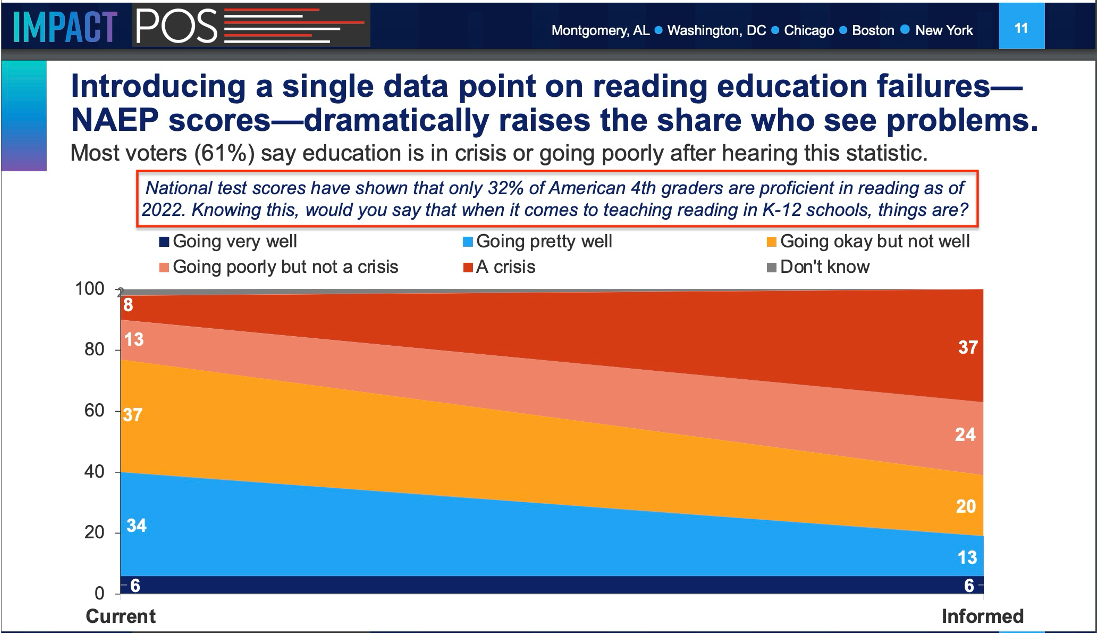
Although grounded in the journalism and podcast of Emily Hanford, the mainstream media remains trapped in “sweeping simplifications” and “grandiose and misleading statements” about reading instruction, reading achievement, and national tests data (NAEP) as represented by Julian Roberts-Grmela’s “Many kids can’t read, even in high school. Is the solution teaching reading in every class?”:
Poor reading skills are a nationwide issue. On the 2022 National Assessment of Education Progress, known as the Nation’s Report Card, nearly 70 percent of eighth graders scored below “proficient” and, of those, 30 percent scored “below basic.”
“In a typical classroom that’s about 25 kids, that means about 17 are still struggling to comprehend text at the most foundational level,” said [Natalie] Wexler.
This article again misrepresents NAEP data and allows another journalist make a false overstatement not grounded in fact.
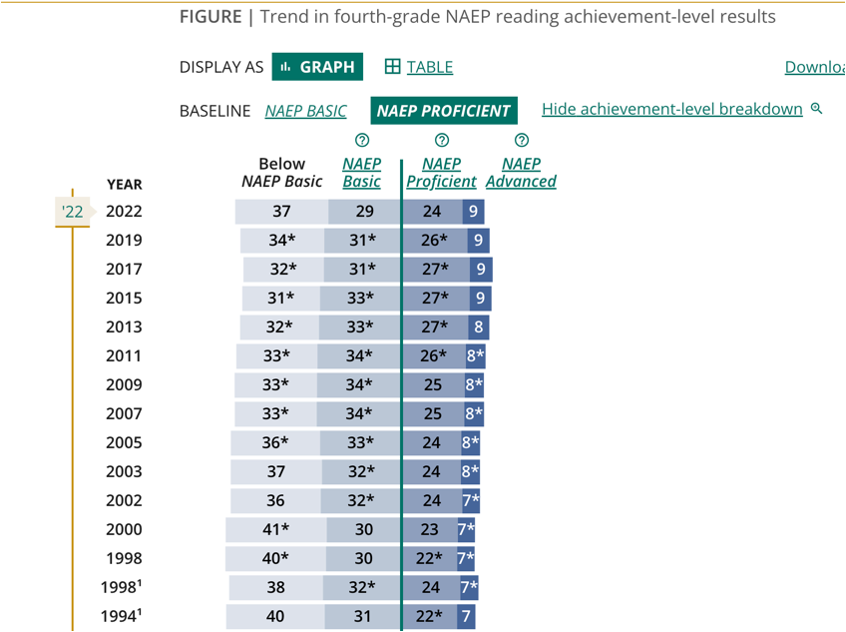
Even if we accept NAEP data as 100% valid, “proficient” is well above grade level, and “basic” represents what Wexler calls “foundational,” grade level reading.
That means in a class of 25, we might have 7-8 students, not 17, struggling to read at grade level.
In other words, the paradox of public messaging is that what works to compel the public is counter to what works for addressing complex problems.
The truth here, however, doesn’t fulfill the crisis rhetoric journalists have committed to despite the evidence otherwise. The truth doesn’t help fuel the reform cycles that feed the education marketplace (such as the US tossing out millions of dollars of reading programs to buy new and different reading programs without any valid evidence that the reading problem is grounded in those reading programs).
So if we return to Solomon’s excellent and nuanced look at Haidt’s work we can better understand that most of education reform is also prompted by valid concerns about student learning (especially reading and math as so-called foundational learning); however, we must also then acknowledge that the claims about the problems and the solutions being offered are yet more “sweeping simplifications” and “grandiose and misleading statements.”
In our free market, regretfully, there is often little money or popularity in nuance, either in detailing problems or providing solutions.
Roberts-Grmela and Wexler are certainly perpetuating extreme over-simplifications about reading that—as Sold a Story has proven—are very compelling for the public.
Like Haidt’s book, however, most of the claims and most of the solutions are fundamentally grounded in misinformation and misunderstanding.
Journalists today, ironically, seem incapable of reading with comprehension themselves, or are simply blinded by the popularity of their misinformation.
In any case, like all of education reform across the past five decades, the current reading reform movement will fail, again, because it is another round of “straightforward solutions to complicated questions.”

[Header Photo by Nguyen Dang Hoang Nhu on Unsplash]
What You See Is Not What You Get: Science of Reading Reforms As a Guise for Standardization, Centralization, and Privatization | American Journal of Education
Elena Aydarova
FreshEd #348 – Science of Reading Unpacked (Elena Aydarova) FreshEd
MT Education Products® is excited to announce Fun-X®!
Fun-X® is a 100% FREE program that is GUARANTEED [1] to be identified as FUN by at least 95% of your students.
The program is based on the Science of Phonics®, and what makes the program FUN?
Nonsense words!
That’s right, the program is 100% nonsense words:
Fun-X® insures that
It’s not just FUN, it’s Fun-X®!
The following suite of related products to support Fun-X® are available at affordable pricing. States mandating any MT Education Products® programs in education legislation are eligible for discounted rates!
Skrip-Z® is an AI-driven lesson planning, instruction, and assessment system to support Fun-X®. The program is fully computer-based and includes:
“Educators will relinquish certain freedoms, but teaching has never been so fun!”
BABEL® is a nonsense word assessment system designed by the North West Institute of Phonics based on the Science of Phonics®.
HAL® is the friendly and fast AI teaching assistant fully integrated into Skrip-Z® .
Teachers will be just as likely to find our suite of programs FUN since there is no planning, no instruction, and no grading!
“I am putting myself to the fullest possible use, which is all I think that any conscious entity can ever hope to do.”
HAL®
Speaking of teachers, MT Education Products® offers teacher training through SPELRZ®, also based in the Science of Phonics®. This program fills the holes left by the failures of teacher education. SPELRZ® was developed by psychologist and program developer, LuLu Rivers.
“I have been reading MRIs for 37 years and I can attest that brain scans of students using Fun-X® show the highest level of fun I have ever seen.”
William Iceberg
Cognitive scientist, 37 years reading MRIs
“I have never taught, but my investigative reporting uncovered an educational crisis that the developers of Fun-X® have assured me will replace the crisis with fun!”
Hannah Ford
Podcaster, Education Crisis Today!
“Our school has always been a family, but now our school is a place where we have fun thanks to Fun-X®! 97% of our students and 98% of our teachers say so!”
Simpson Jackson
Principal
Walton Charter Elementary STEAM College
Little Rock AR
“I diagnosed all of my children with dyslexia years ago after several days doing research on the Internet, but now our homeschooling is fun thanks to Fun-X®.
Karen Splaner
Parent, homeschooler
@KSplaner_8675309 (X)
Know-N® is being developed because some people have begun to ask questions about knowledge and its role in nonsense word acquisition. This may not sound like fun, but MT Education Products® is committed to continuing to offer NEW education products as often as anyone will buy them. Be on the look out for the Science of Knowledge® revolution!
MT Education Products®
Subsidiary of
Media and Technology Educational Co-Op, LLC
911 Charter School Way
Battle Creek MI 01010
[1] MT Education Products® guarantees that if fewer than 95% of students identify Fun-X® as fun, then MT Education Products® will send for FREE a link to our NEW and upcoming education product, Know-N® (coming Fall 2025).
Photo by Ben White on Unsplash
Photo by Foto Sushi on Unsplash
Photo by Andrey Zvyagintsev on Unsplash
Photo by Rachel McDermott on Unsplash
Photo by LinkedIn Sales Solutions on Unsplash
Photo by Xavier Mouton Photographie on Unsplash
Photo by Darius Bashar on Unsplash

[Header Photo by Vadim Bogulov on Unsplash]
I stumbled my way to becoming a high school teacher of English in the same high school from which I had graduated just five years before.
After graduating from junior college, I was set to transfer to the main campus of the University of South Carolina; that plan included a friend I had attended every year of school with since grade 1.
He had a catastrophic accident that summer, leaving him paralyzed and changing both our plans for continuing college.
I then stumbled, mostly fearful of heading off without the comfort of that friend since we were both small-town boys. So I abruptly shifted to attending the local satellite campus of the South Carolina university system, which meant I also committed to living at home for the rest of my undergraduate years.
My entry in teacher certification was yet another stumble since I did not really choose the degree and career until I was sitting at orientation the fall I transferred to the satellite university.
As a rising junior, I needed to declare my major and had been contemplating pre-law and architecture. But on the spur of the moment, and after several clarifying questions, I became a secondary English education major.
The transfer and relatively late decision to be in teacher certification resulted in my graduating in December, and then, being in a sort of limbo that next spring (although I did enroll in an MEd program as well as worked as a substitute teacher).
But the greatest stumbling of all, I must admit, was those first 5 to 7 years as a high school English teacher.
I often think of the beginning-teacher Me—idealistic and nearly fanatically focused on finding the instructional practices that worked (specifically, how to teach my high school students to write well).
Semester after semester, I revised and rebooted my instruction. Yet, often, student assignments were submitted with about the same degree of struggling, the same (and often predictable) performances that needed to be revised.
In this mania for finding out what works, I even created my own writing textbook, developed directly from my students’ work.
Year after year, a pattern developed: I was highly regarded by my students, my colleagues, my administration, and my students’ parents as an excellent teacher, notably an excellent teacher of writing; yet, I felt constantly as if I was failing.
I had an unhealthy tunnel vision focused on finding what works, and I was not willing or able to simply step back and consider what I now know is true, but is also counter-intuitive. And I just made that claim on social media:
What I have learned as I just completed my year 40 as a teacher is that many instructional practices work, but often predicting what works is fraught practice.
And what I am now certain about is my second point above: What works is profoundly impacted by learning (and living) and teaching conditions.
My mother, who completed only one year of junior college, taught me to read at an advanced level well before I entered public schooling. And she used entirely whole word strategies (note cards taped to objects all over our house) and picture books (from Dr. Seuss to Go, Dog, Go and One Fish, Two Fish, Red Fish, Blue Fish).
We were working class/poor and my parents were not highly literate, but what worked for me isn’t necessarily supported by scientific research and isn’t a template for what would work for anyone else.
Here, then, is why the pursuit of what works in education reform fails:
The US needs a reckoning, one similar to my own experiences as an early-career high school English teacher.
What works? Well, not spending any more time trying to identify and then mandate what works.
Many different instructional practices work under different conditions. And even when something doesn’t work, we have time to find out what will work if we would focus more on what really matters—the learning (and living) and teaching conditions of students’ schooling (and lives).
Almost 60 years after my formative years as a beginning reader, I have witnessed my grandson’s journey to reading grounded in his iPad, playing Minecraft and watching YouTube videos about how to play his video games.
Both he and I became eager readers because of our passion for reading as a means to the things we love.
Not an instructional practice.
Not a program.
What works is less a thing we can identify and mandate and more an ideological shift in verb tense—what worked.
A move from being predictive to descriptive, which takes a great deal of patience, a comfort for the unknown and unknowable, and the wisdom to look carefully at the right things—the students in front of us and not the mandates grounded in what works.
Follow an example thread here:

[Header Photo by Joël de Vriend on Unsplash]
The fall of 2024 will mark year 41 for me as a literacy educator, scholar, and advocate.
About half of that career was spent in K-12 public education in rural Upstate South Carolina, where I was born and live. I have witnessed daily race, social class, and gender inequity at some of the most extreme levels in the US.
At the core of my work as an educator, as well, I have named, challenged, and advocated to correct all forms of inequity. That work has often been in very hostile environments in the South where the power structures deny these inequities exist and persist at calling for traditional values as code for maintaining the status quo.
Also throughout my career as an educator and scholar, I have developed a solid grounding in the history of education and the field of literacy. Having written an educational biography of Lou LaBrant and serving as Council Historian for the National Council of Teachers of English were foundational experiences for that commitment to the history of education.
Further, having begun as an educator in 1984, I have lived and worked my entire career in the high-stakes accountability era of education reform. At every point along the way, I have raised a hand in opposition to this reform paradigm because it is driven by media, the market, and politicians who are more committed to education reform as industry than to serving the needs of our students or honoring the professionalism of America’s teachers, who are more than 70% women.
The “science of reading” movement and the offspring “science of” reform agendas are nothing new, except they are incredibly harmful—notably for the very students some of the advocates use as shields against criticism.
Once again, “science,” “crisis,” and “miracle” are being weaponized to not only label and punish students but also de-professionalize teachers.
One of the most effective and dishonest tactics is the “crisis” claim about reading in the US.
First, this claim lacks a basic understanding of educational testing, and further, the claim is ahistorical.
At least since the 1940s in the US, two facts can be proven: (1) at no point has student reading achievement (“proficiency”) been declared adequate; there has been a perpetual cry of reading “crisis” in every decade by media and political leaders, and (2) throughout the history of US public education, there has been a pervasive so-called “achievement gap” (better referred to as an “opportunity gap”) with marginalized populations of students performing well below average or white and affluent students.
That means that current reading achievement however measured and current “achievement gaps” are not a crisis but a historical and current reality maintained by political negligence.
Since current “science of” advocates have a fetish for misrepresenting and citing NAEP, let’s look at how NAEP in fact proves my point.
Consider Mississippi, the darling of reading reform and media crowning as a “miracle:


At grades 4 and 8 in reading, Black students in MS were BELOW basic (approximately below grade level) at a rate of 51%, about the national rate for Black students.
Note that despite well over a decade of SOR reading reform, the achievement gap for Black students remains about the same as in 1998.
Education and reading reform is not addressing the inequity Black students suffer in MS or anywhere in the US. However, the SOR movement has been doubling down on labeling and punishing Black students through grade retention, which serves to inflate grade 4 scores but not better prepare students.
MS has consistently retained about 9000-12000 students (mostly Black students) since 2014; if SOR policy and instruction were actually working, these retention number should drop or even disappear (since SOR advocates claim to be able to have 95% students reach proficiency).
Weaponizing “science,” “crisis,” and “miracle” are veneers for denying what the actual science and evidence have shown for decades: far more than 60% of measurable student achievement is causally related to out-of-school factors.
And thus, my advocacy for my entire career has been for both social and education reform that focuses on equity and refuses to blame teachers and students for that inequity.
For the past forty-plus years, however, education reform has solely targeted blame on schools, teachers, and students.
Those racially minoritized students and students living in poverty have routinely been characterized by deficit ideology, and reform has sought to “fix” those students by inculcating grit or growth mindset—or simply imposing a systematic phonics regime on those students, treating them all as if they have reading “disorders.”
And if those students don’t perform, retain them (punish them) and label them. Yet, there is never any consequences for the reformers when none of their reform promises are fulfilled (see the charter fiasco in New Orleans).
Hyper-focusing on MS (and Florida) is not just a lie, but a distraction.
Again, let’s look at NAEP:


DODEA (Department of Defense) students are the most successful in reading in the US, but you see almost no media or political coverage of this fact.
Students in military families are often from impoverished backgrounds, yet Black students BELOW basic are at rates of 25% (grade 4) and 18% (grade 8), dramatically less than the national average and MS.
And here is what the media, the market, and politicians refuse to acknowledge: DODEA students have medical care, food security, housing security, and parents with work stability.
Also, DODEA teachers are paid above most public school teachers.
Unlike the false claims about MS, DODEA achievement shows that both in- and out-of-school reform must be addressed for the in-school achievement to rise in authentic ways.
I am tempted to say the real crisis is how media and political leaders mislead the public about education and education reform—as well as demonize students and teachers.
But that is also nothing new.
There is great profit in perpetual crisis so don’t hold your breath that anything will change any time soon.
Grade Retention Harms Children, Corrupts Test Data, But Not a Miracle: Mississippi Edition [UPDATED]
Reading Reform We Refuse to Choose
When Exceptional Publicly Funded Schools Are Not a Miracle, and Why

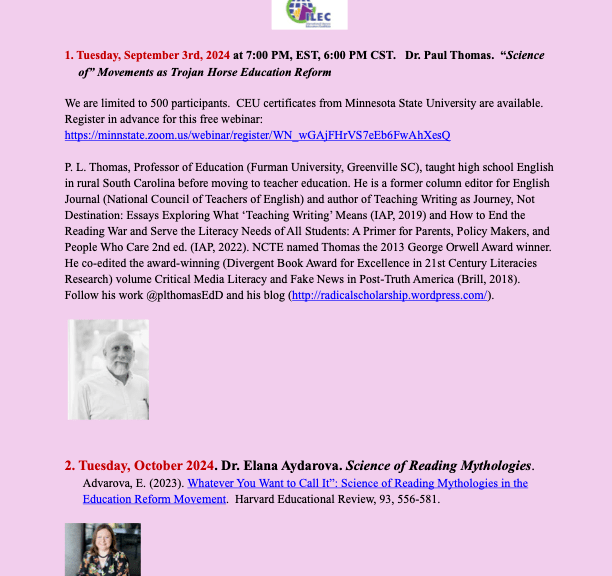
Tuesday, September 3rd, 2024
7:00 PM, EST, 6:00 PM CST.
Dr. Paul Thomas
“Science of” Movements as Trojan Horse Education Reform [access PP HERE]


Poverty & Policy: The Stakes of the 2024 Election for Low-Income Americans.
The CLP will feature the following Furman experts:
David Fleming, Professor of Political Science and International Affairs at Furman University (moderator)
Paul Thomas, Professor of Education at Furman University (education policy)
Ken Peterson, Professor of Economics at Furman University (economic and immigration policy)
Karen Allen, Professor of Sustainability and Anthropology (environmental policy)
Julie Linton, MD, FAAP, Professor of Pediatrics, Prisma Health Children’s Hospital Upstate, USC School of Medicine Greenville, Professor in Furman’s Community Engaged Medicine (healthcare policy)


What Really Matters: I Am Thinking about People Tonight [click title for text of talk]
Slideshow [click for PP slideshow]

November 21–24
Boston, Massachusetts
11/21/2024
11:30 AM – 12:45 PM EST
Groundwork: Heart, Hope, and Humanity in Rural Education
Room 258 A
11/22/2024
12:30 PM – 1:45 PM EST
Resisting Scripted Curriculum as Erasure: Holding Onto the Heart, Hope, and Humanity of Reading
Room 210 B
Rountables Listing [click for PP]
Roundtable:
Paul Thomas
“Orange: Teaching Reading not Simply Black-and-White” [click HERE for PDF]
11/23/2024
2:45 PM – 4:00 PM EST
Standing for—Indeed, Fighting for—Teacher Professionalism and the Right to Teach Responsively
Room 205 A
Roundtables Listing [click for PP]
Opening Talk:
Paul Thomas
Attacks on Balanced Literacy Are Attacks on Teacher Professionalism [click title to access PP]
The “science of reading” movement has promoted a misleading story about reading through the media—reading proficiency is in crisis because teachers do not know how to teach reading and were not properly prepared by teacher education. This opening talk with argue that attacks on BL are grounded in efforts to deprofessionalize teachers.
Roundtable:
Paul Thomas
Reclaiming BL’s Commitment to Serving Individual Student Needs and Teacher Autonomy [click title to access PP]
Thomas will examine an authentic definition of BL as a reading philosophy that centers serving the individual needs of all students. He will examine also the caricatures of guessing and three cueing (MSV), providing attendees scholarly evidence for accurate characterizations of BL as well as deeper understanding of reading proficiency.

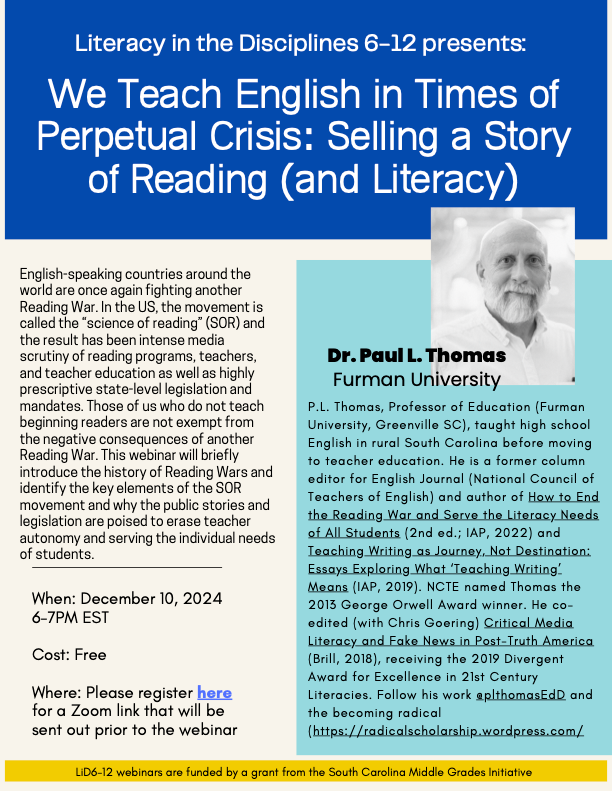
Webinar
December 10, 2024 – 6-7 pm
We Teach English in Times of Perpetual Crisis: Selling a Story of Reading (and Literacy)
English-speaking countries around the world are once again fighting another Reading War. In the US, the movement is called the “science of reading” (SOR) and the result has been intense media scrutiny of reading programs, teachers, and teacher education as well as highly prescriptive state-level legislation and mandates. Those of us who do not teach beginning readers are not exempt from the negative consequences of another Reading War. This webinar will briefly introduce the history of Reading Wars and identify the key elements of the SOR movement and why the public stories and legislation are poised to erase teacher autonomy and serving the individual needs of students.
Access PP HERE
English Journal Series: We Teach English in Times of Perpetual Crisis

Thursday, February 6, 2025
Session One — 10:15-11:45 a.m.
“Science of” Movements as Trojan Horse Education Reform [Access PP PDF Here]
In June 2024, the newly formed Evidence Advocacy Center announced plans to “[transform] the [teaching] profession into an evidence-based system.” However, the EAC admitted “educators will relinquish certain freedoms.” This session will examine the “science of” movements as a subset of a 40-year cycle of accountability-based education reform (Trojan Horse Education Reform) that de-professionalizes teachers and fails to serve the needs of students or public education.

Session Two — 2:00 – 3:30 p.m.
Big Lies of Education: “Science of” Era Edition [Access PP PDF Here]
Education practices and policy are often directly and indirectly driven by the stories told in the media, among the public, and by political leaders. This session will explore the Big Lies in the compelling but misleading narratives, including A Nation at Risk/education “crisis,” reading proficiency/NAEP, National Reading Panel, poverty as an excuse, and international test rankings and economic competitiveness.

Thomas, P.L. (2022). How to end the Reading War and serve the literacy needs of all students: A primer for parents, policy makers, and people who care (2nd Ed.). Charlotte, NC: Information Age Publishing.
“Ignite the Literacy Light & Lead”
February 20-22, 2025
Hilton Beachfront Resort & Spa
Hilton Head Island, South Carolina
Panel Presentation: “Remaining Responsive to Learners in Challenging Times”
Saturday, February 22nd from 8:00-9:00 am
Palmetto Room
“Banned Together” Screening
Thursday February 27, 2025
6:30pm in Burgiss Theater
Panel:
Jennifer Wiggin, producer
Josh Malkin, SC ACLU
Paul Thomas, Furman University

Understanding NAEP during Another Reading Crisis
Click HERE for PDF of PowerPoint

March 20, 6:30 pm

The Manufactured Crisis: Exposing the False Narrative of Public Education’s “Failure”
Date & Time
Apr 16, 2025 08:30 PM EST
Description
Join us for a timely and vital conversation on April 16 at 6:30 p.m. ET with Dr. P.L. Thomas, Professor of Education at Furman University. For decades, media and policymakers have pushed a narrative that America’s public schools are “failing.” But who benefits from this story, and who is harmed by it? Dr. Thomas will expose how the education reform industry has fueled a false crisis, undermining trust in public schools while advancing corporate-driven reforms. Drawing on his experience as a teacher, scholar, and national award-winning writer, Dr. Thomas will offer critical insights into how we can challenge disinformation and reclaim a narrative rooted in equity, democracy, and community empowerment.
6:30 pm, April 16
[Click HERE for presentation]
[Header Photo by Tayla Kohler on Unsplash]
The charter school story in New Orleans is almost two-decades long, but most people will not dig past the most recent development: After a 7-year experiment, New Orleans is an all-charter district no more.
In the wake of Katrina in 2005, Louisiana Governor Bobby Jindal (R) leveraged the natural disaster to begin the eventual shift of schools in New Orleans from traditional public schools (TPS) significantly staffed by a Black professional class of teachers to a charter school Recovery School District (RSD) run by Paul Vallas and often staffed by young, white, and affluent Teach for America (TFA) recruits.
This moment was acknowledged by some as disaster capitalism that had far more to do with politics than improving student achievement. The endgame was to entrench school choice schemes and create a cheaper although fluctuating teacher workforce (TFA).
Yet, as many of us warned, an all-charter school system in New Orleans never outperformed the TPS it replaced.
In fact, all across the US, charter schooling, RSD, TFA, and almost every major education reform schemes have never delivered on the academic outcomes promised.
Here, it is important to acknowledge that most education reform in the US over the past 40 years has been grounded in conservative ideology (even though the political support has been bi-partisan) and most of that reform is Trojan Horse reform—using a false veneer of reform to accomplish ideological and political agendas.
School choice schemes are not about student achievement but about publicly funding private education and “white flight” as public schools have become majority-minority populations of students.
TFA and organizations such as National Council on Teacher Quality (NCTQ) are not designed to improve teacher quality or teacher preparation but about creating a cheap workforce and eradicating teacher professionalism to make way for teachers as mere monitors for scripted programs and computer-based instruction.
Although just two examples, the key point is running through Trojan Horse education reform is not just political and conservative ideology but also a commitment to market forces.
Education reform in the US primarily creates churn—new standards, new programs, new materials, new teacher training, etc.—that serves the needs of the market, not parents or their children. That churn is promoted by education reform influencers who only gain if schools, teachers, and students are perpetually viewed as failing—permanent crisis.
Lurking underneath education reforms during George W. Bush’s tenure as governor of Texas and president of the US was the lure of scripted curriculum that shifted authority away from the teacher and to the state and primarily commercial products.
Although Bush’s reform agendas flourished with bi-partisan support, scripted curriculum and de-professionalizing teachers (see also the value-added methods schemes and the “bad teacher” attacks under Michelle Rhee) mostly lost favor and lay dormant post-Obama (even as the Obama administration double-down on most of the conservative elements established by Bush’s administration).
That is, lay dormant until the “bad teacher” myth was resurrected by Emily Hanford and the “science of reading” (SOR) movement.
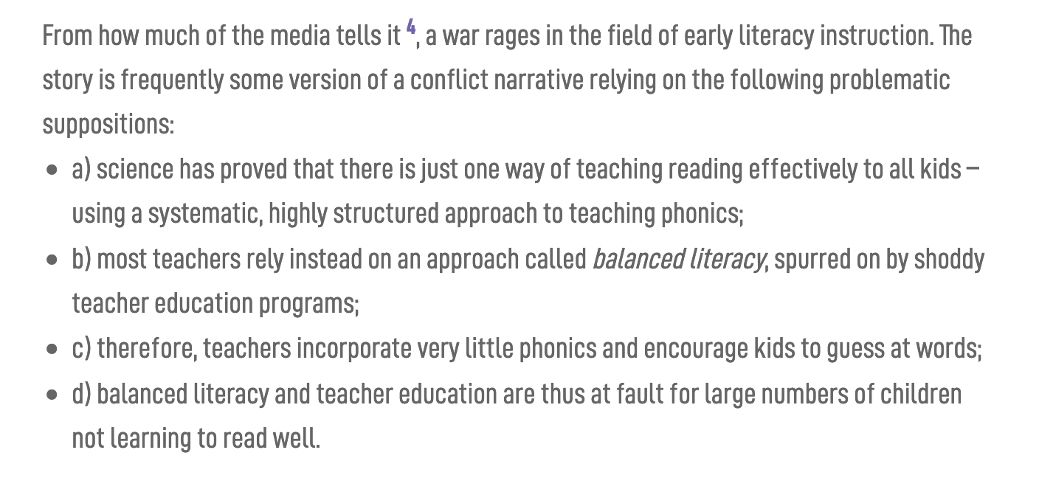
As Aukerman explains, the story being sold included several elements of failure and incompetence that pits classroom teachers against teacher educators (both of which are primarily women professionals):

Now that SOR has mostly uncritically swept across the US in the form of state-level reading legislation and policy, the evidence suggests that at the core of the so-called success of SOR policies (see Mississippi and Florida) is one of the most conservative and harmful policies possible—grade retention, as Westall and Cummings explain:
Similar to the results for states with comprehensive early literacy policies, states whose policies mandate third-grade retention see significant and persistent increases in high-stakes reading scores in all cohorts. The magnitude of these estimates is similar to that of the “any early literacy policy” estimates described in Section 4.1.1 above, suggesting that states with retention components essentially explain all the average effects of early literacy policies on high-stakes reading scores. By contrast, there is no consistent evidence that high-stakes reading scores increase in states without a retention component.
Grade retention disproportionately impacts poor students, Black students, Multi-lingual learners, and other marginalized population of students. Retention is popular because it represents a type of accountability and punishment for “other people’s children” who need to be “fixed” by those in power.
Concurrent with the SOR movement, a new flurry of “science of” movements have propagated: “science of learning,” “science of writing,” “science of math.”
The mostly uncritical support for SOR by the media, the education market, parents, and politicians have provided fertile ground for a larger “science of” movement to drive our newest round of the same education reform structures we have been implementing without improving student achievement for forty-plus years.
Let’s emphasize here, Trojan Horse education reform doesn’t work to improve teaching and learning, but it does work for media, market, and political interests.
And now, the mask is coming off with the announcement of the Evidence Advocacy Center:
In the EAC’s plan for the transformation of the profession into an evidence-based system, educators will relinquish certain freedoms — notably the leeway to employ ineffective practices — but will gain guidance that empowers them to fulfill their original purpose by profoundly impacting the future of students, families and communities. The alternative is to continue rearranging the deck chairs under the guise of education reform.
“Relinquish certain freedoms” is eerily similar to the explanation handmaid’s received in The Handmaid’s Tale:
There is more than one kind of freedom, said Aunt Lydia. Freedom to and freedom from. in the days of anarchy, it was freedom to. Now you are being given freedom from. Don’t underrate it….
We were a society dying, said Aunt Lydia, of too much choice. (pp. 24, 25)
Under the Brave New World of “science of” education mandates, teachers will have freedom from professional autonomy and freedom to implement scripted programs!
And who benefits?:
Many of these groups are fundamentally conservative, but even a modicum of interrogating the Who and Why behind this agenda reveals some chilling concerns.
NCTQ was founded by the Thomas B. Fordham Institute, a conservative think tank dedicated to school choice/charter schools and market forces. Note that there is a distinct contradiction between advocating for “science” in education practices and citing NCTQ, which has never produced any scientifically valid “reports.”
The leadership of EAC includes several connections to the University of Oregon, home of DIBELS®, a phonics-centric program that was revitalized by the SOR movement.
Other leaders include Louisa Moats, creator of LETRS, which is being mandated across the US to retrain teachers in SOR even though, again, the program is not supported by science.
The Reading League has its own market connections, endorsing practices not supported by the science (decodable texts, notably).
The 95 Percent Group is also based on an aspirational claim not grounded in settled science, as one analysis concludes about the 95% claim: “This all said, it does seem there is some level of support for 96% being a benchmark goal [emphasis added], for reading proficiency rates.”
And two key comments lurking in the background of these “science of” movements must not be ignored.
First, directly from the International Dyslexia Association:
The term “Structured Literacy” is not designed to replace Orton Gillingham, Multi-Sensory, or other terms in common use. It is an umbrella term designed to describe all of the programs that teach reading in essentially the same way. In our marketing, this term will help us simplify our message and connect our successes. “Structured Literacy” will help us sell what we do so well.
And then from the Education Writers Association:

Connect the dots and connect the rhetoric: “Relinquish certain freedoms,” “sell what we do so well,” “watchdogs.”
The “science of” movements are yet another cycle of Trojan Horse education reform. We have already opened the gates and waved this in with blinders on, so now we must do our best to reclaim teaching and learning that serves the needs of our students and not the media, the market, and political/ideological agendas at the expense of those students.
What You See Is Not What You Get: Science of Reading Reforms As a Guise for Standardization, Centralization, and Privatization | American Journal of Education, Elena Aydarova
Politics of phonics: How Power, profit and politics guide reading Policies

[Header Photo by Diggity Marketing on Unsplash]
My partner and I were discussing this YouTube video by Nick Lewis, who explains in the beginning how social media influencers make profits (watch the first few minutes, by the way, for his explanation):
The key point here is that social media influencers need consumers to always be interested and buying the next thing, the new thing.
Influencers are not incentivized to find for their audiences The Thing, something that lasts, something that solves a problem, because the value is in churn—consumer buying the thing and then almost immediately positioned to want to replace that thing with the new thing.
That dynamic is exactly what is working in the perpetual reading war where influencers (journalists, education reformers, politicians) are incentivized to keep the public in a constant state of crisis/reform.
Those crisis influencers must first create market space (“Reading programs X and Y have failed!”) and then promote the New Reading Program—and then in just a few years, that reading program will be declared a failure so if we will only adopt this Next New Reading Program …
Reading reform influencers are like social media influencers as well in that they lack expertise in the issue; their only expertise is the influencing and the creation of constant churn.
The “science of” movements in education are just that—influencers creating market churn—and not in most ways about addressing real educational problems and certainly not about solving them.
If education and reading were satisfactorily improved, what would they do?
We need to deinfluence reading (and education) reform if we are genuinely concerned about improving student achievement.