Category Archives: Social Context Reform

Media Manufactured Education Crisis? You Can Count on It

[Header Photo by American Jael on Unsplash]

This fall was the start to year 42 for me as an education, the first 18 as a high school English teacher and the rest as a college professor. I have been noting that career in my presentations at NCTE 2025 in Denver, adding that I am toying with at least making it to year 50.

As I ponder that number, I often return to the sense of awe I always feel when I mention my doctoral work, an educational biography of Lou LaBrant—a former NCTE president (1954) who lived to be 102 and taught for a staggering 65 years (1906-1971).

Approaching 100 and with declining eyesight, LaBrant typed her memoir for the head of the Museum of Education at the University of South Carolina and a key member of my doctoral committee, Craig Kridel.

I was thinking about LaBrant during my presentation yesterday, Recovering Our Reading Dream from a Long Crisis Nightmare, because in her memoir, LaBrant expressed her frustration with the back-to-basics movement during the Reagan administration that orchestrated the 80s education crisis with the melodramatic and misleading A Nation at Risk.

LaBrant noted that over eight decades as an educator she worked through several education crisis cycles and multiple back-to-basics movements—notably the 1940s reading crisis spurred by low literacy rates for draftees during WWII.

While my career pales in many ways compared to LaBrant’s, I feel her pain; with education crisis it is déjà vu all over again.

The only thing, it seems, as common as the media announcing yet another education crisis is people rejecting my arguments against education crisis rhetoric.

And right on cue, after my reading crisis presentation about Tomorrow’s Illiterates: The State of Reading Instruction Today (1961) where I mentioned that our colleagues in math education are now in the crisis crosshair, joining the hyper-intense reading crisis boiling over with “science of reading” advocacy, this morning, I saw this: Editorial: For too many American kids, math isn’t adding up.

The media obsession with declaring an education crisis is so commonplace that I started to just scroll on, but, regretfully, I began to read:

Math scores in the U.S. have been so bad for so long that teachers could be forgiven for trying anything to improve them. Unfortunately, many of the strategies they’re using could be making things worse. It’s a crisis decades in the making.

In the early 20th century, education reformers including John Dewey and William Heard Kilpatrick developed a theory – drawing from the work of Jean-Jacques Rousseau – that came to be known as constructivism. The idea was that learning happens best when students immerse themselves in a problem and find their own solution. By the late 1980s, math standards had embraced “discovery-based learning.”

I expected the lazy and unsupported “math scores” opening, but that second paragraph is the stunner. In 2025, the media still looks for a way to blame John Dewey for the education crisis they repeatedly manufacture.

It was at the core of the reading crisis in the 1940s, and again, in Tomorrow’s Illiterates (1961) noted above

Also in my presentation yesterday, I uttered Dewey’s name and suggested the attendees track down Alfie Kohn’s Progressive Education: Why It’s Hard to Beat, But Also Hard to Find, which does an excellent job of detailing how Dewey’s progressive education is simultaneously blamed and almost never implemented in formal schooling [1].

I immediately posted on social media that the editorial writers could have just search on Wikipedia and avoided the utter nonsense they wrote about constructivism.

Just a few weeks ago, as well, I covered in my 100-level educational philosophy course that behaviorism and constructivism are educational theories (grounded in the scientific method), distinct from philosophies (grounded in rhetoric and logic, such as Dewey’s progressivism).

Learning theories like educational philosophies are contested spaces, but as I plan to share tomorrow in a roundtable presentation, this math crisis editorial triggers several red flags, notably opening the commentary by exposing the editors lack the basic expertise on education to be making any claim of crisis.

If they wanted to blame constructivism, they could have and should have invoked Piaget and Vigotsky (and plenty of “science of learning” folk have already been doing that, often badly and with the sort of caricature I expect).

The media’s education crisis narrative, however, follows a script you can count on—including misunderstanding or misrepresenting test scores, ignoring social context for educational outcomes, and blaming some cartoon version of a leftist education system that, again, has never existed in the US.

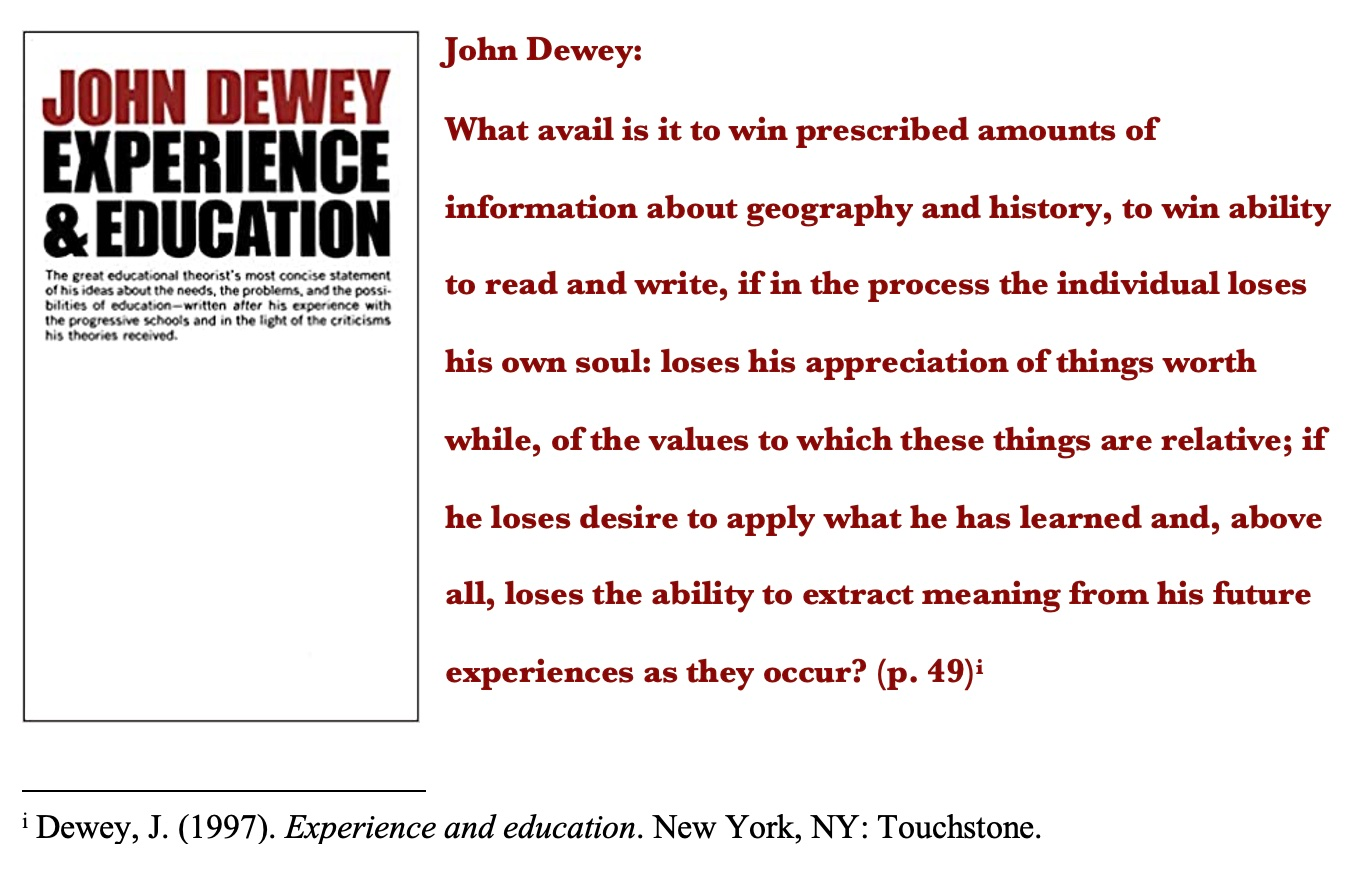
When I mentioned Dewey in my presentation, I joked that almost nobody understood Dewey, including Dewey, which, I think, is a pretty good joke because Dewey (and LaBrant) represented a sort of beautiful and illusive scientific approach to their philosophy of education and their instructional practices.

You see, when Dewey progressives say “scientific,” they mean an organic type of experimentation whereby the educator is always in the process of experimenting and drawing real world conclusions that are evolving (it is better, in fact, to think of Dewey’s ideology as pragmatism, associated with William James).

Theirs is a science of teaching and learning that is grounded in and starts with each individual student in the pursuit of skills, knowledge, and critical awareness. This is distinct from essentialist and perrenialist beliefs that begin with knowledge, basic skills, and Great Books, for example.
Teaching as an experiment only matters in the practical, not any Platonic ideal, and thus, is never settled (one red flag is when anyone makes a claim and bases that on settled science [2]).

A key reason blaming Dewey or progressive education for any education crisis is misguided is that Dewey himself refused to offer prescriptions, calling for every school and every teacher to seek what works best in the evidence before them, the unique set of students who always change.

In short, in teaching and learning, there is no silver bullet, no script, no program that can or will serve the needs of all students.

You can, if you must, insert any content area—math, reading, writing, civics, science, etc.—and shout “Crisis!” But you will be embarrassing yourself.

Just do a little searching, and I dare you to find a single moment over the past century when someone declared that “kids today” are excelling in math, reading, etc.

My point, which is often as misunderstood as Dewey, is not that current teaching and learning are fine, that I am somehow endorsing the status quo.

I am a critical educator; I became an educator to change teaching and learning, and I am disappointed to say that over my 5-decades career, very little has changed, including the popular urge to declare education crisis.

And what remains most disturbingly unchanged is that a vulnerable population of students have always been and continue to be under-served or nearly completely ignored.

But my point also includes that education reform alone (while needed, just not the mainstream way most often tried over and over) will never serve those vulnerable students, whose measurable education outcomes mostly reflect the inequity of their full lives of which the school day is only a fraction:

Almost 63% of the variance in test performance was explained by social capital family income variables that influence the development of background knowledge. Background knowledge is a known predictor of standardized test results. Family income variables are immutable by schools. Only public policies, outside the control of school personnel, can influence family income.

There is some math the education crisis folk never want to calculate.

If you find yourself worrying about your child’s ability to read or do math, I promise you that Dewey is not to blame.

If you find yourself worrying about other people’s children’s ability to read or do math, I promise you that Dewey is not to blame.

Crisis rhetoric, however, doesn’t help; it never has.

Finger pointing and blame probably aren’t very useful either, especially when those pointing fingers go out of their way to show their blame doesn’t quite add up.

In formal education, we have always had and will always have a range of students who excel, struggle, and fail.

As teachers, our job is to serve them all, and serve them better based on who they are and what they need.

However, teachers and schools alone can never be successful.

If evidence of student failure means anything (and those test scores often don’t), it is that we as a democracy are failing not only those students, but also those children, teens, and young adults—many of whom do not have adequate healthcare, food or home security, or the sorts of lives that universal public education, the so-called Founding Fathers, and, yes, John Dewey envisioned that a free people could guarantee.

If you are looking for someone to blame because of those disappointing math scores, well, I hate to tell you that the enemy is us.


[1] I highly recommend also: LaBrant, L. (1931, March). Masquerading. The English Journal, 20(3), 244-246. http://www.jstor.org/stable/803664. Here LaBrant rejects the misunderstood and misapplied project method in the teaching of literature:

The cause for my wrath is not new or single. It is of slow growth and has many characteristics. It is known to many as a variation of the project method; to me, as the soap performance. With the project, neatly defined by theorizing educators as “a purposeful activity carried to a successful conclusion,” I know better than to be at war. With what passes for purposeful activity and is unfortunately carried to a conclusion because it will kill time, I have much to complain. To be, for a moment, coherent: I am disturbed by the practice, much more common than our publications would indicate, of using the carving of little toy boats and castles, the dressing of quaint dolls, the pasting of advertising pictures, and the manipulation of clay and soap as the teaching of English literature. (p. 245)

[2] For example, the math crisis editorial announces authoritatively and with no links to proof:

Unfortunately, a robust body of research has since found that such approaches often fail early math learners (and readers, for that matter). Math rules and facts such as multiplication tables must be taught explicitly, memorized and mastered through practice. Only when this foundation is established can students progress to more complex concepts. Math, it’s often said, is cumulative.


Recommended

Beyond Caricatures: On Dewey, Freire, and Direct Instruction (Again)

Caricature, Faddism, and the Failure of “My Instruction Can Beat Up Your Instruction”

Deja Vu All Over Again: The Never Ending Pursuit of “Scientific” Instruction
Reading Matters

Big Lies of Education: Series

Here I will collect a series dedicated to the Big Lies of Education. The initial list of topics include :

  • A Nation at Risk and education “crisis”
  • Poverty is an excuse in educational achievement
  • 2/3 students not proficient/grade level readers; NAEP
  • Elementary teachers don’t know how to teach reading
  • NRP = settled science
  • Teacher education is not preparing teachers based on science/research
  • Education “miracles”
  • Reading program X has failed
  • Whole language/balanced literacy has failed
  • Systematic phonics necessary for all students learning to read
  • Nonsense word assessments measure reading achievement
  • Reading in US is being taught by guessing and 3 cueing
  • Balanced literacy = guessing and 3 cueing
  • K-3 students can’t comprehend
  • 40% of students are dyslexic/ universal screening for dyslexia needed
  • Grade retention
  • Grit/ growth mindset
  • Parental choice
  • Education is the great equalizer
  • Teacher quality is most important factor in student achievement (VAM)

Series:

Big Lies of Education: A Nation at Risk and Education “Crisis”

Big Lies of Education: Reading Proficiency and NAEP

Big Lies of Education: National Reading Panel (NRP)

Big Lies of Education: Poverty Is an Excuse

Big Lies of Education: International Test Rankings and Economic Competitiveness

Big Lies of Education: “Science of” Era Edition [Access PP PDF Here]

Big Lies of Education: Grade Retention

Big Lies of Education: Growth Mindset and Grit

Big Lies of Education: Word Gap


What I Believe: Education Reform (and SOR) Edition

Many educational philosophers have set forth relatively brief “What I Believe” statements, such as John Dewey. Also common is asking perspective teachers to express their beliefs about teaching, learning, students, assessment, etc.

Teachers are disproportionately practical and often balk at discussions of educational philosophy. But I argue that if we fail to express and examine our beliefs in the context of our practices, we are apt to behave in ways that contradict those beliefs.

As well, many of the important people in educational thought are consistently misunderstood and misrepresented (Dewey becomes the caricature of “learning by doing,” for example, the simplistic project method confronted by Lou LaBrant); therefore, the need to state in direct and somewhat accessible ways exactly what someone believes can be important, especially in the context of public discourse and debate.

As a critical educator and scholar, I find myself often an alien in almost all discussions and debates on education, not finding a home with any mainstream ideologies. Folk on many sides accuse me of being on the other side, and much of the debate is mired in false assumptions and accusations.

Many years ago when I was speaking in Arkansas about my then current book on poverty and education, some nasty “no excuses” advocates significantly misrepresented me in Education Next. Despite the author admitting the characterization wasn’t fair, the false attack remains in the article to this day.

That pattern of false assumptions has repeated itself in the “science of reading” (SOR) debate in part because SOR as reading reform is a subset of the larger 40-year accountability reform movement that I have long opposed: Fix the students by fixing the teachers, and fix the teachers by fixing the programs they are required to teach (with fidelity or as a script); all policed by standardized tests (that we know are biased by race, class, and gender).

The problem for me is that I oppose both the status quo and that standard reform paradigm, and my position garners me false attacks. The position, however, is expressed well in a work I co-edited almost a decade ago: Social context reform: A pedagogy of equity and opportunity.

The description of that work, I think, has an excellent and brief explanation:

Currently, both the status quo of public education and the “No Excuses” Reform policies are identical. The reform offers a popular and compelling narrative based on the meritocracy and rugged individualism myths that are supposed to define American idealism. This volume will refute this ideology by proposing Social Context Reform, a term coined by Paul Thomas which argues for educational change within a larger plan to reform social inequity—such as access to health care, food, higher employment, better wages and job security.

Also in our Introduction (which you can read here), we included a couple foundational paragraphs from my blogging in 2011:

“No Excuses” Reformers insist that the source of success and failure lies in each child and each teacher, requiring only the adequate level of effort to rise out of the circumstances not of her/his making. As well, “No Excuses” Reformers remain committed to addressing poverty solely or primarily through education, viewed as an opportunity offered each child and within which … effort will result in success.

Social Context Reformers have concluded that the source of success and failure lies primarily in the social and political forces that govern our lives. By acknowledging social privilege and inequity, Social Context Reformers are calling for education reform within a larger plan to reform social inequity—such as access to health care, food security, higher employment along with better wages and job security. (Thomas, 2011b, emphasis in the original)

Mainstream education reform is in-school only, and it makes demands on individual students and teachers, seeks the “right” instruction, the “right” program, and the “right” tests. It feeds what I consider to be racist and classist ideologies such as “grit” and growth mindset because everything depends on individual choices, standards, and behaviors (poverty, they say, is an excuse).

Simply stated, until social and school inequities are addressed, in-school only reform will always fail and continue to feed the crisis/reform cycle we have been mired in like Groundhog Day since A Nation at Risk.

When I show that SOR is a deeply misleading and doomed-to-fail reform movement, I am not endorsing the status quo; in fact, I have been fighting the literacy and school status quo since August 1984 when I entered the classroom.

I don’t really believe, I know that US society is criminally inequitable for children, amplified by social class, race, and gender.

I also know that formal schooling tends to amplify, not ameliorate, that inequity—and one of the greatest forces perpetuating inequity is the education reform movement grounded in accountability based on standardized testing.

I also know that petty adult fights about the “right” instruction or the “right” programs is always at the expense of a much more important question: How can we serve the needs of each and every student both in their lives and in their learning?

The false choice being presented between the status quo and education reform is a distraction from the work we should be doing (a distraction like the manufactured religion in Kurt Vonnegut’s Cat’s Cradle).

Both the status quo of formal education and the education reform movement are the work of authority, not the sort of radical change children and democracy deserve.

In the immortal words of John Mellencamp: “I fight authority, authority always wins.”


Recommended

When Exceptional Publicly Funded Schools Are Not a Miracle, and Why

The Ignored Truth about Reading Proficiency in the US


Like dozens of stories in mainstream media, Marion Blank declared in Scientific American, “Biennial testing through NAEP [National Assessment of Educational Progress] consistently shows that two thirds of U.S. children are unable to read with proficiency.”

Reading proficiency crisis has been at the forefront of media coverage and state-level policy for over a decade now. However, the basic claim—2/3 of children not at grade-level proficiency—is misleading at best and false at worst.

The misunderstanding lies in NAEP achievement levels. NAEP warns, “It should be noted that the NAEP Proficient achievement level does not represent grade level proficiency as determined by other assessment standards.”

Tom Loveless calls this the “NAEP proficiency myth,” adding Basic represents grade-level proficiency, and thus, 2/3 of students in the US are reading at grade level or above.

Further, Blank begins the article touting achievement in Mississippi, focusing on impressive gains in NAEP reading. The media embracing of the Mississippi “miracle” further compounds the misinformation about both a reading crisis and one state’s ability to beat the odds.

To understand the US is not experiencing a reading crisis and MS is not a “miracle” template for reading reform, we must consider the recent call for Vermont to mimic MS.

On the 2022 NAEP reading test, VT has 62% of students at or above grade level proficiency (grade 4), compared to MS with 63%. Yes, this is an impressive similarity for MS with a state experiencing a significantly higher rate of poverty and minority students.

But that is not the whole story.

States such as MS and especially FL have very impressive grade 4 NAEP scores that plummet by grade 8: Compare VT (73% grade-level proficient and above) with MS (63%) and FL (69%), notably resulting in VT in the top 6 states in the US, MS in the bottom four, and FL ranking in the middle. Researchers have noted that FL students experience some the greatest drops in achievement from grade 4 to 8, in fact.

Another ignored fact is that MS, like FL, likely achieves the test score bump from extreme levels of grade retention—impacting from about 9,000 – 12,000 students per year across grades K through 3. The MS “miracle” is a test data “mirage.”

But the most important ignored truth about reading in the US can be found in the publicly funded schools run by the Department of Defense (DoDEA)—DoDEA schools NAEP outcomes include in 2022 (grade 4) 80% and (grade 8) 90% at or above grade-level proficient.

Now here is the most ignored truth about reading achievement. DoDEA schools are not distinct from traditional public schools because of reading instruction or reading programs, but as Mervosh reports:

How does the military do it? In large part by operating a school system that is insulated from many of the problems plaguing American education….

For starters, families have access to housing and health care through the military, and at least one parent has a job….

[T]eachers are also well paid, supported by a Pentagon budget that allocates $3 billion to its schools each year, far more than comparably sized school districts.

Who Runs the Best U.S. Schools? It May Be the Defense Department.

The most important and ignored truth about reading proficiency in the US is that reading is a marker for socioeconomic inequity in both our society and our schools. There is no crisis and there are no miracles. But as DoDEA schools demonstrate, if we have the political will, we can and should better serve all our children as developing readers and citizens.

Moving Beyond the Cult of Pedagogy in Education Reform

As a teacher for forty years and a teacher educator for more than half of that career, I have always struggled with the tendency to oversell teacher quality and instructional practice.

Does teacher quality matter? Of course.

Does instructional practice matter? Again, of course.

But both teacher quality and instruction (pedagogy) are dwarfed by teaching and learning conditions within schools and more significantly by the conditions of any child’s life.

As I have noted recently, the peak era of focusing on teacher quality, the value-added movement (VAM) occurring mostly under the Obama administration, instead of identifying high-quality teachers as a driver for improving student achievement found out something much different than intended:

VAMs should be viewed within the context of quality improvement, which distinguishes aspects of quality that can be attributed to the system from those that can be attributed to individual teachers, teacher preparation programs, or schools. Most VAM studies find that teachers account for about 1% to 14% of the variability in test scores, and that the majority of opportunities for quality improvement are found in the system-level conditions. Ranking teachers by their VAM scores can have unintended consequences that reduce quality.

ASA Statement on Using Value-Added Models for Educational Assessment (2014)

Teacher quality necessarily includes two types of knowledge by a teacher—content knowledge and pedagogical knowledge.

Yet the VAM experiment revealed something we have known for decades—standardized tests of student learning mostly reflect the student’s relative privilege or inequity outside of school.

Despite the refrain of Secretary Duncan under Obama, schools have never in fact been “game changers.”

While neoliberal/conservative education reforms leveraged the “soft bigotry of low expectations” and unsubstantiated claims that the Left uses poverty as an excuse, people all along the ideological spectrum are over-focused on instructional practices. And that overemphasis is used to keep everyone looking at teachers, students, and instruction instead of those more impactful out-of-school (OOS) influences on student learning.

A companion to the cult of pedagogy in education reform is the “miracle” school claim, but “miracle” schools rarely (almost never) exist once the claim is interrogated, and even if a “miracle” school exists, it is by definition an outlier and essentially offers no guidance for scaling outward or upward.

The paradox of the cult of pedagogy in education reform is that until will directly address OOS factor we will never have the context for better teasing out the importance of teacher quality and instructional practices.

The current education reform trapped in the cult of pedagogy is the “science of reading” (SOR) movement which oversells the blame for student reading achievement as well as oversells the solutions in the form of different reading programs, reading instructional practice, and teacher preparation and professional development.

The “miracle” of the day in the SOR propaganda is Mississippi, which is very likely a mirage based on manipulating the age of students being tested at grade level and not on teacher quality and instructional practices.

Not a single education reform promise since the 1980s has succeeded, and the US remains in a constant cycle of crisis and reform promises.

Yet, the evidence is overwhelming that many OOS factors impact negatively student learning and that social reform would pay huge dividends in educational outcomes if we simply would move beyond the cult of pedagogy in education reform.

For example, see the following:

My entire career has existed within the neoliberal accountability era of education reform that oversells education as a “game changer” and oversells teacher quality and instructional practices.

Like time-share frauds, we are being duped, and teachers and students need us to move beyond the cult of pedagogy in education reform and focus on the much larger influences on students being able to learn and teachers being able to show that their quality and instruction can matter.

The Crumbling Facade of “No Excuses” and Educational Racism

Sarah Karp offers a long overdue and somewhat surprising opening lede for WBEZ Chicago, home to a number of charter school chains:

Chicago’s largest charter school network sent a letter to alumni this week admitting that its past discipline and promotion policies were racist and apologizing for them. The apology is notable not just as an acknowledgment of misguided policies, but as a repudiation of the “no-excuses” philosophy adopted by many charter schools during the 2000s.

Top Chicago Charter School Network Admits A Racist Past

“No excuses” ideologies and practices have been a foundational staple of charter schools disproportionately serving Black students, Hispanic students, and poor students well back into the 1990s but blossoming in the 2000s since both political parties jumped on the charter school bandwagon. By the late 2000s, mainstream media and the Obama administration were all-in on charter schools as “miracles.”

There were always two problems with the charter school mania and propaganda—data never supported the “miracle” claims (see my “Miracle School Myth” chapter), and worse of all, “no excuses” ideology has always been racist, shifting the blame and gaze onto students and teachers in order to ignore systemic inequity and racism.

“No excuses” schools always began with the assumption that Black, Hispanic, and poor students are fundamentally “broken” and must be “fixed”—an ugly and racist version of deficit thinking.

Almost a decade ago, I spoke at the University of Arkansas after the publication of my book on poverty and education; in that work and talk, I directly challenged “no excuses” ideologies and charter chains as harmful and, yes, racist.

In the wake of that talk, I was discounted and mis-characterized in Education Next, along with an equally unfair swipe at another KIPP critic, Jim Horn: “critics fear that disadvantaged parents do not know enough to choose wisely, or else do not have their children’s best interest at heart.”

Neither Horn nor I hold those views, and our criticisms were firmly and clearly grounded in arguing that “no excuses” is essentially racist and classist.

As I have documented, when I contacted the article authors about the false narrative they created around Horn and me, Maranto both admitted the framing was unfair and claimed the article would be updated; it never was.

The Noble charter chain mea culpa is likely too little, too late, but it is a serious crack in the facade perpetuated by “no excuses” advocates over the last two decades, included so-called “scholars” at the Department of Educational Reform (University of Arkansas) where Maranto works.

Many years ago, in fact, after dozens of blog posts and talks, I co-edited a volume refuting “no excuses” and proposing social context reform instead.

Jim Horn has an excellent volume confronting and dismantling the many problems with KIPP charter schools, Work Hard, Be Hard: Journeys Through “No Excuses” Teaching.

Our work, along with many other scholars and educators committed to equity and anti-racism, has been ignored and often directly attacked, primarily because we dare to name racism as “racism.”

While I am not suggesting that Noble’s confession trumps our scholarship and work that has spanned multiple decades, I do want anyone concerned about education, education reform, and educational equity to step away from assumptions and see clearly how harmful “no excuses” ideologies and practices have been for students and their teachers.

“No excuses” ultimately fails for many reasons—being trapped in “blame the victim” approaches that normalize an unspoken white and affluent standard against which marginalized populations of students are judged, and harmed.

“No excuses” has been compelling because in the U.S. we are prone to seeing all problems as individual and not systemic. But it has also been compelling because education reform has always been tragically drawn to silver-bullet solutions and the shiny mirages seen as “miracles.”

Let me stress here that currently “no excuses” has quite a number of equally racist and flawed practices entrenched all across K-12 schooling: “grit,” growth mindset, word gap, Teach for America, grade retention, and the poverty workshops of Ruby Payne.

K-12 education in the U.S. is mostly a reflection of the communities schools serve; our schools tend to house and perpetuate our social inequities, but schools do very little to overcome racism, sexism, classism, etc.

Education reform has for nearly four decades refused to acknowledge systemic inequity, choosing instead to punish students, teachers, and schools. The many policies and fads of education reform over those decades have been themselves racist and classist, ultimately doing more harm than good to students, teachers, and education.

Karp includes an important realization by Jennifer Reid Davis, chief equity officer for Noble:

“It’s important to own it,” she said. “I think you have to say it, I think you have to be honest. Part of what it truly means to be anti-racist is to be honest about the circumstances in which you are in and or created.”

Top Chicago Charter School Network Admits A Racist Past

The list is quite long still of those who need “to own it” and allow confronting racism to be the first step to ending racism in our schools and our society.

The Great Accountability Scam: High-Stakes Testing Edition

Among other teachers and education scholars, I have been making a case throughout my 36 years in education that has prompted mostly derision from edureformers, politicians, the media, and “no excuses” advocates; the position grounded in evidence includes:

  • Standardized and high-stakes tests are weak proxies for student achievement and teacher/school quality but powerful proxies for the socioeconomic status of students’ homes and communities.
  • And thus, important contributions made by teachers and schools to student learning are very difficult to measure or identify in any direct or singular way (either in a one-sitting test or linked to one teacher over one course, etc.).
  • Accountability structures do not and cannot reform in any substantive way teaching and learning; in fact, high-stakes standards and testing are likely to impact negatively complex and powerful teaching and learning in the name of democracy, human agency, and equity.
  • All in-school-only education reform, then, will appear to (and actually) “fail” as long as public policy does not first or concurrently address socioeconomic inequities such as healthcare, work quality and stability, food insecurity, safety and justice, etc.
  • Social and educational reforms are extremely complex and take far more time than political and public impatience allows; however, the proper political will should shift the U.S. social and educational reform toward an equity structure (not an accountability structure) in order to see observable positive change over time.
  • In-school equity reform must address teacher assignments, de-tracking course access, fully funding all in-school meals, fully publicly funding K-16 education, school discipline and dress codes grounded in restorative justice and race/class/gender equity, and student/teacher ratios.

Historically and currently, public education—as well as charter schools and private schools—serve well the students with the most race, class, and gender privileges and mis-serve inexcusably the most vulnerable students—black and brown students, English language learners, special needs students, and impoverished students.

Accountability does not and cannot address that gap; high-stakes testing measures that gap and often increases the inequity since the stakes are tied to gatekeeping in education and society.

Formal education in the U.S. has mostly reflected and perpetuated our national and regional inequities, and the claim that schooling is a “game changer” remains a deforming myth.

As a recent additional source of evidence for my claims, please see this study by Kenneth Shores, Pennsylvania State University and Matthew P. Steinberg, George Mason University:

The Great Recession was the most severe economic downturn in the United States since the Great Depression. Using data from the Stanford Education Data Archive (SEDA), we describe the patterns of math and English language arts (ELA) achievement for students attending schools in communities differentially affected by recession-induced employment shocks. Employing a difference-in-differences strategy that leverages both cross-county variation in the economic shock of the recession and within-county, cross-cohort variation in school-age years of exposure to the recession, we find that declines in student math and ELA achievement were greater for cohorts of students attending school during the Great Recession in communities most adversely affected by recession-induced employment shocks, relative to cohorts of students that entered school after the recession had officially ended. Moreover, declines in student achievement were larger in school districts serving more economically disadvantaged and minority students. We conclude by discussing potential policy responses. (Abstract)

A Reckoning for the Inexcusable?: “No Excuses” and the Collapse of Misguided Educational Reform

Valerie Strauss has offered questions at The Answer Sheet: Some ‘no-excuses’ charter schools say they are changing. Are they? Can they?—including an answer by Mira Debs, Joanne Golann, and Chris Torres.

As a long-time critic of “no excuses” (and the target of harsh backlash for that criticism), I want here to note briefly that this apparent reckoning for “no excuses” practices in the education of mostly black, brown, and poor students is yet another piece of the developing puzzle that will create a clear picture of the predicted failures of educational reform begun under Ronald Reagan and then expanded under George W. Bush and Barack Obama.

Pet elements of that educational reform movement have come and gone (value-added methods for evaluating teachers [VAM], Common Core), but the foundational approaches (accountability grounded in standards and high-stakes testing) seem deeply entrenched and confirmation of the cliche about insanity (doing the same thing over and over but expecting different results).

Just glancing at my public work, I have over 70 posts criticizing “no excuses” as a deficit perspective, as racist and classist, and as a distraction from addressing the larger causes for low achievement by vulnerable populations of students.

A good portion of that scholarship and advocacy led to an edited volume that both critiques “no excuses” and offers an alternative (that was often ignored or rejected with false claims about the ideology behind social context reform): Social Context Reform: A Pedagogy of Equity and Opportunity, edited by Paul Thomas, Brad J. Porfilio, Julie Gorlewski, and Paul R. Carr.

The distinction between the flawed “no excuses” approaches and our alternative focusing on equity and opportunity both outside and inside schools is identified in the Introduction (see also my Chapter 8):

“No Excuses” Reformers insist that the source of success and failure lies in each child and each teacher, requiring only the adequate level of effort to rise out of the circumstances not of [their] making. As well, “No Excuses” Reformers remain committed to addressing poverty solely or primarily through education, viewed as an opportunity offered each child and within which . . . effort will result in success.

Social Context Reformers have concluded that the source of success and failure lies primarily in the social and political forces that govern our lives. By acknowledging social privilege and inequity, Social Context Reformers are calling for education reform within a larger plan to reform social inequity—such as access to health care, food security, higher employment along with better wages and job security. (Thomas, 2011b, emphasis in the original)

While I am once again frustrated with this current concession to the many credible concerns my colleagues and I raised several years ago, I am also skeptical about reforming “no excuses.” The questions raised on The Answer Sheet failed to include “Should they?”

And to that, I would answer, “No.”

The charter movement broadly is flawed, and the “no excuses” subset of that movement is irreparable because it is driven by a corrosive ideology based in a deficit perspective of children, poverty, and teaching and learning.

Just as the accountability movement, VAM, and charter schools have never achieved the promises advocates have made, they have consumed a tremendous amount of resources (funding and time) that would have been better used in the service of equity and opportunity.

Reforming the reform is more distraction, and wasted time and funding.

As I have detailed time and again, if we genuinely want high-quality and effective formal education for all students, and if we genuinely believe universal education is a powerful lever in promoting and maintaining a democracy and a free people, we must set aside the indirect approaches (the totality of the education reform movement) and begin to address directly [1] both out-of-school factors and in-school factors that perpetuate and maintain inequity.

I am also skeptical because I have witnessed in just the last few days on social media that advocates for in-school only and “no excuses” reform continue to double-down on their false claims of “miracle” schools and lash out (still) at critics of “no excuses” with ugly and false characterizations of our beliefs and our goals.

So as I concluded in my debunking of “miracle” schools, I remain committed to this:

[D]ishonest claims of “miracles” have continued to reap tremendous political, person, and financial gains for some. The accountability era has failed. The focus on “miracle” schools has been a distraction from the rising inequity in the lives and education of children in the U.S. This is a distraction we measure in the loss of children’s lives, the opportunities and contributions denied to our society, and a great loss to democracy. These are losses we can no longer afford to tolerate.

The ultimate reckoning for the inexcusable, then, must include setting aside the distractions and facing so that we can address directly the inequities that plague our students and their families both in their communities and the schools that serve them.


[1] The failure of indirect methods and the need for direct methods is drawn from an often ignored argument from Martin Luther King Jr. concerning eradicating poverty in the U.S.:

At no time has a total, coordinated and fully adequate program been conceived. As a consequence, fragmentary and spasmodic reforms have failed to reach down to the profoundest needs of the poor.

In addition to the absence of coordination and sufficiency, the programs of the past all have another common failing — they are indirect [emphasis added]. Each seeks to solve poverty by first solving something else.

I am now convinced that the simplest approach will prove to be the most effective — the solution to poverty is to abolish it directly [emphasis added] by a now widely discussed measure: the guaranteed income.

Educational Accountability and the Science of Scapegoating the Powerless

Several years ago when I submitted an Op-Ed to the largest newspaper in my home state of South Carolina, the editor rejected the historical timeline I was using for state standards and testing, specifically arguing that accountability had begun in the late 1990s and not in the early 1980s as I noted.

Here’s the interesting part.

I began teaching in South Carolina in the fall of 1984, the first year of major education reform under then-governor Richard Riley. That reform included a significant teacher pay raise, extended days of working for teachers, and the standards-testing regime that would become normal for all public education across the U.S.

In fact, SC’s accountability legislation dates back to the late 1970s (I sent her links to all this).

As a beginning teacher, the only public schooling I ever knew was teaching to standards and high-stakes tests by identifying standards on my lesson plans and implementing benchmark assessments throughout the academic year to document I was teaching what was mandated as a bulwark against low student tests scores. State testing, including punitive exit exams, pervaded everything about being an English teacher.

Yet, an editor, herself a career journalist, was quick to assume my expertise as a classroom practitioner and then college professor of education was mistaken.

This is a snapshot of how mainstream media interact with education as a topic and educators as professionals.

I am reminded of that experience over and over in fact as I read media coverage of education. Take for example this from Education Week, Want Teachers to Motivate Their Students? Teach Them How, which has the thesis:

Most teachers intrinsically understand the need to motivate their students, experts say, but teaching on intuition alone can lead to missteps in student engagement.

A study released in May by the Mindset Scholars Network, a collaborative of researchers who study student motivation, found most teacher education programs nationwide do not include explicit training for teachers on the science of how to motivate students.

Want Teachers to Motivate Their Students? Teach Them How

Two key elements of this article stand out: The new scapegoat in proclaiming education a failure is teacher education and the go-to failure is always about a lack of “science” in teacher education.

This article on motivation is following a media template well worn recently about students in the U.S. can’t read because teachers are not taught the “science of reading,” you guessed it, in their teacher education programs.

As I detailed in a Twitter thread, scapegoating teacher education has many flaws, and my experience and expertise as a teacher educator for almost two decades, following almost two decades as a classroom teacher, inform my understanding of how finding scapegoats for educational failure during the accountability era is fool’s gold.

How has the accountability era gone in terms of where the accountability and locus of power lie, then?

In the 1980s and 1990s, the accountability mechanisms focused on holding students accountable (think exit exams) and schools accountable (student test scores often translated into school rankings or grades, designating schools as “failing,” for example).

Keep in mind that students had no power in that process, and that schools were merely agents of the standards being implemented, again outside the power dynamics of those mandates being determined.

With No Child Left Behind spawned by the false claims of the Texas Miracle, the accountability era was greatly accelerated, including a creeping sense that the process wasn’t improving education but it was punishing students (lower graduation rates due to exit exams) and demonizing schools (most high-poverty and high-racial minority schools were labeled as “failing”).

By the administration of Barak Obama, with education policy under another false narrative (the Chicago Miracle) and false ambassador with no background in education other than appointments (Arne Duncan), the scapegoating took a turn—the problem, went the new message, was “bad” teachers and the solution was not holding students or schools accountable for test scores but those teachers (the era of value-added methods [VAM]).

As some have noted and documented, teacher bashing increased and then prompted a backlash (see magazine covers from Time for a great series of artifacts on this); it seems that VAM proved to be a false metric for accountability and that maybe teachers were not the problem after all.

With the scapegoat role now vacant, the media have discovered a new candidate, teacher education.

Let’s here recognize that once again the power context is way off in who is determining the accountability and who is being held accountable. For the most part, teachers and teacher educators are relatively powerless agents who are mandated to implement standards and assessments that they do not create and often do not endorse as valid.

Now consider another really important reason accountability in education is deeply flawed: The constant misguided scapegoating of powerless agents in formal teaching and learning is a distraction from the actual causal sources for educational challenges.

Fun fact: Decades of research from educators and education scholars have detailed that out-of-school factors overwhelmingly determine measurable student outcomes, some estimates as high as 80+% and most scholars agreeing on 60%. Teacher quality’s impact on measurable student achievement has been identified repeatedly as only about 10-15%.

Yet, the entire accountability era since the early 1980s has focused on in-school reforms only (scapegoating along the way), while tossing up hands and embracing harsh ideologies such as “no excuses” practices that argue teachers fail students with the “soft bigotry of low expectations” and students fail because they lack “grit” or a growth mindset.

Many of us have doggedly argued for social context reform, addressing socio-economic reform first and then reforming education along equity (not accountability) lines next, or concurrently. Many of us have also demonstrated that “grit” and growth mindset have racist and classist groundings that are harmful.

For those positions, we have been demonized and marginalized for decades.

So imagine my surprise when, first, the tide shifted on teacher bashing (I have 34 posts on my blog discrediting VAM and dozens on misunderstanding teacher quality) and then these articles: Better Schools Won’t Fix America (The Atlantic), The Harsh Discipline of No-Excuses Charter Schools: Is It Worth the Promise? (Education Week), and Unchartered territory: 2020 Democrats back away from charter schools (MSN).

My blog posts, however, on social context reform and poverty (157), “no excuses” reform (70), and the mirage of charter schools (80) have either mostly been ignored or are harshly (even angrily) rejected. Like my interaction with the editor discussed in the opening, my experience and expertise as an educator and education scholar have held almost no weight with those in power pr the media.

The media and journalists as generalists seem deeply resistant to learning a lesson they create over and over.

Take for a current example Karin Wulf’s examination of Naomi Wolff and Cokie Roberts; Wulf herself is a historian:

It’s been a tough few weeks for amateur history. First, journalist Naomi Wolf discovered on live radio that she had misinterpreted key historical terms in her new book, “Outrage,” leading her to draw the wrong conclusions. A week later, journalist Cokie Roberts, too, got a quick smackdown when she claimed on NPR that she couldn’t find any incidence of abortion advertised in 19th century newspapers, a claim quickly disproved by historians.

Wolf and Roberts fell victim to a myth widely shared with the American public: that anyone can do history. Whether it’s diving into genealogy or digging thorough the vast troves of digital archives now online, the public has an easy way into the world of the past. And why would they imagine it takes any special training? After all, the best-selling history books are almost always written by non-historians, from conservative commentators like Bill O’Reilly to journalists like Wolf and Roberts.

What Naomi Wolf and Cokie Roberts teach us about the need for historians

Wulf’s confronting “that anyone can do history” immediately prompted in me my experience when I first moved from teaching high school English (and adjuncting at several colleges, including being a lead instructor in a university-based summer institute of the National Writing Project) to higher education. My university was debating a curriculum change that included dropping traditional composition courses (popularly known as English 101 and English 102) for first-year seminars.

One of those first-year seminars was to be writing-intensive, and the argument being posed was that any professor could teach writing.

This change passed, and the English department and professors were relieved of sole responsibility for teaching writing.

Over the next eight years or so, the university learned a really disturbing lesson (one I could have shared in the beginning): “Any professor can teach writing” is false.

As Wulf argues about history, with writing and education, experience and expertise matter.

So here I sit again, writing over and over that the media are getting reading wrong, that scapegoating teacher education is missing the real problem.

How many years will it take until I see articles “discovering” these facts as if no one with experience and expertise ever raised the issue?

On Public Debate, Naming the Enemy, and White Privilege: “a most disagreeable mirror”

Let’s start with one of the most heated public and political issues in the U.S. for at least four decades since Roe v. Wade: the abortion debate.

How does that debate resonate differently if framed as Pro-Life v. Pro-Abortion when compared to Anti-Abortion v. Pro-Choice? Or how does that debate resonate differently if framed as the rights of the unborn child versus women’s rights?

But the abortion debate reveals more than just the power of naming the enemy in that contest of ideologies because the abortion debate has often devolved into mostly a struggle for power, one that leaves in its wake both the claimed concern for the unborn child and women. In other words, too often the abortion debate is about scoring public points or making political hay—and not about the welfare of marginalized human beings, especially in the context of race and racism (without the intervention of the courts, affluent white women had access to reproductive rights that poor black women were denied).

And then if we dig deeper, the abortion debate in its most extreme and insensitive forms also becomes a battle between privileged agents, ones who ignore the race and class issues that significantly overlap the more narrow debate about access to abortion or reproductive rights.

For several years now, I have watched and participated in an increasingly hostile education reform debate that has many of the same characteristics I have identified above.

Early in my public (and evolving) role writing about that reform (in the more recent of thirty-plus years advocating for reform as part of my daily practice as a classroom teacher at both the high school and higher education levels), I found the need to define the debate as a struggle between No Excuses Reformers (NER)—who focus on in-school only reform as accountability—and Social Context Reformers (SCR)—who call for both social and educational reform as equity—aligning myself with the latter.

Also early in that public effort, I confronted directly and even interacted with some of the prominent agents of NER, something I gradually stopped doing. However, those contentious exchanges inevitably spurred my being framed as anti-reform.

Coming from advocates of NER, that label offended me greatly—again because I entered education and then committed my work as a teacher for decades to very unpopular reforms such as expanding the canon to include black and female writers, ending tracking, and erasing the masked racial bigotry of my small home town that was reflected in the high school’s disciplinary and curricular practices.

However, recently Andre Perry and Angela Dye have also used the label “anti-reform” and then I came across this Tweet:

Here I had to step back from my entrenched knee-jerk response to the “anti-reform” label because for Perry, Dye, and Thinnes, the use of “anti-reform” is in the context of many people I have framed as SCR advocates becoming so committed to fighting NER, Perry has noted “that overwhelmingly white movements pursuing change for black and brown communities are inherently paternalistic.” In other words, the two dominant voices debating education reform are often indistinguishable in their missionary zeal and their tendency to ignore the very communities, families, and children historically and currently mis-served by both reform agendas and traditional public schooling.

Thinnes has also commented further (here and here), reaching a powerful and important conclusion:

Exploring these [nuanced] questions [about TFA] this last year have helped start to move me from my own simplistic “us and them” camp mentality; to recognize the richness of the social justice commitments that many individuals are bringing to many sectors and orgs; to wonder what kind of systemic transformation ‘we’ actually envision; and to question who it is, exactly, that ‘we’ are really fighting for.

For me, then, I must stress that when NER advocates toss out the label “anti-reform,” I am skeptical, even cynical, about the intention, but “anti-reform” works for Perry, Dye, and Thinnes in a much different and significant way: This is a warning flag, a vital warning flag, that all along the so-called education reform spectrum, as Thinnes notes, the “us v. them” mentality allows “reform” to be yet another insensitive and blunt baseball bat swung in self-righteousness, battering indiscriminately.

Thirty-plus years into intensive state and federal education reform have not resulted in the sorts of educational or social outcomes politicians have promised and the public has expected. In fact, the reforms themselves have increasingly become secondary to the war and those poised to benefit from that reform debate.

Perry, Dye, and Thinnes—among others—require us to step back from that debate and recognize that white privilege/white denial remain the poisons infecting the so-called “both sides,” whether we label those sides NER v. SCR or reformers v. anti-reformers.

Social and educational justice advocacy that forefronts race and racism must unite everyone dedicated to education reform, and in doing so, this must stop being a war of privilege, one that is deaf and blind to the voices and interests of black, brown, and poor people.

In the August 1965 Ebony, James Baldwin began “The White Man’s Guilt”: “I have often wondered, and it is not a pleasant wonder, just what what white Americans talk about with one another,” adding:

I wonder this because they do not, after all, seem to find very much to say to me, and I concluded long ago that they found the color of my skin inhibitory. This color seems to operate as a most disagreeable mirror, and a great deal of one’s energy is expended in reassuring white Americans that they do not see what they see.

It is 50 years later, and Baldwin’s incisive confrontation of white-as-blind, white-as-deaf to the black condition, of the “most disagreeable mirror” is now being replicated in an education war too often being fought as if the greatest historical and current failure of education doesn’t involve black, brown, and poor people.

Baldwin’s refrain—”White man, hear me!”—in the context of the education reform movement being too white to matter, in the context of #BlackLivesMatter, demands an end to white privilege and white denial that maintain the burden of the accusatory gaze on black, brown, and poor communities, families, and students.

“[P]eople who imagine that history flatters them (as it does, indeed, since they wrote it),” Baldwin argued, “are impaled on their history like a butterfly on a pin and become incapable of seeing or changing themselves, or the world.”

This is the education reform movement challenged by Perry, Dye, and Thinnes—a battle between mostly white advocates, impaled on their own missionary zeal and demanding that other people do what they themselves are incapable of doing.

Before us we have an enemy we seem to refuse to name, the white privilege at the root of the historical failure of universal public education and the remaining white privilege derailing both sides of the reform debate.

From New Orleans to #BlackLivesMatter, the echo of Baldwin’s “White man, hear me!” remains drowned out beneath the white noise of reform debate.

The responsibility lies with that privilege to see ourselves, to change ourselves, and thus to change the world we have created and maintained.

See Also

Why Liberals Separate Race from Class