The puzzle isn’t hard to put together because the pieces are in clear sight and fit together easily, but political, media, and public interest in facing the final picture is at least weak, if not completely absent.
Gerald Bracey (2003) and more directly Gerald Holton (2003) exposed that the stated original intent under the Ronald Reagan administration was to create enough negative perceptions of public education through A Nation at Risk to leverage Reagan’s political goals:
We met with President Reagan at the White House, who at first was jovial, charming, and full of funny stories, but then turned serious when he gave us our marching orders. He told us that our report should focus on five fundamental points that would bring excellence to education: Bring God back into the classroom. Encourage tuition tax credits for families using private schools. Support vouchers. Leave the primary responsibility for education to parents. And please abolish that abomination, the Department of Education. (Holton, n.p., electronic)
The accountability formula spawned after A Nation at Risk swept the popular media included standards, high-stakes testing, and increased reports of pubic school failure.
While the federal report created fertile ground for state-based school accountability, that proved not to be enough for political leaders, who within 15-20 years began orchestrating national versions of education accountability. The result was No Child Left Behind and then Common Core standards and the connected high-stakes tests—both neatly wrapped in bi-partisan veneer.
About thirty years after Reagan gave the commission that created A Nation at Risk the clear message about the need for the public to see public education as a failure, David Coleman, a lead architect of Common Core, exposed in 2011 what really matters about the national standards movement; after joking about having no qualifications for writing national education standards, Coleman explained:
[T]hese standards are worthy of nothing if the assessments built on them are not worthy of teaching to, period. This is quite a demanding charge, I might add to you, because it has within it the kind of statement – you know, “Oh, the standards were just fine, but the real work begins now in defining the assessment,” which if you were involved in the standards is a slightly exhausting statement to make.
But let’s be rather clear: we’re at the start of something here, and its promise – our top priorities in our organization, and I’ll tell you a little bit more about our organization, is to do our darnedest to ensure that the assessment is worthy of your time, is worthy of imitation….
There is no amount of hand-waving, there’s no amount of saying, “They teach to the standards, not the test; we don’t do that here.” Whatever. The truth is – and if I misrepresent you, you are welcome to take the mic back. But the truth is teachers do. Tests exert an enormous effect on instructional practice, direct and indirect, and it‟s hence our obligation to make tests that are worthy of that kind of attention.
The pieces to the puzzle: Education accountability began as a political move to discredit public schools, and next the Common Core standards movement embraced that above everything, tests matter most.
In a move likely to cause political and academic stress in many states, a consortium that is designing assessments for the Common Core State Standards released data Monday projecting that more than half of students will fall short of the marks that connote grade-level skills on its tests of English/language arts and mathematics.
Like Naomi Klein’s disaster capitalism—the consequences of which are being exposed in New Orleans, notably through replacing the public schools with charter schools—the Common Core movement is not about improving public education, but a form of disaster bureaucracy, the use of education policy to insure the perception of educational failure among the public so that political gain can continue to be built on that manufactured crisis.
Yes, disaster bureaucracy is an ugly picture, but it is evident now the accountability movement is exactly that.
Common Core is not some unique and flawed thing, however, but the logical extension of the Reagan imperative to use education accountability to erode public support for public schools so that unpopular political agendas (school choice, for example) become more viable.
The remaining moral imperative facing us is to turn away from political claims of school and teacher failure, away from their repeatedly ineffective and destructive reforms, and toward the actual sources of what schools, teachers, and students struggle under as we continue to reform universal public education: social and educational inequities that have created two Americas and two school systems that have little to do with merit.
Accountability built on standards and high-stakes testing (not Common Core uniquely) is the problem because it is a designed as disaster bureaucracy, not as education reform.
References
Bracey, G. W. (2003). April foolishness: The 20th anniversary of A Nation at Risk. Phi Delta Kappan, 84(8), 616-621.
Holton, G. (2003, April 25). An insider’s view of “A nation at risk” and why it still matters. The Chronicle of Higher Education, 49(33), B13-15. Retrieved March 26, 2010, from OmniFile Full Text Mega database.
Below is a draft proposal for an edited volume. I am seeking possible co-editor(s) as well as potential contributors. Please contact me at paul.thomas@furman.edu if you are interested in either co-editing or contributing. Once I have interest and a revised proposal, I will seek a publisher and then post a formal call for chapter proposals.
—
Invisible Young Men: 21st Century Reports from Occupied Territory
P.L. Thomas, editor
Publisher: TBD
With his Invisible Man, Ralph Ellison’s narrator announced on the first page: “I am invisible, understand, simply because people refuse to see me.” Ellison was soon embraced by the mainstream world of literary fiction at mid-twentieth century, but he also created tensions among those identifying with left-leaning African American arts and civil rights movements—especially among the radicals.
Now at one hundred years since Ellison’s birth and more than fifty years since Invisible Man was published, the rich paradox of the invisible black man in the U.S. at mid-twentieth century must be viewed through the lens of Martin Luther King Jr.’s and Malcolm X’s assassinations—and the more recent controversies surrounding the shootings of Trayvon Martin, Jordan Davis, and Michael Brown as well as the controversies surrounding Richard Sherman and Marcus Smart.
Ellison’s invisible man recognized that mainstream (and white) America refused to see him, but African American males in the second decade of the twenty-first century are now faced with another reality of being mis-seen as “thugs”—criminals by their very existence.
African American males know this reality of being mis-seen as soon as they enter school or walk the streets. In his 1966 “A Report from Occupied Territory,” James Baldwin confronted the African American experience for young men—a confrontation that echoes across the U.S. today:
This is why those pious calls to “respect the law,” always to be heard from prominent citizens each time the ghetto explodes, are so obscene. The law is meant to be my servant and not my master, still less my torturer and my murderer. To respect the law, in the context in which the American Negro finds himself, is simply to surrender his self-respect….
These things happen, in all our Harlems, every single day. If we ignore this fact, and our common responsibility to change this fact, we are sealing our doom. Here is the boy, Daniel Hamm, speaking—speaking of his country, which has sworn to bung peace and freedom to so many millions. “They don’t want us here. They don’t want us—period! All they want us to do is work on these penny-ante jobs for them—and that’s it. And beat our heads in whenever they feel like it. They don’t want us on the street ’cause the World’s Fair is coming. And they figure that all black people are hoodlums anyway, or bums, with no character of our own. So they put us off the streets, so their friends from Europe, Paris or Vietnam—wherever they come from—can come and see this supposed-to-be great city.”
There is a very bitter prescience in what this boy—this “bad nigger”—is saying, and he was not born knowing it. We taught it to him in seventeen years. He is draft age now, and if he were not in jail, would very probably be on his way to Southeast Asia. Many of his contemporaries are there, and the American Government and the American press are extremely proud of them. They are dying there like flies; they are dying in the streets of all our Harlems far more hideously than flies. A member of my family said to me when we learned of the bombing of the four little girls in the Birmingham Sunday school, “Well, they don’t need us for work no more. Where are they building the gas ovens?” Many Negroes feel this; there is no way not to feel it. Alas, we know our countrymen, municipalities, judges, politicians, policemen and draft boards very well. There is more than one way to skin a cat, and more than one way to get bad niggers off the streets. No one in Harlem will ever believe that The Harlem Six are guilty—God knows their guilt has certainly not been proved. Harlem knows, though, that they have been abused and possibly destroyed, and Harlem knows why—we have lived with it since our eyes opened on the world. One is in the impossible position of being unable to believe a word one’s countrymen say. “I can’t believe what you say,” the song goes, “because I see what you do”—and one is also under the necessity of escaping the jungle of one’s situation into any other jungle whatever. It is the bitterest possible comment on our situation now that the suspicion is alive in so many breasts that America has at last found a way of dealing with the Negro problem. “They don’t want us—period!” The meek shall inherit the earth, it is said. This presents a very bleak image to those who live in occupied territory. The meek Southeast Asians, those who remain, shall have their free elections, and the meek American Negroes—those who survive—shall enter the Great Society.
In these historical and contemporary contexts, this volume seeks to gather a wide range of voices addressing the following:
Racial inequity in formal education disproportionately impacting African American males—expulsion and suspension, teacher quality access, course access.
African American males and the allure of sports as a “way out.”
Mass incarceration and the African American male.
Additional?
References
Alexander, M. (2012). The new Jim Crow: Mass incarceration in the age of colorblindness (Rev. ed.). New York, NY: New Press.
Miron, G., Urschel, J. L., Mathis, W, J., & Tornquist, E. (2010). Schools without Diversity: Education management organizations, charter schools and the demographic stratification of the American school system. Boulder, CO and Tempe, AZ: Education and the Public Interest Center & Education Policy Research Unit. Retrieved from http://epicpolicy.org/publication/schools-without-diversity
Nolan, K. (2011). Police in the hallways: Discipline in an urban high school. Minneapolis, MN: University of Minnesota Press. [Kindle edition]
Optimism, seeing the light at the end of the tunnel—these are not my proclivities.
And while I wallow in the self-delusion that I am a Skeptic, the truth is that I have long ago slipped over into the abyss of cynicism.
There are moments, however, when I hope.
One such moment was during the Sandy Hook school shooting tragedy—when I wanted desperately to believe that President Obama’s call for seeing every child as “all our children” would resonate against the recurring din of gunfire killing children—but not only the uniquely American slaying of school children but the daily loss of mostly black and brown children and young adults to gunfire in the homes and streets of U.S. inner cities.
But that has not happened. Michael Brown was shot and killed by a police officer, Brown’s body left callously in the street—adding to the seemingly endless cataloguing of similar tragedies. And those tragedies are daily magnified by our collective refusal to see each death in the same way we would see the death of our own children, our collective refusal to see how “other people’s children” live, learn, and die is just as precious as if they were “all our children.”
So my cynicism is driven by the stark realization that if we cannot come together as a community over the shooting of “other people’s children,” how will we ever come together about the less dramatic but just as tragic conditions such as what we allow for the education of “other people’s children”?
The powerful phrase “other people’s children” comes from the work of Lisa Delpit, who confronts the inequity of educational opportunities for minority and impoverished children. Delpit highlights that marginalized students receive disproportionately test-prep and worksheet-driven instruction, unlike their white and affluent peers. While some have claimed her as a champion of traditional practice because her criticisms have included failures by progressives, Delpit counters:
I do not advocate a simplistic “basic skills” approach for children outside of the culture of power. It would be (and has been) tragic to operate as if these children were incapable of critical and higher-order thinking and reasoning. Rather, I suggest that schools must provide these children the content that other families from a different cultural orientation provide at home. This does not mean separating children according to family background [emphasis added], but instead, ensuring that each classroom incorporate strategies appropriate for all the children in its confines.
And I do not advocate that it is the school’s job to attempt to change the homes of poor and nonwhite children to match the homes of those in the culture of power [emphasis added]. That may indeed be a form of cultural genocide. I have frequently heard schools call poor parents “uncaring” when parents respond to the school’s urging, saying, “But that’s the school’s job.” What the school personnel fail to understand is that if the parents were members of the culture of power and lived by its rules and codes, then they would transmit those codes to their children. In fact, they transmit another culture that children must learn at home in order to survive in their communities.
At first glance, this seems to be the message conveyed by Payne: poor students of color need to be explicitly taught the hidden rules or codes of the middle/upper class in order to be successful in school, work, etc. When examined more closely, this could not be further from the truth. Both terms, the “culture of poverty” (Payne) and the “culture of power” (Delpit) locate the problem in culture—but in different ways/places [emphasis added]. Although Payne and other “culture of poverty” advocates see the problem as residing with the cultural attributes of those living in poverty, the “culture of power” perspective suggests that the middle/upper class hold the power and key to institutional success, partly through their monopolization of educational skills, and that they do all they can to make sure that they and their offspring maintain that power.
When Delpit began her work on “other people’s children” she predicted that her purpose would be misunderstood. People criticized her for “vindicating” teachers who subjected students of color to isolated, meaningless, sub-skills day after day. However, what she was actually advocating when she referred to “skills-based instruction” was the “useful and usable knowledge that contributes to a student’s ability to communicate effectively in standard, generally acceptable literary forms” and she proposed that this was best learned in meaningful contexts. In other words, Delpit argued that both technical skills and critical thinking are essential: a person of color who has no critical thinking skills becomes the “trainable, low-level functionary of the dominant society, simply the grease that keeps the institutions which orchestrate his or her oppression running smoothly.” At the same time, those who lack the technical skills demanded by colleges, universities, and employers will be denied entry into these institutions. Consequently, they will attain financial and social success only within the “disenfranchised underworld.”
The key distinction between Delpit and Payne is the reason why [emphasis added] they believe students should be taught the “hidden rules.” Payne argues that their educational and economic success depend on their being able to conform to the rules of the middle/upper class. While Delpit, too, makes this argument, she does not believe that students should passively adopt an alternate code simply because it is the “way things are,” especially if they want to achieve a particular economic status. Instead, Delpit asserts that students need to know and understand the power realities of this country with the purpose of changing these realities.
We are confronted, then, with the continuing rise in programs funded by the government and supported by a wide range of political, public, and media ideologies and interests that submit only “other people’s children” to teachers produced by alternative pathways (such as Teach For America, but also copycats) and to school structures (usually charter schools, labeled “public” but functioning within a market dynamic) and policies driven by “no excuses” ideologies (such as KIPP, but also numerous copycats) demanding “grit.”
Yet, affluent children, mostly white, find themselves in classrooms with low class size, experienced and qualified/certified teachers, and rich curricula often not linked to the standards-of-the-moment or high-stakes testing—and do not find themselves disproportionately retained, suspended, expelled, or shot while unarmed walking down the street.
Our education dilemma is a subset of our greater cultural dilemma—one that pits our traditional commitments to the rugged individual, Social Darwinism, and consumerism against our potential moral grounding in community and cooperation.
No child should need to depend on the choices her/his parents make, and no parents should be faced with making choices about those foundational things that all humans deserve—one of which is access to the exact same conditions for learning and living that the privileged among us have before them.
Today, the U.S. remains a dog-eat-dog culture that perpetuates and allows one world for “other people’s children” that would never be tolerated for “my child.” A great moral lapse of our time is that we refuse to act in ways that prove “they’re all our children.”
24 August 1922—Howard Zinn was born. His life and career spanned the twentieth century and into the first decade of the twenty-first. It is his memoir, You Can’t Be Neutral on a Moving Train: A Personal History of Our Times, for me, that speaks to the enduring power of Zinn’s metaphor, particularly for teachers.
Historically and currently, teacher remain under the demand that their teaching—and even their lives—remain neutral, not political. University professors—such as Zinn—also face disciplinary and public expectations of objectivity, dispassion—their work as public intellectuals either shunned or unrecognized.
So on the day of Zinn’s birth, it continues to be important not only to read and listen to Zinn, but also to act on Zinn, for it is action, after all, that Zinn lived and called for.
“When I became a teacher,” Zinn explains in You Can’t Be Neutral on a Moving Train, “I could not possibly keep out of the classroom my own experiences”:
I have often wondered how so many teachers manage to spend a year with a group of students and never reveal who they are, what kind of lives they have led, where their ideas come from, what they believe in, or what they want for themselves, for their students, and for the world.
Does not the very fact of that concealment teach something terrible—that you can separate the study of literature, history, philosophy, politics, the arts, from your own life, your deepest convictions about right and wrong?
Concealment is a political act, and in the face of the tragedy surrounding the police shooting of Michael Brown, the educational response has been exactly that, concealment. But as poet Adrienne Rich has confronted:
The study of silence has long engrossed me. The matrix of a poet’s work consists not only of what is there to be absorbed and worked on, but also of what is missing, desaparecido, rendered unspeakable, thus unthinkable.
Instead of striking the masked political poses of neutrality, objectivity, and dispassion, Zinn called for transparency:
In my teaching I never concealed my political views: my detestation of war and militarism, my anger at racial inequality, my belief in democratic socialism, in a rational and just distribution of the world’s wealth. I made clear my abhorrence of any kind of bullying, whether by powerful nations over weaker ones, governments over their citizens, employers over employees, or by anyone, on the Right or the Left, who thinks they have a monopoly on the truth.
Having taught in rural Southern public schools for 18 years and then 13 more years in higher education, I can attest that Zinn’s argument is challenged only because of the positions he holds and not because he took positions. You see, in K-12 classrooms, especially in history classes, textbooks, curriculum, and teachers always represented positions by framing as neutral the mainstream perspectives found among them all: a blind allegiance to capitalism, representing the U.S. as a righteous military victor, whitewashing every struggle in the country’s history, celebrating the wealthy and powerful while turning a blind eye to their many sins.
It has never been that our classrooms are neutral, as Zinn confronts, but that our classrooms have been passive passengers on the moving train of social and cultural indoctrination, the sort of indoctrination that benefits the few who have wealth and power built on their privilege at the expense of the many—workers, racial minorities, women, children, and the impoverished.
As Zinn recognized:
This mixing of activism and teaching, this insistence that education cannot be neutral on the critical issues of our time, this movement back and forth from the classroom to the struggles outside by teachers who hope their students will do the same, has always frightened the guardians of traditional education. They prefer that education simply prepare the new generation to take its proper place in the old order, not to question that order.
And although written well before the current education reform movement built on accountability, standards, and high-stakes testing, Zinn’s memoir has identified the Orwellian reality of that movement: Those decrying the status quo are those in service of the status quo. Education reform is the pursuit of maintaining, not reforming.
This call for teaching as activism was join by Zinn’s disciplinary challenge as well:
History can come in handy. If you were born yesterday, with no knowledge of the past, you might easily accept whatever the government tells you. But knowing a bit of history—while it would not absolutely prove the government was lying in a given instance—might make you skeptical, lead you to ask questions, make it more likely that you would find out the truth.
Here, Zinn recognizes both the power of disciplinary knowledge and the concurrent danger of codified disciplinary knowledge (prescriptive standards, curriculum). Zinn’s confrontation, then, speaks to the foundational principles expressed by critical scholar Kincheloe:
Thus, proponents of critical pedagogy understand that every dimension of schooling and every form of educational practice are politically contested spaces. Shaped by history and challenged by a wide range of interest groups, educational practice is a fuzzy concept as it takes place in numerous settings, is shaped by a plethora of often-invisible forces, and can operate even in the name of democracy and justice to be totalitarian and oppressive.
These critical principles replace the dissembling of neutrality in the classroom, as Kincheloe explains:
Recognition of these educational politics suggests that teachers take a position and make it understandable to their students. They do not, however, have the right to impose these positions on their students [emphasis in original]….
In this context it is not the advocates of critical pedagogy who are most often guilty of impositional teaching but many of the mainstream critics themselves. When mainstream opponents of critical pedagogy promote the notion that all language and political behavior that oppose the dominant ideology are forms of indoctrination, they forget how experience is shaped by unequal forms of power. To refuse to name the forces that produce human suffering and exploitation is to take a position that supports oppression and powers that perpetuate it. The argument that any position opposing the actions of dominant power wielders is problematic. It is tantamount to saying that one who admits her oppositional political sentiments and makes them known to students is guilty of indoctrination, while one who hides her consent to dominant power and the status quo it has produced from her students is operating in an objective and neutral manner.
“Critical pedagogy wants to know who’s indoctrinating whom,” Kincheloe concludes. Teaching and history as activism, for Zinn, were moral imperatives, and thus:
From that moment on, I was no longer a liberal, a believer in the self-correcting character of American democracy. I was a radical, believing that something fundamental was wrong in this country—not just the existence of poverty amidst great wealth, not just the horrible treatment of black people, but something rotten at the root. The situation required not just a new president or new laws, but an uprooting of the old order, the introduction of a new kind of society—cooperative, peaceful, egalitarian.
Zinn, activist, radical, speaks to us now, the “us” of any classroom, the “us” charged with the learning and lives of any child:
From the start, my teaching was infused with my own history. I would try to be fair to other points of view, but I wanted more than “objectivity”; I wanted students to leave my classes not just better informed, but more prepared to relinquish the safety of silence, more prepared to speak up, to act against injustice wherever they saw it. This, of course, was a recipe for trouble.
Today on the date of Zinn’s birth, I argue, it is a recipe we must follow.
January 1, 2000, exposed a truly baffling phenomenon about most humans: A silly fascination with numbers that end in zero that completely renders those humans irrational. In the land of the arbitrary where people fear that arbitrary dates can spawn the Apocalypse, the irrational can’t even manage those arbitrary dates as January 1, 2001 (not 2000), was the turning point of the millennium.
And so we now witness a flurry of articles about James Baldwin, mostly ignored over the past few decades, because August 2, 2014, would have been Baldwin’s 90th birthday—somehow signifying he is more important now than when he would have turned 89.
As someone who has come to cherish Baldwin the essayist and Baldwin the public intellectual, I welcome this sudden burst of sunlight on one of the most daring and perceptive voices ever among writers in the U.S. I cannot stress enough in print that I find Baldwin as valuable today as ever, and often feel deeply inadequate as a writer and would-be public intellectual against the power of Baldwin.
To join in with this celebration, I want to recommend primarily that Baldwin’s voice be read and viewed/heard—that we do not allow all being said and written about him to suffice. And on August 2, 2014, we have so much of Baldwin before us, so much that we have failed to embrace, to consider carefully, to allow these words to complete their unmasking:
No rhetorical sleight of words should mask that Trayvon Martin was a son. He had parents. No rhetorical sleight of words should allow us to ignore that any child is everyone’s child.[i]
Trayvon Martin was killed February 26, 2012, in part because he was reduced to a stereotype, and after his death, Trayvon was again reduced—often by well-meaning people—to an icon, the hoodie. In his death, as well, Trayvon has been spoken about, spoken for—and I am compelled to argue that he has also been rendered voiceless. But, as Arundhati Roy (2004) has explained, “We know of course there’s really no such thing as the ‘voiceless.’ There are only the deliberately silenced, or the preferably unheard” (n.p.).
In this introduction to a volume on the work of James Baldwin, I, like Roy, am compelled to speak beyond Trayvon about “the deliberately silenced, or the preferably unheard”—about those Others: African American males.
At mid-twentieth century, as the U.S. was fighting against its racist heritage, African American males demanded to be heard—Martin Luther King Jr., Malcolm X, Ralph Ellison, James Baldwin, Richard Wright and many others took the stage as artists, public intellectuals, and civic leaders. Wright’s Black Boy and Ellison’s Invisible Man represent in fictional narrative a powerful and disturbing image of the African American male; for Ellison, the guiding metaphor of that narrative is invisibility. The killing of Trayvon and the subsequent trial may suggest that African American males no longer suffer from invisibility but from how they are seen, how they are silenced, and how they are unheard: Trayvon seen (and reduced) as black male, thus necessarily a thug, a threat, and then Trayvon, the hoodie, the icon of the disposable African American male.
The fact of being seen and reduced as African American males too often result in violent deaths and prison. And the intersection of race, class, and gender with education has paralleled the rise of mass incarceration (Thomas, 2013) over the past thirty-plus years. While Wright’s and Ellison’s novels continue to capture the African American male experience—including the entrenched conditions that contributed to Trayvon’s killing—Ellison’s and Baldwin’s concerns about the failure of education to see clearly and holistically—and humanely—the plight of African American males continue to send an ominous and powerful message today (see Chapter 9 for a fuller discussion).
In 1963, Ellison (2003) spoke to teachers:
At this point it might be useful for us to ask ourselves a few questions: what is this act, what is this scene in which the action is taking place, what is this agency and what is its purpose? The act is to discuss “these children,” the difficult thirty percent. We know this very well; it has been hammered out again and again. But the matter of scene seems to get us into trouble. (p. 546)
Ellison recognized the stigma placed on African American students, a deficit view of both an entire race and their potential intelligence (marginalized because of non-standard language skills). But Ellison rejected this deficit perspective: “Thus we must recognize that the children in question are not so much ‘culturally deprived’ as products of a different cultural complex” (p. 549). Ultimately, Ellison demanded that the human dignity of all children be honored.
Baldwin (1998) addressed teachers in that same year, 1963:
Let’s begin by saying that we are living through a very dangerous time. Everyone in this room is in one way or another aware of that. We are in a revolutionary situation, no matter how unpopular that word has become in this country. The society in which we live is desperately menaced, not by Khrushchev, but from within. (p. 678)
Then, Baldwin unmasked the cruel tension between the promise of universal public education and the inequity found in the lives of African American children. Education, for Baldwin, must be revolutionary, an act of social justice. In Baldwin’s words, I hear a refrain: No rhetorical sleight of words should mask that Trayvon Martin was a son. He had parents.No rhetorical sleight of words should allow us to ignore that any child is everyone’s child.
However, if the killing of Trayvon does not haunt us, if the killing of Trayvon slips beneath the next tragedy-of-the-moment—as the Sandy Hook school shooting (December 14, 2012) has beneath the George Zimmerman trial—then society and schools will continue to be mechanisms that shackle “the deliberately silenced, or the preferably unheard.” And I suppose that is ultimately the cruel paradox, rendering Trayvon a ghost in this American house he was never allowed to enter, invisible again as Ellison’s unnamed narrator.
To Jimmy (and Jose), with Love
When teacher and blogger Jose Vilson[ii] posts a blog, I read carefully and don’t multitask. Why? I am a privileged, white male who has lived his entire life in the South where racism clings to the region like the stench of a house razed by fire.
And as a result, I walk freely among racism because I am white. So when Vilson (2013) posted “An Open Letter From The Trenches [To Education Activists, Friends, and Haters],” I listened, and I recognized:
Anger isn’t a title we parade around like doctorates, followers, and co-signers; it’s the feeling before, during, and after we approach things with love and earnest….
However, for anyone to say that racial insults are “no big deal” speaks volumes to the sorts of work people of color and anyone who considers themselves under the umbrella have to do in order to make things right. As colleague Kenzo Shibata once said, “You can’t build a movement by making allies feel unwelcome and telling them to get over it.” I’d take it one step further and say that we can’t build coalition if we continue to think we have to build a movement under one or two people’s terms. I refuse to believe that we can’t coalesce around building a better education system for all children, regardless of background.
How can you say you care about children of color, but ostracize adults of color with the same breath?…
Adults, on the other hand, don’t get excuses. The privilege is in the hopes and dreams we have for our students, not in the ways we act towards our fellow man or woman. The privilege, to convert the anger over how our kids are treated in the system into a passion for student learning, remains at the forefront. (n.p.)
I have learned to read and listen to Jose as I do with New York Times columnist Charles Blow and writer Ta-Nehisi Coates, as I do with Martin Luther King Jr., Malcolm X, Ralph Ellison, and now more than ever, James Baldwin, who is the focus of this volume.
I have learned daily—I continue to learn today—that America the Beautiful has failed an entire race of people, specifically African American males. I have learned daily, I continue to learn today that in my half-century-plus life, the most hateful people I have encountered have been white men—yet, daily brown and black faces smile at me (even or especially when we are strangers) and speak with kindness and joy when we approach each other on the street, in restaurants, and where we all work and live. I have learned daily, I continue to learn today that in my half-century-plus life, the most beautiful humans—and the greatest reason to live on this planet—are children of every possible shade. They laugh and sing and dance and run with the beauty of life that has nothing at all to do with race or the supreme and inexcusable failures of the adults in whose care they reside.
America the Beautiful created a minority class out of a race of people who are as rich, vibrant, and beautiful as anybody else. America the Beautiful has also created a criminal class out of African American men, building a new Jim Crow system (Alexander, 2012) with mass incarceration masked as a war on drugs. America the Beautiful created a dropout class and future criminal class out of African American young men, building school-to-prison pipelines and schools-as-prisons as zero-tolerance schools imprisoning urban communities (Nolan, 2011).
These are not angry and hyperbolic claims about the soot-stained American past; these are claims about the roots that continue to thrive and bear bitter fruit. Baldwin (1998), in “A Report from Occupied Territory” (originally published in The Nation, July 11, 1966), confronted an “arrogant autonomy, which is guaranteed the police, not only in New York, by the most powerful forces in American life” (p. 737) and the corrosive deficit view of race it is built upon: “‘Bad niggers,’ in America, as elsewhere, have always been watched and have usually been killed”:
Here is the boy, Daniel Hamm, speaking—speaking of his country, which has sworn to bring peace and freedom to so many millions. “They don’t want us here. They don’t want us—period! All they want us to do is work on these penny-ante jobs for them—and that’s it. And beat our heads in whenever they feel like it. They don’t want us on the street ’cause the World’s Fair is coming. And they figure that all black people are hoodlums anyway, or bums, with no character of our own. So they put us off the streets, so their friends from Europe, Paris or Vietnam—wherever they come from—can come and see this supposed-to-be great city.”
There is a very bitter prescience in what this boy—this “bad nigger”—is saying, and he was not born knowing it. We taught it to him in seventeen years [emphasis added]. He is draft age now, and if he were not in jail, would very probably be on his way to Southeast Asia. Many of his contemporaries are there, and the American Government and the American press are extremely proud of them…. (pp. 737-738)
These realities of racism from 1966 linger today—the scar of racism cloaked, as Baldwin recognized, with claims of justice:
This is why those pious calls to “respect the law,” always to be heard from prominent citizens each time the ghetto explodes, are so obscene. The law is meant to be my servant and not my master, still less my torturer and my murderer. To respect the law, in the context in which the American Negro finds himself, is simply to surrender his self-respect. (p. 734)
And thus, Baldwin’s conclusion about the Harlem Six rings true still:
One is in the impossible position of being unable to believe a word one’s countrymen say. “I can’t believe what you say,” the song goes, “because I see what you do”—and one is also under the necessity of escaping the jungle of one’s situation into any other jungle whatever. It is the bitterest possible comment on our situation now that the suspicion is alive in so many breasts that America has at last found a way of dealing with the Negro problem. “They don’t want us—period!” The meek shall inherit the earth, it is said. This presents a very bleak image to those who live in occupied territory. The meek Southeast Asians, those who remain, shall have their free elections, and the meek American Negroes—those who survive—shall enter the Great Society. (p. 738)
Today, racism is thinly masked, and many refuse to see it.
In 1853, Frederick Douglass recognized what would 100 years later be portrayed as invisibility by Ralph Ellison:
Fellow-citizens, we have had, and still have, great wrongs of which to complain. A heavy and cruel hand has been laid upon us.
As a people, we feel ourselves to be not only deeply injured, but grossly misunderstood. Our white fellow-countrymen do not know us. They are strangers to our character, ignorant of our capacity, oblivious of our history and progress, and are misinformed as to the principles and ideas that control and guide us as a people. The great mass of American citizens estimate us as being a characterless and purposeless people; and hence we hold up our heads, if at all, against the withering influence of a nation’s scorn and contempt. (qtd. in Alexander, 2012, p. 140)
Douglass’s charges are echoed in Baldwin’s (1998) “No Name in the Street,” which points a finger at the entrenched American problem with race:
The truth is that the country does not know what to do with its black population now that the blacks are no longer a source of wealth, are no longer to be bought and sold and bred, like cattle; and they especially do not know what to do with young black men, who pose as devastating a threat to the economy as they do to the morals of young white cheerleaders. It is not at all accidental that the jails and the army and the needle claim so many, but there are still too many prancing around for the public comfort. Americans, of course, will deny, with horror, that they are dreaming of anything like “the final solution”—those Americans, that is, who are likely to be asked: what goes on in the vast, private hinterland of the American heart can only be guessed at, by observing the way the country goes these days. (pp. 432-433)
America doesn’t know what to do, but it is startlingly clear that we should know what not to do: Don’t suspend and expel young black men without just cause, don’t incarcerate young black men without just cause, don’t lure and then send young black men to war, and without a doubt, don’t allow anyone to demonize anyone else with racial slurs.
Maybe, in the end, racism remains a cancer on America the Beautiful because we will not face it or unmask it—and because we have become so cynical that the solution seems trite: As Jose stated, as King repeated, and as James (“Jimmy”) Baldwin demanded, the solution is love. Love everyone, but be vigilant about loving the least among us—children, the impoverished, the imprisoned, the hungry, the sick, the elderly—and do so color-blind.
As stated above, I offer these words because I walk freely among racism and because I, like Vilson (2013), refuse to believe “that we can’t coalesce around building a better education system for all children, regardless of background” (n.p.). Or, as Baldwin (1998) himself said: “‘I can’t believe what you say,’ the song goes, ‘because I see what you do’” (p. 738)—and we all must hear what everyone else says—especially the words they choose—never offering excuses for the racism of policy, the racism of action, or the racism of language.
James Baldwin: Challenging Authors
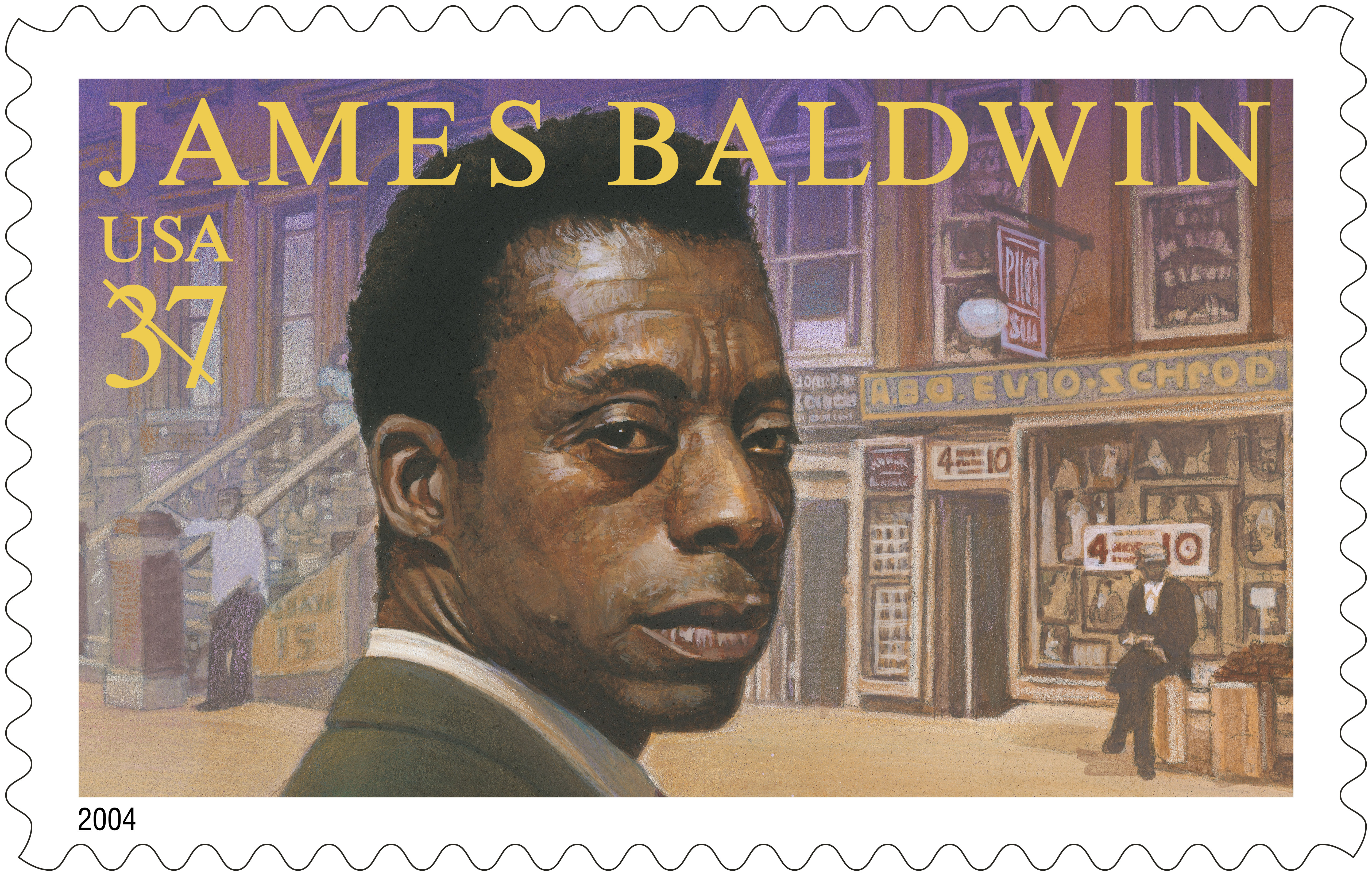
In 2004, poet Adrienne Rich (2009) wrote about a postage stamp bearing the face of American ex-patriot writer James Baldwin: “the stamp commemorates Baldwin’s birthday, August 2: he would have been eighty that year” (p. 49). This volume appears in 2014, the year that Baldwin would have turned ninety.
Rich’s essay reads as the journey of one writer’s experience embracing the other, but Rich also highlights what this volume seeks to address as well—the lack of attention that Baldwin receives in the twenty-first century U.S. Why, Rich asks, does a country still laboring under the same issues of race continue to ignore a powerful voice, as Americans certainly did when Baldwin spoke of racism?
Quoting from “Lockridge: ‘The American Myth,’” Rich (2009) includes the following:
The gulf between our dream and the realities that we live with is something that we do not understand and do not wish to admit. It is almost as though we were asking that others look at what we want and turn their eyes, as we do, away from what we are. I am not, as I hope is clear, speaking of civil liberties, social equality, etc., where indeed strenuous battle is yet carried on; I am speaking instead of a particular shallowness of mind, an intellectual and spiritual laxness….This rigid refusal to look at ourselves may well destroy us; particularly now since if we cannot understand ourselves we will not be able to understand anything. (p. 52; Baldwin, 1998, p. 593)
Baldwin’s challenge here should haunt us because it remains the challenge before us—“[t]his rigid refusal to look at ourselves.”
The following chapters—based on both scholarly and experiential perspectives—make significant contributions to the astonishingly slim amount of research and discussion that exists on one of the twentieth century’s most important public intellectuals. They provide key insights into Baldwin’s literary skills, his political views, and the impact his life and work had on historic, as well as ongoing, policy debates. They reveal a complicated, often tormented, and always provocative individual who confronted racism, imperialism, and homophobia as a black, gay pacifist. It should therefore come as little surprise that his work maintains its relevance as American society continues to grapple with racial, social, and political challenges.
[ii] Vilson offers about himself at his blog, The Jose Vilson (http://thejosevilson.com/): “José Luis Vilson is a math educator for a middle school in the Inwood / Washington Heights neighborhood of New York, NY. He graduated with a bachelor’s degree in computer science from Syracuse University and a master’s degree in mathematics education from the City College of New York. He’s also a committed writer, activist, web designer, and father. He co-authored the book Teaching 2030: What We Must Do For Our Students and Public Schools … Now and In The Future with Dr. Barnett Berry and 11 other accomplished teachers. He currently serves as the president emeritus of the Latino Alumni Network of Syracuse University, as a board member on the Board of Directors for the Center for Teaching Quality, and has been a part of the Acentos Foundation, LATinos In Social Media (LATISM), the Capicu Poetry Group, BlogCritics, and the AfroSpear.”
President Obama will announce on Monday that 60 of the nation’s largest school districts are joining his initiative to improve the educational futures of young African-American and Hispanic boys, beginning in preschool and extending through high school graduation.
But the most important point comes in the fourth paragraph:
No new federal spending is attached to the initiative. The new efforts, which will also seek support from the nonprofit and private sectors, are being coordinated by the Council of the Great City Schools, which represents large urban school districts.
In the U.S., “No new federal spending” equals “This really doesn’t matter.”
Can you imagine no new federal spending being attached to any military initiative?
What about no new federal spending to bail out the banks?
Of course not. But the U.S. has made a clear choice: Fund the interests of the rich and powerful (for them, the dirty money of government isn’t so dirty) and leave the fortunes of the impoverished and victims of inequity to the Invisible Hand of the free market.
We may want to note that at least the Obama administration has made a somewhat bold move to acknowledge the crippling disadvantages faced by African American and Latino boys in the U.S.—and here we should pause and make sure we acknowledge that as the civil rights issue of our time. And because of that acknowledgement, the NYT makes a rare concession to these facts, as Rich explains late in her piece:
Black and Latino students have long experienced a pattern of inequality along racial lines in American schools. According to data from the Department of Education’s Office of Civil Rights, black and Latino students are suspended and expelled at much higher rates than white students and attend schools with less-experienced teachers. Many also attend schools that do not offer advanced math and science courses.
Boys in particular are at a disadvantage. Black and Latino boys are less likely to graduate from high school than white boys, but also less likely than African-American or Latino girls. And in elementary school, they already fall far behind their white counterparts in reading skills: According to the National Assessment of Educational Progress, a series of standardized tests administered to a random sampling of American children, only 14 percent of black boys and 18 percent of Hispanic boys scored proficient or above on the fourth-grade reading tests in 2013, compared with 42 percent of white boys and 21 percent of both black and Hispanic girls.
But without government spending, initiatives are nothing more than rhetoric and distraction—further evidence of our commitment to capitalism first and possibly to the exclusion of democracy and equity, as I have examined before:
More difficult to confront than either mendacity or foma, it appears, is the hard truth that the human pursuit of equity must come before merit can matter and that in order to achieve that possibility, the human condition must commit to a spirit of community and collaboration, not competition.
Regretfully, most in power are apt to continue to not let that cat out of the bag.
The lives and faces of African American and Latino boys in the U.S. are the regrettable portraits of our failures as a people. We are now confronted with an option to embrace our collective power and shared humanity—that which is government, the public sphere, the Commons.
There is often a reason a cliche becomes a cliche—the wisdom of all that is True becomes repeated until we have cliche. In the U.S., our new motto should be: Put your money where your mouth is.
Until then, we remain malnourished by the empty calories of rhetoric.
As a high school English teacher for nearly two decades, I came to embrace a need to offer students a wide range of lenses for interacting with and learning from many different texts, but I also learned that coming to read and re-read, to write and re-write the world is both a powerful and disorienting experience for young people. So a strategy I now use and encourage other teachers to implement is reading and discussing children’s literature, picture books, while expanding the critical lenses readers have in their toolbox.
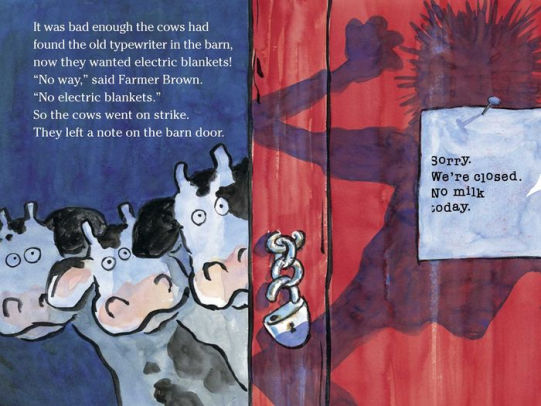
My favorite book for this activity is Click, Clack, Moo: Cows that Type. This work by Doreen Cronin with art by Betsy Lewin (view a read-aloud here) presents a clever and humorous narrative about Farmer Brown and his suddenly recalcitrant cows who, having acquired a rickety typewriter, establish a strike that inspires the chickens to join and ends with the neutral ducks aiding the revolt.
Click, Clack, Moo: Cows that Type
This story is ideal for asking teachers to consider the traditional approach to text in schools, New Criticism (a focus on text in isolation and on the craft in any story, such as characterization, plot, and theme), against Feminist and Marxist criticism, for example.
One fall, while doing the activity with a young adult literature class, I came against yet a new reading of Cronin and Lewin’s work: Why the 1% always wins.
The U.S. Public Likes Farmer Brown
As we explored Click, Clack, Moo recently, the adult members of the class told me they like Farmer Brown, with one student characterizing the striking farm animals as “mean.” And here is where I felt the need to consider how this children’s book helps us all confront the Occupy Wall Street movement or the rise in antagonism toward teachers, tenure, and unions as well as why the 1% continues to own the 99%.
One important element of the story is that the cows and chickens are female workers under the authority of the male Farmer Brown. These female workers produce for the farmer and remain compliant until the cows acquire the typewriter—both a powerful tool of literacy (the cows and chickens cannot effectively strike until they gain access to language) and a representation of access to technology (readers should note that the cows and chickens produce typewritten notes that show they find an old manual typewriter unlike the cleaner type produced by Farmer Brown on an electric typewriter, a representation of the inequity of access to technology among classes).
The cows and chickens, in effect, unionize and strike. Here, members of my classes often fail to notice the unionization, but tend to side with the farmer even when we acknowledge the protest as unionizing—particularly bristling at the duck, as a neutral party, using its access to the negotiation to acquire a diving board for the duck pond.
Like the 1%, Farmer Brown is incensed that the cows and chickens demand basic necessities for comfort, electric blankets, but he eventually secures a compromise, agreeing to give the barn animals the requested electric blankets for the return of the typewriter (the story ends with the obvious next step that the duck uses the typewriter to trade for the diving board).
The 1% have the 99% right where Farmer Brown has the barn animals—mesmerized by the pursuit of materialism and entertainment. Consider the eager hordes of consumers lined up to buy the then-new iPhone 4S, released on the cusp of the passing of Steve Jobs, heralded as a genius for his contribution to our consumer culture.
Just give us our iPhones and we’ll be quiet, we’ll work longer and harder for the opportunity to buy what the 1% tells us we want.
And when the 1% and their compliant media inform us that the top 20% pays 64% of taxes, we slip back to our barns with our tails between our legs, shamed.
We, the 99% who tend to remain silent and compliant, wait patiently for the next generation of technology to occupy our time, our lives reduced to work and amassing the ever-changing and out-dated things that become passe as the next-thing lures us further and further into our sheep lives.
Yes, if we remain eager to trade our voices for things, the 1% will always be the winners.
When we learn to treasure voice over things, however, the chickens may come home to roost.
The stories themselves, literally, are powerful and engaging or George Orwell’s 1984 and Arthur Miller’s The Crucible would not have endured as they have as literature people read again and again—and possibly should read again and again.
However, ultimately, 1984 is not about the future (especially since we have long since passed the future Orwell may have envisioned), and The Crucible is not about the past (although Miller built his play on the very real and troubling history of Puritan witchcraft hysteria). These works are about the complicated present of both authors’ worlds as that speaks to the enduring realities of the human condition.
All of that may seem weighty stuff to step into a look at what appears to be a children’s book, but the paragraphs above should be more than a hint that looks can be deceiving—and enlightening.
“Ever had a burr in your sock?” sets the story in motion—one sentence centered on the page over a giant question mark. It is an opening worthy of a child and all of us who cling to the wonder of childhood.
While Le Guin is often described as a science fiction writer, in her work I recognize the blurring of genres that joins science fiction, speculative fiction, and fantasy; it is that “other world” about which Le Guin and Margaret Atwood appear to argue, and it a stark but rich other world Saunders conjures and Lane pictures.
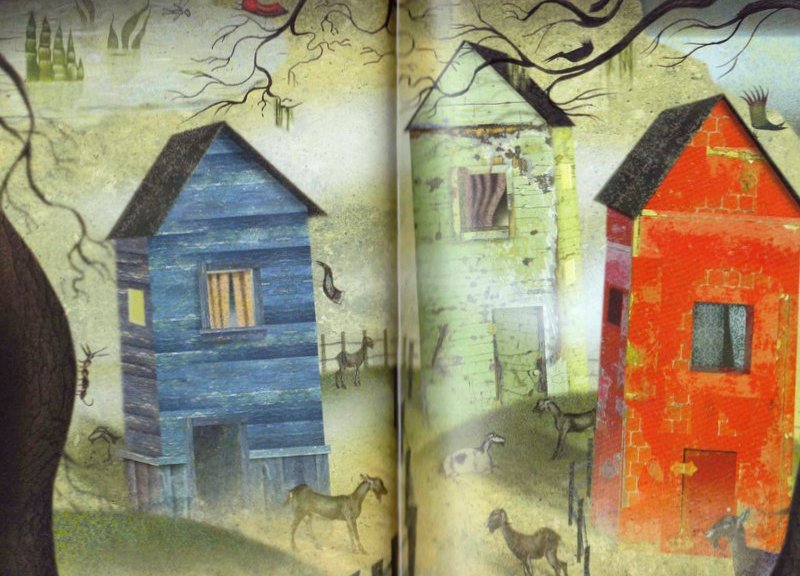
The story of Frip involves three houses for three families, all with children at the center. The houses are distinguished with primary colors—child-like blue, green, and red—but Lane’s artwork adds the ominous to Saunders’ seemingly simple narrative tinged with more than a bite of satire. The illustrations echo the haunting works about and for children found in Neil Gaiman and Tim Burton.
“Frip was three leaning shacks by the sea.” (p. 6) Artwork by Lane Smith
A child standing precariously close to the end of a slanted cliff over an angry ocean catches the eye on page 7 and then the crux of the story pulls you back to the text on page 6:
Frip was three leaning shacks by the sea. Frip was three tiny goat-yards into which eight times a day the children of the shacks would trudge with gapper-brushes and cloth gapper-sacks that tied at the top. After brushing the gappers off the goats, the children would walk to the cliff at the edge of town and empty their gapper-sacks into the sea. (p. 6)
Gappers, orange burr-like creatures with many eyes and the size of a baseball, come to represent throughout the story the power of the systemic inevitable: The presence of the gappers determines the lot of the families (and their goats), but most of the people in the tale remain unable to see beyond their own fixed and mostly misguided worldviews.
“A gapper’s like that, only bigger, about the size of a baseball, bright orange, with multiple eyes like the eyes of a potato.” (p. 2) Artwork by Lane Smith
When the gappers cling to the goats of all three families, there is an ironic appearance of equality among them. But when the fortune of one family shifts, the gappers fulfill their name by creating the gap:
So that night, instead of splitting into three groups, the gappers moved into one very large and impressive shrieking group directly into Capable’s yard. (p. 12)
Before this shift in how the gappers behave, of course, the three families are not equal because Capable is an only child living with her father and who has lost her mother. Capable works as all the children are expected to work (removing gappers in a daily Sisyphean nightmare of chores) and seeks to serve the needs of her grieving father, who along with his grief is a prisoner of nostalgia:
“I myself was once an exhausted child brushing off gappers. It was lovely! The best years of my life. The way they fell to the sea from our bags! And anyway, what would you do with your time if there were no gappers?” (p. 11)
This nostalgia masking an unnecessarily burdensome childhood, however, is but one ideology weighing on Capable because as soon as the other two families are relieved of gappers on their goats, those families reveal themselves to be very much like the people of Le Guin’s Omelas:
“It’s a miracle!” Mrs. Romo shouted next morning, when she came out and discovered that her yard was free of gappers. “This is wonderful! Capable, dear, you poor thing. The miracle didn’t happen to you, did it? I feel so sorry for you. God has been good to us, by taking our gappers away. Why? I can’t say. God knows what God is doing, I guess! I suppose we must somehow deserve it!” (p. 17)
Capable becomes the sacrificed child, and despite her misfortune, the relieved families read the events as their merit (and of course the ugly implication that Capable and her father deserve the burden of the gappers).
What follows from this shift in fate is the central story of Frip with Capable as our main character. The message becomes clear, and Saunders and Lane make the ride one you’ll want to visit again and again. If you are lucky, the book could become one of those read alouds requested by son or daughter, or by a classroom of children.
And while I will leave the rest of the story to you, I think it is necessary to note here that this allegory is both a cautionary tale about how we view children and childhood as well as a brilliant call to reconsider how we view education and education reform.
George Saunders’s Allegory of Scarcity and Slack
The U.S., like the characters (except for Capable) in Saunders’s story, is tragically blinded by a belief in cultural myths that have little basis in evidence: That we live and work in a meritocracy, that competition creates equity, that children need to be “taught a lesson” about the cold cruel world lest they become soft, and such.
As a result of these beliefs, schools often reflect and perpetuate rather harsh environments for children—or to be more accurate, schools often reflect and perpetuate rather harsh environments for other people’s children, as Capable personifies.
Here, then, I want to make the case that The Very Persistent Gappers of Frip is a powerful allegory of scarcity and slack as examined by Sendhil Mullainathan and Eldar Shafir in their Scarcity: Why Having Too Little Means So Much.
Mullainathan and Shafir detail that the conditions of poverty, scarcity, so overburden people psychologically, mentally, and physically that their behavior is often misread (poor people are lazy, poor people make bad decisions, etc.). In Saunders’s story, scarcity and its burden are portrayed by the gappers, and readers witness how the coincidence of the onslaught of the gappers changes the families involved. In other words, the behavior of people is determined by the environment, and not by the inherent goodness or deficiencies of any individual.
The Very Persistent Gappers of Frip goes further, however, by showing that one person’s scarcity (Capable) allows other person slack: privilege is built on the back of others, and those conditions are mostly arbitrary. While Mullainathan and Shafir argue that the slack enjoyed by those living in relative privilege provides the sort of cognitive space needed to excel, Saunders speaks to more than the slack enjoyed by the two families relieved of gappers and the compounding scarcity suffered by Capable (her lot in life and the addition of the gappers):
“And the men succeeded in lifting the house and moving it very very close to the third and final house in Frip, which belonged to Sid and Carol Ronsen, who stood in their yard with looks of dismay on their nearly identical frowning faces.” (p. 23) Artwork by Lane Smith
Capable represents a counter-narrative to claims that impoverished children lack “grit.” As her name suggests, this child is more than capable, but the world appears determined to defeat her.
Capable also embodies Lisa Delpit’s confrontation of “other people’s children”—that those with privilege (slack) are willing to allow one set of standards for other people’s children (often living and learning in scarcity), standards they will not tolerate for their own.
As I stated in the opening, allegory seeks to open our eyes by diversion, creating an other world that helps us see both the flaws with our now and the enduring failures of humans to embrace our basic humanity, a failure Capable teeters on the edge of making herself but cannot:
And [Capable] soon found that it was not all that much fun being the sort of person who eats a big dinner in a warm house while others shiver on their roofs in the dark.
That is, it was fun at first, but then got gradually less fun, until it was really no fun at all. (p. 70).
“Men disappoint me so,” Margaret Fuller shared in a letter (21 February 1841) to Reverend William Henry Channing. Born on May 23, 1810, Fuller was a contemporary of Ralph Waldo Emerson and Henry David Thoreau, notable for what I believe is my favorite comment by Fuller: “I now know all the people worth knowing in America, and I find no intellect comparable to my own.”
The only known daguerreotype of Margaret Fuller (by John Plumbe, 1846)
On July 19, 1850, Fuller along with Giovanni Ossoli and their child died in a shipwreck off the coast of New York.
The personal tragedy of Fuller is a haunting parallel to how her voice and works are often marginalized still in the traditional canon. See the following resources for examining and exploring Fuller:
There exists in the minds of men a tone of feeling toward women as toward slaves….
We would have every arbitrary barrier thrown down. We would have every path laid open to Woman as freely as to Man. Were this done, and a slight temporary fermentation allowed to subside, we should see crystallizations more pure and of more various beauty. We believe the divine energy would pervade nature to a degree unknown in the history of former ages, and that no discordant collision, but a ravishing harmony of the spheres, would ensue.
Yet, then and only then will mankind be ripe for this, when inward and outward freedom for Woman as much as for Man shall be acknowledged as a right, not yielded as a concession.
We doubt not the destiny of our country — that she is to accomplish great things for human nature, and be the mother of a nobler race than the world has yet known. But she has been so false to the scheme made out at her nativity, that it is now hard to say which way that destiny points. (“American Facts” in Life Without and Life Within (1860) edited by Arthur Buckminster Fuller, p. 108)
If current reform commitments are misguided, then what are our alternatives? Broadly, new ways of thinking about public education must occur before the U.S. can fulfill its obligation to the promise of universal public schools:
We have failed public education; public education has not failed us.
And, thus, public education holds up a mirror to the social dynamics defining the U.S. In other words, achievement gaps in our schools are metrics reflecting the equity and opportunity gaps that exist in society.
One aspect of these new ways of thinking about public education that is rarely discussed is that seeking laudable goals (such as closing the achievement gap in schools and the income and upward mobility gaps in society) requires that we address both privilege and poverty—the top and the bottom. Historically and currently, our gaze remains almost exclusively on the bottom.
Richard Reeves in the “The Glass-Floor Problem” poses a provocative and necessary admission about the polar ends of class in the U.S.:
When it comes to the economic malaise facing America, the biggest problem is not the widening gap between rich and poor, but the stagnation of social mobility. When the income gap of one generation becomes an opportunity gap for the next, inequality hardens into social stratification….
These solutions may sound easy, but they are not. While politicians discuss social mobility as a pain-free goal, the unspoken, uncomfortable truth is that relative mobility is a zero-sum game. Opening more doors to applicants from low-income backgrounds often means closing more doors to affluent applicants.
This is delicate territory. Nobody wants parents to stop trying hard for their children. But nor do we want a society in which the social market is rigged in favor of those born into affluence. If we want a competitive economy and an open society, we need the best and brightest to succeed. This means some of the children of the affluent must fail.
In other words, the declining social mobility in the U.S. includes not only that those at the bottom are victims of poverty being destiny, but also that those at the top are reaping the benefit of privilege being destiny. In both extremes, then, the ideal of a U.S. meritocracy is negated.
The lives of adults in the U.S. are more often than not the consequences of large and powerful social dynamics driven by poverty and privilege—and not by the character or tenacity of any individual.
That fact is the basis for the needed new ways of thinking about education posed above.
One example of thinking differently about education is Ravitch, who explains that school-only reform over the past three decades is essentially a “mistake”; instead, social reform must come first so that school reform can work:
And income inequality in our nation is larger than at any point in the last century.
We should do what works to strengthen our schools: Provide universal early childhood education (the U.S. ranks 24th among 45 nations, according to the Economist); make sure poor women get good prenatal care so their babies are healthy (we are 131st among 185 nations surveyed, according to the March of Dimes and the United Nations); reduce class size (to fewer than 20 students) in schools where students are struggling; insist that all schools have an excellent curriculum that includes the arts and daily physical education, as well as history, civics, science, mathematics and foreign languages; ensure that the schools attended by poor children have guidance counselors, libraries and librarians, social workers, psychologists, after-school programs and summer programs.
Schools should abandon the use of annual standardized tests; we are the only nation that spends billions testing every child every year. We need high standards for those who enter teaching, and we need to trust them as professionals and let them teach and write their own tests to determine what their students have learned and what extra help they need.
Annie Murphy Paul also challenges the in-school only focus on seeking ways to close gaps, shifting away from schools and into the home:
When it comes to children’s learning, are we focusing too much on schools—and not enough on parents?
“There is, quite rightly, a cacophonous debate on how to reform schools, open up colleges, and widen access to pre-K learning,” notes a new article, “Parenting, Politics, and Social Mobility,” published by the Brookings Institution, a Washington think tank. “But too little attention is paid to another divide affecting social mobility—the parenting gap.”
Given all the roiling debates about how America’s children should be taught, it may come as a surprise to learn that students spend less than 15% of their time in school. While there’s no doubt that school is important, a clutch of recent studies reminds us that parents are even more so. A study by researchers at North Carolina State University, Brigham Young University and the University of California-Irvine, for example, finds that parental involvement—checking homework, attending school meetings and events, discussing school activities at home—has a more powerful influence on students’ academic performance than anything about the school the students attend.
Another study, published in the Review of Economics and Statistics, reports that the effort put forth by parents (reading stories aloud, meeting with teachers) has a bigger impact on their children’s educational achievement than the effort expended by either teachers or the students themselves. And a third study concludes that schools would have to increase their spending by more than $1,000 per pupil in order to achieve the same results that are gained with parental involvement (not likely in this stretched economic era).
So parents matter—a point made clear by decades of research showing that a major part of the academic advantage held by children from affluent families comes from the “concerted cultivation of children” as compared to the more laissez-faire style of parenting common in working-class families.
While Paul’s challenge pulls us one step back from school-only reform, this doesn’t go quite far enough (and stumbles if her argument is interpreted as “blame the parents”)—especially in the last comment quoted above. From Paul’s argument, we must ask ourselves why affluent parents and impoverished parents appear to parent differently.
“Laissez-faire” is a dangerous and potentially ugly word here.
Impoverished adults are not in poverty primarily due to laziness. Impoverished children do not score poorly on standardized tests because their parents do not care about school or are too lazy to parent properly (read: as affluent parents do).
Poverty is a social dynamic that does not allow people to behave in ways that we view as effective or productive. Privilege is a social dynamic that allows people to behave in ways that we mistakenly suggest is grounded in those people’s superior character.
Just as the achievement gap in schools is a marker for the equity gap in society, parenting style differences are reflections of the social dynamics experienced by those parents.
An affluent family with one parent staying home to support the children is allowed to behave in ways that an impoverished single parent working two part-time jobs (with no retirement or healthcare) cannot.
Privilege is a safety net, poverty is a prison.
Ultimately, we must acknowledge both privilege and poverty if we genuinely wish to close gaps in society and schools. Just as Reeves warns, however, recognizing that both privilege and poverty are unfair calls into question the advantages of children born into affluence.
It seems important that we ask as a culture some foundational questions:
Is ending the momentum of privilege “taking something away” from a child?
Is ending the momentum of poverty “giving something for free” to a child?
What are the foundational promises a country must make to insure the human dignity all people deserve, and expressed in that country’s foundational documents (in the U.S., life, liberty, and the pursuit of happiness)?
These questions can only be answered and then acted upon if we make one additional change to how we think—in the larger scale (not in the schools, not in the home, but in society), how we think about the relationship between the Commons (publicly-funded institutions) and the free market.
The free market, we must admit, is amoral; the free market is Social Darwinism: competition produces losers and winners, not equity.
The Commons are potentially the collective ethics of a people.
And finally, then, in order for a free market to work for the common good, the Commons must be primary in the commitment of any people.
The Commons are the foundation upon which the market can do good.
As long as the U.S. views the Commons and the Market as an either/or proposition, and as long as the U.S. prefers the Market, privilege and poverty will continue to be destiny for our children. And for us all.
Let’s go back now to the second new way of viewing public schools from the beginning—reframed within a primary commitment to the Commons:
Public education has never, cannot, and will never be a singular or primary mechanism for driving large social change as long as social inequity remains and as long as those public schools perpetuate those social inequities.
If we commit to social reform and education reform seeking equity and opportunity, then my first claim at the beginning will be proven wrong.
Here’s to my being wrong.
educator, public scholar, poet&writer – academic freedom isn't free








 dr. p.l. (paul) thomas