Category Archives: teacher preparation

Teacher Education in (Another) Era of the “Bad Teacher” Myth

[Header Photo by CDC on Unsplash]

Note

I entered the classroom as a high school English teacher somewhat ominously in 1984, an academic year when Orwell’s classic was increasingly assigned but also when in South Carolina, where I taught, the high-stakes accountability era began with a vengeance.

From 1995 until 1998, I completed an EdD in Curriculum and Instruction while teaching full-time and even taking on some adjunct work at local colleges. Unlike most of those in my EdD cohort, I have no plans to leave K-12 teaching once I graduated from the program.

However in 2002, my former high school English teacher, Lynn Harrill (whose position I had taken where I was teaching English), left his position at Furman University, which was within driving distance for me. In a flurry of a few weeks, I was offered the job, and frankly, I had almost no idea what committing to teacher education would entail.

To be blunt, teacher education was incredibly frustrating and disappointing because much of my work was bureaucracy—nearly endless cycles of new standards and documenting that we were addressing those standards. Accreditation and certification rendered the quality of teaching pre-service teacher to teach a mere ghost of what we wanted to do, what we were capable of doing.

I have written before about how and why teacher education struggles both to foster new teachers and to challenge misleading and inaccurate (mostly by politicians, media, and pundits) attacks about the failures of teacher education, teachers, students, and public schools (see more HERE).

The piece below represents my uncomfortable position in teacher education because I believe in teacher education as a field and degree but am at least skeptical if not cynical about accreditation/certification.

It seems my time in teacher education has come to a close (my department is transitioning away from teacher certification toward education studies), and since the piece below failed to find a journal home, I am offering it here (and I also prefer open-access).

This is a complicated topic, but I hope this does a fair job because I do love teachers of all kinds and find the “bad teacher” myth one of the most misguided narratives in the US.


Teacher Education in (Another) Era of the “Bad Teacher” Myth

P.L. Thomas, Furman University

In 2018, a simplistic but compelling story was established: Teachers do not know how to teach children to read because teacher educators have failed to teach the “science of reading” (SOR) in teacher preparation programs (Aukerman, 2022a, 2022b, 2022c). These misleading narratives about teacher education, National Assessment of Educational Progress (NAEP) data, and reading have gained momentum and now drive reading policy and legislation in practically every state in the US (Aydarova, 2023, 2024; Reinking, Hruby, & Risko, 2023).

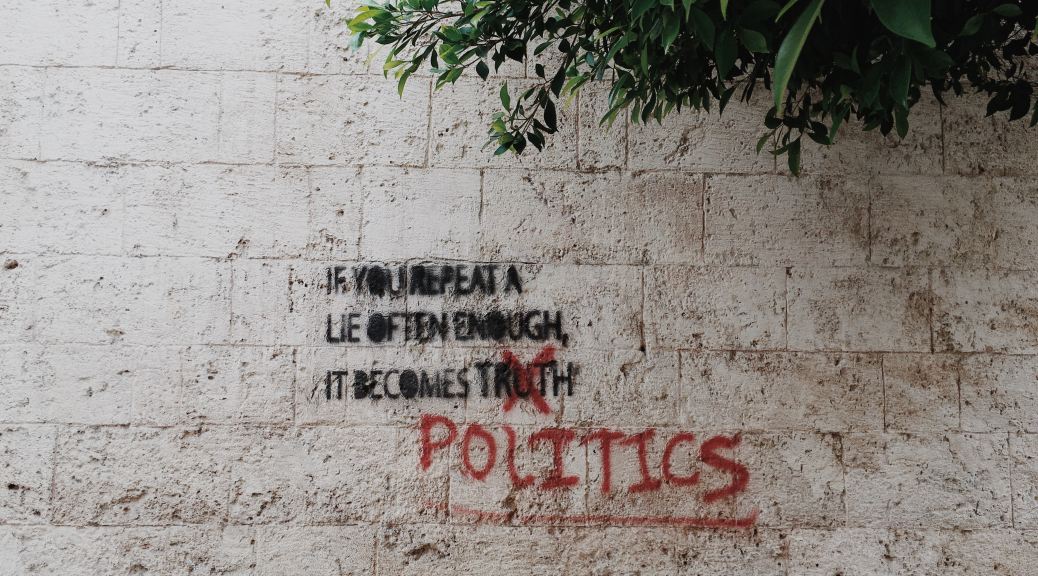
There is an ironic truism—“a lie can travel halfway around the world while the truth is still putting on its shoes”—most often incorrectly attributed to Mark Twain that describes the misguided SOR movement’s central claims wrapped in the initial mantra that SOR is both simple and settled. Here, though, are two more nuanced and evidenced-based counter-points to the SOR story being sold (Thomas, 2024b, 2024c, 2024d):

  • Reading instruction can and should be significantly reformed (in the context of addressing wider systemic inequities), but the SOR version of causes and solutions are false.
  • Teacher education can and should be significantly reformed, but the SOR version of causes and solutions are false.

I have been a strong advocate for education reform, beginning when I entered the field in 1984, and subsequently a strong advocate for teacher education reform, starting with entering higher education and teacher education in 2002. Writing about Maxine Greene over a decade ago, I noted about teacher education: “As teacher educators, we are trapped between the expectations of a traditional and mechanistic field and the contrasting expectations of best practice guided by critical pedagogy” (Thomas, 2010).

Further, critical pedagogy acknowledges that all teaching and learning are political acts (Kincheloe, 2005), which require teachers and teacher educator to reject the norms of teaching being apolitical. The current SOR movement and concurrent re-emergence of the “bad teacher” myth have created a hostile environment for teachers at all levels, and thus, the time is now for re-imagining being teacher educators as well as K-12 teachers who advocate for teacher professionalism and the individual needs of all students.

The Anti-Teacher (and Sexist) Roots of Rejecting Teacher Autonomy

Over the past few years, both traditional and social media have uncritically reanimated the “bad teacher” myth (Bessie, 2010; Thomas, 2023b) with the following stories:

  • Elementary teachers are failing to teach reading effectively to US students.
  • That failure is “because many deans and faculty in colleges of education either don’t know the science or dismiss it,” according to Hanford (2018).
  • Elementary, literature/ELA teachers, and history teachers are brainwashing students with CRT (Pollock & Rogers, 2022).
  • Elementary and literature/ELA teachers are grooming children to be gay or transgender by forcing them to read diverse books and stories.

Except for teachers themselves and some education scholars, these new “bad teacher” myths are both extremely compelling and almost entirely false. Writing more than a decade ago during a peak “bad teacher” movement in the US, Adam Bessie (2010) explains about the bad teacher stories represented then by Michelle Rhee and perpetuated by the Obama administration and Bill Gates:

The myth is now the truth.

The Bad Teacher myth, [Bill] Ayers admits, is appealing, which is why it’s spread so far and become so commonly accepted. Who can, after all, disagree that we “need to get the lazy, incompetent teachers out of the classroom?” Even Ayers agrees that he, like all of us, “nods stupidly” along with this notion. As a professor at a community college and former high school teacher, I nod stupidly as well: I don’t want my students held back, alienated, or abused by these Bad Teachers.

This myth is also seductive in its simplicity. It’s much easier to have a concrete villain to blame for problems school systems face. The fix seems easy, as well: all we need to do is fire the Bad Teachers, as controversial Washington, DC, school chancellor superstar Michelle Rhee has, and hire good ones, and students will learn. In this light, Gates’ effort to “fix” the bug-riddled public school operating system by focusing on teacher development makes perfect sense. The logic feels hard to argue with: who would argue against making teachers better? And if, as a teacher, you do dare to, you must be “anti-student,” a Bad Teacher who is resistant to “reforms,” who is resistant to improvements and, thus, must be out for himself, rather than the students.

Bessie (2010) concludes, “The only problem with the Bad Teacher myth, as anyone involved with education is intimately aware of, is that problems in education are anything but simple,” and ultimately, these myths are not supported by the evidence.

One challenge of doing public work and advocacy addressing education, education reform, and teachers/teaching is framing clear and accessible messages that avoid being simplistic and misleading. Since I have spent years of challenging the overly simplistic and misleading SOR movement (Thomas, 2022), I have attempted to carefully craft some direct and brief messages, including “not simple, not settled,” “teach readers, not reading” (Afflerbach, 2022), and my core commitments to teacher autonomy and the individual needs of all students.

One would think that these core commitments attract support even among those who disagree on other aspects of teaching and education policy. Yet, I face a persistent resistance to supporting teacher autonomy, grounded in a fundamental distrust of all teachers. Teacher autonomy is essential for teaching to be a profession (Kraft & Lyon, 2024), but autonomy is also essential because education is a high-accountability field. One of the historical and current mechanisms to reduce or eliminate teacher autonomy is the norm of teaching as apolitical, discouraging teachers at all levels from advocating for themselves or their students.

The problematic tension in education is that teachers are routinely held accountable for mandates (not their professional decisions and practices) and how well they comply with the mandates, repeated currently in the SOR movement. Since many education mandates are flawed (such as current SOR reading legislation) and for decades have failed, teachers are then blamed for that failure even though they didn’t impose the mandates and were simply the mechanisms for required practices.

Most education crisis rhetoric and education reform have been grounded for decades in anti-teacher sentiments. Currently, the reading crisis movement blames reading teachers for being ill-equipped to teach reading (failing children) and teacher educators for not preparing those teachers, for example (Aukerman, 2022a). One of the strongest elements of rejecting teacher autonomy, in fact, is among SOR advocates who promote structured literacy, often scripted curriculum (Compton-Lily, et al., 2020) that reduces teachers to technicians and perpetuates holding teachers accountable for fidelity to programs instead of supporting teacher expertise to address individual student needs.

Let me be clear that all professions with practitioner autonomy have a range of quality in that profession (yes, there are some weak and flawed teachers just as there are weak and flawed medical doctors). To reject teacher autonomy because a few teachers may not deserve it is a standard not applied in other fields. But the heightened resistance to teacher autonomy is likely grounded in gender bias.

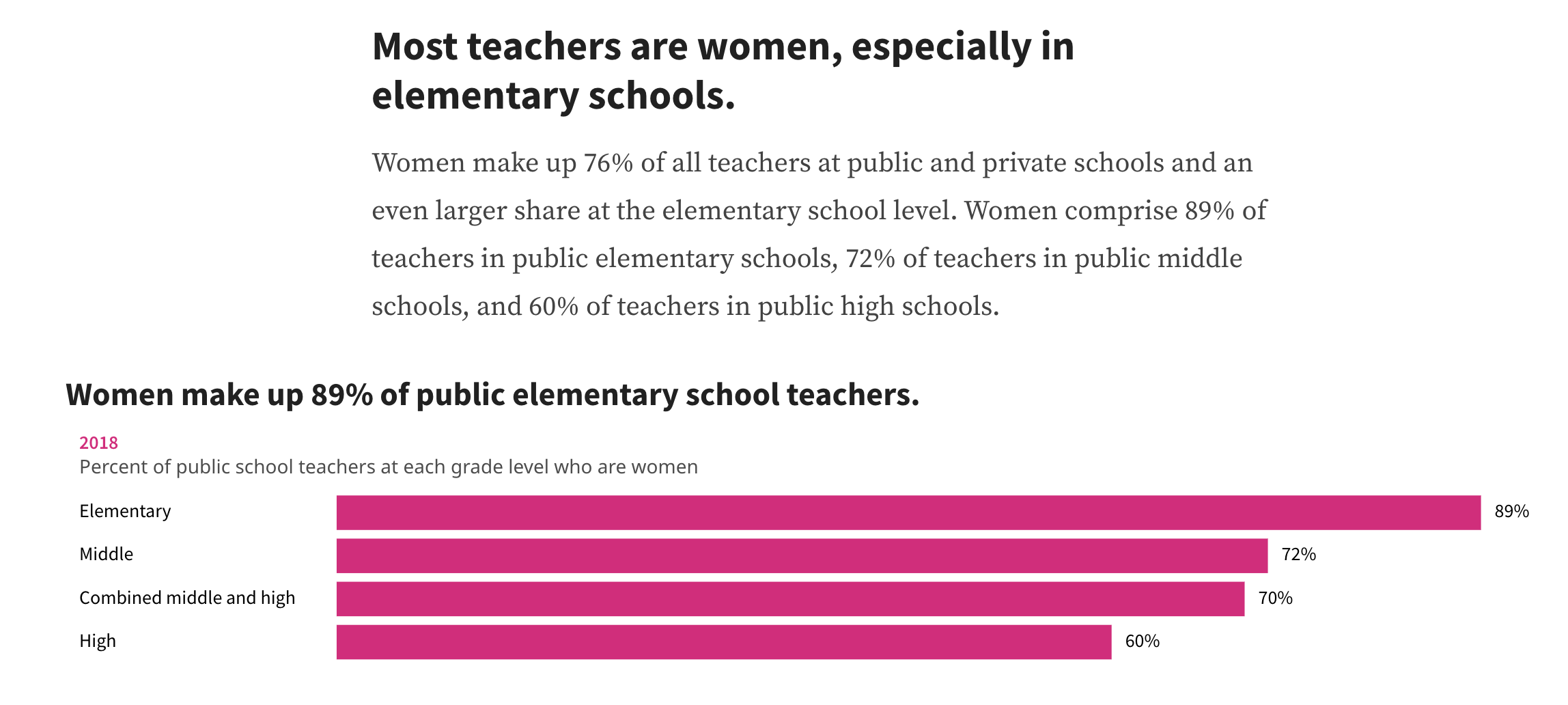
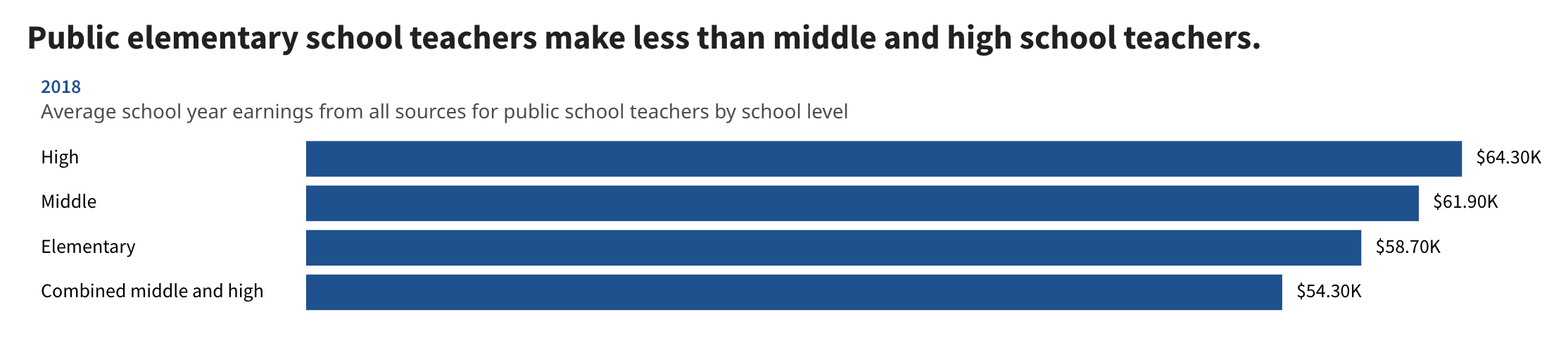
K-12 teaching (especially elementary teaching) is disproportionately a woman’s career since about 8 in 10 public school teachers are women. And while teacher pay is low compared to other professions, the pay inequity is more pronounced in areas where the proportion of women is even higher at the elementary level (Will, 2022). As a frame of reference, a more respected and better rewarded teaching profession is in higher education where professor have professional autonomy, except the gender imbalance exposes a similar sexist pattern. While the gender balance is better in higher education than K-12, the pay and security of being a professor increases where men are a higher proportion of the field (Quinn, 2023).

Autonomy, pay, and respect track positively for men and negatively for women in teaching, and the resistance to autonomy for K-12 teachers strongly correlates with the field being primarily women. A key but ignored element of education reform must include better pay for all K-12 teachers and supporting teacher autonomy so that individual student needs can be met. The historical and current resistance to teacher autonomy exposes the lingering sexism in how we view, treat, and reward educators.

Therefore, at its core, the “bad teacher” myth and requiring teachers to remain apolitical, objective, or neutral serve indirectly to further de-professionalize teachers at both the K-12 level and in teacher education. This leads to the role of science in de-professionalizing teachers when examined as part of the SOR movement.

“Science of Reading” Playing Numbers Games Not Supported by Science

One of the most effective elements of the SOR movement that helps reinforce the “bad teacher” myth is the rhetorical power of “science” in the claims. It appears that the use of “science” has reinvigorated the push to impose scripted curriculum on schools, a central effort of George W. Bush while governor of Texas. While that wave of scripted curriculum failed, in the 2020s, many advocates and legislators have completely caved on teacher autonomy as state after state is mandating scripted reading programs based on stories in the media that misrepresent teacher expertise about reading, teacher educators, and a reading crisis.

At the core of the SOR movement, then, is the pernicious use of numbers games within the rhetoric of “science.” A foundational example is the misrepresentation of NAEP reading scores to declare that 60% or 2/3 of students are not proficient readers and/or not reading at grade level (Hanford, 2018; Kristof, 2023). This numbers shell game is based in the misleading use of “proficient” by NAEP as well as the combination of ignorance about those achievement levels and willful ignorance about those achievement levels (Loveless, 2016, 2023; Thomas, 2025). The NAEP numbers game is frustrating because the claim shuffles “not proficient” and “not on grade level” while literally inverting the valid claim based on NAEP. In fact, for 30 years, NAEP grade 4 reading data show that about 60%+ of students are reading at grade level and above since NAEP “basic” (not “proficient”) is equivalent to grade level reading (See NAEP National Achievement-Level Results, n.d.).

Further, and even more frustrating, is that this numbers game distracts us from the real issues: (1) The US has no standard for “grade level” reading, (2) we have never fully interrogated the need for a standard “age level” instead of “grade level” metric, and most importantly, (3) the real challenge (even failure) is the disproportionate number of marginalized and minoritized students in the below grade level data pool.

Along with the misleading NAEP story, as well, is a numbers game that hasn’t been fully unpacked—the claim that 90-95% students can be proficient if we simply implement SOR. As a side note, those SOR advocates making this shifting claim (sometimes it is 90%, sometimes it is 95% or 96%) have not, along with most of mainstream media, clarified how this claim is based in scientific research while also avoiding a compelling example of the possibility that the 90-95% proficiency is achievable: Department of Defense (DoDEA) schools have close to that rate of achievement (see below).

Now as the SOR movement has grown over the past 6 years, the 90-95% claim has been repeated more and more although that numbers game still has less traction than the 2/3 not proficient claim. However, when I began my review of a recent National Council on Teacher Quality (NCTQ) report (Thomas, 2023a), I took the time to interrogate the 90% claim by the anti-teacher education think tank: “With effective reading instruction, we could take that [student reading proficiency] to more than 90%” (Teacher Prep Review, 2023, p. 4)

That claim by NCTQ has a footnote to a few studies, but the most interesting evidence is the final citation to a blog post by Nathaniel Hansford (2023) who admits at the beginning, “it has always stuck out to me as a strange figure” because:

First, most academic research does not typically use percentages in this sort of manner. Second, I often see this figure unaccompanied by a citation. And third, it seems low; I find it hard to believe that 5% of students just cannot learn how to read.

When Hansford (2023) asked for scientific evidence for the claim, this is what he discovered:

Some of the citations I was sent were policy papers, by authors and institutions that used this claim. However, these papers were not experimental and usually cited popular Science of Reading books, not experimental research. There was also, interestingly, one research paper sent to me from the 1980s, that made the claim, but did not cite any evidence to support it. So it appears that this claim has been in circulation for a long time. The most common source listed for this claim seemed to be Louisa Moats, who has written about this rule on numerous occasions. However, she does not claim that 95% of students can reach grade level, based on just core instruction, but rather in totality. Louisa Moats cites 4 sources in support for this rule. In Kilpatrick’s book Essentials of Assessing, Preventing, and Overcoming Reading Difficulties; a 2009  paper by Lim, et al. on students with Down Syndrome; a 2005 paper by Mathes, et al, examining the rate of risk reduction for struggling reading, with intensive intervention instruction, and a literature review of risk reduction, by Joseph Torgersen. In my opinion, the last two citations provide some experimental evidence to support this claim.

I have found no better conclusion about the 90-95% claim than the one offered by Hansford (2023); there is scarce and dated scientific evidence to support, at best, that the 90-95% claim is a valid aspirational goal of reading proficiency: “This all said, it does seem there is some level of support for 96% being a benchmark goal [emphasis added], for reading proficiency rates.”

Key here is that like the NAEP misrepresentation, the 90-95% claim is in no way a scientific claim being used by a movement that has used “scientific” as a rhetorical lever to promote their ideological (not scientific) agenda targeting K-12 teachers and teacher educators. The SOR numbers games are essentially distractions. Regretfully, we certainly need to address reading proficiency in students, especially for marginalized and minoritized students.

But the real problems and achievable solutions are likely not to make the education marketers money but will require a different way to view education, one that acknowledges the key number that education reformers and SOR advocates ignore. That number is 60+%.

A recent study confirms a statistic that has been repeated by scientific research for decades—about 60+% of measurable student achievement is causally linked to out-of-school (OOS) factors (not reading programs, not instructional practices, not teacher quality, not teacher education): “Almost 63% of the variance in test performance was explained by social capital family income variables that influence the development of background knowledge” (Maroun & Tienken, 2024).

That fact of measurable student achievement discredits claims that reading proficiency, for example, is mostly a problem of reading programs and reading instructional practices. Reading reform for decades has simply shuffled programs and reading theory, which amounts to rearranging chairs on the deck of the Titanic. Yet as I noted above, there is credible evidence that something approaching 90% reading proficiency is achievable; this evidence does not rely on the “bad teacher” myth but does require addressing those OOS factors. Notable, yet mostly ignored, the reading achievement of DoDEA students on NAEP in 2022 are impressive—79% at or above grade level in grade 4 and 91% at or above grade level in grade 8 (See State achievement-level results, n.d.).

The DoDEA story isn’t one of reading programs, reading theory, or teacher/teacher educator bashing; in fact, there is a compelling story here that demonstrates the importance of addressing living as well as teacher and learning conditions so that students and teachers can be successful:

How does the military do it? In large part by operating a school system that is insulated from many of the problems plaguing American education.

Defense Department schools are well-funded, socioeconomically and racially integrated, and have a centralized structure that is not subject to the whims of school boards or mayors….

But there are key differences.

For starters, families have access to housing and health care through the military, and at least one parent has a job.

“Having as many of those basic needs met does help set the scene for learning to occur ,” said Jessica Thorne, the principal at E.A. White Elementary, a school of about 350 students.

Her teachers are also well paid, supported by a Pentagon budget that allocates $3 billion to its schools each year, far more than comparably sized school districts. While much of the money goes toward the complicated logistics of operating schools internationally, the Defense Department estimates that it spends about $25,000 per student, on par with the highest-spending states like New York, and far more than states like Arizona, where spending per student is about $10,000 a year .

“I doubled my income,” said Heather Ryan, a White Elementary teacher . Starting her career in Florida, she said she made $31,900; after transferring to the military, she earned $65,000. With more years of experience, she now pulls in $88,000.

Competitive salaries — scaled to education and experience levels — help retain teachers at a time when many are leaving the profession. At White Elementary, teachers typically have 10 to 15 years of experience, Ms. Thorne said. (Mervosh, 2023)

The SOR movement is playing a harmful and duplicitous numbers game that fits into decades of ineffective and harmful education reform. But the SOR movement is also following the corrosive playbook of using “science” as a rhetorical veneer for ideological agendas. Like scientific racism, the SOR movement is disturbingly absent science for many of their foundational claims, and the collateral damage is not just students but teaching as a profession.

Numbers games have consequences, and ironically, the research emerging from SOR policies is beginning to show that SOR legislation is whitewashing the curriculum (Rigell, et al., 2022) and de-professionalizing teachers (Blaushild, 2023). While there are several shifting numbers in the SOR movement, no science supports the foundational claims. And the numbers that are being ignored are the huge taxpayers’ costs for shuffling reading programs to line the pockets of many of the people promoting those numbers games. Unless teacher educators and K-12 teachers use their political voices to reject and resist the false stories and numbers games, the teaching profession will continue to be eroded.

If Teacher Education Is Failing Reading, Where Is the Blame?

The current SOR climate surrounding public education in the U.S. has its roots, ironically, in misreading (or at least reading uncritically) A Nation at Risk, a report during the Ronald Reagan administration that was widely reported by mainstream media. The politically driven and deeply flawed report also prompted the accountability movement in the U.S.—state standards and high-stakes testing—that eventually enveloped the entire country by the 1990s.

The report established a false but compelling cultural truism that is too rarely interrogated: Public schools in the U.S. are failing. Since the early 1980s, political leadership has decided that the failure is due to a lack of accountability, but accountability of whom or what has shifted over the past 40 years.

The first blame narrative focused on students and schools, ushering in high-stakes testing at 3rd grade, 8th grade, and high school (exit exams) as well as school and district report cards. Eventually high-stakes accountability of students and schools seemed not to change the measurable outcomes that advocates had promised; there were also unintended consequences such as exit exams increasing the number of students not completing high school.

Gradually after No Child Left Behind (NCLB), the blame narrative moved to teachers, in part driven by George W. Bush’s popularizing the slogan “soft bigotry of low expectations,” the rise of charter schools embracing “no excuses,” and the same messages and buy-in for Bush era education policy by Barack Obama’s administration and Department of Education. For about a decade the blame narrative focused on teachers, and political leaders rushed to intensify teacher evaluation, notably the use of value-added methods (VAM). Once again, the outcomes promised by advocates did not come to fruition. Eventually, in fact, the tide turned against the use of VAM and other types of punitive teacher evaluations (ASA, 2014).

The vacuum left in the blame narrative did not remain long. Concurrent with the SOR movement that claims public school teachers are not teaching reading guided by the SOR is the next round of blame—teacher education. The blame narrative makes for strange bedfellows. While mainstream media have begun to blame teacher education consistently, a leading literacy professional organization, the International Literacy Association (ILA), reinforced the story as well. Education Week has led this charge; for example, Madeline Will (2020):

Decades of research have shown that teaching explicit, systematic phonics is the most reliable way to make sure that young students learn how to read words. Yet an Education Week analysis of nationally representative survey results found that professors who teach early-reading courses are introducing the work of researchers and authors whose findings and theories often conflict with one another, including some that may not be aligned with the greater body of scientific research.

EdWeek‘s survey data were confirmed, it seemed, by ILA’s survey data: 60% of respondents claim their teacher education programs did not prepare them well to teach reading (Top takes, 2020).

First, we should pause at media and professional organizations citing survey data while also embracing a very rigid and narrow demand for SOR. Survey data have many problems, and in this case, we may want to know if disgruntled teachers (and disgruntled for many valid reasons unrelated to teacher preparation or literacy) were disproportionately motivated to reply. None the less, it is quite a different thing to say “60% of respondents claimed X” than “60% of teachers claimed X.” Are these survey data representative of all teachers of reading?

Let’s assume this is true, that more than half of teachers charged with reading instruction believe they are not properly prepared to teach reading. But let’s also unpack how that came to be, and ultimately answer in a fair way, where the blame rests.

For the past 30-40 years, teachers and teacher educators have had less and less professional autonomy; or stated a different way, the professional autonomy of teachers and teacher educators has been reduced to how well they can address mandated standards and produce measurable outcomes that prove those standards were addressed and effective. In the high-stakes accountability era, then, if we are going to accept that 60% of teachers were not well prepared in their teacher education programs, we must be willing to acknowledge that those programs were governed most often by the accreditation process. Organizations such as NCATE and CAEP have been holding teacher education accountable along with the coordination of professional organizations (often generating tensions between accountability and teacher autonomy).

How teacher education approached literacy broadly and reading specifically was grounded in standards designed by ILA (elementary) and the National Council of Teachers of English (NCTE) (secondary), and those programs were periodically monitored by ILA and NCTE for if or how well the programs met those standards. If we currently believe that the teaching of reading in our public schools is failing our students, we must also acknowledge that teachers are implementing state standards of reading and preparing students for state tests of reading; those teachers were also taught how to teach in teacher education programs implementing national standards determined by ILA and NCTE under duress to produce measurable student outcomes linked to state-mandated standards and high-stakes testing.

Accepting the survey data as valid, then, the blame for these failures rests at least in part in the accountability and accreditation process, of which teachers and teacher educators are mere agents. After being a classroom teacher of ELA for 18 years and then a teacher educator for the last 24 years, I believe I have a strong and well-informed view of what is happening. This is a better explanation, but not a simple one that the media would prefer or a politically expedient one that politicians would prefer.

Education has never been the type of failure proclaimed by A Nation at Risk, and a lack of accountability was never the cause of what the true failures in education were then and are today. Formal education reflects and a perpetuates inequity in the U.S. Public schools are not game changers. Therefore, it is true that far too many students are not being taught to read well enough, and that on balance, public education is failing far too many students.

Counter to the story being sold, however, those failures are about inequity—inequity of opportunities both outside and inside schools that disproportionately impacts poor students, Black and brown students, multi-lingual learners, and special needs students (populations the SOR movement has correctly identified as being under-served). And as jumbled as the journey has been, the logic experiment I offer above reaches a credible conclusion: the accountability era has failed and once again disproportionately impacting vulnerable populations of students.

But accreditation has failed just as much. Accountability grounded in standards and high-stakes assessment is not conducive to teaching, learning, or scholarship. As a former K-12 classroom teacher, I can attest to that fact; as a teacher educator, I can confirm that the bureaucracy surrounding compliance with accreditation and certification mandates often dilute my courses and overburden my professional work to the exclusion of scholarship and research as well as teaching. Accountability structures are disproportionately bureaucracy within a political system, and thus can be a distraction from effective teaching, learning, or professional behavior.

While I am frustrated with mainstream media misrepresenting reading and reading instruction, I am concerned with the necessity for professional organizations such as ILA and NCTE to work within and through the political bureaucracy of accountability, accreditation, and certification because of the necessary tensions related to accountability and teacher autonomy. Those professional organizations are put into no-win situations similar to the experiences of K-12 teachers and teacher educators. The result is well intentioned and hard-working professionals often work against our bests interests.

Here, then, is a larger lesson of this entire four-decades mess: Let’s stop looking for people to scapegoat in the blame narrative, and recognize instead that systems are failing us, especially when we are complying to them. Professional autonomy for K-12 teachers and teacher educators is a process we have not tried, but one far more likely to give our schools and our students a better chance if we also acknowledge that social and educational equity need the same financial and administrative focus we have given accountability since the early 1980s.

Teacher Educators and the Politics of Resisting Systemic Failure

Media and political stories have for decades perpetuated a story of student, teacher, and school failure. The current SOR movement has expanded the false story of the “bad teacher” by blaming “bad” teacher educators for producing reading teachers ill equipped to serve the most vulnerable students in our schools. The effectiveness of these myths depends on maintaining the blame gaze on individuals to mask systemic failures and the politics of calling for no politics.

What often appears to be student or teacher failure, however, is the negative consequences of failed systems. Both the larger inequity of society and schooling combined with the inherently flawed accountability paradigm constitutes the cause agents for the outcomes (almost always high-stakes testing data) used to determine student achievement. If we want something to change, then, teacher educators must assume a political stance against systemic failures, and part of that stance must include preparing future (and current) teachers also to assume a political stance.

At mid-twentieth century, Lou LaBrant (1952), who would soon after serve as president of NCTE, wrote on English Journal: “When I finished college my teachers thought I was ‘prepared to teach English’” (p. 345). Yet, what she recognized, and advocated for in this article, was a need for change: “It is time to examine the patched and worn bottles into which we have put this magnificent, live wine of language” (p. 347). I suspect, if LaBrant were still with us today, she would make the same call for how we prepare our teachers in the 2020s, acknowledging that to have different outcomes, we need to change the systems that overwhelmingly cause those outcomes.

Teacher educators, to be change agents, must embrace a new politics of resisting systemic failures, which have been unfairly portrayed as “bad teachers.” We are in the same place of crisis and reform after forty years of accountability linked to standards and testing, all of which has driven repeated cycles of new standards for certification and accreditation. Those systems have not only failed but have distracted from the sort of systemic reform needed to address the inequity of living and schooling that guarantees failure. For all teachers, our only option is a new politics of teacher education and teaching.

References

Afflerbach, P. (2022). Teaching readers (not reading): Moving beyond skills and strategies to reader-focused instruction. Guilford Press.

ASA statement on using value-added models for educational assessment. (2014, April 8). American Statistical Association. https://www.amstat.org/asa/files/pdfs/POL-ASAVAM-Statement.pdf

Aukerman, M. (2022a). The Science of Reading and the media: Is reporting biased? Literacy Research Association Critical Conversations. CC BY 4.0 license. https://literacyresearchassociation.org/stories/the-science-of-reading-and-the-media-is-reporting-biased/

Aukerman, M. (2022b). The Science of Reading and the media: Does the media draw on high-quality reading research? Literacy Research Association Critical Conversations. CC BY 4.0 license. https://literacyresearchassociation.org/stories/the-science-of-reading-and-the-media-does-the-media-draw-on-high-quality-reading-research/

Aukerman, M. (2022c). The Science of Reading and the media: How do current reporting patterns cause damage? Literacy Research Association Critical Conversations. CC BY 4.0 license. https://literacyresearchassociation.org/stories/the-science-of-reading-and-the-media-how-do-current-reporting-patterns-cause-damage/

Aydarova, E. (2024). What you see is not what you get: Science of reading reforms as a guise for standardization, centralization, and privatization. American Journal of Education. https://www.journals.uchicago.edu/doi/10.1086/730991

Aydarova, E. (2023). ‘Whatever you want to call it”: Science of reading mythologies in the education reform movement. Harvard Educational Review, 93(4), 556–581, https://doi.org10.17763/1943-5045-93.4.556

Blaushild, N.L. (2023). “It’s just something that you have to do as a teacher”: Investigating the intersection of educational infrastructure redesign, teacher discretion, and educational equity in the elementary ELA classroom. The Elementary School Journal, 124(2), 219-244.

Compton-Lilly, C.F., Mitra, A., Guay, M., & Spence, L.K. (2020). A confluence of complexity: Intersections among reading theory, neuroscience, and observations of young readers. Reading Research Quarterly, 55(S1), S185-S195. https://doi.org/10.1002/rrq.348

Ellis, V., Gatti, L., & Mansell, W. (2024). The new political economy of teacher education: The enterprise narrative and the shadow state. Policy Press.

Hanford, E. (2018, September 10). Hard words: Why aren’t kids being taught to read? APM Reports. https://www.apmreports.org/episode/2018/09/10/hard-words-why-american-kids-arent-being-taught-to-read 

Hansford, N. (2023). Can 95% of children learn to read? [Web log]. Pedagogy Non Grata. https://www.pedagogynongrata.com/the-95-rule

Hoffman, J.V., Hikida, M., & Sailors, M. (2020). Contesting science that silences: Amplifying equity, agency, and design research in literacy teacher preparation. Reading Research Quarterly, 55(S1), S255–S266. https://doi.org/10.1002/rrq.353

Kincheloe, J.L. (2005). Critical pedagogy primer. 2nd ed. Peter Lang USA.

Kraft, M.A., & Lyon, M.A. (2024). The rise and fall of the teaching profession: Prestige, interest, preparation, and satisfaction over the last half century. EdWorkingPaper 22-679. https://doi.org/10.26300/7b1a-vk92

Kristof, N. (2023, February 11). Two-thirds of kids struggle to read, and we know how to fix it. New York Times. https://www.nytimes.com/2023/02/11/opinion/reading-kids-phonics.html

LaBrant, L. (1952, September). New bottles for new wine. The English Journal, 41(7), 341-347. http://www.jstor.org/stable/808950

Loveless, T. (2023, June 11). Literacy and NAEP proficient (blog post). Tom Loveless. https://tomloveless.com/posts/literacy-and-naep-proficient/

Loveless, T. (2016, June 13). The NAEP proficiency myth. Brookings. https://www.brookings.edu/blog/brown-center-chalkboard/2016/06/13/the-naep-proficiency-myth/

Maroun, J., & Tienken, C.H. (2024). The pernicious predictability of state-mandated tests of academic achievement in the United States. Education Sciences, 14(2), 129-142. https://doi.org/10.3390/educsci14020129

Mervosh, S. (2023, December 10). Who runs the best U.S. schools? It may be the Defense Department. The New York Times. https://www.nytimes.com/2023/10/10/us/schools-pandemic-defense-department.html

National achievement-level results. (n.d.). NAEP Report Card: Reading. https://www.nationsreportcard.gov/reading/nation/achievement/?grade=4

Newkirk, T. (2024). The broken logic of “Sold a Story”: A personal response to “The Science of Reading.” Resources section of https://literacyresearchcommons.org/resources/

Pollock, M., & Rogers, J. (2022, January). The conflict campaign: Exploring local experiences of the campaign to ban ‘critical race theory’ in public k–12 education in the u.s., 2020–2021. IDEA. https://idea.gseis.ucla.edu/publications/the-conflict-campaign/

Quinn, R. (2023, September 14). Faculty gender pay disparities persist, even at Vassar. Inside Higher Ed. https://www.insidehighered.com/news/faculty-issues/diversity-equity/2023/09/14/faculty-gender-pay-disparities-persist-even-vassar

Reinking, D., Hruby, G.G., & Risko, V.J. (2023). Legislating phonics: Settle science of political polemic? Teachers College Record. https://doi.org/10.1177/01614681231155688

Rigell, A., Banack, A., Maples, A., Laughter, J., Broemmel, A., Vines, N., & Jordan, J. (2022, November). Overwhelming whiteness: A critical analysis of race in a scripted reading curriculum. Journal of Curriculum Studies, 54(6), 852–870, https://doi.org10.1080/00220272.2022.2030803

State achievement-level results. (n.d.). NAEP Report Card: Reading. https://www.nationsreportcard.gov/reading/states/achievement/?grade=4

Teacher prep review: Strengthening elementary reading instruction. (2023, June). The National Council on Teacher Quality. https://www.nctq.org/dmsView/Teacher_Prep_Review_Strengthening_Elementary_Reading_Instruction

Thomas, P. L. (2010) “Of rocks and hard places—The challenge of Maxine Greene’s mystification in teacher education.” Journal of Educational Controversy 5(1). https://cedar.wwu.edu/jec/vol5/iss1/10

Thomas, P.L. (2024a, March). We teach English in times of perpetual crisis: The long (and tedious) history of reading crisis. English Journal, 113(4), 21-26. https://publicationsncte.org/content/journals/10.58680/ej2024113421

Thomas, P.L. (2024b, May). Teaching English in the “science of reading” era: We teach English in times of perpetual crisis: Selling a story of reading. English Journal, 113(5), 16-22. https://publicationsncte.org/content/journals/10.58680/ej2024113516

Thomas, P.L. (2025, July 28). There is no literacy crisis in the U.S. Here’s what’s really happening. The Washington Post. https://wapo.st/474j758

Thomas, P.L. (2024c, September). We teach English in times of perpetual crisis: The media continue to misread teaching reading and literacy. English Journal, 114(1), 14-19. https://publicationsncte.org/content/journals/10.58680/ej2024114114

Thomas, P.L. (2024d, November). We teach English in times of perpetual crisis: For all ELA teachers, “the time is always now.” English Journal, 114(2), 21-26. https://publicationsncte.org/content/journals/10.58680/ej2024114221

Thomas, P.L. (2023a, September). NEPC review: Teacher prep review: Strengthening elementary reading instruction. Boulder, CO: National Education Policy Center. https://nepc.colorado.edu/review/teacher-prep

Thomas, P.L. (2023b). The Science of Reading era: Seeking the “science” in yet another anti-teacher movement. Journal of Reading Recovery, 22(5), 5-17. https://readingrecovery.org/wp-content/uploads/2023/05/JRR_22-2_spring_2023_thomas.pdf

Thomas, P.L. (2022). The Science of Reading movement: The never-ending debate and the need for a different approach to reading instruction. Boulder, CO: National Education Policy Center. http://nepc.colorado.edu/publication/science-of-reading

Tierney, R.J., & Pearson, P.D. (2024). Fact-checking the Science of Reading: Opening up the conversation. Literacy Research Commons. https://literacyresearchcommons.org

Top takeaways from the 2020: What’s hot in literacy report. (2020). International Literacy Association. https://www.literacyworldwide.org/docs/default-source/resource-documents/whatshottoptakeaways_2020_final.pdf

Will, M. (2022, August 22). The gap between teacher pay and other professions hits a new high. how bad is it? Education Week. https://www.edweek.org/teaching-learning/the-gap-between-teacher-pay-and-other-professions-hits-a-new-high-how-bad-is-it/2022/08

Will, M. (2020). Preservice teachers are getting mixed messages on how to teach reading. Education Week. https://www.edweek.org/teaching-learning/preservice-teachers-are-getting-mixed-messages-on-how-to-teach-reading/2020/01


[1] Sections of this essay are adapted from blog posts by the author.
“Science” as Bad Faith Bullying

[Header Photo by jesse orrico on Unsplash]

The more things change, the more things stay the same.

Especially in America.

F. Scott Fitzgerald’s The Great Gatsby, set in the 1920s, centers the story on a few rich characters—Tom and Daisy Buchanan, who have “old” money, as well as Jay Gatsby, representing the nouveau riche.

At the cusp of 2024 and 2025, a century later, one page from the novel seems disturbingly relevant:

In this scene, Fitzgerald uses Buchanan to portray the rise of scientific racism in the US. The scientific racism era in the early 20th century is but one of many examples of how “science” can be used by bad faith actors to promote an ideological agenda.

It isn’t his fault, Buchanan seems to suggest, that he is among the superior white Western civilization: “‘It’s all scientific stuff; it’s been proved.'”

In recent years in the US, navigating science, proof, and science skepticism has reach a level of complexity that defies postmodern thought. Simultaneously, we may be living in the most advanced era of scientific knowledge along side a rising and powerful science-skepticism era.

Vaccination deniers, flat Earthers, and Covid conspiracy theorists have increasingly prominent voices and policy influence due to social media, and the Trump era certainly has eroded how most people understand and what counts as “proven” science.

“Science” as Bad Faith Bullying: Education Edition

Concurrent to the larger political and cultural problems with “science” and science-denial, the education reform movement grounded in the early 1980s accountability movement has adopted “science” as a bad faith bullying approach to reform.

The “science of reading” (SOR) movement [1], essentially driven by conservative ideology, exploded around 2018 under the first Trump administration, and now, SOR has spawned a series of “science of” companion movements—the “science of math,” “the science of learning,” etc.

We may have reached peak “science” as bad faith bullying, however, with a law suit against Heinemann and a few reading programs [2] disproportionately attacked and scapegoated by Emily Hanford and much of mainstream media: “The suit alleges ‘deceptive and fraudulent marketing and sale of products and services which are undermining a fundamental social good: literacy.'”

If this weren’t yet another personal attack on a few literacy leaders and potentially significant waste of time and money to navigate the nonsense of this legal move, it would be funny since the SOR movement itself is practicing exactly what the suit accuses Heinemann of doing, “fraudulent marketing and sale of products.”

Let’s start with the foundational argument among SOR advocates that teaching practices must be grounded only in practices supported by experimental/quasi-experimental research published in peer review publications, as argued by The Reading League:

While I think these standards are too narrow for real-world practice, this is in fact the basis upon which SOR advocates (and the substance of the law suit) rest sweeping and misleading claims about a range of discounted practices labeled as either whole language or balanced literacy (SOR advocates both interchange and mischaracterize these terms repeatedly along with misrepresenting other terminology such as “three cueing”).

Further, the SOR movement has adopted an old and inaccurate assertion about “science,” echoing Tom’s “‘it’s been proved.'”

Similar to the reading crisis rhetoric from 1961—when Walcutt announces: “We have said that no further ‘research’ into methods of reading instruction is necessary” (p. 141)—Hanford and Moates proclaimed SOR “settled science” in 2018 (and we must note Moates has a huge market interest in these claims as author of LETRS, see below):

However, the “science” in reading research is not settled, and the SOR movement, as I stated above, is committed to a “deceptive and fraudulent marketing and sale of products and services”; as I have shown repeatedly, the SOR movement is itself grounded in a plan from 2014 to brand “structure literacy” to “help us sell what we do so well.”

That plan has included exaggerated attacks on some reading programs, some literacy leaders, and some literacy practices while simultaneously endorsing different programs and some practices that are also not supported by SOR’s mandate for a narrow type of “science.”

For example, in a literature review of the current status of SOR from 2022, note that practices either ineffective or lacking scientific support include those rejected by SOR and those embraced by SOR; while this lit review identified “three cueing” as not supported by science as SOR advocates claims, it also lists decodable texts and multisensory approaches (such as Orton-Gillingham), practices and programs aggressively supported by SOR advocates and legislation:

That pattern is standard practice in the SOR movement, including the false attack on teacher education and teacher knowledge being used as “science” as bad faith bullying to sell LETRS.

LETRS falls into the “ineffective and currently unsupported” category as well since only a few studies exist, showing no improvement in student reading.

The SOR movement has also adopted slogans not supported by science (95% of students can be proficient readers) and practices that inflate test scores, target and harm marginalized groups of students, but are not supported by research (grade retention, which seems to be the sole SOR policy impacting test scores).

The “science of” era of education reform is not about improving instruction or student learning. The movement uses “science” as a Trojan horse for de-professionalizing teaching and teachers (selling scripted curriculum) while clearing market space for a new round of “fraudulent marketing and sale of products.”

The law suit is another example showing this “science of” education reform movement is more bad faith bullying than a credible avenue to better supporting teachers and better serving students as readers and learners.

Once again, don’t buy it.


[1] See We Teach English in Times of Perpetual Crisis: Selling a Story of Reading (and Literacy) [Webinar Companion Post]: “Also when I address the SOR movement, I am not contesting reading science or valid concerns about reading instruction or reading proficiency by students. I am challenging the media story being sold.”

[2] I reject adopting any reading programs and maintain that the reading-program-merry-go-round is the problem, not the solution to reading achievement.

Recommended

How Media Misinformation Became “Holy Text”: The Anatomy of the SOR Movement

English Journal Series: We Teach English in Times of Perpetual Crisis

Recommended: Elena Aydarova on Science of Reading Reform

Recommended: Dr. Elana Aydarova. Science of Reading Mythologies

Big Lies of Education: Series

Here I will collect a series dedicated to the Big Lies of Education. The initial list of topics include :

  • A Nation at Risk and education “crisis”
  • Poverty is an excuse in educational achievement
  • 2/3 students not proficient/grade level readers; NAEP
  • Elementary teachers don’t know how to teach reading
  • NRP = settled science
  • Teacher education is not preparing teachers based on science/research
  • Education “miracles”
  • Reading program X has failed
  • Whole language/balanced literacy has failed
  • Systematic phonics necessary for all students learning to read
  • Nonsense word assessments measure reading achievement
  • Reading in US is being taught by guessing and 3 cueing
  • Balanced literacy = guessing and 3 cueing
  • K-3 students can’t comprehend
  • 40% of students are dyslexic/ universal screening for dyslexia needed
  • Grade retention
  • Grit/ growth mindset
  • Parental choice
  • Education is the great equalizer
  • Teacher quality is most important factor in student achievement (VAM)

Series:

Big Lies of Education: A Nation at Risk and Education “Crisis”

Big Lies of Education: Reading Proficiency and NAEP

Big Lies of Education: National Reading Panel (NRP)

Big Lies of Education: Poverty Is an Excuse

Big Lies of Education: International Test Rankings and Economic Competitiveness

Big Lies of Education: “Science of” Era Edition [Access PP PDF Here]

Big Lies of Education: Grade Retention

Big Lies of Education: Growth Mindset and Grit

Big Lies of Education: Word Gap


What We Don’t Talk about When We Talk about Teacher Education

How can anybody know
How they got to be this way?

Daughters of the Soho Riots, The National

I graduated high school 8th out of 150 students and took with me a great deal of affection and respect for two life-changing teachers—Harold Scipio (chemistry/physics) and Lynn Harrill (English).

My academic success was bolstered by making mostly As in math and science courses, but I puttered along with Bs in English (resisting the drudgery of vocabulary tests and assigned novels). Therefore, I left high school intending to major in physics.

School had taught me I was good with numbers, and I learned that the field of English was grammar book exercises and diagramming sentences (junior high school) or vocabulary tests and assigned novels I had no interest in reading (high school).

Those experiences with English in school were in stark contrast to my ignored and marginalized literary life at home—collecting and reading comic books as well as reading voraciously science fiction and thriller novels.

In fact, that closeted life of reading was teaching me that genre literature was wonderful while English courses and teachers indirectly and directly told me genre writing was trash, that I should read real literature.

I entered a junior college less than thirty minutes from my home with those perceptions of school and myself as well as a youthfully distorted view of my abilities as a golfer and a want-to-be comic book artist.

There a few interesting things happened, notably linked again to teachers for whom I developed affection and respect—Steve Brannon (speech) and Dean Carter (British literature).

Mr. Brannon re-introduced me to e.e. cummings (in a speech course of all places) and sparked my first-year realization that I am a poet and writer; it was during the spring of that first year of college that I began writing seriously.

The other pivotal moment was when Dean Carter (who regularly berated me for my shoes and clothing in front of the class) approached me, asking if I’d like to start tutoring for the course. I clarified for him that I was a math and science person, not an English person.

After Dean Carter explained to me that I was the strongest student in that British literature survey class, however, I began tutoring and soon discovered that I was good at helping other students and I also enjoyed it.

Somehow I didn’t quite get it yet, and I was still mulling options for when I transferred to a four-year university, toying with architecture and pre-law.

A friend with whom I had gone to all 12 years of public school and then junior college and I were set to transfer to the main campus of the state university, but he had a paralyzing accident that summer. I panicked and chose to attend the satellite state university near my home instead of venturing to the main campus.

Having spent over 20 years now in higher education, this next part is something we rarely talk about—how people really chose their majors and how coincidental and haphazard that life-shifting decision can be.

With my friend’s accident and my late change of universities, I was rushed through registration where I was asked (as a rising junior) my major so courses could be chosen for that fall.

At that point I had no real idea but my thinking had shifted to majoring in English (still possibly as a path to law school). Coming from a working class family where neither parent had attended a four-year college, I was hyper-practical, however.

So on the spot I decided I would major in education because that would prepare me for a job and a career. When I said “education,” the advisor nudged me by asking what kind.

Having no idea what that meant, I shrugged and then was prompted with elementary or high school. I immediately said high school only to be asked what kind of high school teacher.

It was at that moment I chose secondary English education as a major; three years later, I entered as a high school English teacher the same classroom that Lynn Harrill had taught me in.

That full circle, I eventually recognized, helped me reconsider what I believed when I left high school, notably that Mr. Scipio and Mr. Harrill had set me on course to be a teacher.

Now here is what we don’t talk about when we talk about teacher education.

Once again, over the last 2.5 years of undergraduate education, I had some really influential professors.

Dr. Tom Hawkins was my secondary English advisor and teacher, and he planted the seeds of how I would eventually think about teaching and learning, specifically about grading (and he introduced me to triathlons, which set me on course to be a life-long serious cyclist).

But I was also an eager English student, taking extra English courses beyond what was required by my education certification; English professors Dr. Richard Predmore and Dr. Nancy Moore profoundly shaped me as a writer and as a potential scholar.

My student teaching was divided between two schools and two teachers, one middle school and one high school.

Here is the really complicated part.

I was greatly motivated to become a teacher so that I could create English classes unlike what most English classes were (no grammar book exercises and tests, no diagramming sentences, no vocabulary tests). And student teaching mostly proved to me all the ways in which I did not want to teach.

Once I was firmly in schooling from the teacher side, I also realized that virtually all the literature I had studied in college would never be works I could teach. In fact, I had to scramble to be prepared to teach the texts assigned and in textbooks during student teaching.

My teaching career began the fall of 1984, right at the beginning of the current 40-year accountability era sparked by the manufactured crisis of Reagan’s A Nation at Risk.

I was handed over a dozen textbooks (grammar, literature, and vocabulary texts) and the journalism course (school newspaper and literary magazine).

Now this is what people really do not want to talk about: I was almost entirely unprepared to teach that fall.

I had no background in journalism (I was a writer, sure, but I had been on the annual staff in high school and dabbled in college newspapers very slightly), and, as I noted above, I was not familiar with almost all of the required literature across four different English courses (mostly British literature) in the textbooks and the required novels/plays.

Most significantly, although my central goal for being an English teacher was to teach my students to write, I soon realized I had almost no composition pedagogy—other than I was myself an accomplished writer in school and college as well as a practicing professional writer (submitting a great deal of writing for publication without success).

Much of that first decade of teaching was spent teaching myself to teach; that journey was supported by also working through my MEd during those years.

But one of the most significant moments was entering the Spartanburg Writing Project (SWP) housed where I had received my undergraduate degree.

I had been teaching (frantically) for several years when I took the SWP summer institute, and it is there, once again, that a teacher changed my life.

The director, Brenda Davenport, essentially took me aside and set me straight, metaphorically kicked my butt.

I had been teaching myself to teach writing with a missionary zeal that had driven me down the wrong road; certainty and arrogance were quickly replaced with humility and patience.

Brenda helped me learn the one thing that we almost never talk about when talking about teacher education and teaching: teaching is learning to teach, and there is no finish line.

I spent much of my first decade of teaching trying to perfect The Way to teach. But each different Way I designed fell just as flat as the Way before.

After SWP, I embraced a true Deweyan approach, recognizing that each new class is a new experiment, informed by all the experiments before but its own different set of humans and requiring different ways of teaching and learning.

You see, there is no One Right Way to prepare people to teach (just as there is no One Right Way to teach reading, for example) because nothing can prepare a person to start teaching.

This fall I start year 40 as a teacher. It will not be like that fall in 1984 when I was first called a teacher.

But it is entirely new, and like that first fall, this is another experiment where I learn how to teach by teaching.

Critically Reconsidering Teacher Education (and NCTQ’s Shoddy Reports): A Reader

In 2018, a simplistic but compelling story was established: Teachers do not know how to teach children to read (60+% are not proficient readers!) because teacher educators have failed to teach the “science of reading” (SOR) in teacher prep programs.

These false narratives about teacher ed, NAEP data, and reading have gained momentum and now drive reading policy and legislation in practically every state in the US.

There is an ironic truism—“a lie can travel halfway around the world while the truth is still putting on its shoes”—most often misattributed to Mark Twain that certainly describes the misguided SOR movement’s central claims wrapped up in the initial mantra that SOR is both simple and settled.

Here are two complicated counter-points that are supported by the full body of evidence:

  • Reading instruction can and should be significantly reformed (in the context of addressing wider systemic inequities), but the SOR version of causes and solutions are false.
  • Teacher education can and should be significantly reformed , but the SOR version of causes and solutions are false.

I have been a strong advocate for education reform, beginning with my entering the field in 1984, and subsequently a strong advocate for teacher education reform, starting with entering higher education and teacher education in 2002.

In “Of Rocks and Hard Places—The Challenge of Maxine Greene’s
Mystification in Teacher Education
,” I wrote about teacher education: “As teacher educators, we are trapped between the expectations of a traditional and mechanistic field and the contrasting expectations of best practice guided by critical pedagogy.”

Below, then, I offer a reader about critically reconsidering teacher education and why the use of NCTQ “reports” are misguided and fail the test of scientific evidence.

Teacher Education

NCTQ


The Myth of the Bad Teacher: 2023

If you are paying attention to traditional or social media, you are aware of the following stories being told about US public school teachers in 2023:

  • Elementary teachers are failing to teach reading effectively to US students.
  • That failure is “because many deans and faculty in colleges of education either don’t know the science or dismiss it,” according to Hanford.
  • Elementary, literature/ELA teachers, and history teachers are brainwashing students with CRT.
  • Elementary and literature/ELA teachers are grooming children to be gay or transgender by forcing them to read diverse books and stories.

Except for teachers themselves and some education scholars, these new bad teacher myths are both extremely compelling and almost entirely false. Writing in 2010 during a peak bad teacher movement in the US, Adam Bessie explains about the bad teacher stories represented by Michelle Rhee and perpetuated by the Obama administration and Bill Gates:

The myth is now the truth.

The Bad Teacher myth, [Bill] Ayers admits, is appealing, which is why it’s spread so far and become so commonly accepted. Who can, after all, disagree that we “need to get the lazy, incompetent teachers out of the classroom?” Even Ayers agrees that he, like all of us, “nods stupidly” along with this notion. As a professor at a community college and former high school teacher, I nod stupidly as well: I don’t want my students held back, alienated, or abused by these Bad Teachers.

This myth is also seductive in its simplicity. It’s much easier to have a concrete villain to blame for problems school systems face. The fix seems easy, as well: all we need to do is fire the Bad Teachers, as controversial Washington, DC, school chancellor superstar Michelle Rhee has, and hire good ones, and students will learn. In this light, Gates’ effort to “fix” the bug-riddled public school operating system by focusing on teacher development makes perfect sense. The logic feels hard to argue with: who would argue against making teachers better? And if, as a teacher, you do dare to, you must be “anti-student,” a Bad Teacher who is resistant to “reforms,” who is resistant to improvements and, thus, must be out for himself, rather than the students.

The Myth of the Bad Teacher

Bessie concludes, “The only problem with the Bad Teacher myth, as anyone involved with education is intimately aware of, is that problems in education are anything but simple,” and ultimately, in 2023, these myths are not supported by the evidence.

For example, as the authors of a report out of UCLA assert about anti-CRT attacks on teachers:

We put “CRT” in quotation marks throughout this report because so often the conflict campaign’s definition of “CRT” (like its description of actual K–12 practice) is a caricatured distortion by loud opponents as self-appointed “experts.” The conflict campaign thrives on caricature — on often distorting altogether both scholarship and K–12 educators’ efforts at accurate and inclusive education, deeming it (and particularly K–12 efforts to discuss the full scope of racism in our nation) wholly inappropriate for school.

The Conflict Campaign

The bad teacher myth in 2023 “thrives on caricature” and anecdotes that, as noted above, as very compelling but ultimately not only lack credible evidence [1] and logic, but also cause far more harm than good in terms of reforming education, serving student needs, or recruiting and retaining high quality teachers.

The bad teacher myth in 2023 is targeting educators who are 70-90% women, and those teachers under the most intense attacks tend to be elementary teachers who are even more disproportionately women and the lowest paid educators [2]:

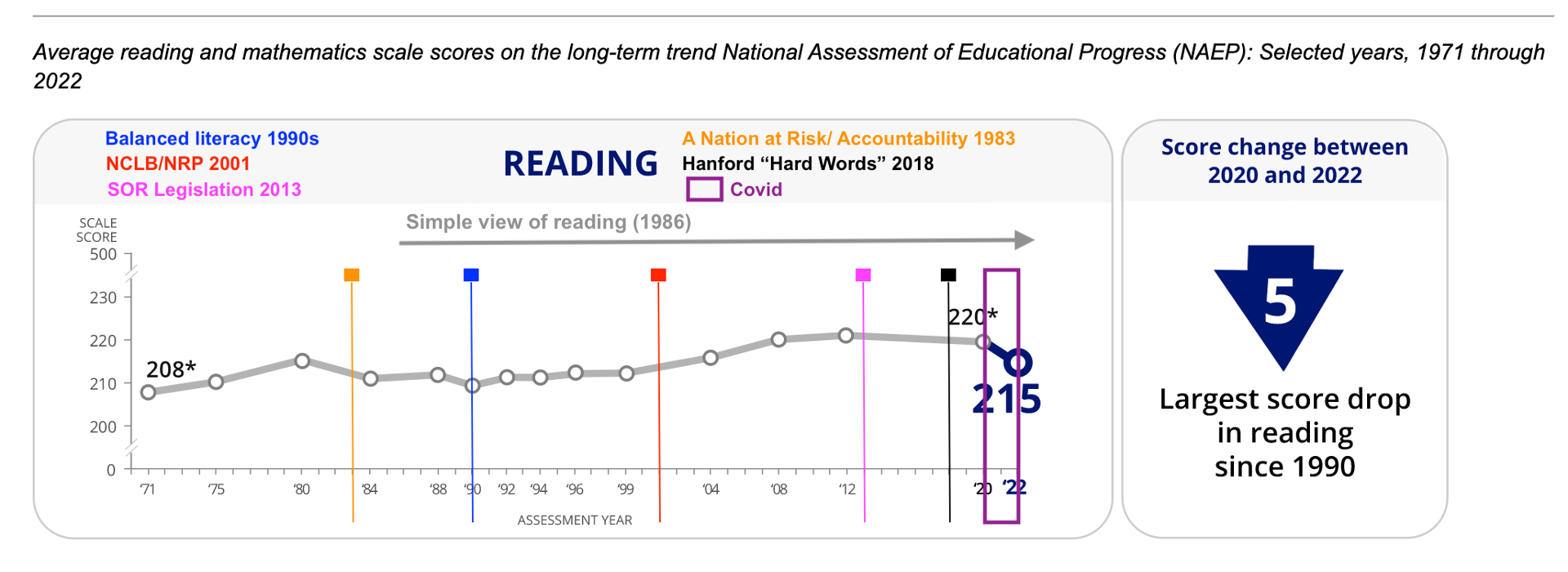
Further, there is little evidence that students today are uniquely underperforming in reading achievement, yet the bad reading teacher myth is perpetuated by misrepresenting reading achievement through misleading messages around NAEP reading data (see Hanford’s chart that ironically suggests gradual improvement, not a crisis).

Two problems with the bad reading teacher myth is that NAEP reading proficiency is not grade level reading, as Loveless examines:

NAEP does not report the percentage of students performing at grade level.  NAEP reports the percentage of students reaching a “proficient” level of performance.  Here’s the problem. That’s not grade level. 

In this post, I hope to convince readers of two things:

1.  Proficient on NAEP does not mean grade level performance.  It’s significantly above that.
2.  Using NAEP’s proficient level as a basis for education policy is a bad idea.

The NAEP proficiency myth

And the low levels of reading proficiency are historical, not a recent set of data that constitutes a reading crisis:

If we want to rely on NAEP reading scores, however flawed that metric, the historical patterns suggest a relatively flat state of reading achievement with some trends of improvement in the 1970s (which was followed by the manufactured myth of schools failing with A Nation at Risk [1983]) and steadily from about 1990 until 2012 (an era demonized as a failure due to reliance on balanced literacy).

Notably, the “science of reading” movement tends to be connected to legislation starting around 2013 and Hanford’s journalism beginning in 2018, and that NAEP data has remained relatively flat except for the Covid drop.

Again, as Bessie acknowledged over a decade ago, the real problems with education, teaching, and learning are very complex and far larger than pointing fingers at teachers as “villains.”

For most of the history of US education, student reading achievement has been described as “failing,” and vulnerable student populations (minoritized races, impoverished students, students with special needs such as dyslexia, and MLLs) have always been underserved.

The dirty little secret about teacher quality related to student reading proficiency is that those vulnerable students are disproportionately sitting in class with early-career and uncertified teachers who are struggling with high student/teacher ratios.

Are students being underserved? Yes, but this is a historical fact of US public education not a current crisis.

Are low student achievement and reading proficiency the result of bad teachers? No, but these outcomes are definitely correlated with bad teaching/learning conditions and bad living conditions for far too many students.

In 2023, just as in 2010, the myth of the bad teacher is a lie, a political and marketing lie that will never serve the needs of students, teachers, or society.

Way back in 1984 when I entered the classroom, I was excited to begin my career but quickly discovered that despite my respect and even love for my English professors and teacher educators in my undergraduate degree, I simply was not prepared well enough to do my job, notably as a teacher of writing.

I set out to learn by teaching, and do better. During the late 1980s, I was fortunate to learn further through the Spartanburg Writing Project (Nation Writing Project), where I discovered that much of my on-the-job training was misguided (thanks, Brenda Davenport).

Anyone who teaches knows that becoming an effective teacher is a journey and that those first 3, 5, or even 10 years are challenging and include a great deal of growth that cannot be accomplished in teacher certification programs.

None the less, everything surrounding teaching, and especially the teaching of reading, can and should be better.

That was true in 1940 and every decade since then.

Teacher and school bashing, shouting “crisis”—these have been our responses over and over; these are not how we create a powerful teacher workforce, and these will never serve the needs of our students who need great teachers and public education the most.

The myth of the bad teacher is a Great American Tradition that need to end.


[1] Valcarcel, C., Holmes, J., Berliner, D. C., & Koerner, M. (2021). The value of student feedback in open forums: A natural analysis of descriptions of poorly rated teachers. Education Policy Analysis Archives29(January – July), 79. https://doi.org/10.14507/epaa.29.6289

[2] See Our study found new teachers perform just as well in the classroom as their more experienced colleagues

Does Instruction Matter?

[Header Photo by Seema Miah on Unsplash]

For me, the pandemic era (and semi-post-pandemic era) of teaching has included some of the longest periods in my 39-year career as an educator when I have not been teaching.

The first half of my career as a high school English teacher for 18 years included also teaching adjunct at local colleges during the academic year along with always teaching summer courses (even while in my doctoral program).

Currently in my twenty-first year as a college professor, in addition to my required teaching load, I have always taught overloads during the main academic year, our optional MayX session, and (again) summer courses.

Teaching has been a major part of who I am as a professional and person since my first day at Woodruff High (South Carolina) in August of 1984.

However, during pandemic teaching, I have experienced several different disruptions to that teaching routine—shifting to remote, courses being canceled or not making (especially in MayX and summer), and then coincidentally, my first ever sabbatical during this fall of 2022 (in year 21 at my university).

One aspect of sabbatical often includes the opportunity to reset yourself as a scholar and of course as a teacher. As I was preparing my Moodle courses for Spring 2023, I certainly felt an unusually heightened awareness around rethinking my courses—an introductory education course, a first-year writing seminar, and our department upper-level writing and research course.

Here is an important caveat: I always rethink my courses both during the course and before starting new courses. Yes, the extended time and space afforded by sabbatical makes that reflection deeper, I think, but rethinking what and how I teach is simply an integral part of what it means for me to be a teacher.

For two decades now, I have simultaneously been both a teacher and teacher educator; in that latter role, I have been dedicated to practicing what I preach to teacher candidates.

I am adamant that teacher practice must always reflect the philosophies and theories that the teacher espouses, but I am often dismayed that instructional practices in education courses contradict the lessons being taught on best practice in instruction.

Not the first day, but a moment from my teaching career at WHS.

In both my K-12 and higher education positions, for example, I have practiced de-grading and de-testing the classroom because I teach pre-service teachers about the inherent counter-educational problems with traditional grades and tests.

Now, here is the paradox: As both a teacher and teacher educator my answer to “Does instruction matter?” is complicated because I genuinely believe (1) teacher instructional practices are not reflected in measures of student achievement as strongly (or singularly) as people believe and therefore, (2) yes and no.

The two dominant education reform movements over the past five decades I have experienced are the accountability movement (standards and high-stakes testing) and the current “science of reading” movement.

The essential fatal flaw of both movements has been a hyper-focus on in-school education reform only, primarily addressing what is being taught (curriculum and standards) and how (instruction).

I was nudged once again to the question about instruction because of this Tweet:

I am deeply skeptical of “The research is clear: PBL works” because it is a clear example of hyper-focusing on instructional practices and, more importantly, it is easily misinterpreted by lay people (media, parents, and politicians) to mean that PBL is universally effective (which is not true of any instructional practice).

Project-based learning (PBL) is a perfect example of the problem with hyper-focusing on instruction; see for example Lou LaBrant confronting that in 1931:

The cause for my wrath is not new or single. It is of slow growth and has many characteristics. It is known to many as a variation of the project method; to me, as the soap performance. With the project, neatly defined by theorizing educators as “a purposeful activity carried to a successful conclusion,” I know better than to be at war. With what passes for purposeful activity and is unfortunately carried to a conclusion because it will kill time, I have much to complain. To be, for a moment, coherent: I am disturbed by the practice, much more common than our publications would indicate, of using the carving of little toy boats and castles, the dressing of quaint dolls, the pasting of advertising pictures, and the manipulation of clay and soap as the teaching of English literature. (p. 245)

LaBrant, L. (1931, March). Masquerading. The English Journal, 20(3), 244-246. http://www.jstor.org/stable/803664

LaBrant and I both are deeply influenced by John Dewey’s progressive philosophy of teaching (noted as the source for PBL), but we are also both concerned with how the complexities of progressivism are often reduced to simplistic templates and framed as silver-bullet solutions to enormous and complex problems.

As LaBrant notes, the problem with PBL is not the concept of teaching through projects (which I do endorse as one major instructional approach), but failing to align the project in authentic ways with instructional goals. You see, reading a text or writing an essay is itself a project that can be authentic and then can be very effective for instruction.

My classrooms are driven, for example, by two instructional approaches—class discussions and workshop formats.

However, I practice dozens of instructional approaches, many planned but also many spontaneously implemented when the class session warrants (see Dewey’s often ignored concept of “warranted assertion”).

This is why Deweyan progressivism is considered “scientific”—not because we must use settled science to mandate scripted instructional practices but because teaching is an ongoing experiment in terms of monitoring the evidence (student artifacts of learning) and implementing instruction that is warranted to address that situation and those students.

So this leads to a very odd conclusion about whether or not instruction matters.

There are unlikely any instructional practices that are universally “good” or universally “bad” (note that I as a critical educator have explained the value of direct instruction even as I ground my teaching in workshop formats).

The accountability era wandered through several different cycles of blame and proposed solutions, eventually putting all its marbles in teacher quality and practice (the value-added methods era under Obama). This eventually crashed and burned because as I have noted here, measurable impact of teaching practice in student achievement data is very small—only about 10-15% with out-of-school factors contributing about 60-80+%.

The “science of reading” movement is making the exact same mistake—damning “balanced literacy” (BL) as an instructional failure by misrepresenting BL and demonizing “three cueing” (see the second consequence HERE, bias error 3 HERE, and error 2 HERE).

Here is a point of logic and history to understand why blaming poor reading achievement on BL and three cueing: Over the past 80 years, reading achievement has never been sufficient despite dozens of different dominant instructional practices (and we must acknowledge also that at no period in history or today is instructional practice monolithic or that teachers in their classrooms are practicing what is officially designated as their practice).

In short, no instructional practice is the cause of low student achievement and no instructional practice is a silver-bullet solution.

Therefore, does instruction matter? No, if that means hyper-focusing on singular instructional templates for blame or solutions.

But of course, yes, if we mean what Dewey and LaBrant argued—which is an ongoing and complicated matrix of practices that have cumulative impact over long periods of time and in chaotic and unpredictable ways.

From PBL to three cueing—no instructional practice is inherently right or wrong; the key is whether or not teachers base instructional practices on demonstrated student need and whether or not teachers have the background, resources, teaching and learning conditions, and autonomy to make the right instructional decisions.

Finally, hyper-focusing on instruction also contributes to the corrosive impact of marketing in education, an unproductive cycle of fadism and boondoggles.

In the end, we are trapped in a reform paradigm that is never going to work because hyper-focusing on instruction while ignoring larger and more impactful elements in the teaching/learning dynamic (out-of-school factors, teaching and learning conditions, etc.) creates a situation in which all instruction will appear to be failing.

Reforming, banning, and mandating instruction, then, is fool’s gold unless we first address societal/community and school inequities.

Whose Voice Matters?: Reading Teacher Edition

Here is a teacher voice that resonates with me in my work as a literacy teacher and scholar:

A brief consideration will indicate reasons for the considerable gap between the research currently available and the utilization of that research in school programs and methods.

It is not strange, in view of the extensive literature on language, that the teacher tends to fall back upon the textbook as authority, unmindful of the fact that the writer of the text may himself be ignorant of the basis for his study. …

This is not the time for the teacher of any language to follow the line of least resistance, to teach without the fullest possible knowledge of the implications of his medium. Before we…experiment with methods of doing specific things or block out a curriculum, let us spend some time with the best scholars in the various fields of language study to discover what they know, what they believe uncertain and in need of study. Let us go to the best sources, and study the answers thoughtfully.

This voice in many ways parallels a dominant narrative in the media about teaching reading in the US:

From how much of the media tells it, a war rages in the field of early literacy instruction. The story is frequently some version of a conflict narrative relying on the following problematic suppositions:

a) science has proved that there is just one way of teaching reading effectively to all kids – using a systematic, highly structured approach to teaching phonics;

b) most teachers rely instead on an approach called balanced literacy, spurred on by shoddy teacher education programs;

c) therefore, teachers incorporate very little phonics and encourage kids to guess at words;

d) balanced literacy and teacher education are thus at fault for large numbers of children not learning to read well.

The opening teacher voice is from Lou LaBrant, published in 1947 in the journal that would become Language Arts (NCTE). LaBrant was a classroom literacy teacher and teacher educator over a 65-year career.

The second passage is by Maren Aukerman, a scholarly analysis of the current media coverage of the “science of reading” (SOR).

Although 77 years apart, these voices and claims about teaching reading seem to suggest that concerns about reading achievement have been similar for many, many decades, and thus, placing blame for current reading achievement on specific aspects of teacher preparation and teacher practice today seems if not baseless at least misguided.

For a couple years now, I have also heard from dozens and dozens of teachers, some of whom send me real-time DMs documenting teacher PD they are receiving in SOR; these teachers identify misinformation in that PD as well as misunderstanding about reading and teaching reading by their administrators.

Often these are LETRS training sessions, or similar programs designed to emphasize phonics for teachers of reading.

Many teachers have contacted me about being reprimanded and threatened for simply asking questions about the training or pointing out the misinformation.

What is important to stress here is that these teachers—often veteran teachers who have a high level of expertise—do not have a podcast or a Facebook page amplifying their stories.

To be blunt, in today’s SOR climate, these reading teachers’ voices do not matter.

But other points need to be stressed also.

First, is the media narrative that teacher education does not include SOR or phonics instruction true?

No, and in fact, there is research that teacher education is grounded in science, but there also is an absence of research on these exact concerns (again, identical to LaBrant’s reference to the “gap” above):

It is clear that the repeated critiques of literacy teacher preparation expressed by the SOR community do not employ the same standards for scientific research that they claimed as the basis for their critiques. However, to dismiss these critiques as unimportant would ignore the reality of consequences, both current and foreseen, for literacy teacher preparation….

In contrast to the claims made by the SOR community, research in literacy teacher preparation has been extensive, scientific, and useful for guiding reform efforts….

Despite the political and media attention given to the SOR and the tools on which the SOR community relies, there is no body of evidence that reflects the SOR perspective on literacy teacher preparation by members of the literacy teacher preparation research community.

Hoffman, J.V., Hikida, M., & Sailors, M. (2020). Contesting science that silences: Amplifying equity, agency, and design research in literacy teacher preparation. Reading Research Quarterly, 55(S1), S255–S266. Retrieved July 26, 2022, from https://doi.org/10.1002/rrq.353

Next, and really important, if we are demanding scientific research inform practice, currently the research base on LETRS simply does not show that the training improves teaching or learning to read by students:

A growing number of U.S. states have funded and encourage and/or require teachers to attend professional development using Moats’s commercial LETRS program, including Alabama, Arkansas, Kansas, Mississippi, Missouri, Oklahoma, Rhode Island, and Texas. This is despite the fact that an Institute of Education Sciences study of the LETRS intervention found almost no effects on teachers or student achievement (Garet et al., 2008).

Hoffman, J.V., Hikida, M., & Sailors, M. (2020). Contesting science that silences: Amplifying equity, agency, and design research in literacy teacher preparation. Reading Research Quarterly, 55(S1), S255–S266. Retrieved July 26, 2022, from https://doi.org/10.1002/rrq.353

We are confronted, then, with an increasingly harmful pattern: The media continues to make unsupported claims about reading failures by teachers, teacher educators, and students, leading to parental and political responses that have resulted in very harmful policies and practices (see HERE, HERE, and HERE).

And these questions remain:

  • Should we reform how reading is taught in the US? Of course.
  • Should we reform teacher education, notably focusing on literacy instruction? Absolutely.

However, the current SOR movement is doing the same thing once again while expecting different results.

And the SOR movement isn’t playing by the rules advocates and policy makers are demanding for everyone else.

If we are disqualifying reading programs popular throughout the US because of personal and corporate profit (a key claim in one podcast episode), then we must hold people and programs being implemented in their place to the same standards.

Media and journalists are making money off a false narrative, shouting “science” while using cherry-picked anecdotes to sell their story.

Corporations and program designers are making huge amounts of money off PD that isn’t supported by science at all. My home state of SC, like many states, just allocated $15 million for LETRS training.

If we are disqualifying anything that isn’t “scientific” (notably the exact same call as was codified in No Child Left Behind in 2001), then we cannot use anecdotes (especially cherry-picked anecdotes) to demand reform and cast blame.

Yet, the media continue to drive a narrative by including only voices that make that story seem true.

We could easily fill a podcast episode with teachers who have suffered through really flawed LETRS training, and at least several episodes of teachers who have had their professional autonomy stripped from them because of administrators holding them accountable for implementing a program and not teaching students (which is exactly what is happening with structured literacy as a replacement for so-called failed programs):

We recognize that some teachers using structured literacy approaches will find ways to respond to the interests, experiences, and literacy abilities of individual students; however, we are concerned about the indiscrim- inate and unwarranted implementation of the following practices:

• Directive and/or scripted lessons that tell teachers what to say and do and the implementation of les- son sequences, often at a predetermined pace (Hanford, 2018)

• Privileging of phonemic awareness and phonics as primary decoding skills (Hanford, 2018, 2019; IDA, 2019; Paige, 2020; Pierson, n.d.; Spear-Swerling, 2019)

• Use of decodable texts that do not engage multiple dimensions of reading (Hanford, 2018; IDA, 2019; Paige, 2020; Spear-Swerling, 2019)

• Specialized forms of reading instruction designed for particular groups of students as core literacy instruction for all students and teacher educators (Hanford, 2018; Hurford et al., 2016; IDA, 2019; Pierson, n.d.)

• Mandating structured literacy programs despite the lack of clear empirical evidence to support these programs

• Privileging the interest of publishers and private education providers over students.

Compton-Lilly, C.F., Mitra, A., Guay, M., & Spence, L.K. (2020). A confluence of complexity: Intersections among reading theory, neuroscience, and observations of young readers. Reading Research Quarterly, 55(S1), S185-S195. https://doi.org/10.1002/rrq.348

Throughout my forty-year career as a K-12 teacher and a university professor/teacher educator, I have a clear record advocating for students (1a) and teachers (1b).

The current megaphone allowed teachers and parents who see failure and feel failed is certainly valuable while also being anecdotes, not science, and more problematic, cherry-picked anecdotes.

I have heard much different voices, and I also know they are being ignored or often silenced with threats.

I suspect there are far more reading teachers who need better teaching and learning conditions so that their expertise can be more effective with students than those who need retraining.

Or at least if we addressed teaching and learning conditions, we would have a better context in which to decide who needs PD.

That story isn’t what sells , however.

The SOR movement has pitted teachers against teachers, teachers against administrators, and teachers against teacher educators. Those conflicts serve the interests of commercial programs, not students and teachers.

So, finally, if we drop the “science” bullying and admit that teacher voices matter, then we must hand that megaphone to all voices, not just the ones that serve the market interests of those who see the SOR movement as an opportunity to cash in (again).


See Also

Reading Science Resources for Educators: Science of Reading Edition

If Teacher Education Is Failing Reading, Where Is the Blame?

Of Rocks and Hard Places—The Challenge of Maxine Greene’s Mystification in Teacher Education, P. L. Thomas

NCTQ: “The data was effectively useless”

You can count on two things when the National Council on Teacher Quality (NCTQ) releases one of their “reports.”

First, media will fall all over themselves to report NCTQ’s “findings” and “conclusions” without any critical review of whether the “findings” or “conclusions” are credible (or peer-reviewed, which they aren’t).

Second, NCTQ’s “methods,” “findings,” and “conclusions” are incomplete, pre-determined (NCTQ has a predictable “conclusion” that teacher education/certification is “bad”), and increasingly cloaked in an insincere context of diversity and equity (now teacher education/certification are not just “bad” but especially “bad” for minority candidates).

So the newest NCTQ report has been immediately and uncritically amplified by Education Week (who loves to take stands for “scientific” evidence while also reporting on “findings” and “reports” that cannot pass the lowest levels of expectations for scientific research).

There is great irony in this report and EdWeek’s coverage that includes two gems:

“The data was effectively useless,” said Kate Walsh, the president of NCTQ….

Said Walsh: “We do think that states ought to be asking some hard questions of institutions that have really low first-time pass rates. … We shouldn’t be afraid of this data. This data can help programs get better.”

First-Time Pass Rates on Teacher Licensure Exams Were Secret Until Now. See the Data

Walsh, in the first comment, is referring to data on passing rates on standardized testing, used for teacher licensure, but the irony is that she would be more accurate if she were referring to the NCTQ “report” itself.

The “report” admits that a number of states refused to cooperate (NCTQ has a long history of lies and manipulation to acquire “data” and many institutions and organizations have wisely stopped complying since the outcomes of NCTQ’s are predictable); therefore, this NCTQ “report” is similar to all their other “reports” in terms of incomplete data and slipshod methodology (a review of another NCTQ “report” by a colleague and me, for example, noted that NCTQ’s methodology wouldn’t be accepted in an undergraduate course, much less as credible scholarship to drive policy).

NCTQ and EdWeek, however, are typically not challenged since their claims and coverage fit a misleading narrative that the public and political leaders believe (again ironically in the absence of the data that Walsh claims “[w]e shouldn’t be afraid of”)—everything about U.S. public education, from teacher education to teacher quality, is total garbage.

NCTQ is a hack, agenda-driven think-tank, and EdWeek has eroded its journalistic credibility by embracing NCTQ’s “reports” when it serves their need for online traffic (see EdWeek’s obsession with the misleading “science of reading” movement where EdWeek shouts “science!” and cites NCTQ reports that fail the minimum requirements of scientific methodology).

This “report” on standardized testing in the teacher licensure process shouldn’t be viewed as in any way valuable for drawing conclusions about teacher education (teacher ed is a real problem that I have criticized extensively, but NCTQ hasn’t a clue what those problems are, and frankly, they don’t care) or for making policy.

However, what is interesting to notice is that NCTQ has chosen to use a shoddy analysis of previously hidden data on standardized testing to (once again) damn teacher education and traditional certification (both of which actually do deserve criticism and re-evaluation) even though there is another position one could take when analyzing (more rigorously and using a more robust methodology and the peer-review process) this data.

What if the problem with passing rates is not the quality of teacher education, but the inherent inequity built into standardized testing throughout the entire system of formal education?

Across the educational landscape—from NAEP to state-based accountability testing to the SAT and ACT to teacher licensure exams—standardized testing remains deeply inequitable, mostly correlated with socio-economic status, race, and gender in ways that perpetuate inequity.

In the very recent past, NCTQ was fully on board with the value-added method (VAM) for determining teacher quality, recall, and that movement eventually fell apart under its own weight since narrow forms of measurement, standardized testing, are actually a lousy way to understand teaching and learning.

If we take Walsh seriously about data (and we shouldn’t), here is a simple principle of gathering and understanding data—one data point (a standardized test score) will never be as powerful of valuable (valid/reliable) as multiple data points:

“Multiple data sources give us the best understanding of something,” said Petchauer, who was not involved in NCTQ’s report. “I get worried when a single high-stakes standardized test can trump other indicators of what a teacher knows and is able to do.”

First-Time Pass Rates on Teacher Licensure Exams Were Secret Until Now. See the Data

For one example, the Holy Grail of data credibility for the SAT has always been to be as predictive as GPA (GPA is the result of dozens of data points over years, and thus, a far more robust data set that one test score). GPA is more predictive.

Teacher education, like all education, remains inadequate, especially for marginalized populations, but one of the key elements in that claim is the overused of standardized testing.

If NCTQ and EdWeek were interested in challenging the use of high-stakes testing, then there may be some value in NCTQ’s most recent “report” (although the data is incomplete and the analysis is shoddy).

NCTQ’s “report” makes a big deal out of the licensure pass rates being hidden until their “report,” but once again, NCTQ’s agenda and total lack of scientific credibility as research makes this unveiling even worse than the data being hidden.

Ultimately, NCTQ’s misinformation campaign could be averted if and when media choose to practice what they preach. EdWeek is obsessed with teachers using the “science of reading” but their journalists routinely publish articles citing “reports” that never reach the level of “scientific.”

Whether you are a journalist or a researcher/scholar, you really are no better than the data, evidence, or sources you choose to stand with.

When your data are not credible, neither are you.

Fact-checking Phonics, NRP, and NCTQ

The “science of reading” movement often claims that a systematic intensive phonics-first approach to teaching reading is endorsed by science that is settled, that the National Reading Panel (NRP) is a key element of that settled science, and that teacher education is mostly absent of that “science of reading” (a message that has been central to NCTQ for many years).

These claims, however, misrepresent what evidence actually shows. Here, then, are some evidence-based fact-checks of phonics, NRP, and NCTQ.

Phonics

Reconsidering the Evidence That Systematic Phonics Is More Effective Than Alternative Methods of Reading Instruction, Jeffrey S. Bowers (2020)

Abstract

There is a widespread consensus in the research community that reading instruction in English should first focus on teaching letter (grapheme) to sound (phoneme) correspondences rather than adopt meaning-based reading approaches such as whole language instruction. That is, initial reading instruction should emphasize systematic phonics. In this systematic review, I show that this conclusion is not justified based on (a) an exhaustive review of 12 meta-analyses that have assessed the efficacy of systematic phonics and (b) summarizing the outcomes of teaching systematic phonics in all state schools in England since 2007. The failure to obtain evidence in support of systematic phonics should not be taken as an argument in support of whole language and related methods, but rather, it highlights the need to explore alternative approaches to reading instruction.

[For context, note some of the problems remaining in how whole language is addressed in this post.]

National Reading Panel

The Federal Government Wants Me to Teach What?: A Teacher’s Guide to the National Reading Panel Report, Diane Stephens (NCTE, 2008)

An Ever-So-Brief Summary with Book Recommendations

1. Phonemic Awareness. According to the studies cited in the NRP report, this is best taught to very young children (K–1) using letters, and when letters are used, PA instruction is considered to be phonics. Therefore, it is not necessary to have a separate instructional time for PA. Rather, children should have opportunities to learn about how language is made up of parts (e.g., onsets and rimes, or word families) as part of phonics instruction. An effective way to do this in the classroom? Provide time for students to write using invented spelling (pp. 2-1 through 2-86). (See Strickland, 1998, for further information about invented spelling.)

2. Phonics. According to the studies cited in the NRP report, there is no evidence that phonics instruction helps in kindergarten or in grades 2 to 9. It does help first graders learn the alphabetic principle—that there is a relationship between letters and sounds. No one method is better than any other. For example, for at-risk first graders, a modified whole language approach and one-on-one Reading Recovery–like instruction both helped children with comprehension (pp. 2-89 through 2-176). This phonics instruction should be conducted in the context of whole, meaningful text. (See Moustafa, 1997, for information on embedded, whole-part-whole instruction.)

3. Fluency. According to the authors of the Fluency report, the practice of round robin (at any age) does not help children and can indeed hurt them. However, according to the studies cited in the Fluency report, repeated oral reading (K–12) helps with comprehension because reading to readers fluidly instead of word-by-word reading helps them better understand the text. Ways to help with this? Try such things as readers theater (pp. 3-1 through 3-43). (See Opitz and Rasinski’s Good-bye Round Robin: 25 Effective Oral Reading Strategies [1998] for additional instructional suggestions.)

4. Vocabulary (grades 3 to 8). One method is not better than another. Children learn most of their vocabulary incidentally (pp. 4-15 through 4-35). (For further information about vocabulary learning, see Nagy, 1988.)

5. Comprehension (grades 3 to 6). Children need to learn that print makes sense and to develop a variety of strategies for making sense of print (pp. 4-39 through 4-168). (For further information on teaching for comprehension, see the references listed in Chapter 8: Beers, 2002; Sibberson & Szymusiak, 2003; Taberski, 2000; Tovani, 2000; see also Harvey & Goudvis, 2000.)

Across all of these recommendations? According to the studies cited in the NRP report, if we want children to learn something, we need to teach them that something. Want great readers? Then teach children what great readers do.

NCTQ (Teacher Education)

NOTE: This is more complicated, but first I am posting an older (2006) and new (2020) report from NCTQ both making essentially the same claims that teacher education fails to teach the “science of reading.” Then, I include a link to several reviews that show that NCTQ’s “reports” are methodologically flawed and essentially propaganda, not “science.”

What Education Schools Aren’t Teaching (2006)

2020 Teacher Prep Review: Program Performance in Early Reading Instruction

NEPC reviews of NCTQ reports

NCTQ on States’ Teacher Evaluation Systems’ Failures, Again