
Category Archives: Teaching

U.S. and Education Reform Need a Critical Free Press

Few things are worse than mainstream media coverage of education.

Except for that sentence above, which stretches hyperbole beyond credibility.

But that is exactly where the mainstream media finds itself when covering education. Journalists, in their quest to maintain the traditional commitment to “fair and balanced” journalism [1], consistently endorse and perpetuate organizations without credibility (such as NCTQ) and baseless claims (such as cries of “bad” teacher, “bad” teacher certification, and “bad” unions).

With yet another report released by NCTQ, that failure of the mainstream media has been highlighted once again—notably at NPR [2] and Education Week: Study Delivers Failing Grades For Many Programs Training Teachers, Claudio Sanchez and Juana Summers; Alternative Certification Deemed Weak by NCTQ in New Teacher-Prep Report, Stephen Sawchuk; Most Teacher Preparation Falls Short on Strategies for ELLs, NCTQ Finds, Lesli A. Maxwell.

First, the mainstream coverage of NCTQ’s reports remains trapped inside assumed crises that have no basis in fact; NCTQ’s reports and then the media begin with the givens that education suffers under the burden of “bad” teachers, “bad” teacher certification, and “bad” unions. However, at the very least, these claims are disproportional, if not outright erroneous:

  • If we maintain the current context that student achievement is accurately reflected in test scores (and it isn’t), then we must acknowledge that teacher quality (10-15%) and school quality account for only about 20% of that measurement, but “60 percent of achievement outcomes is explained by student and family background characteristics (most are unobserved, but likely pertain to income/poverty),” as Di Carlo details.
  • If we accept that value-added methods (VAM) can accurately and consistently identify “good” and “bad” teachers (and the evidence is that it cannot) and if we accept the much repeated claim by Chetty et al. that teacher quality can add $50,000 to the lifetime earning potential of a student (and that also is a significantly contested claim, as well as another example of advocacy and media hyperbole since that lifetime earning figure equates to about 1.5-2 tanks of gas per month), the enormity of the claims about “bad” teachers and the urgency expressed about creating and implementing huge and expensive test-based systems to address teacher quality are at best overstated. No rational person would endorse the cost-benefit analysis of such schemes.
  • Finally, claims that teachers unions are primary or significant negative influences on educational quality are powerfully refuted by the historical and current fact that the states in the U.S. with the lowest standardized test scores tend to be those that are right-to-work (non-union) states. Unionization correlates positively with measurable student achievement, in fact, while poverty is the greatest correlation with low measurable student outcomes (for the record, union bashing is a straw man because U.S. public education has a poverty problem, not a union problem).

Next, NCTQ has established a sort of immediate appearance of credibility through three strategies: partnering itself with U.S. News & World Report, garnering significant and influential sources of funding, and bombarding the mainstream media with a series of reports without vetting those reports as is common in traditional scholarship (which slows down and greatly harnesses higher-quality research from reaching the public [3]. But scholars don’t issue press releases, and apparently, journalists respond primarily to press releases instead of conducting investigative journalism [4].)

Finally, once I engaged Sawchuck (EdWeek) and then Summers (NPR) on Twitter, several key aspects of this phenomenon were highlighted. Both journalists argued that their pieces on NCTQ were fair, and even critical—which I will examine below—but even more significant is a comment on Twitter from Summers:

@plthomasEdD I’m not sure it’s my place to say whether the study is credible, but we both note the significant criticism of the methods.

— Juana Summers (@jmsummers) June 18, 2014

My two reactions to Summers deferring from examining the credibility of NCTQ are, first, to strongly disagree, and second, note that no journalists need to do any real investigative journalism to uncover that NCTQ has no credibility because all of that work has been done already by a number of scholars (see those critiques catalogued here and here).

As disturbing, however, as that stance is, examining carefully the coverage of NCTQ reveals that the mainstream media does in fact endorse NCTQ implicitly (despite claims of impartiality) and also marginalizes the credible critiques of NCTQ.

All three articles (see above) have headlines that establish immediately for any reader that NCTQ’s report is worthy of major media coverage. Next, all three articles have ledes that also present NCTQ positively:

The nation’s teacher-preparation programs have plenty of room for improvement, according to a new report. (Sanchez and Summers)

Alternative-certification programs for preparing teachers suffer from many of the same problems that the National Council on Teacher Quality has identified in traditional, university-based programs, the Washington-based group concludes in a new pilot study. (Sawchuk)

More than 75 percent of elementary teacher-preparation programs are failing when it comes to readying future teachers to work effectively with English-language learners, a new report from the National Council on Teacher Quality contends. (Maxwell)

Sanchez and Summers (again, note that Summers argues it isn’t her job to assign credibility to the study) certainly imply that the study is credible by using this language: “The study is a dismal read, given that the U.S. spends more than $6 billion each year to prepare teachers for the classroom.”

The NCTQ study is only a “dismal read” if it is accurate (and it isn’t). NCTQ has been carefully discredited in scholarship (for example, see Fuller here and here) for serious conflicts of interest (Teach For America and KIPP leaders sit on the Advisory Board, for example), for a flawed study design, and for shoddy methodology [5].

So how are credible academic critiques of NCTQ characterized in the journalism that claims not to take evaluative positions?:

When NCTQ released a version of this report last year, it was met with some skepticism among educators and those responsible for preparing teachers. Critics said the advocacy group should have visited individual teacher-prep programs and talked to graduates and students, rather than relying on syllabi. (Sanchez and Summers)

Last year’s inaugural teacher-prep review was immediately rejected by most teacher colleges and, especially, by their main membership body, the American Association of Colleges for Teacher Education.

Criticism focused on the NCTQ’s tack of reviewing syllabi and other course materials rather than visiting institutions; its use of open-records requests and current students to obtain documents; the complaint that its standards weren’t agreed to by the profession; and the fact that its research products aren’t peer reviewed. Additionally, critics have claimed that the project is ideologically driven, given NCTQ’s role as incubator of an alternative-certification group, the American Board for Certification of Teacher Excellence (ABCTE), which received federal funding from the George W. Bush administration.

The latter complaint seems less viable now that the NCTQ has turned its green eyeshade toward alternative-certification programs. (Sawchuk)

“Some skepticism” and “critics” clearly position credible scholarship negatively while maintaining the implied endorsement of NCTQ as an organization and NCTQ’s reports. And while Sawchuk appears to address more directly NCTQ’s lack of credibility, he still marginalizes scholars as “critics” and then in the last paragraph above, simply discounts the criticism [6].

Further in Sawchuk’s piece, the contrast between lacking credibility (NCTQ) and credibility (scholarship discrediting NCTQ) is reduced to a simple misunderstanding and a matter of tone (not substance):

Notably, the report’s introduction this year contains a number of mea culpas regarding the bad blood between the NCTQ and teacher colleges. And Walsh agreed that her group bore some of the blame.

“At times we were a bit arrogant about what it is we think teacher education should be doing,” she said. “Even if we agree to disagree, we can be more respectful.”

Again, this trivializes criticism of NCTQ and further equates NCTQ (an advocacy think tank) with scholarship—while also painting NCTQ as apologetic (despite the organization maintaining its threat of ranking programs whether they cooperate or not; a powerful tool afforded NCTQ because of its media partnership with U.S. News & World Report).

One of my strongest criticisms of teachers is that we far too often allow ourselves to be trapped within traditional calls that we take neutral stances; however, the U.S. needs critical teachers (political teachers) if our public schools are to be a foundation for our democracy.

What I have detailed above is that journalists in the U.S. have bowed to the same call for neutrality, one that cannot be accomplished but can serve as a shield for maintaining the status quo.

The U.S. needs critical journalists, ones who see their job as maintaining a commitment to seeking out and identifying the credibility of things they report. Only those in power benefit when the free press is mostly free of taking to task those in power.

Nowhere is that more apparent than in how the mainstream media fails the education reform debate.

[1] Journalists and teachers share the burden of traditional expectations that they should never be “political,” but taking a neutral stance is, in fact, taking a passive stance endorsing the status quo. In other words, taking a dispassionate pose is a political stance (see The Politics of Calling for No Politics).

[2] See a similar example with NPR’s coverage of “grit.”

[3] See the following in terms of how the mainstream media disproportionately reports on think tank (non-peer reviewed) reports as compared to peer-reviewed and university-based research:

Molnar, A. (2001, April 11). The media and educational research: What we know vs. what the public hears. Milwaukee, WI: Center for Education Research, Analysis, and Innovation. Retrieved from http://epsl.asu.edu/epru/documents/cerai-01-14.htm

Yettick, H. (2009). The research that reaches the public: Who produces the educational research mentioned in the news media? Boulder, CO and Tempe, AZ: Education and the Public Interest Center & Education Policy Research Unit. Retrieved from http://epicpolicy.org/publication/research-that-reaches

[4] I make this claim not as a direct attack on any journalists, but teachers and journalists now experience very similar and negative influences on their ability to conduct their professions. While education reform tends to impeded good teaching, the contracting media market has tended to overburden journalists. As a result of newspapers and magazines disappearing and contracting their staffs, many journalists resort to press-release journalism as a survival technique, similar to teachers teaching to the tests. The conditions of both professions, teaching and journalism, are stark reasons why both teachers and journalists must exert their political selves in their professional work.

[5] As a brief glimpse into NCTQ’s accidental admission of their methodology, in an effort to twist criticism of their practices, this post adds at the end “As one teacher candidate who is working on our office this summer said,” highlighting that anecdote is enough for NCTQ, as long as it matches their advocacy.

[6] Sawchuk fails to recognize that NCTQ is working within a scorched-earth policy as part of the large disaster capitalism driving education reform in the U.S. For a vivid example of how this works, and why NCTQ, TFA, and KIPP benefit once the traditional education system is dismantled, see the events that have occurred since Katrina in New Orleans where the public school system has been replaced by charters schools, many KIPP and many staffed by TFA recruits.
UPDATED: NCTQ: “their remedies are part of the disease”

Accordingly, with admirable, though misdirected intentions, they very seriously and very sentimentally set themselves to the task of remedying the evils that they see. But their remedies do not cure the disease: they merely prolong it. Indeed, their remedies are part of the disease.

Oscar Wilde (1891), The Soul of Man under Socialism

And so: NCTQ releases yet another think tank faux-report that will spur yet more press-release journalism.

In the wake of the Vergara ruling in California, which is one intended consequence of maintaining the distracting drum beat about “bad teachers,” I am convinced that NCTQ is implementing a strategy dramatized in the (regretfully) ignored film In Time: Keep everyone so frantic and thus distracted that no one can confront, as Oscar Wilde so wonderfully states, that NCTQ’s “remedies are part of the disease.”

I cannot and see no need to speak directly to new reports from NCTQ because, as I have stated before:

NCTQ offers no credible agenda or scholarship worthy of reforming teacher education. But this ideological think tank is a disturbing example of all that is wrong with the current education reform movement that has allowed people without experience or expertise as educators to perpetuate an education reform agenda through the weight of money, political influence, and media compliance.

Here, however, I will gather my previous posts on NCTQ as well as the expected responses to come—keeping in mind that we can feel safe even before looking at the report that NCTQ remains a think tank without credibility.

Responses to NCTQ

[new]

NCTQ (Finally) Gets Formally Rated– And It Isn’t Pretty.

UNC Study Examines NCTQ’s Ratings of Teacher Preparation Programs and Measures of NC Teacher Performance

Measuring Up: The National Council on Teacher Quality’s Ratings of Teacher Preparation Programs and Measures of Teacher Performance

Why NCTQ Is Wrong, NCTE

A Plethora of Recommendations Based on a Paucity of Evidence, Louann Reid

NCTQ’s Gradual Unmasking [UPDATED] (See compiled list of earlier responses to NCTQ at the end.)

UPDATED: NCTQ’s Free Pass in an Era of Press-Release Journalism

Those Nonsense Annual NCTQ Ratings Are Coming on June 17, Mercedes Schneider

Peter Smagorinsky: Response to the new NCTQ Teacher Prep Review

A “Fuller” Look at Education Issues, Ed Fuller

Shaky Methods, Shaky Motives: A Critique of the National Council of Teacher Quality’s Review of Teacher Preparation Programs, Ed Fuller

Knowledge Ventriloquism, EduShyster

Bunkum on teacher quality from the corporate reformers, Fred Klonsky

Professor: How NCTQ Restricts My Reading List, Katherine Crawford-Garrett

Reading Professor Responds to NCTQ Blast at Her Post, Katherine Crawford-Garrett

Statement on NCTQ Teacher Prep Review from Sharon P. Robinson, Ed.D., AACTE President and CEO

NCTQ/USNWR Review, AACTE

Resisting the National Council on Teacher Quality’s Propaganda, Jack Hassard

Also from Schneider

The Very Disappointing Teacher Impact Numbers from Chetty

It appears that Raj Chetty, of the very famous and mostly hypothetical Chetty et al. study addressing teacher quality’s impact on students’ lifetime earning potential, had a big influence on the Vergara case in California:

But one has to wonder how much impact that testimony would have had if the judge had considered that most reviews of the study find it to be poppy-cock (see Baker on the Chetty et al. molehill and Di Carlo) or if we simply displayed the numbers differently.

A 40-year “lifetime earnings” of $50,000 is only about $1250 a year, or about, after taxes, $75-80 per month, or about 1.5 to 2 tanks of gas a month.

Hmmmm. Compared to the $50,000 of hypothetical life-time earning or that insane $1.4 million for a class of 28, 1.5-2 tanks of gas a month appears to be much ado about nothing.

Chetty also fails to make a very important point about the economics of investing in measuring teacher quality: It will cost billions of dollars in public funding to create and implement a significant increase in high-stakes testing in order to hypothetically raise the monthly earning income of students enough for them to buy 1.5-2 tanks a gas each month.

A much more effective strategy would be to take those billions of dollars needed to create and implement VAM and give every worker in the U.S. $75 per month tax free. Simple, direct, and guaranteed.

Setting aside that this is all hypothetical, seems a ridiculously inefficient cost/benefit analysis of addressing a teacher quality issue that already is only about 10-15% of measurable student learning.

What We Tolerate (and for Whom) v. What the Rich Demand: On Teacher Quality

Two of the best teachers and education advocates I respect and listen to carefully, Nancy Flanagan and Susan Ohanian, had an important exchange on Twitter recently:

Prompted by the Vergara court case in California and a related article in The Atlantic, Flanagan and Ohanian share a concern about the political, popular, and media claim that “bad” teachers work in “bad” schools with “bad” students (all of which is the result of a flawed misreading of the conditions common in high-poverty schools that serve high-poverty communities).

Before examining the issue of teacher quality raised above, please take note of a Big Picture problem at the heart of the Vergara ruling: All professions, including teaching, have elite, solid, and weak practitioners, but to suggest that teacher quality is the or one of the primary causes of educational problems is simply false, a manufactured scapegoat to keep the public view off the real problems facing us—mostly social and educational inequity.

Let’s look carefully, now, at how the complex issue of teacher quality is further complicated by high-poverty schools:

  • Teacher quality represents only about 10-15% of measurable student outcomes (test scores); thus, since high-poverty students are disproportionately likely to produce low test scores, it is a mistake to read raw tests scores as a reflection of teacher quality (or even student learning) since those test scores are primarily a reflection of out-of-school influences. (Also note that outliers to that dynamic do not disprove a generalization and do not suggest what the norm should be; as well, all claims of such “miracle” schools have been discredited.)
  • High-poverty schools and high-poverty students are staffed and taught by teachers who are disproportionately new, early career, and/or under-/un-certified. That dynamic does contribute to “teacher quality,” but not in ways popular claims mean (for example, a new teacher is not “bad,” but experience certainly contributes to greater teacher effectiveness—although that is not necessarily reflected in measurable student outcomes).
  • High-poverty students and their parents value education as much as more affluent students and parents, but living in poverty is existing in a state of scarcity that taxes adults and children physically, psychologically, and mentally—often leaving them less capable of advocating for education and benefitting for learning opportunities. Conversely, students and parents from relative affluence are afforded the slack necessary to advocate for education and fully engage with learning experiences. The important point here is that teaching, parenting, and learning in conditions influenced by poverty negatively impact nearly everyone involved, but by changing those conditions (and not the people), those same people would perform differently. (This contradicts claims that we need to rid schools of “bad” teachers and instill poor students with “grit”—both of which focus the problems in the people and not the system.)

Flanagan and Ohanian, then, are right that high-poverty schools are not overburdened by “bad” teachers; many wonderful teachers work in high-poverty schools (but some genuinely weak teachers are protected by the mask of affluent students, affluent schools, and affluent communities)—and high-poverty students are potentially as capable of learning as their more affluent peers (impoverished students don’t need to be “fixed” and don’t need to be taught “grit”).

But those facts are harshly clouded by the knee-jerk conclusions drawn from raw test scores—just as most people erroneously believe private schools are superior to public schools simply because the outward evidence appears to suggest so.

What do the data show, then, when we look at teacher characteristics (interpreted as “quality”) in high-poverty schools along with student test scores as that contrasts with teacher characteristics and student test scores in affluent public and private schools?

As a society, we tolerate the worst possible conditions for the students with the most need (teacher characteristics, school conditions and funding, and high percentage of children living in poverty are the failure of adequate public response and policy) while students living in relative affluence have the advocacy of their parents demanding that they do not suffer the same conditions experienced by children in poverty (disproportionately children of color): high student-teacher ratios, inexperienced and un-/under-certified teachers, underfunded schools, facilities in disrepair, and worksheet and rote instructional practices aimed at test-prep.

The cruel reality is that high-poverty and high-minority schools are not staffed by “bad” teachers forced to teach “bad” students, but that those teachers and students have the most challenging conditions in their lives and schools to overcome while affluent students have slack in their lives and the best conditions in their schools.

Instead of misguided commitments to value-added methods (VAM) for finding the best teachers (which do not work), policies that address equity would serve us much better:

  • No child should be taught by un-/under-certified teachers.
  • No child should have new or early career teachers for several years in a row.
  • Teacher quality must be re-imagined as an effective matching of teachers with students and not reduced to measurable outcomes.
  • Student achievement must no longer be reduced to measurable outcomes.

As with much of the flawed education reform agenda, the teacher quality issue reflects the overuse and misuse of test scores.

Until we address the scarcity in children’s lives and schools, addressing teacher quality is a futile distraction, just as continuing to change standards and tests is a futile distraction.

Instead of labeling, ranking, and then firing teachers, our first best step would be to end the cult of high-stakes testing because the problems of education are mostly systemic (social and educational) and not the adults who choose to teach or the children we seek to serve.

Autonomy Must Precede Accountability

Nearly 2.5 years ago, I wrote directly about the essential flaw with the thirty-plus-years accountability movement in K-12 U.S. public education. That essential flaw is that accountability built on standards and high-stakes testing is a corruption of the concept of accountability—which may be better understood as “responsibility.”

The corrupted “accountability” imposed on students, teachers, and schools in this model fails to establish first some key conditions in which accountability proper can be valid, ethical, and effective:

  • Identify clearly and openly the conditions that are in need of reform as well as the causational roots of those conditions.
  • Insure and then honor the autonomy of those being held accountable.
  • Insure accountability does not include conditions over which those being held accountable have no real control.

As a teacher, and if I am allowed my professional autonomy, I cannot control the outcomes of my students since those outcomes are impacted significantly by many different cause agents outside my control, but I can (or should be able to) control the opportunities to learn that I provide students each day.

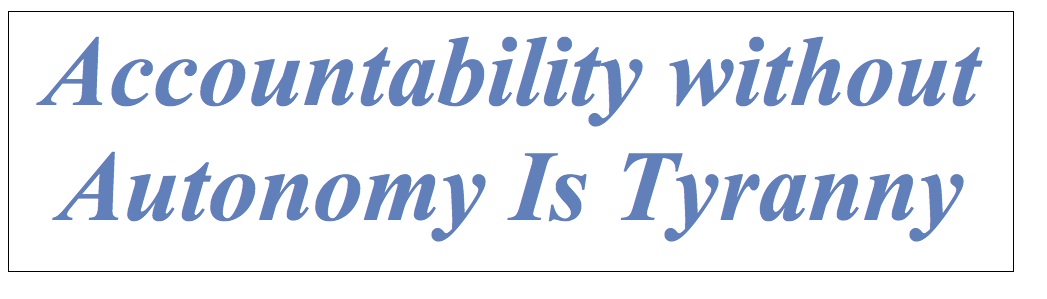
And thus, as we dig deeper the corrupted accountability hole with the shiny new Common Core shovel, it is with great sadness that I must assert that the reposting below remains the ugly reality of today as we near mid-2014 (in handy-dandy bumper sticker format):

UntitledAccountability without Autonomy Is Tyranny

When educational research reaches the public through the corporate media, the consequences are often dire. Chetty, Friedman, and Rockoff released “The Long-Term Impacts of Teachers: Teacher Value-Added and Student Outcomes in Adulthood” and immediately The New York Times pronounced in “Big Study Links Good Teachers to Lasting Gains”:

Elementary- and middle-school teachers who help raise their students’ standardized-test scores seem to have a wide-ranging, lasting positive effect on those students’ lives beyond academics, including lower teenage-pregnancy rates and greater college matriculation and adult earnings, according to a new study that tracked 2.5 million students over 20 years.

The simplistic and idealistic headline reflects the central failure of the media in the education reform debate, highlighted by careless reporting such as including this quote from one of the study’s researchers:

“The message is to fire people sooner rather than later,” Professor Friedman said.

This newest attempt to justify value-added methods for identifying, rewarding, and retaining high-quality teachers (as well as firing so-called weak teachers) was yet to be peer-reviewed, but two close initial examinations of the study—by Matthew Di Carlo and Bruce Baker—have praised the data but urged caution about conclusions drawn by the researchers and in media responses:

This appropriately cautious conclusion stands in stark contrast with the fact that most states have already decided to do so. It also indicates that those using the results of this paper to argue forcefully for specific policies are drawing unsupported conclusions from otherwise very important empirical findings. (Di Carlo)

These are interesting findings. It’s a really cool academic study. It’s a freakin’ amazing data set! But these findings cannot be immediately translated into what the headlines have suggested – that immediate use of value-added metrics to reshape the teacher workforce can lift the economy, and increase wages across the board! The headlines and media spin have been dreadfully overstated and deceptive. Other headlines and editorial commentary has been simply ignorant and irresponsible. (No Mr. Moran, this one study did not, does not, cannot negate  the vast array of concerns that have been raised about using value-added estimates as blunt, heavily weighted instruments in personnel policy in school systems.) (Baker)

Despite these strong and careful cautions, Dana Goldstein followed up with a praising piece in The Nation that links to Di Carlo’s work, but on balance accepts Chetty, Friedman, and Rockoff’s claims and suggests:

Given the widespread, non-ideological worries about the reliability of standardized test scores when they are used in high-stakes ways, it makes good sense for reform-minded teachers’ unions to embrace value-added as one measure of teacher effectiveness, while simultaneously pushing for teachers’ rights to a fair-minded appeals process. What’s more, just because we know that teachers with high value-added ratings are better for children, it doesn’t necessarily follow that we should pay such teachers more for good evaluation scores alone. Why not use value-added to help identify the most effective teachers, but then require these professionals to mentor their peers in order to earn higher pay?

Journalists, politicians, bureaucrats, and researchers are nearly uniform in failing to identify the central flaw in pursuing data as the holy grail of identifying and rewarding high-quality teachers, and the persistent positive response to Chetty, Friedman, and Rockoff’s study doesn’t prove VAM works but does reveal that there is little hope we’ll make any good decisions about teachers and schools any time soon.

Teaching in a Time of Tyranny

Ten-plus years into the federalized accountability era designated as No Child Left Behind, one fact of education is rarely mentioned (except by people who do spend and have spent their lives actually teaching children day in and day out): Since 1983’s A Nation at Risk, and intensified under NCLB, teachers have systematically been de-professionalized, forced by the weight of policy and bureaucracy to implement standards they did not create, to prepare students for tests they did not create (and cannot see, and likely do not support), and to be held accountable for policies and outcomes that are not within their control.

And this is the fact of the accountability era that has evolved from holding students accountable for test scores in the beginning to the more recent call to hold teachers accountable because, as media pundits claim, teachers and their protective unions are all that is wrong with the U.S.—at least according to Mort Zuckerman on CNN:

I think there are huge problems in this country and a lot of it, in my judgment, stems not from capitalism [emphasis added] but from the government….

Because the education is a government function. If there ever was a public function in this country from the days it started, it’s public education and we’ve done a lousy job. Part of it is frankly because we have lousy teachers.

Part of the reason we have lousy teachers is we have teachers union that say won’t deal with those issues. So there are lots of reasons why education is not being properly handled in this country.

If U.S. public education is failing (and that is at least complicated, if not mostly misleading) and if teachers are the source of that failure (and that is demonstrably untrue since out-of-school factors represent at least two-thirds of the influence on measurable student outcomes), let’s consider where the accountability should lie.

For the past ten years, teachers have been reduced to mere conduits of policy, curriculum, and tests that have nothing in common with what educators and researchers know to be best practice. Teacher have had little or no autonomy in these decisions and practices. To hold people accountable for implementing behaviors they do not control or support is, simply put, tyranny—not accountability.

The teacher quality debate is failing among political leaders, corporate elites, and the media because none of them are teachers, and as a consequence, they are controlling a debate about reform that they do not allow to start where it should—not at how to measure teacher quality, but at creating teaching and learning environments that honor the autonomy of children and teachers as professionals.

The ugly truth is that the leading elite do not truly respect children (especially children of color, children living in poverty, and children speaking home languages other than English), and they genuinely do not want professional teachers.

If children were treated with dignity in our schools and provided the environment they deserve to look critically at the world and if teachers were allowed their professional autonomy and held accountable for only that over which they have control, those children and teachers would likely notice and confront the tremendous inequity being controlled and perpetuated by the corporate leaders, corporate politicians, and corporate media—threatening the privilege that is being protected by calls for more testing, more data, and more accountability.

Hasty and misleading reactions to research that confirms the corporate narrative and even moderate pleas for compromise, such as Goldstein’s, are equally inexcusable because they all fail to confront that accountability without autonomy is tyranny.

We are a people tragically enamored with data to the exclusion of humanity, dignity, and the very ideals we claim to be at center of our country—individual autonomy.

And we have sold our souls to capitalism, blind to the reality that the only thing free about the market is that our consumer culture is free of any ethics, free of any commitment to social justice.

Of course teacher quality matters, of course every child deserves a quality teacher. But neither is something we can measure and force to happen as if students and teachers are cogs in a machine.

So ultimately every second spent crunching data about VAM is wasted time; every moment and penny spent on more standards and testing, also wasted time.

Teaching, learning, and human autonomy are complicated and beyond metrics, but they must become the ideals we put into practice. All else is tyranny

If This Is Teacher Appreciation, I’m Glad It Is Only a Week

Talk back, speak up, be heard.

Bill Ayers, To Teach.

This is not the time for the teacher of any language to follow the line of least resistance, to teach without the fullest possible knowledge of the implications of his medium.

LaBrant, L. (1947, January). Research in languageElementary English, 24(1), 86-94.

The first full week in May 2014 is a swift punch in the gut of teachers across the U.S. since the week is both Teacher Appreciation Week and National Charter School Week.

Not since Waiting for “Superman” have teacher bashing and “miracle school” mania had such a distorted coexistence.

Here in my home state of South Carolina, we are witnessing a steady stream of Op-Eds written by teachers calling for VAM and an end to seniority in the dismissal of teachers. Yes, written by teachers. We also have a steady dose of Op-Eds about the plight upon our schools that threatens the very existence of humanity: “bad” teachers. [1]

So as I watch teaching and teachers being bashed, I am glad Teacher Appreciation Week lasts only a week; teachers and our profession have had enough in this time of devaluing teachers in the era of value-added.

The ugly truth is that all across the U.S. people genuinely do not appreciate teachers, and more broadly, people do not appreciate workers.

This makes no sense, of course, because almost all of us in this country are workers, but what are you going to do?

Way back in 2003, I wrote a piece for English Journal, “A Call to Action.”

The piece focuses on two teachers: my high school English teacher, Lynn Harrill, and the focus of my doctoral dissertation, Lou LaBrant. In the piece I conclude:

Each act I do as a person, as a teacher, as a writer is with Lynn Harrill and Lou LaBrant in mind. Everything I have learned about being an English teacher reminds me that each child, each student, is the reason we teach English. I write this not to complain, not to lament, but to call all of us to action. And I make this call in the names of Lynn Harrill and Lou LaBrant—the educator’s educators, who know and knew that this job we do is the most personal of endeavors because language is the essence of us as humans, and it is the only road to human dignity and individual voice.

So I say, teachers, we are mostly not appreciated; in fact, we are scorned. But we share a paradox as members of the scorned workers of the U.S. and as some of the most important people in the lives of our students (who often do appreciate us as individual people even as they express a lack of appreciation for “teachers” or “teaching”).

And here in 2014 as the education reform movement continues down the wrong path at warp speed, I remain convinced that we as teachers must take action. We must be the brakes that stop the momentum and then offer everyone the opportunity to step off and seek a better way.

Keep in mind that many of our students did not appreciate us at first because confronting what we don’t know and what we misunderstand is hard and uncomfortable. But over time, those initially resistant students came to a place where they could make that discomfort their own—and then they were able to appreciate us.

It is well past time for us to take our patience, our poise, our expertise, and our voices out of the classroom and into the public that, for now, doesn’t appreciate us because they simply do not know what this work is.

Teachers, it is time to teach beyond the walls of our schools.

[1] I am purposefully not hyperlinking to these, although I have in previous blogs. If you doubt my claims here, give google a shot, but I am simply exhausted by the nonsense and am teetering on the edge of not wanting to give these commentaries even one more mention.

Teacher Quality: On Hyperbole and Anecdotes

In 2011, 3,764,698,318 retail prescriptions were filled in the U.S. If 0.01% of those prescriptions were filled incorrectly (and thus jeopardizing the health or even lives of patients, including children), 376,469 events could have constituted the danger of tolerating “bad” pharmacists.

Every day, patients are also served by doctors and surgeons who completed their degrees at the bottom of their classes.

Just how many “bad” doctors and “bad” surgeons are we willing to tolerate?

But in the scope of political and media scrutiny, it appears the greatest danger facing our children and society is the ever-present “bad” teacher. When Cindi Scoppe, Associate Editor for The State (Columbia, SC), explored her own experiences as a student, she concluded:

It only takes one lousy teacher, out of 50 really good ones, to leave indelible scars on a child’s education — and on a parent’s political perspective. It only takes one lousy teacher who returns to the classroom year after year to convince a parent that the public schools care more about preserving jobs for incompetents than providing every child with a good education. It only takes one lousy teacher to make a parent susceptible to the siren song of private school “choice” and “scholarships.”

Scoppe’s impassioned claim drawn from anecdote is both compelling and deeply misleading—both in the hyperbole (“one lousy teacher” and “indelible scar”) and the implication that anecdotes are generalizable and valid (some are, and some are not).

I have been a teacher for 31 years, and if we asked one student to pen a similar piece about me, it is possible she/he would draw the same conclusion because I have on occasion been the one “bad” teacher for a few handfuls of students—at least that would be their perception. And some who think I was “lousy” are entirely justified because I was (despite my best intentions), some who think I was “lousy” are, frankly, wrong, and some who think I was “lousy” are examples of how a teacher can be perfect for one student and lousy for another (and this is often the case on my student evaluations which include several students identifying me as the best teacher they have ever had and then one student saying I was the worst).

But the hyperbole grounded in anecdotes about “bad” teachers (and the related handwringing about the urgent need to be able to fire all those “bad” teachers) is more than a public and media failure; the hyperbole is driven by a political agenda as well, notably the recent announcement under the Obama administration that colleges of education are next on the reform agenda (including another round of accountability based on the test scores of students taught by their candidates).

So since the early 1980s, the education reform agenda has tried the following:

  • Link student promotion/retention and graduation to high-stakes tests.
  • Create school report cards based on high-stakes tests.
  • Base teacher promotion, pay, and retention on high-stakes tests.
  • Label and rank teacher education programs based on high-stakes tests.

There is a fatally flawed motif here (high-stakes tests), but even more troubling is that all efforts to reform education through accountability based on those tests have failed as well as increasing the exact problems the accountability advocates claim to be addressing. Exit exams increased drop outs and non-completers, school report cards stigmatized schools and reduced funding for schools most in need, teachers have been dismissed falsely and teacher attrition has increased under merit-based systems, and soon teacher education will suffer negative consequences as well.

So let’s return to the teacher quality problem in education.

On one important level, it is perfectly reasonable to argue that no child should have a “bad” teacher. But those who make that political and public claim appear insincere or misguided when we consider a few important foundational questions and contradictions:

  1. Where is the evidence that teacher quality is a fundamental or primary aspect of the causes of educational failures or weaknesses? And even if we have such evidence, teacher quality constitutes only about 10-15% of those factors impacting student achievement. Teacher quality, although important, is a minor issue in the context of what reform needs to be address.
  2. In the one area of teacher quality that has a large research base—poor, African American, and Latino/a students disproportionately are assigned inexperienced and un-/under-certified teachers—the same political advocates of increasing teacher quality also endorse Teach For America, which is designed to assign inexperienced and uncertified teachers to poor, African American, and Latino/a students.
  3. By labeling and ranking teachers (and teacher education programs), we are insuring that we will always have “bad” teachers by the very nature of ranking and since we can never achieve the Lake Wobegon ideal of everyone being above the average.

It seems likely that education must always be in a state of reform. All children in fact do deserve excellent teachers and excellent schools—and thus we must always be working to that end, regardless of it not being possible to achieve it..

There also appears to be a need to maintain the perception of the “bad” teacher and the inability of schools to fire those “bad” teachers—regardless of the accuracy of the perception or how that contributes (or not) to better schools for all children.

Thus we must confront the corrosive nature of using anecdotes and hyperbole in the context of actual policy.

“Bad” teachers, the inability to fire those “bad” teachers, and the quality of teacher education programs—to be blunt—are calculated distractions in the big picture of What Is Wrong with Our Schools.

Political capital, however, can be built on and perpetuated by attacking these exaggerations in the ways that we have experienced for three decades now.

I have had “bad” teachers, and I have been perceived as a “bad” teacher. I have suffered a teacher certification process that I think was lacking, and I have participated in aspects of teacher certification I know are stymied by bureaucracy.

I strongly advocate for reform. I have no patience for “bad” teachers and for the status quo of teacher certification.

But I cannot tolerate education reform grounded in misleading anecdote and hyperbole, and I cannot support policies that, in fact, reinforce the exact problems we are facing.

And we must stop creating policy that seeks ideals beyond the scope of human control. Like 100% student proficiency in No Child Left Behind, having a school system with no “bad” teachers (or all excellent teachers) is unattainable. The goal itself insures failure. (“You know, my firend’s daughter had a bad teacher last year…”)

Again, where is the public, media, and political call for no “bad” pharmacists—a goal that seems far more pressing and necessary?

There is no political capital is bashing pharmacists, however, and that is the ugly secret about the “bad” teacher mantra: Bashing teaching is bashing a “woman’s” field, and pretending educational failure is mostly the fault of those teachers masks the racial and socioeconomic realities driving those failures.

No abusive teachers? I’m on board.

No predatory teachers? Absolutely.

No hungry child? No child without healthcare? No children living transient lives because their parents cannot find stable employment? Let’s move these to the front of the line, please.

But no “bad” teachers? Mostly hyperbole and disingenuousness so I call “calculated distraction” and demand no more “bad” politicians.

Anyone? Anyone?

Devaluing Teachers in the Age of Value-Added

“We teach the children of the middle class, the wealthy and the poor,” explains Anthony Cody, continuing:

We teach the damaged and disabled, the whole and the gifted. We teach the immigrants and the dispossessed natives, the transients and even the incarcerated.

In years past we formed unions and professional organizations to get fair pay, so women would get the same pay as men. We got due process so we could not be fired at an administrator’s whim. We got pensions so we could retire after many years of service.

But career teachers are not convenient or necessary any more. We cost too much. We expect our hard-won expertise to be recognized with respect and autonomy. We talk back at staff meetings, and object when we are told we must follow mindless scripts, and prepare for tests that have little value to our students.

During the 1980s and 1990s, U.S. public schools and the students they serve felt the weight of standards- and test-based accountability—a bureaucratic process that has wasted huge amounts of tax-payers’ money and incalculable time and energy assigning labels, rankings, and blame. The Reagan-era launching of accountability has lulled the U.S. into a sort of complacency that rests on maintaining a gaze on schools, students, and test data so that no one must look at the true source of educational failure: poverty and social inequity, including the lingering corrosive influences of racism, classism, and sexism.

The George W. Bush and Barack Obama eras—resting on intensified commitments to accountability such as No Child Left Behind (NCLB) and Race to the Top (RTTT)—have continued that misguided gaze and battering, but during the past decade-plus, teachers have been added to the agenda.

As Cody notes above, however, simultaneously political leaders, the media, and the public claim that teachers are the most valuable part of any student’s learning (a factually untrue claim), but that high-poverty and minority students can be taught by those without any degree or experience in education (Teach for America) and that career teachers no longer deserve their profession—no tenure, no professional wages, no autonomy, no voice in what or how they teach.

And while the media and political leaders maintain these contradictory narratives and support these contradictory policies, value-added methods (VAM) of evaluating and compensating U.S. public teachers are being adopted, again simultaneously, as the research base repeatedly reveals that VAM is yet another flawed use of high-stake accountability and testing.

When Raj Chetty, John N. Friedman, and Jonah E. Rockoff released (and re-released) reports claiming that teacher quality equates to significant earning power for students, the media and political leaders tripped over themselves to cite (and cite) those reports.

What do we know about the Chetty, et al., assertions?

From 2012:

[T]hose using the results of this paper to argue forcefully for specific policies are drawing unsupported conclusions from otherwise very important empirical findings. (Di Carlo)

These are interesting findings. It’s a really cool academic study. It’s a freakin’ amazing data set! But these findings cannot be immediately translated into what the headlines have suggested – that immediate use of value-added metrics to reshape the teacher workforce can lift the economy, and increase wages across the board! The headlines and media spin have been dreadfully overstated and deceptive. Other headlines and editorial commentary has been simply ignorant and irresponsible. (No Mr. Moran, this one study did not, does not, cannot negate  the vast array of concerns that have been raised about using value-added estimates as blunt, heavily weighted instruments in personnel policy in school systems.) (Baker)

And now, a thorough review concludes:

Can the quality of teachers be measured the way that a person’s weight or height is measured? Some economists have tried, but the “value-added” they have attempted to measure has proven elusive. The results have not been consistent over tests or over time. Nevertheless, a two-part report by Raj Chetty and his colleagues claims that higher value-added scores for teachers lead to greater economic success for their students later in life. This review of the methods of Chetty et al. focuses on their most important result: that teacher value-added affects income in adulthood. Five key problems with the research emerge. First, their own results show that the calculation of teacher value-added is unreliable. Second, their own research also generated a result that contradicts their main claim—but the report pushed that inconvenient result aside. Third, the trumpeted result is based on an erroneous calculation. Fourth, the report incorrectly assumes that the (miscalculated) result holds across students’ lifetimes despite the authors’ own research indicating otherwise. Fifth, the report cites studies as support for the authors’ methodology, even though they don’t provide that support. Despite widespread references to this study in policy circles, the shortcomings and shaky extrapolations make this report misleading and unreliable for determining educational policy.

Similar to the findings in Edward H. Haertel’s analysis of VAM, Reliability and validity of inferences about teachers based on student test scores (ETS, 2013), the American Statistical Association has issued ASA Statement on Using Value-Added Models for Educational Assessment, emphasizing:

Research on VAMs has been fairly consistent that aspects of educational effectiveness that are measurable and within teacher control represent a small part of the total variation in student test scores or growth; most estimates in the literature attribute between 1% and 14% of the total variability to teachers. This is not saying that teachers have little effect on students, but that variation among teachers accounts for a small part of the variation in scores. The majority of the variation in test scores is attributable to factors outside of the teacher’s control such as student and family background, poverty, curriculum, and unmeasured influences.

The VAM scores themselves have large standard errors, even when calculated using several years of data. These large standard errors make rankings unstable, even under the best scenarios for modeling. Combining VAMs across multiple years decreases the standard error of VAM scores. Multiple years of data, however, do not help problems caused when a model systematically undervalues teachers who work in specific contexts or with specific types of students, since that systematic undervaluation would be present in every year of data.

Among DiCarlo, Baker, Haertel and the ASA, several key patterns emerge regarding VAM: (1) VAM remains an experimental statistical model, (2) VAM is unstable and significantly impacted by factors beyond a teacher’s control and beyond the scope of that statistical model to control, and (3) implementing VAM in high-stakes policies exaggerates the flaws of VAM.

The rhetoric about valuing teachers rings hollow more and more as teaching continues to be dismantled and teachers continue to be devalued by misguided commitments to VAM and other efforts to reduce teaching to a service industry.

VAM as reform policy, like NCLB, is sham-science being used to serve a corporate need for cheap and interchangeable labor. VAM, ironically, proves that evidence does not matter in education policy.

Like all workers in the U.S., we simply do not value teachers.

Political leaders, the media, and the public call for more tests for schools, teachers, and students, but they continue to fail themselves to acknowledge the mounting evidence against test-based accountability.

And thus, we don’t need numbers to prove what Cody states directly: “But career teachers are not convenient or necessary any more.”

Are We (Finally) Ready to Face Teacher Education’s Race Problem?

The teacher quality and teacher education debates have been absent a fundamental acknowledgement of race in the same way that school quality and education reform have mostly ignored race.

Some are taking the recent Office of Civil Rights reports on inequitable discipline policies and access to quality teachers and courses as evidence that education reform may soon confront the race problem in education.

In Educating today’s kids requires different skills, Lewis W. Diuguid accomplishes two notable things: the piece is a rare mainstream media article getting education commentary right, and Diuguid confronts the race problem and the related deficit perspective problem that tarnish education policy and reform:

We’re repeatedly told of an achievement gap, with students of color trailing their white classmates. But that casts the blame on minority students, parents and teachers.

Central to the power of Diuguid’s commentary is that it is informed by the work of Gloria Ladson-Billings, University of Wisconsin-Madison:

Ladson-Billings referred to the gap as “an education debt.” She defines it in historical, economic, social, political and moral inequities affecting communities of color. The debt includes it being illegal to teach slaves followed by 100 years of unequal education for black children.

While the mainstream press and education reform agenda remain distracted by the whitewashed “achievement gap”—a metric not only identified by but created by standardized testing—many critical researchers and educators have called for examining the wider systemic inequities grounded in racism, classism, and sexism that create gaps reflected in and perpetuated by schools.

Ladson-Billings offers ways in which we must begin to examine racial inequities not only in discipline and academics in the schools, but also in the racial make-up of the teacher workforce and the barriers to candidates of color in current teacher education models.

For example, Ladson-Billings examines “the demographic and cultural mismatch that makes it difficult for teachers to be successful with K-12 students and makes it difficult for teacher educators to be successful with prospective teachers” (“Is the Team All Right?, p. 229):

Our teacher education programs are filled with White, middle-class, monolingual female students who will have the responsibility of teaching in school communities serving students who are culturally, linguistically, ethnically, racially, and economically different from them. Our teacher education literature is replete with this reality (see, e.g., Cochran-Smith, 1995; Grant & Secada, 1990; Ladson-Billings, 1999; Zeichner, 1992). However, much of the literature on diversity and teacher education is silent on the cultural homogeneity of the teacher education faculty. Teacher educators are overwhelmingly White (Grant & Gillette, 1987), and their positions as college- and university-level faculty place them much further away from the realities of urban classrooms and communities serving students and families of color. Despite verbal pronouncements about commitments to equity and diversity, many teacher educators never have to seriously act on these commitments because they are rarely in situations that make such a demand on them. (“Is the Team All Right?,” p. 230)

Ladson-Billings identifies a parallel problem in teacher education and the teaching workforce that faces the wider U.S. society and its public institutions, such as public education: Race is either addressed in trivializing or marginalizing ways or not at all.

Just as the racial inequity in school-based discipline, teacher assignment, and course access must be exposed and reformed, teacher education has several race-related issues that Ladson-Billings and others have been raising for years:

  • The racial make-up of the teacher workforce.
  • The masking of addressing race in education and teacher education behind terminology such as “diversity.”
  • Isolating and stereotyping professors and scholars of color.
  • Perpetuating deficit perspectives about children of color:

Searches of the literature base indicate that when one uses the descriptor, “Black education,” one is directed to see, “culturally deprived” and “culturally disadvantaged.” Thus, the educational research literature, when it considers African American learners at all, has constructed all African American children, regardless of economic or social circumstance, within the deficit paradigm (Bettleheim, 1965; Bloom, Davis, & Hess, 1965; Ornstein & Viaro, 1968). (“Fighting for Our Lives,” p. 206)

  • A failure to fully engage with critical race theory as a powerful mechanism for addressing issue of race in education and teacher education.

Toward the end of his commentary, Diuguid highlights a key point from Ladson-Billings about deficit perspectives and children of color:

“This is a new way of thinking about culture and thinking about students,” she said. “Young people are not slackers.”

And from this, Diuguid explains Ladson-Billings remains hopeful.

Let’s hope, then, that Diuguid’s commentary is the beginning—like the Obama administration’s concerns about racial inequities in discipline—of something about which we can all be hopeful.

Ladson-Billings Articles Referenced [click HERE for access]

Is the Team All Right?: Diversity and Teacher Education. Journal of Teacher Education, May/Jun2005, Vol. 56 Issue 3, pp. 229-234.

It’s Your World, I’m Just Trying to Explain It: Understanding Our Epistemological and Methodological Challenges. Qualitative Inquiry, February 2003, Vol. 9 Issue 1, pp. 5-12.

Fighting for Our Lives: Preparing Teachers To Teach African American Students. Journal of Teacher Education, May-June 2000, Vol. 51(3). pp. 206-214.

The evolving role of critical race theory in educational scholarship. Race, Ethnicity & Education, March 2005, Vol. 8 Issue 1, pp. 115-119.

Just Showing Up: Supporting Early Literacy through Teachers’ Professional Communities (with Gomez, Mary Louise). Phi Delta Kappan, May 2001, Vol. 82 Issue 9, pp. 675-680.

For Related Reading

Smagorinsky on Authentic Teacher Evaluation

What’s Wrong with Teacher Education?

Conditions v. Outcomes: More on What’s Wrong with Teacher Education (and Accountability)? pt. 2

“We Brought It Upon Ourselves”: University-Based Teacher Education and the Emergence of Boot-Camp-Style Routes to Teacher Certification, Daniel Friedrich

Linguistics of White Racism: Racist discourse strategy in US politics, Kathryn McCafferty