Category Archives: Teaching

The Citation/Plagiarism Trap

[Header Photo by michael podger on Unsplash]

An adult more than a decade out of college and working as a staff member in a local public school contacted me about a discouraging experience in an on-line course for a graduate degree.

This person’s story is one I have encountered quite often over almost four decades of teaching at both the high schools and college levels.

This person received a zero on an assignment, identified as plagiarism by the professor. The problem here is that this student was cited for plagiarism on the assignment, yet the citation strategy flagged is identical to a previous assignment that the same professor gave a 95.

MacBook Pro near white open book
Photo by Nick Morrison on Unsplash

As background, this 30-something student has been required in the first classes of their program to cite using APA, but has received no instruction in that citation format (which they had never used as an undergraduate). During the earlier course, I shared with this person some of the materials I provide students when I require and also give direct instruction and support in proper APA format in my courses.

Throughout the first course and including the first assignment in this second course, the student’s citations have not been flagged as incorrect or as plagiarism.

However, the student described for me the section flagged as plagiarism in the more recent assignment: They copied and pasted from the original source, included the in-text parenthetical citation and bibliography in the references, but did not include quote marks.

It is hard to capture in writing the sound of discouragement I witnessed when I informed this student that this was, in fact, plagiarism because quote marks are always required when using the exact words of a source.

The student immediately explained, “But I did the exact same thing on the last paper and made a 95.”

As I have documented in English Journal, students often have to navigate a gauntlet of different and conflicting expectations for citation as well as shifting parameters for plagiarism across course and professors.

Academic and scholarly requirements for proper citations are more than simple attribution (a reasonable expectation that ideas and words drawn from sources can be easily identified and accessed by a reader) because for students and scholars, citation includes requirements linked to formal stylesheets grounded, often, in disciplinary expectations for those attributions (MLA, APA, Chicago Manual, etc.).

Real-world standards for attribution (such as in journalism) and consequences for plagiarism tend to be quite different than what students and scholars must navigate—creating yet another set of conflicting and contradictory messages for students.

This student also received another layer of mixed messages from plagiarism detection software, which failed to be effective since the student was working from misinformation (what the software flagged hadn’t been identified by any professor as plagiarism).

This situation is deeply frustrating for me because it remains far too common for students but highlights the citation/plagiarism trap that is allowed to persist in many classrooms.

The citation/plagiarism trap for students includes the following:

  • A shifting or absent definition of what constitutes proper citation and plagiarism in any course as well as in the program or school that course serves.
  • A weak or nonexistent connection between assigning/requiring citation formats and direct instruction in using and understanding those formats in connection with a detailed definition of proper citation and plagiarism.
  • A transfer of responsibility for plagiarism detection to (mostly) inadequate software and technology.
  • A culture of detection and punishment that supersedes a culture of teaching and learning.
  • Different and ever-changing citation systems (from course to course and discipline to discipline) that seem arcane and arbitrary to novices.
  • A blurred relationship among proper citation, plagiarism, grammar, and mechanics.

When I explained this situation to a friend who teachers high school ELA, that teacher immediately replied, “O, that student knew better,” because it seems reasonable to expect quote marks around the exact words from a source and common knowledge that students shouldn’t copy/paste from sources.

My experience in this context and with dozens of other students, however, is that what seems reasonable to those of us well-versed in citation and stylesheets is often a maze of equally confusing and capricious requirements for students.

I cannot find any way to see this situation as having value for students; it simply doesn’t serve well why we have expectations for scholarly writing or for fostering students into ethical and skilled scholars and thinkers.

At the core of why this trap is harmful to our charge as teachers of writing and scholarship is in the bulleted list above: many courses create a culture of detection and punishment that supersedes a culture of teaching and learning.

Teaching students to write and cite as scholars is not a one-time inoculation that can be accomplished by simply assigning and requiring a citation stylesheet (and giving students a link to Purdue OWL).

Like the good student trap, the citation/plagiarism trap leads to the very worst lessons we can pass on to our students—mixed messages that perpetuate antagonistic relationships and fails to encourage students to become the sort of ethical and thoughtful people we claim to be seeking.

No Need to Catch Up: Teaching without a Deficit Lens

Some jokes work only when spoken aloud, and possibly especially when spoken aloud in certain regions of the country, but this one came to mind recently in the context of the impact of Covid-19 on schooling: “This is the worst use of ‘catch up’ in education since the Reagan administration allowed the condiment to count as a vegetable in school lunches.”

Heinz tomato ketchup bottle in shallow focus photography
Photo by Charisse Kenion on Unsplash

As I noted in a Twitter thread, a common response to schools closing during the spring of 2020 because of the pandemic is an editorial (The Post and Courier, Charleston, SC) declaring, Use summer to figure out how to catch up SC students; they’ll need it.

“How do schools help students catch up after the Covid-19 closures?” is the wrong question, grounded in a deficit lens for teaching and learning also found in concepts such as remediation and grade-level reading.

Traditional formal schooling functions under several inter-related ideologies, some of which are contradictory (consider assumptions about the bell-shaped curve and IQ v. the standards movement that seeks to have all students achieve above a normal standard).

Deficit ideologies depend on norms, bureaucratized metrics, against which identified populations (in education, grade levels linked to biological age) can be measured; the result is a formula that labels students in relationship to the norm. Many students, therefore, are positioned as deficient, labeled with what they lack.

The hand wringing about students falling behind with schools moving to remote teaching and learning during the spring exposes this deficit lens, but it has always been pervasive since the early twentieth century (at least) in U.S. education.

Consider the branding of federal education over the past couple decades—No Child Left Behind (George W. Bush) and Race to the Top (Barack Obama)—the first posing an image of falling behind (and thus the need for some to catch up) and the latter framing education as a race with necessary winners and losers (who, of course, were behind, need to catch up).

These deficit views of teaching and learning—and of teachers and students—are essential to the main structures of formal schooling, management and efficiency.

While it is a conservative mantra that all-things-government (such as public schools) are doomed to failure because it is government, the fundamental problem with public education is, in fact, bureaucracy (a weakness found in publicly funded institutions and the free market [read Franz Kafka, of Dilbert, and watch Office Space and The Office]).

Attempting to house and teach large numbers of students as efficiently as possible with constrained public funds is a guiding (if not the guiding) mechanism for how we teach students—students as widget monitored by quality control.

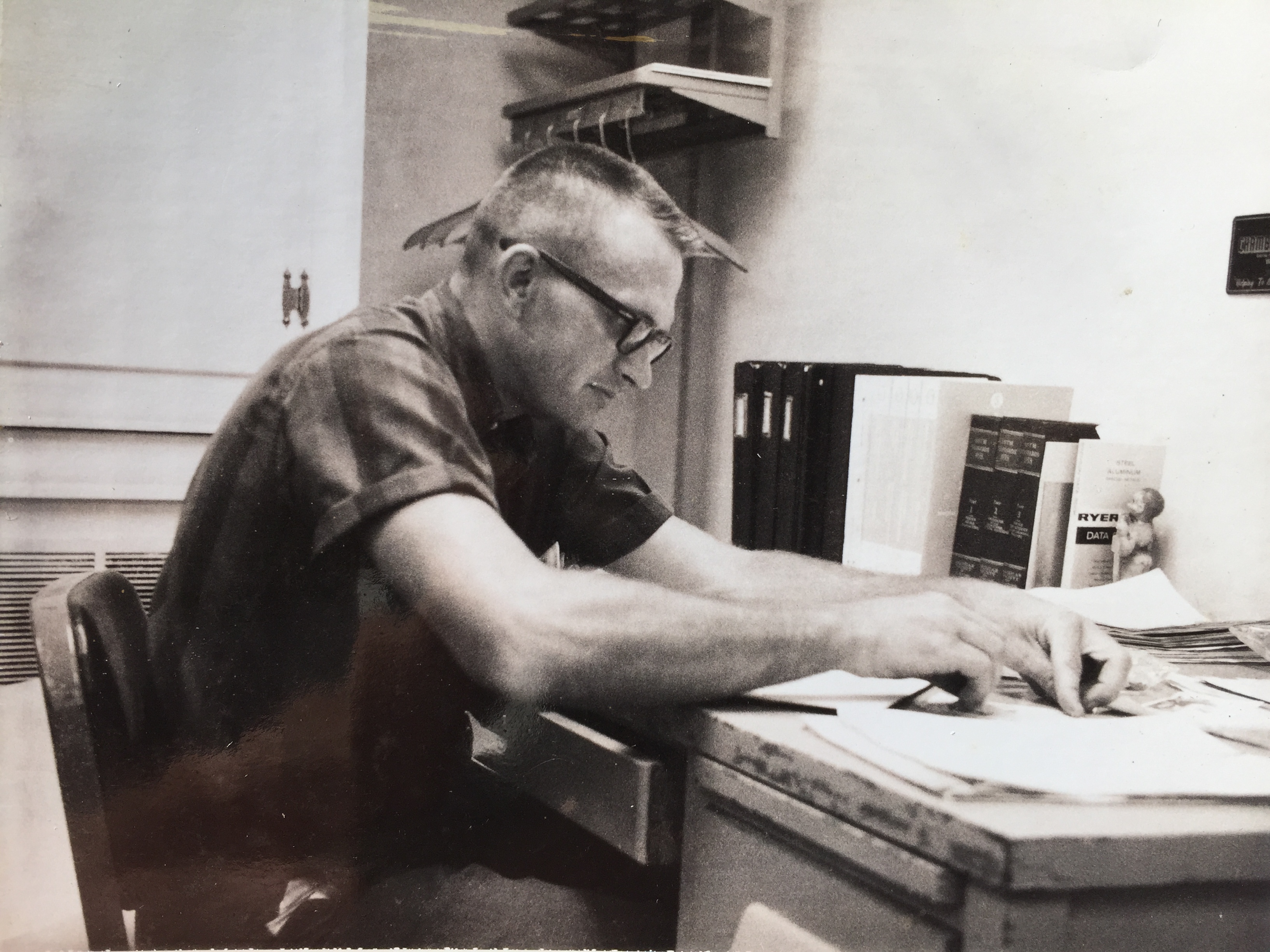
My father, Keith, worked in quality control his entire career. But his work involved machined parts, not human beings.

The manufactured “catch up” dilemma is a subset of that widget/quality control paradigm that can create a perception of efficiency but is antithetical to the complexity of human behaviors such as teaching and learning.

We teachers are tasked daily with a given set of students, traditionally arranged by grade levels that loosely conform to biological ages; however, our schools and our classes also vary significantly by out-of-school factors such as the socioeconomic levels of communities and racial as well as gender demographics that schools house but do not cause.

Putting efficiency and management first often ignores and even works against individual student needs and the corrosive impact of inequity that is embodied by individual and groups of students.

Putting 25-35 students in a classroom, building a highly structured and sequential curriculum, evaluating all students against those standards, and compelling teachers to maintain the same instruction and assessment across every grade level can address the priorities of efficiency and management.

But these deficit-based practices accomplish those goals at the expense of large segments of student populations.

It is counter-intuitive to admit that no such coherent and definable thing really exists as third-grade standards since we have spent forty years determined to create and recreate those standards, to test all students against those standards, and to ignore that “all students will” does not and cannot happen—in this system especially that ignores and perpetuates the inequities our students embody through no fault of their own.

Yet, no such thing as third-grade standards exist as we construct them and as we use them to label and manage students.

Eight- and nine-year-old children are biologically and environmentally incredibly diverse, especially in the ways they learn and respond to the world.

Despite our effort to limit or control human autonomy, even children are compelled to be autonomous; they have some limited ability to want to learn, to choose to comply or not with teacher expectations.

Teaching without a deficit lens is an option, however, possibly even within the system we have; although a new system would be much more preferable.

First, teaching can begin with individual students, focusing on the qualities, strengths, and knowledge they bring to any classroom.

Once a teacher knows the make-up of the abilities among any group of students, the teacher can design new and review material and experiences to provide for all students to incorporate their strengths and interests into acquiring new and better learning. Teachers can accomplish these strength-based lessons around whole-class, small-group, and individualized instruction—concessions to efficiency and management that come after putting students strengths and addressing inequity first.

As a final example of the problem of seeing the Covid-19 impact on education as somehow unique (instead of magnifying existing flaws in the system), consider the concerns raised about inequity in administering the SAT and Advanced Placement (A.P.) tests in modified forms for the remote necessities of the pandemic.

Online and modified SAT and A.P. tests have not created some new inequity; they are the mechanisms of inequity that have always existed and helped drive the deficit lens of public schooling.

Standardized testing has always measured inequity, but that testing has also always perpetuated that inequity by labeling many students as deficient as learners while the metric, in fact, mostly measures disparities in social class, gender, and race.

There is an ugly irony to calling for helping students catch up in the wake of the Covid-19 pandemic. The move to remote teaching and learning is one of the few common experiences among our students, who enjoy or suffer the consequences of privilege and disadvantage whether in school or at home despite a pandemic.

In other words, if we remain trapped in deficit language, students are sharing the same “behindness” of having moved to remote course and having reduced instruction.

Ultimately, trying to help students catch up keeps our judgmental gaze on the student, a deficit lens, in fact. The problem with the impact of the pandemic is the same as before Covid-19 changed our world—inequity.

Pathologizing students further because of the pandemic once again allows the systemic inequities in our communities and schools to be ignored, to remain.

Ketchup was never a valid vegetable in public school lunches, and trying to catch up students in the wake of Covid-19 is yet another way to further malnourish our students.

The Training Wheel Fallacy for Teaching Writing

[Header Photo by Markus Spiske on Unsplash]

The Swamp Rabbit Trail System is a paved multi-use path running from the city of Greenville, South Carolina to Travelers Rest, to the north. As an avid road cyclist, I venture onto the trail occasionally since it runs near my university and allows a somewhat relaxed ride, free of the threat of car traffic (except for the crossings).

Riding a bicycle is often discussed as if it is a universal experience and a skill once learned, never forgotten. As a serious cyclist for well over thirty years, I can attest that observations along the Swamp Rabbit Trail offer a data set that leads to a different theory.

Riding a bicycle requires two essential skills, pedaling and balancing the bicycle. When I see small children and inexperienced cyclists along Swamp Rabbit, I see an oddly similar struggle—cyclists wildly fighting the steering by swinging the handlebars aggressively and pedaling in ways that are counter to gaining momentum and balance.

A stark sign of a less than competent cyclists is the weaving motion as the cyclist approaches, a dramatic contrast to the rail-steady balance of experienced riders. But the oddest thing I see in beginning and inexperienced cyclists is trying to start off by placing one foot on a pedal with the crank arm down and then frantically lifting the other foot to start the pedaling with the crank arm that is up.

That technique is a recipe for disaster, but when successful, those first pedal strokes are combined with some pretty awful weaving that covers the space two or three experienced cyclists could fit into easily.

Holding your line (riding rail straight) and riding without your hands are some of the first skills needed to be a competitive cyclist. I have taken off or changed a significant amount of clothing during hard group rides while continuing to ride at the back of the pack; on a couple of occasions, I have taken a multi-tool out of my saddle pack and adjusted my front derailleur also while continuing to ride at the back of the pack.

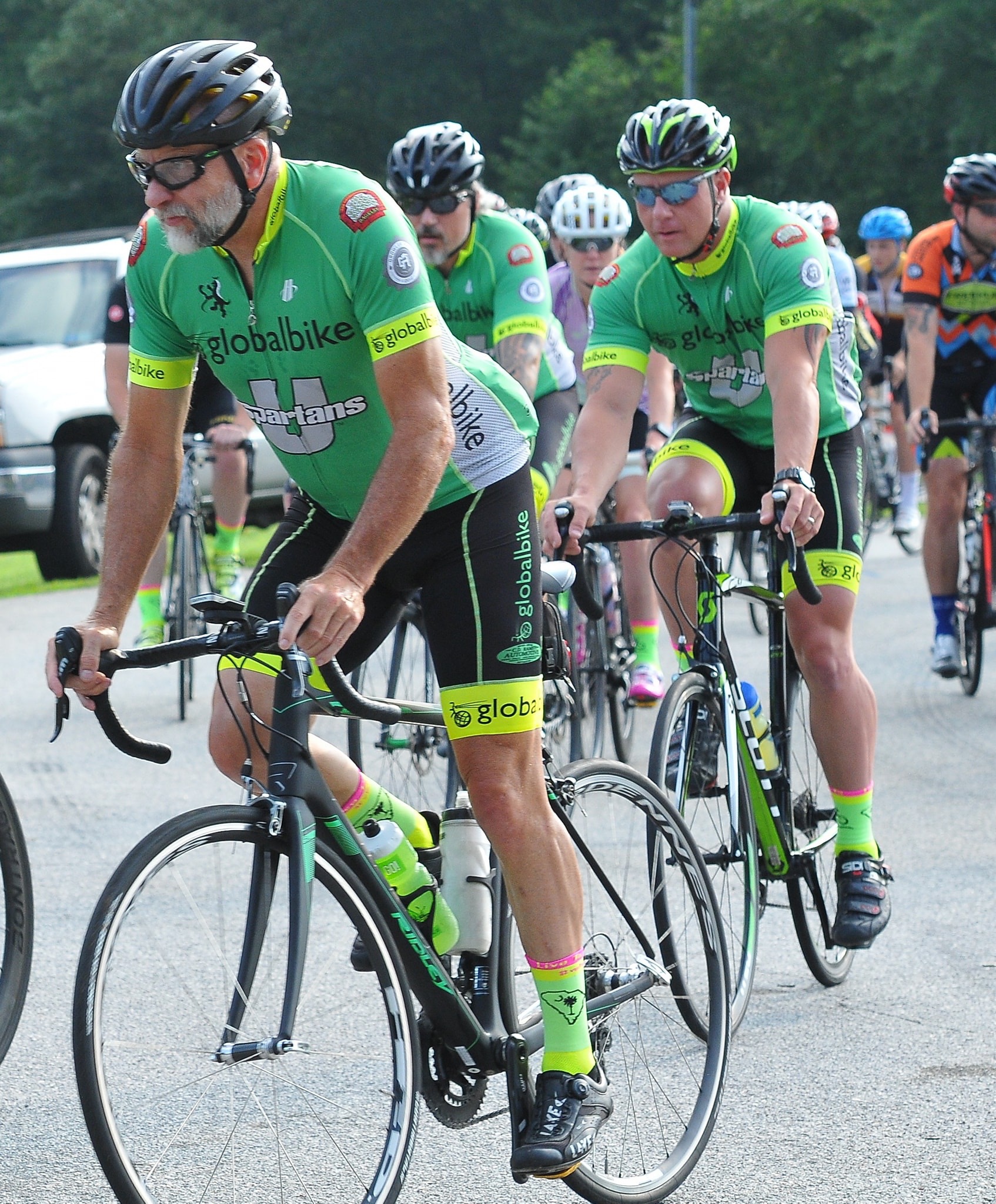
Ride for Safety 2018 GB
Ride for Safety 2018

Pedaling smoothly and maintaining proper weight distribution allow the bicycle to remain in a straight line, the natural momentum of rotating wheels. Another counter-intuitive behavior in road cycling is de-weighting your upper body so that you apply less effort into steering.

Beginners and inexperienced cyclists over-steer and over-pedal.

Here is an interesting problem about how most people learn to ride bicycles—the use of training wheels. Training wheels seek to address those essential skills I noted above by allowing new riders to have balance while learning to pedal.

The problem? Pedaling and balancing in cycling are not discrete, separate skills, but symbiotic skills. Learning to ride a bicycle, also, likely requires a different series of learning those skills since the balance is more valuable than the pedaling (and likely harder, at least we intuit that it is harder).

While training wheels are a traditional way to teach children to ride bicycles, balance bicycles are far superior ways to help children acquire balancing skills until they are old enough to pedal (likely much later than we tend to expect children to ride).

Now, as I have discussed before, let’s be clear that riding a bicycle is not like writing. Pedaling and holding a straight line while riding a bicycle is an acquired skill, but is not nearly as complex as it first appears; yet, writing is a creative process that involves dozens of decisions and interrelated skills and content, and is even more complex than we think as beginners.

However, our misconceptions about the teaching/learning dynamic for beginner cyclists as well as beginner students-as-writers are very similar.

The skills and decision process needed to write well are also not discrete, isolated skills that we simply need to acquire one at a time and then somehow integrate; as Lou LaBrant admonished, we learn to write by writing (not by doing skill and drill)—which is similar to the best way to learn to ride a bicycle, by riding a bicycle (without training wheels, possibly in a grass field at first instead of a sidewalk or parking lot).

Traditional approaches to teaching writing that impose templates (five-paragraph essay) and canned moves (“In this essay, I will…,” “In conclusion…”) are grounded in the same urges as teaching children to ride bicycles by using training wheels; however, these traditional approaches are as misguided and harmful as those training wheels.

Riding in large packs of cyclists requires each rider to demonstrate a high level of cycling authority, again grounded in holding a line and behaving in steady and predictable ways even while in high pressure situations (pace intensity increasing, cornering, contributing to a paceline, sprinting, etc.).

Writing authority, whether as a published writer or as a student or academic, also requires demonstrating high-level skills that are much more than the content of the writing (organization, diction, style, and having control of conventional elements of language use [grammar, mechanics, usage]).

Students are better served as writers-to-be if we always allow them to experiment in authentic and holistic contexts while seeking ways to foster essential or foundational concepts (openings, focus, elaboration, cohesion, paragraphing, closings, etc.). There is ample evidence, however, that templates and canned moves are not helpful and may even be harmful (they don’t encourage students to set them aside).

Many people still rush to buy their children bicycles with training wheels, but balance bicycles are beginning to take hold. The teaching of writing needs to make a similar transition.

Depending on templates and canned moves creates the sort of wobbly writers that remind me of my harrowing experiences trying to navigate down the Swamp Rabbit Trail confronting those teetering cyclists who have been mislead that it’s just like riding a bicycle.

Expanding the Writing Process: Drafting Edition

To be a scholar is to be a writer—often a writer seeking publication. Part of my career-long journey to teach writing well, or at least always trying to teach writing better, has been to bring the necessarily reduced experience of writing as a student closer to the authentic experiences of writers in situations, for lack of the better phrase, in the real world.

Recently on Twitter, scholars (notably Tressie McMillan Cottom and Jess Calarco) discussed choices scholars/writers make when working through the revise-and-resubmit phase common in almost all submissions for scholarly publication:

Encouraging and facilitating drafting by students has always been a struggle for me. Some students resist drafting at all (I have students who fear sharing drafts with me until they are “perfect” and many students simply do not have the tools to revise and edit in ways that make the process seem valuable), but I also recognize that an authentic writing process and the many ways we draft are often more complicated than we allow in classrooms.

Two problems at the root of working with students and fostering an effective writing process is, first, helping students who have been taught directly and indirectly to write only one draft from prescriptive prompts and rubrics (an unintended but negative consequence of the Advanced Placement programs and assessments in English, for example), and, second, re-teaching students that have come through a highly regimented writing process sequence (pre-writing, drafting, revising, and publishing).

That second problem often shifts most of the writer’s work to the teacher and leaves students mostly being compliant; however, effective writing pedagogy seeks to provide students support while they navigate an authentic writing process that is anchored in making writer’s decisions along the way.

One way I have tried to foster drafting better is to move away from “the” writing process to “a” writing process, one that students explore and create for themselves by considering the many ways that writers navigate moving from a writing idea to a final piece (often published).

Building a writer’s toolbox is incredibly important for students-as-writers because moving from first draft to final draft is about having purpose and strategies. I encourage and build that toolbox by providing feedback that prompts an action, something specific to do to the draft.

But drafting involves many different aspects of a text to be addressed, aspects that are not necessarily of equal weight in terms of creating meaning for the reader.

I have used these categories for years with students: content and organization (highest level to be addressed), diction and style (the next and important level to be addressed), and grammar, mechanics, and usage (the final level that is essentially editing).

Although students often resist the necessity of several drafts for a single essay, I tend to respond to first and second levels more aggressively in early submissions, stressing that we have no reason to edit a piece that isn’t working to begin with, as LaBrant (1946) argues:

[A teacher] may be content if the writing is composed of sentences with correct structure, with periods neatly placed, verbs correctly ended, pronouns in the right case, and all attractively placed on the page. I have heard teachers say that if their pupils do all this, and spell with reasonable correctness, they (the teachers) are content. I am willing to admit that a conventional paper, such as is just described, tempts one to be satisfied; but I am not willing to admit that it represents a worth-while aim. As a teacher of English, I am not willing to teach the polishing and adornment of irresponsible, unimportant writing [emphasis added]….I would place as the first aim of teaching students to write the development of full responsibility for what they say. (p. 123)

Knowing what aspects of a draft to attack first is incredibly important for students, but as the exchange above by scholars shows, students also need to have a range of options for moving from one draft to the next.

Too often, students have been allowed simply to “fix” the areas marked for them by the teacher. This is probably one of the worst unintended consequences of writer’s workshop.

I constantly have to prompt students to work on their drafts from the comments I have offered, but moving through the entire draft, not just where I have commented.

To expand student drafting options, I have shifted a great deal of my feedback from marking drafts to conferencing. In those conferences we focus on what students should do next.

I offer several options: abandonment (starting the essay over and completely abandoning the first submission), revising/editing the draft I have commented on and that we are conferencing about (still the most common next step), or starting a new Word document and rethinking organization, sentence and paragraph formation, and likely significant aspects of the content (adding or changing sources, changing and/or elaborating on examples, reorganizing the development of that content, etc.).

Final drafts are greatly improved, I find, when students are allowed a wide range of drafting options and given ample support for making writer’s decisions based on their goals for the writing project.

In our conference, I typically start by asking students to say aloud what they were trying to accomplish with their essay; then we discuss if and how the submitted draft accomplishes those goals.

After that framing, we address what moves and strategies students should follow next, keeping that next step manageable and not necessarily exhaustive. I usually ask what are two or three next things to do with this draft while also stressing that the full drafting process for the essay may take three or four (or more) drafts to reach a satisfying final version.

Drafting must be purposeful, goal oriented, and grounded in actionable strategies for the student/writer. But drafting should never be reduced to simply following a set sequence or “fixing” what the student initially submitted regardless of the quality of that submission.

As LaBrant adds:

All writing that is worth putting on paper is creative in that it is made by the writer and is his own product… . Again there may be those who will infer that I am advocating no correction, no emphasis on form. The opposite is really true. The reason for clarity, for approved usage, for attractive form, for organization, lies in the fact that these are means to the communication of something important. (p. 126)

For scholars as writers, that “something important” is often about publishing as part of academic and scholarly careers, and while revise and resubmit can be tedious and frustrating, how to move through several drafts has an authentic purpose that is too often missing in traditional classrooms for students as writers.

That said, we as teachers of writing can foster something much closer to authentic than a lockstep writing process and reducing drafting to “fix what the teacher marks.”

One way to teach writing better is to expand the what and how of drafting for our students, in ways that look more like drafting among writers in that so-called real world.


The Writing Models Dilemma: On Authentic Writing and Avoiding the Tyranny of Rubrics

While my journey to the fields of English and teaching started with science fiction and comic books, a love of reading that was steered to so-called “literature” by my high school English teacher, Lynn Harrill, I walked into my first high school classroom as a teacher of English primarily committed to teaching young people to write.

My goal was not simply to have my students write well, but to write authentically, to write in ways that existed outside traditional classroom essay writing.

Teacher preparation for teaching high school English was for me (and remains mostly so) grounded significantly in teaching literature. As a result, I spent the first 5-10 years as a teacher teaching myself how to be a writing instructor.

Far too many of my practices were quite bad, even harmful. However, one thing kept my writing curriculum afloat—volume. I somehow recognized very early that people learn to write by writing (see LaBrant, 1953).

But I also began my career as a teacher of writing by embracing two contradictory commitments: (1) I was always anti-five-paragraph essay; however, (2) I tended to remain grounded in a (ridiculous) commitment to using an authentic-template approach.

It took me several years to recognize that teaching writing wasn’t about finding the right template, but about rejecting the tyranny of the rubric/template approach.

Without rubrics/templates, however, teaching writing to a relatively large number of students, most of whom are not genuinely motivated to become writers, is incredibly challenging. None the less, rubrics/templates are conducive to managing the teaching of writing, but they are essentially the enemy of authentic writing.

A watershed moment for me in teaching writing came with helping writers who wanted to write poetry. Writing poetry and teaching people to write poetry are very similar to writing and teaching students to write essays in that both can be accomplished in some superficial way with rubrics/templates, but that those outcomes are only pale imitations of the forms being attempted.

Most of us have participated in the clunky 5-7-5 approach to writing a haiku poem for class just as most of us have performed the five-paragraph essay.

The watershed moment in understanding how to approach the teaching of poetry included a direct move away from templates and mechanical structures (haiku, sonnets, etc.) and toward the conceptual elements that define a form or genre.

While prose is driven by the formation of sentences and paragraphs (both concepts that are not as easily defined as many think), poetry is most often characterized by lines and stanzas (even prose poetry is anchored to the norms it resists).

Without using syllable count, then, line formation and line breaks are something many poets intuit or feel—stanza formation as well.

When I work one-on-one with an emerging poet, I attack lination (line formation and breaks) and stanzas by asking the poet to be aware of the “why” in those formations and whether or not there is any pattern guiding that “why.”

It is about having a purpose, not that one purpose is correct.

This work is very complex, but it is at a conceptual level, not the mechanical framing of rubrics/templates.

Teaching writing at the conceptual level, however, can seem abstract to students (who lack the rich experiences with text as writers for those concepts to be concrete); therefore, I soon began seeking ways to merge concepts to the concrete.

Here I also began to blend more intentionally my responsibility for literature and reading instruction with my writing curriculum by presenting our text readings as models for our journey as writers.

To be authentic in our pursuit as writers, I eventually realized, ours was not to reject rubrics but to reimagine our paths to rubrics. I knew that handing students stilted rubrics/templates was mostly about compliance and did not foster the sort of conceptual understanding my students needed.

The teacher-created rubric makes most of the writer decisions for students that they need experiences with in order to be authentic and autonomous writers.

However, I needed to help students develop their own toolbox of rubrics drawn from a wide and rich reading of texts that model the many ways that writers produce any form or genre.

Poets create poetry always in conversation with forming lines and stanzas just as essayists are aware of beginnings, middles, and ends as they navigate sentences and paragraphs.

For at least thirty years, then, I have been providing my students compelling models of the sorts of essays they are invited to write and walking them through reading-like-a-writer activities (see here and here).

And for the past two decades, where I teach undergraduate and graduate students, I have worked diligently to provide my students detailed models with my comments embedded to walk them through some of the more mundane elements of writing in formal situations (college essays, scholarly writing, public commentary)—citation, document formatting, etc.

Two of those models (linked above) are for cited scholarly essays using APA and public commentaries. Periodically, I create new models and revise my embedded comments, seeking always to refine the effectiveness of using models for teaching writing.

Now here is the dilemma.

Many years ago I had to accept the sobering fact that research shows that teaching writing by models is only modestly effective, far less so than something as clunky and inauthentic as sentence combining (sigh).

But I also live the reality that models often fall short of why I use them and how they should support students writing authentically.

This spring, in fact, I have implemented two new models with embedded notes, and I have been increasingly frustrated by the jumbled efforts at public commentary in my upper-level writing/research course.

That frustration, however, has led to a new understanding, coming 36+ years into teaching writing.

My models with notes are primarily generic examples to walk students through some of the structures and formatting expected in formal cited essays or when submitting a public work for publication. While I am frustrated always with students failing to format as required with these models right there in front of them, I have resolved myself to this process taking several rounds for students to “get” these (trivial) elements of submitting original writing.

My ah-ha! moment this semester has been to recognize that students have repeatedly ignored the public commentary assignment and have clung instead too directly to the model by creating a backward rubric/template for their public commentary submissions.

I soon realized that many of the students simply mimicked exactly my number of and types of paragraphs provided in the model (much of which wasn’t appropriate for this specific assignment).

Of the two major writing assignments, of course, writing a public commentary is the one more foreign to my students, the one about which they have the least expertise. In desperation, they have reverted to the inauthentic process most of them have experienced as writing instruction—prescriptive prompts and conforming to rubrics.

I have been long aware that my writing instruction is mostly unlike what students have experienced. What I ask students to do is extremely hard, often frustrating, but something they genuinely can just suffer through briefly and return to the normal ways of writing essays in college.

There is little I can do about this outlier aspect of my classes and practices, but I am now better equipped to have the rubric/template urge conversation earlier and more directly with students.

Using models and models with embedded notes can be more effective with greater intentionality and my diligence in responding to students who resist working toward conceptual levels of understanding by defaulting to rubric/template mode.

The dilemma with using models to teach writing is a subset of the larger problem with nudging students away from performing as students and toward performing as writers (or whatever role we are trying to achieve—pianist, scientist, historian, etc,).

This newest round of better understanding how to teach writing is yet another adventure in teacher humility—confirming that I must always be diligent about what I am doing and how they guides (or misleads) my students in pursuits we share.

Teaching and learning are different sides of the same complicated coin.

Teaching Writing Remotely in a Time of Crisis

My students and I are in our last couple weeks of remote learning and teaching due to the Covid-19 pandemic. As I have examined, the transition for me was facilitated by many of my philosophical/theoretical commitments and practices—most of which are non-traditional and tend to cause tension in traditional circumstances.

At the root of these commitments, I think, is that I am essentially a teacher of writing. Therefore, I am prone to creating classroom experiences around workshop formats, open-ended discussions, and text-based examinations that are seeking goals beyond simply summarizing or analyzing the texts for meaning.

Most of my teaching career—almost two decades each at the high school and higher education levels—has involved teaching writing to students who are not trying to become writers. My writing instruction is primarily grounded in fostering the power of writing as that is valued within academic and scholarly contexts.

Photo by hannah grace on Unsplash

One of my best assignments, I think, is that I ask my first-year writing students to interview faculty at my university about how they conduct scholarship and research as well as about their lives as writers. Much to their surprise, students discover that most faculty are begrudging writers if not openly antagonistic to writing.

I work much of the time to balance my commitment to the field (and career) of writing with the reality that the vast majority of my students are attempting to navigate academia well, but may be as resistant to being and becoming writers as many of those professors.

My university now has only two writing-intensive courses for students—the first-year writing seminar and an upper-level writing/research course (intended to be taken in a student’s major department if offered).

I teach the upper-level writing/research course for my department, and we are currently navigating that remotely.

This is my third time through the course; therefore, I have continued to revise and better focus my goals for the course and the assignments. Teaching this course remotely has been another, and unexpected, way to rethink what works when teaching writing.

First, a fortunate accident of the move to remote learning/teaching is that it occurred in the middle of the course, which I have designed to be text-based and direct-instruction focused in the first half and workshop oriented in the second half (see the schedule). As a result of the shift to remote, all of the major assignments in the course have been submitted without our having traditional face-to-face class sessions.

The assignments have included annotated bibliographies, a cited scholarly essay, and a public commentary. Students have been invited to choose a topic in education that is being covered significantly in the media, conducting scholarly searches for what the research base shows about that topic, and conducting an informed analysis of how well the media is covering the topic.

I have now received at least the first submissions of all of these assignments, prompting me to email my students about the public commentaries this morning (since it was due yesterday). A key point I made was that the course is designed so that they are experimenting with how different writing purposes have different submission formats, different standards for citations, and different stylistic concerns.

Students are provided several documents to support producing and submitting the assignments. Those materials include a sample scholarly essay with notes and a sample public commentary with notes.

The challenges students face include preparing separate writing assignments and documents with those differences—APA format v. submitting a work of journalism, in-text scholarly citation v. hyperlinking, writing for a scholarly audience v. writing for the general public.

This writing-intensive course, I think, is both quite challenging for students (and the teacher) and a perfect model for helping students move beyond a rules-based or template-driven approaches to writing in academic, scholarly, and public contexts.

The scholarly essay and public commentary force students to see that writing is grounded in purpose and audience—not a simple set of rules demanded by the teacher.

Since workshopping the assignments remotely is not fundamentally different than when we have in-class sessions, I am recognizing another layer of stress because the remote is occurring during a health crisis and the unusual experiences of isolation many of my students are experiencing.

When I have been charged with providing faculty development for faculty teaching writing (as disciplinary professors without backgrounds in composition beyond their own experiences as writers), especially first-year writing, I have highlighted the problem with cognitive overload—asking students to write about new or challenging content while also focusing on being better writers.

If students are overwhelmed intellectually, they often do the multiple expectations poorly (or at least less well than if they could focus on only one) or prioritize by doing one thing well at the exclusion of the other(s), typically choosing to address content and fumble the writing itself.

One of my refrains is that when we are primarily teaching a class addressing writing instruction, we must be careful not to detract from that focus on writing well (or better) by engaging students in new or challenging course content (such as reading a highly technical, complex text to write about).

However, as we move into upper-level writing course, that problem is essentially impossible to avoid. Even in so-called normal circumstances, students have struggled with this upper-level writing/research course because, to be blunt, it is asking a great deal of undergraduate students.

I am accustomed to responding to initial drafts with “Did you look at the sample?” and “You are not doing the assignment.” But during this remote experience compounded by a pandemic, I am giving these responses far more often, nearly to the point of frustration on my part.

As I continue to interrogate my own role as a teacher of writing and a writer/scholar, I have a few key elements of my teaching that need careful consideration:

  • Increasing the tenuous value of providing students with models of writing in academic and public writing.
  • Fairly balancing writing assignments with supporting students making autonomous decisions as writers/scholars.
  • Providing feedback that supports effective and efficient revision (and learning).
  • Disrupting student misconceptions about drafting, written products, and performing as a student instead of as a writer or scholar.

I am not certain that a course shifted mid-semester into remote learning/teaching because of a pandemic can be anything other than a pale version of the original course, but I have witnessed that my courses are providing many if not most of my students quite valuable learning experiences.

The negative consequences of teaching remote during this pandemic are not quite clear yet, but I am certain the added stress of the situation has worked against many of my course goals.

I worry that many of us teaching fail to consider the demands of writing and writing well while students are simultaneously learning and navigating new content. It ultimately may be far too much to ask of students forced to remain in their homes and rooms for weeks on end with a newly uncertain world around them.

My Transition to Emergency Remote Teaching

Across my undergraduate and graduate courses in education, I stress the importance that all educators have a detailed understanding of the educational philosophies and theories that they claim to embrace as well as if their practices match those claims.

Teachers, however, are a practical lot, and most pre-service and in-service teachers resist my argument.

The somewhat abrupt move to remote teaching that has occurred during the Covid-19 pandemic has emphasized for me, again, that the value in educational philosophy/theory and how that matches practice cannot be overemphasized.

While my philosophy/theory and practice are well outside the norms of mainstream, traditional schooling—and that causes stress and anxiety for many of my students, at least temporarily—I was incredibly well prepared to shift my courses to remote and individualized structures within an hour of addressing my schedules (see foundations of education and scholarly reading and writing).

The entire transition is now being handled by email, smart phones (text, Facetime, phone calls), and the blogs linked above. I prepared no Zoom meetings and no video lectures.

In fact, the scholarly reading and writing course is not much different than it would have been without the shift except that we no longer sit together in the same room every Monday evening.

Here are the ways in which my educational philosophy/theory and practice have provided the foundation for moving quite easily to remote asynchronous learning:

  • While I am just noticing the online terminology (asynchronous v. synchronous), I have practiced individualized instruction (asynchronous) for the vast majority of my 36 years of teaching. Throughout my 18 years teaching high school English, I experimented with and refined workshop methods with both writing and literature instruction; therefore, my courses are often designed around students working on holistic and authentic products of learning that are developed over drafts.
  • Individualized instruction that focuses on authentic artifacts of learning is nested inside my larger commitment to student-centered teaching. I start with each student and genuinely place content and so-called skills secondary. I try to begin with student reactions (reflections on readings, drafts of assignments) and then drive instruction with what students know, what students do not yet know, and student misconceptions.
  • As a writing/composition instructor, I tend to function as a teacher by responding to student work as submitted; being “on” for students throughout the day and responding to student work as it is submitted may be stressful for some teachers, but I already function that way, which lends itself well to the necessary asynchronous nature of remote teaching.
  • My courses are supported by checklists, models, and support material that I always prompt students to use before they rely on my help; I see my overarching goal as a teacher as making myself unneeded, fostering intellectual autonomy in my students. “Take your time. You can do this on your own” is essentially the soft message I am whisper behind all that I do.
  • All of my courses are managed by a low-technology commitment; I am neither a no-tech Luddite, nor a technology evangelist. My courses are all on WordPress platforms, easily and freely accessible to anyone, not just students. My students and I already interact by email and through a fairly sophisticated use of Word (comments, track changes, etc.). This low-technology approach allowed me to shift remotely in minutes, sacrificing only a few elements of my teaching (which I discuss below).
  • I teach by inviting students to have shared experiences, but I do not suffer the illusion that those experiences can or will guarantee the same outcomes. I feel far more concerned about fostering ways of learning than covering and asking students to perform to a set of disciplinary knowledge. Thus, I have no standard lectures to video for students to view, although I often ask students to read shared texts that give us some foundation for thinking deeply or at least harder about topics.
  • Throughout my career I have been anti-grades/tests, but in the reality of traditional schooling, my approach is best described as delaying grades—although I do not give any sorts of tests. While many teachers are struggling with assessment (implementing tests, assigning grades on assignments) when moving to remote teaching, my portfolio approach (course grade assigned based on a final portfolio submitted of all work) hasn’t needed to be adjusted for my shift to remote teaching.

Yes, I have made the transition to remote teaching fairly easily; however, I am not suggesting that there haven’t been costs, things lost in the shift. Those losses and concerns include the following:

  • A key aspect of my educational philosophy/theory is that I am solidly anti-online courses; I remain a strong advocate for the traditional classroom structures in which teachers and students interact face-to-face. I am not convinced that the amount of face-to-face class time traditionally practiced is necessary, and I certainly practice a great deal of one-on-one conferencing. However, remote instruction can never match the power of in-person classroom dynamics.
  • Class sessions for me include two major structures: workshop or discussion. Workshop has transitioned remotely quite well, but I have abandoned the discussion element, recognizing that is a major sacrifice. Here, I must distinguish between remote teaching in a crisis and creating a course online (in which synchronous sessions over some App would allow discussion). In the Covid-19 crisis, I have elected not to add the stress of designated days/times to meet as a class. However, I genuinely cannot imagine that online discussions can meet the level of in-person class dynamics create, when we all can make eye contact and be “in the moment” together of discussions.

In one way, the sudden shift to remote teaching also fit well into my educational philosophy/theory that requires me to be vigilant about critical reflection on my role as a teacher, and a human being. I never see any of my practices as “fixed,” always in reflective flux.

The Covid-19 pandemic forced me to reconsider a course mid-stream, but I am prone to doing that most of the time any way.

My teacher personae is a contradictory mix of external self-assurance tempered by a pervasive fear that I am failing my students. As I worked diligently to transform my classes, I monitored my own practices against my educational philosophy/theory (checking what I had planned as well as what I revised and expected of students).

I remain, then, resolute in this belief: Our day-to-day teaching in so-called normal times always benefits from recognizing what our educational philosophy/theory is and how well our practices remain grounded in those commitments.

Who Does Your Instructional Labor Serve?

One recurring theme to many K-12 and higher education institutions moving to remote instruction has been “uh-oh” moments concerning challenges not immediately anticipated. One example is that when my university’s professors have been reaching out to students, they have discovered many of their students left for spring break without their textbooks and notes.

Since the university has discouraged any students returning to campus, professors are now faced with revising courses for remote instruction realizing students may not have the necessary materials or the technology needed.

I want here to pull back from the specifics of teachers and students suddenly shifting mid-course into on-line/remote education in order to pose an essential question for teachers at all levels: Who does your instructional labor serve?

When I first started teaching high school English in 1984, my teaching position for the first 18 years of my career, I was laser-focused on being an effective teacher of writing. Much of those first five or six years were mired in my constantly changing what I was doing because I failed to see in student work (their writing) the growth or positive outcomes that justified my labor as a teacher and their labor as learners.

I was very fortunate, I think, to begin my career with that focus on teaching writing because that sort of instruction is necessarily very labor intensive. Responding to essays takes a great deal of time, and writing as well as rewriting essays is also time intensive for students.

Since I hate wasting time, and wasting other people’s time, I have worked for almost forty years to be extremely efficient—lowering labor while increasing positive outcomes.

Because of those patterns to my work as a teacher, when I was asked to switch to remote teaching of my two courses, I made the shift very easily by being very low-tech and simply revising my daily schedules slightly. Much of my instruction leans toward individualized teaching any way, and my courses are heavily text and writing intensive (and much of the reading students need to do is already provided online).

There remain some problems for my courses, but the only real loss we will experience is that my class sessions are mostly discussion based around how students respond in class. I don’t have lectures prepared, and I am not deeply committed to a fixed set of content that we must cover.

My classes are interactive and extemporaneous, demanding a great deal from me but these are topics I have studied and taught for decades.

Here, I want to emphasize that it is my attitude about teaching, learning, and content that makes this shift less stressful for me; I take a Thoreau attitude about my classes in that it is my obligation not to do everything, but to do something well.

Students who complete four years of college will have 16-17 years of formal education. This accumulated series of experiences likely will afford them a wealth of learning that cannot be narrowed to any single course, teacher, or class session.

While many teachers are making the transition from traditional classes to on-line/remote emergency teaching and learning, I suggest that we all reconsider our teaching labor and the teaching/learning efficiency of that labor.

For example, on a Facebook group about this shift, a teacher noted that they had a stack of essays they had hand-graded and needed to return, but would not see students again.

A key part of this problem, to me, is the teacher framed the need to justify grades with the responses on the essays.

I am a non-grader who does not put grades on any assignments but must record a grade for my classes (per university requirements). My stance has long been that my teaching labor must have some direct learning outcomes; therefore, when I spend time responding to student work, I expect students to do something with those responses—typically revise the assignment.

I, therefore, highly discourage marking student work to justify grades since that teaching labor is not serving the student or learning but bracing for an assumed concern not expressed by the students.

As someone noted, teachers can and should always offer to provide justifications for grades to students who request that (I do this through face-to-face conferences, but would adapt to email or video-conferencing under these unique circumstances).

Here, I would stress that a dialogue around grade justification is a more effective and efficient form of teaching labor than meticulously marking assignments, many if not most of which will never be seriously read or considered by students. (This traditional form of teacher labor is mere martyrdom.)

While this one example represents well navigating the relationship between teaching labor and learning outcomes, I think the entire—and urgent—reframing of classes mid-course is a great time to carry some of these revisions into our classes when (and if) we return to some sort of normal face-to-face teaching and learning.

I am a much better teacher than during my first five or six years, but I remain diligent about who my teaching labor serves and about respecting the learning labor of my students.

Setting aside traditional structures such as lectures and grading have allowed me to focus on my teaching, my students, and their learning in ways that better serve all of us. I think students respect that I am critically aware of what we are doing and why in terms of their learning and not simply serving some bureaucratic or traditional expectation.

As we teachers rush to serve our students as best as we can in the coming weeks and months, I hope we will include several sticky notes on the changes we make in desperate times that can become our new—and better—normal on the other side of COVID-19 in 2020.

Misreading Academia, and Why Education?

While I was teaching high school English in rural South Carolina, I became close friends with a colleague; I was English Department chair and also taught Advanced Placement, and he was the chair of history and also taught A.P.

But the strongest bond we shared was our similar life experiences of having been born, raised, and educated in the Deep South. We came to be ideologically quite different (radical, progressive) than how we were raised (traditional, conservative) in redneck and racist homes. And we both quickly attributed this transformation to our educations, although in slightly different ways.

My colleague often noted that when he and his father fought as they grew older and farther apart intellectually (as I did with my father), his father would often end those fights by declaring that the biggest mistake he ever made was sending my colleague to college.

While I did in fact attribute my liberation from all sorts of negative -isms to wonderful and thoughtful professors and classes in my undergraduate education, my colleague actually graduated college mostly unfulfilled, but motivated to self-educate by reading widely and deeply. Yes, college helped his transition, but he did a great deal of his own intellectual soul-searching after he graduated.

Both of us also eventually sought doctoral degrees later in life and then moved on to higher education. As a result of our backgrounds and experiences in K-12 and higher education, I think, I have noticed two important conversations on social media that at first may not to seem related, but they highlight how often the media and the public misread higher education and the larger question of why we have formal education.

One debate is about political alliances in higher education:

Embedded in this question (an interesting and valid one in many ways) is a couple assumption: (1) the monolithic progressive (liberal) professorate, and (2) a hidden class division within academia that avoids the institutional hierarchy of academia (tenure and promotion structures).

Here is an often ignored fun fact about higher education: Professors and contingent faculty are not monolithically progressive, liberal, and/or leftists.

In fact, some disciplines highly influential beyond the academy are the most moderate and conservative—economics, psychology, political science.

But professors are disproportionately among a privileged class due to their academic status in the academy (although how we arrived here does create some tensions, speaking as a working-class academic). That intellectual privilege skews academia toward a very moderate progressive-leaning middle.

Those of us who embrace and practice a genuine leftist or radical approach to academics and life are outliers, often marginalized in ways that publicly marginalized groups are not overtly treated in academia. For example, higher education is quick to give lip service to inclusion for LGBTQ+ individuals and communities but not to openly Marxist professors (and for the record, stating inclusion doesn’t magically create inclusion even in higher education).

The key distinction between academia and the so-called real world, then, is about the norms of discourse in each setting. Yes, higher education is more aggressively complex and progressive in how many topics are discussed and examined. To people outside academia, this discourse norm seems left of mainstream society (I imagine that is a fair assessment) and likely seems more permissive and less traditional.

It is at this tension where misreading academia can be more directly examined. That tension is captured well in this exchange on social media:

Jason Myers is making a case for a utilitarian, or essentially conservative, view of formal education—to prepare anyone for the world as it exists (in the U.S., that is to create workers). Erin Bartram, however, is speaking for a much broader purpose of education, essentially progressive, one that contributed heavily to my colleague’s and my transformation—to foster critical consciousness and autonomous citizens.

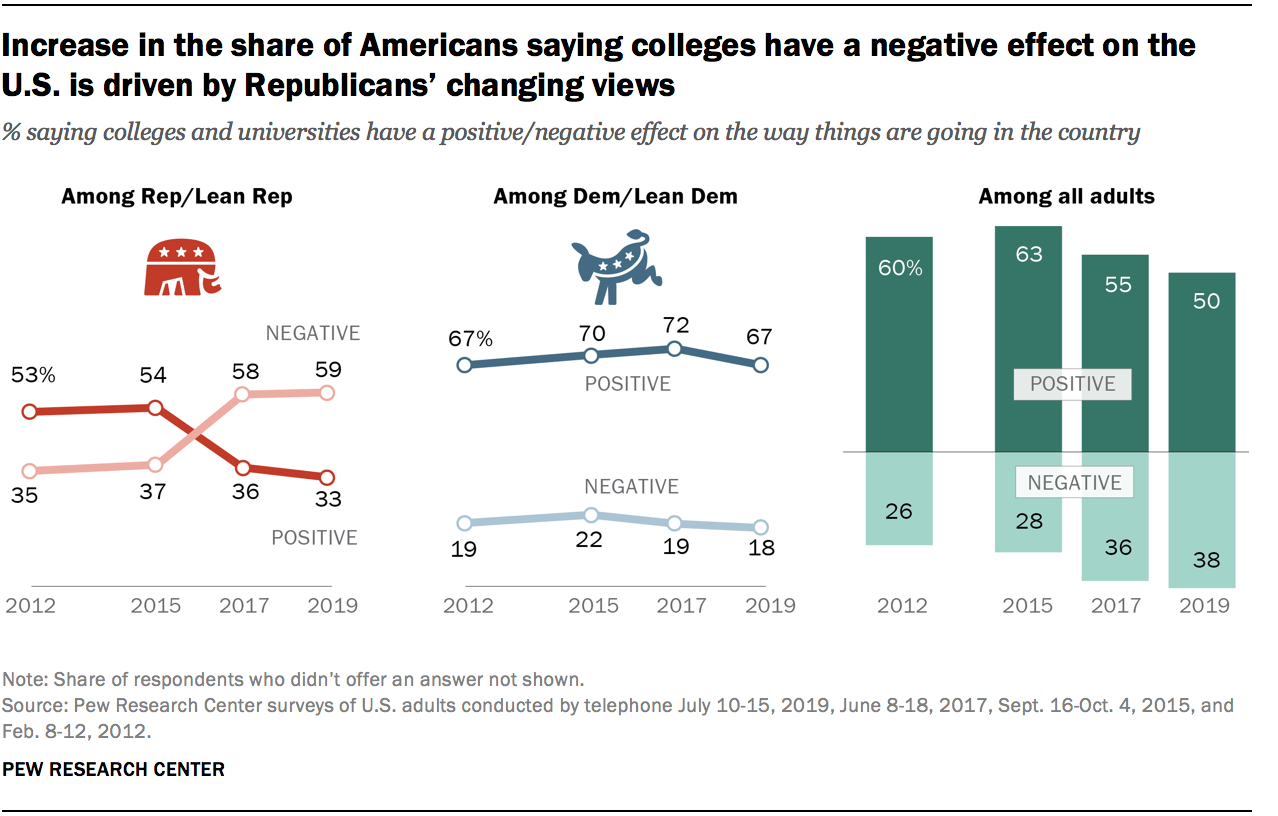
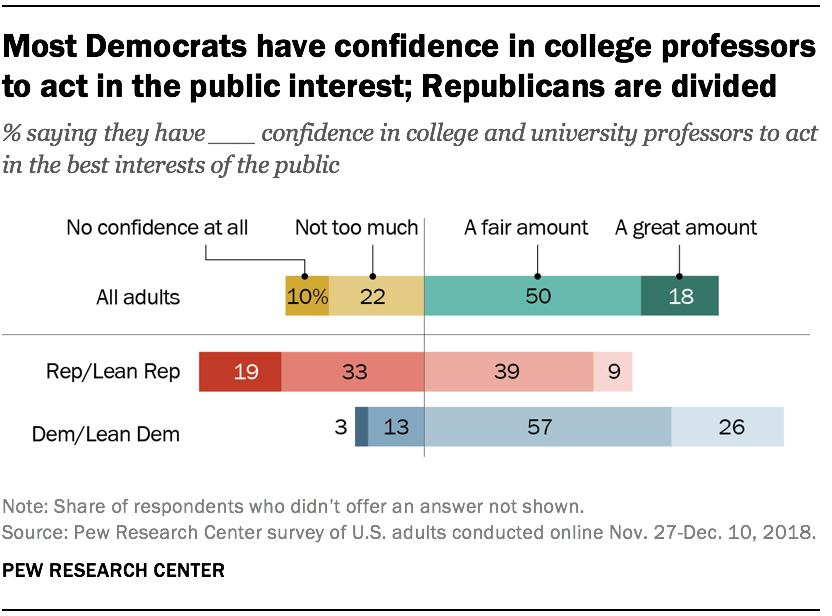
The tension in these Tweets is reflected in the difference between Democrats and Republicans on college:

Increase in the share of Americans saying colleges have a negative effect on the U.S. is driven by Republicans' changing views

There is a similar partisan contrast in terms of perceptions about professors as well:

Most Democrats have confidence in college professors to act in the public interest; Republicans are divided

Misreading academia as uniformly progressive or leftist is grounded in how anyone views the purpose of formal education. Many in the U.S. are ideologically conservative and traditional so anything that seems to challenge that tradition or call for change is viewed skeptically if not cynically.

The current fear-mongering around single-payer health care is an excellent example of how a relatively moderate idea (universal health care) is framed as radical or “socialism” by a conservative culture (media and the public see the status quo as predictable and safe; therefore, change is to be feared).

As a Southerner raised in a conservative home and community, I can attest that formal education has the potential to be transformative—it worked for me—but as someone who is a leftist, I can also attest to the fact that academia is no progressive playground of fair-minded and ideological leftists.

Structures of higher education and the disciplines are too often inequitable and conservative, protective of the status quo even when that reality reflects and perpetuates the worse aspects of society.

Is there more space for equity and inclusion, diversity of radical thought, in higher education? Yes, and when formal education is about interrogating the world, then we are experiencing a more progressive environment. But that is not the norm of higher education because all institutions are prone to self-preservation.

The possibility of education in the pursuit of interrogating the world will always feed the tension between formal education and the so-called real world, leading some to misread higher education for its outlier qualities.

But the greatest tension of all may be at the root of the skepticism among conservatives about higher education (and all formal schooling); education is a debate about who decides what knowledge matters.

For children and young adults, universal public education and public higher education may provide some of the few safe spaces for a young person to discover a rich knowledge base that allows them to rise above indoctrination, bigotry, and uninformed lives.

This is, I admit, as ideal I aspire to as a teacher/professor, something I work hard to nudge my school toward. And simply by hoping a formal education can be a doorway into the life any person wants and deserves, I am that liberal professor people who misread higher education warn you about.

Student Evaluations of Teaching: Research and Commentary [Updated]

One of the prevalent contradictions in higher education is the high-stakes use of student evaluations of teaching (SET) despite the overwhelming evidence that SETs are flawed measures of teacher/teaching quality and are often harmful for faculty already marginalized in society and academia.

Here is a collection of research and commentary highlighting those flaws and calling for ending this traditional practice: