Category Archives: Testing

Howard Zinn: “education cannot be neutral on the critical issues of our time”

[Header Photo by Ankush Minda on Unsplash]

24 August 1922—Howard Zinn was born. His life and career spanned the twentieth century and into the first decade of the twenty-first. It is his memoir, You Can’t Be Neutral on a Moving Train: A Personal History of Our Times, for me, that speaks to the enduring power of Zinn’s metaphor, particularly for teachers.

Historically and currently, teacher remain under the demand that their teaching—and even their lives—remain neutral, not political. University professors—such as Zinn—also face disciplinary and public expectations of objectivity, dispassion—their work as public intellectuals either shunned or unrecognized.

In that context, K-12 education and university education suffer the same ultimate failure found in journalism, a flawed pursuit of objectivity, the faux-neutral pose of representing both sides.

So on the day of Zinn’s birth, it continues to be important not only to read and listen to Zinn, but also to act on Zinn, for it is action, after all, that Zinn lived and called for.

“When I became a teacher,” Zinn explains in You Can’t Be Neutral on a Moving Train, “I could not possibly keep out of the classroom my own experiences”:

I have often wondered how so many teachers manage to spend a year with a group of students and never reveal who they are, what kind of lives they have led, where their ideas come from, what they believe in, or what they want for themselves, for their students, and for the world.

Does not the very fact of that concealment teach something terrible—that you can separate the study of literature, history, philosophy, politics, the arts, from your own life, your deepest convictions about right and wrong?

Concealment is a political act, and in the face of the tragedy surrounding the police shooting of Michael Brown, the educational response has been exactly that, concealment. But as poet Adrienne Rich has confronted:

The study of silence has long engrossed me. The matrix of a poet’s work consists not only of what is there to be absorbed and worked on, but also of what is missing, desaparecido, rendered unspeakable, thus unthinkable.

Instead of striking the masked political poses of neutrality, objectivity, and dispassion, Zinn called for transparency:

In my teaching I never concealed my political views: my detestation of war and militarism, my anger at racial inequality, my belief in democratic socialism, in a rational and just distribution of the world’s wealth. I made clear my abhorrence of any kind of bullying, whether by powerful nations over weaker ones, governments over their citizens, employers over employees, or by anyone, on the Right or the Left, who thinks they have a monopoly on the truth.

Having taught in rural Southern public schools for 18 years and then 13 more years in higher education, I can attest that Zinn’s argument is challenged only because of the positions he holds and not because he took positions. You see, in K-12 classrooms, especially in history classes, textbooks, curriculum, and teachers always represented positions by framing as neutral the mainstream perspectives found among them all: a blind allegiance to capitalism, representing the U.S. as a righteous military victor, whitewashing every struggle in the country’s history, celebrating the wealthy and powerful while turning a blind eye to their many sins.

It has never been that our classrooms are neutral, as Zinn confronts, but that our classrooms have been passive passengers on the moving train of social and cultural indoctrination, the sort of indoctrination that benefits the few who have wealth and power built on their privilege at the expense of the many—workers, racial minorities, women, children, and the impoverished.

As Zinn recognized:

This mixing of activism and teaching, this insistence that education cannot be neutral on the critical issues of our time, this movement back and forth from the classroom to the struggles outside by teachers who hope their students will do the same, has always frightened the guardians of traditional education. They prefer that education simply prepare the new generation to take its proper place in the old order, not to question that order.

And although written well before the current education reform movement built on accountability, standards, and high-stakes testing, Zinn’s memoir has identified the Orwellian reality of that movement: Those decrying the status quo are those in service of the status quo. Education reform is the pursuit of maintaining, not reforming.

This call for teaching as activism was join by Zinn’s disciplinary challenge as well:

History can come in handy. If you were born yesterday, with no knowledge of the past, you might easily accept whatever the government tells you. But knowing a bit of history—while it would not absolutely prove the government was lying in a given instance—might make you skeptical, lead you to ask questions, make it more likely that you would find out the truth.

Here, Zinn recognizes both the power of disciplinary knowledge and the concurrent danger of codified disciplinary knowledge (prescriptive standards, curriculum). Zinn’s confrontation, then, speaks to the foundational principles expressed by critical scholar Kincheloe:

Thus, proponents of critical pedagogy understand that every dimension of schooling and every form of educational practice are politically contested spaces. Shaped by history and challenged by a wide range of interest groups, educational practice is a fuzzy concept as it takes place in numerous settings, is shaped by a plethora of often-invisible forces, and can operate even in the name of democracy and justice to be totalitarian and oppressive.

These critical principles replace the dissembling of neutrality in the classroom, as Kincheloe explains:

Recognition of these educational politics suggests that teachers take a position and make it understandable to their students. They do not, however, have the right to impose these positions on their students [emphasis in original]….

In this context it is not the advocates of critical pedagogy who are most often guilty of impositional teaching but many of the mainstream critics themselves. When mainstream opponents of critical pedagogy promote the notion that all language and political behavior that oppose the dominant ideology are forms of indoctrination, they forget how experience is shaped by unequal forms of power. To refuse to name the forces that produce human suffering and exploitation is to take a position that supports oppression and powers that perpetuate it. The argument that any position opposing the actions of dominant power wielders is problematic. It is tantamount to saying that one who admits her oppositional political sentiments and makes them known to students is guilty of indoctrination, while one who hides her consent to dominant power and the status quo it has produced from her students is operating in an objective and neutral manner.

“Critical pedagogy wants to know who’s indoctrinating whom,” Kincheloe concludes. Teaching and history as activism, for Zinn, were moral imperatives, and thus:

From that moment on, I was no longer a liberal, a believer in the self-correcting character of American democracy. I was a radical, believing that something fundamental was wrong in this country—not just the existence of poverty amidst great wealth, not just the horrible treatment of black people, but something rotten at the root. The situation required not just a new president or new laws, but an uprooting of the old order, the introduction of a new kind of society—cooperative, peaceful, egalitarian.

Zinn, activist, radical, speaks to us now, the “us” of any classroom, the “us” charged with the learning and lives of any child:

From the start, my teaching was infused with my own history. I would try to be fair to other points of view, but I wanted more than “objectivity”; I wanted students to leave my classes not just better informed, but more prepared to relinquish the safety of silence, more prepared to speak up, to act against injustice wherever they saw it. This, of course, was a recipe for trouble.

Today on the date of Zinn’s birth, I argue, it is a recipe we must follow.

VAM Remedy Part of Inequity Disease

But their remedies do not cure the disease: they merely prolong it.
Indeed, their remedies are part of the disease.

Oscar Wilde, “The Soul of Man under Socialism”

In Reliability and validity of inferences about teachers based on student test scores (ETS, 2013), Edward H. Haertel draws an important conclusion about value-added methods of evaluating teachers built on standardized tests: “Tests aligned to grade-level standards cannot fully register the academic progress of students far above grade level or far below grade level,” and thus create a “bias against those teachers working with the lowest performing or the highest performing classes,” adding:

High-stakes uses of teacher VAM scores could easily have additional negative consequences for children’s education. These include increased pressure to teach to the test, more competition and less cooperation among the teachers within a school, and resentment or avoidance of students who do not score well. In the most successful schools, teachers work together effectively (Atteberry & Bryk, 2010). If teachers are placed in competition with one another for bonuses or even future employment, their collaborative arrangements for the benefit of individual students as well as the supportive peer and mentoring relationships that help beginning teachers learn to teach better may suffer. (pp. 8, 24)

All of these consequences of high-stakes testing and VAM, then, are likely to impact negatively high-poverty and minority students, who disproportionately score low on such tests.

Matthew Di Carlo’s new examination of VAM in DC reinforces Haertel’s concern:

Specifically, you’ll notice that almost 30 percent of teachers in low-poverty schools receive the highest rating (“highly effective”), compared with just 7-10 percent in the other categories. In addition, just over seven percent of teachers in low-poverty schools receive one of the two lowest ratings (“minimally effective” or “ineffective,” both of which may result in dismissal), versus 18-21 percent in the medium- and high-poverty schools.

So, the relationship between school poverty and IMPACT ratings may not be linear, as the distributions for medium- and high-poverty schools are quite similar. Nevertheless, it seems very clear that IMPACT results are generally better among teachers in schools serving lower proportions of poor students (i.e., students eligible for subsidized lunch), and that the discrepancies are quite large.

High-poverty schools already share some disturbing characteristics, including that they often reflect and perpetuate the inequities found in the homes and communities of the children they serve (see HERE and HERE). But high-poverty schools also struggle to attract and retain experienced and certified/qualified teachers.

And while virtually no one advocates for using VAM in high-stakes policies, mounting evidence shows that VAM is likely to further deter teachers from the schools and students most needing high-quality dedicated teachers.

No Child Left Behind (NCLB) and then Common Core have been sold to the public as policy intended to close the so-called achievement gap (a misnomer for the equity gap; see HERE and HERE)—just as advocates of VAM have attributed school failure to “bad” teachers and VAM as a way to rid schools of those “bad” teachers, again to address the achievement gap.

However, the evidence refutes the rhetoric because accountability built on standards and high-stakes testing, Common Core, and VAM have not and will not address equity, but are likely to increase the exact problems advocates claim they will solve (see Mathis, 2012Hout & Elliot, 2011Haertel, 2013; Di Carlo, 2014).

If left unchecked, VAM as a education reform remedy will prove to be yet another part of the inequity disease.

“Students Today…”: On Writing, Plagiarism, and Teaching

Posted at Maureen Downey’s Get Schooled, college instructor Rick Diguette offers a grim picture of first year college writing:

Once upon a time I taught college English at a local community college, but not any more.  Don’t get me wrong, I’m still on faculty and scheduled to cover three sections of freshman composition this fall.  But it has become obvious to me that I am no longer teaching “college” English.

Every semester many students in my freshman English classes submit work that is inadequate in almost every respect. Their sentences are thickets of misplaced modifiers, vague pronoun references, conflicting tenses, and subjects and verbs that don’t agree―when they remember, that is, that sentences need subjects.  If that were not bad enough, the only mark of punctuation they seem capable of using with any consistency is the period.

I read this just after I had been mulling Jessica Lahey’s What a 12 Year Old Has in Common With a Plagiarizing U.S. Senator, and I recognize in both pieces several overlapping concerns that deserve greater consideration as well as some warranted push back.

“Students Today…”

Let me first frame my response by noting that I taught high school English for 18 years in rural upstate South Carolina—where I focused heavily on student writing—and now have been in teacher education for an additional 13 years. My primary role is to prepare future English teachers, but I also serve as the university Faculty Director for First Year Seminars, and thus support the teaching of writing at my university.

In both Diguette’s and Lahey’s pieces, we must confront a problematic although enduring sense that “students today” are somehow fundamentally different than students in the past, and that difference is always that “students today” are worse. Students today can’t even write a complete sentence (Diguette), and students today are cheating like there is no tomorrow (Lahey).

This sort of “students today” crisis discourse fails us, I believe, because it is fundamentally skewed by our tendency to be nostalgic about the past as well as by shifting far too much focus on lamenting conditions instead of addressing them.

I offer, then, a broad response to both Diguette’s and Lahey’s central points: Let’s not address student writing and plagiarism/cheating as if these are unique or fundamentally worse concerns for teachers and education in 2014 than at any other point in modern U.S. education.

And for context, especially regarding students as writers, I offer the work of Lou LaBrant on teaching writing (see sources below) and my own examination of teaching writing built on LaBrant’s work; in short:

In “Writing Is More than Structure,” LaBrant (1957) says that “an inherent quality in writing is responsibility for what is said. There is therefore a moral quality in the composition of any piece” (p. 256). For LaBrant, the integrity of the content of a student’s writing outweighs considerably any surface features. In that same article, she offers a metaphor that captures precisely her view of the debate surrounding the teaching of writing—a debate that has persisted in the English field throughout this century: “Knowing about writing and its parts does not bring it about, just as owning a blueprint does not give you a house” (p. 256)….

…LaBrant sought ultimately through writing instruction the self-actualized literate adult, the sophisticated thinker. She never wavered in her demand that writing instruction was primarily concerned with making sincere and valuable meaning—not as a means to inculcate a set of arbitrary and misleading rules, rules that were static yet being imposed on a language in flux.

Lou LaBrant remained paradoxically rigid in her stance: The writing curriculum had to be open-ended and child-centered; the content of writing came first, followed by conforming to the conventions; and English teachers had to be master writers, master descriptive grammarians, and historians of the language. It all seemed quite obvious to her, since she personified those qualities that she demanded. LaBrant was one of many who embodied the debates that surround the field of teaching English, and she left writing teachers with one lingering question: Do we want our students drawing blueprints or building houses? The answer is obvious. (pp. 85, 89)

Instead of framing student writing and plagiarism, then, within crisis discourse, we must view the teaching of writing and the need to instill scholarly ethics in our students as fundamental and enduring aspects of teaching at every level of formal schooling. In other words, the problems in student work we encounter as teachers—such as garbled claims; shoddy grammar, mechanics, and usage; improperly cited sources; plagiarism—are simply the foundations upon which we teach.

Along with the essential flaw of viewing “students today” as inferior to students of the past, the urge to lament that students come to any of us poorly prepared by those who taught them before is also misleading and more distraction.

We certainly could and should do a better job moving students along through formal education (see my discussion of common experiences versus standards), but the simple fact is that each teacher must take every student where she/he is and then move that student forward as well as possible. Formal standards and implied expectations about where all students should be mean little in the real world where our job as teachers is bound to each student’s background, proclivities, and all the contexts that support or impede that student’s ability to grow and learn.

Now, before moving on, let me introduce another point about our perceptions of how and when students “learn” literacy. Consider the common view of children learning to read by third grade, for example. As reported at NPR, this widespread assumption that students acquire reading by third (or any) grade is flawed because children and adults continue to evolve as readers (and writers) in ways that defy neat linear categories.

As educator professor and scholar Peter Smagorinsky notes in his response to Diguette, “Education is very complex, and it’s rare that one problem has a single cause.”

On Writing, Plagiarism, and Teaching

None of what I have offered so far relieves teachers of this truth: All students need (deserve) writing instruction and that must include serious considerations of proper citations as well as focusing on the ethical implications of being a scholar and a writer (and citizen, of course).

And while I disagree with claims that “students today” are fundamentally worse writers or more prone to plagiarism than students in the past, I do recognize that we can expose why students perform as they do as writers and why students plagiarize and settle for shoddy citation.

Whether we are concerned about the claims or organization in a student writing sample, the surface features (grammar, mechanics, and usage), faulty attribution of citations, or outright plagiarism, a central root cause of those issues can be traced to the current thirty-years cycle of public school accountability built on standards and high-stakes testing.

As Smagorinsky does, I want to urge anyone concerned about student writing to consider the conclusions drawn by Applebee and Langer regarding the teaching of writing in middle and high school (see my review at Teachers College Record).

Applebee and Langer present a truly disheartening examination of the consequences related to the accountability era as they impact student writing: Although teachers are more aware than ever of best practices in the teaching of writing (due in no small part to the rise of the National Writing Project in the 1970s and 1980s), throughout middle and high school, students are not writing in ways that foster their abilities to generate original ideas; establish, support, and elaborate on credible claims; and polish writing that conforms to traditional conventions for language.

The primary reasons behind this failure are not “bad” teachers or lazy/stupid students, but the demands linked to high-stakes accountability. Just as one example, please consider Thomas Newkirk’s challenge to the unintended and corrosive consequences of writing being added to the SAT in 2005.

The writing section of the SAT has negatively impacted the teaching of writing in the following ways, all of which can be found in contexts related to preparing students for other high-stakes testing situations related to state-based accountability (although NCTE warned about these consequences from the beginning):

  • Writing (composition) is reduced to what can be tested in multiple-choice format. In other words, students are being taught and assessed for writing in ways that are not composing. Here we have the central failure of allowing testing formats to correlate with holistic performances, and thus, students are not invited or allowed to spend the needed time for developing those holistic performances (composing). See LaBrant (1953) “Writing Is Learned by Writing.”
  • Students write primarily or exclusively from detailed prompts and rubrics assigned by teachers or formulated by test designers. Ultimately, by college, few students have extended experiences with confronting the wide range of decisions that writers make in order to form credible and coherent ideas into a final written form. If many college students cannot write as well as professors would like, the reason is likely that many of those students have never had the opportunity to write in ways that we expect for college students. Students have been drilled in writing for the Advanced Placement tests, the SAT, and state accountability tests, but those are not the types of thinking and writing needed by young scholars.
  • Students have not experienced extended opportunities to draft original essays over a long period of time while receiving feedback from their teachers and peers; in other words, students have rarely experienced workshop opportunities because teachers do not have the time for such practices in a high-stakes environment that is complicated by budget cut-backs resulting in enormous class sizes that are not conducive to effective writing instruction.

The more productive and credible approach to considering why students write poorly or drift into plagiarism, then, is to confront the commitments we have made to education broadly. The accountability era put a halt to best practice in writing for our teachers and students so we should not be shocked about what college professors see when first year students enter their classes.

But another source of shoddy student writing must not be ignored.

Within that larger context of accountability, student writing that is prompted tends to have much weaker characteristics (content as well as surface features including proper citation) than writing for which students have genuine engagement (see the work of George Hillocks, for example). In other words, while students are not composing nearly enough in their K-12 experiences (and not receiving adequate direct instruction of writing at any formal level), when students do write, the assignments tend to foster the worst sorts of weaknesses highlighted by Diguette and Lahey.

Shoddy ideas and careless editing as well as plagiarism are often the consequences of assigned writing about which students do not care and often do not understand. (Higher quality writing and reducing plagiarism [Thomas, 2007] can be accomplished by student choice and drafting original essays over extended time with close monitoring by the teacher, by the way.)

And this leads back to my main argument about how to respond to both Diguette and Lahey: As teachers in K-12 and higher education, we have a moral obligation to teach students to be writers and to be ethical. Period.

To be blunt, it doesn’t matter why students struggle with writing or plagiarism at any level of formal education because we must address those issues when students enter our rooms, and we must set aside the expectation that students come to us “fixed.”

In other words, like most of education, learning to write and polishing ones sense of proper citation as well as the ethical demands of expression are life-long journeys, not goals anyone ever finishes.

However, in the current high-stakes accountability era of K-12 education—and the likelihood this is spreading to higher education—I must concur with Smagorinsky:

If you want kids to learn how to write, then put your money to work to provide teachers the kinds of conditions that enable the time to plan effective instruction, guide students through the process, and assess their work thoughtfully and considerately.

Otherwise, you may as well add yourself to the list of reasons that kids these days can’t write.

And I will add that if college professors want students who write well and ethically, they (we) must commit to continuing to teach writing throughout any students formal education—instead of lamenting when those students don’t come to us already “fixed.”

Writing and ethical expression have never been addressed in formal schooling in the ways they deserve; both have been mostly about technical details and domains of punishment. The current accountability era has reinforced those traditional failures.

I find Diguette’s and Lahey’s pieces both very important and seriously dangerous because they are likely to result in more misguided “blaming the victims” in that too many of the conclusions drawn about why students write poorly and often plagiarize remain focused on labeling teachers and students as flawed.

That students write poorly and often plagiarize is evidence of systemic failures, first and foremost. In order for the outcomes—effective and ethical student writers—to occur, then, we all must change the conditions and expectations of formal education, including understanding that all teachers are obligated to identify our students strengths and needs in order to start there and see how far we can go.

Final Thoughts: Adult Hypocrisy

Many of you may want to stop now. The above is my sanitized response, but it isn’t what I really want to say so here goes.

If you wonder why students write poorly and too often plagiarize, I suggest you stroll into whatever room has the biggest mirror and look for a moment.

As someone who is a writer and editor, I work daily with scholars and other writers who submit work far more shoddy than my students submit.

And as an increasingly old man, I witness the adult world that is nothing like the idealized and ridiculous expectations we level moment by moment on children.

Plagiarism? You too can become vice president of the U.S.!

Lazy student? You can become president of the U.S.!

Now, I absolutely believe we must have high expectations for our students, including a nuanced and powerful expectation for ethical behavior, but many of the reasons that children fail at their pursuit of ethical lives must be placed at our feet. The adults in the U.S. (especially if you are white, if you are wealthy, if you are a man) play a much different ethical game than what we tell children.

Children see through such bunkum and that teaches a much different lesson that doesn’t do any of us any good.

For Further Reading

The New Writing Assessments: Where Are They Leading Us?, Thomas Newkirk

On Children and Childhood

Advice to Students and Authors: Submitting Your Work

High and Reasonable Expectations for Student Writing

What do College Professors Want from Incoming High School Graduates?

References

LaBrant, L. (1949, May). Analysis of clichés and abstractions. English Journal, 38(5), 275-278.

LaBrant, L.L. (1934, March). The changing sentence structure of children. The Elementary English Review, 11(3),  59-65, 86

LaBrant, L. (1945, November). [Comment]. Our Readers Think: About IntegrationThe English Journal, 34(9), 497-502.

LaBrant, L. (1950, April). The individual and his writingElementary English27(4), 261-265.

LaBrant, L. (1955). Inducing students to write. English Journal, 44(2), 70-74, 116.

LaBrant, L. (1943). Language teaching in a changing world. The Elementary English Review, 20(3), 93–97.

LaBrant, L. (1936, April). The psychological basis for creative writingThe English Journal, 25(4), 292-301.

LaBrant, L. (1946). Teaching high-school students to write. English Journal, 35(3), 123–128.

LaBrant, L. (1953). Writing is learned by writing. Elementary English, 30(7), 417-420.

LaBrant, L. (1957). Writing is more than structure. English Journal, 46(5), 252–256, 293.

Thomas, P. L. (2000, January). Blueprints or houses?—Looking back at Lou LaBrant and the writing debate. English Journal, 89(3), pp. 85-89.

Thomas, P. L. (2007, May). Of flattery and thievery: Reconsidering plagiarism in a time of virtual information. English Journal, 96(5), 81-84.


Will Free-Pass Mainstream Media Clean Up Their Chetty Mess?

The New York Times couldn’t hold back: Big Study Links Good Teachers to Lasting Gain.

And for two years now, the so-called Chetty study that claims teacher quality directly causes higher lifetime earnings for their students has been re-released by Chetty and colleagues as well as rehashed by the free-pass mainstream media with a fervor that seems at least over-the-top.

When the Chetty numbers (has anyone noticed that the lifetime earning numbers appear to change?) are put into perspective, all the air should deflate from that misleading balloon: $50,000 gained over a lifetime (40 years) is only about 1.5-2 tanks of gas a month. But inflating that balloon to $1.4 million for a class of 28! Now you have something … (Hint: An overinflated balloon, possibly filled with poop.)

Initial scholarly responses to the Chetty balloon were cautious and critical (see notably Bruce Baker and Matthew Di Carlo here), but the free-pass mainstream press kept on keeping on.

Thus, since I have made a case for our needing a critical free press (in other words, “free press” and not “free pass” found among press-release journalists), we are at a key moment with the release of a thorough review of the Chetty study, a review that discredits the claims, Review of Measuring the Impacts of Teachers by Moshe Adler:

Can the quality of teachers be measured the way that a person’s weight or height is measured? Some economists have tried, but the “value-added” they have attempted to measure has proven elusive. The results have not been consistent over tests or over time. Nevertheless, a two-part report by Raj Chetty and his colleagues claims that higher value-added scores for teachers lead to greater economic success for their students later in life. This review of the methods of Chetty et al. focuses on their most important result: that teacher value-added affects income in adulthood. Five key problems with the research emerge. First, their own results show that the calculation of teacher value-added is unreliable. Second, their own research also generated a result that contradicts their main claim—but the report pushed that inconvenient result aside. Third, the trumpeted result is based on an erroneous calculation. Fourth, the report incorrectly assumes that the (miscalculated) result holds across students’ lifetimes despite the authors’ own research indicating otherwise. Fifth, the report cites studies as support for the authors’ methodology, even though they don’t provide that support. [emphasis added] Despite widespread references to this study in policy circles, the shortcomings and shaky extrapolations make this report misleading and unreliable for determining educational policy.

So my question now is: Will the free-pass mainstream media clean up their Chetty mess?

I suspect we will not have a NYT scorching headline, we will not even have a NYT article, we probably will not see interviews on NPR with Adler, and I am skeptical about Education Week‘s coverage (beyond some bloggers).

The fair and balanced mainstream media, alas, (those journalists who cannot judge the credibility of the research they cover) will not fall all over themselves to cover and then repeat for two years to come the popping of the Chetty balloon because that would mean admitting their own incompetence, which is the sweet allure of fairness that leaves us all misinformed.

Debating the Gates Moratorium, Or Life among the Roadbuilders

As a lifelong fan of science fiction (SF), I want to start by invoking a SF convention that never gets old: time travel (but I’ll spare you the whirlwind prestidigitation mastered by Kurt Vonnegut, who married time travel and non-linear narrative in Slaughterhouse-Five).

Once upon a time (well, I must confess, I enjoy a bit of genre-splicing also), Bill Gates, billionaire and burgeoning education hobbyist, began tossing his considerable expertise (read: money) at small schools projects. Low and behold, Gates eventually looked at the research his own foundation gathered, declared the project a failure, and scuttled away—only to decide that the greatest scourge on the planet was the enormous number of “bad” teachers failing our children everyday!

Since we are now back in time (and you may notice a pattern here about history repeating itself, and such), let’s look at that Gates/small school dynamic as I blogged about this in April and May 2011:

And, Gates’s small schools experiment? While Gates himself declared the experiment a failure, Marshak explains that Gates’ small school experiment actually exposes Gates’ own inability to understand the education dynamics he claims to reform. But ample evidence reveals both that Gates is inexpert and remains unsuccessful as an education reformer. See here, here and here — including his failure to understand statistics and the charts he enjoys using to make his points here. (Accountability? Start at the Top, OpEdNews 11 April 2011)

Let’s do some truly basic math.

First, consider that Bill Gates, a billionaire whose wealth and success have been built on computer innovation and entrepreneurship, has been an education reformer for many years now–stretching back to a small schools focus:

“Bill Gates used to believe that one of the solutions to failing schools was to create smaller ones with 500 students or fewer. His foundation spent $1 billion toward this; seeing the opportunity to bring in private dollars, districts started shifting to smaller schools. Small schools became the big new trend. But then the foundation conducted a study that found that, by itself, school size had little if any effect on achievement. The foundation dropped the project and moved on to teacher reform, but by then some urban districts throughout the nation had changed to small–and more expensive to operate–schools.”

So the first formula is:

Gates initiative + Gates funding = abandoned schools in the wake of failure (with no consequences for Gates)

As the Los Angeles Times reports above, Gates is now focusing on teacher quality–including calls for teacher evaluations tied to test scores measuring student achievement against the common core standards.

This suggests a new formula:

Gates money + common core standards + testing industry = profit for Gates and testing industry at the expense of students, learning, and public education. (If There Remains Any Question, Daily Kos 1 May 2011)

Let’s return now to the present where the Gates machine has called for a moratorium on all that Common Core and VAM stuff because his own people’s research appears to refute what Gates has been pontificating about in the compliant media gaze that only Gates seems worthy of receiving (I hate to beat this to death, but do any of you see a pattern here?).

I want to offer now that this call for a moratorium is another teachable moment—those who fail to learn from history are doomed to repeat it, and all that—and therein we have at least two important lessons:

First, Gates/small schools, Gates/VAM, and Gates/Common Core are all the same flawed dynamic in which political leaders, the media, and the public confuse wealth with expertise. Remove Gates’s billions and he would have zero credibility in any of these ventures—and I still maintain that the small school debacle is the most telling part of this story [1] because Gates misread his own research, declared erroneously the commitment a failure, and simply walked away leaving others to hold the bag (roadbuilder he has always been, roadbuilder he will always be).

And this leads to the debate and discussion that has blossomed from the Gates moratorium announcement.

So our second lesson is somewhat positive: If we could ever set aside confusing wealth with expertise, we may come to recognize that among educators, scholars, and researchers we already have a wealth of expertise that could better serve our goals of education reform.

And thus, I maintain my stance that the Gates moratorium is a sham, but I want to highlight here that within the credible responses to that moratorium call, we see how education reform should be debated by those who know the field:

And while I enjoy coming back to and finding new SF again and again, in education reform I am eager to step off the “Déjà vu all over again” merry-go-round.

Bill Gates, about that moratorium? No thanks. And while we are at it, no thanks to all the rest either.

If you’d stopped building your roads we never asked for right through the middle of our villages, we would have time to take care of business here, instead of constantly staying one step behind underneath the rubble of the disasters you create.

[1] Please read carefully Good Doubt and Bad Doubt from 2007 and Why Did the Gates Small-High-Schools Program Fail?: Well, Actually It Didn’t from 2010 for some really powerful time travel. And this is just must-read: Bill Gates should hire a statistical advisor.

U.S. and Education Reform Need a Critical Free Press

Few things are worse than mainstream media coverage of education.

Except for that sentence above, which stretches hyperbole beyond credibility.

But that is exactly where the mainstream media finds itself when covering education. Journalists, in their quest to maintain the traditional commitment to “fair and balanced” journalism [1], consistently endorse and perpetuate organizations without credibility (such as NCTQ) and baseless claims (such as cries of “bad” teacher, “bad” teacher certification, and “bad” unions).

With yet another report released by NCTQ, that failure of the mainstream media has been highlighted once again—notably at NPR [2] and Education Week: Study Delivers Failing Grades For Many Programs Training Teachers, Claudio Sanchez and Juana Summers; Alternative Certification Deemed Weak by NCTQ in New Teacher-Prep Report, Stephen Sawchuk; Most Teacher Preparation Falls Short on Strategies for ELLs, NCTQ Finds, Lesli A. Maxwell.

First, the mainstream coverage of NCTQ’s reports remains trapped inside assumed crises that have no basis in fact; NCTQ’s reports and then the media begin with the givens that education suffers under the burden of “bad” teachers, “bad” teacher certification, and “bad” unions. However, at the very least, these claims are disproportional, if not outright erroneous:

  • If we maintain the current context that student achievement is accurately reflected in test scores (and it isn’t), then we must acknowledge that teacher quality (10-15%) and school quality account for only about 20% of that measurement, but “60 percent of achievement outcomes is explained by student and family background characteristics (most are unobserved, but likely pertain to income/poverty),” as Di Carlo details.
  • If we accept that value-added methods (VAM) can accurately and consistently identify “good” and “bad” teachers (and the evidence is that it cannot) and if we accept the much repeated claim by Chetty et al. that teacher quality can add $50,000 to the lifetime earning potential of a student (and that also is a significantly contested claim, as well as another example of advocacy and media hyperbole since that lifetime earning figure equates to about 1.5-2 tanks of gas per month), the enormity of the claims about “bad” teachers and the urgency expressed about creating and implementing huge and expensive test-based systems to address teacher quality are at best overstated. No rational person would endorse the cost-benefit analysis of such schemes.
  • Finally, claims that teachers unions are primary or significant negative influences on educational quality are powerfully refuted by the historical and current fact that the states in the U.S. with the lowest standardized test scores tend to be those that are right-to-work (non-union) states. Unionization correlates positively with measurable student achievement, in fact, while poverty is the greatest correlation with low measurable student outcomes (for the record, union bashing is a straw man because U.S. public education has a poverty problem, not a union problem).

Next, NCTQ has established a sort of immediate appearance of credibility through three strategies: partnering itself with U.S. News & World Report, garnering significant and influential sources of funding, and bombarding the mainstream media with a series of reports without vetting those reports as is common in traditional scholarship (which slows down and greatly harnesses higher-quality research from reaching the public [3]. But scholars don’t issue press releases, and apparently, journalists respond primarily to press releases instead of conducting investigative journalism [4].)

Finally, once I engaged Sawchuck (EdWeek) and then Summers (NPR) on Twitter, several key aspects of this phenomenon were highlighted. Both journalists argued that their pieces on NCTQ were fair, and even critical—which I will examine below—but even more significant is a comment on Twitter from Summers:

@plthomasEdD I’m not sure it’s my place to say whether the study is credible, but we both note the significant criticism of the methods.

— Juana Summers (@jmsummers) June 18, 2014

My two reactions to Summers deferring from examining the credibility of NCTQ are, first, to strongly disagree, and second, note that no journalists need to do any real investigative journalism to uncover that NCTQ has no credibility because all of that work has been done already by a number of scholars (see those critiques catalogued here and here).

As disturbing, however, as that stance is, examining carefully the coverage of NCTQ reveals that the mainstream media does in fact endorse NCTQ implicitly (despite claims of impartiality) and also marginalizes the credible critiques of NCTQ.

All three articles (see above) have headlines that establish immediately for any reader that NCTQ’s report is worthy of major media coverage. Next, all three articles have ledes that also present NCTQ positively:

The nation’s teacher-preparation programs have plenty of room for improvement, according to a new report. (Sanchez and Summers)

Alternative-certification programs for preparing teachers suffer from many of the same problems that the National Council on Teacher Quality has identified in traditional, university-based programs, the Washington-based group concludes in a new pilot study. (Sawchuk)

More than 75 percent of elementary teacher-preparation programs are failing when it comes to readying future teachers to work effectively with English-language learners, a new report from the National Council on Teacher Quality contends. (Maxwell)

Sanchez and Summers (again, note that Summers argues it isn’t her job to assign credibility to the study) certainly imply that the study is credible by using this language: “The study is a dismal read, given that the U.S. spends more than $6 billion each year to prepare teachers for the classroom.”

The NCTQ study is only a “dismal read” if it is accurate (and it isn’t). NCTQ has been carefully discredited in scholarship (for example, see Fuller here and here) for serious conflicts of interest (Teach For America and KIPP leaders sit on the Advisory Board, for example), for a flawed study design, and for shoddy methodology [5].

So how are credible academic critiques of NCTQ characterized in the journalism that claims not to take evaluative positions?:

When NCTQ released a version of this report last year, it was met with some skepticism among educators and those responsible for preparing teachers. Critics said the advocacy group should have visited individual teacher-prep programs and talked to graduates and students, rather than relying on syllabi. (Sanchez and Summers)

Last year’s inaugural teacher-prep review was immediately rejected by most teacher colleges and, especially, by their main membership body, the American Association of Colleges for Teacher Education.

Criticism focused on the NCTQ’s tack of reviewing syllabi and other course materials rather than visiting institutions; its use of open-records requests and current students to obtain documents; the complaint that its standards weren’t agreed to by the profession; and the fact that its research products aren’t peer reviewed. Additionally, critics have claimed that the project is ideologically driven, given NCTQ’s role as incubator of an alternative-certification group, the American Board for Certification of Teacher Excellence (ABCTE), which received federal funding from the George W. Bush administration.

The latter complaint seems less viable now that the NCTQ has turned its green eyeshade toward alternative-certification programs. (Sawchuk)

“Some skepticism” and “critics” clearly position credible scholarship negatively while maintaining the implied endorsement of NCTQ as an organization and NCTQ’s reports. And while Sawchuk appears to address more directly NCTQ’s lack of credibility, he still marginalizes scholars as “critics” and then in the last paragraph above, simply discounts the criticism [6].

Further in Sawchuk’s piece, the contrast between lacking credibility (NCTQ) and credibility (scholarship discrediting NCTQ) is reduced to a simple misunderstanding and a matter of tone (not substance):

Notably, the report’s introduction this year contains a number of mea culpas regarding the bad blood between the NCTQ and teacher colleges. And Walsh agreed that her group bore some of the blame.

“At times we were a bit arrogant about what it is we think teacher education should be doing,” she said. “Even if we agree to disagree, we can be more respectful.”

Again, this trivializes criticism of NCTQ and further equates NCTQ (an advocacy think tank) with scholarship—while also painting NCTQ as apologetic (despite the organization maintaining its threat of ranking programs whether they cooperate or not; a powerful tool afforded NCTQ because of its media partnership with U.S. News & World Report).

One of my strongest criticisms of teachers is that we far too often allow ourselves to be trapped within traditional calls that we take neutral stances; however, the U.S. needs critical teachers (political teachers) if our public schools are to be a foundation for our democracy.

What I have detailed above is that journalists in the U.S. have bowed to the same call for neutrality, one that cannot be accomplished but can serve as a shield for maintaining the status quo.

The U.S. needs critical journalists, ones who see their job as maintaining a commitment to seeking out and identifying the credibility of things they report. Only those in power benefit when the free press is mostly free of taking to task those in power.

Nowhere is that more apparent than in how the mainstream media fails the education reform debate.

[1] Journalists and teachers share the burden of traditional expectations that they should never be “political,” but taking a neutral stance is, in fact, taking a passive stance endorsing the status quo. In other words, taking a dispassionate pose is a political stance (see The Politics of Calling for No Politics).

[2] See a similar example with NPR’s coverage of “grit.”

[3] See the following in terms of how the mainstream media disproportionately reports on think tank (non-peer reviewed) reports as compared to peer-reviewed and university-based research:

Molnar, A. (2001, April 11). The media and educational research: What we know vs. what the public hears. Milwaukee, WI: Center for Education Research, Analysis, and Innovation. Retrieved from http://epsl.asu.edu/epru/documents/cerai-01-14.htm

Yettick, H. (2009). The research that reaches the public: Who produces the educational research mentioned in the news media? Boulder, CO and Tempe, AZ: Education and the Public Interest Center & Education Policy Research Unit. Retrieved from http://epicpolicy.org/publication/research-that-reaches

[4] I make this claim not as a direct attack on any journalists, but teachers and journalists now experience very similar and negative influences on their ability to conduct their professions. While education reform tends to impeded good teaching, the contracting media market has tended to overburden journalists. As a result of newspapers and magazines disappearing and contracting their staffs, many journalists resort to press-release journalism as a survival technique, similar to teachers teaching to the tests. The conditions of both professions, teaching and journalism, are stark reasons why both teachers and journalists must exert their political selves in their professional work.

[5] As a brief glimpse into NCTQ’s accidental admission of their methodology, in an effort to twist criticism of their practices, this post adds at the end “As one teacher candidate who is working on our office this summer said,” highlighting that anecdote is enough for NCTQ, as long as it matches their advocacy.

[6] Sawchuk fails to recognize that NCTQ is working within a scorched-earth policy as part of the large disaster capitalism driving education reform in the U.S. For a vivid example of how this works, and why NCTQ, TFA, and KIPP benefit once the traditional education system is dismantled, see the events that have occurred since Katrina in New Orleans where the public school system has been replaced by charters schools, many KIPP and many staffed by TFA recruits.

The Very Disappointing Teacher Impact Numbers from Chetty

It appears that Raj Chetty, of the very famous and mostly hypothetical Chetty et al. study addressing teacher quality’s impact on students’ lifetime earning potential, had a big influence on the Vergara case in California:

But one has to wonder how much impact that testimony would have had if the judge had considered that most reviews of the study find it to be poppy-cock (see Baker on the Chetty et al. molehill and Di Carlo) or if we simply displayed the numbers differently.

A 40-year “lifetime earnings” of $50,000 is only about $1250 a year, or about, after taxes, $75-80 per month, or about 1.5 to 2 tanks of gas a month.

Hmmmm. Compared to the $50,000 of hypothetical life-time earning or that insane $1.4 million for a class of 28, 1.5-2 tanks of gas a month appears to be much ado about nothing.

Chetty also fails to make a very important point about the economics of investing in measuring teacher quality: It will cost billions of dollars in public funding to create and implement a significant increase in high-stakes testing in order to hypothetically raise the monthly earning income of students enough for them to buy 1.5-2 tanks a gas each month.

A much more effective strategy would be to take those billions of dollars needed to create and implement VAM and give every worker in the U.S. $75 per month tax free. Simple, direct, and guaranteed.

Setting aside that this is all hypothetical, seems a ridiculously inefficient cost/benefit analysis of addressing a teacher quality issue that already is only about 10-15% of measurable student learning.

Gates Moratorium Another Scam: Beware the Roadbuilders pt. 2

The road to hell is not paved with good intentions. [1]

The road to hell in the U.S. of the 21st century is paved with the appearance of good intentions fostered by billionaires.

Billionaires are our roadbuilders, and in education reform the main roadbuilder is Bill Gates.

Gates is a billionaire education hobbyist who started a road to small schools, only to bail, but has since shifted his roadbuilding to value-added methods (VAM) for evaluating teachers and his tour de force superhighway, Common Core.

Now that Gates has issued a call for a moratorium on the intersecting roads to hell (VAM linked to next-generations high-stakes tests of the Common Core), we must return to two important points:

  1. I cannot stress or repeat often enough: If Bill Gates had no money, who would listen to him about education reform? No one–the same as who should listen to him now.
  2. Beware the roadbuilders.

To the first point, Gates has never had and does not now have any credibility as an authority on education or education reform. Zero. His commentaries linked to his huge bribes should be ignored when he advocates for policy, and his call for a moratorium should be ignored as well.

Delaying a road to hell still means we will have a road to hell.

To the second point, as Nettie and the Olinka learn in the Color Purple, the roadbuilders have an agenda to be done to those in their way and to benefit the roadbuilders. Words such as moratorium, philanthropy, and entrepreneur are thinly veiled code for not good intentions but the self-interests of the roadbuilders.

The roadbuilders are powerful because money speaks louder than words; however, the option before us is not a moratorium but a collective non-cooperation to end their roadbuilding.

[1] The best version of this cliche is in Ernest Hemingway’s The Sun Also Rises when Bill responds to Jake with the wonderfully ambiguous nod to the corrosive power of materialism: “‘Road to hell paved with unbought stuffed dogs'” (p. 78). In a capitalist society, the consumer’s hell is all the fake crap that consumer does not or cannot buy. The consumer doesn’t need the fake crap, of course, and there is never an end to the fake crap dangled before the consumer.

Death to Common Core! Long Live Failed Education Policy!

From the beginning of the call for and debate about Common Core, I have taken a clear stand against the promise of standards-based reform; for example, Why Common Standards Won’t Work:

A call for national standards ensures that we continue doing what is most wrong with our bureaucratic schools (establish-prescribe-measure) and that we persist in looking away from the largest cause of low student achievement: childhood poverty.

A call for national standards is a political veneer, a tragic waste of time and energy that would be better spent addressing real needs in the lives of children—safe homes, adequate and plentiful food, essential health care, and neighborhood schools that are not reflections of the neighborhoods where children live through no choice of their own.

Education is in no way short of a knowledge base. And even if it were, tinkering (yet again) at a standard core of knowledge while ignoring the dehumanizing practices in our schools, and the oppressive impact of poverty on the lives of children, is simply more fiddling while the futures of our children smolder over our shoulders and we look the other way.

So with the news of Oklahoma and my home state of South Carolina dropping Common Core, you’d think I would feel vindicated, but the truth is that if you dig beneath the (mostly partisan) policy moves to separate states from the Common Core movement, you find that those states maintain a robust and misguided commitment to all the reasons we should be dropping the Common Core.

For example, we must recognize that SC, specifically but as a typical example, is directly rejecting Common Core as a federal and thus flawed set of standards while continuing to develop and implement policy to design (yet again) new SC standards, new SC high-stakes testing, and new SC accountability—all of which are the essential structures that are ineffective.

The problem for education reform, then, is not specifically Common Core, but that the evidence base shows standards-based reform has not and will not address issues of equity or achievement.

As a parallel example of how most of the current education reform commitments simply do not and cannot address the fundamental problems facing education, consider that New Orleans has now replaced the entire public school system with charter schools; the result?:

White students disproportionately attend the best charter schools, while the worst are almost exclusively populated by African American students. Activists in New Orleans joined with others in Detroit and Newark last month to file a federal civil rights complaint, alleging that the city’s best-performing schools have admissions policies that exclude African American children. Those schools are overseen by the separate Orleans Parish School Board, and they don’t participate in OneApp, the city’s centralized school enrollment lottery.

The partisan political backlash against Common Core, then, is not reason to celebrate because the essential political commitments to misguided education reform policy (such as accountability built on standards and testing, charter schools, Teach For America, and value-added methods of teacher evaluation) remain robust below the partisan posturing against Common Core as a uniquely flawed set of standards.

Adopting and implementing Common Core and the related high-stakes testing and accountability mechanisms are tremendous wastes of time and money that we cannot afford. Yes, let’s stop Common Core, but as a key step to stopping the entire flawed education reform movement built on ever-new standards and tests.

Once Again, NAEP? Nope: “states and schools have lied about the rigor of their courses”

Some say the world will end in fire,
Some say in ice.

“Fire and Ice,” Robert Frost

While it appears I was right about Teacher Appreciation Week 2014, I was a tad bit off about the source of the Zombie Apocalypse or Armageddon: The world will not end because of PISA score rankings, but because of stagnant NAEP scores by high school students.

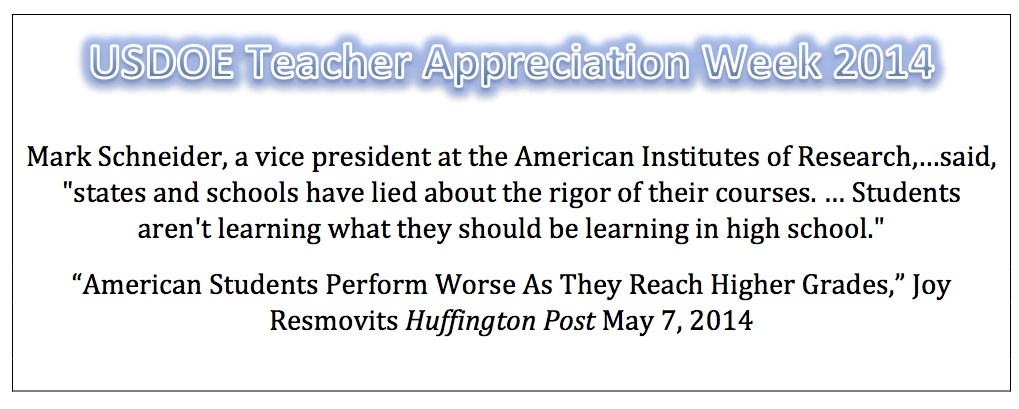
In fact, the U.S. Department of Education has just released a hot-off-the-press bumper sticker that celebrates Teacher Appreciation Week 2014 by acknowledging recent NAEP data:

USDOE TAW 2014

What happens when inept political leadership (Note: The 21st century prerequisite for holding the position of Secretary of Education appears to be a gentle blend of an absence of expertise and outright dishonesty related to NAEP reporting) collides with press-release journalism [1] (like an asteroid slamming into the Earth)?

Well, the claim made above by Schneider (“a vice president at the American Institutes of Research who previously led the government arm that administered NAEP”)—a truly ugly claim about education and teachers that appears to have been accepted without any request for evidence (Evidence? Secretary Duncan, You Can’t Handle the Evidence).

NAEP, then, once again prompts handwringing about stagnant scores and achievement gaps—and there are always charts and graphs to make the point along with the usual insincere nod to “the Civil Rights Issue of Our Time”:

U.S. Secretary of Education Arne Duncan said in a statement about the results, “We project that our nation’s public schools will become majority-minority this fall—making it even more urgent to put renewed attention into the academic rigor and equity of course offerings and into efforts to redesign high schools. We must reject educational stagnation in our high schools, and as [a] nation, we must do better for all students, especially for African-American and Latino students.”

Amongst the ugliness and baseless pontificating by political leaders are absent some key points that the media will fail (again) to uncover:

  • NAEP data are released and pronouncements made, but no one really knows the cause of the data concerns. Why scores appear stagnant and why racial/socioeconomic gaps persist are often complex (although a huge and evidence-based source of both is likely inequity and poverty). The initial reactions to NAEP this time in EdWeek and HuffPo are overwhelmingly speculation by people with political agendas. If we are genuinely interested in people who are likely telling lies, it appears we may want to look at the people cited in these articles.
  • “Achievement gap” is a misnomer for “opportunity gaps,” and using standardized tests to measure and examine that gap is inherently flawed since standardized testing remains biased by race, class, and gender; and thus, the tests themselves not only measure but create the gaps. Furthermore, for any gap to close, identified populations of students would need to be treated differently, but the current policy is a common core of what students experience in schools. And another dirty little secret is that the current era of accountability has damned high-poverty and minority students to test-prep course work that in fact asks less of them (thus, it is not “states and schools” that are telling lies, but politicians who shape accountability policy who are in fact telling lies).
  • Throughout the 20th and into the 21st centuries, we have found no correlation between how U.S. students do on test comparisons (among states or internationally) and claimed goals such as international competitiveness or the robustness of the U.S economy. None. And while we are at it, over the last three decades of accountability, we have found no correlation between the existence or quality of standards and measurable student outcomes. None. Again, it is a political lie to continue to cry “crisis” over test scores. A lie.

While I remain certain that accountability built on standards and high-stakes testing is a fundamental flaw in education reform, political leadership and the media are not doing us any favors either. This latest “high school achievement crisis” based on a rush to misread NAEP data is but more of the same—lamentably so as we certainly could do a better job even within the flawed test-based culture of U.S. education, as Matthew Di Carlo has outlined.

Childhood is steeped in a series of lies—what Kurt Vonnegut has labeled “foma,” although many of these lies are not so harmless: the Easter bunny, Santa Claus, work hard and be nice.

But one truism from our youths must be accepted as fact: Action speaks louder than words.

If we apply that to the USDOE, then we are likely to recognize just who is telling lies and about what:

  1. Lie: U.S. schools, teachers, and students are failing because of low standards and expectations.
  2. Lie: New standards and new tests will save public schools.
  3. Lie: State X is worse than State Y because NAEP (or SAT) scores say so; the U.S. is falling behind Country X because PISA scores say so.
  4. Lie: Poverty is not destiny.
  5. Lie: Arne Duncan (or Bill Gates or Michelle Rhee) knows what he is talking about.
  6. Lie: Education reform is the Civil Rights issue of our time.
  7. Lie: U.S. education is struggling because of “bad” teachers who are too hard to fire.
  8. Lie: Charter school X is a “miracle” school.

Truth: The USDOE is the embodiment of “lies, damned lies, and statistics.”

For Further Reading

I love the smell of NAEPalm in the morning

[1] See also Is It Journalism, or Just a Repackaged Press Release? Here’s a Tool to Help You Find Out.