Category Archives: Testing

Class Grades

Since I am quick to criticize the media for its role in the failures of the current education reform movement—such as PBS, The Charleston Post and Courier, and Education Week—I must also recognize when a media outlet provides much needed insight into education policy that has clearly run off the tracks, such as the so-called Florida miracle and the enduring practice of assigning letter grades to schools.

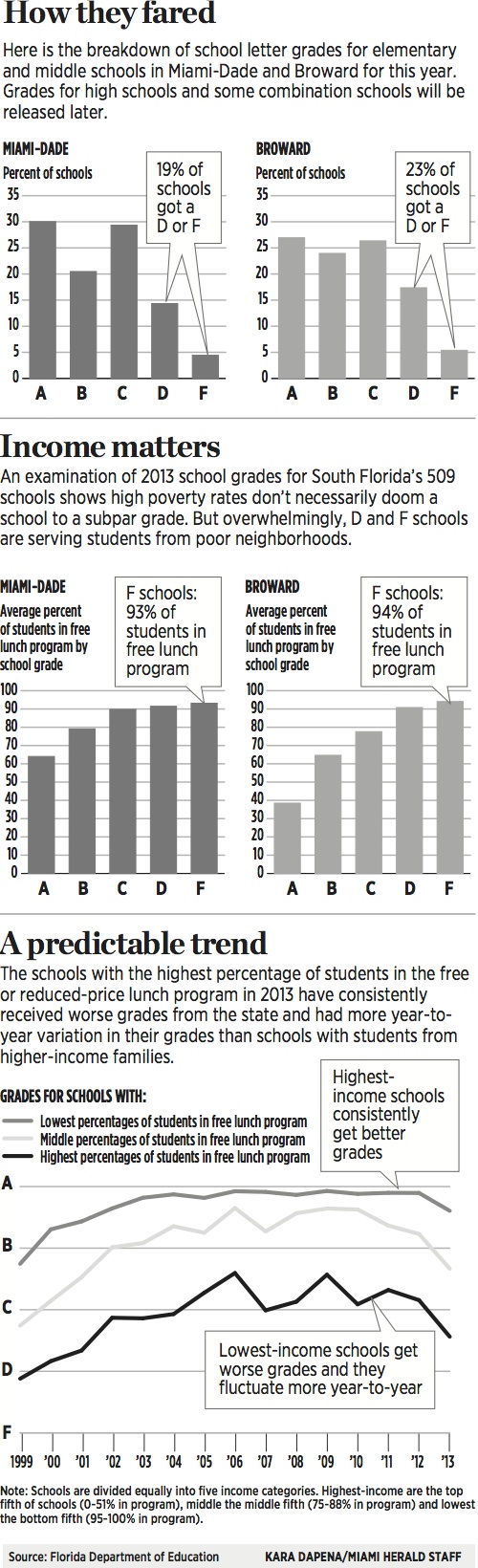
In “Low-income schools struggle under state’s grading system” (Miami Herald, August 10, 2013), Michael Vasquez and David Smiley offer a clear but disturbing picture of accountability in Florida:

With dozens of changes in just the past three years, the formula behind Florida’s A-to-F school grading system has been criticized as a confusing mess. But there’s been at least one constant in Miami-Dade and Broward results: The wealthiest schools never get Fs, and schools with high populations of poor students face an uphill battle to even get a C.

The trend is visible through a decade-plus of school grade results, dating back to the first grades issued in 1999.

Vasquez and Smiley, along with the Miami Herald, represent a needed aspect of journalism addressing education reform: Recognizing large and compelling patterns, and thus the consequences of education policy.

The analysis of assigning letter grades to schools in Florida exposes some important conclusions:

•  Although high poverty rates don’t necessarily doom a school to a subpar grade, D and F schools are overwhelmingly serving students from poor neighborhoods, and the few schools that do overcome poverty to achieve an A are outliers. (There were nine such schools this year, all in Miami-Dade).

•  Of the 209 schools in Miami-Dade and Broward with at least 90 percent of students receiving free or reduced lunch, 78 percent received a grade of C or worse. Roughly 39 percent of these high-poverty schools received a D or F.

•  Of the 43 local schools with much lower poverty rates (30 percent or fewer students receiving free or reduced lunch), 86 percent received an A, and none received a D or F.

Despite efforts to identify educational quality among schools by focusing on growth models, data used in accountability policies remain primarily a reflection of out-of-school factors. Further, the schools that sit outside the typical patterns are rightfully identified by Vasquez and Smiley as “outliers.”

This analytical report on letter grades for schools in Florida is a strong example of quality journalism that seeks out and presents complex and detailed evidence, placing that data in the broader context of the many factors that impact not only the evidence we gather on our schools but also what conclusions we draw as well as how we draw those conclusions.

In the article, Miami-Dade Superintendent Alberto Carvalho explains, “‘Just as much as poverty can’t be an excuse, the exclusion of poverty as a factor is immoral.'”

Rare is the news article that allows a perspective this complex.

No Child Left Behind (NCLB) ushered in several grand promises in 2001, such as closing the achievement gap, but one of the central requirements of the legislation—the use of scientifically based research—is now poised to dismantle the entire accountability movement, including policies such as labeling schools with letter grades based primarily on test scores.

The evidence is clear that thirty years of accountability built on standards and high-stakes testing has failed. The next step is composing and sharing a unified message of that fact, while also building a coalition to reset the reform agenda so that we address poverty, equity, and opportunity in the lives of children and their families as well as in the schools those children attend.

Innocence or Guilt?: Looking Beyond the Individual

The court room presents a powerful narrative focusing on the innocence or guilt of an accused individual. In the U.S. judicial system, the accused is innocent until proven guilty, and this principle is embraced as a foundational commitment to individual freedom.

The George Zimmerman trial, however, prompted for many concerns about the effectiveness and objectivity of that judicial system, including fears that jury trials reflect the biases of the jurors and that the victim, Trayvon Martin, was unfairly put on trial as well. Debates also included a convoluted discussion of the laws themselves surrounding the case, notably the stand your ground laws in Florida. If the laws themselves are flawed or inherently corrupt, how can a trial be just?

The court of public opinion is no less focused on individual innocence or guilt. In the education reform movement, a number of scandals have exposed flawed leaders and dysfunctional systems—Michelle Rhee’s reign as chancellor of DC public schools, Tony Bennett’s role in changing school grades in Indiana, a cheating scandal in Atlanta, and misleading tests scores in New York. Each of these individual people and circumstances lends itself to holding one person or a unique situation accountable, but just as any trial can disproportionately focus blame on an individual, it is careless and ultimately dangerous to ignore the wider accountability era while laying (often justifiable) blame at the feet of Rhee, Bennett, Atlanta public school administrators, or the newest testing process in NY.

Bernhard Schlink’s The Reader confronts readers with the lingering historical horrors of the Holocaust while also weaving an allegory of justice. A central character, Hanna Schmitz, develops a taboo but compelling relationship with a German teen, Michael Berg, many years after she has served as an SS guard at Auschwitz. In the middle section of the novel, Schmitz is on trial for her role at the concentration camp, and the readers of the novel discover that Schmitz’s passion for having Berg read to her grows from her own illiteracy, a key element in how the trial portrays her innocence or guilt.

Readers of Schlink’s novel are likely left torn about Schmitz’s guilt, possibly in ways similar to public opinion about Zimmerman. Schlink, as a lawyer and judge, seems as interested in the larger allegory of justice as he is about the specific horrors of who is culpable for the Holocaust. In fact, the novel suggests that innocence and guilt are not simple, not easily reduced to the acts or decisions of an individual.

Is it possible, the novel asks, that Schmitz is guilty in a nuanced way that is grounded in her illiteracy and the perverse and dehumanizing culture surrounding the Holocaust? Is it then possible that Schmitz is simultaneously guilty but also a victim of forces larger than her?

While I am suggesting no direct comparison between the accountability era and the Holocaust in terms of magnitude, I am compelled to recognize that the allegorical message of The Reader helps inform the potential mistake being layered onto the individual failures represented by Rhee, Bennett, the Atlanta cheating scandal, and the NY test data: Each of these people or circumstances is both an example of individual or situational failures and clear messages about the larger inherently flawed accountability era based on standards, high-stakes testing, and individual accountability (schools, districts, teachers, and students).

Let’s just focus on two recent failures in the accountability era—Bennett and NY test scores. Both, I am convinced, are evidence of specific failures and possibly even unethical behavior by people in power. And I would argue that Bennett and those responsible for testing in NY should all be held accountable for their decisions, actions, and misrepresentations about children, teacher, and schools to the public.

Ultimately, however, that isn’t nearly enough. Assigning grades to schools and all high-stakes testing are the problems; thus, high-stakes testing as a mechanism for labeling, sorting, and ranking schools, teachers, and children is the larger flawed system that Bennett and NY test scores represent.

In the passive voice parlance of avoiding culpability found in the courtroom, it is likely that for Rhee and Bennett “mistakes were made.”

But political, media, and public concern for these individual errors must not end with their individual culpability.

Accountability, standards, and high-stakes testing are dehumanizing, counter to genuine teaching and learning, and corrosive to universal public education, democracy, and individual liberty. With this lesson standing before us, then, it is unconscionable to continue down the road of Common Core and “next generation” national tests.

It is no longer credible to argue about how best to implement Common Core, how best to implement new tests, or how best to analyze that data from those tests. It is time to end an era of misguided accountability.

Even under the weight of forces larger and more powerful than any one of us, we must make a decision to confront and end a failed system, and that system is the accountability era begun thirty years ago, but now has proven itself a failure.

Detesting and Degrading or De-Testing and De-Grading?

It began with an idea, a play on words: Children (and increasingly, teachers) detest school because the current test-and-grade paradigm is degrading so why not de-test and de-grade the schools?

With that idea in mind, I contacted Joe Bower, whose stance against grades and tests I followed on Twitter, and we began discussing an idea of an edited volume addressing de-testing and de-grading our schools, a direct confrontation of the current high-stakes accountability movement. We were fortunate to invite Alfie Kohn on board for the introduction and a chapter. From there the book was developed—although we struggled through a few hiccups with publishers, landing at Peter Lang USA.

Since the volume doesn’t preview each chapter, I want to offer below some snippets from each chapter, and invite you to join the authors of this volume in our tribute to the teachers at Garfield High (Seattle, WA) for their courageous stance against MAP testing (to whom the volume is dedicated):

De-Testing and De-Grading Schools: Authentic Alternatives to Accountability and Standardization

Joe Bower and P. L. Thomas, editors

Table of Contents

Introduction: The Roots of Grades-and-Tests, Alfie Kohn:

Most of the contributions to this book focus on problems with either grades or tests. In an article about college admissions published more than a decade ago, however, I suggested that we might as well talk about “grades-and-tests” (G&T) as a single hyphenated entity (Kohn, 2001). There are certainly differences between the two components, but the most striking research finding on the subject is that students’ G&T primarily predicts their future G&T — and little else. It doesn’t tell us much at all about their future creativity, curiosity, happiness, career success, or anything else of consequence.

In fact, the case for the fundamental similarity of grades and tests runs deeper than their limited predictive power. Both are “by their nature reductive,” as P. L. Thomas, co-editor of this volume, observes in his chapter. I would add that both emerge from — and, in turn, contribute to — our predilection for three things: quantifying, controlling, and competing. All of these are defining characteristics of our educational system but also permeate our culture more generally.

Part I: Degrading Learning, Detesting Education: The Failure of High-Stake Accountability in Education

Chapter One: NCLB’s Lost Decade for Educational Progress: What Can We Learn from this Policy Failure?, Lisa Guisbond, Monty Neill, and Bob Schaeffer (FairTest.org):

It is not too late to revisit the lessons of the past ten years and construct a federal law that provides support for equity and progress in all public schools. With that goal in mind, this report first provides an overview of the evidence on NCLB’s track record. Second, it looks at recent efforts at NCLB “reform” and what past evidence says about their likely outcomes. Finally, it points to alternative strategies that could form the basis for a reauthorized federal law that would improve all schools, particularly those serving our most needy students.

Chapter Two: High-stakes Testing Assessment: The Deus Ex Machina of Quality in Education, Fernando F. Padró:

From here on forward the discussion reflects how assessment and quality are used as proxies for each other. The discussion comes more from a higher education viewpoint than a P-12 one, but one reason for this is that higher education is facing many of the same issues and pressures; therefore, the concerns at the macro level are more similar than dissimilar. In other words, it is another way at looking at those external influences impacting education and all aspects of educational activity from early childhood until the brink of formally entering the workforce. While the focus is not always on testing and assessment, the discussion is always about testing and assessment because that is the stock in trade within the quality model that is strongly impacting education.

Chapter Three: Technocratic Groupthink Inflates the Testing Bubble, Anthony Cody:

The sooner this groupthink bubble bursts, the better off we will be. In our classrooms, we must do our best to give our students meaningful opportunities to learn, in spite of the intense pressure to raise test scores. In the public arena, we can help burst the bubble by focusing on the big picture data that shows that in spite of a decade of obsessing over data, there is no evidence that better learning results (Hout & Elliott, 2011). We can help burst the bubble by calling out the self-appointed umpires like NCTQ, the Media Bullpen, and dozens of other test-obsessed advocacy groups that are attempting to overwhelm critical discussion of these issues. And we can support efforts to give voice to other points of view, through organizations that allow parents, teachers and students to raise their voices, without the filtering effect of foundation funding.

Chapter Four: Mean Scores in a Mean World, Lawrence Baines and Rhonda Goolsby:

Today, personnel from state departments of education are about as welcome in public schools as vultures. A wake of vultures seldom attacks healthy animals, but prey upon the wounded or sick. So, when student achievement levels wane, the state sees its role not as helper, but as disciplinarian—to punish a school for allowing its students to post achievement scores below the mean. If a school is contacted by the state, the news inevitably is bad— at best, a public humiliation and at worst, a tumult of teacher and administrator firings in a takeover. Firing people, while enjoyable for select politicians, is a tactic that helps neither student nor teacher.

Chapter Five: Degrading Literacy: How New York State Tests Knowledge, Culture, and Critical Thinking, Julie Gorlewski and David Gorlewski:

In June 1999, New York State anticipated the political and pedagogical movement that has engulfed public schools through the federal legislation entitled No Child Left Behind (USDE, 2003). The state’s education department implemented learning standards meant to drive local district curricula. In addition, the state unveiled a plan to attach the standards to mandatory assessments for students in grades 4, 8, and 11, beginning in the area of English language arts (ELA). Consequences for students and educators were significant and comprehensive. In addition to gauging individual student performance, tests at all levels were designed to measure schools’ progress towards meeting the learning standards and to rank schools according to student achievement. Scores and rankings were to be published and distributed by districts, the state education department, and media outlets; and schools with consistently inadequate scores and unacceptable levels of improvement were threatened with the designation “School Under Regents Review (SURR).” So-called SURR schools would be required to show rapid, significant improvement on standardized assessments or face state takeover (NYSED, 1999). Tests were equally high-stakes for students. In June 1999, passing the commencement level ELA examination (intended for students in grade 11) became a graduation requirement for the high school graduating class of 2000.

Chapter Six: The Aesthetics of Social Engineering: How High Stakes Testing Dehumanizes/Desensitizes Education, Morna McDermott:

Schools in America, at least since the industrial age, have been vehicles of social control. Factory model schools, designed during the industrial era, and guided by the industrial paradigm served that framework through economic, ideological, and political means. Now, just as decades ago, high-stakes testing (HST) is the weapon of choice used by education reformers to manipulate the educational system in ways that benefit their agenda to privatize public; pushing a standardized and highly regulated curriculum (to match with the required tests), increased social engineering (using and tracking student data via the HST for other purposes), and corporate profit (through the development, implementation and evaluation of the HST). One cannot deeply understand the origins or purposes of today’s high stakes tests without examining the social, political, and economic climate in which they exist. High stakes testing is the thread that ties together a larger picture of reform that includes: privatization of public education, replacing public schools with charter schools, enforcing a curriculum which “force feeds” meaningless data to already disempowered and disenfranchised communities, and uses “accountability” to turn data into big profits. Each of these issues, as they interface with testing policies and effects, will be explored in this chapter.

Chapter Seven: Standardized Testing and Boredom at an Urban Middle School, Richard Mora:

While conducting a multi-year, gender study at an urban K-8 school, I witnessed and documented the ground-level impact the push toward greater accountability in public education had on the group of 33 working-class, Latina/o students that I followed. At Romero, as I call the school, standardized test scores served as the ultimate measure of the school’s performance. As a result, entire class periods, hours at time, were dedicated to both district and statewide assessments, with teachers teaching to the test, to the practice tests, and to pre-practice tests. During these tests and the various quizzes and exams their teachers administered, the students had to sit quietly at their desks for long stretches of time, an expectation that proven difficult for most.

Additionally, during the sixth grade, the majority of students I observed had a double math period meant to prepare them for the upcoming state exam. Students found these experiences excruciatingly frustrating and repeatedly summed up their feelings with some variant of the statement, “School is so boring.”

Chapter Eight: Reconciling Student Outcomes and Community Self-Reliance in Modern School Reform Contexts, Brian Beabout and Andre Perry:

Education for African-Americans has historically been linked to the broad movement to improve their lot in life. Ceaselessly, from slavery and Jim Crow, towards full membership in American society, schooling was as much about academic learning as it was for ensuring the sustainability of the community in which the school was situated. Due to both de jure and de facto racial segregation of their communities and public schools, there have historically been high levels of self-determination in schooling for African-Americans (Anderson, 1988). The boundaries of the racial community were often undistinguishable from the geographic communities in which African-Americans lived. Racial uplift became the raison d’être in all sectors of Black society, but education offered a pragmatic focus for community development, political empowerment, and economic enfranchisement. This has meant black teachers, the visible presence of the African-American experience in the curriculum, and significant local decision-making power….

This current pervasiveness of market approaches is reflected in the reform language of state takeover, school turnaround, and reconstitution. As a consequence, since 2001, administrative control of many schools serving students of color has shifted from local educators and elected school boards to the states and the federal government who set the accountability policies and determine student and school accountability rules based on test scores. The following chapter interrogates this facially benign policy of raising student achievement with respect to the potential impact on the legacy self-determination of African-American schooling.

Chapter Nine: The Role of Assessment in Empowering/ Disempowering Students in the Critical Pedagogy Classroom, David Bolton and John Elmore:

Since the focus of teacher education at West Chester University has shifted toward teacher training, Democracy and Education, the one foundations course that students take is often where they learn critical perspectives on education. In this class, students define and examine their own philosophies and beliefs about the purpose of education in democratic society and compare, contrast, reject, and borrow from the philosophies of others. Since one of the stated goals of education at West Chester University is to create public intellectuals, it is critical that that foundations course be as empowering as possible.

Learning to think critically about assessment should be a vital part of this foundations course. If students are critically examining the purpose and content of education, i.e., instruction, then students also must learn to become critical assessors of their students. They must be given the intellectual tools to refocus the debate about assessment, so that assessment is not their master, but is a tool that will empower them as they teach their own students.

Part II: De-Grading and De-Testing in a Time of High-Stakes Education Reform

Chapter TenThe Case Against Grades, Alfie Kohn

Chapter Eleven: Reduced to Numbers: From Concealing to Revealing Learning, Joe Bower:

Since 2006, I have worked to identify and remove things like grading that traditional school has done for so long. And when I share this with others, I receive mixed responses. Some listen intently, nodding their heads in agreement, as if deep down they have always sensed something wrong with what Seymour Papert (1988) described as School with a capital ‘S’ — which is a place that he explains as having a bureaucracy that has its own interests and is not open to what is in the best interest of the children. Unfortunately, when most people close their eyes and think of their Schooling, many have experienced no other kind of School than the one with a capital “S.” Some listen in shock and awe at how school could even function without such things as grading. The people who have a hard time comprehending how children could learn without extrinsic manipulators concern me the most. They are so invested into traditional schooling that they have never questioned its foundation. Unfortunately, some have a distrustful view of the nature of children. Meaning that they believe that without grading there would be nothing to stop children from running amok.

Chapter Twelve: Assessment Technologies as Wounding Machines: Abjection, the Imagination and Grading, John Hoben:

For me the questions surrounding grading are incessant: Do I subtract marks for improper citation style in a paper where a young teacher talks about the death of her father with remarkable insight, wisdom and grace? What grade do I give a teacher who has the courage to write and share her struggles with breast cancer and her fears about leaving her young daughter? Or to a young man who writes about his mother’s struggles with the late stages of multiple sclerosis? Conventional grading gives no consideration to the marks these students should receive for having taught me about grace under fire, about humility and a quiet kind of perseverance instead of “sorting students like so many potatoes” (Kohn, 1994, p. 38). As a quantifying technology which presents teachers with a set of bureaucratic practices for the management of human subjects, grading is a machinery of abjection: a set of technical and administrative practices which works by “casting out” since schooling needs the threat of the wound to maintain its own internal boundaries and hierarchies. More than a simple means of disciplining students and teachers (Foucault, 1995), grading is a mode of schooling the imagination rather than allowing the imagination to radically transform schools. It does this by excluding those who do not fit prescribed models of excellence and teaching us to revile those who do not conform to dominant ways of thinking and being.

Chapter Thirteen: No Testing Week: Focusing on Creativity in the Classroom, Peter DeWitt:

When I entered college, a friend’s parents, who were both teachers, tried to persuade me from entering the field of education, which I found very sad. They were both excellent teachers but they said the profession was changing, and not for the better. I politely smiled and listened to their concerns but I continued down the same path despite their warnings. After working in an after-school program, I knew that I wanted to be an educator. I never forgot the disappointment I felt when those two retired teachers tried to talk me out of entering the profession that they spent so much time in. After seventeen years in education, first as a teacher and then a principal, I understand why they felt the way they did so long ago. However, I still maintain hope that things will get better and strongly believe it is my job as the school leader to help teachers find that love again.

I have come to a crossroads in my career. According to the movie Under the Tuscan Sun, that sounds very Oprah of me. When I began teaching I remember more seasoned teachers stating that if you stay in education long enough you will see the pendulum swing from one side to the other. It is my hope that the pendulum has swung to one very dysfunctional side long enough and will make its way to a side that is based in common sense and sound educational practices before many of us end our careers.

It seems as though policymakers in education want educators to pay attention to research, data and accountability, but they feel that they do not have to play by the same rules. Apparently research, data and accountability only matter when it tells policymakers what they want to hear. Unfortunately, the direction they have been leading education is not good for kids. It is bordering on educational malpractice. Just like the present economic issues in the U.S., education will continue to benefit only the top percentage of kids who can afford it.

Chapter Fourteen: Creating an Ungraded Classroom, Hadley Ferguson:

It is often easy to identify the beginning of an adventure; but where that journey will take you is usually a mystery. That was certainly the case with my adventure into ungrading and using portfolios for assessment. There have been many unexpected twists and turns in the road, unanticipated challenges as well as significant and rewarding successes. When I asked my administration if I could teach an ungraded class, I knew that I was stepping away from the security of my established practice and into a place where all of my skills and knowledge would have to be applied in fresh ways. A new adventure was truly starting. I asked for and was given permission to teach the only ungraded class in an otherwise school with grades. The school was in a time of transition, and teachers had been challenged to experiment with the best strategies for meeting the changing needs of 21st century students. My class, 7th grade history, became a place where learning took place within a new set of standards and expectations. While there were a wide variety of assignments and assessments, none of them was going to end in a grade.

Chapter Fifteen: “Parents Just Want to Know the Grade”: Or Do They?, Jim Webber and Maja Wilson:

Occasionally, someone has the nerve to suggest that grades are overrated, that a focus on them is detrimental, and that everyone might be happier and learn more if we de-emphasized or got rid of them completely. A widely discussed article on Inside Higher Education (Jaschik, 2010) described Cathy Davidson’s efforts to “get out of the grading business.” In her English classes at Duke University, students held regular meetings to decide if their work was acceptable or needed revision. Davidson gave no grades—only descriptive feedback. At the end of the experiment, Davidson declared, “It was spectacular….It would take a lot to get me back to a conventional form of grading ever again.” …

Still, the research accumulates: a study (Pulfrey, Buchs, & Butera, 2011) demonstrated that when students anticipate grades on papers (with or without comments), they become more likely to avoid difficult work than when they anticipate teacher comments without grades. This finding complements Ruth Butler’s (1987) study showing that grades (with or without comments) lead to lower levels of intrinsic motivation and creativity. But suggest that we act on this research—by de-emphasizing or replacing grades in the classroom—and even sympathetic teachers conjure up parent protests: “I’d be the first to get rid of grades and just do writing conferences and narrative feedback! But parents just want to see the grade!”

Chapter Sixteen: De-grading Writing Instruction in a Time of High-stakes Testing: The Power of Feedback in Workshop, P. L. Thomas:

It is now 2012, and I am at the end of my first decade as a college professor of education. After 18 years teaching high school English, a career that was deep in my heart and bones as a teacher of writing, I moved to the university in part as an act of professional and scholarly autonomy. Teaching in education courses, however, has proven to be far less fulfilling and off-kilter to my central concerns with directly addressing human literacy—fostering writers.

After being allowed to teach one section of the university’s introductory English course, I was fortunate that my university re-imagined its curriculum, replacing the two required freshman English courses with two freshman seminars designed to inspire and fuel student engagement in learning. One of the freshman seminars must be writing intensive, and the seminars are taught by professors across departments—not just the English faculty.

This curriculum change has afforded me a unique opportunity to teach a writing-intensive freshman seminar each fall at the university level, where I have the autonomy to implement writing workshop and, most significantly, to de-grade the feedback process of my students crafting their essays. In that context, this chapter opens with a brief discussion of how the writing curriculum has suffered a failed history in K-12 education—almost completely disconnected from the research and craft of composition as a field. Then, I detail my own evolution as a teacher of writing from my high school years as a teacher and into my recent experiences with de-grading the writing classroom for freshmen. I also examine how K-12 teachers of writing are both inhibited in best practices for composition because of the accountability era as well as how those teacher should and can reclaim the teaching of writing for all children.

Chapter Seventeen: One Week, Many Thoughts, Brian Rhode:

Have you ever had the pleasure of watching a school bloom? I have. I watched the walls around me burst into color, like flower petals extending themselves to the great warmth of the spring sun. Splashes of primary shades crawled throughout the school thoroughfares in which I spend my days as a professional. The entrances to classrooms became bustling hives of activity and the productivity was evidenced in the variety of posters, pictures and projects that emerged. Suddenly my small elementary school in upstate NY resembled a field of flowers in the full throws of its spring awakening!

I am certain many of you are asking what possibly ignited such a school-wide explosion of creativity. Quite simply, it was the result of a week without testing. My principal, Dr. Peter DeWitt, had the idea back in the fall of 2011 to give us, as a staff, a much-needed break from the relentless drive of standardized assessment based instruction. As a veteran of the classroom himself, he recognized a way to re-invigorate his teachers by endorsing a respite from the type of instruction that seems to stand in a starkly antagonistic position to the attitudes and beliefs that typically bring people into teaching.

Conclusion: Striving Towards Authentic Teaching for Social Justice, Lisa William-White:

What does it mean to prepare emergent teachers in an era where we bear witness to anti-immigrant discourses and policies; where we see (or even know) scores of people who live in poverty (Measuring Child Poverty, 2012); or where there is widespread bullying of children and youth in schools and communities (From Teasing to Torment, 2005)? What does preparation mean in a country where we have championed education reform since the 1950s; where we extol the importance of literacy and critical thinking; and yet, we further prescribe what constitutes appropriate knowledge, including what content teachers must teach (Common Core State Standards Initiative n.d.)? And, what does this all mean in an era of education deform (Pinar, 2012) – a time of shrinking state budgets, eroding of educational enrichment opportunities for children and youth, rising tuition costs in universities, and where democratic learning spaces in higher education are further undermined by business models for educational decision making?

De-Testing and De-Grading Schools (Peter Lang USA)

De-Testing and De-Grading Schools (Peter Lang USA)

Joe Bower and P. L. Thomas, editors

[Preview and order at amazon]

De-Testing and De-Grading SchoolsBook synopsis

A century of education and education reform along with the last three decades of high-stakes testing and accountability reveals a disturbing paradox: Education has a steadfast commitment to testing and grading despite decades of research, theory, and philosophy that reveal the corrosive consequences of both testing and grading within an education system designed to support human agency and democratic principles.

This edited volume brings together a collection of essays that confronts the failure of testing and grading and then offers practical and detailed examinations of implementing at the macro and micro levels of education teaching and learning free of the weight of testing and grading. The book explores the historical failure of testing and grading; the theoretical and philosophical arguments against testing and grading; the negative influence of testing and grading on social justice, race, class, and gender; and the role of testing and grading in perpetuating a deficit perspective of children, learning, race, and class.

The chapters fall under two broad sections: Part I: «Degrading Learning, Detesting Education: The Failure of High-Stake Accountability in Education» includes essays on the historical, theoretical, and philosophical arguments against testing and grading; Part II: «De-Grading and De-Testing in a Time of High-Stakes Education Reform» presents practical experiments in de-testing and de-grading classrooms for authentic learning experiences.

Contents

Contents: Lisa Guisbond/Monty Neill/Bob Schaeffer: NCLB’s Lost Decade for Educational Progress: What Can We Learn from This Policy Failure? – Fernando F. Padró: High-Stakes Testing Assessment: The Deus ex Machina of Quality in Education – Anthony Cody: Technocratic Groupthink Inflates the Testing Bubble – Lawrence Baines/Rhonda Goolsby: Mean Scores in a Mean World – Julie A. Gorlewski/David A. Gorlewski: De-grading Literacy: How New York State Tests Knowledge, Culture, and Critical Thinking – Morna McDermott: The Corporate Model of Schooling: How High Stakes Testing Dehumanizes Education – Richard Mora: Standardized Testing and Boredom at an Urban Middle School – Brian R. Beabout/Andre M. Perry: Reconciling Student Outcomes and Community Self-Reliance in Modern School Reform Contexts – David L. Bolton/John M. Elmore: The Role of Assessment in Empowering/Disempowering Students in the Critical Pedagogy Classroom – Alfie Kohn: The Case Against Grades – Joe Bower: Reduced to Numbers: From Concealing to Revealing Learning – John Hoben: Outside the Wounding Machine: Grading and the Motive for Metaphor – Peter DeWitt: No Testing Week: Focusing on Creativity in the Classroom – Hadley J. Ferguson: Journey into Ungrading – Jim Webber/Maja Wilson: Moving Beyond «Parents Just Want to Know the Grade!» – P. L. Thomas: De-grading Writing Instruction in a Time of High-Stakes Testing: The Power of Feedback in Workshop – Brian Rhode: One Week, Many Thoughts.

About the author(s)/editor(s)

Joe Bower is a teacher in Red Deer, Alberta, Canada. He spent 10 years teaching grade eight language arts and science in a middle school, and is now a special education teacher in a childrens psychiatric assessment unit. Follow his work at http://www.joebower.org and @joe_bower.

P. L. Thomas, Associate Professor of Education (Furman University, Greenville SC), taught high school English in rural South Carolina before moving to teacher education. He is currently a column editor for English Journal (National Council of Teachers of English) and series editor for Critical Literacy Teaching Series: Challenging Authors and Genres (Sense Publishers). Follow his work at https://radicalscholarship.wordpress.com/ and @plthomasEdD.

Series

Counterpoints: Studies in the Postmodern Theory of Education. Vol. 451
General Editor: Shirley R. Steinberg

Ending Exit Exams a Start, But Not Enough

As the first decade of the twenty-first century drew to an end, Frederick Douglass High School (Maryland) stood as a contradiction of social history, education and racial promise, the claimed failures of public schools, and the essential flaws in high-stakes accountability.

Focusing on Douglass High, documentarians Alan and Susan Raymond detail the realities of both day-to-day schooling in a high-poverty, majority-minority public schools and the unintended consequences of No Child Left Behind (NCLB), enacted in 2001 with 100% proficiency requirements mandated for 2014.

Toward the end of the film, a voice-over explains that the accountability guidelines in place during the filming excluded exit exam data from graduation requirements for students, but those test scores were included in NCLB accountability decisions about the school and its administration and faculty. Panning across the test room and the voice-over reveal many students with their heads down during those tests.

While standardized testing has been a key component of education in the U.S. for a century, the accountability movement and the impact of high-stakes testing entered mainstream education in the early 1980s. One of the first uses of high-stakes testing then was the introduction of the exit exam, designed to prevent students from being passed along through the system and thus graduating without what proponents called basic skills. South Carolina was one of the first states to commit fully to the accountability movement, establishing standards, state tests, and linking graduation to exit exams.

In 2013, SC now sits poised to abandon the exit exam: “But S.C high school students would no longer have to pass an exit exam to graduate if a state House bill becomes law–welcome news for the thousands of students who struggle year after year to pass both the test’s math and English sections.”

However, this bill does not mean SC will stop implementing those tests: “But because the test is used to determine whether S.C schools and school districts meet state and federal accountability standards, students still would be required to take the exam.”

Sponsors and supporters of this bill should receive credit for recognizing the inherent flaw in honoring one data point (the exit exam) over years of multiple data points (course grades, course credits, GPA). In fact, deciding to drop student accountability for exit exam scores is justified by decades of data on the SAT, revealing that SAT scores remain less credible evidence of student readiness for college than GPA.

However, ending high-stakes consequences for students taking exit exams doesn’t go nearly far enough. SC, and states across the U.S., must end high-stakes testing and begin focusing reform and resources on the conditions of learning and teaching before outcomes can be evaluated in any valid way.

The current plan is flawed and incomplete in the following ways:

  • Just as NCLB has proven to have unintended and detrimental consequences, maintaining teacher and school accountability on an exam that students themselves have no investment in can lead only to the exact scene depicted in Hard Times ay Douglass High—disengaged students and invalid test data. At the end of the documentary, viewers learn that the state takes over the school and replaces the administration, again based on testing many students had essentially felt no obligation to attempt.
  • High-stakes testing has now been exposed as an ineffective reform policy in education. Continuing down the new standards and new tests path is no longer reform, but digging a deeper hole in the status quo.
  • Holding teachers and schools accountable for the outcomes of students is a misuse of accountability since, as scholar and The New York Times columnist Stanley Fish explains, teachers cannot be “responsible for the effects of [their] teaching, whereas, in fact, [they] are responsible only for its appropriate performance.” In other words, ending student, teacher, and school accountability based on high-stakes tests must be replaced by policies that address the conditions of learning and teaching provided for all students by schools and teachers.
  • Ultimately, high-stakes testing is an inefficient drain on state tax dollars; the testing machine and the constant creation, field-testing, and implementation of high-stakes tests fails to produce valid data, but lines the pockets of the testing industry at the expense of public funds.

Should states end using exit exams and other high-stakes tests as gatekeepers for graduation and grade promotion? Yes.

But the current plan to continue implementing exit exams as accountability data for schools and teachers fails to recognize that the problems are the tests themselves and how they are used.

The era of high-stakes testing itself must end, and in its place, let’s instead invest our time and tax dollars on the conditions of learning and teaching.

ADDENDUM

See the following:

THE EFFECT OF HIGH SCHOOL EXIT EXAMS ON GRADUATION, EMPLOYMENT, WAGES AND INCARCERATION
Olesya Baker
Kevin Lang
Working Paper 19182

Abstract

We evaluate the effects of high school exit exams on high school graduation, incarceration, employment and wages. We construct a state/graduation-cohort dataset using the Current Population Survey, Census and information on exit exams. We find relatively modest effects of high school exit exams except on incarceration. Exams assessing academic skills below the high school level have little effect. However, more challenging standards-based exams reduce graduation and increase incarceration rates. About half the reduction in graduation rates is offset by increased GED receipt. We find no consistent effects of exit exams on employment or the distribution of wages.

Limes or Leeches: A Thought Experiment about High-Stakes Accountability

History is a powerful teacher—if we are willing to learn.

Many educators and scholars have triggered the truism “Insanity is doing the same thing over and over while expecting different results,” but that argument seems always to fall on deaf ears among our self-chosen education reformers, the media, and the public.

So let’s venture into history and explore a thought experiment: Would you prefer limes or leeches?

Study the history of identifying and treating scurvy, including how British sailors became known as “limeys.”

Now study the history of blood letting, and the use of leeches.

Solutions, history shows, must be built on a clear identification of the problems and then a careful analysis of what those solutions must be.

Limes and citrus fruits proved credible solutions for preventing scurvy—while “[i]n the overwhelming majority of cases, the historical use of bloodletting was harmful to patients.”

High-stakes accountability built on standards and high-stakes testing is the type of insanity found in bloodletting because the overwhelming majority of educational problems have nothing to do with accountability, standards, or testing—not the lack of accountability, standards, or testing, not the quality of accountability, standards, or testing.

Nothing.

In the education of your child, would you prefer limes or leeches? [And now let’s apply that answer to “other people’s children” because “they’re all our children.”]

Let’s stop the bloodletting.

“Eager to Recreate the Same Old Nightmare”: Revisiting Vonnegut’s Player Piano

Few people could have imagined the acceleration of corporate influence that has occurred in the last two years despite the economic downturn associated with those corporations and the election of Barak Obama, who was repeatedly demonized as a socialist. *

More shocking, possibly, has been the corporate influence on the public discourse about universal public education, driven by Secretary of Education Arne Duncan and promoted through celebrity tours by billionaire Bill Gates, ex-chancellor Michelle Rhee, and “Superman” Geoffrey Canada.

Adam Bessie has speculated about the logical progression of the current accountability era built on tests and destined to hold teachers accountable for their students’ test scores (despite the evidence that teachers account for only about 10-20% of achievement)—hologram teachers. And Krashen believes that the corporate takeover of schools is at the center of the new reformers’ misinformation tour. For Anthony Cody, the future is a disturbing dystopia.

While Bessie’s, Krashen’s, and Cody’s commentaries may sound like alarmist stances–possibly even the stuff of fiction—I believe we all should have been seeing this coming for decades.

The science fiction (SF) genre has always been one of my favorites, and within that genre, I am particularly found of dystopian fiction, such as Margaret Atwood’s brilliant The Handmaid’s TaleOryx and Crake, and The Year of the Flood. Like Atwood, Kurt Vonnegut spoke and wrote often about rejecting the SF label for his work (See Chapter 1 of Wampeters, Foma & Granfalloons), but Vonnegut’s genius includes his gift for delivering social commentary and satire wrapped in narratives that seemed to be set in the future, seemed to be a distorted world that we could never possibly experience.

In 1952, Kurt Vonnegut published Player Piano, offering what most believed was a biting satire of corporate American from his own experience working at GE. A review of the novel describes Vonnegut’s vision of our brave new world:

The important difference lies in the fact that Mr. Vonnegut’s oligarchs are not capitalists but engineers. In the future as he envisages it, the machines have completed their triumph, dispossessing not only the manual laborers but the white collar workers as well. Consequently the carefully selected, highly trained individuals who design and control the machines are the only people who have anything to do. Other people, the great majority, can either go into the Reconstruction and Reclamation Corps, which is devoted to boondoggling, or join the army, which has no real function in a machine-dominated world-society.

Yes, in Vonnegut’s dystopia, computers are at the center of a society run itself like a machine, with everyone labeled with his or her IQ and designated for what career he or she can pursue (although we should note that women’s roles were even more constrained than men’s, reflecting the mid-twentieth century sexism in the U.S.). Where corporations end and the government begins is difficult in this society that is simply a slightly exaggerated of the life Vonnegut had witnessed while working at GE before abandoning corporate America to be a full-time writer.

For me, however, Vonnegut’s Player Piano is as much a warning about the role of testing and labeling people in our education system as it is a red flag about the dangers of the oligarchy that we have become.

Today, with billionaire Bill Gates speaking for not only corporate America but also for reforming public education, how far off was Vonnegut’s vision?

In the first decade of the twenty-first century, how different is Vonnegut’s world to what we have today, as income inequity and the pooling of wealth accelerates?

We have witnessed where political loyalty lies during the bailouts as corporate America collapsed at the end of George W. Bush’s presidency. With corporate America saved, and most Americans ignored, the next logical step is to transform public education by increasing the corporate model that has been crippling the system since the misinformation out of Ronald Reagan’s presidency grabbed headlines with the release of A Nation at Risk.

If Vonnegut had written this storyline, at least we could have been guaranteed some laughter. But this brave new world of public education is more grim—like George Orwell’s 1984.

Our artists can see and understand when many of the rest of us are simply overwhelmed by our lives. In Player Piano, we see how successfully corporate life disorients and overwhelms workers in order to keep those workers under control. And in the relationship between the main character Paul and his wife Anita, we watch the power of corporate life—and the weight of testing and reducing humans to numbers—being magnified by the rise of computers when Paul makes a plea to his wife:

“No, no. You’ve got something the tests and machines will never be able to measure: you’re artistic. That’s one of the tragedies of our times, that no machine has ever been built that can recognize that quality, appreciate it, foster it, sympathize with it.” (p. 178)

In the novel, Paul’s quest and the momentary rise of a few rebels appear to be no match for corporate control. Today, I have to say I am no more optimistic than Vonnegut.

When Secretary Duncan offers misleading claims about international test scores and bemoans the state of public schools for failing to provide us with a world-class workforce, and almost no one raises a voice in protest (except those of us within the field of education, only to be demonized for protesting), I am tempted to think that we are simply getting what we deserve—like Paul at the end of Player Piano: “And that left Paul. ‘To a better world,’ he started to say, but he cut the toast short, thinking of the people of Ilium, already eager to recreate the same old nightmare” (p. 340).

* Slightly revised reposting from OpEdNews (1/3/2011)

See Also

Engineers Own The Future, And Maybe Even Us, Jamie Condliffe


Many Closets, One Fear: How Not to Be Seen

This starts with caveats and clarifications so please be patient.

I am white, male, and heterosexual—by the coincidences of my birth, many of my defining characteristics place me in the norm of my culture and combine to bestow upon me through no merit on my part a great deal of privilege.

Below, then, I am making no claim that the closets I have suffered and that others suffer share some sort of ultimate equivalence even though they share the crippling power of fear. I remain deeply angered at the scars of racism, sexism, and homophobia that linger in my country that claims to be a beacon of life, liberty, and the pursuit of happiness. I remain deeply angered at the scar of poverty that flourishes in that same country wrapping its crass consumerism and capitalism in the flag in order to continue to ignore inequity.

But as a privileged person, I too understand the weight of the closet and the paralysis of fear so I am venturing into this not as a pity party, not as navel gazing, and not to make some grand claim that I know what it is like to be the daily victim of racism, sexism, or homophobia, what it is like to be homeless or hungry.

I don’t.

This, however, is a place to offer a few words about the intersections that may at first not seem like intersections at all: Jason Collins coming out of the closet, the Boston Marathon bombing, Common Core State Standards (CCSS), Knowledge Is Power Program (KIPP) and other “no excuses” schools.

“Stones can make people docile and knowable,” writes Foucault [1]. “The old simple schema of confinement and enclosure—thick walls, a heavy gate that prevent entering or leaving—began to be replaced by the calculation of openings, of filled and empty spaces, passages and transparencies” (p. 190).

Here, Foucault is being literal, confronting the culture of control that is housed in social institutions such as hospitals, prisons, and schools. But I want to consider the enclosure of the metaphorical closet before coming back to the role of the brick-and-mortar school below.

My privilege built on gender, race, and sexuality (all elements of my being I have not chosen, but essentials of whom I am) has contributed to my existential angst of coming to recognize throughout my life the equally important aspects of my Self that are distinctly outside cultural norms.

In my late 30s, I began to experience panic attacks, notably ones not directly associated with an event but attacks that were, as best as I can describe them, the manifestation of a war with myself. The attacks came upon me any time I tried to sleep, relax, and this was when my Normal Self let down the guard enough for the real and true me to begin to fight for the surface.

Again, I don’t want to belabor my personal struggles, but I do want to emphasize that the human condition is fraught with closets of many kinds that are joined by fear.

My closeting has always been an existential one: I have never felt the sort of normal response to religion that others appear to embrace (a powerful closeting condition in the South), but even more profoundly, I recognize my worldview as completely out of kilter with almost all other humans. It has created for me an often overwhelming sense of alienation.

What often is left unspoken is that it is in the moments of conflict between who we truly are and who we are expected to be that we feel self-conscious, we imagine that all eyes are on us, judging us, recognizing us for who we truly are in order to banish us from the community. For me, it is the never-ending ritual of “Let us pray…” or that split second when someone says something and everyone else nods in agreement while I calculate the damage that would be done if I said my piece. Both of these seem trivial to me in the text I just typed, but the cumulative effect of this daily, I think, must not be discounted—particularly as it occurred in my childhood and youth.

Closets exist because humans come to recognize two forces—who we truly are and who the World around us demands that we be. If who we truly are doesn’t match the demand, we often gather the stones to build our closets because above all else we are afraid of not being accepted, not being loved, not being cherished for who we truly are.

Even in our moments of such recognitions, we reach out for someone to join us:

I’m Nobody! Who are you? (260)

Emily Dickinson

I’m Nobody! Who are you?
Are you – Nobody – too?
Then there’s a pair of us!
Don’t tell! they’d advertise – you know!

How dreary – to be – Somebody!
How public – like a Frog –
To tell one’s name – the livelong June –
To an admiring Bog!

The closet, then, is a place to hide, how not to be seen. However, the human condition involves a drive not only to be seen, but also to be accepted, embraced. This has been profoundly demonstrated in Jason Collin’s own words about his motivation for confronting his sexuality within the exponentially judgmental worlds of social and athletic homophobia and normative expectations for being fully a man.

This tension between being seen and not being seen is at the center of Foucault’s culture of control: “This infinitely scrupulous concern with surveillance is expressed in the architecture by innumerable mechanisms….The perfect disciplinary apparatus would make it possible for a single gaze to see everything constantly” (p. 191).

Constant surveillance, then, achieves two ends: The power and coercion of normalizing (control, obedience), and the creation of anxiety, fear, where neither are warranted: “The perpetual penality that traverses all points and supervises every instant in the disciplinary institutions compares, differentiates, hierarchizes, homogenizes, excludes. In short, it normalizes” (p. 195).

The existential angst within the human condition, made more pronounced from within our many closets, confronts the concrete structures recognized by Foucault—hospitals, schools, prisons—but also now confronts a pervasive surveillance that was identified and then normalized itself because of the Boston Marathon bombing—the Brave New World of constant surveillance through smart phones, ubiquitous surveillance cameras, and the interconnectivity afforded through the Internet.

The normalizing came in the form of repeated comments from political leaders, law enforcement, and the media that the constant surveillance has now shown itself as essential for our safety—from the (criminal) Other, our mechanisms for the middle-class cocoon.

“Similarly,” Foucault explains, “the school building was to be a mechanism for training” (p. 190).

Building on Foucault’s recognition of the structures within a culture of control, DeLeuze details:

We are in a generalized crisis in relation to all the environments of enclosure—prison, hospital, factory, school, family….The administrations in charge never cease announcing supposedly necessary reforms: to reform schools….But everyone knows that these institutions are finished….These are the societies of control, which are in the process of replacing the disciplinary societies….In the disciplinary societies one was always starting again (from school to the barracks, from the barracks to the factory), while in the societies of control one is never finished with anything [emphasis added]. (pp. 3, 5)

And now the intersections among closeted existences, fear, constant surveillance and the Boston Marathon bombing, and the “age of infinite examination” that is education reform built on accountability, standards, and high-stakes testing.

First let’s zoom in to the life of the student, specifically the student marginalized in her/his home and community and then marginalized in her/his school: “a pupil’s ‘offense’ is not only a minor infraction, but also an inability to carry out his tasks,” Foucault explains (p. 194), predating significantly the new norm of “no excuses” school cultures as captured by Sarah Carr’s look at post-Katrina New Orleans and the rise of KIPP and similar charter schools:

The reformers approach students they perceive as disadvantaged in much the same way they do struggling teachers….[L]ow income children must be taught, explicitly and step-by-step, how to be good students. Staff at a growing number of “no-excuses” charter schools…are prescriptive about where new students look (they must “track” the speaker with their eyes), how they sit (upright, with both feet planted on the ground, hands folded in front of them), how they walk (silently and in a straight line, which is sometimes marked out for them by tape on the floor), how they express agreement (usually through snaps or “silent clapping” because it’s less disruptive to the flow of class), and, most important, what they aspire to (college, college, college). This conditioning (or “calibration” or “acculturation”…) starts with the youngest of students. (pp. 42-43) [2]

“The disciplinary mechanisms,” Foucault explains, “secreted a ‘penalty of the norm,’ which is irreductible in its principles and functioning to the traditional penalty of the law” (p. 196). Carr and Nolan, in her ethnography of zero tolerance policies in urban high schools [3], shine a light on how schools and the penal system have merged in the U.S. for “other people’s children”—creating both a school-to-prison pipeline and schools as prisons.

CCSS and the high-stakes tests designed to enforce those standards, then, are yet a logical extension of the broader purposes of school to control, an institution that “compares, differentiates, hierarchizes, homogenizes, excludes[,]…normalizes” through the mechanism of tests:

The order that the disciplinary punishments must enforce is of a mixed nature: it is an “artificial” order, explicitly laid down by a law, a program, a set of regulations. But it is also an order defined by natural and observable processes: the duration of apprenticeship, the time taken to perform an exercise, the level of aptitude refer to a regularity that is also a rule. (Foucault, pp. 194-195)

As well, Deleuze recognizes education is in a contant state of crisis, reform, and standardization, within which schools, teachers, and students can never finish. Our Brave New World of standardization and “infinite examination” is one of international rankings, school rankings, teacher rankings, and student rankings—all of which assure that virtually everyone cannot possibly measure up; number two is perpetually the first loser.

“The power of the Norm appears throughout the disciplines,” adds Foucault:

The Normal is established as a principle of coercion in teaching with the introduction of a standardized education and the establishment of the ecoles normales (teachers’ training college)….Like surveillance and with it, normalization becomes one of the great instruments of power at the end of the classical age. (p. 196)

A culture of control is the antithesis of a community.

A culture of control uses the normative gaze to breed conformity and to excise the Different from the herd.

A community reaches out, lends a hand, opens arms. A community is an invitation to the recognition of the humanity that joins all people despite the diversity among us individually.

Many closets, one fear—this should speak to our hearts in a way that moves us beyond cultures and societies of control and toward a community.

We should also come to see that our culture of control is built upon and perpetuated by a dehumanizing education mechanism grounded in surveillance and fear.

Just as fear is the wrong motivation for embracing the perpetual surveillance created by smart phones, cameras on every street corner, and the Internet, fear is the wrong motivation for how we build our schools.

Ultimately, KIPP and other “no excuses” charter schools, CCSS, and the perpetual churn of education reform are the consequences of fear.

Ceaseless school reform is irrational and heartless; it is building closets from the stones of test scores.

Ceaseless school reform creates schools and a society in which we all must find ways not to be seen, fearful if we take the risk to stand as our true selves in that open field we too will be shot down like a punch line in a comedy sketch.

[1] Foucault, M. (1984). The Foucault reader. Ed. P. Rabinow. New York: Pantheon Books. See “The means of correct training” from Discipline and punish.

[2] Carr, S. (2013). Hope against hope: Three schools, one city, and the struggle to educate America’s children. New York, NY: Bloomsbury Press.

[3] Nolan, K. (2011). Police in the hallways: Discipline in an urban high school. Minneapolis, MN: University of Minnesota Press.

“We Are Entering the Age of Infinite Examination”

In 2011, Jim Taylor entered the poverty and education debate, asking U.S. Secretary of Education Arne Duncan and billionaire/education entrepreneur Bill Gates a direct question*:

I really don’t understand you two, the U.S. Secretary of Education and the world’s second richest man and noted philanthropist. How can you possibly say that public education can be reformed without eliminating poverty?

Taylor’s discussion comes to an important element in the debate when he addresses Gates: “Because without understanding the causes of problems, we can’t find solutions,” explains Taylor, adding. “You’re obviously trying to solve public education’s version of the classic ‘chicken or egg’ conundrum.”

Here, recognizing the education/poverty debate as a chick-or-egg problem is the crux of how this debate is missing the most important questions about poverty—and as a result, insuring that Duncan, Gates, Michelle Rhee, Paul Vallas, and other corporate reformers are winning the argument by perpetuating the argument.

The essential questions about poverty and education should not focus on whether we should address poverty to improve education (where I stand, based on the evidence and the words of Martin Luther King, Jr.) or whether we should reform education as the sole mechanism to alleviate poverty (the tenant of the “no excuses” ideology found at Knowledge Is Power Program [KIPP] charters); the essential question about poverty is: Who creates and allows poverty to exist in the wealthiest and most powerful country in recorded history?

The Conservative Nature of Power

As a basic point of logic, any organized entity—a society, a business, a school—has characteristics that are either created or tolerated by those in power controlling that organization. All entities are by their nature conservative—functioning to maintain the entity itself. In other words, institutions and their norms resist change, particularly radical change that threatens the hierarchy of power.

In the U.S., then, poverty exists in the wider society and performs a corrosive influence in the education system (among all of our social institutions, our Commons) because the ruling elite—political and corporate leaders—need poverty to maintain their elite status at the top of the hierarchy of power.

While the perpetual narratives promoted by the political and corporate elite through the media elite have allowed this point of logic to be masked and ignored in American society, we must face the reality that people with power drive the realities of those without power. Yes, the cultural narratives driven by the elite suggest that people trapped in poverty are somehow in control of that poverty—either creating it themselves due to their own sloth, that they somehow deserve their station in life, or failing to rise above that poverty (and this suggestion allows the source of poverty to be ignored) from their own failure to lift themselves up by their own bootstraps.

But that narrative has no basis in evidence—since those without power have control of that which creates the conditions benefiting the elite. The powerful allow those without power to have some token or artificial autonomy—as parents with children—in order to create the illusion of autonomy to keep revolt at bay; this is why the political and corporate elite use the word “choice” and perpetuate the myth that all classes in America have the same access to choice.

Poverty as Necessary for Current Hierarchies of Power

How does poverty benefit the powerful in the U.S.?

  • U.S. cultural narratives depend on the Utopian elements of democracy, meritocracy, and individual freedom. Those ideals form the basis for most of the cultural narratives expressed by the political and corporate elite in the U.S. Poverty works as the Other in those narratives—that which we must all reject, that which we must strive to avoid. If the Utopian goals, including eliminating poverty, is ever achieved, however, the tension between the working-/middle- class and those in poverty would be eliminated as well, exposing the artificial perch upon which the ruling elite sit. The necessity of poverty works both to keep us from attaining the Utopian goals and to make the Utopian goals attractive.
  • Poverty contributes to the crisis motif that keeps the majority of any society distracted from the minority elite benefiting disproportionately from the labor of the majority. Crises large and small—from Nazis, Communists, and Terrorists to the War on Drugs to teen pregnancy to the achievement gap and the drop-out crisis—create the perception that the average person cannot possibly keep these crises under control (crises that would plunge otherwise decent people into the abyss of poverty) and, thus, needs the leadership and protection of the elite. The majority of average people can only be carried to the promised land of Utopian peace and equality by the sheer force of personality held by only a few; these ruling elite are the only defense against the perpetual crises threatening the ideals we hold sacred (see below for how we identify those elite).
  • Along with Utopian promises and the refrain of crisis, the ruling elite need the pervasive atmosphere of fear—whether real or fabricated—in order to occupy the time and energy of the majority. [1] Poverty becomes not just a condition to be feared, but also those people to be feared. The cultural narratives—in contrast to the evidence—about poverty and people living in poverty connect poverty and crime, poverty and drug abuse, poverty and domestic violence, poverty and unattractiveness, and most of all, poverty and the failure of the individual to grasp the golden gift of personal freedom afforded by the United States.

Just as we rarely consider the sources of poverty—who controls the conditions of our society—we rarely examine the conditions we are conditioned to associate with poverty and people living in poverty. Are the wealthy without crime? Without drug abuse? Without deceptions of all kinds? Of course not, but the consequences for these behaviors by someone living in privilege are dramatically different than the consequences for those trapped in poverty.

The ruling elite have created a culture where we see the consequences of poverty, but mask the realities of privilege.

Winners always believe the rules of the game to be fair, and winners need losers in order to maintain the status of “winner.” The U.S., then, is a democracy only as a masking narrative that maintains the necessary tension among classes—the majority working-/middle-class ever fearful of slipping into poverty, and so consumed by that fear that they are too busy and fearful to consider who controls their lives: “those who are stuck at a machine and supervised for the rest of their lives.” [2]

In the narrow debate about poverty and education, we are being manipulated once again by the ruling elite, within which Duncan and Gates function, to focus on the chicken-and-egg problem of poverty/education so that we fail to examine the ruling elite creating and tolerating poverty for their own benefit. By creating the debate they want, they are winning once again.

And that success derives in large part from their successful propaganda campaign about the value of testing.

The Meritocracy Myth, Science, and the Rise of New Gods

Now that I have argued for shifting the discourse about poverty and education away from the chick-and-egg problem to the role of sustaining and tolerating poverty for the benefit of the ruing elite, let’s look at the central role testing plays in maintaining the status quo of power in the U.S. And let’s build that consideration on a couple pillars of evidence.

First, despite decades committed to the science of objective, valid, and reliable standardized testing, outcomes from standardized tests remain most strongly correlated with the socio-economic status of the students. As well, standardized tests also remain biased instruments.

Next, more recently during the thirty-year accountability era, the overwhelming evidence shows that standards, testing, and accountability do not produce the outcomes that political proponents have claimed.

Thus, just as the poverty/education question should address who creates and allows poverty and why, the current and historical testing obsession should be challenged in terms of who is benefiting from our faith in testing and why.

The history of power, who sits at the top and how power is achieved, is one of creating leverage for the few at the expense of the many. To achieve that, often those at the top have resorted to explicit and wide-scale violence as well as fostering the perception that those at the top have been chosen, often by the gods or God, to lead—power is taken and/or deserved.

“God chose me” and “God told me” remain powerful in many cultures, but in a secular culture with an ambiguous attitude toward violence (keep the streets of certain neighborhoods here crime-free, but war in other countries is freedom fighting) such as the U.S., the ruling elite needed a secular god—thus, the rise of science, objectivity, and testing:

[A] correlative history of the modern soul and of a new power to judge; a genealogy of the present scientifico-legal complex from which the power to punish derives its bases, justifications, and rules; from which it extends it effects and by which it masks its exorbitant singularity. [3]

As I noted above, testing remains a reflection of the inequity gap in society and the high-stakes testing movement has not reformed education or society, so the rising call for even more testing of students, testing based on nationalized standards and used to control teachers, must have a purpose other than the Utopian claims by the political and corporate elite who are most invested in the rising testing-culture in the U.S.

That purpose, as with the necessity of poverty, is to maintain the status quo of a hierarchy of power and to give that hierarchy the appearance of objectivity, of science.

Standards, testing, and accountability are the new gods of the political and corporate elite.

Schools in the U.S. are designed primarily to coerce children to be compliant, to be docile; much of what we say and consider about education is related to discipline—classroom management is often central to teacher preparation and much of what happens during any school day:

The exercise of discipline presupposes a mechanism that coerces by means of observation; an apparatus in which the techniques that make it possible to see induce effects of power in which, conversely, the means of coercion make those on whom they are applied clearly visible. [4]

In education reform, the surveillance of students, and now the surveillance of teachers, is not covert, but in plain view in the form of tests (and even Gates calling for cameras in all classrooms) allowing that surveillance to be disembodied from those students and teachers—and thus appearing to be impersonal—and examined as if objective and a reflection of merit.

Testing as surveillance in order to create compliance is central to maintaining hierarchies of power both within schools (where a premium is placed on docility of students and teachers) and society, where well-trained and compliant voters and workers sustain the positions of those in power:

[T]he art of punishing, in the regime of disciplinary power, is aimed neither at expiation, nor precisely at repression….It differentiates individuals from one another, in terms of the following overall rule: that the rule be made to function as a minimal threshold, as an average to be respected, or as an optimum toward which one must move. It measures in quantitative terms and hierarchizes in terms of value the abilities, the level, the “nature” of individuals….The perpetual penalty that traverses all points and supervises every instant in the disciplinary institution compares, differentiates, hierachizes, homogenizes, excludes. In short, it normalizes. [5]

The political and corporate elite in the U.S. have risen to their status of privilege within the “scientifico-legal complex” that both created that elite and is then perpetuated by that elite. As I noted above, the winners always believe the rules of the game to be fair and will work to maintain the rules that have produced their privilege.

The Expanded Test Culture—“The Age of Infinite Examination”

Foucault has recognized the central place for testing within the power dynamic that produces a hierarchy of authority:

The examination combines the techniques of an observing hierarchy and those of normalizing judgment. It is a normalizing gaze, a surveillance that makes possible to qualify, to classify, and to punish. [6]

Thus, as the rise of corporate paradigms to replace democratic paradigms has occurred in the U.S. over the last century, we can observe a rise in the prominence of testing along with how those tests are used. From the early decades of the twentieth century, testing in the U.S. has gradually increased and expanded in its role for labeling, sorting, and controlling students. In the twenty-first century, testing is now being wedged into a parallel use to control teachers.

Those in power persist in both cases—testing to control students and testing to control teachers—to claim that tests are a mechanism for achieving Utopian goals of democracy, meritocracy, and individual freedom, but in both cases, those claims are masks for implementing tests as the agent of powerful gods (science, objectivity, accountability) to justify the current hierarchy of power—not to change society or education: “[T]he age of the ‘examining’ school marked the beginnings of a pedagogy that functions as science.” [7]

Foucault, in fact, identifies three ways that testing works to reinforce power dynamics, as opposed to providing data for education reform driven by a pursuit of social justice.

First, testing of individual students and using test data to identify individual teacher quality create a focus on the individual that reinforces discipline:

In discipline, it is the subjects who have to be seen. Their visibility assures the hold of the power that is exercised over them. It is the fact of their being constantly seen…that maintains the disciplined individual in his subjection. And the examination is the technique by which power…holds them in a mechanism of objectification. [8]

This use of testing resonated in President Obama’s first term as Secretary Duncan simultaneously criticized the misuse of testing in No Child Left Behind and called for an expansion of testing (more years of a student’s education, more areas of content, and more directly tied to individual teachers), resulting in: “We are entering the age of infinite examination and of compulsory objectification.” [9]

As Giles Deleuze confirms in “Postscript on the Societies of Control”:

We are in a generalized crisis in relation to all the environments of enclosure—prison, hospital, factory, school, family….The administrations in charge never cease announcing supposedly necessary reforms: to reform schools, to reform industries, hospitals, the armed forces, prisons….In disciplinary societies one was always starting again (from school to the barracks, from the barracks to the factory), while in the societies of control one is never finished with anything—the corporation, the educational system, the armed services being metastable states coexisting in one and the same modulation, like a universal system of deformation. (pp. 3-4, 5)

Next, testing has provided a central goal of sustaining the hierarchy of power—“the calculation of gaps between individuals, their distribution in a given ‘population.’” [10] Testing, in effect, does not provide data for addressing the equity/achievement gap, testing has created those gaps, labeled those gaps, and marginalized those below the codified level of standard.

What tends to be ignored in the testing debate is that some people with authority determine what is taught, how that content is taught, what is tested, and how that testing is conducted. In short, all testing is biased and ultimately arbitrary in the context of who has authority.

And finally, once the gaps are created and labeled through the stratifying of students and teachers:

[I]t is the individual as he[/she] may be described, judged, measured, compared with others, in his[/her] very individuality; and it is also the individual who has to be trained or corrected, classified, normalized, excluded, etc. [11]

Poverty and Testing—Tools of the Privileged

Within the perpetual education and education reform debates, the topics of poverty and testing are central themes (poverty is no excuse, and better tests are always being promised), but we too often are missing the key elements that should be addressed in the dynamic that exists between poverty and testing.

Yes, standardized tests remain primarily reflections of social inequity that those tests make possible, labeled as “achievement gaps.”

But the central evidence we should acknowledge is that the increased focus on testing coming from the political and corporate elite is proof that those in privilege are dedicated to maintaining poverty as central to their hierarchy of authority.

Standards, testing, accountability, science, and objectivity are the new gods that the ruling class uses to keep the working-/middle-class in a state of “perpetual anxiety,” fearing the crisis of the moment and the specter of slipping into poverty—realities that insure the momentum of the status quo.

* Reposted and revised/updated from earlier publication at Truthout.

References

[1] Foucault, M. (1984). The Foucault reader. Ed. P. Rabinow. New York: Pantheon Books. See Foucault’s discussion of “perpetual anxiety” (p. 144) in “The Birth of the Asylum” from Madness and Civilization.

[2] Ibid., p. 177.

[3] Ibid., p. 170.

[4] Ibid., p. 189.

[5] Ibid., p. 195.

[6] Ibid., p. 197.

[7] Ibid., p. 198.

[8] Ibid., p. 199.

[9] Ibid., p. 200.

[10] Ibid., p. 202.

[11] Ibid., p. 203.

Conservative Leadership Poor Stewardship of Public Funds

In South Carolina and across the U.S., conservative leadership of education reform has failed to fulfill a foundational commitment to traditional values, good stewardship of public funds. [1]

The evidence of that failed stewardship is best exposed in commitments to three education reform policies: Adopting and implementing Common Core State Standards (CCSS), designing and implementing new tests based on CCSS, and proposing and field-testing revised teacher evaluations based on value-added models (VAM).

SC committed a tremendous amount of time and public funding to the accountability movement thirty years ago as one of the first states to implement state standards and high-stakes testing. After three decades of accountability, SC, like every other state in the union, has declared education still lacking and thus once again proposes a new round of education reform primarily focusing on, yet again, accountability, standards, and high-stakes testing.

Several aspects of committing to CCSS, new high-stakes tests, and teacher evaluation reform that are almost absent from the political and public debate are needs and cost/benefit analyses of these policies.

More of the Same Failed Policies?

If thirty years of accountability has failed, why is more of the same the next course of reform? If thirty years of accountability has failed, shouldn’t SC and other states first clearly establish what the problems and goals of education are before committing to any policies aimed at solving those problems or meeting those goals?

Neither of these questions have been adequately addressed, yet conservative political leadership is racing to commit a tremendous amount of public funding and public workers’ time to CCSS, an increase in high-stakes testing never experienced by any school system, and teacher evaluations proposals based on discredited test-based metrics.

Just as private corporations have reaped the rewards of tax dollars in SC during the multiple revisions of our accountability system, moving through at least three versions of tests and a maze of reformed state standards, the only guaranteed outcomes of commitments to CCSS, new tests, and reformed teacher evaluations are profits for textbook companies, test designers, and private consultants—all of whom have already begun cashing in on branding materials with CCSS and the yet-to-be designed high-stakes tests that will eventually be implemented twice a year in every class taught in the state.

SC as a state and as an education system is burdened by one undeniable major problem, inequity of opportunities in society and in schools spurred by poverty.

Numerous studies in recent years have shown that schools across the U.S. tend to reflect and perpetuate inequity; thus, children born into impoverished homes and communities are disproportionately attending schools struggling against and mirroring the consequences of poverty.

Commitments in SC to CCSS, new high-stakes tests, and reforming teacher evaluations based in large part on those new tests are at their core poor stewardship of public funding in a state that has many more pressing issues needing the support of state government.

A further problem with conservative leadership endorsing these education reforms is that much of the motivation for CCSS, new test, and reforming teacher evaluations comes from funding mandates by the federal government.

Misguided education reform is not only a blow to conservative economics but also a snub to traditional trust in local government over federal control.

Recently, as well, a special issue on VAM from Education Policy Analysis Archives (EPAA) includes two analyses that should give policy makers in SC and all states key financial reasons to pause if not halt commitments to education reform based on student test scores—the potential for legal action from a variety of stakeholders in education.

Baker, Oluwole, and Green explain: “Overly prescriptive, rigid teacher evaluation mandates, in our view, are likely to open the floodgates to new litigation over teacher due process rights. This is likely despite the fact that much of the policy impetus behind these new evaluation systems is the reduction of legal hassles involved in terminating ineffective teachers.”

Further, Pullin warns: “For public policymakers, there are strong reasons to suggest that high-stakes implementation of VAM is, at best, premature and, as a result, the potential for successful legal challenge to its use is high. The use of VAM as a policy tool for meaningful education improvement has considerable limitations, whether or not some judges might consider it legally defensible.”

Do schools across SC need education reform? Yes, just as social policy in the state needs to address poverty as a key mechanism for supporting those schools once they are reformed.

But in a state driven by traditional values and conservative political leadership, current commitments to CCSS, new high-stakes tests, and reforming teacher evaluations are neither educationally sound nor conservative.

[1] Expanded version of Op-Ed published in The State (Columbia, SC), March 8, 2013: “Conservatives poor stewards of education funds”