Investigating Poetry Because We Love It (and Our Students)

When it comes to love, to falling in love, I remain quite contentedly always a teenager.

I fall hard and with such passion that I think I come close to losing my mind. I am reminded of terms like “gah-gah” and cartoon depictions of people floating off the ground they are so enthralled.

But this falling in love like a teenager is mostly about my love affairs with writers and artists. I discover a writer I love and I am consumed with consuming that writer’s work—all of it, immediately if possible. I discover a new musical group and I am consumed with consuming that group’s work—all of it, immediately if possible.

And with it all, that desire includes returning to those works over and over with nearly the same glee as the first blush.

While my current appointment is in the education department, and I am no longer technically an English teacher, my soul will always be an English teacher. So as I was driving to work yesterday, my granddaughter in her carseat as my dear daughter was well over two decades ago, I was signing loudly (and badly) from The National (my daughter suffered years of R.E.M.).

As I was murdering The National’s “Wasp Nest,” and glancing at my granddaughter in the backseat to see her smiling, my eternal English-teacher Self kicked into motion.

To appease my urge always to be teaching English, including those glorious days of teaching poetry, I began cobbling together a poetry lesson grounded in “Wasp Nest.”

In my ELA methods seminar, then, we did a meta-lesson (talking about what I was doing and why while I was teaching my four teacher candidates the lesson) combining “Wasp Nest” with Langston Hughes’s “Harlem.”

Here I want to highlight some of the key strategies and goals I have found to be both effective and enduring when investigating text, notably poetry, because we love it (and our students).

I often use popular music with high-quality lyrics (in terms of lyrics that include *craft* [1]) as an entry point to the more traditional focus on so-called established or canonized poetry.

Songs allow me to emphasize an important move many students have yet to embrace—repeated experiences with a text, or for print texts, *re-reading*.

In their lives outside of school, lives deeply rooted in pop culture, children and young people do embrace repeated experiences with songs, TV shows, movies, and choice reading (such as comic books).

But since the required reading of traditional schooling—that teachers assign texts we decide or are decided for us and our students in order to analyze the texts in ways that will be repeated on tests—is mostly a chore, students don’t want to read the text the first time, much less more than once.

So my approach is to ask students simply to listen to the song the first time, not handing out the lyrics or demanding any sort of “school” response. I then ask for their thoughts, again emphasizing I have no predetermined expectations—class discussions are not to be about right and wrong, presided over by the teacher-as-authority.

Students often talk about how the song sounds, the music, and typically are perceptive about the tone.

Next, I hand out the lyrics [2] and ask them to *annotate*, but this second time, I still do not guide that annotating.

We share again, often allowing me several teachable moments (please keep in mind that a tremendous amount of good teaching can never be planned, but if a teacher trusts and listen to her/his students, lessons will always blossom).

Finally, I ask student to listen a third time, guiding them to look carefully at the distinction between *literal and figurative language*. Depending on the students, we may revisit what they know about metaphor and simile, but by the teen years, all students have some sense of figurative language.

“Wasp Nest” is a wonderful text for this exploration so I suggest students mark the figurative language. After the third listening, students share the figurative language identified: “cussing a storm” and “killing clothes” two wonderful examples of grammatical constructions of figurative language that challenge students having simplistic views of metaphor and similes.

Yes, we delve into adjective, gerund, and participle because grammatical constructions are part of the writer’s craft.

The discussion of literal and figurative language leads to (or I guide them to) *diction*, *tone*, and *motif*. Two points are key here in my effort to avoid the literary technique hunt.

First, I reserve the use of technical terms mostly to my role in the discussion; I model using technical language, and over the course of the year, students gradually acquire this.

Second, I monitor carefully that discussions of literary and rhetorical techniques remain broad (we frame all technique as “craft”) and within our exploring *what, how, and why*—What is the writer doing? How (technique and craft) is the writer accomplishing the “what”? And why does it matter to the reader?

In “Wasp Nest,” there is a vivid scene with characters (I always emphasize that poetry is *concrete*, depending on *imagery*), but the use of “wasp nest,” “cutting,” “poison,” and “killing” juxtaposed with the speaker’s desire suggests an intriguing tension in the song.

Throughout the discussion of the song, we try to enjoy the lyrics, the song, and the discussion through our analysis—and avoid making a technical and predetermined analysis the goal of the experience with the song.

For a 30 minute lesson, however, the song discussion necessarily gives way to shifting to “Harlem.”

I have always defaulted to the mini-lesson approach, and weave in my content concerns as I keep the focus on text. Yes, I introduce my students to Hughes, the Harlem Renaissance, and related literature and history content, but none of that is preparation for a test; nor do I expect students to learn or care about any of that which is so much trivia.

Over a course, much of that will stick and some if not many students will be drawn to our field of literature. But in the grand scheme, as I noted, this is simply authorized trivia.

We’ve more important things to worry about.

The beauty of moving from “Wasp Nest” to “Harlem” is returning students to focus on the literal/figurative language distinction.

While the song is mostly literal with figurative language serving to reinforce the plot and characters, “Harlem” is about “a dream deferred” and drives the tension of this work with mostly metaphorical language, ripe for celebrating the power of imagery (triggering the reader’s five senses) to make meaning more rich than simple literal statements.

“Harlem” as well challenges students in terms of what makes poetry, poetry; the use of *punctuation* as craft; and the power of the *rhetorical question*.

I won’t belabor further the details of a discussion, but with the poem, we follow similar patterns including my reading the poem aloud multiple times, students annotating, and discussions in which I model technical language while students are encouraged to have their wide range of affective and cognitive responses, including making claims beyond the text and asking questions.

While discussing “Wasp Nest,” we distinguish between details of the scene and characters we can confirm with the text along with our impressions, noting both are important but in formal schooling that impressions not supported by the text are often not accepted.

“Harlem” allows a similar examination of “dreams”—Hughes has a racial and historical context literally in mind, but the poem can be applied to a wide range of “dreams” other than those.

I want end here by stressing that no lesson should be restricted by trying to do everything possible with any text; set a time, let it happen, and move on once the time passes.

And above all else, exploring text is about the joy of language, the love of text and your students—and not about sacrificing that text on the alter of the literary technique hunt.

“Wasp Nest” and “Harlem” make me happy to be alive, happy to be human, happy to be fully human because of the magic that is language. My students deserve the opportunity to see that joy in me, and to come to that joy themselves.

School can be and should be a sanctuary for that joy—not a place where joy goes to die.


[1] Throughout, I will place key instructional goals between asterisks.

[2] The lyrics for “Wasp Nest”:

The National, Cherry Tree

You’re cussing a storm in a cocktail dress
Your mother wore when she was young
Red sun saint around your neck
A wet martini in a paper cup
You’re a wasp nest

Your eyes are broken bottles
And I’m afraid to ask
And all your wrath and cutting beauty
You’re poison in the pretty glass
You’re a wasp nest

You’re all humming live wires
Under your killing clothes
Get over here I wanna
Kiss your skinny throat
You’re a wasp nest
Essential Questions: Confessions of My Life as a Misguided Teacher

My seniors returned yesterday to our ELA methods seminar after an extended 2.5 months of their field placement, our program’s condensed version of what most people would call student teaching.

After teaching high school English for almost two decades, and now an additional 14 years as a teacher educator, I am even more aware of how challenging beginning to teach is.

One of the hurdles to entering the field of teaching is the mentoring paradox. As teacher candidates approach receiving their degrees and attaining teacher certification, they are likely to focus more on how they are taught as well as how their mentors teach.

Their university professors, I regret to say, often appear very polished and expert, but even their education professors fail to practice what they preach—endorsing an array of instructional and assessment practices that the professors do not implement in the course (thus, candidates have never experienced these practices as students, never seen what they look like).

As well, teacher candidates are routinely observing formally and informally experienced teachers, who seem far more casual and extemporaneous than they are; as well, these experienced teachers are the culmination of years of failures, fits and restarts that teacher candidates have no way of knowing, have no access to witnessing.

The same sorts of problems exists when candidates are placed with teachers in field experiences and student teaching. Those teachers of record present similar paradoxes of their experience and expertise—questionable pedagogy or classroom management practices appear effective to the novice teacher candidate, teacher planning and instructional implementation seem effortless.

These issues along with how my program compresses methods coursework (and thus restricts my own ability to model how to teach ELA) have been bothering me in the wake of more than two months of weekly observations of four teacher candidates in secondary ELA.

Since my candidates returned in the middle of National Poetry Month, poetry and the teaching of poetry have been much on my mind as well—leading to my starting our first seminar back with Nick Flynn’s “Forty-Seven Minutes.”

From that, I was planning to confront the problem of the literary technique hunt in ELA courses, especially those courses preparing students for high-stakes testing and not a love of language and literature.

As I waded into my opening comments and questions, the result became a confession of my own journey from a beginning teacher with good intentions who felt and believed one thing but his practices were resulting in the exact opposite of those beliefs.

My young teacher Self was also a young writer, including being a poet, but my young teacher Self strangled any life that was there in both the poetry we decimated or the students’ own affection for words, language, and text of any kind.

My young teacher Self was fully aware that formal schooling was doing something wrong—actually many things wrong—in the context of authentic responses to text and writing.

However, my initial strategy was bound by my missionary zeal (oh my god!) and the seductive allure of a technocratic grip on teaching and students.

Probably the very worst manifestation of this was my early efforts at teaching poetry.

For my candidates yesterday, I outlined my transitions from a teacher destroying a form I love to a teacher who taught poetry with fidelity. Allow me here to offer those briefly:

  • In the beginning, I painstakingly taught students my glorious “four characteristics of poetry”—using a wide range of wonderful (I thought) poems to model these four characteristics. This adventure in transmissional instruction was designed to culminate in students choosing a poem (my very progressive element!) we had not covered in class to write a formal essay illuminating the four characteristics of poetry I had “taught” them. Those essays were abysmal.
  • Failing to see the essential failure of this approach, I tried to resurrect my poetry unit by pairing the songs of the alternative group R.E.M. with the poems we examined in class (see the unit here and There’s Time to Teach: Making Poetry Sing with R.E.M.). And while this certainly infused the unit on poetry with some life, my commitment to transmissional and template pedagogy continued to result in fatal blows to any sort of fidelity to poetry, writing, or humanity.
  • The two key moments of transition for me and my practices (which during my doctoral program became more intentionally critical) included having my former English teacher and mentor Lynn Harrill guest teach Emily Dickinson and then my abandoning the four characteristics of poetry for an essential question: What makes poetry, poetry?
  • As I observed Lynn teach Dickinson, I was able to see, confront, and reject how my teaching practices were trapped in a false linear, sequential, and analytic view of learning. I demanded part-to-whole approaches to text, an approach grounded in an uncritical deference to New Criticism. Lynn, however, allowed and encouraged students to make the responses they felt were important—often huge and sweeping responses that were both cognitive and affective—and then he helped guide them to clarifying—and thus proving—how their responses were valid or not. In short, Lynn honored that most people have holistic responses, working whole-to-part, to make meaning.
  • Related to that epiphany, I simply had to admit that my four characteristics of poetry routine was inane—mostly manageable but quite inauthentic. Embracing the essential question approach to genre, form, and text in general allowed every lesson to be about investigating text and reaching conclusions grounded in those texts and not just reaching conclusions determined for all texts and all students by the teacher as authoritarian. The beauty of “What makes poetry, poetry?” is that with each poem, students and I must confess that it may be the purposeful composing of text in lines and stanzas (in contrast to forming text in sentences and paragraphs for prose), but even that is disrupted by prose poetry.

Teaching poetry with fidelity, then, is about the possibilities of poetry, of language. It is about those investigations and interrogations that we must not prescribe, unless we have resigned ourselves to formal schooling being about compliance.

My young teacher Self dedicated in my belief system (although not yet aware these existed) to social reconstruction and critical pedagogy was implementing practices that resulted in student compliance, student dread, and student apathy for the very stuff I myself embraced with joy, best represented by poetry.

My teacher candidates have never seen that foolish young man with good intentions, missionary zeal, and daily failures.

And despite what a monumental task becoming a teacher is, I am in awe each year of these candidates, already well past that early Me.

After her extended field experience, one candidate told me she has realized teachers really don’t teach anyone anything; she’s already reached an awareness of the paradoxes that took me a decade to confront.

As I continue to contemplate teaching poetry with fidelity, then, I am more cautious and intentional about teaching future teachers with fidelity as well: Are any of us practicing what we preach? Are we stepping back and observing the consequences of what we teach and holding that against what we believe?

Here, then, in teacher education we confront more essential questions.

The Real Test

This post is not about high-stakes testing.

It is not about testing in schools of any kind. Or even education.

This post is about human dignity—to put a fine point on it, about our very human propensity to indignity.

So what is the real test? The real test is about whether or not you will stand in solidarity with others not like you for the human dignity and freedoms you demand for yourself and people like you.

In my 55 years as a Southerner, in the Bible belt, I have witnessed daily that those who are loudest about moralizing are least likely to be willing to pass this test.

I demand mine, they shout, but you cannot have yours—thumping their bible all the while. Religious texts were thumped to deny women their full humanity, to reduce blacks in the U.S. to property. When will we unmask these refrains as the worst types of unethical behavior?

You see, religious fervor, moral certitude are the mothers of intolerance.

If any of us expect the basic human dignity of access to a public restroom, we must extend that to anyone, everyone, regardless of whether we understand or know the experiences of others unlike us.

Your religious freedom must not supersede the religious freedom of people holding a different faith—or no faith at all.

And that is the real test—Will you stand in solidarity with others not like you for the human dignity and freedoms you demand for yourself and people like you?—one too many fail on a regular basis.

Until we all are willing to take and pass this test, none of us are free, none of us have the human dignity everyone deserves at birth.

And all of us carry the shame of the daily failures of this test.

Teaching Poetry with Fidelity: “Does it matter?”

My take on Sandra Cisneros’s “Eleven” has always focused on the callousness of her math teacher and the subsequent marginalizing of Rachel, who represents for me all students and especially vulnerable students.

Due to both historical and recent (the accountability movement) pressures, teachers fail when they see their work as teaching content instead of teaching students.

Students as well as their love of literature and language and poetry are often sacrificed at the alter of the literary technique hunt so that they can answer questions correctly on a standardized test.

Thus we teach Langston Hughes’s “Harlem” to identify the metaphors and similes; we assign Gwendolyn Brooks’s “We Real Cool” for a daring look at rhyme scheme.

What a bloody waste.

For those who teach, and teach poetry, and love poetry—and probably lose a piece of their soul each time they teach poetry—I recommend the brief poem “Forty-Seven Minutes” by Nick Flynn.

The beauty of the poem is that it sets up a classroom situation in which a student pushes back against the literary technique hunt with “Does it matter?

The persona of the poem is forced to conclude:

I smile—it is as if the universe balanced on those three words & we’ve landed in the unanswerable. I have to admit that no, it doesn’t, not really, matter, if rain is an image or rain is an idea or rain is a sound in our heads. But, I whisper, leaning in close, to get through the next forty-seven minutes we might have to pretend it does.

We must ask, then, when teaching poetry, what it is we are about.

Do we owe anything to our students, to our students’ love of language, literature, poetry? Do we owe anything to our fidelity to poetry itself?

If yes—and I think it is yes—it does not matter if we name the techniques; but otherwise, if poetry is simply one of many sacrifices to the standards and testing gods, then let us reduce all the beauty that is poetry to covering the curriculum, meeting the obligations of accountability.

And all else be damned.


National Poetry Month 2016: Recommending Nick Flynn

Along with my early recommendation this month of Dorothea Lasky, I want to guide readers to the poetry, and other writing, of Nick Flynn.

“[Y]ou are being continually/tattooed, inked,” Flynn write in “Tattoo,” “with the skulls of/everyone.”

His poetry is vivid and daring within a style that seems effortless and inviting. As with Lasky’s poetry, I want to linger on Flynn’s words, and I often find myself smiling—sometimes from the humor, but mostly from the joy of reading his work.

For the English teacher especially, I highly recommend “Forty-Seven Minutes.”

Please visit and enjoy:

2016 Tattoo Nick Flynn
2014 Forty-Seven Minutes Nick Flynn
2013 harbor (the conversion) Nick Flynn
2011 forgetting something Nick Flynn
2007 Emptying Town (audio only) Nick Flynn
2004 Father Outside Nick Flynn
2002 Swarm Nick Flynn
The Incomprehensibility Nick Flynn

Valerie Kinloch’s Call for Humanizing Pedagogy

I was honored and fortunate to present at the College of Education (University of South Carolina) with Valerie Kinloch (The Ohio State University), addressing Exploring Educational Equity.

During Kinloch’s sessions, I learned a great deal, and was prompted to think deeper and further about addressing inequity, especially in educational contexts—issues of race, class, and gender.

One of Kinloch’s most powerful messages warned about “putting on and taking off an equity hat”; in other words, addressing equity and diversity must be systemic and collaborative—not a one-shot workshop, course, or simulation.

At the heart of Kinloch’s message, I think, is her call for humanizing pedagogy, which is the cognate for naming, confronting, and replacing dehumanizing pedagogy, policies, and practices.

Since there is overwhelming evidence that the U.S. remains inequitable along race, class, and gender lines, we must also acknowledge that formal schooling reflects and perpetuates those inequities.

For me, the dehumanizing practices and policies in education that disproportionately impact vulnerable populations of students—black and brown students, impoverished students, English language learners, special needs students—include harsh “no excuses” charter schools and discipline policies, high-stakes testing, gatekeeping and tracking of students for challenging courses and programs, overcrowded classes, underfunded schools and programs, and inequitable assignment of experienced and certified teachers.

Dehumanizing practices and policies, for me, are all connected by deficit approaches to teaching, learning, and people.

Kinloch’s call for humanizing pedagogy is an encompassing challenge facing all educators interested in social justice and liberatory education.

This call raises the stakes about “they’re all our children”—regardless of race, class, or gender.

This call raises the stakes about the centrality of culturally relevant pedagogy as the foundational approach to teaching all children for a just and free society.

This call raises the question: Who is asking what of whom, and why?

This call raises the stakes about what it means to be an educator.

Listen, and then act.

For Further Reading

For White Folks Who Teach in the Hood… and the Rest of Y’all Too: Reality Pedagogy and Urban Education, Chris Emdin

If Black English Isn’t a Language, Then Tell Me, What Is?, James Baldwin

What These Children Are Like, Ralph Ellison

Day on Diversity at the University of South Carolina

I am participating as a discussion leader and speaker for a day on diversity at the University of South Carolina 14 April 2016. Below are my notes which may be of value to some addressing race and class in both social and educational contexts.

University of South Carolina

April 14 1:30 pm

Svec. M., & Thomas, P.L. (2016). The classroom crucible: Preparing teachers from privilege for students of poverty. In A.L. Hurst & S.K. Nenga (Eds.), Working in class: recognizing how social class shapes our academic work. Landham, MD: Rowman & Littlefield Publishers.

http://www.heinemann.com/blog/wp-content/uploads/2015/12/Confronting-Privilege-to-Teach-About-Privilege.pdf

https://radicalscholarship.wordpress.com/2014/11/13/my-redneck-past-a-brief-memoir-of-twos/

https://radicalscholarship.wordpress.com/2015/12/20/i-dont-belong-heremy-otherness-my-privilege/

April 14 6 pm

“How do we look at systemic issues of equity in institutional settings?”

20 minutes

Scarcity: The New Science of Having Less and How It Defines Our Lives, Sendhil Mullainathan and Eldar Shafir

For White Folks Who Teach in the Hood… and the Rest of Y’all Too: Reality Pedagogy and Urban Education, Chris Emdin

Police in the Hallways: Discipline in an Urban High School, Kathleen Nolan

Hope Against Hope, Sarah Carr

Reaching and Teaching Students in Poverty: Strategies for Erasing the Opportunity Gap, Paul Gorski

No Caste Here? Toward a Structural Critique of American Education, Daniel Kiel

Abstract:

In his famous dissent in Plessy v. Ferguson, Justice John Marshall Harlan argued that in the United States, there was “no caste here.” Justice Harlan was rejecting the idea that American society operated to assign preordained outcomes to individuals based upon classifications, including racial classifications. This Article questions whether Justice Harlan’s aspirational assertion accurately reflects contemporary American education. Identifying: (1) multiple classification mechanisms, all of which have disproportionate racial effects, and (2) structural legal, political, and practical impediments to reform, the Article argues that the American education system does more to maintain the nation’s historical racial hierarchy than to disrupt it. This is so, the Article suggests, despite popular agreement with the casteless ideal and popular belief that education can provide the opportunity to transcend social class. By building the framework for a broad structural critique, the Article suggests that a failure to acknowledge and address structural flaws will preclude successful comprehensive reform with more equitable outcomes.

Privilege

Racism, classism

deficit perspectives (word gap, achievement gap, grit)

Paternalism

Accountability v. equity — academics and discipline policies

https://radicalscholarship.wordpress.com/2014/12/04/grit-education-narratives-veneer-for-white-wealth-privilege/

https://radicalscholarship.wordpress.com/2016/04/06/are-racially-inequitable-outcomes-racist/

https://radicalscholarship.wordpress.com/2016/03/29/race-and-education-a-reader/

https://radicalscholarship.wordpress.com/2014/02/11/what-these-children-are-like-rejecting-deficit-views-of-poverty-and-language/

https://radicalscholarship.wordpress.com/2014/05/01/revisiting-james-baldwins-black-english/

https://radicalscholarship.wordpress.com/2016/03/29/race-and-education-a-reader/

https://radicalscholarship.wordpress.com/2015/06/12/recommended-reaching-and-teaching-students-in-poverty-paul-c-gorski/

https://radicalscholarship.wordpress.com/2016/03/22/a-crack-in-the-dam-of-disaster-capitalism-education-reform/

https://radicalscholarship.wordpress.com/2016/01/23/understanding-poverty-racism-and-privilege-again-for-the-first-time/

https://radicalscholarship.wordpress.com/2014/12/30/bearing-witness-hypocrisy-not-ideology/

https://radicalscholarship.wordpress.com/2014/12/31/responsibilities-of-privilege-bearing-witness-pt-2/

http://www.heinemann.com/blog/wp-content/uploads/2015/12/Confronting-Privilege-to-Teach-About-Privilege.pdf

https://radicalscholarship.wordpress.com/2014/11/20/thomas-race-matters-in-school-discipline-and-incarceration-opinion-columns-the-state/

https://radicalscholarship.wordpress.com/2015/09/03/criminalizing-black-children-begins-in-our-schools/

https://radicalscholarship.wordpress.com/2014/11/30/creating-crime-criminals-to-justify-deadly-force/

http://cedar.wwu.edu/cgi/viewcontent.cgi?article=1184&context=jec

Denying, Masking Racism Is Racism: A Reader

The Limitations of Teaching ‘Grit’ in the Classroom, Aisha Sultan

Howard said that exposure to trauma has a profound impact on cognitive development and academic outcomes, and schools and teachers are woefully unprepared to contend with these realities. Children dealing with traumatic situations should not been seen as pathological, he argued [emphasis added]. Instead, educators need to recognize the resilience they are showing already. The instruments and surveys that have been used to measure social-emotional skills such as persistence and grit have not taken into account these factors, Howard said.

He questioned the tools used to collect data that suggest poor students and students of color do not have as high a degree of grit as middle-class and white peers.

No Caste Here? Toward a Structural Critique of American Education, Daniel Kiel

Abstract: 

In his famous dissent in Plessy v. Ferguson, Justice John Marshall Harlan argued that in the United States, there was “no caste here.” Justice Harlan was rejecting the idea that American society operated to assign preordained outcomes to individuals based upon classifications, including racial classifications. This Article questions whether Justice Harlan’s aspirational assertion accurately reflects contemporary American education. Identifying: (1) multiple classification mechanisms, all of which have disproportionate racial effects, and (2) structural legal, political, and practical impediments to reform, the Article argues that the American education system does more to maintain the nation’s historical racial hierarchy than to disrupt it [emphasis added]. This is so, the Article suggests, despite popular agreement with the casteless ideal and popular belief that education can provide the opportunity to transcend social class. By building the framework for a broad structural critique, the Article suggests that a failure to acknowledge and address structural flaws will preclude successful comprehensive reform with more equitable outcomes.

The patient called me ‘colored girl.’ The senior doctor training me said nothing, Jennifer Adaeze Anyaegbunam

Again and again during my four years of training, I encountered racism and ignorance, directed either at patients or at me and other students of color. Yet it was very hard for me to speak up, even politely, because as a student, I felt I had no authority — and didn’t want to seem confrontational to senior physicians who would be writing my evaluations.

These situations made me worry for our future: How can medical professionals address the needs of a rapidly diversifying population, when we cannot address prejudice within our own community?

Confronting the “Soft Bigotry of Low Expectations”

A a political refrain and mantra from the “no excuses” reform movement, the “soft bigotry of low expectations” has resonated among many stakeholders in education.

As Education Week has reported, a new report seems to confirm that among vulnerable populations there is a significant concern about low expectations for black and brown children (and likely among poor, English language learner, and special needs children as well).

The problem with the “low expectations” claim, however, is that the political and education reform use of the slogan is dishonest and misleading, while the new report offers an excellent reframing of how significant and important the concern is.

The “no excuses” movement has positioned the public against schools and teachers serving vulnerable populations as simply not trying hard enough, thus “low expectations.” Concurrently, vulnerable students themselves have been characterized as lacking “grit,” not trying hard enough.

In that vacuum created by politicians and reformers, education policy has increasingly demanded less and less of schools, teachers, and those vulnerable students by increasing the standards and testing focus of education.

The great and disturbing irony of the “no excuses” and “low expectations” movement is that test-prep is cheating black/brown students, poor students, ELL students, and special needs students of challenging educations—while mischaracterizing the ways in which traditional schooling has failed those students historically.

Is there a problem among progressives and white, middle-class teachers who view black/brown and poor students through paternalistic and reductive/deficit lenses?

Yes, there absolutely remains a failure among too many educators who lack a culturally responsive view of teaching, who remain trapped in deficit ideologies such as the “word gap” and a need for “other people’s children” to have basic skills (see the work of Lisa Delpit).

And even more troubling is that among many educators, there is a problem with distorted “high expectations” about discipline, resulting in the criminalization of black and brown children in our schools.

Therefore, I am in no way discounting that there exists a “soft bigotry of low expectations,” but I am rejecting the use of that slogan among “no excuses” reformers who push for racist and classist high-stakes testing as gate keepers and for the expansion of segregating charter schools that increase harsh and racist discipline policies also found in traditional public schools.

New Education Majority: Attitudes and Aspirations of Parents and Families of Color offers a chance for education advocates to reconsider the sloganification of education reform, and to listen to the exact vulnerable populations many “Superman” and “miracle school” saviors (most of whom have no education background, but so have paternalistic missionary zeal) claim to be serving.

The reality of low expectations for vulnerable populations of students include the following:

  • Underfunding and inequitably funding schools serving vulnerable populations of students.
  • Failing to address teacher certification and years of experience for schools and courses serving vulnerable populations of students.
  • Continuing to allow gatekeeping to track “other people’s children” into test-prep while white and affluent students have inequitable access to Advanced Placement, International Baccalaureate, and gifted programs.
  • Masking student/teacher class ratios behind school averages while vulnerable populations of students sit in large classes in the same schools where white and affluent students benefit from low ratios (typically in those AP, IB, and gifted courses).

The problems we continue to ignore in society and education are anchored in race and class inequity: being white and affluent continues to heap tremendous benefits while being of color and poor is a stunning and often inescapable burden.

Those inequities, as well, cannot be overcome by school-only reform policies, particularly when the most popular reforms are themselves perpetuating race and class inequity.

If parental choice and the market place matter (more refrains you hear among the “no excuses” crowd), why do we ignore that the most affluent parents in the U.S. tend to choose private schools with rich curricular options (including a wide array of the arts), low student/teacher ratios, and a glaring absence of test-prep, standards-based coursework?

The answer isn’t pretty: the “no excuses” reform movement is not about the best interests of vulnerable populations of students or vulnerable communities, but about their own investments in education reform.

As I have noted before, we must not trust advocates invested in education reform at the expense of the children and communities those reforms claim to serve.

We must, instead, begin to listen to vulnerable populations who are suffering the negative consequences of race and class inequity, advocates of children and communities.

It is among the “we” who are privileged to listen and then act to create both social and educational policy from an equity of opportunity perspective and not an accountability perspective that further marginalizes children and communities who need our public institutions the most.

Raising Creators, Not Consumers

Traded my daylight
For a career

“Theory of the Crows,” The National

“I’ve yet to meet the writer who didn’t have an inspirational English teacher,” explains writer and former poet laureate Andrew Motion. “Mine was Peter Way,” adding:

This was his gift to me – and he gave it without ostentation, always speaking modestly and carefully, in such a way as to make poetry (in particular) seem an endlessly ingenious thing, but also as natural to the species as breathing. He lent me books from his own library, encouraged me to write my first poems, helped me to prepare for my university entrance and afterwards managed the transition from teacher/pupil to close friend/close friend. It’s no exaggeration to say that in certain ways he gave me my life.

My life as a reader, writer, and teacher also had its genesis in an English teacher, Lynn Harrill—my sophomore and junior teacher as well as my mentor and friend for many years since.

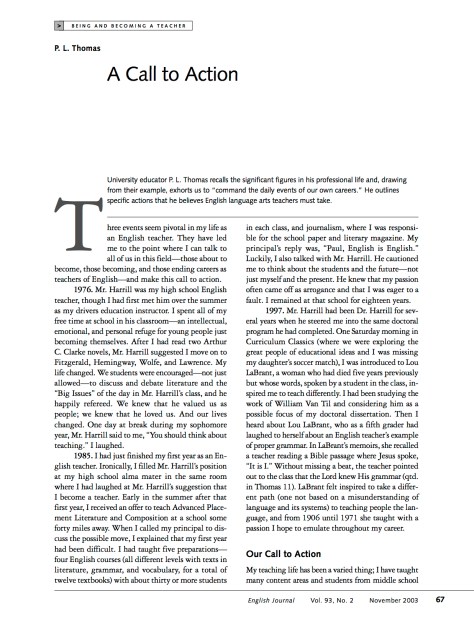
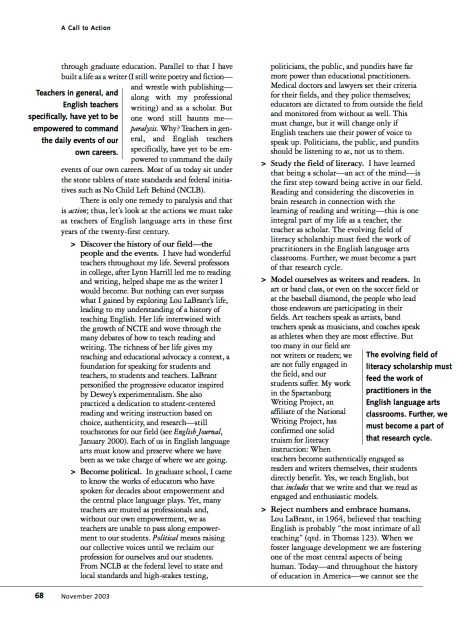
In the November 2003 English Journal (see below), I wrote about Lynn, highlighting how he steered the path of my life, including the initial impact:

1976. Mr. Harrill was my high school English teacher, though I had first met him over the summer as my drivers education instructor. I spent all of my free time at school in his classroom—an intellectual, emotional, and personal refuge for young people just becoming themselves. After I had read two Arthur C. Clarke novels, Mr. Harrill suggested I move on to Fitzgerald, Hemingway, Wolfe, and Lawrence. My life changed. We students were encouraged—not just allowed—to discuss and debate literature and the “Big Issues” of the day in Mr. Harrill’s class, and he happily refereed. We knew that he valued us as people; we knew that he loved us. And our lives changed. One day at break during my sophomore year, Mr. Harrill said to me, “You should think about teaching.” I laughed.

As Motion experienced, I was introduced to who I am by my English teacher, Lynn, who helped me on the course grounded firmly in words—reading voraciously, writing daily, and teaching with and about words.

I am not a poet laureate, but I am a poet and writer—and I am also as a teacher, a person who spends his life creating.

So when I saw the tribute by Motion and then read a comment on my blog about poetry from a parent homeschooling in order to raise children as artists, I was moved to think harder about our obsession in the U.S. with “college and career ready”—an obsession decades-long and really about career, or most factually about using public education to produce workers-as-consumers.

To work and to consume in the service of others.

In Kurt Vonnegut’s masterful satire, Player Piano, Paul Proteus tells his wife Anita:

“No, no. You’ve got something the test and machines will never be able to measure: you’re artistic. That’s one of the tragedies of our times, that no machine has ever been built that can recognize that quality, appreciate it, foster it, sympathize with it.”

And while Vonnegut is taking aim at corporate America, I have noted the novel is also satirizing our reductive approach to learning and knowledge, the blind faith in IQ as a technocratic way to know if someone is ready to become that worker-as-consumer.

We should read Vonnegut carefully, and we should heed his warning.

We should also listen to Motion about how teachers matter, and we should step away from our insistence that the purpose of a human is to become a consumer.

Potentially, we are all creators, artists, and not in some condescending way that suggests frivolity, but in the way that is fully human.

As parents, teachers, coaches, and mentors, to foster creators and not consumers is the greatest gift we can offer another human.

And once again, I sit writing, and thinking, “Thank you, Lynn.”

I work daily to pay this forward on his behalf.

Call 1

Call 2

Call 3

educator, public scholar, poet&writer – academic freedom isn't free