We Can, and We Must

I remembered it had been one of Mother’s pet ideas—she was always voicing it—that in the long run one gets used to anything.

The Stranger, Albert Camus (Trans. Stuart Gilbert)

Pamela Cantor offers her medical perspective to the education reform debate that tends to focus on high-poverty schools disproportionately serving  black and brown children:

The argument that says we can’t fix education until we fix poverty is a false one [1]. We can’t fix poverty or the other adverse events of children’s lives, but we can “fix” the impact of stress on the developing brain. In fact, we have to. We can and must teach schools and teachers how to do this now.

Lurking beneath the good intentions of this charge, however, is the false dichotomy of fatalism that is common among a wide range of education reformers.

For children living in poverty—a stressful and toxic life of unjust scarcity—this “we” has chosen simultaneously to concede that “we” can do nothing about poverty, racism, and inequity, but those impoverished children have been sentenced to both their lives of poverty and then formal education that replicates the stress of the lives (which “we” demand they set aside somehow just by walking through the doors of schools) through mantras of “no excuses,” manufactured lessons in “grit,” and race- and class-biased high-stakes testing that doubles down on stress and anxiety.

The false dichotomy of fatalism has built a world in which privileged adults with the power to tolerate this world or to change this world are afforded excuses (“We can’t fix poverty or the other adverse events of children’s lives”), but powerless and impoverished children are dehumanized with the demand of “no excuses.”

“I have always rejected fatalism,” writes Paulo Freire:

I prefer rebelliousness because it affirms my status as a person who has never given in to the manipulations and strategies designed to reduce the human person to nothing. The recently proclaimed death of history, which symbolizes the death of utopia, of our right to dream, reinforces without doubt the claims that imprison our freedom. This makes the struggle for the restoration of utopia all the more necessary. Educational practice itself, as an experience in humanization, must be impregnated with this ideal.

Meursault in Albert Camus’s The Stranger confesses and embraces human resignation, the fatalism that the world happens to us, that a world in which we are alive or dead is no different, that a world of freedom or prison is simply something “we” get used to.

Margaret Atwood offers a more detailed and darkly disturbing vision in The Handmaid’s Tale and Offred/June, who has been shaped a different woman in her lives before and after the fall of the world “we” know and the brave new world of Gilead.

The world “we” have created is neither existential fiction nor speculative dystopian fiction; the world “we” have created is far more terrible.

“Why exactly was I sad?” asks Ta-Nehisi Coates in Letter to My Son, as he confronts a “failed” guest appearance on a news show:

I came out of the studio and walked for a while. It was a calm December day. Families, believing themselves white, were out on the streets. Infants, raised to be white, were bundled in strollers. And I was sad for these people, much as I was sad for the host and sad for all the people out there watching and reveling in a specious hope. I realized then why I was sad. When the journalist asked me about my body, it was like she was asking me to awaken her from the most gorgeous dream. I have seen that dream all my life. It is perfect houses with nice lawns. It is Memorial Day cookouts, block associations, and driveways. The Dream is tree-houses and the Cub Scouts. And for so long I have wanted to escape into the Dream, to fold my country over my head like a blanket. But this has never been an option because the Dream rests on our backs, the bedding made from our bodies. And knowing this, knowing that the Dream persists by warring with the known world, I was sad for the host, I was sad for all those families, I was sad for my country, but above all, in that moment, I was sad for you.

July 5, 2015, is in too many ways ample evidence not of celebration but disappointment, one grounded in the exact document of declaration that prompts annual flag waving each July in the United States of America.

As “we” rebelled from the British crown, “we” pronounced to “hold these truths to be self-evident, that all men are created equal, that they are endowed by their Creator with certain unalienable Rights, that among these are Life, Liberty and the pursuit of Happiness”—excluding black humans shackled by slavery and those second-class humans, women.

Thomas Jefferson had faced slavery in the original draft of this declaration, but due to the pressure of Southern heritage and the Invisible Hand of the all-mighty market, “we” included only some men, despite the rhetoric otherwise.

More than 100 years passed before the rhetoric of law approached the apparent original intent of declaring independence, but the clock continues to tick as “we” throw up our hands when “we” don’t have them covering our eyes.

Coates above quotes James Baldwin because Coates recognizes in his own life as well as the life of his son that as Baldwin declared:

To be a Negro in this country and to be relatively conscious, is to be in a rage almost all the time. So the first part of the problem is how to control the rage so that it won’t destroy you. Part of the rage is this: it isn’t only what is happening to you, but it’s what’s happening around you all of the time, in the face of the most extraordinary and criminal indifference, the indifference and ignorance of most white people in this country.

“Indifference and ignorance of most white people in this country” is the fatalism “we” embody each time “we” claim nothing can be done about poverty, racism, or inequity—each time “we” ask more of children, the poor, the marginalized and dehumanized than of ourselves.

“We,” I regret, have chosen a resignation and paralysis that benefits the “we” “who believe that they are white,” as Coates channels Baldwin.

Freire believed, however, “we” can transform into we by “reject[ing] fatalism.”

We can, and we must.

[1] While I believe this first comment is a straw man argument (since many are calling for both equity-based reform of society and schools, and this smacks of implying some are using poverty as an excuse), Cantor should consider that Martin Luther King Jr. asserted: “We are likely to find that the problems of housing and education, instead of preceding the elimination of poverty, will themselves be affected if poverty is first abolished.”

What I’m Reading: June/July 2015

Because some of my favorite people have convinced me to share, I will try to post periodically what I’m reading so here is what is on my computer screen and in my hands as my reading life for June/July 2015.

Essay: James Baldwin’s “They Can’t Turn Back” (1960)

Mademoiselle editorial comment:

On February 1, 1960, four students from North Carolina A. & T., a black college in Greensboro, entered the local Woolworth’s department store. After making a few purchases, they sat down at the lunch counter, an area reserved for whites. Told that they could not be served, they remained in their seats until the store closed. More than any other event, the Greensboro sit-in launched the 1960s, a decade of political activism and students were on the cutting edge of social change. In 1960, the writer James Baldwin visited Tallahassee, Florida. to report on student activism there. Baldwin ruminated on the underlying causes of black protests and marveled at the militancy and idealism of the younger generation. To Baldwin, the movement challenged all Americans to rethink whether “We really want to be free” and whether freedom applied to all Americans or only to part of the population.

Short story: Alejandro Zambra‘s “Reading Comprehension: Text No. 1”

ILLUSTRATION BY MATT DORFMAN

This is a brilliant satire of testing and a powerful use of meta-fiction.

Poem: Nikky Finney’s “Dancing with Strom”

black people will forgive you

Powerful, disturbing, and important in the wake of the Charleston shooting at the AME church, this poem confronts and unmasks the racism under the label of “heritage” in South Carolina and the South in the person of Strom Thurmond.

Novel: Cormac McCarthy’s The Crossing

From McCarthy’s official web site:

The Crossing, publicized as the second installment of McCarthy’s Border Trilogy, is the initiation story of Billy Parham and his younger brother Boyd (who are 16 and 14 respectively when the novel opens). The novel, set just before and during World War II, is structured around three round-trip crossings that Billy makes from New Mexico into Mexico. Each trip tests Billy as he must try to salvage something once he fails in his original goal. On both his first and last quest he is reduced (or perhaps exalted) to some symbolic futile gesture in his attempt, against all obstacles, to maintain his integrity and to be true to his moral obligations. This novel explores such issues as guilt, the acquisition of wisdom, heroism, and the crucial importance of stories.

Graphic novel: Mark Millar and Steve McNiven’s Civil War

From Marvel’s description:

The landscape of the Marvel Universe is changing, and it’s time to choose: Whose side are you on? A conflict has been brewing from more than a year, threatening to pit friend against friend, brother against brother — and all it will take is a single misstep to cost thousands their lives and ignite the fuse! As the war claims its first victims, no one is safe as teams, friendships and families begin to fall apart. The crossover that rewrites the rules, Civil War stars Spider-Man, the New Avengers, the Fantastic Four, the X-Men and the entirety of the Marvel pantheon!

globalbike: Two wheels making a world of difference

For several years now, I have been a member of the globalbike Spartanburg chapter team. As pedaling billboards, we represent globalbike, a nonprofit founded and based in Spartanburg, South Carolina that provides bikes to community careworkers, and women and girls organizations in Tanzania, Africa.

July 4, 2015, our chapter team is sponsoring a metric century in part to raise money for the upcoming trip to Africa by globalbike representatives.

Please consider donating and supporting the cause: Two wheels making a world of difference.

From “Remediation” to “No Excuses”: The Indignity of Deficit Thinking

Speaking in Savannah, Georgia, March 21, 1861, in his “Corner Stone” Speech, Alexander H. Stephens, Vice President of the Confederate States of America, carefully enumerated the justification for secession among Southern states.

At length, Stephens addressed slavery: “The new [Confederate] constitution has put at rest, forever, all the agitating questions relating to our peculiar institution African slavery as it exists amongst us the proper status of the negro in our form of civilization.”

That “proper status”—according to Stephens and the declarations of secession by Georgia, Mississippi, South Carolina, Texas, Virginia— was misrepresented in the U.S. Constitution, that “rested upon the assumption of the equality of races. This was an error.”

The Confederacy, instead, embraced “the great truth that the negro is not equal to the white man; that slavery subordination to the superior race is his natural and normal condition.” Stephens chastised the North because “[t]hey assume that the negro is equal, and hence conclude that he is entitled to equal privileges and rights with the white man.”

Stephens called on the triple bedrocks of authority in his statement of the inequality of the races—science, law, and religion:

This, our new government, is the first, in the history of the world, based upon this great physical, philosophical, and moral truth. This truth has been slow in the process of its development, like all other truths in the various departments of science….

With us, all of the white race, however high or low, rich or poor, are equal in the eye of the law. Not so with the negro. Subordination is his place. He, by nature, or by the curse against Canaan, is fitted for that condition which he occupies in our system.

=

While apologists for Southern heritage remain unable or unwilling to confront the blatant racism of the Confederacy, many today remain nearly universal in our inability or unwillingness to recognize and then confront racism, classism, and sexism in the form of deficit thinking.

Deficit thinking, as Stephens represented, is imposing onto groups or individuals deficits as the primary characteristics of their humanity. In education, deficit thinking is pervasive and the foundational mechanism for formal schooling as an institution that reflects and perpetuates bigotry, inequity, and marginalization of people based on status instead of merit.

Some deficit thinking appears nearly harmless because of its common-place use—for example, the term and concept of “remediation.”

Remediation as a normalized deficit concept is at the heart of the third-grade retention movement masquerading as reading policy.

Remediation is built on several flawed assumptions: (i) learning is predictably linear and sequential, (ii) so-called skills such as reading can be accurately quantified (as in “grade level”), and (iii) some “types” of learning (associated with rates and/or biological ages of the students) are lesser than others (basic skills versus higher-order thinking skills, for example).

Remediation also fails a basic point of logic: If remediation is teaching a student something that student doesn’t know, isn’t all teaching remediation?

Remediation, then, is deficit thinking because we must first establish “third grade reading” and then test children in order to label them deficient—and thus the ultimate flaw of grade retention is allowing that seemingly scientific but biased quantifying to represent the entirety of any student.

=

Many key ideologies and practices in the education reform movement, as well, are masks for deficit thinking: culture of poverty, “grit,” the “word gap,” and “no excuses.”

As deficit thinking, all of these are driven by and contribute to unacknowledged racism and classism (often among those claiming to be fighting bias and inequity).

To say “poverty is not an excuse” or that student success depends on “grit” is to “blame the victim” since the focus of these slogans and the educational practices built on them highlight the students as deficient and thus needing to be “fixed.”

The lineage from the bald-faced racism of Stephens to the paternalistic and coded racism/classism of “grit,” “no excuses,” and the “word gap” is deficit thinking.

The racism of the Confederacy did not hide behind code, but more than 150 years later, we are faced with finding the will to decode and debunk the deficit thinking that is just as corrosive to individuals and society as corner-stone speeches.

Remediation, grade retention, lessons in “grit,” “no excuses” charter schools, strategies to end the “word gap”—these all disproportionately target black, brown, and poor children.

Those ideologies and practices, however, do not validate claims of deficient children, but expose a deficit of basic humanity among those in positions to honor the dignity of all children, but instead continue to choose otherwise.

=

About 100 years after Stephens’s racist declaration of secession, author Ralph Ellison concluded in “What These Children Are Like”: “I’m fascinated by this whole question of language.”

“The great body of Negro slang–that unorthodox language–exists,” Ellison explained:

precisely because Negroes need words which will communicate, which will designate the objects, processes, manners and subtleties of their urban experience with the least amount of distortion from the outside. So the problem is, once again, what do we choose and what do we reject of that which the greater society makes available? These kids with whom we’re concerned, these dropouts, are living critics of their environment, of our society and our educational system, and they are quite savage critics of some of their teachers.

Ellison’s lecture to teachers was an extended confrontation of deficit thinking, a powerful refuting of seeing black children and anyone’s language as deficient. His talk ended with a stirring plea:

I don’t know what intelligence is. But this I do know, both from life and from literature: whenever you reduce human life to two plus two equals four, the human element within the human animal says, “I don’t give a damn.” You can work on that basis, but the kids cannot. If you can show me how I can cling to that which is real to me, while teaching me a way into the larger society, then I will not only drop my defenses and my hostility, but I will sing your praises and help you to make the desert bear fruit.

Deficit thinking in its many forms is fruitless for its indignity.

For Further Reading

The Moynihan Report at Fifty, Stephen Steinberg

Letter to the Editor: The Moynihan Report at Fifty, Daniel Geary

The Moynihan Report Is Turning 50. Its Ideas on Black Poverty Were Wrong Then and Are Wrong Now, Daniel Geary

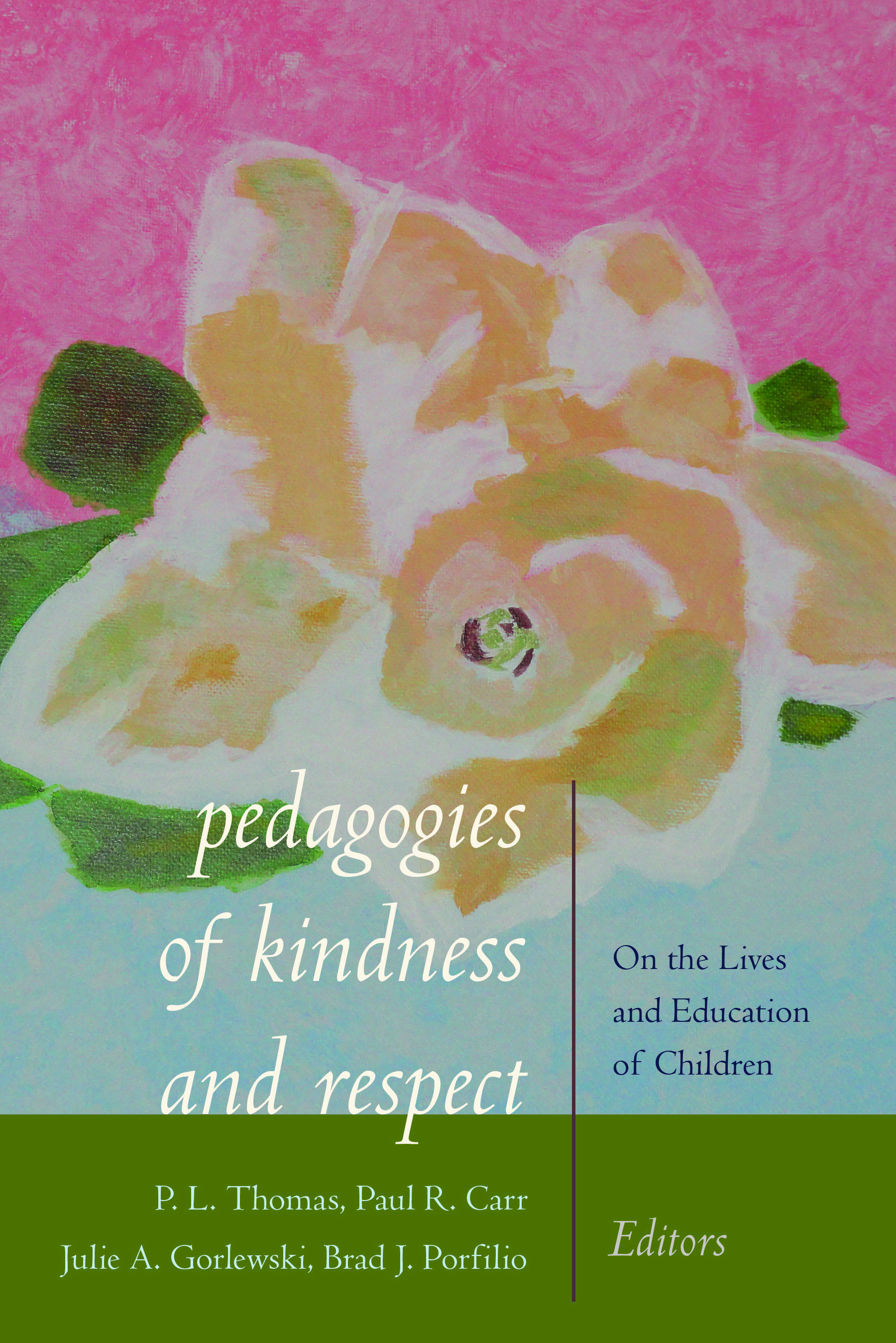
Pedagogies of Kindness and Respect: On the Lives and Education of Children (Peter Lang USA)

Pedagogies of Kindness and Respect: On the Lives and Education of Children (Peter Lang USA)

Thomas, P.L. / Carr, Paul R. / Gorlewski, Julie A. / Porfilio, Brad J. (eds.)

cover

Book synopsis

Pedagogies of Kindness and Respect presents a wide variety of concepts from scholars and practitioners who discuss pedagogies of kindness, an alternative to the «no excuses» ideology now dominating the way that children are raised and educated in the U.S. today. The fields of education, and especially early childhood education, include some histories and perspectives that treat those who are younger with kindness and respect. This book demonstrates an informed awareness of this history and the ways that old and new ideas can counter current conditions that are harmful to both those who are younger and those who are older, while avoiding the reconstitution of the romantic, innocent child who needs to be saved by more advanced adults. Two interpretations of the upbringing of children are investigated and challenged, one suggesting that the poor do not know how to raise their children and thus need help, while the other looks at those who are privileged and therefore know how to nurture their young. These opposing views have been discussed and problematized for more than thirty years. Pedagogies of Kindness and Respect investigates the issue of why this circumstance has continued and even worsened today.

Introducing: Debunked!

Please visit Debunked!—a central location to confront how formal education often reflects and perpetuates racism, classism, and sexism.

Practices and policies specifically addressed include Ruby Payne’s framework of poverty, deficit perspectives, Teach for America, “grit,” “no excuses” practices, and the “word gap.”

What Matters: The Day Is

The challenge is in the moment, the time is always now.

James Baldwin

I.

The day is Friday, 26 June 2015.

My daughter, Jessica, sits in our brown recliner, holding an ice pack on her broken nose with her right hand and cradling her one-year-old daughter, Skylar, in her left arm.

I stand leaning over at the waist in the middle of the living room. Two trickles of bloods run down my left shin from my knee cap. My ring finger and thumb on my right hand are throbbing, jammed, and my left hip is tightening, bruised I am sure. I breathe heavily and am covered in sweat, Jessica asking if I am all right.

No more than ten minutes earlier, Jessica pulls into our driveway with Skylar and her white box-head lab, Sasha. I hurry outside to help her and notice, finally, she has Sasha in a collar and on a leash.

As Jessica leads Sasha to our fenced-in backyard to play with our yellow lab (Sasha’s half-sister), Zoe, I walk around the car to unbuckle Skylar from her car seat.

Just as I have the car seat straps undone and my hands under Skylar’s arms, I look up and notice Jessica is bent over with her face in her hands. Jessica is screaming.

The dogs are both out of the fence, I also notice, before I realize what Jessica is shouting: “I think Zoe broke my nose.”

In the next impossibly long second, I recognize I have three obligations—my granddaughter, my frantic daughter, and two dogs now running away.

These are decisions that are not decisions, moments when the universe demands that we notice what matters.

I carefully lift Skylar out of her car seat and hold her tight in my right arm. I try to call for Zoe and Sasha as I hurry toward Jessica, still leaning over with her face in her hands and screaming.

I put my left arm around Jessica and tell her we are going inside, everything will be fine.

When she looks up at me and moves her hands, there is no blood, and although I can tell something has hit her nose, the injury seems not as bad as I feared.

In our house, I tell Jessica to sit in the recliner, and I grab an ice pack wrapping it in a paper towel for her to hold on her nose. Only a few seconds pass before Jessica tells me she can hold Skylar, to go look for the dogs.

The day is scorching, another during a long June week of 100-degree heat index days. No dogs are in sight.

I call for Zoe and Sasha, whistle, and clap my hands, but our entire neighborhood seems completely deserted.

Sasha, I learn later, has run away just the day before at our house; she is a runner like our family chocolate lab Hershey, who we had to put down along with our black lab within a month of each other in the summer of 2014.

I trot into the road in front of our house, still calling, clapping, and whistling. Then I catch sight of the dogs down through the cul-de-sac, chasing each other behind a neighbor’s house.

I call for Zoe and run.

Zoe turns and sprints toward me, but Sasha remains at the edge of the woods between the neighbor’s house and a larger road outside the neighborhood.

I hurry but avoid running toward Sasha who pauses until I am close, and then she darts away again.

At 54, without thinking, I do something I have only seen on TV, movies, and cartoons; I sprint two or three steps and dive, reaching for the leash dragging behind Sasha.

Scrambling back to my feet, my right shoe twisted and only half way on, I somehow have the leash in my right hand, and immediately begin jogging back to our house with Sasha and coaxing Zoe trailing along. But about halfway there, Sasha twists and pulls out of the collar.

I continue to run and call after them both, noticing a car coming down the road.

The momentum works. Sasha, Zoe, and I run back to our house, and then the dogs tumble through the fence gate as if everything is perfectly fine.

II.

The day is Friday, 26 June 2015.

From the White House, the President of the United States, Barack Obama, addresses the nation about the Supreme Court ruling against states’ banning same-sex marriage:

Progress on this journey often comes in small increments. Sometimes two steps forward, one step back, compelled by the persistent effort of dedicated citizens. And then sometimes there are days like this, when that slow, steady effort is rewarded with justice that arrives like a thunderbolt.

This morning, the Supreme Court recognized that the Constitution guarantees marriage equality. In doing so, they have reaffirmed that all Americans are entitled to the equal protection of the law; that all people should be treated equally, regardless of who they are or who they love.

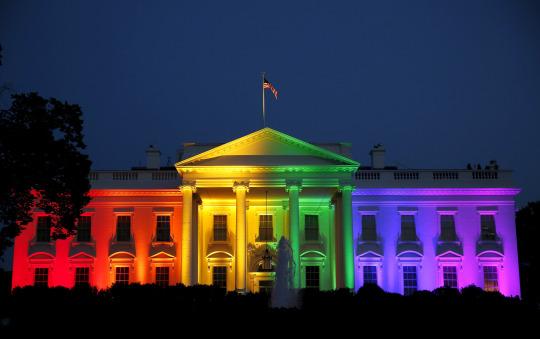
That night, the White House is illuminated with rainbow colors.

In between during mid-afternoon, President Obama speaks in Charleston, South Carolina—at the Emanuel AME Church where only days before nine black people where massacred in a racist act of terrorism. Here, he is behind a pulpit, eulogizing South Carolina state Senator Clementa Pinckney.

“The Bible calls us to hope,” Obama begins, “to persevere and have faith in things not seen.”

About Pinckney, Obama stresses: “No wonder one of his Senate colleagues remembered Senator Pinckney as ‘the most gentle of the 46 of us, the best of the 46 of us.'”

Praising Pinckney builds to Obama’s larger message: “This whole week, I’ve been reflecting on this idea of grace.”

Behind Obama, congregation leaders in purple robes lend an impromptu chorus punctuated by the organist off camera. “Amazing Grace” and “purple mountains majesty” rise beyond the tragedy of the moment and spread across the nation like a rainbow.

III.

The day is today.

Today is.

That is not a question before you.

The question before you is always “What matters?” and then “What will I do?”

Debunking “Heritage Not Hate”: A Reader

Documentarian Ken Burns—noted for his work on the Civil War—explains that the shift in attitudes concerning the Confederate battle flag across the South and the U.S. parallels another watershed moment in the nation, support for gay marriage (I would add the legalization of marijuana is another similar shift).

Many are rightfully concerned that the massacre of the #Charleston9 is being reduced if not trivialized by the political rush to remove the battle flag from state grounds, license plates, and flags, just as some believe the flag debate allows political leaders and the public once again to avoid a real discussion and then action on gun control.

Let us, then, embrace the flag debate as not a symbolic moment, but a symbolic movement—lowering and removing are actions—that both works with and builds on the momentum of those political and public shifts.

Removing the Confederate battle flag from government display, however, is not banning that flag; individuals continue to have the right in the U.S. to flaunt symbolically their beliefs, however misguided or even hateful, regardless of the mechanism—as long as that free speech does not cross a line into denying others their free speech or threaten harm.

Thus, part of that movement must be personal and public education.

And that education must address the “Heritage Not Hate” mantra that has for too long allowed both the Confederate battle flag and the concurrent racism to survive behind slogans without basis in the facts of history.

The Confederate battle flag has not suffered a change in meaning; its meaning has always been corrupt from its original creation within the larger acts of secession and war.

The “heritage” and “state’s rights” claims are cultural lies by omission: The heritage was one of racism and slavery, and the state’s right was to maintain slavery as the primary mechanism of economic power in the South (an economic dynamic that made a very few incredibly wealthy, but also a system of human bondage that benefitted those who didn’t own slaves, rendering nearly all free people complicit during the institution of slavery).

Many have offered the evidence for that personal and public education, and I offer them below as an opportunity for folding “Heritage Not Hate” into the movement that will embrace those willing to say they have also changed their minds and hearts because they are now willing to face the uncomfortable facts that contradict long-held beliefs.

Debunking “Heritage Not Hate”: A Reader

Take Down the Confederate Flag—Now, Ta-Nehisi Coates

Coates 1“Corner Stone” Speech, Alexander H. Stephens,Vice President of the Confederate States of America, Savannah, Georgia, March 21, 1861

What This Cruel War Was Over, Ta-Nehisi Coates

“They Can’t Turn Back,” James Baldwin

signs and symbols Baldwin

The Declaration of Causes of Seceding States (Georgia, Mississippi, South Carolina, Texas, Virginia)

MississippiKen Burns: Flag issue is not about heritage

The “meaning” of the Confederate flag, Bryan Bibb

How people convince themselves that the Confederate flag represents freedom, not slavery, Carlos Lazada

[Quoted from John M. Coski, the historian at the Museum of the Confederacy in Richmond]

raison detreHey white southerners, let’s talk about our Confederate heritage, Matt Comer

How The South Lost The War But Won The Narrative, Tony Horwitz

benign“The face of racism today is not a slaveowner”: Eric Foner on the past and present of white supremacy, Elias Isquith

deplorable

Why do people believe myths about the Confederacy? Because our textbooks and monuments are wrong, James W. Loewen

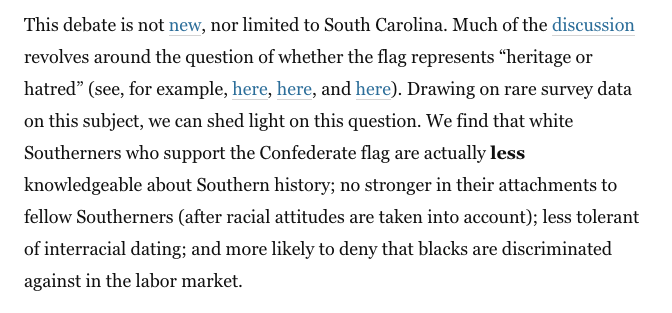
states rightsWhite support for the Confederate flag really is about racism, not Southern heritage, Spencer Piston and Logan Strother

less knowledgableEditorial: Remove Confederate flag this week [Greenville News]

SC slaveryThe South’s Heritage Is So Much More Than a Flag, Patterson Hood

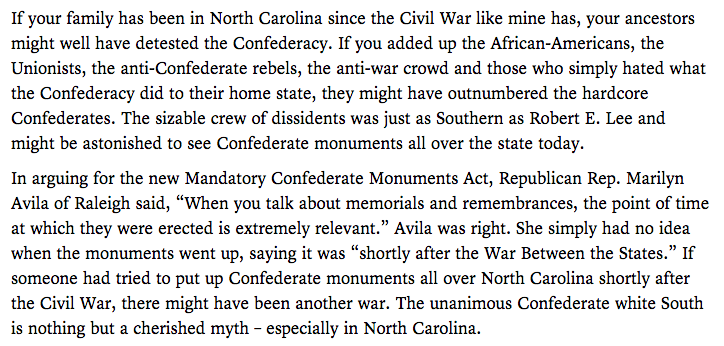
myths and legendsCommemorating North Carolina’s anti-Confederate heritage, too, Timothy B. Tyson

cherished myth

“People know next to nothing about Reconstruction,” Eric Foner

states rights

James Baldwin’s “They Can’t Turn Back” (1960): “On such small signs and symbols does the southern cabala depend”

James Baldwin published “They Can’t Turn Back” in 1960 just as I was about to enter this world.

Baldwin—black, gay and from the North—was witnessing a world from which I—white, straight and from the South—would in many ways be exempt, although it was the same world.

In this essay, Baldwin was charged by Mademoiselle to report on student activism in Florida after the Greensboro (North Carolina) sit-in, which the editors framed, in part, as follows:

More than any other event, the Greensboro sit-in launched the 1960s, a decade of political activism and students were on the cutting edge of social change. In 1960, the writer James Baldwin visited Tallahassee, Florida. to report on student activism there. Baldwin ruminated on the underlying causes of black protests and marveled at the militancy and idealism of the younger generation. To Baldwin, the movement challenged all Americans to rethink whether “We really want to be free” and whether freedom applied to all Americans or only to part of the population.

“I am the only Negro passenger at Tallahassee’s shambles of an airport,” Baldwin begins, as he paints an immediate picture of the tensions between blacks and whites that defined his world: “If she were smiling at me that way I would expect to shake her hand. But if I should put out my hand, panic, bafflement, and horror would then overtake that face, the atmosphere would darken, and danger, even the threat of death, would immediately fill the air.”

In Charleston, South Carolina—about 300 miles away from Greensboro and 55 years later—racial tensions have escalated from “threat” to execution. In the wake of the mass shooting of the #Charleston9 (an eerie and disturbing echo of the Little Rock Nine), the political and public response has focused on the Confederate battle flag on the Capitol grounds in SC as well as in both government and private contexts across the South and U.S.

Time and place, then, do not erase the power of Baldwin’s second paragraph:

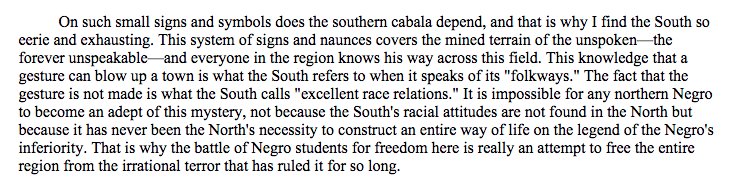
On such small signs and symbols does the southern cabala depend, and that is why I find the South so eerie and exhausting. This system of signs and nuances covers the mined terrain of the unspoken—the forever unspeakable—and everyone in the region knows his way across this field. This knowledge that a gesture can blow up a town is what the South refers to when it speaks of its “folkways.” The fact that the gesture is not made is what the South calls “excellent race relations.” It is impossible for any northern Negro to become an adept of this mystery, not because the South’s racial attitudes are not found in the North but because it has never been the North’s necessity to construct an entire way of life on the legend of the Negro’s inferiority. That is why the battle of Negro students for freedom here is really an attempt to free the entire region from the irrational terror that has ruled it for so long.

“They Can’t Turn Back”

The South Baldwin describes was cracking under the weight of “separate but equal” as that myth crashed into a rising refrain of civil rights. As Baldwin notes, “the viewpoint of the white majority” dictated the narratives about and for blacks—and whites.

Today, as the South and the nation wrestles with symbolism—a flag—we also confront a tarnished and enduring myth-turned-slogan, “Heritage Not Hate,” as Tony Horwitz explains:

Some of those who invoke the “heritage, not hate” mantra are disingenuous. On the day of the shooting, I was in rural east Texas, touring a small town with a businessman who displayed the rebel flag on his truck. After telling me “it’s heritage, not hate,” he proceeded to refer to a black neighborhood as “Niggertown” and rant against the Martin Luther King, Jr. holiday.

Most flag defenders, however, are sincere when they say they cherish the banner as a symbol of their ancestors’ valor. About 20 percent of white Southern males of military age died in the Civil War. In South Carolina the toll was even higher, and thousands more were left maimed, their farms and homes in ruins. For many descendants of Southern soldiers, the rebel flag recalls that sacrifice, and taking it down dishonors those who fought under the banner. No one wants to be asked to spit on their ancestors’ graves….

But a deeper problem remains, and not just among those who cherish the Confederacy. Nationwide, Americans still cling to a deeply sanitized and Southern-fried understanding of the Civil War. More often than not, when I talk to people about the conflict, I hear that it was about abstract principles like “state sovereignty” and “the Southern way of life.” Surveys confirm this. In 2011, at the start of the war’s sesquicentennial, the Pew Research Center asked more than 1500 Americans their view as to “the main cause of the Civil War.” Only 38 percent said the main cause was slavery, compared to 48 percent who answered states’ rights.


For Baldwin in the turbulent cusp of the 1950s/1960s at Florida Agricultural and Mechanical University:

The South is very beautiful but its beauty makes one sad because the lives that people live, and have lived here, are so ugly that now they cannot even speak to one another. It does not demand much reflection to be appalled at the inevitable state of mind achieved by people who dare not speak freely about those things which most disturb them….

It is very nearly impossible, after all, to become an educated person in a country so distrustful of the independent mind. The fact that F.A.M.U. is a Negro university merely serves to demonstrate this American principle more clearly: and the pressure now being placed on the Negro administration and faculty by the white Florida State Board of Control further hampers the university’s effectiveness as a training ground for future citizens. In fact, if the Florida State Board of Control has its way, Florida will no longer produce citizens, only black and white sheep. I do not think or, more accurately, I refuse to think that it will have its way but, at the moment, all that prevents this are the sorely menaced students and a handful of even more sorely menaced teachers and preachers.

“They Can’t Turn Back”

Our contemporary world remains too often silent, just as our institutions of education continue to be in the service of the status quo—failing more often than not the very students most in need of public and higher education. Just as Baldwin’s recognition of the power of symbolism in the South speaks to today, his words strike also at the heart of the return of segregated and inequitable schooling across the entire U.S.:

For the segregated school system in the South has always been used by the southern states as a means of controlling Negroes. When one considers the lengths to which the South has gone to prevent the Negro from ever becoming, or even feeling like, an equal, it is clear that the southern states could not have used schools in any other way.

In his role as witness, Baldwin details his own journey among black leaders and students in Florida, and one student leads him to note:

But this [the historical perspective] does not, and cannot exist, either privately or publicly, in a country that has told itself so many lies about its history, that, in sober fact, has yet to excavate its history from the rubble of romance. Nowhere is this clearer than in the South today, for if the tissue of myths that has for so long been propagated as southern history had any actual validity, the white people of the South would be far less tormented people and the present generation of Negro students could never have been produced.

“They Can’t Turn Back”

For SC and the U.S., pulling down a flag is not an act of erasing history, but a moment, a momentum for facing a history long masked behind the veneer of whitewashing.

Baldwin’s time spent with student protestors in Florida spurred in him angst—an angst not unlike those who fear now that the flag removal will be but a passing symbolic act with little real change to follow: “And all this, I think to myself, will only be a page in history. I cannot help wondering what kind of page it will be, whether we are hourly, in this country now, recording our salvation or our doom,” Baldwin muses.

However, Baldwin’s closing words suggest hope, a hope embodied in young blacks then who were in a different world than the one into which Baldwin was born. And Baldwin believed in the promise of young black activism grounded in a bold recognition of the real history of race in the U.S.:

They [black student activists] cannot be diverted. It seems to me that they are the only people in this country now who really believe in freedom. Insofar as they can make it real for themselves, they will make it real for all of us. The question with which they present the nation is whether or not we really want to be free. It is because these students remain so closely related to their past that they are able to face with such authority a population ignorant of its history and enslaved by a myth. And by this population I do not mean merely the unhappy people who make up the southern mobs. I have in mind nearly all Americans.

These students prove unmistakably what most people in this country have yet to discover: that time is real.

“They Can’t Turn Back”

Hope and angst are with us in the wake of the mass shooting in Charleston, in the wake of political leaders who defended the Confederate flag on one Friday (and for years) only to reverse course after a weekend (and likely some motivation from the very CEOs politicians had invoked as evidence the flag was not a real issue), in the vacuum of the national refusal to confront the violent gun culture that arms the racism we are begrudgingly admitting.

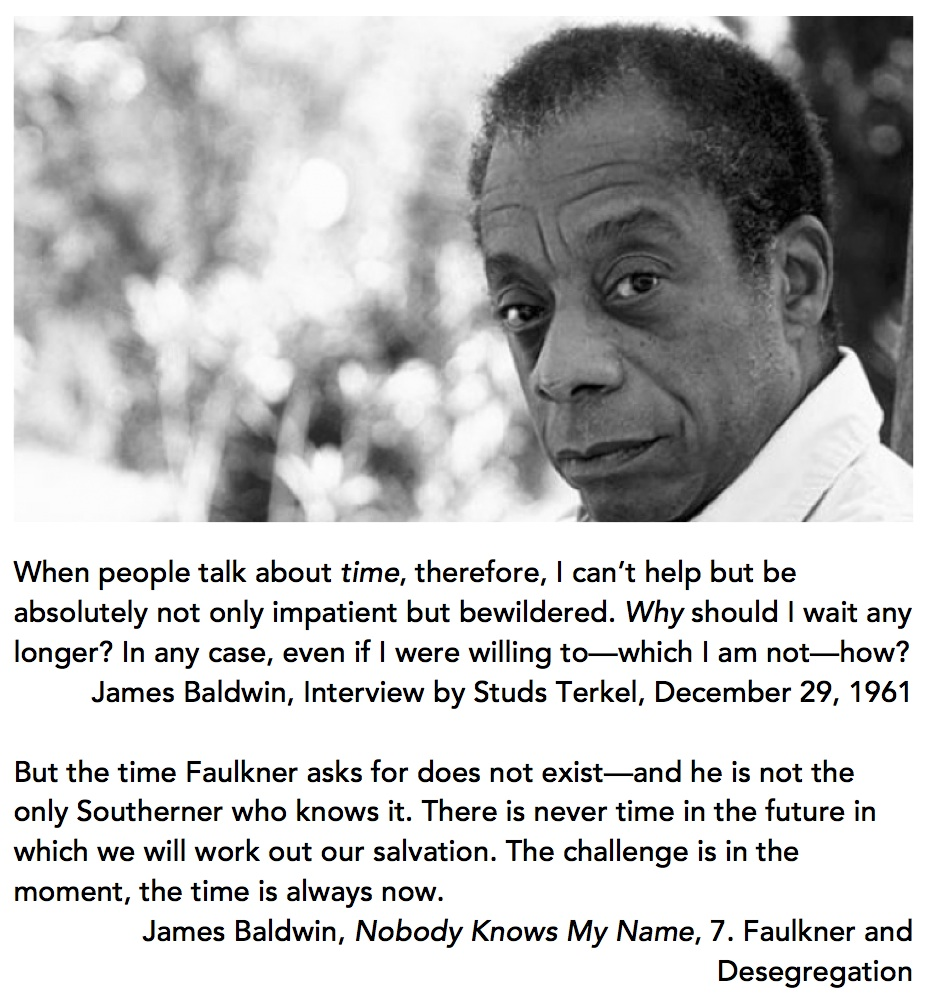
In Baldwin’s refuting of William Faulkner—white calls for patience from blacks—we have more evidence of the relevance of Baldwin in a time of racial unrest:

But the time Faulkner asks for does not exist—and he is not the only Southerner who knows is. There is never time in the future in which we will work out our salvation. The challenge is in the moment, the time is always now.

“Faulkner and Desegregation,” Nobody Knows My Name

educator, public scholar, poet&writer – academic freedom isn't free