
On Southern Heritage and Pride

I’m Nobody! Who are you?

Emily Dickinson

For Skylar and Jessica

When writing about my redneck past—born, raised, and now having lived my entire life in the upstate of South Carolina—I reached back to my grandparents and parents as a way to give context to who I am and how I “got to be this way.”

In the waning days of June 2015, in the sort of near-100-degree heat we tend to suffer in July and August, SC has been exposed to the rest of the U.S. and world in a way that is hard for me as a Southerner to face: nine innocent souls slaughtered in a racist rage.

While the domestic terrorist responsible for this logical consequence of a people hopelessly clutching a culture of violence in the form of the right to bear arms and willfully blind to the lingering racism that stains our refrain of “life, liberty, and the pursuits of happiness” sought to start a race war, instead a state and national conversation has begun about the embarrassment that is Southern Heritage, raised like a petulant bully’s middle-finger on the grounds of SC’s Capitol.

I have never felt pride about being a South Carolinian, a Southerner, or an American—these are all mere coincidences of my birth.

It makes no real sense to me, this personalizing geography and then mangling history and ideology in order to create barriers among people.

As a high school teacher in SC for nearly two decades, my students often bristled at my confronting them about the flag fetish among many white students, mostly males.

As a life-long witness to Southern Heritage, I have come to recognize that we are not unique but representative in the South of the worst aspects of patriotism, nationalism, and jingoism—making a commitment to a false narrative to preserve an ideology that ultimately is self-defeating and dehumanizing.

Those most fervent about Southern Heritage and fundamentalist faith in the South have something important in common: an incomplete at best and missing at worst understanding of either the history of the South (and the Confederacy) or the Bible.

There is a selectivity to calling on history and scripture that exposes the real commitments of the fervent: holding onto a world that insures other people remain inferior.

“Heritage Not Hate” is propaganda, and as Aldous Huxley notes: The propagandist’s purpose is to make one set of people forget that certain other sets of people are human.”

It is the cruelest sort of irony that Southern Heritage advocates misrepresent history as many fundamentalists misrepresent Christianity because those false narratives seek to dehumanize and divide.

Yes, my family and community shaped who I am and how I “got to be this way.” And I am certain the South and SC have played roles in that story of me as well.

But I have no specific idea if any of my ancestors participated in any way in the Civil War or slavery; I must imagine that those ancestors in the South during those eras were like most people—in most ways directly or indirectly complicit in horrible human acts.

I must imagine that because we are directly and indirectly complicit now in horrible human acts—some so large and pervasive that most cannot see them (our consumer culture that includes the wealth of the few on the labor of the discardable many).

I have no desire to contort reality around my ancestors or the history of the region I happen to be born in as a act of somehow justifying my own value as a person.

Southern Heritage and Pride are abstractions that allow a callous disregard for the very real world around us—a world that is unnecessarily violent of our own making, a world that is horribly inequitable of our own making, and a world trapped in the labels of “heritage” and “Christian” but unwilling to learn from history or act on “Love your neighbor as yourself.”

I simply cannot embrace a past that reveals all the ways we have failed each other.

It seems instead that today and every “today” we are called to imagine how the world can be better and then do something to make that happen.

I am grateful in many ways for the life my grandparents and parents afforded me, but my life has also included making choices to set aside many things that redneck past inculcated in me, things that do not fill me with pride, but shame.

The enduring possibilities of human dignity have been my guideposts that I found in literature (not garbled and romanticized history or cherry-picked bible verses): William Faulkner and Flannery O’Connor, Ralph Ellison and Alice Walker, Langston Hughes and e.e. cummings, Margaret Atwood and Haruki Murakami, Milan Kundera and Adrienne Rich.

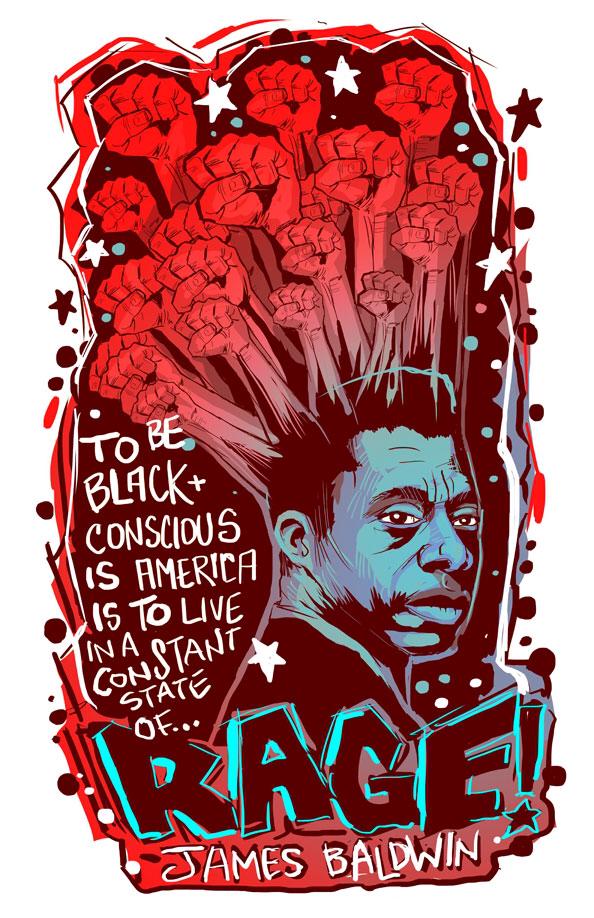
But the moral barometers who ultimately saved me remain the voices I hear daily: Kurt Vonnegut and James Baldwin.

Vonnegut writes through Eliot Rosewater from God Bless You, Mr. Rosewater:

“Go over to her shack, I guess. Sprinkles some water on the babies, say, ‘Hello, babies. Welcome to Earth. It’s hot in the summer and cold in the winter. It’s round and wet and crowded. At the outside, babies, you’ve got about a hundred years here. There’s only one rule that I know of, babies—:

“‘God damn it, you’ve got to be kind.’”

Baldwin confesses in “They Can’t Turn Back”:

It took many years of vomiting up all the filth I’d been taught about myself, and half-believed, before I was able to walk on the earth as though I had a right to be here.

I feel no pride in being a South Carolinian, a Southern or an American; I did not choose any of that geography.

But when I read Vonnegut and Baldwin, I am proud to be a fellow human and I feel a sudden rush of hope found in the pages of literature—as author Neil Gaiman recognizes:

You’re also finding out something as you read vitally important for making your way in the world. And it’s this:

The world doesn’t have to be like this. Things can be different.

And this is my confession: While white parents gave me life, black authors saved my life.

I have debts to pay, and I must pay them forward—things I cannot do clutching a past that has failed us all.
“Objectivity,” “Both Sides” as Code for White Bias in Mainstream Media

A couple of years or more were consumed by my research, writing, and then related public work on school choice, anchored by my book Parental Choice?

The topic of school choice made me aware of the significant gap in credibility along support for and concerns about parental choice as a mechanism for spurring education reform: advocates of choice tend to be from outside the field of education while many who challenge school choice are educators or educational researchers and scholars.

On several occasions, I was invited to debate school choice, but I refused because the pro-choice representative was always someone without real credibility. My position was that to commit to a forum based on pro versus con immediately gave legitimacy to a side that was not, in fact, credible.

Many years before this problem was skewered by John Oliver, I was invoking the Oliver Rule.

The circumstances of debating school choice, I believe, raise issues of credible agents of positions, but school choice is itself a legitimate topic of debate—although the evidence is pretty well tilted against the effectiveness of choice as a reform mechanism.

More recently, I have made strong public statements against corporal punishment, putting me in a slightly different context: physical punishment of children, based on a comprehensive body of research, is not a debatable topic.

And while I did agree to speak on a panel of advocates for and against corporal punishment, I am deeply concerned about venturing into a debate when allowing debate lends credibility to both positions (as opposed to the agent of the position).

As Oliver lampooned, the mainstream media is complicit in both lending credibility to people who have little or no credibility and allowing “both sides” of an issue to be viewed as having equal moral weight and/or equal validity in terms of research or evidence.

I have, then, more often than I would prefer to examine called for a critical free press—one that makes the distinctions about who is credible and what positions are credible.

In the wake of the racist massacre of nine blacks peacefully assembled in their church, the mainstream media have once again revealed themselves to be incapable of any sort of critical awareness of either the issues they cover or themselves, notably the white/privileged bias of objective journalism.

In Room for Debate (The New York Times), which also regularly fields debates on education among people with little or no credibility in the field of education, Does the Confederate Flag Breed Racism? frames the flag issue in SC as having two credible sides—which it doesn’t.

Simply presenting a topic in a civil format with smiling well-dressed advocates for their causes is a corrosive mismanagement of both journalism and human decency.

But more offensive still was the Meet the Press segment from 21 June 2015, featuring David Brooks as a spokesperson on moral character.

As if that isn’t offensive enough, the segment included an extended clip of only black criminals talking about gun violence:

‘Meet The Press’ panelist and Washington Post columnist Eugene Robinson pointed out the apparent disconnect.

“I thought that was a very powerful piece,” he said. “One small thing I would mention, because I haven’t seen the whole piece, is there wasn’t a terribly diverse set of people who were talking. Right now, we’re talking about a horrific crime committed by a white man. We’re talking about the search for two escaped murderers who are white men. So, we should point out that this is not just an African-American problem.”

Todd responded that “it wasn’t intended to be that way.”

At the root of both the NYT and MTP being complicit in perpetuating racism is the journalistic standard of the objective pose, the mostly adolescent view of the world that insists on airing “both sides” of an issue.

However, there is nothing neutral about framing a question when no question remains, and there is nothing objective about calling for the audience to set aside race (Todd made an equally tone-deaf attempt to suggest the gun violence segment can be viewed as only about gun violence, arguing the racialized facts of the clip were not meant to “cloud the discussion of the topic”).

The mainstream media in the U.S.—like partisan politics—exists in a moral vacuum of market ethics.

Without a critical free press, we are left with well-spoken (written) and clean-cut talking heads who are in the service of the highest bidder—our puppet media and puppet politicians.

In 1946, George Orwell lamented: “In our time, political speech and writing are largely the defence of the indefensible.”

So it goes.

Dear White Folk Who Say You “Don’t See Race”

Dear White Folk Who Say You “Don’t See Race”:

I am a white male, and when you see me, you should immediately notice both—because the parts of who I am are ultimately the whole.

To say to someone you don’t see race (or gender), you are in effect refusing to see the person, you are dehumanizing the person as somehow not worthy of being fully seen.

But there are also a few points of logic that make “I don’t see race” truly offensive.

First, the only reason to make the effort not to see race is the implication that once you see race you have racist or bigoted thoughts or actions connected to race.

Second, to consciously not see race (which is an odd concept to begin with since eyesight doesn’t allow us to filter) or to make a false claim of not seeing race also simultaneously prohibits you from seeing racism.

“I don’t see race” is admitting “I refuse to acknowledge racism”—and denying racism has a real evidence problem.

Those who claim “I don’t see race,” then, are likely either racists who are fronting (consciously or unconsciously) or people who consider themselves “good people” but by taking a so-called neutral stance are actually supporting the status quo of racism in the U.S.

Humans have recognizable nuances and differences, and it is ours to denounce equating surface differences as signals of deficits or stereotypes.

We cannot see each other as fully human by refusing to see any of our parts, including the social construction of race that we associate with how we look.

For those of us—especially those of who are white—committed to racial equity in the U.S., we must resist “I don’t see race” and instead seek for ourselves and others: “I see human dignity in all races.”

SC’s Market Ethics and Moral Vacuum

Charleston, South Carolina in just a few months has forced the state and the nation to witness the racial injustice of law enforcement and the horror of violent racism, but these incidences that reflect a larger culture of violence and racism in the U.S. have spurred media and political insult in the form of denial.

The Wall Street Journal, as examined by Scott Eric Kaufman, declared an end to systemic racism:

“The universal condemnation of the murders at the Emanuel AME Church” demonstrates that — Walter Scott notwithstanding — “the system and philosophy of institutionalized racism identified by Dr. King [in his response to the Birmingham bombing] no longer exists.”

And SC governor Nikki Haley continued her refrain reaching back to her campaign mantras:

“What I can tell you is over the last three and a half years, I spent a lot of my days on the phones with CEOs and recruiting jobs to this state,” Haley said. “I can honestly say I have not had one conversation with a single CEO about the Confederate flag.”

Conceding that South Carolina had suffered an image problem in the past, Haley asserted that the state had moved beyond those days.

The mainstream media and elected officials reflect that—despite claims of the U.S. being a Christian nation and the South being the Bible Belt—responses to the racist massacre at the AME church in Charleston exposes we are a people existing in a moral vacuum, we are a people shackled to market ethics.

Governor Haley believes that CEOs outside of SC have the power to determine for the people of the state what is or isn’t offensive. Her comment is a stark testament to her political commitments—but Haley is also a typical if not universal embodiment of politics-as-market-ethics.

And the media share poll after poll—a sort of perverse popularized market-democracy—as well as measured debates of “both sides” to entrench further that those sides have equal moral weight.

Moral imperatives are above market forces, above democratic mechanisms, above debate.

The market and even democracy remained, at best, often silent during all sorts of assaults on human dignity; U.S. slavery, women’s equality, civil rights, marriage equality—all of these existed with the market and popular opinion in support of (and often depending on) denying fellow humans their humanity.

Moral imperatives require leaders with integrity, open eyes, open ears, and open minds for human dignity.

Many people have lamented that after the mass shooting of children at Sandy Hook Elementary, we failed to let go of the death-grip on our sacred guns. And many have gone further to admit that the mass shooting of nine blacks in church is doomed to the same failure to see, to confront, and to act.

These are not cynical responses to horrors; these are admissions of our moral vacuum.

Just as the racist murderer of people gathered in their place of worship is not some isolated incident, the WSJ and Haley are not isolated examples of tone-deaf media and politicians.

The WSJ and Haley are who we are.

The market has spoken.

“To Dismantle Systems of Violence”

The geographical coincidence of my birth often leaves me disappointed and embarrassed—mortified.

I am a son of the South, more specifically South Carolina. And while my birthplace and current home are in the Upstate and nearly as far from Charleston, SC, as one can be and remain in the state, the massacre, the racist terrorism now known as #AMEShooting left me yesterday certain that words were destined to be inadequate.

So when I read Sally Kohn on Twitter, I was compelled to respond:

While tone-deaf and insincere political rhetoric neither starts nor ends with Nikki Haley, Mark Sanford, or Lindsey Graham in SC or across the U.S., there is a certain inexcusable arrogant nastiness I hear when these so-called leaders speak.

Why? Because I am from here, and as a white male Southerner, I know what white people say when only white people are around, what men say when only men are around, what straight people say when only straight people are around.

I have done it. I bear witness to it daily.

I live among the Bible thumping “heritage is not hate” crowd that knows next to nothing about either religious charity or the scarred history to which they cling like a decaying corpse.

I have also witnessed a nation morn heinous violence followed by President Obama making a plea for “all our children”—only to witness also how nothing changed because the real American value is not being a Christian nation or protecting the land of the free but a commitment to unadulterated violence and hatred symbolized by the insult to human decency known as the right to bear arms.

As I was wrestling with the futility of words, I read Nicole Nguyen’s Education Scholars: Challenging Racial Injustice Begins With Us, in which she offers a powerful challenge:

As public transit riders shuffled on and off the train, I began to understand that we cannot solve complex social problems like institutional racism within the prototypical ivory tower as armchair critics. Our scholarship cannot merely inform our own ideas and advance our own careers. If we are to train future teachers, principals, and education researchers, we must recognize how schools perpetuate and disrupt systems of inequality, nourish the critical consciousness of our students, model antiracist and decolonizing pedagogies, and build the tool kits necessary for creating more-democratic schools.

If we are to counter the oppressive systems of inequality that brutalize youths, we cannot do it alone. We must marshal the intellect of all those who board the train, young people in particular. We do not need university solutions to public problems.

Nguyen’s words should be read in full, but she concludes with a clear “mission of colleges of education: to serve as political allies of the young people in our communities to dismantle systems of violence.”

I humbly add this is the mission of every denizen of a place called “free,” called “just.”

I also read Ta-Nehisi Coates’s Take Down the Confederate Flag—Now, pausing at his “Cowardice, too, is heritage.”

Violence through the barrel of a gun, violence spat in a racial slur, violence flapping in the breeze on statehouse grounds—these are all cowardice.

As is the paralysis that follows that violence each time.

Because not taking action seems to be a heritage that unites every region of this country.

Baldwin

English Journal — Call for Manuscripts: Submission Deadline: March 15, 2016

English Journal — Call for Manuscripts

Visible Teaching: Open Doors as Resistance
Editors: Julie Gorlewski, David Gorlewski, P. L. Thomas, and Sean P. Connors
Submission Deadline: March 15, 2016
Publication Date: November 2016

Under pressure to adhere to a scripted curriculum or to conform to standardized instructional practices, educators might choose to adhere to a popular adage that recommends that they “close the door and teach,” presumably as an act of resistance. This advice is problematic, however, because it denies the agency of teachers, as professionals, to effect change in their schools. It willfully conceals alternative instructional practices that might otherwise benefit students, and it ignores the role that shared knowledge can play in sustaining a community.

Alternatively, teaching with our doors open establishes agency where the system has denied it; offers direct alternatives to the practices we reject, especially those that are not supported by the evidence of our field; and models for students how professionals behave.

This issue of English Journal explores how a decision to “teach with our doors open” can be interpreted as a form of empowerment and an act of resistance. It acknowledges teachers as agentive, and aims to understand how making one’s practices visible to others can disrupt standardizing forces and disciplinary mechanisms that are intended to promote conformity and compliance.

Contributors might consider questions such as: What conditions prompt teachers to teach behind closed doors, and how can they productively be addressed? How do you negotiate space to teach with your door open, and what advice would you offer others interested in doing so? How have you engaged with colleagues who respond differently to mandated and prescribed practices that you feel are not valid or effective? If you have experienced a transformative moment—moving from teaching with your door closed to teaching with your door open—how did that look and what advice can you offer those interested in making the same transition? How can teachers work with school leaders to create a school culture that values the open exchange of ideas and embraces evidence-based practices that push against mandates? We welcome educators to share experiences that investigate this important topic in the context of scholarly literature.

We invite manuscripts of 2,500-3,750 words, written to an audience of educators in grades 7-12 English classrooms.

More on Solidarity: “Speak to Shared Goals,” Not “Speak with One Voice”

Responding to my musing about the lack of solidarity among new media resistance to education reform, Sherri Spelic cautioned:

Solidarity, yes. However, in movements in which the aim is to “speak with one voice” whose voices are most likely to be quieted or softened or pushed to the edges? I fear it is often women’s voices which are sacrificed more often than not.

Certainly the number of voices in the ed reform push back camp is growing and we have to realize that new readers, writers, lurkers are finding their way into social media daily. The edu blogosphere is expanding as educators attempt to keep up with what appears to be a runaway train. They are told they must blog and pin and tweet in order to call themselves “connected.” And that’s when folks who were here earliest and built those initial cults of edu personalities began to talk about how shallow and repetitive twitter was becoming and asking whether they shouldn’t move on….

We can add to the solidarity not by limiting our use of voice but by lending it where it may be needed: to uplift one or more of our colleagues in need, in support of the policies and movements which align with our common cause.

My initial response was appreciation for the ideal and thoughtful framing, and then, because of Spelic’s challenge, I was pushed to think better about what I was asking, to state better what I envision.

Solidarity, for me, does not require speaking with one voice, but speaking to shared goals.

Here, then, possibly to continue the conversation, I want to explore what those shared goals may be, keeping in mind we need them to be clear, attainable, and few:

  • Seeking an end to one (preferred) educational experience for privileged children and another (worse) educational experience for “other people’s children.”
  • Seeking a greater appreciation and realization of teaching as an autonomous profession.
  • Confronting and ending inequitable punitive policies (academic and disciplinary) for marginalized populations of students along race, class, gender, and other status categories (English language learners, special needs students).
  • Ending high-stakes accountability focusing on outcomes and implementing a structure that addresses equity of opportunity metrics.
  • Calling for social reform that guarantees for all children that the coincidence of birth is not the dominant factor in their opportunities in life and education.

Among educators, researchers, political leaders, and the public, we will likely disagree about how to achieve these goals—that disagreement is likely important, in fact—but I believe we can and should be in solidarity for achieving these goals.

Divided, Conquered: “Everybody blogs. Nobody reads.”

In her 14 June 2015 email update about her blog, Susan Ohanian offered an opening statement:

When I started this website of resistance 13 years ago, I posted a lot of outrage, outrage I tried to buttress with research. Of late, I’ve cut way back because I feel there’s far too much jabber filling the air–too much rage and not enough explanation. Everybody blogs. Nobody reads. I figure whatever I might say just gets lost in the cacophony so I’ve turned my efforts elsewhere. Right now I’m working on a big project that I hope will startle you with originality. At the very least, it won’t be part of the chorus.  

I’m not abandoning the site–just cutting back on its size.

Well before the education reform debate blossomed on social media, Ohanian was dissecting and challenging the most recent cycle of high-stakes accountability—from the perspective of a classroom teacher.

I very much feel compassion for Ohanian’s concerns, having begun writing against accountability and specifically high-stakes testing in the 1990s, also as a classroom teacher. Once I moved to higher education in 2002, my access to public work was significantly expanded so my public commentaries reach back about as long as Ohanian’s (although my move to blogging is about half that span).

The powerful refrain—”Everybody blogs. Nobody reads”—resonates, I think, because it touches on how social media has in many ways had the opposite effect than its great promise: Instead of building solidarity, blogging, Facebook, Twitter, and all the rest have allowed factions to develop and has reduced much of the vibrant and important discourse to be subsumed by the great failure of social media—the cult of personality.

The online world of public debate about education and education reform has included the ugliest part of social media—anonymous vitriol—but it has also, for me, created a much more troubling dynamic. On more than one occasion, I have been refuted and attacked (based on false assumptions) by those with whom I share solidarity.

It is all too easy, then, for those of us who share the same mission to turn on each other while those who are running the education reform machine sit by mostly untouched.

In fact, that is what the minority in power thrive on—divide and conquer.

Part of my advocacy includes making a case for the importance of workers so I often ask people to consider if all service workers in the U.S. (mostly poorly paid and many part-time without benefits including the horribly under-paid wait staff) simply did not work tomorrow, how would that compare in impact to if all the CEOs did not go to work tomorrow?

And how does that impact expose real value to society versus how we compensate work in the U.S.?

One wait staff compared to one billionaire is a tale of supreme inequity.

Without solidarity, without a moral grounding among those who still may disagree, each of us is ripe for the sort of resignation that happens in isolation and powerlessness.

Each time I post on Common Core and the views increase and then I post on race and the views drop, I contemplate simply walking away from trying to make a difference.

The reason I have shifted from traditional scholarship and toward public work stems from the echo chamber that is scholarship where, to paraphrase Ohanian, everybody publishes, but nobody reads.

Social justice and educational equity are, simply put, the defining goals of a free people, and it seems these are the anchors for a solidarity that could bring about change.

Partisan politics, the cult of personality, building a brand, blogging and not reading/talking but not listening—these, however, are the antidotes to solidarity, and the fuel of the status quo of inequity that poisons our society and our schools.

Without solidarity, each of us is destined to resignation, failing to hold hands and realize our collective power against the few who can afford simply to wait us out.

We are a people, I fear, tragically trapped in individual ownership and competition, denying the essential communal nature of being fully human.

Dedicating the self to the public good is the ultimate act of selfishness. Solidarity is not, then, self-sacrifice, but self-preservation.

We have passion (Ohanian’s “rage”) and we have explanations, but we are doomed by a poverty of solidarity in our pursuit of social and educational equity.

Dueling Frying Pans: O, Arkansas

As are many states, Arkansas is trapped in a silly but expensive game of dueling frying pans: PARCC or ACT?

Political leaders and the public appear unable to understanding the bitter lessons of chasing better tests.

So, let’s consider this: Everything you need to know about the world (and frying pans) can be learned on Saturday morning cartoons—as Cyril from Break Away explains:

Cyril: You know what I’d like to be? A cartoon of some kind. You know, like when they get hit in the head with a frying pan or something, and their head looks like the frying pan, with the handle and everything? They they just go *booiing*

[shakes head]

Cyril: and their head comes back to normal? Wouldn’t that be great?

Mike: How’d you get to be so stupid, Cyril?

Cyril: I don’t know… I guess I just have a dumb heredity. What’s your excuse, Michael?

Of course, Tom and Jerry provides the ultimate visual:

And so we are left with a truly disturbing soundtrack to the standards and high-stakes testing Merry-Go-Round:

educator, public scholar, poet&writer – academic freedom isn't free