
Recommended: Reaching and Teaching Students in Poverty, Paul C. Gorski

The propagandist’s purpose is to make one set of people forget that certain other sets of people are human.”

Aldous Huxley, The Olive Tree (1936)

While working on a piece for The Conversation US rejecting the increased focus on teaching struggling students (mostly poor, black, Latino/a, special needs students as well as English language learners) “grit,” I came across yet another report on poor students disproportionately being assigned to inexperienced and un-/under-certified teachers (including Teach for America candidates) and the inequitable as well as negative consequences of underfunded and poorly maintained school facilities.

Children in the U.S. are increasingly the victims of inequitable social, economic, and educational circumstances not of their making, and mostly ignored by those with power in the country.

Too few educators and academics, I think, are enraged about that inequity; too few are moved to action even if they are enraged.

And that is a large part of the reason I was drawn to the work of Paul Gorski several years ago as I began to compile the growing counter-arguments against the popular but deeply flawed poverty “framework” and concurrent book and workshop being sold by Ruby Payne [1] to schools across the U.S.

Gorski is passionate, measured, and informed about race, class, and gender inequity; he is also a dedicated soldier in taking action against that inequity.

Associate professor at George Mason University and founder of EdChange, an organization dedicated to social justice and educational equity, Gorski has written an incredibly accessible, powerful, and relatively brief alternative to the many careless “culture of poverty” books, workshops, and programs: Reaching and Teaching Students in Poverty: Strategies for Erasing the Opportunity Gap (Teachers College Press, 2013).

As an educator and academic with a working-class background rooted in rural poverty, I recognize in Gorski a shared journey that informs out world-view as well as our belief in advocacy.

Gorski offers several stories of his own working-class and impoverished family while he seeks always to offer readers a compassionate, compelling, and practical journey that asks each of us to confront our biases in order “to take a stand when one of our students is being shortchanged—not standing in front of or standing in place of, but standing next to, standing with low-income students and families” (p. 155).

Gorski’s Equity Literacy Approach: Rejecting “Culture and Mind-Set of Poverty” Frameworks

While Gorski’s book examines specifically issues related to social class and education—and remains mostly concerned with in-school practices—while speaking to a teacher audience, this work is suitable for all sorts of people navigating inequity of many kinds, inside and outside of school.

Gorski frames his discussion around Equity Literacy, defined “as the skills and dispositions that enable us to recognize, respond to, and redress conditions that deny some students access to the educational opportunities enjoyed by their peers and, in doing so, sustain equitable learning environments for all students and families” (p. 19). He outlines the ten principles of Equity Literacy and uses these principles to anchor the remaining chapters of the book.

After detailing Equity Literacy, Gorski continues his discussion by helping readers rethink and understand class and poverty before working through the following: (1) rejecting popular “culture of poverty” claims and other stereotyping of social class, (2) recognizing the out-of-school influences on teaching and learning, (3) reframing the achievement gap as the opportunity gap, (4) debunking popular but flawed approaches to teaching impoverished students, (5) detailing effective practices for students in poverty, (6) advocating for working with (and not on) impoverished families, and (7) calling for teacher advocacy beyond the classroom.

Several important themes run through this volume that should resonate with teachers faced with the significant and complex challenges of working with children and families living in poverty.

Broadly and throughout the book, Gorski asks readers to reconsider our faith in the U.S. being a meritocracy: “[M]eritocracy assumes a level playing field that…simply does not exist. Context counts” (p. 17). And this also challenges our trust in the power of the work ethic, about which he argues, “Working hard is no guarantee, especially not when, on top of your poverty, you’re denied equal educational opportunities” (p. 17).

Next, readers must step back from assumptions about class characteristics and then also reconsider stereotypes about people in poverty specifically. Gorski cautions that no social class is easily reduced to a set of qualities, and that we continue in the U.S. to demonize people in poverty by “blaming the victim” despite “most of what poor people have in common has nothing to do with their culture or dispositions [laziness]. Instead, it has to do with what they experience, such as the bias and lack of access to basic needs” (p. 26).

Here, Gorski warns, is why “culture of poverty” approaches fail—both as stereotyping of people in poverty (and thus not supported by the abundance of research in social class and poverty) and misguided for seeking ways to “fix” the people in poverty instead of poverty and its corrosive consequences directly (see p. 109):

In other words, to use an education example, we deny people in poverty access to equal educational opportunity, access to healthcare, and even access to air unspoiled by environmental hazards. We do this for generations and then, when some low-income youth don’t do well on standardized tests or drop out of school or seem disengaged in class, we forget about these inequities and blame it on their “culture.” (p. 54)

Once we can reject stereotypes about poverty and people in poverty—specifically by refusing the deficit perspective (see p. 111)—we can recognize that children and families in poverty “demonstrat[e] impressive resilience” (p. 60).

Differences among people in identifiable social classes, such as behaviors, are “marker[s] of access and opportunity” (p. 80) but not inherent character differences in those people (see also Mullainathan and Shafir below).

Despite Gorski’s primary focus on how we can better serve impoverished populations through formal education, he stresses “[w]e never will realize educational equity in any full sense until we address bigger economic justice concerns” (p. 118).

That admitted, the discussion warns readers about “missionary zeal,” the desire to impose on children and families in poverty instead of asking how we can use our relative privilege in their service. It is here that Gorski calls on our “humility” (p. 135).

However, Gorski does recognize that current efforts to reform education—often accompanied by claims of “closing the achievement gap”—work in the service of doing just the opposite, further oppressing impoverished and other marginalized students—for example, targeting those students for mostly test-prep.

Faculty and Individual Commitments to Students in Poverty

Ultimately, Gorski’s book is an anti-dote to the “culture of poverty” workshop approach to addressing high-poverty student populations, an approach that is neither supported by the evidence nor effective for specific schools or individual students.

Despite the popularity of poverty simulations and workshops, we must admit, as Kincheloe (2005) explains:

Shaped by history and challenged by a wide range of interest groups, educational practice is a fuzzy concept as it takes place in numerous settings, is shaped by a plethora of often-invisible forces, and can operate even in the name of democracy and justice to be totalitarian and oppressive [emphasis added]. (p. 2)

And as Gorski has written elsewhere, good intentions are not enough if those with good intentions are not well informed.

As faculties and individual teachers confronted with the considerable challenge of teaching students living in poverty, then, we are tasked with first confronting ourselves, and then, taking the time and care to look carefully and listen intently to the specific communities and students we serve so we can, as noted above, “[stand] next to, [stand] with.”

High-poverty students are cheated out of the education they deserve when their school day is reduced to worksheets and workbooks. Educators who believe they can reach and teach students in poverty through workbooks and workshops are equally as destined to failure.

It, then, remains not enough to have good intentions. As Gorski urges, “The good news is, we can stand up….We can listen” (p. 156).

Note

[1] The framework and workshops marketed by Payne are completely lacking in credibility; in fact, her claims about people in poverty are themselves classist and racist stereotypes. See a significant body of scholarship debunking her work.

See Also

Scarcity: The New Science of Having Less and How It Defines Our LivesSendhil Mullainathan and Eldar Shafir

The Payne of Addressing Race and Poverty in Public Education: Utopian Accountability and Deficit Assumptions of Middle-Class America, P. L. Thomas

How School Taught Me I Was Poor, Jeff Sapp

The “Word Gap”: A Reader

Journal of Educational ControversyVolume 4, Number 1 (2009) The Hidden Dimensions of Poverty: Rethinking Poverty and Education

Journal of Educational ControversyVolume 9, Number 1 (2014) Challenging the Deficit Model and the Pathologizing of Children: Envisioning Alternative Models
Jumping Out of the Frying Pan into the Fire, and Other Anti-Common Core Nonsense

“Arkansas Gov. Asa Hutchinson has decided that the state should drop the Partnership for Assessment of Readiness for College and Careers (PARCC) test,” reports Andrew Ujifusa in Education Week, adding, “and instead use the ACT Aspire test.”

Also in Education Week, Ujifusa explains:

South Carolina was one of three states last year—along with Indiana and Oklahoma—to require a replacement for the Common Core State Standards, amid a volatile political climate and challenges states have faced in implementing the standards.

SC has also opted for ACT Aspire testing, and all these changes are characterized as follows:

That shift has led to what state officials say is a calmer political climate for South Carolina’s public schools, support from a broad spectrum of K-12 and higher education leaders, and new standards that the state itself says are very closely aligned to the common core.

If fact, many states have begun to backpedal away from Common Core as well as the related PARCC and Smarter Balanced testing—so much so that many have begun to announce the end of Common Core before the national standards have really been implemented.

Release the doves! Raise the horns! Hallelujah!!!

Well, no, these and other anti-Common Core nonsense are more literary than religious: Much ado about nothing.

Careful examination of both adopting Common Core and then the backlash resulting in dropping Common Core reveals that states remain firmly entrenched in the same exact accountability based on standards and high-stakes testing that has overburdened education since the 1980s.

The names and letters change, but not much else—except for throwing more money at a game of wasteful politics labeled “reform.”

Political posturing and public responses to all this Common Core puffery suggest that the next time a hurricane is plowing toward U.S. soil, the Weather Channel can lessen public panic by simply announcing a kitten is off the coast of Florida.

New and different standards and tests—these are jumping out of the frying pan into the fire, rearranging chairs on the Titanic.

We need to abandon ship.

Let’s stop trying to win the (fixed) game of accountability, and instead create a new, fair game that addresses equity of opportunity for all students.

High-stakes, Standardized Tests Are “Master’s Tools,” Not Tools for Social Justice

Christina Duncan Evans argues that the high-stakes testing opt-out movement “ignores a major function of testing,” which she identifies as: “A major reason we use standardized tests is to make the case that there’s large-scale educational injustice in our nation.”

As an advocate for educational equity and social justice, Evans explains:

States don’t have a very good track record of providing equitable access to education to all of their students, and the federal government should ensure that American school quality is consistent. This has made me an advocate of standardized testing, following the logic that we can’t solve achievement gaps unless we measure them first.

Before examining this commitment to standardized testing (also found among civil rights organizations), I want to highlight that public education and state government have had a long history, continuing today, of failing miserably black, brown, and poor children and adults.

The evidence of lingering race and class inequity in the U.S. is staggering, and that inequity is too often replicated and perpetuated in public schooling—through inequitable access to rich curriculum and experienced, qualified teachers, for example.

As well, there is a troubling aspect to the opt-out movement along with the backlash against Common Core; as Andre Perry states, reinforcing Evans:

Take it from black and brown children who are used to being tested. Students will overcome. However, privileged adults who aren’t used to being tested may never stop crying.

The opt-out and Common Core backlash have exposed an unintended lesson about U.S. public education and society: As long as punitive and biased practices impact mostly or exclusively black, brown, and poor children (think “grit” and “no excuses”), the mainstream world of white privilege and wealth remains silent.

However, Perry also concedes that “having the ability to compare performances among groups hasn’t brought educational justice to black and brown students.”

In other words, and this is my main concern, the accountability era over the past thirty years—based significantly on standards and high-stakes testing—has not confronted and eroded race and class inequity, but in fact, and notably because of the central roles of standardized testing, race and class inequity has become even more entrenched in our schools and society.

Standardized testing remains biased by race, class, and gender, and thus, continues a warped tradition in the U.S. of masking bias as science; consider IQ testing and the current claims about “grit.”

High-stakes, standardized tests are, as Audre Lorde stresses, “the master’s tools.”

For those of us seeking educational and social equity and justice, then, we must heed Lorde’s call:

For the master’s tools will never dismantle the master’s house. They may allow us temporarily to beat him at his own game, but they will never enable us to bring about genuine change….

The essential flaw with continuing to cling to high-stakes standardized testing is two-fold: (1) the tests are race, class, and gender biased, and (2) the demand that we raise test scores keeps all the attention on outcomes (and not the policies and practices that create the inequity).

As such, the demand remains that black, brown, and poor children (and adults) are themselves flawed and must be “fixed” (see Paul Gorski on “blaming the victim”).

This second flaw is also addressed by Lorde: “This is an old and primary tool of all oppressors to keep the oppressed occupied with the master’s concerns.”

Testing is never any better than a proxy, a representation of something else (student learning, teacher quality, school quality), but testing is never a valid proxy for equity or justice—always instead a fatal distraction. As I have argued before:

Testing, in effect, does not provide data for addressing the equity/achievement gap, testing has created those gaps, labeled those gaps, and marginalized those below the codified level of standard.

The accountability movement and the increased stakes linked to standardized testing have focused the gaze even more narrowly on individual children and educators. That tunnel-vision allows the privileged to avoid addressing social and educational inequity because marginalized groups are forced to work at the “master’s concerns,” not their own.

If we are determined to find data to highlight educational inequity so that we can address it, let us turn that gaze to the inequity of opportunity. For example, Rebecca Klein reports:

In Mississippi’s Carroll County school district, there are no advanced placement courses, no foreign language classes and not enough textbooks for children to take home at night. Until last year, students on the high school football team had to change clothes in a makeshift room that previously functioned as a chicken coop….

Schools in Mississippi are provided with some of the lowest levels of state and local funding in the nation, according to two reports released simultaneously Monday detailing disparities in school resources around the country. For most of the past 10 years, the state has failed to live up to its own law requiring certain funding levels for schools.

Unfortunate circumstances like the ones in Carroll County can be seen across the country, say the reports from the Leadership Conference Education Fund and the Education Law Center, a New Jersey legal and advocacy group.

The abundance of evidence of social and educational inequity is overwhelming, and continuing to mis-measure it through relentless and punitive standardized testing is inexcusable.

Lorde concludes:

Racism and homophobia are real conditions of all our lives in this place and time. I urge each one of us here to reach down into that deep place of knowledge inside herself and touch that terror and loathing of any difference that lives there. See whose face it wears. Then the personal as the political can begin to illuminate all our choices.

Advocating for social justice in our schools must include the choice not to bend to high-stakes standardized testing, but to unmask “raising test scores” as the “master’s tools”—and then to demand we turn our gaze to the inequity of opportunities condemning another generation of children to the “master’s concerns,” and not their own.

O, Genre, What Art Thou?

“What is genre in the first place?” asks novelist Kazuo Ishiguro during a conversation with writer Neil Gaiman, who reviewed Ishiguro’s novel, The Buried Giant. Ishiguro continues: “Who invented it? Why am I perceived to have crossed a kind of boundary?”

Ishiguro then makes an interesting speculation about focusing on genre:

Is it possible that what we think of as genre boundaries are things that have been invented fairly recently by the publishing industry? I can see there’s a case for saying there are certain patterns, and you can divide up stories according to these patterns, perhaps usefully. But I get worried when readers and writers take these boundaries too seriously, and think that something strange happens when you cross them, and that you should think very carefully before doing so.

As I have grown older as both a teacher and a writer, I have become both more interested in genre (as well as medium and form—the distinctions and intersections) and less certain, like Ishiguro, about the utility of the labels.

Over the past several years, in fact, I have stumbled over publishers labeling Haruki Murakami‘s 1Q84 and Neil Gaiman’s American Gods as “science fiction.”

While I love both books and authors, I am hard-pressed to define either novel as science fiction; in fact, I am like Gaiman confronting Ishiguro’s Giant:

Fantasy and historical fiction and myth here run together with the Matter of Britain, in a novel that’s easy to admire, to respect and to enjoy, but difficult to love. Still, “The Buried Giant” does what important books do: It remains in the mind long after it has been read, refusing to leave, forcing one to turn it over and over. On a second reading, and on a third, its characters and events and motives are easier to understand, but even so, it guards its secrets and its world close.

Ishiguro is not afraid to tackle huge, personal themes, nor to use myths, history and the fantastic as the tools to do it.

Just as many enduring writers do, Ishiguro, Murakami, Gaiman, Margaret Atwood, and Kurt Vonnegut—just to name a few—weave genre conventions together, working within, against, and beyond the so-called boundaries of genre, medium, and form.

Unfortunately, formal education (and thus students and teachers) tends to remain trapped in the rote, the narrow, and the prescribed—or genre acquisition:

…GENRE ACQUISITION [is] a goal that focuses upon the students’ ability to reproduce a text type, often from a template, that is organized, or ‘staged’ in a predictable way. The Five Paragraph Essay pedagogies, so common in North America, present a highly structured version of this genre acquisition approach. A much more sophisticated version, introduced in Australia but now popular elsewhere, has been devised by the proponents of Systemic Functional Linguistics (Christie 1991; Martin 1993; Eggins 2004). Using well-established pedagogies, practitioners follow a teaching/learning cycle as students are encouraged to acquire and reproduce a limited number of text types (‘genres’) that are thought to be basic to the culture (Macken-Horarik 2002).

However, for the skilled writer, genre awareness is part of the craft of writing, but not templates that dictate:

A quite different goal is GENRE AWARENESS, which is realized in a course designed to assist students in developing the rhetorical flexibility necessary for adapting their socio-cognitive genre knowledge to ever-evolving contexts. Though there are few genre awareness curricula, for a number of reasons (see Freedman 1993), I will argue here that a carefully designed and scaffolded genre awareness program is the ideal for novice students – and for other students, as well.

Investigating Text as a Writer

For my first-year college students, we start the writing experience by cataloguing everything they have been taught about writing essays in school (concepts about introductions, bodies, conclusions, thesis sentences, and paragraphing, for example), and then we investigate the Prologue to Louise DeSalvo’s memoir Vertigo.

That investigation asks students to consider how this piece of nonfiction compares to what they have been taught about writing in school, but we also examine what the term “memoir” means against other terms such as “autobiography,” “biography,” and the fiction/nonfiction dichotomy.

Now I will add this exchange that sets as rule one for writing memoir: “Don’t try to ‘fit’ the genre.”

Learning to write becomes a continual tension between what we think we know about text as that is confirmed and contradicted by what we read—as preparation for what we write.

Being a writer is inseparable from being a reader, but both are ways of being that are always evolving, never fixed just as no genre, medium, or form is ever truly fixed.

As Gaiman and Ishiguro discuss genre, and Gaiman explains, “I think that there’s a huge difference between, for example, a novel with spies in it and a spy novel; or a novel with cowboys in it and a cowboy novel,” Ishiguro adds:

So we have to distinguish between something that’s part of the essence of the genre and things that are merely characteristic of it. Gunfights are characteristic of a western, but may not be essential to making the story arresting.

So there is where I am guiding my students as emerging writers and developing readers—to have the sense of purpose and awareness to recognize “essence” versus “characteristic,” to attain a level of sophistication that informs them in their writing and reading but doesn’t artificially restrain them.

For both the reader and the writer, then, genre is a question, one to ask continually and not a definition or a prescription.

And then, we must admit, the ultimate question remains: Was the text satisfying? That, too, becomes the source of even more debate, which, I would add, is the real essence of writing and reading because as long as there are readers the text always lives.

That, of course, if what every writer wants, to live forever:

NG I know that when I create a story, I never know what’s going to work. Sometimes I will do something that I think was just a bit of fun, and people will love it and it catches fire, and sometimes I will work very hard on something that I think people will love, and it just fades: it never quite finds its people.

KI Even if something doesn’t catch fire at the time, you may find it catches fire further down the line, in 20 years’ time, or 30 years’ time. That has happened, often.

See Also

Kazuo Ishiguro, The Art of Fiction No. 196. Interviewed by Susannah Hunnewell

Judging an Iceberg by the Tip Only: The Cumulative Effects of Opportunities for Students

“[M]ost of what poor people have in common has nothing to do with their culture or dispositions [laziness]. Instead, it has to do with what they experience, such as the bias and lack of access to basic needs” (p. 26).

Reaching and Teaching Students in Poverty: Strategies for Erasing the Opportunity Gap, Paul Gorski

Throughout the first several years as a high school English teacher in rural Upstate South Carolina (in my hometown high school, in fact), I believe I learned far more lessons than I taught.

In those first couple years, I had different ability levels of classes (yes, we tracked every grade with low, average, honors, and Advanced Placement) and multiple grade levels as well—resulting in my juggling as a beginning teacher 13 textbooks among my five courses. Several of the so-called “general” classes were at maximum capacity, 35 students, as well.

One of the most vivid and troubling lessons recurred year after year in my general senior English course: Students, in a burst of maturity accompanied by the realization that adulthood loomed, approached me about taking the SAT and applying to college.

General track students, typically, had been in courses for years specifically designed for students not applying for college; therefore, these students were destined to do poorly on the SAT (because of a combination of their inadequate coursework for many years and their socioeconomic status, mostly working-poor and working-class households) and have their belated motivation squashed.

Although not a popular response, I often replied with: “Well, first go back in time. And then, read, read, read.”

If possible, of course, that solution was and remains quite accurate, but my larger point was addressing the cumulative impact of life and educational experiences that students either have or miss—and that the quality and amount of those experiences are more strongly correlated with the coincidences of those students’ births than with the content of their character.

These students came rushing back to me this spring during my May Experience course on educational documentaries.

My university is a small selective liberal arts environment, and we have a relatively privileged and white student body—despite efforts shared by many universities to increase diversity. One of the unintended consequences of our May X program has been that athletes typically take these courses, and since our student-athletes are more racially diverse than our larger student body, my May X classes have usually been more racially and gender diverse than courses during the main semesters.

This May, my class was about 1/3 students of color and included more males than usual as well.

One day we were discussing Advanced Placement and International Baccalaureate courses in high schools, and when I asked students to raise their hands if they had taken A.P. or I.B., I immediately noticed on the one side of the room where several black student-athletes sat, the students had not raised their hands.

Possibly as a result of this discussion, one black male student-athlete wrote his public piece (they were asked to write a public piece addressing misconceptions about education) on his own background in high school, his recognition that students given access to A.P. had a significant advantage over students not allowed in or offered A.P. courses.

This young man noted that his college experience has highlighted for him his own disadvantage among students who had different backgrounds that he was afforded.

So when I saw Darryl Robinson’s I went to some of D.C.’s best schools. I was still unprepared for college, I immediately saw the faces of my high school students from decades ago blend with the students this May.

Despite his “work[ing] extremely hard to get [to college],” Robinson makes a powerful admission:

But after arriving on campus before the school year, with a full scholarship, I quickly felt unprepared and outmatched — and it’s taken an entire year of playing catch-up in the classroom to feel like I belong. I know that ultimately I’m responsible for my education, but I can’t help blaming the schools and teachers I had in my early years for my struggles today.

Robinson’s story is disturbing and important—and one that must be read carefully so that we turn our eyes away from Robinson himself and to the larger context he is ultimately condemning.

First, Robinson is the embodiment of the racial and class inequities suffered by students, but as he details very well, Robinson also is caught in the “good student trap”—as highlighted by his recognition of how his writing instruction failed him:

I first noticed the gap between me and my classmates after my first writing assignment at Georgetown. In an English class to help prepare incoming freshmen, we were asked to analyze the main character’s development in “Persepolis,” a graphic memoir about growing up in Tehran during the Iranian revolution. I thought it was an easy assignment. Everyone’s papers were distributed to the class, and it was immediately obvious how mine fell short: I merely summarized the plot of the book without making any real argument. I got a D-minus.

I did what I’d been taught growing up in school: memorize and regurgitate information. Other Georgetown freshmen from better schools had been trained to form original, concise thoughts within a breath, to focus less on remembering every piece of information, word for word, and more on forming independent ideas. I was not. I could memorize and recite facts and figures, but I didn’t know how to think for myself. Now, in an attempt to think deeper, I sometimes overthink myself into silence.

Without this first-person account from Robinson, many who claim that success in school and life in the U.S. is mostly a consequence of effort and resilience may continue to point the accusatory finger at the tip of the iceberg and draw their distorted conclusions about outcomes—without regard to the tremendous weight of the opportunities (and lack thereof) below the surface. As Robinson notes about his first experiences with A.P. classes:

It dawned on me that this was what college would be like. But with less than two years left in high school, would I be ready? Before that class, all the papers I had written were hardly analytical, simply retelling the plot of a book. I felt cheated.

Robinson’s story is possibly dangerous since he has somehow found himself at Georgetown University despite great odds against him and despite his realization that he remains behind his classmates for reasons not of his doing.

Robinson is an outlier in many respects, and it is alluring in the U.S. to read him as a model of the power of resilience without asking why some children are condemned to a real-life Hunger Games while some children are praised as smart and “gritty” without recognizing their privilege.

And then, stories, ironically, of the typical child of color growing up in poverty remains ignored—like the great majority of the iceberg below the surface.

Who is telling this story?:

As it turns out, the conditions that attend poverty—what a National Scientific Council report summarized as “overcrowding, noise, substandard housing, separation from parent(s), exposure to violence, family turmoil,” and other forms of extreme stress—can be toxic to the developing brain, just like drug or alcohol abuse. These conditions provoke the body to release hormones such as cortisol, which is produced in the adrenal cortex. Brief bursts of cortisol can help a person manage difficult situations, but high stress over the long term can be disastrous. In a pregnant woman, the hormone can “get through the placenta into the fetus,” Levitt told me, potentially influencing her baby’s brain and tampering with its circuitry. Later, as the same child grows up, cortisol from his own body may continue to sabotage the development of his brain.

Basing our demands of schools, teachers, and students on accountability for outcomes is judging an iceberg by the tip only.

That narrow and misguided view of teaching, learning, and humans is misreading success and failure (attributing them disproportionately to effort and resilience) while also ignoring the cumulative impact of access to rich and sustained opportunities (privilege) versus being denied those rich opportunities while also suffering inordinate and sustained stress (poverty and racism).

And the greatest failure of all in this call for accountability and education reform is that instead of trying to create for children in poverty the sorts of life and school experiences afforded the wealthy, children of color and impoverished children are being diagnosed as deficient (the word gap, lack “grit”) and then being subjected to the worst possible educational experiences: increased stressful environments (academic and disciplinary), reduced academic experiences (test-prep), narrowed curriculum (so-called core disciplines with no P.E. or fine arts), and an anemic teacher workforce (inexperienced, scripted, un-/under-qualified).

We do not need to raise our students test scores. We do not need to gather data on the “grit” of our students so we can teach them “grit.” We do not need slogans about “no excuses” that trivialize the realities of children’s lives as if they should walk through the doors of schools and magically ignore the weight of their lives—lives they did not create.

We do need to admit that outcomes and behaviors reflect an entire life, and that many we label “successful” have had the opportunities that those we label “failing” or “at risk” have been denied.

As a society, we are starving some children, weighing them, labeling them underweight, and then accusing them of not working as hard as their well-nourished peers.

So let me return to my current students at a selective university.

These students are in fact very bright and capable. I love them dearly. But they are not successful primarily because they have some qualities other students do not have.

My students represent the consequences of rich and diverse experiences over many years of mostly privileged lives.

This is how nearly all children could be if we genuinely had the resilience ourselves to make that happen.

Dear Florida: Mean People Suck

Dear Florida:

I know it is impolite to use harsh language and teachers often discourage students from resorting to cliches, but I am hard-pressed to find anything better suited to my concern about education policy in Florida (and Mississippi, and South Carolina, along with another 10+ states) than reminding political leaders and the public in your state: Mean people suck.

And as disturbing as it is when adults are mean to adults, there simply is no way to justify adults being mean to children—or in the case of misguided and uninformed education policy in Florida (and Mississippi, and South Carolina), adults being mean to some children (mostly black, brown, and poor).

I take this opportunity to reach out to you, Florida, because there is a way out of this mean streak: Fewer 3rd-graders could be held back this year.

First, let me note that the avenue to a kind and equitable education system is not examining whether or not your (yet again) new high-stakes tests are valid, but recognizing that grade retention is discredited by a large body of research and grade retention is not a credible form of literacy policy.

Notably, the National Council of Teachers of English, the largest organization of English teachers in the U.S., has a clear position statement against grade retention based on high-stakes testing:

Resolved, that the National Council of Teachers of English strongly oppose legislation mandating that children, in any grade level, who do not meet criteria in reading be retained.

And be it further resolved that NCTE strongly oppose the use of high-stakes test performance in reading as the criterion for student retention.

As well, education policies such as grade retention linked to high-stakes testing disproportionately and negatively impact black, brown, and poor children.

Simply put, grade retention as a policy must be acknowledged as punishing children for the sake of punishing children.

None the less, Florida has become a flawed model for educational accountability across the U.S.

So, as a life-long educator in SC, where that model is now turning my home state into yet another place where mean people suck, I ask that Florida end grade retention and use your ill-got influence to start a new trend in education reform—one that rejects punitive education policy and chooses instead to treat all children with dignity, to provide all children an equitable opportunity to learn.

More Thoughts on “Grit” and the Sloganification of Education Reform

If anyone is truly interested in confronting the “soft bigotry” (not of “low expectations”) that is veiled racism/classism, please consider that an increasing number of black, brown, and poor students are being marched through the school day to “Work hard. Be nice.”

It is dehumanizing and a shallow lie to treat “other people’s children” as deficient of the so-called “grit” that the adults themselves never need and often fail to demonstrate while living in a state of privilege.

However, it seems that being pithy is the way to go if one wishes to be a real education reformer.

So consider these handy slogans (I reserve the right to update as needed):

  • The “grit” approach to education is treating the patient based on a false diagnosis while refusing to address the real cause of the disease.
  • “Grit” advocates who tell poor kids “you can do anything if you work hard enough” themselves say there is nothing they can do about poverty.
  • Telling children without boots to pull themselves up by their bootstraps is heinous.
  • Claiming “a rising tide lifts all boats” is cruel if we ignore those with leaking boats and those without boats.

The race and class bigotry of “no excuses” and “grit” approaches to educational practices and policies can be understood as yet more evidence of a long history of “blaming the victim” (Ryan, 1971, Blaming the victim. New York: Vintage Books).

As Paul C. Gorksi explains:

In other words, to use an education example, we deny people in poverty access to equal educational opportunity, access to healthcare, and even access to air unspoiled by environmental hazards. We do this for generations and then, when some low-income youth don’t do well on standardized tests or drop out of school or seem disengaged in class, we forget about these iequities and blame it on their “culture.” (p. 54)

The Real American Success Story

In the early 1990s after we had moved into our first stand-alone home (having lived in an owned townhouse a few years), my wife and I bought a Honda Accord—a typically American milestone of having finally risen above our station as Honda Civic owners.

As I was dong the paperwork for this car, I realized that the sale price was the same as what my parents had paid for their house in 1971 (a house, by the way, that still is more square footage than any house I have ever owned): $22,500.

I am one generation removed from the white working-class idealists who are my parents, both having been raised in the South during the 1950s—my mother the daughter of a mill worker and my father the son of a gas station owner.

Buying that Honda Accord, however, did not at that moment fill me with pride or a sense accomplishment. It made me feel extremely uncomfortable. I even called my father and told him about the coincidence of the prices of a car for me and the house my parents had worked themselves nearly to death to own.

My parents’ house sits on the largest lot of a local golf course, their having bought it as the course was being built and then scraped and clawed until they had the $1000 downpayment. Their monthly mortgage payment was also less than many of my car payments.

And while most people—especially my parents—would hold me up as proof of all that is Right with the U.S., I have to raise a hand of caution.

Yes, I have worked hard, but most of my success has come in academic settings—being a top student, and then working my way through undergraduate and graduate degrees while also having two careers, first as a high school teacher and now as a professor. To be perfectly blunt and honest, my success has been built on tremendous privilege—being white and male—and what appears to be hard work to many has in fact not been that hard for me at all.

Success in education depends a great deal on reading and writing—two behaviors that are for me both a joy and mostly easy to do.

#

In his Reaching and Teaching Students in Poverty, Paul C. Gorski notes “that many of us were raised to believe that the United States and its schools represent a meritocracy, wherein people achieve what they achieve based solely on their merit, so that all achievement is deserved rather than rendered” (pp. 14-15).

Historically, this American success story has been “tied to the Horatio Alger myth (Pascale, 2005) and the notions of rugged individualism and an ethic of self-sacrifice,” Gorski explains—what we often reduce to as “pulling ones self up by the bootstraps.”

However, this myth is nothing more than a twisted fairy tale—one that normalizes outliers and depends on a very ugly and false characterization of people in poverty: The impoverished, the subtext goes, create their poverty through their laziness.

The mostly false American success story keeps the accusatory gaze always on people in poverty so that little attention is paid to the larger forces of inequity in the U.S.

Gorski warns, “[M]ost of what poor people have in common has nothing to do with their culture or dispositions [ie., charges of laziness]. Instead, it has to do with what they experience, such as the bias and lack of access to basic needs” (p. 26).

#

Social forces—many of which are created and then perpetuated by privilege—drive conditions of scarcity (poverty) and slack (privilege) that are then reflected in the conditions surrounding and behaviors by individual people (see Sendhil Mullainathan and Eldar Shafir’s Scarcity: Why Having Too Little Means So Much).

Therefore, we must confront the real American success story, the one that is typical of life in the U.S. and not one that misrepresents outliers as the expectations for everyone.

In the U.S., the floors of the penthouse of the wealthy are incredibly secure and stable, the few cracks are nearly as tight as they are rare. The best road to success in the U.S. is to be born wealthy.

As well, the ceilings on the basement of poverty are incredibly secure, allowing only a rare fortunate few through by superhuman efforts.

Instead of Horatio Alger, then, we must look to our own former president George W. Bush, who regularly joked about his C-student status, and whose SAT score both reflected a score higher than his GPA and fell below most of his peers accepted in Ivy League educations (an ironic two-fer that exposes the SAT as mostly a measure of wealth and privilege as well as showing how connectedness, being a legacy, is a privileged version of affirmative action).

George W. Bush has been very open as well about his struggle with alcoholism and his relatively unimpressive efforts at adulthood until he was nearly 40. Despite those hurdles and signs of laziness, he acquired part-ownership of the Texas Rangers and then became governor of Texas and president of the U.S.

I must, then, conclude that in the U.S., we have two Americas, and the one George W. Bush represents is the real American success story that exposes the key to achievement—not the content of ones character, but the coincidence of ones birth.

#

Writing in the New York Times, Susan Dynarski reports:

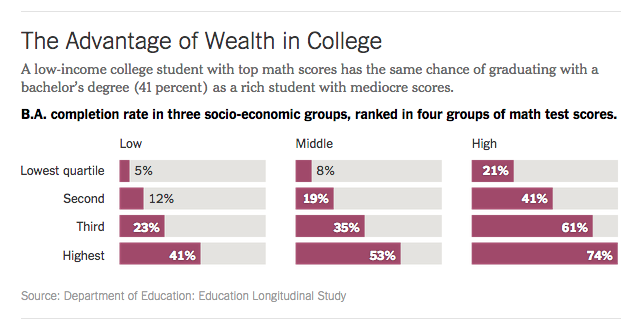
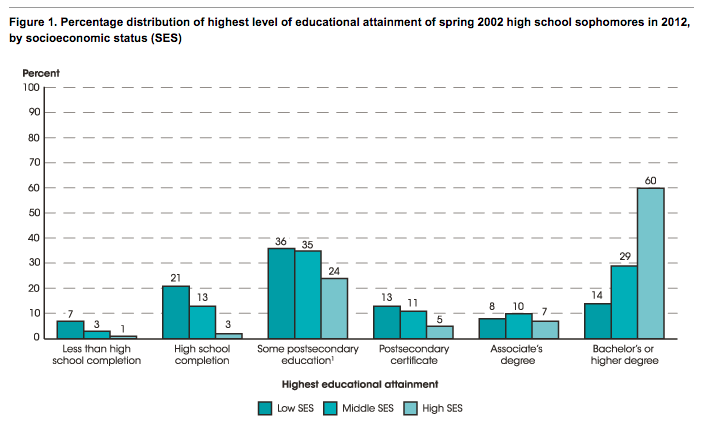
Rich and poor students don’t merely enroll in college at different rates; they also complete it at different rates. The graduation gap is even wider than the enrollment gap.

These sobering facts come from a longitudinal study and a connected report. And the data are stunning, but clear:

vantage of wealth in college
Source: Department of Education: Education Longitudinal Study
edu attainment distribution SES
SOURCE: U.S. Department of Education, National Center for Education Statistics, Education Longitudinal Study of 2002 (ELS:2002), Base Year and Third Follow-up. See Digest of Education Statistics 2014, table 104.91.

Further, Dynarski continues, and then concludes:

Academic skills in high school, at least as measured by a standardized math test, explain only a small part of the socioeconomic gap in educational attainment.

Here’s another startling comparison: A poor teenager with top scores and a rich teenager with mediocre scores are equally likely to graduate with a bachelor’s degree. In both groups, 41 percent receive a degree by their late 20s.

And even among the affluent students with the lowest scores, 21 percent managed to receive a bachelor’s degree, compared with just 5 percent of the poorest students. Put bluntly, class trumps ability when it comes to college graduation.

Poor students are increasingly falling behind well-off children in their test scores, as recent research by Sean Reardon at Stanford University shows.

That is, any poor children who manage to score at the top of the class are increasingly beating the odds. Yet even when they beat the odds in high school, they still must fight a new set of tough odds when it comes to completing college.

#

Steph Curry has gained a well-deserved high level of recognition as the NBA League MYV in the 2014-2015 season. Like Grant Hill, Curry is the black son of a successful and wealthy professional athlete.

Curry is recognized as a hard worker—practicing at rates and amounts that most people cannot comprehend.

An ideal role model for black males in the U.S.?

Not according to high school English teacher Matt Amaral, who recently posted Dear Steph Curry, Now That You Are MVP Please Don’t Come Visit My High School and asked of Curry: “But I have to ask you to do me a solid and make sure you don’t ever come visit my high school.”

Amaral is making a concession I have argued above.

Curry is an outlier, and the personification of a potentially corrosive promise: You can be anything if you just work hard enough.

Well, no, that isn’t true.

So those of us who are parents and educators are put in a truly ugly position.

I love to inspire and encourage young people. I dearly and deeply love young people.

But I also cringe at the adult proclivity to lie in order not to face themselves the ugly truths they create and perpetuate—often by refusing to face them.

There is tremendous value in hard work and effort for the sake of hard work and effort.

And, yes, the world should be a meritocracy, the world should be fair.

Pretending it is while it isn’t, wrapping our young in shallow feel-good slogans and stories—these are sure ways never to achieve the equity we say we love in the U.S.

If we do not want to tell students the real American success story—the one about winning the birth lottery—we damn well better do something to create a better story instead of continuing to lie to children and ourselves.

Because, as you know, it is entirely within your power to make things different, right?

See Also

UPDATED (Again): Grit, Education Narratives Veneer for White, Wealth Privilege

Telling Poor, Smart Kids That All It Takes Is Hard Work to Be as Successful as Their Wealthy Peers Is a Blatant Lie, Taylor Gordon

Writing for the Public: A Framework

In several undergraduate courses (a May course on education documentaries and first year seminars) and a graduate course (current trends in literacy) I teach, students write public pieces that challenges them to examine a common misconception and then help a general audience better understand the issue. The piece is created as an online document as well—requiring that students explore citing and supporting their claims with hyperlinks to credible and effective sources.

Having written public pieces in mainstream and alternative publications (The Conversation, AlterNet) regularly for over a decade and then writing online (in different types and for different venues) blogs for about five years, I have learned a great deal about writing from a specialized perspective for the public. As a university-based academic, I have also come to advocate that public work is at least as important for scholars as traditional publishing (peer-reviewed journals, books)—if not more important since the social/practical impact and scope of reach are often much greater for public work.

As a genre (commentary), a distinct medium (virtual/online), and advocacy, writing for the public is incredibly difficult and too often discouraging.

Primarily for K-12 teachers, academics, and scholars/researchers, this discussion of a framework for public writing also argues that we need more informed public voices—especially from educators, academics, and researchers.

Writing for the Public: A Framework

Public writing is an especially important genre of writing for stepping away from traditional views of essays and argumentation (as taught in formal schooling)—rejecting introduction (thesis), body, and conclusion templates; reconsidering paragraphing (short is better).

Openings (and even the title) of public works should seek to accomplish three goals (sometimes simultaneously): (1) engaging the reader by being interesting, (2) focusing the reader on the central topic and major claim of the piece, and (3) establishing for the reader your expertise or unique perspective related to the topic (consider that readers likely are reading you for the first time and have no context for your credibility).

For educators, academics, and scholars/researchers, public writing must purposefully and carefully recognize that popular perceptions about issues tend to be simplistic or even misinformed. That reality means the audience will be antagonistic and nearly impossible to sway.

Powerful examples of this for me has been writing about grade retention, corporal punishment, and the word gap. In all three situations, the evidence is overwhelming (or significantly complex, as with the research on literacy and social class) but also counter to popular beliefs.

For writers with expertise and experience in a field, public writing must remain constantly aware of that public while also navigating the high standards of traditional scholarship.

That means opening a public piece by being interesting can be accomplished by following a key guideline from Joseph Williams (Style): write with characters and plot. Readers are often interested in people doing things—narrative; and people are really interested in real people doing real things.

For teachers and professors, we can often share actual classroom stories, but public writing can also mine the rich world of journalism for real-world stories that accurately reflect the broader generalizations found in high-quality research.

Yes, qualitative data (narratives) can be outliers or misleading, but our job as experts is to choose and shape narratives that are representative, while also engaging the general public.

Within a few opening paragraphs, then, we want to engage and focus our readers while establishing our credibility; this is a much different and much harder task for a writer than the formulaic introduction/thesis.

Here, we need to acknowledge that public commentaries generally fall in a word-count range of about 750-1250 words (typically at the lower end). This is really brief for complex topics (ones that academics may cover in several 1000 words), and many feel writing public commentaries has more in common with writing poetry (concision, concision, concision) than other forms of prose.

I agree—since I am also a poet.

The bulk of your piece, however, must be the main claims, evidence (hyperlinked) and elaborations that constitute the body. In the body, typically you are challenged to make complicated and sometimes technical information accessible to the general public.

Word choice, sentence formation, use of evidence—these are the really hard parts of doing public writing (and these i no template). And while your evidence is essential, hyperlinks must be used as if readers will not follow them, and the credibility of the evidence (just as you do initially with yourself) must be established in a way that is compelling to the average (non-expert) reader.

And here is the truly frustrating part of public writing: although, for example, I noted that major medical organizations and the American Psychological Association all have clear stances against corporal punishment of any kind, much of the responses I have received completely ignore or even discount that evidence (evidence that in the academic world would carry a great deal of weight).

Since public pieces are brief, as well, your agenda is best served by having a clear major claim/argument and then a few supporting claims; keep the argument as simple as possible without being simplistic.

Just as a narrative is engaging as an opening, the bulk of your discussion must be carried by concrete and vivid details; always give the reader as many sensory triggers as possible (an old Flannery O’Connor rule about writing fiction, by the way).

Now, as we think about an ending, I want to make a counterintuitive claim: The traditional view of the essay (as we have been taught in formal schooling) includes that the body is the meat of an essay; thus, the part that matters most. However, in public writing, the opening captures the reader’s attentions, and then the ending leaves the reader with the impression that likely works or doesn’t in terms of making your case.

Instead of thinking about a conclusion as a restatement of the introduction (horrible advice, by the way, that serves no purpose in any type of writing), the ending often is most effective when you work on framing your argument.

Framing also depends heavily on the use of the concrete. Once you establish a story—or even a refrain—in your opening, you can return to that image, those people, that event, or the refrain in the final paragraph or two.

That motif, then, gives your piece coherence in the reader’s mind, establishing an internal logic to the piece that may have a stronger influence on the reader intuitively than the rational arguments of the body.

As a final point—something I stress to my students since their writing often will be evaluated, graded: work diligently to have a final few sentences, a final few words that are vivid and leave the reader with the new idea or new impression that is at the center of your argument.

“What I have most wanted to do throughout the past ten years is to make political writing into an art. My starting point is always a feeling of partisanship, a sense of injustice,” explained George Orwell in “Why I Write,” adding, “I write it because there is some lie that I want to expose, some fact to which I want to draw attention, and my initial concern is to get a hearing.”

“The job is to reconcile my ingrained likes and dislikes with the essentially public, non-individual activities that this age forces on all of us,” Orwell continued; however, “It is not easy. It raises problems of construction and of language, and it raises in a new way the problem of truthfulness.”

As educators, academics, and scholars/researchers, we are well prepared to tackle “the problem of truthfulness,” and if we the informed do not, we are leaving that important task to others less credible.

The Inhumanity of Humanity: The Real American Value

As I have detailed when examining science fiction (SF) and speculative fiction, the roots of my fascination with those genres include my mother’s love for science fiction as well as my journey from watching 1950s SF films and Shock Theater with her and then discovering my own foundational works, including the original Planet of the Apes films.

Two of the best moments for me as a parent were when I discovered my very young daughter watching over and over the video-taped Tim Burton Batman with Michael Keaton and Jack Nicholson and then Planet of the Apes films.

Since I love the original Planet of the Apes films, I have always been skeptical of the reboots, but when I watched Rise of the Planet of the Apes, I was pleasantly surprised—I think mostly because the technological advances that have made superhero-comics-to-films work also gave a new life to the Apes franchise.

None the less, even when mostly good, Hollywood films designed as blockbusters tend to have far more problems than I can stand.

A week or so ago, I noticed Dawn of the Planet of the Apes had come to my cable service and I caught it after more than 30 minutes in and while my granddaughter was visiting—so I actually only semi-watched some of the film.

My film-watching life has been limited now to cable film watching, but that facilitates my obsessive self—the urge to watch, re-watch, and re-watch films—often in pieces and out of order.

Tired after a hard cycling day in the late May heat of South Carolina, I noticed Dawn running again last night, and then an interesting coincidence occurred: I watched The Good Lie wrapped around the re-watching of Dawn.

Waiting for Dawn to start, I scrolled past Lie, pausing after reading the synopsis. I do not recall ever seeing Lie advertised and had also missed the controversy about the film, but I wondered how badly a Reese Witherspoon vehicle would mangle what appeared to be an important (and mostly ignored in the U.S.) consideration about the Sudan.

After ten or fifteen minutes, I had to switch to my full viewing of Dawn; however, after Dawn, I noticed Lie on a different time zone channel, resulting in my watching both mostly back to back.

Keeping in mind a strong caveat about popular films, I found Dawn to be quite good, and in many ways, Lie is horrible, inexcusably so.

Both films struggle (I think unconsciously) with the white savior motif that plagues Hollywood, and viewed together, the films are stained by sometimes gross stereotyping.

When the films are not simplistic (and when Lie isn’t muddled by a complete lack of control of tone), there are thematic moments shared between them that should not be ignored underneath all the faults.

Dawn shows the inhumanity of humanity, and Lie exposes the inhumanity of capitalism in the U.S.

Both messages are vivid, intense, and mostly accurate; but I suspect also missed by audiences.

Taken together, the films also dramatize the power of cultural norms to shape individual behavior—a story that refutes the rugged individualism narrative endorsed in the U.S. (and typical of U.S. films).

There is a nobility to Caesar (Dawn) and Jeremiah (Lie) that stands in stark contrast with the basic nature of humans (Dawn) and the capitalist ethic in the U.S. (Lie).

Caesar is forced to break and twist his dictum when Caesar kills Koba (the ape embodiment of human nature):

Koba: Apes not kill apes.

Caesar: You are no ape.

And Jeremiah must choose between his own need to work and his ethical code when faced with a grocery store throwing away food and refusing to give that food to the needy:

Nick: What are you doing?

Jeremiah: It is a sin not to give to those in need.

Nick: According to who?

Jeremiah: Jeremiah.

Nick: And who is that?

Jeremiah: [turning in his apron] Me. My name is Jeremiah.

I suppose if nothing else, popular films have their moments when they are so simple even a child can see the messages: Caesar is more humane, more human than the humans, and Jeremiah is more Christlike than the citizens of a so-called Christian nation.

In his 2013 speech about reading and libraries, writer Neil Gaiman could just as easily been talking about the possible consequences of all art:

Empathy is a tool for building people into groups, for allowing us to function as more than self-obsessed individuals.

You’re also finding out something as you read vitally important for making your way in the world. And it’s this:

THE WORLD DOESN’T HAVE TO BE LIKE THIS. THINGS CAN BE DIFFERENT.

He then explains about fiction:

Fiction can show you a different world. It can take you somewhere you’ve never been. Once you’ve visited other worlds, like those who ate fairy fruit, you can never be entirely content with the world that you grew up in. Discontent is a good thing: people can modify and improve their worlds, leave them better, leave them different.

And these words ring true in the wake of my having watched a mostly good film (Dawn) and an often really bad one (Lie) that both demand of the audience: “The world doesn’t have to be like this. Things can be different.”

Humbly, I would add: If we truly were discontent with this world we have created.

And with deep regret, I must conclude that we can tolerate things being different only in these Other Worlds, but not right here in the real world—one in which we are content with pervasive human-made violence and grocery stores that throw away food while the undeserving poor go hungry because that is what the market demands.

educator, public scholar, poet&writer – academic freedom isn't free