The Problem with Pearson (and Hyperbole)

The education reform debate—one often derailed by both the tone taken and then the debate about that tone (and not the issues)—appears determined to have an Evil Person (or Evil Corporation) to slay.

There was Michelle Rhee (whose Time cover really was just begging for it), and then Bill Gates. But to be honest, the list of candidates for Evil Person has been pretty long.

If you mention a person directly, you are immediately discounted as using ad hominem (although in many if not most of those cases, legitimate issues have been raised about expertise, experience, and even intentions—and not ad hominem at all).

Now, Pearson has entered the picture and prompted a new round (and maybe a new level) of hyperbole.

Data security about children/students, surveillance of Twitter and social media—Pearson has become the manifestation of Big Brother for those skeptical of technology and high-stakes testing.

To that, I’d say that we can have a reasonable debate about whether the comparison is hyperbole or an apt literary analogy, but the larger point I’d like to make is that in ether the debate or the comparison, we are likely missing the important issue.

Pearson has earned 8 billion—4 billion in the U.S.—in annual sales as a consequence of the accountability policies adopted by those elected to office within a democratic process.

I’m sorry to have to note this fact, but Pearson is not a Evil Demigod or some such.

Pearson and its profits are a consequence of very clear and consistent decisions by people in power and the people who put them in power.

Pearson is the logical conclusion of democracy and capitalism—not some totalitarian monster.

When you look at the Pearson phenomenon, and its relationship with education policy and the drain on tax dollars, you must admit this: “We have met the enemy and he is us.”

And what hath we wrought?

If Pearson makes you angry, be sure to consider just who is to blame.

Time to Choose Equity Over Accountability

My home state of South Carolina is an ideal lesson in education reform.

SC is a high-poverty state (in the bottom quartile of affluence in the U.S.) that committed early to the accountability era built on state standards and high-stakes tests (exit exams, school report cards, etc.).

Currently, SC has in quick succession adopted and then rejected Common Core, resulting in the state having about 5 or 6 different versions of state standards and tests in those thirty years.

And as we watch winter turn to spring in 2015, ain’t nobody happy with public schools in SC. Also, SC continues to struggle with pockets of extreme poverty and segregated affluence as well as entrenched racism, hostile policies for workers, and Teflon-conservative politics.

That should lead one to question the process of accountability—although apparently it doesn’t.

Two examples, however, can help us here.

First, despite the demonstrable failure of the accountability era to improve schools adequately over three decades by focusing on test data to evaluate school quality and student achievement, the test-mania has now been targeted on teachers with the endless consideration of how best to use value added methods (VAM) to evaluate teachers.

Continuing down the technocratic road of making VAM work statistically, I argue, is another example of how to do the wrong thing the right way.

It is entirely possible that we can develop a scientifically credible use of VAM and also do more harm to education than good—and again, we will suffer the bitter lessons of chasing better tests.

And here comes the irony: If we are determined to keep our eyes focused on test data, why are we not recognizing what those tests tell us over the long haul?

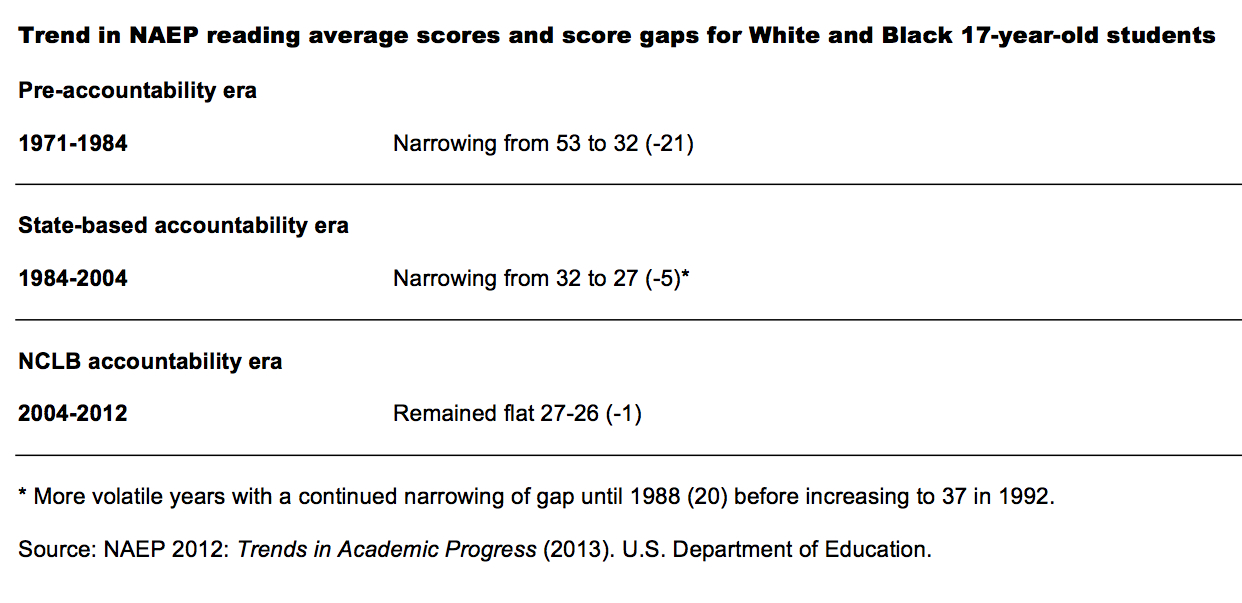
The second example was highlighted for me at Schools Matter, where two charts from longitudinal NAEP data were posted, one of which I have recreated in a different format to highlight phases in education:

NAEP gap simple 2

Before us now, after ample time has passed experimenting with accountability, we can drawn some tentative conclusions [1]: (i) the Civil Rights era from the 1950s into the 1970s (for example, SC schools did not fully integrate until early 1970s) when the focus was on equity seems to have fostered greater narrowing of the achievement gap than either (ii) the state-based accountability era or (iii) the NCLB accountability era.

And so: A lack of accountability, standards, or “good” tests was never the problem in U.S. public education, but as my home state of SC shows, a crippling history of inequity driven by racism, classism, and sexism is the primary plague reflected in the measurable outcomes found in our schools.

It is time to choose equity over accountability for our education policy. In fact, it is well past time to hold the advocates of accountability accountable for misreading their own data.

[1] FairTest has offered a more detailed analysis, drawing similar conclusions.

Manufactured Austerity, Disaster Capitalism, and Education Reform

aus·ter·i·ty /ôˈsterədē/ noun

  • sternness or severity of manner or attitude.

“he was noted for his austerity and his authoritarianism”

  • extreme plainness and simplicity of style or appearance.

“the room was decorated with a restraint bordering on austerity”

  • conditions characterized by severity, sternness, or asceticism.

plural noun: austerities

“a simple life of prayer and personal austerity”

synonyms: severity, strictness, seriousness, solemnity, gravity; frugality, thrift, economy, asceticism; self-discipline, abstinence, sobriety, restraint, chastity; starkness

#

In the second half of AMC’s The Walking Dead Season 5, the main characters and viewers discover Alexandria, introducing into the dystopian landscape a utopian [1] possibility.

This new setting raises, as Erik Kain explains, a different set of dangers, expressed openly by several characters: “The first danger will be the invitation of a warm bed and a warmer meal. Rick, Carol, Daryl, Michonne, Glenn and the rest all risk becoming as soft and weak and fat as their new hosts.”

Rick and his crew, then, are determined to remain vigilant against the creeping allure of becoming soft—having spent years now hardening themselves against the Social Darwinism of the zombie apocalypse.

In this dystopia, zombies are pervasive, and the possibility of any return to so-called normalcy appears gone. Rick, Carol, and Daryl, at least, seem certain that the relief of Alexandria is short-lived, if not entirely illusion.

#

Other than being key elements in education reform over the last 10-30 years, what do all of the following have in common?:

  • School choice formats: vouchers, tuition tax credits, public school choice, charter schools.
  • “No excuses” ideologies and policies.
  • “Grit” narratives and research.
  • No Child Left Behind, Race to the Top, Opting out of NCLB.
  • Value-added methods (VAM) of teacher evaluation and pay; calls to fire “bad” teachers (such as the bottom 5%, reminiscent of stack ranking).
  • Standards and standardized tests as part of high-stakes accountability.
  • School report cards.
  • Exit exams.
  • 3rd-grade retention based on high-stakes tests.
  • School and district take-over policies such as the RSD in New Orleans and ASD in Tennessee.

A common set of threads run through the accountability era: Assumptions that educational outcomes are the result of low effort by schools, teachers, and students; and thus, the need for incentives, competition, and overall accountability.

So my answer to my question above is that education reform is essentially manufactured austerity, resulting in educators, parents, and students being conditioned—like the main characters in The Walking Dead—to be hard in order to survive a dystopian world (a world that functions like New Orleans in a state of disaster capitalism).

The problem? The dystopia of the zombie apocalypse is fiction, and although humans are never going to achieve utopia, we in the more so-called advanced countries in the world (notably the U.S.) are coming very close to being able (if anyone had the political will) to create a world in which austerity is nearly absent.

That would be a world of community and collaboration, equity and trust—essentially nothing like the dystopias being created in our public school system by education reform.

And let me highlight once again the most disturbing element that represents my generalization: using VAM to evaluate, retain/dismiss, and pay teachers creates a system in which each teacher must seeks ways in which her/his students can beat other children in other teachers’ classroom in order to survive and thrive in the zombie apocalypse of education reform.

#

There is a stark reason zombie narratives are popular in the Western world, cultures in practice dedicated not to democracy and equity, but to Social Darwinism and consumerism—a dog-eat-dog existence that we at least unconsciously recognize in the zombie, the living dead trapped in a constant state of consuming simply to be consuming, not as nourishment.

Manufactured austerity feeds disaster bureaucracy, and as such, education reform is not about reforming education, but feeding disaster bureaucracy, as DeLeuze details:

We are in a generalized crisis in relation to all the environments of enclosure—prison, hospital, factory, school, family….The administrations in charge never cease announcing supposedly necessary reforms: to reform schools….But everyone knows that these institutions are finished….These are the societies of control, which are in the process of replacing the disciplinary societies….In the disciplinary societies one was always starting again (from school to the barracks, from the barracks to the factory), while in the societies of control one is never finished with anything [emphasis added]. (pp. 3, 5)

“[N]ever finished with anything”—like a new set of standards and new high-stakes tests every few years?

For Further Reading

Time as Capital: The Rise of the Frantic Class

Post-apocalyptic Mindset in a Civilized World

Endgame: Disaster Capitalism, New Orleans, and the Charter Scam

Education Accountability as Disaster Bureaucracy

Why Sending Your Child to a Charter School Hurts Other Children

Gates’s Cannibalistic Culture: Coming to a School Near You!

Death to Common Core! Long Live Failed Education Policy!

[1] See Margaret Atwood: the road to Ustopia for an excellent discussion of genre and the intersection of dystopia/utopia. Also, Margaret Atwood on Science Fiction, Dystopias, and Intestinal Parasites.

Good Intentions, Political Realities, Privileged Cluelessness: On Education Reform and Poverty

Education and education reform are vibrant examples of the wide spectrum of good people with good intentions and then all the way to the other extreme, spurious people with dubious intentions.

When my home state of South Carolina began sliding down that slippery slope of adopting (flawed and misrepresented) reading policy modeled on Florida, I came face to face (actually, voice to voice) with the harsh realization that good people with good intentions can be as harmful as spurious people with dubious intentions: Good people with whom I had been talking suddenly brushed me off, citing political expediency—better to get the money for reading and swallow the horrible grade retention element than to get no money at all, I was told.

I thought of this when I saw associate editor at The State Cindi Scoppe’s To fix SC schools, start with governance. Scoppe, for full disclosure, has published a number of my Op-Eds in The State, notable is that my positions are decidedly not in line with the politics or ideology of my home state.

Also, I am certain Scoppe is a good person with good intentions; she genuinely wants equitable and effective schools for all children in SC.

However, I also know good intentions (even mine) are not enough.

Scoppe opens with admitting she isn’t an expert on educating students, and then offers a relatively modest plan for education reform—ones she characterizes as “commonsense reforms that come from across the political spectrum.” Scoppe endorses the “best ideas from the right and left,” including:

  • Making it easier to fire bad teachers (right);
  • increasing teacher pay to teach impoverished students, and freeing teachers from non-teaching tasks (left);
  • increasing charter schools, magnet schools, and parental choice, and giving schools more freedom in spending (right);
  • implementing a better school funding formula, with more equity, and pursuing, possibly, district/school consolidation (left).

My immediate response was to share on Twitter my argument that we need not simply appease the political right and left, or the public, but instead should endorse evidence-based reform addressing equity.

So that leaves these questions:

  • Are bad teachers, and the difficulty firing them, major (or even minor) hurdles to high-quality education for all children in SC? I have never seen anyone making this claim show evidence that this is true. I am deeply skeptical of these claims, also, in a right-to-work state where teachers’ unions have no legal power and very limited buy-in by K-12 teachers in the state. The real teacher quality problem in SC (and across the U.S.) is a tremendous inequity of teacher assignment: affluent and white students disproportionately have experienced and certified/qualified teachers while impoverished, minority, ELL, and special needs students disproportionately have beginning/inexperienced and un-/under-certified/qualified teachers.
  • Would targeted merit pay for teaching high-needs students and relief from non-teaching tasks help improve education for high-poverty, majority-minority schools (notably along the Corridor of Shame)? Unlikely, since legislation in the past in SC has included both, unsuccessfully. Merit pay has been discredited for education (as well as all professions) in general, in fact (see the work of Daniel PinkAlfie Kohn, and Joe Bower). What we do know is that teachers are more motivated by teaching and learning conditions as well as support from administration and parents than by merit pay schemes. Step one for encouraging teachers to work with high-needs students is addressing directly teaching/learning conditions in high-poverty schools. Step two is to reject teacher evaluation plans that are predicted to discourage high-quality teachers from working with the students having the greatest needs.
  • Are investments in charter schools, magnet schools, and parental choice effective reform measures for achieving educational equity? No. Charters schools in SC have shown that 95% of charters perform about the same and worse than public schools while also being highly segregated and often underserving ELL and special needs students. And the sloganism of “parental choice” hasn’t proven to be effective either; many efforts to increase parental choice have shown parents rarely choose based on academic quality, but tend to seek social or ideological goals.
  • Does SC need a better school funding formula, one that is more equitable, and one that likely will require consolidation of schools/districts? Yes, with caveats. Here, evidence is key. While there is a “common sense” argument that “money doesn’t matter” or “you can’t just throw money at schools,” solid and long-standing research refutes both; see the work of Bruce Baker. SC needs a new funding formula, but it must not be a partisan political event, and it must be based on research and not talking points. And as a powerful example, school/district consolidation is exactly one of those common sense ideas that research challenges: “While state-level consolidation proposals may serve a public relations purpose in times of crisis, they are unlikely to be a reliable way to obtain substantive fiscal or educational improvement.”

Good intentions and political expediency, then, simply are not enough—and are likely to keep SC mired in bad education reform piled on top of the historical and lingering cancers of racism and concentrated poverty.

Which brings us to the other side of the spectrum—spurious people with dubious intentions, in this case the grand whitesplainer employed by The New York Times.

I refuse to mention he-who-shall-not-be-named, and gross stereotyping of people in poverty deserves as little attention as possible, but for balance here, I offer a wonderful refuting by Elizabeth Stoker Bruenig, Poor People Don’t Need Better Social Norms. They Need Better Social Policies.

And also, Emmitt Rensin offers a thorough unpacking and discrediting of “blame the poor” mentalities:

It would be one thing if we didn’t recognize the problem of American poverty. It would be easy if the moral scolding of our poor were confined to one section of our polity. Then we might pursue the many avenues of fiscal and monetary policy available to us. But among even those whose rhetoric suggests an awareness of the situation, even those who know that to be born monied in America is to be heir to a self-fulfilling prophesy of the kind of “good” behavior Brooks is crying out for, are so easily seduced by a reversal of effect and cause.

But out here, poor parents, poor kids and poor schools don’t have the luxury of indulging Brook’s harmful, costly relativism. They live by the most inflexible “code” of our national life: If you’re poor, you’re on your own. Good luck. Oh, and we’ll be watching. Future pay will reflect performance….

We aren’t bereft of ideals. Rather, we are plagued with bad ones—that discipline is proved by wealth, that the ideas of middle class luxury help children more than material wealth.

A better set might be the kind that makes the elected, empowered, ostensible advocates of America’s poor ask “tough questions” about their culpability in the condition of “our kids.” The kind that recognizes that there is a moral failure at the bottom of American poverty—but this failure does not belong to its own victims.

I will end with this: U.S. public education, notably in SC, is a disturbing reflection of the inexcusable inequity in our country not the result of anyone’s effort or character, but the consequences of privilege and inequity.

Until we make political, media, and public efforts to eradicate inequity and poverty—including that we rise above the hatred aimed at impoverished people, racial minorities, and women—from our society and our schools, whether we fire bad teachers, add more charter schools, or not will make little difference.

Middle-Class Assumptions Fail Literacy Instruction

My doctoral work was anchored significantly in John Dewey—highlighted, I recall, by discovering that Dewey had claimed we need not teach children to read because reading was something that naturally developed in children (and since he could not recall being taught explicitly to read).

I was struck by such a tremendous failure in a great thinker, one that exposes the dangers of assuming “my” experiences prove a generalization, especially when “my” experiences are ones of privilege.

When I posted Encouraging Students to Read: A Reader, this odd fact about Dewey came back to me when Peter Smagorinsky called me out, appropriately, for failing to acknowledge the middle-class assumptions beneath endorsing holistic approaches to teaching reading, ones that far too often have failed students who struggle to develop literacy due to class, race, gender, and other challenges.

I have noted before that progressivism, whole language, and balanced literacy have been misunderstood by politicians, the media, and the public, but we must also confront that practitioners have misunderstood and then implemented progressive and holistic approaches to literacy instruction in ways that have been extremely harmful to the exact students most in need of formal schooling.

The Dewey Paradox

Two aspects of Dewey’s progressive education philosophy are key in that context: (i) Dewey’s progressivism is steeped in idealism, leaning precariously on the edge of naturalistic views of children and learning (one that may be true if a child lives in privilege), and thus (ii) Dewey’s progressivism has mostly been misinterpreted and implemented in ways that do not reflect Dewey’s foundational commitments or serve many students well.

Not to be an apologist for Dewey, but to help clarify what many of us who stand on Dewey’s shoulders embrace (noting that I am a critical educator, and not a progressive), I recommend Dewey’s Experience and Education as well as Alan Ryan’s biography of Dewey (specifically his Chapter Four: The Pedagogue as Prophet).

For me, Dewey provided the seed for critical pedagogy to grow out of the soil of progressivism:

It is not too much to say that an educational philosophy which professes to be based on the idea of freedom may become as dogmatic as ever was the traditional education which is reacted against. For any theory and set of practices is dogmatic which is not based upon critical examination of its own underlying principles. (Experience and Education, p. 22)

In the reading wars, then, dogmatic commitments to either whole language or isolated phonics instruction instead of addressing the needs of each individual student to become a reader is the great failure Dewey himself would have acknowledged.

Misreading Dewey, however, has a long tradition itself. Lou LaBrant, a fervent Dewey progressive, wrote in 1931 a scathing attack on the project method, which claimed to be in the Dewey tradition:

The cause for my wrath is not new or single. It is of slow growth and has many characteristics. It is known to many as a variation of the project method; to me, as the soap performance. With the project, neatly defined by theorizing educators as “a purposeful activity carried to a successful conclusion,” I know better than to be at war. With what passes for purposeful activity and is unfortunately carried to a conclusion because it will kill time, I have much to complain. To be, for a moment, coherent: I am disturbed by the practice, much more common than our publications would indicate, of using the carving of little toy boats and castles, the dressing of quaint dolls, the pasting of advertising pictures, and the manipulation of clay and soap as the teaching of English literature. (p. 245)

Ryan’s biography achieves a manageable and complex picture of Dewey—one that Dewey failed to express clearly. But in that picture, we see the idealism noted above as well as a level of sophistication (for example, seeking to honor both the individual and community, instead of bowing to either/or thinking) that made Dewey hard for a general public and often inaccessible for practitioners who want the practical and not his pragmatic [1].

However, “Dewey himself argued that it was not enough to repudiate traditional education,” Ryan explains, adding:

It was not enough for progressive teachers to throw out everything the old schools had done, to replace discipline by chaos, a rigid syllabus with no syllabus. And Dewey was inclined to think that many schools had done exactly that and had used his name to justify it. The difficulty was to give an account of the educational experience that would elicit a kind of discipline, an approach to the syllabus and to the authority of the teacher in the classroom that would grow out of experience itself. (p. 282)

And it is here that I can speak directly to the great paradox of progressive and critical commitments in education, especially in terms of teaching literacy, as expressed by Dewey himself:

What avail is it to win prescribed amounts of information about geography and history, to win ability to read and write, if in the process the individual loses his own soul: loses his appreciation of things worth while, of the values to which these things are relative; if he loses desire to apply what he has learned and, above all, loses the ability to extract meaning from his future experiences as they occur? (Experience and Education, p. 49)

Teaching for over thirty years while attempting to avoid prescription and indoctrination, to foster joy and pleasure in learning, and to provide all students with the content they deserve and need has often lead to paralysis since those commitments are overwhelming in their contradictions. I have never settled for decoding or even comprehension in any student—always demanding we rise to include critical literacy that requires that students have the decoding and comprehension as well.

Despite Dewey’s warning, dogmatism is easier, and as Ryan warned, Dewey’s progressivism demands more of teachers than traditional approaches. And thus, when faced with the most challenging populations of students, we too often take the path of least resistance, mis-serving those students along the way.

Enter Delpit: Middle-Class Assumptions Fail Literacy Instruction

What appears to have happened in formal education throughout the U.S. is that literacy education has increased the gaps among social classes and racial subgroups because too often than not we have failed to honor the balance between fostering a love and joy for language with the necessary skills to read and write—and the students who suffer the most in that failure have been racial minorities and impoverished children.

Affluent students are allowed to relish in the joy of language (reaping the advantages of their privilege, which includes a literacy growth that seems transparent to them, as it did to Dewey) in formal schooling, while struggling students (disproportionately children of color and impoverished) are sentenced to drudgery masquerading as literacy instruction, further disadvantaging them.

Middle-class norms drive a great deal of practice in formal schooling since the wider U.S. society is trapped in those middle-class norms (ones that include not only socioeconomic but also racial [read “white”] expectations) and since the teacher workforce in the U.S. is itself a middle-class profession dominated by white females.

These middle-class blinders can be observed in the misguided embracing of Ruby Payne’s stereotypes about poverty, the nearly universal acceptance of the “word gap,” and the “grit” narrative as a veneer for white privilege.

Just as Dewey’s progressivism needed a critical re-imagining from Paulo Freire and others, Freire’s critical pedagogy needed bell hooks and others to confront Freire’s paternalism.

Then, enter Lisa Delpit, who provides the confrontation of the failures of misunderstood progressivism and holistic approaches to literacy instruction—the failures that often misrepresent whole language but exist under that terminology (see Ryan’s point about Dewey’s complaints above).

Writing in 1996 about Delpit, Debora Viadero explains:

But Delpit is best-known for the bombs she has lobbed at some of contemporary education’s most sacred cows.

A decade ago, Delpit started penning a series of eloquent, plain-spoken essays in the Harvard Educational Review that questioned the validity of some popular teaching strategies for African-American students. The essays were spun off into a book, Other People’s Children: Cultural Conflict in the Classroom, that was published last year by The New Press.

The problem, Delpit says in those writings, is not that whole-language reading instruction techniques or the process-writing approach to teaching writing are inherently bad. They work for some students–possibly most. They just do not work for everybody. And often the people they do not work for are children who, like Delpit herself, were born black and disenfranchised. What is more, these strategies might not work for children of any group that has strong, distinctive cultural roots and that stands on society’s perimeter peering in.

And while some continue to misrepresent Delpit in similar ways to how Dewey was/is misrepresented, Delpit offers to me the best understanding of achieving the balance Dewey sought.

The powerful phrase “other people’s children” comes from the work of Delpit, who confronts the inequity of educational opportunities for minority and impoverished children. Delpit highlights that marginalized students receive disproportionately test-prep and worksheet-driven instruction, unlike their white and affluent peers. While some have claimed her as a champion of traditional practice because her criticisms have included failures by progressives, Delpit counters:

I do not advocate a simplistic “basic skills” approach for children outside of the culture of power. It would be (and has been) tragic to operate as if these children were incapable of critical and higher-order thinking and reasoning. Rather, I suggest that schools must provide these children the content that other families from a different cultural orientation provide at home. This does not mean separating children according to family background [emphasis added], but instead, ensuring that each classroom incorporate strategies appropriate for all the children in its confines.

And I do not advocate that it is the school’s job to attempt to change the homes of poor and nonwhite children to match the homes of those in the culture of power [emphasis added]. That may indeed be a form of cultural genocide. I have frequently heard schools call poor parents “uncaring” when parents respond to the school’s urging, saying, “But that’s the school’s job.” What the school personnel fail to understand is that if the parents were members of the culture of power and lived by its rules and codes, then they would transmit those codes to their children. In fact, they transmit another culture that children must learn at home in order to survive in their communities.

And Monique Redeaux clarifies:

When Delpit began her work on “other people’s children” she predicted that her purpose would be misunderstood. People criticized her for “vindicating” teachers who subjected students of color to isolated, meaningless, sub-skills day after day. However, what she was actually advocating when she referred to “skills-based instruction” was the “useful and usable knowledge that contributes to a student’s ability to communicate effectively in standard, generally acceptable literary forms” and she proposed that this was best learned in meaningful contexts. In other words, Delpit argued that both technical skills and critical thinking are essential: a person of color who has no critical thinking skills becomes the “trainable, low-level functionary of the dominant society, simply the grease that keeps the institutions which orchestrate his or her oppression running smoothly.” At the same time, those who lack the technical skills demanded by colleges, universities, and employers will be denied entry into these institutions. Consequently, they will attain financial and social success only within the “disenfranchised underworld.”

Like my progressive muse LaBrant, I remain convinced that reading programs—including prescriptive, systematic phonics programs—are “costume parties” that fail our students—and waste a tremendous amount of funding and instructional time, money and time better spent with authentic texts.

But when I endorse choice, independent reading, and access to books, like Delpit, I am not excusing those who idealize those commitments (through middle-class lenses) and then fail to teach reading (or writing) based on the needs of each student, some of whom will flourish with little guidance and some of whom need intensive and direct instruction.

It is no petty thing to acknowledge that a hungry or abused or frightened child will not find joy in reading when allowed choice, independent reading, and access to books because those do not address the burdens denying them that joy and learning opportunity. It is no petty thing either to note that taking struggling students and simply demanding they ignore their life’s inequities and complete phonics worksheets will not work as well.

As Dewey would stress, either/or thinking and dogmatism serve no one well when we are teaching children to read and write. Too often, that dogmatism has its roots in our middle-class privilege that, as with Dewey, blinds us to what our students need most from our teaching.

[1] As Ryan explains: “Dewey spent a great deal of his adult life explaining that ‘pragmatic’ did not mean ‘practical’ in a merely utilitarian and down-to-earth sense” (p. 225).

Encouraging Students to Read: A Reader

Valerie Strauss has dedicated two blog posts (here and here) to a new report, Kids & Family Reading Report.

One key finding deserves highlighting (and a caveat):

Additional factors that predict children ages 12–17 will be frequent readers include reading a book of choice independently in school, ereading experiences, a large home library, having been told their reading level and having parents involved in their reading habits.

First, the caveat: Beware concerns about reading levels, which are the flawed domain of the technocrat. (See 21st Century Literacy, co-authored with Renita Schmidt.)

But more important is that (yet again) choice, independent reading, and access to books are all vital to supporting eager and sophisticated readers among children and students.

Note that eager readers are not the result of reading programs, worksheets, intense phonics instruction, or assigning classic reading lists (although all of those have some role to play if not abused, overemphasized).

“It is important that we do not set up in our class-rooms prejudices or snobberies which will make our students less instead of better able to understand, enjoy, and use this language,” argued Lou LaBrant, former NCTE president, in 1943, adding

Too frequently we give children books which have enough value that we call them “good,” forgetting that there are other, perhaps more important values which we are thereby missing. It is actually possible that reading will narrow rather than broaden understanding.Some children’s books, moreover, are directed toward encouraging a naive, simple acceptance of externals which we seem at times to hold as desirable for children….Let us have no more of assignments which emphasize quantity, place form above meaning, or insist on structure which is not the child’s. (p. 95)

See then:

LaBrant, L. (1937, February 17). The content of a free reading programEducational Research Bulletin, 16(2), 29–34.

LaBrant, L. (1941). English in the American scene. The English Journal, 30(3), 203–209.

LaBrant, L. (1943). Language teaching in a changing world. The Elementary English Review, 20(3), 93–97.

Stephen Krashen: Literacy: Free Voluntary Reading

Setting Free the Books: On Stepping Aside as Teaching

Progressivism and Whole Language: A Reader

Attack on “Balanced Literacy” Is Attack on Professional Teachers, Research

Reading Out of Context: “But there was something missing,” Walter Dean Myers

Conservative Talking Points Wrong for SC Education

Political science professor Brent Nelsen argues Conservatives should support public school reform. However, this commentary proves to be not credible commitments for needed education reform in South Carolina but a series of unsubstantiated conservative talking points.

After opening by defining conservatism and establishing that conservatives recognize the need for education reform, Nelsen misrepresents significantly a foundational issue facing SC: “The recent Supreme Court decision highlighting the failure of many public schools puts education at the top of the policy agenda.”

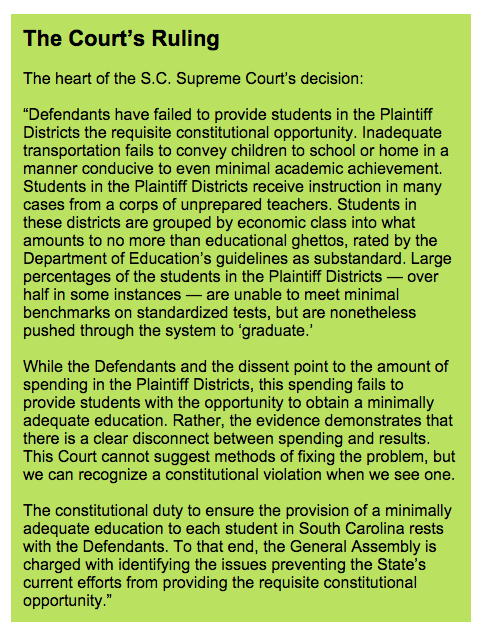
The Supreme Court in SC, in fact, finally ruled on a court case made infamous by the documentary Corridor of Shame [1], true, but the ruling addresses inadequate state support for high-poverty communities and their schools:

SC SC Corridor ruling

As Eva Moore reports:

In a narrow 3-2 decision, the court said South Carolina needs to fix the way it funds education….

“As the court pointed out, it’s a fragmented, inefficient, ineffective method of funding,” Epps says. “Historically the General Assembly has played shell games with the funding. It’s inconsistent and extremely inefficient.”…

The school districts themselves bear some blame, according to the court. They’re administration-heavy and should explore consolidation.

But the bulk of the blame lies with the state of South Carolina.

All parties must work together to create a fairer funding model “within a reasonable amount of time,” the court ruled. In the meantime, the court retains jurisdiction in the case.

A fair but complex representation of SC’s need for education reform, then, must address a historical failure by the conservative political leadership of the state to support adequately both high-poverty communities and the schools that serve those children.

Immediately following this glossing of a major issue facing the state, Nelsen makes a disturbing claim:

But conservatives have allowed liberals to monopolize the public education conversation, promoting private and home school options while leaving the debate over public schools to less conservative voices. Not only does this lead to bad policy, it is also bad politics.

SC’s political and cultural history is solidly conservative, leaning toward a Tea Party conservatism that clings to state’s rights. Even when the South was voting Democrat, SC was conservative, and in the recent years, SC politics is dominated by Republicans.

There are in fact no issues in the state of SC “monopolized” by liberals because progressive and liberal voices are nearly absent from politics, the media, or public debate.

However, Nelsen’s opening shot at “liberals” is solid evidence that this commentary is mostly conservative talking points designed to trigger a targeted political base—the tried-and-true straw men of political discourse in SC linked with the more recent straw men of conservative education reform: liberals and unions along with “bad” teachers, “status quo,” “trap[ped] students in failing schools,” and “throw[ing] tax dollars at problems.”

In SC and across the U.S., these are both common refrains and mostly without merit. For example, the union bashing in SC seems misplaced since we are a right-to-work state. Striking out at liberals and unions in SC is boxing with ghosts.

How about, then, the policy recommendations tagged as “conservative”?

High-stakes uses of teacher VAM scores could easily have additional negative consequences for children’s education. These include increased pressure to teach to the test, more competition and less cooperation among the teachers within a school, and resentment or avoidance of students who do not score well. In the most successful schools, teachers work together effectively (Atteberry & Bryk, 2010). If teachers are placed in competition with one another for bonuses or even future employment, their collaborative arrangements for the benefit of individual students as well as the supportive peer and mentoring relationships that help beginning teachers learn to teach better may suffer. (p. 24)

  • Nelsen also endorses increasing support for public charter schools and “expanding the ability of low-income students to attend private schools” (which appears to avoid the how, vouchers, because vouchers are unpopular and discredited). Charter schools are the new school-choice-light for conservatives and market-committed Democrats, but there is a problem with that advocacy, highlighted by SC. Of the 50+ charter schools each year in SC, about 95% of charter schools have student outcomes the same or worse than comparable public schools. As well, in SC and across the U.S., charter schools avoid mandates public schools cannot; charter schools underserve English language learners and special needs students; and charter schools tend to be highly segregated by race and social class. Charter school advocacy is the hollow politics of waving the “parental choice” flag without doing the hard work called for by SC’s Supreme Court—fully funding and supporting the existing public school system that SC has failed.
  • Finally, Nelsen builds to the most troubling conservative option: closing, as Nelsen’s curious word choice identifies, “[p]oor schools” and adopting state take-over practices such as the Tennessee Achievement School District (ASD). Setting aside that Nelsen is associating state government take-over as conservative while opening with a nod toward “small government,” endorsing the ASD is deeply flawed. Nelsen claims inaccurately: “The results in Tennessee are impressive so far. Students have posted double-digit gains in math, science and literacy — outpacing improvements in other public schools”—when actually, like charter schools in general, the ASD has not performed much different than public schools, according to a 2014 analysis:

My analysis suggests that ASD schools aren’t doing significantly better in terms of student growth than they were before state takeover. In fact, in many cases the schools’ pre-takeover growth outperformed the ASD. These findings have significant implications for the future of the ASD, how we should move forward with continued takeovers, and for future turn-around efforts in general.

From Tennessee to New Orleans to Los Angeles, claims of successful take-over strategies have been discredited, but those take-overs have resulted mostly in disenfranchised children and communities while providing political capital for advocates.

SC education reform doesn’t need conservative talking points, then. Although as I have argued, fiscally conservative principles do support SC changing course in education reform, but that commitment requires acknowledging the accountability movement has not worked and then taking the Supreme Court’s ruling seriously.

SC has an entrenched poverty problem linked to lingering racial and economic inequity that destroys communities and overburdens the schools designed to serve those communities. Partisan conservative political leadership has created and maintained that status quo, and conservative doubling-down would be yet more remedies as part of the disease.

See Also

The Sad History of State Takeovers of Schools and School Districts, Jan Resseger

Opinion: New Orleans takeover is a model — of what not to do with Georgia schools, J. Celeste Lay

VAM Remedy Part of Inequity Disease

Review [UPDATED]: “How to Evaluate and Retain Effective Teachers” (League of Women Voters of SC)

‘Race to the Top’ for education a flop, report finds, Nirvi Shah

The Fatal Flaw Of Education Reform, Matthew Di Carlo

Value-Added, For The Record, Matthew Di Carlo

Time to End the ASD Fiasco

South Carolina and Education Reform: A Reader

Sorry, Kirp’s Fix Another Flawed Discourse on Ed Reform

What We Know Now (and How It Doesn’t Matter)

NPR Whitewashes Charter Schools and Disaster Capitalism in New Orleans

Preventing Arson Instead of Putting Out Fires

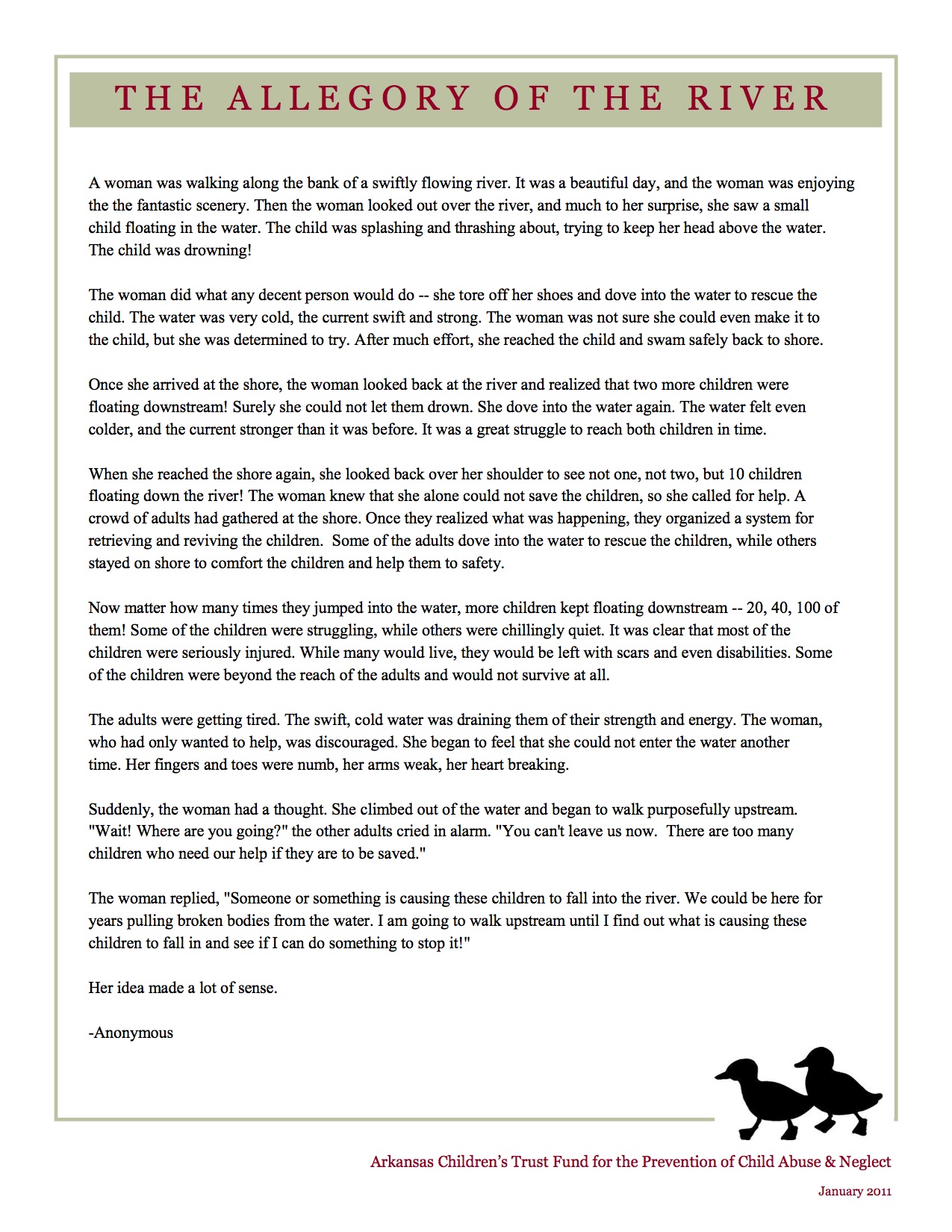
[1] In the original trial, a lawyer for the underfunded school districts used the “Allegory of the River” to confront the state’s failure to address root causes of failing schools; I recommend that allegory and believe the Op-Ed above calls for policies that continue those failures:

_allegory_of_the_river copy

NEW: Beware the Roadbuilders (Garn Press)

Thomas, P.L. (2015). Beware the roadbuilders: Literature as resistance. New York: Garn Press.

Beware the Roadbuilders: Literature as Resistance was born out of blogging as an act of social justice. Over a period of about two years, many posts built the case against market-based education reform and for a critical re-imagining of public education. This book presents a coordinated series of essays based on that work, using a wide range of written and visual texts to call for the universal public education we have failed to achieve. The central image and warning of the book—“beware the roadbuilders”—is drawn from Alice Walker’s The Color Purple. The book presents a compelling argument that billionaires, politicians, and self-professed education reformers are doing more harm than good—despite their public messages. The public and our students are being crushed beneath their reforms. In the wake of Ferguson and the growing list of sacrificed young black men—Trayvon Martin, Jordan Davis, Tamir Rice, Eric Garner—the essays in this book gain an even wider resonance, seeking to examine both the larger world of inequity as well as the continued failure of educational inequity. While each chapter stands as a separate reading, the book as a whole produces a cohesive theme and argument about the power of critical literacy to read and re-read the world, and to write and re-write the world (Paulo Freire).

Supporting that larger message are several key ideas and questions:

  • What are the confrontational texts we should be inviting students to read, that anyone should read?
  • Instead of reducing texts to the narrow expectations of New Criticism or “close reading,” how do we expand those texts into how they inform living in a free society and engaging in activism?
  • How do traditional assumptions about what texts matter and what texts reveal support the status quo of power?
  • And how can texts of all types assist in the ongoing pursuit of equity among free people?

What Does “Teaching Writing” Mean?

Over the past decade, my home university has adopted and implemented a new curriculum that is, in part, built on shifting to a first year seminar (FYS) concept (instead of the traditional first year composition model commonly known as ENG 101 and 102).

In the most recent three years, I have chaired the First Year Seminar Faculty Oversight Committee and been named Faculty Director, First Year Seminars—all of which has led to my role on a newly formed Task Force to consider how to revise (possibly significantly) our commitment to two first years seminars with one being writing intensive (FYW).

While the university is addressing a number of curricular issues related to the FYS program, a central concern involves the teaching of writing in the FYW—specifically issues related to direct writing instruction (including direct instruction on scholarly citation) and the consistency of the writing-intensive element across all FYWs.

Several elements impact these issues and our possible resolutions: (i) the university does not have a formal writing center/institute, (ii) the university doesn’t have an explicit or formal writing program or stated goals/commitments, and (iii) the commitment to the FYS program included the assumption that all faculty across all disciplines are equipped to teach writing.

I have been teaching writing and researching what that means for over thirty years—the first 18 as a high school English teacher and then at the undergraduate and graduate levels over much of those years, including teaching future teachers of English to teach writing. A number of my scholarly articles, chapters, and books also address teaching writing.

And while I learned how to teach writing painstakingly over those wonderful and challenging two decades of teaching high school, I cannot overemphasize what I have learned about the challenges of supporting quality writing instruction in the last three years—highlighted, I think, by coming against the range of insufficient to misguided understanding of what we mean when we call for teaching writing.

What Does “Teaching Writing” Mean?

At the risk of oversimplifying, I can answer this question by how I address students who want to learn to write poetry, a wonderful and impossible task that is a subset of the wonderful and impossible task of teaching writing (to which you should read the glorious and hilarious Teaching the Unteachable by Kurt Vonnegut).

Step one, I explain, is read, read, read poetry—preferably immersing yourself into entire volumes by poets you enjoy and want to emulate.

Step two, I add, is to write, write, write poetry.

And then, step three is to share those drafts with a poet/teacher who can give you substantive feedback—wherein we find ourselves at “teaching writing.”

If those students follow my guidelines, and then send me poems for my feedback, what do I do?

Central to teaching writing, I must stress, is both the authority of the teacher as well as the attitude of that teacher about writing, which I have proposed for the Task Force as follows:

  • Faculty who recognize that all aspects of writing are a process and that undergraduate students continue to struggle with and need guided practice with formal written expression (including the conventions of the disciplines, citation, and grammar/mechanics).

To teach writing, then, you must not be caught in the trap of thinking anyone can be finished learning to write and the concurrent trap of thinking that direct writing instruction is some sort of remediation (since that implies a lockstep sequence of skills that must be acquired).

For example, one challenge we are facing at my university has been brought to my attention by a librarian who works with FYS/W faculty and receives student referrals from the Academic Discipline Committee. She noted that a number of students were being labeled academically dishonest because they lacked the background in proper citation and that faculty were not teaching citation, but simply labeling it incorrect.

This issue with citation, again, is a subset of not understanding that teaching writing is ongoing for all students (and any writers)—not something to master at a set point during formal education.

The teaching of writing includes, as I note above about teaching poetry, creating the conditions within which a student can learn to write and then managing the sort of feedback and opportunities to revise/draft that leads to growth as a writer.

Creating conditions includes reading and examining a wide variety of texts by genre, mode, and media—and that examination must be not only traditional literary analysis but reading like a writer. Reading like a writer entails close consideration of what a text says and how, while navigating the purposeful relationship between the genre and form the writer has chosen for expression and then how the writer has and has not conformed to the conventions of those genres/forms.

Students and the teacher read an Op-Ed from The New York Times in order to confront what Op-Eds and argument tend to do as texts and how in order to determine if the claims in the Op-Ed are sound and how successful the piece ultimately is.

These conditions also include that students always use reading like a writer as a foundation for drafting original writing.

Feedback, then, becomes the element of teaching writing that is both often only what people think of as teaching writing and then the most misunderstood phase.

The primary problematic view of responding to student writing is “correcting,” which overemphasizes and misunderstands the role of conventions in writing (grammar, mechanics, usage).

What many think of as “correcting,” I would argue is editing, and thus, its priority in the teaching of writing is after we have addressed much more important aspects of text, as Lou LaBrant argued:

As a teacher of English, I am not willing to teach the polishing and adornment of irresponsible, unimportant writing….I would place as the first aim of teaching students to write the development of full responsibility for what they say. (p. 123)

And it is at this implication by LaBrant—responsible and important writing—that I think we must focus on what it means to teach writing.

As teachers of writing, we must give substantive feedback that encourages awareness and purpose in our students as well as prompts them in concrete ways to revise. That feedback must address the following:

  • The relationship between the genre/form students have chosen for their writing and then how effective the piece is within (or against) those conventions.
  • Purposefulness of sentence, paragraph, and form/mode creation.
  • Appropriateness and effectiveness of diction (word choice), tone, and readability (in the context of the designated audience).
  • Weight and clarity of claims (notably in the context of disciplinary, genre, and mode conventions). [As a note: novice writers tend to be claim-machines, overwhelming the reader with too many and often overstated claims, and almost no evidence or elaboration.]
  • Credibility and weight of evidence (again, tempered by the conventions of the disciplines and thus the expectations for citation).
  • Effectiveness and weight of elaboration—achieving cohesion through rhetorical and content strategies (such as detailed examples or narrative) that support the reader’s need for clarity, subordination/coordination of ideas, transition, and one or more unifying themes/theses.

Teaching writing, then, is a monumental task, one that may rightly be called impossible (as Vonnegut somewhat tongue-in-cheek claims); however, we who are tasked with teaching writing should understand the first directive above—learning to write is a process that no one can ever finish—and find solace in Henry David Thoreau (excusing the sexism of his language):

A man has not everything to do, but something; and because he cannot do everything, it is not necessary that he should do something wrong.

No single writing-intensive class or individual teacher should be expected to accomplish any prescribed outcome for students as writers.

Instead, the teaching of writing must be guided by the basic concepts I outlined above for teaching a student to write poetry—creating the conditions within which writing can be explored, conditions that include reading like a writer, drafting original writing, and receiving substantive feedback from a mentor.

Teaching writing has a long history of being a challenge, one recognized by LaBrant in 1953:

It ought to be unnecessary to say that writing is learned by writing; unfortunately there is need. Again and again teachers or schools are accused of failing to teach students to write decent English, and again and again investigations show that students have been taught about punctuation, the function of a paragraph, parts of speech, selection of “vivid” words, spelling – that students have done everything but the writing of many complete papers. Again and again college freshmen report that never in either high school or grammar school have they been asked to select a topic for writing, and write their own ideas about that subject. Some have been given topics for writing; others have been asked to summarize what someone else has said; numbers have been given work on revising sentences, filling in blanks, punctuating sentences, and analyzing what others have written….Knowing facts about language does not necessarily result in ability to use it. (p. 417)

Any student taking a seat in our classes deserves the patience and time necessary for teaching writing, something extremely difficult to do but possible if we can embrace its complexity and offer students, as LaBrant argues, ample opportunities to practice being writers.

Recommended

Genre awareness for the novice academic student: An ongoing quest, Ann M. Johns

Writing Instruction That Works: Proven Methods for Middle and High School Classrooms, Arthur N. Applebee and Judith A. Langer

What do College Professors Want from Incoming High School Graduates?

Inducing Students to Write (1955), Lou LaBrant

Teaching High-School Students to Write (1946), Lou LaBrant

Writing Is More than Structure (1957), Lou LaBrant

The Individual and His Writing (1950), Lou LaBrant

The (Macabre) South: A Reader

necrophilia [nek-ruh-fil-ee-uh] – noun, Psychiatry.
1. an erotic attraction to corpses.

There is a perverse irony to this I cling to: My homeland, The South, is best represented by William Faulkner’s “A Rose from Emily”—a story that builds to a Town discovering that dear old Emily has been sleeping with the corpse of a lover, who everyone assumed had left her just before marriage.

To this day in 2015, as I post this, Emily remains the fictional personification of The South.

Case in point: Georgia bill would protect Civil War, other monuments despite any local objections:

Proposed Georgia legislation would prohibit the removal of monuments despite any future objections to them.

Rep. Tommy Benton introduced House Bill 50 to avoid changing fashions from sweeping away memories, he said. It was approved by a Georgia House committee on Wednesday.

“I think history is history,” said Benton, R-Jefferson.

Having been born and then lived my entire life in The South, I am deeply skeptical of the first two words of Rep. Benton’s quote—thinking is not something common among the wink-wink-nod-nod populist politics in The South, but pandering is—and that pandering is often to the lowest possible denominator, I fear.

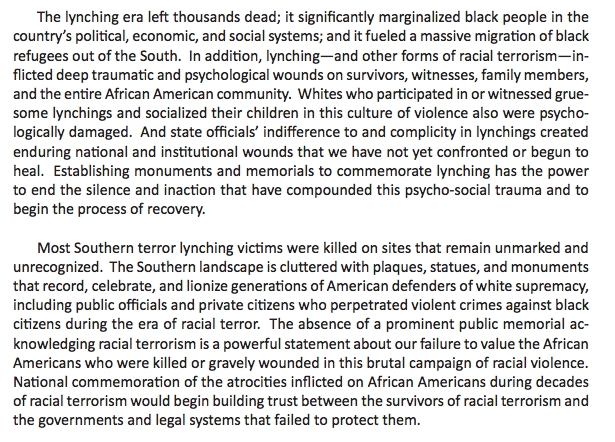
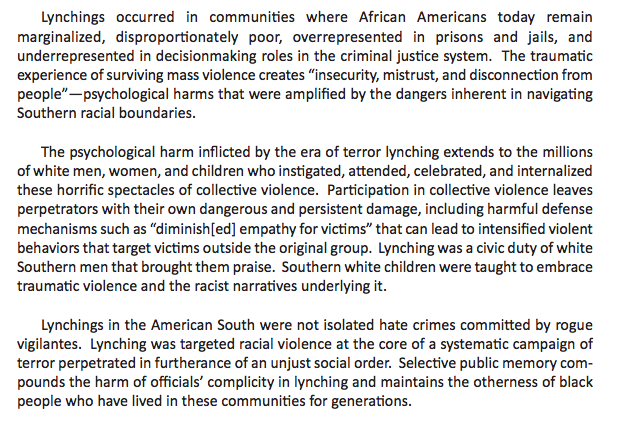
This legislation would once again codify what Lynching in America: Confronting the Legacy of Racial Terror (pp. 22-23) vividly details:

lynching 1

lynchings 2

I imagine that some political leaders in Georgia have heard the rising voices at nearby Clemson University in South Carolina, where students and faculty have called for the renaming of Tillman Hall; see two posts addressing that debate:

Ultimately, The South’s contemporary and historical Selves are almost indistinguishable; we never let go.

Segregation, corporal punishment, self-defeating political allegiances, racism, sexism, inadequate commitments to public institutions (notably education), “right to work” anti-unionism, a contradictory reputation for great literature and “deficient” literacy, a fundamentalist religious fervor—these are The South, and I invite you to read further:

educator, public scholar, poet&writer – academic freedom isn't free