Dear NYT, Better Teachers? How About Better Journalism?

The New York Times has posed at Room for Debate: How to Ensure and Improve Teacher Quality. As an opinion blog designed to offer debate, and thus differing perspectives, we should expect a spectrum of voices—at least that is the appearance.

So let’s start with a broader perspective: Voices in the media addressing education are inversely proportional to the expertise in the field:

Across MSNBC, CNN, And Fox, Only 9 Percent Of Guests In Education Segments Were Educators. On segments in which there was a substantial discussion of domestic education policy between January 1, 2014, and October 31, 2014, there were 185 guests total on CNN, MSNBC, and Fox, only 16 of whom were educators, or 9 percent. Media Matters

Therefore, I think it is fair—and not ad hominem—to clarify the background and experiences of the five debaters selected by the NYT to frame the national debate about teacher quality:

  • Amanda Ripley, journalist, who gained a great deal of national acclaim for her Time cover-story of Michelle Rhee (who eventually left her role in DC under a cloud of suspicion for testing fraud). Ripley has no K-12 classroom experience.
  • Eric Hanushek, economist. Hanushek has no K-12 classroom experience.
  • Mercedes Schneider, 20+-year K-12 classroom teacher who is also an active blogger about education reform.
  • Jal Mehta, Associate Professor in Education at the Harvard Graduate School of Education (with a PhD in sociology). I can find no information on any K-12 teaching experience, but he has written several books on education.
  • Kaya Henderson, Chancellor DCPS with degrees in international relations and leadership (not education). Henderson has K-12 teaching experience.

Any fair person can see this line up is skewed in much the same way that most mainstream journalism distorts the narrative about teacher quality and education.

But let’s add just a couple more details.

Henderson’s background, like Ripley’s, significantly overlaps with Rhee (Henderson served under Rhee at DCPS, although her bio linked above conveniently doesn’t include Rhee’s name) as well as Teach for America and The New Teacher Project, “a spin-off of TFA…originally led by Michelle Rhee.”

And if all this seems to some to be more about the people than the substance of their claims, let’s add a closer look at Hanushek’s first paragraph:

Despite decades of study and enormous effort, we know little about how to train or select high quality teachers. We do know, however, that there are huge differences in the effectiveness of classroom teachers and that these differences can be observed.

Without even a hyperlink or any evidence, Hanushek discounts the entire field of teacher education in the first sentence (which is factually untrue), and then characterizes teacher quality with “huge,” although the research base shows teacher quality’s impact on measurable student outcome is quite small (and note whose work is included in the synthesis of teacher quality research below):

But in the big picture, roughly 60 percent of achievement outcomes is explained by student and family background characteristics (most are unobserved, but likely pertain to income/poverty). Observable and unobservable schooling factors explain roughly 20 percent, most of this (10-15 percent) being teacher effects [emphasis added]. The rest of the variation (about 20 percent) is unexplained (error). In other words, though precise estimates vary, the preponderance of evidence shows that achievement differences between students are overwhelmingly attributable to factors outside of schools and classrooms (see Hanushek et al. 1998;Rockoff 2003; Goldhaber et al. 1999; Rowan et al. 2002; Nye et al. 2004).

At best, Hanushek’s opinion opens with inaccurate, unsubstantiated, and misleading claims.

More of the claims in the five opinions included are factually unsupported than supported, but the focus and the rhetoric maintain a false argument about teacher quality as well as the need for mostly ineffective reform strategies that do not serve the interests of students, communities, teachers, or public education.

Politicians, self-serving organizations (such as TFA), and think tanks promoting bunkum benefit from the inordinate misinformation included, but not genuine education reform aimed at the single greatest problem facing our society and our schools: inequity.

This version of Room for Debate is yet another tired example of an ironic fact: In the debate over teacher quality, there is little room for the truth or the voices of life-long teachers who have served their students and their communities.

Avoiding Patricia Arquette Moments in Education Reform

When Patricia Arquette called for equal pay for women after being awarded the Best Supporting Actress Oscar in late February 2015, Meryl Streep stood, cheering, and Hillary Clinton voiced her support as well.

However, social media began to catalog a much different response, notably by black Haitian writer of Bad Feminist Roxane Gay and Imani Gandy, attorney and political journalist advocating for women’s rights, who explained:

With those words—whether intentional or not (and personally, I believe it was unintentional)—Patricia Arquette gave voice to a system of structural erasure that has been the gold standard in the feminist movement since well before Sojourner Truth stood up and declared “Ain’t I A Woman?”

That erasure assumes that all men are white men and all people of color are men. And that erasure leaves women of color wondering where they fit into all of this.

In a follow up blog, Gandy adds:

My conversation with [Nicole Sandler] got me thinking about the conversations that I have with white women about privilege and why it tends to devolve into shenanigans and feelings of ill-will (as it unfortunately has with Nicole).

Oftentimes when I have these conversations with white women, they’ve never heard the term white privilege before, or if they have, they dismiss it as inapplicable to them.

Arquette represents the dangers of good intentions in the context of unexamined privilege, as Gandy confronts above and then emphasizes:

Here’s the thing about privilege: There are all kinds. There’s privilege based on race, gender, sexual orientation, gender identity, religion, citizenship status, and on and on. (A great primer on the concept is Peggy McIntosh’s “White Privilege: Unpacking the Privilege Knapsack.”)

And you know what? Almost every single person on the planet has privilege in some form or another.

Me? I have class privilege. I make a decent living now and I grew up upper-middle class. I never wanted for anything. And I rarely want for anything now. (Certainly the things that Iwant are luxury items that I really don’t need. I mean, I’ve got my eye on a Michael Kors purse, but do I need it? Hardly.)

Additionally, Arquette as a white woman offers an important moment for the education reform debate, notably since education has its own Arquette in the form of Ruby Payne.

“The current teaching population in the U.S. comprises mostly white, middle-class women,” explain Sato and Lensmire in their analysis of Payne’s claims about poverty and why those discredited stereotypes are nonetheless embraced:

Osei-Kofi (2005) thinks that Payne’s stereotypes provide the well-meaning educator with a certain “guilty voyeuristic pleasure” as they get to affirm their own normalcy against the “comfortably familiar” image of the poor as pathological. Payne plays on our sense of ourselves as normal, the norm, as well as on our sense of the poor as different, other.

Sato and Lensmire then quote Osei-Kofi:

“Based on this depiction of the poor, educators become perfectly situated to take on the role of middle-class, primarily white, saviors of children in poverty by being ‘good’ role models, and teaching these children the so-called hidden rules of middle-class. Through the objectification of the poor, educators are implicitly positioned as the true histor- ical subjects with ability to act in creating social change.” (Osei-Kofi 2005, p. 370; emphasis added)

Bomer, and others, have exposed the same dynamic, including how Payne misrepresents poverty and race in her frameworks:

Racializing the representations of poverty means that Payne is portraying poor people as people of color, rather than acknowledging the fact that most poor people in the US are white (Roberts, 2004). By doing so, Payne is perpetuating negative stereotypes by equating poverty with people of color. Although there is a correlation between race and class, this does not justify her use of racialized “case studies.”

Payne’s audience of teachers is primarily white, female, and middle class, so their probable shared perspective makes it likely that such signals will be understood as racial. Given that the truth claims do not explicitly address the relationships between poverty, race, ethnicity, and gender, we are merely pointing out the absence of such considerations from Payne’s work.

And despite a growing body of research refuting Payne’s claims about class and race, Payne continues to prosper on her self-published books and workshops and has often been defiant—a cycle not unlike Arquette’s defense of her comments and advocacy—as Gorski notes:

For example, in response to a critique of A Framework published by Teachers College Record (Gorski, 2006b), Payne (2006a) writes: “Gorski states that his lens is critical social theory. My theoretical lens is economic pragmatism. The two theoretical frames are almost polar opposites.”

Indeed.

Well-intentioned people, then, unwilling to examine their own privilege and then defiant against the voices of others who speak from marginalized perspectives are as apt to derail the call for equity in education reform as the so-called corporate reformers.

As I have detailed in literacy education, uncritical embracing of the “word gap” reveals the blinders of privilege and then leads directly to policy distorted by racism, classism, and sexism—policy, then, that perpetuates inequity while claiming to be reform.

As Gandy explains above, everyone must be open to examining her/his own privilege, even when she/he feels primarily to be in a marginalized status (such as white women), but that self-examination is often hard since the factors are so close and familiar.

While watching an HBO’s Real Sports episode on Death on Everest recently, I was struck how the relationship between Shirpas and mostly affluent and often white mountain climbers is a stark but real example of the danger and power of privilege: White wealth pays to defer great risk and even death from the climbers to the Shirpas.

A context such as that—also examined in Death and Anger on Everest by Jon Krakauer—may offer the distance needed to understand privilege before turning the mirror on ourselves and those near us.

Nonetheless, as much as the Arquette controversy is important for a national examination of privilege, it is also a key moment for committing to avoiding more Arquette moments within education, where there is no room for privilege or the status quo of racism, classism, and sexism.

The Anxiety Chronicles: Confession 1

Have you ever felt anxious? Right before giving a talk, or waiting on news that could be bad or good, or minutes before a first date?

Well, you don’t understand then; you don’t and probably can’t understand what suffering from anxiety is like because individual events of anxiousness or worry would be a relief to those of us who suffer the unwanted psychological cocktail of anxiety, depression, OCD, and ADHD (among others).

Colleen Flaherty has recently detailed the stigma of mental illness within the academy:

[Peter] Railton’s topic? His battle with depression, which he says he’s hidden for too long.

“As academics, we live in its midst,” Railton said, according to a draft of the John Dewey Lecture he delivered last week at the annual meeting of the American Philosophical Association’s Central Division in St. Louis. “We know how it hurts our students, our colleagues, our teachers, our families. Of course, most of us are ‘educated’ about depression — we like to think that we no longer consider it a stain on one’s character. We’ve gotten beyond that. Or have we?”

In the same way that don’t ask, don’t tell policies implied that being gay was something shameful to be kept private, Railton said, the social codes surrounding mental illness prevent many who need help from seeking it. He encouraged those who have struggled with depression and related conditions, such as anxiety, to come out and share their experiences, rather than conceal them for fear of judgment.

October of 1999—my lifelong battle with anxiety (I’ll use that term for the cocktail noted above) became nearly debilitating. For almost 40 years, I had managed it, masked it so powerfully that when I was rendered unable to sleep due to some invisible force that gripped me every time I tried simply to lie down and then relented to visiting my doctor, he was completely unable to diagnose my condition.

A new partner in the medical group noted immediately that I was having panic attacks (although I reject the “attack” part in that it suggests incidences over the pervasive weight of anxiety).

Like Railton, I admit that possibly the greatest challenge with anxiety is that it becomes a vicious cycle of masking to hide the most embarrassing weakness of all: anxiety is completely irrational. In the rational world of academia, few things are worse to admit.

So my life within academia, higher education especially, is a constant but unenjoyable Merry-Go-Round of trying to explain the irrational to the rational.

“I don’t fly,” I explain calmly.

“You don’t fly?” the person always asks, as if this is unfathomable.

“I have flown,” I add, anticipating where the conversation is going. “And in part, that is why I don’t fly.”

“Just take something,” comes the next round.

“It is not the flying,” I continue diligently. “It is the entire concept, and thus, I would have to be medicated from the moment I knew I was going to fly and then until I returned.”

But virtually no one who ventures into this with me understands. Go back to the opening above.

There is nothing rational about a 54-year-old man with a doctorate and successful academic and scholarly career not flying but driving his car every day and cycling 9000-10,000 miles a year (and having been run over by cars twice during that 30-year hobby).

Nothing rational at all.

But if you are interested, I can detail that anxiety: I hate any sort of formal situation (generally they make we want to run to anywhere else), I hate not knowing (and this isn’t about control; it is genuinely about not knowing), and sleep is both the most wonderful thing ever in the human condition (during my collapse in 1999, I was on sleeping meds and cannot explain the joy I discovered at 38) and a constant struggle (I often wake in the night with one or both hands gripping the headboard, white knuckled).

And just as it took decades for me to recognize my anxiety, I have been forced lately to see that my daughter likely shares some of these challenges (although I had been fooled into thinking that she is quite unlike me) and that my granddaughter, fists always clenched and feet crossed and flexed, will soon carry on this unwelcome family tradition.

The Zombie Apocalypse and Other Stories

If I wanted to be a jerk about it, I’d say, “Clench your fist. Now hold that for 54 years and then get back to me.”

While that is entirely fair, it really isn’t helping for those who sincerely wonder what this anxiety is like. So as I mentioned above, my anxiety is a pervasive condition, a fact of life from which I basically never have any relief (except for the cycling, which appeases both my OCD tendencies and creates durations of pain that nearly shut off my mind).

It is a constant (and I mean constant) internal dialogue not of a split mind, but one singular mind that functions simultaneously in the irrational and rational worlds.

Exhausted yet just thinking about it? Sorry, but that is getting you close.

Michael J. Totten, writing about the popularity of zombie narratives, explains:

The fascination with the zombie apocalypse, I believe, is a cultural reflection of the new age of anxiety that opened on 9/11, with its fear of social collapse. As Penn State professor Peter Dendle puts it, the zombie is a “barometer of social anxiety”—and we’re plenty anxious. The Anxiety and Depression Association of America claims that anxiety disorders are now the most common mental illnesses in the country, affecting more than 40 million people.

And for me, The Walking Dead (graphic or TV series) is exactly that—a recreation of living under the weight of anxiety. Rick Grimes and his band are under the relentless fact of zombies, forced into an irrational world of the living dead.

With Season 5 and episode 12, the power of this TV series to portray anxiety is now in full view.

Safely behind the walls of Alexandria and apparently among new friends, the primary characters have a different challenge:

Much of the episode “Remember” deals with the group learning to live in a new place surrounded by strangers. Although everyone can have a new house, the survivors sleep together, play it safe. They have every reason to worry, every reason to find safety in numbers.

Living during the zombie apocalypse is never being allowed to live in the moment, existence dominated by the glaring light of the next moment.

Living during the zombie apocalypse colors everything, as Rick tries to explain:

Rick’s interview with Deanna is the most important. He keeps telling her—and everyone else—not to trust him. Not to trust anybody.

“You should keep your gates closed,” he tells Deanna. “Why?” she asks.

“Because it’s all about survival now, at any cost,” he replies. “People out there are always looking for an angle, looking to play on your weakness. They measure you by what they can take from you, by how they can use you to live.”

“Are you telling me not to bring your people in, or are you already looking after this place?” she asks him, but he doesn’t answer.

And I think this is why so much of the TV series focuses on night, as viewers watch Rick, Michonne, and Daryl sitting awake or suddenly waking in this new safe haven.

Anxiety as a disorder is relentless as the zombie apocalypse; it fosters an irrational response to the world that feels completely rational while you are inside it.

Just a couple days before The Walking Dead episode above aired, I read “Sleep” by Haruki Murkami from his collection The Elephant Vanishes.

“This is my seventeenth straight day without sleep,” the narrator, a wife and mother, begins, adding: “I’m not talking about insomnia.”

Like The Walking Dead, this story can be read as a story of anxiety about a woman who admits, “It was literally true: I was going through life asleep.” Reminding me of Kafka (Samsa lives a bug’s life before the transformation into a bug), Murakami transforms metaphor into the literal.

The power of this story, I think, is the careful and gradual blurring of the narrator as rational and then irrational due to sleep deprivation, all the while maintaining the ability to narrate in a reasonably controlled tone (a narrative mask).

The main character also echoes Meursault from Camus’s The Stranger, who admits one can adjust to anything (prison or not prison is no difference): “Without noticing it, I had become accustomed in this way to a life without books.”

Murakami’s story details a woman who can no longer sleep but believes that condition allows her to live life more fully, although as readers we watch as she becomes more and more isolated from the world, notably her family:

No one noticed that I had changed—that I had given up sleeping entirely, that I was spending all my time reading, that my mind was someplace a hundred years—and hundreds of miles—from reality. No matter how mechanically I worked, no matter how little love or emotion I invested in my handling of reality, my husband and my son and my mother-in-law went on relating to me as they always had. If anything, they seemed more at ease with me than before.

“Sleep,” then, falls into an existential tradition of literature in which the human condition is portrayed as starkly alone: Samsa as bug in a human family, Meusault as heartless murderer and social pariah, and this sleepless woman who loathes the faces of her sleeping husband and son.

“In other words,” she explains, “people live in the prison cells of their own tendencies.”

And as inadequate as words may be, I have to confess that this captures well what anxiety is, the prison cells of our own tendencies.

But prison cells we did not choose, do not deserve, and like the haunting lyrics of the California rock of my teenage years, prison cells where we can check out, but never leave.

Ellison, Baldwin, Coates: #BlackLivesMatter, a Reader

Published in 1944, An American Dilemma: The Negro Problem and Modern Democracy by Gunnar Myrdal, prompted black novelist Ralph Ellison (March 1, 1913–April 16, 1994) to offer a review, one that is much more than a review, including:

This was a period, the 1870s, wherein scientific method, with its supposed objectivity and neutrality to values, was thought to be the answer to all problems. There is no better example of the confusion and opportunism springing from this false assumption than the relation of American social science to the Negro problem. And let us make no easy distinctions here between Northern and Southern social scientists; both groups used their graphs, charts and other paraphernalia to prove the Negro’s biological, psychological, intellectual and moral inferiority, one group to justify the South’s exploitation of Negroes, and the other to justify the North’s refusal to do anything basic about it. Here was a science whose role, beneath its illusionary non-concern with values, was to reconcile the practical morality of American capitalism with the ideal morality of the American Creed.

And:

The most striking example of this failure is to be seen in the New Deal administration’s perpetuation of a Jim Crow army, and the shamefaced support of it given by the Communists. It would be easy—on the basis of some of the slogans attributed to Negro people by the Communists from time to time, and the New Deal’s frequent retreats on Negro issues—to question the sincerity of these two groups. Or, in the case of the New Deal, to attribute its failure to its desire to hold power in a concrete political situation, while the failure of the Communists could be laid to “Red perfidy.” But this would be silly. Sincerity is not a quality that one expects of political parties, not even revolutionary ones. To question their sincerity makes room for the old idea of paternalism, and the corny notion that these groups have an obligation to “do something for the Negro.”

James Baldwin‘s A Report from Occupied Territory (1966)

Ta-Nehisi Coates’s The Case for Reparations (2014)

Ta-Nehisi Coates Completely Shuts Down Shelby Steele In Epic Fashion In This Reparations Debate (see video clip)

Michelle Alexander’s The New Jim Crow

Black Lives Matter: The Schott 50 State Report on Public Education and Black Males (2015)

“Black Girls Matter”: An Interview With Kimberle Crenshaw and Luke Harris

South Carolina and Education Reform: A Reader

Hartsville, South Carolina sits just north of I-20 and north-west of I-95 about a 30-minute drive from Florence.

Geography matters in SC when discussing education because the state has a long and tarnished history of pockets of poverty and educational inequity now commonly known as the Corridor of Shame [1], a name coined in a documentary addressing that inequity as it correlates with the I-95 corridor running mostly north and south paralleling the SC coast.

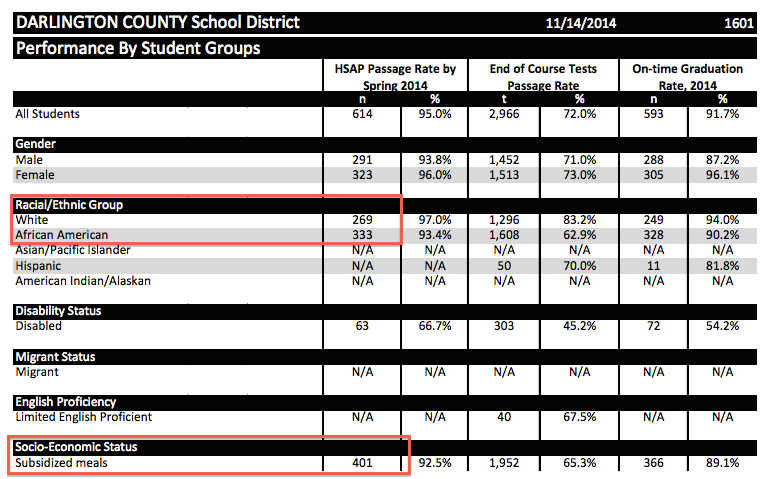
The town’s schools are part of Darlington County School District that serves approximately equal numbers of white and black students, although significantly skewed by poverty as reflected in the district’s 2014 report card detailing tested students:

Darlington 2014

Hartsville is the focus of an upcoming PBS documentary co-produced by Sam Chaltain, who writes about the community:

Take Hartsville. Until recently, no one there had ever asked Thompson or her colleagues what they noticed about their child passengers on the bus, or thought to connect their observations to the behavior teachers might witness in the classroom. Moreover, while Hartsville’s teachers were expected to be knowledgeable about their students’ academic standing, they were not expected to be attuned to their psychological states.

That began to change in 2011, when the community announced a five-year plan to transform its elementary schools. It partnered with Yale University’s School Development Program, which helps schools identify and meet the developmental needs of children. It began to evaluate its schools by a broader set of measurements – including the number of disciplinary referrals a bus driver had to write each morning. And it started to coordinate its social services to ensure a more equitable set of support structures for Hartsville’s poorest families.

This focus on Hartsville specifically and SC more broadly is important for understanding the entire education reform movement in the U.S. for several reasons.

The standards/testing issues in SC are complex (the anti-Common Core movement in SC is mostly ill-informed and falls along libertarian lines, for example) and represent well patterns found across the country during the mostly state-based accountability era (see below).

SC was one of the first accountability states, and we have had about 5-6 sets of standards and new tests over 30-plus years (see below). Throughout those years, almost no one in political leadership has acknowledged SC being in the bottom quartile of poverty in the U.S.—huge pockets of poverty and affluence—is the real educational crisis.

Like New Orleans, I think, SC is a perfect model of all that is wrong with the education reform debate.

I recommend viewing the 180 Days focus on Hartsville through the complicated and often jumbled politics and education reform over the past three decades in SC, much of which I have addressed in the reader offered below, organized by major accountability issues and policies:

Value-Added Methods of Teacher Evaluation:

South Carolina Officially Vamboozled

Review [UPDATED]: “How to Evaluate and Retain Effective Teachers” (League of Women Voters of SC)

SC and Common Core:

South Carolina and Common Core: A Next Step?

Death to Common Core! Long Live Failed Education Policy!

Should SC Ditch Common Core?

SC, Reading Policy, and Grade Retention:

Just Say No to Just Read, Florida, South Carolina

Retain to Impede: When Reading Legislation Fails (Again)

SC and Opt-Out:

SC Parents Warned: “no state provision…to opt-out of state-or district-wide testing”

SC, Oklahoma, and Florida:

GreenvilleOnline: SC should choose Oklahoma, not Florida

SC’s Former Superintendent Zais:

SC’s Zais Mistake

SC and Accountability:

Welcome to SC: A Heaping Stumbling-Bumbling Mess of Ineptitude

SC and Charter Schools:

Should SC Increase Charter School Investment?

Public School, Charter Choice: More Segregation by Design

SC and Exit Exams:

Ending Exit Exams a Start, But Not Enough

SC’s Conservative Leadership:

Conservative Leadership Poor Stewardship of Public Funds

[1] This documentary focuses on a court case in South Carolina initiated by high-poverty school districts surrounding primarily the I-95 corridor of the state, paralleling the east coast and stretching from the NE to the SE region. The documentary suffers from melodramatic production values (music, slow-motion panning of sad children’s faces), but the essential claim of the film is important for confronting the social inequity that is reflected in educational inequity, particularly in the South. Issues included in the film are school funding, community-based schools, access to high-quality educational opportunities and facilities, teacher assignments related to student characteristics, and state education accountability mechanisms. Some related resources (SC school report cards, poverty indices, related blog posts) to the documentary support examining the film in my educational documentary May experience course.

De-professionalization for Profit: “Leery of teachers”

In Common Core’s unintended consequence?, Jonathan Sapers examines a report from the Center for Education Policy (CEP), self-described as “a national, independent advocate for public education and for more effective public schools.”

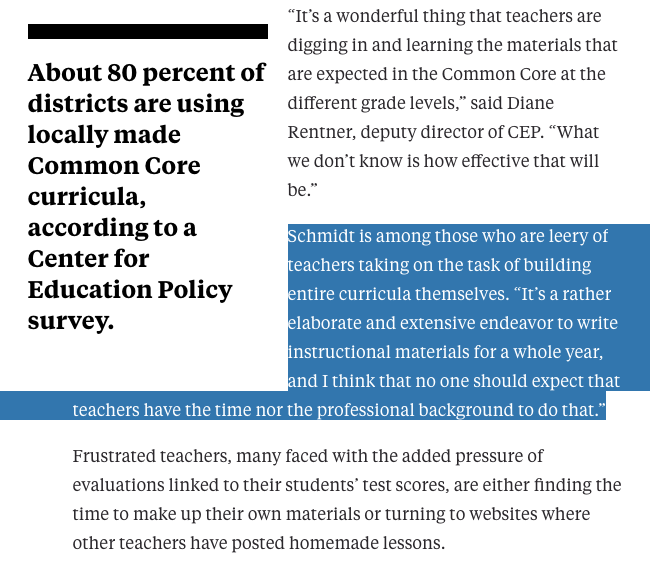
CEP has discovered “that in roughly two-thirds of districts in Common Core states, teachers have developed or are developing their own curricular materials in math (66 percent) and English Language Arts (65 percent). In more than 80 percent of districts, the CEP found that at least one source for curriculum materials was local — from teachers, the district itself or other districts in the state.”

As has been the pattern throughout roughly thirty years of public school accountability—one characterized by a revolving door of state standards and high-stakes testing—new standards and tests mean profit opportunities for education-focused businesses.

Sapers reports:

However, Jay Diskey, executive director of the PreK-12 Learning Group of the Association of American Publishers, said publishers are pulling their weight. “We have more than 150 members in our PreK-12 Learning Group. And the ones I’ve seen over the past several years or more have tried very hard to align with Common Core standards in reading and math.”…

Some teachers and districts are viewing the dearth of materials as an opportunity, but experts and even some educators say putting the job of creating curriculum materials into the hands of teachers may not necessarily be a good thing [emphasis added].

And this is where the article takes a troubling turn, as highlighted here:

leery of teachers

“Leery of Teachers”

My career as an educator includes 18 years teaching English in a SC public high school throughout the 1980s and 1990s, followed by the most recent 13 years as a teacher educator in higher education.

Those experiences and in my work teaching future teachers, I note that a powerful and problematic difference between a K-12 teacher and a college professor is the locus of authority in terms of the content of any course.

Historically and currently, the authority over content for K-12 teachers has too often been textbooks, curriculum guides, standards, and high-stakes tests.

For college professors, the single most important element of teaching authority is that professors are the locus of authority of the content they teach; in fact, many if not most college professors have little or no formal training in pedagogy, how to teach.

The great irony of this distinction is that between K-12 teachers and professors, K-12 teachers have the greater expertise in teaching, but a far reduced status as a professional when compared to professors.

Along with the locus of authority over the content, the status of professional is strongly related to autonomy and respect—which brings me back to the “unintended consequence” above.

The attitude toward K-12 teachers not having time to create curriculum is valid, but the reason they do not have time includes the incessant changing of bureaucratic mandates that consume their time and that K-12 teachers do not have professional schedules (which professors do) in which to conduct research and create curriculum (which are often related at the university level).

However, the “leery” as well as the unsubstantiated claim that teachers do not have the “professional background” to create curriculum is a genuinely ugly example of the de-professionalization of teaching—a process aided by a historical marginalizing of teaching (significantly as an element of professional sexism), the bureaucratizing of teaching, and the union-busting momentum in recent years.

We should be exploring the real intended consequence of Common Core: billions are to be made off the standards and testing charade, and teachers creating their own curriculum and materials infringes on that profit.

Teaching at all levels includes curriculum, instruction, and assessment, but central to those elements are the unique set of students each teacher faces every day.

Curriculum, instruction, and assessment mean almost nothing without the context of students, and the only person qualified to make those decisions is the teacher.

If we must be leery, let’s be leery about think tanks, publishing companies, and mainstream media who all seem to have little respect for the professionalism of teaching.

See Also

Teaching: Too Hard for Teachers, Peter Greene

Passive Progressivism

Hamlet:
A man may fish with the worm that hath eat of a
king, and eat of the fish that hath fed of that worm.

King:
What dost thou mean by this?

Hamlet:
Nothing but to show you how a king may go a
progress through the guts of a beggar.

Hamlet (Act 4, Scene 3)

The phrase “bleeding heart liberal” has always created in me some tension between skepticism about those who use it as a baseless slur against left-wing ideology and recognition that those calling themselves “liberal,” “progressive,” and/or “Democrat” are as likely to disappoint me as right-wingers (although for different reasons).

A Twitter conversation today with Camika Royal prompted by my Are We (Finally) Ready to Face Teacher Education’s Race Problem? led to this:

I have previously examined how the status quo of power in the U.S. seeks to acknowledge Martin Luther King Jr. only as a distorted passive radical, and I have recently called out my own field of teacher education for the tendency of education professors to complain and then comply.

Passivity and compliance, I note, are both necessary for maintaining the status quo of inequity in the U.S. and the central qualities among so-called progressives.

Progressivism rightly viewed is the antithesis of conservatism—although in the U.S. both terms are rarely understood, expressed correctly, or embodied in their original meanings.

Progressivism is inherently about not only recognizing the inevitability of change, but also embracing change for often idealistic ends (and thus, when taken to an extreme, the “bleeding heart liberal” paralyzed by that idealism).

Conservatism is about maintaining (conserving) conditions within a framework of traditional (enduring) values.

Neither term or ideology is understood or practiced with much faith in the U.S., but with great regret, I must note that the negative connotation of “bleeding heart liberal” rings all too true when we examine the behavior of many on the left, including self-professed progressives.

U.S. progressivism as liberalism is mostly about symbolism and lip-service.

Liberal Hollywood talks a great game, but never gets off the bench.

The liberal academy, much the same—ironically clinging to traditional norms of the aloof ivory tower that discourages public intellectualism as base, beneath the scholar.

And the liberal media? The greatest disappointment of all as the mainstream media in the U.S. is trapped in the objective pose of recognizing both sides of every issue—as if the world is a ninth-grade debate team contest.

Passive progressivism is more powerful in the U.S. than the conservative center that keeps the U.S. moving forward at a glacial creep anchored by racism, sexism, bigotry, homophobia, and widespread inequity.

Progressivism is nothing without the radicalism of action, as expressed by Howard Zinn:

From that moment on, I was no longer a liberal, a believer in the self-correcting character of American democracy. I was a radical….The situation required not just a new president or new laws, but an uprooting of the old order, the introduction of a new kind of society—cooperative, peaceful, egalitarian.

Much as Democrat and Republican are different sides of the same partisan-politics coin, progressive and conservative are different sides of the same static coin in the U.S.

And thus action in the U.S. is marginalized as radicalism, serving only to benefit the world as we now have it.

To have a world otherwise, we must all embrace radicalism.

See also here and below:

Public School, Charter Choice: More Segregation by Design

Academic Magnet High School serves the Charleston school district on the coast of South Carolina. The school functions under a choice umbrella, but requires students to submit to an admissions process.

SC is relatively more diverse than the U.S. on average in terms of white (+/- 70%)/black (+/- 30%) demographics, while less diverse in Hispanic/Latino (although those groups are growing significantly). Charleston certainly is even more diverse racially and culturally than the state.

Those realities have now prompted students at Academic Magnet to challenge the lack of diversity at their school:

Calls for a change in the admissions process at Academic Magnet High School continued Monday, with students urging the Charleston County School Board to tackle diversity issues at their school.

“Is the system that has produced an overwhelmingly white, upper-middle-class school in place of an equal opportunity magnet school for all Charleston County students fair?” asked Academic Magnet student Natalie Davidson….

Davidson said that although the school’s admissions process is “in a vacuum unbiased,” it has produced a “homogeneous” student body that is only 2 percent black in a school district that is 42 percent black.

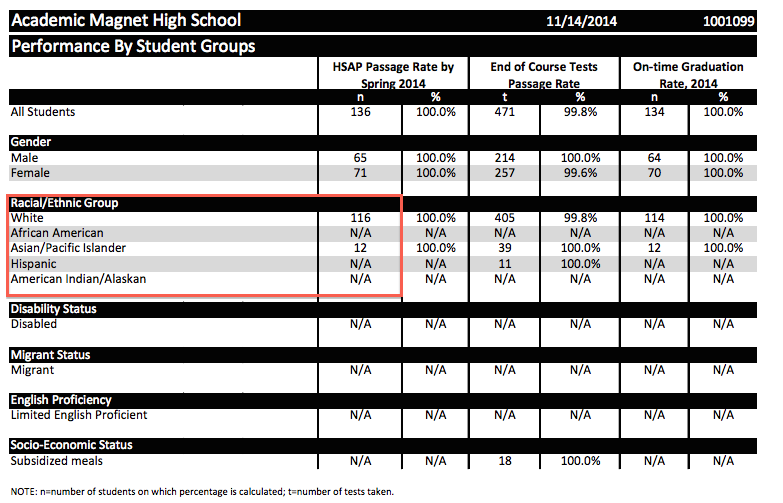
The 2014 SC school report card for Academic Magnet shows absolute and growth ratings of excellent, but tested students included no African American or Hispanic/Latino students:

AMHS test 2014

Magnet and charter schools, however, are not the only choice mechanisms in SC since Greenville County school district offers (and aggressively markets) public school choice:

GCSD choice market

What has public school choice and charter choice produced in Greenville County?

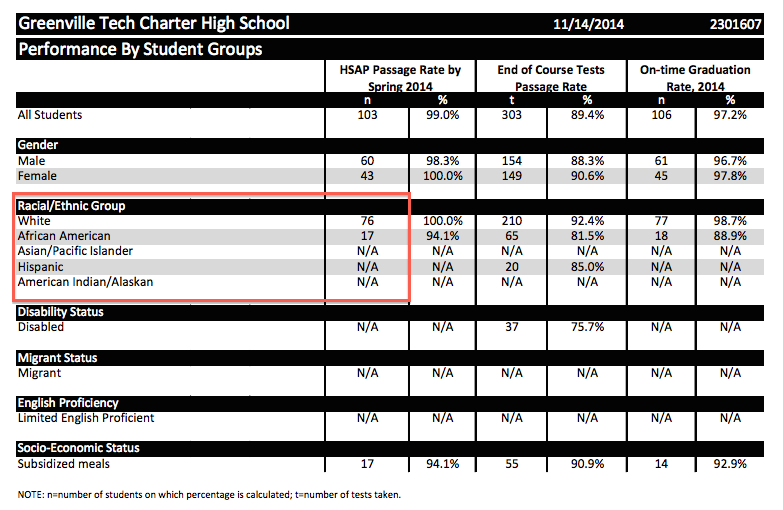
Greenville Tech Charter High School, like Academic Magnet, has 2014 school report card ratings of excellent/excellent, but just over 80% of the students tested are white with no limit English proficiency students included:

GTCHS tested 2014 race

Public school choice has also resulted in highly segregated schools within the same district.

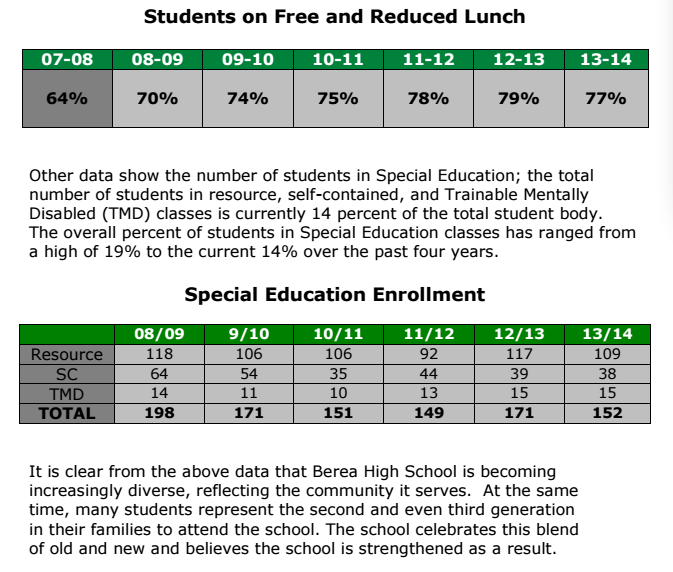
Berea High School has a consistent record of being a majority-minority school and also serves a diverse population of students by poverty and special needs:

BHS race

BHS poverty special needs

As a result, Berea High’s 2014 school report card looks quite different when compared to Academic Magnet or Greenville Tech Charter—good (absolute) and below average (growth) ratings, and a much different tested demographic of students:

BHS tested 2014

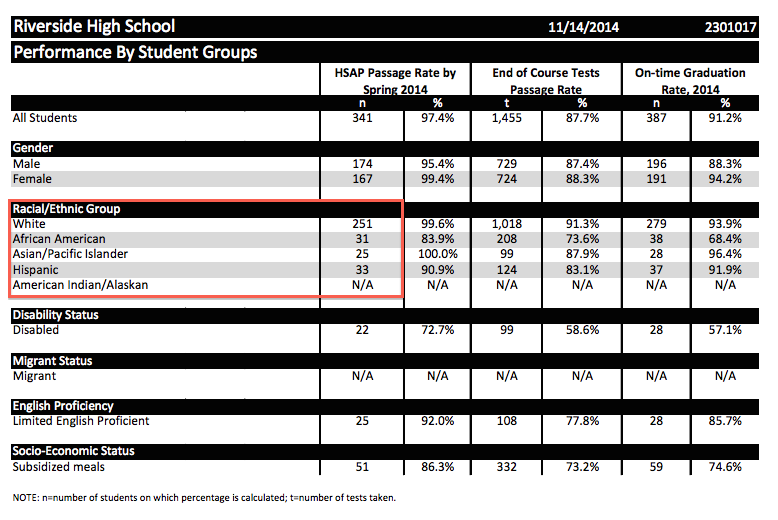
However, Riverside High School looks much more like Academic Magnet or Greenville Tech Charter—an excellent/excellent rating in 2014 and serving/testing a population 73% white:

RHS race

RHS tested 2014

Choice, then, in a variety of forms such as public school choice, charter schools, and magnet schools/academies are isolating students by race and class within highly diverse regions of a highly diverse state.

No longer vouchers or tuition tax credits, choice is now masked behind the allure of misleading labels—public, charter, magnet, academy—but ultimately resulting in one disturbing fact: choice segregates by design.

More choice will result in greater segregation and more shuffling, but market forces will never address equity and will always create winners and losers instead of establishing opportunities for all—as Academic Magnet demonstrates.

The call for fairness and diversity by students at Academic Magnet should be a call among all in SC and across the U.S.

See Also

Why Sending Your Child to a Charter School Hurts Other Children

On Memory and History: What’s in a Name?

In the 1996 film version of Arthur Miller’s The Crucible, John Proctor chooses his name over his life:

John Proctor: Because it is my name! Because I cannot have another in my life! Because I lie and sign myself to lies! Because I am not worth the dust on the feet of them you have hanged! How may I live without my name? I have given you my soul; leave me my name!

While Proctor speaks to the association between a name and honor, names also carry the burdens of gender and heritage. “I have guarded my name as people/ in other times kept their own clipped hair,” begins the speaker in Barbara Kingsolver’s “Naming Myself” from Another America. Later, she explains:

I could shed my name in the middle of life,
the ordinary thing, and it would flee
along with childhood and dead grandmothers
to that Limbo for discontinued maiden names.

But it would grow restless there.
I know this. It would ride over leaf smoke mountains
and steal horses.

Names also represent race and the lingering weight of the heaviest shackles of history. To that, Malcolm X explains his name:

Like Malcolm X, Countee Cullen confronts the name he was called, adding the power of memory, of how names and history combine:

Now I was eight and very small,
     And he was no whit bigger,
And so I smiled, but he poked out
     His tongue, and called me, "Nigger."

From his trip to Baltimore, Cullen concludes: “That’s all that I remember.”

The current debate over renaming Tillman Hall at Clemson University is yet another moment about the intersections of memory, history, and names. Possibly lost in the Tillman debate is the wider issue it represents.

“It’s true, South Carolinians would do well to remember Tillman’s legacy,” argues Paul Bowers, addressing directly the naming of Tillman Hall:

But we shouldn’t honor it, which is exactly what we’re doing by keeping his name on a building at a public university….

It’s another thing entirely for it to be named after Tillman, a progenitor and perpetuator of American apartheid who led lynch mobs during Reconstruction and boasted about it until his dying day.

Remembering history, the worst scars of history, is different than honoring those scars of history. And naming—whether it be a person’s name or a building’s—treads a thin line between remembering (as not to make the same mistake again) and honoring.

William Stafford’s “At the Un-National Monument along the Canadian Border” forces readers to consider through inversion that what we name is what we honor:

This is the field where the battle did not happen,…
where no monument stands,…

No people killed—or were killed—on this ground
hallowed by neglect and an air so tame
that people celebrate it by forgetting its name.

The South presents a history that must not be forgotten, but includes much that should not be honored—including the person, ideologies, acts, and name of Benjamin Tillman.

And somewhere between John Proctor’s impassioned but fictionalized plea and Malcolm X’s steadfast and reasonable refusal to accept the name given him lies my recognition that what we name anyone or anything, and why, is powerful evidence of what we remember and why—and ultimately what we honor beneath claims otherwise.

In Lynching in America, that fact—as in Stafford’s poem—is highlighted:

Most Southern terror lynching victims were killed on sites that remain unmarked and unrecognized. The Southern landscape is cluttered with plaques, statues, and monuments that record, celebrate, and lionize generations of American defenders of white supremacy, including public officials and private citizens who perpetrated violent crimes against black citizens during the era of racial terror [emphasis added]. The absence of a prominent public memorial acknowledging racial terrorism is a powerful statement about our failure to value the African Americans who were killed or gravely wounded in this brutal campaign of racial violence. National commemoration of the atrocities inflicted on African Americans during decades of racial terrorism would begin building trust between the survivors of racial terrorism and the governments and legal systems that failed to protect them. (p. 22)

Sandra Cisneros’s The House on Mango Street has a chapter “My Name” that begins, “In English my name means hope,” adding, “It was my great-grandmother’s name and now it is mine”:

She looked out the window her whole life, the way so many women sit their sadness on an elbow. I wonder if she made the best with what she got or was she sorry because she couldn’t be all things she wanted to be. Esperanza. I have inherited her name, but I don’t want to inherit her place by the window. (pp. 4-5)

Tradition is static, like “forgotten.” A name given, a name chiseled in granite, a name uttered each time someone gives directions.

Remembering in order to remain steadfast against the mistakes of the past does not require the echo of names, and renaming becomes an act of defiance and recognition, as Esperanza proclaims: “I would like to baptize myself under a new name, a name more like the real me, the one nobody sees” (p. 5).

The call to rename Tillman Hall, then, is not about erasing or forgetting, but about the baptism of re-naming as an act of courage, a claiming of honor too often denied and too often ignored. The refusal to rename Tillman Hall proves James Baldwin right, although he made these observations sixty years ago:

[The South] clings to the myth of its past but it is being inexorably changed, meanwhile, by an entirely un-mythical present: its habits and its self-interest are at war. Everyone in the South feels this and this is why there is such panic on the bottom and such impotence at the top. …

[I]t is, admittedly, a difficult task to try to tell people the truth and it is clear that most Southern politicians have no intention of attempting it….

This failure to look reality in the face diminishes a nation as it diminishes a person. (“Nobody Knows My Name: A Letter from the South”)

Renaming is a baptism long overdue in the Bible Belt.

See Also

Why the Heck Do Latino Reporters on Public Radio Say Their Names That Way?, Quenna Kim

educator, public scholar, poet&writer – academic freedom isn't free