[With appreciation to posting HERE, South/South]
—

In addition to the absence of coordination and sufficiency, the programs of the past all have another common failing — they are indirect. Each seeks to solve poverty by first solving something else.
I am now convinced that the simplest approach will prove to be the most effective — the solution to poverty is to abolish it directly by a now widely discussed measure: the guaranteed income.
Martin Luther King Jr., “Final Words of Advice”
“I am a writer, nothing more, nothing less,” begins Roxane Gay in the wake of a grand jury decision not to charge Darren Wilson in the killing of Michael Brown, adding, “In the face of injustice, I only have words and words can only do so much.”
On a much smaller scale, I too am a writer—and I am a teacher, Selves inextricable one from the other. My initial response to the grand jury’s inaction has been near paralysis, especially as a writer who mostly offers this blog; it seems appropriate that I shut up, take a moratorium and do as many have requested—listen.
Gay’s “I only have words and words can only do so much” haunts me, haunts me in the context of Martin Luther King Jr.’s words offered above—that tension between “indirect” and “direct” action.
Teaching and writing often feel merely “indirect”—symbolic, impotent, shouting down an empty well.
This is an awful feeling if, like me, you are compelled to be a writer-teacher, a teacher-writer.
Not as a conscious plan (in the way I am a poet), but typical of my twin compulsions to teach and to write, I finally landed at the keyboard this morning, composing to my three fall classes of students an email—such arrogance, such intrusion while these beautiful and wonderful young people slip away from college for a holiday, Thanksgiving.
Being a writer is the perpetual state of hyperawareness of one’s frailty and inadequacy combined with the relentless inevitable, sharing your words with a mostly anonymous audience. A writer’s writer, J.D. Salinger (flawed possibly to the inexcusable) has already captured how I offer my email below to the readers of this blog: “As nearly as possible in the spirit of Matthew Salinger, age one, urging a luncheon companion to accept a cool lima bean” (dedication for Franny and Zooey).
#
[Email to my students]
I do love you all. It is a very special thing to be given the task of teaching, to have students randomly assigned to your care, your responsibility.
Sometimes, that charge is more than I can handle, but I am only human (and aging, slipping into decrepitude, and thus, not as flawed in some ways as in my youth, but flawed in new and different ways).
Especially at Furman, and especially in our teens and 20s, it is easy to miss the world around us (I did mostly, and often, and well past then)—to empathize fully and genuinely with that world, those people unlike us.
So excuse this intrusion on your holiday … and do not feel obligated in any way to care about this now, or instead of turkey, or instead of just doing nothing, or instead of enjoying family or friends or someone you love … no one should deny you any of those things, and especially not me …
And now, teacher-Me: This essay is wonderfully written (what it says, yes, but how it is written, crafted):
Why We Won’t Wait, Robin D.G. Kelley
And here are some poems of mine pulled out of the rubble of this horrible thing we allow in the US, a callousness about the lives of (especially) young black men:
Four Poems: For Jordan Davis and Trayvon Martin
I think, let us be thankful for we have many people and things that bring us happiness, but could we also find ways to insure that everyone has the opportunities to share the luxury of being thankful?
To you, then, accept as you wish a virtual side-hug, handshake, or your preferred virtual display of affection.
“The law is meant to be my servant and not my master, still less my torturer and my murderer.” James Baldwin. The Nation. July 11, 1966.
“As JRR Tolkien reminded us, the only people who inveigh against escape are jailers.” Neil Gaiman. October 15, 2013
“If you’re not careful, the newspapers will have you hating the people who are being oppressed, and loving the people who are doing the oppressing.” Malcolm X
In several ways, I have seen on social media: “Dear white people, listen” [1]—coming in the wake of the failure to charge Darren Wilson for shooting Michael Brown.
Here, I want to catalogue those voices that speak to that need to listen.
Listen
Harlem, Lanston Hughes
Only Words, Roxane Gay
Ferguson isn’t about black rage against cops. It’s white rage against progress., Carol Anderson
Week 13: Put Your Hands Where My Eyes Can See, Jose Vilson
I am utterly undone: My struggle with Black rage and fear after Ferguson, Brittney Cooper
Ferguson is not a special case, Tony N. Brown
Why We Won’t Wait, Robin D.G. Kelley
Telling My Son About Ferguson, Michelle Alexander
Barack Obama, Ferguson, and the Evidence of Things Unsaid, Ta-Nehisi Coates
The Gospel of Rudy Giuliani, Ta-Nehisi Coates
Urge to ask Ferguson protestors to “be like Martin Luther King,” ignores the how the State actually responded to Martin Luther King.
— Ta-Nehisi Coates (@tanehisicoates) November 25, 2014
Ferguson, goddamn: No indictment for Darren Wilson is no surprise. This is why we protest, Syreeta McFadden
In America, black children don’t get to be children, Stacey Patton
Fury After Ferguson, Charles M. Blow
The Illipsis: Jay Smooth on Ferguson, Riots & Human Limits
Kareem Abdul-Jabbar: White People Feel Targeted by the Ferguson Protests—Welcome to Our World
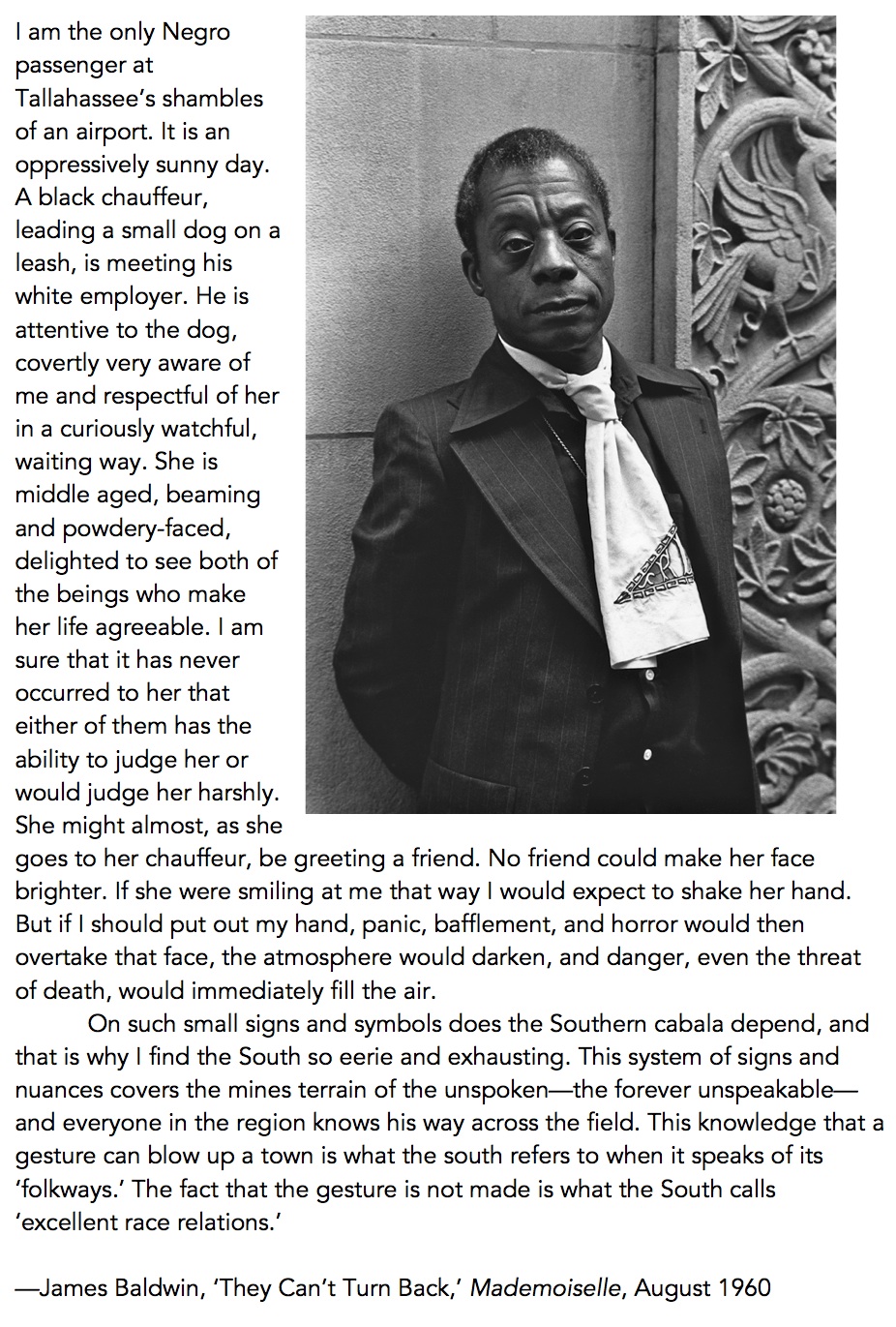
A Report from Occupied Territory, James Baldwin
The Master’s Tools Will Never Dismantle the Master’s House, Audre Lorde
“To be afraid is to behave as if the truth were not true…” Bayard Rustin
Toni Morrison, the White Gaze, Race, and Writing
“This rigid refusal to look at ourselves may well destroy us” James Baldwin
From Baldwin to Coates: Denying Racism, Ignoring Evidence
James Baldwin (Aug. 2, 1924 – Dec. 1, 1987)
—
[1] Our Silence Means More Violence: An Open Letter to Fellow White People, Carl Gibson
Related
“It is very nearly impossible, after all, to become an educated person in a country so distrustful of the independent mind.”
― James Baldwin, “They Can’t Turn Back”
During my 18 years as a public high school English teacher, I had a standing commitment shared with my students: I taught with my door open.
This may not sound that radical, but I want to offer two points of context: (i) I taught with a colleague who always kept the door locked (and advocated that all other teachers do that also to create a barrier for drop-in visits by administrators), and (ii) I taught in ways not supported by my school as well as allowing student behavior explicitly punishable by school rules (eating and drinking in class, for example).
This context of my years as an English teacher came back to me during my session at the 2014 National Council of Teachers of English. At the end of the session, including Sean Connors (University of Arkansas) and Nita Schmidt (University of Iowa), the audience discussion turned to a tradition in teaching that likely is doing us great harm: teaching with our doors shut as an act of resistance (since we use the shut doors to implement practices counter to mandates).
Let me offer two moments from the history of teaching English before making a call for teaching with our doors open as acts of resistance.
Around 1931-1932, English educator (and 1954 NCTE president) Lou LaBrant taught while working on her doctorate at Northwestern University. In her unpublished memoir housed with her papers at the Museum of Education (University of South Carolina), LaBrant recalled a powerful—and disturbing—situation she encountered with her roommate, a Spanish teacher at her school.
Since the school had a prescriptive curriculum (including required books, etc.) and a standard assessment system based on that curriculum, LaBrant and her roommate fabricated an entire year’s lesson plans to conform to the mandates, but then implemented what LaBrant called progressive practices throughout the year (LaBrant did not require the books provided, allowing choice in reading and writing instead, for example).
In one respect, LaBrant and her roommate represent the all-too-common “shut your door and teach the way you believe.” But the disturbing aspect is that LaBrant’s students scored exceptionally high at the end of the year on the mandated assessment, prompting the administration to highlight how well LaBrant implement the requirements—and thus attributing the students’ success to the prescribed curriculum LaBrant did not implement.
Now let’s jump forward about 40 years to what Stephen Krashen calls Whole Language and the Great Plummet of 1987-92.
Krashen and Regie Routman have both detailed how problematic “shut your door and teach” can be when we consider literacy policy.
While many blamed whole language as a policy commitment in California for the literacy test score drop in the late 1980s and early 1990s, Krashen explains:
Did teachers change their ways in California? Nobody really knows. There have been no empirical studies comparing methodology in language arts teaching before and after the 1987 committee met. (p. 749)
Routman is more direct:
So while the California framework…recommended the teaching of skills in context (as opposed to isolation), in actuality, the teacher training to empower all teachers to do this successfully was insufficient. In addition, the framework was widely misinterpreted. (p. 19)
At best, then, we can say about whole language implementation in California: (i) we have no firm data on if it was practiced, (ii) few teachers were adequately trained to implement whole language, and (iii) evidence suggests whole language was misunderstood often. Ultimately, California failed whole language, but whole language did not fail California—in part, because so many teachers shut their doors and teach.
This highlights a central tension around teacher agency and professionalism within a culture that demands teachers to be not political, not activists: Implementing mandates is not the work of professionals, notably when teachers and the research base for a field are excluded from how the policies are created within a partisan political arena (that teachers are deterred from entering as professionals).
My solution, then, is that teachers must begin to embrace and embody their professional selves by teaching with the doors open, especially when our practices reject flawed policy and mandates. Additionally, we must make transparent more credible artifacts of students learning, and not simply rely on the high-stakes testing data also used to de-professionalize teachers.
Teaching with our doors open creates agency where the system has denied it; teaching with our doors open offers direct alternatives to the practices we reject, to practices not supported by the evidence of our field; and teaching with our doors open models for our students how professionals behave.
While there is understandable refuge in teaching with our doors closed—historical and current forces that have worked to deny teachers their voices, their professionalism—it will only be through teaching with our doors open that we can both serve our students well and create a lever to reclaim our profession.
See Also
A Call for Non-Cooperation: So that Teachers Are Not Foreigners in Their Own Profession
A Moment in NCTE History – NCTE Annual Convention
Washington DC, 2014
Paul Thomas, Council Historian
Delivered at the Board of Directors Meeting, 2014 Annual Convention
The Possible?: “You must consider what happens to a life which finds no mirror”
In late November of 2003, I sat on the floor in a crowded luncheon just a few feet and slightly behind Adrienne Rich, speaking and reading her poetry at the annual convention of the National Council of Teachers of English, held that year in San Francisco. Appropriately, Rich was reading from her then-upcoming collection, The School among the Ruins, and talking about teaching, teachers, and education. I was struck by many things that day, but one of Rich’s most enduring messages from her Arts of the Possible confronts our choices about education in the U.S.:
Universal public education has two possible—and contradictory—missions. One is the development of a literate, articulate, and well-informed citizenry so that the democratic process can continue to evolve and the promise of radical equality can be brought closer to realization. The other is the perpetuation of a class system dividing an elite, nominally “gifted” few, tracked from an early age, from a very large underclass essentially to be written off as alienated from language and science, from poetry and politics, from history and hope—toward low-wage temporary jobs. The second is the direction our society has taken. The results are devastating in terms of the betrayal of a generation of youth. The loss to the whole of society is incalculable. (162)
If anything, history is a tapestry of choices—the story of human commitments, choices that shape us. Universal public education in the U.S. is such a tapestry of choices, choices about the possible as well as the possible ignored.
Writing in the November 1985 English Journal, novelist Walter Dean Myers reflected on his journey to loving literature:
I would read a library book under my desk with the assigned text on the desk itself. It happened that I had no library book one day, but I had discovered a store which sold used paperbacks for ten cents a piece. The cover of the book I had selected featured a young woman, sword in hand, blouse carelessly pulled down from her shoulder, standing before a billowing mainsail….
Now, I’d like to think that I read today because I enjoy the finer things in literature. I’m sure that’s the case. I remember, years later, icebound on a cargo ship on Baffin Bay, I actually experienced Coleridge’s “wondrous cold” and the “dismal sheen” of Arctic fog. But sometimes…sometimes I wonder if I wasn’t reading for at least a few years, at just the right time in my life, in hopes that I would find another really juicy line the likes of “he silently padded over her.” (93-94)
And then in 2014, the year he passed away on July 1 just a month and one day before James Baldwin would have turned 90, Myers returned to why he loved literature, why he wrote in“Where Are the People of Color in Children’s Books?”:
But by then I was beginning the quest for my own identity. To an extent I found who I was in the books I read….
But there was something missing. I needed more than the characters in the Bible to identify with, or even the characters in Arthur Miller’s plays or my beloved Balzac. As I discovered who I was, a black teenager in a white-dominated world, I saw that these characters, these lives, were not mine. I didn’t want to become the “black” representative, or some shining example of diversity. What I wanted, needed really, was to become an integral and valued part of the mosaic that I saw around me….
Then I read a story by James Baldwin: “Sonny’s Blues.” I didn’t love the story, but I was lifted by it, for it took place in Harlem, and it was a story concerned with black people like those I knew. By humanizing the people who were like me, Baldwin’s story also humanized me. The story gave me a permission that I didn’t know I needed, the permission to write about my own landscape, my own map.
And thus, Myers in the January 2005 English Journal explained: “As a writer I especially want to reach the uninspired reader. I believe it is vital for the country and important for social order, and I relish my shared experiences with inner-city youths” (37).
Like Myers, Rich wrote in 2004 about Baldwin in her “The Baldwin Stamp.” Rich had encountered Baldwin’s work when she was 19, and then met him personally in 1980, explaining, “I did not need to introduce myself to Baldwin nor raise my hand in a question. His work was what I needed” (51). Later, Rich adds,
Baldwin was a moralist, a role which many writer today are apparently uncomfortable, since morality has become hostage of various fundamentalisms, or Hollywood/TV “good guys and “bad guys,” or relegated to the critical trash heap of “post-” discards. But there was no self-righteous or simplistic moral scenario for him. (52)
In the U.S. where our streets and schools are increasingly hostile to young black males—the threat of being shot and killed by the exact police meant to protect them or destined to be suspended, expelled, or failed by the exact schools meant to teach them—we teachers of English, among all teachers, have become hostage to yet another era of accountability, standards, and tests that keep us from our central calling—one identified by Rich and Myers, one voiced by Baldwin at the Non Violent Action Committee Los Angeles (December 18, 1964): “you must consider what happens to a life which finds no mirror.”
With each passing moment, we are contributing to the ever-growing tapestry of history, too often adding the possible ignored. Instead, let’s create the possible; let’s offer our students those mirrors for their quests for their own identities.
In her “Language Teaching in a Changing World,” Lou LaBrant (1943) warned: “Teachers should consider carefully what they are doing with the most intimate subject in the curriculum” (97). The possible, then, resides in the words of Rich, Myers, and Baldwin and the faces of our students who come to our classes seeking themselves.
Works Cited
LaBrant, Lou. “Language Teaching in a Changing World.” The Elementary English Review 20.3 (1943, March): 93–97. Print.
Myers, Walter Dean. “How I Came to Love English Literature.” English Journal (1985, November): 93-94. Print.
Myers, Walter Dean. “Where Are the People of Color in Children’s Books?” The New York Times (2014, March 15). Web.
Myers, Walter Dean. “Writing for the Uninspired Reader.” English Journal 94.3 (2005, January): 36-38. Print.
Rich, Adrienne. A Human Eye: Essays on Art in Society, 1997-2008. New York: Norton, 2010. Print.
Rich, Adrienne. Arts of the Possible: Essays and Conversations. New York: Norton, 2001. Print.
While we can never make statistically valid claims about who and what is posted in online comments, I believe those comments represent common beliefs more than we’d like to admit.
Possibly the nastiest and most troubling comments occur when I publish something about race and racism, as in this piece in The State (Columbia, SC) about racial inequity in school discipline and mass incarceration.
Let’s consider some of the failed logic:
The raw data on school discipline and mass incarceration are undeniable in terms of racial inequity. As I noted, that requires a careful and nuanced consideration of the many reasons that inequity exists. In the case of mass incarceration, Michelle Alexander has offered a detailed examination that uncovers significant racism in who is arrested, how (and if) people are charged, and what sentences are handed down.
Decades of research also shows racial inequity in school discipline and then high and disturbing correlations between school discipline and incarceration rates.
Denial of racism in school discipline and incarceration, from the nasty to the illogical, is embracing school and judicial realities that mis-serve black children and black young adults—and then mis-serves us all.
Asking why these inequities exist so that they can be eradicated is a call for justice, not a plea for anarchy.
Thomas: Race matters in school discipline and incarceration | Opinion Columns | The State
An old joke tells of a police officer confronting a man crawling on his hands and knees beneath a streetlight one night. The man explains he is looking for his lost keys. When the officer asks if the man is sure he dropped the keys where he is crawling, the man replies, “No, but the light is better here.”
This joke offers something that is deadly serious about both school discipline and the U.S. judicial and incarceration systems: Males, specifically black males, suffer the brunt of punishment in schools and life because they are disproportionately targeted.
Richland 2’s task force examining inequity of discipline and expulsion for black males reflects a pattern that exists nation-wide. In 2012 the Office of Civil Rights released disturbing data about racial imbalances in school suspensions and expulsions: “African-American students represent 18% of students in the CRDC sample, but 35% of students suspended once, 46% of those suspended more than once, and 39% of students expelled.”
Expulsion and suspension begin as early as pre-kindergarten, also disproportionately affecting males and black students. Along with grade retention, discipline policies strongly predict drop-out rates as well as incarceration in adulthood.
Often called the school-to-prison pipeline, the relationship between school discipline and the judicial system demands attention, such as the task force by Richland 2.
But the public response to this data often includes two misleading claims. First, many directly embrace suspension and expulsion as part of a larger faith in a “do the crime and do the time” mentality. Second, some immediately assume raising concerns about race-based discipline inequity is a call to let students do whatever they want in school.
In order to understand the race problem in school discipline and then how to address those inequities in ways that benefit everyone, let’s consider the current mass incarceration situation in the U.S.
White males outnumber black males 6 to 1 in the U.S., but black males outnumber white males 6 to 1 in our prisons.
Legal scholar Michelle Alexander has labeled this the New Jim Crow. In her examination of the rise of mass incarceration begun during the Reagan administration, Alexander admits that she began her project rejecting the claim that the judicial system is racially biased against blacks.
However, she discovered ample evidence for race playing a key role in who is arrested and imprisoned as well as what punishments people receive. Two examples are worth highlighting.
First, The Fair Sentencing Act is the result of recognizing that penalties for powder cocaine and crack cocaine created significant disparities in arrests and sentencing along racial lines. And while whites and blacks use marijuana at equal rates, blacks suffer higher rates of arrest and sentencing as well as harsher penalties.
Alexander, in fact, details that whites and blacks experience much different routes in the judicial system after being arrested for similar crimes, experiences represented by the drug war noted above.
Next, I want to return to the opening joke because Alexander also shows that police tend to target blacks more often than whites for arrests.
Her most powerful example is that while the police commonly sweep minority and high-poverty neighborhoods for illegal recreational drugs, the police almost never conduct similar sweeps through college campus dorms—where recreational drug use is also likely.
The light, then, being shined results in arrests, but if that light were aimed somewhere else, who is arrested would also change.
The conditions of mass incarceration confronted by Alexander are now being recognized in the disciplinary policies, such as zero tolerance, and outcomes in public schools, where black males are disproportionately suffer the negative consequences that last into adulthood, even though we have no evidence blacks exhibit worse behavior.
Just as research on grade retention and corporal punishment suggest more effective alternatives to both—alternative that do not simply allow failure or harmful behavior—Walter S. Gilliam, psychologist at the Yale School of Medicine, suggests schools treat extreme behavior instead of using punishment, address teacher stress and time spent with children exhibiting extreme behavior, lower student-teacher ratios, maintain better records of disciplinary actions toward children, and implement wrap-around services that address childhood behavior in the home as well as school.
Gender and race inequity exists in school discipline policies; that fact is not an avenue to ignoring bad behavior, but the first step toward seeking ways in which all students succeed in school and then in life.
Arkansas Newswire: U of A Scholar Examines Hunger Games Trilogy as Literature
Please see all the volumes in this series HERE.
 |
Sean P. Connors (University of Arkansas, Fayetteville, USA) (Ed.)
2014 | 236 pages
Subject: Literacy
Price: $ 54.00
 |
A. Scott Henderson (Furman University, Greenville, USA )and Paul Thomas (Furman University, Greenville, USA )(Eds.)
2014 | 232 pages
Subject: Literacy, Teacher Education
Price: $ 43.00
 |
Antero Garcia (Fort Collins, CO, USA)
2013 | 162 pages
Subject: Literacy
Price: $ 43.00
 |
Paul Thomas (Furman University, Greenville, SC, USA)(Ed.)
2013 | 226 pages
Subject: Literacy, Teacher Education, Culture and Education
Price: $ 43.00
 |
Karen Stein (University of Rhode Island, Kingston, RI, USA)
2012 | 212 pages
Subject: Environmental Education, Literacy
Price: $ 43.00
 |
Paul Thomas (Furman University, Greenville, USA)
2010 | 244 pages
Subject: Literacy
Price: $ 43.00
The puzzle isn’t hard to put together because the pieces are in clear sight and fit together easily, but political, media, and public interest in facing the final picture is at least weak, if not completely absent.
Gerald Bracey (2003) and more directly Gerald Holton (2003) exposed that the stated original intent under the Ronald Reagan administration was to create enough negative perceptions of public education through A Nation at Risk to leverage Reagan’s political goals:
We met with President Reagan at the White House, who at first was jovial, charming, and full of funny stories, but then turned serious when he gave us our marching orders. He told us that our report should focus on five fundamental points that would bring excellence to education: Bring God back into the classroom. Encourage tuition tax credits for families using private schools. Support vouchers. Leave the primary responsibility for education to parents. And please abolish that abomination, the Department of Education. (Holton, n.p., electronic)
The accountability formula spawned after A Nation at Risk swept the popular media included standards, high-stakes testing, and increased reports of pubic school failure.
While the federal report created fertile ground for state-based school accountability, that proved not to be enough for political leaders, who within 15-20 years began orchestrating national versions of education accountability. The result was No Child Left Behind and then Common Core standards and the connected high-stakes tests—both neatly wrapped in bi-partisan veneer.
About thirty years after Reagan gave the commission that created A Nation at Risk the clear message about the need for the public to see public education as a failure, David Coleman, a lead architect of Common Core, exposed in 2011 what really matters about the national standards movement; after joking about having no qualifications for writing national education standards, Coleman explained:
[T]hese standards are worthy of nothing if the assessments built on them are not worthy of teaching to, period. This is quite a demanding charge, I might add to you, because it has within it the kind of statement – you know, “Oh, the standards were just fine, but the real work begins now in defining the assessment,” which if you were involved in the standards is a slightly exhausting statement to make.
But let’s be rather clear: we’re at the start of something here, and its promise – our top priorities in our organization, and I’ll tell you a little bit more about our organization, is to do our darnedest to ensure that the assessment is worthy of your time, is worthy of imitation….
There is no amount of hand-waving, there’s no amount of saying, “They teach to the standards, not the test; we don’t do that here.” Whatever. The truth is – and if I misrepresent you, you are welcome to take the mic back. But the truth is teachers do. Tests exert an enormous effect on instructional practice, direct and indirect, and it‟s hence our obligation to make tests that are worthy of that kind of attention.
The pieces to the puzzle: Education accountability began as a political move to discredit public schools, and next the Common Core standards movement embraced that above everything, tests matter most.
And now we have the final piece; Gerwertz reports:
In a move likely to cause political and academic stress in many states, a consortium that is designing assessments for the Common Core State Standards released data Monday projecting that more than half of students will fall short of the marks that connote grade-level skills on its tests of English/language arts and mathematics.
Like Naomi Klein’s disaster capitalism—the consequences of which are being exposed in New Orleans, notably through replacing the public schools with charter schools—the Common Core movement is not about improving public education, but a form of disaster bureaucracy, the use of education policy to insure the perception of educational failure among the public so that political gain can continue to be built on that manufactured crisis.
Yes, disaster bureaucracy is an ugly picture, but it is evident now the accountability movement is exactly that.
Common Core is not some unique and flawed thing, however, but the logical extension of the Reagan imperative to use education accountability to erode public support for public schools so that unpopular political agendas (school choice, for example) become more viable.
The remaining moral imperative facing us is to turn away from political claims of school and teacher failure, away from their repeatedly ineffective and destructive reforms, and toward the actual sources of what schools, teachers, and students struggle under as we continue to reform universal public education: social and educational inequities that have created two Americas and two school systems that have little to do with merit.
Accountability built on standards and high-stakes testing (not Common Core uniquely) is the problem because it is a designed as disaster bureaucracy, not as education reform.
References
Bracey, G. W. (2003). April foolishness: The 20th anniversary of A Nation at Risk. Phi Delta Kappan, 84(8), 616-621.
Holton, G. (2003, April 25). An insider’s view of “A nation at risk” and why it still matters. The Chronicle of Higher Education, 49(33), B13-15. Retrieved March 26, 2010, from OmniFile Full Text Mega database.
 dr. p.l. (paul) thomas