If The Onion Gets It … : “when the mist distorts the outline of the cypress trees”

The power of ideology makes me think of those dewy mornings when the mist distorts the outline of the cypress trees and they become shadows of something we know is there but cannot really define. The shortsightedness that afflicts us makes our perception difficult. More serious still is the way we can so easily accept that what we are seeing and hearing is, in fact, what really is and not a distorted version of what is. This tendency to cloud the truth, to become myopic, to deafen our ears, has made many of us accept without critical questioning the cynical fatalism of neoliberal thought, which proclaims that mass unemployment is an inevitable end-of-the-century calamity. Or that the dream is dead and that it is now the era of the pedagogical pragmatism of the technio-scientific training of the individual and not of his or her total education (which, obviously, includes the former). The capacity to tame, inherent in ideology, makes us at times docilely accept that the globalization of the economy is its own invention, a kind of inevitable destiny, an almost metaphysical entity rather than a moment of economic development, subject to a given political orientation dictated by the interests of those who hold power, as is the whole of capitalist economic production. What we hear is that the globalization of the economy is a necessity from which we cannot escape. (p. 113)

Pedagogy of Freedom, Paulo Freire (2000)

Paulo Freire died in the spring of 1997 while preparing to teach in the fall of that year, resulting in the publication of  Pedagogy of Freedom. Freire’s passage above, then, grew out of the billowing storm called “accountability”—anticipating, ironically, the inevitable expansion of test-based assaults on students, schools, and teachers (at least students, schools, and teachers in the public/state systems throughout the world).

As philosophical text, Freire’s final testament has likely (and probably now) falls on deaf ears, increasing the irony: We (especially in the U.S., and especially teachers) are too practical for all those big words and all that deep thinking.

However, Freire’s essential confrontation of fatalism seems to be obvious enough for The Onion [1] to recognize.

Consider New STEM Education Initiative Inspires Girls To Earn Less Than Men In Scientific Career:

“If America intends to maintain its status as an international research leader, we must do more to encourage young women to enter careers in engineering and technology where they’ll be paid, on average, $4,000 less than their male peers for doing the same work,” said program director Elizabeth Grant, stressing that the strategy would include inspirational K-12 classroom visits by female scientists, televised ad campaigns, and mentorship opportunities targeted at showing young girls that they too could attain a position in which they have fewer opportunities for professional advancement relative to men and are regarded as less competent by their superiors.

And ‘No Way To Prevent This,’ Says Only Nation Where This Regularly Happens:

“This was a terrible tragedy, but sometimes these things just happen and there’s nothing anyone can do to stop them,” said North Carolina resident Samuel Wipper, echoing sentiments expressed by tens of millions of individuals who reside in a nation where over half of the world’s deadliest mass shootings have occurred in the past 50 years and whose citizens are 20 times more likely to die of gun violence than those of other developed nations.

The same sort of uncomfortable dark satire could be written about school discipline impacting African American and Latino boys and the mass incarceration of African American young men [2]—or the relentless bloodlust for war already catalogued in satire by Kurt Vonnegut, Joseph Heller, and many others.

It seems to me, then, if The Onion can recognize and confront the fatalism existing in and fostered by capitalism and consumerism in the U.S., then the rest of us should be able to do the same—and then to take action against the paralysis of that fatalism.

Or we could just follow The Onion and Funny or Die on Twitter.


[1] My points here are couched within an important caveat: Please do not ignore that satire in the U.S. is corporate satire. While popular outlets such as The Onion and Funny or Die as well as popular satirists such as Jon Stewart and Stephen Colbert are apt to confront well ideas ignored among the so-called serious media, these outlets and entertainers are, nonetheless, part of the corporate (neoliberal, Freire would say) problem also. See my Legend of the Fall series as one example of that concern.

[2] The Onion has already shown they get Teach For America: Teach For America Chews Up, Spits Out Another Ethnic-Studies Major and My Year Volunteering As A Teacher Helped Educate A New Generation Of Underprivileged Kids (with the brilliant by-line “By Megan Richmond, Volunteer Teacher”).

What’s Really Wrong with Advanced Placement Courses and College Board?

“Fraudulent schemes come in all shapes and sizes,” asserts John Tierney, adding, ” To work, they typically wear a patina of respectability. That’s the case with Advanced Placement [A.P.] courses, one of the great frauds currently perpetrated on American high-school students.”

Tierney calling the A.P. program from the College Board a scam may seem at first to be at best hyperbole and at worst, baseless screed.

But I find Tierney’s arguments are important as one more door opening into what is wrong with the College Board broadly, as well as what is wrong with A.P. more specifically.

Let me offer some context for my assertions to follow.

First, I am no fan of the College Board’s SAT, having addressed the class-, race-, and gender-based flaws with the SAT for at least two decades now—along with confronting the more recent flaws with the 2005 addition of writing on the SAT, the David Coleman planned reboot, and the proposed relationship with the Khan Academy.

However, from 1984 until 2002, while teaching high school English in a rural South Carolina public school, I always taught either advanced feeder courses, A.P. Literature courses, or both.

My experience with A.P. in a small impoverished high school that often ranked first in the state for highest percentage of students enrolled in A.P. courses was not typical because our district policy was to push as many students up into the advanced track as possible (occasionally with those students and their parents kicking and screaming). As well, my A.P. students hovered around scoring 3 or above at about only a 50% rate—whereas at nearby high schools, A.P. was a strictly gated program and those teachers were expected to have 3 or above rates at 100% [1].

The commitment of my district also included that my classes were very small and I had nearly complete autonomy for the content of the courses and how I taught the courses.

As a result of the unusual context of my A.P. experience as a public school teacher, my background is mostly positive in terms of how well we prepared students for college within our unique implementation of the A.P. program (notably disregarding—or at least greatly expanding—the College Board’s guidelines for gatekeeping that existed in those years).

Like the SAT, the College Board’s A.P. program experienced changes in who took the exams throughout the 1980s and 1990s, during my public teaching career. Since the early 2000s, A.P. programs have increasingly lost value at the university level (as Tierney points out and Schneider details, and as I have witnessed, colleges are often likely to give less or different credit than parents and students expect, and for much higher scores).

The A.P. program has also received criticism (again like the SAT) for inherent inequity problems, mostly about the lack of diversity in who has access to the courses or the score gaps among race and class groups.

But, this still leaves us with an important question regarding Tierney’s provocative claim: Are A.P. courses a scam?

My short answer is that we must come to terms with this: The A.P. program (as well as the SAT and ACT college-entrance exams, Common Core, and all test-based practices and policies in education) is a deeply flawed distraction, as Jack Schneider concludes:

Without a doubt, programs like AP have their place. And in many schools AP remains a valuable addition to the curriculum. But when we pretend that all our schools need is the right reform, we erode our collective will to do the harder work required of us. We distract ourselves from our greater purposes. (see HERE and HERE for additional criticism of A.P. by Schneider)

While not unique to the program, A.P. ultimately fails the broader promise of universal public education in the following ways:

  • The A.P. program is grounded in gatekeeping (historically hard gatekeeping metrics as well as lingering soft gatekeeping dynamics) and tracking [2], both of which are counter to goals of equity in public schooling. As a result, A.P. scores share with SAT (and ACT) scores the power to perpetuate privilege and establish inequitable schools-within-schools.
  • The A.P. program is one example of the popular and political fetish for “top students”—a fabricated crisis that speaks to and perpetuates privilege [3].
  • A.P. tests further reinforce the reduction of learning and merit to single test scores generated from one testing session. As well, the importance of the A.P. score as a potential ticket to earning college credit (and the claim that this process can save students and their parents money) can and often reduces A.P. courses to teaching-to-the-tests.
  • Through the aura of being an “elite” program and by their selective nature, A.P. courses erode efforts to create educational settings that are equitable for all students. [The A.P. program was built on the allure of being elite, and regardless of the College Board’s claims for seeking equity and diversity, the A.P. program benefits from elitism and selectivity.]
  • The concept of “earning college credit while in high school” distorts and marginalizes the value of both student intellectual development and instructional time spent in courses. While I disagree in some respects with Tierney’s claim that A.P. course are rarely comparable to college-level courses (some A.P. Literature and A.P. Language courses are far more demanding than freshman composition courses), I would pose that it is essentially impossible to capture a college experience in a high school classroom—and there is no reason to seek that goal as well.
  • Thus, A.P. courses draw too much focus on attaining certain content and away form valuing the entire learning experience that is greater than content acquisition.
  • A.P. courses and programs are a secondary and additional financial drain on families (often indirectly) and public funding, yet another source of expenses (time and funding) for materials, tests, and training that would be better spent elsewhere.
  • Another part of the allure of the A.P. program is similar to the promise embedded in the Common Core—establishing a standard curriculum across the U.S. However, if the A.P. program shows us anything, it is that the goal of standardization is both misguided and impossible to attain. In this respect, the A.P. program may not be quite a scam, but it is a mirage.
  • And as Schneider emphasizes, A.P. courses suggest that all we need to do it get what is taught, how it is taught, and how it is tested right and then all will be well. Among almost all the current calls for in-school-only education reform, A.P. courses are distractions from needed social reform and in-school reform seeking equity.

My final point about the College Board’s A.P. program is the same as my argument about school choice: We need to create the sort of equitable public school curriculum for all students that would make A.P. courses unnecessary.

The best parts of my and my students’ experiences when I taught A.P.—small class sizes, teacher autonomy, rich content (mostly immune from censorship), administrative support—can and should be what all teachers and students experience as the norm of schooling—not the rare air of selective programs that cost parents and schools additional funds and time to create.

[1] At surrounding high schools (and common across the U.S.) in the 1980s and 1990s, students were often blocked from taking A.P. courses unless they had scored well on the PSAT or met other quantitative requirements set by schools. At one nearby high school, for example, that had a student body 3 to 4 times larger than where I taught, the A.P. Literature class was about the same number of students as the one I taught.

[2] See Moving Beyond Tracking, Mathis (2013)

[3] Satire Warning: See a post from 2011 below about the “top student” crisis:

Top Student Crisis!: A Call for Trickle-Down Education Reform

The elite minds at The Thomas B. Fordham Institute have unmasked a serious but neglected crisis in education:

[M]any high-achieving students struggle to maintain their elite performance over the years and often fail to improve their reading ability at the same rate as their average and below-average classmates. The study raises troubling questions: Is our obsession with closing achievement gaps and ‘leaving no child behind’ coming at the expense of our ‘talented tenth’—and America’s future international competitiveness?

This study has prompted Room for Debate at The New York Times to ask: “Are Top Students Getting Short Shrift?”

The answer? According to Rick Hess, “We are shortchanging America’s brightest students, and we’re doing it reflexively and furtively.”

The top students in U.S. schools are in crisis, and the economic competitiveness of our country hangs in the balance. With this now exposed, I am calling for a move to trickle-down education reform, modeled on the trickle-down economic theories driving our commitment to avoid overtaxing the wealthy in the U.S. since they are our job creators and the backbone of our thriving economy.

Trickle-Down Education Reform

Trickle-down education reform requires our current education reform movement—spearheaded by Secretary of Education Arne Duncan, philanthropist Bill Gates, and student-first advocate Michelle Rhee—to shift its focus on the bottom 10% of student performance and apply their same reform to the top 10%. This transformation must include the following:

  • Initiate funding of Teach for America (TfA) to send their core of teachers to teach in high-needs schools serving the top 10% achieving students. This core must replace the current experienced and certified teachers now teaching the top students.
  • Initiate funding to support Knowledge Is Power Program (KIPP) charter schools to serve schools consisting only of the the top 10% of students. These top students must be held to “no excuses” and taught to form lines, make eye contact, shake hands, say “yes, sir” and “no, sir,” and chant daily words of inspiration that will serve them well in corporate America.
  • Place the top students in classes with 40-to-1 student/teacher ratios.
  • Eliminate all band, music, art, and PE courses at the schools serving the top students and insure that these students focus exclusively on math, ELA, and science in order to perform well on state and national tests.
  • Increase dramatically the number of tests top students take and provide these top students the intense test-prep they deserve.

Once these reforms have been implemented, of course, we must hold the TfA teachers and KIPP schools accountable for not only the test scores of these top students but also the trickle-down effect of these policies on the remaining 90% of students who are currently being served to the detriment of our top students.

As Michael J. Petrilli implores us:

But if we want to do right by our highest-achieving students — and maintain America’s international competitiveness — we should rethink the move to eradicate tracking. Future generations will thank us.

UPDATED: Memorial Day 2015: A Reader

If we could find a space to honor peace, to honor peace by taking action so that peace was the norm of humanity…

Whom Will We Honor Memorial Day?, Howard Zinn

Memorial Day should be a day for putting flowers on graves and planting trees. Also, for destroying the weapons of death that endanger us more than they protect us, that waste our resources and threaten our children and grandchildren….

Meanwhile, there is such a shortage of housing that millions live in dilapidated sections of our cities and millions more are forced to pay high rents or high interest rates on their mortgages. There’s 90 billion for the B1 bomber, but people don’t have money to pay hospital bills.

We must be practical, say those whose practicality has consisted of a war every generation. We mustn’t deplete our defenses. Say those who have depleted our youth, stolen our resources. In the end, it is living people, not corpses, creative energy, not destructive rage, which are our only real defense, not just against other governments trying to kill us, but against our own, also trying to kill us.

Let us not set out, this Memorial Day, on the same old drunken ride to death.

The First Decoration Day, David W. Blight

Thousands of black Charlestonians, most former slaves, remained in the city and conducted a series of commemorations to declare their sense of the meaning of the war. The largest of these events, and unknown until some extraordinary luck in my recent research, took place on May 1, 1865. During the final year of the war, the Confederates had converted the planters’ horse track, the Washington Race Course and Jockey Club, into an outdoor prison. Union soldiers were kept in horrible conditions in the interior of the track; at least 257 died of exposure and disease and were hastily buried in a mass grave behind the grandstand. Some twenty-eight black workmen went to the site, re-buried the Union dead properly, and built a high fence around the cemetery. They whitewashed the fence and built an archway over an entrance on which they inscribed the words, “Martyrs of the Race Course.”

Then, black Charlestonians in cooperation with white missionaries and teachers, staged an unforgettable parade of 10,000 people on the slaveholders’ race course. The symbolic power of the low-country planter aristocracy’s horse track (where they had displayed their wealth, leisure, and influence) was not lost on the freedpeople. A New York Tribune correspondent witnessed the event, describing “a procession of friends and mourners as South Carolina and the United States never saw before.”

21st century “Children’s Crusade”: A curriculum of peace driven by critical literacy, P. L. Thomas

Slaughterhouse-Five, Kurt Vonnegut

“All the King’s Horses,” Kurt Vonnegut

Whom Will We Honor Memorial Day?, Howard Zinn

At the Un-National Monument along the Canadian Border, William Stafford

“next to of course god america i, e. e. cummings

Misreading the Never-Ending Drop-Out “Crisis”

Prompted by Peter Greene’s Why Students Drop Out, further evidence that evidence doesn’t matter for the Obama administration of Secretary Duncan, I post below an entry for the Daily Kos from 4 February 2012.

The political and public concern about high school graduation rates must be placed in two contexts: the historical reality of drop-out rates in the U.S. and the misleading use of “crisis” discourse surrounding drop-out rates.

I also strongly recommend Ralph Ellison’s speech from 1963, What These Children Are Like, which confronts the high drop-out rate among African American students:

I assume you all know that I really have no business attending this sort of conference. I have no technical terminology and no knowledge of an academic discipline. This isn’t boasting, nor is it an apology; it is just a means of reminding myself of what my reality has been and of what I am. At this point it might be useful for us to ask ourselves a few questions: what is this act, what is this scene in which the action is taking place, what is this agency and what is its purpose? The act is to discuss “these children,” the difficult thirty percent. We know this very well; it has been hammered out again and again. But the matter of scene seems to get us into trouble.

Daring to Look Behind the Curtain: The Drop-Out Crisis Redux

“‘Only four out of ten U.S. children finish high school, only one out of five who finish high school goes to college’”—does this sound familiar? Possibly at least echoed in the 2012 State of the Union Address by President Obama, who made this charge regarding U.S. public education?:

We also know that when students don’t walk away from their education, more of them walk the stage to get their diploma. When students are not allowed to drop out, they do better. So tonight, I am proposing that every state — every state — requires that all students stay in high school until they graduate or turn 18.

The opening quote is from a 1947 Time magazine article focusing on John Ward Studebaker, a former school superintendent who served as U.S. Commissioner of Education in the mid-1940s. The drop-out crisis has been one of many refrains in U.S. politics and education for nearly a century.

Fifty years later, in 1997, The America’s Promise Alliance formed, chaired by General Colin Powell, with the express purpose of confronting the drop-out crisis.

Yet, despite decades of some essential facts—many students persisting in dropping out of school, drop-out rates disproportionately occurring in at-risk sub-groups (high poverty, racial minorities, English language learners), federal and state policies and codes mandating school attendance—we find ourselves in 2012 with President Obama declaring yet another mandate, which was met with applause.

Daring to Look Behind the Curtain

Power, authority, privilege, and winning are certain narcotics—numbing the mind and soul, limiting vision, and removing the possibility of pulling aside the curtain of assumptions to see the reality behind the pageantry.

I have always had an affinity for The Wizard of Oz, similar to my life-long affection for children’s books like Hop on Pop and Go, Dog, Go! of my childhood. The Wizard of Oz, now, offers an important reading about the nature of critical pedagogy as it confronts the enormity of authority.

A critical reading of the classic film of Dorothy and Toto focuses on the dangers of norms—that those caught up in the given are trapped like bugs in amber, never even considering there is a curtain, much less the possibility of looking behind it—and the need for the brave outsider, that person or those people who both consider the possibility of the curtain and act on pulling it aside.

Americans are tragically bound to our ideals—such as our faith in free markets, rugged individualism, and our contemporary tandem of royalty, wealth and fame—and we fear pulling aside those curtains because we don’t want to confront that those ideals may be wrong.

Thus, our leaders are allowed and even encouraged to do the same thing over and over, while lamenting that things never change (or worse, while never even acknowledging that our so-called “crises” are not unique to our time but persistent realities we in fact maintain by the very cures we prescribe). And such is the case with the drop-out crisis redux (Obama’s 2012 incarnation).

Mandating that students remain in school until 18 or upon graduating is maintaining the status quo while decrying the status quo. Like No Child Left Behind (NCLB) and the endless accountability spawns of that legislation, creating a national mandate for attending school fails for the same reasons a national curriculum and national testing will fail, for the same reasons that student accountability morphing into school and teacher accountability have and will fail: These are all acts of those who cannot imagine the curtain, and are, in effect, desperately keeping anyone from looking behind the curtain.

So here are just some of the things we should pull aside the curtain to consider:

The prekindergarten expulsion rate was 6.7 per 1,000 prekindergarteners enrolled. Based on current enrollment rates, an estimated 5,117 prekindergarten students across the nation are expelled each year. This rate is 3.2 times higher than the national rate of expulsion for K-12 students, which is 2.1 per 1,000 enrolled.

Four-year-olds were expelled at a rate about 50 percent greater than three-year-olds. Boys were expelled at a rate over 4.5 times that of girls. African-Americans attending state-funded prekindergarten were about twice as likely to be expelled as Latino and Caucasian children, and over five times as likely to be expelled as Asian-American children.

And Gilliam (2005) details further that gender and race are distinct elements in how pre-kindergarteners experience school:

African-American preschoolers were about twice as likely to be expelled as European-American (both Latino and non-Latino) preschoolers and over five times as likely as Asian-American preschoolers. Boys were expelled at a rate over 4½ times that of girls. The increased likelihood of boys to be expelled over girls was similar across all ethnicities, except for African-Americans (?2 = 25.93, p < .01), where boys accounted for 91.4% of the expulsions.

Students from some racial- and ethnic-minority groups, and those from disadvantaged families, continued to turn in lower SAT scores on average than those of their white, Asian, and more-affluent peers, patterns that have held their shape for the past decade.

In reading, for instance, white students’ average score was 528, and Asian students’ was 519, compared with 454 for Latino students and 429 for African-Americans. In math, white students outscored blacks by 108 points and Latinos by 69 or more points. Asians’ average math score was 55 points higher than that of white students….

Students’ scores continued to reflect their family income and parents’ education. Those in the lowest-income brackets, and whose parents had the least education, scored 125 points or more below their peers at the top of the family-income or parental education grid.”

South Africa under Apartheid was internationally condemned as a racist society. What does it mean that the leader of the “free world” locks up its Black men at a rate 5.8 times higher than the most openly racist country in the world?

While white males outnumber African American males 5 to 1 in the U.S., the prison population (which exceeds a ratio of 10 to 1 of men to women) is 6 to 1 African American males to white males.

“You Matter. Your Culture Matters. You Belong Here.”

When Diane Ravitch pulled back the curtain and asked “Does President Obama Know What Race to the Top Is?” some responses to her blog clamored to support the ideals we allow to thrive behind “Pay no attention to the man behind the curtain”—looking always at the student or the teacher and abdicating supreme authority to tests.

But if we dare to pull aside the curtain we must ask: Why is prekindergarten so much like prison? How do males and specifically African American males find their lives so often trapped in exclusion and punishment?

Yes, if we pull back the curtain of the drop-out crisis, and set aside the notion that compulsion is the answer, we can stop to ask: Why are so many students dropping out?

This question is vital since there is no compelling evidence that dropping out of school has ever been a fruitful path for most people to take.

Linda Christensen offers a rare look behind the curtain, an alternative to Obama’s myopic policy:

The school-to-prison pipeline doesn’t just begin with cops in the hallways and zero tolerance discipline policies. It begins when we fail to create a curriculum and a pedagogy that connects with students, that takes them seriously as intellectuals, that lets students know we care about them, that gives them the chance to channel their pain and defiance in productive ways. Making sure that we opt out of the classroom-to-prison pipeline will look and feel different in every subject and with every group of students[emphasis added]. But the classroom will share certain features: It will take the time to build relationships, and it will say, “You matter. Your culture matters. You belong here.”

Standardizing students is dehumanizing, and likely driving children into our streets. Compulsion doesn’t address that fatal flaw.

Compelling children and young adults to remain in our scripted, test-based classrooms where we can predict how children will be labeled and ranked simply by the accident of their zip codes, the color of their skin, and the language of their homes is inexcusable; it is the act of those who are deaf and blind and numb to the humanity of us all.

Testing, labeling, sorting, and ranking are both the creation and tool of the historical realities of the U.S., a culture committed to the ideals of equity but mired in the realities of racism, classism, and sexism. Testing perpetuates these plagues on our possibilities; testing will never address them.

In hundreds of ways, the Obama administration’s education policies are being orchestrated from behind a curtain where no questions can be asked, not even the wrong ones.

Those with power, authority, and privilege (often built on the pillars of the circumstances of their birth and the fortunes afforded them by test scores) must face the mirror now and ask, “Why are children dropping out?” while making sure they keep their gaze steady into their own eyes where the answers lie.

References

Get adjusted. (1947, December 15). Time.

Gilliam, W. S. (2005, May 4). Prekindergarteners left behind: Expulsion rates in state prekindergarten systems. Yale University Child Study Center.

Margaret Fuller: “I find no intellect comparable to my own”

“Men disappoint me so,” Margaret Fuller shared in a letter (21 February 1841) to Reverend William Henry Channing. Born on May 23, 1810, Fuller was a contemporary of Ralph Waldo Emerson and Henry David Thoreau, notable for what I believe is my favorite comment by Fuller: “I now know all the people worth knowing in America, and I find no intellect comparable to my own.”

The only known daguerreotype of Margaret Fuller (by John Plumbe, 1846)

On July 19, 1850, Fuller along with Giovanni Ossoli and their child died in a shipwreck off the coast of New York.

The personal tragedy of Fuller is a haunting parallel to how her voice and works are often marginalized still in the traditional canon. See the following resources for examining and exploring Fuller:

Margaret Fuller quotes

Margaret Fuller: A New American Life, Megan Marshall [NYT review]

Margaret Fuller 2010 Bicentennial web site

Margaret Fuller at American Transcendentalism Web

Margaret Fuller at PBS

Margaret Fuller at Literary Jukebox

Woman in the Nineteenth Century, Margaret Fuller

There exists in the minds of men a tone of feeling toward women as toward slaves….

We would have every arbitrary barrier thrown down. We would have every path laid open to Woman as freely as to Man. Were this done, and a slight temporary fermentation allowed to subside, we should see crystallizations more pure and of more various beauty. We believe the divine energy would pervade nature to a degree unknown in the history of former ages, and that no discordant collision, but a ravishing harmony of the spheres, would ensue.

Yet, then and only then will mankind be ripe for this, when inward and outward freedom for Woman as much as for Man shall be acknowledged as a right, not yielded as a concession.

At Home And Abroad; Or, Things And Thoughts In America and Europe, Margaret Fuller

Life Without and Life Within: Or, Reviews, Narratives, Essays, and Poems, Margaret Fuller


Fuller’s perceptive mind remains relevant today:

We doubt not the destiny of our country — that she is to accomplish great things for human nature, and be the mother of a nobler race than the world has yet known. But she has been so false to the scheme made out at her nativity, that it is now hard to say which way that destiny points. (“American Facts” in Life Without and Life Within (1860) edited by Arthur Buckminster Fuller, p. 108)

REVIEW: An Untamed State, Roxane Gay

Toward the final pages of Roxane Gay‘s An Untamed State, the primary narrator, Mireille, admits about her response to the earthquake in Haiti in the wake of her own personal horror of being kidnapped and repeatedly raped and tortured over thirteen days of captivity: “We sent money instead and it was then I felt like a true American” (p. 345).

An Untamed State, Roxane Gay

When Margaret Atwood writes about Canada, she is also writing about the U.S. When Atwood writes about women, she is also writing about men. And in both dualities, Atwood writes about the intersections, Canada/U.S. and woman/man—as Classen and Howes explain:

From Atwood’s perspective, Canada has traditionally occupied, and internalized, the position of the female in relation to the dominant, male land to the south (Atwood 1982: 389), and so the figure of the female is well suited to represent the Canadian character. As Rosemary Sullivan writes in her biography of Atwood, within Canada “national identity and gender were both predicated on second-class status” (Sullivan 1998: 128).

In fact, in many of Atwood’s poems and stories, the context for the exploration of dualism and borders subtly shifts back and forth from the personal or the interpersonal to the national (Hutcheon 1988).

In Gay’s novel, readers find a parallel to Atwood’s dualities as Gay confronts both Haiti and the U.S. through a personal hell experienced by Mireille who personifies some deeply ugly Truths: when poverty and privilege intersect, violence occurs; when males and females intersect, violence occurs; in both dynamics, as Mireille concludes, “Girl children are not safe in a world where there are men” (p. 344).

An Untamed State: Of Mind, Body, and Nation

My entry point to Gay’s writing was “There is No ‘E’ in Zombi Which Means There Can Be No You Or We.” The story reached out from the computer screen and demanded that I find more by Gay to read so I ordered An Untamed State the same day after exploring Gay’s web site.

That first story struck me with Gay’s use of voice, genre manipulation, and tone; I was lost much of the story until the end, which pays off brilliantly.

My experience with the novel confirms my initial attraction to Gay’s gifts, but the novel presents a paradox: The story is so brutal, it is nearly unreadable, unbearable, and the story is so brutal, I never wanted to put the book down until I reached the last word.

I am prone to placing books on my bookshelves in ways that honor how I feel about those books. I will slip An Untamed State beside Atwood’s The Handmaid’s Tale and Stieg Larsson’s Millennium trilogy because at their cores these works are about what Mireille (again at the end of the novel and after the 2010 earthquake in Haiti) proclaims:

There was an earthquake….It was a new sorrow, a fresh break in an already broken place. The tents are still there, providing no shelter. Women are in even more danger. There is no water. There is no hope. My parents survived and for that I was grateful, in spite of myself. My father’s buildings stood strong while the rest of the country fell. I imagine he is proud of his work, these standing monuments of his resolve. (p. 344)

The most powerful motifs of the novel are weaved into the passage above, exhibiting a simplicity that masks the weight the novel carries from the very title itself. “An Untamed State” speaks to Haiti as country, especially as that contrasts with the U.S. and as privilege and poverty are dramatized in Mireille’s parents (their gated estate in Haiti) and Mireille’s captivity once kidnapped, and to the fragility of Mireille’s mental and physical states.

“Forgive me for my father’s sins”

Gay’s narration mixes time and perspectives with both a suddenness and grace that left me as conflicted about the style, structure, and point of view as I was about the content, Mireille’s kidnapping, the repeated scenes of rape and torture, and the tension Gay creates with her characters and her themes. For example, what am I to do when the kidnappers and rapists express valid confrontations about the violence of inequity?

Within the first few pages, the dominant motif is established, as Mireille offers the first flashback embedded in her coming to consciousness in captivity:

We sat on our lanai, illuminated by paper lanterns and candles, all of us drunk on the happiness of too much money and too much food and too much freedom. (p. 10)

This passage echoes for me the opening of Chapter III in F. Scott Fitzgerald’s The Great Gatsby:

There was music from my neighbor’s house through the summer nights. In his blue gardens men and girls came and went like moths among the whisperings and the champaign and the stars. (p. 39)

But in Gay’s novel, the opulence and decadence are framed against Mireille’s story of being grotequely tamed, her nightmare of awareness germinated in her native Haiti: “There are three Haitis—the country Americans know and the country Haitians know and the country I thought I knew” (p. 11).

Also in those first few chapters, I came to recognize that the chapter numbering was tallying—I, II, III, IIII, IIII …—a subtle technique that reveals the fact of Mireille’s many states of captivity: captive to her father’s privilege and arrogance; captive to her native Haiti; captive to her existence as a woman; captive to her life as a Haitian married to a pale American; captive for 13 days to kidnapping, rape, and torture; and then captive to her history for the entirety of her life.

An Untamed State is a compelling novel and deserves your time if you love to read well crafted stories and characters, but the work is also a brave and piercing spotlight on the violence of this world bred by socioeconomic and gender inequity. Gay focuses those messages, in part, on Mireille’s father:

My father does not understand obstacles, doesn’t believe they exist. He cannot even see obstacles. Failure was never going to be an option. He often says, “There is nothing a man cannot get through if he tries hard enough.”

He built skyscrapers….My father said, “There’s no telling how high a man can reach if he’s willing to look up into the sky and straight into the sun.” (p. 32)

The father’s discourse is steeped in the sort of rugged individualism mythology at the core of the U.S., is paternalistic and chauvinistic, and is ironic in its embracing of a concluding image of self-induced blindness.

As a Haitian embodying the Great American Myths, Mireille’s father embodies the “no excuses” and “grit” ideologies found in current education reform discourse and policies in the U.S.:

Growing up, my father told my siblings and me two things—I demand excellence and never forget you are Haitian first; your ancestors were free because they took control of their fate.. When he came home from work each night, he’d find us in our corners of the house and ask, “How we you excellent today?”…If he disapproved, he’d remove his glasses and rub his forehead, so wearied by our small failures. He would say, “You can be better. You control your fate.”…

It was easy for my father to overlook the country’s painful truths because they did not apply to him, to us. He left the island with nothing and returned with everything—a wife, children, wealth. (pp. 35, 36-37)

In the wake of her father’s arrogant idealism, however, is the living death of Mireille—reduced to a shell of herself, sated only by hunger like a Kafkan nightmare, and left always a captive, mostly of her being a woman and the unfortunate child of privilege in a violently untamed state.

Readers are not left only with these tragedies, although the counterweight to the consequences of the sins of the father don’t quite equal out despite the novel’s final word being “hope.”

Mireille and her mother-in-law form over the course of the novel a compact built on basic human kindness; in fact, the word “kindness” rises to the level of refrain throughout the last third of the novel.

But it is a kindness shared by battered women risen from the ashes of a man’s razed world.

The reader learns of Mireille’s last moments with the Commander, the lead kidnapper who brutalizes her, in the final chapter of the novel when Mireille utters to him, “‘Forgive me for my father’s sins'” (p. 363).

Heavy with this novel, I put it down recognizing that like Tom and Daisy in The Great Gatsby, Mireille’s father, a man of privilege, and Mireille’s captor, a man of poverty, walk away from their carnage, but I fear Mireille’s plea rings louder in my ears than in the ears of either of these men, these sinners.

Segregation not about Proximity, but Equity

For several years, I have been showing Little Rock Central: 50 Years Later in both my introductory education course and an interim educational documentaries course at the selective private university where I teach.

Two scenes address the contemporary realities of lingering segregation within the walls of historic Central High in Little Rock, Arkansas: the school principal announcing mix-up day over the intercom and Minnijean Brown Trickey, one of the Little Rock Nine, speaking to a class of students and asking them to identify why the room upsets her.

These moments from the documentary lead to my students discussing the segregated dynamics of our university, attended disproportionately by affluent and white students (also overwhelmingly female). The dining hall is the most stark example of the segregation on campus with tables of mostly African American athletes and then an assortment of less overt self-segregation by a number of characteristics easily identified by the students themselves.

Race, social class, and the inherent overlap of race with social class all still shuffle the university into distinct and separate groups that are the result of far more than simple shared interests or the seemingly natural human habit of forming cliques.

Throughout May of 2014, numerous media events and publications have been exploring where we stand as a people in the U.S. 60 years after the court-ordered end to racial segregation in public schools. The messages have consisted of somewhat idealized celebrations of the 1954 Brown vs the Board of Education Supreme Court judgement and confrontations of the current state of segregation in schools and communities throughout the U.S.—notably that segregation is not only a lingering scar in the South, but a reality of the entire country.

When I published Racial segregation returns to US schools, 60 years after the Supreme Court banned it at The Conversation (UK) and then AlterNet reposted the piece, I noticed several trends in the responses that warrant some clarification.

First, it appears that many who are confronted with the facts of segregation misunderstand that large phenomenon in ways similar to how we misread poverty.

Segregation and poverty are, in fact, manageable terms for extremely complex and unwieldy conditions—terms that comprise a number of interrelated but smaller conditions that may exist in an unpredictable array of combinations.

Segregation presents several complicating factors for understanding the phenomenon. One is that racial segregation is overt, relatively easy to identify. Social class segregation is less overt, but racial and class segregation are so closely interrelated that confronting one often allows the other to be ignored or marginalized.

This first trend—misreading and misunderstanding the condition of segregation—leads to a second: Many who acknowledge the fact of segregation immediately express something between skepticism and cynicism about the ability of a people or the government to do anything about it.

Since segregation is a complex condition and an abstraction of many shifting but related conditions, the sheer enormity of doing something about segregation does appear overwhelming. But fatalism seems to spring from both a blindness to how laws, policies, and grassroots activism have created change and a lack of individual and community agency among the public in the U.S.

A third and important trend is almost as enormous to confront as eradicating segregation itself: the profound misunderstanding of just why we continue to seek integration.

A typical misunderstanding of acknowledging a need to end segregation is couched in this comment from the AlterNet posting: “Will a black child develop better reading skills or be more proficient at math because he sat next to a white child.”

If we focus for a moment on racial segregation among schools or within schools, this comment provides a powerful entrance into addressing all three trends noted above.

To answer the question, then, is to begin to see how we might address segregation in ways that can eradicate the root causes of segregation.

The answer involves recognizing that race is a marker in the U.S. for access to equity and the coincidences of poverty and privilege. Thus, African American children may in fact learn better if sitting beside a white child, but not because of the proximity of one child to another but because that African American child would then likely be afforded proximity to the opportunity that white child enjoys as a result of that child’s privilege.

In other words, segregation is the result of racism, the momentum of poverty and privilege, sexism, classism, and public policy. If we were to begin to build the U.S.—in both policy and public behavior—around goals of equity for all, then segregation would either be eliminated or reduced to a dynamic that is no longer a marker of injustice but the consequence of mostly harmless human socialization.

To put a sharp point on what we are supposed to do about segregation, let’s focus on just education.

Segregation among schools and within schools represents a measurable inequity of opportunity by race and class among students.

Currently, African American, Latino/a, and impoverished students experience both segregation in the schools they attend as well as within schools that are racially balanced (schools-within-schools created by selective tracks such as Advanced Placement [AP] and International Baccalaureate [IB]; again, see Little Rock Central: 50 Years Later for students confronting that reality). These examples of segregation are markers for seminal problems: Inequitable school funding, inequitable teacher assignments, school facilities in disrepair, lower access to technology and materials, teacher churn, higher rates of suspension and expulsion, etc.

So we are now faced in 2014 with the opportunity to reconsider how we have exposed and then addressed segregation for 60 years.

Yes, some policies and practices have proven futile—especially those that created tensions, bussing to force integration, and ultimately targeted the consequences without addressing root causes.

It seems that we need now to make a better case that seeking integration is a commitment to equity for all. The problem is not segregation itself because segregation is the large phenomenon that serves as a marker for the facts of systemic and institutional inequity correlated with race, class, gender, sexual orientation, and native language (for examples).

Sixty years from now if we look up to see our communities and schools are still often segregated by race, we may be able to declare success if we can also show the conditions among those segregated communities and schools are no longer inequitable in terms of anyone’s or any child’s access to opportunities.

Ending segregation, then, is not about forcing African American children to sit beside white children, is not about forcing African American families to live beside white families—as if racial proximity is what ultimately matters.

Ending segregation is about African American children enjoying the same opportunities white children have, about African American adults enjoying the same opportunities white adults have.

Doing something about segregation—whether we mean public policy or public activism—must be doing something about equity, and not continuing the mistake of reading segregation as a problem of simple proximity.

For Further Reading

“So That’s Just One Of My Losses,” Ta-Nehisi Coates

Last year, I went to visit the home of Clyde Ross in North Lawndale. I was there to research an argument for reparations. Clyde Ross had just turned 90. I asked Mr. Ross why he’d come from Mississippi to Chicago. He told me he came because he was seeking “the protection of the law.” I didn’t understand what he meant. He told me there were no black judges, no black police, no black prosecutors in his hometown of Clarksdale. For a black man living in that town it effectively meant that there was “no law.”

This was a particularly illustrative example of why it is always important to report. Talking to Ross clarified something I’d been thinking about–specifically that being black was not a matter of white people thinking you had cooties. It was something deeper and more mature. It was the branding of black people as outside of American society, outside of American law, and outside of the American social contract. And this branding was done even as black people pledged fealty to the state, paid taxes to the state, and died for the state. This was high tech robbery, plunder at the systemic level. White Supremacy was not about getting black and white people to sit at the same lunch table, it was about getting white people to stop stealing shit from black people–labor, bodies, children, taxes, lives.

RECOMMENDED: Vonnegut’s Graduation Speeches and Drawings

Small and unexpected resurrections of a kind help lighten the weight of the inevitable consequence of aging, those losses of people and things that you know must happen but you regret nonetheless.

One such loss for me was when the group R.E.M. called it a day. So it is fitting that I sit writing these recommendations while listening to Unplugged 1991 2001, a beautiful and bittersweet resurrection of everything I love about R.E.M. and everything I miss, mostly that there will never be a new R.E.M. album.

When Kurt Vonnegut died 11 April 2007, I cried on and off for several days, unable to hold inside that I was filled with Vonnegut’s art. I found myself crying as I came to the end of the first official biography of Vonnegut as well, prompting a poem.

Since Vonnegut’s death, we have been gifted small and unexpected resurrections, including two new books.

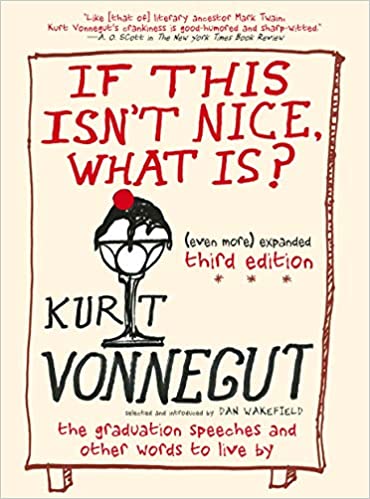
If This Isn’t Nice, What Is?: Advice to the Young is a collection of Vonnegut’s graduation speeches, a form that suited Vonnegut perfectly since he worked on a basic framework found among comedians: The Joke. And jokes are perfect for graduations where people invited to give speeches often take themselves and the ceremony far too seriously (see my own tongue-in-cheek graduation speech written mostly as a homage to Vonnegut).

If This Ian’t Nice, What Is?

If this collection isn’t perfect for a graduation gift, what is?

In “How I Learned from a Teacher What Artists Do,” Vonnegut employs his standard speech format, exhibiting his mainstay of seeming simplicity and dark bitterness masking crystal clear Truth and genuine kindness, or better phrased, a genuine call to kindness among all humans and for all things of this only world we know:

There are three things that I very much want to say in this brief hail and farewell. They are things which haven’t been said enough to you freshly minted graduates nor to your parents or guardians, nor to me, nor to your teachers. I will say these in the body of my speech, I’m just setting you up for this.

First, I will say thank you. Second, I will say I am truly sorry—now that is the striking novelty among the three. We live in a time when nobody ever seems to apologize for anything; they just weep and raise hell on the Oprah Winfrey Show. The third thing I want to say to you at some point— probably close to the end—is, “We love you.” Now if I fail to say any of those three things in the body of this great speech, hold up your hands, and I will remedy the deficiency.

I probably fell in love hard with the work of Vonnegut with Breakfast of Champions, although Vonnegut himself offered only an average grade for the work. Part of the attraction, I know, are the crude drawings, Vonnegut’s artwork that blends his calling to capture the world simply—I feel Thoreau in the background—and to remain true to his primary love, words.

I probably came to understand fully the work for Vonnegut with Cat’s Cradle, which Vonnegut graded highly also, and I return to it often to help me navigate the world too complex for a humankind unkind.

However, like his A Man without a Country, the collected graduation speeches are punctuated with his drawings, something that remains possibly the most endearing quality of published Vonnegut, which leads me to the other new Vonnegut resurrection—Kurt Vonnegut Drawings.

Kurt Vonnegut Drawings

There is an apt and warm touch to this collection of Vonnegut’s visual art, the “drawings” in the title. Vonnegut, if anything, is an artist that embodies childhood as well as a glorious faith in childhood. When he is most serious and most angry, he appears to be his most playful and childlike, but never childish (preview some of the pieces in this review).

In my most recent poem, Vonnegut’s Bluebeard came rushing back to me, unbidden. I preface the poem with a line from the novel and then include an allusion to the novel’s ending. Bluebeard is one of Vonnegut’s many faux autobiographies that exist in a netherworld between fiction and nonfiction that forces the reader to consider everything she/he knows about genre while also setting all of those assumptions aside.

There is a good deal of Vonnegut to find in Bluebeard and Rabo Karabekian (who confesses [for Vonnegut?], “I may have been a lousy painter, but what a collector I turned out to be!”); just as there is much in both that tells us almost nothing about Vonnegut.

Having spent a year or so of my life as a biographer, and then having read dozens of biographies, I am under no delusion Vonnegut was some saint of a human as he walked the earth daily. Who is?

But—despite Vonnegut being mostly a man of letters—I find his drawings help me come to terms with the complete Vonnegut, the human Vonnegut wanted to be, the humans Vonnegut wanted all of us to be.

Vonnegut shall not pass for me until I too pass because he remains in that thing that a small group of humans reach for, frantically I think as a very human thing to do—our shared frailty and mortality coming up against our longing for immortality: Art.

Buy these books.

Hold the hardback copies in your hands to feel the weight, and then flip each over for the two photos of Vonnegut.

On the back cover of the speeches, Vonnegut is striking a Tom Wolfe pose and look, foregrounded by a pigeon just slightly out of focus.

But save the back cover of the drawings for last: Vonnegut sitting, weathered face balanced beautifully by weathered sneakers and then ceramic Laurel and Hardy on the table beside him.

Please, buy these books, but buy extra copies.

Hand them out to strangers as you walk down the street.

Click for Further Reading

educator, public scholar, poet&writer – academic freedom isn't free