Post-apocalyptic Mindset in a Civilized World

The mass of men lead lives of quiet desperation.

Henry David Thoreau, Walden

Since October 1999, when I experienced several weeks of unrelenting panic attacks, I have been negotiating my lifelong struggle with anxiety—many of those years spent completely unaware of the problem and then coming to recognize and even understand a condition that to most people seems completely irrational (even silly).

Not to slip into being simplistic, one of the foundational ways in which I have come to understand better anxiety is that my body responds to the civilized world in ways that prehistory demanded.

In other words, when human existence depended on a constant state of vigilance, anxiety, that quality was passed on from human to human since those humans most vigilant—most aware of the world around them—lived long enough to procreate.

Now, although no mountain lion lies in wait to pounce upon me and make me its lunch, I live in a constant state as if that were true—hyperaware of both the world and every possibility about that world.

And that is the seemingly irrational part for those who do not experience incessant anxiety. Of course, I know better, but anxiety of the type I experience is beyond rationality.

Thus, for me (and possibly my fellow sufferers of anxiety), The Walking Dead (both the graphic series and the TV series) serves as a powerful allegory for our condition because surviving humans in that imagined post-apocalyptic world actually must exist always aware of the omnipresent possibility of zombie attack.

Post-apocalyptic Mindset in a Civilized World

But there is something here far beyond my personal wrestling with anxiety: The cultural and educational post-apocalyptic mindset in a civilized world.

To survive and thrive as a human has always been, is currently, and likely will be in the context of finite resources for survival and thriving.

For much of human history (and in our imagined post-apocalyptic worlds), those finite resources were necessarily the focus of human competition.

In the 21st century, humanity has not yet eradicated existence-as-survival among large numbers of people (disproportionately children, with no political power) born into and living in extreme poverty. However, in so-called developed countries, we do have pockets of organized societies that have built resources that, although still finite, are adequate to eradicate existence-as-survival if those people had the political will to address the distribution of those resources.

The U.S. is one such country that does not suffer under a scarcity of resources, but under an inequitable distribution of resources, one that allows (and even perpetuates) scarcity for some and abundance for others (primarily determined by anyone’s accident of birth).

I want to pose two claims now:

  1. The U.S. as a civilized nation could establish an equitable society in which the basic minimum human condition would insure that all have access to those resources that support both the need to survive and the urge to thrive.
  2. That ideal cannot be attained as long as the U.S. remains entrenched in ideologies committed to rugged individualism, competition, and institutional pursuits of “grit” and “zero tolerance.”

Not only are U.S. commitments to #2 counter to achieving #1, but also those commitments serve only to support the minority elite class that benefits from those ideologies despite having rarely exhibited those qualities.

In other words, the ruling elite have been born into abundance and haven’t experienced the anxiety of scarcity, but they demand that those born into and living in scarcity rise through a manufactured culture of competition—even though we have an abundance of resources to make such social Darwinism unnecessary.

As just one example, researchers and advocates of “grit” actually recommend placing impoverished and minority students in fabricated situations of scarcity to teach them the “grit” those researchers and advocates claim is the source of achievement among the affluent (a claim that, in fact, is at best misleading, and at worst, simply false).

And to add insult to injury, those outliers who have risen through scarcity to thrive have been co-opted into the post-apocalyptic mindset maintaining that since some have fought to survive, others must fight to survive.

The alternative of a society in which such base struggles do not have to occur is either ignored or trivialized as a soft option beneath our ruggedly individualistic culture. We boast, in fact, when we make other people suffer: “I taught him a lesson.”

As someone trapped in an irrational existence governed by anxiety—an existence dramatized in the fabricated world beyond the zombie apocalypse—I treasure the possibility of rejecting the post-apocalyptic mindset in a civilized world.

We know that scarcity creates anxiety and that any person suffers under the weight of scarcity, notably if that scarcity is avoidable. We also know that everyone benefits from a condition of abundance (see Scarcity).

And thus, I remain offended by the incessant refrain offered by those with the loudest voices in our society, voices that demand the least among us must work twice as hard as everyone else to earn the basic dignity of human existence the privileged have handed to them.

It is, ultimately, a shallow call against the world we could create, a world unlike our prehistoric past and unlike our fabricated post-apocalyptic future.

It is world where we no longer foster competition, but make competition unnecessary—as it already could be if we recognized we are no longer slaves to scarcity but to the inequitable distribution of resources that erases our humanity in very real ways that have nothing to do with zombies.

Many people throughout the world and in the U.S.—many children—lead lives of quiet desperation, desperation about food, shelter, health, and happiness.

One new fact of the human condition, however, is that those people do not have to lead lives of desperation. For those living in abundance, the choice to end scarcity is ours.

That we appear unwilling (not unable) to do so causes me great, and for once, justifiable anxiety.

Free Reading Redux

A book must be the axe for the frozen sea within us.

Franz Kafka, Letter to Oskar Pollak 1904

Paul Horton at Anthony Cody’s blog has offered a third installment of his defense of reading, recommending:

David Mikics, a Professor of English at the University of Houston, has recently written a very good book on this issue, Slow Reading in a Hurried Age (2013).

As reading and English teachers grapple with teaching literacy to prepare students for PARCC tests across the country, they should read this book very slowly to attempt to maintain a semblance of sanity: Slow Reading in a Hurried Age describes what you know you should be doing and want to do in your classes: reading to open minds rather than prescribed literacy drills that closes them.

Horton’s defense speaks to two important points I want to add here.

First, over 31 years as a teacher primarily concerned with literacy, I can attest that one of the most powerful forces that stands between students and a life-long love of reading is formal schooling.

For example, virtually all children (who are healthy, safe, and well fed) are eager and excited about both learning to read and reading. By 9th or 10th grade, however, a solid majority of students respond to reading somewhere between ambivalence and dread.

What do all those students have in common? Years of formal schooling in which their reading has overwhelmingly been assigned and then the purpose of text has almost exclusively been reduced to mining those assigned texts for the information teachers or test creators want those students to identify (up next, the hell that will be “close reading”—or “how to destroy the love of reading in one easy step”).

Teaching at the university level and working closely with English majors have presented me with another powerful phenomenon: College students who lament that their formal education keeps them from pleasure reading and who feel relief and excitement at the possibility of returning to reading by choice once they graduate.

Second, Horton’s series on reading speaks to the work of Lou LaBrant, who spent most of her 65 years as a formal educator calling for free reading—including her foundational “The Content of a Free Reading Program” (1937).

And thus, to the term “free reading.”

Directly, advocacy for free reading is an evidence-based argument that reading is essential for human agency and empowerment, but the quest for reading among the young must be couched in recognizing the tension between the ability to read (so-called reading skills such as decoding, comprehension, etc.) and the proclivity to read (appreciating the value of reading as well as simply wanting to read).

If teaching children to read makes them non-readers, what’s is the point?

That leads to the secondary implication of the term “free reading”—we must find ways in which to free reading from the historical and current policies and practices that destroy the love of reading all children need and deserve.

And here is what we know (from the earliest years of LaBrant’s work to the continued scholarship and advocacy of Stephen Krashen):

  • Choice is one of the most powerful conditions for all literacy growth, especially when students are allowed choice in the context of the guidance of expert readers and writers (including but not exclusively teachers).
  • Access to books and texts is central to literacy development, especially abundant access to texts in the home and in schools (such as well-funded libraries with professional librarians).

The ways in which many of us come to love reading have been identified and confirmed again and again by teachers and researchers, but also among writers. Read Neil Gaiman on libraries and books, or Ray Bradbury, or Walter Dean Myers.

That list, in fact, is nearly endless, but we fail to listen to teachers, researchers, writers, and worst of all, students.

There is a wonderful and powerfully subtle remembrance in Lousie DeSalvo’s Vertigo in which she shares a moment from her high school experience. DeSalvo’s physics teacher confronts the young Louise about her ignoring his lectures by reading novels not-so-covertly in the back of room (otherwise, Louise notes that she is a good student in that class).

Mr. Horton, the teacher, does not respond in the way we expect. He takes her book, Fyodor Dostoevsky’s The Possessed, in his hand and then offers her a deal: He wants her to stop ignoring his lectures, but he offers to read the books she is reading and then talking with her about them (pp. 168-169).

For me, this teacher asks that DeSalvo respect the course by acknowledging his respect for those things that matter to her. It is an elegant and gracious compromise found all too rarely in schools.

If we are to take seriously the value in reading, as Horton does, we must come to terms with the paradox: Free reading is the path to free reading from the failures of demanding and teaching reading in our schools.

In 1937, LaBrant reached a conclusion that holds true today:

The theory that in a free or extensive reading program designed to utilize interest and to serve individual needs there will be fruitless reading of light fiction gains no evidence from this study. The report does, however, point to the possibility that the adolescent has much greater power to read and to think intelligently about reading than the results of our conventional program have led us to believe. (p. 34)

DeSalvo’s physics teacher ends his deal offer by noting that Louise has the key quality needed for a teacher: “‘A passionate interest in your subject'” (p. 169).

Moments such as this must become the norm of schooling, not the rare recollection found in a memoir—a memoir, by the way, that is a beautiful and incisive read, an “axe for the frozen sea within us.”

For Further Reading

How an economics professor taught me a life-changing lesson — in literature

Autonomy Must Precede Accountability

Nearly 2.5 years ago, I wrote directly about the essential flaw with the thirty-plus-years accountability movement in K-12 U.S. public education. That essential flaw is that accountability built on standards and high-stakes testing is a corruption of the concept of accountability—which may be better understood as “responsibility.”

The corrupted “accountability” imposed on students, teachers, and schools in this model fails to establish first some key conditions in which accountability proper can be valid, ethical, and effective:

  • Identify clearly and openly the conditions that are in need of reform as well as the causational roots of those conditions.
  • Insure and then honor the autonomy of those being held accountable.
  • Insure accountability does not include conditions over which those being held accountable have no real control.

As a teacher, and if I am allowed my professional autonomy, I cannot control the outcomes of my students since those outcomes are impacted significantly by many different cause agents outside my control, but I can (or should be able to) control the opportunities to learn that I provide students each day.

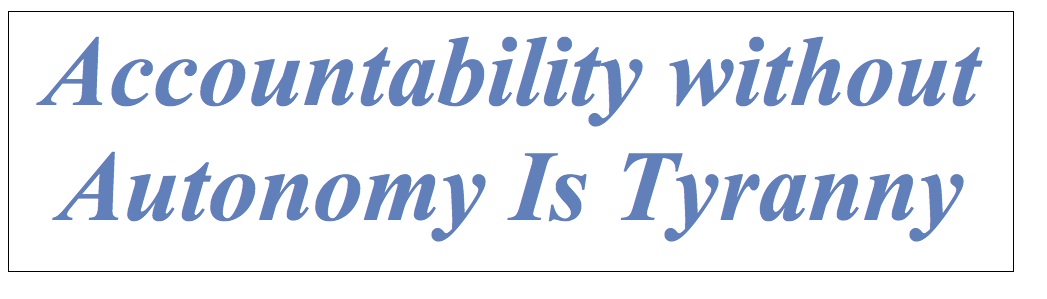
And thus, as we dig deeper the corrupted accountability hole with the shiny new Common Core shovel, it is with great sadness that I must assert that the reposting below remains the ugly reality of today as we near mid-2014 (in handy-dandy bumper sticker format):

UntitledAccountability without Autonomy Is Tyranny

When educational research reaches the public through the corporate media, the consequences are often dire. Chetty, Friedman, and Rockoff released “The Long-Term Impacts of Teachers: Teacher Value-Added and Student Outcomes in Adulthood” and immediately The New York Times pronounced in “Big Study Links Good Teachers to Lasting Gains”:

Elementary- and middle-school teachers who help raise their students’ standardized-test scores seem to have a wide-ranging, lasting positive effect on those students’ lives beyond academics, including lower teenage-pregnancy rates and greater college matriculation and adult earnings, according to a new study that tracked 2.5 million students over 20 years.

The simplistic and idealistic headline reflects the central failure of the media in the education reform debate, highlighted by careless reporting such as including this quote from one of the study’s researchers:

“The message is to fire people sooner rather than later,” Professor Friedman said.

This newest attempt to justify value-added methods for identifying, rewarding, and retaining high-quality teachers (as well as firing so-called weak teachers) was yet to be peer-reviewed, but two close initial examinations of the study—by Matthew Di Carlo and Bruce Baker—have praised the data but urged caution about conclusions drawn by the researchers and in media responses:

This appropriately cautious conclusion stands in stark contrast with the fact that most states have already decided to do so. It also indicates that those using the results of this paper to argue forcefully for specific policies are drawing unsupported conclusions from otherwise very important empirical findings. (Di Carlo)

These are interesting findings. It’s a really cool academic study. It’s a freakin’ amazing data set! But these findings cannot be immediately translated into what the headlines have suggested – that immediate use of value-added metrics to reshape the teacher workforce can lift the economy, and increase wages across the board! The headlines and media spin have been dreadfully overstated and deceptive. Other headlines and editorial commentary has been simply ignorant and irresponsible. (No Mr. Moran, this one study did not, does not, cannot negate  the vast array of concerns that have been raised about using value-added estimates as blunt, heavily weighted instruments in personnel policy in school systems.) (Baker)

Despite these strong and careful cautions, Dana Goldstein followed up with a praising piece in The Nation that links to Di Carlo’s work, but on balance accepts Chetty, Friedman, and Rockoff’s claims and suggests:

Given the widespread, non-ideological worries about the reliability of standardized test scores when they are used in high-stakes ways, it makes good sense for reform-minded teachers’ unions to embrace value-added as one measure of teacher effectiveness, while simultaneously pushing for teachers’ rights to a fair-minded appeals process. What’s more, just because we know that teachers with high value-added ratings are better for children, it doesn’t necessarily follow that we should pay such teachers more for good evaluation scores alone. Why not use value-added to help identify the most effective teachers, but then require these professionals to mentor their peers in order to earn higher pay?

Journalists, politicians, bureaucrats, and researchers are nearly uniform in failing to identify the central flaw in pursuing data as the holy grail of identifying and rewarding high-quality teachers, and the persistent positive response to Chetty, Friedman, and Rockoff’s study doesn’t prove VAM works but does reveal that there is little hope we’ll make any good decisions about teachers and schools any time soon.

Teaching in a Time of Tyranny

Ten-plus years into the federalized accountability era designated as No Child Left Behind, one fact of education is rarely mentioned (except by people who do spend and have spent their lives actually teaching children day in and day out): Since 1983’s A Nation at Risk, and intensified under NCLB, teachers have systematically been de-professionalized, forced by the weight of policy and bureaucracy to implement standards they did not create, to prepare students for tests they did not create (and cannot see, and likely do not support), and to be held accountable for policies and outcomes that are not within their control.

And this is the fact of the accountability era that has evolved from holding students accountable for test scores in the beginning to the more recent call to hold teachers accountable because, as media pundits claim, teachers and their protective unions are all that is wrong with the U.S.—at least according to Mort Zuckerman on CNN:

I think there are huge problems in this country and a lot of it, in my judgment, stems not from capitalism [emphasis added] but from the government….

Because the education is a government function. If there ever was a public function in this country from the days it started, it’s public education and we’ve done a lousy job. Part of it is frankly because we have lousy teachers.

Part of the reason we have lousy teachers is we have teachers union that say won’t deal with those issues. So there are lots of reasons why education is not being properly handled in this country.

If U.S. public education is failing (and that is at least complicated, if not mostly misleading) and if teachers are the source of that failure (and that is demonstrably untrue since out-of-school factors represent at least two-thirds of the influence on measurable student outcomes), let’s consider where the accountability should lie.

For the past ten years, teachers have been reduced to mere conduits of policy, curriculum, and tests that have nothing in common with what educators and researchers know to be best practice. Teacher have had little or no autonomy in these decisions and practices. To hold people accountable for implementing behaviors they do not control or support is, simply put, tyranny—not accountability.

The teacher quality debate is failing among political leaders, corporate elites, and the media because none of them are teachers, and as a consequence, they are controlling a debate about reform that they do not allow to start where it should—not at how to measure teacher quality, but at creating teaching and learning environments that honor the autonomy of children and teachers as professionals.

The ugly truth is that the leading elite do not truly respect children (especially children of color, children living in poverty, and children speaking home languages other than English), and they genuinely do not want professional teachers.

If children were treated with dignity in our schools and provided the environment they deserve to look critically at the world and if teachers were allowed their professional autonomy and held accountable for only that over which they have control, those children and teachers would likely notice and confront the tremendous inequity being controlled and perpetuated by the corporate leaders, corporate politicians, and corporate media—threatening the privilege that is being protected by calls for more testing, more data, and more accountability.

Hasty and misleading reactions to research that confirms the corporate narrative and even moderate pleas for compromise, such as Goldstein’s, are equally inexcusable because they all fail to confront that accountability without autonomy is tyranny.

We are a people tragically enamored with data to the exclusion of humanity, dignity, and the very ideals we claim to be at center of our country—individual autonomy.

And we have sold our souls to capitalism, blind to the reality that the only thing free about the market is that our consumer culture is free of any ethics, free of any commitment to social justice.

Of course teacher quality matters, of course every child deserves a quality teacher. But neither is something we can measure and force to happen as if students and teachers are cogs in a machine.

So ultimately every second spent crunching data about VAM is wasted time; every moment and penny spent on more standards and testing, also wasted time.

Teaching, learning, and human autonomy are complicated and beyond metrics, but they must become the ideals we put into practice. All else is tyranny

My Speech to the Graduates: Don’t Listen to Graduation Speakers

I have lived some thirty years on this planet, and I have yet to hear the first syllable of valuable or even earnest advice from my seniors. They have told me nothing, and probably cannot tell me anything to the purpose. Here is life, an experiment to a great extent untried by me; but it does not avail me that they have tried it. If I have any experience which I think valuable, I am sure to reflect that this my Mentors said nothing about.

Henry David Thoreau, Walden

No institution has invited me to be the speaker at graduation, and none is ever likely to do so.

But I feel compelled to offer this speech to gradates. So in the spirit of Kurt Vonnegut—great American novelist who knew how to give a graduation speech—I’ll start by telling you exactly what I want you to learn from this speech: Don’t listen to graduation speakers.

Now that I have the main point out of the way, I want to share why I feel compelled to offer this speech to graduates, a speech I will never give, and I have two reasons:

  1. A book of Kurt Vonnegut speeches were just published, If This Isn’t Nice, What Is?: Advice for the Young, and I recommend you either buy a copy or ask for one as a graduation gift.
  2. First Lady Michelle Obama gave a May 2014 commencement address that is offensive to me in its portrayal of teachers:

So my mother volunteered at my school — helping out every day in the front office, making sure our teachers were doing their jobs, holding their feet to the fire if she thought they were falling short. I’d walk by the office and there she’d be. (Laughter.) I’d leave class to go to the bathroom, there she’d be again, roaming the halls, looking in the classrooms. And of course, as a kid, I have to say, that was a bit mortifying, having your mother at school all the time.

But looking back, I have no doubt that my classmates and I got a better education because she was looking over those teachers’ shoulders. (Applause.) You see, my mom was not a teacher or a principal or a school board member. But when it came to education, she had that hunger. So she believed that our education was very much her business.

Next is the part I opened by asking you to ignore—the part where I offer what I learned from my parents and how that differs greatly from the image Michelle Obama created about teachers who needed their feet held to the fire when they were falling short.

I want to focus on two lessons from my parents.

First, my father lived by a creed he repeated often to me: Do as I say and not as I do.

And this lesson is not what my father intended, but it taught me that adults often are hypocritical, especially in their interactions with children and young people (the same adults who implore children to work hard and be nice, do neither themselves). So the lesson I learned—don’t be a hypocrite—is one basis for my speech’s main thesis: Don’t listen to graduation speakers.

They are apt, I have found, to offer my father’s advice (Do as I say and not as I do), thinly veiled behind a number of rhetorical strategies that the speakers themselves likely did not write.

Second, like Michelle Obama, I learned powerful lessons about teachers and education from my parents. But my parents impressed upon me that teachers deserved my unwavering respect and that teaching was a noble thing for any person to do.

If  my parents had concerns about a teacher, that was never uttered in my presence, and if I ever crossed any lines of improper behavior or shoddy work as a student, my parents assured my teachers that would change and that the teachers had my parents’ full support in seeing that I never stumbled again.

The result of this second lesson—one quite distinct from the picture Michelle Obama painted about teachers? I have been a teacher for 31 years.

My parents are very proud of me for having dedicated my life to a noble profession.

They do not see me as someone who needs my feet held to the fire, as someone who must be watched because I am likely to fall short.

I am also proud to call myself a teacher.

Now, here toward the end, I want to include what all graduation speakers are expected to offer, advice.

I could have spent my career so far making more money than I have as a teacher, but my profession is a profession of service and the benefits of dedicating myself to that service is more than enough to counterbalance the money I have not earned.

So I am telling you without an ounce of hypocrisy or without the usual lip-service that accompanies this advice in the U.S.: Dedicate your life to something that matters to you because you have but one life and the pursuit of money and things will always prove hollow in the long run if those pursuits keep you from the things that matter.

In the off chance that you didn’t take the paradoxical advice of this speech, I must end in the only way I can in full sincerity, leading you again to the world of Kurt Vonnegurt.

Eliot Rosewater in Kurt Vonnegut’s God Bless You, Mr. Rosewater implores:

Go over to her shack, I guess. Sprinkles some water on the babies, say, “Hello, babies. Welcome to Earth. It’s hot in the summer and cold in the winter. It’s round and wet and crowded. At the outside, babies, you’ve got about a hundred years here. There’s only one rule that I know of, babies—:

“God damn it, you’ve got to be kind.” (p. 129)

The adult world is filled with abundant mean-spirited hypocrisy, and you can certainly do better.

I hope that you will.

On Foma and Mendacity: Letting the Cat Out of the Bag

Kurt Vonnegut’s Cat’s Cradle and Tennessee Williams’s Cat on a Hot Tin Roof may seem at first blush to share only the use of “cat” in their titles, but both works are masterful examinations of something central to the human condition: the lie.

But Vonnegut’s foma at the heart of Bokononism and Big Daddy’s railing against mendacity  present contrasting dramatizations of “lying and liars,” as Brick and Big Daddy wrestle with “one of them five dollar words” [1]:

Mendacity is the darkest of lies because it corrupts and ultimately destroys relationships and even lives. For Big Daddy, mendacity is inevitable, central to the human condition: “I’ve lived with mendacity!—Why can’t you live with it? Hell, you got to live with it, there’s nothing else to live with except mendacity, is there?”

While Vonnegut’s novel is also dark—and typically satirical—foma is offered as harmless lies, as Julian Castle explains to the narrator:

“Well, when it became evident that no governmental or economic reform was going to make the people much less miserable, the religion became the one real instrument of hope. Truth was the enemy of the people, because the truth was so terrible, so Bokonon made it his business to provide the people with better and better lies.” (p. 172)

Although different consequences result from the mendacity of Cat on a Hot Tin Roof and the foma of Cat’s Cradle, all lies share one important characteristic: They are almost impossible to confront, and once confronted, they create a great deal of pain.

As a parent, I came face to face with letting the cat out of the bag when my daughter first unmasked the foma of the Tooth Fairy, and then connected that realization with Santa Claus. After I confessed to the truth—trying as I did to make a case about “harmless lies”—my daughter cut right to the heart of the matter, asking, “Why did y’all lie to me?”

The thinnest margins between mendacity and foma, I think, are found in our cultural myths—the fatal flaw of confusing the ideals we aspire to as a people with conditions already achieved. Many of those aspirations have tipped into mendacity, poisoning the possibility of those ideals—especially in the foundational promises of public institutions.

Here, then, are those ideals that could have served us well as aspiration, but now work as mendacity and thus against our best intensions:

  • Capitalism and choice. The realization is now becoming hard to ignore, that capitalism (the free market) is incompatible with equity (see, for example, Thomas Piketty). As well, choice as a concept central to freedom is far more complicated than expressed in our public discourse. Both capitalism and choice have worked against cultural aspirations for equity, but those failures may be better explained by the reason they have failed: idealizing capitalism and choice while failing to commit fully to the power of the Commons to establish the context within which capitalism and choice could serve equity well.
  • Meritocracy. In the U.S., possibly the greatest lie that results from confusing an aspiration with an achieved condition is the argument that we live in a meritocracy. The evidence suggests that we currently do not have a meritocracy (see how being born rich and not attending college trumps being born poor but completing college), and even more disturbing, we are unlikely to achieve a meritocracy (see why “[e]qual opportunity cannot actually be achieved”).
  • Education as Key to Equity. As misleading as claims about the U.S. being a meritocracy (or that we are a post-racial country) are assertions that education is the one true way to overcome social ills and how any individual can lift her/himself out of poverty. However, education has not and does not, in fact, change society, rarely lifts people out of the circumstances of their births, and serves as a marker for privilege (thus creates the illusion that education is a force for change)—as Reardon explains:

Here’s a fact that may not surprise you: the children of the rich perform better in school, on average, than children from middle-class or poor families. Students growing up in richer families have better grades and higher standardized test scores, on average, than poorer students; they also have higher rates of participation in extracurricular activities and school leadership positions, higher graduation rates and higher rates of college enrollment and completion.

Whether you think it deeply unjust, lamentable but inevitable, or obvious and unproblematic, this is hardly news. It is true in most societies and has been true in the United States for at least as long as we have thought to ask the question and had sufficient data to verify the answer.

What is news is that in the United States over the last few decades these differences in educational success between high- and lower-income students have grown substantially….

Meanwhile, not only are the children of the rich doing better in school than even the children of the middle class, but the changing economy means that school success is increasingly necessary to future economic success, a worrisome mutual reinforcement of trends that is making our society more socially and economically immobile.

When my daughter allowed the evidence to lead her to a conclusion that made her at least uncomfortable if not disillusioned, she had to begin to re-evaluating her perception of the world, a perception that included the nature of truth and the role of her parents in her navigating that world.

That may sound dramatic about a conversation including the Tooth Fairy, but for a child, the intentions of foma have the same stinging consequences as the cynicism of mendacity. For adults, it seems, burying ourselves in the opiate of foma (Aldous Huxley’s soma) allows us to ignore the bitter pill of mendacity.

As aspirations, the bulleted concepts above remain important for a free people, but as mendacity, they have and will continue to insure that inequity cannot be achieved.

Many readers miss the powerful theme of optimism that runs through Vonnegut’s works; he maintains a genuine and compelling hope among the ruins for the capacity of humans to be kind. The bitterness and fatalism of Big Daddy, however, seem for now a more accurate assessment of the human condition in 2014.

More difficult to confront than either mendacity or foma, it appears, is the hard truth that the human pursuit of equity must come before merit can matter and that in order to achieve that possibility, the human condition must commit to a spirit of community and collaboration, not competition.

Regretfully, most in power are apt to continue to not let that cat out of the bag.

[1] The film adaptation of the play has some shifts in the wording and transposing of character’s lines, but the film is iconic as pop culture so I include a clip from that although I use lines from the play in the quotes.

Once Again, NAEP? Nope: “states and schools have lied about the rigor of their courses”

Some say the world will end in fire,
Some say in ice.

“Fire and Ice,” Robert Frost

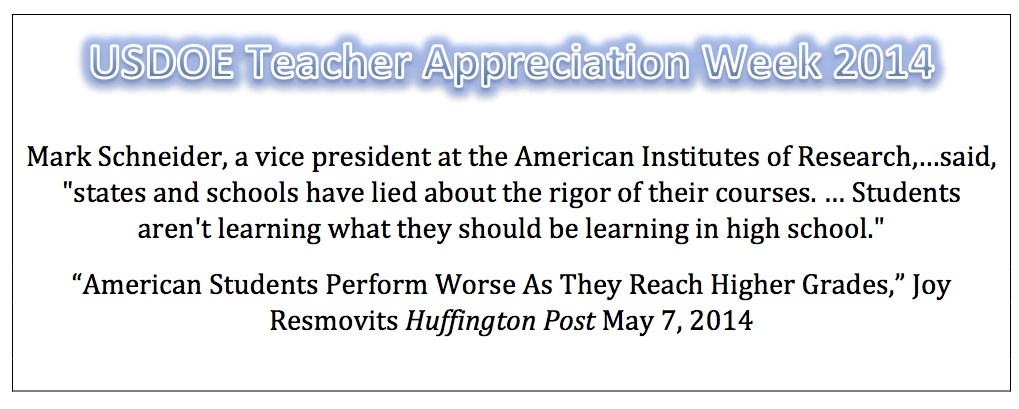
While it appears I was right about Teacher Appreciation Week 2014, I was a tad bit off about the source of the Zombie Apocalypse or Armageddon: The world will not end because of PISA score rankings, but because of stagnant NAEP scores by high school students.

In fact, the U.S. Department of Education has just released a hot-off-the-press bumper sticker that celebrates Teacher Appreciation Week 2014 by acknowledging recent NAEP data:

USDOE TAW 2014

What happens when inept political leadership (Note: The 21st century prerequisite for holding the position of Secretary of Education appears to be a gentle blend of an absence of expertise and outright dishonesty related to NAEP reporting) collides with press-release journalism [1] (like an asteroid slamming into the Earth)?

Well, the claim made above by Schneider (“a vice president at the American Institutes of Research who previously led the government arm that administered NAEP”)—a truly ugly claim about education and teachers that appears to have been accepted without any request for evidence (Evidence? Secretary Duncan, You Can’t Handle the Evidence).

NAEP, then, once again prompts handwringing about stagnant scores and achievement gaps—and there are always charts and graphs to make the point along with the usual insincere nod to “the Civil Rights Issue of Our Time”:

U.S. Secretary of Education Arne Duncan said in a statement about the results, “We project that our nation’s public schools will become majority-minority this fall—making it even more urgent to put renewed attention into the academic rigor and equity of course offerings and into efforts to redesign high schools. We must reject educational stagnation in our high schools, and as [a] nation, we must do better for all students, especially for African-American and Latino students.”

Amongst the ugliness and baseless pontificating by political leaders are absent some key points that the media will fail (again) to uncover:

  • NAEP data are released and pronouncements made, but no one really knows the cause of the data concerns. Why scores appear stagnant and why racial/socioeconomic gaps persist are often complex (although a huge and evidence-based source of both is likely inequity and poverty). The initial reactions to NAEP this time in EdWeek and HuffPo are overwhelmingly speculation by people with political agendas. If we are genuinely interested in people who are likely telling lies, it appears we may want to look at the people cited in these articles.
  • “Achievement gap” is a misnomer for “opportunity gaps,” and using standardized tests to measure and examine that gap is inherently flawed since standardized testing remains biased by race, class, and gender; and thus, the tests themselves not only measure but create the gaps. Furthermore, for any gap to close, identified populations of students would need to be treated differently, but the current policy is a common core of what students experience in schools. And another dirty little secret is that the current era of accountability has damned high-poverty and minority students to test-prep course work that in fact asks less of them (thus, it is not “states and schools” that are telling lies, but politicians who shape accountability policy who are in fact telling lies).
  • Throughout the 20th and into the 21st centuries, we have found no correlation between how U.S. students do on test comparisons (among states or internationally) and claimed goals such as international competitiveness or the robustness of the U.S economy. None. And while we are at it, over the last three decades of accountability, we have found no correlation between the existence or quality of standards and measurable student outcomes. None. Again, it is a political lie to continue to cry “crisis” over test scores. A lie.

While I remain certain that accountability built on standards and high-stakes testing is a fundamental flaw in education reform, political leadership and the media are not doing us any favors either. This latest “high school achievement crisis” based on a rush to misread NAEP data is but more of the same—lamentably so as we certainly could do a better job even within the flawed test-based culture of U.S. education, as Matthew Di Carlo has outlined.

Childhood is steeped in a series of lies—what Kurt Vonnegut has labeled “foma,” although many of these lies are not so harmless: the Easter bunny, Santa Claus, work hard and be nice.

But one truism from our youths must be accepted as fact: Action speaks louder than words.

If we apply that to the USDOE, then we are likely to recognize just who is telling lies and about what:

  1. Lie: U.S. schools, teachers, and students are failing because of low standards and expectations.
  2. Lie: New standards and new tests will save public schools.
  3. Lie: State X is worse than State Y because NAEP (or SAT) scores say so; the U.S. is falling behind Country X because PISA scores say so.
  4. Lie: Poverty is not destiny.
  5. Lie: Arne Duncan (or Bill Gates or Michelle Rhee) knows what he is talking about.
  6. Lie: Education reform is the Civil Rights issue of our time.
  7. Lie: U.S. education is struggling because of “bad” teachers who are too hard to fire.
  8. Lie: Charter school X is a “miracle” school.

Truth: The USDOE is the embodiment of “lies, damned lies, and statistics.”

For Further Reading

I love the smell of NAEPalm in the morning

[1] See also Is It Journalism, or Just a Repackaged Press Release? Here’s a Tool to Help You Find Out.


PISA Brainwashing: Measure, Rank, Repeat

When Mary Catherine Bradshaw, a teacher since 1984 in Nashville, TN, announced her retirement from public schools, Bradshaw pointed her finger at one major reason, standardized testing:

[S]he says standardized testing is the reason….

Testing, she said, has taken away from instructional time and taken the joy out of learning.

Much has changed, she said, since she took her first job as a teacher at Hillsboro in 1984 when she said she was attracted to its diversity and commitment to academic reputation.

“There was more of a focus on the whole student, the joy of learning, building a community and finding one’s own passion in the midst of the K-12 experience,” she said.

“Now, with the focus on testing, data collection and closing a too narrowly defined gap among learners, I have found myself ready to retire from public education.”

Bradshaw’s concern about the loss of joy due to the central place of testing in education is echoed in a recent statement about PISA rankings [1], as Peter Wilby details in Academics warn international school league tables are killing ‘joy of learning’:

Now nearly 100 leading educational figures from around the world have issued an unprecedented challenge to Pisa – and what they call “the negative consequences” of its rankings – in a letter to its director, Andreas Schleicher….

“Education policy across the world is being driven by the single aim of pushing up national performance levels on Pisa,” says one signatory, Stephen Ball, professor at London university’s Institute of Education. “It’s having a tremendously distorting effect, right down to the level of classroom teaching.” Another signatory, Sally Tomlinson, research fellow at Oxford university’s education department, says that, though the Pisa league tables appear to be scientifically based, “you really can’t compare a country the size of Liechtenstein with one the size of China and nor can you compare education systems that developed over the years in different political, social and cultural contexts”.

The signatories are particularly concerned about the UK, the US and other countries imitating schools in Asian countries that come high in the Pisa rankings. They are suspicious of Shanghai’s success. “Shanghai’s approach is an incredibly strategic one,” says Ball. “Their students practise the tests. It’s difficult to see what their maths teachers can say to ours except ‘teach to the test’.”

While international rankings based on test scores have influenced public perception of U.S. public education for at least 60+ years (see Hyman Rickover’s books lamenting U.S. rankings, for example), state rankings based on NAEP and SAT/ACT scores have also been central to perception as well as policy, especially since the early 1980s.

While the open letter to Schleicher is a powerful and important challenge to the misleading influence of PISA, the essential problem is high-stakes testing coupled with ranking as well as a persistent misinterpretation of test data (see this excellent examination of how test scores are misunderstood and misused).

As I have addressed often about the SAT (see HERE and HERE), even when a comparison of states appears fair and accurate—South Carolina with Mississippi, for example, since the states share a similar high-poverty demographics of students—the reality is far more complex: MS has a higher SAT average score than SC because the test-taking populations of students are significantly different despite the overall student populations being similar:

Two Southern states, Mississippi and South Carolina, share both a long history of high poverty rates (Mississippi at over 30% and SC at over 25%) and reputations for poor schools systems. Yet, when we compare the SAT scores (pdf) from Mississippi in 2010 (CR 566, M 548, W 552 for a 1,666 total) to SAT scores in SC (CR 484, 495, 468 for a 1,447 total), we may be compelled to charge that Mississippi has overcome a higher poverty rate than South Carolina to achieve, on average, a score 219 points higher.

This conclusion, based on a “few data points”, is factually accurate, but ultimately misleading once we add just one more data point: the percentage of students taking the exam. Just 3% of Mississippi seniors took the exam, compared to 66% in South Carolina. A fact of statistics tells us that SC’s larger percentage taking the exam is much closer to the normal distribution of the all seniors in that state, thus the average must be lower than a uniquely elite population, such as in Mississippi. Here, the statistics determined by the populations taking the exam trump the raw data of test averages, even when placed in the context of poverty. (The truth about failure in US schools)

Even if the open letter about PISA prompts reform by the OECD, we have evidence that the problem will persist. For example, The College Board struggles with both the statistical complexity of SAT data (see here about the recentering) and the misleading use of SAT data to rank states:

Educators, the media and others should:

8.1 Not rank or rate teachers, educational institutions, districts or states solely on aggregate scores derived from tests
that are intended primarily as a measure of individual students. Do not use aggregate scores as the single measure to
rank or rate teachers, educational institutions, districts, or states.

And yet, each year when SAT data are released, the media, political leaders, and public school critics rank states and pronounce schools a failure.

The open letter about PISA implores, “Slow down the testing juggernaut,” adding:

OECD’s narrow focus on standardised testing risks turning learning into drudgery and killing the joy of learning. As Pisa has led many governments into an international competition for higher test scores, OECD has assumed the power to shape education policy around the world, with no debate about the necessity or limitations of OECD’s goals. We are deeply concerned that measuring a great diversity of educational traditions and cultures using a single, narrow, biased yardstick could, in the end, do irreparable harm to our schools and our students.

Once we apply the brakes, we must then take a close look at the fundamental policy errors—high-stakes standardized testing, labeling, sorting, and ranking—and then abandon those practices for alternatives that address inequity both outside and inside schools and that honor the essential dignity and humanity of students and their teachers.

For Further Reading

Among the Many Things Wrong With International Achievement Comparisons, Gene V. Glass

More Things Wrong with International Assessments Like PISA, Gene V. Glass

[1] As full disclosure, I am a signatory on the letter.

If This Is Teacher Appreciation, I’m Glad It Is Only a Week

Talk back, speak up, be heard.

Bill Ayers, To Teach.

This is not the time for the teacher of any language to follow the line of least resistance, to teach without the fullest possible knowledge of the implications of his medium.

LaBrant, L. (1947, January). Research in languageElementary English, 24(1), 86-94.

The first full week in May 2014 is a swift punch in the gut of teachers across the U.S. since the week is both Teacher Appreciation Week and National Charter School Week.

Not since Waiting for “Superman” have teacher bashing and “miracle school” mania had such a distorted coexistence.

Here in my home state of South Carolina, we are witnessing a steady stream of Op-Eds written by teachers calling for VAM and an end to seniority in the dismissal of teachers. Yes, written by teachers. We also have a steady dose of Op-Eds about the plight upon our schools that threatens the very existence of humanity: “bad” teachers. [1]

So as I watch teaching and teachers being bashed, I am glad Teacher Appreciation Week lasts only a week; teachers and our profession have had enough in this time of devaluing teachers in the era of value-added.

The ugly truth is that all across the U.S. people genuinely do not appreciate teachers, and more broadly, people do not appreciate workers.

This makes no sense, of course, because almost all of us in this country are workers, but what are you going to do?

Way back in 2003, I wrote a piece for English Journal, “A Call to Action.”

The piece focuses on two teachers: my high school English teacher, Lynn Harrill, and the focus of my doctoral dissertation, Lou LaBrant. In the piece I conclude:

Each act I do as a person, as a teacher, as a writer is with Lynn Harrill and Lou LaBrant in mind. Everything I have learned about being an English teacher reminds me that each child, each student, is the reason we teach English. I write this not to complain, not to lament, but to call all of us to action. And I make this call in the names of Lynn Harrill and Lou LaBrant—the educator’s educators, who know and knew that this job we do is the most personal of endeavors because language is the essence of us as humans, and it is the only road to human dignity and individual voice.

So I say, teachers, we are mostly not appreciated; in fact, we are scorned. But we share a paradox as members of the scorned workers of the U.S. and as some of the most important people in the lives of our students (who often do appreciate us as individual people even as they express a lack of appreciation for “teachers” or “teaching”).

And here in 2014 as the education reform movement continues down the wrong path at warp speed, I remain convinced that we as teachers must take action. We must be the brakes that stop the momentum and then offer everyone the opportunity to step off and seek a better way.

Keep in mind that many of our students did not appreciate us at first because confronting what we don’t know and what we misunderstand is hard and uncomfortable. But over time, those initially resistant students came to a place where they could make that discomfort their own—and then they were able to appreciate us.

It is well past time for us to take our patience, our poise, our expertise, and our voices out of the classroom and into the public that, for now, doesn’t appreciate us because they simply do not know what this work is.

Teachers, it is time to teach beyond the walls of our schools.

[1] I am purposefully not hyperlinking to these, although I have in previous blogs. If you doubt my claims here, give google a shot, but I am simply exhausted by the nonsense and am teetering on the edge of not wanting to give these commentaries even one more mention.

educator, public scholar, poet&writer – academic freedom isn't free