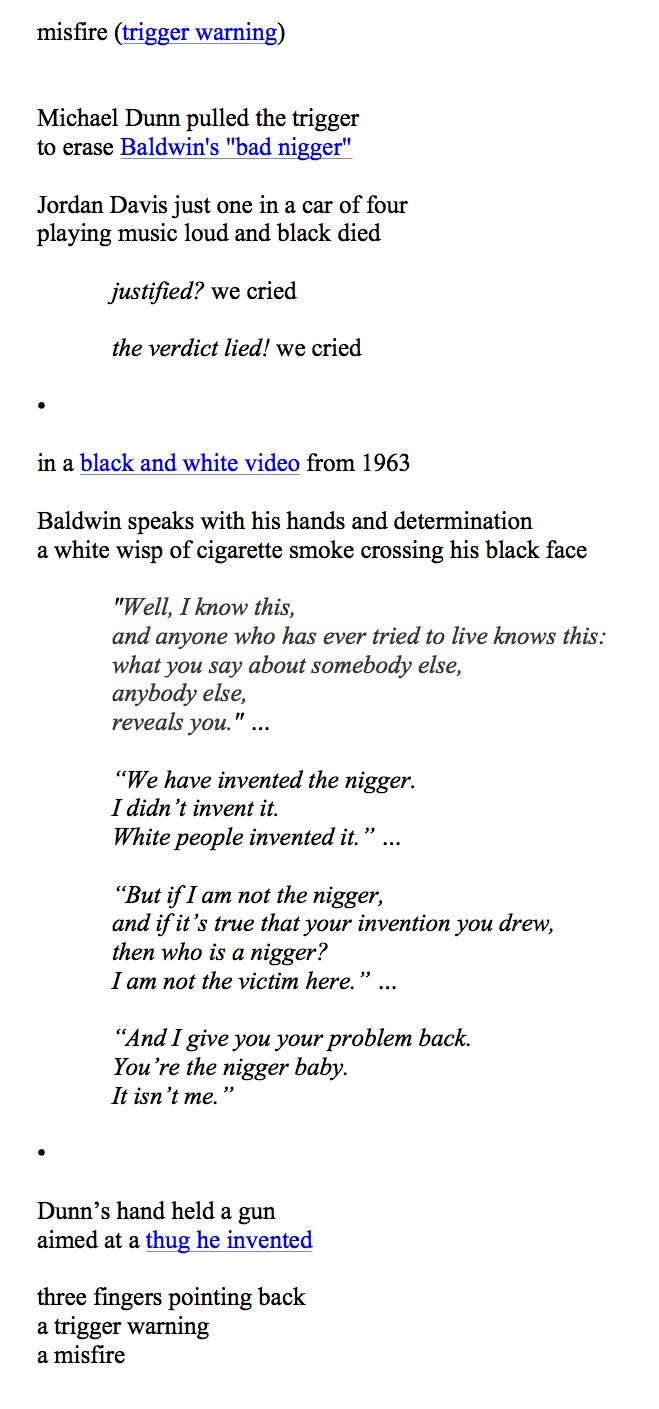
misfire (trigger warning) [please click title to the left for poem with hyperlinks]
—
—
—
—

Prologue
I am a child of literature, more specifically of science fiction.
As a result, I am also a child of allegory, metaphor, and the richness of layered language.
Smitten as a reader, I eventually—and predictably—looked in the mirror and saw a writer. For almost four decades now, I have been chasing that image in the mirror, that writer I hope to be.
So when I write—mostly non-fiction, mostly essays addressing issues related to education, poverty, race, and class—I am channeling the science fiction novelist I long(ed) to be. Some Vonnegut, some Atwood, some Bradbury—laced with Ellison and cummings and Dickinson as well as Salinger and a relentless pursuit of Baldwin’s passion, bravery, and incisiveness.
So in my blogging and scholarship, I am apt to confront the conditions of teachers as worker in the context of Cloud Atlas‘s thematic exploration of slavery, calling the current state of workers in the U.S. “wage-slavery.”
I write as I live—with anger and passion.
But I also write as I live—in a constant state of critical reflection. My anxieties are many, but one constant is the anxiety that I have failed the ultimate goal in some small or even significant way.
The road to hell is paved with good intentions. [1]
•
Nancy Flanagan has recently blogged about Monstrous Labels (see Part I and Part II), raising hard questions about the sorts of analogies and hyperbole that exist in the education reform debate. Flanagan is confronting another aspect of the tone debate I have been wrestling with for some time [2]:
Clearly, everyone who writes about the existence and meaning of cultural holocausts–including The Holocaust–must bow to the experience of the ones who lived it. Our only possible ethical response, however, is to try to take the sacrifices made in humanity’s historical tragedies and make them sacred, through remembrance and honor.
That’s an enormously difficult thing to do, fraught with false equivalencies and cultural misappropriation. But is it wrong? When you’re faced with what Jeff Bryant–correctly, in my opinion–labels an “existential threat” to an essential cornerstone of democratic equality, public education, is it immoral to call up the spirit of other existential threats to democracy, other weapons of human destruction?
On Twitter, Flanagan engaged Jose Vilson about the problems with misappropriations, further emphasizing how efforts to stress the importance of education reform issues to a lay public is fraught with substantive dangers and unintended consequences—ones that often serve to work against the good intentions of those making their cases.
If I have learned anything from committing to my own blog space and actively participating on Twitter and in the public sphere, my resistance to bowing to tone complaints and my effort to engage the public effectively are often now at odds because of the rising and stringent misinformed voices that too often are indistinguishable from informed voices (and I am pointing a finger here at me).
To put it briefly, if I can be mistaken by the public as little different in substance and tone for Glenn Beck or Michelle Malkin, I have failed miserably. That failure rests on my belief that expertise and experience are often lacking in deciding education policy, and therefore, I want to offer a voice of expertise and experience clearly distinguishable from the Beck/Malkin populism and libertarian fear-mongering.
So Flanagan’s question and Vilson’s warnings about misappropriations are important and powerful—and ultimately troubling.
All along the ideological spectrum, education reform commentary includes direct and indirect references to the Holocaust (and even Hitler), U.S. slavery, child abuse, and prisons—just to name a few analogies and uses of hyperbole.
In my 30+ years of teaching, I have heard numerous students call school prison; that may be one of the most common analogies uttered by students (even those not in schools with armed police and metal detectors).
In light of Flanagan’s question and Vilson’s warning, then, when I confront my own work—in blogs and scholarly publications—I must begin to examine more closely the very thin line between illuminating analogy and misappropriation. Here, then, are some guiding ideas and questions for keeping the discourse from failing our goals despite our good intentions:
•
Epilogue
Is the use of high-stakes testing in kindergarten child abuse?
Are zero tolerance policies, police in the hallways, and metal detectors creating schools as prisons?
Is mass incarceration the New Jim Crow?
Have U.S. workers been reduced to wage-slaves?
I think we must all ask ourselves at what cost are we making these claims, and we must be able to see and hear these claims through the eyes and ears of those who may not immediately see the difference between what we hope to accomplish and those who hold up posters of George W. Bush or Barack Obama as Hitler.
When people see no difference, we have lost something very important, and something precious.
When we offend the marginalized and oppressed as if they do not exist, we certainly have little room to criticize anyone about anything.
The privilege of having a voice must be tempered with humility, by honoring the dignity of everyone and by having the empathy to walk in someone else’s shoes, to live in someone else’s skin, to honor someone else’s past.
It may be best when we seek the truth that we also include “With explanation kind.”
•
Tell all the truth but tell it slant — (1263)
—
[1] Possibly one of the best passages from a novel is “‘Road to hell paved with unbought stuffed dogs'” from Ernest Hemingway’s The Sun Also Rises.
[2] See for example:
Tone, pt. 1: Does Tone Matter in the Education Reform Debate?
Tone, pt. 2: On “Hostile Rhetoric,” Laziness, and the Education Debate
Tone, pt. 4: Dystopian Fiction, Passion, and the Education Reform Debate
With Professors, We Need You!, Nicholas Kristof makes a case for professors as public intellectuals:
Professors today have a growing number of tools available to educate the public, from online courses to blogs to social media. Yet academics have been slow to cast pearls through Twitter and Facebook. Likewise, it was TED Talks by nonscholars that made lectures fun to watch (but I owe a shout-out to the Teaching Company’s lectures, which have enlivened our family’s car rides).
I write this in sorrow, for I considered an academic career and deeply admire the wisdom found on university campuses. So, professors, don’t cloister yourselves like medieval monks — we need you!
While Kristof’s plea stumbles in many places (for example, left-leaning academics appear to be discounted out of hand, suggesting that society can somehow be changed only by academics who hold ideologies similar to that public), Daniel Willingham’s follow up presents a strong case as well, notably targeting the role of professors as public intellectuals in the education debate:
Kristof did not distinguish between faculty in Arts & Sciences and those in professional schools such as law, medicine, education, and engineering. These latter have practical application embedded in their mission and I think are therefore more vulnerable to his charges….
But again, I think Kristof’s blade is much sharper when applied to university schools that claim a mission which includes practical application. Schools of Ed., I’m looking at you.
Also important is a comment from Stwriley at Willingham’s The Answer Sheet post, which reads in part:
The reason is that there are far fewer professors who don’t have to worry that what they say in public will cost them their jobs and that have the time to spend on non-teaching and non-research duties. At this time, 3 out of 4 university faculty are adjuncts or other contingent faculty. It is only those in tenured or tenure-track positions, with the far better pay, guarantees of due process and academic freedom, and personal time for outside activity who can take up the role of public intellectual….
This is the real reason for the decline in professors as public intellectuals: the destruction of their profession for the bottom line of others.
The closing point in this comment must not be ignored: The dismantling of academic tenure at university and K-12 levels includes a silencing of academics—something Kristof and Willingham appear to be lamenting.
Neither Kristof nor Willingham acknowledge that high-profile cases have shown that even tenured professors risk everything by being public voices. And when professors shift into the world of blogging, the stakes often are high.
If professors as public intellectuals are needed, then, some time must be spent addressing the many ways in which institutional and public policies are working against that possibility.
Ultimately, calls for professors as public intellectuals confront a number of problems, including:
Since I have made a conscious shift in how much energy I commit to traditional scholarly work versus public work, I have addressed these issues in a number of ways. Here, then, is a reader on the issues above as they relate to professors as public intellectuals:
See Also
What Academics Misunderstand About ‘Public Writing,’ Irina Dumitrescu
The difficulties scholars have writing for a broad audience, Christopher Schaberg and Ian Bogost
Academic Self-Marginalization Not the Problem, James Kwak
Why Is Academic Writing So Academic?, Joshua Rothman
Why Is Academic Writing So Beautiful? Notes on Black Feminist Scholarship, Emily Lordi
The responsibility of adjunct intellectuals, Corey Robin
Scabs: Academics and Others Who Write for Free, Yasmin Nair
The war on black intellectuals: What (mostly) white men keep getting wrong about public scholarship, Brittney Cooper
Columbia University Fired Two Eminent Public Intellectuals. Here’s Why It Matters. Michelle Goldberg
Roundup of Responses to Kristof’s Call for Professors in the Public Sphere, Jessie Daniels
Educating the Public on the Public’s Terms: An Open Letter to Academics, Peter Smagorinsky
In Defense of Public Writing, David Leonard
academic influence on Twitter: the findings
What’s Wrong With Public Intellectuals?, Mark Greif
How Scientists Engage the Public, Lee Rainie, Cary Funk, and Monica Anderson
The Dangerous Silence of Academic Researchers, Y. Claire Wang
‘But Does It Count?’, David M. Perry
Twitter and Tenure, David M. Perry
Prof, no one is reading you, Asit K. Biswas and Julian Kirchherr
The Perils of Being a Public Intellectual, Henry Giroux
From Tweet to Blog Post to Peer-Reviewed Article: How to be a Scholar Now, Jessie Daniels
Here’s why academics should write for the public, Jonathan Wal and David Miller
Faculty trained to speak about systems of oppression should not be required to be neutral in the classroom (opinion), Nicole Truesdell
Many people call for an end to politics in the classroom, as this is seen as the source of the problem. Rather than address systemic and structural oppression and discrimination, faculty are being asked to take “neutral” stances and just teach our disciplines, leaving politics to social media and in-person conversation. Yet for many scholars, this is our work. Many of us are trained to see and then speak on institutional and structural systems of oppression. I have been trained specifically to see and call out institutional racism through an intersectional lens. If we are being told to just do our job, then we are. So the real question becomes, is society ready to accept the true point of an education, which is to develop a group of critically thinking, conscious citizens? Is higher education ready and capable of taking on this work?
That is the true point of education, what James Baldwin meant when he said in 1963, “The paradox of education is precisely this — that as one begins to become conscious, one begins to examine the society in which he is being educated.” As educators, it is our job to teach students how to think critically so that they can engage with larger social issues. That is not confined to just the social sciences, but has an impact on all academic disciplines and departments. Yet as Baldwin also said, society is not always that anxious to have a mass of critically thinking and engaged people, because “what societies really, ideally, want is a citizenry which will simply obey the rules of society. If a society succeeds in this, that society is about to perish.” That is why education matters more so now than ever as a location that should be unapologetically committed to developing students to become true critically engaged thinkers who learn how to apply those knowledges, methodologies and skills to locations outside spaces like this.
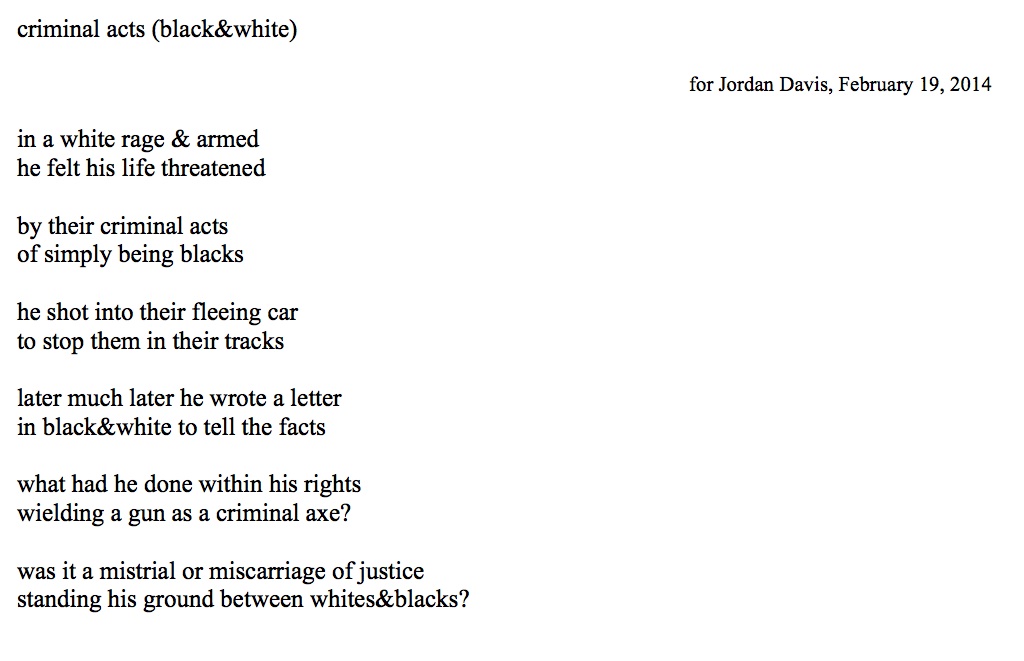
In On the Killing of Jordan Davis by Michael Dunn, Ta-Nehisi Coates confronts the injustice of simply being born an African American son:
Jordan Davis had a mother and a father. It did not save him. Trayvon Martin had a mother and a father. They could not save him. My son has a father and mother. We cannot protect him from our country, which is our aegis and our assailant. We cannot protect our children because racism in America is not merely a belief system but a heritage, and the inability of black parents to protect their children is an ancient tradition.
These words—”We cannot protect him from our country, which is our aegis and our assailant”—echo James Baldwin writing in 1966:
This is why those pious calls to “respect the law,” always to be heard from prominent citizens each time the ghetto explodes, are so obscene. The law is meant to be my servant and not my master, still less my torturer and my murderer. To respect the law, in the context in which the American Negro finds himself, is simply to surrender his self-respect.
In this essay, Baldwin lays bare the scar of racism in the U.S.:
These things happen, in all our Harlems, every single day. If we ignore this fact, and our common responsibility to change this fact, we are sealing our doom. Here is the boy, Daniel Hamm, speaking—speaking of his country, which has sworn to bung peace and freedom to so many millions. “They don’t want us here. They don’t want us—period! All they want us to do is work on these penny-ante jobs for them—and that’s it. And beat our heads in whenever they feel like it. They don’t want us on the street ’cause the World’s Fair is coming. And they figure that all black people are hoodlums anyway, or bums, with no character of our own. So they put us off the streets, so their friends from Europe, Paris or Vietnam—wherever they come from—can come and see this supposed-to-be great city.”
There is a very bitter prescience in what this boy—this “bad nigger”—is saying, and he was not born knowing it. We taught it to him in seventeen years. He is draft age now, and if he were not in jail, would very probably be on his way to Southeast Asia. Many of his contemporaries are there, and the American Government and the American press are extremely proud of them. They are dying there like flies; they are dying in the streets of all our Harlems far more hideously than flies. A member of my family said to me when we learned of the bombing of the four little girls in the Birmingham Sunday school, “Well, they don’t need us for work no more. Where are they building the gas ovens?” Many Negroes feel this; there is no way not to feel it. Alas, we know our countrymen, municipalities, judges, politicians, policemen and draft boards very well. There is more than one way to skin a cat, and more than one way to get bad niggers off the streets. No one in Harlem will ever believe that The Harlem Six are guilty—God knows their guilt has certainly not been proved. Harlem knows, though, that they have been abused and possibly destroyed, and Harlem knows why—we have lived with it since our eyes opened on the world. One is in the impossible position of being unable to believe a word one’s countrymen say. “I can’t believe what you say,” the song goes, “because I see what you do”—and one is also under the necessity of escaping the jungle of one’s situation into any other jungle whatever. It is the bitterest possible comment on our situation now that the suspicion is alive in so many breasts that America has at last found a way of dealing with the Negro problem. “They don’t want us—period!” The meek shall inherit the earth, it is said. This presents a very bleak image to those who live in occupied territory. The meek Southeast Asians, those who remain, shall have their free elections, and the meek American Negroes—those who survive—shall enter the Great Society.
Post-racial discourse offers make-up, seeks a bit of cosmetic surgery for that scar, but denying racism doesn’t erase racism. The Michael Dunn verdict as partially a “mistrial” is a bitter but apt term for the lack of justice when the victim is an African American young man.
Failing to convict Dunn is more of the evidence problem facing those who seek to deny racism in the U.S.
Baldwin’s essay from 1966 simply remains a chilling echo behind Coates’s final words:
I will not respect the lie. I would rather be thought crazy.
I insist that the irrelevance of black life has been drilled into this country since its infancy, and shall not be extricated through the latest innovations in Negro Finishing School. I insist that racism is our heritage, that Thomas Jefferson’s genius is no more important than his plundering of the body of Sally Hemmings, that George Washington’s abdication is no more significant than his wild pursuit of Oney Judge, that the G.I Bill’s accolades are somehow inseparable from its racist heritage. I will not respect the lie. I insist that racism must be properly understood as an Intelligence, as a sentience, as a default setting which, likely to the end of our days, we shall unerringly return.
For young African American men in the U.S., the options appear incredibly narrow between the mass incarceration machine rightly called The New Jim Crow and victimization that can never find justice as Baldwin warned: “The law is meant to be my servant and not my master, still less my torturer and my murderer.”
Jordan Davis, like Trayvon Martin, joins a growing list of casualties for whom we cannot even sigh rest in peace.
—
See also:
Black Boy Interrupted, Ta-Nehisi Coates
Fight With Us Too, Damnit (Educators and Jordan Davis), Jose Vilson

 dr. p.l. (paul) thomas