Denying Racism Has an Evidence Problem

Several years before I wrote an educational biography of Lou LaBrant for my doctoral dissertation, Jeanne Gerlach and Virginia Monseau published Missing Chapters: Ten Pioneering Women in NCTE and English Education for the National Council of Teachers of English (NCTE, 1991).

Their important volume included a chapter on LaBrant by England and West, but the project also produced a recorded interview of LaBrant when she was 100, a gold mine for my biographical work.

Jeanne and I became good friends because of our love of English teaching, history, and the people who have created that history. But one of our frequent conversations was about a claim by LaBrant in the interview: LaBrant was adamant that during her life that spanned the 1880s into the 1990s she had never once experienced sexism.

LaBrant, Jeanne and I agreed, was so determined and assertive as a person that this claim was both a perfect example of who LaBrant was and completely unbelievable.

So when I read Charles Blow’s Op-Ed on Clarence Thomas denying racism—in the 1960s and today—I thought of LaBrant.

Thomas’s assertion about racism reminds me of LaBrant’s about sexism, but it also strikes a cord about the pervasive responses I receive to much of my public writing about race, class, and poverty.

Two comments recur: (1) Why does it always have to be about race?, and (2) I agree with most of what you’re saying, but I think the problem is class, not race.

The first comment tends to prompt me to want to say, Why is it never about race? But I suspect people who offer that first response are unlikely to listen to anything.

Thus, it is the second response where I believe raising a few questions has the potential for helping people who deny racism today see that they have a serious evidence problem.

Let me start by returning to Blow’s central thesis when responding to Thomas:

One thing that I will submit, however, is that the emphasis must shift from discussions of interpersonal racism — which I would argue are waning as they become more socially unacceptable — to systemic and institutional biases, which remain stubbornly infused throughout the culture.

Interpersonal incidents of racism are easy to identify and condemn, particularly as their prevalence dwindles. We do hear too much about these at the expense of discussions about the systemic and institutional biases that are harder to see — it’s the old “can’t see the forest for the trees” problem — and that rarely have individual authors. This bias is obscured by anecdote but quite visible in the data sets.

The evidence, I acknowledge, supports Blow’s assertion that “interpersonal racism” is “waning” but that “systemic and institutional” racism remains powerful and must be confronted.

My caveat to waning interpersonal racism is that overt racism certainly suffers much greater public scorn than in the fairly recent past, but as the Richard Sherman “thug” incident (and the Michael Dunn shooting of Jordan Davis prompted by “thug music”) shows, racism on the interpersonal level still persists beneath more socially accepted codes.

Systemic and institutional racism, however, poses a greater evidence problem for racism deniers.

For those who insist that racism no longer exists, even at the systemic or institutional level, I have a series of questions that must be answered:

  1. Please read Michelle Alexander’s The New Jim Crow. Why are African Americans arrested and incarcerated for drug use at rates much higher than whites, even though African Americans and whites use drugs at similar rates? Why do police target African American neighborhoods for drug sweeps, and not college dorms?
  2. Please examine the prison incarceration data by race. White males outnumber African American males in the U.S. about 6 to 1, but per 100,000 people in each racial group, 2207 African Americans to 380 whites (nearly an inverse proportion of 6 to 1) constitute that prison population (2010 data). Since there are also more whites in poverty than African Americans (about 2 to 1, 2011-2012 data), what accounts for the inequity of these numbers by race? If incarceration is a function of class and not race, the prison population should be about 2 whites to 1 African American.
  3. Please examine data on discipline rates, access to courses and teachers, and retention rates in U.S. schools; for example, “African-American students represent 18% of students in the CRDC sample, but 35% of students suspended once, 46% of those suspended more than once, and 39% of students expelled.” Why such inequity by race in schools, inequities that foreshadow the incarceration inequities?

Are issues related to race different in 2014 when compared to the 1960s? Yes, in many ways, some of the more overt aspects of blatant racism have been confronted—although the consequences of that development have also masked racism—and racism no longer finds refuge in statutes.

To answer the questions above is to confront the evidence and then to offer answers that I suspect racism deniers simply do not want to admit—despite the inevitable conclusion that racism remains a powerful marker for inequitable consequences throughout society and within institutions.

Blow ends his Op-Ed with: “Simplistic discussions about race — both those that are history-blind and those that give insufficient weight to personal choices — do nothing to advance understanding. They obscure it.”

To that I add, denying racism does not end it, but that denial obscures it as well.

Saying something doesn’t exist will not make that true; it is a sort of word magic that reinforces the unacknowledged status quo.

The evidence shows systemic and institutional racism persists and is powerful. To end racism, we must first name it.

Recommended

The Good, Racist People, Ta-Nehisi Coates

Leonard Pitts Jr.: How ‘thug’ has become a ‘safe’ racial slur

The Bias Against Black Bodies, Charles Blow

See Also

Race Inequality in America by Graph, from Crime Sentencing to Income

Understanding Privilege (Slack) and Poverty (Scarcity) in a Snow Storm

The snow started in South Carolina on Tuesday, February 11, 2014, and when I woke up Thursday, February 13, the snow continued, laying down a powdery blanket on the ice crust formed with several intervening hours of heavy sleet Wednesday afternoon and evening.

This is unusual for the South. The whiteness hides where yards end and the road begins. It is a bit of an unfair characterization—everyone likes to laugh about how wintery weather paralyzes the South—but we are now pretty much frozen in time like the weather outside.

Recently I offered my flat tire story to explain how the conditions of privilege (slack) and poverty (scarcity) are powerful forces that drive human behavior—rejecting the cultural stereotype of poverty being the result of personal laziness.

If you don’t understand the nuance and weight of privilege and poverty, this snow storm should help.

For the salaried class in the U.S.—mostly people in privilege (slack)—when businesses close and the world of work comes to a halt, the response is “paid vacation.”

For the hourly class in the U.S.—mostly people confronted with scarcity or the possibility of scarcity—when businesses close and the world of work comes to a halt, the falling snow is sand in the hour glass of not getting paid. For the working poor and the working class, time is money.

The privileged are allowed to relax, sip coffee, read that book, and post witty stuff on Facebook.

People living in poverty, in scarcity, or on the very edge of scarcity watch the snow and feel their anxieties rise, the stress of knowing money is not being made, the fear that the snow and ice will cause something unexpected and expensive to happen (beyond their control).

So when those of us in privilege feel that electric shock of realization of something needed while we sit trapped in our homes, a realization pressed up against the reality that we cannot leave the house and will simply have to do without, we are being exposed briefly to the condition of living experienced by people in poverty, the working poor, and the working class every minute of their lives.

We have the privilege of imagining what that must be like.

People living in poverty don’t.

“Treating People with Fundamentally Unequal Backgrounds as Superficially the Same”

“Work hard. Be nice.” is the tag-line of Knowledge Is Power Program (KIPP) charter schools, schools that serve primarily (and often exclusively) high-poverty minority students.

These concepts for students are also central to enduring slogans in the U.S. aimed at workers. The Puritan work ethic is a pillar upon which capitalism is built, in fact.

As a cultural myth, however, that implores students and workers to work hard, “Work hard. Be nice.” proves to be almost all myth, a misleading myth, a deforming myth—one that serves the interests of the privileged and thus would be better phrased as “Work Hard (So We Don’t Have To).”

This sloganism must be placed in its historical and current contexts.

In the U.S., until the mid-1800s, Blacks were shackled and told to work hard and be quiet.

In the U.S., until the early-1900s, women* were told don’t work because this is men’s work.

In the U.S., at best, the sort of meritocracy possibility behind work hard wasn’t open to everyone until well into the twentieth century in fact.

In the U.S., as we move deeper into the twenty-first century, the intersection of the meritocracy myth, the work hard ethic, and the promise of upward mobility reveals a pretty disturbing picture—one that refutes each of these refrains, one that calls into question building schools for high-poverty minority students on false promises.

What, then, do we know about the conditions of the worker in the U.S., meritocracy, and upward mobility—as well as the claim that education is the great equalizer, the one true path to equity and opportunity?

The U.S. Worker in the Era of Disaster Capitalism

Continuing to tell children that hard work is a valued quality is a calloused lie in an era of disaster capitalism. If the American worker ever was revered, that time has surely passed.

Being a worker in the U.S. is something to be endured, something to be avoided, something that is not nearly as respected as being rich.

And the great irony, of course, is “most Americans will always be workers”:

and to be a worker should be an honorable thing worthy of poetic speeches and artistic black-and-white film tributes. Being an American worker doesn’t need to be a condition tolerated on the way to something better, and it shouldn’t be twenty-first century wage-slavery that is a reality echoed in the allegory of SF: “one fine day, a purely predatory world shall consume itself.” As the last paragraphs of Cloud Atlas express, however, the wage-slavery of workers in the context of assembly-line and disaster capitalism is a condition Americans have chosen (or at least been conditioned to choose), but it is also a condition workers can change—if workers believe it is wrong, “such a world will come to pass.” (Academia and the American Worker: Right to Work in an Era of Disaster Capitalism?, p. 22)

Work hard, then, succeeds as a demand from those in power and for those in power because it asks children and adults to plow forward, heads down. If students or workers ever pause to look up, the evidence before them discredits the value in slogans like “Work hard. Be nice.”

Meritocracy as a Promise that Blinds

It is no accident that when Martin Luther King Jr. is honored each year in the U.S., his most referenced words are “I have a dream that my four little children will one day live in a nation where they will not be judged by the color of their skin, but by the content of their character.”

MLK serves the privileged elite in the U.S. only as he can be reduced to the meritocracy myth. MLK serves the privileged elite as long as the gaze remains on individuals and how hard he tries or how hard she tries.

And thus, the meritocracy myth is not a tool of seeking equity in a free society, but a deforming myth, because:

Meritocracy, defined as a system that rewards according to ability or achievement and not birth or privilege, may be unfair precisely because it is blind to differences of class, wealth and social status.

As Kenneth Paul Tan explains:

Meritocracy, in trying to “isolate” merit by treating people with fundamentally unequal backgrounds as superficially the same, can be a practice that ignores and even conceals the real advantages and disadvantages that are unevenly distributed to different segments of an inherently unequal society, a practice that in fact perpetuates this fundamental inequality. In this way, those who are picked by meritocracy as having merit may already have enjoyed unfair advantages from the very beginning, ignored according to the principle of nondiscrimination.

In “no excuses” schools such as KIPP—reinforced by slogans such as “Work hard. Be nice.”—the same ideology found in the meritocracy myth exists: “treating [students] with fundamentally unequal backgrounds as superficially the same.”

Word hard because that work will be rewarded despite who you are is a compelling narrative, but it also a promise that blinds, a promise that pretends systemic inequity no longer exists, no longer matters.

Upward Mobility? No. Birth Lottery? Yes.

“Contrary to the mantra commonly touted by campaigning politicians,” reports Andy Warner, “few Americans born into poverty ever get to experience the iconic rise from ‘rags to riches.'”

So what do we know about upward mobility, the hope that working hard matters more than the accident of anyone’s birth?

Is America the “Land of Opportunity”? In two recent studies, we find that: (1) Upward income mobility varies substantially within the U.S. [summary][paper] Areas with greater mobility tend to have five characteristics: less segregation, less income inequality, better schools, greater social capital, and more stable families. (2) Contrary to popular perception, economic mobility has not changed significantly over time; however, it is consistently lower in the U.S. than in most developed countries. [summary][paper] (The Equality of Opportunity Project)

The last point above is really important because if people in the U.S. want access to meritocracy and upward mobility, they would be better off in another country.

Also, while income gaps have increased in the U.S., the report concludes:

Contrary to the popular perception, we find that percentile rank-based measures of intergenerational mobility have remained extremely stable for the 1971-1993 birth cohorts. For example, the probability that a child reaches the top fifth of the income distribution given parents in the bottom fifth of the income distribution is 8.4% for children born in 1971, compared with 9.0% for those born in 1986. Children born to the highest-income families in 1984 were 74.5 percentage points more likely to attend college than those from the lowest-income families. The corresponding gap for children born in 1993 is 69.2 percentage points, suggesting that if anything mobility may have increased slightly in recent cohorts.

Upward mobility, then, has a fairly long history of being a misleading promise, and as noted above, a masking narrative like meritocracy. A more accurate narrative is the “birth lottery”:

Although rank-based measures of mobility remained stable, income inequality increased substantially over the period we study. Hence, the consequences of the “birth lottery” – the parents to whom a child is born – are larger today than in the past. A useful visual analogy…is to envision the income distribution as a ladder, with each percentile representing a different rung. The rungs of the ladder have grown further apart (inequality has increased), but children’s chances of climbing from lower to higher rungs have not changed (rank-based mobility has remained stable).

In fact the “birth lottery” remains more powerful than working hard to attend and complete college, as Matt Bruenig explains when answering What’s more important: a college degree or being born rich?:

So, you are 2.5x more likely to be a rich adult if you were born rich and never bothered to go to college than if you were born poor and, against all odds, went to college and graduated. The disparity in the outcomes of rich and poor kids persists, not only when you control for college attainment, but even when you compare non-degreed rich kids to degreed poor kids!

Therefore, the answer to the question in the title is that you are better off being born rich regardless of whether you go to college than being born poor and getting a college degree.

Hard work should matter, and all societies should work toward a meritocracy. But offering meritocracy, hard work, and upward mobility as contracts, instead of goals requiring collective activism, serves only the interests of the privileged—and certainly further erodes the promise of education and the status of the worker.

For high-poverty minority students, especially African American males, “Work hard. Be nice.” rings hollow against a shrinking labor market (even for college graduates), the ballooning debt associated with attending college, the inequity of discipline policies in schools, and the entrenched mass incarceration disproportionately impacting AA young men.

As long as those inequities remain, a slogan such as “Work hard. Be nice.” is insidious soma, a narcotic, the opium of the passive student as passive worker-to-be.

Instead of vapid sloganism, all students but especially students living poverty and minority students are better served by the words of James Baldwin:

I began by saying that one of the paradoxes of education was that precisely at the point when you begin to develop a conscience, you must find yourself at war with your society.  It is your responsibility to change society if you think of yourself as an educated person.  And on the basis of the evidence – the moral and political evidence – one is compelled to say that this is a backward society.  Now if I were a teacher in this school, or any Negro school, and I was dealing with Negro children, who were in my care only a few hours of every day and would then return to their homes and to the streets, children who have an apprehension of their future which with every hour grows grimmer and darker, I would try to teach them –  I would try to make them know – that those streets, those houses, those dangers, those agonies by which they are surrounded, are criminal.  I would try to make each child know that these things are the result of a criminal conspiracy to destroy him.  I would teach him that if he intends to get to be a man, he must at once decide that his is stronger than this conspiracy and they he must never make his peace with it.  And that one of his weapons for refusing to make his peace with it and for destroying it depends on what he decides he is worth.  I would teach him that there are currently very few standards in this country which are worth a man’s respect.  That it is up to him to change these standards for the sake of the life and the health of the country.

* I was urged by a reader to note that the history of woman and work is impacted by race. African American women as workers have a history impacted by race and gender that is often ignored and is unique from white women’s (see, for example, Stay-at-home motherhood not an option for most black women). As well, women have varied and complex histories related to work that include unpaid domestic labor. My rhetorical strategies in this piece were not intended to trivialize, overgeneralize, or ignore any of these complex and important issues.

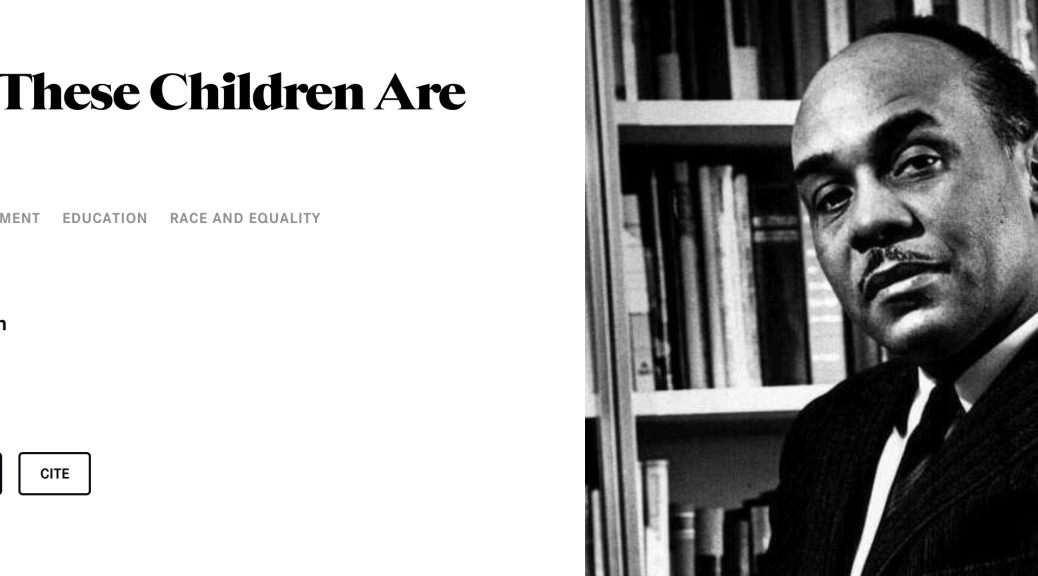
“What These Children Are Like”: Rejecting Deficit Views of Poverty and Language

“I am an invisible man,” begins Ralph Ellison‘s enduring modern classic Invisible Man, which transforms a science fiction standard into a metaphor for the African American condition in the U.S.

Less recognized, however, is Ellison’s extensive non-fiction work, including a lecture from 1963 at a seminar for teachers—“What These Children Are Like.”

More than 50 years ago, Ellison was asked to speak about “‘these children,’ the difficult thirty percent,” the disproportionate challenges facing African American children in U.S. schools. Ellison’s discussion of language among African Americans, especially in the South, offers a powerful rejection of enduring cultural and racial stereotypes:

Some of us look at the Negro community in the South and say that these kids have no capacity to manipulate language. Well, these are not the Negroes I know. Because I know that the wordplay of Negro kids in the South would make the experimental poets, the modern poets, green with envy. I don’t mean that these kids possess broad dictionary knowledge, but within the bounds of their familiar environment and within the bounds of their rich oral culture, they possess a great virtuosity with the music and poetry of words. The question is how can you get this skill into the mainstream of the language, because it is without doubt there. And much of it finds its way into the broader language. Now I know this just as William Faulkner knew it. This does not require a lot of testing; all you have to do is to walk into a Negro church….

But how can we keep the daring and resourcefulness which we often find among the dropouts? I ask this as one whose work depends upon the freshness of language. How can we keep the discord flowing into the mainstream of the language without destroying it? One of the characteristics of a healthy society is its ability to rationalize and contain social chaos. It is the steady filtering of diverse types and cultural influences that keeps us a healthy and growing nation. The American language is a great instrument for poets and novelists precisely because it could absorb the contributions of those Negroes back there saying “dese” and “dose” and forcing the language to sound and bend under the pressure of their need to express their sense of the real. The damage done to formal grammar is frightful, but it isn’t absolutely bad, for here is one of the streams of verbal richness….

I’m fascinated by this whole question of language because when you get people who come from a Southern background, where language is manipulated with great skill and verve, and who upon coming north become inarticulate, then you know that the proper function of language is being frustrated.

The great body of Negro slang–that unorthodox language–exists precisely because Negroes need words which will communicate, which will designate the objects, processes, manners and subtleties of their urban experience with the least amount of distortion from the outside. So the problem is, once again, what do we choose and what do we reject of that which the greater society makes available? These kids with whom we’re concerned, these dropouts, are living critics of their environment, of our society and our educational system, and they are quite savage critics of some of their teachers.

What Ellison is rejecting is a deficit view of language as well as a deficit view of people living in poverty that blurs with racial prejudices. This deficit view is not some remnant of history, however; in fact, a deficit view of language and impoverished people is one of the most resilient and often repeated claims among a wide range of political and educational ideologies [1].

For example, Robert Pondiscio notes in a post for Bridging Differences:

We know that low-SES kids tend to come to school with smaller vocabularies and less ‘schema’ than affluent kids, and both of these are correlated with (and probably caused by) poverty. Low-SES kids have heard far fewer words and enjoyed few to no opportunities for enrichment.

When I posted a challenge to this deficit view, Labor Lawyer added this comment:

How about the seminal research outlined in Hart & Risley’s “Meaningful Differences”? Their research showed that there were significant differences in how low-SES parents and high-SES parents verbally interacted with their children + that the low-SES parents’ interactions were generically inferior, not just reflective of different vocabularies. The low-SES parents spoke less often to their children, used fewer words, used fewer different words, initiated fewer interactions, responded less frequently to the child’s attempt to initiate an interaction, used fewer encouraging words, and used more prohibitive words.

Two important points must be addressed about deficit views of language among impoverished people: (1) Ellison’s argument against a deficit view from 1963 is strongly supported by linguists, anthropologists, and sociologists, but (2) the flawed Hart and Risley study remains compelling, not because the research is credible (it isn’t), but because their claims match cultural assumptions about race and class, assumptions that are rooted in prejudices and stereotypes.

One powerful example of the popularity of a deficit view of language and poverty is the success of Ruby Payne’s framework of poverty books and teacher training workshops—despite a strong body of research refuting her claims and despite her entire framework lacking any credible research [2].

To understand the problems associated with deficit views of language and poverty, the Hart and Risley study from 1995 must be examined critically, as Dudley-Marling and Lucas published in 2009 [3].

Hart and Risley: Six African American Families on Welfare in Kansas City

Dudley-Marling and Lucas reject the deficit view of poverty and language, calling instead for an asset view. They note that deficit views place an accusatory gaze on impoverished parents, and thus, blaming those parents reinforces stereotypes of people in poverty and allows more credible sources of disproportionate failure by students in poverty and minority students to be ignored.

Since the political, social, and educational embracing of deficit views is commonly justified by citing Hart and Risley (1995) [4], Dudley-Marling and Lucas carefully detail what the study entails and how the claims made by Hart and Risley lack credibility.

First, Hart and Risley

studied the language interactions of parents and children in the homes of 13 upper-SES (1 Black, 12 White), 10 middle-SES (3 Black, 7 White), 13 lower-SES (7 Black, 6 White), and 6 welfare (all Black) families, all from Kansas City. Families were observed for one hour each month over a period of 2 1/2 years, beginning when children were 7–9 months old. (p. 363)

Dudley-Marling and Lucas stress:

What is particularly striking about Hart and Risley’s data analysis is their willingness to make strong, evaluative claims about the quality of the language parents directed to their children….

Many educational researchers and policy makers have generalized the findings about the language and culture of the 6 welfare families in Hart and Risley’s study to all poor families. Yet, Hart and Risley offer no compelling reason to believe that the poor families they studied have much in common with poor families in other communities, or even in Kansas City for that matter. The primary selection criterion for participation in this study was socioeconomic status; therefore, all the 6 welfare families had in common was income, a willingness to participate in the study, race (all the welfare families were Black), and geography (all lived in the Kansas City area). (pp. 363, 364)

In other words, Hart and Risley make causational claims based on a very limited sample, and those claims are widely embraced because they speak to the dominant culture’s assumptions about race and class, but not because the study’s data or claims are valid. Dudley-Marling and Lucas explain:

Conflating correlation with causation in this way illustrates the “magical thinking” that emerges when researchers separate theory from method (Bloome et al., 2005). Hart and Risley make causal claims based on the co-occurrence of linguistic and academic variables, but what’s missing is an interpretive (theoretical) framework for articulating the relationship between their data and their claims….

The discourse of “scientifically based research,” which equates the scientific method with technique, has led to a body of research that is resistant to meaningful (theoretical) critique. Hart and Risley’s conclusions about the language practices of families living in poverty, for example, are emblematic of a discourse of language deprivation that “seems impervious to counter evidence, stubbornly aligning itself with powerful negative stereotypes of poor and working-class families. It remains the dominant discourse in many arenas, both academic and popular, making it very difficult to see working-class language for what it is . . . or to be heard to be offering a different perspective.” (Miller, Cho, & Bracey, 2005b, p. 153)…

[T]hey are establishing a norm thoroughly biased in favor of middle- and upper-middle-class children. This common-sense rendering of the data pathologizes the language and culture of poor families, reflecting harmful, long-standing stereotypes that hold the poor primarily responsible for their economic and academic struggles (Nunberg, 2002). (p. 367)

The accusatory blame, then, focusing on impoverished parents is a powerful and detrimental consequence of deficit views of poverty and language, as Dudley-Marling and Lucas add:

Blaming the poor for their poverty in this way leaves no reason to consider alternative, systemic explanations for poverty or school failure. There is, for example, no reason to wonder how impoverished curricula (Gee, 2004; Kozol, 2005; Oakes, 2006), under-resourced schools (Kozol, 1992), and an insufficiency of “high-quality” teachers in high-poverty schools (Olson, 2006) limit the academic performance of many poor students. Nor is there any reason to consider how the conditions of poverty affect children’s physical, emotional, and neurological development and day-to-day performance in school (Books, 2004; Rothstein, 2004). Recent research in neuroscience, for example, indicates that the stresses of living in poverty can impair children’s brain development (Noble, McCandliss, & Farah, 2007). But most Americans do not easily embrace systemic explanations for academic failure. In our highly individualistic, meritocratic society, it is generally assumed that academic underachievement is evidence of personal failure (Mills, 1959). (p. 367)

That deficit views of language and poverty remain compelling is yet another example of a research base being discounted because cultural beliefs offer pacifying blinders:

Rolstad (2004) laments that “linguistically baseless language prejudices often underlie [even] well-designed, well-conducted studies” (p. 5). Linguistic research conducted within theoretical and anthropological linguistics and sociolinguistics that demonstrates the language strengths of children from non-dominant groups “has had virtually no impact on language-related research elsewhere” (Rolstad, 2004, p. 5). The deficit-based research of Hart and Risley, with all of its methodological and theoretical shortcomings, has been more persuasive than linguistic research that considers the language of poor families on its own terms (e.g., Labov, 1970; Heath, 1983; Michaels, 1981; Gee; 1996; see also Michaels, 2005), perhaps because Hart and Risley’s findings comport with long-standing prejudices about the language of people living in poverty (Nunberg, 2002). (pp. 367-368)

Continuing, then, to cherry-pick one significantly flawed study in order to confirm cultural stereotypes reveals far more about society and education in the U.S. than it does about children living and learning in poverty.

Despite many well-meaning educators embracing this deficit view as well as Hart and Risley’s flawed study, seeking to help students from impoverished backgrounds acquire the cultural capital associated with the dominant grammar, usage, and vocabulary is actually inhibited by that deficit view:

Finally, Hart and Risley draw attention to a real problem that teachers encounter every day in their classrooms: children enter school with more or less of the linguistic, social, and cultural capital required for school success. However, we take exception to the characterization of this situation in terms of linguistic or cultural deficiencies. Through the lens of deficit thinking, linguistic differences among poor parents and children are transformed into deficiencies that are the cause of high levels of academic failure among poor children. In this formulation, the ultimate responsibility for this failure lies with parents who pass on to their children inadequate language and flawed culture. But, in our view, the language differences Hart and Risley reported are just that—differences. All children come to school with extraordinary linguistic, cultural, and intellectual resources, just not the same resources. (p. 369)

A larger point we must confront as well is that all efforts to describe and address any social class as monolithic is flawed: Neither all affluent nor all impoverished children are easily described by what they have and don’t have. In fact, social classifications and claims about a culture of poverty are equally problematic as deficit views of poverty and language [5].

Just as Ellison confronted, U.S. society and schools remain places where minority and impoverished children too often fail. Much is left to be done to correct those inequities—both in society and in our schools—but blaming impoverished and minority parents as well as seeing impoverished and minority children (no longer invisible) as deficient stereotypes behind a false justification of research has never been and is not now the path we should take.

“I don’t know what intelligence is,” concludes Ellison in his lecture:

But this I do know, both from life and from literature: whenever you reduce human life to two plus two equals four, the human element within the human animal says, “I don’t give a damn.” You can work on that basis, but the kids cannot. If you can show me how I can cling to that which is real to me, while teaching me a way into the larger society, then I will not only drop my defenses and my hostility, but I will sing your praises and help you to make the desert bear fruit.

Continuing to embrace a deficit view of poverty and language is to embrace a desert that will never bear fruit.

[1] The source of this blog post is a comment on a post at Education Week, but deficit views of language by social class, notably the standard claim that children in poverty speak fewer words than children in middle-class and affluent homes, are common and not unique to the blog post identified here.

[2] Please see this bibliography of scholarship discrediting Payne’s framework. See also:

Thomas, P.L. (2010, July). The Payne of addressing race and poverty in public education: Utopian accountability and deficit assumptions of middle class AmericaSouls, 12(3), 262-283.

[3] See Dudley-Marling, C., & Lucas, K. (2009, May). Pathologizing the language and culture of poor childrenLanguage Arts, 86(5), 362-370.

[4] Hart, B., & Risley, T. R. (1995). Meaningful differences in the everyday experiences of young American children. Baltimore: Brookes.

[5] Please consider the following works in order to confront a wide range of problems associated with class and poverty:

Return of the Deficit, Curt Dudley-Marling

The Myth of the Culture of Poverty, Paul Gorski

Poor Teaching for Poor Children … in the Name of Reform, Alfie Kohn

The Pedagogy of Poverty Versus Good Teaching, Martin Haberman

Workplace: Academia and the American Worker: Right to Work in an Era of Disaster Capitalism?

Academia and the American Worker: Right to Work in an Era of Disaster Capitalism?

Abstract

Why do educational degrees of any kind, especially advanced degrees, matter if there are only part-time service industry jobs waiting for graduates? In this article, the reduced labor market experienced by graduate students seeking tenure-track positions as professors is couched as one example within a much larger context that includes the following: contradictory political and public messages about American workers, the de-professionalized working conditions of K-12 teachers (teaching as a service industry), and the increasingly antagonistic mischaracterizations of tenure and unions expressed by politicians, the public, and the media.

See Also

The public school teacher as “privileged worker”, Shawn Gude

State Impact: Core Questions: How Does Common Core Address Poverty?

Core Questions: How Does Common Core Address Poverty?

Speaking for the Education Trust, Sonja Brookins Santelises makes the following argument in support of Common Core:

And before Baltimore, she worked in Massachusetts – the state whose standards are a model for Common Core. The Bay State is now one of the top-ranked education systems in the country.

Common standards will allow districts across the U.S. to share tips, techniques and lessons that work best for low-income or minority students.

In Twenty Years After Education Reform: Choosing a Path Forward to Equity and Excellence for All, Dan French, Ed.D., Lisa Guisbond and Alain Jehlen, Ph.D., with Norma Shapiro, conclude, among other things, about the impact of Massachusetts’ standards:

Large gaps in educational equity, opportunity and outcomes persist:

• On the MCAS, significant gaps remain among student groups based on race, poverty, ethnicity, language and special needs, with some gaps stagnant and some increasing. The school districts with the highest scores on the 2012 10th grade MCAS English test  had low-income student populations ranging from two to nine percent, while the ten lowest scoring districts had percentages ranging from 50 to 87 percent.

• On the National Assessment of Educational Progress, though our average results place us at the top of all states, Massachusetts ranks in the bottom tier of states in progress toward closing the achievement gap for Black, Hispanic, and low-income students. Massachusetts has some of the widest gaps in the nation between White and Hispanic students, a sign that the English immersion policy created by the Unz initiative has failed.

• Massachusetts ranks 31st of 49 states for the gap between Black and White student graduation rates (with 1st meaning that the gap is the smallest) and 39th of 47 states for the size of the gap between Hispanic and White student graduation rates. For students with disabilities, Massachusetts’ four-year graduation rate is only 64.9 percent, which ranks the state at 28th out of the 45 states with available data in 2009. A significant reason for this low figure is the impact of the MCAS graduation requirement on this subgroup.

Progressivism and Whole Language: A Reader

If you read a criticism of progressivism or whole language, I suspect you are reading one of two things:

  1. A misrepresentation of either so that the writer can attack the misrepresentation. Sometimes this is purposeful misrepresentation, but often the misrepresentation comes from carelessness or a lack of expertise.
  2. A confusion between the genuine principles of progressivism or whole language and how either has been misapplied in the real world. Both progressivism and whole language are terms claimed by those who also misunderstand the terms and concepts behind them. [1]

Since a number of blog and Twitter discussions have addressed both progressivism and then briefly whole language, I offer a reader on both below. [2] And my goal is not necessarily to endorse either progressivism or whole language (although I embrace many aspects of both), but to establish what each represents as a context for supporting or challenging either as being effective or misguided.

Progressivism

Progressivism is rightly associated with John Dewey, but Deweyan progressivism never found its way into mainstream public schools in any significant way. However, distortions of Dewey’s focus on project-based learning (see William Heard Kilpatrick’s The Project Method) have a long and illuminating history.

Thus, a great start to understanding progressivism is to read Lou LaBrant’s 1931 challenge to misguided use of projects. LaBrant is also a solid example of a genuine Deweyan progressive:

LaBrant, L. (1931, March). Masquerading. The English Journal, 20(3), 244-246.

Another important aspect of progressivism is examining how the term and practices are often misrepresented as well as how rare authentic progressivism is in real-world classrooms; thus, see Alfie Kohn:

Progressive Education: Why It’s Hard to Beat, But Also Hard to Find

I have also placed progressivism in the context of traditional and critical ideologies:

Two-Headed Dragon of Education Policy

Whole Language

Like progressivism, whole language has suffered a long history of being blamed for failure even though it has almost never been implemented in any widespread or accurate way.

Did whole language destroy literacy in California? Nope. Read Stephen Krashen:

Whole Language and the Great Plummet of 1987-92: An Urban Legend from California

Does whole language call for no teaching of phonics? Nope. See more by Krashen:

The Phonics Debate: 2004

Defending Whole Language: The Limits of Phonics Instruction and the Efficacy of Whole Language Instruction

See Alfie Kohn:

On Teaching Reading, Spelling, and Related Subjects

See also:

The Reading Wars: Phonics versus Whole Language 

Facts: On the nature of whole language education

Progressivism and whole language, then, share some important characteristics. Both are credible perspectives built on scholarship and research, but neither has found widespread or authentic places in traditional public school practices (both likely have had much more influence and success in private settings). However, both have been repeatedly blamed for so-called failures in the exact public school systems where neither is practiced.

Nonetheless, making a case for or against either progressivism or whole language would be better served if both are accurately identified.

[1] In a recent blog, I carelessly made mistake #2 by taking aim at behaviorism without clarifying I was focusing on how behaviorism often is misused in education; as a result of being called on this, I did apologize and reframe that blog.

[2] And since this is a general blog post related to a number of other blogs and Tweets, I want to be sure this doesn’t come off as sub blogging. Directly I have interacted with Annie Murphy PaulRobert Pondiscio, and Harry Webb in one way or the other about these topics.

educator, public scholar, poet&writer – academic freedom isn't free