What’s Missing in the “Science of” Education Reform Movements? Often, the Science

[Header Photo by Andrew George on Unsplash]

In an analysis of how media represents teachers and education, Silvia Edling argues, “Newspapers do not just write about education, they also represent to their readers what education is ‘about.’”

Edling notes that teachers and education are often characterized by stereotypes, focusing on “four inter-related propensities”:

  • Viewing education as being in more or less permanent crisis
  • Taking the role as a spokesperson for teachers and on behalf of the field of education
  • Excluding the knowledge and experiences of teacher(s), educators and/or educational researchers in the public press
  • Simplifying the notion of being a good teacher through stereotypes and dualistic frameworks that overlook task and relational complexity.

At the core of effective journalism is the importance of compelling stories. However, one truism offers a problem with relying on narratives without ensuring that the broader evidence supports the anecdote: “a lie can travel halfway around the world while the truth is still putting on its shoes.”

For media coverage of education, the softer version may be that an exciting story can attain a status of fact before educational research can confirm or refute the narrative as an outlier or misinformation.

One challenge is, of course, that journalism works much more quickly than scientific research, and this is compounded by the inherent complexity of conducting education research and then applying that evidence to the real world.

For about a decade now, education reform has mostly invested in an expanding “science of” movement that began with the “science of reading” and now includes an international focus on the “science of learning” as well as a parallel “science of math” movement.

The origin stories of the “science of reading” movement is grounded, in fact, in the journalism of Emily Hanford, notably Hard Words, the ironically named Sold a Story podcast, and There Is a Right Way to Teach Reading, and Mississippi Knows It.

As I have detailed, the Mississippi “miracle” and reading crisis narratives generated and perpetuated by the media are missing one key ingredient—scientific evidence for the hyperbolic claims and narratives.

In fact, the current “science of” movements fail all four of Edling’s concerns by presenting a crisis absent research to support the claims; creating non-education reading “experts” among journalists and advocates for commercial programs; cherry-picking teacher voices while also misrepresenting teacher expertise through stereotypes and caricatures; and framing both the crisis and solutions in simplistic either/or rhetoric along ideological lines (progressive v. traditional framed as vibe-based v. scientific).

While the most recent wave, for example, of reading reform reaches back to 2012, the tipping point was Mississippi’s 2019 grade 4 reading scores. Since Mississippi has a long history of unfairly being cast as “last in the nation in education,” that these grade 4 scores suddenly rocketed into the top 25% of state scores certainly qualifies as a compelling story.

It also doesn’t hurt that the appearance that Mississippi had proven that “poverty is an excuse” adds fuel to the hyperbole fire.

Quickly, a “science of” narrative erupted, resulting in copy-cat legislation and the same unverified story about a reading crisis and the Mississippi miracle across local, regional, and national media.

The “science of” story has, in fact, traveled around the world several times at this point, but the key element remains missing—the science.

For example, The Reading League and the 95 Percent Group have become powerful advocacy organizations that make narrow and absolute claims about the need for science-only reading instruction linked to the promise that 95% of student will become proficient readers.

Again, ironically, neither of these positions (or the advocacy of the organizations) is grounded in the science.

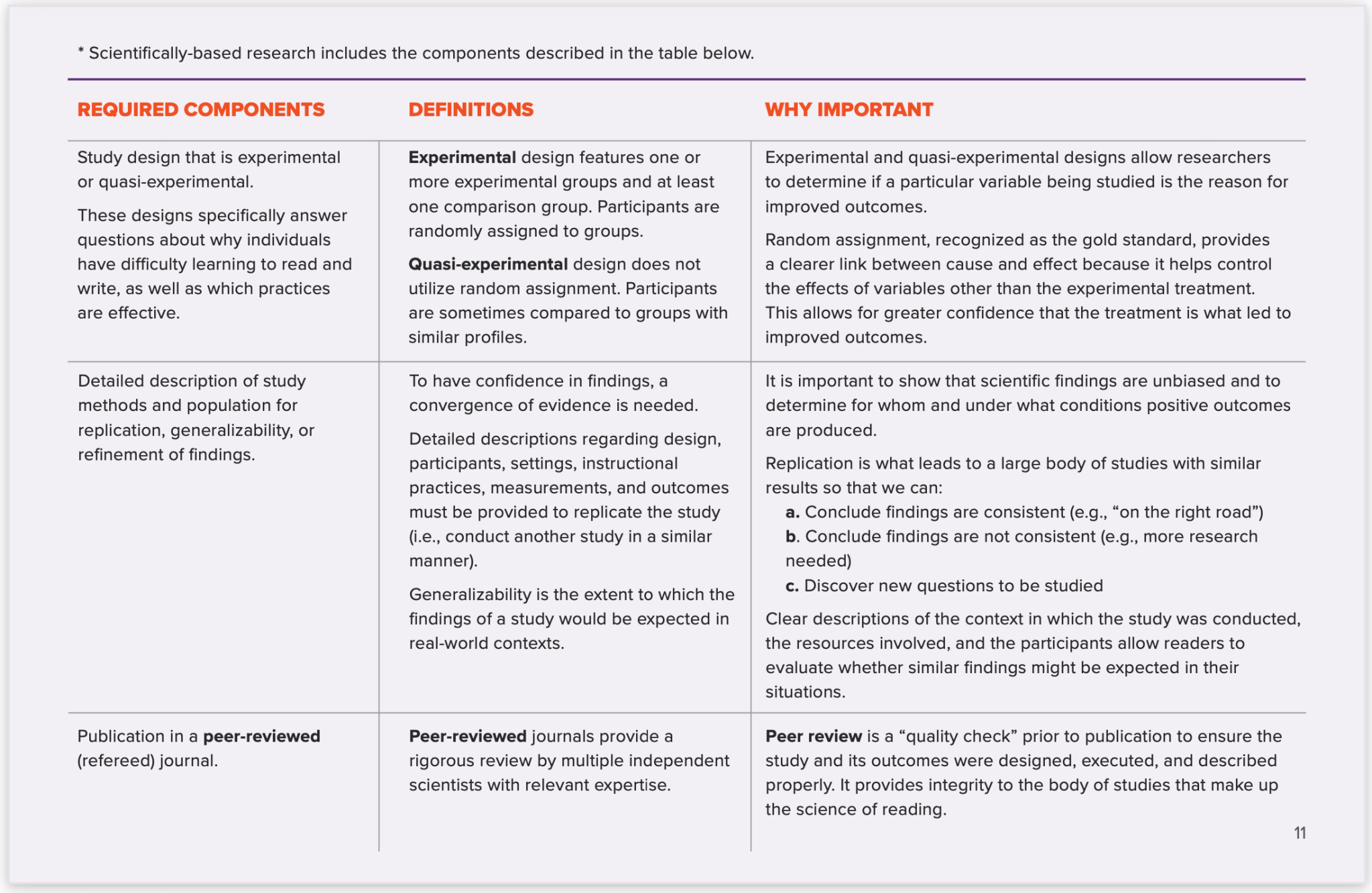
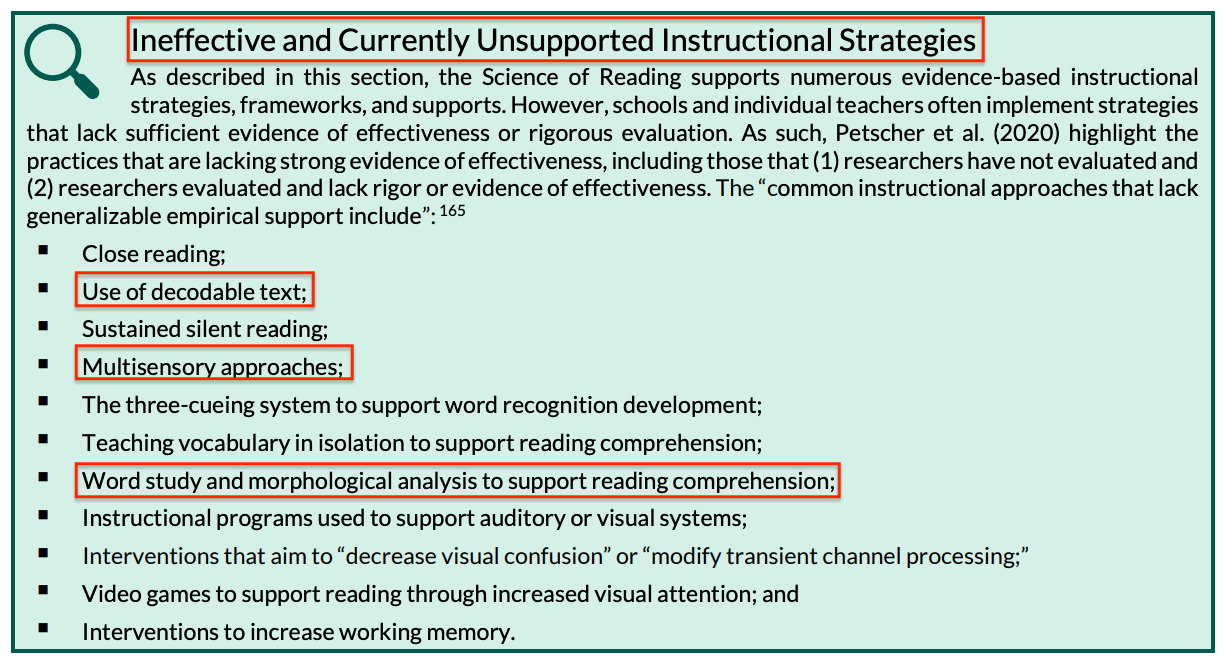
First, The Reading League simultaneously demands only scientific evidence (first image) while advocating for practices and programs (for example, decodable texts and O-G phonics) that literature reviews on the current state of reading science refute (second image):
And, even more problematic, the 95% claim is not a scientific fact, but a very weakly supported and likely aspirational argument with only a few research studies behind the over-sized claim. As I have noted, the only evidence I have found is a a blog post cited by NCTQ, who twisted the stat to 90% and issued a report on teacher education that failed to match claims with the science.

Recently, the science is now catching up with the Mississippi story—although education journalism has remained silent on the current body of research that contradicts the story.

First, if we stick to the science and not the story, poverty is not an excuse when considering reading proficiency; in fact, over 60% of measurable student achievement is causally linked to “social capital family income variables that influence the development of background knowledge. Background knowledge is a known predictor of standardized test results. Family income variables are immutable by schools. Only public policies, outside the control of school personnel, can influence family income.”

In fact, these researchers reject continuing to base education reform on testing data such as NAEP:

Policy makers and education leaders should rethink the current reliance on standardized test results as the deciding factor to make decisions about student achievement, teacher quality, school effectiveness, and school leader quality. In effect, policies that use standardized test results to evaluate, reward, and sanction students and school personnel are doing nothing more than rewarding schools that serve advantaged students and punishing schools that serve disadvantaged students.

Next, two analyses of reading reform—one targeting the larger early reading reform movement and another specifically addressing Mississippi reading reform—find that the early grade reading score increases are not linked to changes in teacher training, reading instruction, and reading programs, but are grounded in grade retention policies.

In the broader study, Westall and Cummings found that only states with grade retention in their reading reform achieved increased reading proficiency scores, and those increases faded from elementary to middle school (paralleling the drop from top 25% to bottom 25% of states in NAEP from grade 4 to grade 8 by Mississippi and Florida).

They, however, drew no conclusions about why retention appears to result in higher scores.

Now, however, Howard Wainer, Irina Grabovsky and Daniel H. Robinson offer a conclusive connection between retention and reading scores:

But it was the second component of the Mississippi Miracle, a new retention policy, perhaps inspired by New Orleans’ Katrina disaster a decade earlier, that is likely to be the key to their success….

Prior to 2013, a higher percentage of third-graders moved on to the fourth grade and took the NAEP fourth-grade reading test. After 2013, only those students who did well enough in reading moved on to the fourth grade and took the test.

It is a fact of arithmetic that the mean score of any data set always increases if you delete some of the lowest scores (what is technically called “left truncation of the score distribution”)….

It is disappointing, but not surprising, that the lion’s share of the effects of the “Mississippi miracle” are yet another case of gaming the system. There is no miracle to behold. There is nothing special in Mississippi’s literacy reform model that should be replicated globally. It just emphasises the obvious advice that, if you want your students to get high scores, don’t allow those students who are likely to get low scores to take the test. This message is not a secret….

The science now suggests that reading proficiency score gains do not equate with improved reading proficiency due to classroom teaching learning reform. Mississippi reform is a statistical veneer for a harmful policy.

Notably, the current science on grade retention also confirms a body of evidence that retention does more harm than any possible good:

[T]hird-grade retention significantly reduces annual earnings at age 26 by $3,477 (19%). While temporarily improving test scores, retention increases absenteeism, violent behavior, and juvenile crime, and reduces the likelihood of high school graduation. Moreover, retained students exhibit higher community college enrollment but lower public university attendance, though neither estimate is statistically significant.

We are left with a significant problem and a question that must be answered: Since, as Edling shows, media controls what most people know and believe about education, teachers, and students, why are journalists committed to a story not grounded in evidence while also ignoring the science that seems essential for creating an authentic “science of” education reform movement?


Recommended

Research Highlights “Science of Reading” Fails Equity, Teacher Autonomy, and Social Media Discourse
One-Time
Monthly
Yearly

Make a one-time donation

Make a monthly donation

Make a yearly donation

Choose an amount

$5.00
$15.00
$100.00
$5.00
$15.00
$100.00
$5.00
$15.00
$100.00

Or enter a custom amount

$

Your contribution is appreciated.

Your contribution is appreciated.

Your contribution is appreciated.

DonateDonate monthlyDonate yearly

Poem: someone died today

[Header Photo by Ron Szalata on Unsplash]

someone died today
and made my partner cry

i am afraid of dying
but more afraid of not living


not living like today
is the only today we have

how do we do this living
better than our fear of dying

and i slip into the arch of your foot
that i rub my thumb across

someone died today
and made my partner cry

i am afraid of dying
but more afraid of not living


sometimes i fear i am the frailest
sometimes i fear you are the frailest

i heard you talking in your sleep
did you feel me longing there

this is the best we can do
because this is the only us we can be

someone died today
and made my partner cry

i am afraid of dying
but more afraid of not living


i want to take your hand in mine
tell you i am sorry that i will die

i want to lie beside you in our bed
and do this night after night forever

because the shadows show us
where to turn to see the light

someone died today
and made my partner cry

i am afraid of dying
but more afraid of not living


—P.L. Thomas

Myrtle Wilson as MAGA Allegory

[Header Photo by Girl with red hat on Unsplash]

As a “good student” in high school and through college, I dutifully worked my way through the so-called major writers, mostly American writers of the early twentieth century such as Hemingway, Faulkner, and, yes, Fitzgerald.

I spent almost two decades teaching American literature in high school, including dozens of class sessions on The Great Gatsby, which I have noted isn’t one of my favorites.

However, The Great Gatsby has proven to be a wonderful literary allegory on the US in the 2020’s, a century after its setting.

Tom and Daisy, for example, are a disturbing characterization of the very “careless people” who are now destroying the country—the Trump era often referred to MAGA for the darkly ironic slogan lifted from Reagan, Make America Great Again.

One of my key lessons when I taught the novel, however, was asking students to focus on the character Myrtle Wilson, Gatsby’s lover and a woman disillusioned into believing she had joined the affluent class.

The gathering where Nick Carraway, the novel’s narrator who is star-struck by Gatsby, meets Myrtle includes some of the most important scenes in the story.

Myrtle attempts to perform as a now-rich woman, embarrassing herself in the eyes of the reader.

One key scene is her excoriating her husband George:

“I married him because I thought he was a gentleman,” she said finally. “I thought he knew something about breeding, but he wasn’t fit to lick my shoe.”

At that gathering also, Tom hits Myrtle violently: “Making a short deft movement, Tom Buchanan broke her nose with his open hand.”

And at that scene, I prompted students to note the difference in how Tom treats Daisy, who regularly taunts him in front of guests including Gatsby.

Readers never see Tom physically abusing Daisy (although he is abusing in other ways).

Combined these elements of Myrtle as a character reveal that by rejecting her working class realities, she is rejected herself; Myrtle is a self-defeating character similar to MAGA and similar to how poor Southerners have voted against their own self interest for decades (always voting conservative regardless of party).

And then one of the most coldly gruesome scenes is when Daisy hits and kills Myrtle with Gatsby’s car.

The scene is sparse, almost told with journalistic distance. Myrtle is slaughtered, sacrificed and seemingly forgotten.

Mangled and dead, Myrtle is the carnage left in the wake of calloused affluence.

Myrtle is MAGA.

Misreading What’s Wrong with College: Social Media Edition

[Header Photo by Dom Fou on Unsplash]

Social media is all atwitter over two compelling stories about colleges and universities in the US.

First, is the politically charged controversy over a student receiving a zero on an essay assignment at the University of Oklahoma:

Second is concern over the significant increase in students with accommodations in higher education:

While both stories are provocative and likely raise important concerns about what is wrong with colleges and universities in the US, most people are misreading where the problems lie.

I have been a teacher and then professor for 42 years, the last 24 years in higher education.

In that context, I want to stress that I believe both situations offer an opportunity to address the systemic problems with our society and how we do education. Regretfully but predictably, in both stories, most of the commentary is focused on the individuals instead of systemic forces.

Let me start with the student receiving a zero for the essay assignment.

Coincidentally, when this story broke, many of my students were experiencing feedback from me on their major essay assignment, a message that informed them they had not completed the project as assigned.

Since the Oklahoma student’s essay and the assignment rubric have been made public (and should not have been, in my opinion), I am very comfortable with the instructor’s very measured and detailed response acknowledging that, in a very clear way, the student had not fulfilled the assignment. [1]

Here is the issue, however.

Because the instructor and student are bound by a traditional grading system, the zero is completely justifiable, as are other arguments for less harsh but still failing scores for the work.

In no way is the essay acceptable or passing college-level work.

I am a non-grader, and my students work under a course grade contract. Students must complete all assignments fully (and preferably on time); therefore, a zero is not a real option.

When my students fail to complete an assignment as assigned, they are prompted with feedback and conferencing to revise and resubmit the assignment.

I work under the belief that if an assignment is worth assigning, then a student choosing not to complete it or a teacher simply assigning the work a zero or failing grade deems the assignment not worth assigning in the first place.

The shift I make in an un-graded classroom is that my assignments are teaching and learning experiences, and not assessments (the assessment component is moved to the contract).

Therefore, in the traditional grading context of the Oklahoma incident, the zero is valid; but I think that traditional context is the problem—not the instructor or the student (even as I doubt the sincerity of the student and those fanning the flames of blaming the instructor).

If that student had been prompted to resubmit with guidance on why she had not fulfilled the assignment, no one would have ever heard of the incident—and she likely would have learned and grown in ways that a zero ended. (Or more likely, her ploy to trap the instructor would have fallen short.)

Next, the issue about the rise in students with accommodations in higher ed also resonates with me because when I moved to college teaching in 2002, I immediately noticed what I thought then was a high number of students with accommodation plans.

I did not think these were frivolous, but I did attribute much of that to the students being affluent and having access to mental health care that identified and supported real needs.

The current concern about high numbers of students with accommodations, I think, fits into a larger belief that “kids today” are frail or weak—or frailer and weaker than they used to be (a ridiculous belief that exists at every “now” in the US stretching back more than a century).

Similar to the popular misunderstanding about autism, the higher number of students with academic accommodations is likely the result of better definitions and diagnoses of these needs along with current college students having lived through incredibly precarious experiences, including Covid.

Higher numbers of students with accommodations is not a problem but a symptom of a very harsh American culture that is replicated in the high-stakes environments of K-12 schooling.

Most of these students are not frail; they are damaged or broken by a hostile society and a dehumanized education system.

These growing numbers of students with accommodations are our canaries in the coalmine.

When students have accommodations or not in my courses, however, I typically never notice and there is never an issue because the way the course works is itself accommodating to all students.

This again is grounded in not grading, not giving tests, and shifting the course toward teaching/learning and away from punishment/rewards.

The student receiving a zero is not a lesson about that instructor or that student, but about our culture of grading in education.

Rising numbers of students with accommodations in our colleges and universities is not a lesson on the weakening of America’s youth, but a signal about the often harsh and hostile environments of those young people’s lives and, yes, their formal schooling.

These are lessons Americans typically refuse to see, and with that negligence, we insure even greater harm and more evidence of failure and frailty that we, in fact, created.


[1] Early in my career teaching in a very conservative right-to-work state, I did not accept a student essay that argued against interracial marriage, a position common in my Southern community and that I found deeply offensive. The student used no evidence in the essay, not fulfilling the minimum requirements for accepting the submission (students were writing evidence-based and cited persuasive essays). The process was, even then, that the student simply needed to resubmit, meeting the requirements. The student quickly resubmitted, adding the sentence “It’s in the Bible.” I again did not accept the submission, explaining he had not provided evidence, and that if, in fact, that was in the Bible, he merely had to quote and cite the passage(s) supporting his position.

Several days passed before I was contacted by administration that the student and his father wanted a conference, which my principal attended. At the conference, the father explained that he and his son had gone to their pastor, who was unable to locate a passage in the Bible to support his argument (because that doesn’t exist, by the way; the often misapplied Old Testament passage they were likely seeking is about no marriage between different tribes). I very patiently stated that the assignment required students write an argument that can be supported by evidence and that the evidence had to be cited. After a pause, my principal said, “Well, looks like your son needs a different topic.”

Science of Reading or Science of Retention?: Why Miracles Fail Reading Reform

[Header Photo by Ava Sol on Unsplash]

My entire career in education, begun in the fall of 1984, has been during the accountability era of education that is primarily characterized by one reality—perpetual reform.

The template has been mind-numbingly predictable, a non-stop cycle of crisis>reform>crisis>reform, etc.

Another constant of that cycle is that the crisis-of-the-moment has almost always been overblown or nonexistent, leading to reforms that fall short of the promised outcomes. Reforms, ironically, just lead to another crisis.

But one of the most powerful and damning elements in the crisis/reform cycle has been the education miracle. [1]

Two problems exist with basing education reform on education miracles. First, and overwhelmingly, education miracles are almost always debunked as misinformation, misunderstanding of data, or outright fraud. Research has shown that statistically education miracles are so incredibly rare that they essentially do not exist.

Second, even when an education miracle is valid, it is by definition an outlier, and thus, the policies and practices of how the miracle occurred are likely not scalable and certainly should not be used as a template for universal reform.

Those core problems with education miracles have prompted the attention of Howard Wainer, Irina Grabovsky and Daniel H. Robinson, who have analyzed the reading reform miracle claims linked to Mississippi:

In 1748, famed Scot David Hume defined nature. He elaborated such a law as “a regularity of past experience projected by the mind to future cases”. He argued that the evidence for a miracle is rarely sufficient to suspend rational belief because a closer look has always revealed that what was reported as a miracle was more likely false, resulting from misperception, mistransmission, or deception….

A careful examination confirms that enthusiasm to emulate Mississippi should be tempered with scepticism….

In short, the authors followed a key point of logic: If something seems too good to be true, then it is likely not true.

In their analysis, On education miracles in general (and those in Mississippi in particular), they focused on two of the key problems with the story about Mississippi’s outlier grade 4 reading scores (in the top quartile of state scores) on NAEP: What is the cause of the score increases? And, why are Mississippi’s grade 8 reading scores remaining in the bottom quartile of state scores?

They found, notably, that Mississippi’s instructional reform, teacher retraining, additional funding, and reading program changes were not the cause of the score increases, concluding:

But it was the second component of the Mississippi Miracle, a new retention policy, perhaps inspired by New Orleans’ Katrina disaster a decade earlier, that is likely to be the key to their success….

Prior to 2013, a higher percentage of third-graders moved on to the fourth grade and took the NAEP fourth-grade reading test. After 2013, only those students who did well enough in reading moved on to the fourth grade and took the test.

It is a fact of arithmetic that the mean score of any data set always increases if you delete some of the lowest scores (what is technically called “left truncation of the score distribution”)….

In short, Mississippi has inflated grade 4 NAEP scores, but that is unlikely evidence that student reading proficiency has improved. This is not a story about reading reform, but about “gaming the system”:

It is disappointing, but not surprising, that the lion’s share of the effects of the “Mississippi miracle” are yet another case of gaming the system. There is no miracle to behold. There is nothing special in Mississippi’s literacy reform model that should be replicated globally. It just emphasises the obvious advice that, if you want your students to get high scores, don’t allow those students who are likely to get low scores to take the test. This message is not a secret….

Wainer, Grabovsky and Robinson’s analysis also needs to be put in context of two other studies.

First, their analysis puts a finer point on the findings by Westall and Cummings, whose comprehensive review of contemporary reading reform found the following: Third grade retention (required by 22 states) is the determining factor for increased test scores (states such as Florida and Mississippi, who both have scores plummet in grade 8), but those score increases are short-term.

Next is a recent study on grade retention. Jiee Zhong concluded:

[T]hird-grade retention significantly reduces annual earnings at age 26 by $3,477 (19%). While temporarily improving test scores, retention increases absenteeism, violent behavior, and juvenile crime, and reduces the likelihood of high school graduation. Moreover, retained students exhibit higher community college enrollment but lower public university attendance, though neither estimate is statistically significant.

Grade retention masquerading as reading reform, then, is fool’s gold for inflating test scores, but it is also harming the very students the reform purports to be helping.

The evidence now suggests that reading reform should not be guided by miracle claims; that no states should be looking to a miracle state for reading reform templates; that the so-called “science of reading” movement is mostly smoke and mirrors, and should be recognized as the “science of retention”; and that grade retention policies are distorting test scores at the expense of our most vulnerable students in life changing ways.


[1] Thomas, P.L. (2016). Miracle schools or political scam? In W.J. Mathis & T.M. Trujillo, Learning from the Federal Market-Based Reforms: Lessons for ESSA. Charlotte, NC: IAP.

One-Time
Monthly
Yearly

Make a one-time donation

Make a monthly donation

Make a yearly donation

Choose an amount

$5.00
$15.00
$100.00
$5.00
$15.00
$100.00
$5.00
$15.00
$100.00

Or enter a custom amount

$

Your contribution is appreciated.

Your contribution is appreciated.

Your contribution is appreciated.

DonateDonate monthlyDonate yearly
Media Manufactured Education Crisis? You Can Count on It

[Header Photo by American Jael on Unsplash]

This fall was the start to year 42 for me as an education, the first 18 as a high school English teacher and the rest as a college professor. I have been noting that career in my presentations at NCTE 2025 in Denver, adding that I am toying with at least making it to year 50.

As I ponder that number, I often return to the sense of awe I always feel when I mention my doctoral work, an educational biography of Lou LaBrant—a former NCTE president (1954) who lived to be 102 and taught for a staggering 65 years (1906-1971).

Approaching 100 and with declining eyesight, LaBrant typed her memoir for the head of the Museum of Education at the University of South Carolina and a key member of my doctoral committee, Craig Kridel.

I was thinking about LaBrant during my presentation yesterday, Recovering Our Reading Dream from a Long Crisis Nightmare, because in her memoir, LaBrant expressed her frustration with the back-to-basics movement during the Reagan administration that orchestrated the 80s education crisis with the melodramatic and misleading A Nation at Risk.

LaBrant noted that over eight decades as an educator she worked through several education crisis cycles and multiple back-to-basics movements—notably the 1940s reading crisis spurred by low literacy rates for draftees during WWII.

While my career pales in many ways compared to LaBrant’s, I feel her pain; with education crisis it is déjà vu all over again.

The only thing, it seems, as common as the media announcing yet another education crisis is people rejecting my arguments against education crisis rhetoric.

And right on cue, after my reading crisis presentation about Tomorrow’s Illiterates: The State of Reading Instruction Today (1961) where I mentioned that our colleagues in math education are now in the crisis crosshair, joining the hyper-intense reading crisis boiling over with “science of reading” advocacy, this morning, I saw this: Editorial: For too many American kids, math isn’t adding up.

The media obsession with declaring an education crisis is so commonplace that I started to just scroll on, but, regretfully, I began to read:

Math scores in the U.S. have been so bad for so long that teachers could be forgiven for trying anything to improve them. Unfortunately, many of the strategies they’re using could be making things worse. It’s a crisis decades in the making.

In the early 20th century, education reformers including John Dewey and William Heard Kilpatrick developed a theory – drawing from the work of Jean-Jacques Rousseau – that came to be known as constructivism. The idea was that learning happens best when students immerse themselves in a problem and find their own solution. By the late 1980s, math standards had embraced “discovery-based learning.”

I expected the lazy and unsupported “math scores” opening, but that second paragraph is the stunner. In 2025, the media still looks for a way to blame John Dewey for the education crisis they repeatedly manufacture.

It was at the core of the reading crisis in the 1940s, and again, in Tomorrow’s Illiterates (1961) noted above

Also in my presentation yesterday, I uttered Dewey’s name and suggested the attendees track down Alfie Kohn’s Progressive Education: Why It’s Hard to Beat, But Also Hard to Find, which does an excellent job of detailing how Dewey’s progressive education is simultaneously blamed and almost never implemented in formal schooling [1].

I immediately posted on social media that the editorial writers could have just search on Wikipedia and avoided the utter nonsense they wrote about constructivism.

Just a few weeks ago, as well, I covered in my 100-level educational philosophy course that behaviorism and constructivism are educational theories (grounded in the scientific method), distinct from philosophies (grounded in rhetoric and logic, such as Dewey’s progressivism).

Learning theories like educational philosophies are contested spaces, but as I plan to share tomorrow in a roundtable presentation, this math crisis editorial triggers several red flags, notably opening the commentary by exposing the editors lack the basic expertise on education to be making any claim of crisis.

If they wanted to blame constructivism, they could have and should have invoked Piaget and Vigotsky (and plenty of “science of learning” folk have already been doing that, often badly and with the sort of caricature I expect).

The media’s education crisis narrative, however, follows a script you can count on—including misunderstanding or misrepresenting test scores, ignoring social context for educational outcomes, and blaming some cartoon version of a leftist education system that, again, has never existed in the US.

When I mentioned Dewey in my presentation, I joked that almost nobody understood Dewey, including Dewey, which, I think, is a pretty good joke because Dewey (and LaBrant) represented a sort of beautiful and illusive scientific approach to their philosophy of education and their instructional practices.

You see, when Dewey progressives say “scientific,” they mean an organic type of experimentation whereby the educator is always in the process of experimenting and drawing real world conclusions that are evolving (it is better, in fact, to think of Dewey’s ideology as pragmatism, associated with William James).

Theirs is a science of teaching and learning that is grounded in and starts with each individual student in the pursuit of skills, knowledge, and critical awareness. This is distinct from essentialist and perrenialist beliefs that begin with knowledge, basic skills, and Great Books, for example.

Teaching as an experiment only matters in the practical, not any Platonic ideal, and thus, is never settled (one red flag is when anyone makes a claim and bases that on settled science [2]).

A key reason blaming Dewey or progressive education for any education crisis is misguided is that Dewey himself refused to offer prescriptions, calling for every school and every teacher to seek what works best in the evidence before them, the unique set of students who always change.

In short, in teaching and learning, there is no silver bullet, no script, no program that can or will serve the needs of all students.

You can, if you must, insert any content area—math, reading, writing, civics, science, etc.—and shout “Crisis!” But you will be embarrassing yourself.

Just do a little searching, and I dare you to find a single moment over the past century when someone declared that “kids today” are excelling in math, reading, etc.

My point, which is often as misunderstood as Dewey, is not that current teaching and learning are fine, that I am somehow endorsing the status quo.

I am a critical educator; I became an educator to change teaching and learning, and I am disappointed to say that over my 5-decades career, very little has changed, including the popular urge to declare education crisis.

And what remains most disturbingly unchanged is that a vulnerable population of students have always been and continue to be under-served or nearly completely ignored.

But my point also includes that education reform alone (while needed, just not the mainstream way most often tried over and over) will never serve those vulnerable students, whose measurable education outcomes mostly reflect the inequity of their full lives of which the school day is only a fraction:

Almost 63% of the variance in test performance was explained by social capital family income variables that influence the development of background knowledge. Background knowledge is a known predictor of standardized test results. Family income variables are immutable by schools. Only public policies, outside the control of school personnel, can influence family income.

There is some math the education crisis folk never want to calculate.

If you find yourself worrying about your child’s ability to read or do math, I promise you that Dewey is not to blame.

If you find yourself worrying about other people’s children’s ability to read or do math, I promise you that Dewey is not to blame.

Crisis rhetoric, however, doesn’t help; it never has.

Finger pointing and blame probably aren’t very useful either, especially when those pointing fingers go out of their way to show their blame doesn’t quite add up.

In formal education, we have always had and will always have a range of students who excel, struggle, and fail.

As teachers, our job is to serve them all, and serve them better based on who they are and what they need.

However, teachers and schools alone can never be successful.

If evidence of student failure means anything (and those test scores often don’t), it is that we as a democracy are failing not only those students, but also those children, teens, and young adults—many of whom do not have adequate healthcare, food or home security, or the sorts of lives that universal public education, the so-called Founding Fathers, and, yes, John Dewey envisioned that a free people could guarantee.

If you are looking for someone to blame because of those disappointing math scores, well, I hate to tell you that the enemy is us.


[1] I highly recommend also: LaBrant, L. (1931, March). Masquerading. The English Journal, 20(3), 244-246. http://www.jstor.org/stable/803664. Here LaBrant rejects the misunderstood and misapplied project method in the teaching of literature:

The cause for my wrath is not new or single. It is of slow growth and has many characteristics. It is known to many as a variation of the project method; to me, as the soap performance. With the project, neatly defined by theorizing educators as “a purposeful activity carried to a successful conclusion,” I know better than to be at war. With what passes for purposeful activity and is unfortunately carried to a conclusion because it will kill time, I have much to complain. To be, for a moment, coherent: I am disturbed by the practice, much more common than our publications would indicate, of using the carving of little toy boats and castles, the dressing of quaint dolls, the pasting of advertising pictures, and the manipulation of clay and soap as the teaching of English literature. (p. 245)

[2] For example, the math crisis editorial announces authoritatively and with no links to proof:

Unfortunately, a robust body of research has since found that such approaches often fail early math learners (and readers, for that matter). Math rules and facts such as multiplication tables must be taught explicitly, memorized and mastered through practice. Only when this foundation is established can students progress to more complex concepts. Math, it’s often said, is cumulative.


Recommended

Beyond Caricatures: On Dewey, Freire, and Direct Instruction (Again)

Caricature, Faddism, and the Failure of “My Instruction Can Beat Up Your Instruction”

Deja Vu All Over Again: The Never Ending Pursuit of “Scientific” Instruction

Reading Matters

Poem: be careful (DMZ)

[Header Photo by Антон Дмитриев on Unsplash]

There is only dance music in times of war

“100 Horses,” Geese


be careful
what you allow Them
to call War

Casualties
Collateral Damage
The Enemy

someone should take your hand darling
whisper softly in your ear

there is no DMZ
be careful
what you allow


those bullets are for us
those bullets are for everyone

there are landmines all around
the placement indiscriminate
the destruction is on purpose

and this callousness
is never ending
never ending

there is no DMZ
be careful
what you allow


—P.L. Thomas

The Zombie Politics of Merit Pay for Teachers

[Header Photo by Yohann LIBOT on Unsplash]

The metaphors for education reform are far too easy, and thus, becoming themselves cliches—deja vous all over again, beating a dead horse, and for me, the most apt, zombies.

Education reforms are championed, and then implemented; invariably, these reforms never achieve what is promised—charter schools/ school choice, reading reform, accountability built on (new) standards and (new) standardized tests, and then, of course, merit pay for teachers.

The Editorial Staff at the Post and Courier are trying to resurrect the zombie politics of merit pay: SC teacher bonuses show promise, but rules need spelling out:

It took a whole lot of years, and a state education superintendent who advocates some really smart ideas and some really bad ones, but the S.C. Legislature seems finally to have settled into supporting the idea of paying at least a few teachers based at least partially on performance, rather than simply the amount of time they’ve been teaching and the degrees they have.

This lede seems as hastily written (the double “at least) and thought out. However, one aspect of politics and education reform that my students are currently analyzing is that people tend to rely on their beliefs over empirical evidence when advocating for policies.

Further, “performance” and “simply” are doing some heavy and misleading lifting.

Over 15 years ago while I was researching and writing a book on school choice, I found a fascinating research report from a conservative think tank in Wisconsin (renamed in 2017 from the Wisconsin Policy Research Institute), which had one of the longest and most robust school choice policies in the US.

Despite the study [1] finding choice ineffective, George Lightbourn introduced the report as a Senior Fellow, admitting:

The report you are reading did not yield the results we had hoped to find. We had expected to find a wellspring of hope that increased parental involvement in the Milwaukee Public Schools (MPS) would be the key ingredient in improving student performance.

And later on the WPRI web site (no longer available online), Lightbourne emphasized:

So that there is no misunderstanding, WPRI is unhesitant in supporting school choice. School choice is working and should be improved and expanded. School choice is good for Milwaukee ‘s children.

Here is a key moment in education reform: Despite the evidence to the contrary, the reformers remain steadfast in supporting the policy because they believe in it. [2]

And that brings us to merit pay for teachers, a policy that has been tried over and over (as well as often in the private sector) without ever yielding the outcomes promised.

In fact, research has shown that merit pay produces negative consequences without the positives promised.

A significant aspect of that failure is that decades of research has shown that cooperation and collaboration are more effective that competition, which is at the core of merit pay schemes.

And in education, we must acknowledge that competition is incompatible with the work of educators; under merit schemes, teachers are being incentivized to have their students outperform other teacher’s students—a gross distortion of the ethics of teaching.

Let’s turn back to “performance,” which suggests that all teachers can be objectively or fairly evaluated for the quality of their teaching in the context of dozens of students with an incredibly wide range of abilities.

This always means standardized testing (note here that many teachers work in areas that are not tested, making the merit schemes a nightmare of evaluation or an astronomical increase in testing of students).

The US is only about a decade away from one of the most intense eras of teacher evaluation based on “merit,” the value-added methods policies under the Obama administration.

And here is what the American Statistical Association concluded in 2014:

VAMs should be viewed within the context of quality improvement, which distinguishes aspects of quality that can be attributed to the system from those that can be attributed to individual teachers, teacher preparation programs, or schools. Most VAM studies find that teachers account for about 1% to 14% of the variability in test scores, and that the majority of opportunities for quality improvement are found in the system-level conditions. Ranking teachers by their VAM scores can have unintended consequences that reduce quality.

Teachers have extremely small measurable impacts on tested student learning, and, this is key to note, “the majority of opportunities for quality improvement are found in the system-level conditions.”

Again, the research conflicts with bootstrapping myths in the US, but decades of evidence shows what the ASA discovered, notably in a 2024 study from Maroun and Tienken:

Almost 63% of the variance in test performance was explained by social capital family income variables that influence the development of background knowledge. Background knowledge is a known predictor of standardized test results. Family income variables are immutable by schools. Only public policies, outside the control of school personnel, can influence family income….

The influence of family social capital variables manifests itself in standardized test results. Policy makers and education leaders should rethink the current reliance on standardized test results as the deciding factor to make decisions about student achievement, teacher quality, school effectiveness, and school leader quality. In effect, policies that use standardized test results to evaluate, reward, and sanction students and school personnel are doing nothing more than rewarding schools that serve advantaged students and punishing schools that serve disadvantaged students.

The evidence is overwhelming, then, that there simply is no justification for advocating for or trying again merit pay for teachers.

The scheme will invariably be costly, produce negative outcomes, and not worked as promised by those who simply believe merit pay is the thing to do.

We should pay teachers more, and we should fund and support our public schools in ways that improve the teaching and learning conditions in those schools.

However, the policies that will have the greatest impact on teaching and learning remain social policies such as universal healthcare, food security, housing and home security, access to books in the home, and as Mauron and Tienken argue, a matrix of “public policies, outside the control of school personnel.”

You see, what we need to do is not supported by what many in the US choose to believe despite what the evidence shows us.


[1] Dodenhoff, D. (2007, October). Fixing the Milwaukee public schools: The limits of parent-driven reform. Wisconsin Policy Research Institute Report, 20(8). Thiensville, WI: Wisconsin Policy Research Institute. https://www.badgerinstitute.org/wp-content/uploads/2022/08/vol20no8.pdf

[2] Note that choice advocates in Wisconsin have persisted:

NEPC Review: Wisconsin’s Most Cost-Effective K-12 Program (School Choice Wisconsin, August 2025) https://nepc.colorado.edu/sites/default/files/reviews/NR%20Baker_23.pdf

Poem: the you you used to be

[Header Photo by stefan moertl on Unsplash]

there are moments
i remember
the you
you used to be

they fill my heart
and a piece of me
misses the you
you used to be

although i would never
want to replace
the you you are
with that you before now

because the you
you are now
is all your yous
you have been

except the you
you will be tomorrow
who i will choose over
the you you used to be

—P.L. Thomas

The Reading Crisis that Always Was and Never Is

[Header Photo by Towfiqu barbhuiya on Unsplash]

In 1961, scholar Jacques Barzun declared “we who run businesses, carry on professions, work for the government, or engage in teaching itself are forced to admit that illiteracy is still with us” (xii-xiii).

This was in an introduction to Tomorrow’s Illiterates: The State of Reading Instruction Today.

Well, it is tomorrow, which is today, and here we are: Many Young Adults Barely Literate, Yet Earned a High School Diploma.

I suppose, if you want to look on the bright side of life, we have progressed from “illiterate” to “barely literate.”

But seriously, the reading crisis rhetoric is a paradox because it is a thing that always was and never is.

I strongly recommend Ch. IV: The Whole-Word and Word-Guessing Fallacy, Helen R Lowe from Tomorrow’s Illiterates as a companion to The 74 article for context.

And I highly recommend: Loveless, T. (2023, June 11). Literacy and NAEP proficient (Web log). https://tomloveless.com/posts/literacy-and-naep-proficient/

In short, declaring “kids today” as illiterate or barely literate is mostly adult bloviating for adult purposes.

Yes, we fall short on literacy and we certainly can and should do better, especially for the most vulnerable students.

We shouts of “Crisis!” have never been effective for helping those students, but certainly sells.


NCTE 2025 Individual Presentation: Recovering Our Reading Dream from a Long Crisis Nightmare

11/21/2025 – 2:45 – 3:15, Mile High Ballroom 1A/1B

Access a PDF of presentation HERE

In 1961, Jacques Barzun in Tomorrow’s Illiterates declared “illiteracy is still with us.” Charles Child Walcutt added: “[N]o further ‘research’ into methods of reading instruction is necessary.” This session examines reading crisis/reform cycles to reconsider the stories told about reading and offer a new approach for reform that serves the needs of students and supports teacher professionalism.


educator, public scholar, poet&writer – academic freedom isn't free