Way back in the late 1970s, I changed my schedule—either in grade 10 or 11—and found myself in two class periods without my friends; I had been trafficking among the top-ranked students in my class (I graduated number 8 out of about 150 students), but the schedule change put me in a so-called “regular” history class.
The class was taught by a football and track coach. He had a very simple and even elegant instructional strategy.
In the center of the classroom stood an overhead projector. Beside it, daily, he had a designated stack of overheads.
After the first couple classes, he assigned the slowest note taker (or better named, note copier) to sit beside the stack of notes to rotate as that student completed copying.
After one day of this tedium, I rushed to guidance and returned to my original schedule along side my friends.
Something that is rarely discussed in the many public discussions of US education is that history, social studies, civics, and government courses in public schools are disproportionately taught by coaches.
Most coaches are coincidentally teachers—and a few teachers are coincidentally coaches. A significant number of US public school students get begrudging instruction in history, social studies, civics, and government—and that instruction is superficially facts, easy to test (or at least easy to put on tests that are easy to score).
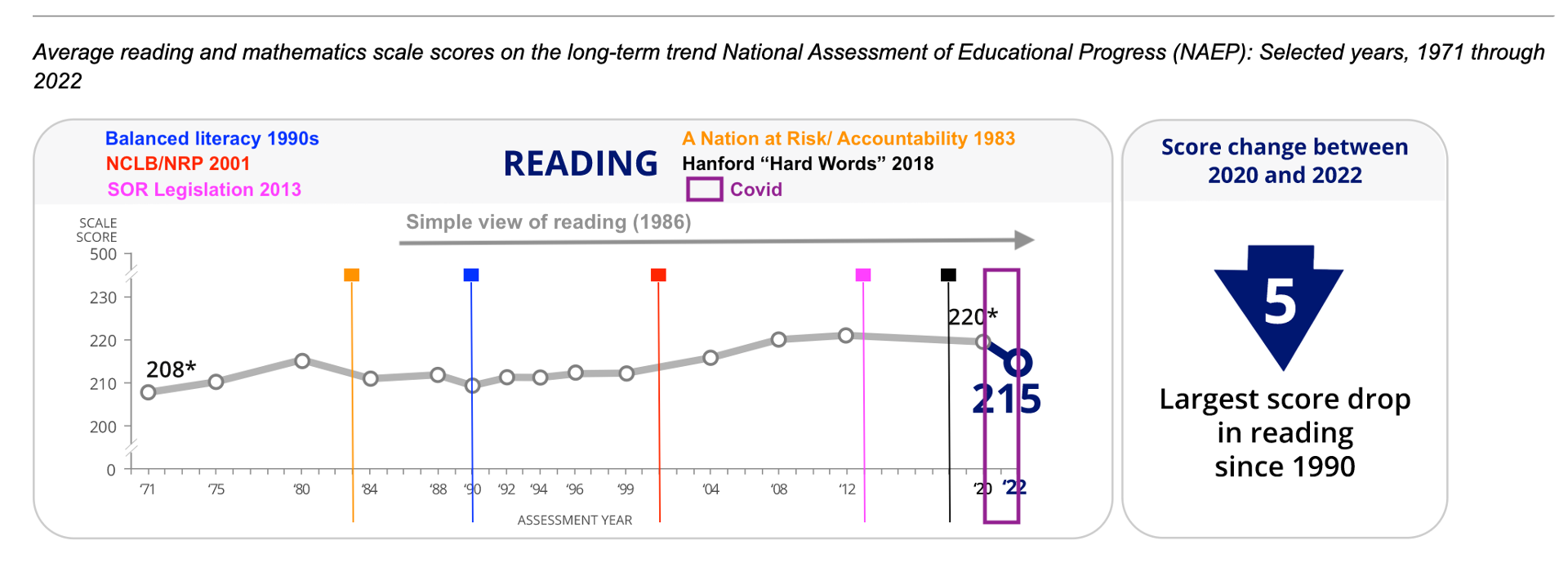
This relatively flat data line for NAEP history scores should remind you of reading NAEP data:
Despite evidence to the contrary, once again, mainstream media, the public, and political leaders have only two ways to react to anything about US public education—crisis or miracle.
We might anticipate that the drop in US history and civics NAEP scores (despite the obvious connection to Covid, as noted above in NAEP reading) will prompt “science of history” and “science of civics” movements.
But, honestly, those will not materialize because politically the US does not care about history or civics—at least not about the quality of teaching and learning in history or civics.
Politically, we only care about anything that allows a public outrage and melodramatic media response to further prove that students suck, teachers suck, and schools, well, suck.
Similar to the false stories around reading, however, the actual problems with history and civics teaching and learning in the US have little to do with a very bad test (that, we should note, is what NAEP is, a very bad test).
History, social studies, civics, and government courses have for decades been part of an open secret—a set of content eagerly sacrificed to the scholastic sports Gods.
And more recently, history, social studies, civics, and government are the political tool of the Republican Party who wants schooling to indoctrinate children in the fairy tales that maintain the status quo of inequitable power, freedom, and humanity that is the good ol’ U.S. of A.
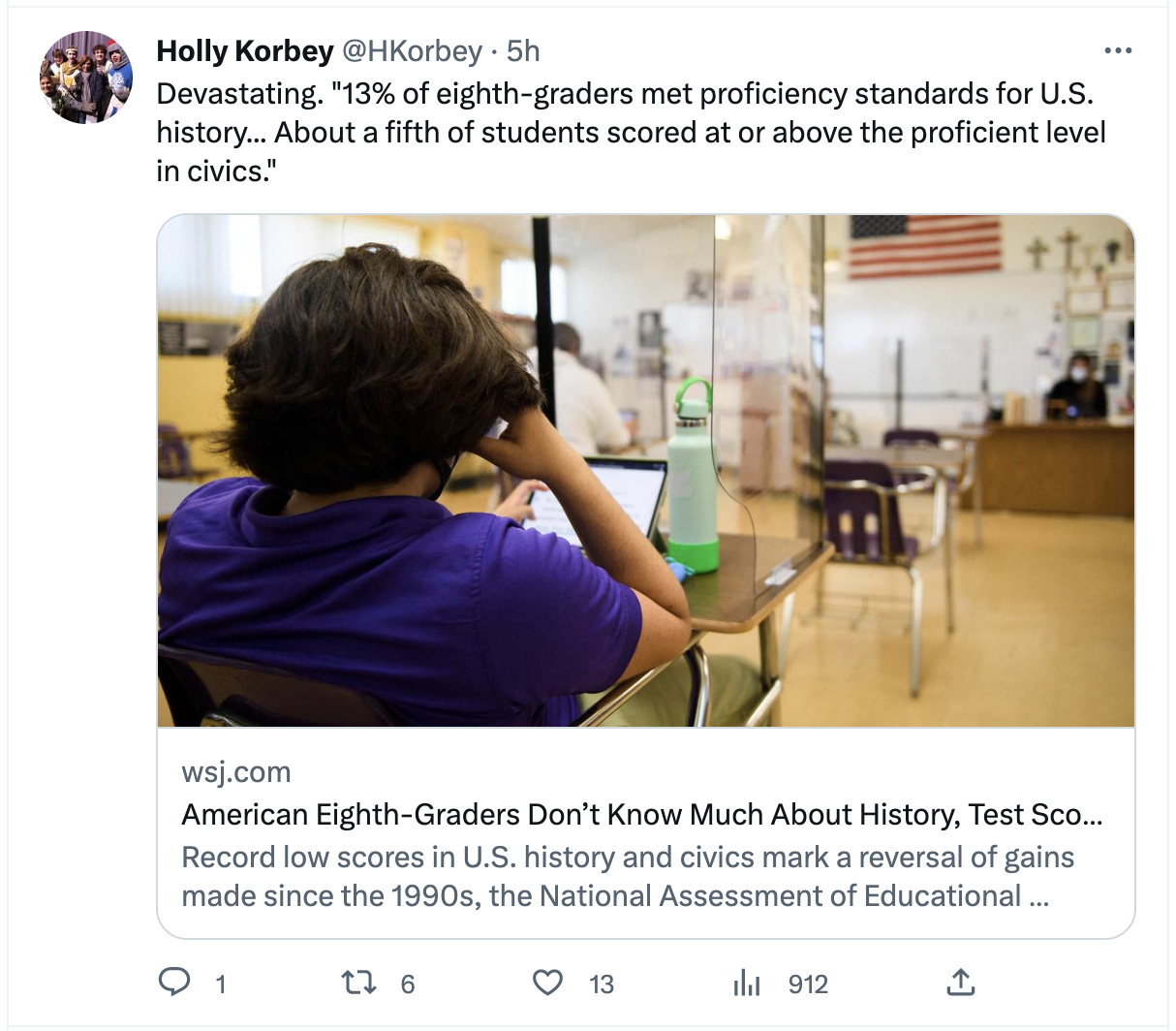
The real purpose of NAEP is to give periodic space to the only way journalists know how to respond to education:
Ironically, that journalists and the public are so easily fooled by this nonsense is the strongest indictment of the failures of US public education.
We all should know better. We all should do better.
But we won’t.
That, by the way, is one predictable lesson of history.
The crisis rhetoric of A Nation at Risk has become the norm for how media covers education, how the public perceives public education (mostly “other people’s schools”), and how politicians gain political points.
Harvey notes: “One of the tragedies around ‘A Nation at Risk’ was not simply that it misdiagnosed the problem and put forth ersatz solutions, but that it refused to face up to the financial implications of its argument.”
The elements of that crisis approach to education include the following:
Teachers are failing students.
Teacher education is failing teachers and students.
Public education is failing.
But this “miracle” school is doing the right thing!
As many scholars have noted, these claims are baseless but made primarily as a political move to dismantle public education and teacher education (and also teachers unions).
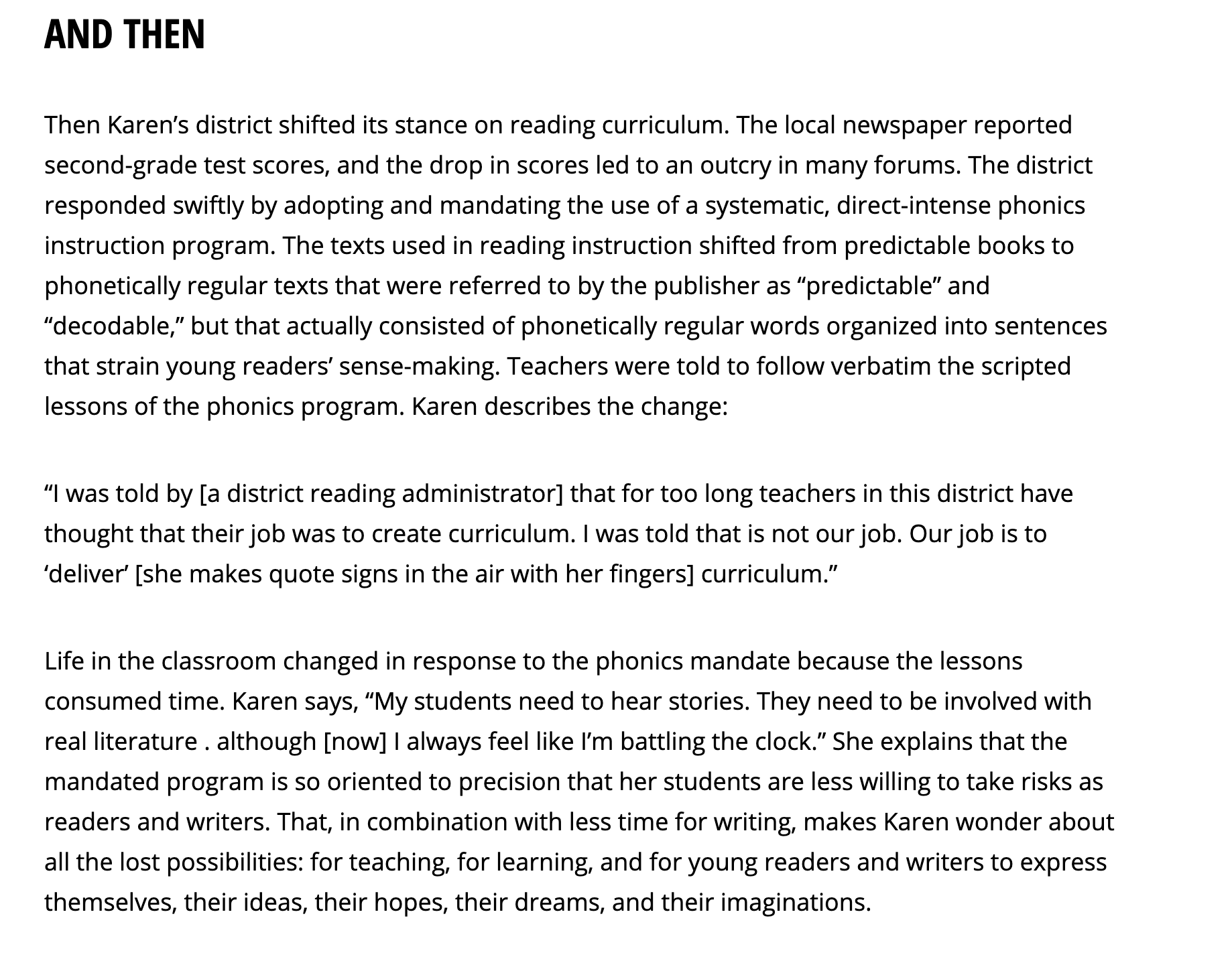
The media has now spoken directly into that conservative machine with the “science of reading” (SOR) movement that follows the tired and destructive pattern begun under Reagan in the 1980s.
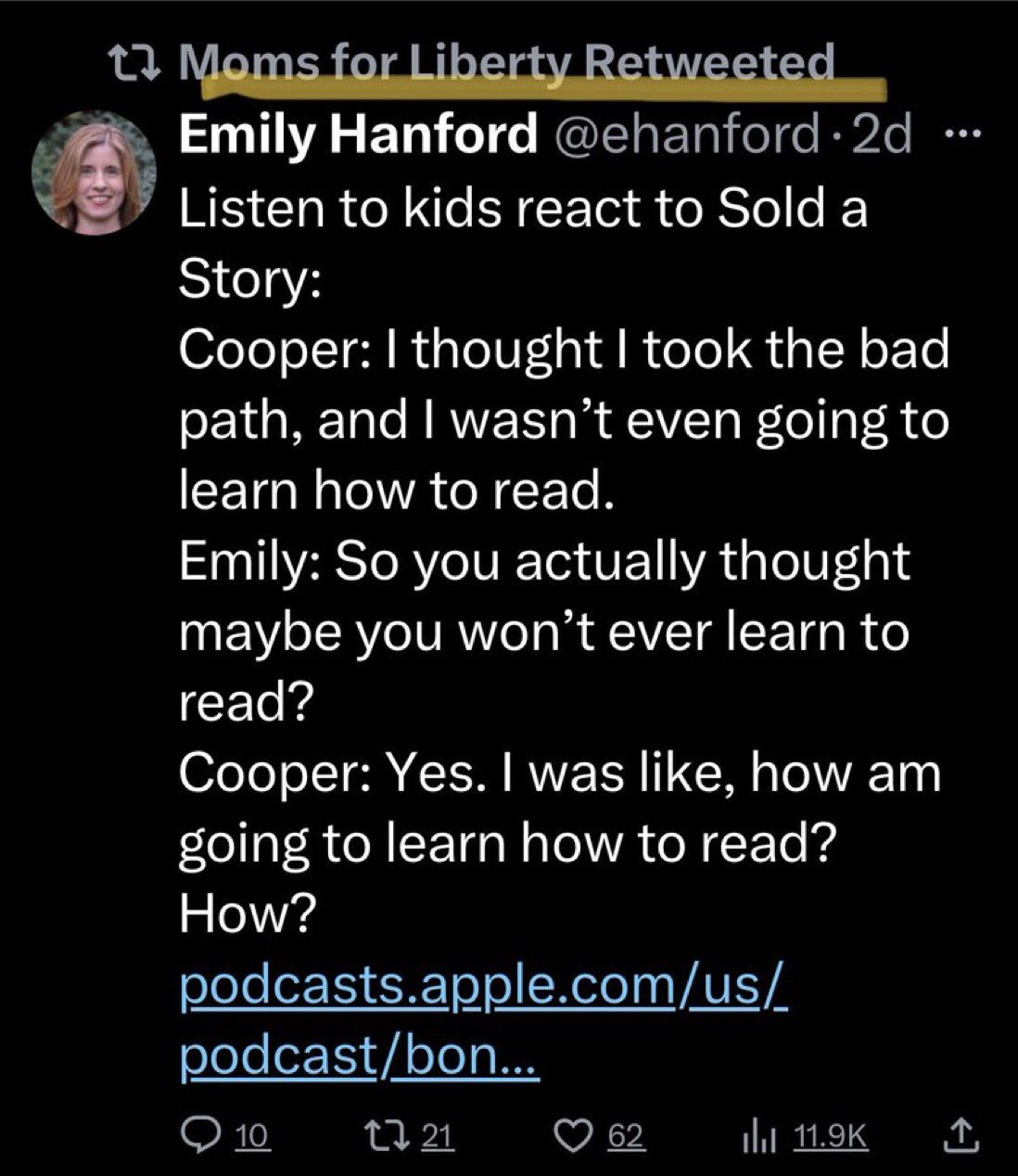
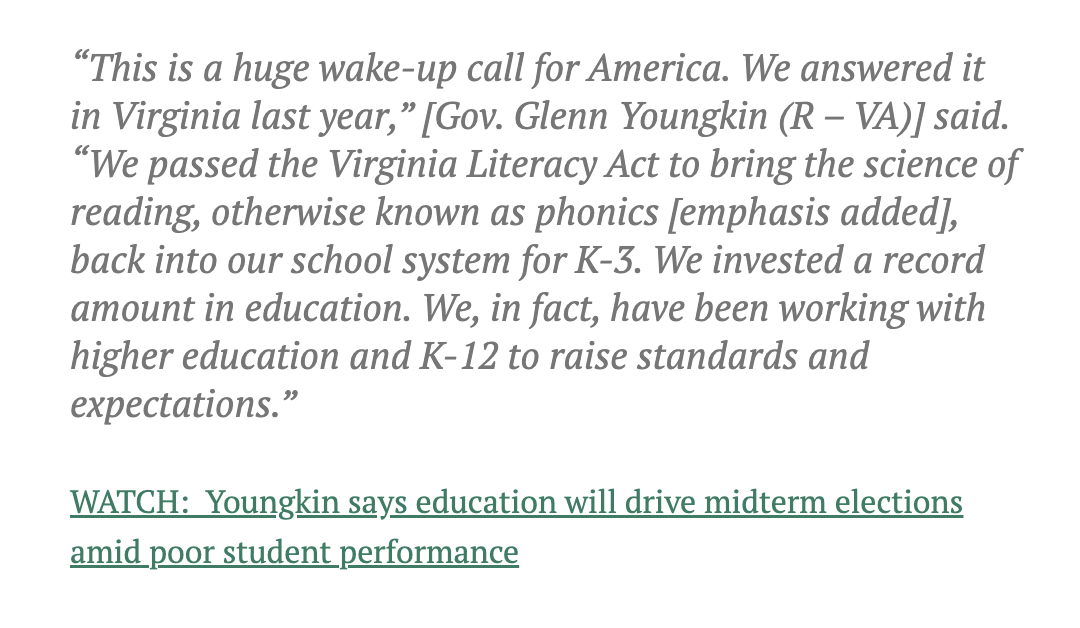
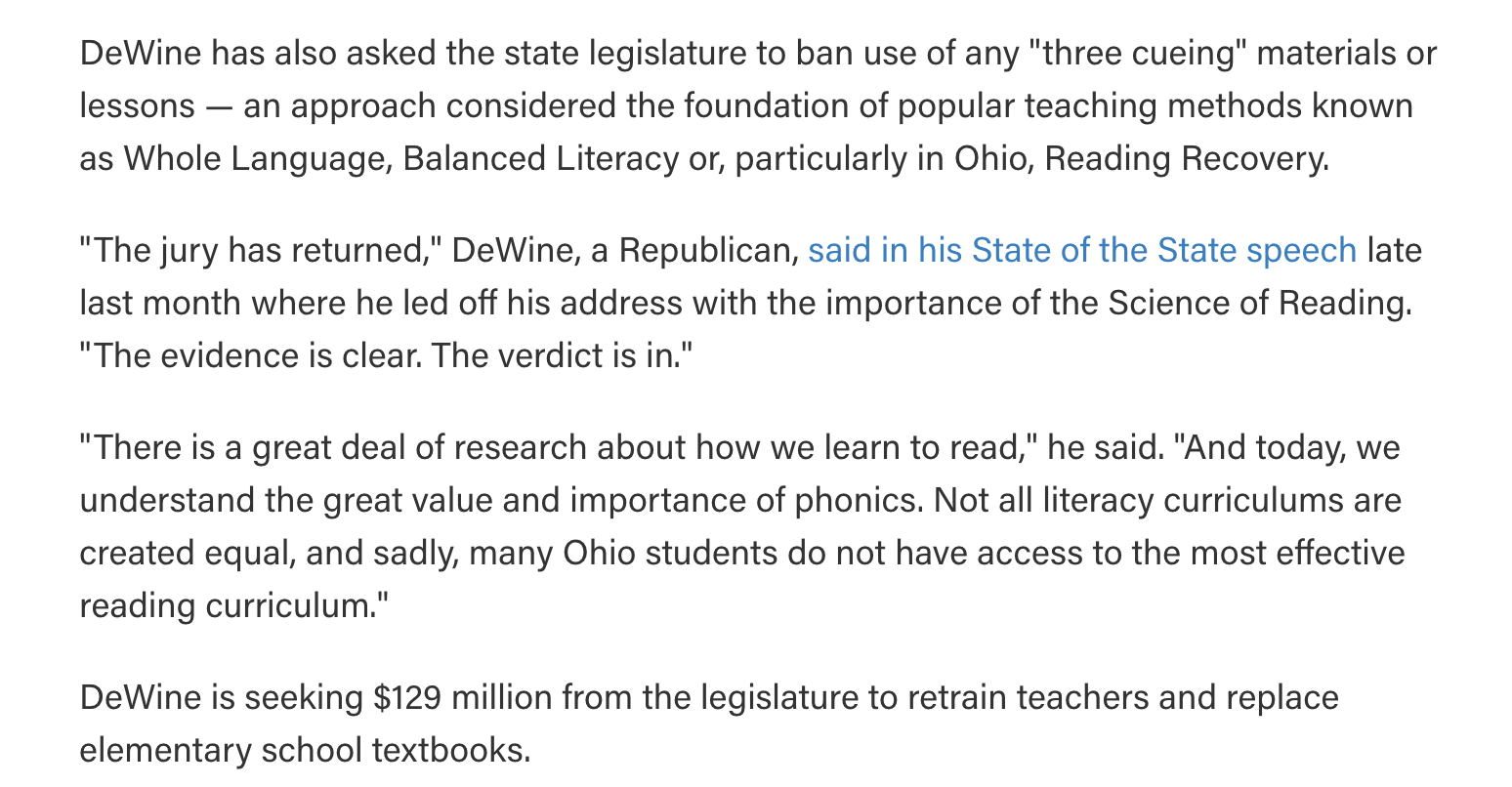
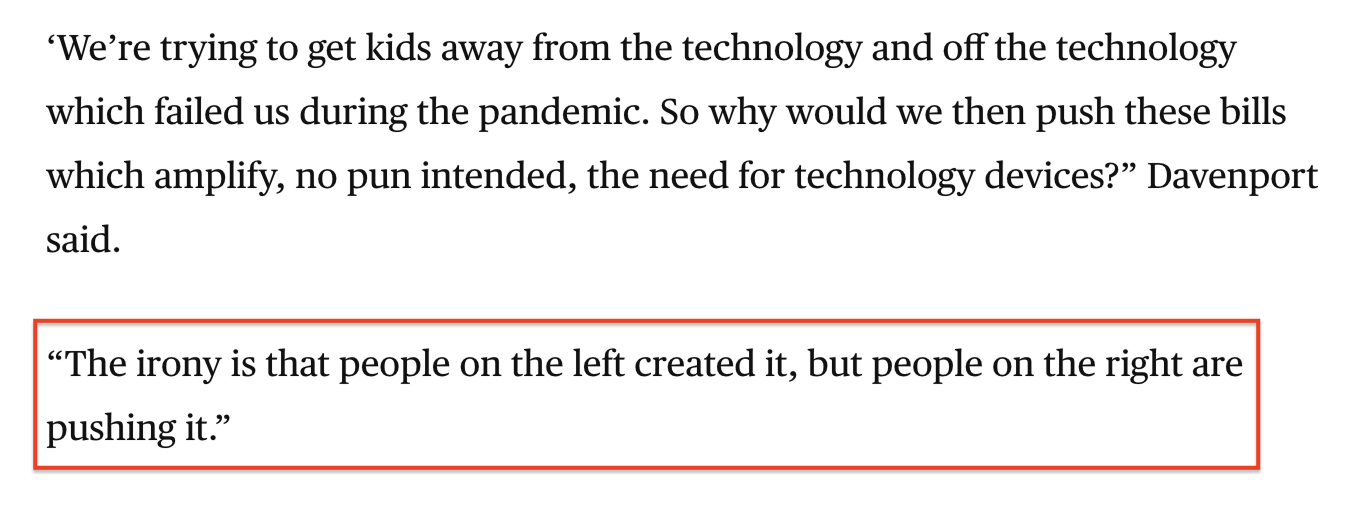
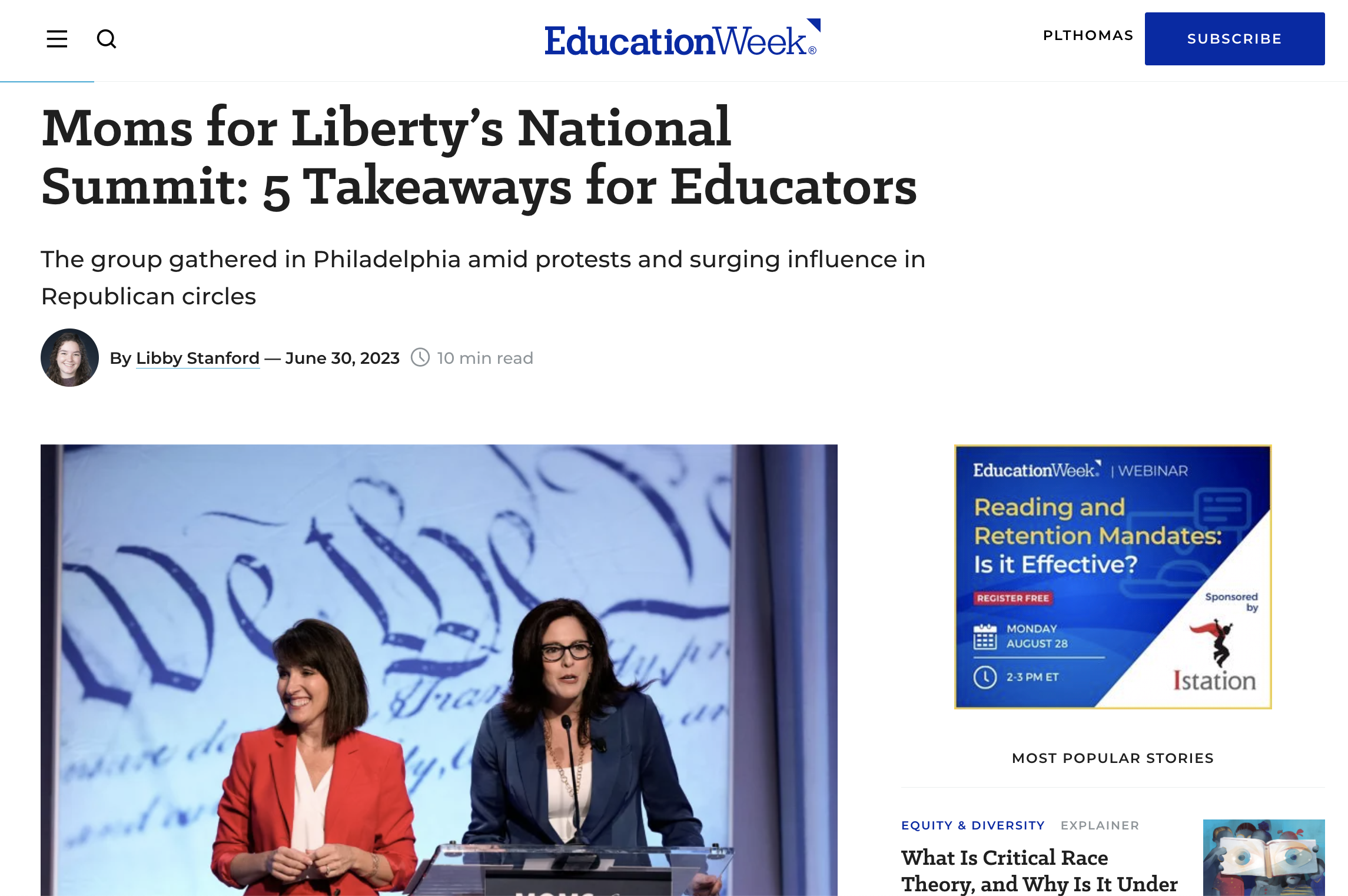
For example, there is now a clear merging of the SOR movement and conservative politics as well as education market interests—from charter schools to the Bushes and Republican governors:
What is very disturbing is that the false claims of crisis and the misguided policy solutions being passed in almost every state now were already exposed twenty years ago by Richard J. Meyer’s Captives of the Script: Killing Us Softly with Phonics:
The fall of 2023, I will be walking into my year 40 as a teacher. I started my career journey as a high school English teacher in the high school where I graduated and even the same English classroom I had sat in as a student during my sophomore and junior years.
The somewhat early years teaching high school English at Woodruff High (Woodruff, SC).
Many of the teachers had been my teachers when I was a student, and I was then (seemingly suddenly) a colleague with veteran and well-loved members of the school and my small hometown.
One of those English teachers assigned their seniors only one essay, due at the end of the academic year and never returned or commented on by that teacher. Many of those seniors were destined for college and had essentially no writing instruction their entire senior year—filled instead with weekly vocabulary tests, grammar tests, and textbook tests on British literature.
Just down the hall, I was embarking on 18 years of responding to about 4000 essays per year by my students; I was committed to teaching students to write well by having them write often and in workshop experiences.
I just completed my spring 2023 semester, which had two writing-intensive courses. This spring followed my only sabbatical experience in the fall of 2022, although I had been in higher education for 20 years.
I returned to teaching with a renewed commitment to decreasing stress and high-stakes for my students while trying to foster greater engagement by those students.
For about three-quarters of my teaching career, lowering stress and high-stakes has included de-grading and de-testing my courses, although the de-grading applied to assignments since I still had/have to assign course grades (see here about delaying grades).
However, once again, a number of students offered feedback on student evaluations that deflate significantly my enthusiasm for many of my efforts to support autonomous students.
In courses with required conferencing, some students noted that conferences should be required; this disconnect is linked to students being responsible for requesting and scheduling those conferences.
In a semester where I responded to about 200 essays over three courses and 24 total students, some students complained that I did not provide enough feedback for their work and/or that my feedback was too negative or not specific enough (see here about negative feedback).
At the core of these tensions and disconnects, I feel, is the essential paradox of who is responsible for learning.
For over twenty years now, I am teaching adults, yes, young adults, but college students are adults. My career before higher education was high school, and again, I worked with teens and young adults.
Yet, most students have experiences in formal schooling that teaches them they are passive agents in the teaching/learning dynamic. My students, particularly those who struggle in my course, think the responsibility for their learning is me, the teacher.
My teaching is grounded in critical pedagogy, and I practice an awareness that the role of the teacher is to teach with the role of the student, to learn. More nuanced is Freire’s argument that the teacher is always a teacher/student and the student is always a student/teacher.
Critical pedagogy views teaching and learning as liberatory—to learn is to become fully human, which is a state that requires autonomy.
Broadly, my role as a teacher (and mentor) is to provide the ideal context for students to learn; however, I cannot make someone learn.
As painful as this is to admit, teaching does not guarantee learning, and ultimately, learning is the role of the student (acknowledging that far too many students are in life situations that inhibit that autonomy).
My students are mostly in ideal contexts to learn, yet they often struggle even as I create courses with low stakes (no grades, no tests, no lateness penalties, etc.) and encourage high engagement; that struggle is grounded in the stress that students feel by having the responsibility for learning shifted from me to them.
Traditional and enduring practices around assigning and teaching writing prove to be barriers for student autonomy—essay prompts, rubrics, comprehensive marking of student writing, etc.
Here is another story from my first years of teaching.
A very highly regarded teacher of English moved to the high school when my district reorganized around a middle school concept and shifted ninth grader from our junior high to the high school.
I often taught that teacher’s students, and they explained to me that they would submit their essays, and then the teacher would return the papers with comments before using the overhead to show the students how to rewrite the essays.
Students dutifully followed the essay that teacher rewrote for them and resubmitted essentially identical essays.
My students today often have one of those two experiences—the negligent writing teachers who assign almost no writing or provide no real feedback or the hyper-controlling teacher who uses scripted prompts and rubrics (the enduring five-paragraph essay included) while also commenting exhaustively on submitted essays.
For those students, my classes are disorienting and often difficult to navigate.
While I have worked for decades to reduce high-stakes environments in my courses to reduce stress, students are often stressed when the responsibility for learning is shifted toward them
As I ponder how to revise further my writing-intensive courses, I continue to look for ways to increase student engagement. Currently, here are the structures I use with varying degrees of effectiveness:
Reducing how much I copyedit and comment on student drafts and increasing face-to-face conferencing.
Providing students with resources that support their learning to revise and edit their own writing.
Grounding writing assignments in authentic forms of writing and inviting students to explore examples of published writing to support their own awareness about forms and purposes for writing.
Maintaining a culture of low-stakes that includes not grading student work while in process, establishing workshop environments for students as writers, and providing structure for students without using punitive or coercive procedures.
Establishing minimum requirements for student engagement that include required drafting of essays as well as options for additional drafts and conferences by choice and request.
Regretfully, I am not seeing these materials being as effective as I hoped because at the core of the problem is not my structure or guidance, but that students remain committed to seeing my role not as teaching but as making them learn.
For example, I often mark needed revisions on essays and add a comment to check for the issues throughout the essay, yet most students only revise what I have marked.
That is a habit they bring to my classes, and one I find nearly impossible to break.
What I am addressing as a writing teacher, then, is a subset of how to foster learning autonomy in students.
Traditional schooling and the pervasive consequences of the Covid era are working against students’ abilities to recognize and embrace that autonomy.
And having an outlier class like mine that centers student autonomy, despite my commitment to lowering stress and high-stakes, is ironically highly stressful for my students.
And thus, I have much to ponder before walking into my classrooms for year 40 this coming fall.
I imagine it is quite rare to have your favorite band release an album with your name featured on the cover.
The day the album was released, I wore my New Order t-shirt released by The National along with New Order, related to one of the albums songs, “New Order T-Shirt.”
While standing in line on release day at Second Line Brewing, I turned around and the guy behind me had on the original New Order t-shirt mine was based on. He was a casual fan of The National but had seen them in concert.
A bit later, another guy in line spoke to me, surprised the band had been around since 1999 (noted on the back of the t-shirt).
I was introduced to The National sometime in the early to mid-2000s through R.E.M. I immediately fell in love with the group and was frantically catching up as anticipation built for the release of Boxer.
This has been a central body of music for me as I aged through my 40s into my 60s and has included seeing them in concert across the U.S.—Asheville, NC; Atlanta, GA; Pittsburg, PA; Red Rocks, CO.
At first, I recognized The National was a niche alternative band with a dedicated following but most people had never heard of them. The National t-shirt would attract the occasional fan, but mostly people had no idea.
My “I Am Easy to Find” t-shirt elicits laughs, but people are oblivious that it is a song/album title.
With First Two Pages of Frankenstein, however, The National has attained an oddly higher profile, in some ways because of their critical success, but mostly because the band has begun working with Taylor Swift, who is also featured on one song from the new album, “The Alcott.”
With that heightened fame, The National has also been branded “Sad Dad” music, and for me, this is somewhat funny and mostly missing the whole point of what the band does and why their work resonates.
The lyrics are primarily written by Matt Berninger, often with his wife, Carin Besser. Swift and other guest musicians contribute also with the music written by the rest of the band, often driven by the Dessner twins.
Here, recognizing that groups’ music is never singularly created, I want to focus on why Berninger’s lyrics aren’t actually “sad,” and why his lyrical development is much more important than that sort of reductive label.
First, let me acknowledge why I think many people do view The National’s music as sad.
Upon my first listen of the new album, I cried very hard during the final song, “Send for Me,” one of the best songs of the band’s career for me (a bit more on that below).
I suspect that song is more than a passing reference to their first album and the tenuous state of the band post-Covid as they struggled to produce this album.
The National does evoke deeply emotional responses; for me, crying is often about being emotionally overwhelmed, not sad.
When thinking about discussing why The National isn’t “sad” music, I immediately thought of how people misunderstand existentialism—specifically Albert Camus’s “The Myth of Sisyphus”: “The struggle itself toward the heights is enough to fill a man’s heart. One must imagine Sisyphus happy.”
Berninger’s lyrics, I think, reflect the existential reality that our passions are our suffering, and we should never wish away our suffering because that would eliminate our passions as well.
Feeling deeply is being fully human, not sad. And what resonates with me about Berninger’s lyrics is their sincerity about feeling deeply in our human experience.
I have also seen people describe The National’s lyrics as too male-centric, which I also reject because Berninger is expressing human experiences as they, of course, exist in his body and mind (even when creating is not directly autobiographical).
Another element here that I find simplistic is that many of the lyrics are acknowledging clinical depression, anxiety, and introversion; it is discounting and careless to brush that aside as “sad.”
Berninger’s fascination with Tennessee Williams and self-medicating, along with acknowledging being on medication, are the core of what makes the lyrics sincere, not sad, and is wonderfully demonstrated here:
I get a little punchy with the vodka Just like my great uncle Valentine Jester did When he had to deal with those people like you Who made no goddamn common sense I’d rather walk all the way home right now Than to spend one more second in this place I’m exactly like you, Valentine, just Come outside and leave with me
While I am not claiming some sort of traditional argument that Berninger’s lyrics are universal themes, I am arguing that his lyrics capture the frailty and tenderness of being fully human and that his growth as a lyricist includes a level of sincerity that fill a person’s heart.
So why did I cry upon first hearing “Send for Me”?
On one level, the sincerity for me is in the use of specific details, which lifts a song that could be cheesy or lazy to a sincere sweetness:
If you’re ever in a psychiatric greenhouse With slip-on shoes Wipe a smile on the shatterproof windows I’ll know what to do If you’re ever in a gift shop dying inside Filling up with tears ‘Cause you thought of somebody you loved You haven’t seen in years
Often, Berninger’s narratives are like verbal collages and speakers are prone to crying themselves.
Another powerful aspect of the lyric writing is that Berninger has increased his use of rhetorical structures to give song cohesion and structure in the way that most pop music depends on heavy rhyme; the use of “if” clauses in “Send for Me” is a craft element found all throughout the album.
As a writer, poet, and teacher of writing, I appreciate how difficult it is to make writing sound natural, even easy, while also not being cliche, lazy, or writing beneath your topic.
The National, for me, isn’t a collection of Sad Dads, but a group of sincere people who have a high level of craft in the art they produce.
That fills my heart, and I feel lucky to have the songs surrounding me like the soundtrack we all imagine for ourselves.
[Below is an OpEd submitted to newspapers in SC; no response yet.]
Writing in Teachers College Record, literacy scholars Reinking, Hruby, and Risko explain: “Since 2015, 47 state legislatures have enacted, or are currently considering, a remarkable total of 145 bills that address reading and reading instruction in public schools.”
A few days apart, an article in the New York Times again announced the US has a reading crisis, and in EdSource, a school’s exceptional success with multilingual learners was celebrated.
The problem with new reading legislation, another reading crisis, and highlighting education “miracles” is that they all are factually untrue.
For example, Reinking, Hruby, and Risko demonstrate that reading achievement as measured by NAEP grade 4 reading scores have remained flat for many years in the US:
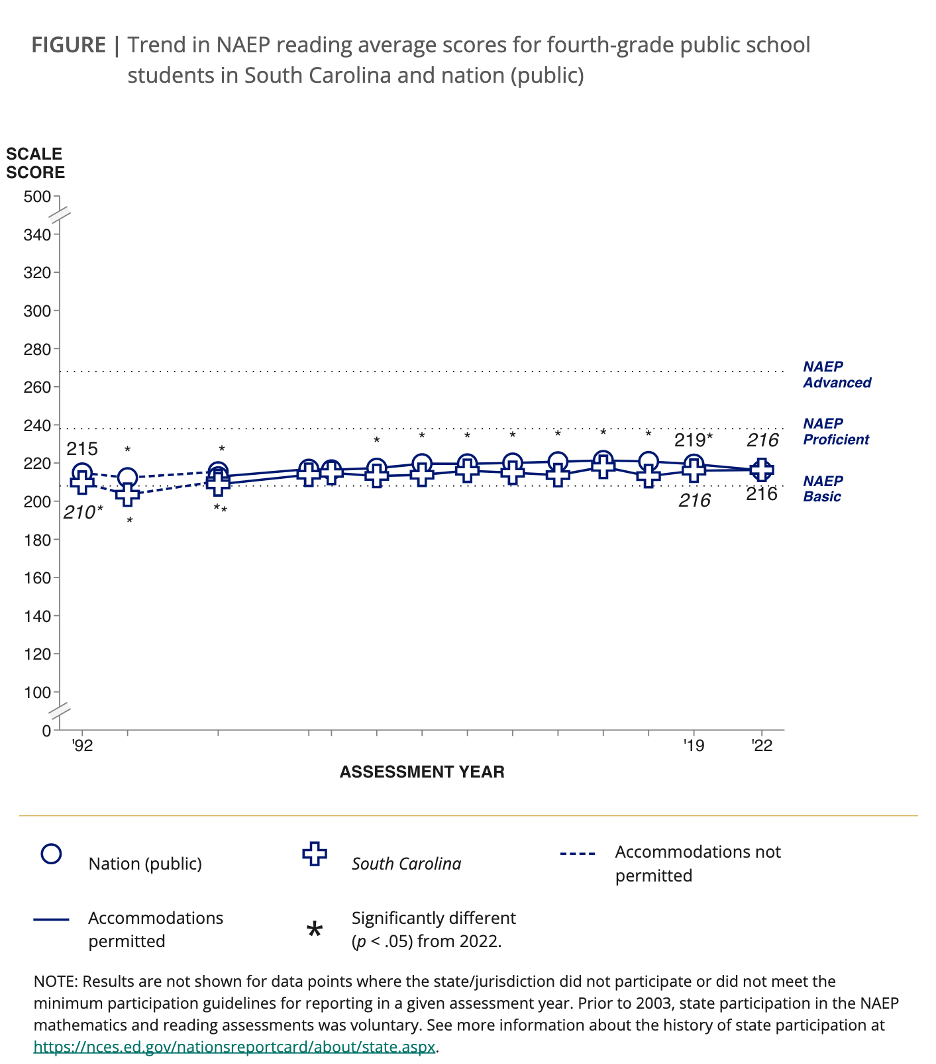
The same is true of South Carolina:
South Carolina has also been an early and eager adopted of standards, high-stakes testing, and embracing the current trend to legislate reading. However, these models of crisis and reform have never produced the sort of reading achievement that the media, the public, or political leaders have promised.
After multiple versions of different standards and tests as well as several rounds of reading wars, South Carolina like the rest of the US continues to lament low reading proficiency in students.
As a lifelong literacy educator in SC over five decades, I recommend that we first stop focusing on crisis and “miracle” stories about our schools, our teachers, and our students. These extreme stories almost always prove to be misleading or false.
Next, and most importantly, we need to do something different—at the school and classroom levels, but also at the political level of legislation, funding, and mandates.
South Carolina has a historical challenge of extreme pockets of poverty, and recent data from the value-added era of education reform under Obama confirmed that about 86 – 99% of measurable student achievement is linked to out-of-school factors, not teacher practice or quality.
The historical negligence of political leadership in SC highlighted in the documentary Corridor of Shame has simply never been addressed.
Further, what do students, teachers, and public schools needed from legislators in SC?
Political leaders must resist the current trend to ban teaching practices and reading programs while also mandating narrow approaches to reading and a new batch of preferred reading programs.
Simply put, there is no silver bullet for teaching reading, and neither the problem nor the solution is a magic reading program.
Students and teachers instead need political leaders to address learning and teaching conditions in our schools concurrent with addressing poverty and inequity in the homes and communities of our children.
Equitable learning and teaching conditions would include repealing grade retention, reducing significantly class sizes in the earliest grades and for the populations of students struggling to read, funding better all aspects of public education (teacher pay, school facilities, learning and teaching materials), and refusing to succumb to the current trends of legislating curriculum through bans and censorship.
The two most powerful commitments that a state can make in terms of supporting education and reading instruction is ensuring that the individual educational needs of all students are supported and that teacher professionalism is directly and fully supported.
For my entire career in SC as a literacy educator, political leaders have failed to address poverty and inequity, ignored the needs of our most vulnerable students, and eroded the profession of teaching in the state.
The stories we have told and the political responses to those stories have failed all of us for decades. We must do better and that means we must do something different.
When I entered the classroom as an English teacher in 1984 at the high school where I had graduated just five years earlier, students lugged around two huge textbooks for their English courses, one of which was Warriner’s English grammar text.
Students were conveniently color coded by these texts since the publishers provided different ability and grade levels of the literature and grammar texts. And universally students hated these textbooks, the carrying and their use in the classrooms.
Since I taught different ability levels (we used and A, B, C level system for each grade) and grades, I had about 15 textbooks across my five courses because students in English also were assigned vocabulary books (the publisher we used proudly printed in bright letters that these vocabulary books prepared students for the SAT!).
At least the vocabulary books were small paperbacks.
Two important facts stand out about those first couple years teaching in the traditional expectations for English teachers at that school (mostly the same teachers who taught me as a student): first, Warriner’s regardless of grade or ability level had essentially the exact same chapters for teachers to systematically and comprehensively teach every year, and second, teachers expressed repeatedly that students never learned those grammar lessons, noting that student writing failed to improve in terms of grammar, mechanics, and usage.
Another big picture point to make here is that when I was a student, grammar texts included lessons on “shall” and “will”; that my students had to cover an entire chapter and be tested on “who” and “whom”; and both my students and I had to “learn” about pronoun/antecedent agreement (specifically the use of “they” as plural only).
Today, we must acknowledge that all of these rules and the consequences of students “not learning them” have evaporated since “shall” and “whom” have graciously disappeared and “they” has been (finally) acknowledged as a resourceful pronoun.
As a beginning teacher, I had entered education to teach writing, although, of course, I loved literature also. Yet, the grammar- and skills-centric approach to teaching English, I recognized, was failing students miserably—I mean literally because students were miserable, learning to hate English, writing, and literature.
Of course, my stories here speak to a disturbing reality in education: Lou LaBrant, writing in 1946, noted: “We have some hundreds of studies now which demonstrate that there is little correlation (whatever that may cover) between exercises in punctuation and sentence structure and the tendency to use the principles illustrated in independent writing” (p. 127). And then in 1947: “A brief consideration will indicate reasons for the considerable gap between the research currently available and the utilization of that research in school programs and methods” (p. 87).
Yet, English teachers throughout the decades kept beating their heads against the grammar and skills wall, lamenting “kids today” for not being good writers—regardless of decade, regardless of the grammar programs implemented.
This raises a current issue about “scientific” or “evidence” as the basis for how teachers teach, notably in the current reading war.
Here, I think, is an excellent overview by Jal Mehta (Harvard University) about why calling for “scientific” or “evidence” to mandate teaching literacy is just as misguided as the evidence-free practices I witnessed as a beginning teacher almost 40 years ago:
What may have started out about a decade ago as a sincere plea similar to LaBrant’s—the teaching of reading in practice often failed to be effectively evidence-based (“scientific”)—has turned into the exact sort of one-size-fits-all ideological movement that Jal warns about: scientific as a “weapon.”
The mistake being made is also perfectly identified by Jal: “In my experience, the best educators and leaders see lots of complexity, consider context, and artfully weave together different approaches to solve particular problems.”
Ironically, this is the exact approach grounding both whole language and balanced literacy as philosophies of teaching reading and writing; however, as we have witnessed, both WL and BL also became convenient labels for practices not following those philosophies or simply slurs ideologues use to criticize.
Instead, the SOR movement has become ideological and weaponized to create simplistic and unfounded crisis rhetoric for politicians and skills-driven reading policy and practice.
For example, no one argues that phonics, vocabulary, and knowledge are not key elements in reading. But the SOR movement demands a linear and sequential skills-first approach; teach phonics, vocabulary, and knowledge systematically before students read.
The skills-first approach is essentially authoritarian (what phonics, vocabulary, and knowledge students “need” is determined and outlined for students and teachers) and necessarily erases diversity of language and experiences by students.
The counter approach, the complex approach to reading, acknowledges the importance of elements such as phonics, vocabulary, and knowledge, but also honors that the relationship between so-called skills and reading is reciprocal, not linear or sequential.
In other words, yes, students need some direct and purposeful instruction in phonics, vocabulary, and knowledge building as they become beginning readers; however, most of a person’s acquisition of phonics, vocabulary, and knowledge comes from reading—not direct or systematic instruction.
The problem with systematic and comprehensive teaching of any literacy skills is that the goal and accountability around teaching and learning become the acquisition of the skills (phonics tests, vocabulary tests, knowledge tests) instead of the authentic goal of fostering eager, independent, and critical students who read.
Ultimately, if we genuinely want evidence-based reading instruction for children in the US, we must recognize that the most important sources of evidence are the children themselves and the most valuable person to understand what children need to read are their teachers.
However, beyond shifting to what evidence counts, we must also recognize that students and teachers cannot be successful unless we address learning and teaching conditions (the one move politicians refuse to make).
Regretfully, as Jal recognizes, students and teachers are again simply pawns in another fruitless war won by the SOR advocates “who are loudest about ‘evidence-based practices,’ [and] ironically tend to be more ideologues who have a few preferred solutions that they think can address every problem.”
“Teaching reading to children whose language differs from the oral language of the classroom and from the linguistic structure of academic text adds an additional layer of complexity to reading instruction,” write Washington and Seidenberg.
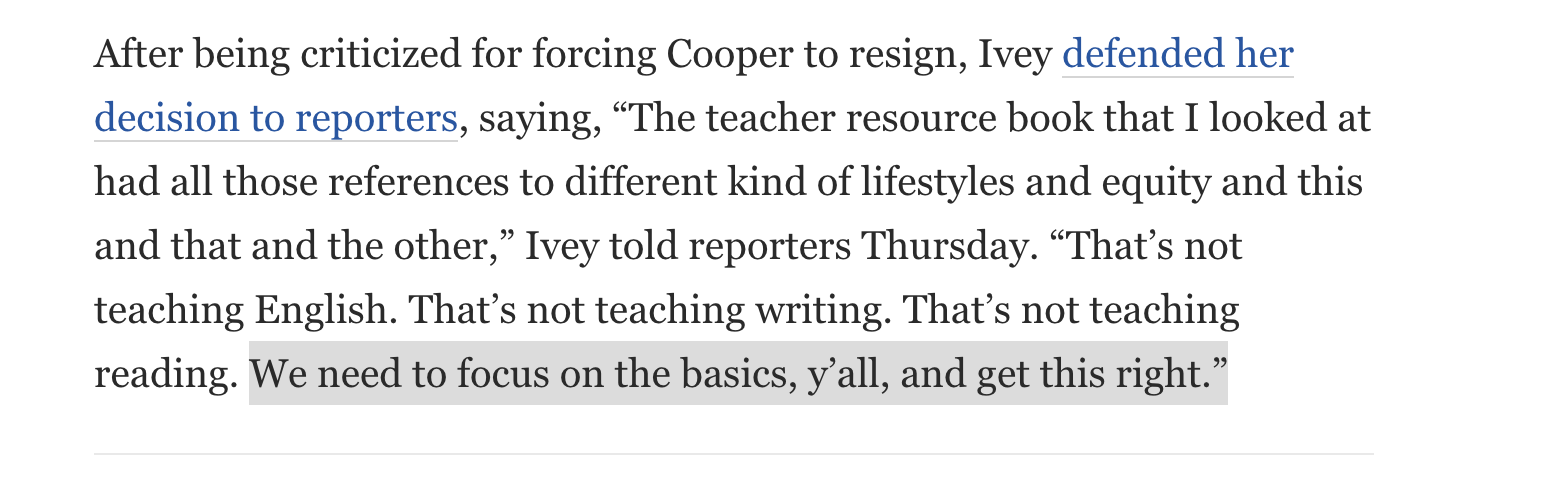
This speaks to a concern I have raised, and been harshly criticized for, about teaching phonics, the centering of standardized pronunciation, and the deficit perspective of stigmatizing regional and cultural pronunciation patterns.
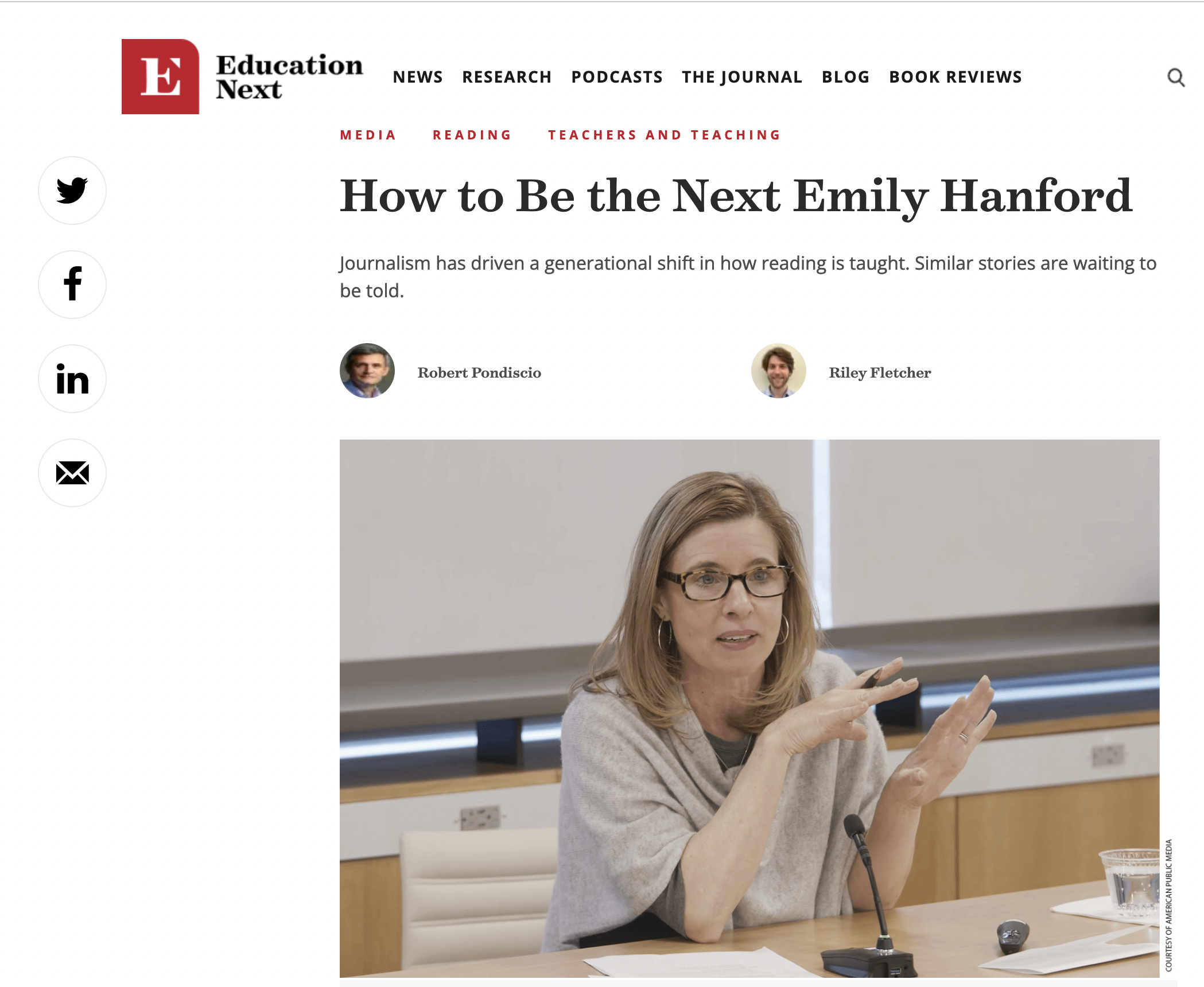
Here I invite you to read the following as a text set to interrogate systematic phonics instruction, standardized pronunciation, and the humanity of individual student differences grounded in their spoken language variations:





























 dr. p.l. (paul) thomas