COE Spring Forum: Are We in the Midst of “Reading Wars” – Again?

COE Spring Forum: Are We in the Midst of “Reading Wars” – Again?

Access this PowerPoint for my part of the forum. Access expanded PowerPoint also.

YouTube RECORDING

Rachael Gabriel SLIDES

See RESEARCH supporting my presentation:

Reading Science Resources for Educators (and Journalists): Science of Reading Edition [UPDATED]

No Crisis, No Miracles: The False Narratives of Education Journalism

With a sort of humility rarely found when someone of prominence speaks to or about education in the US, celebrated author Ralph Ellison (Invisible Man) found himself speaking at a teachers conference in 1963 “to discuss ‘these children,’ the difficult thirty percent,” the identified population making up the drop-out crisis of the time [1].

One of the most impressive aspects of Ellison’s talk is his emphasis on systemic influences on children and their language acquisition: “The American scene is a diversified one, and the society which gives it its character is a pluralistic society-or at least it is supposed to be,” explaining:

The education which goes on outside the classroom, which goes on as they walk within the mixed environment of Alabama, teaches children that they should not reach out for certain things. Much of the education that I received at Tuskegee (this isn’t quite true of Oklahoma City) was an education away from the uses of the imagination, away from the attitudes of aggression and courage. This is not an attack. This is descriptive, this is autobiographic. You did not do certain things because you might be destroyed. You didn’t do certain things because you were going to be frustrated. There were things you didn’t do because the world outside was not about to accommodate you….

It does me no good to be told that I’m down on the bottom of the pile and that I have nothing with which to get out. I know better. It does me no good to be told that I have no heroes, that I have no respect for the father principle because my father is a drunk. I would simply say to you that there are good drunks and bad drunks. The Eskimos have sixteen or more words to describe snow because they live with snow. I have about twenty-five different words to describe Negroes because I live principally with Negroes. “Language is equipment for living,” to quote Kenneth ’Burke. One uses the language which helps to preserve one’s life, which helps to make one feel at peace in the world, and which screens out the greatest amount of chaos. All human beings do this.

What These Children Are Like

And then Ellison goes right to the core issue about language in marginalized and minoritized populations:

Some of us look at the Negro community in the South and say that these kids have no capacity to manipulate language. Well, these are not the Negroes I know. Because I know that the wordplay of Negro kids in the South would make the experimental poets, the modern poets, green with envy. I don’t mean that these kids possess broad dictionary knowledge, but within the bounds of their familiar environment and within the bounds of their rich oral culture, they possess a great virtuosity with the music and poetry of words. The question is how can you get this skill into the mainstream of the language, because it is without doubt there. And much of it finds its way into the broader language. Now I know this just as William Faulkner knew it. This does not require a lot of testing; all you have to do is to walk into a Negro church….

Thus we must recognize that the children in question are not so much “culturally deprived” as products of a different cultural complex. I’m talking about how people deal with their environment, about what they make of what is abiding in it, about what helps them to find their way, and about that which helps them to be at home in the world. All this seems to me to constitute a culture. If you can abstract their manners, their codes, their customs and attitudes into forms of expression, if you can convert them into forms of art, if you can stylize them and give them many and subtle ranges of reference, then you are dealing with a culture. People have learned this culture; it has been transferred to them from generation to generation, and in its forms they have projected their most transcendent images of themselves and of the world.

What These Children Are Like

On social media, I had a cognitive scientist SOR-splain to me literacy in my home state of South Carolina, recommending I look at narrow assessments of reading (a popular program) to admit that SC has a reading crisis. Like Ellison, I pointed out I don’t need a test to know the truth about reading and literacy in SC, all across the South, and even in the US.

In my 39th year as a literacy educator in SC, where I was born in 1961 and attended formal education from 1967 through 1998, I have lived and witnessed firsthand a fact that the media narratives never capture, but let me ask you to help me before I explain the real story.

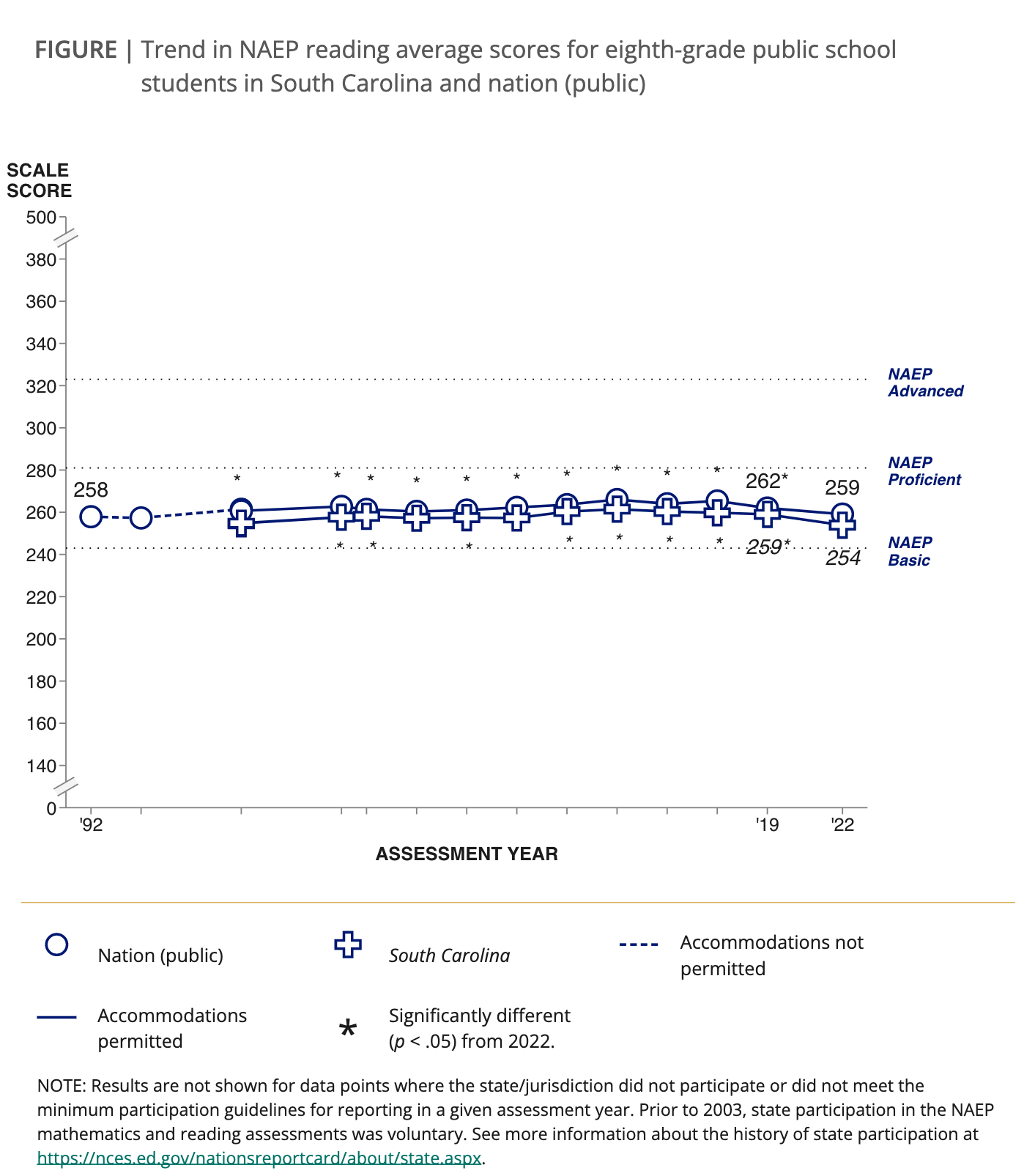
Here are longitudinal data for SC NAEP reading scores in grades 4 and 8 from 1992 to 2022; could you please identify where the “crisis” is?:

I lived, learned, and taught in the three decades before these three decades, and I can only conclude that reading achievement (whatever that is) as measured in formal testing has been about the same forever.

In my home state and across the nation, this is the real story: We have become content with a historical and current negligence about the reading acquisition of some populations (Black and brown students, poor students, special needs students, multi-lingual learners), and we lack the political will to address the systemic forces of inequity in the lives and schooling of these students to do anything about it.

Historical negligence is not a crisis; it simply is how things are, what we have come to accept as “normal.”

As I have examined in my scholarship [2], journalism in the US has only two false stories about education—crisis and miracle.

The problem is that neither narrative is true; they are anecdotal and melodramatic so they are compelling to the public, politically useful, and likely to drive reader/viewership for the media.

The US remains in a false crisis cycle begun by A Nation at Risk, and then powerfully expanded under the Obama/Duncan era of shouting education crisis while propping up the false charter school miracle machine (for example, the Harlem “miracle” celebrated by David Brooks citing the Obamas).

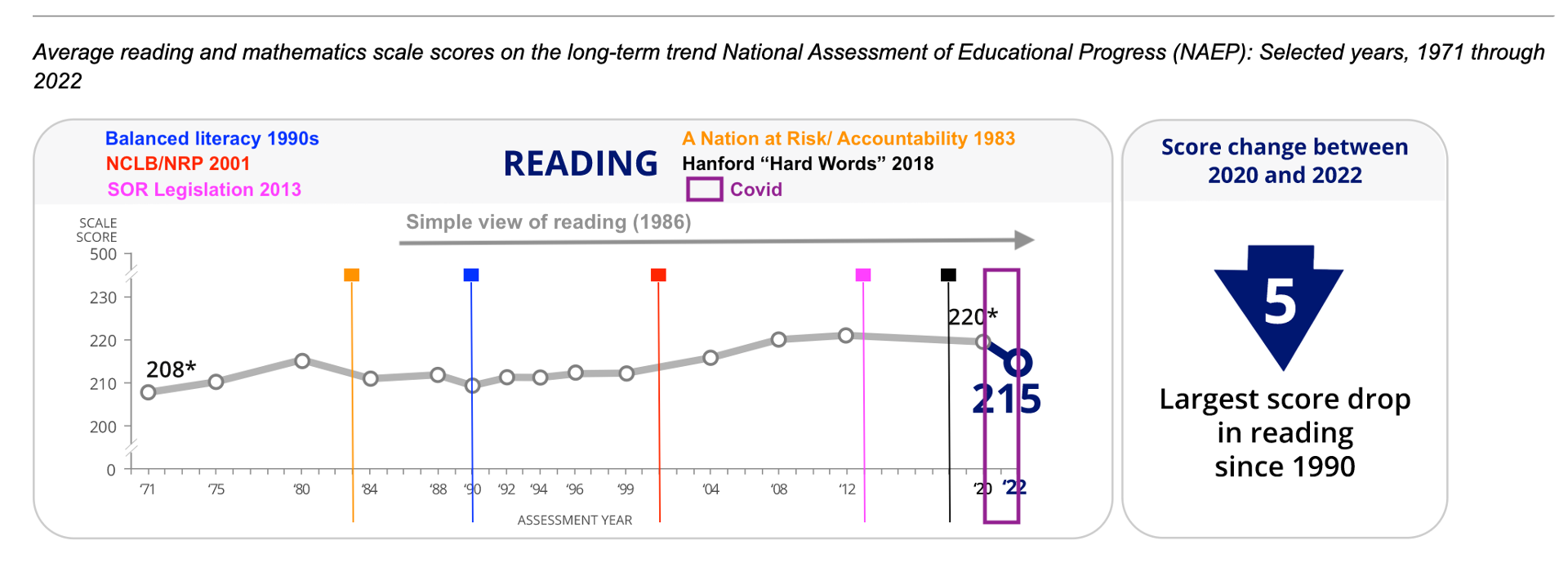
The crisis/miracle narrative approach from the Obama era has recently been replicated by the media obsession with SOR; Hanford’s seminal story planted both seeds by falsely claiming the US has a reading crisis and promoting a miracle school that wasn’t.

Again, please point out the crisis here:

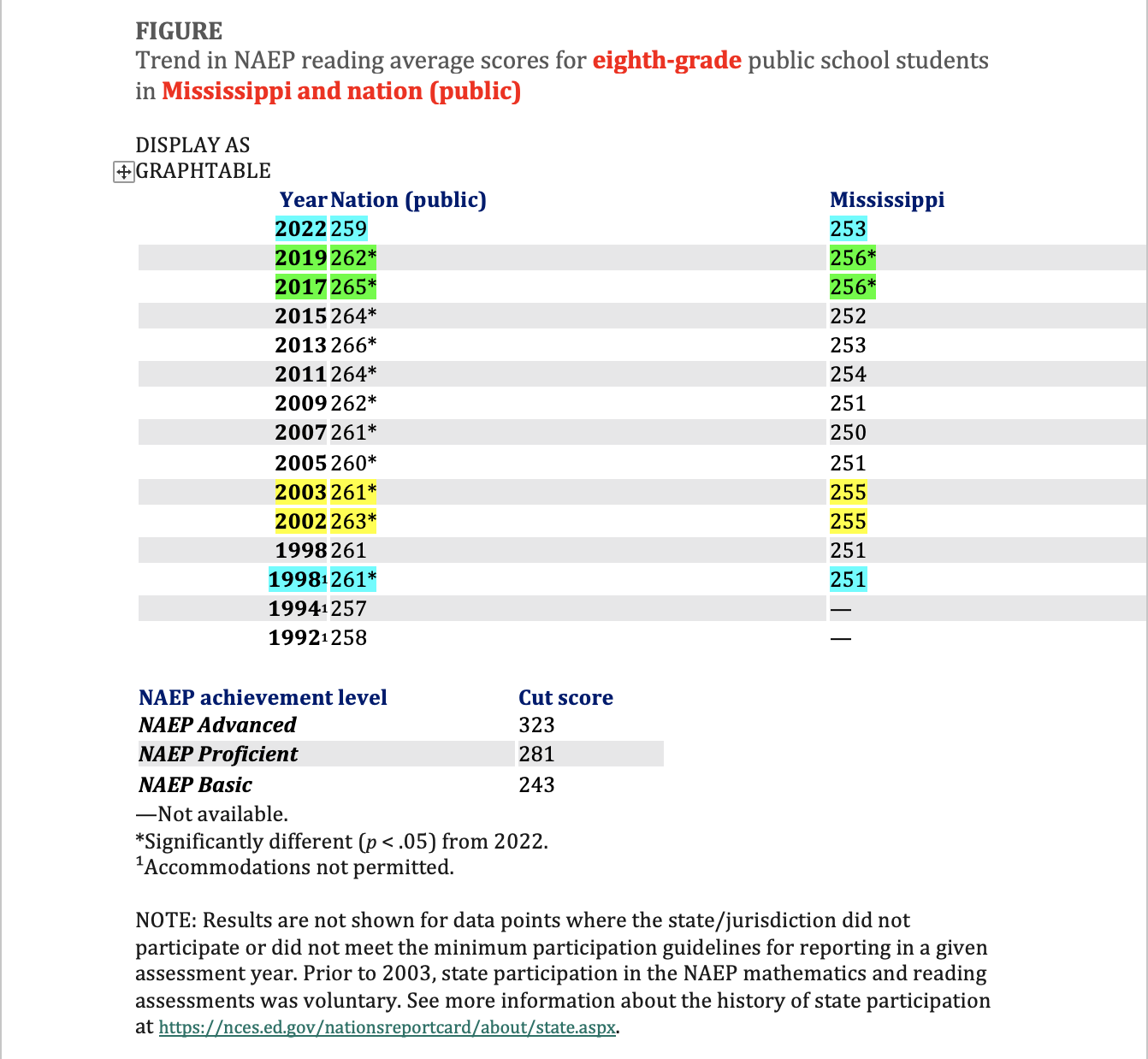
And as I have explained, the miracle of the moment, Mississippi, like all the other educational miracles, simply doesn’t exist; MS has had steady growth and some jumps, often well before any SOR reading legislation:

And MS remains below NAEP proficient and continues to have drops between grade 4 and 8:

For many years, I have had to help my students navigate the media obsession with the melodramatic—crisis! miracle!—often found in films such as Waiting for Superman (false union crisis v. charter miracles) and the compelling documentary about education in SC, Corridor of Shame (an emotionally manipulative film about the powerful connection between poverty and educational negligence in the state).

The media, public, and politicians love and benefit from the crisis/miracle rhetoric about education. But those stories do not serve the needs of children, teachers, or schools.

Ellison ends his talk powerfully:

I don’t know what intelligence is. But this I do know, both from life and from literature: whenever you reduce human life to two plus two equals four, the human element within the human animal says, “I don’t give a damn.” You can work on that basis, but the kids cannot. If you can show me how I can cling to that which is real to me, while teaching me a way into the larger society, then I will not only drop my defenses and my hostility, but I will sing your praises and help you to make the desert bear fruit.

What These Children Are Like

Education journalism has reduced education to crisis or miracle, and like the reductive formula Ellison rejects for children, I must reject this false pair of stories.

There is no reading or education crisis, and there are no miracle schools.

There is historical and current political negligence for addressing inequity in the lives and schooling of “other people’s children” in the US.

But that reality doesn’t sell or garner votes.


[1] Toward end, Ellison is scathing:

The great body of Negro slang–that unorthodox language–exists precisely because Negroes need words which will communicate, which will designate the objects, processes, manners and subtleties of their urban experience with the least amount of distortion from the outside. So the problem is, once again, what do we choose and what do we reject of that which the greater society makes available? These kids with whom we’re concerned, these dropouts, are living critics of their environment, of our society and our educational system, and they are quite savage critics of some of their teachers.

What These Children Are Like

[2] Thomas, P.L. (2016). Miracle school myth. In W.J. Mathis & T.M. Trujillo, Learning from the Federal Market-Based Reforms: Lessons for ESSA. Charlotte, NC: IAP.

Thomas, P.L. (2015). Ignored under Obama: Word magic, crisis discourse, and utopian expectations. In P. R. Carr & B. J. Porfilio (Eds.), The phenomenon of Obama and the agenda for education: Can hope (still) audaciously trump neoliberalism? (pp. 45-68). Charlotte, NC: Information Age Publishing.

POEM: the things we outgrow (negligence)

You don’t even notice me at all

“This Isn’t Helping,” The National

in his negligence
many people were hurt

over the course of many years
when his negligence waned

he began to wonder if
every man’s autobiography

should begin with
“in his negligence”

he wanted to apologize one by one
but the project was daunting

the neglected covered over everything
like every breath he took

so he wrote about it instead

the things we outgrow
when we can no longer
keep our footing on the ice
of our own selfishness


—P.L. Thomas

Open Letter on Reading Legislation

A recent scholarly commentary by professors Reinking, Hruby, and Risko note: “Since 2015, 47 state legislatures have enacted, or are currently considering, a remarkable total of 145 bills that address reading and reading instruction in public schools.”

Many literacy and policy scholars [1] have also noted that this wave of reading legislation is often grounded in the “science of reading” (SOR) movement that has been characterized as misleading, overly simplistic, and driven by melodramatic anecdotes.

Further, the growing number of states adopting SOR-based reading legislation includes bans of reading practices and programs as well as narrow mandates for different reading practices and programs.

A 2020 policy statement warned about using the SOR movement to inform legislation, however, by:

• Failing to place the current concern for reading in a historical context.
• Overemphasizing recent test scores and outlier data instead of longitudinal data with greater context (for example, NAEP).
• Misrepresenting the “science of reading” as settled science that purportedly prescribes systematic intensive phonics for all students.
• Overstating and misrepresenting the findings of the National Reading Panel report of 2000, without acknowledging credible challenges to those findings.
• Focusing blame on K-12 teachers and teacher education without credible evidence or acknowledgement of challenging teaching and learning conditions and the impact of test-based accountability policies on practice and outcomes.
• Celebrating outlier examples of policy success (in particular, the Mississippi 2019 NAEP data) without context or high-quality research evidence for those claims.

National Education Policy Center & Education Deans for Justice and Equity (2020). Policy Statement on the “Science of Reading.” Boulder, CO: National Education Policy Center.
http://nepc.colorado.edu/publication/fyi-reading-wars

The policy statement remains an important guide for revising reading legislation in order to avoid continuing to under- and mis-serve the individual needs of all students and to de-professionalize teachers.

The recommendations remain urgent and include the following for what legislation should not/should do:

Should not fund or endorse unproven private-vendor comprehensive reading programs or materials.
Should not adopt “ends justify the means” policies aimed at raising reading test scores in the short term that have longer-term harms (for example, third-grade retention policies).
• Should not prescribe a narrow definition of “scientific” or “evidence-based” that elevates one part of the research base while ignoring contradictory high-quality research.
• Should not prescribe a “one-size-fits-all” approach to teaching reading, addressing struggling readers or English language learners (Emergent Bilinguals), or identifying and serving special needs students.
• Should not prescribe such a “one-size-fits-all” approach to preparing teachers for reading instruction, since teachers need a full set of tools to help their students.
• Should not ignore the limited impact on measurable student outcomes (e.g., test scores) of in-school opportunities to learn, as compared to the opportunity gaps that arise outside of school tied to racism, poverty, and concentrated poverty.
• Should not prioritize test scores measuring reading, particularly lower-level reading tasks, over a wide range of types of evidence (e.g., literacy portfolios and teacher assessments), or over other equity-based targets (e.g., access to courses and access to
certified, experienced teachers), always prioritizing the goal of ensuring that all students have access to high-quality reading instruction.
• Should not teacher-proof reading instruction or de-professionalize teachers of reading or teacher educators through narrow prescriptions of how to teach reading and serve struggling readers, Emergent Bilinguals, or students with special needs.
• Should not prioritize advocacy by a small group of non-educators over the expertise and experiences of K-12 educators and scholars of reading and literacy.
• Should not conflate general reading instruction policy with the unique needs of struggling readers, Emergent Bilinguals, and special needs students.

• Should guarantee that all students are served based on their identifiable needs in the highest quality teaching and learning conditions possible across all schools:
o Full funding to support all students’ reading needs;
o Low student/teacher ratios;
o Professionally prepared teachers with expertise in supporting all students with the most beneficial reading instruction, balancing systematic skills instruction with authentic texts and activities;
o Full and supported instructional materials for learning to read, chosen by teachers to fit the needs of their unique group of students;
o Intensive, research-based early interventions for struggling readers; and
o Guaranteed and extensive time to read and learn to read daily.
• Should support the professionalism of K-12 teachers and teacher educators, and should acknowledge the teacher as the reading expert in the care of unique populations of students.
• Should adopt a complex and robust definition of “scientific” and “evidence-based.”
• Should embrace a philosophy of “first, do no harm,” avoiding detrimental policies like grade retention and tracking.
• Should acknowledge that reading needs across the general population, struggling readers, Emergent Bilinguals, and special needs students are varied and complex.
• Should adopt a wide range of types of evidence of student learning.
• Should prioritize, when using standardized test scores, longitudinal data on reading achievement as guiding evidence among a diversity of evidence for supporting instruction and the conditions of teaching and learning.
• Should establish equity (input) standards as a balance to accountability (output) standards, including the need to provide funding and oversight to guarantee all students access to high-quality, certified teachers; to address inequitable access to experienced teachers; and to ensure supported, challenging and engaging reading and literacy experiences regardless of student background or geographical setting.
• Should recognize that there is no settled science of reading and that the research base and evidence base on reading and teaching reading is diverse and always in a state of change.
• Should acknowledge and support that the greatest avenue to reading for all students is access to books and reading in their homes, their schools, and their access to libraries (school and community).

National Education Policy Center & Education Deans for Justice and Equity (2020). Policy Statement on the “Science of Reading.” Boulder, CO: National Education Policy Center.
http://nepc.colorado.edu/publication/fyi-reading-wars

This current cycle of the reading wars is another example of reducing historical and current failures of reading instruction to unwarranted crisis rhetoric and then resorting to the same failed patterns of education reform enacted for nearly five decades.

The individual needs of all students as readers can only be served by autonomous teachers in educational environments that support learning and teaching—not by mandates for scripted programs that enforce a once-size-fits-all approach to learning and teaching.

Reading legislation has the potential to do great harm or great good for the children of the US and our democracy. Once again, political leaders have chosen to do great harm.


Recommended

School Reformers’ Pledge of Good Conduct

[1] See

Where Do We Go from Here?: Learning and Teaching in the SOR Era

One of the most important and too often ignored works by Martin Luther King Jr. is his Where Do We Go from Here: Chaos or Community? (see an excerpts here).

I have relied on this work for many years in the context of my public writing and scholarship addressing equity, poverty, race, and literacy (for example, see pt. 1 and pt. 2). What has always rung true and important is King’s practical call for needed direct action instead of the status quo of political indirect action.

For example, King noted that the political will in the US was to view education as a mechanism for erasing poverty, racism, and inequity (indirect action) instead of directly eradicating the forces that create poverty, racism, and inequity.

I have reached a very sobering moment in my public work addressing the “science of reading” (SOR) movement as that has informed reading legislation across the US:

Since 2015, 47 state legislatures have enacted, or are currently considering, a remarkable total of 145 bills that address reading and reading instruction in public schools.1 Many of these bills are relatively routine appropriations, procedural issues, licensures, and so forth. However, an increasing number define, endorse, and sometimes mandate instructional approaches—a legislative excursion into matters that in other fields of practice, such as medicine or law, are left to certified professionals and the standards set by their professional organizations or accrediting agencies. In that sense, the existence of such laws suggests a perception of a problem with the teaching of reading of such consequence that it demands legislative action. In so doing, it moves professional practice into the political realm, subject to all the forces and vested interests inherent to that domain.

More specifically, it moves the teaching of reading into ideological territory, at least in the narrow pragmatic sense suggested by Fine and Sandstrom (1993; see also Seliger, 1970/2019). They defined ideologies as uniting individuals around shared beliefs and offering “diagnoses of what is and is not problematic in the sociopolitical world” (p. 24). Ideologies, they say, motivate ameliorative action, create affinity by energizing emotional reactions, and set boundaries of acceptable belief, inoculating members against outside influences and helping to recruit new members. Further, ideologies, so conceived, naturally generate a dissimulating rhetoric in which “speech about topics of public controversy, including political and ‘scientific’ speech . . . is subject to slanting and shaping when those treatments seem beneficial to [ideological] groups” (p. 30).

Reinking, D., Hruby, G. G., & Risko, V. J. (2023). Legislating Phonics: Settled Science or Political Polemics? Teachers College Record125(1), 104–131. https://doi.org/10.1177/01614681231155688

In my own work about reading policy, I had cited 32 states less than a year ago, and now, I must admit, SOR reading policy has become the dominant approach to teaching reading in the US despite extensive and credibly scholarly evidence that the reading crisis; blame leveled at reading programs, balanced literacy, and teacher educators; and misrepresentation of reading science are false narratives.

Media stories, political responses, and state-level legislation have resulted in pre-service and in-service training/retraining (often LETRS) and reading programs being banned with short lists of SOR-approved programs being mandated—both of which substantially change the landscape of how children will learn to read and how teachers will be mandated to teach (often in scripted environments).

Therefore, where do we go from here?

First, we must resist fatalism, and thus, we must adopt practices and strategies for advocating for addressing individual student needs as readers and teacher autonomy as reading teachers—even as both students and teachers must adopt ways to navigate this new SOR reality.

Key concerns about SOR legislation and policy include reducing reading instruction to scripted programs (often labeled “structured literacy) that erase individual student needs and teacher professionalism.

Educators, parents, and advocates for reading must acknowledge and reinforce that reading science is not settled, even as we have decades of valuable evidence for what works when teaching children to read.

This advocacy must walk a very difficult path of honoring individual stories of parents, children, and teachers while also raising cautions that anecdotes do not equal science (credible generalizations).

Anecdotes are powerful and compelling, but they often perpetuate overly melodramatic stories that misrepresent reading and teaching reading.

Next, we must hold SOR practices and policies to the highest standards of meeting the equity and diversity needs of our students.

Early evidence suggests that SOR-labeled reading programs and materials often have the same lack of diversity that has plagued reading materials for decades.

One of the historical negative consequences of “science” (which has historically been used to support racism and sexism) is that it promotes authority grounded in claims of being objective, which allows science to often be a veneer for practices that are, in fact, inequitable and biased.

The technocratic focus of the SOR movement and policy is fertile ground for continuing to see reading and students in monolithic ways that erases their humanity. Cultural backgrounds, regional dialects, and individual experiences must all be honored and fostered in our pursuit of teaching reading and the love of literacy that all children deserve.

There simply is not one right way to become a reader, and not one right way to teach children to read.

Finally, we must begin to detail and document what learning to read and teaching reading should look like if we do in fact embrace addressing individual student needs and teacher autonomy.

As a start, that requires that everyone must resist forming reading camps (labels are our enemy) and that we shift away from adopting reading programs to teach reading and call for teaching children to read.

I don’t see what we must do next as a compromise, but as a different way forward.

At its core, the SOR movement and the legislation that has become a national norm are deja vu all over again. We have lived the reading crisis/reading reform merry-go-round for almost a century.

I remain committed to King’s vision of recognizing that status quo approaches to systematic and important problems are doomed to fail again, to feed the entrenched political cycle.

Each child is precious, and unique, and each child deserves the opportunity to love reading, to become an eager and critical reader in order to enjoy the sort of human autonomy we claim to cherish.

Too often adult pettiness stands in the way of that opportunity.

The “Science of Reading” Era: An Open-Access Reader [UPDATED]

[Header Photo by Thought Catalog on Unsplash]

[Revised and Updated]

Increasingly since around 2012, the media story around the “science of reading” has resulted in legislation that bans targeted reading instruction and mandates limited reading program options for schools, teachers, and students.

Concurrently, literacy scholars have documented that key aspects of the SOR media story are false, and thus, legislation based on the media SOR story is misguided and likely to be ineffective or harmful.

Scholars have documented that the following elements of the media SOR story are misleading or false:

  • The US has a reading crisis because of reading programs not aligned with SOR and based in balanced literacy instead.
  • SOR is settled science that is reflected in NRP reports and the simple view of reading (SVR).
  • Students have not been afforded systematic phonics instruction that must be implemented for all students before they can comprehend or even “love” to read.
  • The reading crisis includes misidentifying and under-serving students with dyslexia, who represent a large percentage of students struggling to read at grade level.
  • The evidence of a reading crisis is NAEP data.

While there is a great deal of scholarly research available, such as two targeted issues of highly regarded Reading Research Quarterly, below is a listing of open-access scholarship that refutes the media story around SOR and establishes why reading legislation based on that SOR story should be rejected or revised:

These open-access scholarly examinations of the SOR movement should be used to advocate for an accurate characterization of reading and reading instruction, to address the individual needs of all students, to support the professional autonomy of teachers, and to call for reading legislation that avoids sweeping bans, narrow mandates, and creating yet more profit for the education marketplace.

Recommended

The Balancing Act: An Evidence-Based Approach to Teaching Phonics, Reading and Writing, Dominic Wyse and Charlotte Hacking

Reading wars or reading reconciliation? A critical examination of robust research evidence, curriculum policy and teachers’ practices for teaching phonics and reading, Dominic Wyse and Alice Bradbury

Decoding, reading and writing: the double helix theory of teaching, Dominic Wyse and Charlotte Hacking


Unsettling the Science of Reading: Who Is Being Sold a Story?, Nick Covington

See Also

[4-article series at English Journal]

Thomas, P.L. (2024, March). We teach English in times of perpetual crisis: The long (and tedious) history of reading crisis. English Journal, 113(4), 21-26. https://publicationsncte.org/content/journals/10.58680/ej2024113421


Thomas, P.L. (2023, November). Everything you know is wrong: The “science of reading” era of reading legislation. Perspectives and Provocations, (11), 1-17. https://drive.google.com/file/d/12fAfLV1pCh7ZXV-UFsTftFd7y_MLSK-O/view

Compton-Lilly, C., Spence, L.K., Thomas, P.L., & Decker, S.L. (2023, November 2). Stories grounded in decades of research: What we truly know about the teaching of reading. The Reading Teacher. https://doi.org/10.1002/trtr.2258

[Update]

Compton-Lilly, C., Spence, L.K., Thomas, P.L. and Decker, S.L. (2024), A Response to our Critics: Agreements, Clarifications, and Children. Read Teach. https://doi.org/10.1002/trtr.2298

Thomas, P.L. (2023, September). NEPC review: Teacher prep review: Strengthening elementary reading instruction. Boulder, CO: National Education Policy Center. https://nepc.colorado.edu/review/teacher-prep

Thomas, P.L. (2023). The Science of Reading Era: Seeking the “Science” in Yet Another Anti-Teacher Movement. Journal of Reading Recovery, 22(5), 5-17. https://readingrecovery.org/wp-content/uploads/2023/05/JRR_22-2_spring_2023_thomas.pdf

Thomas, P.L. (2023). The “Science of Reading,” Education Faddism, and the Failure to Honor the Intellectual Lives of All Children: On Deficit Lenses and Ignoring Class and Race Stereotyping. Voices in the Middle, 30(3), 17-21. https://publicationsncte.org/content/journals/10.58680/vm202332439

Thomas, P.L. (2022). The Science of Reading movement: The never-ending debate and the need for a different approach to reading instruction. Boulder, CO: National Education Policy Center. http://nepc.colorado.edu/publication/science-of-reading

A Critical Examination of Grade Retention as Reading Policy (white paper). Prepared for the Ohio Education Association in response to Ohio’s “Third Grade Reading Guarantee,” September 15, 2022.

POEM: working always back to you

the universe reminds me of you
or do i simply see you in everything

that is how my mind works
working always back to you


sometimes i don’t know what to do
with my hands when we are apart

fingers stiff with age and overuse
reaching for you under covers


there scrawled in concrete your initials
sending my mind working and reaching

i clench my hands feeling the tightness
of knuckles and the loneliness of fingertips


you do not have to lie there
your arm extended across my chest

but when you turn to me under covers
i am there waiting and longing to be


the universe reminds me of you
or do i simply see you in everything

that is how my mind works
working always back to you


—P.L. Thomas

Simplistic View of Reading Fails Children, Reading, and Science

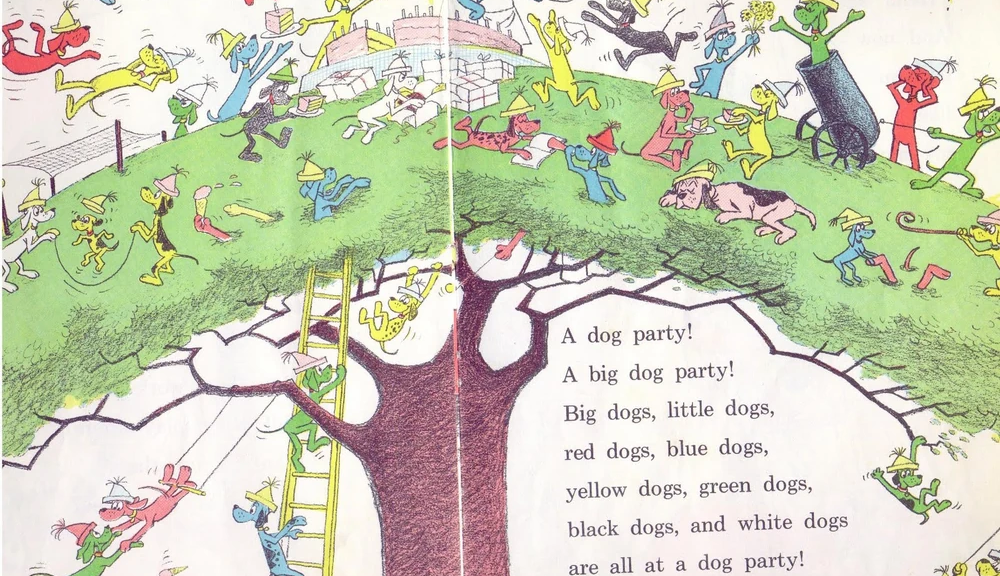
In 1967, I entered formal schooling as a first grader reading well above so-called grade level. I am 62, and I can vividly recall the books that my mother read to me and my sister—Hop on Pop, One fish two fish red fish blue fish, Green Eggs and Ham, and Go, Dog. Go!

And when I say “recall,” I mean I can see the books, the colors and images decades and decades later.

I fell in love with these books, and reading, well before I could navigate letters and words; in fact, my journey to navigating text began with falling in love with the physical books and the images.

There is a very solid line from those days in early childhood before school and my adolescent fascination with comic books that remains to this day. I continue to read whole issues of comics without ever noticing a word.

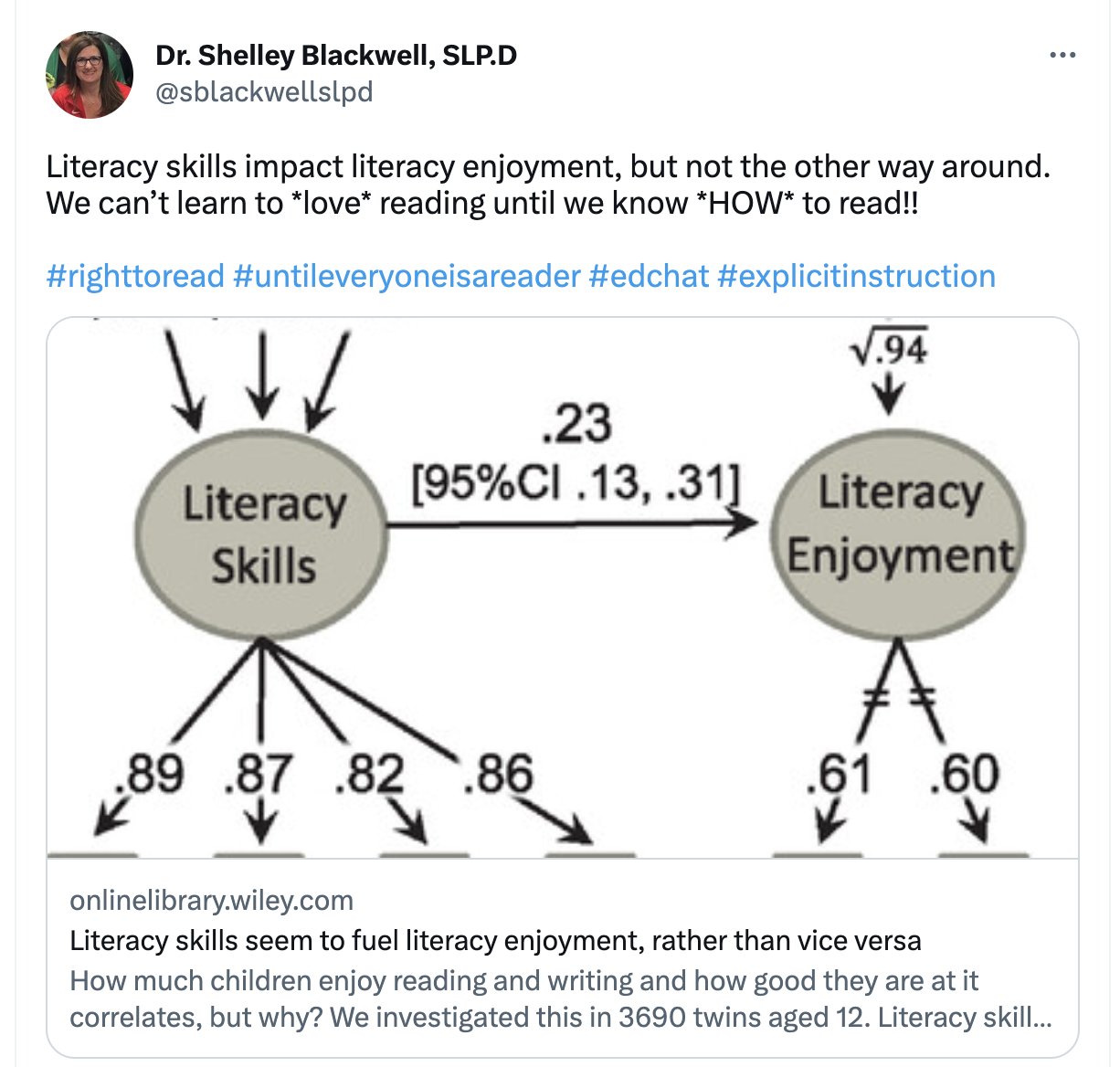
So I was filled with a particular sadness and even anger when I saw the following on Twitter:

This is maddeningly untrue about how and why children fall in love with reading, but it serves one of the central agendas of the “science of reading” movement—perpetuating a simplistic sequential view of reading that is skills-based and serves a systematic program of reading.

The SOR movement stands on a reductive claim that the science of reading is both simple and settled.

Neither is true.

More and more, elected officials are banning reading instruction practices and mandating a limited pool of reading programs schools can adopt and implement.

These natural consequences of media claiming reading science is simple and settled do not serve the needs of children or the goal of reading, but do serve political and marketing agendas.

Looking back, I am well aware that I often overcame my working-class roots because my household had plentiful picture books, a routine of reading aloud, and a culture of storytelling (my very not literary father loved to tell stories over and over).

Most of this for my sister and me fostered a love for reading and was not text-based. Our desire to read text was fueled by our love for our parents and reading—as is likely common among many children fortunate enough to have the advantages of our household.

Yes, the letter-sound-meaning dynamic is a key part of reading, but that is not primary to reading and certainly is not necessary seed of learning.

The SOR movement has evolved from misrepresenting reading science as simple and settled to reducing reading to simplistic platitudes about reading that are in no way supported by science or experience.

The cultural and ideological demonizing of whole language has also erased a key element of the holistic understanding of reading, and allowed a mechanical view of reading (and children) to feed a market for scripted programs and efficient ways to systematically assure that children will learn to hate reading and hate the schooling that ruined books for them.

Neanderthal Academia Reanimated!

In 2002, I left my career as a high school English teacher for 18 years and entered higher education full time.

I genuinely loved teaching high school, specifically teaching teenagers. But that part of my career had significant personal costs because I was always an extreme outlier in terms of ideologies among my peers.

Faculty were overwhelmingly religious and most of my colleagues voted Republican (this was South Carolina in the 1980s and 1990s).

As I entered higher education, I must admit now, I had an idealistic view of academia that was shaped by the standard view that colleges and professors are liberal.

However, once in the halls of academia, I recognized that once again I was an outlier.

Higher education is populated by performative progressivism; yes, many if not most professors are moderate to progressive on social issues.

But in their professional roles, college professors are overwhelmingly conservative and traditional. The normative culture of higher education is firmly conservative.

Also, despite what the public thinks, many professors are ideologically conservative about teaching and knowledge and conduct their classes and research in highly conservative ways because those traditional norms are expected and rewarded.

How should a professor teach? With an objective pose that simply exposes students to a wide range of (normative) perspectives.

How should a professor conduct research? Experimental/quasi-experimental studies are by far the most rewarded, quantitative and objective.

Should a professor conduct public work or activism? Not no, but hell no.

Professors that conform to and perpetuate the most conservative views on disciplinary content (seminal works, classic thinkers, essential knowledge), the most conservative research (scientific), and the most conservative teaching practices (objective, not political) have the easiest paths to full professor and also have the highest prestige in the university, holding key chair positions on the committees that drive the university—Faculty Status, Curriculum, etc.

“Conservative” is grounded in having normal established and endorsed; the entire basis of scientific research is normative, finding generalizable conclusions from randomized data.

The implication is always that normal is right, and being outside that norm, abnormal, is wrong.

Of course, the key problem with generalizable research is that it excludes outliers, perpetuating the idea that everyone, even those outliers, should conform to that norm.

The marginalized (lesser status) approach to research is descriptive, qualitative, and allows there to be value is simply exploring one event or person. The non-normative approach to research is open to possibilities that what has been scientifically determined to be “normal” may in fact not be right (or even true beyond a scientific truth), at least for some.

Research and science helped create the norm, for example, that humans are sexually straight and that gender is binary. That sexuality and gender may be fluid, and that we are considering that because of the life stories of individual people, challenges not only our norms about sex and gender, but our scientific norms.

Science has proven the superiority of races, the frailty of women, and even designated homosexuality as a mental illness.

To think that the scientific norm of higher education isn’t conservative takes a great deal of mental gymnastics.

We are currently witnessing how any challenge to what has been determined as normal, especially under the guise of science, is viewed in melodramatic ways.

As a cultural example, despite the US overwhelmingly being Christian, Christians often claim to be oppressed, notably each season fighting a manufactured War on Christmas.

Somehow uttering “happy holidays” threatens the very fabric of the largest cultural holiday in the US celebrated by the overwhelming majority, Christians, while non-Christians are compelled to join in with the ubiquitous acknowledgement of Christmas from Halloween through the New Year.

The much protesting we are seeing from conservative academics is exactly like the performative crisis espoused by Christians each Christmas holiday season.

Academia is extremely conservative—scientific research, objective teaching, authorized disciplinary knowledge—and that conservative norm has allowed for many decades mediocre people (mostly white, mostly men) to thrive and even excel.

And yet, Neanderthal academia has been reanimated (not revived, because it never died).

Conservative academics are shouting that they have been canceled.

Conservative academics bemoan their university’s “woke” curriculum.

Conservative academics cry that they are being threatened by “woke mobs” of students.

This, you see, is all theater, melodrama, by people who are not really relevant and are fighting desperately to be relevant in a world continuing to question what is normal

In fact, the fight against woke agendas is clearly a manufactured drama in which these Neanderthal academics have cast themselves in leading roles with predictable lines:

“Marketplace of ideas!”

“Scientific!”

“Objectivity!”

“Classic!”

“Seminal texts!”

It is genuinely embarrassing when people with the most power shed so many tears into the chilling effect of their histrionics that the result is a blizzard that will soon leaves us all snow blind.

I have spent 39 years as an extreme ideological minority within my profession, and frankly, most situations of my life. Yet, you will not see me crying “cancel culture!” or “woke mob!” because I can see clearly from the margins.

Neanderthal academia is not just alive and well, but it is reanimated in ways it hasn’t seen since the glory days at mid-twentieth century when minoritized people “knew their place,” being contentedly white-man adjacent if not subservient.

Trash Talk

When I checked Twitter and noticed Larry Bird trending, I immediately assumed that it was connected to the Angel Reese/ Caitlin Clark debate surrounding trash talk.

I was right, and the discussions around Bird, a legendary trash talker, echoes the same racial tension that responses to Reese and Clark are exposing.

My basketball life was grounded in the 1970s and 1980s when I played a great deal of basketball—on school and rec teams throughout junior and high school as well as almost daily pick-up games in the late 70s and early 80s—and was an avid college and NBA fan.

That basketball life included being a rabid fan of Pete Maravich and Bird, and since I was a scrawny white redneck from a working class family, there were many aspects of race and social class entrenched in my basketball life.

Despite my compulsive practicing—much of that focusing on dunking and spinning a basketball on my finger—I was mostly a bench warmer on school teams; I was routinely humiliated by my teammates who were overwhelmingly Black.

In fact, on a 13-person roster as a sophomore, I was the only white guy on the team.

But probably the most important part of my basketball life, and ultimately my life in general, was playing pick-up basketball almost exclusively with Black guys throughout high school and into college (where I also played intramural basketball).

Despite my limited skills as a basketball player, I was pretty athletic, I knew how to play ball well, I was a physical player, and I talked trash. On the court and off, I was known for my gifted use of profanity.

Concurrent with my basketball life, I listened for hours to George Carlin and Richard Pryor comedy albums. Carlin and Pryor taught me the power of language while also disrupting much of my redneck upbringing that was often narrow-minded and bigoted.

I learned from Carlin and Pryor that being smart and gifted knew no race, but I also learned that individual power and autonomy was grounded in my mind and my verbal abilities.

On the basketball court, I had a great to deal to make up for since I was often the weakest pure player on the court. So I had to play hard, and I used one skill I trusted—running my mouth.

One year that stands out to me is playing intramural basketball in my first couple years of college when I was playing pick-up basketball nearly daily with members of the college team and local elite high school players. Again, pick-up gains were overwhelmingly with Black guys and a couple of my closest white friends who, like me, were very Black-guy-adjacent in their basketball and personal lives.

Looking back on these experiences, especially in the context of the reductive and racist debates raging over Reese/ Clark and including references to Bird, I am now vividly aware of the moral codes I was taught through the Black culture elements of basketball.

One of my white friends used to say to me often, “Paul, you’re going to get your ass beat,” referring to my trash talk. Notably, these moments were always about my antagonistic interactions with other white guys.

I could have, and should have, gotten my ass beat, by the way. I was more mouth than ass, and I really never monitored when the other guy didn’t understand the moral code I had acquired.

The mostly Black-guy pick-up games were intense with a great deal of mouthing. But we usually smiled, we often slapped hands or shook hands to compliment good play, and I really never expected anyone to come to blows.

Unlike white guys, as well, Black guys called their own fouls when they committed them. If you fouled guys and let it slide, you caught extra hell so there was a not-so-subtle message to do the right thing.

White guys cried and moaned about being fouled, and trash talking often teetered in the edge of starting a fight.

I am certain I learned to respect the game from Black guys, and part of that code had to do with respecting each other even as we talked trash. White guys were often petty, what I called back then “punks,” calling touch fouls, complaining, being soft.

Talking trash was as much of the game as dribbling, passing, rebounding, and shooting. But talking trash was also a sign of respect and a level of expectations.

If you talk trash, you are going to pay for it at some point.

Bird often used trash talking to gain an advantage, but Bird lost games and match ups many times over his career. I am sure many people let him know that.

Bird was very open about his respect for Black athletes, and even said aloud he took it as a sign of disrespect when coaches had a white player guard him.

There is a very complex and even uncomfortable set of lessons in the racial dynamics of the basketball world of the 1970s and 1980s, often represented by Bird and Magic Johnson but also involving Michael Jordan and the Detroit Pistons.

Basketball was much more physical and even violent then, but basketball in many ways (along with professional sports) represented a way for Black men to gain status in US society in ways mostly denied them.

We want to think sports is a meritocracy, and maybe it is more so than in other contexts, but the basketball world I grew up in pushed racial tensions, racism and stereotypes, and cultural norms into a stronger spotlight for me.

In 2023, I shake my head, I sigh, and I regret that white people remain trapped in the sort of pettiness I witnessed growing up—thin skinned and absent a moral code that respects all humanity.

The Reese/ Clark controversy is much bigger than these athletes, and it exposes how public discourse remains white-centered, shaping a much different narrative of Reese than Clark.

An unfairly different narrative grounded in race and racism but also extending a faux respectability politics onto Reese but excused in Clark.

There was an important camaraderie  in the trash talking of my teen and young adult years that I cherish and miss (my basketball life was quite different than my all-white golf life that had a false decorum I never felt comfortable in). Dozens and dozens of Black guys made me a better athlete and person.

Clark like Bird likely understands that trash talk has its rewards but you will pay for it.

Millions of moments like the Reese/ Clark clash happened and do happen on basketball courts around the world, daily. But theirs was on one of the brightest stages and televised.

While too many people want to make claims about the character of Reese or Clark, the truth is that the debate itself is a window into the character of everyone choosing to debate their trash talking.

Too many people, mostly white, never learned the moral codes I did, never learned the lessons of race that were gifted me in the 1970s on vinyl records and on sweaty basketball courts.

If you are inclined to chastise Reese and praise Clark, you need to take a long moment in the mirror and consider holding yourself accountable before worrying about two young women playing college basketball at the highest level.


educator, public scholar, poet&writer – academic freedom isn't free