It’s the End of Writing as We Know It (And I Feel Fine)

[Header Photo by Solen Feyissa on Unsplash]

Recently there has been a different type of crisis rhetoric around education. This “the sky is falling” event concerns “the OpenAI, ChatGPT interface [that] is now capable of producing convincing (though uninspired) college student quality writing to just about any prompt within seconds,” explains John Warner.

The freaking out has been a tad bit extreme: Daniel Herman announcing, for example, The End of High-School English.

Let me emphasize first that if you are concerned about AI-generated writing by students, please prefer Warner’s analyses and his two excellent books on writing (I use one with my first-year writing seminars): my review of The Writer’s Practice, my review of Why They Can’t Write, and my post about my FYW students’ response to The Writer’s Practice.

Now let’s focus on the hyperbole and the seemingly very real threat that AI-generated writing will erase writing assignments in K-16 education.

First, like Warner, I say: It’s the End of Writing as We Know It (And I Feel Fine).

I have been writing about writing and the teaching of writing for decades, and I have consistently challenged traditional approaches to writing instruction that is template and prompt driven. But I have also challenged the over-reliance on computer programs and technology to respond to, evaluate, and police student writing.

This new development around AI-generated writing is simply an extension of the Turnitin.com problem.

Once again, technology is not threatening student writing or the teaching of writing in K-16 education. Technology is exposing the essential problems with student writing and writing instruction in K-16 education.

As I outline in my chapter, De-grading Writing Instruction: Closing the “Considerable Gap,” for De-Testing and De-Grading Schools, the history of writing instruction in K-16 education is primarily one of misguided instruction, assignments, and outcomes. Yet, I also note that with the rise of the National Writing Project (NWP) and a move toward process writing in workshop contexts, there was a brief period of hope in the 1970s when momentum shifted in writing instruction toward what many writers and educators recognize as authentic composition.

And then A Nation at Risk and the tidal wave of accountability driven by standards and high-stakes testing washed away that hope.

The accountability movement ushered in the rise of rubrics and set the stage for computer grading of the so-called basic skills needed by all students—reading, math, and writing.

The consequences of this shift to accountability, which essentially ended the era of authentic writing instruction, resulted in teachers who believed they understood more than ever how to teach writing, but were in teaching/learning situations that did not allow for much writing to be assigned or for students to produce substantial amounts of original writing (see Applebee and Langer).

For example, when I was a beginning high school English teacher, my home state of South Carolina was an early adopter of exit exams, including a writing section.

My high school quickly pivoted to teaching to the test (see Bracey about WYTIWYG: “What you test is what you get”) by training struggling students to write 3-5-3 essays—a 3-sentence introduction, a 5-sentence body, and a 3-sentence conclusion.

This template provided the minimum amount of writing to be scored proficient but also limited the space in which students could demonstrate “errors” (we learned that patterns in writing, not single instances, triggered low scores).

The result was the highest passing rates in the state and a generation of students who wrote incredibly vapid and brief “essays.”

Now, if AI-generated writing can produce passages or even entire essays that meet the expectations of assignments in K-16 education, we shouldn’t be flailing our arms and racing around in Apocalyptic panic because that is a signal that the type of writing students are assigned and the writing they are taught to produce weren’t very good to begin with.

None the less, there appears to be a technology antidote available to those prone to seeking out technology—How to Detect OpenAI’s ChatGPT Output, Sung Kim.

Just as I see no need for Turnitin.com (and the research also refutes the values in the program; see the end of this post HERE), I believe the very real threat of AI-generated writing in K-16 education can be both a welcomed end to bad writing instruction, assignments, and essays by students as well as an opportunity to implement writing practices that greatly minimize students wanting or needing to cheat (similar to how we should be approaching traditional plagiarism).

Here, then, are my recommendations for addressing the Brave New World of AI-generated student writing:

  • A key problem at the core of student writing and teaching writing in K-16 formal education is that the assigning and teaching of writing has disproportionately been the responsibility of ELA teachers (disproportionately experts in literacy and literature) who have little to no experience as writers and woefully inadequate preparation to teach writing. So a first-step to addressing writing in formal schooling is to better prepare teachers as writers and writing teachers (again, we have a ready-made process for that in the now underfunded NWP model).
  • Next, a key way to encourage student engagement in writing and learning to write is to de-grade the writing process. See posts on de-grading and De-testing and de-grading schools: Authentic alternatives to accountability and standardization. Students who cheat are often driven by fear of failure or their inability to manage deadlines and workloads. Creating supportive and low-stakes environments for writing is foundational to both students learning to write and high-quality original student writing.
  • A subset of the above point, writing must be a process and conducted in workshop class sessions. Process writing means students must produce artifacts demonstrating brainstorming and pre-writing, drafting, research, and revision after peer and instructor feedback. Plagiarism and AI-generated writing thrive in one-shot writing assignments driven by prompts; process and workshop writing by students support original thinking and writing as well as artifacts of the type of writing students can produce.
  • Begin any course that includes writing assignments by having students produce in class a writing sample followed by having them submit a brief writing sample out of class. These samples can provide evidence for their writing styles and abilities.
  • Include direct instruction and conversations in class about Turnitin.com and ChatGPT as well as why students engaging in authentic learning trumps trying to fulfill assignments or achieve specific grades.
  • Finally, re-evaluate all writing assignments for authenticity and value in the course. If students can succeed with AI-generated writing in an assignment, that is likely a signal the assignment is the problem.

The fatalistic response to AI-generated student writing does not upset me because I have been making the same arguments above decades before this occurred. As I have often explained, writing and teaching writing are journeys, not destinations.

The threat of AI-generated student writing is not the end of that journey but an opportunity to take the fork in the road that we have been ignoring for decades.


See Also

AI Isn’t The Threat to High School English. Censorship Is: Book Censorship News, December 16, 2022

Journey cover

Thomas, P.L. (2019). Teaching writing as journey, not destination: Essays exploring what “teaching writing” means. Charlotte, NC: Information Age Publishing.

Is Reading a “Guessing Game”?: Reading Theory as a Debate, Not Settled Science

[Header Photo by Chi Xiang on Unsplash]

The word “theory” is a technical term in the sciences that doesn’t mean “guessing.” “Theory” is not “hypothesis,” even as “hypothesis” isn’t really guessing either (maybe it is an educated guess).

Yet, average people tend to use “theory” as just a guess. That tension between laypeople and scientists is central to many problem with attempting to create evidence-based (“scientific”) policy in the context of media, public, and political debate that is mostly among laypeople.

Reading theory is rarely labeled “theory” in those debates among laypeople. Popular labels, such as “whole language,” often lose their theory origin and become teacher practice.


About a decade into teaching high school English, I taught a group of tenth graders with whom I immediately bonded (and was fortunate to teach again as seniors). Many of these students, now well into their 40s, remain friends of mine.

This class was very bright and genuinely eager to learn, but they were also driven to be “pleasers.” I worked hard to help them become more independent thinkers (instead of being incredibly compliant).

The worst way that urge to do the right thing hindered these students is reading. Early in the course, they pleaded with me that they could not read the assigned texts as fast as I wanted. This seemed odd because no class had ever complained about that, and the amount was quite manageable.

We set aside a class period to discuss how they read and such. What I learned was that these students in the early 1990s had been taught (or learned) that reading is done letter-by-letter to create words and word-by-word to create complete thoughts.

And there was their problem with reading speed.

I shared with them an epiphany I had in my MEd program during a course on early literacy. In that class we discusses how proficient and fast readers actually read. The process is much closer to what many would call skimming (“reading” large chunks at a time) and includes skipping as well as continually reading faster until the reader senses a loss of meaning before circling back.

My epiphany was that this described me perfectly as a reader, but I had always thought I was doing something wrong for not sticking to letter-by-letter and then word-by-word.

The discussion freed many of these students from a perception of reading that simply wasn’t accurate.


That explanation of highly proficient readers is also a story about reading as guessing and why reading theory remains a debate and not settled science.

The current “science of reading” movement depends heavily on melodramatic anecdotes to drive a narrative about reading and teaching reading that is overly simplistic and often simply wrong (see Media Coverage of SOR HERE).

One of those anecdotes portrays a teacher prompting a student struggling to read simply to guess at the words instead of using any sort of decoding strategy (what most people would call “sounding it out”).

So a key issue in the current reading debate is “guessing.”

To understand how “guessing” is part of the debate, we have to return to “theory.”

Whole language is a reading theory that is strongly associated with scholar Ken Goodman (see Whole Language HERE). In the 1960s, Goodman published Reading: A Psycholinguistic Guessing Game.

Goodman’s stated purpose in the piece is as follows:

Simply stated, the common sense notion I seek here to refute is this:

“Reading is a precise process. It involves exact, detailed, sequential perception and identification of letters, words, spelling patterns and large language units.”

In phonic centered approaches to reading, the preoccupation is with precise letter identification. In word centered approaches, the focus is on word identifications. Known words are sight words, precisely named in any setting.

Reading: A Psycholinguistic Guessing Game

And his alternative, where the issue with “guessing” has its roots:

In place of this misconception, I offer this: Reading is a selective process. It involves partial use of available minimal language cues selected from perceptual input on the basis of the reader’s expectation. As this partial information is processed, tentative decisions are made to be confirmed, rejected, or refined as reading progresses.

More simply stated, reading is a psycholinguistic guessing game. It involves an interaction between thought and language. Efficient reading does not result from precise perception and identification of all elements, but from skill in selecting the fewest, most productive cues necessary to produce guesses which are right the first time. The ability to anticipate that which has not been seen, of course, is vital in reading, just as the ability to anticipate what has not yet been heard is vital in listening.

Reading: A Psycholinguistic Guessing Game

While Goodman noted later that “guessing” may have not been the best choice, whole language proposed a theory of reading that valued meaning over accurately reading every word. And while the pervasiveness of whole language in K-12 education, I think, is greatly overstated, elements of holistic and workshop approaches certainly impacted practice and informed what would later be called “balanced literacy.”

The problem with “guessing” is the same as the problem with “theory”; both have very specific meanings in science and quite different (and often negative) meanings in day-to-day use.

And when theory is translated into practice, it is entirely possible, even likely, that some practitioners misunderstand and misuse “guessing.”

But it is quite a huge leap, as the “science of reading” movement has done, to announce that we have a unique reading crisis now that can be traced to teacher education teaching “guessing” and a couple reading programs that rely exclusively on “guessing.”

That “guessing” is also being identified (and even banned by some states) as “three cueing.”

So there are a few things to note about Goodman’s “guessing.”

First, that essay and idea is well over forty years ago; Goodman himself noted that he would later in his career have written a much different piece.

Next, the line between Goodman’s theorizing and the use of “guessing” or “three cueing” is complicated and extremely long.

Finally, it is much better to have a debate about reading theory and practice if we all agree to use important terms accurately. Here is a great and well cited overview of “multiple cueing”:

In some cases, proponents of structured literacy approaches have denigrated instructional practices that attend to multidimensional aspects of reading. For example, Spear-Swerling (2019) argued against encouraging students to attend to multiple-cueing systems when reading. Arguing that explicit teaching of decoding/phonics skills should dominate reading instruction, she warned against coaching students to use “meaning in conjunction with print cues and having students ‘problem-solve’ with teacher guidance (e.g., Burkins & Croft, 2010)” (p. 205). Spear- Swerling cited two reports (Foorman et al., 2016; National Institute of Child Health and Human Development, 2000) to argue that “research on students’ reading development… has conclusively disproven the multiple-cuing-systems model” (p. 206), although neither of these reports directly addressed or tested that model.

This rally against multiple-cueing systems models has been reiterated by scholars (Paige, 2020) and journalists (Hanford, 2018, 2019, 2020). Although it may be true that as readers become more proficient, they attend less to illustrations, this does not negate the role that illustrations play in helping young students learn to attend to meaning while reading. In short, drawing students’ attention to illustrations is one means of helping them attend to the stories and information presented in texts. Learning to attend to meanings that emerge while reading is essential for understanding both the simple and increasingly complicated texts that students encounter as they become skilled readers. Describing multiple-cueing systems models as having students draw on “partial visual cues to guess at words (Adams, 1998; Rayner & Pollatsek, 1989; Solman & Stanovich, 1992; Stanovich, 1986)” (Paige, 2020, p. 13) misrepresents these models and ignores the important role of illustrations as tools for learning to access and monitor meaning construction.

Compton-Lilly, C.F., Mitra, A., Guay, M., & Spence, L.K. (2020). A confluence of complexity: Intersections among reading theory, neuroscience, and observations of young readers. Reading Research Quarterly, 55(S1), S185-S195. Retrieved July 26, 2022, from https://doi.org/10.1002/rrq.348

In 2022, scholars of literacy have moved beyond Goodman’s initial theories of whole language, but they have also moved on from the “simple” view of reading (yet, SOR continues to blame whole language and balanced literacy while endorsing the “simple” view).

And the current state of reading theory remains a debate, not settled science. And that debate has those who focus on letters, sounds, words, and meaning versus those who envision proficient readers who scan text and create meaning through dozens of strategies, many of which aren’t grounded in letters and words.

This is more of a theory than a guess, but our only hope of not continuing the cycle of reading crisis, reform, reading crisis, reform, etc., we must begin to understand the complexities of reading and teaching reading instead of declaring winners and losers in order to play the blame game.

Reading Wars and Censorship Have a Long and Shared History

[Header Photo by Mick Haupt on Unsplash]

This is the story of a religiously and politically conservative couple who committed to changing how children are taught in the U.S. (see HERE or HERE):

The Gablers’ views are straight-forward and comprehensive. They believe that the purpose of education is “the imparting of factual knowledge, basic skills and cultural heritage” and that education is best accomplished in schools that emphasize a traditional curriculum of reading, math, and grammar, as well as patriotism, high moral standards, dress codes, and strict discipline, with respect and courtesy demanded from all students. They feel the kind of education they value has all but disappeared, and they lay the blame at the feet of that all-purpose New Right whipping boy, secular humanism, which they believe has infiltrated the school at every level but can be recognized most easily in textbooks.

Though they have gained most of their notoriety for protests that reflected ultra-conservative political and religious views, the Gablers have consistently — and rightly, in my view — stressed basic academic skills, with particular attention to the use of intensive phonics to teach reading. Their handbook on phonics is a helpful collection of articles and references that thoroughly documents the superiority of the phonetic over the “look-say” method of reading instruction, a method whose wide use in American schools seems to me not only to negate the chief advantage of an alphabet over pictographs but also to deserve much of the blame for the depressingly high rate of functional illiteracy in this country.

But the Gablers also feel that even those students who learn to read through intensive phonics, memorize their “times tables,” diagram sentences perfectly, and win spelling bees and math contests must still cope with an educational system that is geared to undermining their morals, their individuality, their pride in America, and their faith in God and the free enterprise system. Much of this corrosive work is accomplished through textbooks in history, social sciences, health, and homemaking.

The Guardians Who Slumbereth Not, William Martin

Three things are important to note here.

First, this is from 1982 and concerns the Gablers’ activism reaching back two decades before this news article:

Norma and Mel Gabler entered the field of textbook reform twenty years ago, after their son Jim came home from school disturbed at discrepancies between the 1954 American history text his eleventh-grade class was using and what his parents had taught him. The Gablers compared his text to history books printed in 1885 and 1921 and discovered differences. “Where can you go to get the truth?” Jim asked.

The Guardians Who Slumbereth Not, William Martin

Second, the religious and conservative crusade of the Gablers represents that reading wars emphasizing the lack of phonics and the need for systematic phonics as well as conservative censorship of what students can read and learn are historical patterns found over many decades in the U.S.

The “science of reading” movement and the anti-CRT/book banning movements of the 2020s are nothing new in 20th- or 21st-century America.

And third, most controversially, phonics-centric reading wars and censorship have deep overlaps as conservative movements—as I have noted about the current literacy movements.

Compare this graphic from the 1982 article to the reading war and censorship today:

The rhetoric used by the Gablers sounds disturbingly familiar. They justified their censorship by calling for textbooks that are “‘fair, objective and patriotic'” (although these terms are contradictory). And they were unapologetically “protective of Christianity.”

The Gablers also fought for traditional (unequal) gender roles, again based on their Christian beliefs: “When texts note that the desire of women to earn pay equal to that of men, the Gablers complain that such equality could come only if women ‘abandon their highest profession— as mothers molding young lives.'”

Eerily similar to the attitudes of journalists and parents in the “science of reading” movement, the Gablers were expert at erasing actual expertise:

Norma says she has read so many textbooks that “I figure I know enough to be a Ph.D.” It is clear, however, that they have little appreciation or understanding of the life of the mind as it is encouraged and practiced in many institutions of learning. They tend to cite the Reader’s Digest as if it were the New England Journal of Medicine and to regard a single conversation with a police chief or a former drug user as an incontrovertible refutation of some point they oppose.

The Guardians Who Slumbereth Not, William Martin

The Gablers were also early versions of conservatives who frame being privileged as an oppressed group: “‘When we try to get changes made,’ Norma said, ‘it’s called censorship. When minorities and feminists do the same thing, nobody complains.'”

As we reach the end of 2022, if we care about universal public education and academic freedom as essential for a free people, we need to recognize that the essentially conservative and ideological elements of the “science of reading” and anti-CRT/censorship movements are antithetical to those foundational principles.

Reading wars and culture wars fought over education are often driven by misinformation, melodramatic narratives, and the erasure of expertise and historical context; and ultimately, these movements are destined to do far more harm than good, regardless of anyone’s sincerity or intentions.

The “Science of Reading” Movement Fails Implementation Science

The “science of reading” (SOR) movement consisting of the media, parents, and politicians has painted itself into a corner. And like cornered animals, they often react with anger:

The SOR self-inflicted corner is demanding a narrow use of “science” for everyone else but not following that demand themselves:

It is clear that the repeated critiques of literacy teacher preparation expressed by the SOR community do not employ the same standards for scientific research that they claimed as the basis for their critiques. However, to dismiss these critiques as unimportant would ignore the reality of consequences, both current and foreseen, for literacy teacher preparation. Consider the initiatives under- way despite the fact that there is almost no scientific evidence offered in support of these claims or actions.

Hoffman, J.V., Hikida, M., & Sailors, M. (2020). Contesting science that silences: Amplifying equity, agency, and design research in literacy teacher preparation. Reading Research Quarterly, 55(S1), S255–S266. Retrieved July 26, 2022, from https://doi.org/10.1002/rrq.353

Increasingly scholars have shown the SOR movement is a misinformation movement that depends on bullying, not “science.” And for a few years now, I have experienced and witnessed SOR advocates responding to evidence-based Tweets with anger, mischaracterizations, and personal attacks.

And thus, this passage from Bertrand Russell and panels from Daredevil 6 (v.7) resonate with me:

The SOR social media anger is grounded, I think, in the impossible corner SOR advocates have created. When I have posted scientific research about dyslexia (notably Orton-Gillingham) or LETRS, I have been visciuously attacked simply for noting that O-G and LETRS do not have scientific support but are embraced by the SOR movement.

I have never said O-G or LETRS is ineffective; I have never rejected or endorsed either. I simply have noted that if we are saying any program or approach must be scientific, neither of these meet that standard.

What is even more concerning is that the entire SOR movement itself fails implementation science; for example, Leveraging Evidence-based Practices: From Policy to Action, Ronnie Detrich, Randy Keyworth, and Jack States.

Detrich, Keyworth, and States provide an excellent example of why the SOR movement is doomed by its own standards, how even high-quality “science” fails its own standards, and why this reading war is yet another cycle of the same misguided claims and idealistic solutions.

“Policy without evidence is just a guess and the probability of benefit is likely to be low,” Detrich, Keyworth, and States explain, adding, “Evidence without policy is information that is unlikely to have impact as it has limited reach.”

When I stated LETRS fails scientific scrutiny, several SOR advocates responded by noting the lack of fidelity in implementing LETRS. And thus, what we know from implementation science:

The development of evidence-informed policy is not sufficient to assure the benefits of the policy will be realized. Policies must actually be implemented well if they are to have impact. Many education policies have been enacted without any meaningful impact on educational outcomes. Often this was because there was no comprehensive, coherent plan for implementing the policy. Implementation science is defined as the study of factors that influence the full and effective use of innovations (National Implementation Research Network, 2015) and brings coherence to the implementation of policies. It is the third leverage point that can be utilized to turn policy into meaningful action, thus achieving desired outcomes. It is the bridge between policy, evidence-based practices, and improved outcomes for students. Without implementation science, the aspirations of evidence-informed policy, no matter how well intentioned, are not likely to result in benefit for students.

Leveraging Evidence-based Practices: From Policy to Action, Ronnie Detrich, Randy Keyworth, and Jack States

That last sentence is extremely important because it speaks to the very high stakes involved in reform as well as the nearly impossible task of implementing reform in ways that can be identified as successful.

Some of the inevitable traps of reform are identified in implementation science:

Policy is made broadly but implemented locally. Policy is generally made at a distance removed from the local context in which it is to be implemented and all of the differences across implementation settings cannot be anticipated. … It has been argued that because of the complexities of differing contexts, the concept of evidence-informed policy is not realistic (Greenhalgh & Russell, 2009). The concern is that the research context is so different from the local context as to make research evidence irrelevant.

Evidence-informed policy can prescribe what to do, but not how to do it in a specific context. Those with the best understanding of that context are in a better position to make those decisions. At the local level decisions about how to best implement an evidence-informed policy requires professional judgment and a clear understanding of the values of the local community. Conceptualizing evidence-informed policy as a decision-making framework addresses many of the concerns about the feasibility of it being realistic to address issues of context (Greenhalgh & Russell, 2009).

…[T]here are complex issues to be solved if evidence is to influence policy. There is an implication that policymaking is a rationale process in the sense that if the evidence is available policymakers will act on it; however, the formulation of policy is influenced by a number of factors other than evidence. A challenge for those advocating evidence-informed policy is that policymakers bring their own political and personal biases to the task. In instances when evidence conflicts with political and personal preferences, preferences usually prevail and evidence is discounted [emphasis added](Gam- brill, 2012).

Leveraging Evidence-based Practices: From Policy to Action, Ronnie Detrich, Randy Keyworth, and Jack States

What the SOR movement demonstrates is the essential flaw of advocacy grounded in missionary zeal; and thus, “If evidence is to play a central role in influencing policy, then the challenges of overcoming personal biases, political considerations, advocacy groups, and financial incentives must be confronted.”

In short, when SOR advocates challenge existing market forces driving reading program adoption, they seem incapable of seeing how that same market dynamic is shaping their own movement.

As well, the SOR movement is trapped in an idealistic and simplistic use of “science” (along with a misunderstanding of meta-analyses):

A limitation of experimental evidence is that one experimental study is never sufficient to definitively answer a question about what should be done and is a poor basis for formulating policy. If there is a body of literature, the common approach by education scholars has been to review the extant literature and make a reasoned judgment about what should be done. Policymakers are not necessarily prepared to conduct a review of the literature and come to reasonable conclusions about what should be done as a matter of policy. An alternative to the narrative type of review is a systematic review or meta-analysis that summarizes a body of research and can inform policymakers about the general effect of a practice. A significant advantage of meta-analysis for policymakers is that it provides a single score (effect size) that best estimates the strength of an intervention across populations, settings, and other contextual variables. Program evaluation is another type of evidence that is valuable to policymakers. It provides feedback about the effectiveness of a program or practice and can provide insights about how policies can be changed to increase benefit.

Leveraging Evidence-based Practices: From Policy to Action, Ronnie Detrich, Randy Keyworth, and Jack States

Often, little weight is allowed for teacher-based evidence because that doesn’t meet the narrow definition of “science” that has painted SOR advocates into a corner:

Similarly, practitioners seeking answers to challenges they are facing can collect data about the frequency of occurrence, the contexts in which they are most likely to occur, and the differences between the contexts in which the problem occurs and does not occur. Practice-based evidence is the essence of data-based decision making (Ervin, Schaughency, Mathews, Goodman, & McGlinchey, 2007; Stecker, Lembke, & Foegen, 2008). Single participant designs are commonly used in data-based decision making. The unit of analysis can be an individual to determine if she is benefiting from an intervention and is common in response to intervention approaches (Barnett, Daly, Jones, & Lentz, 2004). The unit of analysis can also be larger such as a whole school. Practitioners of school-wide positive behavior support rely on single participant designs to make decisions regarding the effectiveness of whole school interventions (Ervin et al., 2007).

Leveraging Evidence-based Practices: From Policy to Action, Ronnie Detrich, Randy Keyworth, and Jack States

But the limitations of “scientific” or “evidence-based” policy and practice have occurred in recent history, specifically No Child Left Behind (NCLB):

There were a number of implicit assumptions in the use of this approach with NCLB (Detrich, 2008). First, it was assumed that there was an established body of evidence-based interventions. Secondly, it was assumed that educators were aware of the evidence supporting different practices. A third assumption was that educators had the expertise to implement a specific practice. A final assumption was that the necessary resources were available to support effective implementation. The experience with NCLB would suggest that these assumptions are not justified. When NCLB was enacted, there was no organized resource for educators that provided information about the evidentiary status of various interventions. More recently, there are a number of organizations that summarize and evaluate the evidence supporting educational interventions such as the What Works Clearinghouse and Best Evidence Encyclopedia.

Leveraging Evidence-based Practices: From Policy to Action, Ronnie Detrich, Randy Keyworth, and Jack States

The irony of the failures of evidence-base policy in education is that we have implementation science that can and should guide how policy is crafted and implemented: “The stages of implementation science are exploration and adoption, installation, initial implementation, and full implementation (Blasé, Van Dyke, Fixsen, & Bailey, 2012).”

The SOR movement fails the very first stage: “Exploration and adoption is the phase in which all stakeholders (teachers, administrators, etc.) are involved in the decision-making in terms of defining the problem they are trying to solve and identifying possible solutions.”

This is, in fact, what I call for in my policy brief on the current policy failures in the SOR movement:

Develop teacher-informed reading programs based on the population of students served and the expertise of faculty serving those students, avoiding lockstep implementation of commercial reading programs and ensuring that instructional materials support—rather than dictate—teacher practice.

Thomas, P.L. (2022). The Science of Reading movement: The never-ending debate and the need for a different approach to reading instruction. Boulder, CO: National Education Policy Center. http://nepc.colorado.edu/publication/science-of-reading

The SOR movement is a media-based movement that has resulted in very bad and often harmful policy (see HERE, HERE, HERE, and HERE).

And thus the paradox of implementation science: “The fundamental goal of implementation science is to make sure that at each phase of implementation the necessary steps are taken to assure that an intervention is implemented with integrity.”

Most if not all reforms must be implemented with such a high degree of fidelity (likely one not possible in the real world) that all reform is doomed necessarily to be identified as a failure.

The SOR movement will be declared a failure exactly like all the similar reading reform movement before it:

It is abundantly clear that policy alone is not sufficient to improve students’ academic achievement. Since the publication of A Nation at Risk (Gardner, 1983) there has been a steady stream of policy initiatives with the intent to reform the U.S. education system. In the time period covered by these various policy initiatives there is almost 50 years of data suggesting that academic performance in reading and math as measured by NAEP has not changed in any significant way despite all of the policies and money spent (Nations Report Card, 2015).

Leveraging Evidence-based Practices: From Policy to Action, Ronnie Detrich, Randy Keyworth, and Jack States

Regardless of the identified problems and regardless of the policy solutions, education is a steady march of failed reforms—most of which are indistinguishable from the others.

One example offered by Detrich, Keyworth, and States demonstrates the fatal gap between evidence and policy:

An additional shortcoming in the development of the policy to reduce class size was that all available evidence from Tennessee suggested that class size should be 17 or less and the teacher should be credentialed and have experience. California reducing class size to 20 was without support in the available evidence so even with fully credentialed teachers, the effects may have been minimized.

Leveraging Evidence-based Practices: From Policy to Action, Ronnie Detrich, Randy Keyworth, and Jack States

In reality, even when policy is identified as “scientific” or “evidence-based,” the actual practice is distorted by ideology or practical issues of implementation (evidence-based policy tends to be too politically or financially expensive to implement with fidelity).

And there is an unintended message in Detrich, Keyworth, and States—how researchers themselves fall into ideological traps.

Similar to the flaws in media coverage of SOR (see HERE and HERE), Detrich, Keyworth, and States misrepresent the whole language movement in California (see HERE and HERE) and uncritically cite NCTQ reports that do not meet a minimum bar of scientific research (see HERE, HERE, and HERE).

SOR advocates, then, find themselves in a very real dilemma. They often resort to anger and bullying because, I think, unconsciously they recognize the corner they have painted themselves into, the hypocrisy they are trafficking in.

Education and reading reform are cycles of doomed failure because we are too often lacking historical context, we are prone to ideological and market bias, and we commit to standards that no one can achieve.

The anger and bullying of SOR advocates isn’t justifiable, but it is predictable.

Again, as Detrich, Keyworth, and States explain: “Without implementation science, the aspirations of evidence-informed policy, no matter how well intentioned, are not likely to result in benefit for students.” LETRS training, for example, increases teacher confidence but doesn’t raise student achievement.

In a few years, just as we are experiencing a few years after NCLB’s “scientifically-based” mandate, there will be hand wringing about reading, charges of failure, and calls for new (read: the same) solutions that we have cycled through before.

It seems the one science we are determined to ignore is implementation science because it paints a complex picture that isn’t very politically appealing.

A Devil as Christ Figure: “We Should Feed Them”

[Header and all images property of Marvel and artists]

As a long-time fan and collector of Daredevil, I have expressed my concern about the current storyline that has included Daredevil and Elektra as king and queen of The Fist as well as Daredevil announcing, “This is God’s plan.”

With Daredevil 6 (v.7), Chip Zdarsky appears to be shifting the trajectory of Daredevil away from the precipice of knowing the mind of God and toward a much more compelling characterization of the Devil of Hell’s Kitchen as a Christ figure—complete with human frailty and doubt (see more below):

With issue 6, I immediately thought of the recurring motif in literature that reveals the alienating consequences of putting Jesus’s plea for charity into real-world practice. Literature often portrays religiosity as false and dangerous, framed against a more humanistic and secular embracing of simply living one’s life with empathy without regard to punishments or rewards (in this life or in a claimed afterlife):

About belief or lack of belief in an afterlife: Some of you may know that I am neither Christian nor Jewish nor Buddhist, nor a conventionally religious person of any sort.

I am a humanist, which means, in part, that I have tried to behave decently without any expectation of rewards or punishments after I’m dead.

God Bless You, Dr. Kevorkian, Kurt Vonnegut

Daredevil finds himself struggling to communicate with a world disconnected from God/Jesus in a way that parallels John Irving’s A Prayer for Owen Meany; John Wheelwright, narrator and friend of Owen, offers a key scene in Chapter 1:

We were in Rye, passing the First Church, and the breeze from the ocean was already strong.  A man with a great stack of roofing shingles in a wheelbarrow was having difficulty keeping the shingles from blowing away; the ladder, leaning against the vestry roof, was also in danger of being blown over. The man seemed in need of a co-worker—or, at least, of another pair of hands.

“WE SHOULD STOP AND HELP THAT MAN,” Owen observed, but my mother was pursuing a theme, and therefore, she’d noticed nothing unusual out the window….

“WE MISSED DOING A GOOD DEED,” Owen said morosely. “THAT MAN SHINGLING THE CHURCH—HE NEEDED HELP.” (pp. 33-34, 35)

A Prayer for Owen Meany

Owen sees a world that those around him appear either unwilling or incapable of seeing; Owen also is eager to act on his vision for empathy and compassion while those around him are paralyzed by their daily lives:

The world is too much with us; late and soon,
Getting and spending, we lay waste our powers;—
Little we see in Nature that is ours;
We have given our hearts away, a sordid boon! ("The World Is Too Much With Us," William Wordsworth

While issue 5 posed Daredevil at the boundary of zealotry, issue 6 presents a man seeking a way to balance his mission from God with a real-world restorative justice agenda.

The arc of issue 6 depends on creating some nuance to vigilanteism, a core problem in superhero narratives. That arc begins with Daredevil and ends with the Punisher, who has long provided a moral complication to Daredevil’s code of ethics.

Matt Murdock, lawyer, and Daredevil, superhero, have carried this tension as well throughout the long history of Daredevil:

Daredevil’s mission is grounded not in punishment but in a key tenet of restorative justice:

Criminals are a consequence of social forces, Daredevil argues, and thus, he seeks a way to use love and compassion to help those labeled “criminals” regain their humanity.

Daredevil’s commitment to restorative justice is dramatized in an exchange with Bullet:

Like Daredevil, Bullet is aware of the inherent flaws in the criminal justice system, built on punishment; however, Bullet is also a voice of blunt reality against Daredevil’s idealism:

Here, my concerns from issue 5 are greatly tempered although this exchange creates even more tension in the story itself. Similar to the powerful scenes between Frank Castle/The Punisher and Daredevil in S2 of Daredevil, here Bullet calls Daredevil on his idealism:

Alone, the weight of that reality on Daredevil is revealed, the pressure of being Christlike, leading by example:

The religious motif of issue 6 is made explicit once Daredevil confronts Goldy while Elektra serves the mission (and faces Iron Man*):

From issue 5—”This is God’s plan”—to issue 6—”The Lord knows the plans of man”—Psalm 94:11 pulls the reader back from Daredevil’s idealism, suggesting that despite his best intentions, his mission is “futile.”

And then, the narrative returns to something ominous, the motif of punishment:

Justice, we must acknowledge, is in the eye of the beholder, and issue 7 appears to be tracking toward a clash between the mission (Daredevil) and the cause (The Punisher).

And the question remains if that justice can be restorative or futile.


* A beautiful panel not to be ignored in issue 6:

Rafael De Latorre (artists) and Matthew Wilson (colorist)

Understanding “Science” as Not Simple, Not Settled: Meta-Analysis Edition

A powerful but often harmful relationship exists among research/science, mainstream media, and public policy.

One current example of that dynamic is the “science of reading” (SOR) movement that is driving reading legislation and policy in more than 30 states (see HERE and HERE).

Mauren Aukerman, who has posted two of three planned posts on media coverage of SOR (HERE and HERE), identifies in that second post a key failure of media: Error of Insufficient Understanding 3: Spurious Claims that One Approach is Settled Science.

For example, Aukerman details with citations to high-quality research/science: “In short, there is insufficient evidence to conclude that any single approach, including the particular systematic phonics approach often elided with ‘the science of reading,’ is most effective.” And therefore, Aukerman recommends: “Be skeptical of ‘science of reading’ news that touts ‘settled science,’ especially if such claims are used to silence disagreement.

What makes media a dangerous mechanism for translating research/science into policy is that journalists routinely oversimplify and misrepresent research/science as “settled” when, in reality, most research/science is an ongoing conversation with data that presents varying degrees of certainty about whatever questions that research/science explores.

In education, research/science seeks to identify what instruction leads best to student learning—such as in the reading debate.

The other problem with media serving as a mechanism between research/science and policy is that journalists are often trapped in presentism and either perpetuate or are victims of fadism.

Despite no settled research/science supporting media’s coverage of the current reading “crisis,” the initial “science of reading” narrative created by Emily Hanford has now become standard media narratives without any effort to check for validity (again, I highly recommend Aukerman’s first post).

Regretfully, education (and students, teacher, parents, and society) is regularly the victim of fadism at the expense of research/science. The list of recent edu-fads that were promoted uncritically by media only to gradually lose momentum because, frankly, they simply never were valid policies is quite long: charter schools (notably no-excuses models), value-added methods for evaluating/paying teachers, school choice, Common Core, etc.

Two fads that represent well how the misuse of “science” helps this failed cycle in education are “grit” and growth mindset. Both gained their introduction to mainstream education because media portrayed the concepts are research/science-based (even justified, as “grit” was, by the Genius grant).

While schools fell all over themselves, uncritically, to embrace and implement “grit” and growth mindset, the research community gradually revealed that both concepts have some important research and ideological problems. Scholars have produced research/science that complicates claims about “grit” and growth mindset, and many critical scholars continue to call for interrogating the racist/classist groundings of both concepts.

Growth mindset has been in the news again (and discussed on social media) because two recent meta-analyses reach different conclusions; see this Twitter thread for details:

Tipton and co-authors, in fact, have published an analysis and commentary on this problem: Why Meta-Analyses of Growth Mindset and Other Interventions Should Follow Best Practices for Examining Heterogeneity.

The issue raised about meta-analyses parallels the exact problem with media coverage of research/science—scientific methodologies that fail due to oversimplification. See this Tweet, for example, about meta-analyses:

Especially in education, when individual student needs greatly impact what is “best” for teaching and learning in any given moment, Tipton’s final Tweet cannot be over-emphasized:

The use of “science” in research is necessarily limiting (see HERE) when that “science” is restricted to experimental/quasi-experimental designs seeking proof of cause (does instructional approach X cause students to learn better than instructional approach Y).

While causal conclusions and research methods that address populations and controls are the Gold Standard for high-quality research/science, this type of “science” is often less valuable for the practical day-to-day messiness of teaching and learning.

Educators are better served when research/science is used to inform practice, not to mandate one-size-fits-all practice (see HERE).

The media and journalists more often than not turn research/science into oversimplified truisms that then are used as baseball bats to beat policy advocates into submission. The conversation and nuance are sacrificed along with effective policy.

The public and policymakers are left with a challenge, a way to be critical and careful when either the media or researchers present research/science.

As Aukerman warns, if journalists or researchers start down the “simple, settled” path, then they are likely not credible (or they have an agenda) because the real story is far more complicated.


See Also

The misdirection of public policy: comparing and combining standardised effect sizes, Adrian Simpson

Whose Voice Matters?: Reading Teacher Edition

Here is a teacher voice that resonates with me in my work as a literacy teacher and scholar:

A brief consideration will indicate reasons for the considerable gap between the research currently available and the utilization of that research in school programs and methods.

It is not strange, in view of the extensive literature on language, that the teacher tends to fall back upon the textbook as authority, unmindful of the fact that the writer of the text may himself be ignorant of the basis for his study. …

This is not the time for the teacher of any language to follow the line of least resistance, to teach without the fullest possible knowledge of the implications of his medium. Before we…experiment with methods of doing specific things or block out a curriculum, let us spend some time with the best scholars in the various fields of language study to discover what they know, what they believe uncertain and in need of study. Let us go to the best sources, and study the answers thoughtfully.

This voice in many ways parallels a dominant narrative in the media about teaching reading in the US:

From how much of the media tells it, a war rages in the field of early literacy instruction. The story is frequently some version of a conflict narrative relying on the following problematic suppositions:

a) science has proved that there is just one way of teaching reading effectively to all kids – using a systematic, highly structured approach to teaching phonics;

b) most teachers rely instead on an approach called balanced literacy, spurred on by shoddy teacher education programs;

c) therefore, teachers incorporate very little phonics and encourage kids to guess at words;

d) balanced literacy and teacher education are thus at fault for large numbers of children not learning to read well.

The opening teacher voice is from Lou LaBrant, published in 1947 in the journal that would become Language Arts (NCTE). LaBrant was a classroom literacy teacher and teacher educator over a 65-year career.

The second passage is by Maren Aukerman, a scholarly analysis of the current media coverage of the “science of reading” (SOR).

Although 77 years apart, these voices and claims about teaching reading seem to suggest that concerns about reading achievement have been similar for many, many decades, and thus, placing blame for current reading achievement on specific aspects of teacher preparation and teacher practice today seems if not baseless at least misguided.

For a couple years now, I have also heard from dozens and dozens of teachers, some of whom send me real-time DMs documenting teacher PD they are receiving in SOR; these teachers identify misinformation in that PD as well as misunderstanding about reading and teaching reading by their administrators.

Often these are LETRS training sessions, or similar programs designed to emphasize phonics for teachers of reading.

Many teachers have contacted me about being reprimanded and threatened for simply asking questions about the training or pointing out the misinformation.

What is important to stress here is that these teachers—often veteran teachers who have a high level of expertise—do not have a podcast or a Facebook page amplifying their stories.

To be blunt, in today’s SOR climate, these reading teachers’ voices do not matter.

But other points need to be stressed also.

First, is the media narrative that teacher education does not include SOR or phonics instruction true?

No, and in fact, there is research that teacher education is grounded in science, but there also is an absence of research on these exact concerns (again, identical to LaBrant’s reference to the “gap” above):

It is clear that the repeated critiques of literacy teacher preparation expressed by the SOR community do not employ the same standards for scientific research that they claimed as the basis for their critiques. However, to dismiss these critiques as unimportant would ignore the reality of consequences, both current and foreseen, for literacy teacher preparation….

In contrast to the claims made by the SOR community, research in literacy teacher preparation has been extensive, scientific, and useful for guiding reform efforts….

Despite the political and media attention given to the SOR and the tools on which the SOR community relies, there is no body of evidence that reflects the SOR perspective on literacy teacher preparation by members of the literacy teacher preparation research community.

Hoffman, J.V., Hikida, M., & Sailors, M. (2020). Contesting science that silences: Amplifying equity, agency, and design research in literacy teacher preparation. Reading Research Quarterly, 55(S1), S255–S266. Retrieved July 26, 2022, from https://doi.org/10.1002/rrq.353

Next, and really important, if we are demanding scientific research inform practice, currently the research base on LETRS simply does not show that the training improves teaching or learning to read by students:

A growing number of U.S. states have funded and encourage and/or require teachers to attend professional development using Moats’s commercial LETRS program, including Alabama, Arkansas, Kansas, Mississippi, Missouri, Oklahoma, Rhode Island, and Texas. This is despite the fact that an Institute of Education Sciences study of the LETRS intervention found almost no effects on teachers or student achievement (Garet et al., 2008).

Hoffman, J.V., Hikida, M., & Sailors, M. (2020). Contesting science that silences: Amplifying equity, agency, and design research in literacy teacher preparation. Reading Research Quarterly, 55(S1), S255–S266. Retrieved July 26, 2022, from https://doi.org/10.1002/rrq.353

We are confronted, then, with an increasingly harmful pattern: The media continues to make unsupported claims about reading failures by teachers, teacher educators, and students, leading to parental and political responses that have resulted in very harmful policies and practices (see HERE, HERE, and HERE).

And these questions remain:

  • Should we reform how reading is taught in the US? Of course.
  • Should we reform teacher education, notably focusing on literacy instruction? Absolutely.

However, the current SOR movement is doing the same thing once again while expecting different results.

And the SOR movement isn’t playing by the rules advocates and policy makers are demanding for everyone else.

If we are disqualifying reading programs popular throughout the US because of personal and corporate profit (a key claim in one podcast episode), then we must hold people and programs being implemented in their place to the same standards.

Media and journalists are making money off a false narrative, shouting “science” while using cherry-picked anecdotes to sell their story.

Corporations and program designers are making huge amounts of money off PD that isn’t supported by science at all. My home state of SC, like many states, just allocated $15 million for LETRS training.
If we are disqualifying anything that isn’t “scientific” (notably the exact same call as was codified in No Child Left Behind in 2001), then we cannot use anecdotes (especially cherry-picked anecdotes) to demand reform and cast blame.
Yet, the media continue to drive a narrative by including only voices that make that story seem true.

We could easily fill a podcast episode with teachers who have suffered through really flawed LETRS training, and at least several episodes of teachers who have had their professional autonomy stripped from them because of administrators holding them accountable for implementing a program and not teaching students (which is exactly what is happening with structured literacy as a replacement for so-called failed programs):

We recognize that some teachers using structured literacy approaches will find ways to respond to the interests, experiences, and literacy abilities of individual students; however, we are concerned about the indiscrim- inate and unwarranted implementation of the following practices:

• Directive and/or scripted lessons that tell teachers what to say and do and the implementation of les- son sequences, often at a predetermined pace (Hanford, 2018)

• Privileging of phonemic awareness and phonics as primary decoding skills (Hanford, 2018, 2019; IDA, 2019; Paige, 2020; Pierson, n.d.; Spear-Swerling, 2019)

• Use of decodable texts that do not engage multiple dimensions of reading (Hanford, 2018; IDA, 2019; Paige, 2020; Spear-Swerling, 2019)

• Specialized forms of reading instruction designed for particular groups of students as core literacy instruction for all students and teacher educators (Hanford, 2018; Hurford et al., 2016; IDA, 2019; Pierson, n.d.)

• Mandating structured literacy programs despite the lack of clear empirical evidence to support these programs

• Privileging the interest of publishers and private education providers over students.

Compton-Lilly, C.F., Mitra, A., Guay, M., & Spence, L.K. (2020). A confluence of complexity: Intersections among reading theory, neuroscience, and observations of young readers. Reading Research Quarterly, 55(S1), S185-S195. https://doi.org/10.1002/rrq.348

Throughout my forty-year career as a K-12 teacher and a university professor/teacher educator, I have a clear record advocating for students (1a) and teachers (1b).

The current megaphone allowed teachers and parents who see failure and feel failed is certainly valuable while also being anecdotes, not science, and more problematic, cherry-picked anecdotes.

I have heard much different voices, and I also know they are being ignored or often silenced with threats.

I suspect there are far more reading teachers who need better teaching and learning conditions so that their expertise can be more effective with students than those who need retraining.

Or at least if we addressed teaching and learning conditions, we would have a better context in which to decide who needs PD.

That story isn’t what sells , however.

The SOR movement has pitted teachers against teachers, teachers against administrators, and teachers against teacher educators. Those conflicts serve the interests of commercial programs, not students and teachers.

So, finally, if we drop the “science” bullying and admit that teacher voices matter, then we must hand that megaphone to all voices, not just the ones that serve the market interests of those who see the SOR movement as an opportunity to cash in (again).


See Also

Reading Science Resources for Educators: Science of Reading Edition

If Teacher Education Is Failing Reading, Where Is the Blame?

Of Rocks and Hard Places—The Challenge of Maxine Greene’s Mystification in Teacher Education, P. L. Thomas

Daredevil: The Collection

[Header and all images property of Marvel and artists]

This origin story is set in rural Upstate South Carolina during the 1970s, and there are plenty of uncomfortable parallels with the scrawny nerd-to-hero Peter Parker (the origin story of Spider-Man, 1962, occurring a bit over a year after my birth, 1961).

This origin story isn’t about nerd-to-hero, however; it is about an anxious rail-thin teenager being diagnosed with scoliosis and stumbling into reading, drawing from, and collecting Marvel comic books.

From 1975 until I graduated high school in 1979, I managed to collect about 7000 Marvel comic books, the greatest bilk of what was published in the 1970s. One huge part of that collection was buying a collection from an ad in our local newspaper.

As I have written about often, my parents turned themselves inside out to support their son resigned to spending his adolescence wearing a full body brace to correct a crooked spine. Buying comics and even attending a comic-con in Atlanta were stressful for my working-class family, but my parents never wavered.

While my collecting—and drawing from comic books—gradually faded while I was in college and then married in the early 1980s, I held onto that collection until my then-wife and I decided to buy a townhouse before having our only child.

Here, I allowed the normal life expectations to prompt a really bad decision—selling the entire collection to a comic book store in Charlotte (who mainly wanted the X-Men titles, and the full original run of Conan) for enough money to make a small downpayment on that townhouse.

While the money for us then was enough, looking back, I essentially threw away a wonderful collection because of impatience to start the sort of life I believed I was supposed to follow.

Over the next 40 years, I was a former comic book collector—although I popped back into collecting a few times because of students I taught and the growing wider interest in superheroes grounded in films featuring Batman and then the X-Men.

Also over those 40 years, my life—as life does—changed dramatically and in ways I could have never envisions.

In 2002, I moved from K-12 teaching to higher education, and it is then, that I turned to comic book scholarship/blogging and began once again filling my office with comic books used in that work as well as starting (without any initial purpose) collection Daredevil, focusing on my favorite Alex Maleev run.

The 2010s included the greatest changes in my life. Grandchildren, another serious cycling versus car accident (on Christmas eve 2016), the death of both parents in 2017, and then a major life change in 2019 after spending two years in therapy.

This may seem trivial to many people, but a key to coming to embrace my true self, and thus, true life, was to allow myself to return to the joys of my teenage years.

For a few years now, I have recommitted to comic book collecting, focusing on Daredevil and Black Widow along with a few other Marvel (and some DC) titles.

I moved my small collection from my office into a very small apartment already overwhelmed by two occupants and way too many high-end bicycles.

But in 2022, we moved into a larger apartment allowing us to dedicate a small bedroom to those bicycles and that growing collection—along with another new avocation, Lego.

Something unexpected happened in 2022.

First, I was able to complete my Black Widow solo series collection while I also wrote an 8-blog series on Black Widow and recently submitted a book proposal on the character (currently under review).

Next, I gradually began to make huge dents in the more daunting Daredevil collection since his solo series began in 1964 and includes nearly 700 issues.

After connecting with a local comic book store, where they targeted Daredevil issues for me, I began making some large purchases and eventually believed I could complete the entire run.

A tipping point in 2022 was making the big leap to buy Daredevil 1, 2, and 3 from that store, and then realizing I had dwindled my needed issues from about 100 to just about 10.

In that final 10, I was faced with a few key issues that were experiencing the usual market inflation connected to the MCU so I was patient and watched for dropping prices at local stores and on ebay.

This post in December 2022, then, is a magical one for me, surreal as I announce with acquiring Daredevil v.1 issue 7 (the first issue with his red uniform), I have a full run of Daredevil.

Issue 7

Below are scans of favorite and key issues in that collection, just to share.

Now I have begun turning to adding key appearances including Daredevil across the Marvel universe.

Enjoy!

Daredevil Vol. #1–380 (April 1964 – October 1998)

Volume 1

Issue 1

Issue 2

Issue 3

Issue 16 – Spider-Man

Issue 81 – Black Widow

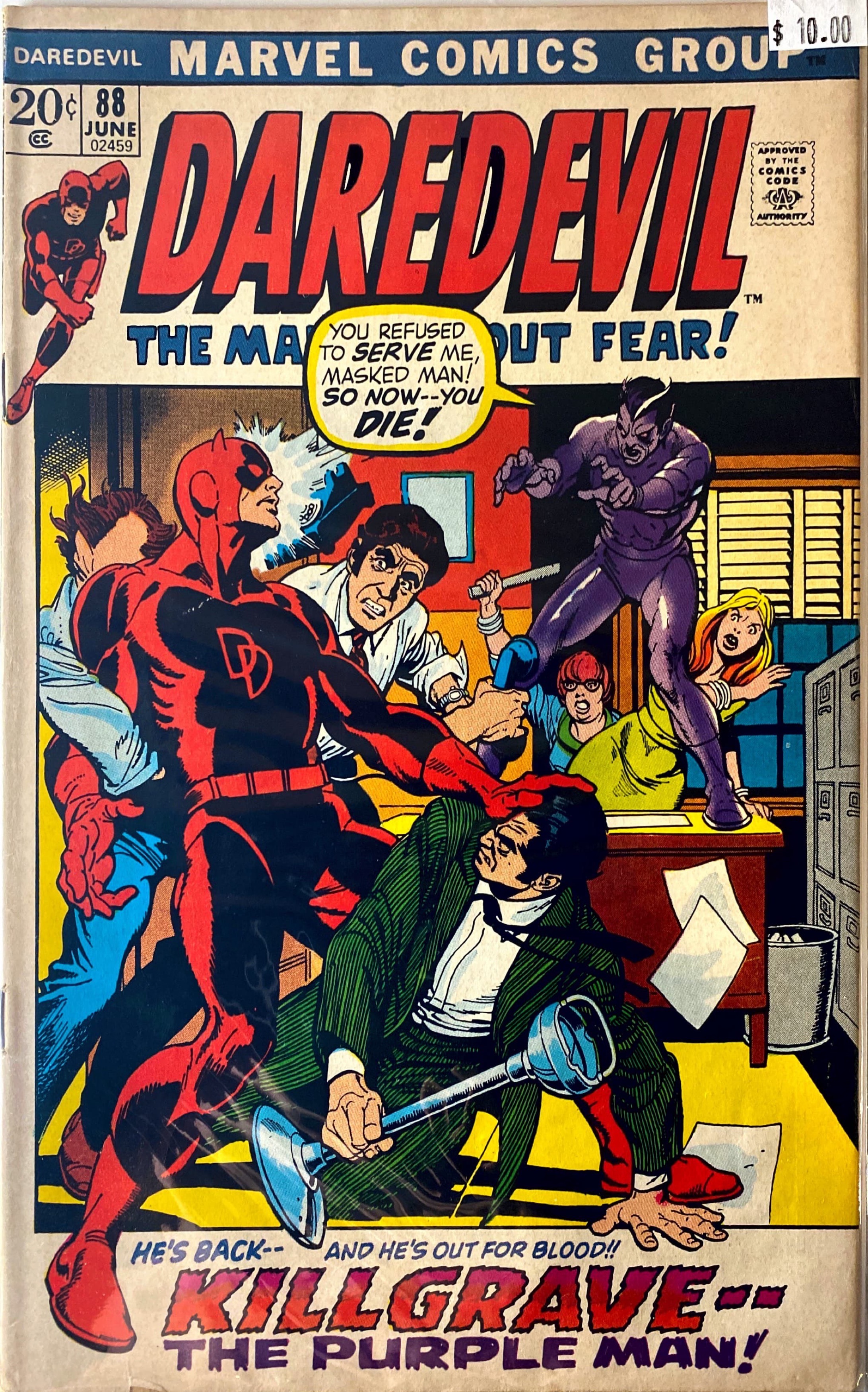
Issue 88 – Killgrave

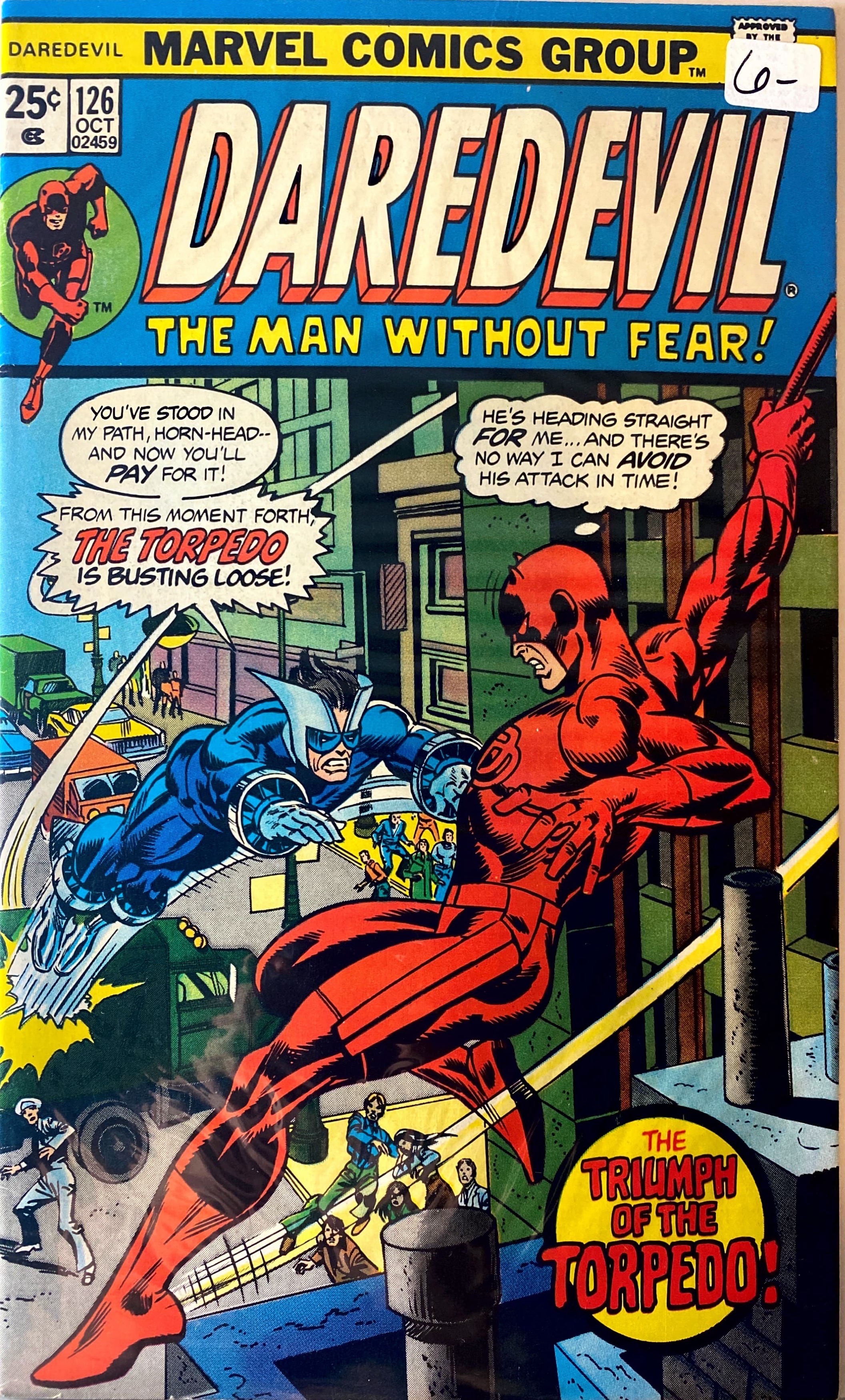
Issue 126

Issue 131 – Bullseye

Issue 156 – Red v. Yellow

Issue 158 – Key Frank Miller

Issue 188 – Black Widow

Issue 201 – Black Widow

Issue 217 – Black Widow (Barry Windsor Smith cover)

Issue 230 – Born Again

Issue 287 – Lee Weeks art

Issue 347 – Red v. Yellow

Issue 373

Issue 380 – Last issue volume 1

Daredevil Vol. 2, #1–119 [#381–499] (November 1998 – August 2009)

Note: With issue #22, began official dual-numbering with original series, as #22 /402, etc.

Daredevil #500–512 (October 2009 – December 2010) Original numbering resumes.

Volume 2

Issue 5

Issue 10

Issue 36 – Alex Maleev cover

Issue 51

Issue 66 – Maleev **

Issue 116

Daredevil Vol. 3, #1–36, #10.1 [#513-548] (July 2011 – February 2014)

Volume 3

Issue 4

Issue 11 – Punisher

Issue 18

Daredevil Vol. 4 #1-18, #1.50, #15.1 [#549-566] (March 2014 – September 2015)

Volume 4

Issue 14

Daredevil Vol. 5 #1-28 [#567-594] (February 2016 – December 2017)

Daredevil #595-612 (2017 – 2018) Original numbering resumes.

Volume 5

Issue 006 – Bill Sienkiewicz cover

Issue 14

Issue 26

Issue 595 – Bill Sienkiewicz cover

Issue 604

Issue 610 – Second printing variant, Phil Noto

Daredevil Vol. 6 #1-36 (2019 – 2022)

Volume 6

Issue 4 – The Punisher

Issue 10 – Fornes second printing variant

Issue 25.3 – Third printing variant

Issue 34

Daredevil Vol. 7 #1-TBD (2022 – TBD)

Volume 7

Issue 1 vF

Issue 1 vQ

Issue 2 vS

Issue 3 vM

Update

Issue 8 – Planet of the Apes variant

Issue 11 – Spider-Verse variant

Issue 14 – Zdarsky variant

Volume 8

Issue 1 – Frank Miller Variant

Issue 1 – foil variant

Media “Distorts” Coverage of the “Science of Reading”: A Reader

In the first of a series of posts, Maren Aukerman, The University of Calgary, details the dominant media “narrative [that] distorts the picture [of reading] to the point that readers are easily left with a highly inaccurate understanding of the so-called ‘science of reading.'”

As literacy scholars and teachers have noted since the beginning of media coverage of the “science of reading,” Aukerman explains how the coverage often misinforms through oversimplification and switching between claims of “research” and simple anecdotes:

I examine how well-intentioned journalism about the “science of reading” is frequently biased and inadequately research-based, ultimately making the case that such reporting has damaging consequences for the teaching of early reading.

The Science of Reading and the Media: Is Reporting Biased?

Mainstream media, in fact, remain selective in what and how they report on education and reading; for example, the daily email from the New York Times sends a different message about reading than their articles on the “science of reading” (notably by Goldstein and Hanford):

More recently, the national test results capture both the initial academic declines and any recovery, and they offer some nuance. While there was a notable correlation between remote learning and declines in fourth-grade math, for example, there was little to no correlation in reading. Why the discrepancy? One explanation is that reading skills tend to be more influenced by parents and what happens at home [emphasis added], whereas math is more directly affected by what is taught in school.

So remote learning does not explain the whole story. What else does? In a sophisticated analysis of thousands of public school districts in 29 states, researchers at Harvard and Stanford Universities found that poverty played an even bigger role in academic declines during the pandemic [emphasis added].

“The poverty rate is very predictive of how much you lost,” Sean Reardon, an education professor at Stanford who helped lead the analysis, told me.

NYT “Behind the declines” daily email (28 November 2022)

Below, then, are sources from scholarly and public publications/posts examining the patterns and bias identified by Aukerman:

See additional resources for examining media coverage, misinformation, and bias:

“This Is God’s Plan”: Daredevil’s Descent?

[Header and all images property of Marvel and artists]

As a teenager, I was a huge John Belushi fan, beginning with Saturday Night Live, of course, and then his series of successful and now iconic films such as National Lampoon’s Animal House and The Blue Brothers.

Few movies for me have been as relentlessly quotable as The Blues Brothers, especially Elwood’s refrain: “We’re on a mission from God”:

Looking back at the film today, this “mission” resonates in ways that could not have been imagined in 1980, unless you continued to deal in fiction. That “mission” and casual exchange between the brothers—Elwood: Illinois Nazis; Jake: I hate Illinois Nazis—are much harder to laugh along with as the U.S. slips further and further into a pit of Christian Nationalism and the rise of neo-Nazi-adjacent white supremacy.

I immediately, however, thought of Elwood’s deadpan refrain when I read the first page of Daredevil 5 v.7:

Daredevil 5 v.7, Chip Zdarsky (writer) and Marco Checchetto (artist)

The opening of issue 5 centers what many feel is the essential tension of Daredevil/Matt Murdock as a superhero—his religious zeal and righteous anger meant “to save the world.”

This exchange between Daredevil and Doc Sasquatch is a red flag, I think, although the challenge from Doc helps tether where Daredevil is heading. None the less, I think physicist Steven Weinberg’s warning is relevant here:

“With or without religion, good people can behave well and bad people can do evil; but for good people to do evil—that takes religion. Religion is an insult to human dignity. Without it, you would have good people doing good things and evil people doing evil things.”

Steven Weinberg: A physicist who found religion ‘an insult to human dignity’

Daredevil exhibit s a great deal of bravado and certainty throughout the issue as he begins to assemble what he refers to as an “army” while stressing the need for Elektra, as his new wife, to remain by his side.

Yet, one of the important scenes addressing Daredevil’s doing God’s work reveals someone quite different:

Daredevil 5 v.7, Chip Zdarsky (writer) and Marco Checchetto (artist)

Here Zdarsky reminds readers of Daredevil’s closeted humility, or at least his ability to self-check, anchored in the imagery of the Devil of Hell’s Kitchen (and later the Man without Fear) bringing hell to anywhere he goes.

One key part of Daredevil’s quest to form his army, the Fist, is Zdarsky including a powerful framing of Daredevil against John Walker and introducing motifs that resonate with the current state of political and ideological upheaval in the U.S.:

Daredevil 5 v.7, Chip Zdarsky (writer) and Marco Checchetto (artist)

This clash between Daredevil and John Walker allows Daredevil to distance himself from “fascists” and “authoritarians” (John Walker) while maintaining the problem of both characters’ being certain they are “right with God.”

And here is the essential problem: John Walker, authoritarian, represents religious zeal grounded in fear, and Daredevil perceives himself as a superior warrior in “God’s plan” because: “I need him to see what a man without fear can do.”

How do we as readers come to see Daredevil’s beliefs? Is he descending into delusion and falling prey to Weinberg’s warning—”but for good people to do evil—that takes religion”?

That Marvel and Zdarsky have chosen over the most recent two volumes to further blur Matt Murdock/Daredevil and Elektra in terms of moral barometers is certainly at play in this most recent issue and the impending doom it portends.

The many iterations of Daredevil in print and film/series are held together by Daredevil losing his way despite his overt and even simplistic good intentions.

As a reader and fan, I am finding it much harder to trust this narrative—unlike the more compelling version of Daredevil in the Netflix series (and upcoming Disney+ series).

In fact, the Daredevil fight with John Walker may simply be a metaphor for Daredevil’s own battle with himself.

Again, the current state of politics in the U.S. includes an entire party, Republicans, who have embraced missionary zeal and ends-justify-means politics. Is Daredevil facing a similar descent?

Much of superhero narratives either depend on or call into question ends-justify-means behavior, vigilantism and the codes that may or may not separate heroes from villains (again, think about Weinberg’s warning and the entire catalog of Batman narratives).

Daredevil may have decided that to get to heaven he must go through hell. And he may have also decided to make that choice for everyone else.

Daredevil 5 v.7, Chip Zdarsky (writer) and Marco Checchetto (artist)

As the issue ends and an apocalypse appears on the horizon—including the Avengers and the Punisher/Frank Castle—Detective Cole’s concerns from early in the issue should guide us into the next phase of Daredevil’s quest to implement “God’s plan”—”‘This doesn’t make any sense.'”

Weinberg’s “‘Science does not make it impossible to believe in God, it just makes it possible not to believe in God'” may be embodied by Detective Cole, a rational check that Daredevil needs—unless his descent is what is being planned all along.

educator, public scholar, poet&writer – academic freedom isn't free