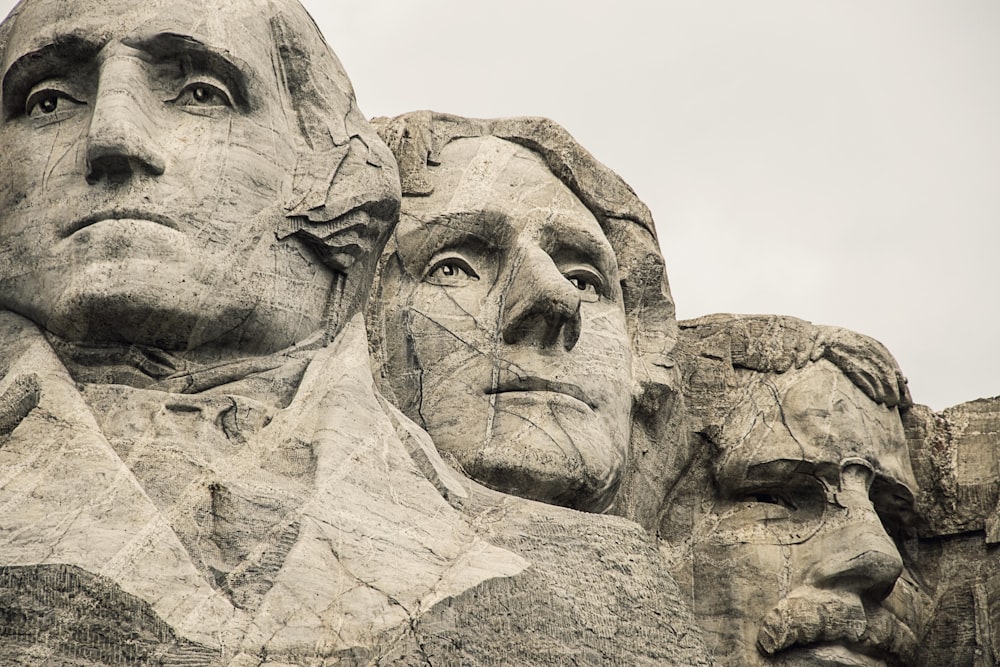
Monuments of Honor, Monuments of Shame

Mount Rushmore
Photo by John Bakator on Unsplash

Gun advocates often proclaim that guns don’t kill people, but that people kill people. Of course, this has a kernel of truth to it while also glossing over the inherent violent potential in those guns.

That sort of truth can also be applied to any published text.

The enslavement of Black people in the U.S. was supported by citing Biblical passages among, for example, Southern Baptists.

In other words, meaning tends to be less objectively in any object and more so in the intent of those imposing meaning on that thing.

With the election of Donald Trump as the U.S. president, many in the country became more ad more concerned about the possibility of fascism and totalitarianism coming to a free people grown lazy in their consumerism.

Margaret Atwood’s The Handmaid’s Tale and George Orwell’s 1984 saw a surge in popularity among those troubled by Trump and his supporters.

During the Covid-19 pandemic, however, the U.S. is now facing another potential tipping point among free people—a renewed public uprising over police brutality disproportionately impacting Black people. The killing of George Floyd has expanded and reignited the #BlackLivesMatter movement, which has nudged the country a bit farther along in confronting its racial and racist sins often memorialized and honored in building names and statues across the country.

One of America’s literary monuments of shame is William Faulkner, considered a giant of Southern letters despite being a Southern apologist (see James Baldwin’s “Faulkner and Desegregation”). However, there is an irony in Faulkner because his precise depictions of the South prove, not Faulkner, but Baldwin correct.

In 2020, conservatives who have lined up behind Trump (and seemingly forgotten their roots in Ronald Reagan who famously demanded “Mr. Gorbachev, tear down this wall”) are rushing to defend racists whose names emblazon buildings and images stand permanently as statues of honor across the country, even as we know most of these purposeful celebrations occurred in defiance of Black liberation and full entry into our so-called free country.

Conservatives are shouting that renaming buildings and removing statues are acts of erasing history. Trump conservatives are our contemporary Emily, discovered at the end of Faulkner’s story to have been spending her nights clinging to the corpse of the lover she could not have and killed instead to hold onto forever.

This thing that has never existed, I shall hold onto always.

And in another monumental irony, these Trump conservatives are quoting Orwell’s 1984 as a warning about the current racial reckoning in the U.S. targeting monuments to racists:

“Every record has been destroyed or falsified, every book rewritten, every picture has been repainted, every statue and street building has been renamed, every date has been altered. And the process is continuing day by day and minute by minute. History has stopped. Nothing exists except an endless present in which the Party is always right.”

Here Winston is explaining to Julia how “history” is a tool of the Party, a weapon of totalitarian rule.

The problem, of course, is that in a time of memes and social media—when many people routinely post quotes that are misattributed at best and simply false at worst—most conservatives quoting Orwell have never read his work, or 1984, and have completely misread the purpose of this passage since it is taken out of context.

Southern Baptist preachers were fond of quoting every possible passage using master/slavery analogies in the Bible, decontextualized and twisted (making the metaphorical literal) to show that God endorsed a master/slave relationship.

Orwell’s fiction is anti-fascism, anti-totalitarianism, in fact, but the novel was not written as prediction; it was a dark parody of the imminent threat to freedom in Orwell’s lifetime.

This passage is no simple warning about the renaming of buildings or the removal of statues. Orwell’s narrative dramatizes for readers that history is determined by those with power. Totalitarian regimes must control history to control people.

What Trump conservatives also miss is that the call to rename buildings and remove statues is not coming from authoritarian leaders, but from the people, people recognizing that honoring racists has no place among free people.

The U.S. is an admirable idea, something beautiful to aspire to—life, liberty, and the pursuit of happiness. But Trump conservatives misread the American Dream just as they misread Orwell.

America has never yet been great for all people; American has mostly been great for a few white people at the expense of other people, often Black Americans.

Langston Hughes writes of the tension between what America can be and how it continues to fail:

O, let America be America again—
The land that never has been yet—
And yet must be—the land where every man is free.
The land that’s mine—the poor man’s, Indian’s, Negro’s, ME—
Who made America,
Whose sweat and blood, whose faith and pain,
Whose hand at the foundry, whose plow in the rain,
Must bring back our mighty dream again.

The names and statues honoring Ben Tillman, John C. Calhoun, Robert E. Lee, and countless other racists and white supremacists are monuments of shame portraying “[t]he land that never has been yet.”

Along with Langston Hughes‘s “Theme for English B” and “Let America Be America Again”—and instead of misreading Orwell—let me offer better literary commentaries on the call to remove the names and images of our racist past from Carl Sandburg and William Stafford:

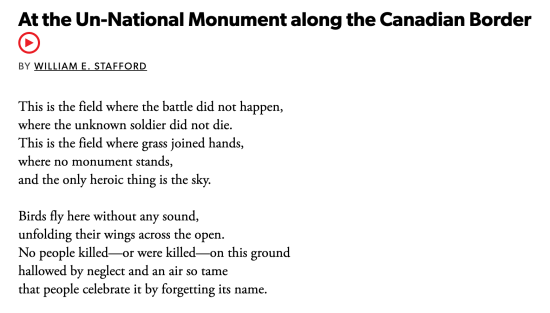
Ready to Kill Carl Sanburg

Stafford Monument

Democracy is also a beautiful idea, one Americans have failed by choosing consumerism and rugged individualism over “liberty and justice for all.”

Renaming and removing the whitewashed history of our ugly past is not erasing history, but acknowledging, like Hughes and Sandburg and Stafford, that to finally build a free and equitable people, ugly things must be torn down so that we can start again.


Recommended

On Memory and History: What’s in a Name?

Dismantling Monuments: History as a Living Document

Clemson’s Tillman Hall and the Tragedy of Southern Tradition

accidental monuments to their shame 

A Conversation in 2020 with James Baldwin’s “Letter from a Region in My Mind”

One of the worst forms of propaganda about text and reading in formal schooling is that any text has a fixed meaning, independent of the reader, the reader’s history, or the writer and the writer’s history.

Traditionally, K-12 schooling, often in English courses, has implemented a very reduced version of New Criticism that frames all text meaning as a static formula whereby the reader adds up the techniques and discovers an authoritative meaning (that is singular and, again, not grounded in the people creating meaning or the conditions surrounding either the writing or the reading). More recently this anemic approach to text and reading has been reinvigorated by the “close reading” movement embedded in the failed Common Core era.

In 2020 as the Trump era could be coming to a close and the U.S. is being ravaged by a pandemic and another round of something like mainstream racial awareness, I re-read James Baldwin’s “Letter from a Region in My Mind.”

The 1962 publication of this essay (which becomes a section of The Fire Next Time) had a distinct historical and personal set of purposes—Baldwin’s relationship with the church and Christianity as well as his being courted by Elijah Muhammad for the Nation of Islam.

This essay has a powerful online presence for The New Yorker currently:

Main image

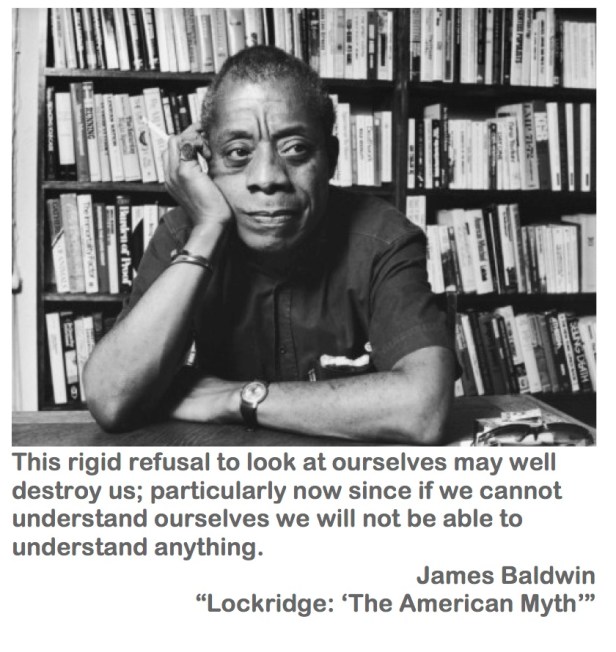
One of Baldwin’s persistent messages in his nonfiction is the inextricable relationship between white and Black America, and, as he stated, “[t]this rigid refusal to look at ourselves [that] may well destroy us” (“Lockridge: ‘The American Myth'”). “Ourselves” and “us” are telling in that Baldwin sought a new self-awareness for both white and Black Americans even as he was especially focusing on white fragility and denial.

As I re-read a few days ago, I shared quotes on social media, drawn to how this essay speaks vividly to now and to the lingering white problem in the U.S., a white problem that fuels racism, still, through white denial.

One of the first essays by Baldwin I invite my first-year writing students to read in my Baldwin/#BlackLivesMatter seminar is “A Report from Occupied Territory” since this 1966 essay details the historical/systemic racial/racist inequity of police violence in the U.S. that is a part of the two Americas confronted early in “Letter” by Baldwin:

quote 1

A paradox of racism driven by white supremacy narratives is that white power has demands for “other people” that white leaders and most white people cannot and do not maintain. While some confront the tendency of hypocrisy in leadership, we far too rarely ascribe that to a feature of white supremacy narratives and cultural myths. In fact, this hypocrisy may be more embedded in whiteness than any aspect of leadership.

One of those white lies is being replayed in the respectability politics of white people focusing on marches and demonstrations by framing them as “rioting” and “looting.” This misguided attention (distractions from the police shootings and killing that prompted the demonstrations) is also a calculated effort to ignore or erase the white violence and economic theft that are essential to white dominance and capitalism.

U.S. enslavement of Black people made capitalism “successful” for white America, and white economic theft of Black people and on the backs of Black people remains a daily aspect of this country’s “success”—as Baldwin explains:

quote 2

The role of racism in capitalism and the U.S. market is paralleled by that same corruption of Christianity, with Baldwin’s message prescient for the deplorable embracing of Trump by conservative Christians:

quote 3

Racism is a race lie, an economic lie, and a religious lie.

For Baldwin, the latter meant that Black Americans needed to walk away from a fatally corrupted Christianity:

quote 4

Compared to Martin Luther King Jr., Baldwin poses a much blunter confrontation of the white progressive and the hollowness of progressive policies, the incredibly slow incrementalism bending (maybe) toward King’s “justice”:

quote 5

As some in the U.S. feel hopeful in 2020 that the promise of racial justice seems closer at hand, Baldwin, again, acknowledged this possibility in the need for the types of disruptions filling the streets across the country in the wake of the killing of George Floyd:

quote 6

That American Dream is a myth not framing Truth but myth that is a lie—as Paulo Freire explains, “myths that deform us”:

quote 7

Few moments are more apt in 2020 than this closing question, which also forces the reader to consider that white denial also ignores that the house is, in fact, burning even as white supremacy maintains the myth of white superiority.

Baldwin continues his rhetorical brilliance by confronting the corrosive nature of deficit ideology (whereby Black people are framed always as lacking white qualities) as he builds again to his recognition of white people refusing to see themselves even as they beg to always be at the center of everyone’s consciousness:

quote 8

This essay becomes a brilliant and enduring unmasking of white America:

quote 9

Being white is inevitably being “the slightly mad victims of their own brainwashing.”

By the end, Baldwin returns to a moral grounding and phrase that has remained connected to Baldwin as has his resilient hope and trust in the power of love:

quote 10

Baldwin’s writing as hope and prophesy seems too long delayed, a “dream deferred” because, as Langston Hughes also mused, “(America never was America to me.)”

The Paradoxes of Dismantling Racism and White Privilege

If you just clicked on a link and are reading this, you are experiencing one of the paradoxes of dismantling racism and white privilege because by writing this and making it available across the Internet, I have centered my whiteness and the voice of (yet another) man.

As a white man, I simultaneously have an ethical obligation to dismantle racism and white privilege (and gender inequity) that sits in contrast to another ethical obligation that I (to cite a group of white men) need to STFU and not occupy the spaces where Black and women’s voices must be centered and embraced.

My scholarship and public work have for many years now been focused on class, gender, and race inequity, especially as they intersect with formal education.

Any credibility in addressing racism and white privilege that I have earned comes from my critical unpacking of my own whiteness and of my racist heritage in my home and community of birth, but I also have manufactured a greater level of racial awareness by reading and listening to Black voices—notably Black artists/writers and Black scholars.

My teaching seeks always to center Black voices and the voices of women, which I have documented by detailing who is included in my syllabi.

However, there I stand in front of my classes, centered by my role of authority, my whiteness, and my being a man with the additional weight of almost 6 decades.

Two situations, one recent and one a year or so ago, have pushed me to continue to wrestle with the paradoxes of my activism dedicated to dismantling racism and white privilege.

More immediately, I have been disturbed to see a blog post discrediting Robin DiAngelo’s White Fragility being shared across social media, often by Black academics and friends. This challenge to DiAngelo’s work, I discovered, comes from a source that is neither credible nor reliable.

The other situation came over a year ago when I was invited to speak on whiteness and racism at a university (in a series of programs that also included DiAngelo before I spoke there).

What these two contexts have in common, I think, is one of the most difficult paradoxes of dismantling racism and white privilege: centering whiteness to de-center whiteness.

If and how any of us dedicated to anti-racism work engage with DiAngelo’s concept of white fragility is itself a problem and a paradox.

I added DiAngelo’s popular book to the choice reading selections in my foundations of education course recently, and the book proved to be popular and effective with my students who tend to be white, privileged, and conservative (or from conservative homes).

Many students confessed that they went into the book not believing in white privilege or systemic racism but that DiAngelo had opened their eyes and changed their minds.

These students also read For White Folks Who Teach in the Hood…and the Rest of Y’all Too by Chris Emdin as well as essays by James Baldwin and Ralph Ellison; they are introduced to bell hooks and Maxine Greene as well.

But there is always a risk of centering white works such as DiAngelo’s since that can imply that Black voices and experiences with racism are valid only when verified by white witnesses or when in proximity to white witnesses.

Black advocates for anti-racism embracing the “don’t read DiAngelo” is coming from, I think, recognizing that risk and from their own experiences where only white voices are allowed in formal education. White witnesses to confirm their lived experiences and white proximity giving credibility to the moment-by-moment stress of their being Black in the U.S.

It is a powerful and important question to ask why white people do not find this credible itself, without white confirmation:

To be a Negro in this country and to be relatively conscious, is to be in a rage almost all the time. So that the first problem is how to control that rage so that it won’t destroy you. (James Baldwin from “The Negro in American Culture,” Cross Currents, XI [1961], p. 205)

As I opened in this post about my white man’s voice, DiAngelo is in fact not only occupying spaces where Black voices are not being read or heard, but also profiting on anti-racism, the capitalism paradox of dismantling racism and white privilege.

Activism, scholarship, and the Market are invariably going to overlap in the U.S., and even as we worship at the alter of capital, we also become skeptical when activists and scholars gain celebrity status or simply earn money from other people’s inequity.

It is inexcusable in the U.S. to ignore that racism has always fueled capitalism and profited almost exclusively white people.

I remain resolute that the primary obligation of anti-racism work dedicated to dismantling racism and white privilege belong to white people. But that drives the paradox of centering whiteness and can perpetuate the muting or erasing of Black voices.

The paradoxes of white people doing anti-racism work cannot deteriorate into fatalism, however.

For white people, awareness of racism, white privilege, white fragility, and the paradoxes of dismantling racism and white privilege as a white person is a first step often wrapped in the paradox of centering whiteness to de-center whiteness.

For far too long, there have been far too many white-only spaces, and the work of anti-racism by white people must seek shared spaces among all races, not just creating but allowing through white absence enough space so that voices do not have to compete and so that whiteness does not justify or regulate whose voice ultimately matters.

Confronting White Responses to Racism: De-centering Whiteness and White Fragility

I grew up in the 1960s and 1970s with daily contact with what Ta-Nehisi Coates labels as “oafish” racists. These white men of my childhood and teen years were brazen and arrogant in their racial slurs and embarrassingly ignorant philosophies about race.

One oafish racist calmly explained to me that Black people were the result of Cain mating with apes after being cast out of the Garden of Eden. His “it’s in the Bible” racism was common in my South Carolina life.

But this is not about some racism in the past. Oafish racists remain throughout the U.S., not some vestige of the Old South. Social media and the Trump presidency have allowed and even welcomed overt racists into the American “both sides” approach to the free press and free speech.

However, the specter of oafish racists allows white people to keep whiteness and white fragility centered while refusing to acknowledge the greater danger posed by whiteness throughout the twentieth century and in 2020; as Martin Luther King Jr. confronted:

A leading voice in the chorus of social transition belongs to the white liberal…. Over the last few years many Negroes have felt that their most troublesome adversary was not the obvious bigot of the Ku Klux Klan or the John Birch Society, but the white liberal who is more devoted to “order” than to justice, who prefers tranquility to equality….

The White liberal must see that the Negro needs not only love, but justice. It is not enough to say, “We love Negroes, we have many Negro friends.” They must demand justice for Negroes. Love that does not satisfy justice is no love at all. It is merely a sentimental affection, little more than what one would love for a pet. Love at its best is justice concretized. Love is unconditional. It is not conditional upon one’s staying in his place or watering down his demands in order to be considered respectable….

The white liberal must rid himself of the notion that there can be a tensionless transition from the old order of injustice to the new order of justice…. The Negro has not gained a single right in America without persistent pressure and agitation….

As the U.S. experiences a revitalization of the #BlackLivesMatter movement in the wake of repeated police violence toward Black citizens, the killing of George Floyd as a notable flash point, white Americans are daily confronted with the recognition of racism, white privilege, and racial inequity.

White nationalists and racists have been especially emboldened for years now under Trump, but white people who claim to be invested in eradicating racism must also be invested in eradicating white privilege while working to resist the language of white fragility and centering whiteness.

A policeman’s knee on the neck of George Floyd, a state-endorsed execution lasting 8:46, demands a response from white people.

Consider these white responses to racism:

  • “Not me.”
  • “Not all white people.”
  • “Not all police.”
  • “I don’t see race.”
  • “I have Black friends.”
  • “What about Black-on-Black crime?”
  • “If they would just do what the police said, they would not have been shot/killed.”
  • “I am not a racist, but …”
  • “What about reverse racism?”
  • “I don’t have white privilege because I was born poor.”
  • “I didn’t own slaves, and slavery ended in the 1800s.”
  • “Heritage, not hate.”
  • “Taking down monuments and renaming buildings and schools is erasing history.”
  • “The Civil War was fought over states’ rights, not slavery.”
  • “There is only one race, the human race.”
  • “All lives matter.”
  • “What about affirmative action? What about Miss Black America? What about Black colleges?”

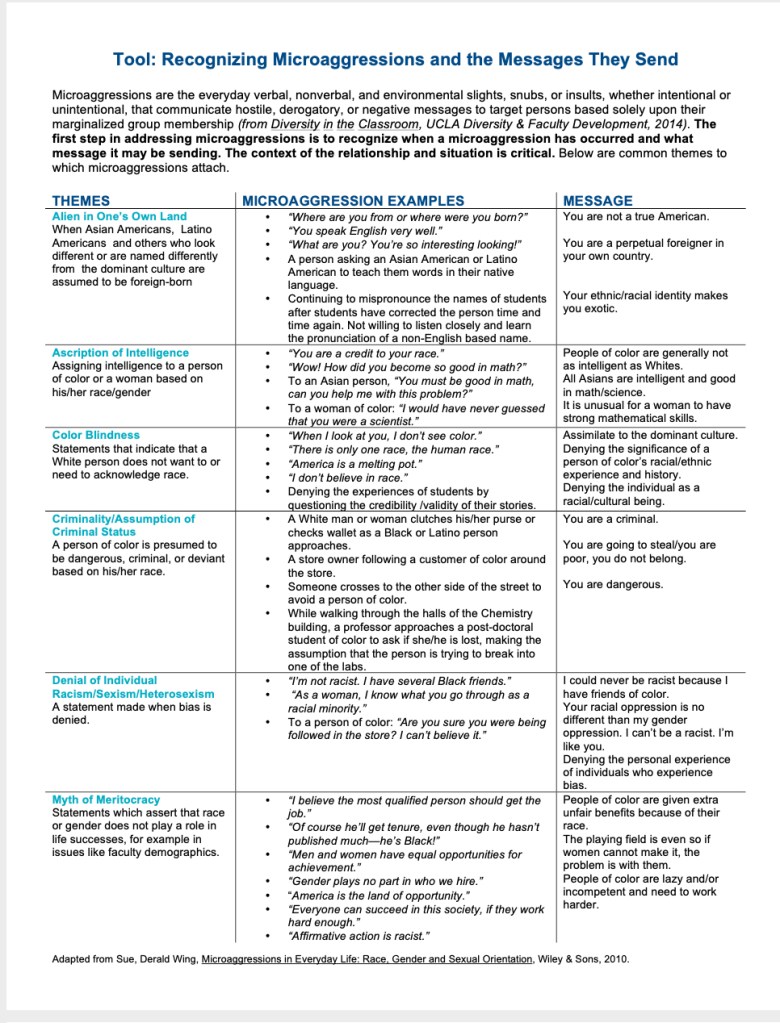
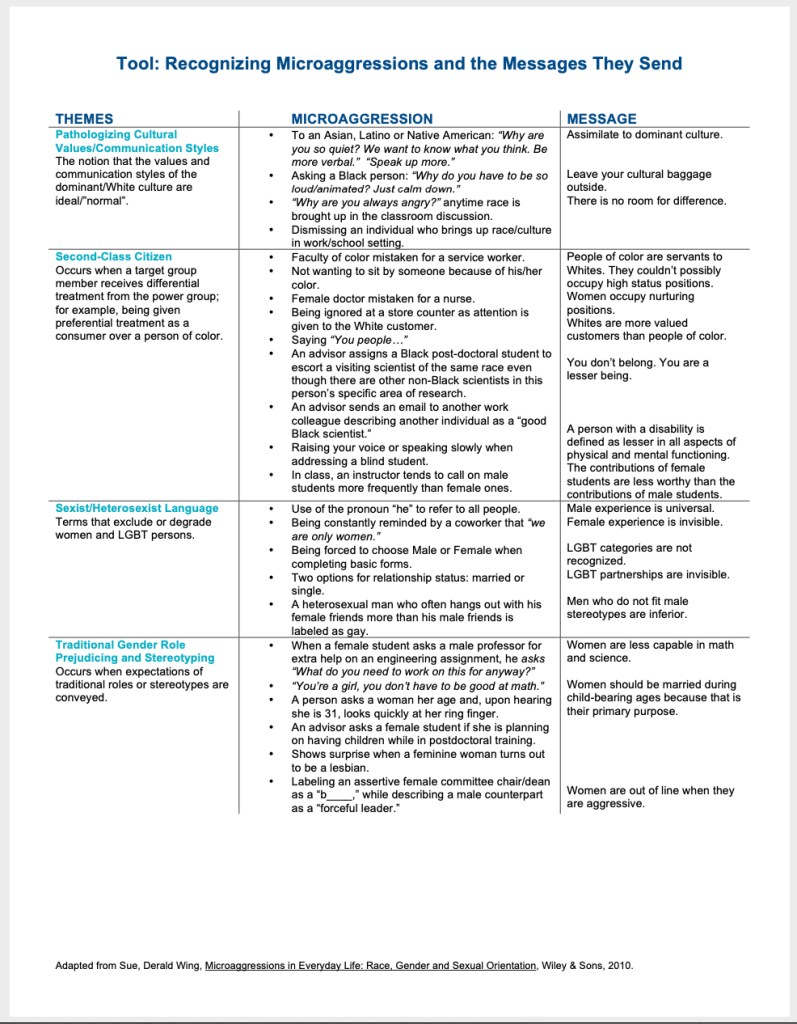
These white responses are grounded in two racist sources: white fragility and centering whiteness.

Racism is not just anti-Black; racism is whiteness.

Any white person responding to racism with an “I” statement is requesting that they and their whiteness (and delicate sensibilities) remain centered when the focus should remain on racism and its consequences for Black citizens.

To understand the centering of whiteness we need only to confront monuments and building/schools named after historical leaders with racists ideologies and practices.

De-centering whiteness looks like the statues of the Little Rock Nine, the young Black people who suffered the consequences of racism.

White fragility (“Not me!” and “Not all white people”) responses are ironic in that they unconsciously admit that centering whiteness has been the norm of their lives and their defensiveness is a fear of losing that centering. No white person can be allowed to continue to cling to their whiteness if racism is to be eradicated.

Racism and white privilege are inseparable, and that means by simply being white, all white people are moment by moment benefitting from white privilege and racism even as they did not create them, even as they ideologically denounce them.

Being white means being complicit in racism, which means to be white is to be racist.

Anti-racism language and practices, then, are not when a white person says “not me” or “not all white people.” There can be no “but” response to confronting racism.

As with all equity work, good intentions are not enough.

Policing shooting in the back and killing Rayshard Brooks in Atlanta rests most recently in the wake of civil unrest after the killing of George Floyd.

The site of the killing of Brooks, a Wendy’s, has been razed, and the centering of whiteness seeks to keep the public gaze on the outcomes of the racist killing—property as a marker for whiteness and rioting as code for racist stereotypes—and not the racism that precipitated these events.

Less dramatic is the response of white fragility in language that makes how white people feel and respond more important than the racism.

A different dramatic is pop culture where Blackness is elevated only in relationship to centering whiteness—The Help, Green Book, The Matrix trilogy, To Kill a Mockingbird.

To be white and anti-racism is to acknowledge whiteness is always complicit in racism. To be white and anti-racism is to work to de-center whiteness, to resist the language of white fragility and respectability politics, and to eradicate white privilege.

There is no room in anti-racism for “not me” or “not all white people.”

Here are resources for understanding white privilege, centering whiteness, white fragility, and respectability politics:

Racism scale copy
rigid refusal

RIP, Mr. Harold Scipio

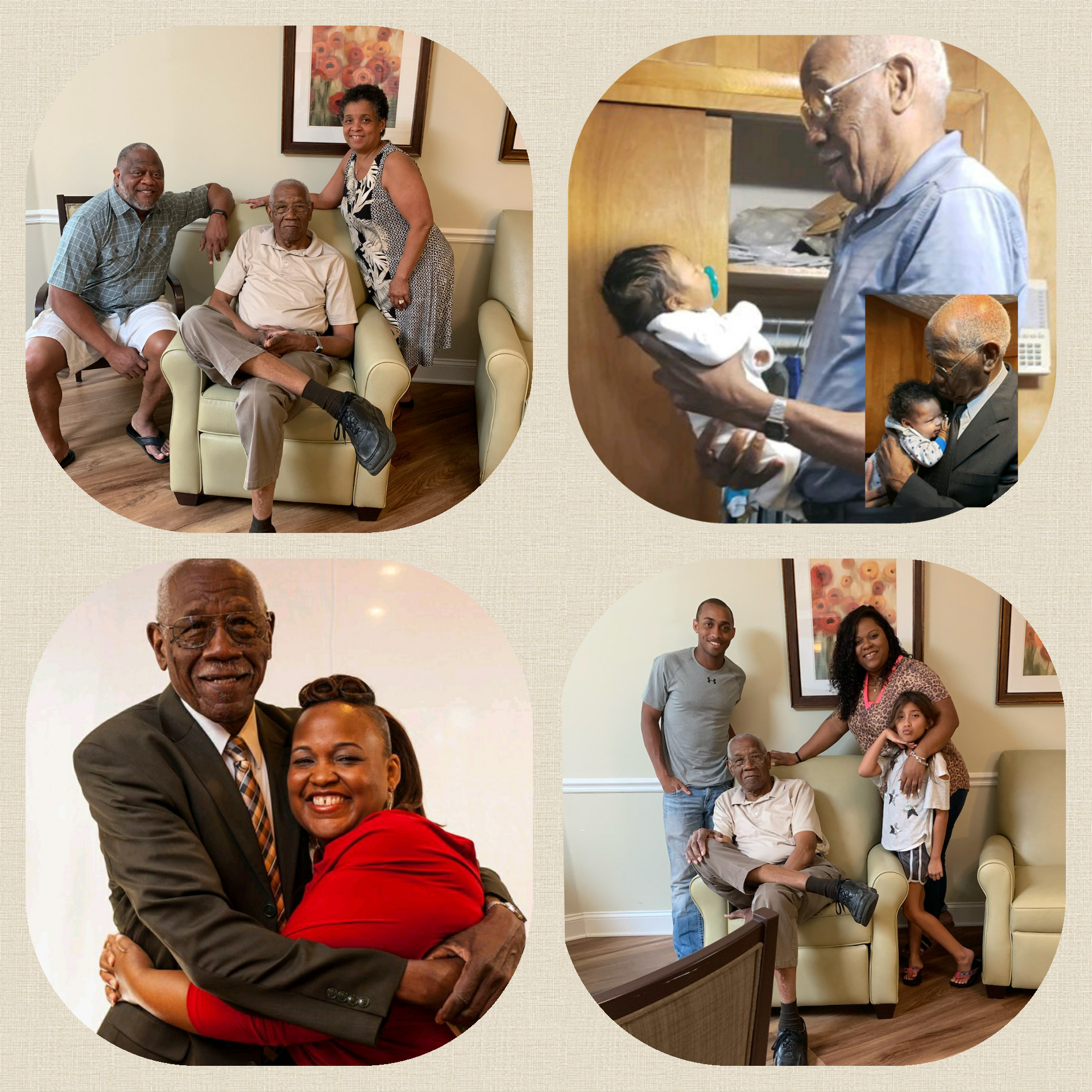
Mr. Harold Scipio was my high school chemistry and physics teacher. He died at 91 on June 11.

PhotoCollage_20200616_084600481
Image provided by Hope Abraham, granddaughter.

I am 59 and am deeply saddened by his passing because he remains a powerful influence on my teaching, many decades after I sat in his classroom and then later taught with him at the same high school I attended.

In an open letter to my students in 2014, I wrote about Mr. Scipio:

Harold Scipio taught me high school chemistry and physics. He was a tall black man, very measured and formal. It is because of Mr. Scipio, I think ultimately along with Lynn Harrill, that I found my way to teaching after thinking I was going to major in physics (that was because of Mr. Scipio, but it was also because I was young and mostly misreading myself and the world).

Mr. Scipio practiced two behaviors that were totally unlike any other teacher I ever had. First, he referred to all of us as Mr. or Miss and our last names, and he explained to us that since we had to call him Mr. Scipio, he should certainly return the courtesy.

In the last days of my senior year at the National Honor Society banquet (Mr. Scipio was a faculty sponsor), as we were cleaning up afterward, he called me Paul, smiled widely, and told me to call him Harold because I was graduating and an adult.

And throughout my junior and seniors years, each time Mr. Scipio would hand out a test or exam, he would quietly gather a wide assortment of lab materials around the room before walking out of the main room and into the back where he washed and returned the materials to the storage shelf.

During every test, Mr. Scipio left the room, sent an unspoken message about not only our very frail and young integrity but also his trust that although we were surely not perfect, that we would ultimately make the right decisions.

I now teach every single day in the wake of Mr. Scipio—often disappointed in myself for failing his lessons about the essential dignity of all people, especially young people, especially students in the care of a teacher.

Teaching isn’t about chemistry or physics, or introductions to education or first year seminars and learning to write.

Teaching is about those becomings and beings that truly matter: becoming and being a citizen of communities grand and intimate, becoming and being the only you that you can be, becoming and being a scholar and student.

In an odd twist of fate, after teaching English for 18 years at that high school, I sat in a restaurant interviewing to move to my current position now as a college professor. As I dined with the department chair and head of graduate education, I looked across the restaurant and saw Mr. Scipio.

I excused myself, walked over, and talked with Mr. Scipio.

He was always a quiet and measured man. He smiled and said he was proud of where I was, what I had accomplished.

Just as he was a key person in my path to becoming a teacher, I took this brief encounter with Mr. Scipio as a subtle message from the universe that making that change was the right path for me.

As an incredibly provincial white guy raised in a racist home and community, I was incalculably fortunate to have been a student of Mr. Scipio for two years as he laid the foundation for me becoming a better person.

I am always in his debt.

Rest in peace, Mr. Scipio.


Dabo Swinney and the White-Man No-Apology Apology

After a series of critical challenges to the highest paid college football coach in the U.S., Dabo Swinney, concerning weak responses to the uttering of racial slurs by a Clemson coach (and Swinney) and Swinney sporting a “Football Matters” shirt in the wake of George Floyd’s death underneath the knee of a police office, a calloused death sentence executed in 8:46, Swinney wants everyone to believe he is offended equally by the N-word and GD:

You see, Swinney’s racial awareness is as hollow as his Christianity, worn on his sleeve 24/7.

In a statement lasting about 5-plus minutes longer than Floyd’s last breaths, Swinney launches into the white-man no-apology apology.

Swinney isn’t the first, and won’t be the last, to practice the art of no-apology apologies, but he hits all the key elements.

We weren’t there, and we don’t understand.

There were no racial slurs directed at players, but simply uttered near players.

All the white men in charge took care of the situations, and since we weren’t there, we simply don’t know, and can’t understand.

The assistant coach in question is a fine man, Swinney assures us, as all white men are when they have power and are inexplicably held accountable.

We have watched this play out fairly recently, in gross relief from any kind of decency at Penn State, another fine university where Football Matters, but not the humanity of those consumed in the process.

Swinney, like some of his fellow elite-coaches such as Nick Saban and Mike Krzyzewski, has made his millions and built his authority mostly on the backs of unpaid Black labor. And while, yes, a small percentage of these amateur athletes reap huge salaries as pros and a fair share of them receive mostly reduced college degrees, the elite-coach fraternity is where the real power and money are.

This college football monstrosity of abuse and hypocrisy is dwarfed only by the Holy Grail waiting at the end of some players’ rainbow—the NFL.

An important lesson that seems less obvious during the current wave of civil unrest and calls for racial equity—for an end to racism and white privilege—is that if you are surprised at the corruption and hypocrisy in policing in the U.S., wait until you take a similar critical look at coaching—from the pee-wee leagues all the way through professional leagues.

Like Swinney, coaches are the least likely people to accept accountability, and they rarely embody the principals they demand of the players who have no power in their charge.

Take one of the stumbles in Swinney’s no-apology apology concerning whether or not he banned players from participating in racial protests at Clemson several years ago when See the Stripes and other groups called for the renaming of Tillman Hall.

Once again, Swinney explains that we weren’t there, and that he didn’t ban players from attending the rallies. Swinney did warn in his most Christian fatherly role that athletes at Clemson have lofty statuses and that they should be careful about what they associate themselves with and consider how their presence at the rallies could be interpreted.

[Note: Swinney determines who plays and when on the team, and someone with Swinney’s power need not directly ban player behavior in order to effectively ban player behavior.]

Of course, this is the same Swinney who just recently wore a Football Matters shirt directly in the moments of civil unrest focusing on #BlackLivesMatter, a movement not well supported in the state of South Carolina, where Clemson resides.

Swinney’s supporters are often the Blue Lives Matter and All Lives Matter folk.

Clemson University, we must note, is a public university whose founding and funding originated from one of the most notorious racists in the state’s history, Ben Tillman, and has until recently also included the honors college being named for another virulent SC racist, John C. Calhoun.

Not insignificant, Clemson University is funded in a state including a population that is nearly 30% Black, but out of the top 100 universities in the U.S., the university ranks 98th in diversity with under 7% of undergraduates identified as Black.

Swinney wants us to believe that for him Black lives matter, but as he so eloquently warned his players, his high profile actions suggest that Black doesn’t matter as much as white or, especially, green.

Since Swinney’s no-apology apology, “hotbed of reality” Don Lemon was taken to task by Dave Chappelle in his 8:46:

Chappelle is not the first to challenge Lemon’s role as a prominent Black voice in the media, but Lemon’s measured, calm response to criticism serves as a powerful contrast to the white-man no-apology apology from Swinney.

Lemon doesn’t tell us we weren’t there, that we don’t understand. Lemon accepts Chappelle’s criticism but also takes responsibility for his own words without denying them or gaslighting his audience.

Lemon makes a strong point about two high-profile Black men agreeing and disagreeing in a very public forum. And unless I am being naive, I have been watching Lemon evolve during the Trump years in a way that stands in stark contrast to the stubborn sameness we watch in Swinney or the “rigid refusal” that seems to have finally begun to crumble in Roger Goodell and Jim Harbaugh.

Swinney’s white-man no-apology apology sits in a long tradition in the South where honor and tradition allow men with power to cling to the rotting corpses of the region’s past without acknowledging that it is far past time to do the right thing, not the thing we have always done.

Like the perpetual gaslighter in the White House, Swinney cannot walk the talk, cannot embody the ethics or behavior he demands of his players; and he will not because he doesn’t have to.

One of the few completely honest things Swinney has done recently is the shirt, Football Matters.

I wouldn’t expect anything more because Swinney has no reason to be the man he demands his players to be.

A Reader for Confronting Whiteness, Supporting #BLM: “How Do I Open Their Eyes?”

A former student and current college student sent me an email with the subject line “How Do I Open Their Eyes?”

Their story is one that resonates with me since they have found themselves quarantined during Covid-19 “with my parents and neighbors, all of which I would say are very religiously right leaning.” During the more recent re-energized #BlackLivesMatter movement, they have experienced yet another challenge as they confronted those around them to support #BLM, but “was unable to get a word in because I was simply outnumbered by conservative white men.”

This is a journey that fits into this racism scale that details the challenges facing white people who genuinely seek to rise to the level of allyship/abolitionist:

Racism scale copy

The work of dismantling racism includes confronting whiteness and white privilege in order to eradicate both—and this is the work of white people in confrontation with white people.

There is a sizable faction of “conservative white men” who will not listen, will never listen, and will never move beyond their white fragility and white denial.

But racism cannot be overcome in a state of fatalism.

Here then is a reader, some resources for doing the work by white people and for white people who aspire to allyship/abolitionist:

“Science of Reading” Advocacy Stumbles, Falls

First, the stumble.

Yet another education journalist (also identified as a novelist and historian), Natalie Wexler, has weighed in on the “science of reading” (SoR). Wexler isn’t an educator, and she seems to suffer from the Columbus Syndrome far too common among journalists covering education.

I am not linking to the article, but it has already been updated since Wexler has received strong challenges to her tactics in this over-stated and misleading article

Accompanying the standard misrepresentations about teaching reading in the U.S., Wexler attempts to cast an accusatory shadow—invoking racism—over teaching reading by joining the “science of reading” propaganda movement.

However, Zaretta Hammond set the record straight on Twitter. In brief, Hammond challenges Wexler’s jumbled attempts at calling out racism and misguided references to recent racist police violence as well as implicating Hammond’s work in Wexler’s claims.

As Hammond notes, Wexler’s failure exposes the problems with fanning a Reading War that, once again, keeps our gaze on so-called failed students and failing teachers instead of systemic inequity and racism.

Wexler is wrong about reading and racism, but the criticism her article prompted has only nudged her to retract the racism stumbles, whitewashing her mistakes by apologizing on Twitter and revising her article.

Now, the fall.

One of the most damaging aspects of the “science of reading” movement has been how swiftly advocates of SoR and dyslexia have translated their movement into state-level reading legislation.

While I have been helping literacy educators and activists resist these efforts to change state education laws, some of us saw at least a pause in the SoR momentum with the Covid-19 pandemic, an unfortunate consequence that now seems to have had unintended positive outcomes for education (flawed reading legislation not passing for financial stress prompted by the pandemic).

For example, “A bid to improve Louisiana’s dismal reading skills for its youngest students died near the legislative finish line, leaving backers baffled on just what happened,” writes Will Sentell.

The surprise at this defeat comes, as Sentell explains, because “[t]he proposal, House Bill 559, had led something of a charmed life until it wilted at the end.”

However, as with other state-level reading legislation agendas across the U.S., this bill was grounded in misinformation about reading achievement as well as claims about the “science” they claim is missing in reading instruction.

Advocacy for the SoR has a fatal flaw found in both Wexler’s article and the “charmed” but failed bill in Louisiana—a “rigid refusal” to address first and fully the systemic inequity that is at the root of all educational measurements, including reading achievement.

SoR advocacy is grounded in a deficit lens that sees only individuals (students, teachers) and measures them against very reduced and narrow ideas of what counts as “normal.”

This advocacy also falls victim to silver-bullet solutions, reducing teaching to “all students must” and suggesting that this program is better than that program (without recognizing that the problem is reducing reading instruction to any program).

SoR advocacy is a misuse of “science” and a misunderstanding of human nature and the teaching/learning dynamic.

There is a powerful relationship among measurable reading achievement by students, reading instruction provided students in formal schooling, and the corrosive persistence of racism and systemic inequity in U.S. society and schools—systemic racism and inequity.

Since the SoR playbook is wrong on all of that, as Hammond ends her Twitter thread, “Know the difference.”

See Also

NEW: How to End the Reading War and Serve the Literacy Needs of All Students: A Primer for Parents, Policy Makers, and People Who Care (IAP)

Policy Statement on the “Science of Reading”


All White People Must Confront How the System Only Works in Total Whiteness

I was born in 1961, after Brown v. Board but before the Civil Rights Act.

My childhood in the upstate of South Carolina included the assassination of John F. Kennedy, Martin Luther King Jr., Malcolm X, and Robert Kennedy as well as vivid memories of my mother’s family living through the racial unrest in nearby Asheville, North Carolina and my uncle being shipped off to the Vietnam War.

My parents had been raised in the 1940s and 1950s throughout North and South Carolina; they were among the white Americans who disapproved of King, and I recall vividly my parents’ animosity for Muhammad Ali that sat next to their anger at the mainstream media for bringing down Richard Nixon.

I was born in 1961, but I was baptized and washed daily in whiteness.

I believed in whiteness even as I was conditioned never to see it because my accusatory gaze was trained on blackness, and any racial identity not white.

These were the lessons of my home, my community, my school, and nearly every moment of the media I was consuming through news or entertainment.

My history books, TV shows, movies, novels, and comic books were filled with white saviors—and all that was wrong with the world shaded in darkness, blackness.

By the time I entered college during the fall of Jimmy Carter and the rise of Ronald Reagan, I believed entirely in the reverse racism narrative that buoyed Reagan’s ascent.

Despite the challenges of growing up in a working class family in the South at mid-twentieth century, I had been afforded tremendous privileges of race, gender, and more that, once again, were rendered invisible to me, and in that un-self-aware blindness, I was allowed to pity myself at every perceived disadvantage.

College, however, was a paradox; it was my ticket out of white denial even as it helped intensify my white privilege.

In 2020, I am the small percentage of people with a doctorate, and my salary as a tenured professor places me in a life of comfort and leisure that is well beyond what I have earned, what I deserve by the mere content of my character.

My working-class roots certainly contributed to my work ethic, but they also allowed me to believe the rewards I garnered were mostly about effort, even as white privilege supported me at every turn.

For about 40 years, then, I have been on a journey to confront not only my whiteness but also all whiteness.

Here is what I can confess at this moment on that journey.

Even as I did not create racism and white privilege, even as I have come to denounce the forces at the root of both (the enslavement of Black people, capitalism, etc.), I have daily benefitted from racism and white privilege.

Daily.

Moment by moment.

To be white in the U.S. is never to be neutral about race. Whiteness has a lift and momentum that carry me and all white people unless we actively resist it—and even then, at best, we are applying meager brakes, merely slowing that incessant force.

A person of the rural South, I know in my bones what Southern white poverty and ignorance look and sound like. I know they are real, and I have heard and still hear the voices of that angry whiteness who feel cheated by life, who can only exist in white denial because of the inability to confront their whiteness.

Systemic racism and white privilege can work invisibly to those who benefit from it. The mythologies of America have come out of racism and white privilege, working to maintain them and keep them invisible.

Rugged individualism and individual freedom implore us all to think about the individual person, and maintain a lie about individuality that keeps in place blinders hiding how the system only works in total whiteness.

Whiteness is the most powerful vaccination in the U.S., but like even the best vaccination, it isn’t universally effective.

White people fail, and white people struggle—while some Black people succeed, and some Black people seem to rise effortlessly above the barriers of racism and white privilege.

Confronting racism and white privilege, however, means coming to recognize that when white people fail and struggle, it isn’t because of their whiteness, but in spite of their whiteness.

Black people are daily, moment by moment, living under the weight their blackness because of racism and white privilege.

Despite the ever-trivialized manipulation of King’s “content of their character” message, in the U.S. whiteness trumps character and blackness renders character irrelevant.

In my journey confronting whiteness, then, I cannot be complacent simply in that confronting. White people created racism and white privilege; white people maintain racism and white privilege, both actively and in naive neutrality.

Only white people can dismantle racism and white privilege.

The very things that have allowed my success must be eradicated, and I must lend my hand to the dismantling.

Two acknowledgements sustain me in that quest.

Howard Zinn explored his life through a metaphor for understanding whiteness, warning that you cannot be neutral on a moving train.

And James Baldwin offered possibly the best discrediting of white denial in 1979:

Every white person in this country—and I do not care what he or she says—knows one thing. They may not know, as they put it, “what I want,” but they know they would not like to be black here [emphasis in original]. If they know that, then they know everything they need to know, and whatever else they say is a lie.

The system only works in total whiteness.

The system must change.


educator, public scholar, poet&writer – academic freedom isn't free