As a “good student” in high school and through college, I dutifully worked my way through the so-called major writers, mostly American writers of the early twentieth century such as Hemingway, Faulkner, and, yes, Fitzgerald.
I spent almost two decades teaching American literature in high school, including dozens of class sessions on The Great Gatsby, which I have noted isn’t one of my favorites.
However, The Great Gatsby has proven to be a wonderful literary allegory on the US in the 2020’s, a century after its setting.
Tom and Daisy, for example, are a disturbing characterization of the very “careless people” who are now destroying the country—the Trump era often referred to MAGA for the darkly ironic slogan lifted from Reagan, Make America Great Again.
One of my key lessons when I taught the novel, however, was asking students to focus on the character Myrtle Wilson, Gatsby’s lover and a woman disillusioned into believing she had joined the affluent class.
The gathering where Nick Carraway, the novel’s narrator who is star-struck by Gatsby, meets Myrtle includes some of the most important scenes in the story.
Myrtle attempts to perform as a now-rich woman, embarrassing herself in the eyes of the reader.
One key scene is her excoriating her husband George:
“I married him because I thought he was a gentleman,” she said finally. “I thought he knew something about breeding, but he wasn’t fit to lick my shoe.”
At that gathering also, Tom hits Myrtle violently: “Making a short deft movement, Tom Buchanan broke her nose with his open hand.”
And at that scene, I prompted students to note the difference in how Tom treats Daisy, who regularly taunts him in front of guests including Gatsby.
Readers never see Tom physically abusing Daisy (although he is abusing in other ways).
Combined these elements of Myrtle as a character reveal that by rejecting her working class realities, she is rejected herself; Myrtle is a self-defeating character similar to MAGA and similar to how poor Southerners have voted against their own self interest for decades (always voting conservative regardless of party).
And then one of the most coldly gruesome scenes is when Daisy hits and kills Myrtle with Gatsby’s car.
The scene is sparse, almost told with journalistic distance. Myrtle is slaughtered, sacrificed and seemingly forgotten.
Mangled and dead, Myrtle is the carnage left in the wake of calloused affluence.
I recently cited Bertrand Russell, a philosopher who I read during college. But I also came back to read a biography of Russell in the 1990s during my doctoral program, when I was writing an educational biography for my dissertation.
I was in my mid-30s by then and had left my early 20s search for what I believed mostly behind. As I discovered by becoming a biographer, unmasking any person is quite shocking, and Russell seemed much frailer, less resolute once I saw the whole man.
Russell, you see, had espoused a free love ideology, but putting his beliefs into practice proved much different than advocating for those beliefs.
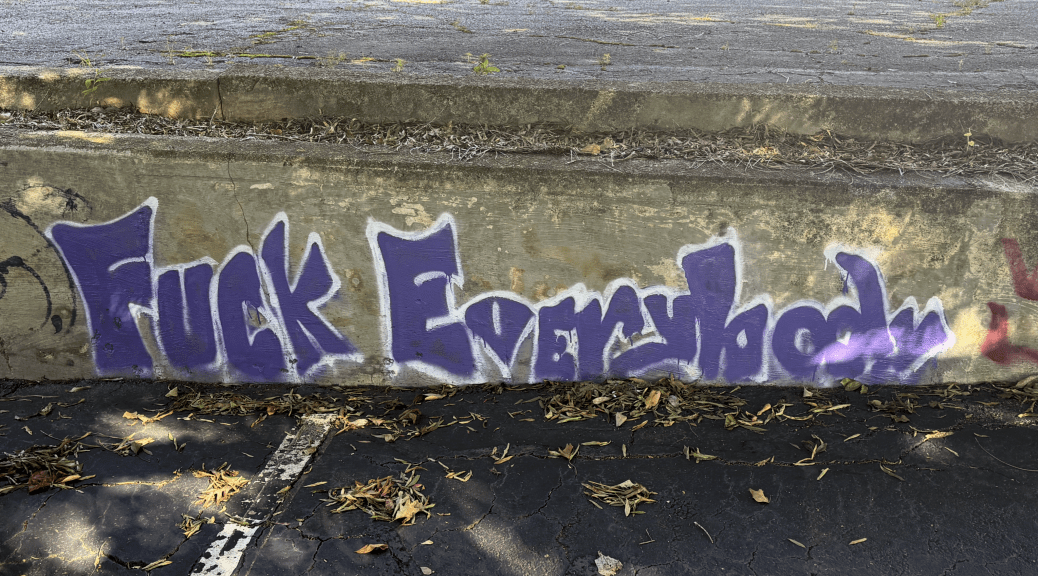
I think Russell was lurking there in my mind when I saw this graffiti recently:
I snapped a picture with my phone and posted a snarky “Free love or anger?” caption across social media.
Sexual liberation, free love, polyamory, etc., are all fascinating to me because I find these concepts both powerfully compelling and (as witnessed in Russell’s own life) incredibly difficult to realize in lived experiences.
Too often, I think, what should be issues of sexual liberation—more needed by women—is a tactic by men to leverage some space or justification for men’s infidelity; further, these progressive ideas about love and sex tend to hit a wall with men’s inability to be possessive in relationships.
Another interesting example is the creator of DC’s Wonder Woman, William Moulton Marston, who is featured in Jill Lepore’s The Secret History of Wonder Woman.
Marston is often credited with weaving feminist ideals into Wonder Woman, and he also practiced polyamory—living and having children with his wife Elizabeth Holloway Marston and partner Olive Byrne, an arrangement that also included Marjorie Wilkes Huntley from time to time.
Again, the reality behind the ideal revealed that these women made much of Marston’s work possible, and likely did some significant amount of that work.
Who did these progressive ideas about women, sex, and relationships benefit?
Marston reminded me of another foundational author in my life, D.H. Lawrence who expressed and portrayed in his fiction a belief that men needed a woman for his intellectual partner and another for his sexual partner.
These are, of course, just a few examples of how the real world manufactures normal, how individuals navigate that normal or find ways to forge their own normal.
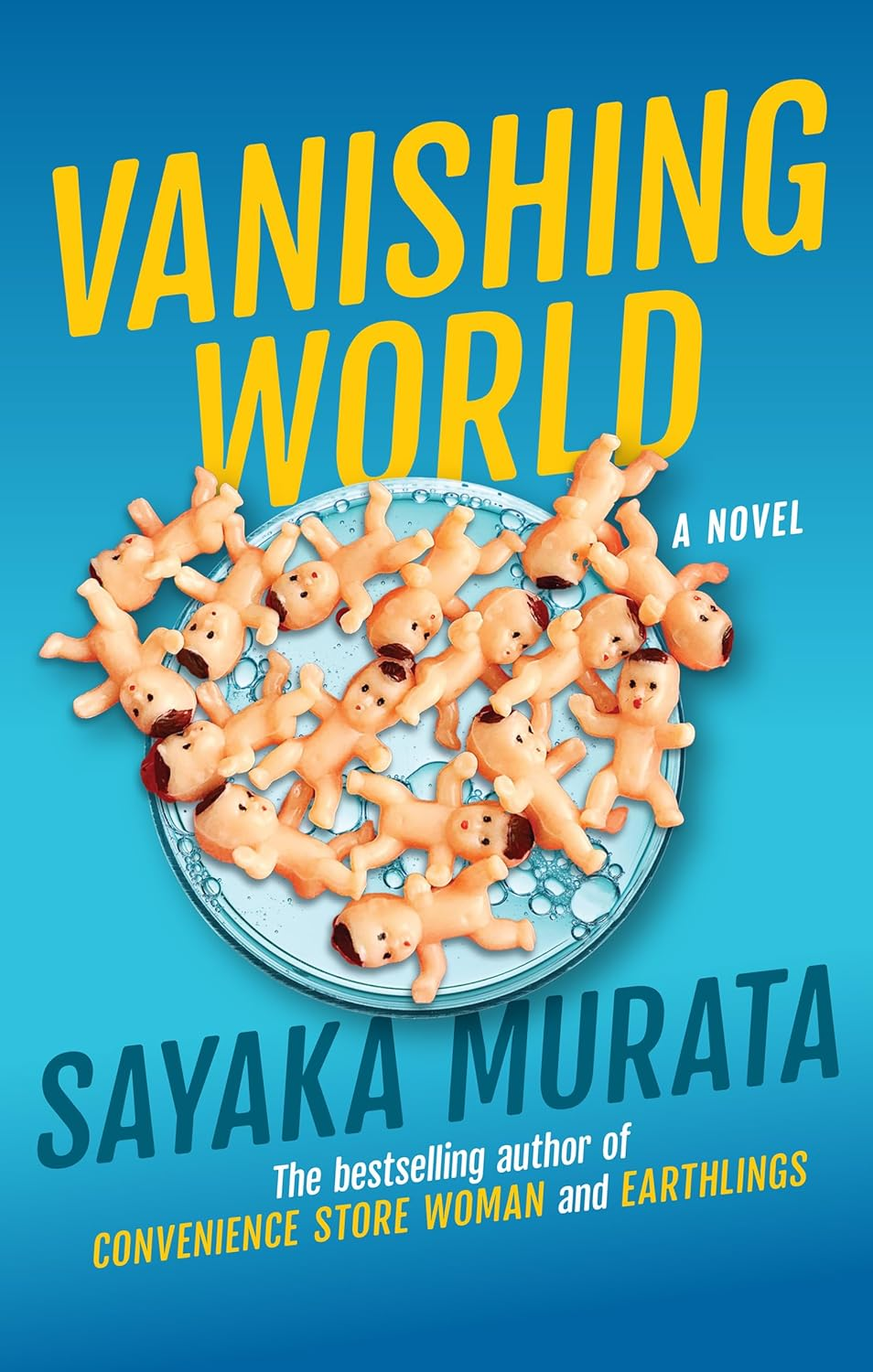
And thus, that blunt graffiti two-words also sit just as I was reading and finishing Sayaka Murata’s Vanishing World.
Sayaka Murata’s Vanishing World: Another Examination of Normal
Like Haruki Murakami, Sayaka Murata is a Japanese writer who draws me in with what reads like literary fiction but is heavily tinged with something like science fiction, or fantasy, or magical realism.
Murata’s works, such as her newest novel Vanishing World, falls into what Margaret Atwood calls speculative fiction. Both Murata and Atwood include elements that are speculative science, but much of these created other worlds seem disturbingly normal, or at least not so much different from the world we live in now.
And similar to her Convenience Store Woman and Earthlings, Vanishing World draws the reader into another engaging and surprising examination of normal.
Amane, the main character, lives in the cusp of an old world where procreation is achieved through intercourse (her parents, to Amane’s discomfort, produce Amane through sex), and the brave new world of procreation only through artificial insemination.
In fact, the new normal is that husband and wife are family, and thus, any sexual contact is deemed incest, taboo.
There are some surprises, twists, and disturbing developments, but all in all, Murata forces the reader to think deeply about sex and gender roles, what makes normal “normal.”
The end is disorienting and powerful (similar to Earthlings), bringing the entire work into stark focus.
“Men and women were now all the same,” Amane acknowledges, “all wombs in service of the human race.”
And just pages from the end, Amane argues with her mother: “‘And you aren’t brainwashed, Mom? Is there any such thing as a brain that hasn’t been washed? If anything, it’s easier to go insane in the way best suited for your world?'”
This speculative world of Murata is about humans making normal “fuck nobody,” a sort of extreme puritanical alternate world that renders human nature unnatural—or at least, no longer normal.
Teaching high school English has a Groundhog Day dynamic that people who have not taught may never consider.
Over my 18-year career as a teacher of high school English, I taught some works of literature more times than I’d like to admit. But let me also note that I often taught some works of literature several times a day and then year after year.
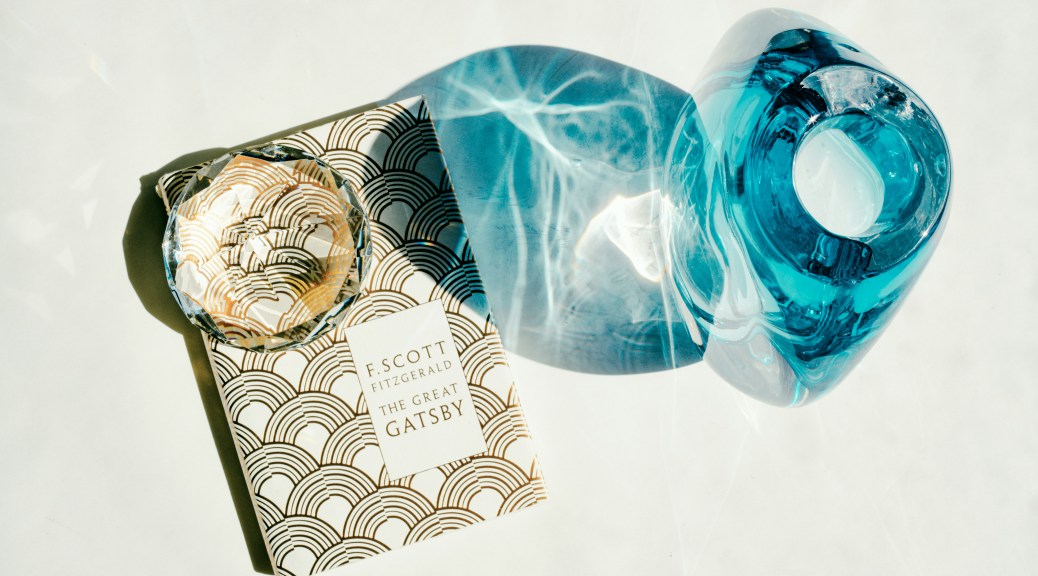
One of those works—that I in some ways loathe—is F. Scott Fitzgerald’s The Great Gatsby, which turned 100 this week in 2025.
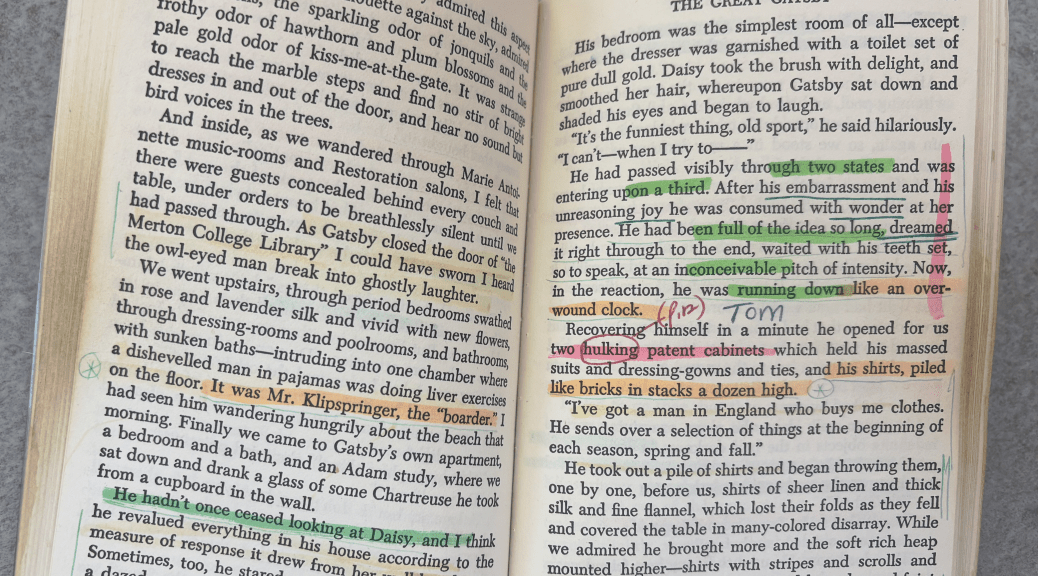
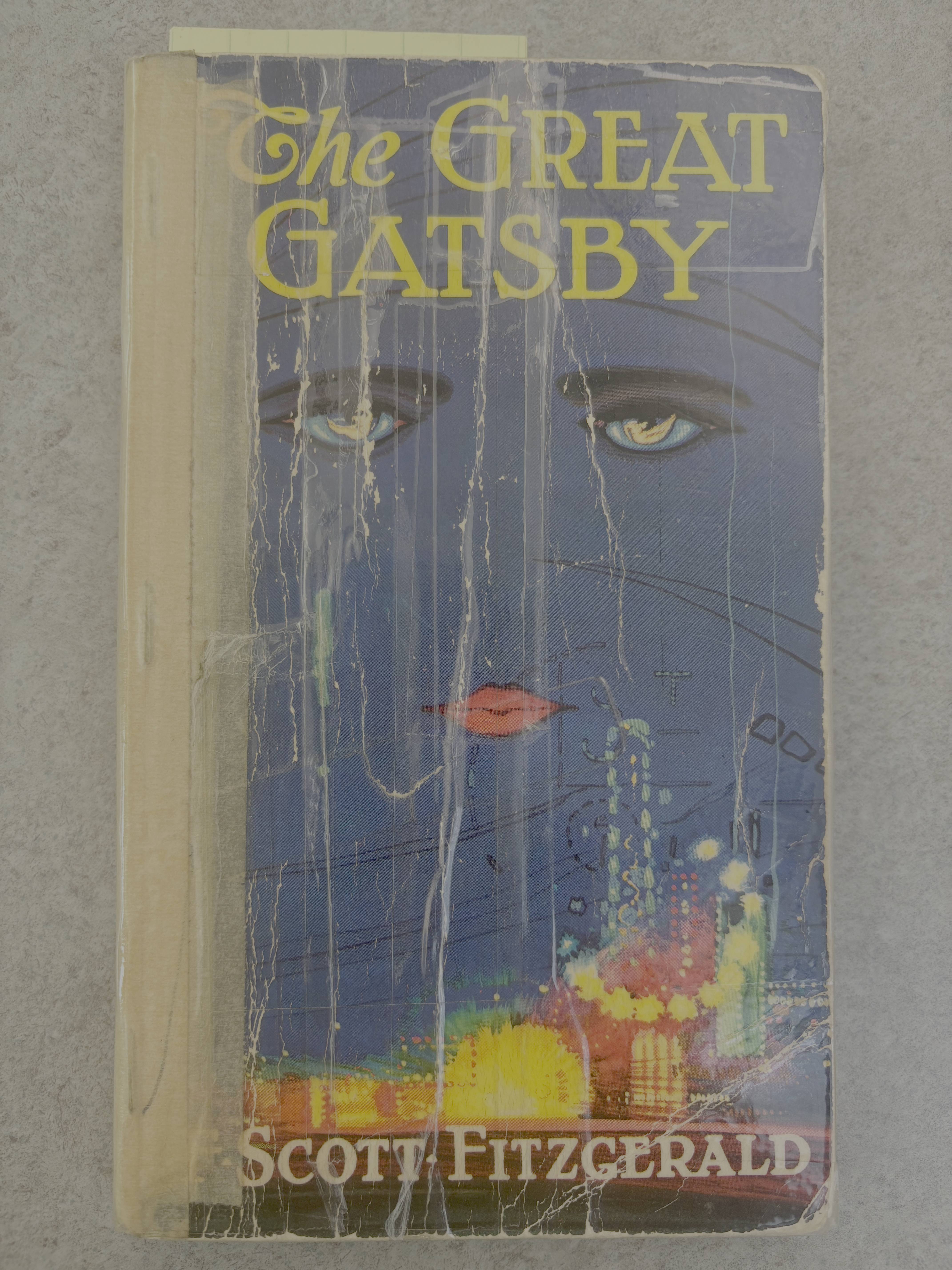
My well-worn teaching copy of The Great Gatsby used to teach high school English from 1984 until 2002.
Setting aside my own skepticism about the canon and requiring all students to read certain so-called “classics,” among the American literature works I was required to teach year after year after year—The Great Gatsby, The Scarlet Letter, The Crucible, and The Sun Also Rises at the core of those required lists—I must admit that Gatsby was often the most accessible for students (easy to read and the Robert Redford film was a great supplement to the unit).
I prefer Hemingway as a writer to Fitzgerald, but I prefer student choice and more diverse and contemporary works as well.
However, a century on and many students in the US still read and study Gatsby in high school along with a fairly conservative list of works from the slightly expanding canon of American literature.
My point here is not to crucify Gatsby or Fitzgerald or modernist literature (lots there that is worth interrogating), but to confront that how secondary (and college) teachers teach along with how students read and learn from Gatsby in traditional and reductive ways that cheat the novel, cheat students, and ultimately cheat the democratic purposes of public education in a (for now) free country.
This act, of course, is a nod to the color imagery running through Gatsby, culminating in the penultimate paragraph of the novel:
Gatsby believed in the green light, the orgiastic future that year by year recedes before us. It eluded us then, but that’s no matter—tomorrow we will run faster, stretch out our arms farther … And one fine morning—
This reductive and figurative language approach to what this novel shows the reader is about more than the often mechanical way students are required and taught to analyze text (more on that next); while teachers, students, and then the public often “get” that Gatsby is about the American Dream, too often that becomes completely disconnected from the novel itself.
Partly, that happens because that next-to-the-last paragraph can become a sort of idealistic doubling-down on the American Dream that Fitzgerald pretty clearly dismantles over fewer than 200 pages.
That idea—humankind’s inalienable right to life, liberty, and the pursuit of happiness—coupled with a system for protecting human rights—was and is the quintessential American Dream. The rest is greed and pompous foolishness—at worst, a cruel and sentimental myth, at best, cheap streamers in the rain. (p. 96)
Taking Gardner’s figurative language, then, Gatsby’s American Dream (a sort of singular obsession with wealth and Daisy) is just “cheap streamers in the rain,” what has for the most part replaced the essential American Dream—life, liberty, and the pursuit of happiness.
Fitzgerald’s own life being sold to the capitalism of Jazz Age America, both in his relentless production of short stories for income and his alcoholism and partying, sits behind the fictional dramatization of what America had become, what America kept becoming, and how America now has nearly fully erased “life, liberty, and the pursuit of happiness” for “filthy lucre” (as D.H. Lawrence warned just a year after Gatsby was published).
Two dynamics are at play here, I think.
The first is most students like Gatsby because it is short and easy to read (notably more so than reading Edgar Allan Poe or Nathaniel Hawthorne, for example); students also enjoy the melodramatic plot of the novel centered on partying, violence, and adultery.
Not to wander to deep into the weeds of literary criticism and classroom pedagogy, but most of us can recognize how often high school English classes become “guess what the English teacher wants you to say about this text”—and that guess often includes some literary technique, what I call the “literary technique hunt.”
For high school teachers and students, then, Gatsby become likes most texts being studied—a vehicle for identifying techniques.
Students begin what amounts to an Easter egg hunt; there’s lots of green and yellow (gold) throughout the novel (hint: money), and the job students have is to find the color and identify the symbolism. (It’s how we ruin poetry, for example.)
About mid-way through the novel, Daisy encounters Gatsby’s “‘beautiful shirts'” (her own Easter egg hunt), and readers encounter the green light:
“If it wasn’t for the mist we could see your home across the bay,” said Gatsby. “You always have a green light that burns all night at the end of your dock.”…
Now it was again a green light on a dock. His count of enchanted objects had diminished by one.
I want to emphasize here, I am not blaming high school English teachers necessarily because the “literary technique hunt” is a consequence of how formal public education has been reduced to testing (easier to test students finding and identifying literary terms than having them do complex analysis of texts) and teachers and schools are expected to be non-political.
The reductive New Criticism of high school English classes seems objective, then, and offers what appears to be a fixed way to assess students.
It is frustrating, however, that Gatsby is reduced to color imagery and symbolism while most of the racism and bigotry are skirted over or ignored entirely.
“They Were Careless People, Tom and Daisy”
Not that I want to “save” Gatsby on its centennial anniversary, but I am particularly invested in literature and how we teach it (and how we often ruin it for students)—and I am also deeply committed to the role of literature/literacy in our democracy, which is currently in Hospice.
But if we could set aside our reductive New Criticism approaches, and then shift our focus away from Nick and Gatsby and toward Tom and Daisy, we could make Gatsby work for our students and for this country that we seem uninterested in saving.
In the last pages, Nick explicates Tom, and Daisy:
I couldn’t forgive him or like him, but I saw that what he had done was, to him, entirely justified. It was all very careless and confused. They were careless people, Tom and Daisy—they smashed up things and creatures and then retreated back into their money or their vast carelessness, or whatever it was that kept them together, and let other people clean up the mess they made … .
Fitzgerald showed us 100 years ago that America was a wasteland, a product of “vast carelessness.”

 dr. p.l. (paul) thomas