Tag Archives: Common Core standards

De-professionalization for Profit: “Leery of teachers”

In Common Core’s unintended consequence?, Jonathan Sapers examines a report from the Center for Education Policy (CEP), self-described as “a national, independent advocate for public education and for more effective public schools.”

CEP has discovered “that in roughly two-thirds of districts in Common Core states, teachers have developed or are developing their own curricular materials in math (66 percent) and English Language Arts (65 percent). In more than 80 percent of districts, the CEP found that at least one source for curriculum materials was local — from teachers, the district itself or other districts in the state.”

As has been the pattern throughout roughly thirty years of public school accountability—one characterized by a revolving door of state standards and high-stakes testing—new standards and tests mean profit opportunities for education-focused businesses.

Sapers reports:

However, Jay Diskey, executive director of the PreK-12 Learning Group of the Association of American Publishers, said publishers are pulling their weight. “We have more than 150 members in our PreK-12 Learning Group. And the ones I’ve seen over the past several years or more have tried very hard to align with Common Core standards in reading and math.”…

Some teachers and districts are viewing the dearth of materials as an opportunity, but experts and even some educators say putting the job of creating curriculum materials into the hands of teachers may not necessarily be a good thing [emphasis added].

And this is where the article takes a troubling turn, as highlighted here:
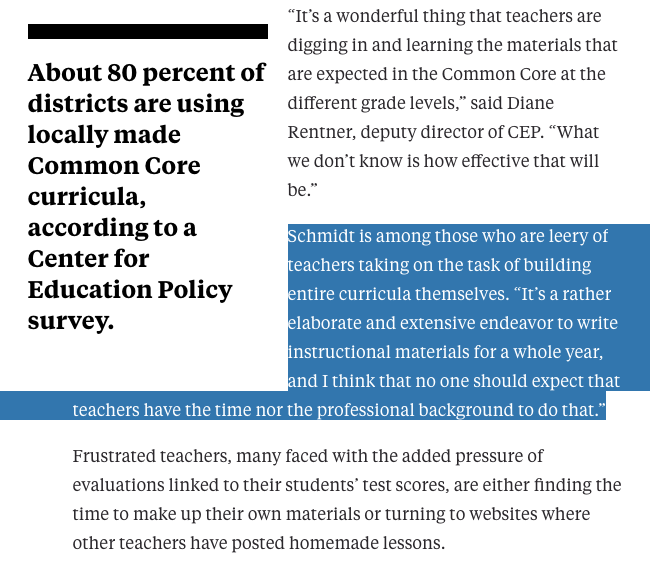
leery of teachers

“Leery of Teachers”

My career as an educator includes 18 years teaching English in a SC public high school throughout the 1980s and 1990s, followed by the most recent 13 years as a teacher educator in higher education.

Those experiences and in my work teaching future teachers, I note that a powerful and problematic difference between a K-12 teacher and a college professor is the locus of authority in terms of the content of any course.

Historically and currently, the authority over content for K-12 teachers has too often been textbooks, curriculum guides, standards, and high-stakes tests.

For college professors, the single most important element of teaching authority is that professors are the locus of authority of the content they teach; in fact, many if not most college professors have little or no formal training in pedagogy, how to teach.

The great irony of this distinction is that between K-12 teachers and professors, K-12 teachers have the greater expertise in teaching, but a far reduced status as a professional when compared to professors.

Along with the locus of authority over the content, the status of professional is strongly related to autonomy and respect—which brings me back to the “unintended consequence” above.

The attitude toward K-12 teachers not having time to create curriculum is valid, but the reason they do not have time includes the incessant changing of bureaucratic mandates that consume their time and that K-12 teachers do not have professional schedules (which professors do) in which to conduct research and create curriculum (which are often related at the university level).

However, the “leery” as well as the unsubstantiated claim that teachers do not have the “professional background” to create curriculum is a genuinely ugly example of the de-professionalization of teaching—a process aided by a historical marginalizing of teaching (significantly as an element of professional sexism), the bureaucratizing of teaching, and the union-busting momentum in recent years.

We should be exploring the real intended consequence of Common Core: billions are to be made off the standards and testing charade, and teachers creating their own curriculum and materials infringes on that profit.

Teaching at all levels includes curriculum, instruction, and assessment, but central to those elements are the unique set of students each teacher faces every day.

Curriculum, instruction, and assessment mean almost nothing without the context of students, and the only person qualified to make those decisions is the teacher.

If we must be leery, let’s be leery about think tanks, publishing companies, and mainstream media who all seem to have little respect for the professionalism of teaching.

See Also

Teaching: Too Hard for Teachers, Peter Greene

Education Accountability as Disaster Bureaucracy

The puzzle isn’t hard to put together because the pieces are in clear sight and fit together easily, but political, media, and public interest in facing the final picture is at least weak, if not completely absent.

Gerald Bracey (2003) and more directly Gerald Holton (2003) exposed that the stated original intent under the Ronald Reagan administration was to create enough negative perceptions of public education through A Nation at Risk to leverage Reagan’s political goals:

We met with President Reagan at the White House, who at first was jovial, charming, and full of funny stories, but then turned serious when he gave us our marching orders. He told us that our report should focus on five fundamental points that would bring excellence to education: Bring God back into the classroom. Encourage tuition tax credits for families using private schools. Support vouchers. Leave the primary responsibility for education to parents. And please abolish that abomination, the Department of Education. (Holton, n.p., electronic)

The accountability formula spawned after A Nation at Risk swept the popular media included standards, high-stakes testing, and increased reports of pubic school failure.

While the federal report created fertile ground for state-based school accountability, that proved not to be enough for political leaders, who within 15-20 years began orchestrating national versions of education accountability. The result was No Child Left Behind and then Common Core standards and the connected high-stakes tests—both neatly wrapped in bi-partisan veneer.

About thirty years after Reagan gave the commission that created A Nation at Risk the clear message about the need for the public to see public education as a failure, David Coleman, a lead architect of Common Core, exposed in 2011 what really matters about the national standards movement; after joking about having no qualifications for writing national education standards, Coleman explained:

[T]hese standards are worthy of nothing if the assessments built on them are not worthy of teaching to, period. This is quite a demanding charge, I might add to you, because it has within it the kind of statement – you know, “Oh, the standards were just fine, but the real work begins now in defining the assessment,” which if you were involved in the standards is a slightly exhausting statement to make.

But let’s be rather clear: we’re at the start of something here, and its promise – our top priorities in our organization, and I’ll tell you a little bit more about our organization, is to do our darnedest to ensure that the assessment is worthy of your time, is worthy of imitation….

There is no amount of hand-waving, there’s no amount of saying, “They teach to the standards, not the test; we don’t do that here.” Whatever. The truth is – and if I misrepresent you, you are welcome to take the mic back. But the truth is teachers do. Tests exert an enormous effect on instructional practice, direct and indirect, and it‟s hence our obligation to make tests that are worthy of that kind of attention.

The pieces to the puzzle: Education accountability began as a political move to discredit public schools, and next the Common Core standards movement embraced that above everything, tests matter most.

And now we have the final piece; Gerwertz reports:

In a move likely to cause political and academic stress in many states, a consortium that is designing assessments for the Common Core State Standards released data Monday projecting that more than half of students will fall short of the marks that connote grade-level skills on its tests of English/language arts and mathematics.

Like Naomi Klein’s disaster capitalism—the consequences of which are being exposed in New Orleans, notably through replacing the public schools with charter schools—the Common Core movement is not about improving public education, but a form of disaster bureaucracy, the use of education policy to insure the perception of educational failure among the public so that political gain can continue to be built on that manufactured crisis.

Yes, disaster bureaucracy is an ugly picture, but it is evident now the accountability movement is exactly that.

Common Core is not some unique and flawed thing, however, but the logical extension of the Reagan imperative to use education accountability to erode public support for public schools so that unpopular political agendas (school choice, for example) become more viable.

The remaining moral imperative facing us is to turn away from political claims of school and teacher failure, away from their repeatedly ineffective and destructive reforms, and toward the actual sources of what schools, teachers, and students struggle under as we continue to reform universal public education: social and educational inequities that have created two Americas and two school systems that have little to do with merit.

Accountability built on standards and high-stakes testing (not Common Core uniquely) is the problem because it is a designed as disaster bureaucracy, not as education reform.

References

Bracey, G. W. (2003). April foolishness: The 20th anniversary of A Nation at Risk. Phi Delta Kappan, 84(8), 616-621.

Holton, G. (2003, April 25). An insider’s view of “A nation at risk” and why it still matters. The Chronicle of Higher Education, 49(33), B13-15. Retrieved March 26, 2010, from OmniFile Full Text Mega database.

What We Know (and Ignore) about Standards, Achievement, and Equity

Calling for, establishing, and implementing high (or higher) standards has been a part of U.S. public education at least since the 1890s when the Committee of Ten called for higher standards for high schools to prepare students for college.

The more recent accountability era built on standards (and multiple versions of revised standards) and high-stakes tests (and multiple versions of those tests) began in the 1980s.

Common Core as a reform initiative is a federalization, then, of that state-based accountability paradigm; there is noting in the Common Core initiative that distinguishes it from the state-based approach except for unsubstantiated and untested claims that the standards and tests are superior to the state versions.

Since we have had a standards-based accountability system for three decades, we have ample evidence of the relationship between the presence and quality of standards and their impact on achievement and equity.

In Research-based options for education policymaking, Mathis (2012) highlights what we know about standards, achievement, and equity.

First, Mathis notes the larger context of Common Core and their potential for reform:

The actual effect of the CCSS, however, will depend much less on the standards themselves than on how they are used. Two factors are particularly crucial. The first is whether states invest in the necessary curricular and instructional resources and supports, and the second concerns the nature and use of CCSS assessments developed by the two national testing consortia. (1 of 5)

Key here are several important points: (1) Common Core standards are not and cannot be separated from implementation or the related high-stakes tests, and (2) nothing in the Common Core initiate guarantees that implementation and testing will be any different than what has occurred over the previous thirty years of state-based accountability.

Currently, we already know some things about implementation and testing related to Common Core:

  • Every state adopting Common Core is also using high-stakes tests, committing to either of two companies charged with creating those tests. There is no mechanism in the Common Core initiative to insure that the standards will not become “what is tested is what is taught”—which is exactly what did happen to all standards at the state levels, which is what must happen when any set of standards are linked to high-stakes tests and punitive consequences for that data.
  • Despite calls for a need to have a common set of standards for the entire nation (a call that has never been verified by evidence), the Common Core is being implemented in a wide variety of ways across the states. If “common” is really our goal (and I suspect it isn’t a worthy goal), it is not happening—even with the tests since they come from two different companies.
  • Common Core implementation is costing states millions and even billions of dollars—with no evidence of their quality, no vetting by educators, no guarantee that this version of standards and tests will be any less a failure than the ones that have come before.

So what do we know about standards and achievement?:

There is, for example, no evidence that states within the U.S. score higher or lower on the NAEP based on the rigor of their state standards. [4] Similarly, international test data show no pronounced tests core advantage on the basis of the presence or absence of national standards. [5] Further, the wave of high-stakes testing associated with No Child Left Behind (NCLB) has resulted in the “dumbing down” and narrowing of the curriculum. [6]

It bears emphasizing that there is no correlation between the presence or quality of standards and student achievement, and that high-stakes testing has created a dynamic in which we ask less of students not more.

At the very least, Common Core implementation should not move forward until clear mechanisms are in place to insure that this round of standards and testing does not replicate the history of standards and testing so far.

As of now, no such guarantees exist. None.

So what do we know about standards and equity?:

As the absence or presence of rigorous or national standards says nothing about equity, educational quality, or the provision of adequate educational services, there is no reason to expect CCSS or any other standards initiative to be an effective educational reform by itself. [13]

As I have noted above about no safeguards that Common Core and the related tests will impact achievement any differently than all the other standards and tests before, there is absolutely nothing in the Common Core initiative that addresses equity—which remains the greatest problem facing education, school, and teacher impact on student achievement.

With Common Core, African American, Latino/a, and impoverished students will continue to be disproportionately funneled into test-prep courses with high student-teacher ratios and inexperienced as well as un-/under-certified teachers

With Common Core, African American and Latino boys will continue to be disproportionately suspended and expelled.

With Common Core, African American, Latino/a, and impoverished students will continue to be disproportionately blocked from advanced courses.

Standards-based reform has never and will never address equity. Common Core is no different.

Since Common Core as a reform initiative in no way offers solutions to identifiable problems with student achievement and equity, we must stop that train, get off, and try something new.

Some are calling for a pause button. I urge delete.

Notes (retaining original report numbering)

[4] Whitehurst, G, (2009, October 14). Don’t forget curriculum. Brown Center Letters on Education, #3, 6. Washington, DC: Brown Center on Education Policy, Brookings Institution. Retrieved February 11, 2010, from http://www.brookings.edu/papers/2009/1014_curriculum_whitehurst.aspx/

Bandeira de Mello, V. D., Blankenship, C., & McLaughlin D. (2009, October). Mapping state proficiencies onto NAEP scales: 2005-2007. Washington, DC: U.S. Department of Education, National Center for Education Statistics. Retrieved March 20, 2010, from http://nces.ed.gov/nationsreportcard/pubs/studies/2010456.asp/

[5] Kohn, A. (2010, January 14). Debunking the case for national standards: one size fits all mandates and their dangers. Retrieved January 13, 2010, from http://www.alfiekohn.org/teaching/edweek/national.htm/

McCluskey, N. (2010, February 17). Behind the curtain: Assessing the case for national curriculum standards, Policy analysis 66. Washington: CATO Institute. Retrieved February 18, 2010, from http://www.cato.org/pub_display.php?pub_id=11217/

[6] Robelen, E. (December 8, 2011) Most teachers see the curriculum narrowing, survey finds (blog post). EdWeekOnline. Retrieved October 2, 2012, from http://blogs.edweek.org/edweek/curriculum/2011/12/most_teachers_see_the_curricul.html/

Wisconsin Center for Educational Research. (1999, Fall). Are state-level standards and assessments aligned? WCER Highlights, 1–3. Madison, WI: Author.

Amrein, A. & Berliner, D. (2002). High-stakes testing, uncertainty, and student learning. Education Policy Analysis Archives, 10(18). Retrieved October 4, 2012, from http://epaa.asu.edu/epaa/v10n18

Shepard, L. (2000). The role of assessment in a learning culture. Educational Researcher, 29(7), 4–14.

Phillip Harris, Bruce M. Smith,B. M. & Harris, J. (2011) The Myths of Standardized Tests: Why They Don’t Tell You What You Think They Do. Rowman and Littlefield, 100-109.

[13] Whitehurst, 2009 (see note 4); McCluskey, 2010 (see note 5);

Mathis, W. J. (July, 2010). The “Common Core” Standards Initiative: An Effective Reform tool? Retrieved October 2, 2012, from nepc.colorado.edu/files/PB-NatStans-Mathis.pdf

On Public Schools and Common Core: Graff’s Critique of Ravitch

Are U.S. public schools failing, and if so, will implementing Common Core and next-generation tests as part of school accountability correct those failures?

At Valerie Strauss’s The Answer Sheet, Gerald Graff, an English professor at the University of Illinois at Chicago, has challenged Diane Ravitch’s stance on the both public schools and Common Core, which he characterizes as follows:

“Public education is not broken,” says Diane Ravitch in her new book, “Reign of Error: The Hoax of the Privatization Movement and the Danger to America’s Public Schools.”  The “diagnosis” of the corporate reformers “is wrong,” Ravitch writes, and their solutions are also wrong.  “Our urban schools are in trouble because of concentrated poverty and racial segregation.  But public education as such is not ‘broken,’” and “the solutions proposed by the self-proclaimed reformers have not worked as promised.”

Ravitch’s argument — that the real problem is not public education but its would-be reformers — has become a familiar one for opponents of current attempts to reform the American educational system.  Like most such opponents, Ravitch concedes that the system is far from perfect, but she argues that the causes lie in social conditions outside education, in “concentrated poverty and racial segregation,” as she puts it, and in the false story of a broken system that reformers disseminate in order to justify privatizing education and enriching themselves.  So goes this argument.

Graff concludes: “I don’t buy it.”

While he concedes that Ravitch is correct about the negative impact of poverty and inequity on schools as well as the failure of many aspects of the reform movement (“more charters, more standardized tests and fetishized test data, all of it used punitively, more privatization”), Graff argues that, based on his experiences as a professor, public schools are failing and poverty cannot be the sole cause: “Few of the college students I teach are poor and many are white, middle class, and relatively privileged, yet their command of basic skills of reading, writing, and critical thinking falls far short of their potential.”

And thus, Graff aligns himself with the promise of Common Core standards, “which focus on precisely these ‘college readiness’ skills that my students not only struggle with but don’t seem to have been told are important” (See Mercedes Schneider’s response to Graff’s endorsing Common Core).

First, Graff’s characterization of Ravitch, I think, distorts how public school effectiveness should be described (and likely Ravitch’s position).

Public education is not failing the ways that reformers claim, typically based on raw test score comparisons (year-to-year in the U.S., international, state-to-state) and sweeping charges about “bad” teachers, public school monopolies (and lack of choices), and the negative influences of the status quo (often code for “unions”).

However, public schools are failing as they are overburdened by out-of-school influences (as long as we focus on standardized test scores, that influence remains the dominate problem facing education reform) and in the ways in which they perpetuate those social inequities (for example, tracking, inequitable discipline practices such as zero tolerance policies, rising segregation in public and charter schools, and inequitable teacher assignment including commitments to Teach for America for high-poverty minority students).

But the larger public school failure (the one I believe at the root of Ravitch’s “Public education is not broken”), however, is not that public education is failing the U.S., but that so far, we have failed public education. In other words, Ravitch’s argument is a call to reconsider our commitment to public education as part of the essential Commons and the need to reject market-based critiques and reform for that institution.

Here, Graff ignores that much of Ravitch’s Reign is, in fact, a call for reforms—which would be an odd thing to do if she in fact held as Graff claims that public schools are fine as they are.

Next, Graff’s reasons for endorsing the Common Core are ironically the reasons Common Core standards will never address the failures of public schools.

Since Graff and Ravitch highlight that public education struggles under the weight of poverty and inequity, we must acknowledge that there is nothing about Common Core (or any aspect of the accountability movement based on standards and testing) that addresses those inequities; in fact, a great deal of evidence suggests that high-stakes accountability simply labels inequity and often increases inequity—along with failing to achieve the goals often associated with accountability-based reform.

For example, there is nothing in Common Core that will change African American males being disproportionally suspended and expelled, nothing that will change African American and impoverished students attending majority-minority schools that are underfunded and staffed by inexperienced and un-/under-certified teachers, nothing that will insure that minority and high-poverty students will have access to high-quality courses (such as Advanced Placement and International Baccalaureate), and nothing that will end the disproportionate retention of minority and male students (in fact, a growing trend of the accountability movement is retaining third grade students based on high-stakes test scores).

Finally, and directly drawn from Graff’s concerns about college students not burdened by poverty, is the claim that those students are not well prepared by public education.

Setting aside that every generation has bemoaned the failure of the children coming after them (including Aristotle), we must ask why those students appear not prepared for the demands of college work.

The answer, for example, lies in Graff’s experience with students analyzing text and writing original essays.

Applebee and Langer have explored what students are asked to do as student writers in middle and high schools. Their research reveals a powerful, but damning dynamic: English teachers of middle and high school know more than ever about best practices in the teaching of writing, but students do little extended writing and much of that best practice is never implemented in U.S. classrooms.

Applebee and Langer’s research appears to expose why Graff finds his students ill prepared for college demands related to text analysis and writing, but the most important pattern found by Applebee and Langer is the reasons students are not be challenged are the inordinate high-stakes demands of the standards and testing era under which U.S. public schools function.

College-bound students, currently and over the past thirty years, have disproportionately spent their time in English classes learning to write to prompts for AP exams, high-stakes state tests, and, since 2005, the one-draft, 25-minute essay on the SAT.

As a writing teacher of freshman at a selective liberal arts university, I can attest that Graff’s characterization of students’ ability to write autonomously and with authority is lacking, but unlike Graff, I recognize that the problem is grounded in high-stakes accountability.

I also recognize that the historical record of standards and testing reveal that Common Core and next-generation tests will not change the entrenched failures of the accountability era, and Common Core has no mechanism to shift traditional failures of public schools (the inequities I have identified above).

In the end, Common Core is continuing to dig even after we have found ourselves in a pointless hole.

As Deborah Meier explains, even if Common Core standards do align better with college readiness (and that claim falls short), we are still asking too little of students with that goals.

And that is the problem, ultimately, with standards-based education and education reform.

If schools are failing to meet the needs of children living in a free society—and they are—that failure can be traced to the narrowing of teacher and student expectations—the one guaranteed consequence of standards-based education about which we have ample evidence.

In ten years, political leaders and the public will be decrying the failures of public education, professors such as Graff will still bemoan the inadequacies of their students, and we will again hear demands for yet another round of new standards and new tests—standards and tests that must be world-class and address college readiness. And Common Core will be placed on the shelf with all the other disappointing trophies to how we continue to fail universal public education.

Faith-Based Education Reform: Common Core as Standards-and-Testing Redux

Let’s start with irony:

Compelling research suggests that the public in the U.S. is unique in its commitment to belief, often at the expense of evidence—leading me to identify the U.S. as a belief culture.

Additionally, while I remain convinced that the U.S. is a belief culture, I also argue that, below, the political cartoon posted at Truthout captures another important dynamic: Many committed to their own beliefs both do not recognize that they are committed to belief and belittle others for being committed to their beliefs:

By Clay Bennett, Washington Post Writers Group | Political Cartoon

And this brings me to advocacy for Common Core standards, with one additional point: Along with embracing belief over evidence, the public (along with political leadership) in the U.S. tends to lack historical context.

Placed in the century-plus commitment to pursuing new and supposedly higher standards for public schools, then, Common Core advocacy falls into only two possible characterizations:

  1. Common Core is a response to the historical failure of all the many standards movements that have come before, and thus, the success of CC depends on CC being somehow a different and better implementation of an accountability/standards/testing paradigm.
  2. CC advocacy is yet another example of finding oneself in a hole and persisting with digging despite evidence to the contrary. In other words, CC may well be yet another commitment to a reform paradigm that isn’t appropriate regardless of how it is implemented, as John Thompson details in his review of The Allure of Order:

Jal Mehta’s masterpiece, The Allure of Order, answers the question, “Why have American [school] reformers repeatedly invested such high hopes in these instruments of control despite their track record of mixed results?” He starts with the review of how the bloom fell off the NCLB rose, explaining why its results in the toughest schools have been “miserable.” In the highest poverty schools the predictable result has been “rampant teaching to the test” which has robbed children of the opportunity to be taught in an engaging manner.

Mehta explains that this “outcome might have been surprising if it were the first time policymakers tried to use standards, tests, and accountability to remake schooling from above.” The contemporary test-driven reform movement is the third time that reformers have used the “alluring but ultimately failing brew” of top down accountability to “rationalize” schools and, again, they failed [emphasis added].

These two claims are themselves evidence-based (and it will be interesting to watch as others respond, as they have to my previous work on CC, by either ignoring evidence or garbling evidence to support what proves to be faith-based commitments to CC), and thus should provide a foundation upon which to continue the debate about CC.

CC advocacy and criticism are often based on false narratives and baseless claims (see Anthony Cody for one example of this problem and Ken Libby‘s [@kenmlibby] cataloguing on Twitter #corespiracy)—again reinforcing the pervasive and corrosive consequences of faith-based, but not evidence-based debates.

Instead, we should start with an evidence-based recognition about standards-driven education reform.

For example, the existence and/or quality of standards are not positively correlated with NAEP or international benchmark test data—leading Mathis (2012) to conclude about CC: “As the absence or presence of rigorous or national standards says nothing about equity, educational quality, or the provision of adequate educational services, there is no reason to expect CCSS or any other standards initiative to be an effective educational reform by itself [emphasis in original]” (p. 2 of 5).

Therefore, CC advocacy has some principles within which it should continue if that advocacy is to be credible and thus effective:

  • Claims that CC advocacy is separate (and can be separated) from high-stakes testing must show evidence of when standards have been implemented without high-stakes tests (and how that was effective) or evidence of some state implementing CC without high-stakes tests connected. Otherwise, this is a faith-based claim.
  • Claims that accountability built on standards and high-stakes testing is an effective education reform strategy must show evidence of how that has worked in the previous state-based accountability era and then explain why those examples of success must now be replaced by the new CC set of standards. Otherwise, this is a faith-based claim.
  • CC advocacy has been endorsed as a logical next step built on the call in NCLB for scientifically based education reform; thus, CC advocates must either comply with the two points above or concede that the CC era is a break from evidence-based reform.

I am no advocate for remaining only within rational, evidence-based, and quantifiable norms for decision making, by the way, but I am convinced we must make clear distinctions between evidence and belief—and I am equally convinced that many education reformers enjoy a flawed freedom to call for evidence from their detractors while practicing faith-based reform themselves.

It is the hypocrisy that bothers me, the hypocrisy of power:

scientist evidence – Married to the Sea

Let’s acknowledge that teachers currently work under the demand of measurable evidence of their impact on students while CC advocates impose faith-based policies such as CC, new generation high-stakes testing, merit pay, charter schools, value-added methods of teacher evaluation, and a growing list of commitments to education reform at least challenged if not refuted by evidence.

CC advocates now bear the burden of either offering the evidence identified above or admitting they are practicing faith-based education reform.