
Tag Archives: education

LD Johnson Lecture Series: What Really Matters: I Am Thinking about People Tonight

What Really Matters: I Am Thinking about People Tonight [click title for text of talk]

Slideshow [click for PP slideshow]
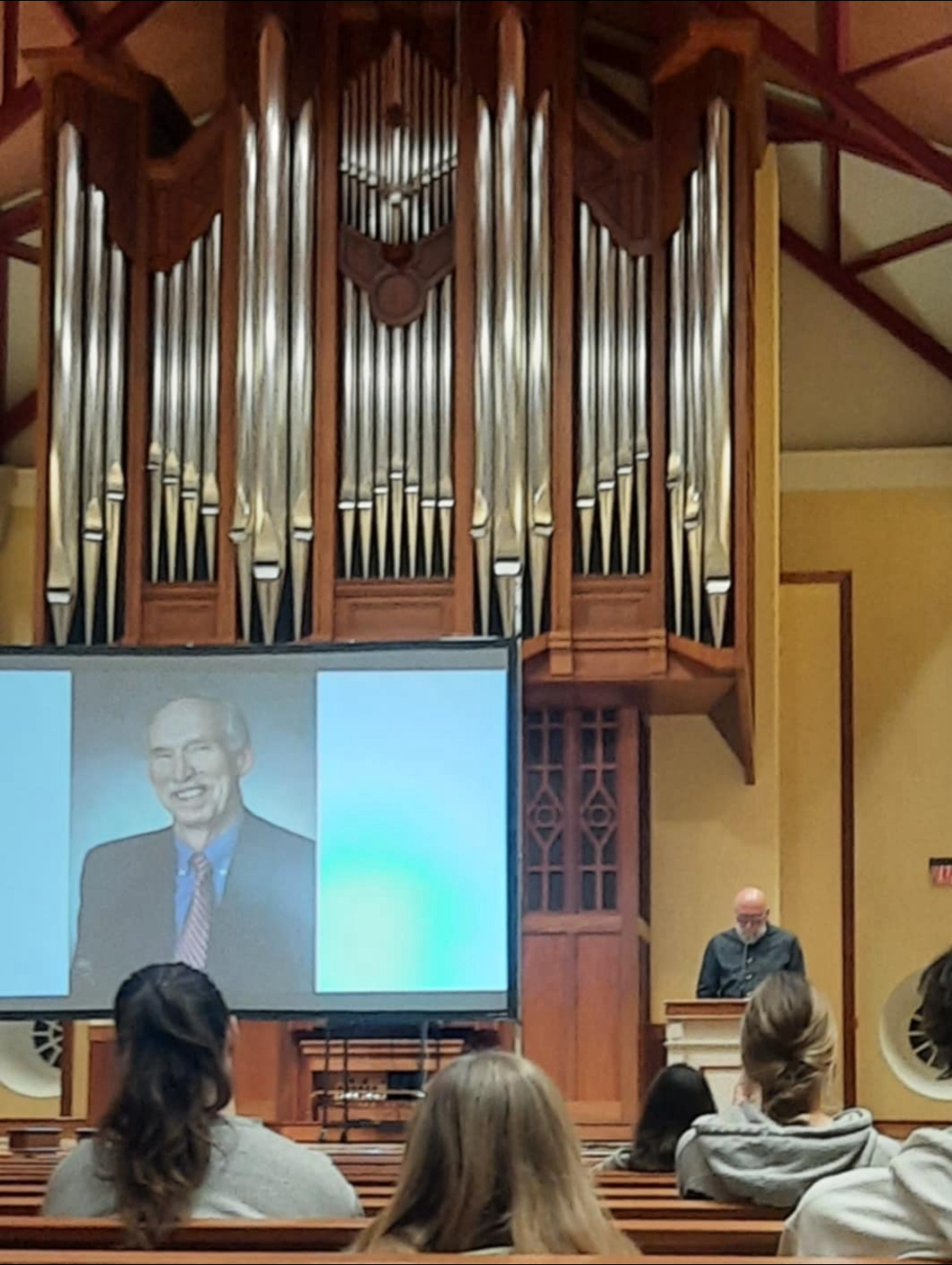

What Really Matters: I Am Thinking about People Tonight

P.L. Thomas, Furman University

Prelude

This is a prelude. This is not what I had originally written for tonight.

Just over a week ago, I woke to learn that Trump had been elected again as the president of the US. Along my immediate despair, I felt that I would not be able to give this talk, to share What Really Matters when so many people had just chosen that so little matters.

I almost immediately thought about a former student who has a trans daughter. I have watched that family choose love and also watched how that choice of love has been met with anger and hate, making their journey more difficult than necessary. Far less humane.

I love my former student and her wonderful family. A family facing an impending doom that is now darkening their frail but blossoming hope.

We are connected on social media, and watching this all unfold in their daily lives is overwhelming, saddening, and even maddening.

Of course, I cannot give in to despair, and so, next is what I had planned, an early draft written in a rush of inspiration when I was so kindly invited to share this with you tonight.

This then is my …

What Really Matters

I am thinking about people tonight.

I am thinking about Jim Edwards.

Jim was a much loved and highly respected professor of philosophy for 41 years at Furman, his alma mater.

If you look up anything about Jim, you see he was born in Columbia, SC, but he always went out of his way to say he was a son of Woodruff, my hometown.

Any time I would see Jim he would smile and say, “Who would have ever imagined two boys from Woodruff, professors at Furman University.” You could hear in that voice a kindness, a reverence for both that town and this university.

I wish Jim could be here because I know what he’d be thinking.

I am thinking about people tonight.

I am thinking about my mom and my dad, Rose and Keith Thomas.

I don’t know what to do with my parents.

My father and mother both died in 2017. My father in late June. And then my mother in early December, just several days before her birthday.

The end was slow, awful, and premature for my parents. I watched them die while living the reality of the consequences of having little money at the end of your life.

My parents’ death taught me a lesson, in fact: The healthcare system in the US doesn’t care about anyone’s health. It is the bank account that matters.

But I have so much of my parents in my memory, a memory that I am learning is flawed at best.

After tropical storm Helene devastated Western North Carolina and Asheville, I have been trying to recover, trying to recreate as much of my family as I can, specifically my mother’s family who lived for about a decade in Asheville during the 1960s.

After my parents died, my nephews and I cleaned out my parents’ house, the only real capital they left behind and likely the thing they were most proud of. Part of what we held onto was hundreds of pictures that my oldest nephew, Tommy, sifted through and had many scanned.

I have been looking through them all trying to find Asheville pictures. Recently, Tommy dropped by two containers of pictures and other things, most of which have not been scanned.

And there among the pictures, I found letters. A few from my mother to my father in 1960 while they attended Spartanburg Junior College (now Spartanburg Methodist College).

The college was very strict about relationships, including no public displays of affection. However, one day on my mother’s lunch break while working as a cashier at a grocery store, my mom and dad slipped off and were married at the courthouse, although marriage was also not allowed for anyone attending the college.

This led to their coded dialogue. Dad was “Honeybun” and Mom was “Nut,” the only two words on the envelope of one letter. As long as I can remember, my dad would say to my mom, “You tickled me nut,” meaning “I love you.”

My father told stories about that courtship over and over throughout my life. They were happy stories, and they reinforced the happy parents I enjoyed during my childhood and teen years.

I also found a stack of letters my mother wrote from Lumberton, NC just after I turned one year old. My mother, you see, had left my father and moved back in with her parents (who moved constantly, mostly around NC but in SC also).

The letters have the return address at Southern National Bank where Mom was working. We also have her social security card issued while in Lumberton.

These letters are sad and imploring, and often confusing. By spring, my mother began signing letters “Love always, Rosie + Paul + ?” because she was pregnant with my sister.

One letter, as well, is a sweet one from my mother to my father’s dad, Tommy (my namesake since his given name was Paul Lee Thomas).

And then there are letters from my mom to my dad in 1964, three from Asheville and four from Woodruff/Enoree (they lived in a small mill village, Enoree, just south of the slightly larger mill town of Woodruff, SC).

My father was in the National Guard and training in Fort Gordon, GA. Similar to the love letters in college and the letters from Lumberton, these letters are filled with love and missing my father by my mom, my sister, and me.

But in all these letters, the thing missing is my father. No letters back, and several times my mother asking if he has forgotten how to write letters.

I do not know what to do with my parents.

Because I have now begun to recreate a new version of them, a new version captured well I think in many of the pictures that remain.

But I am recreating what I can with what I have, and this new version, I think, will find a new place in my heart that doesn’t have to know everything.

I wish my parents could be here because I do know what this would mean to them.

I am thinking about people tonight.

I am thinking about Pat Lanford. She was my first-grade teacher, and my first surrogate mother.

For those who know me, this will not be a surprise, but I was a momma’s boy. My mom taught me to read and play cards well before school. And instilled in me a love for science fiction. Her favorite movie was The Day the Earth Stood Still, and she introduced me to the sci-fi horror classics like Vincent Price’s The Fly.

So that transition to school was a hard one. I cried, I resisted.

But Mrs. Lanford was always loving and patient.

The story goes I was sitting in the back of class making car revving noises once. Mrs. Lanford said, “Paul, stop it!” So I made a loud tires-screeching-to-a-stop noise.

I think Mrs. Lanford that year adopted a common refrain, “Now, Paul!”

I am thinking about people tonight.

I am thinking of Mrs. Townsend, my second-grade teacher. She was a small woman, and her husband was Mr. Townsend, a highway patrolman. I was terrified of her.

The first day of school, she called the roll, and when she came to my name, she said I was named after my father.

This was Woodruff. Every knew everyone, and everyone knew my father and my grandfather, who ran the Pure Oil and then 76 gas station in the middle of town.

I said, “No, ma’am, I was named after my grandfather.”

First day of second grade I was sent to the hall for talking back.

That gas station I mentioned, it was Tommy’s 76, and everyone in Woodruff knew my grandfather as Tommy. But his name was Paul Lee Thomas, and I was Paul Lee Thomas II.

I had carefully explained that, and that if I were named after my father, Paul Keith Thomas, I would be Jr. and not II.

In the hallway I was terrified of my fate once I got home, but the next day, Mrs. Townsend took me in the hall—not in front of the class—and apologized. That was over 50 years ago, and I remember that as if it were last week.

A couple decades later, I was a teacher at Woodruff High. On the first day of class, I was checking roll, including a student Billy Laughter (spelled L A U G H T E R). Thinking I would be funny, I pronounced his name as “laughter.” Billy was a big guy, redneck in overalls, and I watched as his neck and face began to turn red.

I quickly added, “Billy, I thought I was being funny. I know your family name is Laughter and I also know that wasn’t funny. Sorry.”

The red subsided and Billy stopped contemplating how much trouble he would be in for strangling a teacher.

A lesson Ms. Townsend never knew she taught me. A lesson that both Billy and I appreciate.

I am thinking about people tonight.

I am thinking about people, you may be starting to recognize, who profoundly shaped me to be the person I am standing before you.

That began with my parents, but this list so far and to come, I must emphasize, has mostly been teachers, the profession I too have chosen—or the profession, like being a writer, that I came to recognize is who I am.

I think that recognition of being a teacher is in part out of a debt I feel to all of those people, all of those teachers, in and out of classrooms.

Sometimes I take a few moments and recall all of their names, and I can name nearly every teacher I had from first grade through my doctoral program.

I don’t want to forget.

I am thinking about people tonight.

I am thinking about Mrs. Parks, my first Black teacher, third grade, who taught me the year Woodruff incorporated the previously Black-only schools into its school system.

Integrating came to Upstate SC slowly, into the late 1960s and even into the 1970s.

My mother took a job in the school office that year because my sister and I would be attending that school in the Black neighborhood of Woodruff, Pine Ridge, that literally sat on the other side of the railroad tracks.

Mrs. Parks delivered the first lesson of my life about racism because a student had uttered the N-word. She made us all get out our dictionaries and proceeded to explain to us that the racial slur had its roots in a word that meant “dirty.”

She was calm, stern, and amazingly practical with a room full of third graders, many of us white students living daily in racist homes where that word was commonly used by our parents and nearly every white person we knew.

It was the first time I started to understand there was something profoundly wrong about the words and anger of white culture while I spent my days at school with friends both Black and white.

I am thinking about people tonight.

I am thinking about Mrs. Simpkins.

Mrs. Simpkins was my 6th-grade math teacher. She had two sons, one a year younger and one a year older than me, Clark and Scott. We went through school and played basketball together. A few after she was my teacher, her husband was my high school principal and would also be my first principal when I became a teacher.

They were from Moncks Corner, SC, and once when I was over playing basketball with Scott and Clark, Mrs. Simpkins warned us, “Now, boys, don’t you get in that rud.”

Like most of her students, I loved but was also terrified of Mrs. Simpkins, and I found myself worried about her warning. When I asked her sons what the “rud” was, they laughed and clarified, “The road, the road!”

I am thinking about people tonight.

I am thinking about Harold Scipio.

By high school, Mrs. Simpkins and other teachers had instilled in me a belief that I was a math and science student. Mr. Scipio taught me chemistry and physics, and further convinced me that my future lay in the sciences.

Mr. Scipio was a tall, thin, and even-speaking Black man who printed meticulously on the overhead as he taught. He referred to all his students with “Mr.” and “Miss” and our last names—I was Mr. Thomas—explaining that since we had to address him as Mr. Scipio, he felt he should do the same.

At a banquet near the end of my senior year, as we were cleaning up afterward, he smiled and called me Paul. It was after school hours and I was about to graduate. He was telling me we were both just people, we were equals.

I can still see and hear that moment today.

And the other moments I will never forget were when we took tests. Mr. Scipio would casually walk in and out of the room, often staying out of sight in the back of the lab cleaning lab equipment.

The first time that happened, we all looked around making eye contact, realizing that these tests were about more than chemistry or physics.

He never said a word about this behavior, but I knew even as a teenager that Mr. Scipio was showing us you don’t cheat or lie, especially to those people who treated you with dignity and respect.

Many years after I graduated and had taught high school for almost two decades, I was at dinner being interviewed for this job at Furman. Nelly Hecker, Hazel Harris, and I were talking after a day of interviewing when I saw Mr. Scipio sitting at a table nearby.

I walked over, and when I told him what I was doing, he beamed.

I think at that moment I knew I would take the position if offered.

I am thinking about people tonight.

I am thinking about Lynn Harrill.

Strands of the webs of my life keep breaking.

That is an inevitable consequence of living into your 60s, and hopefully beyond.

I received a text message in July that my high school math teacher and later teaching colleague had informed a group of people that my high school English teacher, Lynn Harrill, passed away.

He had been suffering from Alzheimer’s—something I found out about second hand, explaining several months of fruitless phone calls from him when he never spoke—but the end came quite awfully after Covid prompted a stroke.

I sat on the couch with my partner, and there was nothing I could do except a sudden and deep burst of crying.

This reminded me too much of my mother’s death—a sudden stroke and then dying of cancer a few months later—and my father dying sitting beside my mother right after that stroke.

The end is always too, too awful, and humans, we are too, too frail.

Lynn was a wonderful human and a life-changing teacher who willed me to be a teacher and a reader and a writer.

Lynn taught me two years of high school English, and like Mr. Scipio, profoundly shaped me as a person.

I was that student who wandered into Mr. Harrill’s room any time I was free, talking endlessly, likely consuming time he didn’t have to spare.

Once he said I should consider teaching, and I laughed, thinking it was a ridiculous idea.

About 6 years later, I was sitting in the exact chair Mr. Harrill had been sitting in, teaching in the position he had left for the district office.

And that position here at Furman I interviewed for seeing Mr. Scipio at dinner? Lynn Harrill had just left Furman, and my office is the one he picked out and furnished when Hipp Hall was first opened.

Few days pass without me thinking of Lynn.

No one had a greater impact on who I am than Lynn, and as he would attest, that is what teachers do.

I cannot move on from Lynn with sharing a poem from Emily Dickinson, who Lynn loved:

This World is not Conclusion (373)

I am thinking about people tonight.

I am thinking about Steve Brannon and Dean Carter.

I now live in a converted textile mill just a couple miles from my first college, Spartanburg Methodist Junior College. It is there that my life transformed, grounded in Mr. Scipio but fulfilling what Mr. Harrill saw well before I did.

Mr. Brannon introduced me to e.e. cummings in his speech class, and I still recall the day I realized I am a poet and a writer while sitting in the dorm I pass when driving from my apartment to downtown Spartanburg, a poem mimicking cummings.

Dean Carter taught me survey literature courses, and when he wasn’t chastising me for wearing my high-top, leather Converse All-Stars unlaced, he convinced me to begin tutoring for the course, and it was during that experience I discovered my love for teaching.

At SMC, Dean Carter and Mr. Brannon gave me the gifts of being a writer and being a teacher, gifts built on all the gifts of teachers before them.

I am thinking about people tonight.

I am thinking about Richard Predmore and Nancy Moore.

Called USC-Spartanburg at the time, my undergraduate experience became a journey in English and education thanks to Mr. Brannon and Dean Carter.

Dr. Predmore, meticulously writing in pencil on my essays, and Dr. Moore—introducing me to Ralph Ellison, Langston Hughes, and Alice Walker—completed the transformation of my nerdy math and science self into the person who would spend his life with books, literature, and teaching.

Richard was demanding, and Nancy was encouraging and kind. I find myself always trying to emulate those qualities as I teach my college students.

I am thinking about people tonight.

I am thinking about Ann Shelley, John and Mark.

Dr. Ann Shelley taught me at USC-S during my MEd, and after that, she and I did research together in my classroom at Woodruff High. Ann was gracious to have me co-author my first scholarly works years before my doctoral program.

But I also would become colleagues with her son Mark at WHS, where he started a long and stellar career as an educator. And as many of you here know, I would later be a colleague with Dr. John Shelley a cherished faculty member at Furman for decades in the religion department.

I am thinking about people tonight.

I am thinking about Lorin Anderson and Craig Kridel, the chair and anchor of my doctoral committee. [Craig is kindly here with us tonight.]

Once again, Ann’s foundation of me as a scholar was finally fully realized in my doctoral program, one recommended by Lynn Harrill.

I cannot stress the great fortune it was for me to have Lorin Anderson as my committee chair. He was practical, patient, and above all else, like many of the people I have mentioned tonight, incredibly supportive of me as a scholar.

And Craig Kridel introduced me to Joseph Williams’s book Style, and one of the most important people I have yet to mention tonight—Lou LaBrant.

Craig is a giant in the world of educational biography, a field—what I have tried to do here tonight—that centers people to stress what really matters.

Through Craig, I met in person Maxine Greene, and interviewed Louise Rosenblatt.

But most of all, I was entrusted with the legacy of LaBrant, for which I can never repay Craig, himself a person who has always treasured that people above all else, people are what really matter.

I am too much indebted to Craig to simply thank him, so instead, I want to share a few words from LaBrant, a now constant voice, a sort of sound track for my life who continues to speak into a world too often like hers mid-twentieth century:
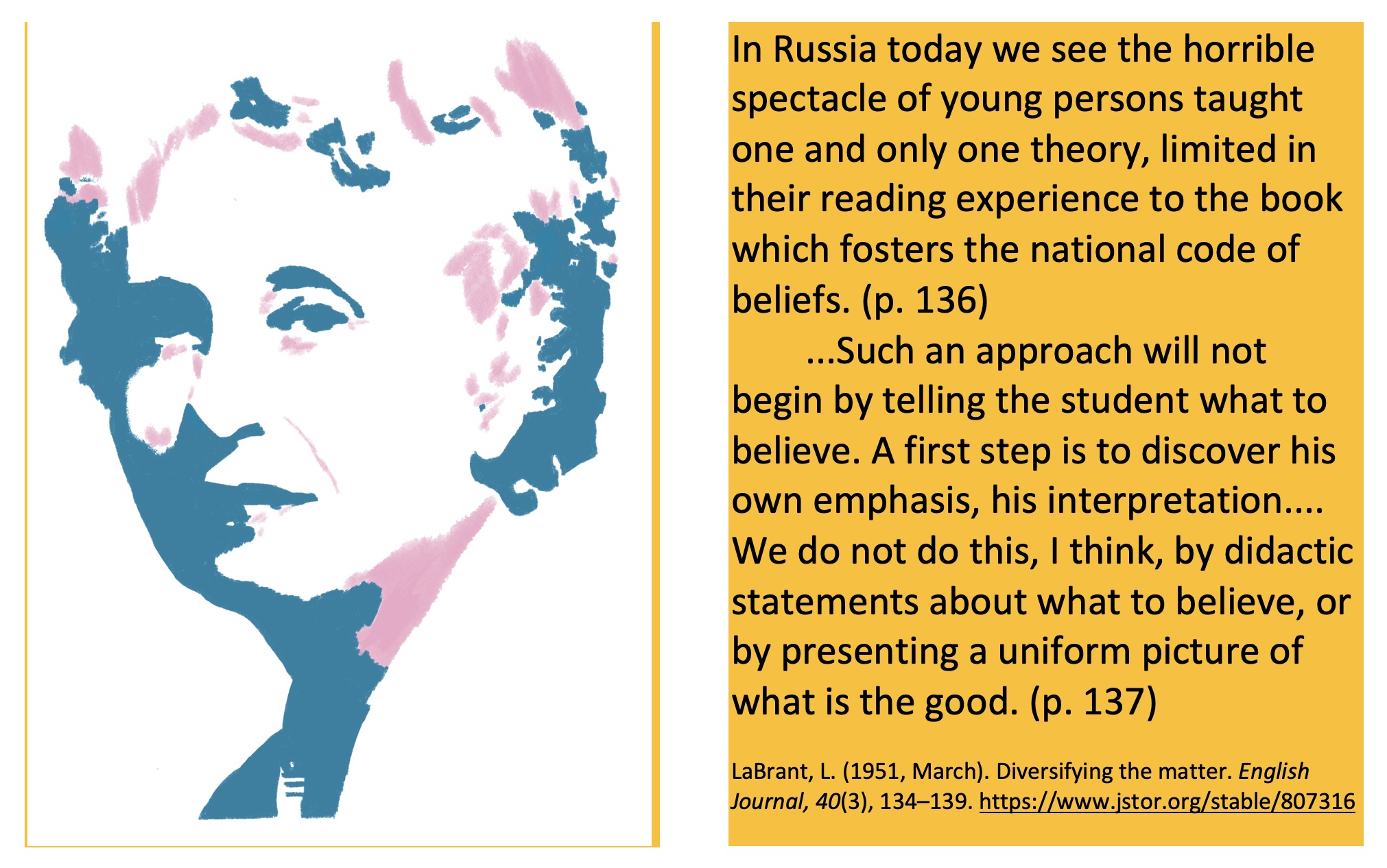
Screenshot

LaBrant, L. (1951, March). Diversifying the matter. English Journal, 40(3), 134–139. https://www.jstor.org/stable/807316
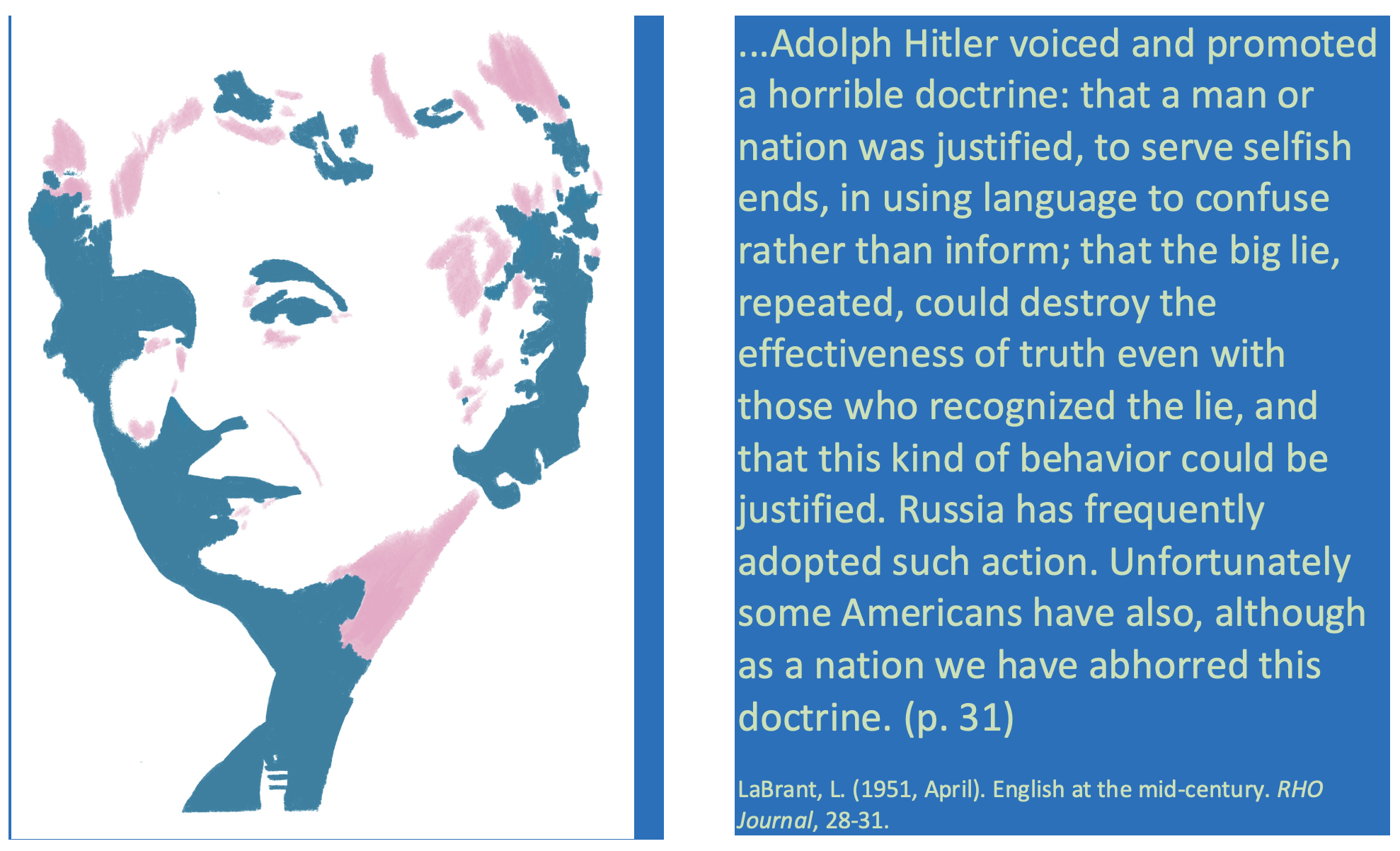
Screenshot

LaBrant, L. (1951, April). English at the mid-century. RHO Journal, 28-31.

I am thinking about people tonight.

I am thinking about the people devastated by Hurricane/Tropical Storm Helene. Especially in WNC and Asheville.

Asheville was a central part of my life in the 1960s when my mother’s family lived there.

My mother’s parents can be fairly described as “characters.” Even as a small child, I found them fascinating, fun, and a treat to visit. The thing that is most distinct about them—Harold Sowers and Edith Mize—was that most people called them Slick and Deed.

And then there is their Asheville.

It sweeps over me, more than a memory, more like a flashback, every time we drive into Asheville on Hwy 25 and pass through a tunnel.

The rock tunnels of Asheville and the very distinct area of West Asheville are buried in my child’s brain from trips in the 1960s and 1970s.

As an adult, much of my life included the close mountains of Tryon and Saluda, NC as well as frequent trips to Asheville—for MTB trails, gravel riding, and the explosion of breweries that many people now associate with the bohemian city.

Asheville has become gentrified, and the South Slope introduced the town to tourist beer drinkers. I know locals and long-time Asheville folk (my aunts and uncle included) likely regret these changes, but my life has spanned both Ashevilles in almost completely positive ways.

But with the help of my aunt Lynda (second oldest of five children by Slick and Deed, my mom the oldest by several years), I have reassembled some of what my fractured memory holds.

Slick and Deed moved the remaining family (my mother was married and living in Enoree, SC) from Roanoke Rapids, NC to Asheville in 1963. Moving was normal for the Sowers family; my mother attended 4 high schools, including in Pendleton (SC), Concord (NC), Lumberton (NC) and Union (SC), graduating finally from the latter.

Slick had trouble keeping work, although he mostly moved the family from mill town to mill town.

Asheville proved to be some stability for Lynda, Buddy, Mary, and Patsy—my aunts and uncle. However, they lived in four different houses, and Deed eventually secured the managing job at a motel on 690 Merrimon Avenue, Sunset Court Motel.

My aunts and uncle lived through the often violent integration era for schools in Asheville, attending Asheville High (which was named Lee H. Edwards High School from 1935 to 1969).

Uncle Buddy was eventually expelled from there—he had pictures of the bruises from repeated beatings he received as a high school student—and moved in with my parents in Woodruff where he graduated high school before serving in Vietnam.

Two of the most traumatic events for the Sowers family occurred in Asheville.

Slick fell and broke his leg while drunk, but Deed refused to help him.

I recall my mom talking on the phone and finding out he had a compound fracture and had to drag himself inside to call for help while Deed sat on the porch.

Soon after, Slick, drunk again, threatened Deed with a gun.

These extreme events, it seems, prompted Deed to seek the motel managing work to help provide the family some stability.

Another place that likely has the most consistent memories for me with family is Myrtle Beach, SC.

It was about a four-hour drive from Woodruff in the Upstate of SC, and for most people, Myrtle Beach was a somewhat expensive vacation destination (but, to be fair, this was a working class and middle class beach with the beaches for wealthy people further south near Charleston or North Myrtle Beach).

My working-class parents visited Myrtle Beach in off seasons; I mostly recall the beach in December, in fact. We have many pictures of Myrtle Beach covered in snow; I think we were there for the heaviest snowfall recorded for the area.

Slick and Deed loved Myrtle Beach, but as a family with very meager resources (often as a result of Slick’s alcoholism), they were also resourceful.

Usually in the off season as well, Slick and Deed arranged to help manage the Victory Motel in Myrtle Beach.

In many ways, the Sowers’ world was volatile like the 1960s, but my childhood was more than an hour away, allowing me to hold onto idealistic memories of my family.

And finally.

I am thinking about people tonight.

I am thinking about John Irving, Kurt Vonnegut, Maggie Smith, Eugene V. Debs, Ralph Ellison, and James Baldwin.

I am an old—in more ways than one—English teachers so you’ll have to excuse my ending with literature. Like teachers, authors are the people who made me, the people who saved my life and continue to save my life.

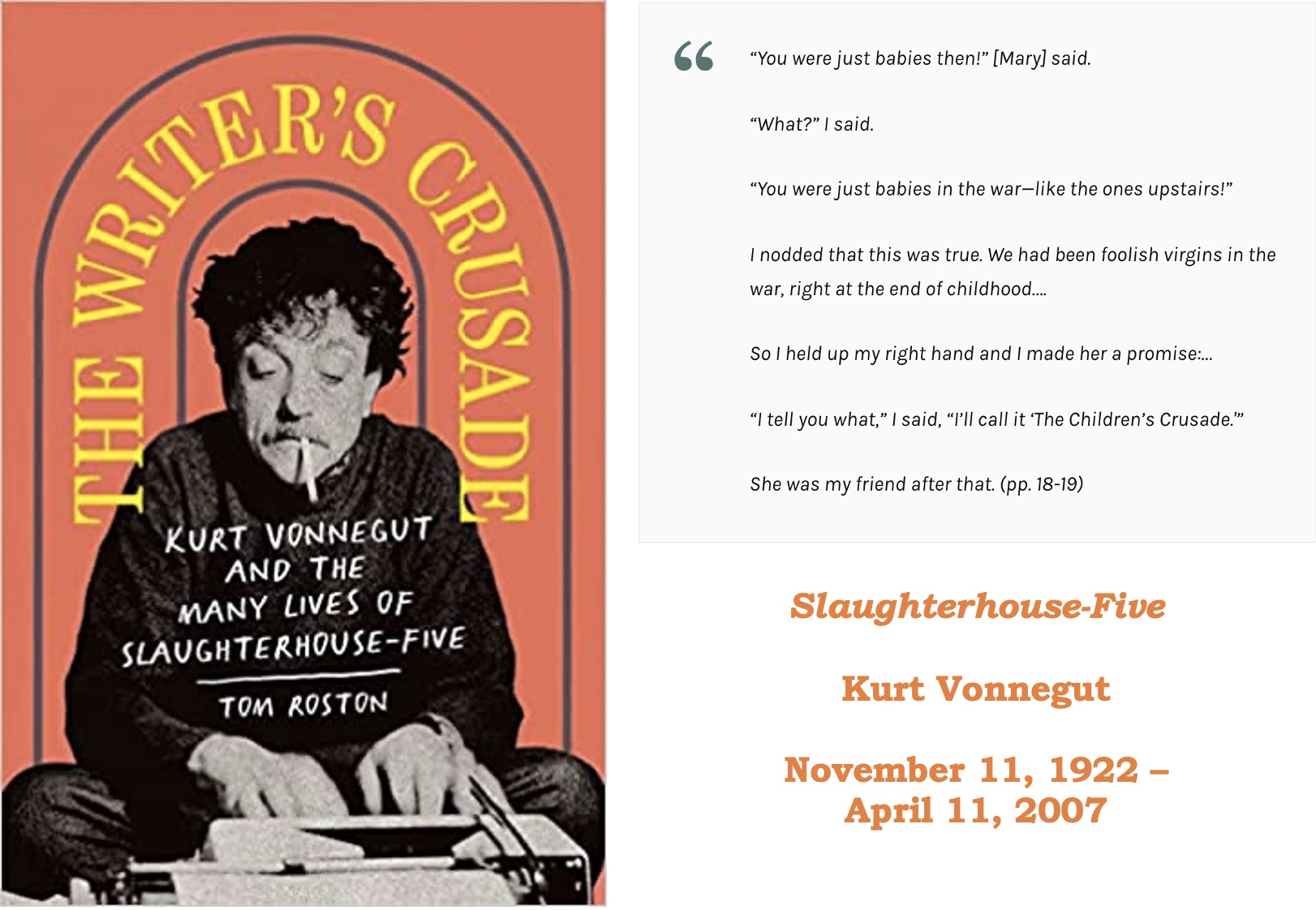
One of my favorite writers is Kurt Vonnegut, who was not only an era defining novelist but also a teacher of writing. And Vonnegut on occasion has noted that one of his best pupils was novelist John Irving, who gained famed for The World According to Garp and The Cider House Rules, both of which were popular novels and films.

In John Irving’s A Prayer for Owen Meany, which builds to being something of a Vietnam War novel, John Wheelwright, narrator and friend of the titular character Owen Meany, offers a key scene in Chapter 1:

We were in Rye, passing the First Church, and the breeze from the ocean was already strong.  A man with a great stack of roofing shingles in a wheelbarrow was having difficulty keeping the shingles from blowing away; the ladder, leaning against the vestry roof, was also in danger of being blown over. The man seemed in need of a co-worker—or, at least, of another pair of hands.

“WE SHOULD STOP AND HELP THAT MAN,” Owen observed, but my mother was pursuing a theme, and therefore, she’d noticed nothing unusual out the window….

“WE MISSED DOING A GOOD DEED,” Owen said morosely. “THAT MAN SHINGLING THE CHURCH—HE NEEDED HELP.” (pp. 33-34, 35)

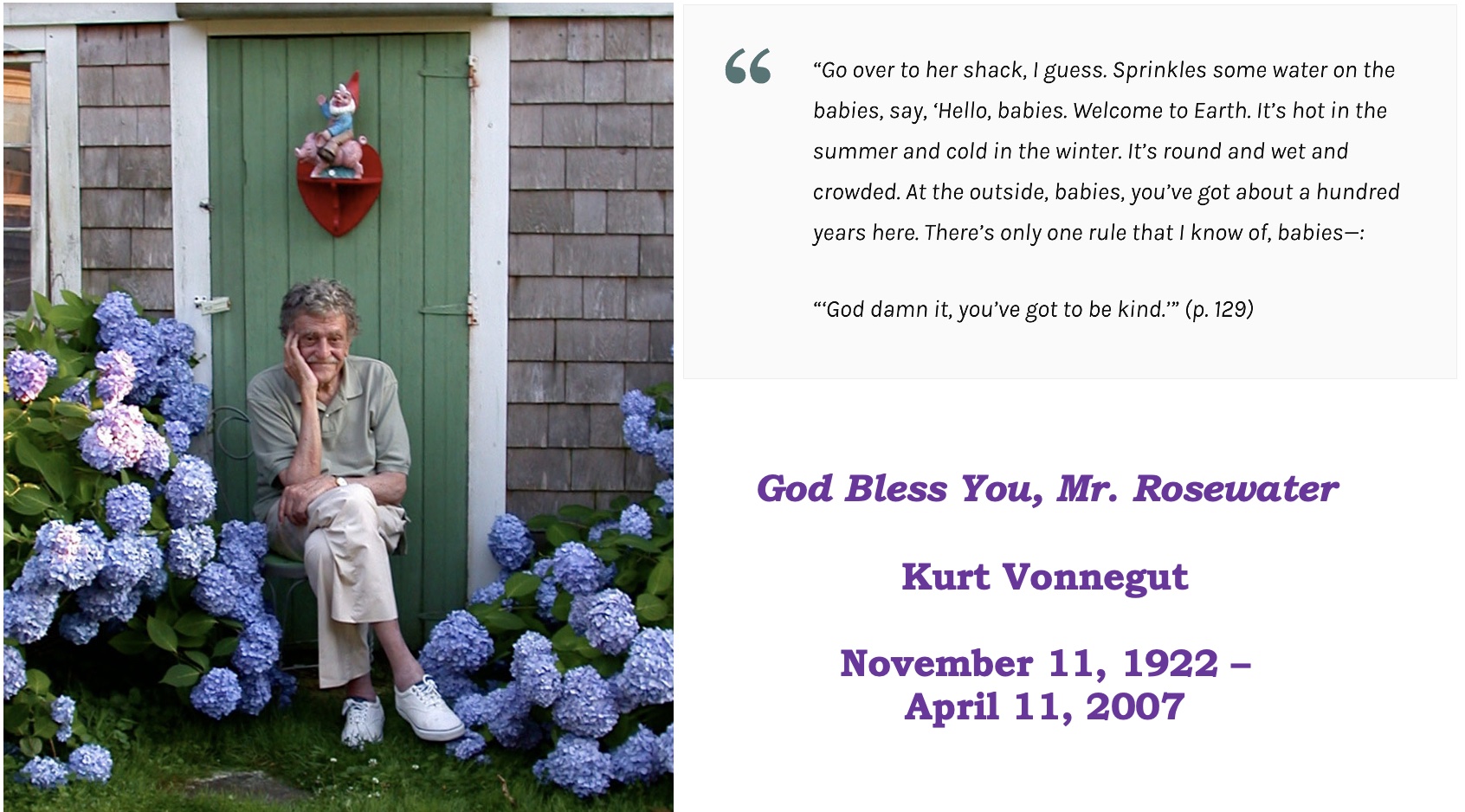
In Kurt Vonnegut’s God Bless You, Mr. Rosewater, the titular character of the novel, Eliot Rosewater, implores:

“Go over to her shack, I guess. Sprinkles some water on the babies, say, ‘Hello, babies. Welcome to Earth. It’s hot in the summer and cold in the winter. It’s round and wet and crowded. At the outside, babies, you’ve got about a hundred years here. There’s only one rule that I know of, babies—:

“‘God damn it, you’ve got to be kind.’” (p. 129)
Screenshot

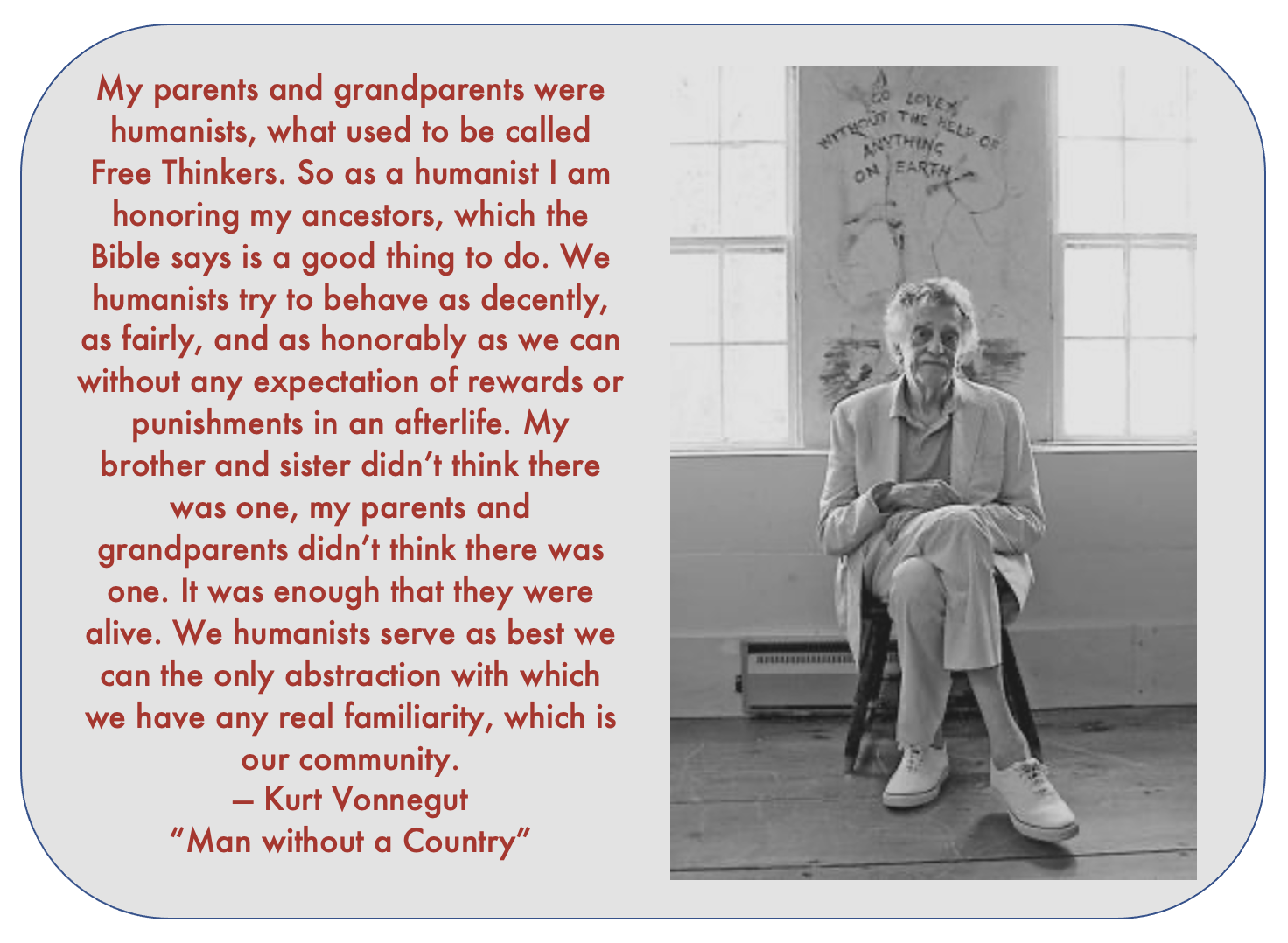
Writing in A Man without a Country, Kurt Vonnegut explains:

My parents and grandparents were humanists, what used to be called Free Thinkers. So as a humanist I am honoring my ancestors, which the Bible says is a good thing to do. We humanists try to behave as decently, as fairly, and as honorably as we can without any expectation of rewards or punishments in an afterlife. My brother and sister didn’t think there was one, my parents and grandparents didn’t think there was one. It was enough that they were alive. We humanists serve as best we can the only abstraction with which we have any real familiarity, which is our community.
Screenshot

Vonnegut also made a name for himself giving graduation speeches.

“We love you, are proud of you, expect good things from you, and wish you well,” Vonnegut began at Agnes Scott College in Decatur, Georgia on May 15, 1999:

This is a long-delayed puberty ceremony. You are at last officially full-grown women—what you were biologically by the age of 15 or so. I am as sorry as I can be that it took so much time and money before you could at last be licensed as grown-ups.

If graduation speeches are meant to punctuate ceremony, then Vonnegut was going to throw cold water on ceremony.

If graduation speeches offer one last moment for sage advice from elders to the young, Vonnegut was going to say something to displease adults and disorient the young.

But always wrapped inside his curmudgeon paper was a recurring gift, one that tied all of his work together: Vonnegut was tragically optimistic and even gleeful about this world.

On cue, then, at Agnes Scott, Vonnegut rejected the Code of Hammurabi, revenge, and admitted he was a humanist, not a Christian, adding:

If Christ hadn’t delivered the Sermon on the Mount, with its message of mercy and pity, I wouldn’t want to be a human being.

I would just as soon be a rattlesnake.

Finally, to those young women, Vonnegut concluded:

I’ll want a show of hands after I ask this question.

How many of you have had a teacher at any level of your education who made you more excited to be alive, prouder to be alive, than you had previously believed possible?

Hold up your hands, please.

Now take down your hands and say the name of that teacher to someone else and tell them what that teacher did for you.

All done?

If this isn’t nice, what is?

I can’t end without more poetry because while my refrain here tonight is designed to argue that people really matter, I also believe that one of the most human of human behaviors is our urge to create and enjoy poetry, the very human urge to produce song with only words, to utter the unutterable.

One of the very best written in recent years, one that resonated when Trump was first elected and has, regretfully, gained renewed power, is “Good Bones” by Maggie Smith.

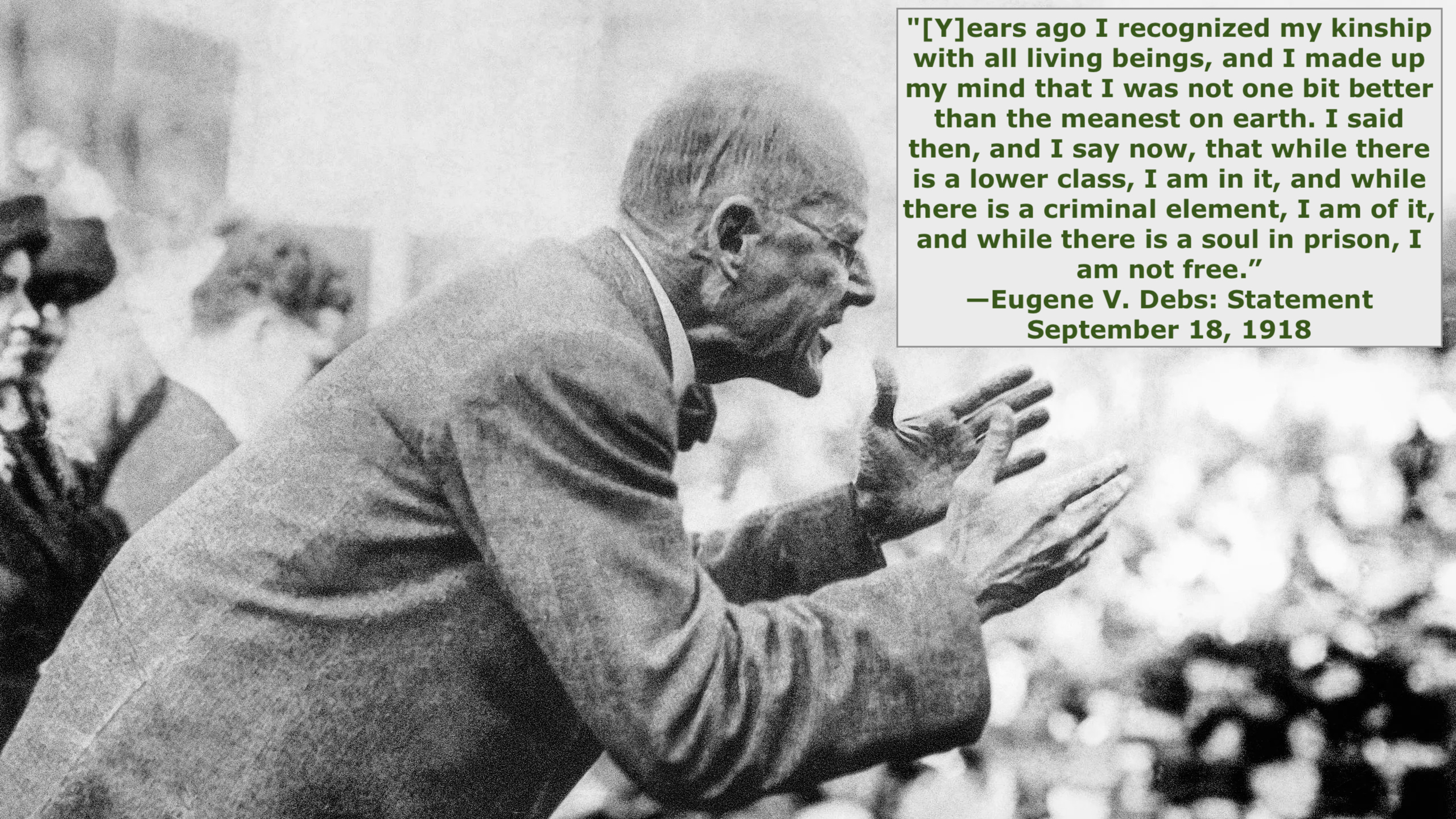
Because of Vonnegut, as well, I am indebted to Eugene V. Debs, a prominent Socialist candidate for president and activist.

I return to his words often:

[Y]ears ago I recognized my kinship with all living beings, and I made up my mind that I was not one bit better than the meanest on earth. I said then, and I say now, that while there is a lower class, I am in it, and while there is a criminal element I am of it, and while there is a soul in prison, I am not free.
In my teaching and writing, I also return often to Ralph Ellison, celebrated author of Invisible Man.

But the work that resonates is his talk to teachers, “What These Children Are Like,” from 1963. Ellison challenges the conventional wisdom about drop-outs and the deficit beliefs about language among rural and Black people. He ends with a wonderful recognition about the place of honoring who people are:

I don’t know what intelligence is. But this I do know, both from life and from literature: whenever you reduce human life to two plus two equals four, the human element within the human animal says, “I don’t give a damn.” You can work on that basis, but the kids cannot. If you can show me how I can cling to that which is real to me, while teaching me a way into the larger society, then I will not only drop my defenses and my hostility, but I will sing your praises and help you to make the desert bear fruit.

Jame Baldwin also gave a talk to teachers in 1963. Now 60-plus years ago, Baldwin could as easily be speaking to us today:

The purpose of education, finally, is to create in a person the ability to look at the world for himself, to make his own decisions, to say to himself this is black or this is white, to decide for himself whether there is a God in heaven or not. To ask questions of the universe, and then learn to live with those questions, is the way he achieves his own identity. But no society is really anxious to have that kind of person around. What societies really, ideally, want is a citizenry which will simply obey the rules of society. If a society succeeds in this, that society is about to perish. The obligation of anyone who thinks of himself as responsible is to examine society and try to change it and to fight it — at no matter what risk. This is the only hope society has. This is the only way societies change.

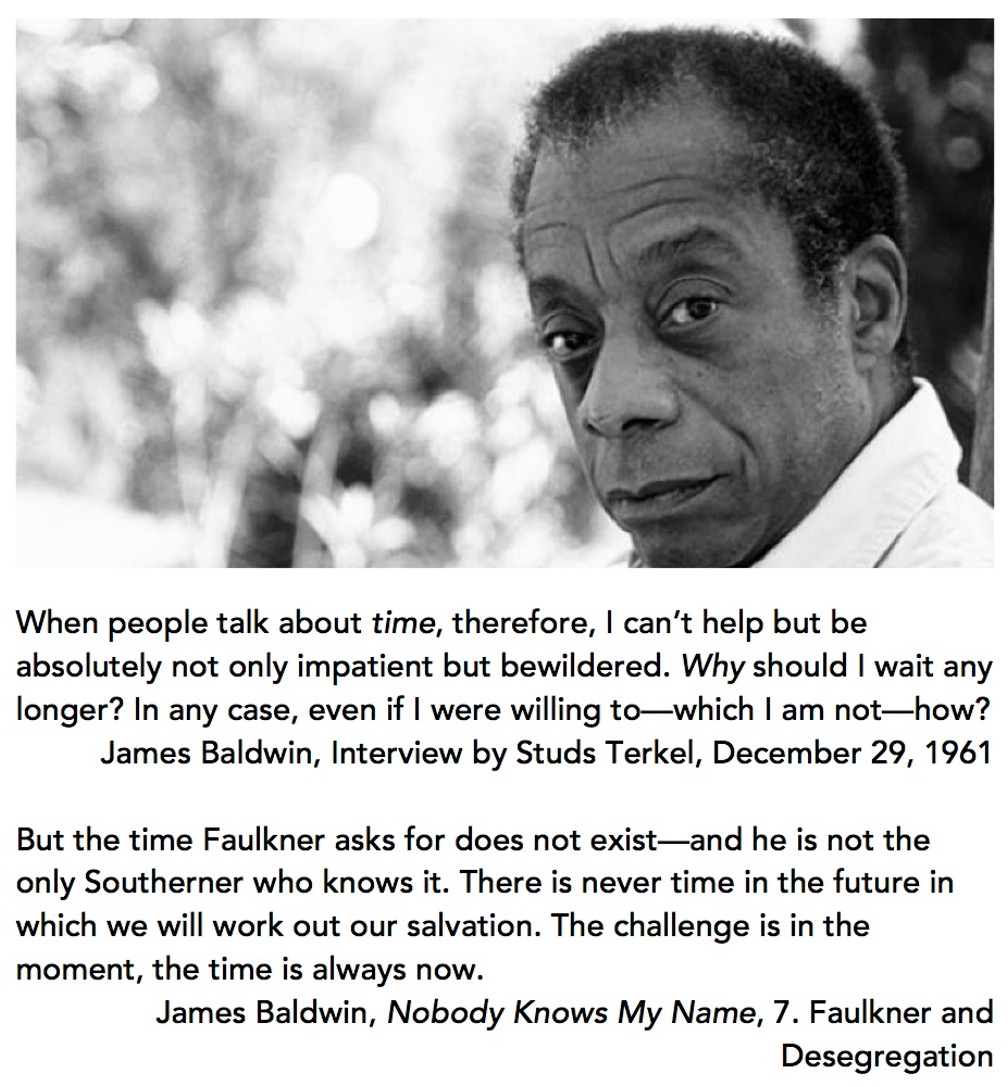
In the Prelude, I admitted my despair, and my momentary hesitation about trying to share tonight What Really Matters, but again, I must stand on the shoulders of giants, again Baldwin who argued, “There is never time in the future in which we will work out our salvation. The challenge is in the moment, the time is always now.”
I am thinking about people tonight.

What really matters? It may seem simple, but what really matters is people.

Love them while you have them here. Speak their names when they are gone to keep them in this moment.

We are all standing on the shoulders of giants, the people who were our teachers whether in classrooms of not.

We are all giants when we choose to be.

Be brave, be kind.


If You Don’t Think, Why Should I listen?

Often, my high school students would draft a sentence that began “I don’t think,” and I would highlight or circle the construction and then comment: “If you don’t think, why should I listen?”

This was a typical ploy of my feedback on student writing—one designed to develop in my students a purposefulness and care for not only the words they chose, but also the assembling of those words.

For “I don’t think the movie was good,” we would discuss the placement of “not,” recasting as “I think the movie was not good” or simply “bad,” and then “I think the movie was cliche and condescending to the viewers.”

But I was relentless (and still am) about what word choices and sentence formations actually stated (“I could care less”) versus what was meant (“I couldn’t care less”): “I want to kiss you badly” isn’t a very good invitation to romance, I’d explain.

We argued about “not” and “only” placements, but also I emphasized the lazy openings of sentences: “Flying low over the fields, the cows were startled by the plane.” So we could examine dangling and misplaced modifiers as well as the inherent dangers of passive voice; eventually, hitting on the real danger of passive voice—the absent agent: “Documents were shredded.”

Mostly, for my students, class time was about playing with language as readers and writers. It endeared my students to Margaret Atwood and Kurt Vonnegut—Atwood’s wordplay and Vonnegut’s sparse snark.

Words are how humans define the world, and how we are equipped to re-define the world.

And that is why I am so persistent about the importance of careful, purposeful language—especially for young people.

“I Don’t Think” v. “I Don’t Believe”

During my first 18 years as a high school English teacher in my rural Upstate South Carolina home town, I was committed to confronting the provincialism that had plagued me—and the realization that education had changed my life by changing my mind (or more accurately, education had realigned my mind with my soul).

My wonderful parents gave me life, but writers—many black writers, notably Alice Walker, Ralph Ellison, Langston Hughes, Toni Morrison, and James Baldwin—saved my life.

Currently, I am easing into my second decade teaching at a selective liberal arts college, also in the rural Upstate of SC, and the provincialism is different, but not absent.

While I had to confront “I don’t think” with my high schoolers, I am more often challenging “I don’t believe” with undergraduates.

In my education foundations course, I engage the students in the lingering controversy over teaching evolution in public schools. The students at my university are high-achieving students who tend to be religiously and politically conservative and from economically and racially privileged backgrounds.

I must note here, that for 30+ years, I have taught overwhelmingly wonderful young people, and I must stress that all young people have histories, misconceptions, and home-based baggage to overcome.

This is what it means to go from childhood to adulthood. But for some of us, that journey and the baggage are uglier than for others.

During the teaching of evolution discussion I witness each semester some patterns:

  • Students often make this statement: “I don’t believe in evolution.”
  • When I note evolution is a credible theory, students rarely can define accurately the term “theory” (confusing it with “hypothesis,” and even “guessing”).
  • And when I ask what evolution means (and thus what they don’t believe), students typically misrepresent evolution (something akin to “I don’t believe humans came from monkeys”).

And then, I must admit, that I am fairly certain that despite the care taken (and the time, including viewing and discussing the documentary Flock of Dodos) to examine terminology (“hypothesis,” “theory,” “law”) and the students’ misconceptions, many if not most of those students claiming “I don’t believe in evolution” hold that same view afterward—as well as their belief that “both sides” of the evolution debate should be taught in biology, despite the problem with that stance being discredited in our discussions.

Yes, “I don’t think” is both a sloppy construction and a real problem behind what many people embrace—because in many instances people cling to “I believe” without having challenged those beliefs, and with little regard for evidence that contradicts those beliefs.

For those of us in academia, claims and evidence are a way of discourse and the foundations of knowing the world.

However, in the so-called real world, unsupported and unsupportable claims have a great deal of power.

And as I am often overwhelmed with my recalcitrant but very academically bright students, I am equally discouraged by the impact of my public work, most of which addresses education, poverty, and racism—phenomena awash in “I believe.”

Is teacher quality the greatest factor in student achievement? Well, no.

Is education the great equalizer? Well, no.

Is the U.S. a post-racial country? Well, no.

This could go on for quite a while— pairing the entrenched commitments to charter schools, merit pay, school choice, etc., against the substantial body of evidence showing those commitments are ill founded.

There is great irony in all this.

Education could be the key to overcoming this problem, but when many people start their comments with “I don’t think” they are unwittingly admitting exactly what is wrong with the claim that follows.

The Doable We Refuse to Do: End Poverty, Confront Privilege

Since I have recently challenged the word magic behind claims that education is the one true path out of poverty and that the free market can ever address poverty and inequity, I want to highlight that the unwillingness of political leaders and the public to acknowledge the importance and potential of the Commons results in a refusal to end directly poverty and confront privilege.

Austin Nichols offers a powerful argument that We can end child poverty. Or, at least, do more:

We could effectively end child poverty now, at least in the short run. The question is whether we’re willing to do that.

If the United States offered cash benefits to children in poor families, we could cut child poverty by more than half. According to calculations using the 2012 Current Population Survey, poor children need $4,800 each, on average, to escape poverty. That’s $400 a month for each child.

If we issued a $400 monthly payment to each child, and cut tax subsidies for children in  higher-income families, we would cut child poverty from 22 percent to below 10 percent. If we further guaranteed one worker per family a job paying $15,000 a year, and each family participated, child poverty would drop to under 1 percent.

A child benefit is now common across developed countries, with amounts of about $140 a month in the UK, $190 in Ireland, $130 in Japan, $160 in Sweden, and $250 in Germany.  A smaller child benefit of $150 per month would chop child poverty from 22 percent to below 17 percent. Adding the job guarantee would lower child poverty to 8 percent.

As important as the need and ability to end poverty directly is the need to face the power of privilege, as detailed by Richard Fry’s The growing economic clout of the college educated. Note specifically the following data displays:

Fry explains the growing disparity:

For the first time on record, households headed by someone with at least a bachelor’s degree received nearly a majority (49.7%) of aggregate U.S. household income; nearly one out of every two dollars went to the college educated.  In 2012 one-in-three households was college educated, so, put another way, half of the aggregate U.S. income goes to one third of the households.

Buried in the strong correlation between level of education attained and household income is the very real causational relationship between privilege and access to that education (both the quality and attainment). While it remains statistically true that higher earning is associated with higher educational attainment, it is also likely that higher educational attainment is simply a marker for the privilege that led to that attainment.

In other words, identifying any person’s educational attainment may be more about that person’s relative privilege or poverty and not that person’s effort, ability, or genuine achievement. (Please note Bruenig’s recognition that birth-wealth without college still has higher income potential than birth-poverty and college attainment.)

The evidence is overwhelming that poverty and affluence are destiny, that inequity is growing in the U.S., and that the best and most effective methods for ending poverty and closing the equity gap is through direct action by our publicly funded institutions (and not waiting on the magic of the Invisible Hand).

Disaster Capitalism and Charter Schools: Revisiting New Orleans Post-Katrina

Andrea Gabor examines the rise of charter schools in post-Katrina New Orleans, raising an important question in the subhead: “Are New Orleans’s schools a model for the nation—or a cautionary tale?”

Gabor ends the piece suggesting caution:

But even for students who don’t fall through the cracks or get expelled, it bears asking: have the pressures and incentive systems surrounding charter schools taken public education in the direction we want it to go? Anthony Recasner, a partner in founding New Orleans Charter Middle School and FirstLine, is visibly torn between his hopes for the New Orleans charter experiment and his disappointment in the distance that remains between today’s no-excuses charter-school culture and the movement’s progressive roots. “Education should be a higher-order exploration,” says Recasner, a child psychologist who left FirstLine in 2011 to become CEO of Agenda for Children, a children’s advocacy organization. The typical charter school in New Orleans “is not sustainable for the adults, not fun for kids,” says Recasner, who is one of the few African-American charter leaders in New Orleans; his own experience as a poor child raised by a single parent mirrors that of most students in the charter schools. “Is that really,” he asks, “what we want for the nation’s poor children?”

In my review of Sarah Carr’s Hope Against Hope for The Wilson Quarterly, I found Carr’s work to suggest, also, that New Orleans was yet more evidence of the failures of charter schools, “no excuses” ideology, and Teach for America. Below is my expanded review:

Sarah Carr’s Hope Against Hope: Three Schools, One City, and the Struggle to Educate America’s Children is a story of place.

Readers see first a map of eastern New Orleans, the 9th and 7th Wards, Treme, French Quarter, and Algiers—situating the three schools at the center of the story, Knowledge Is Power Program (KIPP) Renaissance, SciAcademy, and O. Perry Walker.

As a Southerner, I thought of Yoknapatawpha County maps in William Faulkner’s novels. That connection predicted accurately the narrative Carr shapes about the intersection of place, race, class, education, and America’s pervasive market ideology. New Orleans public schools have a long history of failure connected to the city’s high poverty rates and racial diversity, but post-Katrina New Orleans has experienced a second flood, a school reform surge characterized by charter schools, Teach for America (TFA), and education reformers from outside the city and the South:

But in 2007…Paul Vallas, the new superintendent of the state-run Recovery School District [RSD], helped bring hundreds of young educators to the region. Vallas arrived in New Orleans in 2007 after a decade spent leading the Chicago and Philadelphia schools….Vallas brought the mind-set of a frenetic businessman to the New Orleans superintendency.

An education journalist for over a decade (The Chronicle of Higher EducationNew Orleans Times-Picayune), Carr weaves a vivid story of twenty-first century education reform, examining the influx of charter schools in New Orleans as options designed to address high-poverty and minority students. The stories are drawn from principal Mary Laurie, student Geraldlynn Stewart, and TFA recruit and Harvard graduate Aidan Kelly in the wake of Katrina recovery efforts from 2010 through 2012.

The place, New Orleans, is Carr’s touchstone for six parts, each divided among The Family (Geraldlyn’s family), The Teacher (Kelly), and The Principal (Laurie). Geraldlyn expresses ambivalent attitudes about her KIPP education as it contrasts with her mother’s efforts to provide Geraldlyn a better life. Kelly personifies the “missionary zeal” of TFA recruits, but also offers insight into those ideals as they clash with the reality of day-to-day schooling. Dedicated to her city, Laurie was a successful public school educator before Katrina, but after the hurricane, the RSD laid off public school teachers and dissolved the teachers unions; charter schools gave Laurie a new start, but not without complications.

Carr crafts some of the best education reform journalism to date, presenting a critical eye on charter schools (specifically KIPP), TFA, and a market-based model supported by both Republicans and Democrats. Charter schools and TFA represent reform policies that view public school traditions, teacher certification and teachers unions, as root causes of poor academic outcomes. To eradicate those in-school problems, choice and competition are embraced as the primary tools for reform. Carr’s examination, however, calls these claims and solutions into question.

Education journalism often offers slogans such as “miracle schools” and “grit” (Paul Tough’s How Children Succeed and Whatever It Takes, David Kirp’s Improbable Scholars, and Jay Matthews’s Work Hard. Be Nice.). But Carr allows KIPP and TFA advocates to speak for themselves. For example, Kelly reveals his unwavering idealism as it intersects the no-excuses ideology of TFA and KIPP, organizations that attract and encourage privileged young people who believe they can change the world through their own determination.

Instead of silver bullets, Carr presents a nuanced analysis: “A trap confronted schools: If they took the students with the most intense needs, their numbers might suffer. But the state would shut them down if their numbers suffered too much and for too long. Then who would take the neediest?” That analysis is driven by stories. At the end of Part II, Rebirth, Carr quotes Laurie, principal of O. Perry Walker High School:

There are so many stories, she said one afternoon, sitting on a bench under Walker’s breezeway. “I worry that they will get lost, that there’s no one to tell them. My big fear is that all folks will remember is that when Katrina hit, people had to ride in on their white horses and save the children of New Orleans.” She shuddered at the thought.

Yet, stories are often ignored in twenty-first century education after the implementation of No Child Left Behind (NCLB). Since NCLB, school and teacher accountability has increased, based primarily on high-stakes tests and judged against data such as the achievement gap. Later, a comment from Laurie stands at the center of the education reform movement that Carr’s narrative confronts, unmasks, and exposes powerfully:

“I think we’ve done good work, but I don’t know that the numbers (test scores, attendance and graduation rates) will always reflect our good work because of the kids we take on,” said Laurie, referring to the fact that the school accepts some of the city’s most challenged and challenging students….“Walker’s a twenty-four-seven school. We believe we’ve got to find a way to give kids a safe place to be,” Laurie said. “And that’s not spoken for in these numbers.”

To this, we might add that Laurie’s concern about her charter school in the crucible of New Orleans education reform parallels the often-ignored problem at the center of universal public education in the U.S., a system designed to serve any and all students with equity regardless of background.

While Carr challenges education reform and the limits of good intentions among KIPP and TFA advocates, she also grounds her confrontations in a larger commitment: “At times, both KIPP’s staunchest supporters and its fiercest critics insult and demean the very families they purpose to protect by assuming they, and they alone, know what is best for other people’s children.”

Furthermore, by echoing educator Lisa Delpit’s recognition that many reforms ask less of “other people’s children” by narrowing their learning to worksheets and test-prep, Carr forces critics of KIPP and TFA to examine why many low-income minority parents not only choose no-excuses schools but also enthusiastically encourage no-excuses practices. No-excuses ideologies place an emphasis on authoritarian discipline and a culture of intense personal responsibility that includes teachers and students being held accountable for outcomes that critics warn are beyond the control of either. No-excuses advocates, including parents, embrace the exact paternalism critics challenge.

Carr offers a skeptical voice against education reform mirroring “disaster capitalism” in New Orleans, when markets generate profit from the “blank slate” of disasters (see The Shock Doctrine: The Rise of Disaster Capitalismby Naomi Klein). Yet, she offers nuanced praise when reformers succeed. For example, students are told at KIPP orientation a Cherokee legend about everyone embodying a good and bad wolf. That lesson gains a life of its own among students: “The fable’s power over their actions seemed to suggest that appealing to a person’s high self, no matter whether they are young teenagers or adults, carries more influence than rules or demerits ever could.”

In the middle of the book, Carr discusses Woodson Middle School, supplanted by a KIPP campus after FEMA declared the building irreparable because of Katrina. Woodson Middle had been named for Carter G. Woodson, author of The Mis-Education of the Negro in the 1930s. Woodson “represented an evolution, and radicalization, of W.E.B. Du Bois’s philosophy, which emphasized black empowerment through political rights and educational attainment”—a “philosophy…[that] stood in stark contrast to the view of contemporary school reformers” such as Michelle Rhee (TFA recruit, former chancellor of education in Washington DC, and founder of Students First), KIPP advocates, and TFA supporters.

Hope Against Hope is a cautionary tale about ideology—reformers honoring market forces over democratic values by stressing indirect reform through choice and competition instead of reforming directly public institutions when they fail to achieve equity—and the muted and ignored agency of people in their own lives.

As Carr acknowledges in the Prologue, her narrative details “competing visions for how to combat racial inequality in America,” but anyone seeking silver bullets, trite slogans, or popular assumptions will find “inside the schools, the war over education no longer seems so stark and clearly defined. Edges blur, shades of gray abound, and simple solutions prove elusive.” Like Kathleen Nolan confronting zero-tolerance policies in Police in the Hallways (University of Minnesota Press, 2011), Carr shows that simple solutions cannot remedy complex problems.

Where claims of “miracle” schools and no-excuses mantras stumble, Hope against Hope soars in its bittersweet humanity, the rich and uncomfortable tapestry of living and learning in poverty in twenty-first century America.

Carr’s Epilogue offers advice for reforming education reform: “If the schools want to succeed in the long run, the education they offer must become an extension of the will of the community—not as a result of its submission.”

To understand U.S. education and education reform, then, Carr’s story of New Orleans is an essential place to start.

“Word Magic,” Education, and Market Forces

Writing about writing instruction, Lou LaBrant, in “The Individual and His Writing” (Elementary Education, 27.4, April 1950) sounded an alarm about “word magic”:

There is other sematic knowledge with which our students should become familiar. They should discover the danger in word-magic, that calling a man by a name does not necessarily make him what we say; that describing the postal system as socialist does not transfer our mail to Moscow, nor brand either the writer or the postman as disciples of Stalin. We must teach our students that words are symbols which they use, and that there is stupidity in word magic. (p. 264)

While LaBrant’s message about powerful and clear writing—as well as powerful and clear thinking—remains important lessons for students, it appears that there remains political advantage in word magic, particularly in how leaders frame discussions of education in the U.S. and the importance of the free market.

For example, a persistent refrain from self-proclaimed education reformers, political appointees, and government leaders is “poverty is not destiny.” However, in the U.S. poverty is demonstrably destiny, as is affluence.

“Poverty is not destiny” is word magic, but it doesn’t make that come true. A more credible claim, an ethical claim, is “poverty should not be destiny,” and then we need to do something about it.

In fact, the entire accountability era of education reform built on standards and high-stakes testing along with a variety of market-based reforms is driven almost entire by word magic, and not evidence. Huge claims such as the U.S. economy depends on a world-class public school system continue to dominate public discourse despite decades of research that show little or no positive correlation among test scores, international education rankings, and economic competitiveness. None.

There are, then, two powerful but misleading forms of word magic that must be confronted before genuine and significant education reform can occur in the U.S.: (1) the ability of public schools to overcome poverty, and (2) the ability of the free market to eradicate poverty and inequity. [In short, both are lies.]

Is Education the One True Way Out of Poverty?

Matt Brunig has challenged one of the central uses of word magic in education reform:

The New York Times ran a long and very good article on poverty. In it, they quote Education Secretary Arne Duncan:

“What I fundamentally believe — and what the president believes,” Duncan told me, “is that the only way to end poverty is through education.”

Bruenig concludes: “This thinking is the biggest enemy of poverty reduction. Poor people are poor because they don’t have enough money, not because they don’t have enough education.” In fact, Bruenig has shown that privilege is far more powerful still than education:

So, you are 2.5x more likely to be a rich adult if you were born rich and never bothered to go to college than if you were born poor and, against all odds, went to college and graduated. The disparity in the outcomes of rich and poor kids persists, not only when you control for college attainment, but even when you compare non-degreed rich kids to degreed poor kids!

Therefore, the answer to the question in the title is that you are better off being born rich regardless of whether you go to college than being born poor and getting a college degree.

And thus, turning next to Michelle Rhee’s use of word magic, Bruenig explains:

But I come in when Loomis writes this about Rhee: “Rhee says that we can’t solve poverty until we solve education. This is absurd on the face of it.” Anyone who says this is an enemy of poor people, full stop. And there are plenty. Recall earlier Arne Duncan said it: “What I fundamentally believe and what the president believes […] is that the only way to end poverty is through education.”

To be super clear, let’s distinguish between three claims here:

  1. Education is a way to end poverty.
  2. Education is the best way to end poverty.
  3. Education is the only way to end poverty.

These are all false….

In the U.S., poverty is destiny, but poverty should not be destiny. As well, education is not the one true way out of poverty, but education should be more transformative than it currently is.

Word magic surrounding the power of education is also accompanied by number magic—the persistent claim we use to bribe students into taking their education serious (as detailed by the College Board):

Figure 1.2: Expected Lifetime Earnings Relative to High School Graduates, by Education Level

The claim suggests that level of education equates positively to higher levels of earning potential. But this too is likely a lie.

Instead the formula is actually as follows:

privilege/poverty = educational access/quality = lifetime earning potential

Education, then, is a marker for privilege/affluence and poverty, but is not the cause agent for the outcome.

And thus the real problem with U.S. public education isn’t international education rankings of test scores, it isn’t having standards that are too low, and it certainly isn’t the need for next-generation high-stakes tests.

As detailed in “Social Class and the Hidden Curriculum of Work,” Jean Anyon exposed that public schools tend to reflect and perpetuate social class in the U.S.:

In the two working-class schools, work is following the steps of a procedure….

In the middle-class school, work is getting the right answer….

In the affluent professional school, work is creative activity carried out independently.

Schools, then, are not failing in the ways political leaders claim, trapped as they are in word magic, but are failing to be the transformative public institutions that they could and should be.

The great irony is that the true failure of universal public education is a lesson about the need for the publicly funded Commons and the failure of the free market to achieve ethical goals of democracy and social justice.

Can the Free Market Eradicate Poverty and Inequity?

If any commitment is poisoned by the power of word magic, it is the blind faith afforded the free market in the U.S. The free market holds a misplaced first priority in the U.S.—with the Commons marginalized and demonized. (Despite some simple examples of how the Commons are first in important: How might the free market dependent on private property function in the U.S. without the highway infrastructure, the judicial system, or the police force?)

Embedded in that faith in the free market is, as Bruenig explains, a misconception about poverty itself:

When you say you want to “solve” poverty, you generally assume poverty just exists as an independent-from-policy phenomenon and that we are then going to tackle it with policyinterventions. So we talk about it as if it’s akin to someone being trapped in a burning house that we then come from the outside of to rescue.

But that is not true. Poverty doesn’t just happen. Poverty is created. It is a consequence of policy. We have in our society a set of policies that govern the distribution of income. That set of policies distributes income very unevenly such that a lot of people have very little and are thus impoverished. Poverty is not a thing that just exists that we then try to solve with policy. It is a thing that is brought into existence by our (distributive) policy in the first place. In the burning house metaphor, policy sets the house on fire.

What I am saying is that we should stop setting houses on fire.

Free market capitalism is amoral; in other words, the market has an insular ethic of supply and demand, what the market will tolerate.

For example, during the scar of slavery in the U.S., there was a market incentive to treat slaves as property, but not as humans. Calling for treating slaves as humans was a role accomplished by the Commons, a collective of people driven by human dignity.

But we need not go that far back in history. Consider the HIV-positive scandal in the pornography industry, as reported by Kathleen Miles:

Owning nothing but a backpack full of clothes, Cameron Bay started working as an escort, hoping to rebuild her life. A few months ago, she performed in her first-ever porn scene — an orgy with 10 people, she said. After just nine more scenes, she discovered she has HIV. Nobody’s sure where or when she contracted it.

During her scenes, none of the male performers she had sex with ever used a condom, she said. One female performer told her, “Don’t even bring it up because they have somebody waiting to replace you.”

“I learned that there’s always someone younger and sexier, willing to do something you’re not. It’s a dog-eat-dog world,” Bay said in an exclusive interview with The Huffington Post. “I think we need more choices because of that. Condoms should be a choice.”

Cameron Bay is the face of the free market, the human cost of competition without the ethical context of the Commons. Condom use, a regulation, could have provided the safety net if the Commons were afforded first priority. But it isn’t.

And since many here will simply discount the choice this porn actress has made—many will marginalize her with glee, I imagine, disregarding the sexism in her circumstances and the power of reduced circumstances to distort the concept of “choice”—Bay’s comment is exactly why Walmart and other companies across the U.S. can and have turned much of the workforce into wage-slaves: There is always someone willing to take the reduced circumstances of a part-time job without benefits because the horror of poverty exists to keep this dynamic in place for the benefit of those running the free market.

Referring to her opening quote from Alice in Wonderland, LaBrant ended her piece on word magic focusing on democracy:

Perhaps not everyone in the land is ready to read Macbeth or to write a sonnet. Better, it seems to me, that each read what he can honestly understand, and admit on occasion that he is baffled; better that the boy or girl write a simple account of what he saw on the street than that he write a collection of stereotypes on democracy. Let him, perhaps, admit with all of us that he is learning about democracy and has much to read and to think before he can say what should be. Misuse of language, as Hitler demonstrated, is a terrible thing; we teachers of English can at the very least teach our students that language is a tool of thought, a tool which can be sharp and keen, but is easily blunted. Alice was wrong, for once: It makes a great deal of difference whether one says “important” or “unimportant.” (p. 265)

Yes, “misuse of language…is a terrible thing,” and few misuses are as damaging as to continue lies about the power of education and the free market to overcome poverty.

Instead of word magic, we must speak and then act about creating an equitable society in which poverty is never created—and within that equitable society, we must also recreate an education system also driven by equity, democracy, and a genuine respect for the dignity of children.

Instead of political lies, we need direct messages about direct action, as Martin Luther King, Jr., represents:

We are likely to find that the problems of housing and education, instead of preceding the elimination of poverty, will themselves be affected if poverty is first abolished….

The curse of poverty has no justification in our age. It is socially as cruel and blind as the practice of cannibalism at the dawn of civilization, when men ate each other because they had not yet learned to take food from the soil or to consume the abundant animal life around them. The time has come for us to civilize ourselves by the total, direct and immediate abolition of poverty.

REVIEW: “Reign of Error,” Ravitch 3.0

When faced with the many competing narratives of the religions of the world, comparative myth/religion scholar Joseph Campbell explained to Bill Moyers that Campbell did not reject religion, as some scholars have, but instead reached this conclusion:

Every religion is true one way or another. It is true when understood metaphorically. But when it gets stuck to its own metaphors, interpreting them as facts, then you are in trouble.

Following the unveiling of Ravitch 2.0 in The Death and Life of the Great American School System: How Testing and Choice Are Undermining Education, Diane Ravitch now offers Ravitch 3.0 with her newly released Reign of Error: The Hoax of the Privatization Movement and the Danger to America’s Public Schools.

The Death and LIfe of the Great American School System

Reign of Error

Since Ravitch is a respected historian of education, a brief history seems appropriate for context.

Ravitch 1.0 established herself as a leading scholar of the history of education. She also wrote best-selling and influential books on education beginning in the mid-1970s. During the 1970s and into the early 2000s, Ravitch was associated with conservative politics (notably because of her public service from 1991 to 1993 as Assistant Secretary of Education and Counselor to Secretary of Education Lamar Alexander under President George H.W. Bush) and traditional educational philosophy. Ravitch 1.0 was a strong advocate for standards, high-stakes testing, accountability, and school choice.

With the publication of Death and Life, however, Ravitch 2.0 unveiled a stunning and powerful reversal of positions for Ravitch, who detailed in this popular book how she had come to see that the mounting evidence on the accountability era revealed that standards, high-stakes testing, and market forces were doing more harm to public education than good. In the following year, Ravitch became a highly visible and controversial public face on a growing movement to resist the accountability era and champion the possibility of achieving the promises of universal public education in the U.S.

An additional significant commitment from Ravitch, along with her relentless speaking engagements, was that she began to blog at her own site, creating a public intellectual persona that gave her more latitude than her traditional commitment to scholarship allowed. Ravitch’s blog now stands as a vivid and living documentation of how Ravitch has informed the education reform debate and how Ravitch herself has been informed by the experiences and expertise of an education community that has been long ignored by political leaders, the media, and the public.

Ravitch 2.0, however, remained tempered, often withholding stances on key issues in education, such as the debate over Common Core State Standards, that frustrated some of her colleagues teaching in the classroom, blogging about education, and conducting research on education and education reform.

Now, with Reign, we have Ravitch 3.0, displayed in a comprehensive work that in many ways echoes not only her own blog, but the growing arguments among educators and scholars that much of the reform agenda lacks evidence and that alternative commitments to education reform need to address poverty, equity, and opportunity.

In her Introduction, Ravitch explains her motivation for this book:

[David Denby] said to me, “Your critics say you are long on criticism but short on answers.”

I said, “You have heard me lecture, and you know that is not true.”

He suggested that I write a book to respond to the critics.

So I did, and this is that book. (pp. xi-xii)

Like Campbell, Ravitch confronts competing narratives about the state of education in the U.S. and the concurrent calls for reform. I have labeled these competing agendas as “No Excuses” Reform (NER), the dominant narrative driving policies at the federal and state levels, and Social Context Reform (SCR), a broad coalition of educations, academics, and scholars among whom I’d place Ravitch.

Also in her introduction, Ravitch begins by stating her purpose for the book as addressing four questions:

First, is American education in crisis?

Second, is American education failing and declining?

Third, what is the evidence for the reforms now being promoted by the federal government and adopted in many states?

Fourth, what should we do to improve our schools and the lives of children? (p. xi)

The first twenty chapters of Reign continues a tradition of other important, but too often ignored by politicians and the media, works confronting the false narratives perpetuated about U.S. public education—The Manufactured Crisis: Myths, Fraud, And The Attack On America’s Public Schools by David Berliner and Bruce Biddle, from the mid-1990s, and Setting the Record Straight: Responses to Misconceptions About Public Education in the U.S. by Gerald Bracey, which followed Berliner and Biddle about a decade later.

Ravitch carefully and meticulously discredits claims that U.S. public education is in decline and details that crisis discourse misleads the public about what problems schools do face (messages echoing the work of Berliner, Biddle, and Bracey). Further, while offering a welcomed refrain that poverty and inequity drive most educational struggles, Ravitch details that the research base on most accountability era reform commitments (since the early 1980s) fails to justify those policies—for example, merit pay and linking teacher evaluations to test scores, charter schools, dismantling tenure, Teach for America, online education, parent trigger laws, vouchers and other choice mechanisms, and school closings.

In these opening and foundational chapters, Ravitch 3.0 will not allow a discussion of education and education reform to ignore the corrosive influence of poverty and inequity of opportunity. Ravitch also maintains a compelling and accessible mix of painting a clear and detailed picture of the history of education, the people driving the new reform era, and the research base that now reveals the accountability era is failing.

Readers cannot miss that poverty matters, and should never be allowed to determine children’s destinies (as it does now), and that the driving principle behind a commitment to public education is democracy, and not simply bending to the needs of the market.

Before moving to her alternative reform plan, Ravitch makes a direct statement about school choice advocates that serves well to represent what distinguishes the two competing narratives about education reform:

Conservatives with a fervent belief in free-market solutions cling tenaciously to vouchers. They believe in choice as a matter of principle. The results of vouchers don’t matter to them. (p. 212)

And therein lies the problem between NER and SCR. As Campbell explained above, NER is “stuck” in an ideological commitment that the evidence refutes. Ravitch, however, has maintained her ideological commitment to public education but honored her scholar’s ability to place evidence over beliefs.

From Chapter 20 on, Ravitch provides a powerful opportunity for educators to move beyond reacting to the accountability movement and to begin calling for alternatives to a failed three decades of new standards and the relentless misuse of high-stakes testing. In the last third of the book, Ravitch offers the following:

  • Rejecting the rise of school closures as effective policy.
  • Calling for prenatal care as a foundation for education.
  • Emphasizing the need for early childhood education for all children, but especially children trapped in poverty.
  • Shifting the focus on “basics” education to a commitment to a broad and rich curriculum for all children:

We cannot provide equal educational opportunities if some children get access to a full and balanced curriculum while others get a heavy dose of basic skills….The fact of inequality is undeniable, self-evident, and unjustifiable. This inequality of opportunity may damage the hearts and minds of the children who are shortchanged in ways that may never be undone….The essential purpose of the public schools…is to teach young people the rights and responsibilities of citizens. (p. 237)

  • Endorsing the importance of low class sizes.
  • Rejecting the misguided corporate charter movement but endorsing the original purposes of charter schools envisioned by Albert Shanker as collaborative and experimental and not competition for public schools.
  • Stressing the need for wraparound services to support in-school reform—medical care, summer programs, after-school enrichment, parent education.
  • Eliminating high-stakes testing and embracing authentic assessment that guides instruction: “Accountability should be turned into responsibility” (p. 273).
  • Rejecting demonizing teachers and the teaching profession and embracing instead teacher autonomy and professionalism.
  • Protecting democratic control of public schools.
  • Addressing directly racial segregation and poverty: “We should set national goals to reduce segregation and poverty” (p. 298).
  • Honoring the “public” in education and rejecting the privatization of schools: “We must pause and reflect on the wisdom of sundering the ties between communities and schools” (p. 312).

Toward the end of her plan for alternative policies to reform education, while discussing the problem with privatizing schools, Ravitch sounds what I think is the most dire point confronting the U.S. and our commitment to democracy:

The issue for the future is whether a small number of very wealthy entrepreneurs, corporations, and individuals will be able to purchase educational policy in this nation, either by funding candidates for local and state school boards, for state legislatures, for governor, and for Congress or by using foundation “gifts” to advance privatization of public education. (p. 310)

And the problem is not “whether” this can occur, but that it is happening now.

Legislation across the U.S. is driven by Bill Gates and his billions as well as the celebrity of Michelle Rhee, Secretary of Education Arne Duncan, and Jeb Bush while the careful messages crafted by Ravitch in Reign have been readily available through the Internet over the last several years.

The publication of Reign represents a watershed moment. Will money driving ideology continue to ruin our public education system, or will evidence win out?

Ravitch’s voice and scholarship were a needed boost to the field of education. Ravitch speaks with us now.

But until political leadership and the media have similar conversions to Ravitch’s—until evidence trumps money—we are likely to watch the self-fulfilling end to public education happen right before our eyes.

Addendum

Just to offer some balance and context.

Since Ravitch’s concerns about Common Core came fairly recently, Reign feels a bit incomplete on that topic. Ravitch is clear about her view that the broader accountability movement has done a great deal of harm, and CC appears clearly more of that bad policy, but many of us who strongly oppose CC would likely have preferred more here on that topic.

I also have real problems with Paul Tough and David Kirp (see HERE and HERE), both of whom I feel do work that helps perpetuate “miracle” school narratives and “no excuses” ideologies that I completely reject. Ravitch is far more gracious with Tough and Kirp than I can embrace.

Tone, pt. 3: Mirror, Mirror

[NOTE: The topic of the appropriate tone for making and debating points in education reform will not die; thus, I am reposting two pieces on tone, both originally posted at Daily Kos in 2012 (See pt. 1 HERE, and pt. 2 HERE); pt. 3 is original and intended as a prelude to the release of Diane Ravitch’s Reign of Error, which is drawing some criticism for her tone (see my review HERE). Let me be clear that it is absolutely true that tone matters, but I also have learned that the charge of inappropriate tone tends to come from those in power to put the powerless in their “place” and from those who have no substantive point to make. In the end, I call for addressing the credibility and validity of the claims being made first and then, if relevant, we can discuss tone.]

During my 18-year career teaching high school English in rural South Carolina, a foundational unit of study included a nine-week focus on non-fiction, highlighting argumentation. In that unit, we examined carefully the lineage of making arguments that depended on ethical authority—spanning from Henry David Thoreau to Gandhi to Martin Luther King Jr.

An important point, I believed, for young people was how these powerful and influential writers committed themselves to embodying the principles they called for in everyone. In other words, to have ethical authority, all of us must walk the talk. Otherwise, our claims are discredited by our hypocrisy.

Especially in my 30-years as a teacher of young people—many of which were also spent coaching—and in my challenging life as a father for 24 years now, I have found that young people are greatly impressed by adults who practice what they preach, but are quick to discount those of us who venture into hypocrisy.

And thus, I feel compelled to offer all the education reformers who find themselves concerned about the tone of educators, scholars, and academics who are raising a growing voice against education reform that does not hold up to the weight of evidence and increasingly offering alternatives to the failed accountability era built on standards and high-stakes testing, charter school expansion, Teach for America, VAM, merit pay, and related free-market policies a mirror to their own hypocrisy.

If you are an education reformer speaking from a position of privilege or power (Secretary of Education or USDOE official, governor, superintendent of education, billionaire, EdWeek blogger, think tank member, self-appointed leader of a reform organization, etc.) and you have made or intend to make a claim of inappropriate tone aimed at a K-12 teacher, an education researcher, or an education scholar, I must note that any of the following immediately discredits you as having ethical authority, and thus, the mirror:

  • If you use “no excuses” discourse, stop it. “No excuses” language implies those of us who teach are making excuses. We aren’t. It is an ugly, ugly implication, and it fails the tone argument.
  • If you wave “miracle” schools up as examples of what we all should be doing, stop it. “Miracle” schools don’t exist, and if they did, see above. To suggest some people are simply working harder but the rest of us can’t cut it, again, is an ugly, ugly claim. It too fails the tone argument.
  • If you label those of us who support public education as foundational to the U.S. democracy as part of the “government school lobby,” you are being purposefully dismissive and triggering intentionally the anti-government sentiment among the libertarian streak in the U.S. This is misleading, and thus, fails the tone argument for its snark.
  • If you accuse any in education of “defending the status quo,” especially after acknowledging the historical and current struggles of high-poverty, high-minority schools, you are making a vicious and malicious claim about people that is untrue. The great irony of such a claim is that it is not only an ugly charge but a foolish argument made by accountability advocates who are calling for a continuation of the ineffective accountability status quo.
  • If you accuse any educator of believing that poor children, children of color, or English language learners cannot learn, you have scraped the bottom of the ugly claim barrel. The rare people who genuinely believe such bigotry do exist, but they often have stated such in ways that we can confront and expose. But the vast majority of educators in no way believe such and to imply it is the worst sort of slander.
  • If you say teachers don’t want to be held accountable because we speak out against misguided accountability, once, again, stop it. This is more of the laziness and gravy-train narrative that has no place in conversations about professional educators. It is a damned lie.
  • If you say experience and certification do not matter—either directly or by supporting TFA—you are discounting an entire profession and central principles of all professions. Experience and qualifications matter. Period. Apply this ridiculous claim to the medical profession and you’ll see the folly. Or airline pilots.
  • If you have no experience or background as a K-12 teacher, hold your tongue until you have listened carefully to those who have taught and those who do teach. Your ill-founded arrogance is offensive.

Those who hold positions of privilege are often quick to question the tone of those they deem beneath them. That in itself calls into question the issue of tone. But in the education reform debate, it is also becoming more and more common to promote a false image of MLK as a passive voice in order to keep subordinates in our place.

That, too, is a lie.

King, especially, carried the torch lit by Gandhi that rejected framing either man as a passive leader. They called for non-violent non-cooperation—nothing passive about it.

To call a political appointee someone without qualifications or experience is not a personal attack; it is a fact. And it is something Gandhi and King did.

So let’s stop that game as well.

I end here, then, with a solemn pledge.

If any person in the education reform movement who is concerned about tone will take the first step to reject the mirror items above and to commit to never stooping to them again, I too will join you and likewise honor a similar list of concerns.

Since the reformers have all the power, however, I must ask them to go first—that is, if tone really is the issue (and I suspect it is not).

Recommended: “Social Class and the Hidden Curriculum of Work,” Jean Anyon

Abstract

It’s no surprise that schools in wealthy communities are better than those in poor communities, or that they better prepare their students for desirable jobs. It may be shocking, however, to learn how vast the differences in schools are – not so much in resources as in teaching methods and philosophies of education. Jean Anyon observed five elementary schools over the course of a full school year and concluded that fifth-graders of different economic backgrounds are already being prepared to occupy particular rungs on the social ladder. In a sense, some whole schools are on the vocational education track, while others are geared to produce future doctors, lawyers, and business leaders. Anyon’s main audience is professional educators, so you may find her style and vocabulary challenging, but, once you’ve read her descriptions of specific classroom activities, the more analytic parts of the essay should prove easier to understand. Anyon is chairperson of the Department of Education at Rutgers University, Newark.

Please read “Social Class and the Hidden Curriculum of Work,” Jean Anyon*:

In the two working-class schools, work is following the steps of a procedure….

In the middle-class school, work is getting the right answer….

In the affluent professional school, work is creative activity carried out independently.

Consider also how things have changed little:

Studies Suggest Economic Inequity Is Built Into, and Worsened by, School Systems

Education Reform in the New Jim Crow Era

*(This essay first appeared in Journal of Education, Vol. 162, no. 1, Fall 1980.) “Thank you” to Adam Golub (@adamgolub) for posting this on Twitter.

The Lingering Legacy of Segregation

As we approach 60 years since U.S. Supreme Court’s 1954 Brown v. Board of Education decision and stand in the wake of a 50-year anniversary of the March on Washington, Richard Rothstein details:

Today, many black children still attend schools in racially and economically isolated neighborhoods, while their families still reside in lonely islands of poverty: 39 percent of black children are from families with incomes below the poverty line, compared with 12 percent of white children (U.S. Census Bureau(a)); 28 percent of black children live in high-poverty neighborhoods, compared with 4 percent of white children (Casey 2013).

Reports from 2012 also highlighted the growing resegregation of schools in the South and across the U.S. Concurrent with the re-segregation of public schools—along with the ignored reality that children’s ZIP codes tend to determine their access to high- or low-quality schools, which reflect the affluence/poverty of the community—a growing commitment to charter schools ignores that charter schools fail to achieve academic success distinguishable from traditional public schools (both formats of schooling produce a range of outcomes) but tend to segregate children by race and class.

Rothstein recognizes a historical link between burying the Coleman report from the mid-1960s and the rise of “no excuses” reform today:

The fear of education reformers today, that discussion of social and economic impediments to learning will only lead to “making excuses” for poor teaching (Rothstein 2008), mirrors fears in 1966 that similar discussion would undermine support for federal aid to education.

A few important lessons lie beneath these historical and current patterns.

First, continuing to refuse to confront, discuss, and address directly race, class, segregation, and inequity guarantees that none of these contexts will ever be overcome.

Next, continuing to focus on bureaucratic and political answers to complex social and educational issue is the central failure we associate with “government.” When government is primarily political and bureaucratic, it is impotent or even corrosive.

For democracy and government to work, then, we must re-envision government as a mechanism for democratic goals. That will require lessening our faith in the free market and the Invisible Hand while increasing our faith in the Commons.

Segregation itself is ugly but so is its recent history in the U.S.

Since the mid-1950s, the U.S. has nearly eradicated blatant and legal segregation. But that structural shift forced segregation to go underground.

A second wave of segregation developed and has existed in public schools for decades—schools within schools. The persistent use of  tracking and the gate-keeping mechanisms that create Advanced Placement and International Baccalaureate “schools” within the “other” schools where mostly black and brown children living in poverty sit in overcrowded classes with inexperienced and un-/under-certified teachers have institutionalized a masked segregation that we still mostly ignore.

Upon that second wave of insidious and tacit segregation we are now confronted with a third frontier of segregation that almost no one seems to find offensive—represented by Knowledge Is Power Program (KIPP) charter schools and their copy-cat “no excuses” charters (see the story of New Orleans for a vivid picture).

Public education is a mirror of U.S. society. Our schools do not change society; they mimic and perpetuate our society.

The school-choice-option of the day, charter schools, is yet more of the great bureaucratic failure of government—investing precious public funds to build a system of schools that are indistinguishable from the schools we claim are failing, replete with the worst public education has to offer.

If segregation is a scar on a free people (and it is), then segregation cannot be tolerated in any form in our public institutions.

Commitments to new standards, next-generation high-stakes tests, charter schools, and Teach for America are not only failed education reform mechanisms, but also tragic re-investments in segregation that remains separate and unequal.

The rich get richer, and fewer, while everyone else frantically competes for the little that is left over.

Rothstein ends his report by confronting public policy:

It is inconceivable to think that education as a civil rights issue can be addressed without addressing residential segregation—a housing goal of the March on Washington. Housing policy is school policy; equality of education relies upon eliminating the exclusionary zoning ordinances of white suburbs and subsidizing dispersed housing in those suburbs for low-income African Americans now trapped in central cities.

By stressing integration as the most important goal of education improvement, the March on Washington had it right. It is appropriate not only to commemorate this resolve, but to renew it.

Saying education is the civil rights issue of our time, as President Obama and Secretary Duncan do, is a hollow political act. To continue that refrain while embracing policies that increase inequity and segregation tarnishes daily the brave and bold words and actions that held such promise at mid-twentieth century.

First, Do No Harm: That Includes the Media

Public education in the U.S. suffers under a powerful intersection of politics, the media, and the public. As I have too often documented, misinformation tends to be reinforced among all three of these forces.

The role of media, as Alfie Kohn has examined, is central to perpetuating not only misleading beliefs about school quality and education reform but also bad policy.

For example, in South Carolina, The Greenville News has posted an editorial position on reading legislation that misreads what is the best path forward for addressing literacy in this high-poverty and deeply segregated state, notably:

The core part of the legislation makes common sense and is widely supported. It would make it mandatory to retain any third-grader who is not proficient in reading by the end of the school year. It is an idea that has been implemented in Florida to promising results, and it simply makes sense. Promoting a child to fourth-grade if he or she lacks the needed reading skills dooms that child to failure. Although holding back a student can have negative effects on him or her, that student certainly will do better if educators ensure he or she first knows how to read before advancing past third grade.

While we may need some proof that retention of third graders based on high-stakes test scores is in fact “common sense,” it seems true that retention is “widely supported.” The problem with those justifications is that four decades of research strongly rejects retention and close analysis of Florida’s Just Read, Florida, policies discredits claims of its “promising results” (see a full analysis with extensive evidence of the research base on both here).

A point of flawed logic also drives this editorial position: Retention and promotion are not the only options available, and are thus a false dichotomy that likely sits beneath the reality that retention is “widely supported” by the public and then political leaders (see how narrow choices create a false narrative that an issue is supported in the fourth paragraph from the end here).

Further, embedded in this misunderstanding of the research base on retention are careless claims about Florida’s education reform success as well as the current understanding of reading/ literacy instruction and development.

Florida, in fact, is a lesson in what not to do in terms of education policy (see HERE, HERE, and HERE).

Reading/ literacy instruction has been eroded by the accountability era based on standards and high-stakes testing. Literacy is misrepresented by multiple-choice testing, and teaching to those tests greatly warps good literacy instruction.

Test-reading is almost nothing like reading in the real world.

Instead of misguided reading policies reinforced by uninformed media endorsements, a few important and grounding commitments should be guiding reading policy:

  • First, do no harm. Allowing reading policy to be linked to harmful retention policies is inexcusable.
  • Relieve literacy policy from the accountability machine. Authentic, rich, and holistic literacy is eroded by focusing on isolated and skills-based instruction and testing.
  • Recognize that literacy is deeply linked to social class. Unless some powerful efforts are made to address poverty and inequity, students from poverty will remain mislabeled as “bad students” in school and then mis-served in those schools by being funneled into skill-and-drill classes serving the mandates to raise test scores.
  • Set aside the crisis discourse and policies related to literacy. Treating third grade like an Emergency Room ensures that students in most need of patient and rich learning environments will continue to be offered emergency care, and thus once again will be cheated.
  • Embrace low-cost and evidence-based practices that will guarantee literacy growth by increasing student access to books in their lives and their schools: “Perhaps the most serious problem with current literacy campaigns is that they ignore, and even divert attention from, the real problem: Lack of access to books for children of poverty,” explains Stephen Krashen.

Literacy growth is a natural part of being human. Children in middle-class and affluent homes (and thus likely to be enrolled in schools and classes that reinforce rich and authentic literacy) enjoy the sort of experiences with literacy all children deserve.

Retaining third graders based on high-stakes testing will further perpetuate inequity and erode opportunities for children living in poverty to experience rich and authentic learning environments with texts that would result in the type of literacy growth associated with privileged children.

A final problem with the media’s endorsement of “common sense” and “widely supported” education policy is the recurring call for compromise (see Cindy Scoppe at The State), also expressed in The Greenville News editorial:

The important work this fall and heading into the next legislative session is for education leaders and lawmakers to get on the same page about how such an effort would be implemented. There is plenty of room for common ground on this issue….

When policy is evidence-based (as it should be), a compromise between positions that are not evidence based and positions that are evidence based results in flawed policy. In other words, compromise between wrong and right can only result in wrong.

Yes, I recognize that politics is the realm of compromise, but I also believe therein lies the great failure of politics for setting education policy.

In the end, then, much could be solved if we kept our focus on first, do no harm instead of seeking always compromise as the basis for decisions on education policy.