
Tag Archives: education

Gates’s Cannibalistic Culture: Coming to a School Near You!

Bill Gates has adopted education as a billionaire’s hobby for many years—once supporting small schools projects, but more recently focusing on teacher quality.

Little attention, however, has been paid in the mainstream media to Gates’s struggles in business (Microsoft) or his complete lack of expertise, experience, or success as an educational entrepreneur.

Until this expose by Vanity Fair addressing the key practices at the foundation of Microsoft’s failures (“Today, a single Apple product—the iPhone—generates more revenue than all of Microsoft’s wares combined”). [1]

Gates has argued for a need to identify the best (and worst) teachers in order to control who teachers teach and how:

What should policymakers do? One approach is to get more students in front of top teachers by identifying the top 25 percent of teachers and asking them to take on four or five more students. Part of the savings could then be used to give the top teachers a raise. (In a 2008 survey funded by the Gates Foundation, 83 percent of teachers said they would be happy to teach more students for more pay.) The rest of the savings could go toward improving teacher support and evaluation systems, to help more teachers become great.

In effect, Gates’s plan to address teacher quality is shared among almost all education reformers, including the USDOE and Secretary Arne Duncan, and focuses on labeling,ranking, and sorting teachers—a practice eerily similar to the “Cannibalistic Culture” identified as central to the failures at Microsoft:

Eichenwald’s conversations reveal that a management system known as “stack ranking”—a program that forces every unit to declare a certain percentage of employees as top performers, good performers, average, and poor—effectively crippled Microsoft’s ability to innovate. “Every current and former Microsoft employee I interviewed—every one—cited stack ranking as the most destructive process inside of Microsoft, something that drove out untold numbers of employees,” Eichenwald writes. “If you were on a team of 10 people, you walked in the first day knowing that, no matter how good everyone was, 2 people were going to get a great review, 7 were going to get mediocre reviews, and 1 was going to get a terrible review,” says a former software developer. “It leads to employees focusing on competing with each other rather than competing with other companies.”

“Competing with Each Other”: Students as Weapons of Mass Instruction

It all starts with a lie. A very compelling lie that has the weight of common sense reinforced by the proclamations of people with wealth, Bill Gates, and power, Secretary Arne Duncan: Teachers are the single most important element in the learning of a child.

The problem is, of course, this is factually untrue. Nonetheless, the follow up lie (when you base a conclusion on a false permise, that conclusion is also false) is also compelling: Teacher quality must be improved!

The balance of evidence shows that measurable student outcomes (itself a serious flaw in how we draw conclusions about both student learning and teacher quality) is overwhelmingly linked with out-of-school factors—anywhere from about 2/3 to well over 80% of that data correlated with out-of-school factors.

Even arguing that teachers are the single most important in-school factor in measurable student outcomes is problematic since the research on that claim is mixed at best (some evidence suggests that school leadership and culture are as important, if not more so, than teacher quality).

Gates and the USDOE, then, are making a foundational problem of seeking solutions to problems that haven’t been identified. In other words, no one has shown definitively that teacher quality is the primary or even one of the primary causes of low student outcomes.

Now, once we move beyond that problem, approaches to teacher evaluation and pay may need to be revised, but ample evidence shows that the proposals being offered by Gates and Duncan, as well as all across the U.S., are also without solid evidence to support them (disproportionate teacher assignment has been identified, but that reality is somehow often ignored since the privileged children are winning in that inequity [see Peske & Haycock, 2006]).

Incentive-based evaluation and compensation have a long record of being ineffective, counter-production, and not cost effective (see Hout & Elliot, 2011, and Kohn, 1993/1999). Yet, as with the compelling message about teacher quality and student outcomes, competition and incentives are almost universally embraced in U.S. culture without regard for the evidence (see Worthen, et al., 2009, regarding competition).

That leads to the revelations about the previously unexplored problems at Microsoft exposed by Eichenwald—the Cannibalistic Culture of stack ranking by which all workers are evaluated on an imposed scale of ranking in order to identify the elite workers.

If Eichenwald’s characterization of the ranking as corrosive is accurate, leading as it did to workers “competing with each other,” then we can anticipate a truly disturbing reality to occur when teachers are held accountable for their students’ grade as significant percentages of their evaluations and compensation: Teachers will begin to use their students as weapons of mass instruction to defeat the students of the competing teachers, either in their own school or within the district.

This is a debilitating and ethically corrupt outcome that cannot be avoided if we continue to seek incentive-based, VAM approaches to teacher quality.

Education and teacher quality absolutely need to be reformed, but increasing the Cannibalistic Culture for teachers and students is not the path we need as a free people seeking universal public education as a central institution supporting democracy.

Education is a collaborative venture; a culture of competition is poison in the teaching/learning dynamic. Labeling, sorting, and ranking teachers and students is inexcusable in any form as long as we are genuinely committed to fostering a culture of collaboration necessary for learning.

The Cannibalistic Culture has created the winners who call for expanding that game. The Cannibalistic Culture benefits only the winners as it forces the status of loser upon most people regardless—again consider the stack ranking at Microsoft.

Teacher evaluation and education need to be reformed toward a culture of collaboration, a culture that encourages human interactions that are not about winning or losing and not about fighting for ever-shrinking pieces of the pie.

Public education and teacher quality reform currently being pursued is certain to drive good people from teaching and to ask less and less of both teachers and students. We have ample evidence from the disturbing Microsoft story being revealed to us, but we also have the stories of generations of teachers who know how education and teaching need to be supported and reformed.

Teachers want all students to succeed. Teachers want to be treated as professionals. Teachers want school conditions that support their work as educators.

Teachers do not want to use their students to outperform some other teachers’ students.

A Cannibalistic Culture will certainly create students as weapons of mass instruction that will destroy universal public education.

[1] See also The Poisonous Employee-Ranking System That Helps Explain Microsoft’s Decline, which prompted this reposting from Daily Kos July 5, 2012.
What We Know Now (and How It Doesn’t Matter)

Randy Olson’s Flock of Dodos (2006) explores the evolution and Intelligent Design (ID) debate that represents the newest attack on teaching evolution in U.S. public schools. The documentary is engaging, enlightening, and nearly too fair considering Olson admits upfront that he stands with scientists who support evolution as credible science and reject ID as something outside the realm of science.

Olson’s film, however, offers a powerful message that rises above the evolution debate. Particularly in the scenes depicting scientists discussing (during a poker game) why evolution remains a target of political and public interests, the documentary shows that evidence-based expertise often fails against clear and compelling messages (such as “teach the controversy”)—even when those clear and compelling messages are inaccurate.

In other words, ID advocacy has often won in the courts of political and public opinion despite having no credibility within the discipline it claims to inform—evolutionary biology.

With that sobering reality in mind, please identify what XYZ represents in the following statement about “What We Know Now”:

Is there a bottom line to all of this? If there is one, it would appear to be this: Despite media coverage, which has been exceedingly selective and misrepresentative, and despite the anecdotal meanderings of politicians, community members, educators, board members, parents, and students, XYZ have not been effective in achieving the outcomes they were assumed to aid….

This analysis is addressing school uniform policies, conducted by sociologist David L. Brunsma who examined evidence on school uniform effectiveness (did school uniform policies achieve stated goals of those policies) “from a variety of data gathered during eight years of rigorous research into this issue.”

This comprehensive analysis of research from Brunsma replicates the message in Flock of Dodos—political, public, and media messaging continues to trump evidence in the education reform debate. Making that reality more troubling is that a central element of No Child Left Behind was a call to usher in an era of scientifically based education research. As Sasha Zucker notes in a 2004 policy report for Pearson, “A significant aspect of the No Child Left Behind Act of 2001 (NCLB) is the use of the phrase ‘scientifically based research’ well over 100 times throughout the text of the law.”

Brunsma’s conclusion about school uniform policies, I regret to note, is not an outlier in education reform but a typical representation of education reform policy. Let’s consider what we know now about the major education reform agendas currently impacting out schools:

Well into the second decade of the twenty-first century, then, education reform continues a failed tradition of honoring messaging over evidence. Neither the claims made about educational failures, nor the solutions for education reform policy today are supported by large bodies of compelling research.

As the fate of NCLB continues to be debated, the evidence shows not only that NCLB has failed its stated goals, but also that politicians, the media, and the public have failed to embrace the one element of the legislation that held the most promise—scientifically based research—suggesting that dodos may in fact not be extinct.

* Santelices, M. V., & Wilson, M. (2010, Spring). Unfair treatment? The case of Freedle, the SAT, and the standardization approach to differential item functioning. Harvard Educational Review, 80(1), 106-133.; Spelke, E. S. (2005, December). Sex differences in intrinsic aptitude for mathematics and science? American Psychologist, 60(9), 950-958; See page 4 for 2012 SAT data: http://media.collegeboard.com/digitalServices/pdf/research/TotalGroup-2012.pdf

The Unintended Lessons from Florida: Class Grades, pt. 2

After recognizing the excellent analysis by Michael Vasquez and David Smiley of Florida’s school grades being strongly correlated with out-of-school factors associated with the students*, I have received several important related points from Vasquez about the unintended lessons coming from one of the most often cited reform states in the U.S.

First, Vasquez pointed me to Matthew DiCarlo’s What Florida’s School Grades Measure, And What They Don’t, in which DiCarlo explains:

A while back, I argued that Florida’s school grading system, due mostly to its choice of measures, does a poor job of gauging school performance per se. The short version is that the ratings are, to a degree unsurpassed by most other states’ systems, driven by absolute performance measures (how highly students score), rather than growth (whether students make progress). Since more advantaged students tend to score more highly on tests when they enter the school system, schools are largely being judged not on the quality of instruction they provide, but rather on the characteristics of the students they serve.

New results were released a couple of weeks ago. This was highly anticipated, as the state had made controversial changes to the system, most notably the inclusion of non-native English speakers and special education students, which officials claimed they did to increase standards and expectations. In a limited sense, that’s true – grades were, on average, lower this year. The problem is that the system uses the same measures as before (including a growth component that is largely redundant with proficiency). All that has changed is the students that are included in them. Thus, to whatever degree the system now reflects higher expectations, it is still for outcomes that schools mostly cannot control.

The really important aspect of DiCarlo’s analysis is that Florida’s accountability system has likely caused harmed instead of attaining the lofty goals often associated with accountability policies, as DiCarlo concludes:

In other words, there are many Florida schools with lower-performing students that are actually very effective in accelerating student performance (at least insofar as tests can measure it). This particular ratings system, however, is so heavily driven by absolute performance – how highly students score, rather than how much progress they have made – that it really cannot detect much of this variation.

Closing or reconstituting these schools is misguided policy; their replacements are unlikely to do better and are very likely to do worse. Yet this is what will happen if such decisions are made based on the state’s ratings.

Florida will have to do a lot more than make tweaks to truly improve the high-stakes utility of this system. In the meantime, one can only hope that state and district officials exercise discretion in how it is applied.

Both Vasquez and Smiley’s 2013 analysis and DiCarlo’s 2012 analysis, however, are even more troubling in light of a St. Petersburg Times (Florida) March 21, 1999, article, “A lesson in grading schools,” by Kent Fischer and Geoff Dougherty:

Bush believes the grades, A through F, will make it easier for parents to compare schools and assess how they are doing. A noble goal.

But a St. Petersburg Times analysis indicates his school-grading system may be fundamentally flawed.

It takes no account of the impact poverty has on student achievement, though many studies have proven that children from wealthy families generally outscore children whose parents are poor. So Bush’s grades are more apt to reflect the relative wealth of a school’s student body rather than the competency of its teachers, the newspaper’s analysis shows.

Fourteen years ago, then, Fischer and Dougherty accurately identified the flawed Florida school grading plan, but also acknowledged the key ignored hurdle facing education, poverty:

If there’s one thing that has been firmly established by research, it is the impact social factors have on student achievement. This does not mean poor kids can’t achieve. Many do. But poor children often lead transient lives, may suffer from malnutrition and endure higher rates of abuse and neglect than other children. They also tend not to be exposed to books, music and other cultural influences that help ready young minds for school.

Research – and the Times’ analysis – shows that when large numbers of students are considered, poverty reliably predicts test scores. The Times’ analysis found that depending on which test is given, from 69 to 79 percent of the difference in test scores among schools is explained by poverty.

That seems to ignore several significant demographic factors, like single-parent homes and student mobility. But many of those factors have an extremely high correlation to poverty and thus are effectively included in the analysis.

The bottom line, according to many experts: Any grading system that fails to take poverty into account is flawed.

Ultimately, Fischer and Dougherty offered Florida parents a message still relevant today: “There’s more to a school than good test scores. When trying to gauge school quality, educators suggest parents do some investigating.”

* See below a graphic (click to open and then click again to enlarge) related to Vasquez and Smiley’s article they were unable to include in the online article:

gradeschart copy

Class Grades

Since I am quick to criticize the media for its role in the failures of the current education reform movement—such as PBS, The Charleston Post and Courier, and Education Week—I must also recognize when a media outlet provides much needed insight into education policy that has clearly run off the tracks, such as the so-called Florida miracle and the enduring practice of assigning letter grades to schools.

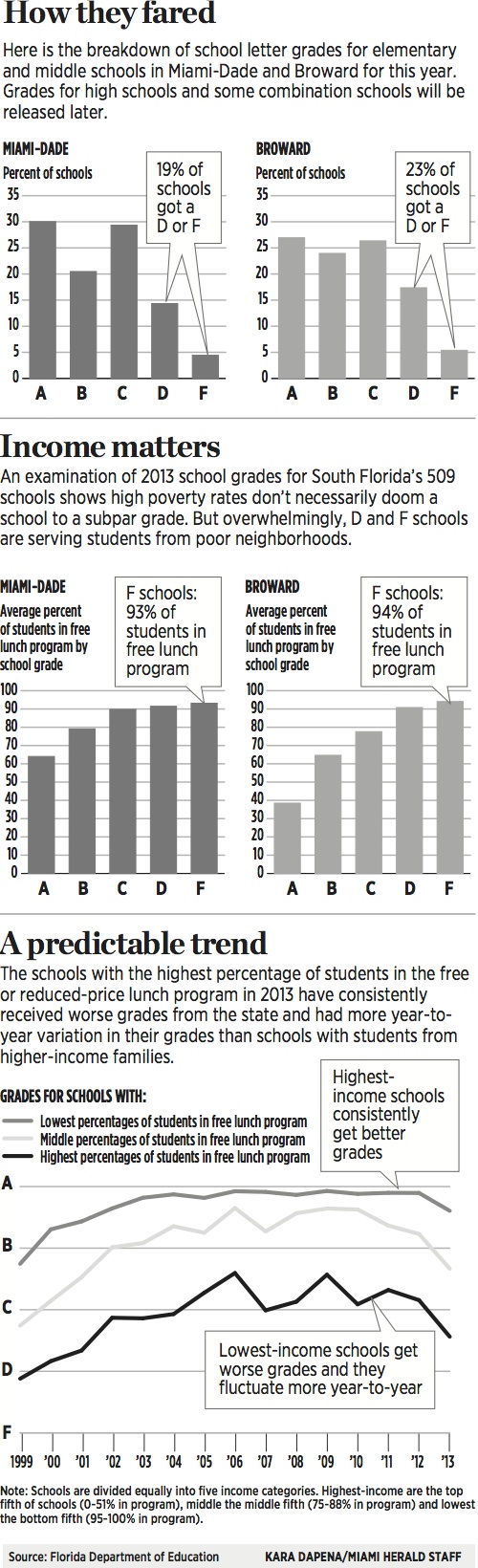
In “Low-income schools struggle under state’s grading system” (Miami Herald, August 10, 2013), Michael Vasquez and David Smiley offer a clear but disturbing picture of accountability in Florida:

With dozens of changes in just the past three years, the formula behind Florida’s A-to-F school grading system has been criticized as a confusing mess. But there’s been at least one constant in Miami-Dade and Broward results: The wealthiest schools never get Fs, and schools with high populations of poor students face an uphill battle to even get a C.

The trend is visible through a decade-plus of school grade results, dating back to the first grades issued in 1999.

Vasquez and Smiley, along with the Miami Herald, represent a needed aspect of journalism addressing education reform: Recognizing large and compelling patterns, and thus the consequences of education policy.

The analysis of assigning letter grades to schools in Florida exposes some important conclusions:

•  Although high poverty rates don’t necessarily doom a school to a subpar grade, D and F schools are overwhelmingly serving students from poor neighborhoods, and the few schools that do overcome poverty to achieve an A are outliers. (There were nine such schools this year, all in Miami-Dade).

•  Of the 209 schools in Miami-Dade and Broward with at least 90 percent of students receiving free or reduced lunch, 78 percent received a grade of C or worse. Roughly 39 percent of these high-poverty schools received a D or F.

•  Of the 43 local schools with much lower poverty rates (30 percent or fewer students receiving free or reduced lunch), 86 percent received an A, and none received a D or F.

Despite efforts to identify educational quality among schools by focusing on growth models, data used in accountability policies remain primarily a reflection of out-of-school factors. Further, the schools that sit outside the typical patterns are rightfully identified by Vasquez and Smiley as “outliers.”

This analytical report on letter grades for schools in Florida is a strong example of quality journalism that seeks out and presents complex and detailed evidence, placing that data in the broader context of the many factors that impact not only the evidence we gather on our schools but also what conclusions we draw as well as how we draw those conclusions.

In the article, Miami-Dade Superintendent Alberto Carvalho explains, “‘Just as much as poverty can’t be an excuse, the exclusion of poverty as a factor is immoral.'”

Rare is the news article that allows a perspective this complex.

No Child Left Behind (NCLB) ushered in several grand promises in 2001, such as closing the achievement gap, but one of the central requirements of the legislation—the use of scientifically based research—is now poised to dismantle the entire accountability movement, including policies such as labeling schools with letter grades based primarily on test scores.

The evidence is clear that thirty years of accountability built on standards and high-stakes testing has failed. The next step is composing and sharing a unified message of that fact, while also building a coalition to reset the reform agenda so that we address poverty, equity, and opportunity in the lives of children and their families as well as in the schools those children attend.

Open Letter to the Media, Politicians, Reformers, B/Millionaires, and Celebrities

First, some context for the problem with education reform and how we discuss the topic.

Cindy Scoppe, associate editor at The State, addresses grading schools, drawing several conclusions:

What we need is a single grading system, which wasn’t possible before the Obama administration decided to let states apply for waivers from No Child Left Behind….

We’re never going to make the progress we need unless we demand an increasingly higher level of performance, but we need to make sure everyone understands that, rather than mistakenly believing that lower school scores mean schools are doing worse….

Actually requiring that each subgroup meet expectations is important, because without that, schools can ignore the difficult-to-teach students, knowing that their low scores will be masked by the high scores of easier-to-teach students….

South Carolina Superintendent Mick Zais continues to push his version of accountability:

South Carolina has two systems for education accountability. One was developed in 2011 by the S.C. Department of Education and was approved by the U.S. Department of Education as meeting federal requirements. The other was developed in 2001 by the state’s Education Oversight Committee. These dual systems are redundant, confusing and expensive….

Finally, in any situation, timely information is necessary to make informed decisions. The letter grade system tells parents, educators and the public how each school and district performed the previous year. This information is publicized in early August so educators can use the data to make adjustments prior to the beginning of a new school year and so parents can make decisions about where their children are educated.

And while the media and political leadership wrangle with education reform and accountability, yet another wealthy celebrity enters the reform arena, M. Night Shyamalanhas:

Until recently, he says, moviemaking was his real passion. “I’m not a do-gooder,” he says. Still, after the commercial success of his early movies, he wanted to get involved in philanthropy. At first, he gave scholarships to inner-city children in Philadelphia, but he found the results disheartening. When he met the students he had supported over dinner, he could see that the system left them socially and academically unprepared for college. “They’d been taught they were powerless,” he says.

He wanted to do more. He decided to approach education like he did his films: thematically….

Much of his initial research was contradictory. When he asked experts which improvements would close the gap, some said smaller classes, others said school vouchers and still others said school spirit. He discovered that none of these reforms had worked across the board, but this finding, paradoxically, encouraged him. He knew he had to think more broadly.

An idea came to him over dinner with his wife and another couple who were both physicians. One of them, then the chief resident at a Pennsylvania hospital, said that the first thing he told his residents was to give their patients several pieces of advice that would drastically increase their health spans, from sleeping eight hours a day to living in a low-stress environment. The doctor emphasized that the key thing was doing all these things at the same time—not a la carte.

“That was the click,” says Mr. Shyamalan. It struck him that the reason the educational research was so inconsistent was that few school districts were trying to use the best, most proven reform ideas at once. He ultimately concluded that five reforms, done together, stand a good chance of dramatically improving American education. The agenda described in his book is: Eliminate the worst teachers, pivot the principal’s job from operations to improving teaching and school culture, give teachers and principals feedback, build smaller schools, and keep children in class for more hours.

The problem highlighted and represented in these three examples involves several key flaws inherent in education reform being analyzed and driven by people without expertise and experience as educators themselves. The media, politicians, reformers, b/millionaires, and celebrities dominate the debate, formation, and implementation of education policy—all of which focuses on how best to design (and redesign) accountability plans and thus ignores the possibility that accountability based on standards and high-stakes testing is the problem.

Scoppe, Zais, and Shyamalanhas offer common sense claims that ring true with the public, building compelling narratives of what is wrong with education and what, then, would serve as credible solutions.

Common sense claims, however, are often misleading and misguided, especially in the education reform debate. Let’s consider just a couple concerns I have about the dominant arguments found in these three pieces but typical of the wider reform debate during the past thirty years.

I taught high school English in a public school in SC for eighteen years before entering teacher education at the university level for the past twelve years, thus, when I read commentaries and media reports related to education, I feel compelled to ask the following:

“We’re never going to make the progress we need unless we demand an increasingly higher level of performance.”* Really? Does this mean that a student scoring an average score on a test in 8th grade should score above average on the 9th grade test? Or does that mean that eighth graders in 2012 should score higher than different 8th graders in 2011? In other words, the claim of constantly increasing achievement is much more rhetoric than a credible expectation. It ignores that different populations of students are incredibly difficult to compare fairly (and possibly that making such comparisons is of little value); that much that we call academic achievement may be a reflection of brain development, effort, or circumstances beyond anyone’s control and not learning; and that in an environment of ever-changing standards and tests, making valid comparisons of data grows nearly impossible as well. For just one complicating example, consider two populations of students tested in 8th and 11th grades:

2009 8th grade math score — 87

2010 8th grade math score — 72

2012 11th grade math score — 85

2013 11th grade math score — 83

It appears, if we focus on simple increases from one year to the next, that the 2013 scores dropped 2 points from 2012. But a close inspection shows that the 2009/2012 scores (same population of students plus/minus drop-outs and other population shifts) remained about the same (a small drop), but that the 2013 score of 83 may easily be a really impressive increase of the 2010 score, from 72 to 83 by the same population of students. However, what if the 2010-2013 increase was the result of an unusual loss of low scoring students due to drop outs, expulsions, and a shifting population of non-native language learners?

In short, ever-increasing outcomes is neither something we should seek, nor something we can make simple claims about. The hypothetical data above could reveal dozens of conclusions, with few having anything to do with achievement, teaching quality, or school quality.

“Over the course of his research, Mr. Shyamalan found data debunking many long-held educational theories. For example, he found no evidence that teachers who had gone through masters programs improved students’ performance; nor did he find any confirmation that class size really mattered. What he did discover is plenty of evidence that, in the absence of all-star teachers, schools were most effective when they put in place strict, repetitive classroom regimens.” Again, really? If fact, the many claims in this passage are a series of powerful public narratives (ones found,  and debunked, in the propagandistic Waiting for “Superman”) that themselves are not reflected in educational research (for example, class size, or better described as student/teacher ratio, does matter—as revealed in rigorous research and as a market mechanism represented by the small class sizes found in elite K-12 schools and universities).

The piece on Shyamalan having an epiphany about education while talking with friends who are doctors is strikingly similar to the Bill Gates phenomenon, both revealing a message that is being ignored: Wealth, celebrity, and success in one field does not guarantee expertise in other fields.

As an educator myself, one who has studied the history of educational thought from the late 1900s until today very closely, I am compelled to ask Shyamalan and Gates why they believe they have discovered ideas that no one else spending her/his whole life and career on education has considered before Shyamalan or Gates. How credible does it seem that a movie director and two medical doctors chatting could suddenly imagine ways to do schools that no one else in the field has imagined?

I’m not saying there is no chance, but it takes a great deal of arrogance and an absence of awareness to make the claims Shyamalan and Gates have made—notably since many of those claims are in fact not supported by research although Shyamalan and Gates claim they are.

There’s more, of course, because despite the simplistic claims surrounding education and education reform (“poverty is not destiny,” “no excuses”), education is a complex process that is rarely predictable and essentially never completed.

However, I remain compelled to ask the media, politicians, reformers, b/millionaires, and celebrities to set aside their assumptions and reset the education reform debate by beginning again but this time begin with the expertise and experience that already exist among educators and within the field of education.

And let me suggest that we step back from how best to create an accountability system, recognizing that accountability, new standards, and new tests have not succeeded for thirty years and thus are unlikely to work now because the key challenges of education have nothing to do with a lack of or the quality of accountability, standards, and testing.

That new beginning, then, must stop focusing on outcomes and start focusing on input and the conditions of teaching and learning. Ironically, that change is likely to bear fruit, the types of outcomes we have asked for all along.

* Zais’s argument builds on a similar argument: “This new system has many advantages over the old federal and the current state accountability systems. The new system has three important elements we are committed to maintaining: yearly progress, transparency and timeliness.”

Blinded by the Stereotype Spotlight

Why are drug sweeps routinely conducted by police in high-poverty minority neighborhoods and not dorms on college campuses?

Why was shooting victim Trayvon Martin drug tested, and his shooter, George Zimmerman, not tested?

Why are Teach for America recruits, with no formal training as teachers, allowed to teach high-poverty minority students, often in “no excuses” charter schools such as Knowledge Is Power Program (KIPP), but affluent and white students tend to have certified and experienced teachers?

Why are charter schools, which often segregate students by race and class, expanding, while public schools also grow increasingly segregated—and why are both conditions essentially ignored?

The answers lie somewhere in the blinding power of the stereotype spotlight focused on people and children living and learning in poverty.

Consider Esther J. Cepeda’s “Overcoming generational poverty”:

Teachers in low-income school districts often get specialized training about the culture of poverty in order to better understand their students’ lives and take those challenges into account in the classroom. As a high school teacher, I was trained in Ruby K. Payne’s “A Framework for Understanding Poverty.”

Payne has a 20-item list of the characteristics of generational poverty, which includes constant high levels of background noise, the overvaluation of entertainment as a respite from the exertions of survival, a strong belief in destiny or fate because choices are in low supply, and polarized thinking in which options are hardly ever examined (again, because so few tend to be available).

Also pervasive in the culture of poverty is the sense that time isn’t for measuring, that it occurs only in the present, and that the future exists only as a word.

Cepeda, first, carelessly* honors the Payne “framework,” despite a significant and growing body of scholarship that has rejected Payne’s worksheets and workshops as the worst possible examples of deficit perspectives built on stereotypes, and not credible and nuanced evidence about class or race.

Payne, having no formal expertise in poverty, class, or race has admitted she based her work initially on her husband having grown up poor. In its genesis, Payne’s work is at best anecdotal.

But the “framework” also perpetuates and speaks to corrosive stereotypes about class and race. For example, Payne presents her clients (generating a tremendous amount of revenue for her through the self-published workbooks and workshops offered across the US) with what she claims are foundational conditions about people in poverty that explain why children living in poverty struggle in schools: According to Payne, people in poverty know how to bail someone out of jail, how to acquire handguns, and how to gather resources from trash and recycling bins.

Let’s imagine for a moment a similar “framework” for affluence**. You may be from wealth if:

  • You know how to hire an escort without being arrested.
  • You know people who can have charges dropped if you are arrested.
  • You know how to hide your income to avoid, legally, paying taxes.

Framed within the cultural fetish in the US for wealth and the wealthy, that “framework” likely seems unfair, but are those conditions and the implications in them any more unfair that Payne’s claims about people in poverty?

The blinding power of the stereotype spotlight fails even among advocates seeking, in earnest, to help people and children living in poverty. The failures include the following:

  • Stereotyping is gross overgeneralizing. The worst stereotyping is recognized as racism, sexism, or homophobia. Any category of humans (such as class, race, gender, or sexuality) is likely far more nuanced than monolithic. Payne’s stereotyping is classism, tinted by racism.
  • Focusing on claimed flaws inherent in people in poverty (and poverty itself) keeps the focus on personal failure, personal responsibility, but it ignores systemic inequity. As long as we continue to act as if people in poverty are deficient, and all we need to do is “fix” them, we continue to absolve ourselves of any social responsibility for inequity and injustice.
  • Creating stereotypes as deficits against social norms entrenches those norms as “right” and thus above being confronted or changed. The idealized middle class of the US has historically and currently constitutes, however, beliefs and practices that need to be challenged. Consider that separate but equal was a norm of the US, as was slavery. Social norms remain that speak to groups about “knowing their place” (women), as well.

As long as the stereotype spotlight remains focused on children in poverty, highlighting them as academic failures who need a culture of “no excuses” to force them to conform to the idealized middle-class norm (Payne’s “hidden rules”), the historical and current race and class biases remaining in standardized testing, the inequity of opportunity existing in US consumerism and capitalism, the inequity of opportunity expanding in access to high-quality schools and high-quality courses in schools, and the inequity of access to high-quality teachers all remain unacknowledged and thus never addressed.

The blinding power of the stereotype spotlight needs to be switched off and replaced by a mirror for middle-class and affluent America.

* Payne often expresses her “common sense” claims about people in poverty to large auditoriums filled with, disproportionately, middle-class, white, and female teachers. Those teachers often sit shaking their heads in agreement. Payne’s claims are compelling because they seem accurate within a cultural stereotyping. The result is many good people with wonderful intentions also find themselves trapped within stereotypes.

** Paul Gorski uses this method to discredit Payne’s simplistic claims.

Clarifying Common Core Compromise (part 2)

My initial Common Core compromise was intentionally brief—in part to make it accessible and, ultimately, as a concession that it details elements unlikely to be embraced by the political and corporate leaders driving CC-mania.

While I remain north of skeptical, able to see clearly cynicism, about the possibility that my compromise will be embraced, I did receive enough response—and many important concerns—to justify a follow up, clarifying a few key concepts behind my compromise.

First, the foundational motivation for the compromise is to highlight that both CC (and the entire accountability movement) and the USDOE are, as currently functioning, deeply flawed structures, each working to ruin universal public education. The flaws at the root of CC and the USDOE are related to bureaucracy, political/partisan corruption (a redundancy, I realize), and predatory corporations (the private feeding on public funds).

Next, the elements in my compromise are designed to re-imagine CC as a genuine mechanism of change—to end the current accountability era and spur a new era of authentic commitments to social and educational equity and opportunity and to end the USDOE as a political/partisan bureaucratic nightmare and re-invision the USDOE as a centralized and professional ministry of education that serves the public good and the people.

So here are a few clarifications directed at the concerns raised so far:

  • Ending high-stakes testing accomplishes a few key reforms: (a) ending the disaster capitalism of Pearson and other corporations that benefit from crisis discourse about schooling, feeding on precious public funds, (b) ending a historically bankrupt tradition of linking test scores to individual students, teachers, and schools (using NAEP, random sampling, and broad data sets), and thus, addressing privacy concerns (NAEP data not linked to individual students but creating longitudinal data bases by states), ending high-stakes accountability, and stemming the tide of value-added methods designed to de-professionalize teachers.
  • Transforming the USDOE to a centralized, professional, and responsive ministry of education does not mean I am calling for standardization or “government control of schools.” In fact, I am calling for the exact opposite of those concerns. Centralized does not mean standardized. Currently, the US has a public workforce composed of public school teachers and publicly funded university professors that includes all the expertise and knowledge needed to create the resources every public school in the US needs. As I detailed, the USDOE centralizes all materials, resources, and assessments (NAEP), but  centralized must not mandate for any schools. Instead, each school will base needs on the populations of students being served, and then the USDOE becomes a centralized (thus creating an equity of opportunity) resource to serve the needs expressed by each school. Education must begin with each student and work outward.
  • Although I didn’t directly note this before, I also envision once we end high-stakes testing and move to NAEP-like data sets (similar to what Finland does), we must then expand dramatically the evidence used to monitor and reform further our schools.

Is it possible for educators, scholars, researchers, and community members who believe in public education and the essential nature of the Commons for a free people to take the tool of oppression (Common Core) and turn it against the very people who created it?

I wonder, yes, I wonder.

And when I wonder, I think about—despite all its flaws—the film Gandhi, and the spirit found in key scenes of a people coming to embrace their own freedom:

Brigadier: You don’t think we’re just going to walk out of India!

Gandhi: Yes. In the end, you will walk out. Because 100,000 Englishmen simply cannot control 350 million Indians, if those Indians refuse to cooperate.

Can a spirit of non-cooperation grow from a solidarity around CC as a true mechanism of reform?

Nehru: Bapuji, the whole country is moving.

Gandhi: Yes. but in what direction?

My Common Core Compromise

While nearly all states in the US implement Common Core standards as well as brace for the so-called “next generation” high-stakes tests guaranteed in their wake, the debate around CC has increased. Most people fall into one of three camps—CC advocates, Tea Party/libertarian CC detractors who see the standards as liberal “big” government intrusion, and educators, academics, and researchers who reject CC as more of the same failed accountability paradigm.

Early and often, I have stood firmly in the third camp, entirely rejecting CC. I remain troubled by the number of educators who say they support CC, but reject the high-stakes testing and accountability linked to the new standards. I also remain troubled that the tremendous investment of public funds and time benefitting directly private corporations feeding off new standards and tests appears to concern few people.

However, I am now prepared to compromise and support CC implementation under the following conditions:

  • Adopting CC in all states is part of a complete repealing of No Child Left Behind.
  • New federal education legislation fully funds CC implementation and bans any public funds being spent on private corporation materials or tests.
  • All CC materials and resources will be produced, distributed, and monitored by the USDOE, and funded by federal and state resources allocated for education.
  • The USDOE will create a centralized web-based clearing house for educators to upload lesson plans and other resources for all teachers to implement CC.
  • States accepting federal funds and implementing CC must end immediately all high-stakes testing and linking teacher evaluations and pay to test scores.
  • NAEP assessments will be aligned with CC and then administered in 3rd, 8th, and 11th grades to random samples of students in all 50 states to create a data base for examining the effectiveness of CC.

Under these conditions, adopting CC would represent real reform and would be a needed mechanism for ending the worst aspects of the accountability era over the past 30 years.

As long as CC remains central to maintaining the status quo—notably as a cash cow for private corporations to feed off public funds—I cannot support them in any way.

Charter Schools, the Invisible Hand, and Gutless Political Leadership

Billy Pilgrim becomes unstuck in time in Kurt Vonnegut‘s Slaughterhouse-Five. Billy’s experience introduces readers to Tralfamadorians:

The creatures were friendly, and they could see in four dimensions. They pitied Earthlings for being able to see only three. They had many wonderful things to teach Earthlings, especially about time….

The Tralfamadorians can look at all the different moments just the we way we can look at a stretch of the Rocky Mountains, for instance. They can see how permanent all the moments are, and they can look at any moment that interests them. It is just an illusion we have here on Earth that one moment follows another, like beads on a strong, and that once a moment is gone it is gone forever. (pp. 33, 34)

One of the most memorable moments of Billy becoming unstuck in time is his watching a war movie backward. Viewed in reverse, the film becomes a narrative of renewal, of peace, as fighter planes “sucked bullets and shell fragments from some of the planes and crewmen,” and “[t]he bombers opened their bomb bay doors, exerted a miraculous magnetism which shrunk fires, gathered them into cylindrical steel containers, and lifted the containers into the bellies of the planes” (pp. 93, 94).

In the spirit of folding time back onto itself to give us clarity of sight, let’s become unstuck in time while viewing American Indian Charter Schools.

Spitting in the Eye of Mainstream Education?

Like Billy watching a war film, we start now and move backward.

Jill Tucker reports (June 26, 2013) that American Indian Charter Schools have had their charter revoked by Oakland Unified school district:

The American Indian charter schools, which enroll 1,200 students in grades K-12, are among the highest-scoring in the state on standardized tests.

Yet Oakland district officials said they had a duty to the public to close the schools given the inability of the schools’ management to rein in the misuse of taxpayer money.

A 2012 state audit of the charter organization found several instances of financial impropriety, including $3.8 million in payments to the school’s former director, Ben Chavis, and his wife through real estate deals, consulting agreements and other services, raising ethical questions and conflict-of-interest concerns.

The decision was supported by the state’s leading charter school advocates.

“In this situation, it is clear that academic performance is not enough to either overlook or excuse the mismanagement of public funds and the unwillingness from the board of directors to respond in ways that would satisfactorily address the legitimate concerns raised by OUSD,” said Jed Wallace, president and CEO of the California Charter Schools Association, in a letter to the board in support of the revocation.

Mitchell Landsberg explains—in a provocatively titled “Spitting in the Eye of Mainstream Education” (May 31, 2009)—about American Indian Charter Schools:

Conservatives, including columnist George Will, adore the American Indian schools, which they see as models of a “new paternalism” that could close the gap between the haves and have-nots in American education. Not surprisingly, many Bay Area liberals have a hard time embracing an educational philosophy that proudly proclaims that it “does not preach or subscribe to the demagoguery of tolerance.”

It would be easy to dismiss American Indian as one of the nuttier offshoots of the fast-growing charter school movement, which allows schools to receive public funding but operate outside of day-to-day district oversight. But the schools command attention for one very simple reason: By standard measures, they are among the very best in California….

“What we’re doing is so easy,” said Ben Chavis, the man who created the school’s success and personifies its ethos, especially in its more outrageous manifestations. (One example: He tends to call all nonwhite students, including African Americans, “darkies.”) Although he retired in 2007, Chavis remains a presence at the school.

Focusing on American Indian Charter Schools among five other “no excuses” schools adopting a new paternalism,  David Whitman (2008, Fall) praises the accomplishments and possibilities of these schools:

Yet above all, these schools share a trait that has been largely ignored by education researchers: They arepaternalistic institutions. By paternalistic I mean that each of the six schools is a highly prescriptive institution that teaches students not just how to think, but also how to act according to what are commonly termed traditional, middle-class values. These paternalistic schools go beyond just teaching values as abstractions: the schools tell students exactly how they are expected to behave, and their behavior is closely monitored, with real rewards for compliance and penalties for noncompliance. Unlike the often-forbidding paternalistic institutions of the past, these schools are prescriptive yet warm; teachers and principals, who sometimes serve in loco parentis, are both authoritative and caring figures. Teachers laugh with and cajole students, in addition to frequently directing them to stay on task.

The new breed of paternalistic schools appears to be the single most effective way of closing the achievement gap. No other school model or policy reform in urban secondary schools seems to come close to having such a dramatic impact on the performance of inner-city students. Done right, paternalistic schooling provides a novel way to remake inner-city education in the years ahead….

Still, these entrepreneurial school founders battle on, slowly replicating their institutions across the country. It is too soon to say that all of the copycat schools will succeed. But the early results are extremely encouraging. It is possible that these schools, so radically different from traditional public schools, could one day educate not just several thousand inner-city youngsters but tens or even hundreds of thousands of students in cities across the nation. Done well, paternalistic schooling would constitute a major stride toward reducing the achievement gap and the lingering disgrace of racial inequality in urban America.

The Invisible Hand and Gutless Political Leadership

Backward or forward, this story is ugly. “No excuses” and the new paternalism themselves are classist and racist—ways in which the middle class and affluent allow “other people’s children” to be treated, but not their own—yet the larger faith in the Invisible Hand is the ugliest part of the narrative.

Idealizing parental choice narrowly and choice broadly is the foundation upon which both political parties stand. Why is the Invisible Hand of the Free Market so appealing to political leaders?

The answer is simple: Abdicating political leadership to the market absolves our leaders from making any real (or ethical) decisions, absolves them from doing anything except sitting back and watching the cards fall where they may.

And thus the charter school movement, with its school-choice light that allows progressives to tap into their closeted libertarian. Experimenting with impoverished children, African American children, Latino/a children, English Language Learners, and special needs children—this is the acceptable playground for the Invisible Hand.

Political leaders bask in the glory of Capitalism because the free market requires no moral conviction, no ethical stands, no genuine decision making based on careful consideration of foundational commitments to democracy and human dignity and agency. Capitalism allows Nero to sit and fiddle while Rome burns. If the fire needs putting out, and someone can monetize that, the market will take care of it, right?

Political leadership has ignored and marginalized children in poverty for decades, notably in the schools we provide high-poverty, majority-minority communities. The school-choice light commitment to charter schools is a coward’s way out of facing that reality and doing anything about it.

So it goes.

Kids [Still Don’t] Count

Some predictions aren’t that bold, and this is one of them:

I predict there will be much shouting and gnashing of teeth over the newest CREDO charter schools study and that the Kids Count 2013 report will dissipate into thin air like smoke from an abandoned camp fire.

Ultimately, the charter school debate continues to be much ado about nothing because charter schools produce about the same range of quality as public and private schools. Charter schools are school-choice-lite so they appease the beefy middle ground of conservatives and progressives who want to appear reasonable, but charter schools are not credible solutions to our pressing social and educational problems that remain primarily issues of equity and opportunity.

Schooling in the US continues to be a reflection and perpetuation of the inequities of our society; they don’t transform society, and they never have—primarily because education remains a tool of the political and economic elite who simply do not want social reform since that reform would challenge their perches atop the masses.

And the Kids Count report will remain ignored because it proves exactly that—social reform is needed in the US.

But most disturbing of all, beyond how debates about the CREDO study and charter schools will overshadow substantive examinations of social inequity, is that the CREDO study helps perpetuate the mindless and also distracting focus on data that ignores the ugly underbelly of many charter schools—segregating children by race and class, perpetuating “no excuses” and zero tolerance policies for African American and Latino/a children (but not white children), demonizing and de-professionalizing teachers and teaching, and reducing education for “other people’s children” to test-prep factories beholden to textbook publishers and high-stakes testing regimes (such as the ACT).

Count of this; my prediction will be proven true.

And we all lose in the process.

Addendum

And almost no one is paying attention to the Pew report on economic mobility—except for Matt Bruenig and The Atlantic. Why? Because just as the Kids Count data refute the big political lies, so does the Pew report in terms of the American Dream; for example:

Americans raised at the bottom and top of the family income ladder are likely to remain there as adults, a phenomenon known as “stickiness at the ends.”

  • While a majority of Americans exceed their parents’ family incomes, the extent of that increase is not always enough to move them to a different rung of the family income ladder.
  • Forty-three percent of Americans raised in the bottom quintile remain stuck in the bottom as adults, and 70 percent remain below the middle.
  • Forty percent raised in the top quintile remain at the top as adults, and 63 percent remain above the middle.
  • Only 4 percent of those raised in the bottom quintile make it all the way to the top as adults, confirming that the “rags-to-riches” story is more often found in Hollywood than in reality. Similarly, just 8 percent of those raised in the top quintile fall all the way to the bottom….

There is stickiness at the ends of the wealth ladder.

  • Sixty-six percent of those raised in the bottom of the wealth ladder remain on the bottom two rungs themselves, and 66 percent of those raised in the top of the wealth ladder remain on the top two rungs.

Blacks have a harder time exceeding the family income and wealth of their parents than do whites.

  • Sixty-six percent of blacks raised in the second quintile surpass their parents’ family income compared with 89 percent of whites.
  • Only 23 percent of blacks raised in the middle surpass their parents’ family wealth compared with over half (56 percent) of whites.

Blacks are more likely to be stuck in the bottom and fall from the middle than are whites.

  • Over half of blacks (53 percent) raised in the bottom of the family income ladder remain stuck in the bottom as adults, compared with only a third (33 percent) of whites. Half of blacks (56 percent) raised in the middle of the family income ladder fall to the bottom two rungs as adults compared with just under a third of whites (32 percent).
  • Half of blacks (50 percent) raised in the bottom of the family wealth ladder remain stuck in the bottom as adults, compared with only a third (33 percent) of whites. More than two-thirds of blacks (68 percent) raised in the middle fall to the bottom two rungs of the ladder as adults compared with just under a third of whites (30 percent).