Tag Archives: learning

Media Manufactures Mississippi “Miracle” (Again) [Updated]

[Header Cropped from Photo by Miracle Seltzer on Unsplash]

I almost feel sorry for Louisiana. (See Update 2 below)

When the 2024 reading scores for NAEP were released, LA seemed poised to be the education “miracle” of the moment for the media and political leaders.

Since mainstream media seems to know only a few stories when covering education—outliers, crises, and miracles—the outlier gains by LA compared to the rest of the nation, reportedly still trapped in the post-Covid “learning loss,” was ripe for yet another round of manufacturing educational “miracles.”

However, the media is not ready to let go of the Mississippi “miracle” lie: There Really Was a ‘Mississippi Miracle’ in Reading. States Should Learn From It.

To maintain the MS “miracle” message, journalists must work incredibly hard to report selectively, and badly.

For example, Aldeman celebrates, again, MS as a outlier for for the achievement of the bottom 10% of students (carelessly disregarding that outlier data is statistically meaningless when making broad general claims):

But one state is bucking this trend: Mississippi. Indeed, there’s been a fair amount of coverage of Mississippi’s reading progress in recent years, but its gains are so impressive that they merit another look.

Next, Aldeman highlights reading gains by Black students in MS, omitting a damning fact about the achievement of Black (and poor) students in MS (which mirrors the entire nation):
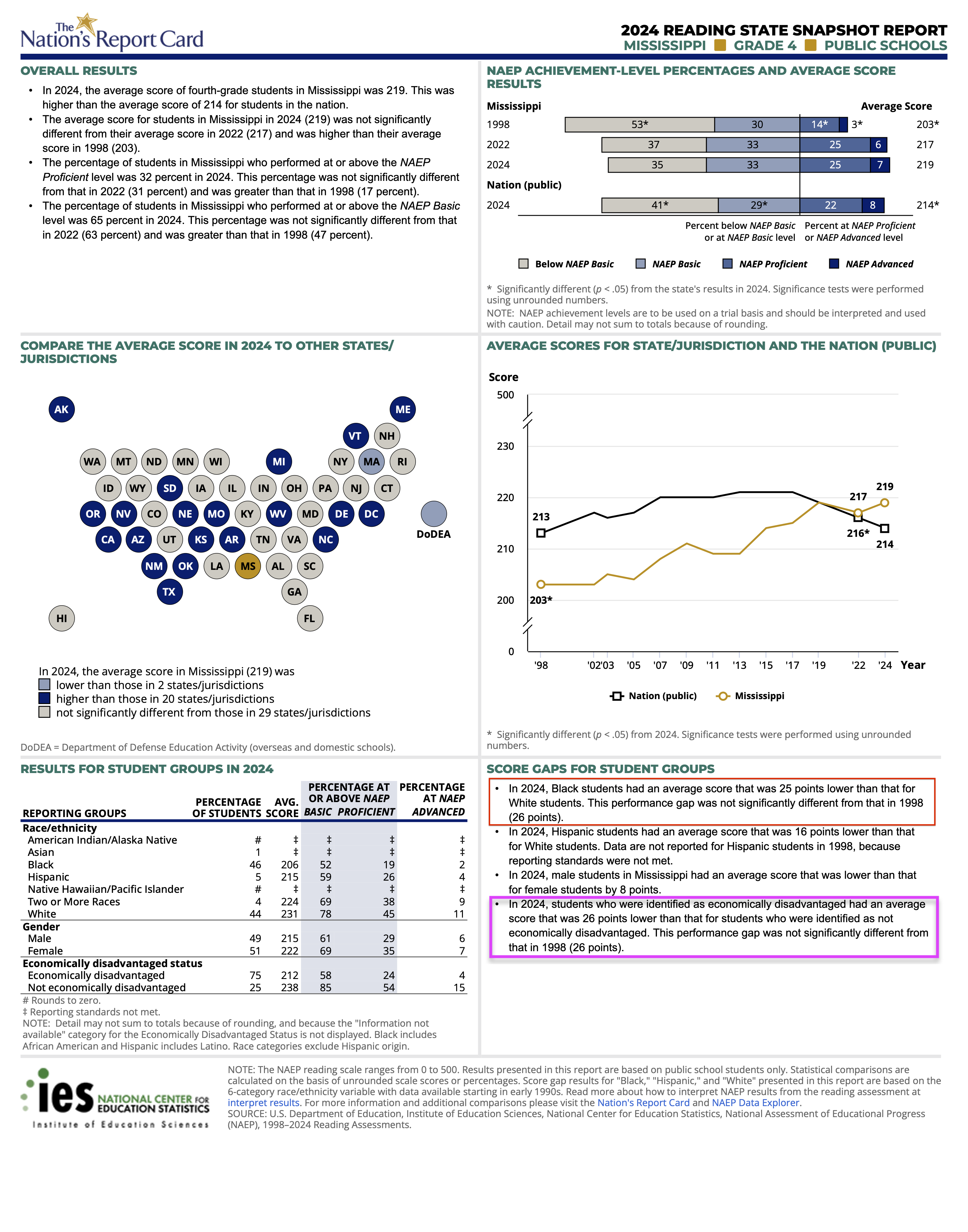
That’s right, MS has the same racial and socio-economic achievement gaps since 1998, discrediting anything like a “miracle.”

But the likely most egregious misrepresentation of MS as a reading “miracle” is Aldeman “debunking” claims that MS gains are primarily grounded in grade retention, not the “science of reading.”

Notably, Aldeman seems to think linking to the Fordham Institute constitutes credible evidence; it isn’t.

So let’s look at the full picture about grade retention and MS’s reading scores on NAEP.

First, the research on increased reading achievement has found that only states with retention have seen score increases. Westall and Cummings concluded in a report on reading policy: “[S]tates whose policies mandate third-grade retention see significant and persistent increases in high-stakes reading scores in all cohorts…. [T]here is no consistent evidence that high-stakes reading scores increase in states without a retention component [emphasis added].” [Note that Aldeman selective refers to this study late in the article, but omits this conclusion.]

The positive impact of retention on test scores has not been debunked, but confirmed. What hasn’t been confirmed is that test score gains are actual achievement gains in reading acquisition.

Next, MS (like FL and SC, for example) has risen into the top 25% of states in grade 4 reading on NAEP, but then plummets into the bottom 25% of states by grade 8 (despite their reading reform having been implemented for over a decade), suggesting those grade 4 scores are a mirage and not a miracle:

And finally, MS has consistently retained about nine thousand students each year (mostly Black and poor students) for a decade; if the state was actually implementing something that works, the number of students being retained would decrease and (according the SOR claims that 95% of students can be proficient) disappear.

A final point is that media always omits the most important story, what research has shown for decades about student achievement:

Almost 63% of the variance in test performance was explained by social capital family income variables…. The influence of family social capital variables manifests itself in standardized test results. Policy makers and education leaders should rethink the current reliance on standardized test results as the deciding factor to make decisions about student achievement, teacher quality, school effectiveness, and school leader quality. In effect, policies that use standardized test results to evaluate, reward, and sanction students and school personnel are doing nothing more than rewarding schools that serve advantaged students and punishing schools that serve disadvantaged students.

High-poverty states and states with high percentages of so-called racial minorities are not, in fact, beating the odds—again, note that states have not closed the racial achievement gap or the socio-economic achievement gap.

Yes, too often our schools are failing our most vulnerable students. But the greater failures are the lack of political will to address the inequity in the lives of children and the lazy and misleading journalism of the mainstream media covering education.


Update 1

The Mississippi “miracle” propaganda is part of a conservative Trojan Horse education reform movement.

Note this commentary from the Walton-funded Department of Education Reform (University of Arkansas): Mississippi’s education miracle: A model for global literacy reform. The key reveal is near the end of the commentary:

Teaching at the right level and a scripted lessons plan are among the most effective strategies to address the global learning crisis. After the World Bank reviewed over 150 education programs in 2020, nearly half showed no learning benefit.

The goal is de-professionalizing teachers and teaching, not improving student reading proficiency.

Updated 2

The political, market, and media hype over both MS and LA are harmful because that misrepresentation and exaggeration drive the fruitless crisis/reform cycles in education and distracts reform from the larger and more impactful causes of student achievement.

To understand better education reform, I recommend the recently released Opportunity to Learn Dashboard.

According to the press release from NEPC:

Funded and maintained by the National Center for Youth Law (NCYL) and The Schott Foundation for Public Education, the Opportunity to Learn Dashboard tracks 18 indicators across 16 states. The project seeks to provide information about factors impacting the degree to which children of different ethnicities and races are exposed to environments conducive to learning.

However, indicators directly related to schools explain only a minority of the variation in achievement-related outcomes. Therefore, the dashboard includes out-of-school factors such as access to health insurance and affordable housing, as well as within-school factors such as exposure to challenging curricula and special education spending.

For both MS and LA, we must acknowledge the significant and robust systemic (out-of-school) disadvantages minoritized and impoverished students continue to face in both states:

Note here my points raised about lingering opportunity/achievement gaps exposed by NAEP scores in both states:
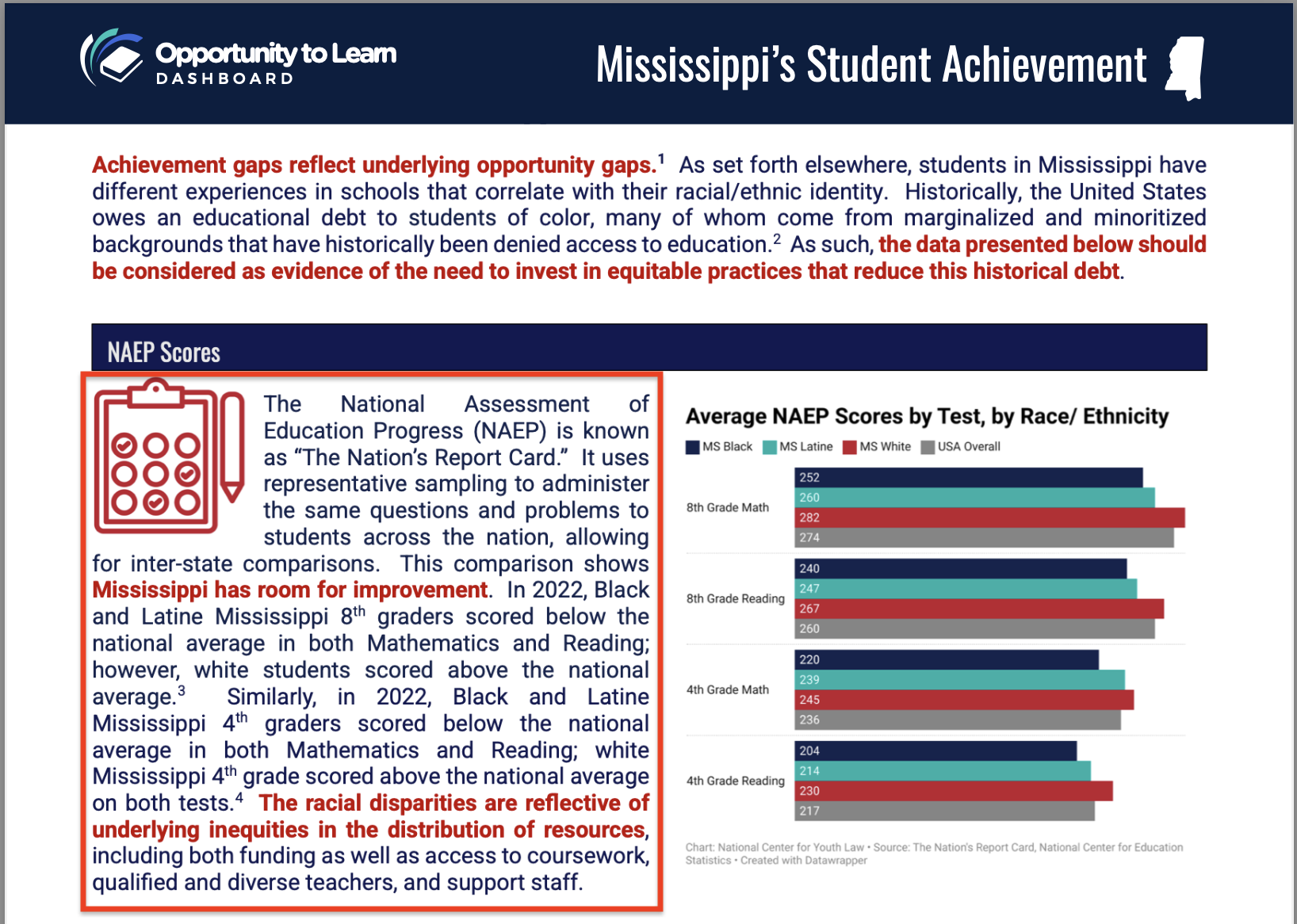
To emphasize again, NAEP scores do not reveal education “miracles” in either MS or LA. In fact, NAEP scores continue to show that education reform as usual is a failure.


Recommended

Does the “Science of Reading” Fulfill Social Justice, Equity Goals in Education? (pt. 1)

America Dishonors MLK By Refusing to Act on Call for Direct Action (pt. 2)

Scripted Curriculum Fails Diversity, Students, and Teachers: SOR Corrupts Social Justice Goals (pt. 3)

If We Are Scripted, Are We Literate? (Presentation)

Reading Deserves a New Story, Different Reform

[Header Photo by Gaelle Marcel on Unsplash]

You know the story: Students today can’t read.

And those who can, don’t read.

But there is more.

Children who can’t read have been cheated by their teachers, who fail to teach reading skills such as phonics.

And our national reading crisis is a threat to our very nation, especially our international economic competitiveness.

However, there are a few problems with this story.

If you were to find a Time Machine, you could travel to any year over the past century and hear the exact same story.

As well, this crisis rhetoric has been used historically and currently with math—and every other content area tested in the US.

Here is a story about reading you probably are not familiar with: There is no reading crisis, and there is no evidence that reading test scores are driven by reading instruction or programs.

Further, again, there is nothing unique or catastrophic about reading test scores or reading achievement by US students.

Historically and currently, reading test scores and achievement reflect a fact that has been replicated for decades:

Almost 63% of the variance in test performance was explained by social capital family income variables….The influence of family social capital variables manifests itself in standardized test results. Policy makers and education leaders should rethink the current reliance on standardized test results as the deciding factor to make decisions about student achievement, teacher quality, school effectiveness, and school leader quality. In effect, policies that use standardized test results to evaluate, reward, and sanction students and school personnel are doing nothing more than rewarding schools that serve advantaged students and punishing schools that serve disadvantaged students.

Now, consider a newer story: Post-Covid students are suffering a historic learning loss:

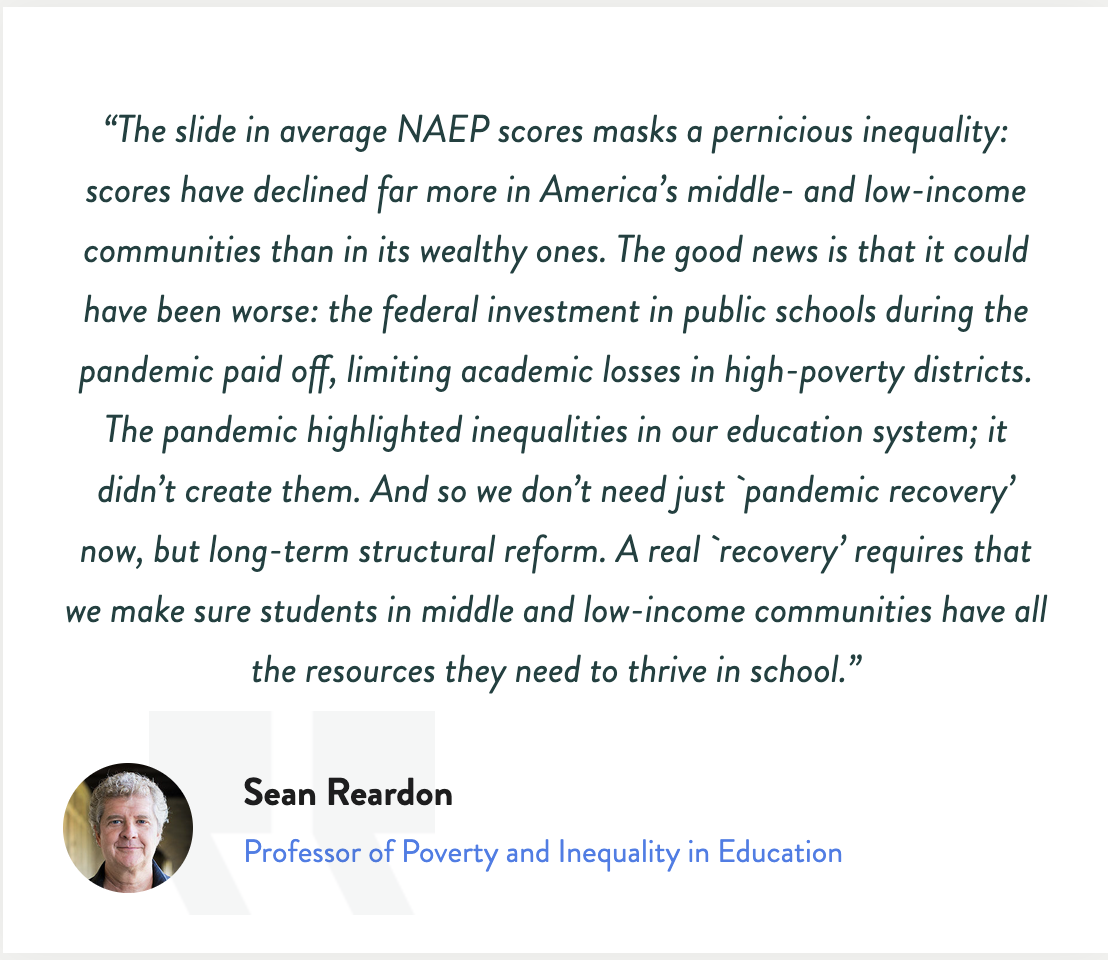
Reardon’s call for “long-term structural reform” must follow a new story about reading and a different approach to reading reform.

First, since the vast majority of causal factors reflected in reading standardized test scores are out-of-school conditions, the new reading story and different reform must address universal healthcare, food security and eliminating food deserts, home and housing stability, and stable well-paying job for parents.

Another out-of-school reform needed for reading is guaranteeing students have access to books and texts in their homes, communities (public libraries), and then in their schools (school and classroom libraries).

A simple program that gives every child from birth to high school graduation 20 books a year (10 chosen by the child/parents and 10 common texts) would build a library and ensure access to texts, one of the strongest research-based elements of reading acquisition.

Without social reform, reading scores will likely remain flat and inadequate.

The most important different aspects of a new story and reading reform is confronting traditional approaches to in-school reform in the US common since the 1980s. A different approach to reading reform must include the following:

  • De-couple reading reform and instruction from universal or prescribed reading programs and center teaching children to read (not implementing reading programs with fidelity). Admit there is no one way to teach all students to read, and provide the contexts that allow teachers to serve individual student needs.
  • Reform the national- and state-level testing of reading. The US needs a standard metric for “proficient” and “age level” (instead of”grade level”) shared on NAEP and state tests in grades 3 and 8; and that achievement level needs to be achievable and not “aspirational” (such as is the case with NAEP currently). National and state testing must be age-based and not grade-based to better provide stable data on achievement.
  • End grade retention based on standardized testing. Retention is punitive, and it harms children while also distorting test data.
  • Monitor and guarantee vulnerable populations of students who are below “proficient” to insure they are provided experienced and certified teachers and assigned to classes with low student/teach ratios.
  • Address teaching and learning conditions of schools, including teacher pay and autonomy.
  • Honor and serve students with special needs and multi-lingual learners.

While we have no unique or catastrophic reading crisis in the US—and even hand wringing over learning loss seems unfounded—we have allowed a century (or more) of political negligence to ignore the negative impact of children’s lives on their learning.

We have remained trapped in a manufactured story of reading crisis and that poverty is an excuse.

All the available evidence suggests otherwise.

Crisis, miracles, blame, and punishment have been at the center of the story everyone is familiar with. That story has never served the interests of students, teachers, or public education.

In an era of intense political hatred and fearmongering, this is a tenuous call, but if we really care about students learning to read, and if we truly believe literacy is the key to the economic and democratic survival of our country, reading deserves a new story, an accurate story, and a different approach to reform grounded in the evidence and not our cultural mythologies and conservative ideologies.

See Also

Big Lies of Education: Series

NAEP Serves Manufactured Education Crisis, Not Teaching and Learning

[Header Photo by Andy Feliciotti on Unsplash]

I teach an upper-level writing and research course for undergraduates as part of their general education requirements. The overarching project asks students to gather media coverage of an education topic in order to analyze the credibility of that coverage.

Since the course is undergraduate, I ask them to approach their analysis through critical discourse analysis, but I narrow that lens some for them. The process includes the following:

  • Identify the pattern of claims about the topics.
  • Evaluate the validity of the claims in the context of a literature review of the educational topic (limited to peer-reviewed, published recent journal articles).
  • Consider whose interests these claims serve (the CDA element).

I note that claims about education in the media tend to fall in a range of accurate, misleading, and false; however, for this analysis, identifying whose interest the claims serve is the key aspect of the evaluation.

False and accurate claims are typically easy to manage for students, but the misleading claims can be complicated.

For example, in public discourse about police shooting victims, two accurate data points are often cited: The majority of people shot and killed by police in the US are white and Black people are shot and killed at a higher rate than white people.

Failing to address both data points and clarifying why rates are more important than raw data contributes to media coverage being misleading, and thus, selectively emphasizing true data is often a form of manipulation and serves a particular population or ideology.

With another release of NAEP reading and math scores, we have an opportunity to address how media and political leaders tend to offer false and misleading claims based on NAEP score, but also, that NAEP itself serves to perpetuate the manufactured education crisis, which benefits the media (more clicks), political leaders, and the education market place.

Regardless of what national and state scores on NAEP are, the foundation of media and political claims is always “crisis.”

Ironically, perpetual “crisis” rhetoric and education reform since the early 1980s has had one clear outcomes—maintaining the status quo of educational and socioeconomic inequity in the US.

To consider this, let’s focus on Massachusetts and Tennessee.

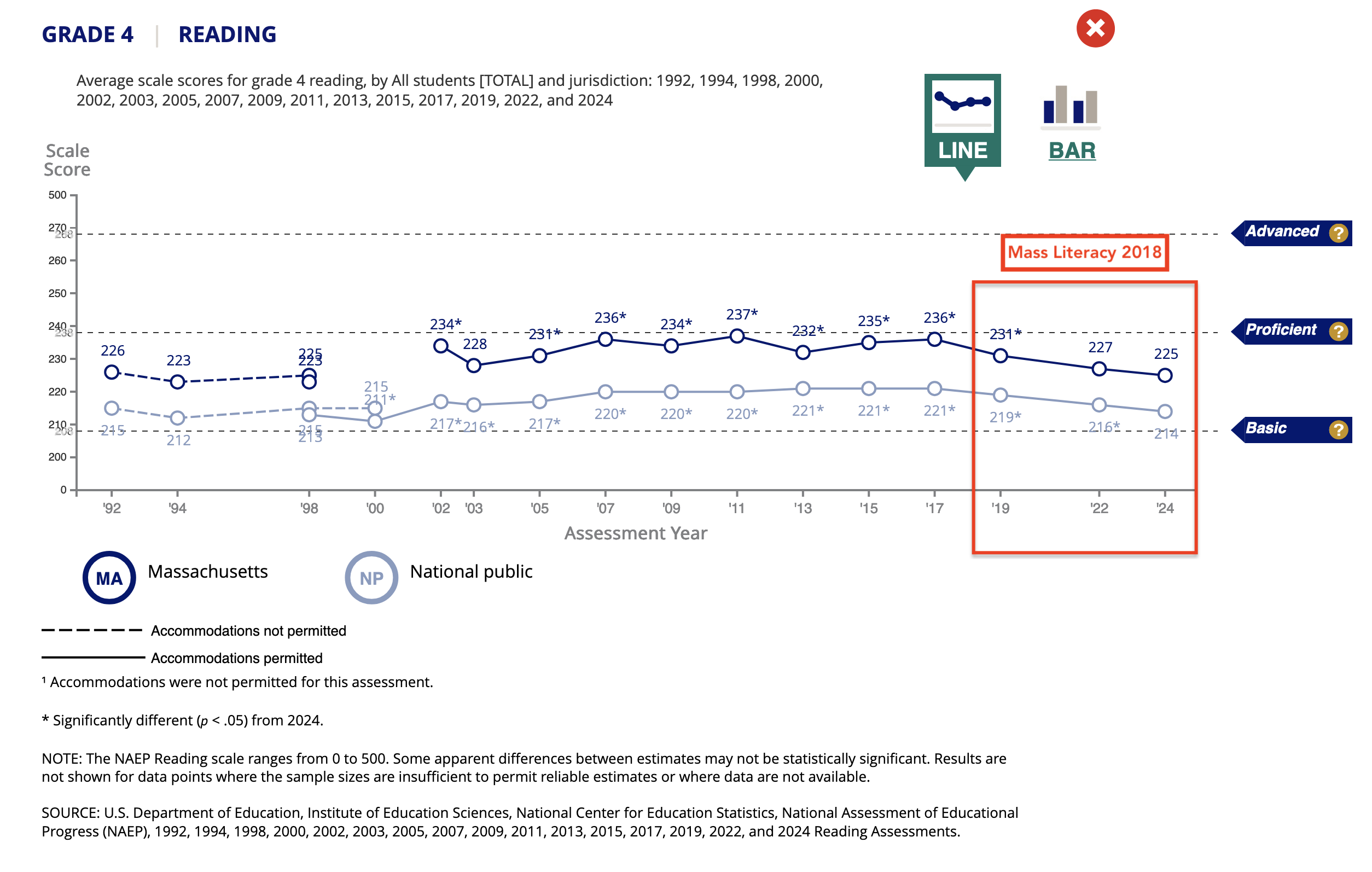
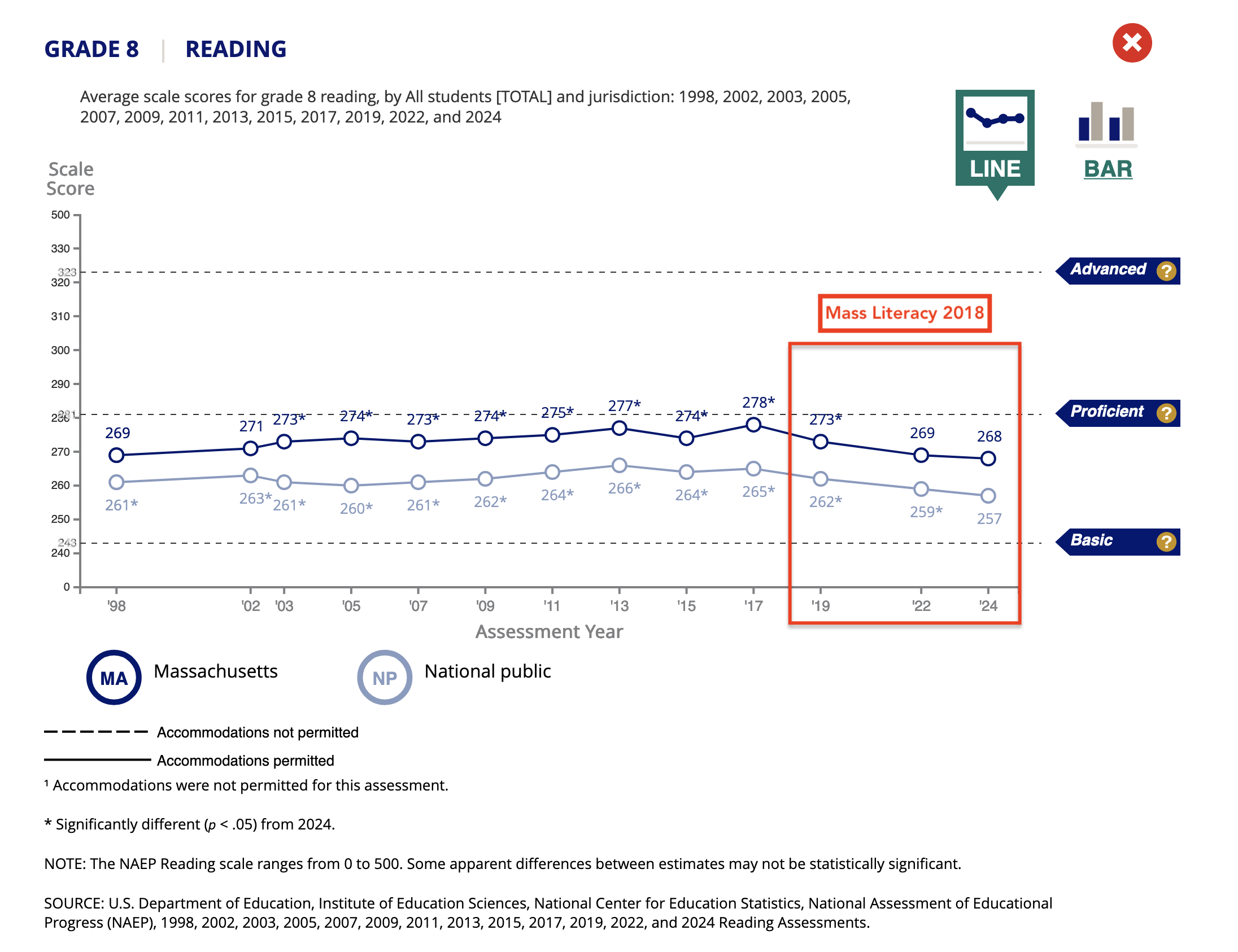
Other than top-scoring DoDEA schools, MA sits atop reading scores in the US in both grades 4 and 8:

As a relatively low-poverty state, MA should rank above states with higher poverty students. However, MA certainly serves students in pockets of poverty as well as other vulnerable populations of students who tend to have low standardized test scores.

None the less, MA has joined the standard chorus in the US about reading. The Education Trust released a report in March 2024 providing “5 Things You Need to Know about the literacy crisis in Massachusetts.”

To be fair, MA is similar to most of the US where standardized tests scores have dropped post-Covid and those drops have coincided with MS’s Mass Literacy initiative from 2018:

Perpetual reform and perpetual crisis in education, regretfully, seems only to fuel more reform and more crisis.

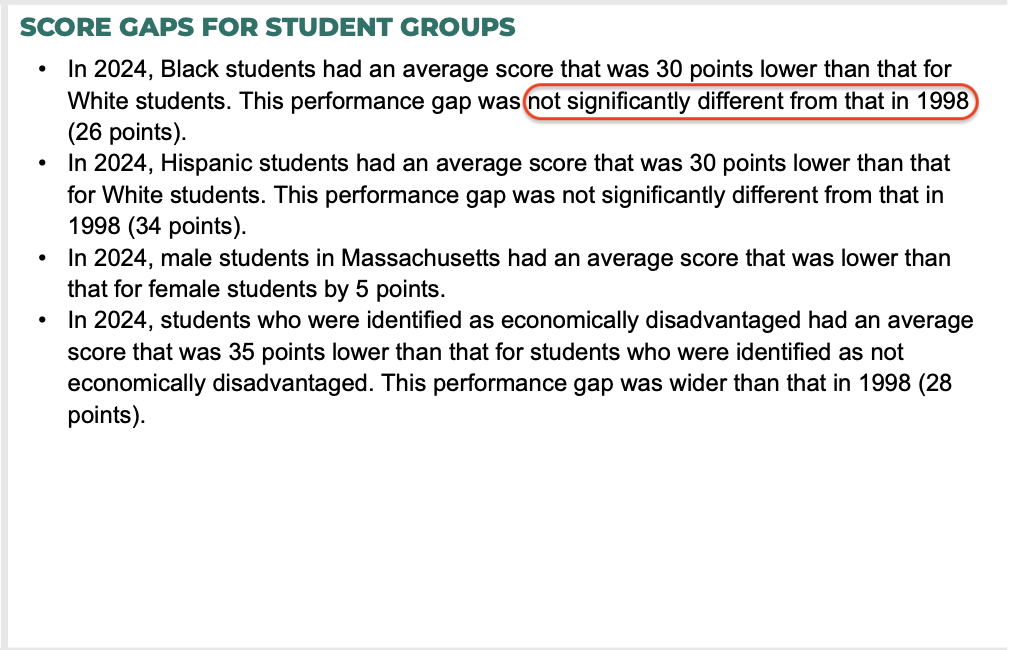
Note that MA also has something in common with almost all states regardless of whether states have high or low NAEP results. Achievement gaps by race and socioeconomic status have remained fixed for almost three decades:

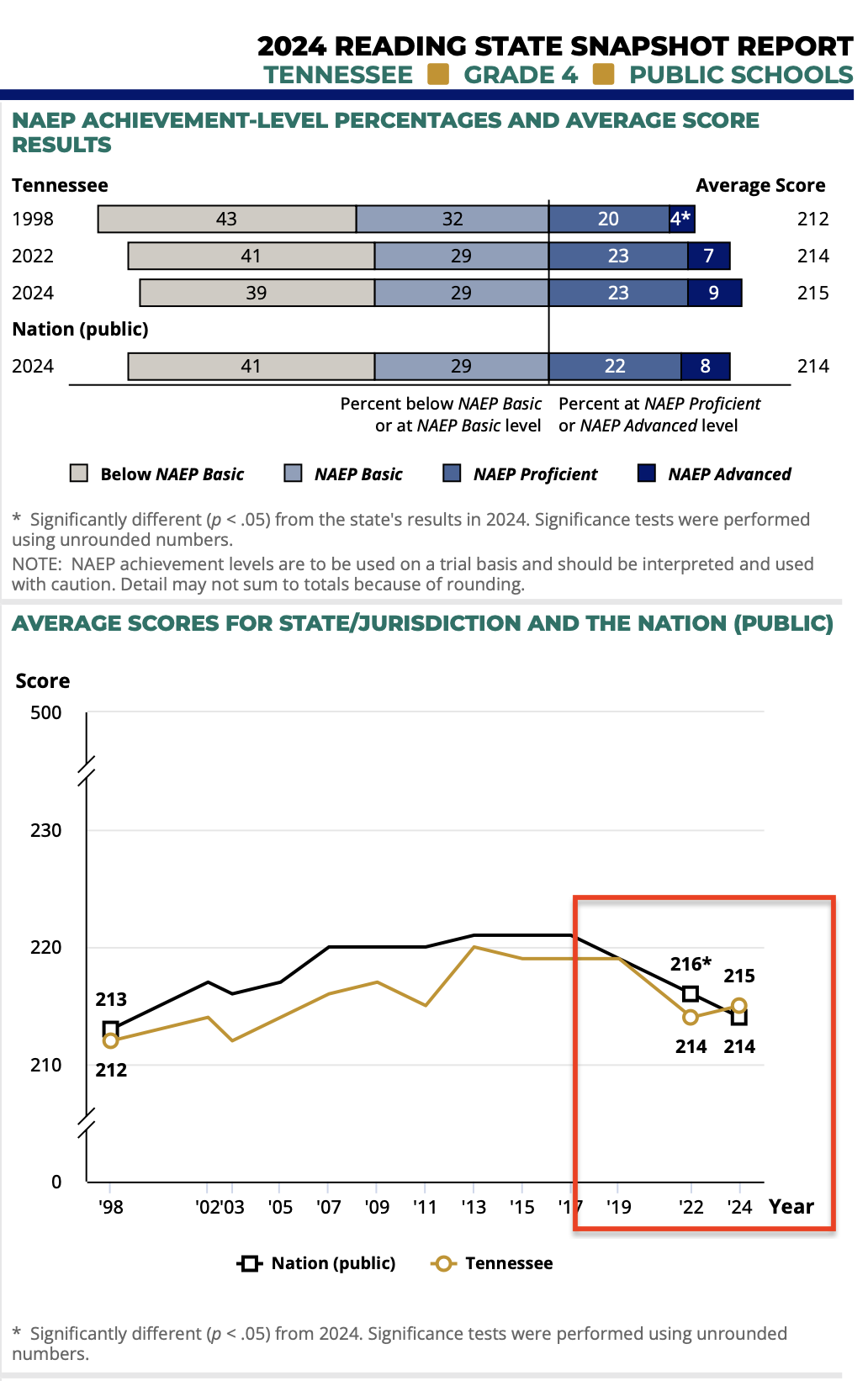
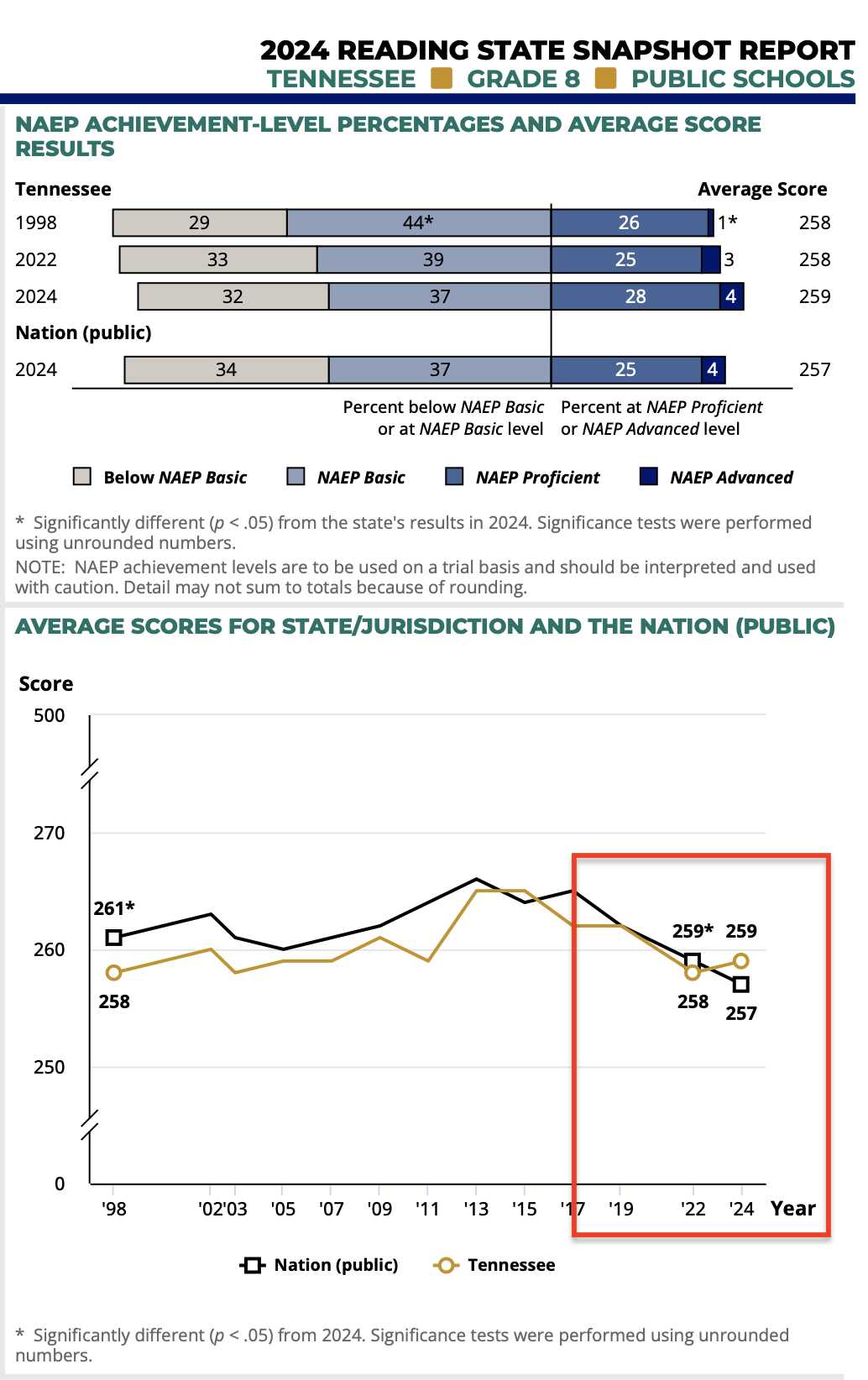
While a top-scoring state like MA is shouting “crisis” primarily based on a sort of national psychosis about the “science of reading,” TN is trying to have it both ways with a reading crisis and a celebration of 2024 NAEP scores.

An October 2023 report from the TN Department of Education, “Tennessee’s Commitment to Early Literacy,” forefronts the “Literacy Crisis in Tennessee” based on (you guessed it) historically poor rankings in NAEP reading scores.

One important point here is that the media and political discourse tend to focus on “bad” statistics such as rankings and averages—which is how TN establishes their “crisis.”

Yet, while the 2024 NAEP data has spurred a great deal of misguided doom and gloom, TN is putting a positive spin on their results: Nation’s Report Card Shows Meaningful Academic Gains as a Result of Tennessee’s Commitment to Public Schools.

For political leaders, “we have a crisis” and “I have saved us from the crisis” are not a sequential series of events, however, but a permanent rotation.

So why this positive spin for TN?

While the national average on NAEP reading has dropped, TN has experienced in 2024 a slight uptick. Because most everyone else was dropping, then, TN has seen a rise in their rankings (a key example of why ranking is a “bad” statistic).

Important again is that like MA and most states, TN scores for racial and socio-economic gaps remain fixed: “This performance gap was not significantly different from that in 1998.”

These responses to NAEP by MA and TN reveal a stark lesson that NAEP serves the interests of the media, politicians, and the education market place, but at least since 1998, NAEP hasn’t provided the data needed for any sort of genuine education reform or analysis.

Education is a political and market football, in fact.

Here are a few better takeaways from NAEP:

  • NAEP’s achievement levels are designed to be confusing and support the manufactured education crisis (see here).
  • Using NAEP to rank and sort is misleading and doesn’t support needed reform.
  • NAEP scores do offer some important facts related to achievement gaps and the pervasive influence of affluence and poverty on educational outcomes, but the media and political leaders choose to ignore those lessons.
  • Decades of NAEP reinforce this conclusion by Maroun and Tienken: “Policy makers and education leaders should rethink the current reliance on standardized test results as the deciding factor to make decisions about student achievement, teacher quality, school effectiveness, and school leader quality. In effect, policies that use standardized test results to evaluate, reward, and sanction students and school personnel are doing nothing more than rewarding schools that serve advantaged students and punishing schools that serve disadvantaged students.”
  • Media persist in focusing on only two stories about education: Crisis and outliers; both of which serve the interests of anyone expect students and teachers.

Like my students in my upper-level writing and research course, we would all benefit from evaluating the claims being made by media and political leaders in order to determine, first, is the claims are true (they often as misleading or false), and then to confront in whose interests these claims are being made.

Maybe this isn’t surprising given the current and historical political climate in the US, but almost never are the interests of students and teachers being served—especially when the interests of the most vulnerable students are the issue.

The “Science of Reading” Ushers in NAEP Reading Decline: Time for a New Story

With the release of the 2024 NAEP reading results, a disturbing new story is developing:

The media has long been obsessed with reading in the US, crying “crisis” every decade over the past century. The most recent media-based reading crisis has prompted aggressive and new reading legislation reaching back over a decade, policy and programs identified as the “science of reading” (SOR).

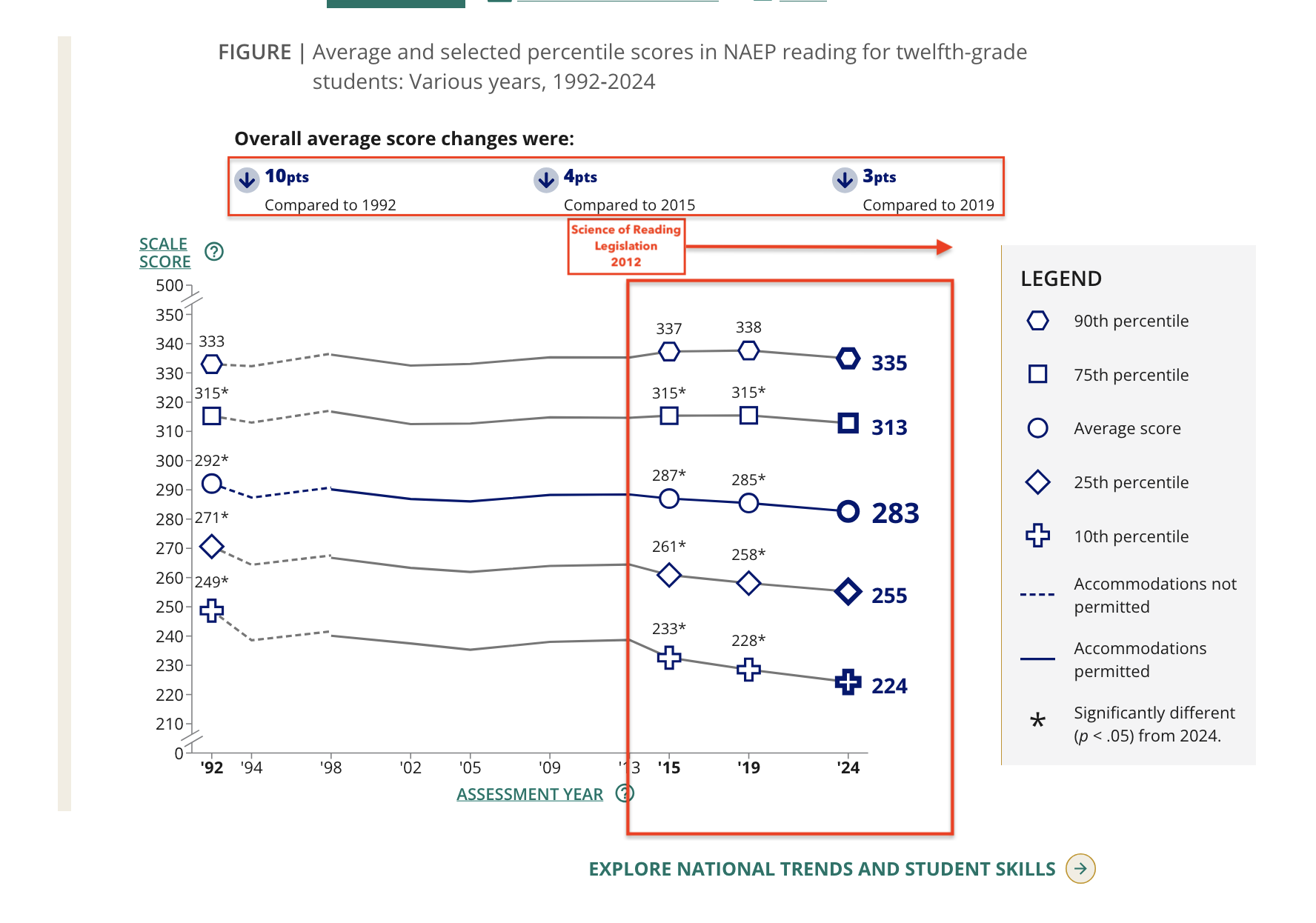
The hand wringing over the 2024 NAEP reading results, however, seems to focus on learning loss and post-Covid consequences—not that reading achievement on NAEP was flat during the balanced literacy era and now has dropped steadily during the SOR era:

The senior cohort in the 2024 NAEP reading scores represent the SOR era begun in 2012.

Suddenly, media appears to forget that the SOR movement was built on a series of baseless claims: the US has a reading crisis (despite NAEP score being flat for decades) because teachers do not know how to teach reading and rely on failed reading programs and balanced literacy.

The foundational claim of the SOR movement has been firmly discredited: “[T]here is no indisputable evidence of a national crisis in reading, and even if there were a crisis, there is no evidence that the amount of phonics in classrooms is necessarily the cause or the solution.”

But a key element of the SOR story is often overlooked: “One of the excuses educators have long offered to explain America’s poor reading performance is poverty.”

In other words, the SOR story argues that the US has a reading crisis that is entirely the result of in-school policies and practices, that SOR-based reading instruction guarantees 95%+ of students will achieve reading proficiency.

How then is the recent 5-year decline in NAEP scores being blamed on out-of-school factors, Covid learning loss? The story being sold is such blame is merely an excuse.

The problem here is that the entire SOR story is a series of misrepresentations and ideological claims not grounded (ironically) is research or evidence.

As I have noted, NAEP achievement levels are confusing since “proficient” is well above grade level and “basic” tends to correlate with most state metrics for “proficient” (see here for a full explanation and state/NAEP correlations).

However, journalists persists is misrepresenting NAEP scores in order to feed their manufactured “crisis” story: Two-Thirds of Kids Struggle to Read, and We Know How to Fix It.

With the release of 2024 NAEP scores on reading, we have an opportunity to embrace a different story, a credible story, by examining scores from Department of Defense (DoDEA) schools as well as Mississippi and Florida.

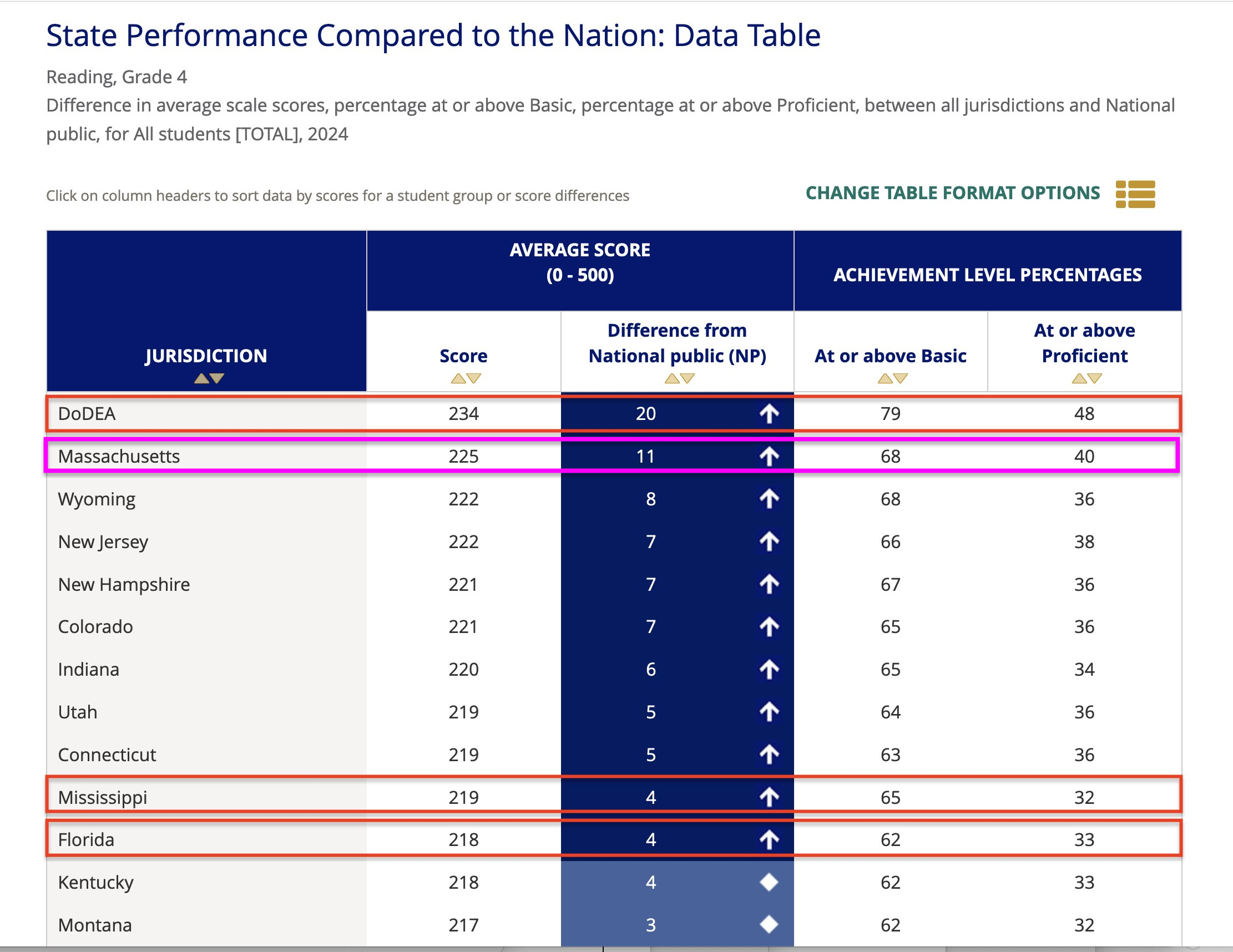
First, note that DoDEA schools again are the top scoring schools in grade 4 reading, but MS and FL rank in the top 25% of states despite challenging populations of students being served (both states appear to be outliers defying the odds):

Both MS and FL have been praised for their reading and education reform; however, there are two parts to this “miracle” story that are often left out, that show there is a mirage, not a miracle.

First, MS and FL join many states that have enacted SOR reading reform over the past decade-plus, yet the research on that reading reform highlights something other than reading instruction or programs.

Westall and Cummings concluded in a report on reading policy: “[S]tates whose policies mandate third-grade retention see significant and persistent increases in high-stakes reading scores in all cohorts…. [T]here is no consistent evidence that high-stakes reading scores increase in states without a retention component [emphasis added].”

States implementing K-3 grade retention are gaming the system by pulling out the lowest performing students and then re-inserting them into the testing population when older.

In fact, MS has been retaining about 9000-10,000 K-3 students a year since 2014, and FL retains about 17,000 students annually. [1]

Beyond the impact of grade retention on test scores, we should also ask: If SOR “works,” why do states continue to retain about the same number of students per year?

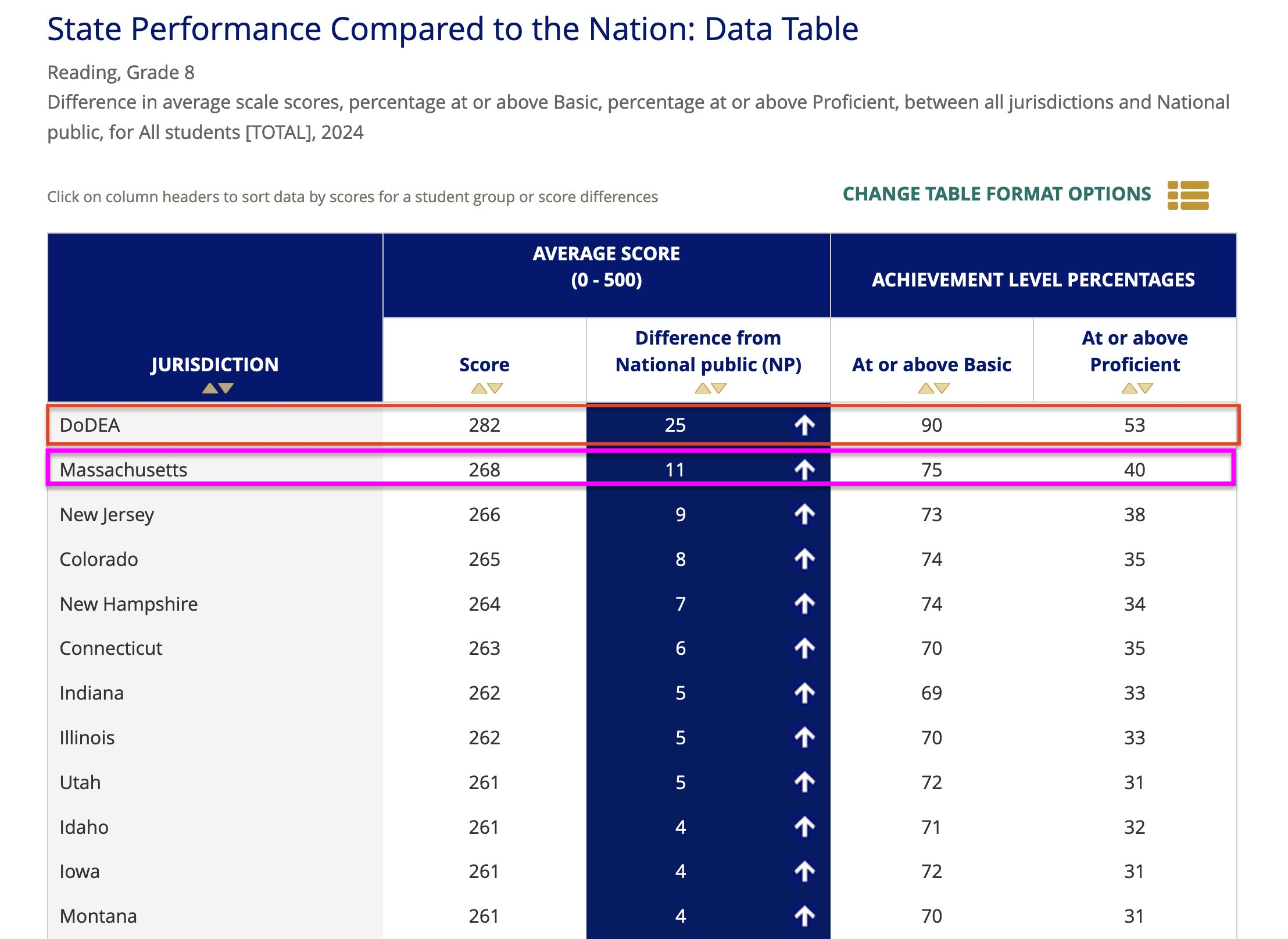
But NAEP also tells a story about SOR that has been ignored for years. Both MS and FL rank in the top 25% of grade 4 but the bottom 25% by grade 8 while DoDEA remains the top scoring schools in both grades:

Grade retention creates a mirage of achievement in grade 4 that disappears by grade 8, further evidence that SOR is not working at either grade.

Reading achievement as measured on testing has never been about reading instruction, teacher quality, or reading programs.

DoDEA school reading achievement is a testament to what research has shown for decades about student achievement:

Almost 63% of the variance in test performance was explained by social capital family income variables….The influence of family social capital variables manifests itself in standardized test results. Policy makers and education leaders should rethink the current reliance on standardized test results as the deciding factor to make decisions about student achievement, teacher quality, school effectiveness, and school leader quality. In effect, policies that use standardized test results to evaluate, reward, and sanction students and school personnel are doing nothing more than rewarding schools that serve advantaged students and punishing schools that serve disadvantaged students.

DoDEA student populations are diverse, often coming from impoverished and working class backgrounds; these schools also serve vulnerable and challenging populations of students.

However, teacher pay is high, and those students have healthcare, food and housing security, and parents with stable work.

DoDEA students almost all have the advantages mostly afforded children living in privilege so that how and what they are taught can matter.

If reading and literacy matter—and they do—and education matters in the US, we are well past blaming teachers, declaring false “miracles,” and jumping on the reading program merry-go-round once again.

Students must have their lives addressed so that their education can serve them well.

NAEP scores tell us little about reading (or math), but confirms again and again that the US is a country determined to ignore the corrosive impact of inequity on the lives and education of children.


Update

Media has only one story—a false one—about outliers in NAEP scores. Compare the coverage of MS in 2019 with LA 2024:

[1] Note that in the early 2000s, FL was the “miracle” state and established the Florida Model that essentially became the MS “miracle.”

Next up is Louisiana, and most of the coverage is claiming LA’s success is because the state has copied MS.

And a part of the lineage is more grade retention. Here are the currently available data on LA grade retention:

The Outlier Story: How Education Journalism (Almost) Always Gets It Wrong

[Header Photo by Will Myers on Unsplash]

The first two decades of my career as a literacy educator were spent as a high school English teacher in rural Upstate South Carolina, the high school I had graduated from and my home town.

This began in 1984 when SC had passed sweeping education legislation that would become the standard legislative approach across the US—accountability policy grounded in state standards, high-stakes testing (grades 3 and 8 with exit exams in high school starting in grade 10), and school report cards.

SC was an early and eager adopter of the “crisis” rhetoric fueled by A Nation at Risk report released under the Reagan administration.

That high school and town were populated mostly by working-class and poor people; the town and smaller towns served by the high school were dead or dying mill towns.

Schools had far more poverty than the data showed because rural Southerners often refused to accept free and reduced meals (the primary data point for measuring poverty in schools).

However, for many years the high school ranked number 1 in the entire state for student exit exam scores in math, reading, and writing. Because of our student demographics (and notably because these students had relatively low or typical scores in grade 8 testing), we were what many people would refer to as a “high flying” or “miracle” school.

In more accurate statistical terms, we were an “outlier” data point in the state.

I have been in SC education for an ongoing five decades, and the overwhelming body of data related to student achievement in the state has matched what all data show across the US—measurable student learning is most strongly causally related to the socioeconomic status and educational levels of those students’ parents.

Further, the full story about how we achieved outlier status includes two aspects.

One is that from grade 8 to grade 10 testing, the population of students changed because of students dropping out of school (and these were among the lowest scoring students in grade 8). In fact, students were often encouraged to drop out and enroll in adult education (a two-fer win for the school because they would not be tested and enrolling in adult ed removed them from the drop-out data).

A second part of the story is that students scoring low in grade 8 were enrolled in two math and two ELA courses in grade 10. The “extra” courses were specifically designed as test-prep for state testing. We rigorously adopted a teach-to-the-test culture.

For the state writing exam, for example, we discovered that the minimum text a student could produce was an “essay” with a three-sentence introduction, a five-sentence body, and a three-sentence conclusion. Students in the “extra” ELA course wrote dozens of 3-5-3 essays in grade 10 with the teacher focusing on helping students avoid the “errors” that would flag the text as a below standard.

Many of us found the 3-5-3 approach to writing became a huge problem when students were required to write in other courses; even as students “passed” the state writing exam, they were not performing well as writers in other courses, and even refusing at times to write more than 3-5-3 essays.

For the high-stakes accountability era, we did do a great deal of good because many students across the US passed all their courses but could not receive a diploma because of exam exams. Most of our students graduated, and not because we did anything underhanded.

Yet, I must stress that how we accomplished our outlier status was likely not scalable, but more importantly, our approach should not be replicated by other schools.

Fast-forward 40 years, and education journalism has written hundreds and hundreds of stories not only in pursuit of “outlier” schools, but carelessly framing them as both proof of the on-going (permanent) education crisis and that “status quo” education refuses to implement what we know “works.”

The newest iteration of this misleading story in education is the “science of” movement grounded in the “science of reading” story first popularized by Emily Hanford, who wrote about a “miracle” school in Pennsylvania. This compelling but false story has been parlayed into an even more successful podcast as well as spawning dozens of copy-cat articles by education journalists across the country.

Media, however, never covered Gerald Coles’s careful debunking of the “miracle” school Hanford featured. Similar to my story above about the beginning of my teaching career, the full story of that school was quite different than what was covered in the media.

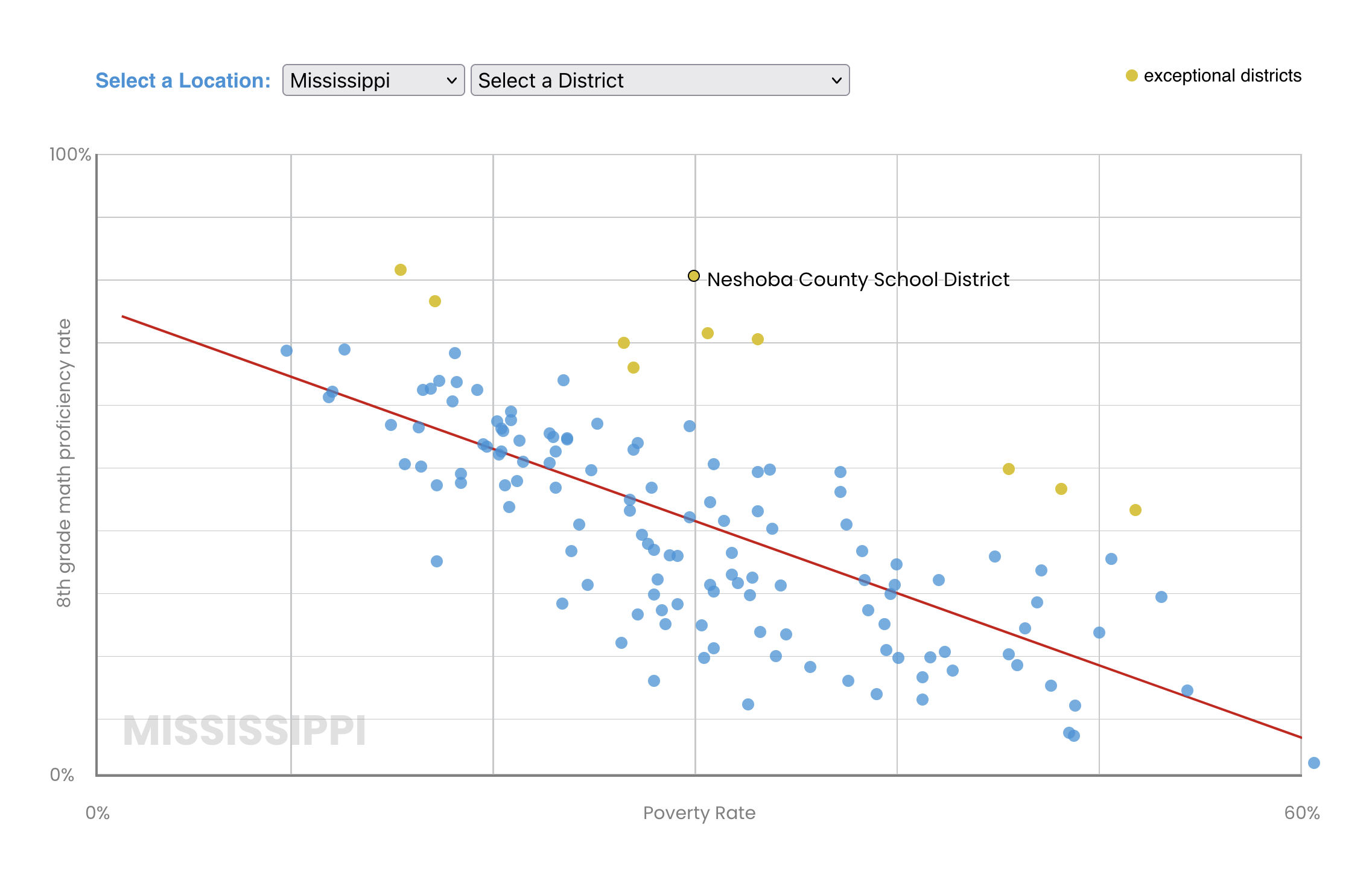
And as 2024 drew to a close, education journalists simply have no other lens that this: Which School Districts Do the Best Job of Teaching Math?

To be blunt, education journalists are mistakenly compelled to focus on the “exceptional” districts (outliers) while ignoring the more compelling red line that, again, shows what, in fact, is normal and what can and should be addressed in terms of educational reform—the negative impact of poverty on educational attainment.

So here is a story you likely will not read: Education journalism is failing public education, and has been doing so for decades.

Education journalists are blindly committed to the “crisis” and “outlier” stories because they know people will read and listen to them.

The “outlier” story makes for a kind of “good” journalism, I suppose, but the problem is that these stories become popular beliefs and then actual legislation and policy.

The current”science of” movement is riding a high wave because of the “science of reading” tsunami. But like all the misguided reforms since the original false education story, A Nation at Risk, this too will crash and reveal itself as a great harm to students, teachers, and our public school system.

This is boring, I know, but most outlier stories are ultimately false or they simply are not replicable or scalable, as I explained in my opening story.

If we genuinely care about student learning, teaching, and the power of public education, we need education journalists more dedicated to the full story and the not the outliers that help drive their viewing numbers.


Recommended

Big Lies of Education: A Nation at Risk and Education “Crisis”

Big Lies of Education: Reading Proficiency and NAEP

Big Lies of Education: National Reading Panel (NRP)

Big Lies of Education: Poverty Is an Excuse

Big Lies of Education: International Test Rankings and Economic Competitiveness

Big Lies of Education: Grade Retention

Big Lies of Education: Grade Retention

Update [November 2025]

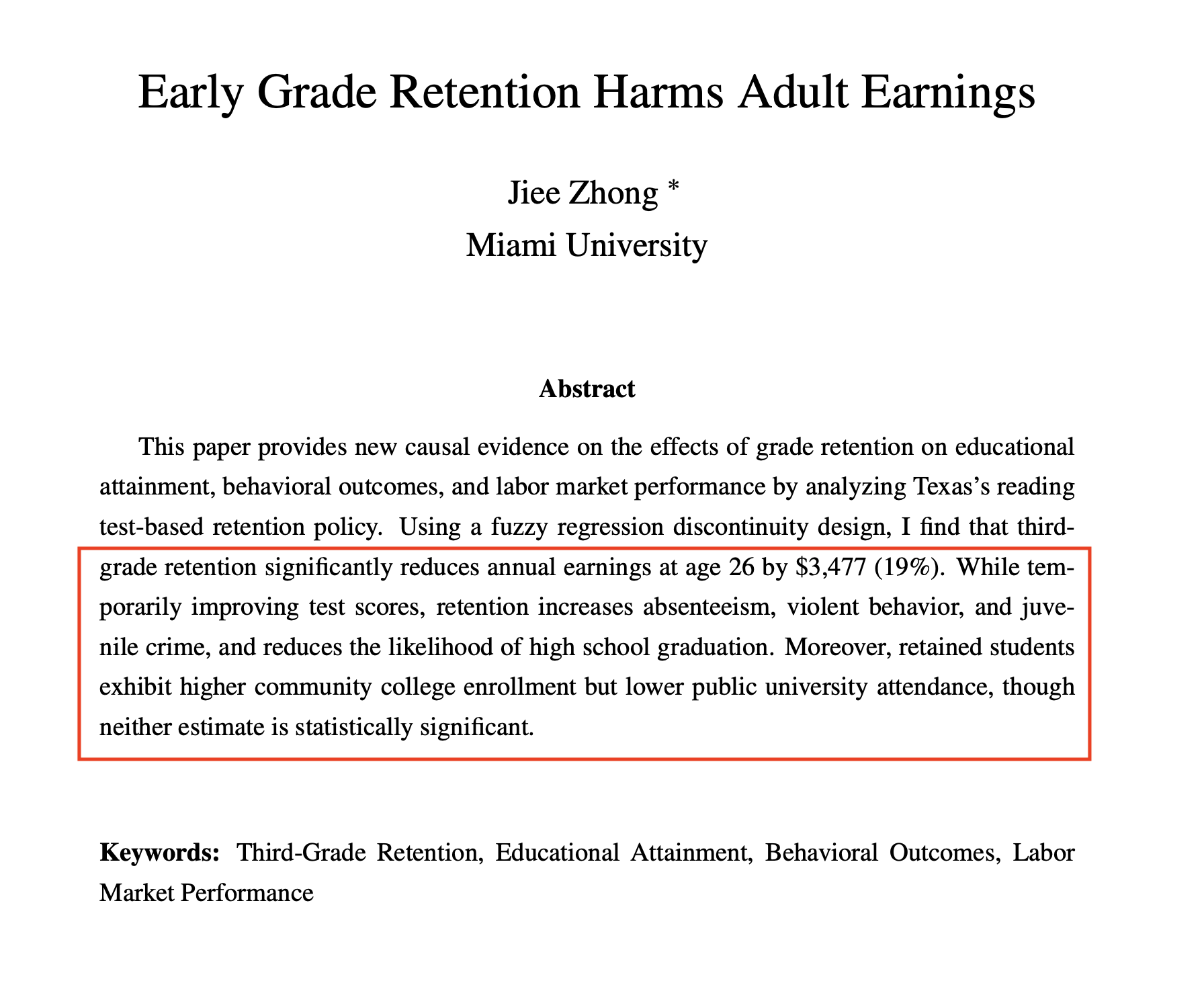
Early Grade Retention Harms Adult Earnings, Jiee Zhong [access PDF HERE]

See also: American Economic Journal: Applied Economics (Forthcoming)


The Big Lie of grade retention in the US is that it is often hidden within larger reading legislation and policy, notably since the 2010s:

The Effects of Early Literacy Policies on Student Achievement, John Westall and Amy Cummings

Westall and Cummings, in fact, have recently found:

  • Third grade retention (required by 22 states) significantly contributes to increases in early grade high-stakes assessment scores as part of comprehensive early literacy policy.
  • Retention does not appear to drive similar increases in low-stakes assessments.
  • No direct causal claim is made about the impact of retention since other policy and practices linked to retention may drive the increases.

However, their analysis concludes about grade retention as reading reform :

Similar to the results for states with comprehensive early literacy policies, states whose policies mandate third-grade retention see significant and persistent increases in high-stakes reading scores in all cohorts. The magnitude of these estimates is similar to that of the “any early literacy policy” estimates described in Section 4.1.1 above, suggesting that states with retention components essentially explain all the average effects of early literacy policies on high-stakes reading scores. By contrast, there is no consistent evidence that high-stakes reading scores increase in states without a retention component.

Therefore, one Big Lie about grade retention is that it allows misinformation and false advocacy for the recent “science of reading” reform across most states in the US.

To be blunt, grade retention is punitive, impacts disproportionately minoritized and marginalized students, and simply is not “reading” reform [1]:

Since grade retention in the early grades removes the lowest scoring students from populations being tested and reintroduces them biologically older when tested, the increased scores may likely be from these population manipulations and not from more effective instruction or increased student learning.

Evidence from the UK, for example, suggests that skills-based reading testing (phonics checks) that count as “reading” assessment strongly correlate with biological age (again suggesting that test scores may be about age and not instruction or learning):

Another Big Lie about grade retention is that reading reform advocates fail to acknowledge decades of evidence that grade retention mostly drives students dropping out of school and numerous negative emotional consequences for those students retained.

Consequently, NCTE has a resolution rejecting test-based grade retention:

Resolved, that the National Council of Teachers of English strongly oppose legislation mandating that children, in any grade level, who do not meet criteria in reading be retained.

And be it further resolved that NCTE strongly oppose the use of high-stakes test performance in reading as the criterion for student retention.

Grade retention, then, is an effective Big Lie of Education because it allows misinformation based in test-score increases to promote policy and practices that fail to increase test scores in sustained ways (see the dramatic drop in “success” for “high-flying” states such as Mississippi and Florida, both of which taut strong grade 4 reading scores, inflated by grade retention, but do not sustain those mirage gains by grade 8).

Grade retention is a Big Lie of education reform that punishes minoritized and marginalized students, inflates test scores, and fuels politicized education reform.

In short, don’t buy it.

Recommended


Note [Updated]

[1] Consider that states retaining thousands of students each year, such as Mississippi, have not seen those retention numbers drop, suggesting that the “science of reading” reforms are simply not working but the retention continues to inflate scores.

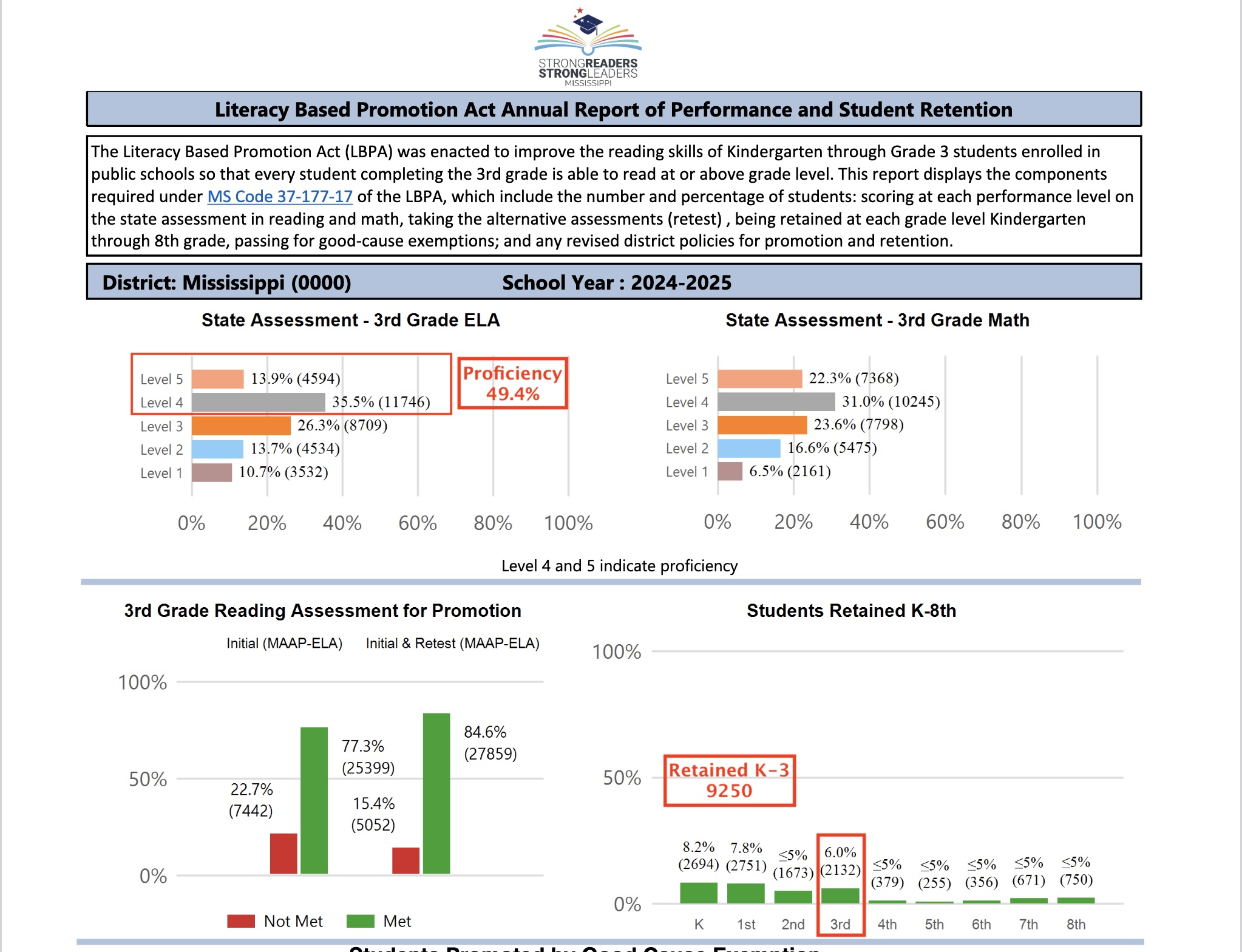
The following data from Mississippi on reading proficiency and grade retention exposes that these claims are misleading or possibly false:

2014-2015 – 3064 (grade 3) – 12,224 K-3 retained/ 32.2% proficiency

2015-2016 – 2307 (grade 3) – 11,310 K-3 retained/ 32.3% proficiency

2016-2017 – 1505 (grade 3) – 9834 K-3 retained / 36.1 % proficiency

2017-2018 – 1285 (grade 3) – 8902 K-3 retained / 44.7% proficiency

2018-2019 – 3379 (grade 3) – 11,034 K-3 retained / 48.3% proficiency

2021-2022 – 2958 (grade 3) – 10,388 K-3 retained / 46.4% proficiency

2022-2023 – 2287 (grade 3) – 9,525 K-3 retained/ 51.6% proficiency

2023-2024 – 2033 (grade 3) – 9,121 K-3 retained/ 57.7% proficiency

2024-2025 – 2132 (grade 3) – 9250 K-3 retained/ 49.4% proficiency

Update [January 2026]

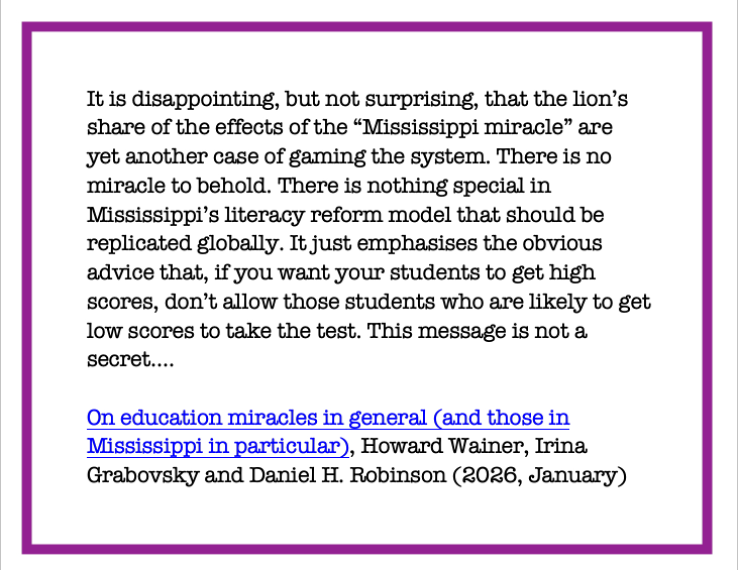
On education miracles in general (and those in Mississippi in particular), Howard Wainer, Irina Grabovsky and Daniel H. Robinson


Course Grade Contracts: Assignments as Teaching and Learning, Not Assessment

[Header Photo by Diomari Madulara on Unsplash]

At the end of fall semester of year 41 as an educator, I can admit two things: (1) I may have learned more than my students (taught two new courses and continue to experiment with course grade contracts), and (2) I am excited about spring courses where I can implement what I learned (both about grade contracts and teaching students to write).

Since I entered the classroom in 1984, I am in my fifth decade as a teacher, much of that work dedicated to teaching writing to students but also using writing assignments as teaching and learning, not assessment.

Gradually and then at some point in the 1990s, I successfully eliminated traditional tests and assignment grades in my high school English courses. As a note of clarification, although I do not use tests or grades, I have always been required to assign grading period and course grades.

Thus, I have been seeking ways to better navigate a test/grade culture of traditional schooling (one my students have been conditioned to trust and even embrace) while practicing my critical philosophy that rejects both.

A few semesters ago, as part of that journey, I returned to the course grade contract, something I had tried in some fashion during my high school teaching years.

The problem I continued to have was that students were mostly unable to set aside their test/grade mentality, and thus, the absence of tests and assignment grades often negatively impacted student engagement and learning.

Initially, I envisioned course grade contracts would improve student engagement and lower stress and anxiety, thus improving learning.

Some non-traditional practices worked. I have students prepare for and participate in a class discussion for their midterm, for example. No memorization, no “cover your work,” and no exam stress.

This collaborative approach students both embraced and recognized as not assessment, but as learning experiences themselves.

However, particularly in courses that are not designated as writing courses (I do teach first-year writing and an upper-level writing/research courses), students tend to struggle significantly with the course structure and the use of a major writing assignments as an extended teaching and learning experiences (and not a way to grade them).

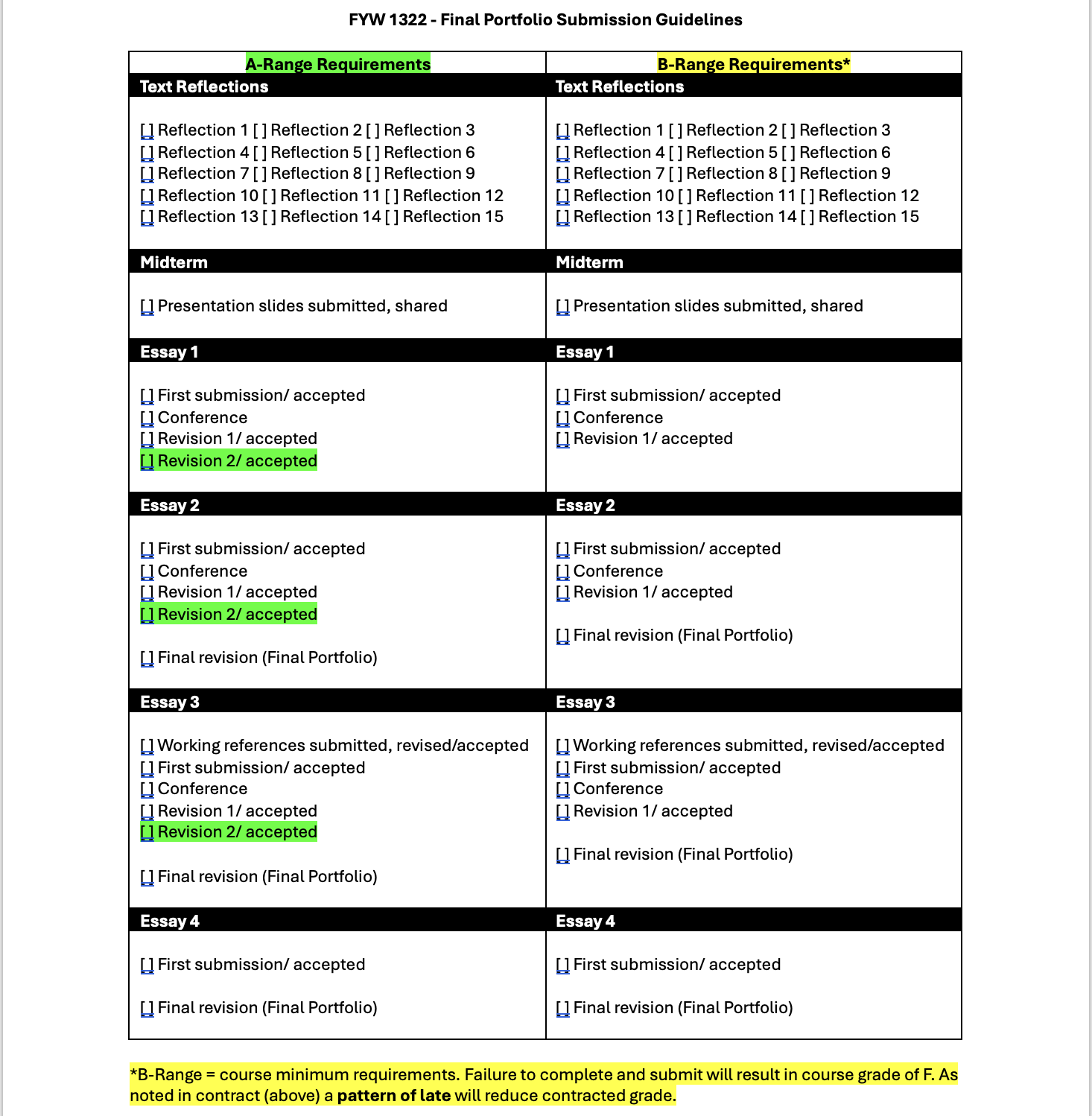
The first iteration of the course grade contract, then, focused on requiring students to submit, conference, and revise essays; I structured A and B course grades around minimum standards for the B-range (submit an acceptable essay, conference after receiving my feedback, and submit one acceptable revision that addresses the feedback) and additional revisions after more feedback for the A-range.

Despite the course grade being explicitly linked to minimum expectations for the process, students continue to see my feedback as negative and harsh, but also remain trapped in the possibility of submitting a perfect essay and never having to complete revisions.

In short, they see the essay assignment as a form of assessment and cannot fully engage in the submitting/revising process as individualized teaching and learning experiences.

Oddly, students continue to email me apologizing for their first submissions because they see the revision-oriented feedback, again, as negative or harsh—evaluative—and not a necessary part of essay assignment as teaching and learning.

The semester ending now, in fact, proved to me that using the course grade contract to shift assignments from forms of assessment to teaching/learning experiences (like the midterm exam period as a class discussion) needed another round of revision by me.

The problems I am still encountering include students struggling in content-focused courses (where they expect traditional tests and are not expecting to be challenged as thinkers and writers) because of the absence of tests/grades as well as the course structure that forefronts course content in the first half of the semester and mostly implements workshop the second half.
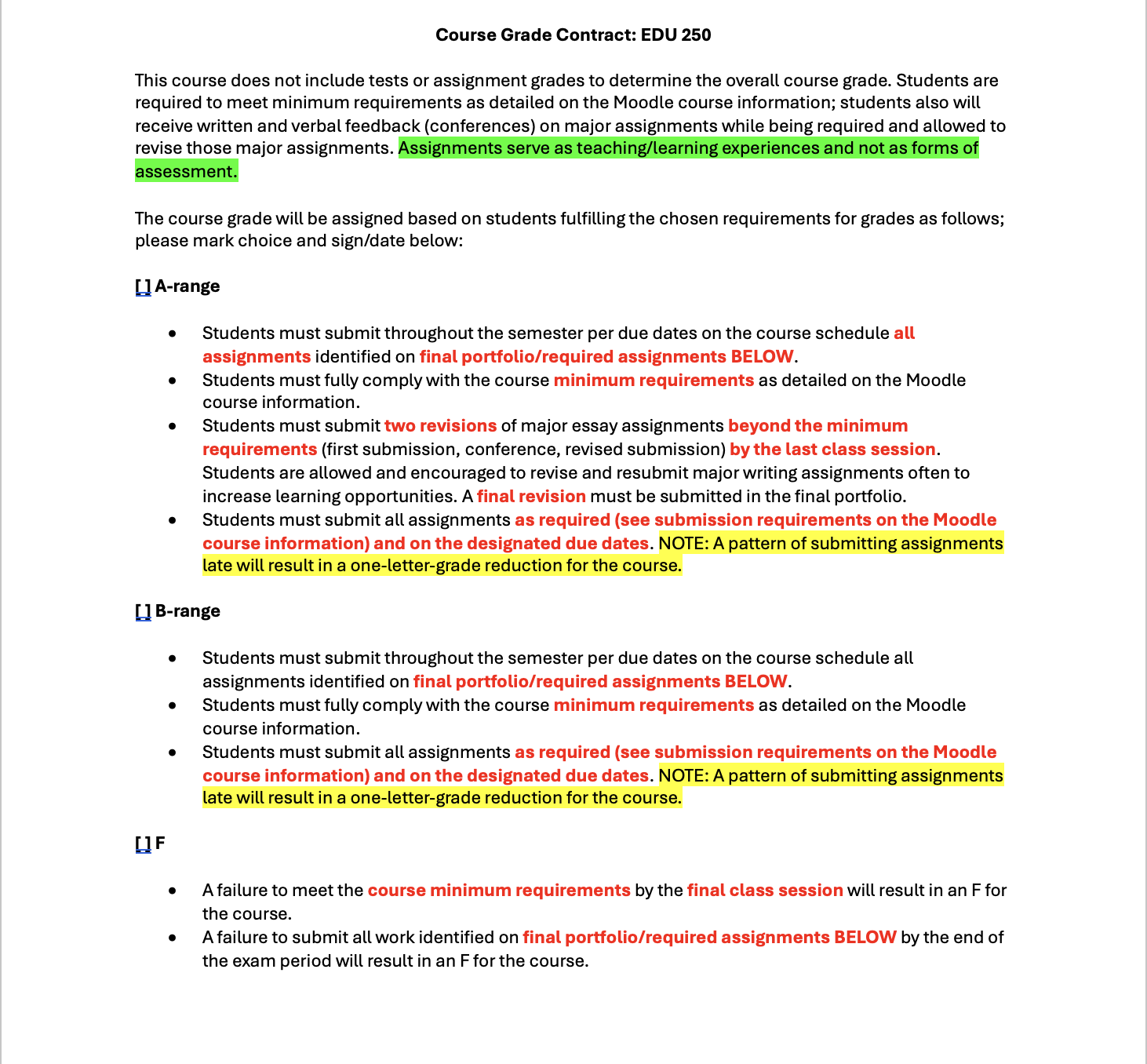
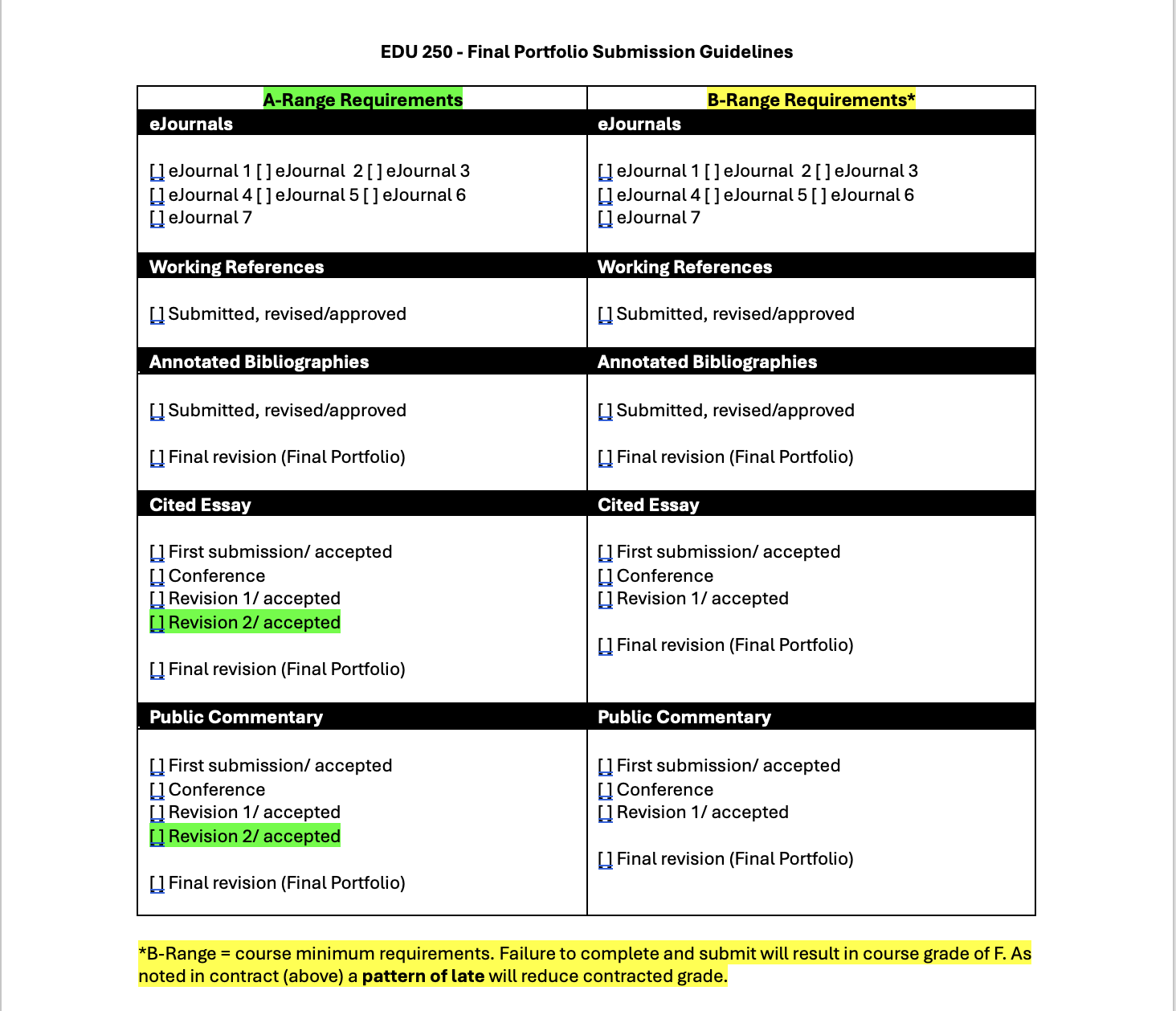
Here, then I want to share the new versions of those contracts to be implemented in spring. I have more explicitly included language about the purpose of the contract and added the final portfolio expectations in a format that also is more explicit about assignment expectations as well as fulfilling the contracted grade.

Here is the revised course grade contract for my first-year writing course:

And here is the revised course grade contract for my upper-level writing/research course:

The problem will remain, however, that I teach students conditioned for more than 2/3 of their lives in a culture of tests and grades, a culture that has taught them that assignments as by the teacher for evaluation and not for the student as teaching and learning.

I am seeking ways to shift the culture of teaching and learning as well as my students’ expectations for what it means to be a student and a teacher.

These are big asks for those students, but I am convinced they can make those shifts and benefit greatly from doing so.