The list of media and political claims of “miracle” is long since the foundational misleading crisis alarm was set off by A Nation at Risk, the bedrock Big Lie of accountability education reform—Texas miracle, Harlem miracle, and others.
Another companion of the crisis/miracle Big Lies is the “poverty is an excuse” Big Lie; the so-called miracle schools tend to be used as proof that student achievement is not most strongly causally related to socioeconomic factors outside the control of schools. [1]
Many people who are eager to accept education miracles are less interested in the education miracle and more seeking evidence to confirm their beliefs that reject economic privilege and disadvantage; the core here is the rugged individualism, bootstrap, and meritocracy myths.
Building on research from 2006 [2], I wrote a chapter on miracle schools in 2016 [3] and found the following:
Miracle school claims are rarely confirmed by non-partisan review; the so-called “high flying” schools (high poverty schools with high test scores) are incredibly rare events.
Those rare miracle schools are outliers, and thus, are not evidence of any generalizations about what all schools, or all high-poverty schools, can do to be more successful.
Evidence from outliers also are rarely scalable or transferable to schools with different challenges and populations of students.
Miracle school claims are often the tools for media, political, and marketing interests. They are designed to shame educators, not to provide evidence for credible reform.
Here are a few examples of how miracle claims in media are unmasked as false or misleading:
[1] Maroun, Jamil, and Christopher H. Tienken. 2024. “The Pernicious Predictability of State-Mandated Tests of Academic Achievement in the United States” Education Sciences 14, no. 2: 129. https://doi.org/10.3390/educsci14020129
If trending matters on social media, a consensus is building that Bari Weiss has ushered in the death of CBS, a nail in the coffin of mainstream media:
Farewell to CBS News and "60 Minutes." It just went the way of the Washington Post's editorial page
Once you begin surrendering to Trump, he always wants more. You can’t appease a tyrant. Some thoughts… pic.twitter.com/g8JBxfkCHk
Many things can be true at once even when they seem to be somewhat contradictory, and here is such a case.
First, Weiss being hired by and then allowed to shape one of the original major networks in the US—associated with Walter Cronkite and Dan Rather—does deserve the criticism being leveled at both Weiss and CBS.
However, lurking beneath this hand wringing about the death of the mainstream media are interrelated realities—media and journalists have a long tradition of seeking to remain unbiased and nonpartisan, but they are both perceived by the public as liberal.
Over my 40+-year career, I have worked in two professions that share reputations for being liberal (education and journalism) even though both professions demand that teachers and journalists remain unbiased and nonpartisan, essentially not political.
Here is what many people miss about the Weiss/CBS controversy: Journalists/media represent a body of workers who are often disproportionately progressives or moderates but who have historically in the US (mostly because of standards around remaining unbiased and not political) perpetuated conservative and traditional values, often to the exclusion of pursuing truth and accuracy.
Yes, Weiss pulling (or delaying) the 60 Minutes episode is a grossly extreme example, but this action isn’t substantially different than how mainstream media has always worked. And that includes the nostalgia often associated with Cronkite and the Golden Era of broadcast television.
Journalists and media performing their work in unbiased and objective ways is not possible (all human endeavors are biased) but that standard also works as a veneer for maintaining social and political norms—which is a conservative bias.
Mainstream media has never really disrupted the political and economic status quo of the US; media has mostly served that status quo and those profiting from it.
My work as a public scholar keeps me in constant contact with mainstream media. This past summer, I had a commentary in The Washington Post, and while I found the journalists and experience very professional and supportive, the very long process tended toward softening my analysis of the reading crisis and shifting the discourse toward normative beliefs instead of critical evidence.
But I also had an experience with 60 Minutes in the spring of 2024.
A producer at 60 Minutes had read some of my public work on the current reading crisis movement, the “science of reading,” and he found my perspective unique, surprising. He emailed, and we set up a phone conversation.
We talked for over an hour and a half, and while the producer was engaged and interested, the discussion was mostly punctuated with him asking me to repeat key points that contradicted the norms of what people believe about reading and teaching reading.
He seemed most disoriented by my explaining what NAEP reading scores and achievement levels mean and how that tends to distort how reading proficiency and reading at grade level are understood.
By the end of the conversation, the producer concluded that everything I shared was important and even fascinating, but as he explained, there was no story there for a 60 Minutes segment.
Not long after this, however, 60 Minutes ran a segment on Moms for Liberty, an extremist right-wing group that also happens to perpetuate the exact reading misinformation that does provide the sort of story that media loves (compelling even though it is misleading or even false).
Frustrated and angry, I emailed the producer who responded by stating he had not been aware of the M4L segment, but that producers didn’t interfere in each other’s projects. You see, a compelling story trumps an accurate story.
Again, the Weiss/CBS controversy is a valid concern, but David Brooks—often considered not just a credibly journalist but an elite one—was a lower-key version of Weiss’s nonsense well before anyone knew her name. And Brooks enjoys a mostly uncritical acceptance and even celebration of his conservative ideology thinly wrapped in astute public commentary.
And The New York Times as well as Education Week have long been viewed as high-quality journalism that the public believes to be liberal while routinely producing conservative journalism and traditional stories.
Yes, many journalists (and educators, especially in higher ed) self-identify as progressives and moderates. But mainstream media is ultimately a business, and as the Trump era has shown, the public can be self-defeating in its retreat from anything critical, accurate, or counter to what most people believe.
Before Weiss, CBS was not liberal mainstream media or a Gold Standard of journalism; it was corporate media, often negligent while maintaining a veneer of being unbiased.
After Weiss, who has completely perverted the already problematic both-sides approach to journalism, CBS seems to believe that dropping the mask of objectivity will be the sort of story that sells—even when brazenly eradicating truth and accuracy.
You see, Weiss didn’t murder a robust and mature media; she just nudged it into the grave from Hospice.
Having just re-watched 28 Days Later last night, I am prone to suggest that while we mourn the death of CBS, let’s not rush to raise the dead.
In corporate America, there has never been either a liberal or unbiased mainstream media.
The Weiss dumpster fire is razing the garbage that most Americans pretended not to smell rotting right under their noses.
Another flurry of over-the-top commentary has resurfaced on social media concerning reading reform in Mississippi; for example:
The fact that Mississippi cast aside decades of Department of Education recommendations and immediately saw its test scores skyrocket is all the proof you need that the Department of Education shouldn't exist.
Since 2019, the discourse around reading reform in MS has been consistently hyperbolic and misleading because, frankly, there is little solid evidence supporting the rush to copy the state’s reform.
Even a historically top-scoring state, Massachusetts, is poised to join the “science of reading” reform fad.
The relentless cycles of ever-new education reform since the 1980s and the fatal mistake of copycat reform movements are being replicated by the rush to “be like Mississippi.”
The belief that MS has performed a miracle in reading instruction and achievement is likely at least misleading if not a mirage (increased test scores due to manipulating the population of students being tested but not due to greater reading proficiency). Regardless, states must resist copycat education reform.
Questions Remain Unanswered about Popular Reading Reform: The Mississippi Model
Because of the state’s exceptional National Assessment of Educational Progress (NAEP) grade 4 reading scores in 2019, Mississippi was anointed as an education “miracle” in The New York Times.
However, one admission in that NYT’s christening has yet to be fully addressed: “What’s up in Mississippi? There’s no way to know for sure what causes increases in test scores, but Mississippi has been doing something notable: making sure all of its teachers understand the science of reading.”
At best, Mississippi’s grade 4 reading scores challenge the overwhelming evidence that standardized test scores mostly correlate with race and social class. However, in 2019, the outlier NAEP scores were merely correlated with Mississippi’s comprehensive reading reform that has now been implemented for well over a decade.
Much of that reform, unfortunately, has been the result of media, politicians, and reformers failing to understand test data—such as misunderstanding and misrepresenting NAEP achievement levels—and thus passing reform that fails to match the needs of students, teachers, and schools.
Despite the lack of robust research on why Mississippi has achieved and maintained outlier scores in grade 4 reading, many states have rushed to implement the Mississippi model of reading reform, often identified as the “science of reading.”
That reform has some common features: mandates about what reading programs meet the standard of “scientific,” teacher retraining in the “science of reading,” bans on some reading instructional practices, and third-grade retention based on state assessments of reading.
Research by Westall and Cummings offers insight into the current state of reading reform, acknowledging that those reforms have resulted in some short-term test score gains similar to Mississippi’s.
However, that study has an important caveat: Only states implementing third-grade retention are seeing those score increases. The researchers note that this study does not conclude why retention correlates with short-term score gains, however.
While Reading Wars are often contentious and driven by hyperbole and confrontational rhetoric, most people would agree that the US can and should do a better job of teaching children to read, and our most vulnerable populations of students are those being carelessly left behind despite a permanent state of education reform in the US for over five decades.
Before we commit to more reform, there are at least three questions needing to be answered about the Mississippi model for reading.
The first question may be the most important: What is the role of grade retention in reading reform?
Research on grade retention continues to raise red flags about the practice, often resulting in negative consequences for students and disproportionately impacting minoritized and impoverished students.
Mississippi has been retaining about 9,000+ K-3 students since 2014, and those retention numbers seem to be relatively consistent. If the reading reform is working, MS should have seen a significant drop in students being retained.
It seems possible that grade retention impacts the population of students being tested, and thus, distorts the test data. In short, grade retention may be raising test scores without improving student reading proficiency.
A second question must seek why Mississippi’s exceptional grade 4 scores do not erase the race or poverty gaps. As NAEP reports in 2024: “In 2024, Black students had an average score that was 25 points lower than that for White students. This performance gap was not significantly different from that in 1998 (26 points). … [And] students who were identified as economically disadvantaged had an average score that was 26 points lower than that for students who were identified as not economically disadvantaged. This performance gap was not significantly different from that in 1998 (26 points).”
The opportunity and achievement gaps in education in the US are by far the most pressing needs in our schools, and yet, these reforms seem to be inadequate for closing them.
The influence of family social capital variables manifests itself in standardized test results. Policy makers and education leaders should rethink the current reliance on standardized test results as the deciding factor to make decisions about student achievement, teacher quality, school effectiveness, and school leader quality. In effect, policies that use standardized test results to evaluate, reward, and sanction students and school personnel are doing nothing more than rewarding schools that serve advantaged students and punishing schools that serve disadvantaged students.
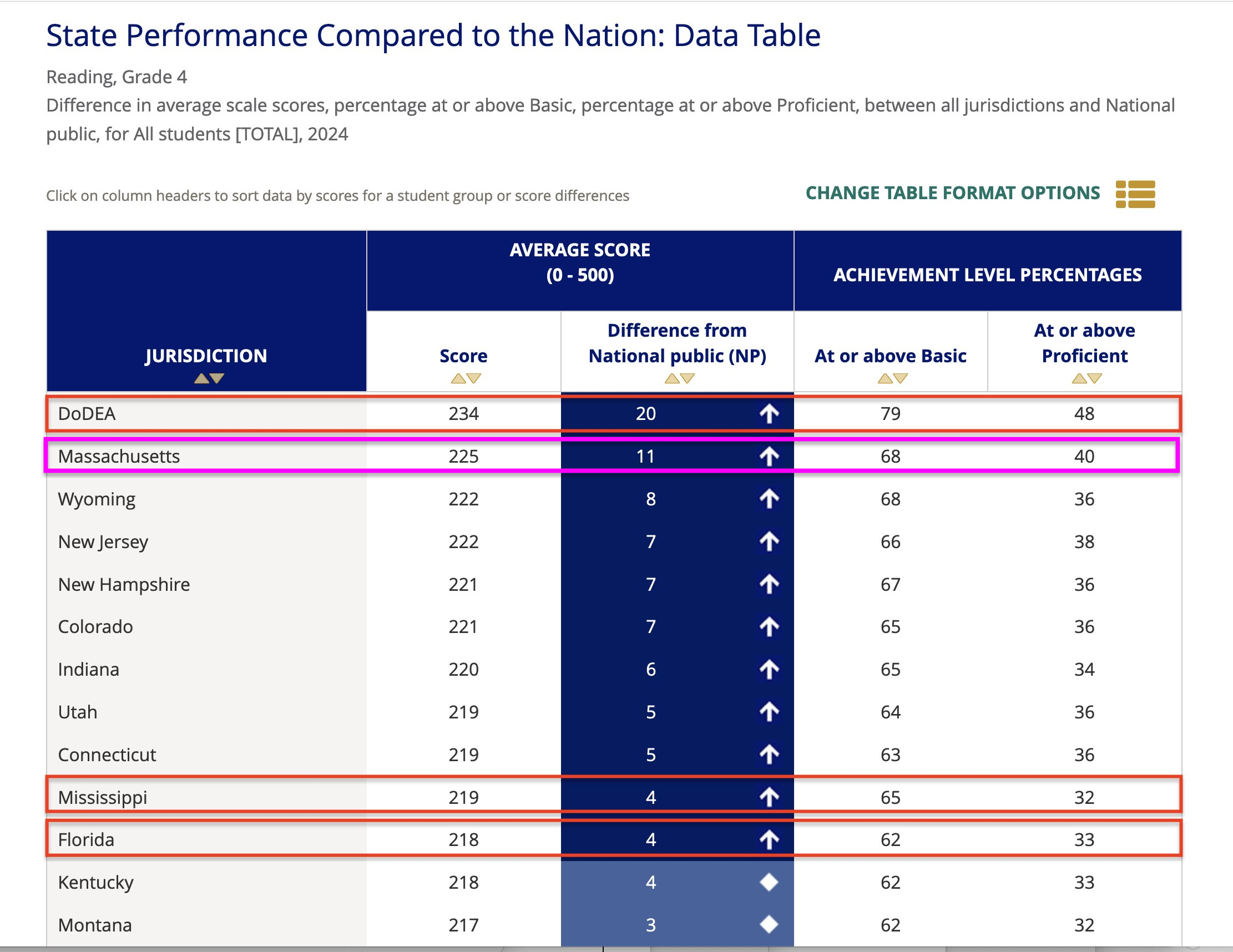
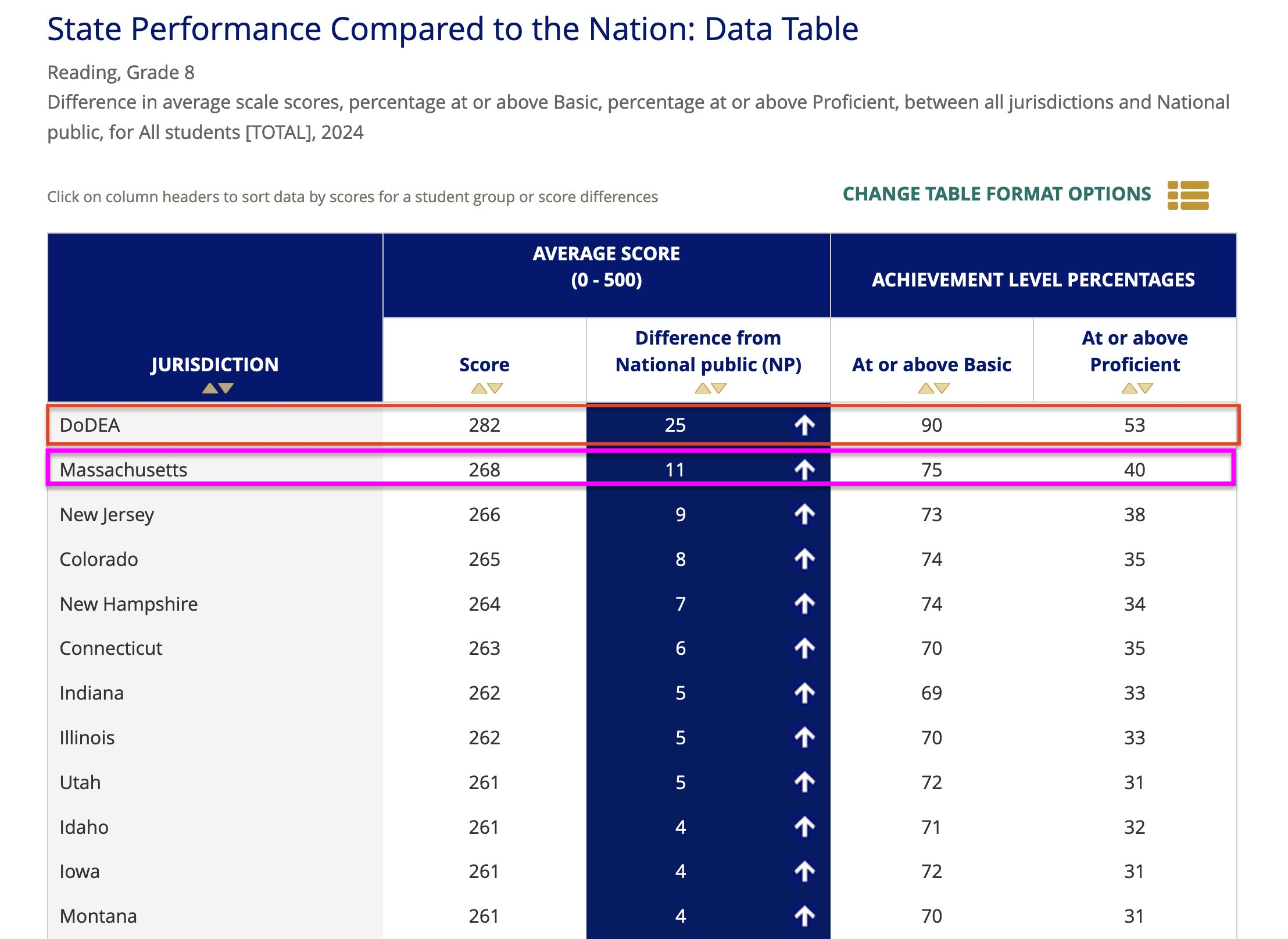
A final question concerns the evidence about short-term score increases among states implementing reading reform. Similar to another high-retention state, Florida, Mississippi has remained in the bottom 25% of states in grade 8 reading NAEP scores.
This data evidence also suggests that retention may be distorting test scores and not supporting robust or valid reading achievement by students.
Regretfully, the “science of” era of education reform is repeating a problem found in reform cycles since the Reagan era: Focusing on trends and failing to do the hard work of identifying what our problems are and then seeking reform to improve teaching and learning for all students.
The crisis/reform approach has not worked and likely is not working now.
However, the truth is that we simply do not know what is needed or what works because we are not committed to doing the complicated work needed and we remain too often trapped in market forces as well as political and ideological agendas that fail to serve the needs of the children who need reading the most.
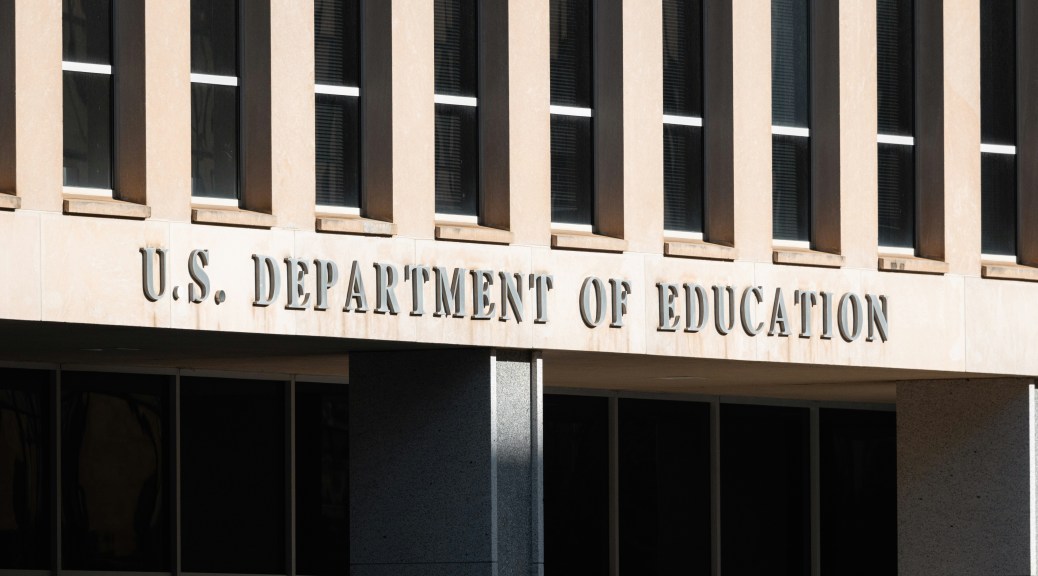
Likely the most influential standardized test in the US is the National Assessment of Educational Progress (NAEP), under the purview of the beleaguered US Department of Education.
Also without question, NAEP is one of the most misunderstood and misrepresented standardized tests since the mainstream media, political leaders, pundits, and the public routinely shout “Crisis!” with each release of NAEP data.
NAEP’s achievement levels are misleading at best, but at worst, those achievement levels were designed to create the appearance of perpetuate educational failure, and yes, crisis.
“Proficient” is almost always conflated with “grade level” resulting in false claims, for example, that 2/3 of fourth graders are reading below grade level. NAEP’s “basic” is approximately what most states identify as “proficient”—suggesting on grade level (see an extensive analysis here).
What most people misunderstand as well about NAEP is its purpose: NAEP was born in the fertile soil of high-stakes accountability education reform spurred by the Reagan administration’s propaganda A Nation at Risk. Reagan sought to reintroduce forced prayer in schools and wanted to close the Department of Education, labeled an “abomination.”
However, what Reagan spawned was over four decades of ever-changing standards and tests to hold schools, teachers, and students accountable. In short, NAEP was created as a test of random samples of students to hold states accountable for their educational standards and outcomes (historically, public education has been the responsibility of the states, and NCLB in 2001 was a departure toward more federal oversight).
Frankly, NAEP was designed as an accountability mechanism, not a way to provide feedback on individual student achievement. (Note that state-level accountability testing was designed to provide individual student assessment that should provide evidence for instruction.)
In 2025, on the heels of recent shouts of “Crisis!” (again) because almost everyone has misunderstood and misrepresented NAEP scores across math, reading, and even civics, Reagan’s dream may be coming true since the Trump administration has promised to end the USDOE, and that move imperils the future of NAEP.
As Peter Greene has confronted, some have taken this uncertainty about NAEP to propose turning NAEP into (you should pause here to prepare yourself for the inanity) the failed Common Core experiment that sought to replace the state-based public education accountability process with national standards and testing.
Into the nonsense that is NAEP historically and the current doubling-down on Common Core Redux, I want to make a modest proposal about the future of NAEP.
Actually I want to make two modest proposals, acknowledging that the first is never going to happen (although it is the one more strongly supported by empirical data; you know, the “science” that so many education reformers claim to worship).
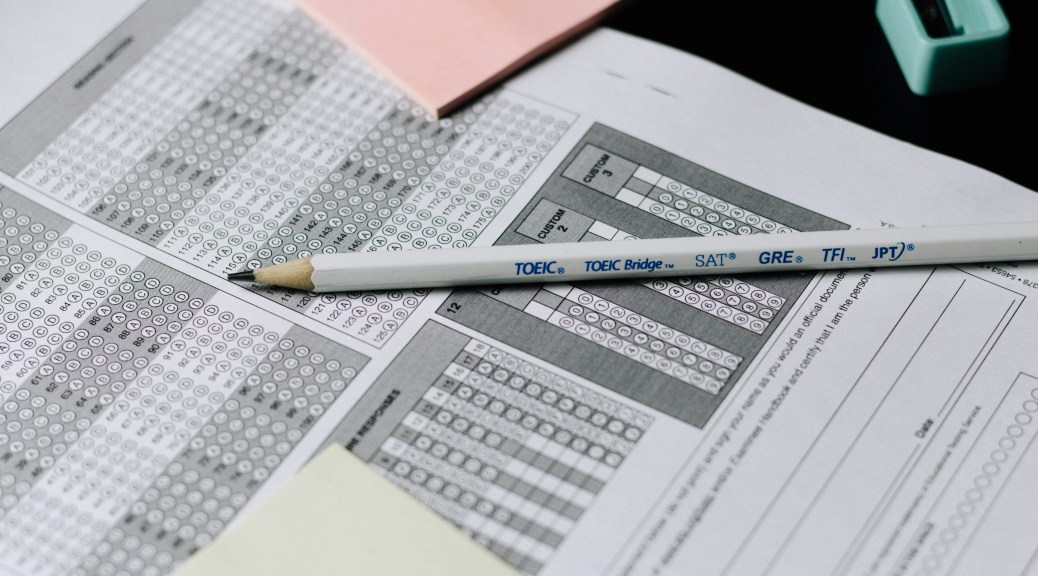
I strongly reject standardized testing as well as traditional classroom testing and grades. That has been at the core of my 40-plus-year career, and again, this is informed not just by my experiences as an educator but by a very robust body of research.
Therefore, my first modest (and completely unrealistic in the US) proposal is the conclusions reached by Maron and Tienken:
Almost 63% of the variance in test performance was explained by social capital family income variables that influence the development of background knowledge. Background knowledge is a known predictor of standardized test results. Family income variables are immutable by schools. Only public policies, outside the control of school personnel, can influence family income.
The United States has one of the highest levels of childhood poverty among Organisation of Economic Co-operation and Development (OECD) countries. It is well known that the social safety net in the United States is not as strong as some nations in Europe and other parts of the world [20]. Neoliberal policies have greatly reduced government support for families in the United States. Important social policy frameworks that reduce poverty, such as monetary, labor, fiscal, and health policies, have been weakened over the last 40 years, causing increases in childhood poverty in the United States compared to other democratic countries [41].
Although some education policy makers in the United States claim that standardized test results are an important component of a comprehensive system of educational quality control, the results from decades of research on the topic suggest otherwise [42]. The influence of family social capital variables manifests itself in standardized test results. Policy makers and education leaders should rethink the current reliance on standardized test results as the deciding factor to make decisions about student achievement, teacher quality, school effectiveness, and school leader quality. In effect, policies that use standardized test results to evaluate, reward, and sanction students and school personnel are doing nothing more than rewarding schools that serve advantaged students and punishing schools that serve disadvantaged students.
Alas, the US will never follow this last point because we refuse to acknowledge systemic forces and remain a people fatally committed to rugged individualism and bootstrap mythologies.
And thus, here is my compromise, a modest proposal that can and should be explored for the future of NAEP:
Rename achievement levels in standardized testing that share a national standard metric for the levels (all states and NAEP would share the same achievement levels and metric).
Achievement levels must be age-level and not grade-level(currently, using “grade level” allows states to game scores through grade retention, for example). A clear system of “below age level,” “age level,” and “above age level” would simplify reporting and allow for more accurate political, media, and public responses to data.
This proposal would be a first step, I hope. The problem at first is that this doesn’t address the excessive testing culture the US has embraced without positive outcomes for over forty years.
This first step, I think, can create a new basis for evaluating and viewing our public schools, and then, we may be primed to begin dismantling the standardized testing machine—or at least become more acclimated to reducing it dramatically.
The great irony of the power of high-stakes testing in the education accountability era is that it has proven only one thing: Weighing a pig does not make it fatter.
Testing, testing, and testing has not improved schools, teachers, or students, but it has created a perpetuate state of educational crisis.
Perpetual educational crisis serves only political agendas and the unquenchable education marketplace.
If we can entertain for a moment of idealism that the Trump disaster doesn’t destroy both the USDOE and public education, let’s consider how to more forward in ways that better serve the promise of public education and our fragile democracy.
If not an end to NAEP, at least a better NAEP that serves the interest of students and not political or market agendas?
On April 28, 1967, Muhammad Ali publicly defied being drafted into the Vietnam War, costing him his heavy-weight title and derailing his career for three years during his prime.
Ali’s willingness to put publicly his name and his words on his beliefs reminds me of James Baldwin’s response to William Faulkner’s call for patience when confronting racism and inequity in the US: “There is never time in the future in which we will work out our salvation. The challenge is in the moment, the time is always now.”
I am also compelled by a central motif in the life and work of historian and activist Howard Zinn, who argued that we cannot be neutral on a moving train. In this era of the second Trump administration, our democracy and academic freedom train is heading off a cliff; we are all on board.
At the end of the first Trump administration, I implored academics to do more, to speak more, to use our academic and intellectual capital to advocate for the marginalized and the vulnerable as well as the core principle of what academics and education must preserve—academic freedom.
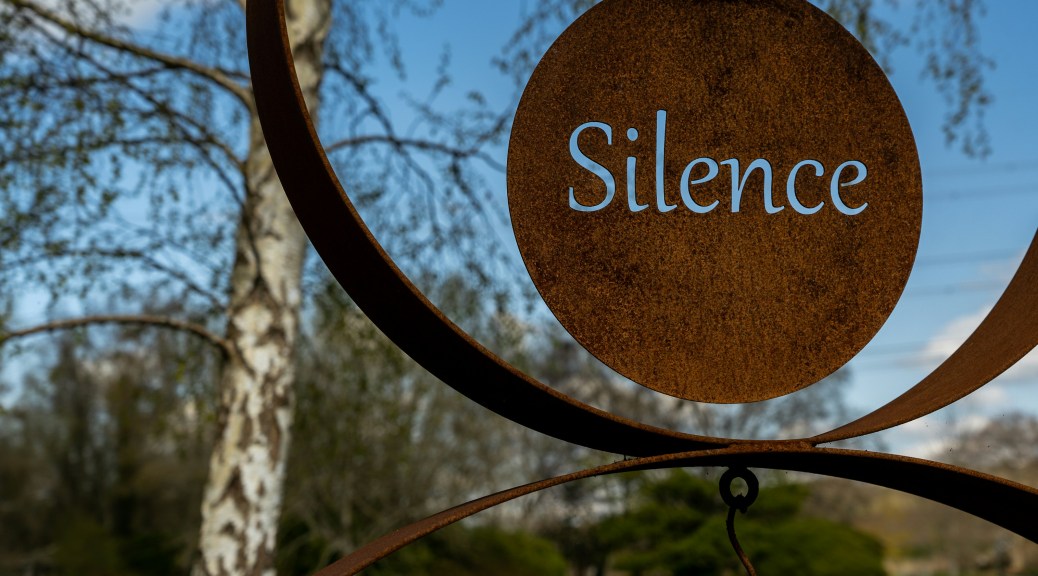
Yet, most academics and colleges/universities remained committed to the “politics of silence” approach to the threats around us.
We have chosen a sort of self-preserving silence, in fact, despite the danger that poses, one confronted by poet Adrienne Rich:
The study of silence has long engrossed me. The matrix of a poet’s work consists not only of what is there to be absorbed and worked on, but also of what is missing, desaparecido, rendered unspeakable, thus unthinkable.
The current political dismantling of K-12 and higher education is an assault on democracy; real people are suffering in inexcusable ways. The values we claim to hold sacred are being destroyed each moment we hesitate, each moment we remain silent, each moment we fail to act.
We academics may believe that the Ivory Tower allows us to protect our community as our only priority, and thus that we must protect that Ivory Tower. But I have witnessed at the highest level of my 41-year career very real and justified fear among college students, staff, and faculty.
A first-year student writing about their journey as a gay child navigating their family expectations concluded an essay with the following chilling recognition: “No one knows what the future holds for the United States now. Unfortunately, what we face is not simply a political matter, but rather, a threat on individual liberty, and I am scared for what will happen in the next four years.”
And for faculty—especially those most vulnerable due to personal status or rank—who have served the academic community as scholars and teachers, the same fear of the uncertain and hostile world beyond the Ivory Tower is directly impacting how and if we teach as we know we should. Many of us have targets on our backs simply for remaining committed to the academic freedom we hold sacred and fulfilling our moral obligation to address diversity, equity, and inclusion.
That Ivory Tower was never protecting anyone; it isn’t protecting us now in that increasingly hostile world.
Therefore, now is not the time to keep our heads down, now is not the time to retreat into the politics of silence.
As a former high school English teacher, I hear constantly in my mind Willy Lohman imploring “the woods are burning,” and I fear if we persist in a “politics of silence” approach, if we bow to cultural expectations that education and educators must appear to be politically neutral, that fire will consume us all.
We could be better than that, we should be better than that.
The world is at least fifty percent terrible, and that’s a conservative estimate, though I keep this from my children.
…This place could be beautiful, right? You could make this place beautiful.
Ultimately, we must make a decision, one reflected in William Butler Yeats’s enduring poem:
The best lack all conviction, while the worst Are full of passionate intensity.
The time is now to reject the politics of silence that brought us here, to speak and act in the name of academic freedom, in the name of our students walking our campuses now but who must enter the very real world burning around them.
We, the faculty of Furman University, in our role as stewards of this institution, reaffirm Furman’s mission to support “rigorous inquiry, transformative experiences, and deep reflection.” This mission calls us to preserve a community where freedom of thought and expression is actively defended, even when doing so is costly.
We are gravely concerned that our mission is in danger. Growing political pressures seek to curtail international education, narrow institutional autonomy, restrict academic freedom, and suppress open discourse. These pressures—whether through legislation, policy threats, or public intimidation—undermine the core values of the liberal arts and the very foundation of higher education. The coercive tactics used to enforce such restrictions jeopardize not only our institutional mission but also the well-being of individuals who contribute to it—students, employees, and the communities we serve.
We are troubled to see other institutions respond to these pressures by compromising their values, narrowing the boundaries of inquiry, and chilling protected speech. Furman must not follow this path. Our Statement on Free Expression and Inquiry is based on the “foundational belief that diverse views and perspectives deserve to be articulated and heard, free from interference.”
Furman’s leadership must continue to support policies that safeguard expression, uphold human dignity, and foster inclusive dialogue. As faculty, we pledge to defend these commitments, and to hold ourselves and our institution accountable to them—especially in moments of crisis.
To that end, we assert that we will not betray the following principles:
Academic Freedom is Nonpartisan and Nonnegotiable
We will not permit external pressures to determine what or how we teach, whom we hire, or the direction of our research. Furman’s academic mission exists not to serve ideology, but to pursue truth through open, critical, and disciplined inquiry.
Free Inquiry is Foundational to a Learning Community
In accordance with Furman’s Statement on Free Inquiry, we commit to defending the right of all members of the Furman community to express differing—even controversial—views without fear. Offense is not a sufficient justification for censorship.
Dignity, Respect, and Inclusion Enhance—Not Inhibit—Freedom of Thought
We affirm the worth of every individual and the necessity of diverse voices in the search for understanding. We reject any effort to pit freedom of expression against the dignity of persons; both are essential to a thriving community.
Solidarity with Vulnerable Members of Our Community
We will advocate for and protect students, faculty, and staff who may be targeted due to their political beliefs, immigration status, or identity. Furman must remain a place of open and active inquiry—not surveillance or exclusion. Faculty will use our academic freedom and resources to push for legal protection and other support for any of our campus community who requests it in the face of bullying and intimidation.
We affirm our responsibility not only to preserve Furman’s mission in the present, but to also ensure that in years to come, we can look back with pride—knowing that we upheld the values that make this university a place of real learning, meaningful dialogue, and thriving community.
Mainstream media loves a compelling story. And, regretfully, media tends to care very little how accurate or complete that story is.
Media coverage of education is almost entirely a series of misleading stories grounded in either crisis or miracle rhetoric.
One of the darlings of the media is the charter school, the one aspect of the school choice movement that has garnered bipartisan support.
However, as a type of school choice, charter schools must market themselves and recruit. So when media and school marketing combine, I urge “Buyer Beware”:
Here, The State (Columbia, SC) has platformed the principal of a charter school, who makes a couple important (but misleading) claims: the charter school is exceptional and that is because the school practices separating boys and girls for instruction.
“Exemplary High Performing School” is causally connected by Wooten to the boy/girl instructional segregation; however, rarely can a school conduct the sort of scientific research in-house to determine causation, and more importantly, student achievement (test scores) remain overwhelmingly a reflection of the students’ socioeconomic status (60+%), not the school, instruction, or teacher quality.
Here is the missing parts to this story:
Note that Langston Charter Middle has the third lowest poverty index (PI) in the state (12.9), and for comparison, in the same district, the Washington Center has one of the highest PI (96) in the state. [Note that Greenville has a incredibly wide range of low and high poverty schools because the district is large and covers an area of the state with significant pockets of poverty and affluence; and thus, neighborhood schools tend to reflect that socioeconomic reality.]
Further, if we look at Langston Charter Middle’s state report card, the “exceptional” seems to be missing:
Yes, the academic achievement is “excellent,” but again, this data point reflects mostly the very low PI for the students being served.
Note that when Langston Charter Middle is compared to schools with similar student demographics (Daniel Island School, 8.2PI, and Gold Hill Middle, 11.5 PI), the “exceptional” appears to be typical among similar schools:
Media and marketing do more harm than good for public education. When the media is fixated on incomplete and misleading stories and schools feel compelled to market themselves for customers, we all lose.
The OpEd run by The State is not about an exceptional school or the success of separating girls and boys for instruction (although that does speak into a current political ideology that wants this to be true).
The story, as usual, is incomplete, and the marketing is at best misleading.
Once again, many in the US do not want to hear or see the full story: Our schools and student achievement mostly reflect the socioeconomic status of the students’ parents, homes, and communities.
When it comes to media coverage of our schools, I must emphasize: Don’t buy the story being sold.
My mother was extremely smart and had a remarkable sense of humor. Even at the worse moments in her life, she found humor and insight. One day, as my sisters and I were playing (and fighting) in the house because of rainy weather, she called out to none, some or all of her three children, “Hey, do you want to know a way to lose twenty pounds of ugly fat?” We stopped our bickering and turned to her, waiting for her to reply to her own question. “Cut off you’re your head,” she said and quietly continued making dinner. Her remark cut through the tension and led to some whole-hearted laughter.
I think of my mom today as I try to understand what it means for a country to work on becoming more efficient. My mom was right: your body would be twenty pounds lighter if you removed your head. That’s an efficient solution to a weight problem. The problem is the effect: you’d most certainly die. Indiscriminately removing something that’s weighty may not be good for the body of the whole.
In a country striving to be a democracy, the tension between efficiency and effect is crucial. Tom Paine said that in a democracy, law is king, and in a monarchy, the king is law. The latter is an efficient way to get laws made and enforced, with the king having power over both the laws and their implementation. The problem is the effect on the people living within the country in that they all work for the king, for the perpetuation of the monarchy, and suffer at the king’s whims, desires, moods, needs, and temperament. The effect on the people is that they are essentially enslaved.
In contrast, in a democracy, when the law is the king—meaning it’s the center of organization, structure, and power—things are much more complicated because the government is obligated to consider its impact on all the people. In a representative democracy, like the one in our country, those that represent us are morally, ethically, and legally bound to the good of all. A democracy is organic, meaning that it changes over time as our understandings of life, liberty, and the pursuit of happiness are informed by our deepening understanding of what it means to be a human being. We learned about, understood and acted upon slavery, putting Japanese people in internment camps, workers’ rights, women’s right, voting rights, civil rights, and so much more.
Our growing knowledge also causes tension as, for example, outlawing the owning of slaves affected the economy and led to war. But we adjust because of our deep-rooted belief in and commitment to a country that offers the potential for every human being to realize and act upon all that they can do. In other words, a democracy is not always efficient because the effects that efficiency has matter.
Cutting Medicaid is efficient: money is saved. The effect is that people without economic means lose access to medical care that keeps them alive.
Cutting social security is efficient: money is saved. The effect is that people lose their earned deferred income—money they were forced by law to set aside for their future and their quality of life deteriorates to the point of losing their homes, dignity, and peace in their later years.
Cutting the department of education is efficient: money is saved. The effect is that schools lose essential aid, programs that protect health and civil rights, support for reading instruction, research programs, and even statistical analyses of progress.
Cutting funding of scientific research is efficient: money is saved. The effect is that research that can save lives, improve our food and water, keep our air clean, make communities safer, improve mental health and so much more is lost.
Cutting funding for the arts is efficient: money is saved. The effect is that beauty does not matter, expression is marginalized, and the voices that push our thinking and being are silenced.
Cutting support for programs in other countries is efficient: money is saved. The effect is that more people die of AIDS and other diseases, more children die of starvation, countries are left unprotected against radicals, and oppressed people no longer hear voices of hope.
We should not fall prey to chaos, attacks on a free press that expose chaos and selfishness, and the push to simplify the complexity of our democracy. We need to demand that every member of our government safeguards our well-being, demands that programs for the good of all are replenished, and uncovers who is getting the money that is supposedly being saved. We need to make sure that our heads are not being cut off to reduce our weight.
Rick is an activist and retired literacy researcher.
I teach an upper-level writing and research course for undergraduates as part of their general education requirements. The overarching project asks students to gather media coverage of an education topic in order to analyze the credibility of that coverage.
Since the course is undergraduate, I ask them to approach their analysis through critical discourse analysis, but I narrow that lens some for them. The process includes the following:
Identify the pattern of claims about the topics.
Evaluate the validity of the claims in the context of a literature review of the educational topic (limited to peer-reviewed, published recent journal articles).
Consider whose interests these claims serve (the CDA element).
I note that claims about education in the media tend to fall in a range of accurate, misleading, and false; however, for this analysis, identifying whose interest the claims serve is the key aspect of the evaluation.
False and accurate claims are typically easy to manage for students, but the misleading claims can be complicated.
For example, in public discourse about police shooting victims, two accurate data points are often cited: The majority of people shot and killed by police in the US are white and Black people are shot and killed at a higher rate than white people.
Failing to address both data points and clarifying why rates are more important than raw data contributes to media coverage being misleading, and thus, selectively emphasizing true data is often a form of manipulation and serves a particular population or ideology.
With another release of NAEP reading and math scores, we have an opportunity to address how media and political leaders tend to offer false and misleading claims based on NAEP score, but also, that NAEP itself serves to perpetuate the manufactured education crisis, which benefits the media (more clicks), political leaders, and the education market place.
Regardless of what national and state scores on NAEP are, the foundation of media and political claims is always “crisis.”
Ironically, perpetual “crisis” rhetoric and education reform since the early 1980s has had one clear outcomes—maintaining the status quo of educational and socioeconomic inequity in the US.
To consider this, let’s focus on Massachusetts and Tennessee.
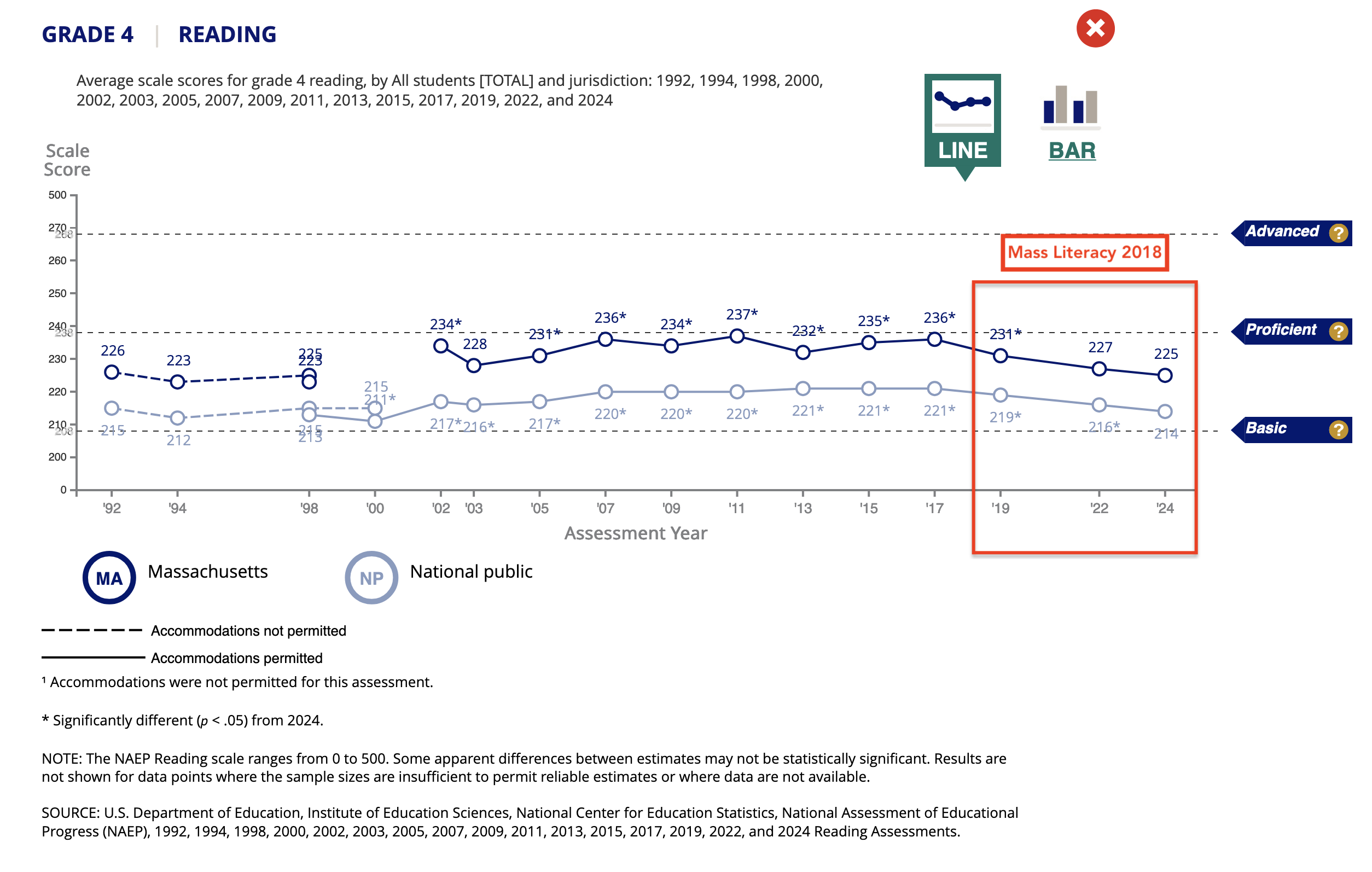
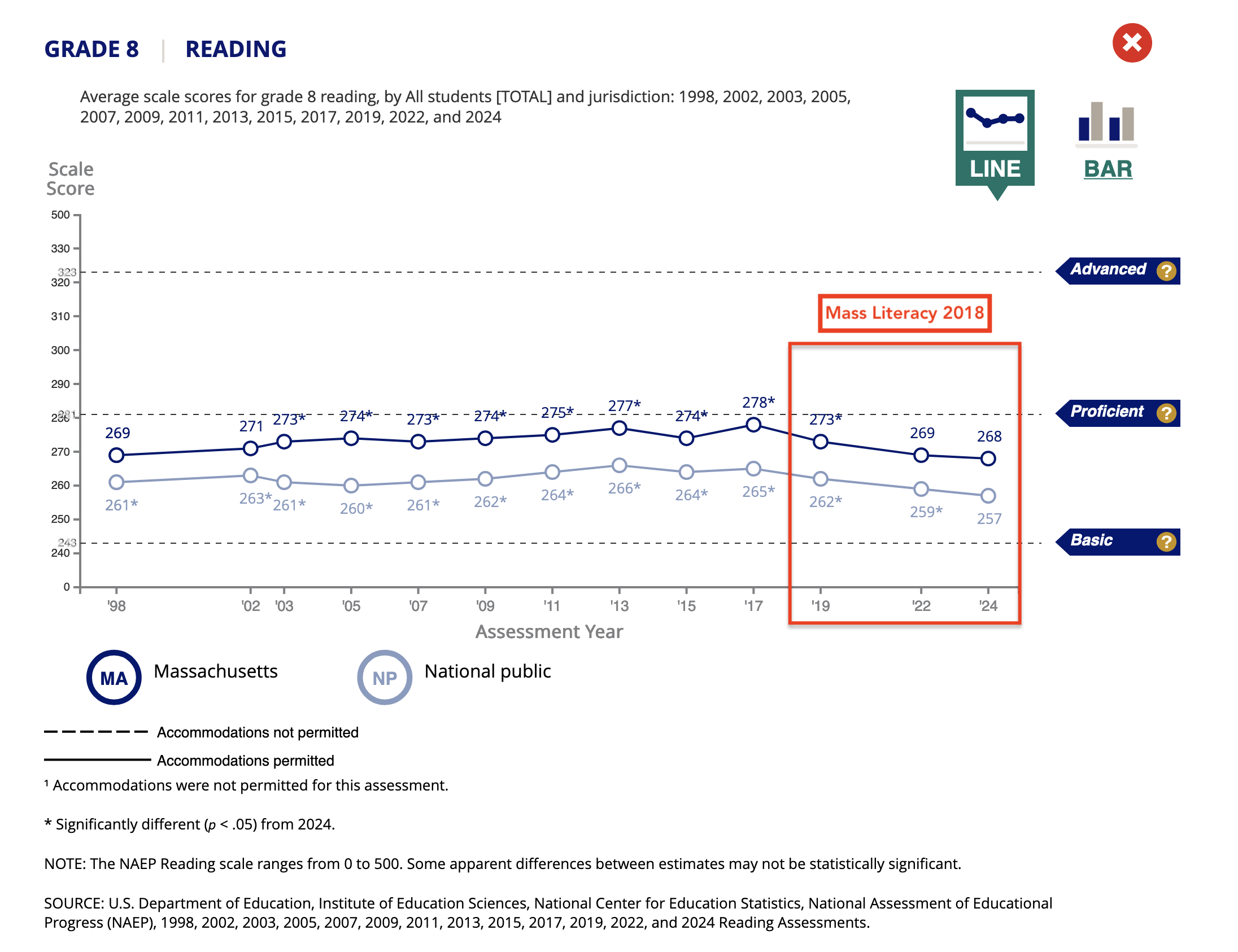
Other than top-scoring DoDEA schools, MA sits atop reading scores in the US in both grades 4 and 8:
As a relatively low-poverty state, MA should rank above states with higher poverty students. However, MA certainly serves students in pockets of poverty as well as other vulnerable populations of students who tend to have low standardized test scores.
None the less, MA has joined the standard chorus in the US about reading. The Education Trust released a report in March 2024 providing “5 Things You Need to Know about the literacy crisis in Massachusetts.”
To be fair, MA is similar to most of the US where standardized tests scores have dropped post-Covid and those drops have coincided with MS’s Mass Literacy initiative from 2018:
Perpetual reform and perpetual crisis in education, regretfully, seems only to fuel more reform and more crisis.
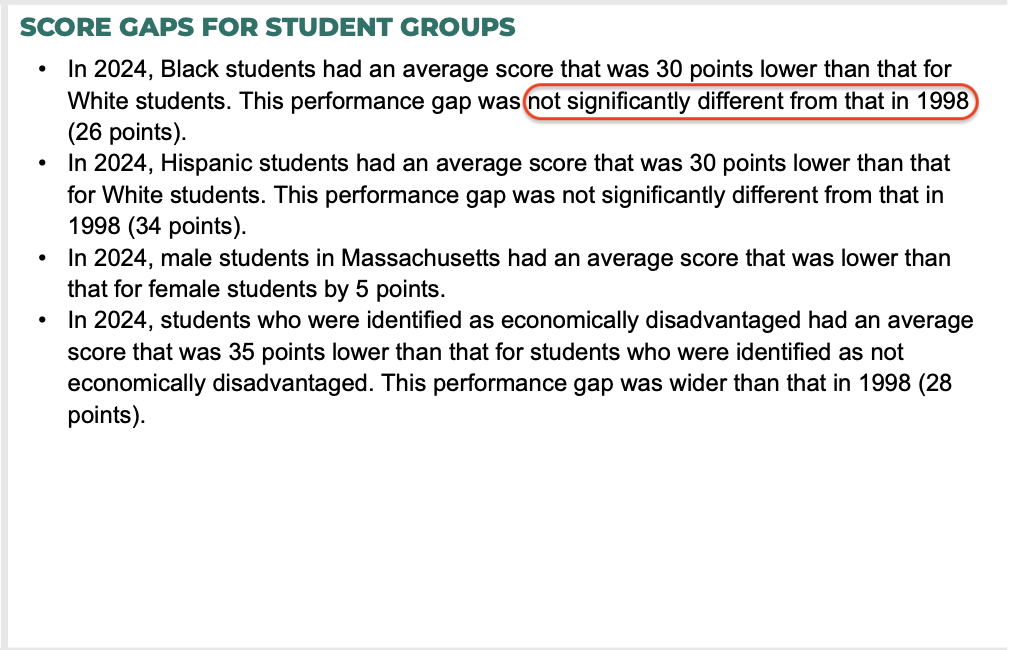
Note that MA also has something in common with almost all states regardless of whether states have high or low NAEP results. Achievement gaps by race and socioeconomic status have remained fixed for almost three decades:
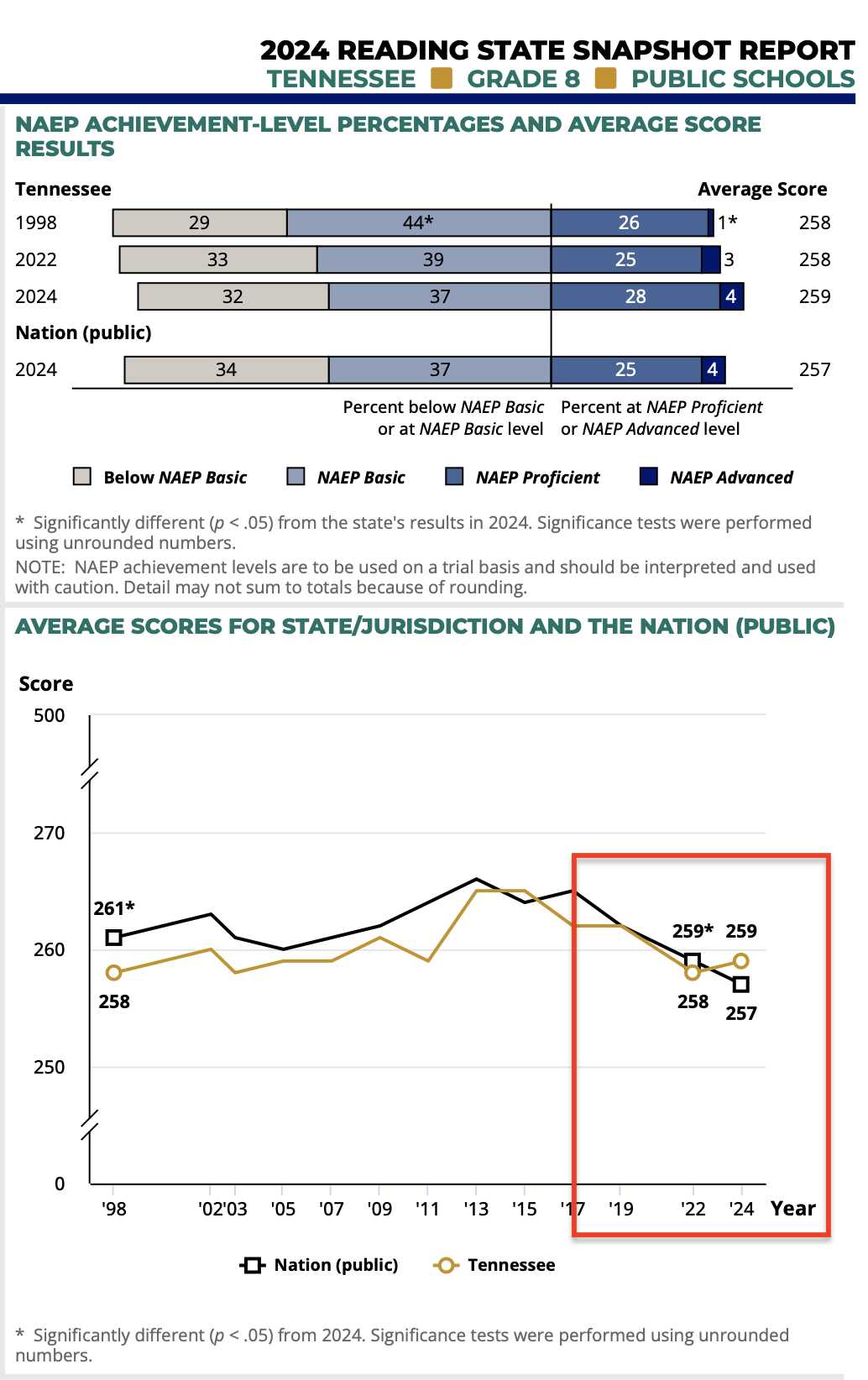
While a top-scoring state like MA is shouting “crisis” primarily based on a sort of national psychosis about the “science of reading,” TN is trying to have it both ways with a reading crisis and a celebration of 2024 NAEP scores.
An October 2023 report from the TN Department of Education, “Tennessee’s Commitment to Early Literacy,” forefronts the “Literacy Crisis in Tennessee” based on (you guessed it) historically poor rankings in NAEP reading scores.
One important point here is that the media and political discourse tend to focus on “bad” statistics such as rankings and averages—which is how TN establishes their “crisis.”
For political leaders, “we have a crisis” and “I have saved us from the crisis” are not a sequential series of events, however, but a permanent rotation.
So why this positive spin for TN?
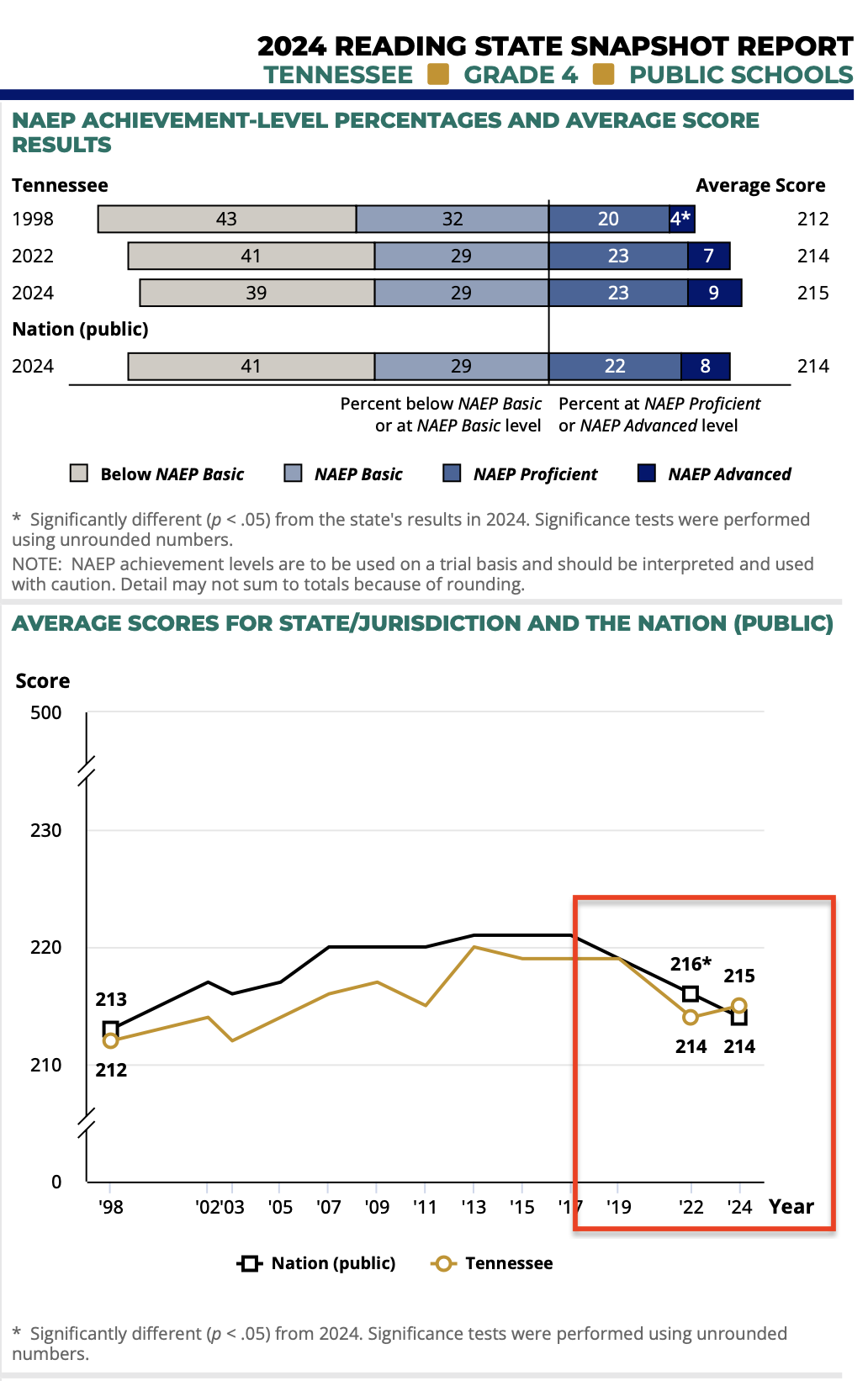
While the national average on NAEP reading has dropped, TN has experienced in 2024 a slight uptick. Because most everyone else was dropping, then, TN has seen a rise in their rankings (a key example of why ranking is a “bad” statistic).
Important again is that like MA and most states, TN scores for racial and socio-economic gaps remain fixed: “This performance gap was not significantly different from that in 1998.”
These responses to NAEP by MA and TN reveal a stark lesson that NAEP serves the interests of the media, politicians, and the education market place, but at least since 1998, NAEP hasn’t provided the data needed for any sort of genuine education reform or analysis.
Education is a political and market football, in fact.
Here are a few better takeaways from NAEP:
NAEP’s achievement levels are designed to be confusing and support the manufactured education crisis (see here).
Using NAEP to rank and sort is misleading and doesn’t support needed reform.
NAEP scores do offer some important facts related to achievement gaps and the pervasive influence of affluence and poverty on educational outcomes, but the media and political leaders choose to ignore those lessons.
Decades of NAEP reinforce this conclusion by Maroun and Tienken: “Policy makers and education leaders should rethink the current reliance on standardized test results as the deciding factor to make decisions about student achievement, teacher quality, school effectiveness, and school leader quality. In effect, policies that use standardized test results to evaluate, reward, and sanction students and school personnel are doing nothing more than rewarding schools that serve advantaged students and punishing schools that serve disadvantaged students.”
Media persist in focusing on only two stories about education: Crisis and outliers; both of which serve the interests of anyone expect students and teachers.
Like my students in my upper-level writing and research course, we would all benefit from evaluating the claims being made by media and political leaders in order to determine, first, is the claims are true (they often as misleading or false), and then to confront in whose interests these claims are being made.
Maybe this isn’t surprising given the current and historical political climate in the US, but almost never are the interests of students and teachers being served—especially when the interests of the most vulnerable students are the issue.
The first two decades of my career as a literacy educator were spent as a high school English teacher in rural Upstate South Carolina, the high school I had graduated from and my home town.
This began in 1984 when SC had passed sweeping education legislation that would become the standard legislative approach across the US—accountability policy grounded in state standards, high-stakes testing (grades 3 and 8 with exit exams in high school starting in grade 10), and school report cards.
SC was an early and eager adopter of the “crisis” rhetoric fueled by A Nation at Risk report released under the Reagan administration.
That high school and town were populated mostly by working-class and poor people; the town and smaller towns served by the high school were dead or dying mill towns.
Schools had far more poverty than the data showed because rural Southerners often refused to accept free and reduced meals (the primary data point for measuring poverty in schools).
However, for many years the high school ranked number 1 in the entire state for student exit exam scores in math, reading, and writing. Because of our student demographics (and notably because these students had relatively low or typical scores in grade 8 testing), we were what many people would refer to as a “high flying” or “miracle” school.
In more accurate statistical terms, we were an “outlier” data point in the state.
I have been in SC education for an ongoing five decades, and the overwhelming body of data related to student achievement in the state has matched what all data show across the US—measurable student learning is most strongly causally related to the socioeconomic status and educational levels of those students’ parents.
Further, the full story about how we achieved outlier status includes two aspects.
One is that from grade 8 to grade 10 testing, the population of students changed because of students dropping out of school (and these were among the lowest scoring students in grade 8). In fact, students were often encouraged to drop out and enroll in adult education (a two-fer win for the school because they would not be tested and enrolling in adult ed removed them from the drop-out data).
A second part of the story is that students scoring low in grade 8 were enrolled in two math and two ELA courses in grade 10. The “extra” courses were specifically designed as test-prep for state testing. We rigorously adopted a teach-to-the-test culture.
For the state writing exam, for example, we discovered that the minimum text a student could produce was an “essay” with a three-sentence introduction, a five-sentence body, and a three-sentence conclusion. Students in the “extra” ELA course wrote dozens of 3-5-3 essays in grade 10 with the teacher focusing on helping students avoid the “errors” that would flag the text as a below standard.
Many of us found the 3-5-3 approach to writing became a huge problem when students were required to write in other courses; even as students “passed” the state writing exam, they were not performing well as writers in other courses, and even refusing at times to write more than 3-5-3 essays.
For the high-stakes accountability era, we did do a great deal of good because many students across the US passed all their courses but could not receive a diploma because of exam exams. Most of our students graduated, and not because we did anything underhanded.
Yet, I must stress that how we accomplished our outlier status was likely not scalable, but more importantly, our approach should not be replicated by other schools.
Fast-forward 40 years, and education journalism has written hundreds and hundreds of stories not only in pursuit of “outlier” schools, but carelessly framing them as both proof of the on-going (permanent) education crisis and that “status quo” education refuses to implement what we know “works.”
The newest iteration of this misleading story in education is the “science of” movement grounded in the “science of reading” story first popularized by Emily Hanford, who wrote about a “miracle” school in Pennsylvania. This compelling but false story has been parlayed into an even more successful podcast as well as spawning dozens of copy-cat articles by education journalists across the country.
Media, however, never covered Gerald Coles’s careful debunking of the “miracle” school Hanford featured. Similar to my story above about the beginning of my teaching career, the full story of that school was quite different than what was covered in the media.
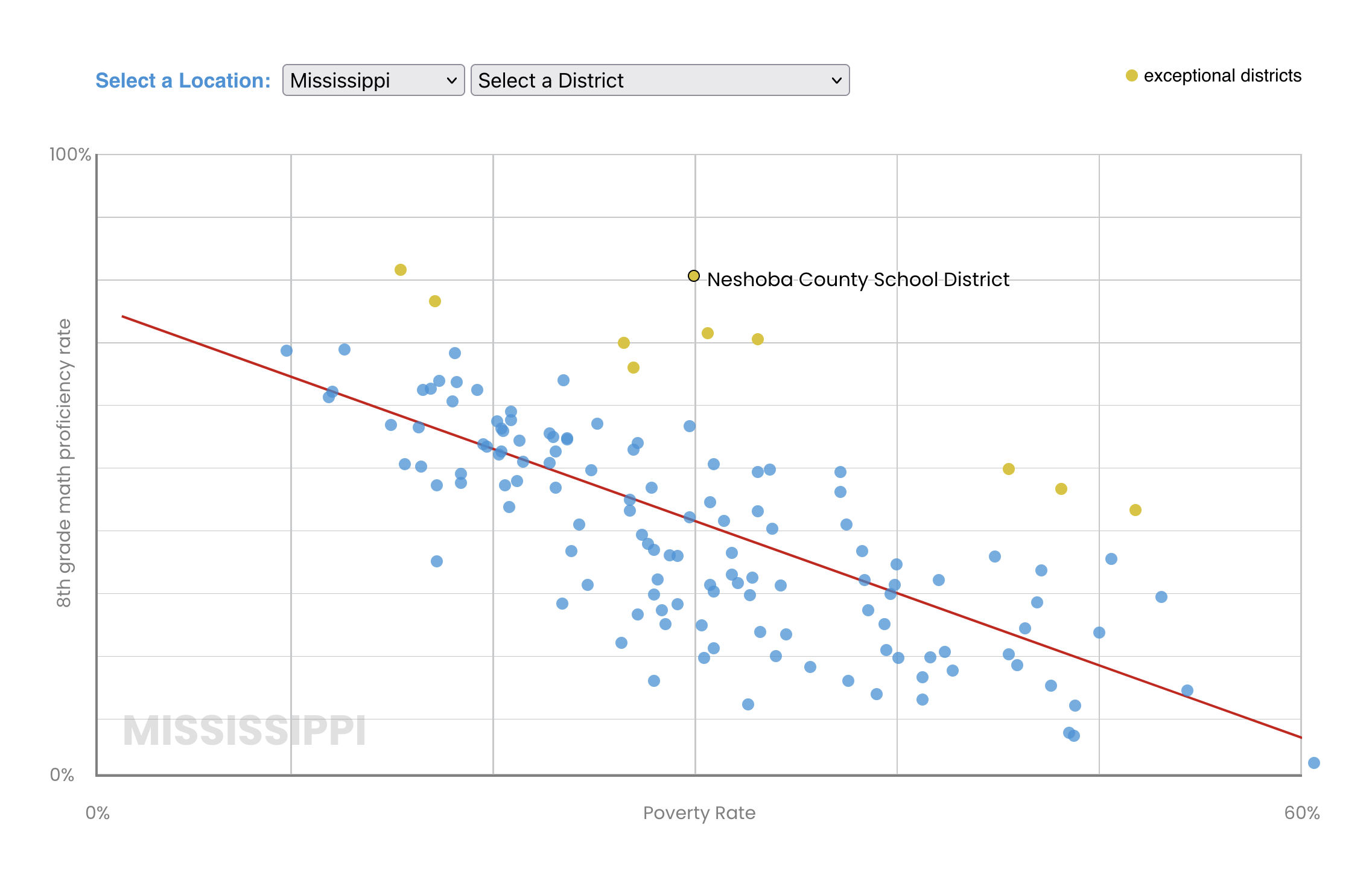
To be blunt, education journalists are mistakenly compelled to focus on the “exceptional” districts (outliers) while ignoring the more compelling red line that, again, shows what, in fact, is normal and what can and should be addressed in terms of educational reform—the negative impact of poverty on educational attainment.
So here is a story you likely will not read: Education journalism is failing public education, and has been doing so for decades.
Education journalists are blindly committed to the “crisis” and “outlier” stories because they know people will read and listen to them.
The “outlier” story makes for a kind of “good” journalism, I suppose, but the problem is that these stories become popular beliefs and then actual legislation and policy.
The current”science of” movement is riding a high wave because of the “science of reading” tsunami. But like all the misguided reforms since the original false education story, A Nation at Risk, this too will crash and reveal itself as a great harm to students, teachers, and our public school system.
This is boring, I know, but most outlier stories are ultimately false or they simply are not replicable or scalable, as I explained in my opening story.
If we genuinely care about student learning, teaching, and the power of public education, we need education journalists more dedicated to the full story and the not the outliers that help drive their viewing numbers.









 dr. p.l. (paul) thomas