On April 28, 1967, Muhammad Ali publicly defied being drafted into the Vietnam War, costing him his heavy-weight title and derailing his career for three years during his prime.
Ali’s willingness to put publicly his name and his words on his beliefs reminds me of James Baldwin’s response to William Faulkner’s call for patience when confronting racism and inequity in the US: “There is never time in the future in which we will work out our salvation. The challenge is in the moment, the time is always now.”
I am also compelled by a central motif in the life and work of historian and activist Howard Zinn, who argued that we cannot be neutral on a moving train. In this era of the second Trump administration, our democracy and academic freedom train is heading off a cliff; we are all on board.
At the end of the first Trump administration, I implored academics to do more, to speak more, to use our academic and intellectual capital to advocate for the marginalized and the vulnerable as well as the core principle of what academics and education must preserve—academic freedom.
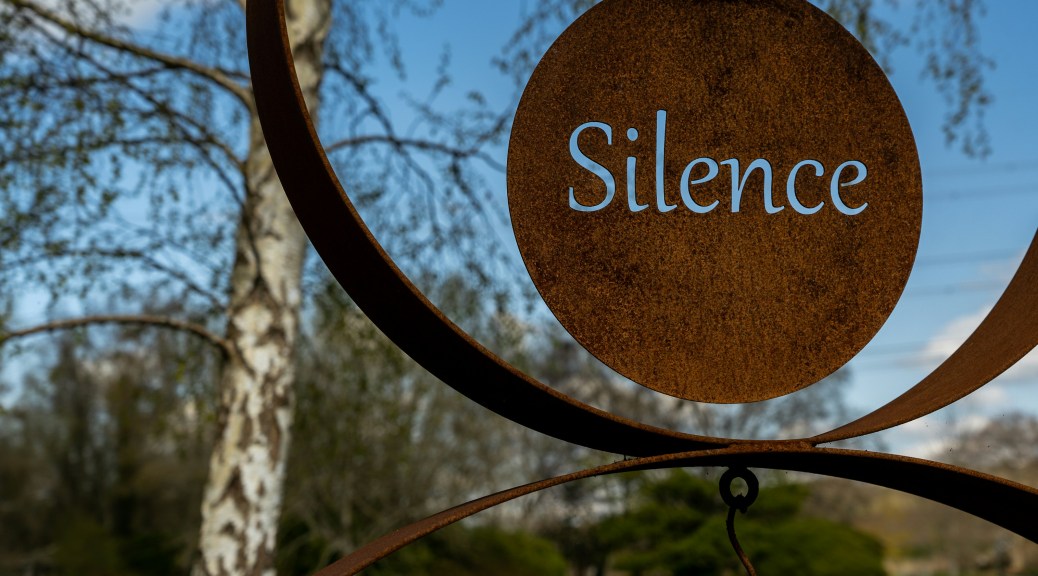
Yet, most academics and colleges/universities remained committed to the “politics of silence” approach to the threats around us.
We have chosen a sort of self-preserving silence, in fact, despite the danger that poses, one confronted by poet Adrienne Rich:
The study of silence has long engrossed me. The matrix of a poet’s work consists not only of what is there to be absorbed and worked on, but also of what is missing, desaparecido, rendered unspeakable, thus unthinkable.
The current political dismantling of K-12 and higher education is an assault on democracy; real people are suffering in inexcusable ways. The values we claim to hold sacred are being destroyed each moment we hesitate, each moment we remain silent, each moment we fail to act.
We academics may believe that the Ivory Tower allows us to protect our community as our only priority, and thus that we must protect that Ivory Tower. But I have witnessed at the highest level of my 41-year career very real and justified fear among college students, staff, and faculty.
A first-year student writing about their journey as a gay child navigating their family expectations concluded an essay with the following chilling recognition: “No one knows what the future holds for the United States now. Unfortunately, what we face is not simply a political matter, but rather, a threat on individual liberty, and I am scared for what will happen in the next four years.”
And for faculty—especially those most vulnerable due to personal status or rank—who have served the academic community as scholars and teachers, the same fear of the uncertain and hostile world beyond the Ivory Tower is directly impacting how and if we teach as we know we should. Many of us have targets on our backs simply for remaining committed to the academic freedom we hold sacred and fulfilling our moral obligation to address diversity, equity, and inclusion.
That Ivory Tower was never protecting anyone; it isn’t protecting us now in that increasingly hostile world.
Therefore, now is not the time to keep our heads down, now is not the time to retreat into the politics of silence.
As a former high school English teacher, I hear constantly in my mind Willy Lohman imploring “the woods are burning,” and I fear if we persist in a “politics of silence” approach, if we bow to cultural expectations that education and educators must appear to be politically neutral, that fire will consume us all.
We could be better than that, we should be better than that.
The world is at least fifty percent terrible, and that’s a conservative estimate, though I keep this from my children.
…This place could be beautiful, right? You could make this place beautiful.
Ultimately, we must make a decision, one reflected in William Butler Yeats’s enduring poem:
The best lack all conviction, while the worst Are full of passionate intensity.
The time is now to reject the politics of silence that brought us here, to speak and act in the name of academic freedom, in the name of our students walking our campuses now but who must enter the very real world burning around them.
We, the faculty of Furman University, in our role as stewards of this institution, reaffirm Furman’s mission to support “rigorous inquiry, transformative experiences, and deep reflection.” This mission calls us to preserve a community where freedom of thought and expression is actively defended, even when doing so is costly.
We are gravely concerned that our mission is in danger. Growing political pressures seek to curtail international education, narrow institutional autonomy, restrict academic freedom, and suppress open discourse. These pressures—whether through legislation, policy threats, or public intimidation—undermine the core values of the liberal arts and the very foundation of higher education. The coercive tactics used to enforce such restrictions jeopardize not only our institutional mission but also the well-being of individuals who contribute to it—students, employees, and the communities we serve.
We are troubled to see other institutions respond to these pressures by compromising their values, narrowing the boundaries of inquiry, and chilling protected speech. Furman must not follow this path. Our Statement on Free Expression and Inquiry is based on the “foundational belief that diverse views and perspectives deserve to be articulated and heard, free from interference.”
Furman’s leadership must continue to support policies that safeguard expression, uphold human dignity, and foster inclusive dialogue. As faculty, we pledge to defend these commitments, and to hold ourselves and our institution accountable to them—especially in moments of crisis.
To that end, we assert that we will not betray the following principles:
Academic Freedom is Nonpartisan and Nonnegotiable
We will not permit external pressures to determine what or how we teach, whom we hire, or the direction of our research. Furman’s academic mission exists not to serve ideology, but to pursue truth through open, critical, and disciplined inquiry.
Free Inquiry is Foundational to a Learning Community
In accordance with Furman’s Statement on Free Inquiry, we commit to defending the right of all members of the Furman community to express differing—even controversial—views without fear. Offense is not a sufficient justification for censorship.
Dignity, Respect, and Inclusion Enhance—Not Inhibit—Freedom of Thought
We affirm the worth of every individual and the necessity of diverse voices in the search for understanding. We reject any effort to pit freedom of expression against the dignity of persons; both are essential to a thriving community.
Solidarity with Vulnerable Members of Our Community
We will advocate for and protect students, faculty, and staff who may be targeted due to their political beliefs, immigration status, or identity. Furman must remain a place of open and active inquiry—not surveillance or exclusion. Faculty will use our academic freedom and resources to push for legal protection and other support for any of our campus community who requests it in the face of bullying and intimidation.
We affirm our responsibility not only to preserve Furman’s mission in the present, but to also ensure that in years to come, we can look back with pride—knowing that we upheld the values that make this university a place of real learning, meaningful dialogue, and thriving community.
Every white person in this country—and I do not care what he or she says—knows one thing. They may not know, as they put it, “what I want,” but they know they would not like to be black here. If they know that, then they know everything they need to know, and whatever else they say is a lie.
And then, just a few years later, there is Margaret Atwood’s The Handmaid’s Tale, specifically the closing “Historical Notes” where readers learn about the context behind how Gilead comes about.
At a satirical symposium in Gileadean studies dated June 25, 2195, the keynote, Professor James Darcy Pieixoto, explains that context:
Men highly placed in the regime [of Gilead] were thus able to pick and choose among women who had demonstrated their reproductive fitness by having produced one or more healthy children, a desirable characteristic in an age of plummeting Caucasian birthrates, a phenomenon observable not only in Gilead but in most northern Caucasian societies of the time.
The reasons for the decline are not altogether clear to us. Some of the failure to reproduce can undoubtedly be traced to the widespread availability of birth control of various kinds, including abortion, in the immediate pre-Gilead period. Some infertility, then, was willed, which may account for the differing statistics among Caucasians and non-Caucasians.
…But whatever the causes, the effects were noticeable, and the Gilead regime was not the other one to react to them at the time. Rumania, for instance, had anticipated Gilead in the eighties by banning all forms of birth control, imposing compulsory pregnancy tests on the female population, and linking promotion and wage increases to fertility.
What are these texts from over four decades ago telling us about the current political and cultural state of the US during the era of Trump/MAGA?
White Americans, notably the white political and cultural leaders, are openly concerned about the low birthrate among white people. And thus, restricting and banning abortion have swept much of the country after the overturning of Roe v. Wade. [1]
Not that long ago, mainstream thinkers believed Roe v. Wade and abortion rights were safe in the US; people raising concerns were considered alarmists.
Now, as Republicans and conservatives seem to be coming after birth control next, we cannot hesitate as we did before the dismantling of women’s rights came as we should have known it would.
In the passage from the “Historical Notes,” we have a key point about the birthrates of white people falling against the rise of birthrates about other races.
And thus, the connection to Baldwin’s confronting “every white person in this country—and I do not care what he or she says—knows one thing. … [T]hey would not like to be [B]lack here.”
Not to speak for or over Baldwin, but to help us tease out this connection in 2025, white fear in the US is fear not singularly grounded in race but ultimately fueled by the fear of becoming a minority.
We must next consider fully Baldwin’s recognition that for white people, Black people and the consequences of their minority status in the US are a mirror for who white people are—more so than any commentary on Black people themselves.
For all the histrionics denying white privilege, white people know one thing—that white people as the majority, that white people with the balance of power, used that majority status and power to the detriment of any and all minorities.
If and when white people become the minority, they fear that they will then suffer the same consequences of minority status that white people have imposed on other races in the US.
White people cannot fathom a world in which majority and minority statuses do not result in some winning because others are losing.
The Great Whitewashing is upon us—one foreseen by Baldwin and Atwood.
One that is coming to fruition before our eyes.
What every white person knows may destroy everything for everyone.
What each white person does now will tell everyone everything we need to know.
My mother was extremely smart and had a remarkable sense of humor. Even at the worse moments in her life, she found humor and insight. One day, as my sisters and I were playing (and fighting) in the house because of rainy weather, she called out to none, some or all of her three children, “Hey, do you want to know a way to lose twenty pounds of ugly fat?” We stopped our bickering and turned to her, waiting for her to reply to her own question. “Cut off you’re your head,” she said and quietly continued making dinner. Her remark cut through the tension and led to some whole-hearted laughter.
I think of my mom today as I try to understand what it means for a country to work on becoming more efficient. My mom was right: your body would be twenty pounds lighter if you removed your head. That’s an efficient solution to a weight problem. The problem is the effect: you’d most certainly die. Indiscriminately removing something that’s weighty may not be good for the body of the whole.
In a country striving to be a democracy, the tension between efficiency and effect is crucial. Tom Paine said that in a democracy, law is king, and in a monarchy, the king is law. The latter is an efficient way to get laws made and enforced, with the king having power over both the laws and their implementation. The problem is the effect on the people living within the country in that they all work for the king, for the perpetuation of the monarchy, and suffer at the king’s whims, desires, moods, needs, and temperament. The effect on the people is that they are essentially enslaved.
In contrast, in a democracy, when the law is the king—meaning it’s the center of organization, structure, and power—things are much more complicated because the government is obligated to consider its impact on all the people. In a representative democracy, like the one in our country, those that represent us are morally, ethically, and legally bound to the good of all. A democracy is organic, meaning that it changes over time as our understandings of life, liberty, and the pursuit of happiness are informed by our deepening understanding of what it means to be a human being. We learned about, understood and acted upon slavery, putting Japanese people in internment camps, workers’ rights, women’s right, voting rights, civil rights, and so much more.
Our growing knowledge also causes tension as, for example, outlawing the owning of slaves affected the economy and led to war. But we adjust because of our deep-rooted belief in and commitment to a country that offers the potential for every human being to realize and act upon all that they can do. In other words, a democracy is not always efficient because the effects that efficiency has matter.
Cutting Medicaid is efficient: money is saved. The effect is that people without economic means lose access to medical care that keeps them alive.
Cutting social security is efficient: money is saved. The effect is that people lose their earned deferred income—money they were forced by law to set aside for their future and their quality of life deteriorates to the point of losing their homes, dignity, and peace in their later years.
Cutting the department of education is efficient: money is saved. The effect is that schools lose essential aid, programs that protect health and civil rights, support for reading instruction, research programs, and even statistical analyses of progress.
Cutting funding of scientific research is efficient: money is saved. The effect is that research that can save lives, improve our food and water, keep our air clean, make communities safer, improve mental health and so much more is lost.
Cutting funding for the arts is efficient: money is saved. The effect is that beauty does not matter, expression is marginalized, and the voices that push our thinking and being are silenced.
Cutting support for programs in other countries is efficient: money is saved. The effect is that more people die of AIDS and other diseases, more children die of starvation, countries are left unprotected against radicals, and oppressed people no longer hear voices of hope.
We should not fall prey to chaos, attacks on a free press that expose chaos and selfishness, and the push to simplify the complexity of our democracy. We need to demand that every member of our government safeguards our well-being, demands that programs for the good of all are replenished, and uncovers who is getting the money that is supposedly being saved. We need to make sure that our heads are not being cut off to reduce our weight.
Rick is an activist and retired literacy researcher.
It seems not just a different time, a naive time, but an entirely different world—the conservative backlash against “Black Lives Matter” spawning the “All Lives Matter” response.
Even the “Blue Lives Matter” companion backlash now feels far less sinister than at the time.
But many of us always knew these conservative slogans were insincere, masking a much more insidious intent.
Now that we have allowed Trump 2.0 and the full rise of the MAGA movement (recall when people believed that Project 2025 wasn’t part of the Trump 2.0 plan?), the veneer has been dropped.
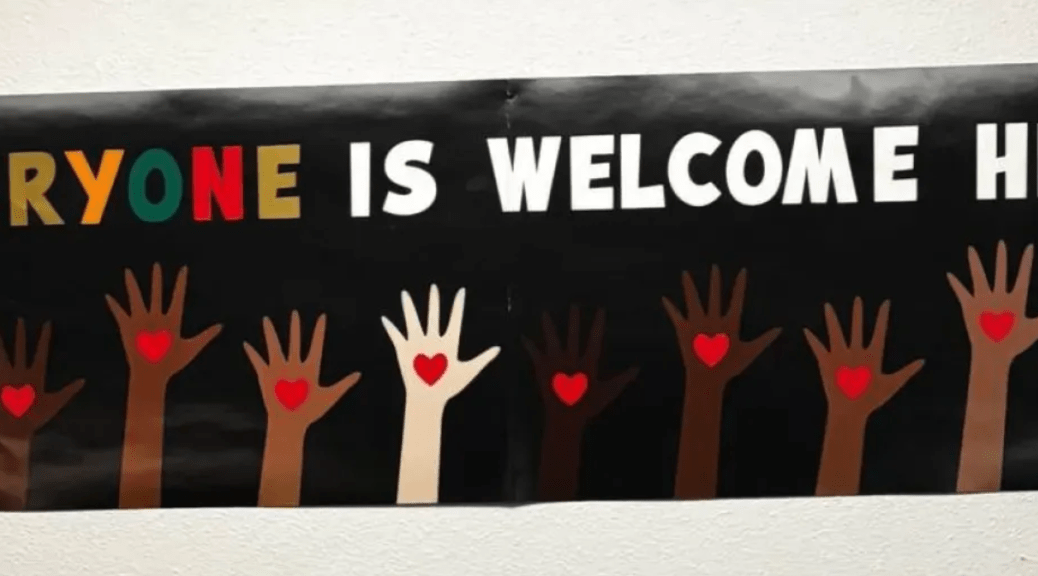
A teacher in Idaho has been told to take down her “Everyone Is Welcome Here” signs. But the most disturbing aspect of this event is the explanation:
In emails shared by the district with the Idaho Statesman, Marcus Myers, the district’s chief academic officer, told Inama to remove the signs because they violated Idaho’s Dignity and Nondiscrimination in Public Education Act, as well as school policy, which requires signs to be “content neutral and conducive to a positive learning environment.”
The district also mentioned to the Statesman that, if it is enacted into law this legislative term, House Bill 41 will force schools to comply with a measure that bans “flags or banners that present political, religious, or ideological views, including but not limited to political parties, race, gender, sexual orientation, or political ideologies.”…
When discussing the “Everyone is welcome here” sign, the district told the Statesman that it was not the message that was at issue, but rather the hands of different skin tones on the poster.”
While ‘Everyone is welcome here’ is a general statement of being welcoming, concerns arose around the specific visual presentation of the signs in question and whether they aligned with district policies on classroom displays,” Scheppers said in an email.
A visual representation of different races now breaks the law in public schools serving the children of this country.
Public schools serving a population of students who themselves are different races.
Those of us warning about the racism and the rise of white Christian nationalism in the Republican party have been rejected, marginalized, and even attacked for decades now.
Not Reagan.
Not Bush One.
Not W. Bush.
And Trump 1.0 was just a buffoon, a clown.
The veneer mostly worked across mainstream America, and anyone seeing behind the facade was the enemy. The problem with this country.
At the end of Trump 1.0, the veil was pulled back as the attacks on CRT ramped up in his last months in office.
Regretfully, the Biden respite allowed mainstream apathy to win out. Again.
Statistically, almost no one in the US is trans, and certainly, almost no athletes are trans in high school and college sports.
But the outsized rage over a minority group tells a story that we cannot ignore. Or we can ignore, but it will be to the peril of everyone.
Because everyone is not welcome here.
MAGA is a people obsessed with other people’s lives and not their own. MAGA is driven by hate, fear, and spite for other people’s happiness because MAGA believe they are safely the “normal” people and they are simply demanding everyone else be normal too.
This is the essential problem with “normal,” since it almost always becomes “right” and then a way to weaponize political power.
History and diversity are being attacked and erased to create a white nationalist state in the US.
Anyone now seeing that claim as extreme is simply being willfully ignorant of the gears of history grinding over a nation that never achieved the freedom it espoused, but until recently seemed mostly committed to that aspiration.
Denying rights and deporting human beings are now the American values replacing life, liberty, and the pursuit of happiness.
“Black Lives Matter” was never an offensive or divisive slogan.
“Give me your tired, your poor, Your huddled masses yearning to breathe free, The wretched refuse of your teeming shore. Send these, the homeless, tempest-tost to me, I lift my lamp beside the golden door!”
My cynical self believes this was always a lie, an aspiration for humans that was beyond our capacity as a species.
My cynical self comes back to this again and again, an eerily relevant warning about our current second coming:
Turning and turning in the widening gyre The falcon cannot hear the falconer; Things fall apart; the centre cannot hold; Mere anarchy is loosed upon the world, The blood-dimmed tide is loosed, and everywhere The ceremony of innocence is drowned; The best lack all conviction, while the worst Are full of passionate intensity.
I teach an upper-level writing and research course for undergraduates as part of their general education requirements. The overarching project asks students to gather media coverage of an education topic in order to analyze the credibility of that coverage.
Since the course is undergraduate, I ask them to approach their analysis through critical discourse analysis, but I narrow that lens some for them. The process includes the following:
Identify the pattern of claims about the topics.
Evaluate the validity of the claims in the context of a literature review of the educational topic (limited to peer-reviewed, published recent journal articles).
Consider whose interests these claims serve (the CDA element).
I note that claims about education in the media tend to fall in a range of accurate, misleading, and false; however, for this analysis, identifying whose interest the claims serve is the key aspect of the evaluation.
False and accurate claims are typically easy to manage for students, but the misleading claims can be complicated.
For example, in public discourse about police shooting victims, two accurate data points are often cited: The majority of people shot and killed by police in the US are white and Black people are shot and killed at a higher rate than white people.
Failing to address both data points and clarifying why rates are more important than raw data contributes to media coverage being misleading, and thus, selectively emphasizing true data is often a form of manipulation and serves a particular population or ideology.
With another release of NAEP reading and math scores, we have an opportunity to address how media and political leaders tend to offer false and misleading claims based on NAEP score, but also, that NAEP itself serves to perpetuate the manufactured education crisis, which benefits the media (more clicks), political leaders, and the education market place.
Regardless of what national and state scores on NAEP are, the foundation of media and political claims is always “crisis.”
Ironically, perpetual “crisis” rhetoric and education reform since the early 1980s has had one clear outcomes—maintaining the status quo of educational and socioeconomic inequity in the US.
To consider this, let’s focus on Massachusetts and Tennessee.
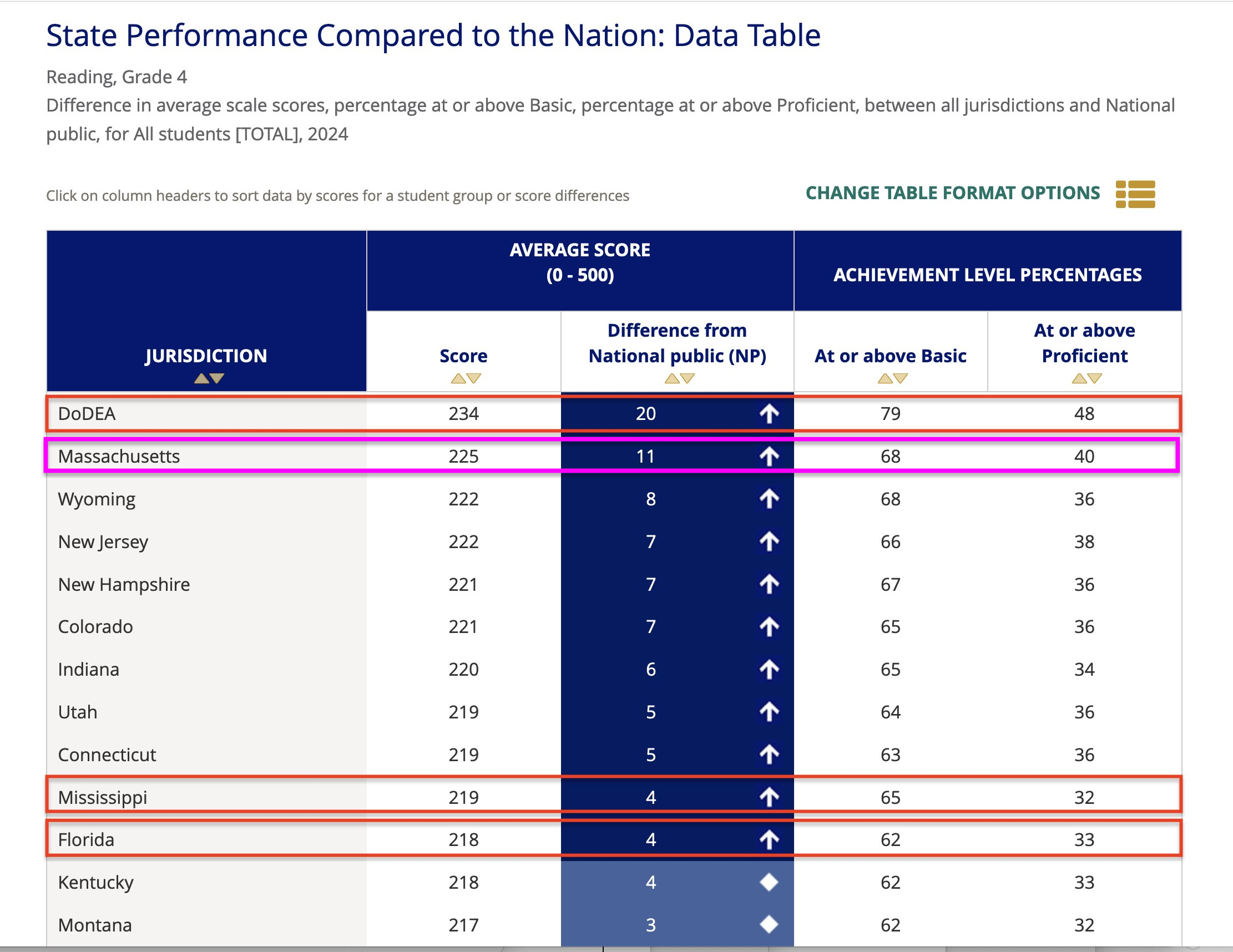
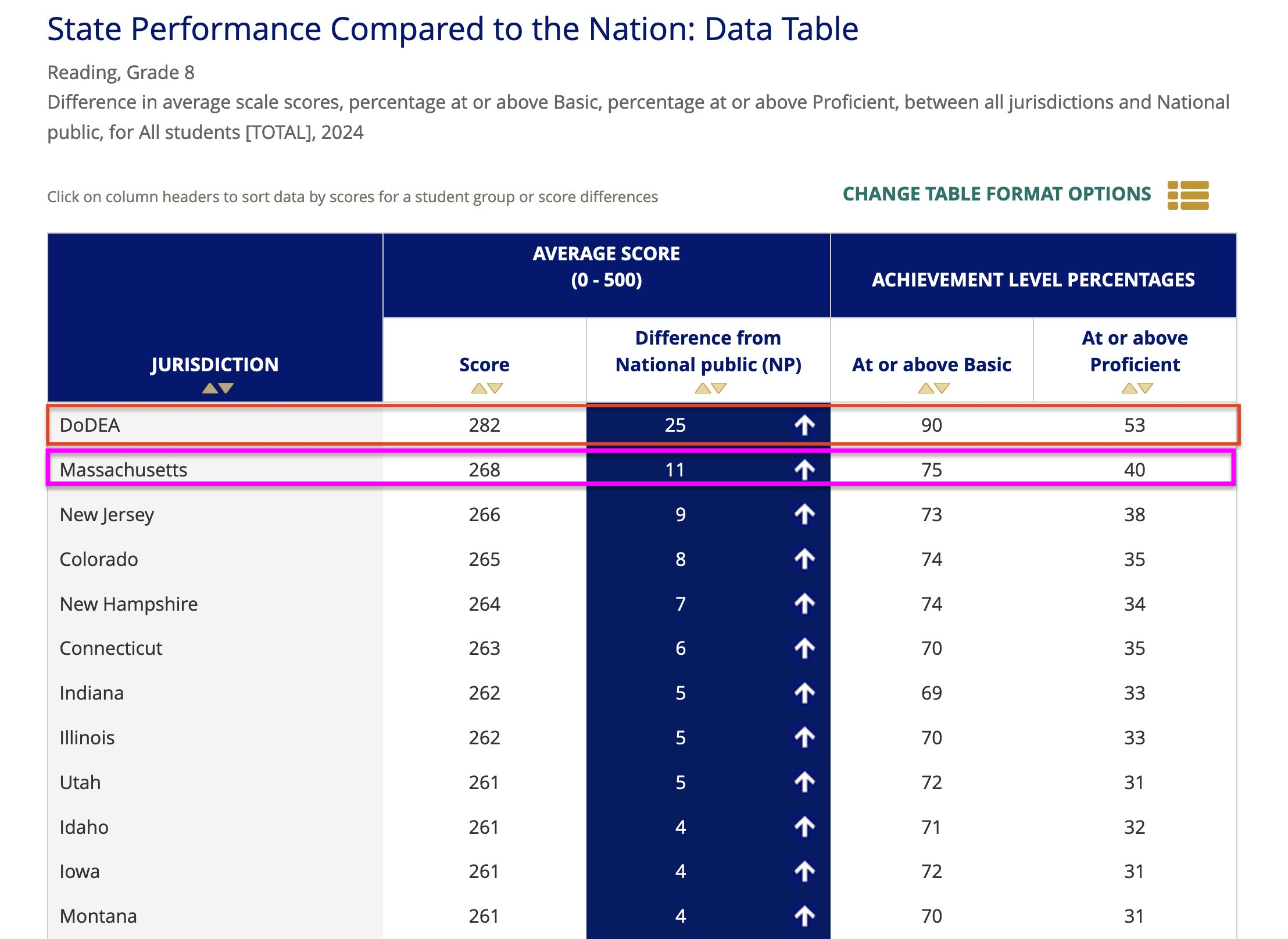
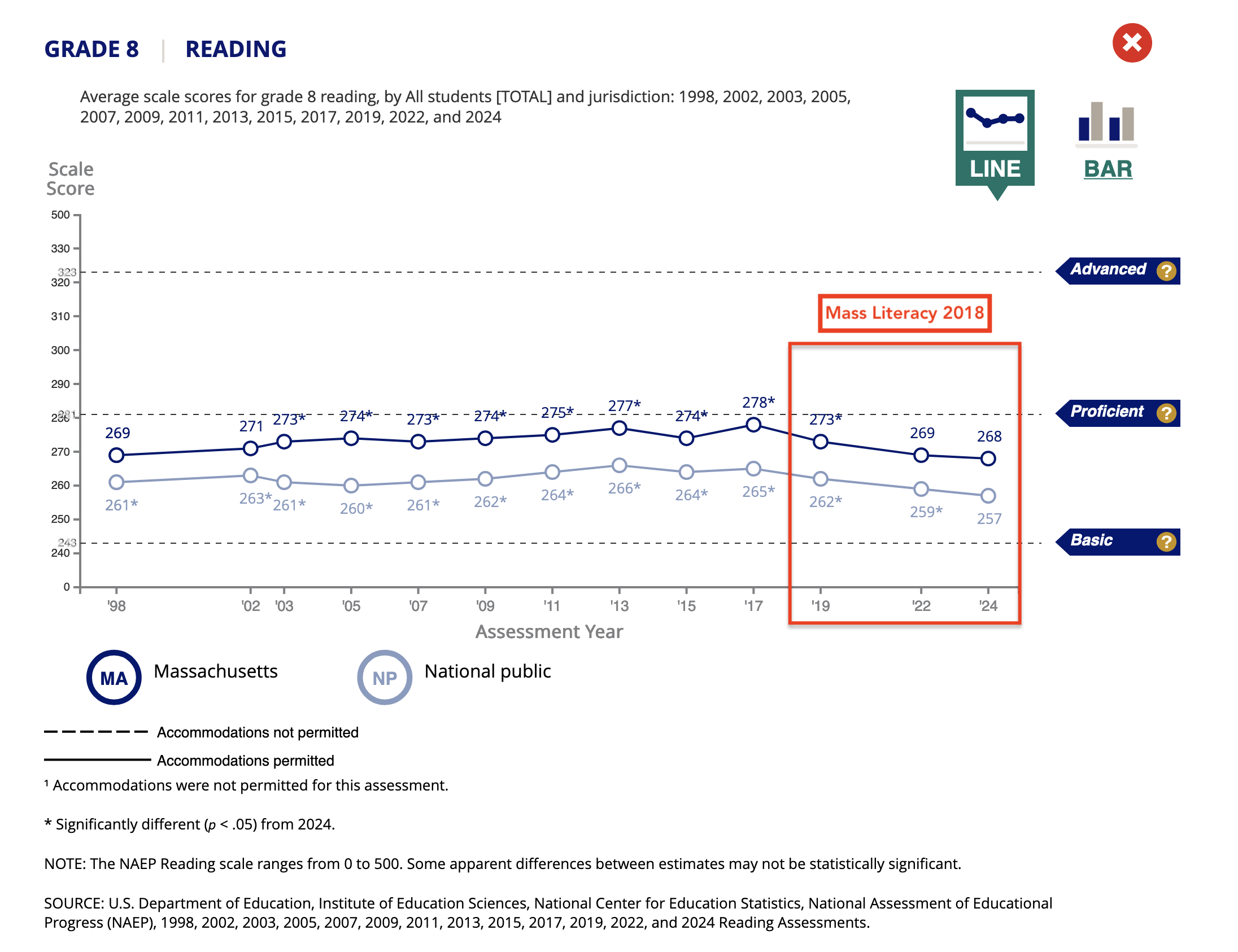
Other than top-scoring DoDEA schools, MA sits atop reading scores in the US in both grades 4 and 8:
As a relatively low-poverty state, MA should rank above states with higher poverty students. However, MA certainly serves students in pockets of poverty as well as other vulnerable populations of students who tend to have low standardized test scores.
None the less, MA has joined the standard chorus in the US about reading. The Education Trust released a report in March 2024 providing “5 Things You Need to Know about the literacy crisis in Massachusetts.”
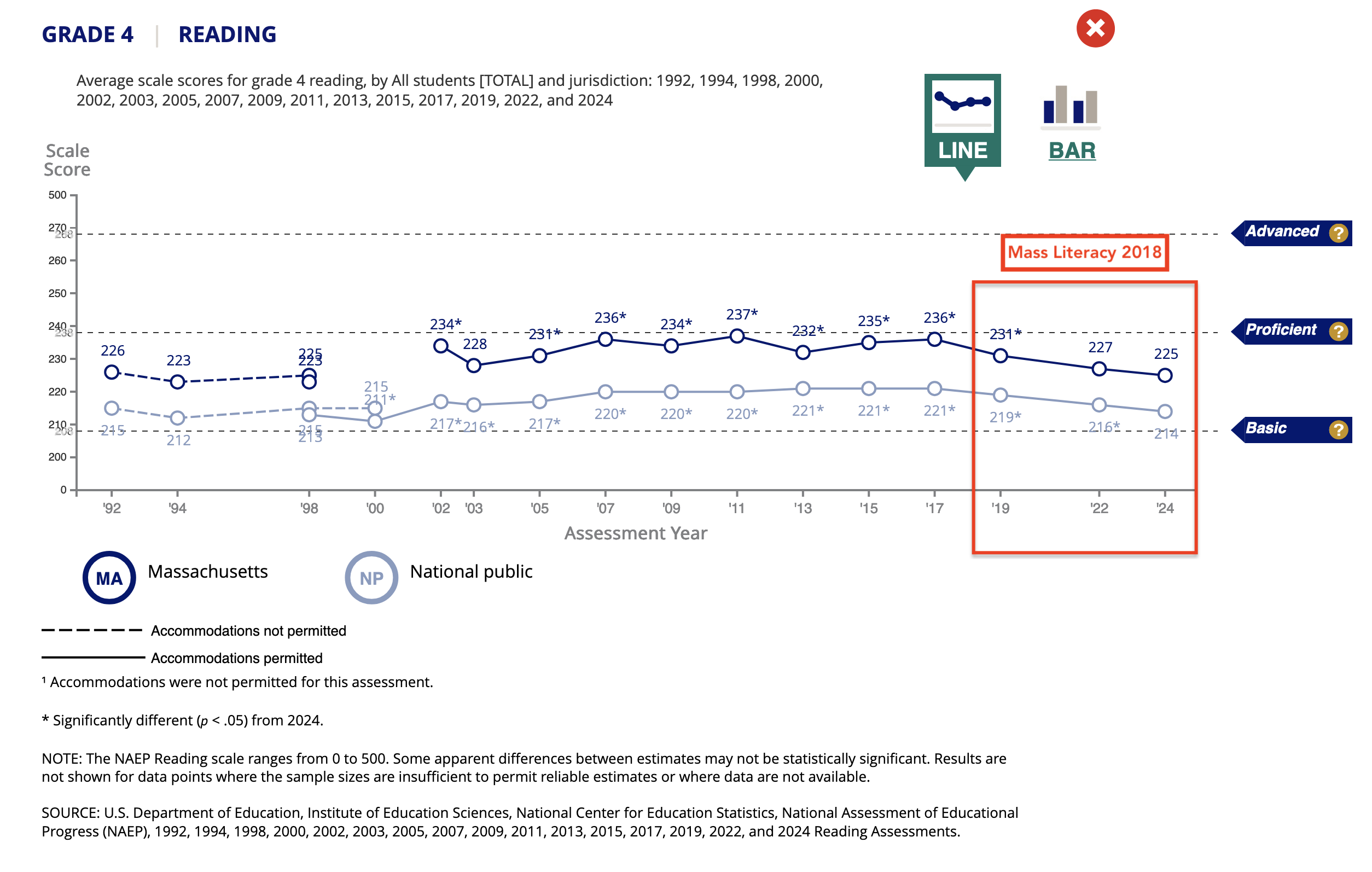
To be fair, MA is similar to most of the US where standardized tests scores have dropped post-Covid and those drops have coincided with MS’s Mass Literacy initiative from 2018:
Perpetual reform and perpetual crisis in education, regretfully, seems only to fuel more reform and more crisis.
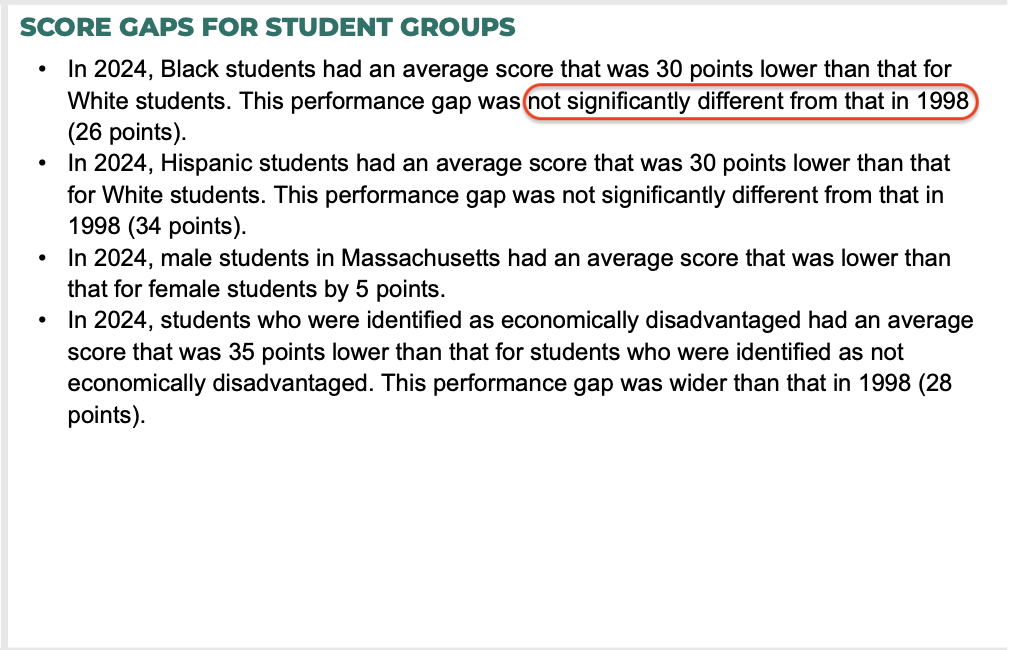
Note that MA also has something in common with almost all states regardless of whether states have high or low NAEP results. Achievement gaps by race and socioeconomic status have remained fixed for almost three decades:
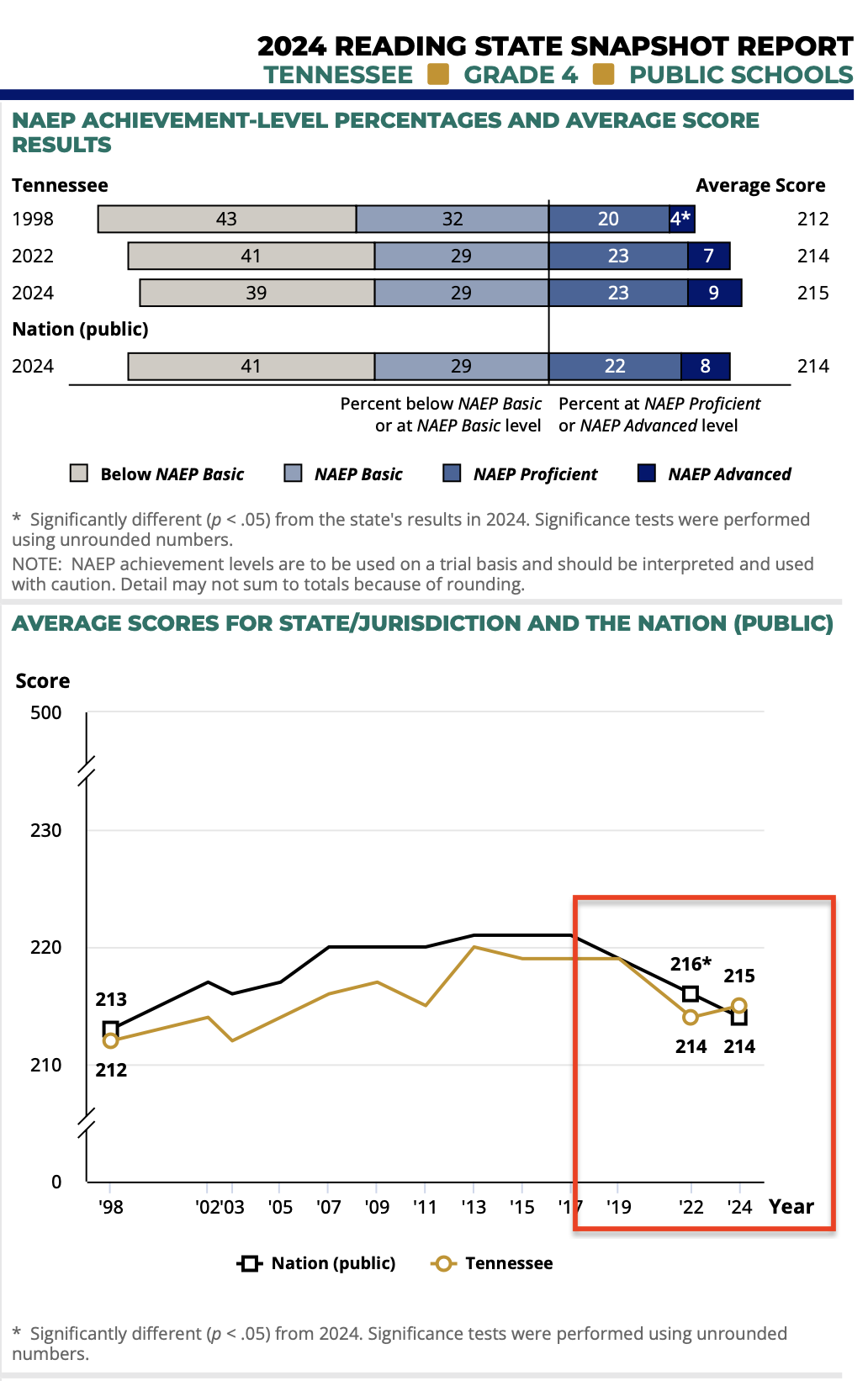
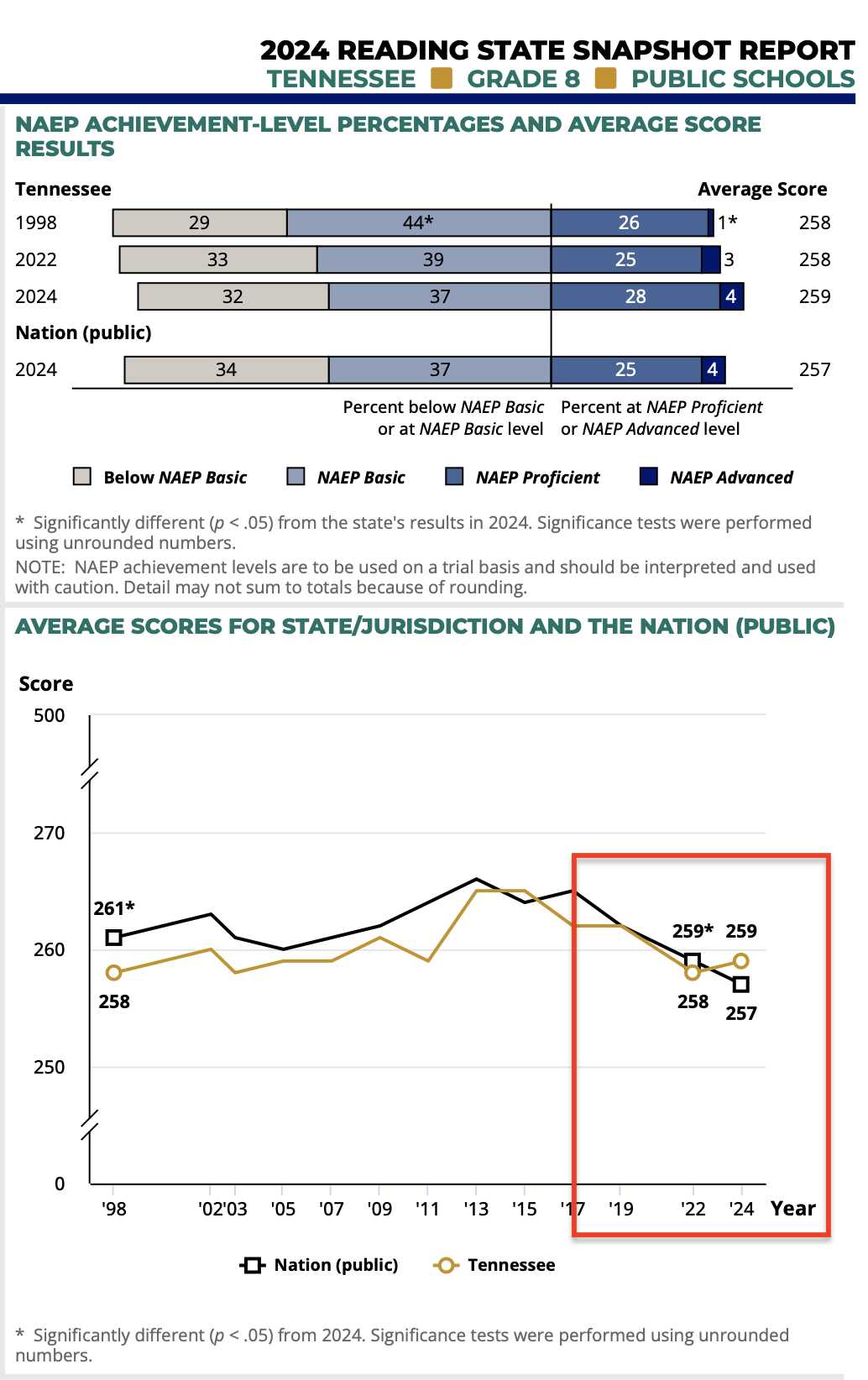
While a top-scoring state like MA is shouting “crisis” primarily based on a sort of national psychosis about the “science of reading,” TN is trying to have it both ways with a reading crisis and a celebration of 2024 NAEP scores.
An October 2023 report from the TN Department of Education, “Tennessee’s Commitment to Early Literacy,” forefronts the “Literacy Crisis in Tennessee” based on (you guessed it) historically poor rankings in NAEP reading scores.
One important point here is that the media and political discourse tend to focus on “bad” statistics such as rankings and averages—which is how TN establishes their “crisis.”
For political leaders, “we have a crisis” and “I have saved us from the crisis” are not a sequential series of events, however, but a permanent rotation.
So why this positive spin for TN?
While the national average on NAEP reading has dropped, TN has experienced in 2024 a slight uptick. Because most everyone else was dropping, then, TN has seen a rise in their rankings (a key example of why ranking is a “bad” statistic).
Important again is that like MA and most states, TN scores for racial and socio-economic gaps remain fixed: “This performance gap was not significantly different from that in 1998.”
These responses to NAEP by MA and TN reveal a stark lesson that NAEP serves the interests of the media, politicians, and the education market place, but at least since 1998, NAEP hasn’t provided the data needed for any sort of genuine education reform or analysis.
Education is a political and market football, in fact.
Here are a few better takeaways from NAEP:
NAEP’s achievement levels are designed to be confusing and support the manufactured education crisis (see here).
Using NAEP to rank and sort is misleading and doesn’t support needed reform.
NAEP scores do offer some important facts related to achievement gaps and the pervasive influence of affluence and poverty on educational outcomes, but the media and political leaders choose to ignore those lessons.
Decades of NAEP reinforce this conclusion by Maroun and Tienken: “Policy makers and education leaders should rethink the current reliance on standardized test results as the deciding factor to make decisions about student achievement, teacher quality, school effectiveness, and school leader quality. In effect, policies that use standardized test results to evaluate, reward, and sanction students and school personnel are doing nothing more than rewarding schools that serve advantaged students and punishing schools that serve disadvantaged students.”
Media persist in focusing on only two stories about education: Crisis and outliers; both of which serve the interests of anyone expect students and teachers.
Like my students in my upper-level writing and research course, we would all benefit from evaluating the claims being made by media and political leaders in order to determine, first, is the claims are true (they often as misleading or false), and then to confront in whose interests these claims are being made.
Maybe this isn’t surprising given the current and historical political climate in the US, but almost never are the interests of students and teachers being served—especially when the interests of the most vulnerable students are the issue.
“The available research does not ratify the case for school cellphone bans,” writes Chris Ferguson, professor of psychology at Stetson University, adding, “no matter what you may have heard or seen or been [told].”
What Ferguson then offers is incredibly important, but also, it exposes a serious lack of awareness by Kappan considering their coverage of education:
And the media treatment has played a part in amplifying what can only be described as a moral panic about phones in schools.
News media often cater to panics, neglecting inconvenient science and stoking unreasonable fears. And this is what I see happening with the issue of cellphones in schools.
First, Ferguson’s characterizations of media coverage of education—”News media often cater to panics”—is not only accurate but matches a warning many scholars and educators have been offering for decades, especially during five decades of high-stakes accountability education reform uncritically endorsed by media.
The only story education journalists seem to know how to write is shouting crisis and stoking panic.
Just a couple days ago in The Hechinger Report, this headline, “6 observations from a devastating international math test,” is followed by this lede: “An abysmal showing by U.S. students on a recent international math test flabbergasted typically restrained education researchers. ‘It looks like student achievement just fell off a cliff,’ said Dan Goldhaber, an economist at the American Institutes for Research.”
And for a century, in fact, education journalism has been persistently fostering a “moral panic” about reading proficiency by students.
Here is Nicholas Kristof in the New York Times: “One of the most bearish statistics for the future of the United States is this: Two-thirds of fourth graders in the United States are not proficient in reading.”
Kristof is but one among dozens in the media repeating what constitutes at best an inexcusable mischaracterization and at worst a lie about what exactly NAEP testing data show about reading achievement in the US.
Nearly every media story about reading in the US since Emily Hanford launched in 2018 (and then repackaged as a podcast) the popular mischaracterization/lie has dutifully “amplif[ied] what can only be described as a moral panic” about reading achievement and instruction:
The stakes were high. Research shows that children who don’t learn to read by the end of third grade are likely to remain poor readers for the rest of their lives, and they’re likely to fall behind in other academic areas, too. People who struggle with reading are more likely to drop out of high school, to end up in the criminal justice system, and to live in poverty. But as a nation, we’ve come to accept a high percentage of kids not reading well. More than 60 percent of American fourth-graders are not proficient readers, according to the National Assessment of Educational Progress, and it’s been that way since testing began in the 1990s.
Ferguson’s warning about the misguided panic over cell phones in schools and the resulting rush to legislate based on that misguided panic is but a microcosm of the much larger and much more dangerous media misinformation about reading and the rise of “science of reading” (SOR) legislation.
We should heed Ferguson’s message not just about cell phones in schools but about the vast majority of media coverage of education and then how the public and political leaders overreact to the constant but baseless moral panics.
Yes, I am glad Kappan included Ferguson’s article, but I wish Kappan‘s The Grade and all education journalists would pause, take a look in the mirror, and recognize that his concern about media coverage of cell phones easily applies to virtually every media story on education.
In fact, I encourage The Grade and other education journalists to implement Ferguson’s “Red Flags” when considering education research, specifically the SOR story being sold:
RED FLAG 1: Claims that all the evidence is on one side of a controversial issue….
RED FLAG 2: Reversed burden of proof. “Can you prove it’s not the smartphones?”…
RED FLAG 3: Failing to inform readers that effect sizes from studies are tiny, or near zero, only mentioning they are “statistically significant.”…
RED FLAG 4: Comparisons to other well-known causal effects.
As I and others have repeatedly shown, the SOR stories fails all of these Red Flags.
There is no debate at this point among scientists that reading is a skill that needs to be explicitly taught by showing children the ways that sounds and letters correspond.
“It’s so accepted in the scientific world that if you just write another paper about these fundamental facts and submit it to a journal they won’t accept it because it’s considered settled science,” Moats said.
And this refrain is at the center of SOR advocacy, media coverage, and the work of education journalists: “Hanford pushed reporters to understand the research on how students learn to read is settled.”
Ultimately, the moral panics around education have far more to do with media begging for readers/viewers, education vendors creating market churn for profit, and politicians grandstanding for votes.
In the wake of education journalists repeatedly choosing to “cater to panics,” students, teachers, and education all, once again, are the losers.
Since I have recently challenged the word magic behind claims that education is the one true path out of poverty and that the free market can ever address poverty and inequity, I want to highlight that the unwillingness of political leaders and the public to acknowledge the importance and potential of the Commons results in a refusal to end directly poverty and confront privilege.
We could effectively end child poverty now, at least in the short run. The question is whether we’re willing to do that.
If the United States offered cash benefits to children in poor families, we could cut child poverty by more than half. According to calculations using the 2012 Current Population Survey, poor children need $4,800 each, on average, to escape poverty. That’s $400 a month for each child.
If we issued a $400 monthly payment to each child, and cut tax subsidies for children in higher-income families, we would cut child poverty from 22 percent to below 10 percent. If we further guaranteed one worker per family a job paying $15,000 a year, and each family participated, child poverty would drop to under 1 percent.
A child benefit is now common across developed countries, with amounts of about $140 a month in the UK, $190 in Ireland, $130 in Japan, $160 in Sweden, and $250 in Germany. A smaller child benefit of $150 per month would chop child poverty from 22 percent to below 17 percent. Adding the job guarantee would lower child poverty to 8 percent.
As important as the need and ability to end poverty directly is the need to face the power of privilege, as detailed by Richard Fry’s The growing economic clout of the college educated. Note specifically the following data displays:
Fry explains the growing disparity:
For the first time on record, households headed by someone with at least a bachelor’s degree received nearly a majority (49.7%) of aggregate U.S. household income; nearly one out of every two dollars went to the college educated. In 2012 one-in-three households was college educated, so, put another way, half of the aggregate U.S. income goes to one third of the households.
Buried in the strong correlation between level of education attained and household income is the very real causational relationship between privilege and access to that education (both the quality and attainment). While it remains statistically true that higher earning is associated with higher educational attainment, it is also likely that higher educational attainment is simply a marker for the privilege that led to that attainment.
The evidence is overwhelming that poverty and affluence are destiny, that inequity is growing in the U.S., and that the best and most effective methods for ending poverty and closing the equity gap is through direct action by our publicly funded institutions (and not waiting on the magic of the Invisible Hand).
Writing about writing instruction, Lou LaBrant, in “The Individual and His Writing” (Elementary Education, 27.4, April 1950) sounded an alarm about “word magic”:
There is other sematic knowledge with which our students should become familiar. They should discover the danger in word-magic, that calling a man by a name does not necessarily make him what we say; that describing the postal system as socialist does not transfer our mail to Moscow, nor brand either the writer or the postman as disciples of Stalin. We must teach our students that words are symbols which they use, and that there is stupidity in word magic. (p. 264)
While LaBrant’s message about powerful and clear writing—as well as powerful and clear thinking—remains important lessons for students, it appears that there remains political advantage in word magic, particularly in how leaders frame discussions of education in the U.S. and the importance of the free market.
For example, a persistent refrain from self-proclaimed education reformers, political appointees, and government leaders is “poverty is not destiny.” However, in the U.S. poverty is demonstrably destiny, as is affluence.
“Poverty is not destiny” is word magic, but it doesn’t make that come true. A more credible claim, an ethical claim, is “poverty should not be destiny,” and then we need to do something about it.
In fact, the entire accountability era of education reform built on standards and high-stakes testing along with a variety of market-based reforms is driven almost entire by word magic, and not evidence. Huge claims such as the U.S. economy depends on a world-class public school system continue to dominate public discourse despite decades of research that show little or no positive correlation among test scores, international education rankings, and economic competitiveness. None.
There are, then, two powerful but misleading forms of word magic that must be confronted before genuine and significant education reform can occur in the U.S.: (1) the ability of public schools to overcome poverty, and (2) the ability of the free market to eradicate poverty and inequity. [In short, both are lies.]
So, you are 2.5x more likely to be a rich adult if you were born rich and never bothered to go to college than if you were born poor and, against all odds, went to college and graduated. The disparity in the outcomes of rich and poor kids persists, not only when you control for college attainment, but even when you compare non-degreed rich kids to degreed poor kids!
Therefore, the answer to the question in the title is that you are better off being born rich regardless of whether you go to college than being born poor and getting a college degree.
And thus, turning next to Michelle Rhee’s use of word magic, Bruenig explains:
But I come in when Loomis writes this about Rhee: “Rhee says that we can’t solve poverty until we solve education. This is absurd on the face of it.” Anyone who says this is an enemy of poor people, full stop. And there are plenty. Recall earlier Arne Duncan said it: “What I fundamentally believe and what the president believes […] is that the only way to end poverty is through education.”
To be super clear, let’s distinguish between three claims here:
Education is a way to end poverty.
Education is the best way to end poverty.
Education is the only way to end poverty.
These are all false….
In the U.S., poverty is destiny, but poverty should not be destiny. As well, education is not the one true way out of poverty, but education should be more transformative than it currently is.
Word magic surrounding the power of education is also accompanied by number magic—the persistent claim we use to bribe students into taking their education serious (as detailed by the College Board):
Figure 1.2: Expected Lifetime Earnings Relative to High School Graduates, by Education Level
The claim suggests that level of education equates positively to higher levels of earning potential. But this too is likely a lie.
And thus the real problem with U.S. public education isn’t international education rankings of test scores, it isn’t having standards that are too low, and it certainly isn’t the need for next-generation high-stakes tests.
In the two working-class schools, work is following the steps of a procedure….
In the middle-class school, work is getting the right answer….
In the affluent professional school, work is creative activity carried out independently.
Schools, then, are not failing in the ways political leaders claim, trapped as they are in word magic, but are failing to be the transformative public institutions that they could and should be.
The great irony is that the true failure of universal public education is a lesson about the need for the publicly funded Commons and the failure of the free market to achieve ethical goals of democracy and social justice.
Can the Free Market Eradicate Poverty and Inequity?
If any commitment is poisoned by the power of word magic, it is the blind faith afforded the free market in the U.S. The free market holds a misplaced first priority in the U.S.—with the Commons marginalized and demonized. (Despite some simple examples of how the Commons are first in important: How might the free market dependent on private property function in the U.S. without the highway infrastructure, the judicial system, or the police force?)
Embedded in that faith in the free market is, as Bruenig explains, a misconception about poverty itself:
When you say you want to “solve” poverty, you generally assume poverty just exists as an independent-from-policy phenomenon and that we are then going to tackle it with policyinterventions. So we talk about it as if it’s akin to someone being trapped in a burning house that we then come from the outside of to rescue.
But that is not true. Poverty doesn’t just happen. Poverty is created. It is a consequence of policy. We have in our society a set of policies that govern the distribution of income. That set of policies distributes income very unevenly such that a lot of people have very little and are thus impoverished. Poverty is not a thing that just exists that we then try to solve with policy. It is a thing that is brought into existence by our (distributive) policy in the first place. In the burning house metaphor, policy sets the house on fire.
What I am saying is that we should stop setting houses on fire.
Free market capitalism is amoral; in other words, the market has an insular ethic of supply and demand, what the market will tolerate.
For example, during the scar of slavery in the U.S., there was a market incentive to treat slaves as property, but not as humans. Calling for treating slaves as humans was a role accomplished by the Commons, a collective of people driven by human dignity.
But we need not go that far back in history. Consider the HIV-positive scandal in the pornography industry, as reported by Kathleen Miles:
Owning nothing but a backpack full of clothes, Cameron Bay started working as an escort, hoping to rebuild her life. A few months ago, she performed in her first-ever porn scene — an orgy with 10 people, she said. After just nine more scenes, she discovered she has HIV. Nobody’s sure where or when she contracted it.
During her scenes, none of the male performers she had sex with ever used a condom, she said. One female performer told her, “Don’t even bring it up because they have somebody waiting to replace you.”
“I learned that there’s always someone younger and sexier, willing to do something you’re not. It’s a dog-eat-dog world,” Bay said in an exclusive interview with The Huffington Post. “I think we need more choices because of that. Condoms should be a choice.”
Cameron Bay is the face of the free market, the human cost of competition without the ethical context of the Commons. Condom use, a regulation, could have provided the safety net if the Commons were afforded first priority. But it isn’t.
And since many here will simply discount the choice this porn actress has made—many will marginalize her with glee, I imagine, disregarding the sexism in her circumstances and the power of reduced circumstances to distort the concept of “choice”—Bay’s comment is exactly why Walmart and other companies across the U.S. can and have turned much of the workforce into wage-slaves: There is always someone willing to take the reduced circumstances of a part-time job without benefits because the horror of poverty exists to keep this dynamic in place for the benefit of those running the free market.
Referring to her opening quote from Alice in Wonderland, LaBrant ended her piece on word magic focusing on democracy:
Perhaps not everyone in the land is ready to read Macbeth or to write a sonnet. Better, it seems to me, that each read what he can honestly understand, and admit on occasion that he is baffled; better that the boy or girl write a simple account of what he saw on the street than that he write a collection of stereotypes on democracy. Let him, perhaps, admit with all of us that he is learning about democracy and has much to read and to think before he can say what should be. Misuse of language, as Hitler demonstrated, is a terrible thing; we teachers of English can at the very least teach our students that language is a tool of thought, a tool which can be sharp and keen, but is easily blunted. Alice was wrong, for once: It makes a great deal of difference whether one says “important” or “unimportant.” (p. 265)
Yes, “misuse of language…is a terrible thing,” and few misuses are as damaging as to continue lies about the power of education and the free market to overcome poverty.
Instead of word magic, we must speak and then act about creating an equitable society in which poverty is never created—and within that equitable society, we must also recreate an education system also driven by equity, democracy, and a genuine respect for the dignity of children.
We are likely to find that the problems of housing and education, instead of preceding the elimination of poverty, will themselves be affected if poverty is first abolished….
The curse of poverty has no justification in our age. It is socially as cruel and blind as the practice of cannibalism at the dawn of civilization, when men ate each other because they had not yet learned to take food from the soil or to consume the abundant animal life around them. The time has come for us to civilize ourselves by the total, direct and immediate abolition of poverty.
Republicans have emphasized that the bill targets able-bodied adults who don’t have dependents. And they say the broader work requirements in the bill are similar to the 1996 welfare law that led to a decline in people receiving that government assistance.
“Politically it’s a great issue,” says Rep. Tim Huelskamp, R-Kan., one of the conservatives who has pushed for the larger cuts. “I think most Americans don’t think you should be getting something for free, especially for the able-bodied adults.”
House Minority Leader Nancy Pelosi, D-Calif., said Tuesday that Democrats are united against the bill.
“Maybe I’m just hoping for divine intervention, but I really do believe that there are enough Republicans that will not identify themselves with such a brutal cut in feeding the American people,” Pelosi said at a news conference.
Hearing this, the Libertarian Faerie appeared before Congress and proclaimed: “I can grant you all one wish—that all people of this great land will have only that which they have earned!”
House and Senate alike nodded their heads and the Libertarian Faerie waved his arms.
And thus, that day, the entire House and Senate stood naked and penniless before the American public, and few times in recent history had so many white men wandered also naked and penniless across the US of A.
Republicans have emphasized that the bill targets able-bodied adults who don’t have dependents. And they say the broader work requirements in the bill are similar to the 1996 welfare law that led to a decline in people receiving that government assistance.
“Politically it’s a great issue,” says Rep. Tim Huelskamp, R-Kan., one of the conservatives who has pushed for the larger cuts. “I think most Americans don’t think you should be getting something for free, especially for the able-bodied adults.”
House Minority Leader Nancy Pelosi, D-Calif., said Tuesday that Democrats are united against the bill.
“Maybe I’m just hoping for divine intervention, but I really do believe that there are enough Republicans that will not identify themselves with such a brutal cut in feeding the American people,” Pelosi said at a news conference.
Hearing this, the ghost of Ayn Rand appeared before Congress and proclaimed: “I declare that all people of this great land will have only that which they have earned!”
House and Senate alike nodded their heads as the ghost of Ayn Rand waved her arms.
And thus, that day, the entire House and Senate stood naked and penniless before the American public, and few times in recent history had so many white men wandered also naked and penniless across the US of A.