Tag Archives: politics

The Ignored Arm of the Commons and the Invisible Hand of the Market

Education Week has posted a new report on charter school funding, the blog titled “Charter Schools’ Funding Lags, Study Finds”:

Charter school students receive about $4,000 less in per-pupil funding than their regular public school peers according to an analysis of five regions across the U.S., a new report has found.

The report, conducted by the University of Arkansas and funded by the Walton Family Foundation, compared per-pupil funding rates between charter and regular public schools in Denver, Los Angeles, Milwaukee, Newark, and the District of Columbia from 2007-2011.

The Walton Family Foundation has been a major backer of school-choice, including charters and private school vouchers. (The Walton Family Foundation also supports coverage of parent empowerment issues at Education Week.)

…Many of the same researchers that conducted the Ball State University study participated in the University of Arkansas research.

What should anyone make about a report coming from the Department of Education Reform Walmart housed at the public University of Arkansas?

First, the charter school movement, good or bad, depends on the existence of public schools—a fact of the Commons often ignored.

The Invisible Hand of the Market sits at the end of the Ignored Arm of the Commons.

Try running your great new business without public streets and highways, public law enforcement, or public schools educating the vast majority of workers and consumers in the U.S.

As Bruce Baker has shown [1], the charter shuffle and its dependence on public schools must never be discounted; note this graphic:

Figure 1. The General Model

—–

As Kelvin Smythe notes:

The education situation is dire, western economies are struggling, with one of its manifestations being the rich and powerful acting to undermine public schools. Charter schools not being about charter schools is emblematic of that dire situation.

Charter schools and charter school reports coming from thinly veiled free market think tanks housed inside public universities are about unfairly discrediting public schools and the wider Commons as well as misrepresenting the power and importance of the free market.

The Invisible Hand of the Market can never conduct its magic without a powerful but Ignored Arm of the Commons to guide it.

[1] See also COMPARING CHARTER SCHOOL AND LOCAL PUBLIC DISTRICT FINANCIAL RESOURCES IN NEW YORK, OHIO, AND TEXAS, Baker & Wiley (2012); and FISCAL DISPARITIES AND PHILANTHROPY AMONG NEW YORK CITY CHARTER SCHOOLS, Baker & Ferris (2011)

Consumed by Manufactured Demons: The “-ism’s” that Blind

Science fiction and horror are two genres that often find themselves intersecting where some form of power reduces humans to mere cogs in the machine. Technology, the future, aliens, and the like, it seems, can be terribly frightening.

George Orwell’s Nineteen Eighty-Four stands as one of the most comprehensive and enduring examinations of when that power abuse is in the hands of a totalitarian government. Dystopian SF that explores the dangers of “big government” resonates with the Libertarian thread running through the American public, but SF also aims its detailed satire and allegory at the nuances of just how governments become totalitarian.

Ridley Scotts’ Alien and more recent Prometheus share more than a director and some sort of lineage in their narratives: Both SF films are horrifying tales of oppressive corporations. [Scott’s Blade Runner can be included here are these films also include the dangers of megalomaniacs, especially corporatists and industrialists who use their ill-got billions for something other than the common good.]

While the mid-1950s spawned SF/horror films as thinly disguised propaganda matching the public hysteria about the Red Scare—the immediate and insidious threat of Communism (see Invasion of the Body Snatchers for a tour de force of such)—the Cold War eventually proved that the creeping cancer of Communism wasn’t as powerful as political leadership and pop culture claimed.

What, then, does SF say about more credible fears facing humanity?

In Cat’s Cradle, Kurt Vonnegut (1963) introduces into his fictional world Bokononism, a religion in which its messiah through the sacred text, The Books of Bokonon, confesses: “‘All of the true things I am about to tell you are shameless lies'” (p. 5).

The government of San Lorenzo finds its stability built on a fabricated conflict between General McCabe and the founder of Bokononism, Bokonon:

“‘Well, when it became evident that no governmental or economic reform was going to make the people much less miserable, the religion became the one real instrument of hope. Truth was the enemy of the people, because the truth was so terrible, so Bokonon made it his business to provide the people with better and better lies.'” (p. 172)

The charade driven by McCabe outlawing Bokononism and declaring Bokonon a fugitive continues at the expense of McCabe and Bokonon as men until their manufactured war between the righteous McCabe and renegade holy man Bokonon becomes essential itself:

“‘McCabe was always sane enough to realize that without the holy man to war against, he himself would become meaningless.'” (p. 175)

Cat’s Cradle examines the power of creating a demon for the public in order to keep that public distracted while the privileged remain privileged. Yet, Vonnegut’s often slapstick and always raucous narrative could just as easily be about the U.S. at almost any point in the past century.

What should be feared about the U.S. government and society is better captured, in fact, by Cat’s Cradle, Alien, and Prometheus than Invasion of the Body Snatchers. In other words, Communism and Socialism remain much invoked demons, but the dangers lie somewhere else entirely.

In 2013, two ideologies are intersecting—not unlike SF and horror—the progressive and often liberal education community and the libertarian and populist rightwing commentators and public. The common demon?

Common Core State Standards (CCSS).

While the progressive education community tends to reject CCSS as yet more of the failed accountability, standards, and high-stakes testing paradigm (the insanity of doing the same thing over and over while expecting different results) as well as a distraction from the need to address poverty and inequity, the libertarian/populist rejections of CCSS tend toward a fear of an Orwellian Big Brother or subversive curriculum as pods placed beside the beds of our children; thus, all over Facebook, CCSS are being linked to the Great Evils—Communism and Socialism.

While there is much to be feared about CCSS, that fear need not be grounded on its use to instill communism and/or socialism in America’s youth.

“Communism” and “Socialism” are terms tossed about without much regard for what they mean, but like Bokononism in San Lorenzo, the terms are “ism’s” that blind; they are manufactured demons that allow genuine threats to exist and prosper.

In both Alien and Prometheus, main characters and the audience soon discover that under the guise of science and exploration, the evils of corporate greed—controlling government and its military—are far more horrifying and real than any Red Scare or any form of government, in fact.

Ironically, while I contend we don’t need CCSS, the ability of corporate America to so easily and persistently manipulate the public’s lack of understanding of “-ism’s” seems to beg for a close inspection of just what is being taught in our schools. And if I were going to implement a core curriculum in the U.S., it would include a careful and extensive consideration of some foundational terms:

  • Communism
  • Socialism
  • Capitalism
  • Fascism
  • Oligarchy
  • Indoctrination
  • Consumerism

Condemning CCSS as a government plot to brainwash America’s children with Communism or Socialism ignores some basic points of fact:

  1. Socialists and communists have no power and almost no voice in the U.S.; for at least sixty years, both terms have been used in public discourse to demonize and marginalize (even as both terms are almost always misused in that discourse).
  2. The CCSS were created by and are overwhelming endorsed by the power and corporate elite—who benefit from a consumer culture, not a communist or socialist society.

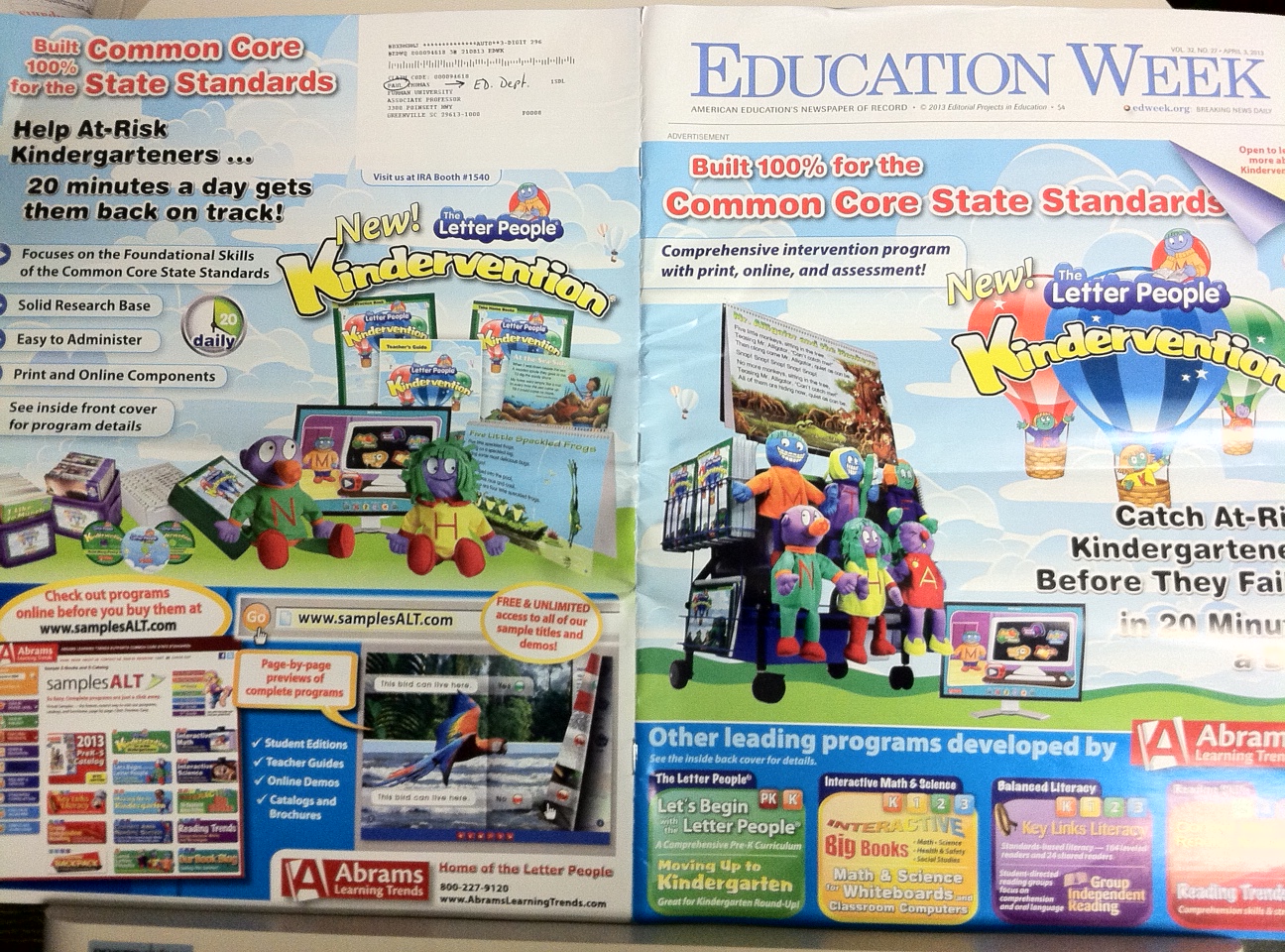
For those who fear the CCSS, I want to remind you once again: Look carefully at this entire cover of Education Week exposing that CCSS is consumerism and commodification—not communism and socialism:

EW.CCSS

The crass commercialism covering a major education publication reads like an infomercial:

“Catch At-Risk Kindergarteners Before They Fail…in 20 Minutes a Day!”

“Help At-Risk Kindergarteners…20 minutes a day gets them back on track!”

But a letter from the company vice president doesn’t inspire much confidence about high standards: “Kindervention is the most unique program in our history…,” it opens.

Most unique? Maybe words that can’t be qualified aren’t in the CCSS.

Ultimately, CCSS are a distraction.

And cries that CCSS are a communist, socialist, or government plot are distractions.

So the odd intersection of progressives and libertarians rejecting the CCSS fails ultimately since the reasons are deeply divided, but there is a reason that we all—every citizen of the U.S. regardless of ideology—should unite against CCSS and most other corporate manipulations of our Commons:

Being consumed by manufactured demons is a self-defeating American tradition that needs to be set aside.

Like the crews in both Alien and Prometheus, Americans are blinded, and often asking the wrong questions (“Why is Common Core not requiring cursive writing instruction?”)—or worse yet, not asking any questions at all about the power of corporate America over the government we fail to see as “we the people.”

“What You Say about Somebody Else, Anybody Else, Reveals You”

In a clip from Take this Hammer (1963), James Baldwin speaks pointedly and thoughtfully about “Who is the Nigger?”

—–

In this explication of the racial slur now rendered taboo, Baldwin explains that “What you say about somebody else, anybody else, reveals you.” His examination asks his listeners to turn the racism and demonizing of people positioned as “Others” back on those using language as both a sword and a mask.

Currently, in 2013, racial slurs as taboo words have resulted in an ironic silencing of discussions of race as well. Polite company—that middle-class norm of civility—will not allow racial slurs, but that censoring of a word also becomes a more insidious form of oppression, a verbal shielding of the remaining racism that strangles the American democracy.

Nearly fifty years later, during the 2012 Republican primaries for president, Americans found themselves confronted by the most corrosive forms of racism in the candidacy of Newt Gingrich, but few strayed outside the confines of civility to name it for what it was.

[As SC Republicans have joined the rise of voters supporting Donald Trump, the discussion below remain relevant, and Trump has followed an even more aggressively racist and fascist pattern than Gingrich.]

“I’m Going to Continue to Help Poor People Learn How to Get a Job”

During Gingrich’s rise to winning the South Carolina presidential primary in January 2012, Gingrich built a steady platform about “poor people”—including the following:

• Repeating the refrain that Obama is the “food stamp president.”

• Calling for “poor children” to be given work in schools as janitors because:

“Really poor children in really poor neighborhoods have no habits for working and have nobody around them who works. So they literally have no habit of showing up on Monday,” Gingrich told more than 500 employees inside the Nationwide Insurance lunchroom, NBC News reported. “So they literally have no habit of showing up on Monday. They have no habit of staying all day. They have no habit of ‘I do this and you give me cash,’ unless it’s illegal.”

• Assuming the pose of professor and job creator by announcing he was “…going to continue to help poor people learn how to get a job, learn how to get a better job, and someday learn how to own the job.”

Gingrich’s racism and his speaking to the racism of his constituency were in many ways more insidious than the racial slur confronted by Baldwin in 1963 because Gingrich’s ploy allowed him to mask his intent one or two layers beneath his words. “Food stamps,” “janitor,” “no habit” (laziness), and “illegal” trigger the racial stereotypes that drive racism—stereotypes that have no basis in fact, but remain robust in America’s social norms and uncritical acceptance of myths such as the culture of poverty.

As a fifty-plus-year-old white man living my entire life in the South, I am well acquainted with the pervasive direct racism as well as the wink-wink-nod-nod racism not just a legacy of the South but a daily reality remaining in 2013. As Gingrich mined and as Obama remained mostly silent on that racism, Americans and their leaders must confront the realities of the land of the free and the home of the brave:

• Males constitute about half the U.S. population, but represent by 10 to 1 the prison population; white men outnumber black men about 5 to 1, but black men fill U.S. prisons at a rate 6 to 1 compared to white men.

• According to 2005 research by Walter Gilliam, prekindergarten expulsion rates mirror U.S. prison dynamics: “Black boys receive less attention, harsher punishments, and lower grades in school than their White counterparts”:

African-American preschoolers were about twice as likely to be expelled as European-American (both Latino and non-Latino) preschoolers and over five times as likely as Asian-American preschoolers. Boys were expelled at a rate over 4½ times that of girls. The increased likelihood of boys to be expelled over girls was similar across all ethnicities, except for African-Americans (?2 = 25.93, p < .01), where boys accounted for 91.4% of the expulsions.

• Childhood poverty has accelerated in the U.S. (22%) and ranks far below countries similar to the U.S. throughout the world (see HERE, HERE, and HERE).

• The wealth gap has increased significantly among racial groups:

The racial wealth gap has been enormous ever since the Census Bureau began measuring it 25 years ago. But it has never been larger than today. The median wealth of a white family is now at least 20 times higher than that of a black family and 18 times that of a Latino family, according to an analysis by the Pew Research Center.

• The welfare myth remains powerful but also inaccurate—specifically in terms of who receives food stamps:

Gingrich, meanwhile has been criticized not only for singling out Obama as the “food stamp president” but for specifically linking the program to minorities. The NAACP and the National Urban League sharply criticized him for comments in early January that “the African-American community should demand paychecks and not be satisfied with food stamps,” accusing him of feeding stereotypes about the black poor. In fact, 22% of SNAP recipients are black, compared to 36% for whites, 10% for Latinos and 18% from unknown racial backgrounds.

Equity, especially among the races, and upward mobility have eroded in the U.S., often dwarfed by greater equity and upward mobility in other countries. Timothy Smeeding explains:

Higher levels of economic inequality are associated with lower rates of mobility. But children are more upwardly mobile in some nations than in others. How do countries like Canada, with above-average inequality and above-average child poverty rates, do so well on mobility outcomes compared with the United States? Canada has more effective public investments in education, including nearly universal preschool, effective secondary schools and high rates of college completion. And the Canadians are much more generous to low- and middle-income families, including child allowances and tuition breaks for university education.

• While “No Excuses” education reformers simultaneously decry public education a historical failure and the sole mechanism for social reform, children of color and children in poverty are routinely assigned to classrooms taught by the least experienced and un-/under-qualified teachers—including a rise in hiring Teach for America (TFA) recruits to staff high-poverty schools and in corporate charter schools that are re-segregating public education.

The reality of racism and inequity in America is being ignored, and politicians, such as Gingrich, bait racists and perpetuate racism, directly and indirectly.

A recent Room for Debate (The New York Times) includes George Lakoff identifying why and how politicians continue to misrepresent the state of America:

But more often politicians lie to protect or advance what they see as a moral endeavor (e.g., the invasion of Iraq, Reagan’s war on nonexistent ‘welfare queens, Johnson on the Tonkin Gulf). In the conservative moral system, the highest value is protecting and extending the moral system itself. When conservative icons or ideas themselves are threatened, it is not uncommon for conservative politicians to lie in their defense (Reagan never raised taxes; there’s no evidence for global warming; “government takeover”).

It is politically advantageous to claim that America is post-racial, that America has achieved equity, but as the evidence above shows, those claims are political lies.

We may say that Gingrich’s campaign strategy included race-baiting or class warfare, but that would be yet more masking and avoiding the harsh reality that Gingrich’s strategy was racism—and it often worked.

To paraphrase and extend Baldwin’s perceptive understanding of a racial slur, what Gingrich said about poor people was telling us about him, and by association, those who voted for him.

Racism remains a vivid and crippling scar on the American character in 2013, and America needs leadership and voices that will name that reality and call for a commitment to seeking the ideals of equity and post-racial America. But that will never occur if we hide behind the masks of middle class civility and political expediency that claim we have achieved the ideals we debase every day.

Recommended James Baldwin

Who is the Nigger? -James Baldwin

Baldwin’s Nigger 1 of 3

Baldwin’s Nigger 2 of 3

Baldwin’s Nigger 3 of 3

James Baldwin on Education

Where Is Our “Sense of Decency”?

Before teaching The Crucible in my American literature courses during my two decades as a high school English teacher in rural Upstate South Carolina, I played the students R.E.M.s “Exhuming McCarthy,” which “makes an explicit parallel between the red-baiting of Joe McCarthy‘s time and the strengthening of the sense of American exceptionalism during the Reagan era, especially the Iran-Contra affair” (Wikipedia).

The song includes an audio from the McCarthy hearings, including this soundbite of Joseph Welch confronting Joe McCarthy:  “Let us not assassinate this lad further, Senator….You’ve done enough. Have you no sense of decency, sir, at long last? Have you left no sense of decency?”

Part of The Crucible unit asked students to examine how societies continue to repeat the basic flaws of abusing power and oppressing powerless groups of people. Despite the lessons of the Witch Trials and the Red Scare/McCarthy Era (with the Japanese Internment in between), Americans seem hell-bent on doubling down on policies and practices that are authoritarian, hypocritical, and simply mean—especially if those policies can be implemented by people with power onto the powerless.

Current education reform needs a McCarthy hearing, and we need to confront those driving those reforms with “You’ve done enough. Have you no sense of decency, sir, at long last? Have you left no sense of decency?”

For example, consider the following:

History is replete with evidence that the ends do not justify the means.

While there remains great political and public support for grade retention, for example, a huge body of evidence shows that retention negatively impacts students retained, taxpayers, and peers not retained—all for mixed results of short-term test scores.

The only justification for grade retention is giving the appearance of being tough (raising a key question about how tough any adult is for lording him/herself over a child).

Americans’ puritanical roots are some of our worst qualities, and especially where children and other marginalized groups are concerned, Americans need to regain our sense of decency.

We would be well advised to begin with how we reform our schools.

The Rise of the Dogmatic Scholar: “A Cult of Ignorance” pt. 2

By oft repeating an untruth, men come to believe it themselves.
Thomas Jefferson, letter to John Melish, Jan. 13, 1812

The moment a person forms a theory, his imagination sees, in every object, only the traits which favor that theory.
Thomas Jefferson to Charles Thompson, 1787

—–

My university sits in the socially and politically conservative South, and our students tend toward a conservative political and world view as well. The most powerful student organizations are self-identified as conservative as well as being awash in power and funding, some from outside the university.

One conservative student organization, supported and funded by a network of such organizations spreading throughout campuses across the U.S., has for years dominated the Cultural Life Program of the university, a series of events students must attend as part of graduation requirements.

Several years ago, this organization brought Ann Coulter to campus, and when I mentioned my own concerns about her credibility during class, a student quickly defended Coulter by saying, “But she has footnotes in her book.”

Coulter’s confrontational conservatism speaks to the world views of many of our students and the greater public of SC, and thus seems credible even without footnotes. That student’s defense highlights a key element in the rise of the dogmatic scholar that has its roots in the 1980s, a period identified by Isaac Asimov as “a cult of ignorance” guided by a new ethic, “Don’t trust the experts.”

April of 2013 is the thirty-year anniversary of A Nation at Risk, a political and popular turning point for America’s perception of not only public education but also education reform as well as the discourse surrounding both. John Holton (2003) and Gerald Bracey (2003) have since then detailed that the report was also, in Bracey’s words a decade ago on the cusp of No Child Left Behind, “false”:

It has been 20 years, though, since A Nation at Risk appeared. It is clear that it was false then and is false now. Today, the laments are old and tired – and still false. “Test Scores Lag as School Spending Soars” trumpeted the headline of a 2002 press release from the American Legislative Exchange Council. Ho hum. The various special interest groups in education need an other treatise to rally round. And now they have one. It’s called No Child Left Behind. It’s a weapon of mass destruction, and the target is the public school system. Today, our public schools are truly at risk.

What was “false” about A Nation at Risk?

First, Holton, as an insider, exposed that Ronald Reagan himself directed the commission to insure his agenda for public schools:

We met with President Reagan at the White House, who at first was jovial, charming, and full of funny stories, but then turned serious when he gave us our marching orders. He told us that our report should focus on five fundamental points that would bring excellence to education: Bring God back into the classroom. Encourage tuition tax credits for families using private schools. Support vouchers. Leave the primary responsibility for education to parents. And please abolish that abomination, the Department of Education. Or, at least, don’t ask to waste more federal money on education — “we have put in more only to wind up with less.” Just discover excellent schools to serve as models for all the others. As we left, I detected no visible dismay in our group. I wondered if we were all equally stunned.

Second, Bracey noted that despite the report depending on research and data, only one trend line out of nine suggested anything negative—and that the commission focused on that one trend line in order to comply with the political pressure aimed at the committee.

And third, A Nation at Risk as a political document parading as scholarship received not only a pass from the media but also a rush to benefit from the bad news by many stakeholders, as Bracey explained:

Alas, nothing else is new and, indeed, we must recognize that good news about public schools serves no one’s reform agenda – even if it does make teachers, students, parents, and administrators feel a little better. Conservatives want vouchers and tuition tax credits; liberals want more resources for schools; free marketers want to privatize the schools and make money; fundamentalists want to teach religion and not worry about the First Amendment; Catholic schools want to stanch their student hemorrhage; home schooling advocates want just that; and various groups no doubt just want to be with “their own kind.” All groups believe that they will improve their chances of getting what they want if they pummel the publics.

A Nation at Risk, the process involved to create the report, the uncritical media endorsement of the report, and the public and academic embracing of the claims represent a seminal moment in the rise of the dogmatic scholar, one foreshadowed by Asimov and personified by Coulter.

Recently, a debate between Diane Ravitch and Patrick Wolf highlights how the dogmatic scholar looks today. Mercedes Schneider examines that debate by first addressing Wolf’s credentials, Endowed Chair in School Choice, Education Reform, University of Arkansas.

Both Schneider and Ravitch raise concerns about the conflict of interests when a scholar holds a chair in a department that is heavily funded by school choice advocates, as Schneider explains about Wolf’s complaint that Ravitch attacked him personally:

Whereas she does not personally attack Wolf, Ravich certainly clearly exposes Wolf’s conflict of interest in evaluating a program obviously supported by his funders.

I agree with Ravitch that this conflict of interest is noteworthy for its undeniable potential in “shaping” study reporting and outcomes.

At the root of this debate is the unmasking of the dogmatic scholar and the concurrent rise of conservative advocacy taking on the appearance of scholarship despite the historical claims among conservatives that pointy-headed intellectuals shouldn’t be trusted (again, read Asimov).

Coulter’s book has footnotes to appear scholarly, and free market think tanks have increasingly embraced a formula that is both deeply deceiving and powerfully effective: (1) Hire fellows with advanced degrees, preferably PhDs, (2) generate reports that include a great deal of data, statistics, and charts/graphs, (3) create scholarly but attractive PDFs of the reports accessible for free through the think tank web sites, (4) aggressively promote the reports through press releases, and (5) circumvent entirely the peer-review process (in fact, conservative think tanks are actively demonizing the peer-review process).

The dogmatic scholar differs from the traditional university-based scholar in a few important ways. The university-based scholar and the promise of academia rest on some basic concepts, including the wall between undue influence and independent thought that tenure affords combined with the self-policing effect of peer-review.

While traditional scholarship, tenure, and peer-review are not without problems, this essential paradigm does allow for (although it cannot guarantee) rich and vibrant knowledge bases to evolve for the sake of knowledge absent the allure of profit or the influence of inexpert authority (tenure stands between university boards of trustees and faculty to insure academic freedom, for example).

As a critical educator and scholar, however, I do reject the traditional view that scholars must be apolitical, must assume some objective stance. In fact, I believe that scholars must be activists.

Therefore, my concern about the rise of the dogmatic scholar is not the activism or advocacy but two key failures found among dogmatic scholarship: (1) masking advocacy as objective (typically behind the use of statistics and charts/graphs), and (2) committing to an ideology despite the weight of evidence to the contrary.

Activist scholars such as Howard Zinn represent the power of taking a public intellectual stance that is both ideologically grounded (social justice) and informed by scholarship, Zinn’s own careful and detailed work as a historian.

Dogmatic scholarship typically found in think tanks but increasingly occurring in externally funded schools, departments, and institutes within universities and colleges (such as Wolf’s role at the University of Arkansas) is represented by a school choice report funded by the Wisconsin Policy Research Institute (WPRI), which is explicitly a free market advocacy think tank.

Fixing the Milwaukee Public Schools: The Limits of Parent-Driven Reform, by David Dodenhoff, PhD, was released by WPRI in 2007 with George Lightbourn, representing the institute, lamenting: “The report you are reading did not yield the results I had hoped for.”

Further, despite the evidence of the research commissioned by WPRI, Lightbourn issued a commentary and explained:

So that there is no misunderstanding, WPRI is unhesitant in supporting school choice.  School choice is working and should be improved and expanded.  School choice is good for Milwaukee’s children.

While Lightbourn’s commentary raises some concerns about the data, the key message is “evidence be damned, WPRI remains committed to school choice!”

The problem, then, with the rise of the dogmatic scholar is that several contradictions lie underneath the movement.

Conservative America has persistently marginalized and demonized the Left as biased while embracing not only the possibility of objectivity but also the necessity for objectivity, especially among educators, scholars, and researchers (consider the uproar over climate change science).

Yet, conservatives are the base of dogmatic scholars and those who embrace dogmatic scholars (or popular versions such as Coulter)—despite dogmatic scholars being themselves advocates masquerading as objective and academic.

Further, the dogmatic scholar is failing in the exact ways some traditional scholarship fails—allowing the influence of funding and profit to skew the pursuit of knowledge. In fact, since dogmatic scholarship is often driven by market ideology, the influence of funding and profit is common.

The impact of dogmatic scholarship on education reform has been staggering, resulting in a common pattern found among researchers and think tanks committed to reviewing educational research such as Bruce Baker, Matthew Di Carlo, and the National Education Policy Center: The reports coming from dogmatic scholars produce impressive data sets but misleading, incomplete, or contradictory claims and recommendations (see, for example, Baker on the highly publicized Chetty, Friedman, and Rockoff study).

The reports coming from dogmatic scholars, notably the school choice research, tends to replicate the comments coming from WPRI about Milwaukee school choice: The claims and recommendations are decided before and in spite of the evidence of the data.

In fact, school choice research has revealed a pattern of making a series of ever-changing claims simply to keep the debate alive and thus the choice agenda vibrant. In the popular and enduring evolution debate, for example, Intelligent Design as a faux science endorses “teach the debate” to lend credibility to their claims and to gain equal footing with the scientific process without actually conforming to that process.

Do Ravitch and Wolf, then, have the right to debate? Of course. Their debate is likely a potentially powerful mechanism for examining education reform.

Does Wolf have a right to advocate for school choice? Again, I believe he does.

The problem, however, with both Wolf’s agenda and the debate is that Wolf wants to hide behind a mask of objectivity and has taken a “holier than thou” stance to marginalize Ravitch’s credible concerns about school choice research.

In the end, the dogmatic scholar fails for the same reason dogma does—because neither can be questioned.

All credible scholarship is rendered more valuable by the light of questions so I will end with a simple solution offered by Julian Vasquez Heilig, Ph.D. at Wolf’s complaint:

Dr. Patrick, Please hurry and de-identify the data you used in your papers and provide it to independent researchers. I have the ability to critique the methodological rigor and quality of your actual research. I am very very much looking forward to it.

Among researchers, no claim is any more credible than the data the claim rests on. As long as dogmatic scholars ignore the data and hide the data, their work will be questioned in ways that also include their motives.

The job of the scholar is not to be objective, but to be transparent—admitting evidence-based stances providing context for claims and recommendations. Dogmatic scholars refuse to be transparent, and their weakness is that entrenched dishonesty.

In short, all scholars likely should heed the opening comments from Jefferson.

References

Bracey, G. W. (2003). April foolishness: The 20th anniversary of A Nation at Risk. Phi Delta Kappan, 84(8), 616-621.

Holton, G. (2003, April 25). An insider’s view of “A Nation at Risk” and why it still matters. The Chronicle Review, 49(33), B13.

Just Say No to Just Read, Florida, South Carolina

“Nearly 3,000 of South Carolina’s third-graders who struggle with reading could be held back if the state adopts a plan that would require students to read at or near grade level,” Jamie Self reports in The State (“Education leaders: Florida holds key to SC literacy fix,” March 31, 2013), adding later,

Under Peeler’s bill, 2,886 SC third-graders scored low enough on a 2012 reading test to be held back a year — more than four times the 584 third-graders held back in 2012. The number reflects only the lowest-scoring readers, about 27 percent of the more than 10,500 third-graders who scored as not reading on grade level….

SC schools chief Mick Zais supports the plan to hold back struggling third-graders and would like to see a similar track for seventh graders, his spokesman Jay Ragley said.

SC Senate Majority Leader Harvey Peeler, R-Cherokee, has introduced the bill modeled on Just Read, Florida, part of a grade-retention policy widely promoted by Jeb Bush as one aspect of the larger so-called “Florida Miracle.”

SC political leadership must not follow Florida’s lead in reading policy or grade retention policy for several reasons, including the following: the “Florida Miracle” has been thoroughly discredited, grade retention has no support in the research that shows retention has no positive outcomes but many negative consequences for children and tax payers, and initiatives such as Just Read, Florida ignore and replace credible literacy policy desperately needed in high-poverty states such as SC.

First, SC political leadership and the public must acknowledge what low reading test scores represent and the negative consequences of basing policy on test data:

  • All standardized test scores, including reading scores, are overwhelmingly a reflection of home, community, and school inequities more so than direct and clear evidence of holistic reading ability by children. Low reading scores by third graders in SC are signals of a high-poverty state, first and foremost.
  • Reading test scores are often poor evidence of real-world and holistic reading ability. Standardized tests of reading are typically skills-based and/or complicated by other student skills imbedded in the test format (for example, having students write on a reading test blurs the evidence on reading and writing proficiencies).
  • High-stakes test-based decisions for grade retention, instructional programs, and instructional practices—especially in literacy—have a clear negative impact on the quality of instruction as well as the quality of learning opportunities children who need education the most are likely to receive:

In too many places, however, graduation and promotion tests are putting many students at sharply increased risk of suffering the serious, well-documented harm associated with grade retention and denial of high school diplomas. Those at greatest risk include the very populations—students of color, students with disabilities, English-language learners, and low-income students—whom standards-based reform could potentially help the most. (Heubert, 2002/2003)

Second, SC political leadership and the public must acknowledge that the “Florida Miracle”—like the “Texas Miracle,” the “Harlem Miracle,” and the “Chicago Miracle”—has been thoroughly discredited as incomplete data, misrepresented accomplishments, or outright failures.

A brief review of credible examinations of the “Florida formula” include strong cautions about both the claims of success and the use of Florida as a model of reform.

Matthew Di Carlo acknowledges mixed results, but cautions using the formula to drive policy:

That said, the available evidence on these policies, at least those for which some solid evidence exists, might be summarized as mixed but leaning toward modestly positive, with important (albeit common) caveats. A few of the reforms may have generated moderate but meaningful increases in test-based performance (with all the limitations that this implies) among the students and schools they affected. In a couple of other cases, there seems to have been little discernible impact on testing outcomes (and/or there is not yet sufficient basis to draw even highly tentative conclusions). It’s a good bet – or at least wishful thinking – that most of the evidence is still to come.

In the meantime, regardless of one’s opinion on whether the “Florida formula” is a success and/or should be exported to other states, the assertion that the reforms are responsible for the state’s increases in NAEP scores and FCAT proficiency rates during the late 1990s and 2000s not only violates basic principles of policy analysis, but it is also, at best, implausible. The reforms’ estimated effects, if any, tend to be quite small, and most of them are, by design, targeted at subgroups (e.g., the “lowest-performing” students and schools). Thus, even large impacts are no guarantee to show up at the aggregate statewide level (see the papers and reviews in the first footnote for more discussion)….

Whether we like it or not, real improvements at aggregate levels are almost always slow and incremental. There are no “miracles,” in Florida or anywhere else. The sooner we realize that, and start choosing and judging policies based on attainable expectations that accept the reality of the long haul, the better.

Julian Vasquez Heilig identifies the error of focusing on apparent increases in 3rd to 4th grade reading scores and associating them with policy:

Cloaking Inequity examined the purported test score miracle earlier here. In 4th grade, Florida improved over the last decade and was position in the top ten nationally, but as you move up the grade levels, the longer student stay in Florida schools, the worse their performance relative to the nation. I also discussed the official Florida scholarship evaluation in Florida that showed their scholarship (aka neovoucher) program had not increased the achievement of program participants.

Third, all evidence on grade retention reveals only negative consequences for children (academic and emotional) and tax payers, the public. [1]

Alfie Kohn notes that accountability “get tough” attitudes are masking the need for policy to be built on evidence:

The same get-tough sensibility that has loosed an avalanche of testing has led to a self-congratulatory war on “social promotion” that consists of forcing students to repeat a grade. The preponderance of evidence indicates that this is just about the worst course of action to take with struggling children in terms of both its academic and social-psychological effects. And the evidence uniformly demonstrates that retention increases the chance that a student will leave school; in fact, it’s an even stronger predictor of dropping out than is socioeconomic status.

Some of the well-documented effects of grade retention include the following:

Retained students are more likely to be male, younger than classmates, from a lower socio-economic class, black or Hispanic, a behavior problem and immature (Karweit, 1991).

Research shows a large correlation between dropouts and retention….

Controlled studies do not support the benefits claimed for extra-year programs (i.e., transitional first, pre-kindergarten) and negative side effects occur just as they do for retention in later grades….

Empirical research shows retention does not improve the achievement of children as measured by tests of basic skills. No significant positive long-term effect is evident. Studies indicate retention is either ineffective or harmful, with more negative than positive effects….

Retention imposes an economic burden of financing an extra year of schooling….

Children attach stigma, stress, and shame to retention.

Kevin Welner states directly and clearly that no policy decisions should include grade retention, specifically citing Florida’s policies:

Let’s use grade retention to illustrate. States across the U.S. are adopting mandates requiring that  third graders with low reading scores repeat the grade. The ‘leave the student back’ policy is being heavily marketed by the Foundation for Excellence in Education, an organization created by former Florida governor Jeb Bush. But retaining students is not a new idea. It’s an experiment that’s been tried on and off for generations, and it’s been studied for almost that long.

The overarching message from research in this area is that retaining a low-scoring third grader will not help her do better than a similar classmate with similar scores who is moved along to fourth grade, but she will be more likely to eventually drop out.

Viewed from a taxpayer perspective, retaining a student will likely have one of two outcomes:

1. She may drop out, meaning she will pay about $60,000 less in taxes over her lifetime, be more likely to commit crimes, and be more likely to depend on government assistance; or

2. She may complete high school, at a cost of an extra year of school – about $10,000. If retention had a substantial payoff, paying for an extra year of school would be worthwhile (although it nationally adds up to billions of dollars each year). But there’s no benefit. With grade retention, we are paying more and getting a worse outcome.

That’s the evidence. It’s what we have learned (or should have learned) from decades of  experience. Grade retention can be expected to have the same destructive results in 2012 as it did when it was tried ten or twenty or forty years ago – or any of the years in between. Yet our lawmakers do the same thing over and over again, each time expecting different results.

Allensworth (2005) found that retention based on test scores at the elementary level contributed to higher drop-out rates; this study is particularly important to evaluating the long-term impact of the Florida formula as well as any state considering implementing similar policies that focus on short-term test scores while ignoring long-term consequences.

Grade retention fails students retained, fails taxpayers, and as Gottfried (2013) has shown, fails the non-retained classmates of students retained:

This research has brought to the foreground a new dimension of the analysis relating to grade retention, as well as peer effects. In essence, by demonstrating a pervasive negative effect of retained classmates, as derived from multiple quasi-experimental methods on a panel data set of urban schoolchildren, this study corroborates the predominant conclusions of prior research on retention. Namely, this practice of grade retention is associated with negative outcomes (Allen et al. 2009; Holmes 1989; McCoy and Reynolds 1999; Meisels and Liaw 1993; Reynolds 1992; Roderick and Nagaoka 2005). The unique contribution of this study is that the negative outcomes of this schooling practice are not restricted to the retained students themselves; rather, this study has found that retention can affect the academic outcomes for other members of the classroom. Moreover, this study has also facilitated an opportunity for urban educational experiences to be further delineated and for policy implications of this practice to be more thoroughly discussed.

Finally, SC political leadership needs to address in authentic and effective ways the very real literacy challenges faced by our high-poverty students. Modeling SC educational policy on Florida, however, would achieve only what Kohn has identified as policy insuring more non-readers.

Credible reading policy in SC would include the following:

  • Create and implement social policy that addresses poverty and job creation/stability in the historically high-poverty areas of the state. Children living in high-poverty homes and communities are “doubly disadvantaged” in ways that cannot be overcome by schools alone and that are too often reflected in and perpetuated by community-based schools and failed educational policies such as Florida’s Just Read, Florida.
  • Reading and literacy achievement should be evaluated through holistic, classroom-based mechanisms, not high-stakes testing. Increasing high-stakes test scores in reading may have the unintended consequence of producing both misleading data and further eroding the literacy proficiency of high-poverty, minority, special needs, and ELL students. Test-based evaluations of students, teachers, schools, and policy tend to create conditions that ask less of everyone, not more.
  • Reading proficiency is of little value if students are non-readers due to punitive and skills-based school policy. Reading is a holistic and unpredictable human behavior that must be fostered over many years and through strategies that appear “too simple”—increase children’s access to books in their homes, increase children’s access to books in school, provide students extended opportunities to read by choice during the school day, address adult and community literacy
  • Reading proficiency and creating life-long, eager readers will never be achieved by reading policies or programs, particularly pre-packaged commercial programs. Teachers and parents can and should foster reading and all literacy, but ultimately children cannot be bribed, forced, or punished into being readers.

As Welner concludes in his consideration of education reform:

To be clear, “social promotion” – the movement of students from grade to grade with no meaningful intervention for those who fall behind – is also not supported by research evidence. Instead, as proven approaches to address the problem of early reading gaps, research supports high-quality early-childhood education, intensive early reading interventions, and smaller class sizes in early grades for at-risk students. These are all less costly and more effective than grade retention.

Evidence supports grade promotion combined with these sorts of interventions, and it clearly cautions against a systemic use of grade retention, even retention combined with additional academic support.

A reckless disregard of evidence is harmful. It leads to the waste of precious resources: our tax dollars and our children themselves. And grade retention is only one example of the larger problem.

SOURCES

“Florida Miracle” 

Review of Closing the Racial Achievement Gap, Madhabi Chatterji

Water into Wine?, Julian Vasquez Heilig

Lurking in the Bushes, Julian Vasquez Heilig

Parsing the Florida “Miracle,” Diane Ravitch

The Test-Based Evidence on the “Florida Formula,” Matthew Di Carlo

Editorial: Florida needs no advice from Jeb Bush on education policy, Jac Versteeg

Review of Getting Farther Ahead by Staying Behind, Derek C. Briggs

How Jeb Bush’s school reforms really played out in Florida, interview with Sherman Dorn

Grade Retention: U.S.

Third Grade Reading Policies, Rose (2012)

Education in Two Worlds: Follow Up to “50 Myths & Lies,” Gene V. Glass

A second myth we see as dangerous has that quality because of what it reveals about too many of America’s politicians and school leaders: it reveals both their ignorance and their cruelty! This is the myth that leaving a child back in grade who is not doing well academically is good for the child. It provides the child with “the gift of time” to catch up. We believe that only ignorant and cruel people would support such a policy, although it is law in about a dozen states, including Arizona and Florida. First of all, a large and quite consistent set of research studies, many of excellent quality, point out that for the vast majority of the children retention in grade has either no benefit, or is detrimental. Only rarely does retention benefit the child who was left back. So the research overwhelming suggests that those who recommend retention are likely to be ignorant. Second, an important piece of the rationale for retention policies is that if you cannot read well by third grade you are more likely to be a school failure. But reading expert Stephen Krashen disputes this, citing research on 12 young students with serious reading problems, dyslexics all. Eleven of the twelve did not learn to read well until they were between 10 and 12 years of age, and one did not learn to read until he was in 12th grade. Among these slow learners, all of whom would have been left back in Florida and Arizona, were nine who published creative scholarly works, and one who became a Nobel laureate. So not doing well by third grade does not determine one’s destiny. Third, the research informs us that retention policies are disproportionately directed at those who are poor, male, English language learners, and children of color. Middle class white children are rarely left back. Fourth, a retention decision changes family dynamics. Parents and siblings change in their treatment of, and aspirations for, the child identified by the school as having “flunked.” Of course, the schools do not say a child is dumb. Instead they offer the children and the families “the gift of time” to catch up. But the world interprets that gift more cruelly. Fifth, being left back is associated with much higher rates of dropping out before completion of high school. Thus, the social costs of this policy go way up since these children are more likely to need assistance in living because of poor wage earning capacity, and there is also the greater likelihood of a higher incarceration rate for people that do not finish school and cannot find decent work. Sixth, when surveyed, children left back say it feels as bad as losing a parent or going blind. It is an overwhelmingly negative event in the lives of the vast majority of the retained children, so leaving them back is cruel as well as a reflection of the ignorance of those who promote these policies. Seventh, and finally, the same costs expended for an extra year of education for the child who is held back, say eight thousand dollars, could more profitably be spent on a more beneficial treatment than repetition of a grade. A certified reading specialist, working twice a week as a tutor throughout the school year and for some part of the summer, would have greater success in improving a child’s academic performance. There is no more powerful treatment than tutoring, and in this case it is cheaper and more humane than is flunking a child. For the seven reasons given, we can think of no education policy that reflects worse on America’s politicians and educators than the policy of retaining students in grade.

Hold Back to Move Forward? Early Grade Retention and Student Misbehavior, Umut Özek

Test-based accountability has become the new norm in public education over the last decade. In many states and school districts nation-wide, student performance in standardized tests plays an important role in high-stakes decisions such as grade retention. This study examines the effects of grade retention on student misbehavior in Florida, which requires students with reading skills below grade level to be retained in the 3rd grade. The regression discontinuity estimates suggest that grade retention increases the likelihood of disciplinary incidents and suspensions in the years that follow. The findings also suggest that these adverse effects are concentrated among economically disadvantaged students

Retaining Students in Grade A Literature Review of the Effects of Retention on Students’ Academic and Nonacademic Outcomes, Nailing Xia, Sheila Nataraj Kirby (2009)

Our review of these 91 studies indicates that grade retention is associated with gender, race, SES, age for grade, student mobility, family and parental characteristics, prior academic achievement, prior behavioral and socioemotional development, and student health. Converging evidence suggests that grade retention alone is not an effective intervention strategy for improving academic and longer-term life outcomes. In general, retention does not appear to benefit students academically. Although some studies have found academic improvement in the immediate years after retention, these gains are usually short-lived and tend to fade over time. Past research has consistently shown that retained students are at significantly increased risk of dropping out of school. Although only a few studies have examined the effects of retention on postsecondary outcomes, the available evidence suggests negative effects on enrollment in postsecondary education and on employment outcomes in adulthood. Overall, the literature indicates mixed findings on attitudinal, socioemotional, and behavioral outcomes among the retained students….Our review found fruitful avenues of research, most notably the impact of supportive interventions (such as early identification of at-risk students, academic instructional services provided in and out of school, and different types of intervention strategies) on proximal and future student outcomes.

The Spillover Effects of Grade-Retained Classmates: Evidence from Urban Elementary Schools, Michael A. Gottfired, American Journal of Education 119 (May 2013)

Retention, Social Promotion, and Academic Redshirting: What Do We Know and Need to Know?, Nancy Frey, Remedial and Special Education, volume 26, number 6, November/December 2005, pages 332-346

The evidence gathered in the last 30 years on the practice of retention suggests that it is academically ineffective and is potentially detrimental to children’s social and emotional health. The seeds of failure may be sown early for students who are retained, as they are significantly more likely to drop out of high school. Furthermore, the trajectory of adverse outcomes appears to continue into young adulthood, when wages and postsecondary educational opportunities are depressed.

Dropout Rates after High-Stakes Testing in Elementary School: A Study of the Contradictory Effects of Chicago’s Efforts to End Social Promotion, Elaine M. Allensworth, Educational Evaluation and Policy Analysis, Vol. 27, No. 4 (Winter, 2005), pp. 341-364

Alternative to Grade Retention, Jimerson, Pletcher, and Kerr (2005)

Given the accumulating evidence that grade retention is an ineffective and possibly harmful intervention, it is imperative that school administrators advocate for “promotion plus” policies that depend on effective, evidence-based interventions. The issue for secondary school educators is twofold. Not only must educators determine whether retention is appropriate for a given student, they also need to address the negative academic, social, and emotional consequences for students who were retained in earlier grades. Very often the student’s original difficulties persist, or more likely worsen, as their school career progresses.

Winning the Battle and Losing the War, Jimerson, Anderson, and Whipple (Psychology in the Schools, Vol. 39(4), 2002)

Considering the results of this review of research examining the association between grade retention and high school dropout and other reviews of research addressing the efficacy of grade retention (Holmes, 1989; Jimerson, 2001a, 2001b; Smith & Shepard, 1987, 1988), we must move beyond the use of grade retention as an intervention strategy and attempt to implement those strategies research has demonstrated to be effective (Jimerson, 2001a). Educational professionals, researchers, parents, and policymakers would be remiss to overlook the implications of research that demonstrate the association between grade retention and school dropout. Furthermore, a new imperative has emerged, where the onus is on programs training future educational professionals to disseminate the results of the recent research presented in this review. It is crucial that we transcend limited solutions and begin to consider student developmental and achievement trajectories in order to reinforce and strengthen pathways that promote social and cognitive competence and lead to academic success.

Does Retention (Repeating a Grade) Help Struggling Learners?

Some stakeholders in Florida believe that the “hard line in the sand” created by mandatory, test-based retention created a motivational difference in teachers and parents…, since it is thought that many of the same learning supports were being provided to struggling students prior to the policy. This may be the case for test score gains close to the retention year, but given the well-known longer-term negative effect of retention on drop-out rates (e.g., Allensworth, 2005) as well as the assured delayed entry into the workforce, Florida’s evidence falls far short of even suggesting that retention is the only or best way to motivate a real positive difference for struggling students, nor has it contradicted the overwhelming evidence against retention prior and since.

What Doesn’t Work, Smith and Shepard (Phi Delta Kappan, October 1987)

The Lesson of the Cupcakes: Fixing Schools by Resisting Gimmicks and Heeding Evidence, Kevin Welner

Exploring the Association Between Grade Retention and Dropout, Jimerson, et al. (The California School Psychologist, Vol. 7, pp. 51-62, 2002)

Ultimately, the research is unequivocal in identifying that grade retention does not appear to address the needs of these students at risk of academic failure. Findings from this study should not be misinterpreted as an indication that retention was an effective intervention strategy for the retained students who did not drop out of high school. There is a need for further research comparing the retained students who completed high school with matched comparison groups of similarly low achieving but socially promoted students. This study highlights the association of early socio-emotional and behavioral adjustment and high school dropout among a group of retained students. These findings have direct implications for school psychologists and other educational professionals. In particular, rather than focusing on the unsupported academic intervention of grade retention, it is time to implement prevention and intervention programs that have been empirically demonstrated to meet the needs of these students in facilitating both positive academic success and socio-emotional adjustment.

Grade Retention: A Flawed Education Strategy, Xia and Glennia (part 1)

Decades of research suggest that grade retention does not work as a panacea for poor student performance. The majority of research fails to find compelling evidence that retention improves long-term student achievement. An overwhelmingly large body of studies have consistently demonstrated negative academic effects of retention. Contrary to popular belief, researchers have almost unanimously found that early retention during kindergarten to grade three is harmful, both academically and emotionally. [2] Many studies find that retention does not necessarily lead to increased work effort among students as predicted.

Cost-Benefit Analysis of Grade Retention, Xia and Glennia (part 2)

Grade Retention: The Gap Between Research and Practice, Xia and Glennia (part 3)

The majority of published studies and decades of research indicate that there is usually little to be gained, and much harm that may be done through retaining students in grade. Yet, many educators continue to use retention as a way to improve student achievement and claim that it produces positive results. The consequence is while a growing body of studies show that retention does not improve academic performance and has a number of negative side effects, more and more states and school districts have adopted retention policy in an effort to enhance the educational accountability.

Synthesis of Research on Grade Retention, Shepard and Smith (Educational Leadership, May 1990)

Grade Retention [a synthesis]

Social Promotion – In Comparison to Grade Retention, Advantages and Disadvantages, Different Perspectives, Jere Brophy

Meta-analysis of Grade Retention Research: Implications for Practice in the 21st Century, Shane R. Jimerson (School Psychology Review, 2001, Volume 30, No. 3, pp. 420-437)

A Synthesis of Grade Retention Research: Looking Backward and Moving Forward, Shane R. Jimerson (The California School Psychologist, Vol. 6, pp. 47-59, 2001)

In looking backwards at the retention research and previous reviews and meta-analyses, a consistent theme emerges—grade retention is not an empirically supported intervention. As reflected in the results of the three meta-analyses described above, the confluence of results from research during the past century fails to demonstrate achievement, socioemotional, or behavioral advantages of retaining students. Moreover, the research consistently demonstrates that students who are retained are more likely to drop out of high school.

Evaluating Kindergarten Retention Policy, Hong and Raudenbush (September 2006)

First, Do No Harm, Jay P. Heubert (Educational Leadership, December 2002/January 2003)

The Facts on Education: Should Students Be Allowed to Fail Grades?

Holding Kids Back Doesn’t Help Them, Deborah Stipek and Michael Lombardo

Grade Retention and Social Promotion, National Association of School Psychologists

For children experiencing academic, emotional, or behavioral difficulties, neither repeating the same instruction another year nor promoting the student to the next grade is an effective remedy. (p. 5)

Grade Retention: International

Early Academic Performance, Grade Repetition, and School Attainment in Senegal: A Panel Data Analysis (Senegal)

Grade retention and educational attainment (Belgium)

Grade retention and its association with school misconduct in adolescence (Flemish)

This study represents one of the few to investigate the effect of grade retention on students’ school-disruptive behavior in adolescence. It is unique in addressing multilevel issues in this line of research. First, it has shown that it is important to distinguish grade retention at different educational levels. While we find evidence that primary school retention may be associated with less misconduct in adolescence, we establish that secondary school retention may give rise to deviance in adolescence. Moreover, we address the important role of schools’ retention composition, finding that students attending schools with more retainees are more likely to be deviant, although this composition does moderate negative retention effects. Together with previous literature on the effectiveness of grade retention, we advocate the abandonment of this intervention, especially at the secondary level.

See Demanet and Van Houtte’s cites:

In many countries, the practice of grade retention is widespread (Switzerland: Bonvin, Bless, & Schuepbach, 2008; Germany:  Ehmke, Drechsel, & Carstensen, 2010; US:  Jimerson, 2001; Lorence & Dworkin, 2006; Canada:  Pagani, Tremblay, Vitaro, Boulerice, & McDuff, 2001; Belgium:  Juchtmans et al., 2011; Van Petegem & Schuermans, 2005). Proponents believe that giving students ‘‘the gift of time’’ will put them back on track for normal educational growth. Ensuing the popularity of this strategy, a rich body of research has developed to test its effectiveness. The practice has some positive effects on students’ cognitive growth (Alexander, Entwisle, & Dauber, 1994), but these remain mainly short term (Jimerson & Ferguson, 2007; Meisels & Liaw, 1993) and occur only when special help is provided to retained children. In fact, in recent decades many studies have condemned grade retention as an ineffective practice to improve student learning (see, e.g., Bonvin et al., 2008; Jimerson, 2001; McCoy & Reynolds, 1999; Pagani et al., 2001).

Relation of Academic History and Demographic Variables to Grade Retention in Lebanon

[1] See Krashen, S. (2013, May). Need Children Read ‘Proficiently’ by Grade Three? Language Magazine.

[2] Deborah A. Byrnes, and Kaoru Yamamoto, 1985, “Academic Retention of Elementary Pupils: An Inside Look,” Education, 106(2), 208-14; Peg Dawson, 1998, “A Primer on Student Grade Retention: What the Research Says,” NASP Communique, 26(8); Shane R. Jimerson et al., 1997, “A Prospective, Longitudinal Study of the Correlates and Consequences of Early Grade Retention,” Journal of School Psychology, 35(1), 3-25; Panayota Y. Mantzicopoulos, 1997, “Do Certain Groups of Children Profit from Early Retention? A Follow-Up Study of Kindergartners with Attention Problems,” Psychology in the Schools, 34(2), 115-27; Samuel J. Meisels and Fong-Ruey Liaw, 1993, “Failure in Grade: Do Retained Students Catch Up?” Journal of Educational Research, 87(2), 69-77; Judy Temple, Arthur Reynolds and Suh-Ruu Ou, 2001, “Grade Retention and School Dropout: Another Look at the Evidence,” The CEIC Review, 10(5), 5-6 & 21; Charles L. Thompson and Elizabeth K. Cunningham, 2000, “Retention and Social Promotion: Research and Implications for Policy,” Eric Clearinghouse on Urban Education Digest, 161, 1-5; Deneen M. Walters and Sherry B. Borgers, 1995, “Student Retention: Is It Effective?” School Counselor, 42(4).

Contemporary Education Reform and “A Cult of Ignorance”

Writing in Newsweek (1980, January 21) in the cusp of America’s shift into the Reagan era of conservatism that included the roots of the current education reform movement built on accountability, standards, and high-stakes testing, Isaac Asimov declared the U.S. “a cult of ignorance,” explaining:

There is a cult of ignorance in the United States, and there always has been. The strain of anti-intellectualism has been a constant thread winding its way through our political and cultural life, nurtured by the false notion that democracy means that “my ignorance is just as good as your knowledge.”

While science fiction (SF)—a genre within which Asimov is legendary—is often misread as prediction (SF is often allegorical or a critical and satirical commentary on the contemporary world, more so than predictive), Asimov’s brief essay is eerily prescient about the most recent education reform movement and the discourse surrounding it.

As Reagan ascended the presidency in the U.S., Asimov noticed a clear line being drawn by politicians between them as spokespeople for and with the public versus intellectuals, academics, and experts of all kinds. One shift Asimov observed was a move away from the 1960s “Don’t trust anyone over 30” to a new conservative “Don’t trust the experts.”

In America, it seems, economic elitism was desirable but intellectual elitism was to be avoided at all costs.

Asimov noted both the central importance of a powerful, independent, and critical media along with the inherent problem of how well equipped the public is to gain from such a media (if one exists). While I find Asimov’s concern for Americans’ literacy too flippant and suffering (ironically) from his own blindspot as an expert writer who likely was far less expert in the broader field of literacy and literacy instruction (his advanced degrees are in chemistry), he did make a credible though garbled call for critical literacy among an American public that is functionally literate:

[T]he American public, by and large, in their distrust of experts and in their contempt for pointy-headed professors, can’t and don’t read.

To be sure, the average American can sign his name more or less legibly, and can make out the sports headline—but how many nonelitist Americans can, without undue difficulty, read as many as a thousand consecutive words of small print, some of which may be trisyllabic? [1]

Asimov eventually raised an important question about the right to know among a free people, the role of the media, and the need for an educated public in a free and democratic society:

I contend that the slogan “America’s right to know” is a meaningless one when we have an ignorant population, and that the function of a free press is virtually zero when hardly anyone can read….

I believe that every human being with a physically normal brain can learn a great deal and can be surprisingly intellectual. I believe that what we badly need is social approval of learning and social rewards for learning.

We can all be members of the intellectual elite and then, and only then, will a phrase like “America’s right to know” and, indeed, any true concept of democracy, have any meaning.

As we time-travel forward thirty-three years, Asimov has offered the current education reform template as well as the tremendous hurdle facing teachers, researchers, and scholars seeking to raise their voices of expertise and experience against a political and public commitment to a cult of ignorance: Don’t trust experts, but do trust politicians, celebrities, and billionaires.

Asimov’s essay, with only a few edits, could easily be written today and aimed squarely at the education reform movement. Secretary Duncan, Bill Gates, and Michelle Rhee warn the American public not to listen to the experts—teachers, researchers, and scholars.

That discourse remains robust as long as the media reports and perpetuates that political message and as long as formal education remains primarily bureaucratic, insuring that schools fail to foster critical literacy while the consumer culture feeding on entertainment keeps the public so busy and distracted that few bother to consider the danger ignoring experts poses to both freedom and democracy.

The political and economic elites benefit themselves from marginalizing and demonizing educators and the educated (the expert); the political and economic elites also benefit indirectly and directly from keeping universal public education in the most reduced form possible, exactly what accountability, standards, and high-stakes testing insure.

The education reform movement’s commitments to Common Core State Standards, national high-stakes tests, teacher evaluation linked to those tests, and chain-type charter schools are not quests for a better educated American public, but strategies for further entrenching the U.S. in the cult of ignorance Asimov unmasked over three decades ago.


[1] Asimov’s immediate school bashing based on test scores suggests he, too, was a victim of careless attention to the facts.

Alternative Education Reform: Among the Invisible and “Preferably Unheard”

Educators as workers in a profession rendered invisible and “preferably unheard” are increasingly being demonized, marginalized, and challenged as defenders of the status quo and anti-reformers.

The Sisyphean hell of being a teacher includes having almost no autonomy or power in educational policy but receiving the brunt of the blame when the outcomes of those policies do not meet the goals promised.

Yet, throughout the academic and scholarly press as well as the public media and “new” media, such as blogs, educators, researchers and scholars present daily alternatives to the repackaged reform movement committed to the same failed policies that have plagued education for a century—standards, testing, and assorted business models of efficiency forced onto education.

Education is a massive and complex endeavor, and the common sense perception of how to address teaching and learning, how to reform schools that appear to be broken, envisions equally massive and complex solutions (think VAM and merit pay).

And here is where educators may be trapped in our quest to discredit misguided reform and to take ownership of credible reform: Our alternatives appear too simple on the surface but are incredibly complicated, unpredictable, and unwieldy in their implementation. In short, most credible calls for education reform are outside the box thinking when compared to traditional education, business models, and social norms.

For example, Larry Ferlazzo in one sentence dismantles much of the current reform movement and offers alternatives:

“Even though it’s not necessarily an either/or situation, I would suggest that both educators and students would be better served by emphasizing creating the conditions for intrinsic motivation over teaching techniques designed to communicate standards-based content.”

Again, maybe this is too simple, but education reform does not need new standards, new tests, or new accountability and merit pay policies.

Education reform is needed, but should be re-imagined as a few new paradigms:

• Instead of a standards-based education system that places the authority for curriculum in a centralized bureaucracy, teacher autonomy and expertise should be the focus of reform—paralleling the culture of higher education in which professors are hired for field expertise as well as the teaching of their fields. [This change in the midset of reform and the culture of K-12 schools, thus, creates the conditions in which a revised paradigm in accountability can be implemented, see below.]

• Instead of a test-based education system that measures, quantifies, ranks, and evaluates, high-quality and rich feedback for both teachers and students should be the focus of reform; feedback is formative and thus contributes positively to learning and growth.

• Instead of high-stakes accountability focusing on outcomes and that demands compliance as well as blurs causation and correlation (teachers, for example, being held accountable for student outcomes), teacher accountability focusing on the learning conditions provided by the teacher should be embraced. This reform measure should emphasize the equity of opportunity provided all students [1], regardless of the teacher, the school the community, or the home environment.

• Instead of devaluing teacher preparation through alternative programs or ideologies that suggest content knowledge is more valuable than (or even exclusive of) pedagogy and through teacher evaluation policies that label, rank, and seek to fire teachers, teacher preparation and teacher evaluation should honor the complex nature of content knowledge and the pedagogy needed to teach that knowledge (see the first bullet above) while emphasizing mentoring and teaching as constant learning over stack ranking and dismissing a predetermined percentage of teachers.

Educators know what and how to teach. Education is a rich field with a tremendous amount of consensus and enduring debates along the spectrum of subcategories that constitute education—pedagogy, curriculum, assessment, teacher preparation, teacher evaluation, and more.

The great irony of the need to shift away from the historical dependence on bureaucratic efficiency models of education reform and toward a professional and scholarly culture of being a teacher and conducting schooling is that the latter is far more challenging for teachers and students, and as Felazzo explains:

“Let’s look at what some research shows to be necessary to create the conditions for intrinsic motivation to flourish, and how that research can be applied specifically to teaching and learning about reading and writing….Pink argues that there are three key elements required for the development of intrinsic motivation—autonomy, mastery, and purpose…..Helping students to motivate themselves is a far more effective and energizing teaching/learning strategy than the faux magical one of extrinsic motivation.”

Both teachers and students can and will benefit from education reform that focuses on the conditions of learning that honor “autonomy, mastery, and purpose” in ways that allow for failure, revision, and unpredictable outcomes—none of which are fostered in the efficiency model that historically and currently corrupts education reform.

[1] See Wright’s examination of access to equitable early childhood education

Education: The Invisible Profession

“I am an invisible man,” announces the unnamed narrator of Ralph Ellison’s Invisible Man, adding:

I am invisible, understand, simply because people refuse to see me….When they approach me they see only my surroundings, themselves, of figments of their imaginations—indeed, everything and anything except me….That invisibility to which I refer occurs because of a peculiar disposition of the eyes of those with whom I come in contact….you often doubt if you really exist….It’s when you feel like this that, out of resentment, you begin to bump back. And, let me confess, you feel that way most of the time. You ache with the need to convince yourself that you exist in the real world, that you’re a part of all the sound and anguish, and you strike out with your fists, you curse and you swear to make them recognize you. And, alas, it’s seldom successful.

After the reader follows the narrator along his journey from naivete and idealism to the battered realism of coming face-to-face with his invisibility, we discover that his invisibility leads to hibernation:

I’m an invisible man and it placed me in a hole—or showed me the hole I was in….So I took to the cellar; I hibernated. I got away from it all. But that wasn’t enough. I couldn’t be still even in hibernation.

Invisibility and hibernation represent well the education profession because educators are more and more rendered invisible and as a result have hibernated, literally in their rooms (shut the door and teach) and figuratively in their muted voices (teachers are to be objective, neutral, apolitical).

While the main elements of the current education reform movement—expanding charter schools, implementing and testing Common Core State Standards (CCSS), Teach for America (TFA), value-added methods (VAM) of teacher evaluation, merit pay—have created a significant amount of political and public debate (debates that by their very nature lend credibility to all of these reform policies), absent from that debate has been an essential message about the field of education: All of these education reform policies suggest that no field of education even exists.

Two powerful and persistent responses from the new reform advocates when anyone (especially an educator) challenges their reform agendas include (a) teachers are against reform and want the status quo, and (b) while teachers are quick to criticize X reform policy, they never offer any solutions of their own.

These responses are not accurate (most educators are reformers at heart, and educators, thus, have many things to offer in terms of better reform agendas), but most of all they exist in a narrative that renders the entire field of education invisible.

Modern education as a field of study is over a century old. A great deal of consensus and enduring debates characterize teacher education, pedagogy, curriculum, teacher evaluation, and assessment—all rich and vibrant elements of the larger field of education, informed by decades of practitioners and educational researchers.

My doctoral work included writing a biography of Lou LaBrant, who lived to be 102 and taught from 1906-1971. Recurring messages of LaBrant’s work as a teacher and scholar reveal an ignored fact of the teaching profession: Education in the U.S. has been primarily driven by political and bureaucratic mandates that have reduced teachers to implementing education policy, not creating it.

The most recent thirty years have intensified that legacy that reaches back to at least the first decade of the twentieth century, but was identified by LaBrant (1947) directly: “A brief consideration will indicate reasons for the considerable gap between the research currently available and the utilization of that research in school programs and methods.”

In effect, then, for a century, teachers have been invisible in their own field, except as both compliant workers implementing political and bureaucratic mandates and as often-silent scapegoats as that bureaucracy fails.

However, even that teachers have primarily been those who implement education policy instead of those creating it is more complicated than it seems.

Regie Routman documented the typical dysfunction that characterizes education policy. By the 1990s, California’s state literacy curriculum was being labeled a failure by politicians, the media, and the public; the culprit was whole language.

Yet, Routman unmasked the charges as misleading because of two factors: (1) Much of the measurable decline in California test scores was strongly correlated with decreased education funding and an influx of English language learners, and (2) while teachers received extensive in-service for implementing whole language, the vast majority of the teachers returned to their classes, shut their doors (hibernated), and taught as they had been taught, as they had always taught—thus, never implementing the whole language pedagogy and curriculum that constituted the official bureaucracy of the state.

The current reform agenda fails to seek from teachers themselves either what the primary challenges are facing education or what credible solutions would best address those hurdles.

As a result, teachers as invisible workers rebel as Ellison’s narrator does, by hibernating and embracing their autonomy and agency in ways that do not serve them, their students, or education well.

Just as teenagers seek out self-defeating ways to appear adult (cigarettes, alcohol, recreational drugs, sex) as expressions of their autonomy and agency, invisible workers of all kinds respond in dysfunctional ways when their autonomy is denied and their voices muted—just as Routman detailed about California during the rise and fall of whole language.

CCSS, charter schools, TFA, VAM, and merit pay plans are driven by advocates who refuse to see not only teachers but also the entire history and field of education, or as Arundhati Roy explains, “We know of course there’s really no such thing as the ‘voiceless.’ There are only the deliberately silenced, or the preferably unheard.”

If teacher quality is a genuine problem in U.S. public education, we already have a knowledge base for teacher preparation, teacher evaluation, and compensation.

If curriculum and pedagogy are genuine problems in U.S. public education, we already have a knowledge base for curriculum and pedagogy.

Let’s allow for the first time in history educators the recognition they deserve to examine, evaluate, and reform their own field. Current reform that is top-down and driven by the same historical and bureaucratic methods that have brought us to where we now stand is destined to repeat the same patterns we have already experienced for over 100 years.

But educators must step outside the social norm of apolitical, silent, hibernating teachers. Educators must confront our invisibility, but most of all, our culpability in our own de-professionalization, our hibernation, as Ellison’s narrator recognizes:

Even hibernations can be overdone, come to think of it. Perhaps that’s my greatest social crime, I’ve overstayed my hibernation, since there’s a possibility that even an invisible man has a socially responsible role to play.

LaBrant, L. (1947, January). Research in languageElementary English, 24(1), 86-94.

More on the Culture of Control

In my review of Kathleen Nolan’s book on zero tolerance policies in urban schools, I focused on the “culture of control”:

The students in this urban high school are situated in their lives and the school, both of which are permeated by the police gaze and messages about these teens as criminals. Nolan shows that a culture of control in the school creates a reciprocal dynamic in which all people in that culture embrace and perpetuate behaviors in the students that trap them in a continual state of penal control.

Former educator and professor, currently blogging at Education Week, Walt Gardner raised a concern about my review in an email:

I’m a bit more sympathetic about a principal’s job today than I was when I retired in 1992.  I attribute the change to the shootings at so many schools.  That’s why I’m wondering if the “culture of control” that you correctly describe is not unavoidable.  In an ideal world, we wouldn’t need police on campus or metal detectors.  But I don’t see how they can be avoided.  Principals and districts would be held liable if they did NOT take such precautions.

I have received other similar comments, directly about the review but often in response to many of my pieces rejecting the discipline policies in “no excuses” charter schools; thus, I think a few points need to be clarified.

First, let me offer some context.

One day in the first few years of my 18 years as a public school English teacher in the rural South, I walked past the study hall during my planning period. The lunchroom served as the study hall and was filled with two or three classes of students, monitored by one woman who worked as an aid.

It took me a second to realize that the students were all gathered around a fight. I rushed in to find two boys on the ground, the floor swirled in blood. I managed to separate the two boys, one of which had apparently struck the other in the nose with a pair of brass knuckles. Later that day, I arrived at home with my button-down collar shirt and dress pants splattered with blood.

Several years later, as I discussed after the Sandy Hook Elementary shooting, I bumped into a student gunman just outside my classroom door.

I have lived and worked in the realities of school violence, and I do not take school safety lightly, as a teacher or a parent.

Further, I have spent a great deal of scholarly and public writing confronting the current reform movement that claims schools alone can change society; thus, I am not being a hypocrite about the potential for schools alone to overcome the violence and crime of the communities surrounding far too many urban schools.

In fact, my argument about school academic and discipline reform is the same: Social reform addressing inequity must come first in order to support school reform, but school policies must guard against mirroring and perpetuating social inequity.

And it is at that second part that I reject zero tolerance and “no excuses” policies that institutionalize school-to-prison pipelines and create schools-as-prisons.

Arguments for authoritarian school policies—such as police in the hallways, metal detectors, and one-strike-you’re-out expulsion triggers—often rest on a false either/or choice between anarchy and lock-down. Further, many calls for zero tolerance and “no excuses” practices are masks for racism and deficit views of class and children (see Ta-Nehihi Coates about the racism we tend to skirt or mask with “It’s socio-economic, not race”).

Let me be clear: All children deserve to be safe in their lives and their schools. Period.

And it is both a legal and moral obligation for adults to seek that safety.

But extreme policies that turn schools into prisons are fatalistic, ensuring that children come to see themselves as not potential criminals (which is inexcusable itself) but as criminals.

We must confront that school discipline policies are powerful harbingers of America’s judicial system: Pre-kindergarten expulsions predict the gender and race inequity found in the U.S. judicial and prison systems in which males are disproportionately punished and imprisoned and in which African American males are even more greatly over-represented in both school punishments and incarceration.

My concern is not trapped in an ideal world, and I reject entirely that schools-as-prisons are unavoidable [1].

I also contend that treating students with dignity and respect by rising above the racism and classism of society is not just a desirable goal but something we can achieve.

And nothing about treating students with dignity and respect, nothing about creating a school environment free of racism and classism prevents us from also creating schools that are safe.

[1] For one snapshot of that possibility, consider the documentary Heart of Stone.