Tag Archives: reading

“Science” as Bad Faith Bullying

[Header Photo by jesse orrico on Unsplash]

The more things change, the more things stay the same.

Especially in America.

F. Scott Fitzgerald’s The Great Gatsby, set in the 1920s, centers the story on a few rich characters—Tom and Daisy Buchanan, who have “old” money, as well as Jay Gatsby, representing the nouveau riche.

At the cusp of 2024 and 2025, a century later, one page from the novel seems disturbingly relevant:

In this scene, Fitzgerald uses Buchanan to portray the rise of scientific racism in the US. The scientific racism era in the early 20th century is but one of many examples of how “science” can be used by bad faith actors to promote an ideological agenda.

It isn’t his fault, Buchanan seems to suggest, that he is among the superior white Western civilization: “‘It’s all scientific stuff; it’s been proved.'”

In recent years in the US, navigating science, proof, and science skepticism has reach a level of complexity that defies postmodern thought. Simultaneously, we may be living in the most advanced era of scientific knowledge along side a rising and powerful science-skepticism era.

Vaccination deniers, flat Earthers, and Covid conspiracy theorists have increasingly prominent voices and policy influence due to social media, and the Trump era certainly has eroded how most people understand and what counts as “proven” science.

“Science” as Bad Faith Bullying: Education Edition

Concurrent to the larger political and cultural problems with “science” and science-denial, the education reform movement grounded in the early 1980s accountability movement has adopted “science” as a bad faith bullying approach to reform.

The “science of reading” (SOR) movement [1], essentially driven by conservative ideology, exploded around 2018 under the first Trump administration, and now, SOR has spawned a series of “science of” companion movements—the “science of math,” “the science of learning,” etc.

We may have reached peak “science” as bad faith bullying, however, with a law suit against Heinemann and a few reading programs [2] disproportionately attacked and scapegoated by Emily Hanford and much of mainstream media: “The suit alleges ‘deceptive and fraudulent marketing and sale of products and services which are undermining a fundamental social good: literacy.'”

If this weren’t yet another personal attack on a few literacy leaders and potentially significant waste of time and money to navigate the nonsense of this legal move, it would be funny since the SOR movement itself is practicing exactly what the suit accuses Heinemann of doing, “fraudulent marketing and sale of products.”

Let’s start with the foundational argument among SOR advocates that teaching practices must be grounded only in practices supported by experimental/quasi-experimental research published in peer review publications, as argued by The Reading League:

While I think these standards are too narrow for real-world practice, this is in fact the basis upon which SOR advocates (and the substance of the law suit) rest sweeping and misleading claims about a range of discounted practices labeled as either whole language or balanced literacy (SOR advocates both interchange and mischaracterize these terms repeatedly along with misrepresenting other terminology such as “three cueing”).

Further, the SOR movement has adopted an old and inaccurate assertion about “science,” echoing Tom’s “‘it’s been proved.'”

Similar to the reading crisis rhetoric from 1961—when Walcutt announces: “We have said that no further ‘research’ into methods of reading instruction is necessary” (p. 141)—Hanford and Moates proclaimed SOR “settled science” in 2018 (and we must note Moates has a huge market interest in these claims as author of LETRS, see below):

However, the “science” in reading research is not settled, and the SOR movement, as I stated above, is committed to a “deceptive and fraudulent marketing and sale of products and services”; as I have shown repeatedly, the SOR movement is itself grounded in a plan from 2014 to brand “structure literacy” to “help us sell what we do so well.”

That plan has included exaggerated attacks on some reading programs, some literacy leaders, and some literacy practices while simultaneously endorsing different programs and some practices that are also not supported by SOR’s mandate for a narrow type of “science.”

For example, in a literature review of the current status of SOR from 2022, note that practices either ineffective or lacking scientific support include those rejected by SOR and those embraced by SOR; while this lit review identified “three cueing” as not supported by science as SOR advocates claims, it also lists decodable texts and multisensory approaches (such as Orton-Gillingham), practices and programs aggressively supported by SOR advocates and legislation:

That pattern is standard practice in the SOR movement, including the false attack on teacher education and teacher knowledge being used as “science” as bad faith bullying to sell LETRS.

LETRS falls into the “ineffective and currently unsupported” category as well since only a few studies exist, showing no improvement in student reading.

The SOR movement has also adopted slogans not supported by science (95% of students can be proficient readers) and practices that inflate test scores, target and harm marginalized groups of students, but are not supported by research (grade retention, which seems to be the sole SOR policy impacting test scores).

The “science of” era of education reform is not about improving instruction or student learning. The movement uses “science” as a Trojan horse for de-professionalizing teaching and teachers (selling scripted curriculum) while clearing market space for a new round of “fraudulent marketing and sale of products.”

The law suit is another example showing this “science of” education reform movement is more bad faith bullying than a credible avenue to better supporting teachers and better serving students as readers and learners.

Once again, don’t buy it.


[1] See We Teach English in Times of Perpetual Crisis: Selling a Story of Reading (and Literacy) [Webinar Companion Post]: “Also when I address the SOR movement, I am not contesting reading science or valid concerns about reading instruction or reading proficiency by students. I am challenging the media story being sold.”

[2] I reject adopting any reading programs and maintain that the reading-program-merry-go-round is the problem, not the solution to reading achievement.

Recommended

How Media Misinformation Became “Holy Text”: The Anatomy of the SOR Movement

English Journal Series: We Teach English in Times of Perpetual Crisis

Recommended: Elena Aydarova on Science of Reading Reform

Recommended: Dr. Elana Aydarova. Science of Reading Mythologies

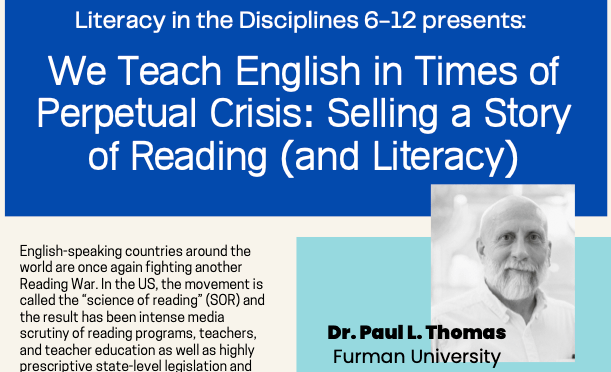
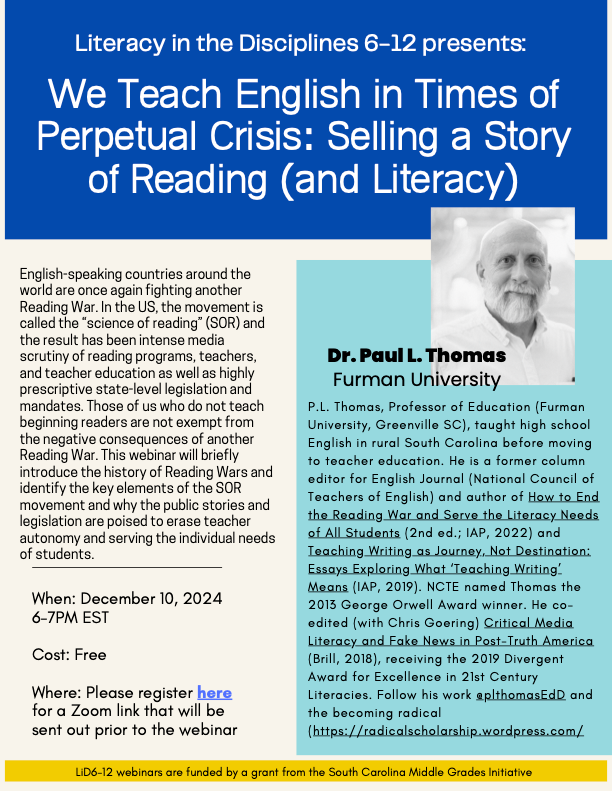
We Teach English in Times of Perpetual Crisis: Selling a Story of Reading (and Literacy) [Webinar Companion Post]

Click here to register: https://forms.gle/mvvs7etQAg7RESxs8

See the webinar presentation HERE.

Webinar recording:


In 1947, writing in NCTE’s Elementary English (which became Language Arts), Lou LaBrant announced, “This is not the time for the teacher of any language to follow the line of least resistance, to teach without the fullest possible knowledge of the implications of his medium” (p. 94).

The 2020s have made this call even more important for teachers of language K-12 in the US because of the rise of censorship and curriculum gag orders along with legislative mandates including scripted curriculum as part of the “science of reading” (SOR) movement.

Here, I want to focus on the SOR movement as another cycle of the Reading War, one that threatens the professionalism and autonomy of all teachers at every level.

Those Reading War cycles have included:

Teachers must recognize that Reading War cycles tend to be about ideology, market concerns (reading programs), and political agendas, but not grounded in credible evidence or well focused on the needs of students or the professionalism of teachers.

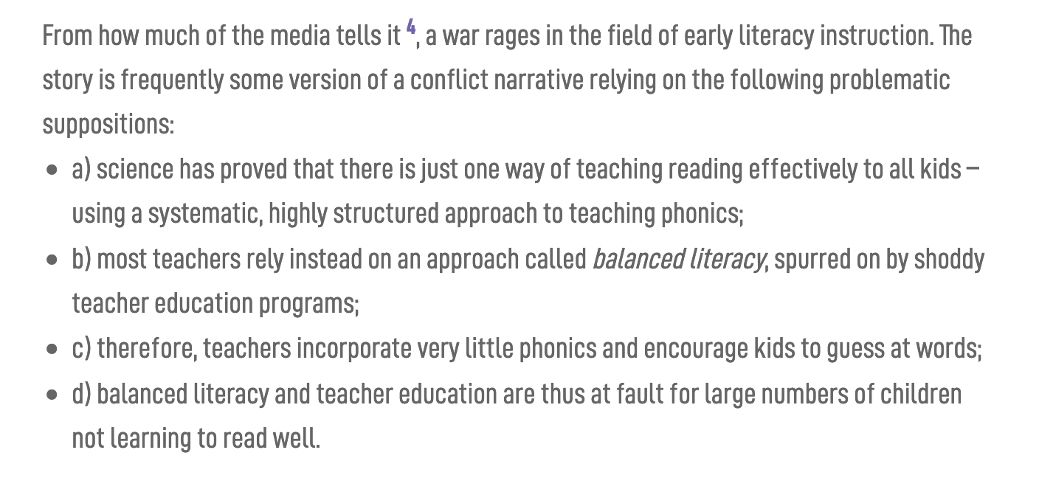
Also when I address the SOR movement, I am not contesting reading science or valid concerns about reading instruction or reading proficiency by students. I am challenging the media story being sold:

Aukerman, M. (2022, November 23). The science of reading and the media: Is reporting biased? Literacy Research Association. https://literacyresearchassociation.org/stories/the-science-of- reading-and-the-media-is-reporting-biased/ 

Further, teachers at all levels must be familiar with the key issues for misleading and even inaccurate claims within the SOR movement (again distinct from reading science and a broad base of research over a century):

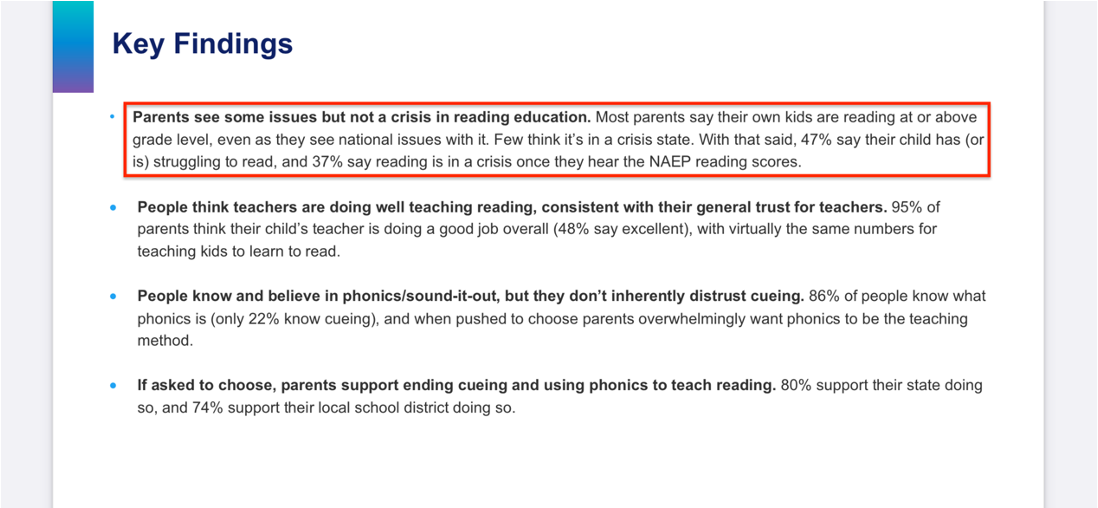
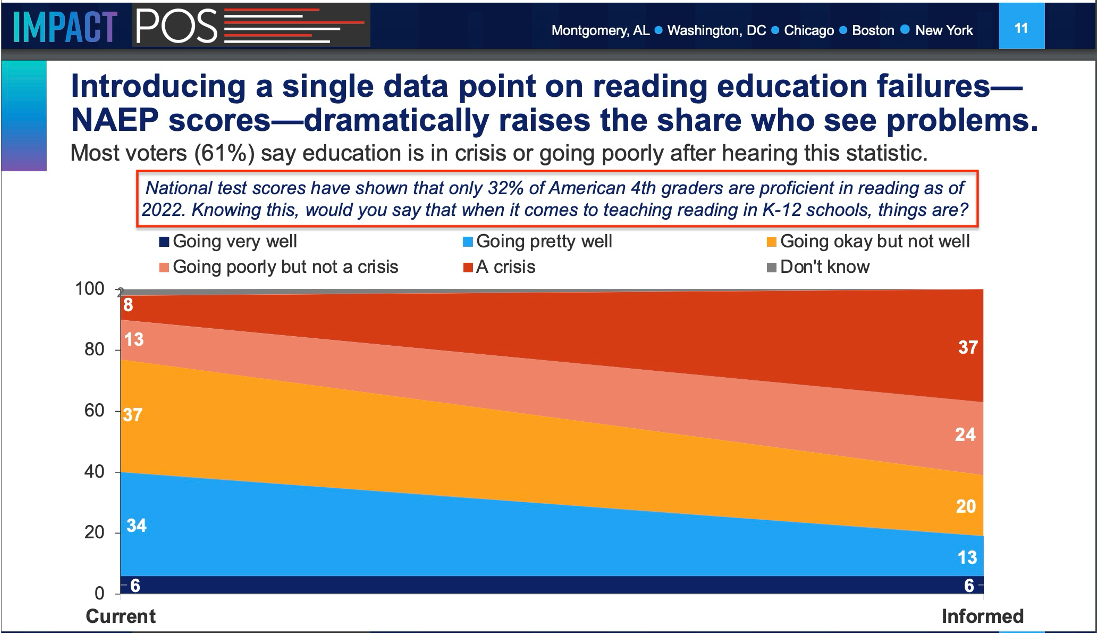
Despite many of the claims made in this media story being misleading or false, the story is very compelling for the public, especially parents. For example, a poll, Reading Education Messaging: Findings and Recommendations from an Online Poll of K-5 Parents in America, shows a disturbing pattern:

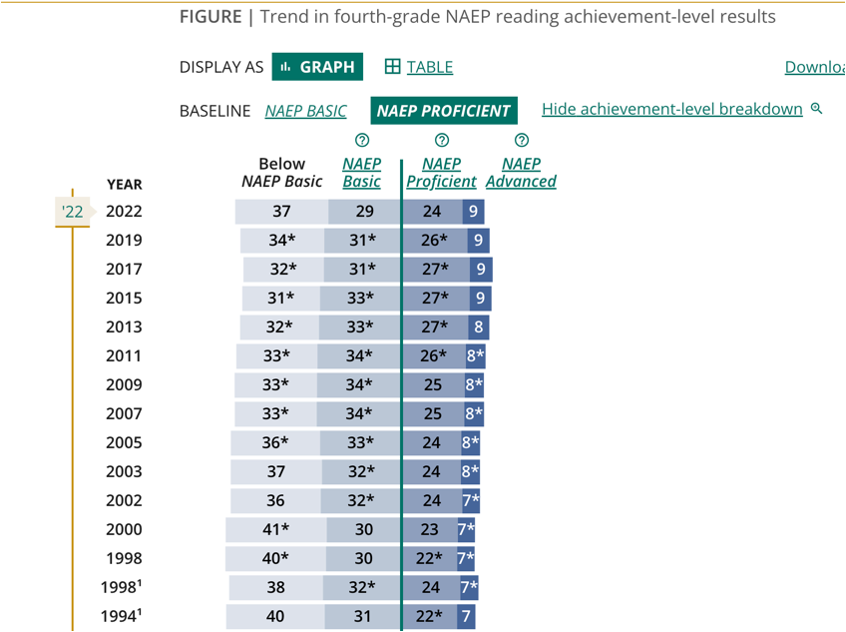
The media claim about reading proficiency (which is false because of the confusing categories in NAEP testing) actually changes parental opinion from positive to negative.

“Basic,” not “proficient,” in NAEP is at grade level; therefore, instead of about 2/3 of students struggling to read, the closer statistic is about 1/3 (and this has been a flat data point for 30+ years, which suggests a norm of reading proficiency and not some recent crisis):

More broadly, the phonics agenda in the Reading War is driven by the same conservative ideology as book bans.

One example is the advocacy of the Gablers in the 1980s, featured in a article in Texas Monthly:

But the Gablers also feel that even those students who learn to read through intensive phonics, memorize their ‘times tables,’ diagram sentences perfectly, and win spelling bees and math contests must still cope with an educational system that is geared to undermining their morals, their individuality, their pride in America, and their faith in God and the free enterprise system. Much of this corrosive work is accomplished through textbooks in history, social sciences, health, and homemaking.

The Gablers also targeted textbooks in their crusade similar to the book bans and misguided attacks on some reading programs:

Norma and Mel Gabler entered the field of textbook reform twenty years ago, after their son Jim came home from school disturbed at discrepancies between the 1954 American history text his eleventh-grade class was using and what his parents had taught him. The Gablers compared his text to history books printed in 1885 and 1921 and discovered differences. “Where can you go to get the truth?” Jim asked.

Since states have been moving toward reading legislation and programs labeled as SOR since around 2012, the evidence is mounting that these misleading and ideological claims of a reading crisis have not (and cannot) deliver on their promises. [1]

But possibly more troubling than the failure to improve student reading proficiency is that these legislative commitments are wasting taxpayers’ money on another baseless Reading War that serves the interests of the education marketplace: “In the first year of implementation, $100 million was allocated for the reform, with $60 million coming from CO VID-19 relief funds. Most of these resources, however, went toward covering the products and services provided by nonprofit and private-sector organizations” (Aydarova, 2023, p. 570).

The market motives behind SOR, in fact, were openly expressed a decade ago in a post by IDA, Structured Literacy: A New Term to Unify Us and Sell What We Do:

At its July 1st meeting, the IDA Board of Directors made a landmark decision designed to help market our approach to reading instruction.  The board chose a name that would encompass all approaches to reading instruction that conform to IDA’s Knowledge and Practice Standards. That name is ‘Structured Literacy.’…

If we want school districts to adopt our approach, we need a name that brings together our successes. We need one name that refers to the many programs that teach reading in the same way. A name is the first and essential step to building a brand….

The term “Structured Literacy” is not designed to replace Orton Gillingham, Multi-Sensory, or other terms in common use. It is an umbrella term designed to describe all of the programs that teach reading in essentially the same way. In our marketing, this term will help us simplify our message and connect our successes. “Structured Literacy” will help us sell what we do so well.

Structured literacy is more a marketing term than a proven way to address the manufactured reading crisis; further, structured literacy accomplishes two outcomes that are counter-educational—de-professionalizing teachers and whitewashing the reading curriculum. [2]

The SOR movement grounded in structured literacy driven by efforts to curb teacher autonomy is being admitted also by the Evidence Advocacy Center, as reported in New Initiative Is Creating Evidence-Based Guidelines for Educators:

In the EAC’s plan for the transformation of the profession into an evidence-based system, educators will relinquish certain freedoms — notably the leeway to employ ineffective practices — but will gain guidance that empowers them to fulfill their original purpose by profoundly impacting the future of students, families and communities. The alternative is to continue rearranging the deck chairs under the guise of education reform.

Since over 75% of public school teachers are women (Report on the Condition of Education 2024), all educators, regardless of content area or grade level, must recognize the threat of “relinquish certain freedoms,” eeriely similar to arguments posed to Handmaid’s in Atwood’s The Handmaid’s Tale:

There is more than one kind of freedom, said Aunt Lydia. Freedom to and freedom from. in the days of anarchy, it was freedom to. Now you are being given freedom from. Don’t underrate it….

We were a society dying, said Aunt Lydia, of too much choice. (pp. 24, 25)

While these efforts are about power and control, the SOR movement includes a harmful pattern of journalists taking on the role of “watchdogs,” as Hanford claims for the Education Writers Association.

Finally, then, the SOR movement is not just another Reading War, and the SOR movement is far more than an immediate concern for beginning reading teachers and teacher educators.

This movement is another threat to teaching as a profession, an organized agenda that seeks ways to de-professionalize teachers while serving market and political goals at the expense of teaching and learning.

Recommended

Betts, E. A., Dolch, E. W., Gates, A. I., Gray, W. S., Horn, E., LaBrant, L., Roberts, H., Smith, D. V., Smith, N. B., & Witty, P. (1942). What shall we do about reading today? A symposium. The Elementary English Review, 19(7), 225–­ 256. https://www.jstor.org/stable/41382636

Thomas, P.L. (2024, March). We teach English in times of perpetual crisis: The long (and tedious) history of reading crisis. English Journal, 113(4), 21-26. https://publicationsncte.org/content/journals/10.58680/ej2024113421

Thomas, P.L. (2024, May). Teaching English in the “science of reading” era: We teach English in times of perpetual crisis: Selling a story of reading. English Journal, 113(5), 16-22. https://publicationsncte.org/content/journals/10.58680/ej2024113516 [Access HERE until open access at EJ]

Thomas, P.L. (2024, September). We teach English in times of perpetual crisis: The media continue to misread teaching reading and literacy. English Journal, 114(1), 14-19. https://publicationsncte.org/content/journals/10.58680/ej2024114114 [Access HERE until open access at EJ]

Thomas, P.L. (2024, November). We teach English in times of perpetual crisis: For all ELA teachers, “the time is always now.” English Journal, 114(2), 21-26. TBD

Thomas, P.L. (2022). The Science of Reading movement: The never-ending debate and the need for a different approach to reading instruction. Boulder, CO: National Education Policy Center. Retrieved [date] from http://nepc.colorado.edu/publication/science-of-reading

Thomas, P.L. (2016). Miracle schools or political scam? In W.J. Mathis & T.M. Trujillo, Learning from the Federal Market-Based Reforms: Lessons for ESSA. Charlotte, NC: IAP.

Lou LaBrant: An Annotated Bibliography

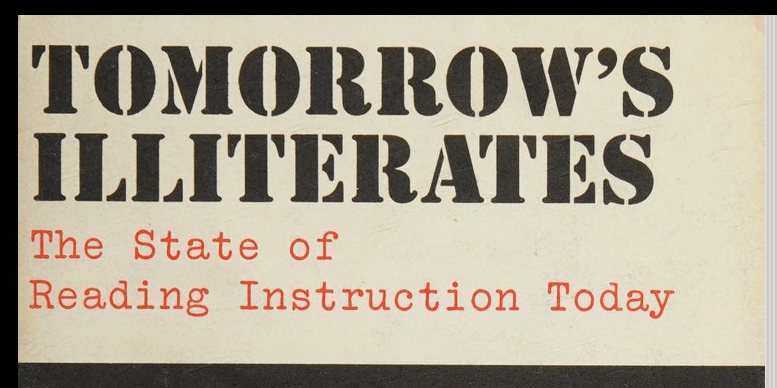
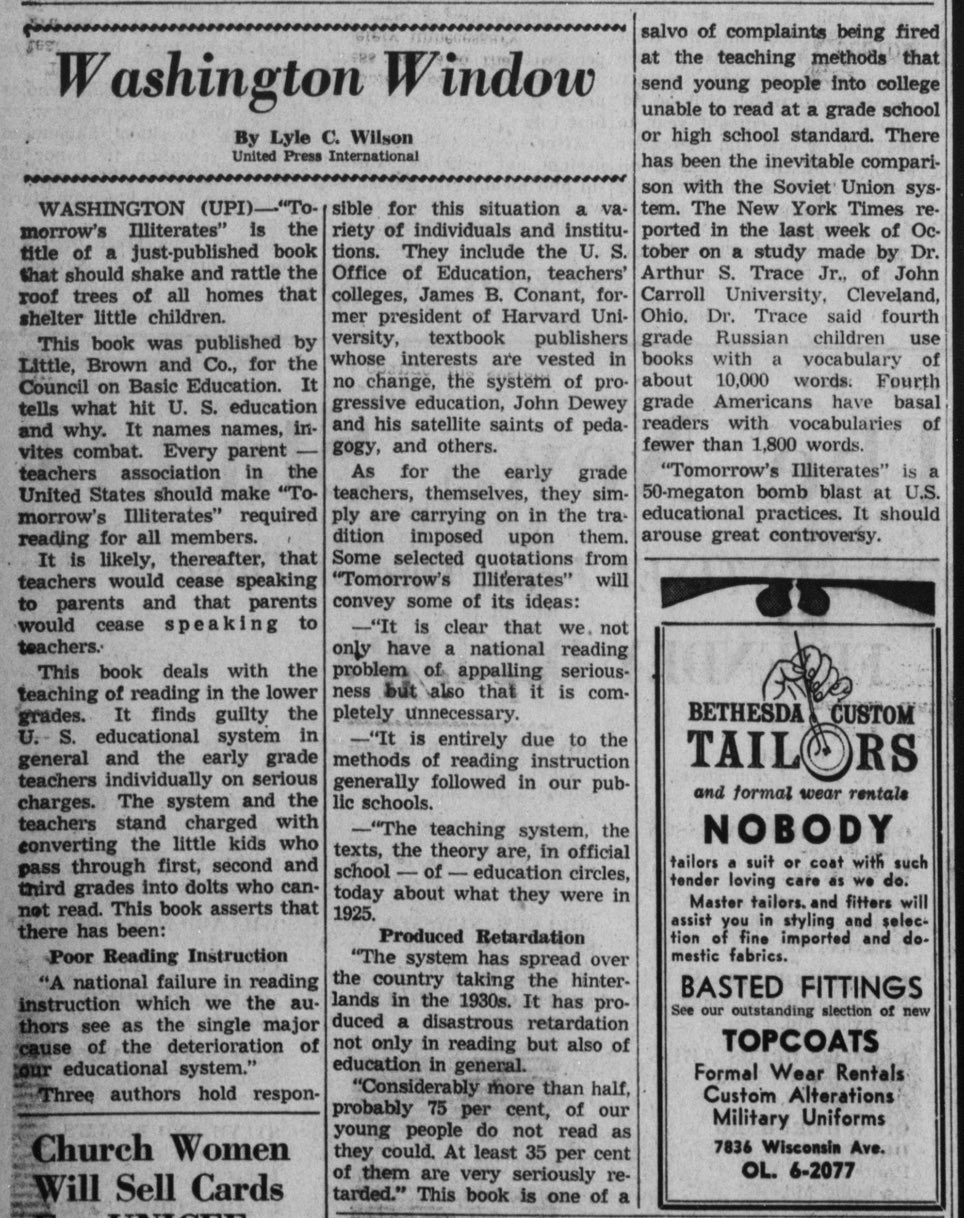
Tomorrow’s Illiterates: The State of Reading Instruction Today, by Walcutt, Charles Child


Notes

[1] See for example:

  • Aydarova, E. (2023). ‘Whatever you want to call it”: Science of reading mythologies in the education reform movement. Harvard Educational Review, 93(4), 556–581, https://doi.org10.17763/1943-5045-93.4.556
  • Chaffin, M., Riesco, H.S., Hacket-Hill, K., Collet, V., Grizzle, M.Y., Y Warren, J. (2023). “Phonics monkeys” and “real life reading”: Heteroglossic views of a state reading initiative. Literacy Research and Instruction, 1–22. https://doi.org10.1080/19388071.2023.2271085
  • Reinking, D., Hruby, G.G., & Risko, V.J. (2023). Legislating phonics: Settle science of political polemic? Teachers College Record. https://doi.org/10.1177/01614681231155688
  • Thomas, P.L. (2022). The Science of Reading movement: The never-ending debate and the need for a different approach to reading instruction. Boulder, CO: National Education Policy Center. http://nepc.colorado.edu/publication/science-of-reading 

[2] See for example:

Reading Crisis 1961: “[N]o Further ‘Research’ into Methods of Reading Is Necessary”

“After half a century of [progressive reform and expanding public education],” wrote Jacques Barzun in Tomorrow’s Illiterates: The State of Reading Instruction Today, “we who run businesses, carry on professions, work for the government, or engage in teaching itself are forced to admit that illiteracy is still with us” (xii-xiii).

This was published in 1961, and the cause of illiteracy Barzun confronts may sound familiar to those of us in the 2020s: “the loss of the proper pedagogy in the lower schools…, the goal of seeing whole words instead of letters” (p. xiii).

Barzun pleads, “the citizen who is interested (and who has managed to learn to read) [may have their] hair [stand] on end at hearing what folly has been condoned as educational theory during the past thirty years” (p. xiv).

Along with Barzuns dismay about how reading was taught and what passed for “reading theory,” he mused at the end of his Introduction: “Shall we need another book like the present one, fifty years hence, about the misdeeds of the new simplifiers?” (p. xvi).

Considering Barzun lived to be 102, dying in 2012, he may have had what little hair remained stand on end to watch the reading crisis return in the 1990s (the national meltdown over whole language) and 2000s (the National Reading Panel era). And if he could have just held on a bit longer, the current “science of reading” (SOR) onslaught that takes its playbook from the very volume that includes Barzun’s hand wringing now some 60-plus years ago.

Despite the authors’ lamentations in this volume (along with others in the 1950s and 1960s that held forth again progressive education and whole word reading instruction), neither the US nor the world collapsed due to misguided reading instruction or theory.

Shouting “reading crisis!” has proven to be more hobby that credible pronouncement, and ironically, if folks would find the time to read a bit (I recommend this book, b the way), it doesn’t take long to see the arguments as mostly nonsense and wild overreactions grounded in ideologies.

Let me show you a few examples beyond Barzun’s smug and sensationalistic Introduction.

Chapter I: The Reading Problem in America, Charles Child Walcutt [click for a selection of screen shots]

Walcutt, editor of the volume and also author of Chapter VII, offers and opening chapter that takes a full swing at announcing a reading crisis as well as casting plenty of blame. Much of the chapter should sound eerie similar to those familiar with Emily Hanford’s journalism and podcast, patterns that pervade the entire volume.

Walcutt starts by showing evidence of claims of a reading crisis (somehow avoiding credible evidence of a reading crisis). This is particularly interesting because of the strong connections made about low literacy, special needs, and what children are suited for higher education and what children should move from high school into the workforce. Of note, Walcutt mentions Samuel Orton (of Orton-Gillingham), but provides no citation, when discussing disability (p. 8)

If nothing else, the certainty exhibited by Walcutt framed against how much of that certainty comes off as deeply misguided, and by today’s standards, offensive and dehumanizing should give all of us pause about our own certainty and blanket claims.

However, note that immediately follow Walcutt’s arguments about low literacy, he immediately shares a single example of a school that excels at teaching reading! Yes, even in the 1960s, there were claims of miracle schools: “In a school of 700 pupils, there are only 20 with reading problems….We cannot stress too positively that fact that in this school every child learns to read independently in the first grade, unless he is mentally retarded [sic] or disabled”—a percentage oddly close to SOR claims that 90, 95, or 96% of students can be proficient readers (pp. 10-11). [Nowhere is terminology such as “independently” defined or linked to how these claims are verified beyond the claims of the school. We also have no demographics on students or how those students compare to a generalized populations of students.]

We should note that these extraordinary claims have no proof, no scientific research—just claims and anecdotes.

Walcutt does launch into a few pages of “facts,” including data mostly grounded in IQ testing. One example is a reference to the 1940s reading crisis based on the draft for WWII; note that this reading crisis was strongly discredited by literacy scholars as a false attack on progressive education.

Walcutt’s facts also criticize popular commercial reading programs (Macmillan) and associate low literacy with delinquency and low IQ.

Then comes the direct blame, which, again, will sound familiar: “One way to describe the reading problem is to say that it is a teacher problem and —even more—that it is a problem of the teaching of teachers” (p. 18).

And of course: “The assertion that the reading experts do not understand the theory of their system can be demonstrated if we point out the false assumptions, the faulty extrapolations from scientific research, and the absolute contradictions that appear in its central propositions and procedures” (pp. 19-20).

Walcutt then discredits the look-and-say method that he claims dominates reading instruction—although we are left simply to trust that the characterization is both fair and as universally applied as he claims.

Walcutt also traces look-and-say back to Horace Mann, although, again, we must trust this analysis is credible.

Embedded here is a big picture characterization-as-criticism:

This says that reading for meaning has supplanted reading for pronunciation, or even word-recognition, and that some teachers teach only reading for meaning (presumably by whole sentences), ignoring phonics completely on the theory that the child who can read for meaning will pick up his phonics incidentally and without special instruction or effort, but he will read for meaning before he can sound out a word” (p. 31).

In the 1990s, this is the same argument leveled against whole language; today, this is the same argument leveled at balanced literacy.

After Walcutt spends a great deal of time metaphorically discrediting the look-and-say method (an extended bird analogy), he ends melodramatically (but not scientifically): “With this rickety equipment the look-and-say bird has flown for more than thirty years, casting a huge shadow over the lives of our children” (p. 43).

Chapter II: The Nature of Reading Skill, John C. Daniels and Hunter Diack [click for a selection of screen shots]

Daniels and Diack start with exploring different definitions for reading, using another analogy (driving a car). Much of the discussion focuses on concerns about reading through whole word methods, leading to the authors noting their own research on reading errors.

Again, they criticisms seem mostly grounded in disagreements with Dewey and Gestalt psychology. This leads to a discussion of new reading primers, which they criticize as lacking and boring because of efforts to identify and use a necessarily limited number of sight words.

As an artifact of the recurring patterns of the Reading War, this chapter highlights the problems with reading programs and primers grounded in narrow theories and philosophies of reading, but it also demonstrates the complexity of the debates in their final paragraph: “But having said this, we must add that, though the unit of accomplished reading is the word, the phrase, or even the sentence, the unit of learning to read is the letter. These are not two contradictory, conflicting aspects of reading; the one agrees with the other. However, present anxieties about the teaching of reading stem from failures to distinguish between, and indeed actually confusing, these two aspects of the reading process” (p. 67).

Ch. III: Reading Readiness in Theory and Practice, Glenn McCracken [click for a selection of screen shots]

McCracken explains that the New Castle Reading Experiment was published in the book, The Right to Learn, and thus, “Its most important contribution to reading is its proof that the ‘reading readiness’ program is both meaningless and harmful” (p. 71).

This chapter includes a claim that seems common across decades: “Today reading specialists have a long list of reasons why about one third of the public school children can’t read” (p. 80). [Note that despite claims by SOR advocates, NAEP reading scores have been fairly flat with about 30% of students below basic, which is below grade level approximately.]

McCracken represents as well the “poverty is an excuse” faction in the Reading War, arguing: “It is folly to blame poor reading on distracting home influences….Children will learn to read if they are taught to read….If they don’t learn to read it is the fault of the teaching, not the taught” (p. 82).

If fact, McCracken continues, “The reading readiness fad as we have described it here was invented to excuse poor reading instruction by shifting the entire blame to the child….Almost every five-year-old child is ready to learn to read the day he enters school if the reading program is ready for him” (pp. 82, 83).

But, alas, “Reading instructional method in this country is abysmally poor, and blaming the matter on the child is never going to provide any improvement” (p. 84).

Ch. IV: The Whole-Word and Word-Guessing Fallacy, Helen R Lowe [click for a selection of screen shots]

Lowe shares an anecdote about a 28-year-old who holds a high school diploma designated with “Honors”; yet, Arthur cannot read.

Of course, such stories have been highlighted throughout the twentieth and into the twenty-first centuries; they are tragic but are none the less anecdotes, proving nothing that can be generalized about how children are taught to read.

Lowe, like the other authors in this volume, has an agenda so as is common in all the eras of the Reading War, their are bait-and-switch tactics, never grounded in valid evidence or claims.

Notable, Lowe recognizes that standardized testing of reading can and was gamed to meet the ways students were taught to read; she accuses reading tests focusing on predicting means that “the best predicters are rated the best readers” (p. 103)

The agenda is to attack, you may be surprised, teaching children to guess at words by using pictures: “How can he learn to read words when he is taught to look and think about pictures?” she ponders (p. 104).

Lowe also mentions Orton (in this volume paired with Gallagher, not Gillingham), again without citation.

Ch. V: Reading: A Therapeutic Tool, Hildred Rawson [click for a selection of screen shots]

Rawson’s chapter demonstrates a few key patterns found in today’s Reading War. First is the tension between teaching reading and how to identify students with special needs such as dyslexia.

Rawson argues that “children with reading disorders are not usually referred to us for examination and treatment until they reach the third grade” because of the look-and-say curriculum.

However, “Children…who have been taught for the first grade…to sound out words—that is, by the phonetic method—approach reading differently. They do not need picture clues” (p. 132).

She calls for phonics-first instruction, and no guessing using pictures, to prevent dyslexia, in fact.

[Ch. VI deals with the claimed link between reading “retardation [sic]” and delinquency.]

Ch. VII: Phonics Systems—Proved and Available, Charles Child Walcutt [click for a selection of screen shots]

Walcutt returns and offers the anchor chapter with the stunning opening line: “We have said that no further ‘research’ into methods of reading instruction is necessary” (p. 141).

The chapter is dedicated to an overview of phonics-based reading programs that, he claims, show that reading research is settled—in 1961.


So here you have essentially the exact same arguments made in 1961 that are being used in the SOR movement.

This is basically a silly book, filled with anecdotes and overstatements. But the SOR movement is no less silly, no less bombastic, and no less futile.

We persist with the same arguments getting us nowhere.

Maybe the problem is the arguments, the silly adult bickering.

Actually, there is no “maybe.”


Tomorrow’s Illiterates: The State of Reading Instruction Today, by Walcutt, Charles Child [click title for access through Internet Archive]

You can access screenshots HERE.


NCTE 2025 Individual Presentation: Recovering Our Reading Dream from a Long Crisis Nightmare

11/21/2025 – 2:45 – 3:15, Mile High Ballroom 1A/1B

Access a PDF of presentation HERE

In 1961, Jacques Barzun in Tomorrow’s Illiterates declared “illiteracy is still with us.” Charles Child Walcutt added: “[N]o further ‘research’ into methods of reading instruction is necessary.” This session examines reading crisis/reform cycles to reconsider the stories told about reading and offer a new approach for reform that serves the needs of students and supports teacher professionalism.

Is Learning to Read Natural?

I need to offer as few clarifications since my recent post on how the teaching of reading has been historically corrupted by the influence of reading programs. The motivation of the clarification comes from a comment posted by KenS.*

First, my literacy teaching for the past thirty years does rest on a controversial concept—that grammatical knowledge is essentially biological (see Pinker and Chomsky). This I believe is important as it helps keep literacy instruction from being reduced to seeing language as something acquired.

Next, and to KenS’s questions, speaking and listening are inherent to being human, but reading and writing are artificial, thus acquiring reading and writing are not natural.

However, my point in the earlier post, which certainly wasn’t clear or fully explored, is that Dewey’s claim about not needing to teach reading is grounded in that when children have privileged environments, notably ones that are language and text rich, the acquisition of reading can appear to be natural.

Our goals, then, should be to insure all children have privileged homes that are conducive to language acquisition and that schools provide parallel environments that foster and reinforce  literacy acquisition.

One additional caveat is all of the above is addressing decoding and comprehension (“reading” is a complex term). But I never see decoding and comprehension as going far enough in formal education.

Direct instruction and careful fostering of critical literacy must be provided to all students, and the acquisition of critical literacy, I believe, is certainly not acquired naturally since it requires that we confront and challenge all of the conditions that constitute “natural” for each person.

I hope this is more clear and addresses the great comment from KenS.

* See the comment from Kens at my original post and below:

First, Dr. Thomas, thanks, as always, for making me aware of historical perspectives I was not previously aware of. Your writing always provides much food for thought.

I am not certain of your point with this post, however, and because understanding how young people learn to read (or don’t) has become so important to me, I hope you will clarify for me.

Mea culpa: Despite the fact that I am in my 17th year of teaching middle school English, I have come to see myself as a teacher of reading only gradually. Earlier in my career I saw it as my job to teach literature and academic writing. It took me far longer than it should have, but I finally began to wonder why students reached middle school with such widely varying aptitudes for understanding what they read.

My question pertains to your statement that your “perspective on reading isn’t all that different from Dewey’s” belief that “reading just happened.” How close, then is your perspective to Dewey’s position?

Dewey’s stance contradicts what I’ve come to believe – although there seems to be much disagreement about reading instruction, even among experts, so I am keeping an open mind.

OK, I’ll try to be brief: Pinker, in The Language Instinct, convinced my that young children are wired to learn oral language without formal instruction. Hart and Risley, in Meaningful Differences in the Everyday Experiences of Young American Children, convinced me that the extensive differences in the quantity and quality of verbal experiences among children had an enormous impact on children’s readiness to learn once they started school. Lakoff and Johnson, in Metaphors We Live By, led me to believe that the advantages affluent children had in verbal practice led not only to a larger vocabulary, but a conceptual system far more prepared to make sense of the abstract content they encountered in school.

But here is where I disagree with Dewey; here is where I think he just didn’t understand that a reason he didn’t remember being taught to read is that his young mind didn’t have the conceptual framework yet to be metacognitive about what he was undergoing in his childhood.

Dr. Diane McGuinness, in several books, has argued that children don’t naturally learn to read any more than they naturally learn to work on car engines. Yes, some people have more aptitude for learning how car engines work, just as some people learn to read faster. But, still, having some guidance from someone more experienced seems a “natural” part of our development as humans.

McGuinness points out that writing systems are a human invention and the English alphabetic system is particularly complicated. To fully understand it, children must be taught to decode written words and encode into writing the sounds we produce as words. She also points out that the brain is an incredible pattern-spotting machine, and children will learn, even when teaching methods are not particularly efficient.

Now, to be clear, it seems to me there are essentially two stages (that must overlap) to learning to read – learning to decode and encode the code that is our alphabet, and learning to read for meaning. Perhaps I misunderstood your position, and you were referring to learning to read for meaning. To some extent, I think that can occur more “naturally,” as our brains are also meaning-seeking.

Finally, all this has led me to believe most definitely that discrepencies in wealth and power and priviledge are responsible for the much of the discrepencies we see in children’s academic achievment. In that regard, I agree with you 100%.

Common Core in the Real World: Destroying Literacy through Standardization (Again)

I have a brief comedy routine I use with my students, typically early in each course I teach—in part to introduce them to me, and in part to make a point about literacy.* The joke goes like this:

“When I graduated high school,” I say, ” I had 7,000 comic books,” slight pause, “and no girl friend.”

The students typically laugh, and then I deadpan, “That’s not funny. That’s sad.”

When they suddenly stop laughing, I smile widely, and we all laugh together.**

I began collecting comic books—primarily to draw from them—in the summer before my ninth grade, the summer I learned I had scoliosis and would have to wear a huge back brace throughout my high school years (23 hours a day at first and throughout school hours into my junior year of high school). That situation provided me with yet another joke for my students; when I tell that part of my life story, I say that I called my back brace “the chick magnet.” More laughter.

By my sophomore year of high school, I was collecting, drawing from, and reading dozens of comics each month. I also had begun reading science fiction (SF) voraciously. I can still recall Lucifer’s HammerRendezvous with Rama and Childhood’s End vividly—not the contents of the books so much as the reading was hard and that I felt accomplished by making my way through each one.

Lynn Harrill was my driver’s education teacher the summer before my tenth grade, and then my English teacher in both my sophomore and junior years. Lynn would prove to be the most important man and mentor in my life after my father, but during tenth grade, he told me that I needed to stop reading SF and start reading “real literature.”

And I did (well, I starting reading real literature, but didn’t stop reading SF). In the next several years, I had read everything by D.H. Lawrence (to whom Lynn introduced me), F. Scott Fitzgerald, Ernest Hemingway, William Faulkner, Thomas Wolfe, and many other literary authors.

I owe a great deal to Lynn, despite his being wrong about his proclamation marginalizing SF (and indirectly my comics) and honoring literary fiction. But another moment in my sophomore year of English deserves mentioning.

A required book in my tenth grade was A Tale of Two Cities. The summative assessment on the novel was a multiple-choice test—on which I scored a 96, the highest grade in the class. Most of the students in the class—which was the highest track—made much lower, and they all were mad at me from ruining any chance at the grades being curved.

But that isn’t the important aspect of this story—what is?

I never read the novel.

I scored a 96 by reading the Cliff’s Notes and taking careful notes in class.

Common Core in the Real World: Destroying Literacy through Standardization (Again)

An essay in the Educational Research Bulletin addressing reading requirements in high school opens with the following:

Within the last few years heated discussion has centered around the question of free reading for high-school students in English classes. Critics have insisted that interest as a basis for book selection merely tends to establish poor taste; they have stressed the importance of organization in reading as in any program; they have assumed that free reading, with its emphasis upon pupil-direction, lacks content. Indeed, the arguments in slightly more abstract form are those frequently advanced against any program in whose construction pupils participate, and have been offered as criticism of the whole progressive-school movement. (p. 29)

While this could easily be a description of the debates surrounding Common Core, this is by Lou LaBrant, written in 1937.

LaBrant presents a careful study of the positive consequences of free reading in the context of the traditional view that students must be assigned reading and that students must also read primarily (if not only) from the Great Books. She concludes from the study:

The theory that in a free or extensive reading program designed to utilize interest and to serve individual needs there will be fruitless reading of light fiction gains no evidence from this study. The report does, however, point to the possibility that the adolescent has much greater power to read and to think intelligently about reading than the results of our conventional program have led us to believe. (p. 34)

In the seventy-plus years since LaBrant’s piece, as literacy scholars such as Stephen Krashen have argued and detailed in their research, student literacy has been shown to spring from choice reading and access to books (in the home and libraries)—not from prescribed reading lists, not from revised standards, and certainly not from testing reading.

Advocates for Common Core insist that CC is not prescriptive and that CC is not the tests to come from these new standards.

Those advocates are simply ignoring the real world and the history of standards-bases education in the U.S.; they are, in fact, confusing the use of “to be” verbs with “should.” It may very well be that CC should not be prescriptive and should not be reduced to the tests. But should does not dictate what most surely is and will be.

Last week, for example, a former student of mine who is now a high school English teacher texted me distraught. Her English department is aggressively pursuing a new policy to end the use of young adult (YA) literature in the high school courses at her school. Why?

The department leaders have argued that CC requires literature that is “rigorous.”

Despite having abundant evidence on her side (including research and that students do read voraciously YA literature), she has been told to stop her resistance.

Another former student of mine who teachers high school English also faced harsh evaluations during her first year of teaching because she designed and implemented a wonderful unit around The Hunger Games. Despite the huge popularity of the unit among her students (and among student not in her class who were drawn into the books because of word of mouth), the leaders of her department also reprimanded her for depending on lesser literature—arguing that her students needed higher quality reading (required Great Books, again).

In the real world, CC and the tests that are to follow have and will once again reinforce the exact practices that have harmed literacy among students for a century; teachers will be emboldened to assign Great Books (and marginalize further everything else) and teachers will be compelled to teach to the test.

In the real world, as Gerald Bracey has explained, what is tested is what is taught—especially when standards and testing are part of high-stakes accountability. CC may in fact raise (eventually) some reading test scores, but I guarantee it will only harm the teaching of literacy and the literacy of students.

I have slipped past the age of 50. I have read thousands of books and written several myself.

My greatest literacy joys remain authors I was never assigned, but discovered for myself—Milan Kundera, Kurt Vonnegut, Margaret Atwood, Haruki Murakami, Neil Gaiman.

My literary life can be traced back to my mother and the wealth of children’s books that populated my childhood home and then my deeply self-conscious nerd self as a teen sitting in my comic book room surrounded by comic books and stacks of Arthur C. Clarke novels.

I graduated high school with mostly As in math and science, intending to be physics major, because school had profoundly misled me about the joy and wonder of words.

In college, on my own, I learned otherwise.

There is no justification for CC and the tests that have and will follow if we genuinely seek to offer children the rich and valuable literacy that every child deserves. Denying students choice is ignoring what we know about literacy development as well as the essence of basic human agency.

Common Core in the real world is once again destroying literacy through standardization.

* This blog was inspired by Christopher Lehman @iChrisLehman.

** My newer joke springs from The Big Bang Theory; at some point I tell students I watch and enjoy the show, and then pause before saying quite seriously I don’t understand, however, why people think it’s funny. Then I smile widely.

Just Say No to Just Read, Florida, South Carolina

“Nearly 3,000 of South Carolina’s third-graders who struggle with reading could be held back if the state adopts a plan that would require students to read at or near grade level,” Jamie Self reports in The State (“Education leaders: Florida holds key to SC literacy fix,” March 31, 2013), adding later,

Under Peeler’s bill, 2,886 SC third-graders scored low enough on a 2012 reading test to be held back a year — more than four times the 584 third-graders held back in 2012. The number reflects only the lowest-scoring readers, about 27 percent of the more than 10,500 third-graders who scored as not reading on grade level….

SC schools chief Mick Zais supports the plan to hold back struggling third-graders and would like to see a similar track for seventh graders, his spokesman Jay Ragley said.

SC Senate Majority Leader Harvey Peeler, R-Cherokee, has introduced the bill modeled on Just Read, Florida, part of a grade-retention policy widely promoted by Jeb Bush as one aspect of the larger so-called “Florida Miracle.”

SC political leadership must not follow Florida’s lead in reading policy or grade retention policy for several reasons, including the following: the “Florida Miracle” has been thoroughly discredited, grade retention has no support in the research that shows retention has no positive outcomes but many negative consequences for children and tax payers, and initiatives such as Just Read, Florida ignore and replace credible literacy policy desperately needed in high-poverty states such as SC.

First, SC political leadership and the public must acknowledge what low reading test scores represent and the negative consequences of basing policy on test data:

  • All standardized test scores, including reading scores, are overwhelmingly a reflection of home, community, and school inequities more so than direct and clear evidence of holistic reading ability by children. Low reading scores by third graders in SC are signals of a high-poverty state, first and foremost.
  • Reading test scores are often poor evidence of real-world and holistic reading ability. Standardized tests of reading are typically skills-based and/or complicated by other student skills imbedded in the test format (for example, having students write on a reading test blurs the evidence on reading and writing proficiencies).
  • High-stakes test-based decisions for grade retention, instructional programs, and instructional practices—especially in literacy—have a clear negative impact on the quality of instruction as well as the quality of learning opportunities children who need education the most are likely to receive:

In too many places, however, graduation and promotion tests are putting many students at sharply increased risk of suffering the serious, well-documented harm associated with grade retention and denial of high school diplomas. Those at greatest risk include the very populations—students of color, students with disabilities, English-language learners, and low-income students—whom standards-based reform could potentially help the most. (Heubert, 2002/2003)

Second, SC political leadership and the public must acknowledge that the “Florida Miracle”—like the “Texas Miracle,” the “Harlem Miracle,” and the “Chicago Miracle”—has been thoroughly discredited as incomplete data, misrepresented accomplishments, or outright failures.

A brief review of credible examinations of the “Florida formula” include strong cautions about both the claims of success and the use of Florida as a model of reform.

Matthew Di Carlo acknowledges mixed results, but cautions using the formula to drive policy:

That said, the available evidence on these policies, at least those for which some solid evidence exists, might be summarized as mixed but leaning toward modestly positive, with important (albeit common) caveats. A few of the reforms may have generated moderate but meaningful increases in test-based performance (with all the limitations that this implies) among the students and schools they affected. In a couple of other cases, there seems to have been little discernible impact on testing outcomes (and/or there is not yet sufficient basis to draw even highly tentative conclusions). It’s a good bet – or at least wishful thinking – that most of the evidence is still to come.

In the meantime, regardless of one’s opinion on whether the “Florida formula” is a success and/or should be exported to other states, the assertion that the reforms are responsible for the state’s increases in NAEP scores and FCAT proficiency rates during the late 1990s and 2000s not only violates basic principles of policy analysis, but it is also, at best, implausible. The reforms’ estimated effects, if any, tend to be quite small, and most of them are, by design, targeted at subgroups (e.g., the “lowest-performing” students and schools). Thus, even large impacts are no guarantee to show up at the aggregate statewide level (see the papers and reviews in the first footnote for more discussion)….

Whether we like it or not, real improvements at aggregate levels are almost always slow and incremental. There are no “miracles,” in Florida or anywhere else. The sooner we realize that, and start choosing and judging policies based on attainable expectations that accept the reality of the long haul, the better.

Julian Vasquez Heilig identifies the error of focusing on apparent increases in 3rd to 4th grade reading scores and associating them with policy:

Cloaking Inequity examined the purported test score miracle earlier here. In 4th grade, Florida improved over the last decade and was position in the top ten nationally, but as you move up the grade levels, the longer student stay in Florida schools, the worse their performance relative to the nation. I also discussed the official Florida scholarship evaluation in Florida that showed their scholarship (aka neovoucher) program had not increased the achievement of program participants.

Third, all evidence on grade retention reveals only negative consequences for children (academic and emotional) and tax payers, the public. [1]

Alfie Kohn notes that accountability “get tough” attitudes are masking the need for policy to be built on evidence:

The same get-tough sensibility that has loosed an avalanche of testing has led to a self-congratulatory war on “social promotion” that consists of forcing students to repeat a grade. The preponderance of evidence indicates that this is just about the worst course of action to take with struggling children in terms of both its academic and social-psychological effects. And the evidence uniformly demonstrates that retention increases the chance that a student will leave school; in fact, it’s an even stronger predictor of dropping out than is socioeconomic status.

Some of the well-documented effects of grade retention include the following:

Retained students are more likely to be male, younger than classmates, from a lower socio-economic class, black or Hispanic, a behavior problem and immature (Karweit, 1991).

Research shows a large correlation between dropouts and retention….

Controlled studies do not support the benefits claimed for extra-year programs (i.e., transitional first, pre-kindergarten) and negative side effects occur just as they do for retention in later grades….

Empirical research shows retention does not improve the achievement of children as measured by tests of basic skills. No significant positive long-term effect is evident. Studies indicate retention is either ineffective or harmful, with more negative than positive effects….

Retention imposes an economic burden of financing an extra year of schooling….

Children attach stigma, stress, and shame to retention.

Kevin Welner states directly and clearly that no policy decisions should include grade retention, specifically citing Florida’s policies:

Let’s use grade retention to illustrate. States across the U.S. are adopting mandates requiring that  third graders with low reading scores repeat the grade. The ‘leave the student back’ policy is being heavily marketed by the Foundation for Excellence in Education, an organization created by former Florida governor Jeb Bush. But retaining students is not a new idea. It’s an experiment that’s been tried on and off for generations, and it’s been studied for almost that long.

The overarching message from research in this area is that retaining a low-scoring third grader will not help her do better than a similar classmate with similar scores who is moved along to fourth grade, but she will be more likely to eventually drop out.

Viewed from a taxpayer perspective, retaining a student will likely have one of two outcomes:

1. She may drop out, meaning she will pay about $60,000 less in taxes over her lifetime, be more likely to commit crimes, and be more likely to depend on government assistance; or

2. She may complete high school, at a cost of an extra year of school – about $10,000. If retention had a substantial payoff, paying for an extra year of school would be worthwhile (although it nationally adds up to billions of dollars each year). But there’s no benefit. With grade retention, we are paying more and getting a worse outcome.

That’s the evidence. It’s what we have learned (or should have learned) from decades of  experience. Grade retention can be expected to have the same destructive results in 2012 as it did when it was tried ten or twenty or forty years ago – or any of the years in between. Yet our lawmakers do the same thing over and over again, each time expecting different results.

Allensworth (2005) found that retention based on test scores at the elementary level contributed to higher drop-out rates; this study is particularly important to evaluating the long-term impact of the Florida formula as well as any state considering implementing similar policies that focus on short-term test scores while ignoring long-term consequences.

Grade retention fails students retained, fails taxpayers, and as Gottfried (2013) has shown, fails the non-retained classmates of students retained:

This research has brought to the foreground a new dimension of the analysis relating to grade retention, as well as peer effects. In essence, by demonstrating a pervasive negative effect of retained classmates, as derived from multiple quasi-experimental methods on a panel data set of urban schoolchildren, this study corroborates the predominant conclusions of prior research on retention. Namely, this practice of grade retention is associated with negative outcomes (Allen et al. 2009; Holmes 1989; McCoy and Reynolds 1999; Meisels and Liaw 1993; Reynolds 1992; Roderick and Nagaoka 2005). The unique contribution of this study is that the negative outcomes of this schooling practice are not restricted to the retained students themselves; rather, this study has found that retention can affect the academic outcomes for other members of the classroom. Moreover, this study has also facilitated an opportunity for urban educational experiences to be further delineated and for policy implications of this practice to be more thoroughly discussed.

Finally, SC political leadership needs to address in authentic and effective ways the very real literacy challenges faced by our high-poverty students. Modeling SC educational policy on Florida, however, would achieve only what Kohn has identified as policy insuring more non-readers.

Credible reading policy in SC would include the following:

  • Create and implement social policy that addresses poverty and job creation/stability in the historically high-poverty areas of the state. Children living in high-poverty homes and communities are “doubly disadvantaged” in ways that cannot be overcome by schools alone and that are too often reflected in and perpetuated by community-based schools and failed educational policies such as Florida’s Just Read, Florida.
  • Reading and literacy achievement should be evaluated through holistic, classroom-based mechanisms, not high-stakes testing. Increasing high-stakes test scores in reading may have the unintended consequence of producing both misleading data and further eroding the literacy proficiency of high-poverty, minority, special needs, and ELL students. Test-based evaluations of students, teachers, schools, and policy tend to create conditions that ask less of everyone, not more.
  • Reading proficiency is of little value if students are non-readers due to punitive and skills-based school policy. Reading is a holistic and unpredictable human behavior that must be fostered over many years and through strategies that appear “too simple”—increase children’s access to books in their homes, increase children’s access to books in school, provide students extended opportunities to read by choice during the school day, address adult and community literacy
  • Reading proficiency and creating life-long, eager readers will never be achieved by reading policies or programs, particularly pre-packaged commercial programs. Teachers and parents can and should foster reading and all literacy, but ultimately children cannot be bribed, forced, or punished into being readers.

As Welner concludes in his consideration of education reform:

To be clear, “social promotion” – the movement of students from grade to grade with no meaningful intervention for those who fall behind – is also not supported by research evidence. Instead, as proven approaches to address the problem of early reading gaps, research supports high-quality early-childhood education, intensive early reading interventions, and smaller class sizes in early grades for at-risk students. These are all less costly and more effective than grade retention.

Evidence supports grade promotion combined with these sorts of interventions, and it clearly cautions against a systemic use of grade retention, even retention combined with additional academic support.

A reckless disregard of evidence is harmful. It leads to the waste of precious resources: our tax dollars and our children themselves. And grade retention is only one example of the larger problem.

SOURCES

“Florida Miracle” 

Review of Closing the Racial Achievement Gap, Madhabi Chatterji

Water into Wine?, Julian Vasquez Heilig

Lurking in the Bushes, Julian Vasquez Heilig

Parsing the Florida “Miracle,” Diane Ravitch

The Test-Based Evidence on the “Florida Formula,” Matthew Di Carlo

Editorial: Florida needs no advice from Jeb Bush on education policy, Jac Versteeg

Review of Getting Farther Ahead by Staying Behind, Derek C. Briggs

How Jeb Bush’s school reforms really played out in Florida, interview with Sherman Dorn

Grade Retention: U.S.

Third Grade Reading Policies, Rose (2012)

Education in Two Worlds: Follow Up to “50 Myths & Lies,” Gene V. Glass

A second myth we see as dangerous has that quality because of what it reveals about too many of America’s politicians and school leaders: it reveals both their ignorance and their cruelty! This is the myth that leaving a child back in grade who is not doing well academically is good for the child. It provides the child with “the gift of time” to catch up. We believe that only ignorant and cruel people would support such a policy, although it is law in about a dozen states, including Arizona and Florida. First of all, a large and quite consistent set of research studies, many of excellent quality, point out that for the vast majority of the children retention in grade has either no benefit, or is detrimental. Only rarely does retention benefit the child who was left back. So the research overwhelming suggests that those who recommend retention are likely to be ignorant. Second, an important piece of the rationale for retention policies is that if you cannot read well by third grade you are more likely to be a school failure. But reading expert Stephen Krashen disputes this, citing research on 12 young students with serious reading problems, dyslexics all. Eleven of the twelve did not learn to read well until they were between 10 and 12 years of age, and one did not learn to read until he was in 12th grade. Among these slow learners, all of whom would have been left back in Florida and Arizona, were nine who published creative scholarly works, and one who became a Nobel laureate. So not doing well by third grade does not determine one’s destiny. Third, the research informs us that retention policies are disproportionately directed at those who are poor, male, English language learners, and children of color. Middle class white children are rarely left back. Fourth, a retention decision changes family dynamics. Parents and siblings change in their treatment of, and aspirations for, the child identified by the school as having “flunked.” Of course, the schools do not say a child is dumb. Instead they offer the children and the families “the gift of time” to catch up. But the world interprets that gift more cruelly. Fifth, being left back is associated with much higher rates of dropping out before completion of high school. Thus, the social costs of this policy go way up since these children are more likely to need assistance in living because of poor wage earning capacity, and there is also the greater likelihood of a higher incarceration rate for people that do not finish school and cannot find decent work. Sixth, when surveyed, children left back say it feels as bad as losing a parent or going blind. It is an overwhelmingly negative event in the lives of the vast majority of the retained children, so leaving them back is cruel as well as a reflection of the ignorance of those who promote these policies. Seventh, and finally, the same costs expended for an extra year of education for the child who is held back, say eight thousand dollars, could more profitably be spent on a more beneficial treatment than repetition of a grade. A certified reading specialist, working twice a week as a tutor throughout the school year and for some part of the summer, would have greater success in improving a child’s academic performance. There is no more powerful treatment than tutoring, and in this case it is cheaper and more humane than is flunking a child. For the seven reasons given, we can think of no education policy that reflects worse on America’s politicians and educators than the policy of retaining students in grade.

Hold Back to Move Forward? Early Grade Retention and Student Misbehavior, Umut Özek

Test-based accountability has become the new norm in public education over the last decade. In many states and school districts nation-wide, student performance in standardized tests plays an important role in high-stakes decisions such as grade retention. This study examines the effects of grade retention on student misbehavior in Florida, which requires students with reading skills below grade level to be retained in the 3rd grade. The regression discontinuity estimates suggest that grade retention increases the likelihood of disciplinary incidents and suspensions in the years that follow. The findings also suggest that these adverse effects are concentrated among economically disadvantaged students

Retaining Students in Grade A Literature Review of the Effects of Retention on Students’ Academic and Nonacademic Outcomes, Nailing Xia, Sheila Nataraj Kirby (2009)

Our review of these 91 studies indicates that grade retention is associated with gender, race, SES, age for grade, student mobility, family and parental characteristics, prior academic achievement, prior behavioral and socioemotional development, and student health. Converging evidence suggests that grade retention alone is not an effective intervention strategy for improving academic and longer-term life outcomes. In general, retention does not appear to benefit students academically. Although some studies have found academic improvement in the immediate years after retention, these gains are usually short-lived and tend to fade over time. Past research has consistently shown that retained students are at significantly increased risk of dropping out of school. Although only a few studies have examined the effects of retention on postsecondary outcomes, the available evidence suggests negative effects on enrollment in postsecondary education and on employment outcomes in adulthood. Overall, the literature indicates mixed findings on attitudinal, socioemotional, and behavioral outcomes among the retained students….Our review found fruitful avenues of research, most notably the impact of supportive interventions (such as early identification of at-risk students, academic instructional services provided in and out of school, and different types of intervention strategies) on proximal and future student outcomes.

The Spillover Effects of Grade-Retained Classmates: Evidence from Urban Elementary Schools, Michael A. Gottfired, American Journal of Education 119 (May 2013)

Retention, Social Promotion, and Academic Redshirting: What Do We Know and Need to Know?, Nancy Frey, Remedial and Special Education, volume 26, number 6, November/December 2005, pages 332-346

The evidence gathered in the last 30 years on the practice of retention suggests that it is academically ineffective and is potentially detrimental to children’s social and emotional health. The seeds of failure may be sown early for students who are retained, as they are significantly more likely to drop out of high school. Furthermore, the trajectory of adverse outcomes appears to continue into young adulthood, when wages and postsecondary educational opportunities are depressed.

Dropout Rates after High-Stakes Testing in Elementary School: A Study of the Contradictory Effects of Chicago’s Efforts to End Social Promotion, Elaine M. Allensworth, Educational Evaluation and Policy Analysis, Vol. 27, No. 4 (Winter, 2005), pp. 341-364

Alternative to Grade Retention, Jimerson, Pletcher, and Kerr (2005)

Given the accumulating evidence that grade retention is an ineffective and possibly harmful intervention, it is imperative that school administrators advocate for “promotion plus” policies that depend on effective, evidence-based interventions. The issue for secondary school educators is twofold. Not only must educators determine whether retention is appropriate for a given student, they also need to address the negative academic, social, and emotional consequences for students who were retained in earlier grades. Very often the student’s original difficulties persist, or more likely worsen, as their school career progresses.

Winning the Battle and Losing the War, Jimerson, Anderson, and Whipple (Psychology in the Schools, Vol. 39(4), 2002)

Considering the results of this review of research examining the association between grade retention and high school dropout and other reviews of research addressing the efficacy of grade retention (Holmes, 1989; Jimerson, 2001a, 2001b; Smith & Shepard, 1987, 1988), we must move beyond the use of grade retention as an intervention strategy and attempt to implement those strategies research has demonstrated to be effective (Jimerson, 2001a). Educational professionals, researchers, parents, and policymakers would be remiss to overlook the implications of research that demonstrate the association between grade retention and school dropout. Furthermore, a new imperative has emerged, where the onus is on programs training future educational professionals to disseminate the results of the recent research presented in this review. It is crucial that we transcend limited solutions and begin to consider student developmental and achievement trajectories in order to reinforce and strengthen pathways that promote social and cognitive competence and lead to academic success.

Does Retention (Repeating a Grade) Help Struggling Learners?

Some stakeholders in Florida believe that the “hard line in the sand” created by mandatory, test-based retention created a motivational difference in teachers and parents…, since it is thought that many of the same learning supports were being provided to struggling students prior to the policy. This may be the case for test score gains close to the retention year, but given the well-known longer-term negative effect of retention on drop-out rates (e.g., Allensworth, 2005) as well as the assured delayed entry into the workforce, Florida’s evidence falls far short of even suggesting that retention is the only or best way to motivate a real positive difference for struggling students, nor has it contradicted the overwhelming evidence against retention prior and since.

What Doesn’t Work, Smith and Shepard (Phi Delta Kappan, October 1987)

The Lesson of the Cupcakes: Fixing Schools by Resisting Gimmicks and Heeding Evidence, Kevin Welner

Exploring the Association Between Grade Retention and Dropout, Jimerson, et al. (The California School Psychologist, Vol. 7, pp. 51-62, 2002)

Ultimately, the research is unequivocal in identifying that grade retention does not appear to address the needs of these students at risk of academic failure. Findings from this study should not be misinterpreted as an indication that retention was an effective intervention strategy for the retained students who did not drop out of high school. There is a need for further research comparing the retained students who completed high school with matched comparison groups of similarly low achieving but socially promoted students. This study highlights the association of early socio-emotional and behavioral adjustment and high school dropout among a group of retained students. These findings have direct implications for school psychologists and other educational professionals. In particular, rather than focusing on the unsupported academic intervention of grade retention, it is time to implement prevention and intervention programs that have been empirically demonstrated to meet the needs of these students in facilitating both positive academic success and socio-emotional adjustment.

Grade Retention: A Flawed Education Strategy, Xia and Glennia (part 1)

Decades of research suggest that grade retention does not work as a panacea for poor student performance. The majority of research fails to find compelling evidence that retention improves long-term student achievement. An overwhelmingly large body of studies have consistently demonstrated negative academic effects of retention. Contrary to popular belief, researchers have almost unanimously found that early retention during kindergarten to grade three is harmful, both academically and emotionally. [2] Many studies find that retention does not necessarily lead to increased work effort among students as predicted.

Cost-Benefit Analysis of Grade Retention, Xia and Glennia (part 2)

Grade Retention: The Gap Between Research and Practice, Xia and Glennia (part 3)

The majority of published studies and decades of research indicate that there is usually little to be gained, and much harm that may be done through retaining students in grade. Yet, many educators continue to use retention as a way to improve student achievement and claim that it produces positive results. The consequence is while a growing body of studies show that retention does not improve academic performance and has a number of negative side effects, more and more states and school districts have adopted retention policy in an effort to enhance the educational accountability.

Synthesis of Research on Grade Retention, Shepard and Smith (Educational Leadership, May 1990)

Grade Retention [a synthesis]

Social Promotion – In Comparison to Grade Retention, Advantages and Disadvantages, Different Perspectives, Jere Brophy

Meta-analysis of Grade Retention Research: Implications for Practice in the 21st Century, Shane R. Jimerson (School Psychology Review, 2001, Volume 30, No. 3, pp. 420-437)

A Synthesis of Grade Retention Research: Looking Backward and Moving Forward, Shane R. Jimerson (The California School Psychologist, Vol. 6, pp. 47-59, 2001)

In looking backwards at the retention research and previous reviews and meta-analyses, a consistent theme emerges—grade retention is not an empirically supported intervention. As reflected in the results of the three meta-analyses described above, the confluence of results from research during the past century fails to demonstrate achievement, socioemotional, or behavioral advantages of retaining students. Moreover, the research consistently demonstrates that students who are retained are more likely to drop out of high school.

Evaluating Kindergarten Retention Policy, Hong and Raudenbush (September 2006)

First, Do No Harm, Jay P. Heubert (Educational Leadership, December 2002/January 2003)

The Facts on Education: Should Students Be Allowed to Fail Grades?

Holding Kids Back Doesn’t Help Them, Deborah Stipek and Michael Lombardo

Grade Retention and Social Promotion, National Association of School Psychologists

For children experiencing academic, emotional, or behavioral difficulties, neither repeating the same instruction another year nor promoting the student to the next grade is an effective remedy. (p. 5)

Grade Retention: International

Early Academic Performance, Grade Repetition, and School Attainment in Senegal: A Panel Data Analysis (Senegal)

Grade retention and educational attainment (Belgium)

Grade retention and its association with school misconduct in adolescence (Flemish)

This study represents one of the few to investigate the effect of grade retention on students’ school-disruptive behavior in adolescence. It is unique in addressing multilevel issues in this line of research. First, it has shown that it is important to distinguish grade retention at different educational levels. While we find evidence that primary school retention may be associated with less misconduct in adolescence, we establish that secondary school retention may give rise to deviance in adolescence. Moreover, we address the important role of schools’ retention composition, finding that students attending schools with more retainees are more likely to be deviant, although this composition does moderate negative retention effects. Together with previous literature on the effectiveness of grade retention, we advocate the abandonment of this intervention, especially at the secondary level.

See Demanet and Van Houtte’s cites:

In many countries, the practice of grade retention is widespread (Switzerland: Bonvin, Bless, & Schuepbach, 2008; Germany:  Ehmke, Drechsel, & Carstensen, 2010; US:  Jimerson, 2001; Lorence & Dworkin, 2006; Canada:  Pagani, Tremblay, Vitaro, Boulerice, & McDuff, 2001; Belgium:  Juchtmans et al., 2011; Van Petegem & Schuermans, 2005). Proponents believe that giving students ‘‘the gift of time’’ will put them back on track for normal educational growth. Ensuing the popularity of this strategy, a rich body of research has developed to test its effectiveness. The practice has some positive effects on students’ cognitive growth (Alexander, Entwisle, & Dauber, 1994), but these remain mainly short term (Jimerson & Ferguson, 2007; Meisels & Liaw, 1993) and occur only when special help is provided to retained children. In fact, in recent decades many studies have condemned grade retention as an ineffective practice to improve student learning (see, e.g., Bonvin et al., 2008; Jimerson, 2001; McCoy & Reynolds, 1999; Pagani et al., 2001).

Relation of Academic History and Demographic Variables to Grade Retention in Lebanon

[1] See Krashen, S. (2013, May). Need Children Read ‘Proficiently’ by Grade Three? Language Magazine.

[2] Deborah A. Byrnes, and Kaoru Yamamoto, 1985, “Academic Retention of Elementary Pupils: An Inside Look,” Education, 106(2), 208-14; Peg Dawson, 1998, “A Primer on Student Grade Retention: What the Research Says,” NASP Communique, 26(8); Shane R. Jimerson et al., 1997, “A Prospective, Longitudinal Study of the Correlates and Consequences of Early Grade Retention,” Journal of School Psychology, 35(1), 3-25; Panayota Y. Mantzicopoulos, 1997, “Do Certain Groups of Children Profit from Early Retention? A Follow-Up Study of Kindergartners with Attention Problems,” Psychology in the Schools, 34(2), 115-27; Samuel J. Meisels and Fong-Ruey Liaw, 1993, “Failure in Grade: Do Retained Students Catch Up?” Journal of Educational Research, 87(2), 69-77; Judy Temple, Arthur Reynolds and Suh-Ruu Ou, 2001, “Grade Retention and School Dropout: Another Look at the Evidence,” The CEIC Review, 10(5), 5-6 & 21; Charles L. Thompson and Elizabeth K. Cunningham, 2000, “Retention and Social Promotion: Research and Implications for Policy,” Eric Clearinghouse on Urban Education Digest, 161, 1-5; Deneen M. Walters and Sherry B. Borgers, 1995, “Student Retention: Is It Effective?” School Counselor, 42(4).