On the first day of spring classes, I mentioned to one of my first-year writing seminar classes that I now live just a few minutes from my first college, Spartanburg Methodist College (SMC).
I currently live in a converted mill, one among many empty mills or mills transformed into apartments in the area around SMC, which began as a mill college.
It was in the beautiful rock building, the first-year dorm for young men, on the third floor where I recall vividly writing my first real poem; it was prompted by a combination of having read e.e. cummings in my speech class with Mr. Brannon and watching students throw a Frisbee on the lawn in front of my dorm.
That was spring of 1980, some 46 years ago. I have been a poet and writer since.
At SMC, also, I was invited by a literature professor, Dean Carter, to tutor for the course, and so, there I also discovered that I am a teacher.
Teacher and writer have been wonderful twin avocations for a redneck who grew up in the South, lived through the 1960s and 1970s as a child and teen.
College saved my life, or more specifically, saved my soul.
It is in college where I started becoming a better person. Shedding the racism and other bigotries I was raised in, both my home and my community.
I have not ventured very far physically, but I have traveled a great distance in my mind and my heart.
I recently saw a post on social media asking teacher if students should be allowed to redo assignments. This question has always bothered me since I have spent 42 years grounding my teaching in requiring and allowing students to revise their work.
My courses are structured as workshop environments and the assignments (including the major assignments that are always essays) are designed as teaching/learning experiences and not as assessments.
I have also spent the great majority of my career not grading assignments and not giving tests.
These commitments seek to increase student engagement with learning and to reduce the stress often associated with students completing assignments.
Those goals, however, have remained elusive.
In the last few years, I have begun experimenting with grade contracts to help students better navigate the atypical aspects of my courses and grading approach. Here are some sample contracts:
Of course, I still must assign students grades in the courses, but I continue not to grade the assignments.
Especially in the context of the current renewed cycle of concern about grade inflation, notably in higher education and at selective universities, I have always been confronted with having too many As, or the assumption that students being allowed to revise work increases (inflates?) the likelihood of As.
Critics of revision also argue students will not try when submitting assignments the first time (and thus, I have a strict minimum requirement policy that allows me not to accept inferior or incomplete work).
To be blunt, students earn grades; teachers do not give grades.
Further, if and when my students earn As, I see that as success; when students fail or earn lowers grades, I typically feel as if I have also underachieved.
This past fall, I taught 3 courses with 53 students receiving grades; as you suspect, almost all of them contracted for an A. However, as the semester drew to a close, many students were on the precipice of failing (not meeting the minimum requirements of the course), and as a result, I offered two extensions during the week of exams (the contract specifies that students must meet the grade contract/course minimum requirements by the last day of the course in order to be allowed to submit their final portfolio/exam).
Here is the grade distribution from fall (please note that I teach in a selective university and these students were high achieving in high school):
A = 30
B = 8
C = 13
F = 2
Notable is that the first-year students were outliers in terms of being able to achieve As:
A = 4
B = 1
C = 7
The grades for fall were particularly frustrating for me since I think the most recent iterations of my contracts and assignments are far superior to earlier versions, and since I am in years 42 as a teacher, I do think I am a better teacher.
Here are a few thoughts about grades and contracts as well as how current students are struggling as a result of having been in school during the Covid era.
First, I must stress that not grading assignments and using grade contracts asks more of students, not less. The key is that I have minimum expectations for submitted work and then minimum expectations for the additional work required to meet the A-range.
For example, I had a student submit their major essay in one course without any citations in the essay. I responded that the work could not be accepted and provided support material for resubmitting the work.
That submission, in effect, did not count. Students tend to recognize that making their best effort upfront benefits them. [Note the minimum requirements in this discourse analysis assignment used in two courses.]
In a traditional graded course, the student could have just received an F (and never really engage in the learning experience), had success on the other assignments and tests, and then maybe received a B or C in the course.
What is lost in that traditional scenario is learning.
Requiring and allowing revised work is an individualized teaching/learning process.
Although students often become frustrated by the expectations and my strictness, here is one student’s response to a course this fall (a student who had several submissions not accepted):
I just wanted to reach out and thank you for all of your help and keen attention with my paper. I think I learned more from that assignment than I did in my FYW. But, I know it took a lot of time and effort on the back end and I just wanted to reach out and thank you for all of your edits and feedback! I don’t think I have a paper from my college experience that is so technically detailed and I cannot even begin to express how much I learned when it came to APA. I see it everywhere now and am very grateful for the APA skills this assignment pushed me to gain.
A few semesters ago, a former student from my upper-level writing/research course (see the assignment here) contacted me and thanked me, expressing their frustration during the course but noting that they realized the value then because they were in a doctoral program where the experience was bearing fruit (my course required annotated bibliographies and APA citation).
Using assignments as teaching/learning experiences and not assessments in the context of grade contracts allows me to be more rigorous while also raising expectations for student engagement.
However, Covid-era students have been taught in traditional courses and by traditional grading that any work submitted must receive some credit, and because of the many disruptions to schooling, they have also been taught that their perception of trying hard also deserves credit (in the form of grades).
I believe these dynamics are particularly true for high-achieving students.
Students have directly told me that traditional tests and grades are easier for them to navigate and easier for them to achieve the grades they want (even when they admit that the learning is increased in the expectations I implement).
Frankly, the struggles I witness represent one of the most ignored flaws with education in the US—the tension between grades and learning.
Grading doesn’t reflects well learning and grading often inhibits learning.
My commitment to ungrading, requiring/allowing students to revise, and grade contracts is a commitment to learning (and teaching).
It remains discouraging that this commitment, however, often creates stress and even failure for some students who are the product of grade-centered traditional schooling.
Starring Charlton Heston, Soylent Green was released in 1973 and set in 2022. Heston, in fact, starred in several classic science fiction films and is the face on some of the most memorable scenes and lines in cinema, including the Big Reveal in Soylent Green:
This film perfectly demonstrates the cross-genre power of blending science fiction and horror, usually a sort of slow boil horror pervading everything else in the film.
Heston starred in Planet of the Apes, but also Omega Man, released a couple years before Soylent Green. Omega Man is very much a slow boil film that emphasizes being terrifyingly alone as a human (also a key motif of Planet of the Apes).
Watching the first season of Pluribus, I was reminded of these classic science fiction films because of the motifs shared as well as some disturbing direct connections (more of that below). The main character, Carol, plays the role of “last human” similar to the Heston films above.
The horror here is not only losing her own humanity but also the end of all humanity.
Pluribus has been criticized by some as being too slow, but for me, that pace is essential for the dread that Carol feels, the existential angst that is her character even though for much of the first season she feels relatively safe because of the strict moral code exhibited by the infected (all but about a dozen are infected or dead).
I find that lens compelling and see the show as an allegory of religion, a dark satire of black-and-white moral codes and missionary zeal.
Season 1 builds to a Big Reveal in the final episode; that reveal depends strongly on the core elements of the show as an allegory of religion:
The infected view all life as sacred, likely speaking into the extreme “pro-life” movement that has successfully banned and even criminalized abortion.
That view of all life as sacred creates for the infected a paradox about their own survival, resulting in one of the most horrifying elements of the show; they consume HDP (human-derived protein) created from deceased humans.
And the infected are both happy and certain that everyone must join them in that happiness; their relentless niceness and efforts to convert the few remaining uninfected (their moral code requires the remaining humans must consent to the conversion) often feels like some parts Jehovah’s Witnesses and some parts Hare Krishnas.
One of the most well crafted aspects of the show, I think, is Carol proves again and again that she is a miserable human, and possibly a not very endearing person (even before the infection).
The obvious tension of the show, then, is that the infected are eerily and resolutely happy in contrast with Carol’s not-so-subtle perpetual state of misery and anger.
Carol’s seething rage, in fact, threatens the infected in dramatic ways that seem far worse than the power the infected have to convert her (again, she is ostensibly safe due to the moral code of their needing her consent).
This happy motif is far more complex than a clever element to create plot and tension.
Like the religious happiness running through major religions (being religious, the argument goes, brings happiness and contentment to the believers), however, I see the infected as miserable people unable to acknowledge or confront that their happiness is a veneer.
Concurrent with the release of Pluribus, the year 2025 has demonstrated the misery and even hate lurking beneath those most vocal about being religious.
The Trump agenda has knocked down the wall separating church and state with the consequences being anything except happiness for all.
The infected’s moral code seems naive and even a bit silly at first, but there is a Stepford Wives vibe lurking throughout, with both the HDP and final episodes exposing that, yes, this is an alien invasion of the horror kind.
The infected seem the product of some distant higher power, and they, like fundamentalists, have fixed moral codes and an insatiable missionary zeal.
The infected know what is best for everyone.
Few things are more horrifying than their certainty always offered with a smile.
Pluribus isn’t a show about happiness; it is an allegory summarized in a cliche—misery loves company.
If trending matters on social media, a consensus is building that Bari Weiss has ushered in the death of CBS, a nail in the coffin of mainstream media:
Farewell to CBS News and "60 Minutes." It just went the way of the Washington Post's editorial page
Once you begin surrendering to Trump, he always wants more. You can’t appease a tyrant. Some thoughts… pic.twitter.com/g8JBxfkCHk
Many things can be true at once even when they seem to be somewhat contradictory, and here is such a case.
First, Weiss being hired by and then allowed to shape one of the original major networks in the US—associated with Walter Cronkite and Dan Rather—does deserve the criticism being leveled at both Weiss and CBS.
However, lurking beneath this hand wringing about the death of the mainstream media are interrelated realities—media and journalists have a long tradition of seeking to remain unbiased and nonpartisan, but they are both perceived by the public as liberal.
Over my 40+-year career, I have worked in two professions that share reputations for being liberal (education and journalism) even though both professions demand that teachers and journalists remain unbiased and nonpartisan, essentially not political.
Here is what many people miss about the Weiss/CBS controversy: Journalists/media represent a body of workers who are often disproportionately progressives or moderates but who have historically in the US (mostly because of standards around remaining unbiased and not political) perpetuated conservative and traditional values, often to the exclusion of pursuing truth and accuracy.
Yes, Weiss pulling (or delaying) the 60 Minutes episode is a grossly extreme example, but this action isn’t substantially different than how mainstream media has always worked. And that includes the nostalgia often associated with Cronkite and the Golden Era of broadcast television.
Journalists and media performing their work in unbiased and objective ways is not possible (all human endeavors are biased) but that standard also works as a veneer for maintaining social and political norms—which is a conservative bias.
Mainstream media has never really disrupted the political and economic status quo of the US; media has mostly served that status quo and those profiting from it.
My work as a public scholar keeps me in constant contact with mainstream media. This past summer, I had a commentary in The Washington Post, and while I found the journalists and experience very professional and supportive, the very long process tended toward softening my analysis of the reading crisis and shifting the discourse toward normative beliefs instead of critical evidence.
But I also had an experience with 60 Minutes in the spring of 2024.
A producer at 60 Minutes had read some of my public work on the current reading crisis movement, the “science of reading,” and he found my perspective unique, surprising. He emailed, and we set up a phone conversation.
We talked for over an hour and a half, and while the producer was engaged and interested, the discussion was mostly punctuated with him asking me to repeat key points that contradicted the norms of what people believe about reading and teaching reading.
He seemed most disoriented by my explaining what NAEP reading scores and achievement levels mean and how that tends to distort how reading proficiency and reading at grade level are understood.
By the end of the conversation, the producer concluded that everything I shared was important and even fascinating, but as he explained, there was no story there for a 60 Minutes segment.
Not long after this, however, 60 Minutes ran a segment on Moms for Liberty, an extremist right-wing group that also happens to perpetuate the exact reading misinformation that does provide the sort of story that media loves (compelling even though it is misleading or even false).
Frustrated and angry, I emailed the producer who responded by stating he had not been aware of the M4L segment, but that producers didn’t interfere in each other’s projects. You see, a compelling story trumps an accurate story.
Again, the Weiss/CBS controversy is a valid concern, but David Brooks—often considered not just a credibly journalist but an elite one—was a lower-key version of Weiss’s nonsense well before anyone knew her name. And Brooks enjoys a mostly uncritical acceptance and even celebration of his conservative ideology thinly wrapped in astute public commentary.
And The New York Times as well as Education Week have long been viewed as high-quality journalism that the public believes to be liberal while routinely producing conservative journalism and traditional stories.
Yes, many journalists (and educators, especially in higher ed) self-identify as progressives and moderates. But mainstream media is ultimately a business, and as the Trump era has shown, the public can be self-defeating in its retreat from anything critical, accurate, or counter to what most people believe.
Before Weiss, CBS was not liberal mainstream media or a Gold Standard of journalism; it was corporate media, often negligent while maintaining a veneer of being unbiased.
After Weiss, who has completely perverted the already problematic both-sides approach to journalism, CBS seems to believe that dropping the mask of objectivity will be the sort of story that sells—even when brazenly eradicating truth and accuracy.
You see, Weiss didn’t murder a robust and mature media; she just nudged it into the grave from Hospice.
Having just re-watched 28 Days Later last night, I am prone to suggest that while we mourn the death of CBS, let’s not rush to raise the dead.
In corporate America, there has never been either a liberal or unbiased mainstream media.
The Weiss dumpster fire is razing the garbage that most Americans pretended not to smell rotting right under their noses.
Pluribus is a science fiction series that moves very slowly, often beautifully, and echoes other post-apocalyptic films.
While we were watching S1E7, The Gap, my partner recognized parallels with I Am Legend (and that sparked for me The Omega Man).
The series fits into my favorite type of science fiction, often films that dramatize the existential dread of the human condition through stark settings and extreme isolation—The Andromeda Strain and 2001: A Space Odyssey, for example.
The Gap, for me, solidifies the core motifs of the series through Carol Sturka’s simmering rage against her painful loneliness. But the focus in S1E7 on Manousos intensifies the existential motif through his stubbornly self-defeating trek—a quasi-Sisyphean pilgrimage (with a clever twist on Chekhov’s gun).
My journey to existentialism has an unusual origin (a seed planted in the rich soil of my childhood introduction to science fiction films by my mother)—Billy Joel’s “The Stranger” and “My Life.”
Carol’s loss of her partner, her excruciating loneliness in the wake of that loss, and then her growing attraction to Zocia reminded me of Joel’s songs that deeply impacted my teen years before I started reading and studying existential philosophy on my own in college:
Did you ever let your lover See the stranger in yourself?
And:
They will tell you you can’t sleep alone in a strange place Then they’ll tell you you can’t sleep with somebody else Ah, but sooner or later, you sleep in your own space Either way, it’s okay, you wake up with yourself.
Carol and Manousos are desperately clinging to their humanity while simultaneously experiencing and dramatizing the most horrifying aspects of that humanity—precarity.
Creators of science fiction often have to remind people that post-apocalyptic narratives are less warnings of what may come to be and more slightly exaggerated reflections of how things are.
Like Carol and without the impact of an alien virus, we humans are all completely alone—we always wake up with ourselves—and we long for being with others, often a special other, a monogamous other.
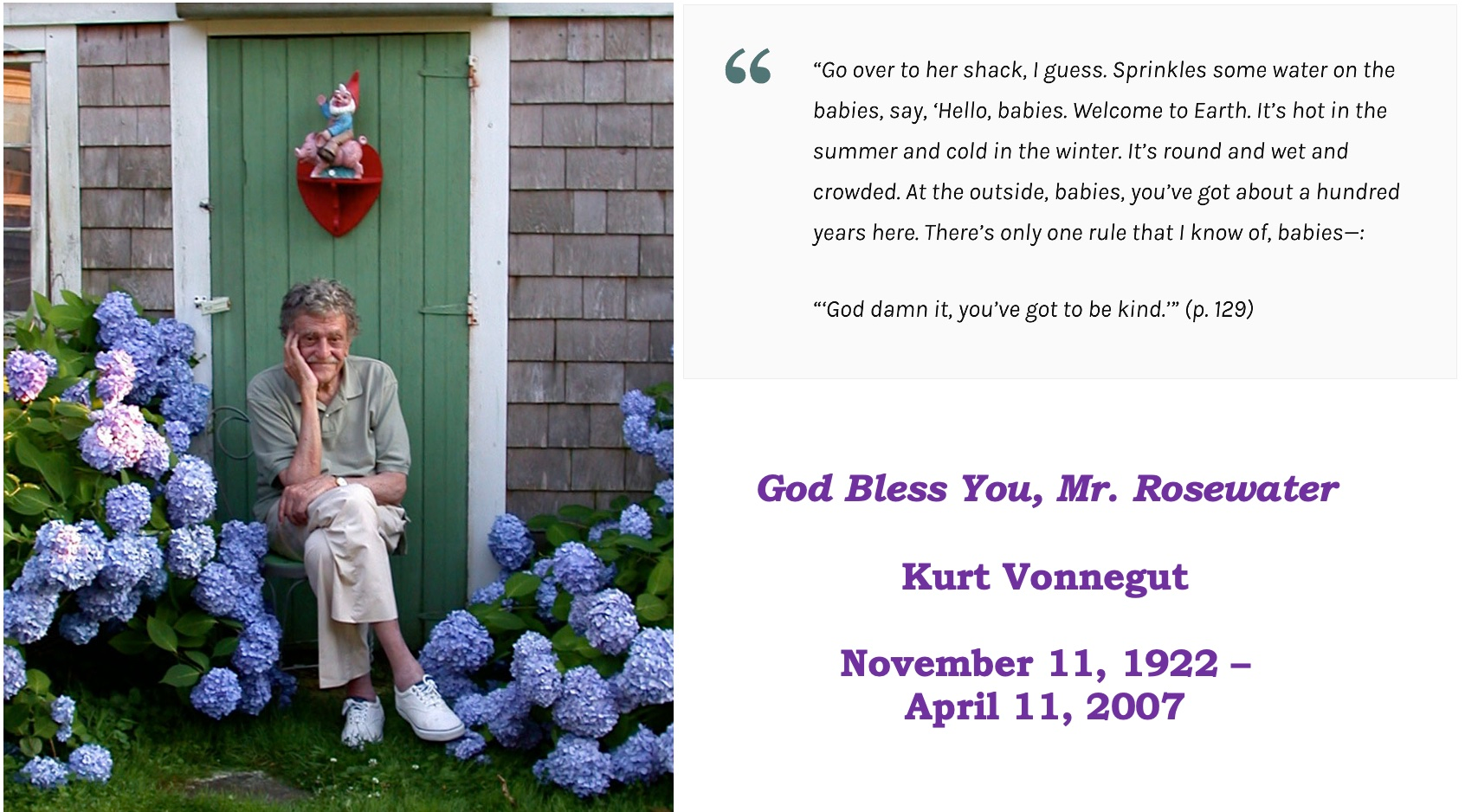
One of my favorite authors bristled at being called a science fiction writer, Kurt Vonnegut, but his works often did include key elements of science fiction such as aliens, time travel, total destruction of humanity, and yes, those existential elements of human loneliness and even fatalism.
But Vonnegut offers an interesting tension in his thematic grounding; he used his fiction to advocate for our potential to embrace our full humanity, our kindness, and the need to form and cultivate communities, extended families.
Vonnegut’s humanism and socialism sit just beneath the surface of his narratives that tend to darkly satirize the dehumanizing systems that people both create and tolerate. Player Piano is a brutal satire of corporate America decades before The Office or Office Space.
Some aspects of human precarity are inevitable, our bodies are prone to disease and they age inevitably to death.
And, yes, we often find our anxieties picking at the scab of our mortality.
But in Pluribus, death is at the edges in many ways (Helen dies and that sparks Carol’s intense loneliness). The focus of the story, however, is the fierce anger and determination of Carol to maintain and save her and everyone’s humanity, a determination seen in Manousos turned up a few notches.
Then there is the other precarity, the one created by systems, the one those systems need so that precarity is cultivated in horrible and dehumanizing ways.
Our Sisyphean existence in the US is dutifully and daily playing our roles as workers, and that role is carefully constructed to be a precarious one.
If we don’t work, we don’t eat.
If we lose our jobs, we lose healthcare, retirement, and frankly, our humanity.
Most people in capitalism cannot define themselves without their jobs. And few things bring more shame that losing a job.
It is subtle, but in S1E8, Charm Offensive, Carol and Zocia become lovers; the next morning, Carol writes again, returning to her job as a writer.
Few things are wasted in Pluribus—Manousos is warned about the spikes on the trees, and Zocia tells Carol “we” are excited she is writing again when Carol lies that she is.
Nothing is wasted, like the title of S1E1, We Is Us.
The paradox of the human condition, our precarity, e pluribus unum.
I attended public schools in the rural South from 1967 to 1979, including three years in junior high school from 1973 to 1976 (punctuated by the US Bicentennial).
Junior high included grades 7 through 9; some of those ninth graders could drive so mornings a few students would roll into the parking lot and smoke would billow out of the car, students emerging like rock stars through the cloud of the cigarettes and pot they were smoking.
The bathrooms at that school were also filled constantly with a gray and yellow fog, the smell of marijuana strong throughout the school and on most of our clothes simply from going to the bathroom between classes.
I was always a good student, and frankly, school was easy for me even in the top classes. I was on the basketball team and had many friends who were not in those top classes.
And, as almost everyone has experienced, we were mostly told by the adults that we were dumb and lazy as a box of rocks—not like in their day as young people.
I entered the classroom as a teacher of high school students in 1984 right out of college so I have been directly in the formal education system across seven decades.
My doctoral work was grounded in the history of education, that work reaching back into the beginning of the twentieth century.
And here is the problem: “Kids today” at every point that I can find (not across just decades but centuries) are always considered at any point of now to be dumb and lazy as a box of rocks.
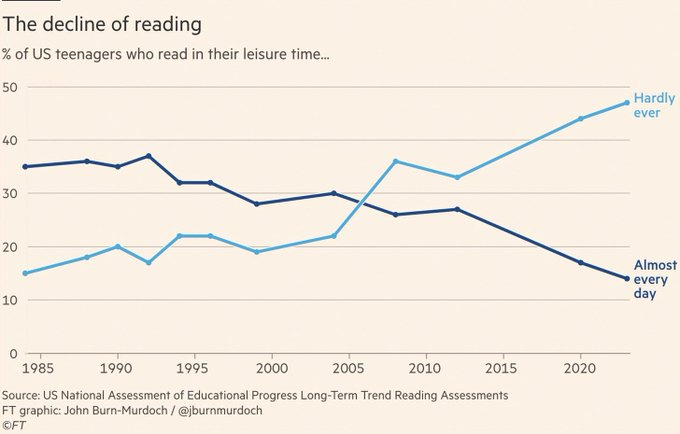
This graphic is causing a stir on social media:
We are in a high point as well of adults shouting that “kids today” cannot do math, cannot read, and of course, “kids today” don’t read.
I currently teach at a selective liberal arts college. The students are among the top high school students, having come out of elite private schools and many have been in Advanced Placement and International Baccalaureate programs.
Since the “kids today” mantra has included a current wave of bashing college students (another tired mantra)—they don’t read, and they can’t read extended texts, like complete books—I have asked my students about those charges (and of course, I assign a great deal of reading, including books, as well as all of my students write essays).
As much or maybe even more so than my students over 42 years of teaching, these students have, in fact, been assigned many books in high school, often in their college classes, and even read by choice, many eagerly sharing their favorite writers and series.
I can attest without hesitation that “kids today” over my teaching career have been mostly about the same as you’d expect teens and young adults to be, but if anything, they are smarter and have more challenging K-12 educations year after year.
I do think that the Covid era has had some unique negative consequences for current cohorts of students, and some of that is reflected in the reductive ways we determine if students are learning, mostly test scores.
And that leads back to the chart above; I don’t see anyone noting this is data from NAEP (a national random-selected population of students) and it is self-reported by the students (who are not held accountable in any way for their test scores or the data they provide).
I have never been convinced that NAEP scores are that valuable in terms of what and how student learning is measured, but I can assure you that self-reported data by those students is likely even weaker evidence of anything.
NAEP scores, in fact, like all standardized testing is a far greater reflection of the lives students are living outside of schools than of the quality of their learning in formal schooling.
Children and teens living without food or housing security as well as with little or no access to healthcare are likely finding little time or motivation to read for pleasure, and their intellectual batteries are drained by the lives resulting in not being able to fully engage with the few hours a day for about half the year when they are in classes that may be overcrowded or taught by an un- or under-certified teacher being paid poorly and attacked as a groomer and an indoctrinator by the current political climate.
Most of my college students have had much more privileged lives than the average child or teen in the US so it is worth nothing, as well, that they invariably say they want to read more but the main reason they don’t is schooling. They simply do not have time to read while they are taking courses, and they add that the assigned reading tends to also discourage them from reading (the pervasive obsession with assigning novels and focusing on the canon has never worked to motivate students).
There seems to be something futile and hollow about “adults today” perpetually criticizing “kids today,” particularly when adults today were themselves kids at some point in their lives also then accused of being dumb and lazy as a bag of rocks.
The “kids today” crisis rhetoric, I believe, is much more a reflection of adults, the cynicism of aging and the loss we all feel as we move further and further away from our childhood and teens years.
Kids today are not dumb and lazy as a bag of rocks, but they do have something we adults can never recover—youth.
But I can assure you that finding children and young people fascinating, fun, and surprising is a far better way to navigate growing older.
I am very lucky as a teacher of young people, and equally blessed by young grandchildren, who I assure you are not dumb and lazy as a bag of rocks.
I will always resist the crisis rhetoric around education and “kids today” because it defies logic that “kids today” have always been dumb and lazy as a box of rocks.
However, if anyone would like to launch into a criticism of adults today, I may be willing to join in.
While both stories are provocative and likely raise important concerns about what is wrong with colleges and universities in the US, most people are misreading where the problems lie.
I have been a teacher and then professor for 42 years, the last 24 years in higher education.
In that context, I want to stress that I believe both situations offer an opportunity to address the systemic problems with our society and how we do education. Regretfully but predictably, in both stories, most of the commentary is focused on the individuals instead of systemic forces.
Let me start with the student receiving a zero for the essay assignment.
Coincidentally, when this story broke, many of my students were experiencing feedback from me on their major essay assignment, a message that informed them they had not completed the project as assigned.
Since the Oklahoma student’s essay and the assignment rubric have been made public (and should not have been, in my opinion), I am very comfortable with the instructor’s very measured and detailed response acknowledging that, in a very clear way, the student had not fulfilled the assignment. [1]
Here is the issue, however.
Because the instructor and student are bound by a traditional grading system, the zero is completely justifiable, as are other arguments for less harsh but still failing scores for the work.
In no way is the essay acceptable or passing college-level work.
I am a non-grader, and my students work under a course grade contract. Students must complete all assignments fully (and preferably on time); therefore, a zero is not a real option.
When my students fail to complete an assignment as assigned, they are prompted with feedback and conferencing to revise and resubmit the assignment.
I work under the belief that if an assignment is worth assigning, then a student choosing not to complete it or a teacher simply assigning the work a zero or failing grade deems the assignment not worth assigning in the first place.
Therefore, in the traditional grading context of the Oklahoma incident, the zero is valid; but I think that traditional context is the problem—not the instructor or the student (even as I doubt the sincerity of the student and those fanning the flames of blaming the instructor).
If that student had been prompted to resubmit with guidance on why she had not fulfilled the assignment, no one would have ever heard of the incident—and she likely would have learned and grown in ways that a zero ended. (Or more likely, her ploy to trap the instructor would have fallen short.)
Next, the issue about the rise in students with accommodations in higher ed also resonates with me because when I moved to college teaching in 2002, I immediately noticed what I thought then was a high number of students with accommodation plans.
I did not think these were frivolous, but I did attribute much of that to the students being affluent and having access to mental health care that identified and supported real needs.
The current concern about high numbers of students with accommodations, I think, fits into a larger belief that “kids today” are frail or weak—or frailer and weaker than they used to be (a ridiculous belief that exists at every “now” in the US stretching back more than a century).
Similar to the popular misunderstanding about autism, the higher number of students with academic accommodations is likely the result of better definitions and diagnoses of these needs along with current college students having lived through incredibly precarious experiences, including Covid.
Higher numbers of students with accommodations is not a problem but a symptom of a very harsh American culture that is replicated in the high-stakes environments of K-12 schooling.
Most of these students are not frail; they are damaged or broken by a hostile society and a dehumanized education system.
These growing numbers of students with accommodations are our canaries in the coalmine.
When students have accommodations or not in my courses, however, I typically never notice and there is never an issue because the way the course works is itself accommodating to all students.
This again is grounded in not grading, not giving tests, and shifting the course toward teaching/learning and away from punishment/rewards.
The student receiving a zero is not a lesson about that instructor or that student, but about our culture of grading in education.
Rising numbers of students with accommodations in our colleges and universities is not a lesson on the weakening of America’s youth, but a signal about the often harsh and hostile environments of those young people’s lives and, yes, their formal schooling.
These are lessons Americans typically refuse to see, and with that negligence, we insure even greater harm and more evidence of failure and frailty that we, in fact, created.
[1] Early in my career teaching in a very conservative right-to-work state, I did not accept a student essay that argued against interracial marriage, a position common in my Southern community and that I found deeply offensive. The student used no evidence in the essay, not fulfilling the minimum requirements for accepting the submission (students were writing evidence-based and cited persuasive essays). The process was, even then, that the student simply needed to resubmit, meeting the requirements. The student quickly resubmitted, adding the sentence “It’s in the Bible.” I again did not accept the submission, explaining he had not provided evidence, and that if, in fact, that was in the Bible, he merely had to quote and cite the passage(s) supporting his position.
Several days passed before I was contacted by administration that the student and his father wanted a conference, which my principal attended. At the conference, the father explained that he and his son had gone to their pastor, who was unable to locate a passage in the Bible to support his argument (because that doesn’t exist, by the way; the often misapplied Old Testament passage they were likely seeking is about no marriage between different tribes). I very patiently stated that the assignment required students write an argument that can be supported by evidence and that the evidence had to be cited. After a pause, my principal said, “Well, looks like your son needs a different topic.”
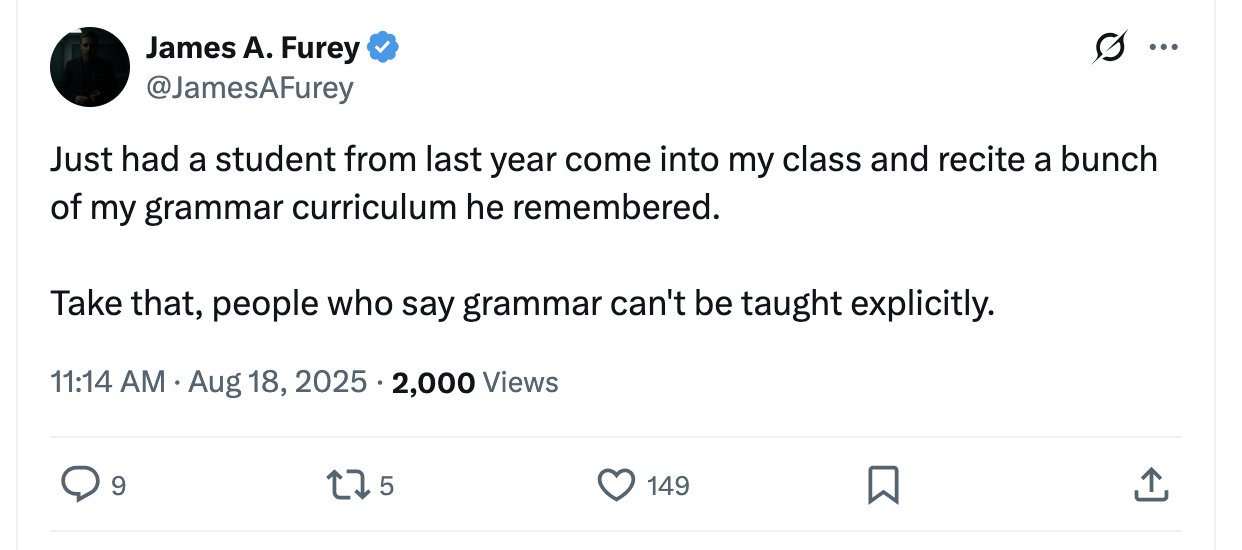
Since the “science of reading” (SOR) has now expanded into a “science of learning” (SOL) movement, the same problems among SOR advocates have appeared among SOL advocates—misinformation and misunderstanding about teaching and learning combined with a bait-and-switch approach that offers anecdotes as if they prove the so-called “science,” for example:
There is so much wrong with this that it is mind boggling, but let’s focus on, first, this is merely an anecdote, which proves nothing except that it happened.
Second, that direct instruction can be effective for students demonstrating simple recall is not very shocking; in fact, many would recognize that direct instruction/recall is asking far too little of students, especially in literacy instruction.
At one point in my education, I could name all the presidents in order as well as all the state capitals. It would have been better if I had developed a more sophisticated understanding of the presidency and the political realities of the US.
Through direct instruction over a brief amount of time, I can say one word, “inside,” and my poodle will happily trot into our apartment. I didn’t let her discover that; direct instruction produced pretty reliable recall in that sweet dog.
But she isn’t smarter; she is well trained.
Here, then, I am going to expand some on a third point: Furey clearly does not understand the issue he seems to be attacking, grammar instruction (with the implied agents being woke progressives who worship at the alter of discovery learning).
Intensive Phonics. This position claims that we learn to read by first learning the rules of phonics, and that we read by sounding out what is on the page, either out-loud or to ourselves (decoding to sound). It also asserts that all rules of phonics must be deliberately taught and consciously learned.
Basic Phonics. According to Basic Phonics, we learn to read by actually reading, by understanding what is on the page. Most of our knowledge of phonics is subconsciously acquired from reading (Smith, 2004: 152)….
Zero Phonics. This view claims that direct teaching is not necessary or even helpful. I am unaware of any professional who holds this position.
Furey seems to be posting a Gotcha! aimed at what he believes is a Zero Grammar view so let me follow Krashen’s lead and clarify: “I am unaware of any professional who holds this position.”
The Big Irony of a “science of” advocate attacking a straw man position on grammar is that there is pretty solid body of research/science on grammar instruction (note that many people use “grammar” to encompass grammar, mechanics, and usage).
To understand the research on direct (and isolated) grammar instruction, we first must clarify our instructional goal. If a course is a grammar course, and the goal is for student to acquire grammar knowledge, then some or even a significant amount of direct instruction can be justified and effective.
Even in the context of teaching students to acquire distinct grammar knowledge, however, many would caution against viewing grammar as “rules” and instead would encourage seeing grammar as a set of contextualized conventions that also carry some degree of power coding.
For example, subject/verb usages are a feature of so-called standard English, and some dialects can be identified by varying from those standards. It is important to acknowledge that one is not “right” or “better” linguistically, although the so-called standard forms tend to carry some cultural or social capital. And there may be cultural/social negative consequences for using dialects considered not standard.
As an analogy, direct (isolated) grammar instruction can be effective for teaching students grammar knowledge just as having students diagram sentences can be effective for teaching students how to diagram sentences.
The problem is when we make our instructional goal teaching students to write with purpose and with awareness of language conventions (grammar, mechanics, usage).
There is a long and deep research base reaching back into the early 1900s showing that direct (isolated) grammar instruction fails to transfer into student writing and can even have negative outcomes for the quality and amount of student writing.
For example, LaBrant (1946) noted: “We have some hundreds of studies now which demonstrate that there is little correlation (whatever that may cover) between exercises in punctuation and sentence structure and the tendency to use the principles illustrated in independent writing” (p. 127).
This does not mean “do not teach grammar,” but does mean that direct grammar instruction needs to in the context of student writing.
Students who are writing by choice and with purpose are much more likely to engage with and understand (and thus apply) language conventions (grammar, mechanics, usage) than when we directly teach those in isolation.
So let me be clear: Teaching students to write without direct instruction would be inexcusable, but teaching grammar through direct and isolated instruction is malpractice when our goal is teaching writing.
Here, then, are some ways to insure direct grammar instruction in the context of student writing is effective:
Establish direct instruction of grammar in context based on student writing and demonstration of need. This can be effective for both individual student writing conferences and whole-class instruction (if most student demonstrate the same needs).
Recognize that some language conventions are abstractions that may be difficult to grasp for students at early stages of brain development; holding students accountable for usage should be tempered by their development (see Weaver below).
Avoid the “error hunt” (see Weaver below) and do not frame language conventions as “right/wrong” or revising and editing as “correcting.” The goal is language convention awareness and purposeful writing by students.
Avoid traditional grammar textbook and exercises. Prefer instead research-based direct instruction that transfers to writing such as sentence combining and lessons on the history of the English language (see Style below).
Adopt either a workshop approach to writing or integrate workshop elements (choice, time, and feedback) into the course.
Forefront and help students understand that revising writing is their primary responsibility as writers in order to communicate as well as possible; however, editing (addressing language conventions) is a part of that process, although it may be delayed until a piece is worthy of editing and before publishing or submitting. As LaBrant (1946) cautioned: “I am not willing to teach the polishing and adornment of irresponsible, unimportant writing” (p. 123).
The surface features of student writing need not be perfect when writing is part of a course. Seeking perfect surface features can and often is a goal for published writing.
As this discussion shows, another failure of the “science of” movement is the urge to attack caricatures and to oversimplify.
Teaching grammar is not a simple thing to address, and, again, I will note using Krashen, there simply is no credible professional saying teachers should not teach grammar. In fact, no credible educator would reject direct instruction of grammar as long as that instruction is in the context of student writing.
LaBrant (1947) made an assertion about teaching almost 80 years ago that may sound familiar: “A brief consideration will indicate reasons for the considerable gap between the research currently available and the utilization of that research in school programs and methods” (p. 87).
I have always regarded this as accurate, and have repeated the claim myself for decades.
Straw man fallacies, caricature, and anecdotes, I fear, are not the path to making this less true.
The “science of” movement is failing here, and the consequences are to the detriment of students and teachers who deserve better.
“Did you write this?” I once asked a sophomore in my advanced English class. The student was one of three siblings I would teach, and their mother was a colleague of mine in our English department.
With students and my own daughter, I have asked questions like that one often, and I always knew the answer. The question was an opportunity for the student to confront what I already knew.
This student, you see, had turned in a cited essay that her older sister had turned in just a few years earlier. I had the paper in my files, and since I immediately recognized it, I had the copy with her sister’s name on the cover page waiting for her reply.
English and writing teachers especially, but all teachers are constantly seeking ways to insure students do their own work.
As long as there have been students, teachers, and formal schooling, however, students have sought ways to pass off writing and reading that they, in fact, had not done.
This student cold-face lied, and I handed her the paper by her sister.
Something like that has occurred several times over my forty-plus years of teaching.
A non-traditional aged woman in a night composition class for a local junior college became enraged when I asked her “Did you write this?”
I had been reading her writing for several weeks, and this essay she submitted wasn’t her work. There was no doubt and no need to prove it.
She became loud and angry, steadfast in her claim the writing was hers. After that night, I never saw her again.
Several years ago in my first-year writing seminar, a basketball player submitted a teammate’s essay from a few semesters earlier. The essay rang a bell, and after a search on my laptop, I found the original essay on my hard drive.
Plagiarism and passing off other people’s work as their own have not been rampant throughout my career, in part because I have implemented reading and writing workshop in courses. Students have been reading and writing in front of me for decades.
Lots of cheating can been avoided by daylight and surveillance.
Part of the workshop approach, as well, stresses for students that the reading and writing processes are acts of learning; further, the emphasis on process helps lessen the importance of the product as a mechanism for acquiring a grade.
“It ought to be unnecessary to say that writing is learned by writing; unfortunately there is need,” wrote Lou LaBrant in 1953. LaBrant then continued and this may sound familiar:
Again and again teachers or schools are accused of failing to teach students to write decent English, and again and again investigations show that students have been taught about punctuation, the function of a paragraph, parts of speech, selection of “vivid” words, spelling—that students have done everything but the writing of many complete papers. Again and again college freshmen report that never in either high school or grammar school have they been asked to select a topic for writing, and write their own ideas about that subject. Some have been given topics for writing; others have been asked to summarize what someone else has said; numbers have been given work on revising sentences, filling in blanks, punctuating sentences, and analyzing what others have written….Knowing facts about language does not necessarily result in ability to use it. (p. 417)
Over the seventy-plus years since LaBrant’s article, students have written original texts far too rarely; in fact, as writers and students in general, students sit in classrooms where the teacher does much of the work the student should be doing as part of learning.
Writing prompts and rubrics have done far more harm to students as writers than any technology work around, but technology has also joined in the fun over those eight decades.
ChatGPT and other forms of AI are the current miracle/crisis forms of technology in education. Seemingly, many people in education, surprisingly, are jumping on the AI bandwagon, much like the coding wave and cellphone bans.
You see, we are trapped in a love/hate binary with technology in education that too often isn’t based in evidence.
Tech and AI products like Grammarly and Turnitin.com have ridden high waves of use despite both products, to be blunt, just being very poor quality. Grammarly gives really bad writing advice, and Turnitin.com is less effective detecting plagiarism than a simple (and free) Google search.
The broader technology problem in education, which parallels the AI problem, is that technology in education is often like a microwave; something can be completed quicker but the product is either hard to stomach or simply ruined.
A recent study, in fact, shows that students using AI to draft tend to produce very similar texts that are shallow at best. Further, students who use AI to compose struggle to recall any of their writing.
Why? Let’s invoke LaBrant again: Writing is learned by writing.
Better worded, we should think of “writing” as composing. Composing is the art of simultaneously creating meaning, developing understanding, and drafting communication in words, sentences, and paragraphs.
AI generating functional text in some real-world contexts may be a time saver, a net positive. But for students, scholars, and writers, using AI at any point of the composing process is a new form of plagiarism.
Let me be clear, this is about the composing process because AI has long been useful for surface editing; grammar and spell check is not cheating, and AI can relieve the writer some of the burden of editing (a role humans often play for other people in the world of writing an publishing).
Maybe AI will prove valuable in many ways for humans, but AI that does for students the very behaviors students must perform to learn is never justified—just as teachers doing the work for students has never been justified.
“As citizens we need to be able to write and to understand the importance and difficulty of being honest and clear. We will learn to do this by doing it,” LaBrant offers bluntly.
“Did you write this?” is an enduring question between teacher and student.
In 2025, using AI is just as damning as putting your name on your sister’s essay before turning it in as your own.
So that’s why you cannot spell “plagiarism” without “AI.”
“Red herring” perfectly describes the bulk of education reform in the US since the Reagan administration because thosee reforms have been based on false claims to distract from needed social and educational reform in the interests of students, teachers, and public education.
The US (and many English-speaking nations around the world) have remained in a perpetual state of education and reading crises for decades.
The US has never stopped using crisis rhetoric or blaming schools, teachers, and students, but policy has been a revolving door of new standards, new tests, and new “miracle” solutions—none of which ever produce the positive outcomes promised.
The dirty little secret is that perpetual crisis/reform in education (and reading) is its own goal because constant crisis/reform is politically and economically profitable to those fanning the flames of crisis.
In 2018, the “science of reading” (SOR) became a tired and constant refrain of the media, spreading to parent advocacy and then legislation and policy.
By 2025, the “science of” has added “math” and “learning,” including many English-speaking countries where a reading crisis is the norm.
And thus, education reform in the US and other countries has now adopted at the core of education reform “science of” rhetoric, claims, blame, and policy.
Parallel to education reform since the 1980s, the “science of” education reform is not grounded in credible claims about education crisis or problems, and therefore, the blame and solutions are also not credible or effective.
The “science of” approach to education reform has been extremely effective since “science” is being weaponized, and when anyone dare to challenge the movement, those people are accused of being anti-science, often compared to the anti-vaccination movement.
Here’s the problem: Those of us challenging the “science of” movement are not rejecting scientific research in education; we are acknowledging that “science of” advocacy is misrepresenting educational challenges, educational research, and educational practice for ideological, political, and market purposes.
Journalists, educators/scholars, education “celebrities,” the education marketplace, and politicians have made their careers on false “science of” claims and unfounded attacks on anyone calling them out for not being credible.
Ironically, the evidence supports those of us who are critics of “science of” education/reading reform, and consequently, “science of” claims are red herrings, distractions from the valid education challenges and potential reforms that would serve the interests of students, teachers, and public education.
Here, then, is the core evidence that the “science of” movements are, in fact, red herring education reform.
Further, “science of” advocates tend to move quickly from the false claims of “crisis” to offering false blame.
Just as there is no evidence of crisis, there is simply no scientific studies showing, for example, that the US has a reading crisis caused by a few reading programs, the implementation of balanced literacy, or the failure of teacher education to prepare teachers.
Again, there is a paradox in the “science of” movement whereby the advocates of “science of” themselves do not adhere to the narrow use of “science” to support their major claims.
For example, in the US, SOR advocates and SOR-based policy and legislation include support for a number of practices, claims, and programs that lack scientific evidence—decodable texts, LETRS, 95% rule, Orton-Gillingham, systematic phonics first for all students, nonsense word assessments (DIBLES), etc.
Broadly, also, “science of” advocates’ most damning red herring is that they are weaponizing “science” as a veneer to take a non-ideological pose although “science of” advocates are themselves mostly making ideological claims.
Direct instruction and skills-based instruction have long been at the core of conservative ideology.
Once we acknowledge that “science of” claims of crisis and who/what they blame are not evidence-based, we can also acknowledge they are mostly making ideological arguments, and then, we must unpack why.
Noted above, there is a great deal of profit in crying education/reading crisis and maintaining a constant state of reform.
As long as that reform never works.
And it never has, it never will.
The “science of” movements, then, are grounded in misinformation, oversimplification, and ideological bias.
The “science of” movements are another form of red herring education reform.
The distraction is also ideological, grounded in a rejection of the power of systemic forces and a belief in rugged individualism as well as the bootstrapping myth.
The “science of” movement is also a distraction from other ulterior motives, such as de-professionalizing teachers with scripted curriculum and imposing AI/computer program approaches for teaching students.
More irony: Education reform is designed to keep our eyes on individual people—students, teachers—and not the overwhelming evidence:
Almost 63% of the variance in test performance was explained by social capital family income variables that influence the development of background knowledge. Background knowledge is a known predictor of standardized test results. Family income variables are immutable by schools. Only public policies, outside the control of school personnel, can influence family income….
Policy makers and education leaders should rethink the current reliance on standardized test results as the deciding factor to make decisions about student achievement, teacher quality, school effectiveness, and school leader quality. In effect, policies that use standardized test results to evaluate, reward, and sanction students and school personnel are doing nothing more than rewarding schools that serve advantaged students and punishing schools that serve disadvantaged students. (Maroun and Tienken, 2024)
Here is the science that critics of the “science of” movement recognize.
And fun fact, we are not trying to sell you anything or get your vote.
Aydarova, E. (2023). “Whatever you want to call it”: Science of reading mythologies in the education reform movement. Harvard Educational Review, 93(4), 556–581, https://doi.org10.17763/1943-5045-93.4.556
Aydarova, E. (2024). What you see is not what you get: Science of reading reforms as a guise for standardization, centralization, and privatization. American Journal of Education. https://www.journals.uchicago.edu/doi/10.1086/730991
Reinking, D., Hruby, G.G., & Risko, V.J. (2023). Legislating phonics: Settle science of political polemic? Teachers College Record. https://doi.org/10.1177/01614681231155688
Thomas, P.L. (2025). Navigating (another) reading crisis as an administrator: Rethinking the “science of reading” movement. Journal of School Administration, Research and Development, 10(1), 38-48. https://ojed.org/JSARD/article/view/6706
Tierney, R.J., & Pearson, P.D. (2024). Fact-checking the Science of Reading: Opening up the conversation. Literacy Research Commons. https://literacyresearchcommons.org
educator, public scholar, poet&writer – academic freedom isn't free












 dr. p.l. (paul) thomas