Tag Archives: writing

Writing Process: Scholarly/Academic Writing Edition

[Header Photo by 🇸🇮 Janko Ferlič on Unsplash]

Like many academics working in higher education, I spent several days over my holiday break preparing my courses for spring (two first-year writing seminars and one upper-level writing/research course) and then an intense three days writing and submitting a scholarly chapter on growth mindset and grit for an upcoming book.

I am fortunate, I think, because my teaching life and my writing life continually inform each other. Especially when teaching my writing-intensive courses, I teach as a writer and scholar, fore-fronting my writing/scholarship in my teaching.

My chapter on mindset and grit gave me a perfect opportunity to think deeply about and prepare new materials for my courses this spring (access those artifacts in this folder: Scholarly Essay Process).

As a writing teacher, I have been struggling throughout my 40-plus-year career with the negative impact of templates and scripts for students developing the skills and knowledge they need to be autonomous and compelling writers.

I have rejected, for example, the five-paragraph essay model, and I have challenged the mechanical implementation of the writing process as a sequential series of steps.

The problem is that this crusade against templates and scripts is not as simple (or effective) as I initially believed many decades ago.

Another problem with rejecting templates and scripts is that a significant amount of scholarly and academic writing is bound by scripts, word-count limits, formatting requirements, and citation/style guidelines.

My evolved and more nuanced position on templates and scripts in writing instruction and assignments acknowledges that beginning writers need opportunities to read widely in order to develop their own “scripts” for a wide variety of writing types. Of course they also need structure, but starting with the rigid template does far more harm than good for emerging writers.

Then, as students-as-writers move into high school and college, they need more experiences with authentic templates and guidelines found in much of academic and scholarly writing.

The editors of the chapter I just completed, for example, sent writers an content outline for chapters to follow as well as a word count limit and citation/style sheet requirements (APA).

When I write reviews for a think tank, I receive the same structures and very rigid expectations for staying within those limits (including their own in-house style sheet).

The irony, then, is that this spring, my first-year writing seminar will focus on challenging scripts and “rules” for essays and writing while my upper-level writing/research class will be writing a strictly scripted major scholarly essay (I assure upper-level students that this experience will prepare them for graduate school, and I recently received an email from a former student in this course telling me “thank you” for just that).

While I feel like my teaching of writing has better bridged the gap between helping students acquire the broad concepts of effective and compelling writing (versus imposing on them artificial templates and “rules”), I continue to struggle with fostering in students the sort of writing process that would better serve them.

Similar to my stance on the essay form, I teach that the writing process is not sequential or a rigid template, but a set of concepts that most writing addresses to help produce a writing final product needed for the purposes of that project. In other words, these broad concepts are fairly stable but the so-called “steps” may differ and the time spent on each “step” likely will vary for different writing purposed.

For scholarly writing, the writing process includes much more than composing sentences and paragraphs. Here, then is a brief overview of my recent process this week writing and submitting my book chapter on mindset and grit.

Let me start with a caveat that I think should be shared with students.

When most scholars start a writing project, we are dealing with content that we have expertise in; my project on mindset and grit has years of blogging and gathering research behind the brief process I followed over three days.

My first steps included revisiting the chapter guidelines sent by the editors, confirming formatting, citation, word count, etc.

Then, as I stress to students, I prepared my Word document, conforming to APA guidelines and inserting the subheads, etc., along with the chapter template required by the editors. One concern I have with students is they tend to address formatting last, and I urge them to address this tediousness first. (See my submitted and not yet edited copy here.)

Next, I put the required page break in the end of the document and prepared my working references list. To create the list, I reviewed my many blogs on the topics, searched through my library data bases, reached out to other scholars for recommendations, and carefully culled sources from the references of the sources I had gathered (working from the most recent publications).

Let me stress here that as I detail my process, as I worked, these “steps” became more and more recursive in that as I worked in one “step” I would invariably return to and revise other “steps” (I caught simple formatting edits and typos, for example, in many of the “steps” being detailed here even as that is considered the editing “step”).

One goal as I worked was to create a compelling opening that included a thesis paragraph clearly aligned with the subheads and organization of the chapter. I drafted that opening on the first day and then I carefully edited and formatted all of my references, checking APA and loosely thinking about removing or adding needed sources. See the opening here:

Literacy educator and scholar Lou LaBrant (1947) asserted almost eight decades ago: “A brief consideration will indicate reasons for the considerable gap between the research currently available and the utilization of that research in school programs and methods” (p. 87). While valid in the mid-2020s, a slightly more nuanced argument needs to be proposed: Scientific research on teaching and learning is often lost in translation once it is packaged by the education marketplace and reduced to legislation and policy. In other words, what is popular, packaged, and mandated in education is too often an oversimplified and even misguided version of scientific findings, nothing more than a fad. An even more complicating problem, as well, is that classroom practices likely should be guided by more than experimental and quasi-experimental research (Wormeli, n.d., The problem).

Over the past decade-plus, two examples of research lost in translation include growth mindset and grit. Carol Dweck (2008), often publishing with others (Dweck & Yeager, 2019) examines the role of mindset is academic success. Grit is grounded in the research and advocacy of Angela Duckworth (2018); however, a great deal of the popularization of grit occurred through the journalism and advocacy of Paul Tough (2013) who promoted “no excuses” charter school practices, specifically the Knowledge Is Power Program (KIPP) charter chain (Abrams, 2020). While growth mindset and grit are distinct concepts and educational movement, they tend to share similar spaces and problems in practice.

This chapter explores the central claims of growth mindset and grit before considering the validity of those claims in the context of the following critical questions: How are growth mindset and grit grounded while also perpetuating bootstrapping, rugged individualism and meritocracy myths? What are the roles of deficit ideologies (word gap, victim blaming, racism, sexism, classism, etc.) in popular advocacy for growth mindset and grit? As well the research and popular claims about growth mindset and grit are interrogated at three levels: (1) research validity and robustness, (2) evidence-based or ideologically based, and (3) racism and classism.


The next morning I reviewed and organized all of sources to comply with the structures required in the chapter. Here, I think, is where students are lost because of their previous experiences writing inauthentic research papers (in which many students gather the required number of sources and then simply walk the reader through their sources, writing about the sources and not their topic).

I created a table by my topics, mindset and grit, and then by the three major themes/patterns I planned to address; the key here, for students, is recognizing the need to focus on the patterns in their discussion and to cite multiple sources for those patterns.

I also created a listing of sources by my major topics, and then carefully reviewed them all to be sure I had classified them correctly and to identify the few I wanted to cite or quote more fully (I stress to students who have more experience with MLA and textual analysis that quoting is only one way to give evidence in scholarly writing and is often discouraged in many disciplines when not doing textual analysis).

Analyzing and organizing my evidence is designed to creating writing that offers a compelling generalization that is valid followed by a representative source or two to support the pattern; for example:

However, the current public discourse around mindset has made a significant turn to being critical and even skeptical (Study finds, 2018; Tait, 2020; Young, 2021a, 2021b). This shift is spurred by the growing research base that fails to replicate the primary claims of mindset advocacy or shows negative correlations or harm in implementing mindset intervention over other aspects of learning and achievement (Brez et al., 2020; Burgoyne et al., 2020; Burnette et al., 2018; Dixson et al., 2017; Ganimian, 2020; Li & Bates, 2019; Macnamara & Burgoyne, 2023; Sisk et al., 2018; Schmidt et al., 2017). Brez at al. (2020) conclude: “The pattern of findings is clear that the intervention had little impact on students’ academic success even among sub-samples of students who are traditionally assumed to benefit from this type of intervention (e.g., minority, low income, and first-generation students)” (p. 464). And Macnamara and Burgoyne (2023) make a more problematic assertion:

Taken together, our findings indicate that studies adhering to best practices are unlikely to demonstrate that growth mindset interventions bene t students’ academic achievement. Instead, significant meta-analytic results only occurred when quality control was lacking, and these results were no longer significant after adjusting for publication bias. This pattern suggests that apparent effects of growth mindset interventions on academic achievement are likely spurious and due to inadequate study design, flawed reporting, and bias. (p. 163)


Again, I need to emphasize that students must understand that several of these steps require and prompt continuous revision and editing. I returned to my title and the thesis paragraph for revision as I drafted the two major subhead sections and the subheadings under those. In other words, I was then in a constant state of seeking coherence in the chapter whereby all the parts match and create the whole (which then is reinforced by the final section/closing of the chapter).

For students, I will stress that I drafted an opening on the first day, drafted the first major subheading section the second day, and then drafted the second major section and closing the third day. But the writing parts were embedded in a great deal of reading, cataloguing, and organizing.

I also completed a full initial draft, but then let that sit for a while before doing a full re-read, revision, and editing session with the entire chapter in front of me; I did several re-read-revise-edits along the way as well.

For students, then, here is what they should see as elements of a writing process for academic/scholarly writing:

  • Identify writing assignment guidelines, formatting requirements, and citation style.
  • Prepare your Word document per those guidelines, creating your initial title, subheads, and any guiding bullet points or questions detailed in the assignment.
  • Create working references list, addressing citation formatting before working further.
  • Create an initial compelling opening (multiple paragraphs) with a thesis paragraph that correlates with the title, the organization, and subheads of the essay.
  • Read, re-read, organize, and catalogue (patterns/themes) references based on the organization of the assignment; identify the representative anchor sources that will be used to elaborate on the patterns identified and cited with multiple valid sources. Be sure to carefully identify direct quotes and include citation, page or paragraph numbers, etc., when creating a matrix of patterns and analyses of the evidence.
  • Revise and edit throughout these steps, even significant revisions such as addressing the title, the thesis paragraph, or organization if the review of the evidence prompts those revisions.
  • Create a full first draft, and then let that sit. The final step should be a careful re-read to revise and edit before submitting.

The essay form and the writing process are important concepts for developing writers and students to understand, and that understanding must come from authentically engaging with both in supportive environments.

The challenge with teaching students to write generally and then as academics/scholars is that there are too many moving parts and simply no hard and fast “rules” to govern either the essays they write or the process they use to write them.

Course Grade Contracts: Assignments as Teaching and Learning, Not Assessment

[Header Photo by Diomari Madulara on Unsplash]

At the end of fall semester of year 41 as an educator, I can admit two things: (1) I may have learned more than my students (taught two new courses and continue to experiment with course grade contracts), and (2) I am excited about spring courses where I can implement what I learned (both about grade contracts and teaching students to write).

Since I entered the classroom in 1984, I am in my fifth decade as a teacher, much of that work dedicated to teaching writing to students but also using writing assignments as teaching and learning, not assessment.

Gradually and then at some point in the 1990s, I successfully eliminated traditional tests and assignment grades in my high school English courses. As a note of clarification, although I do not use tests or grades, I have always been required to assign grading period and course grades.

Thus, I have been seeking ways to better navigate a test/grade culture of traditional schooling (one my students have been conditioned to trust and even embrace) while practicing my critical philosophy that rejects both.

A few semesters ago, as part of that journey, I returned to the course grade contract, something I had tried in some fashion during my high school teaching years.

The problem I continued to have was that students were mostly unable to set aside their test/grade mentality, and thus, the absence of tests and assignment grades often negatively impacted student engagement and learning.

Initially, I envisioned course grade contracts would improve student engagement and lower stress and anxiety, thus improving learning.

Some non-traditional practices worked. I have students prepare for and participate in a class discussion for their midterm, for example. No memorization, no “cover your work,” and no exam stress.

This collaborative approach students both embraced and recognized as not assessment, but as learning experiences themselves.

However, particularly in courses that are not designated as writing courses (I do teach first-year writing and an upper-level writing/research courses), students tend to struggle significantly with the course structure and the use of a major writing assignments as an extended teaching and learning experiences (and not a way to grade them).

The first iteration of the course grade contract, then, focused on requiring students to submit, conference, and revise essays; I structured A and B course grades around minimum standards for the B-range (submit an acceptable essay, conference after receiving my feedback, and submit one acceptable revision that addresses the feedback) and additional revisions after more feedback for the A-range.

Despite the course grade being explicitly linked to minimum expectations for the process, students continue to see my feedback as negative and harsh, but also remain trapped in the possibility of submitting a perfect essay and never having to complete revisions.

In short, they see the essay assignment as a form of assessment and cannot fully engage in the submitting/revising process as individualized teaching and learning experiences.

Oddly, students continue to email me apologizing for their first submissions because they see the revision-oriented feedback, again, as negative or harsh—evaluative—and not a necessary part of essay assignment as teaching and learning.

The semester ending now, in fact, proved to me that using the course grade contract to shift assignments from forms of assessment to teaching/learning experiences (like the midterm exam period as a class discussion) needed another round of revision by me.

The problems I am still encountering include students struggling in content-focused courses (where they expect traditional tests and are not expecting to be challenged as thinkers and writers) because of the absence of tests/grades as well as the course structure that forefronts course content in the first half of the semester and mostly implements workshop the second half.

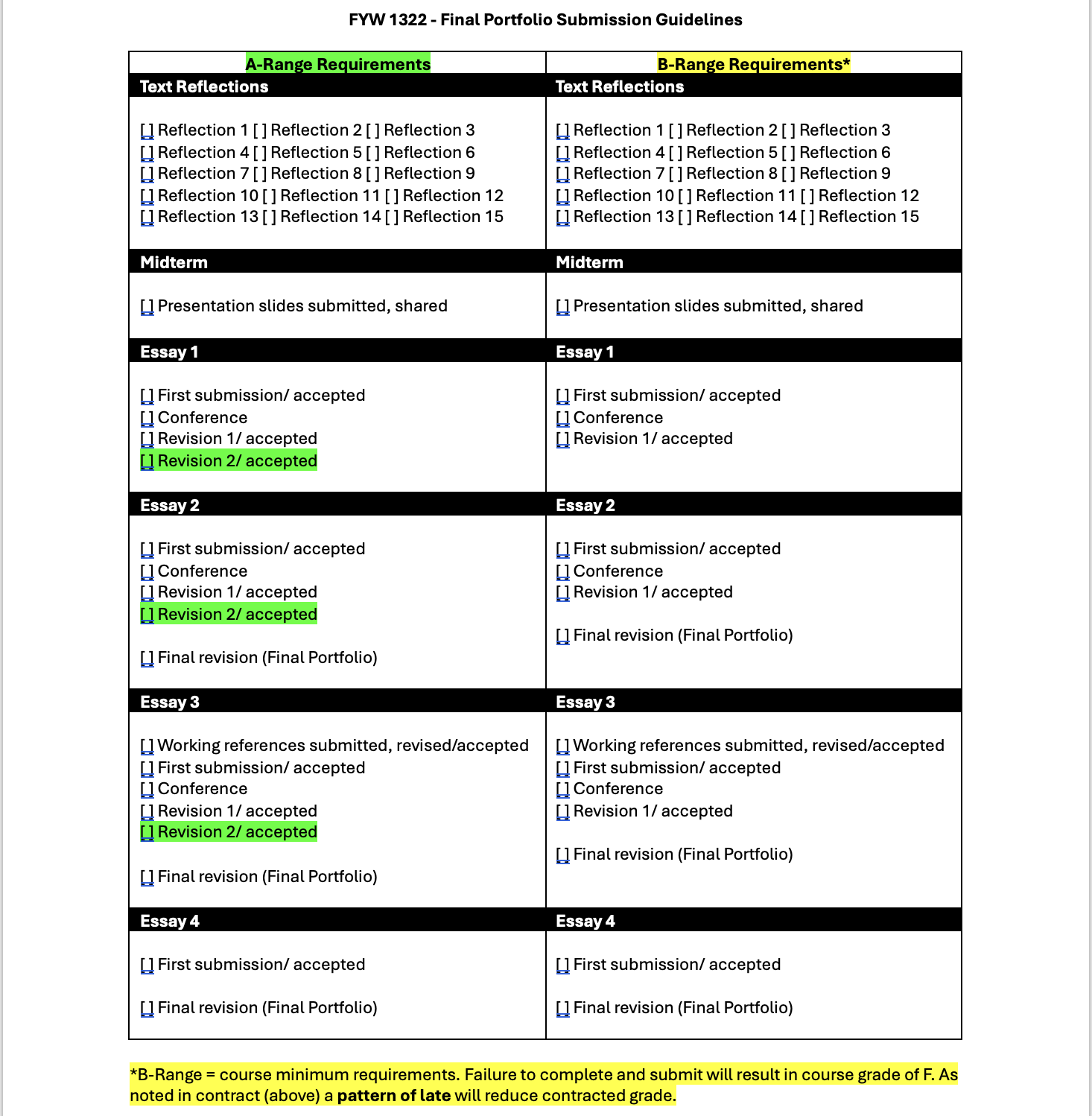
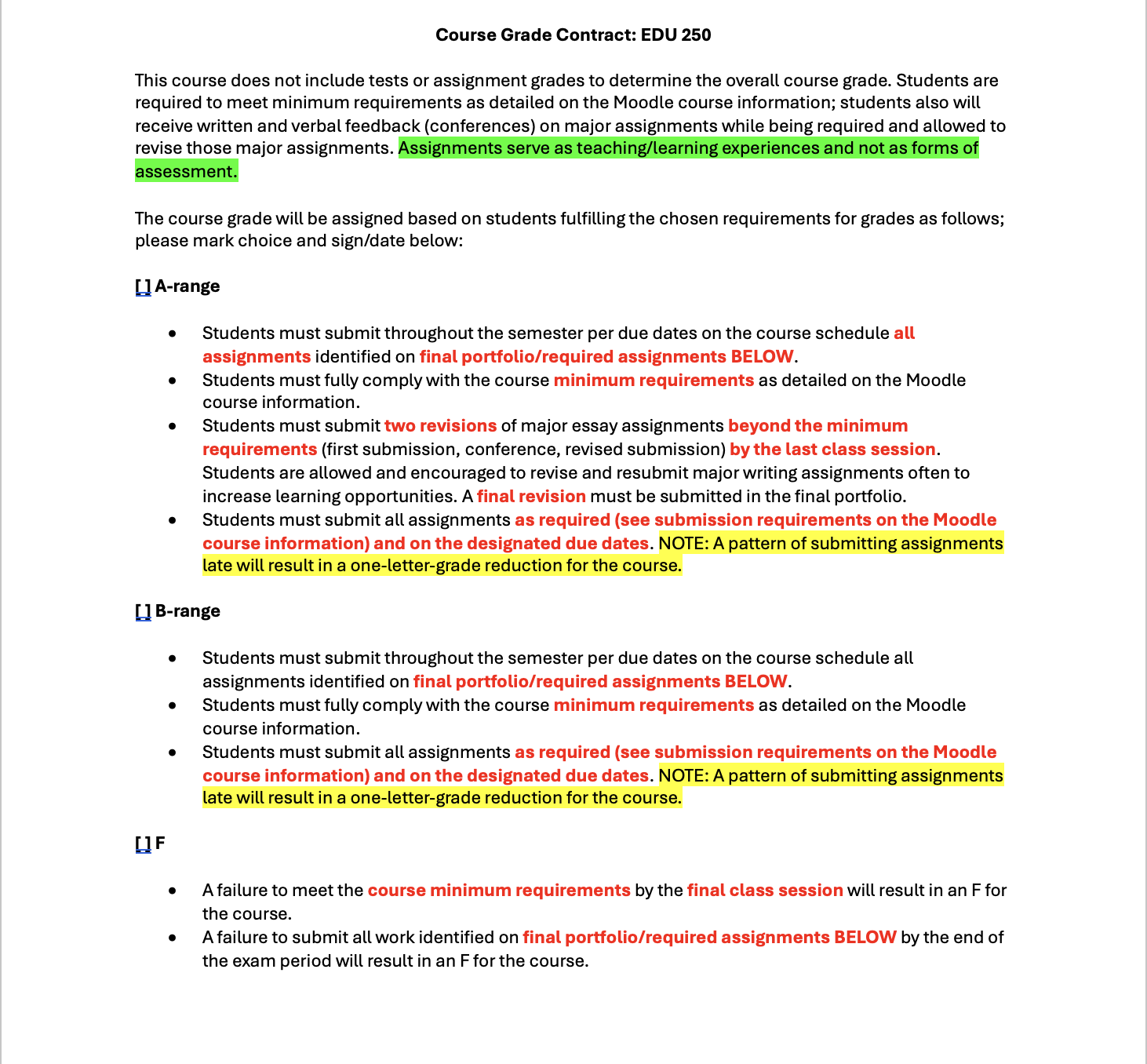
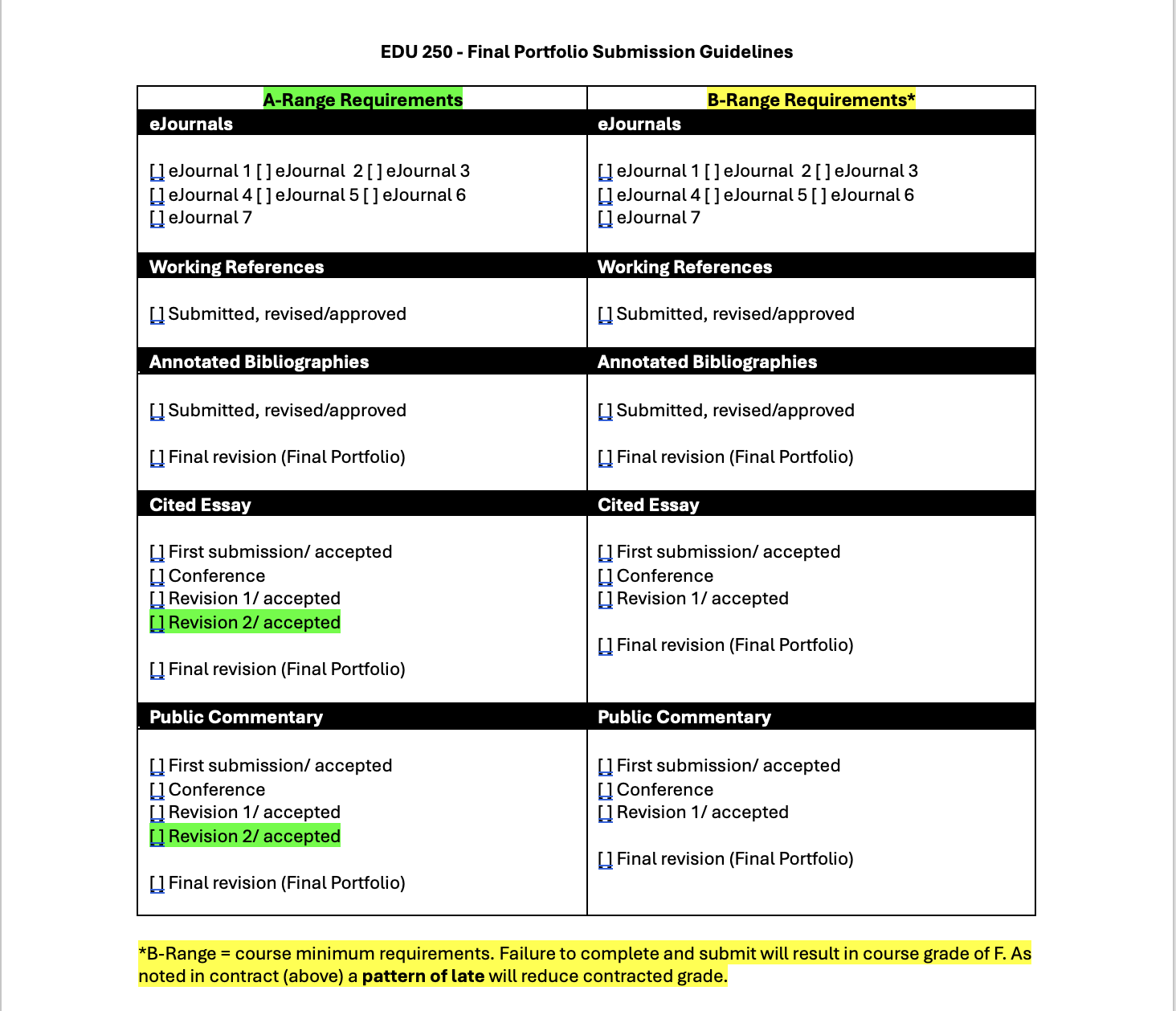
Here, then I want to share the new versions of those contracts to be implemented in spring. I have more explicitly included language about the purpose of the contract and added the final portfolio expectations in a format that also is more explicit about assignment expectations as well as fulfilling the contracted grade.

Here is the revised course grade contract for my first-year writing course:

And here is the revised course grade contract for my upper-level writing/research course:

The problem will remain, however, that I teach students conditioned for more than 2/3 of their lives in a culture of tests and grades, a culture that has taught them that assignments as by the teacher for evaluation and not for the student as teaching and learning.

I am seeking ways to shift the culture of teaching and learning as well as my students’ expectations for what it means to be a student and a teacher.

These are big asks for those students, but I am convinced they can make those shifts and benefit greatly from doing so.

How to Write Like a Scholar (and Not Like a Student)

[Header Photo by Andrew Neel on Unsplash]

Having taught now an on-going 41 years—about half that time as a high school English teacher and now a college professor—if there is one thing I know very well, it is the student.

While I love teaching and my students, there is also one thing I have worked diligently to discourage, young people in classrooms performing like students.

Most student behavior is artificial (hand raising to speak, sitting in neat rows, walking in single-file lines) and often dehumanizing (asking permission to go to the bathroom). And since the core of my work as a teacher has focused on teaching writing, few aspects of being a student are worse than writing like a student.

Much of my writing instruction focuses on moving students away from writing like students and toward writing like scholars (or, ideally, like writers).

While I cringe a bit focusing with the negative, let’s consider what writing like a student looks like (and what young writers should avoid):

Starting essays with and punctuating the discussion throughout with Big Claims that are often inaccurate or mostly empty and then nearly never proven or cited.

One of the best examples of this rhetorical patterns is from The Onion: “For as far back as historians can go, summer vacations have been celebrated by people everywhere as a time for rest and relaxation.”

Many students are drawn to the “throughout history” claims or framing a topic as “people have always debated,” “many people today debate,” or this topic is “controversial.” Scholars and writers avoid the Big Claims and especially the “throughout history,” “debate,” or “controversy” framing of a topic.

Student writing is often too big and overstated while scholars tend to work in very small and nuanced spaces around a topic; students seek to draw definitive and black-and-white conclusions while scholars deal in questions to be considered and reach tentative conclusions that are qualified.

Writing about doing the writing or research assignment.

Student papers are often filled with references to being a student writing an essay: “The sources I analyzed show,” “In the essay, I am going to,” “The research that I found explains,” “Most of the sources used,” “Many articles and papers done on these topics,” etc.

While there may be some charm to this accidental postmodernist approach to writing (alas, most students are not Kurt Vonnegut intruding on his own fiction narrative), for students, these meta-writing rhetorical moves do not accomplish anything substantive for the purpose of the essay or the content; these phrases simply add to the word count as empty calories.

For example consider the following and the revision (by removing the meta-writing, the word counts drops, and the writing is more direct and clear):

Student writing: Extensive scientific research has been conducted to determine if ADHD is the result of genetics or environmental factors. While this research has shown some correlation between certain genes or environmental factors and the onset of ADHD, the results remain inconclusive (Thapar et al., 2012).

Revised: While some correlation exists between certain genes or environmental factors and the onset of ADHD, the results remain inconclusive (Thapar et al., 2012).

[Note that students can and should use “I” in writing when first person is appropriate and drives the content and purpose of the essay. Typically, students are apt to use “I” in empty and performative ways instead of powerfully and appropriately.]

In cited writing assignments, producing a very narrow form of the “research paper.”

I now include on essay assignments “Do not write a research paper on …” as part of the assignment. The artificial “research paper” that many students have acquired from K-12 schooling is a mechanical and prompted essay form that results in students writing about their sources instead of writing a purposeful essay with a clear audience: “One article I read pushed for dialogue in their congregational community surrounding the mental health of black parishioners.”

Also, as another example: “John Dewey (1953) wrote a book about progressive education. In his book, Dewey (1953) states, ‘The educator is responsible for a knowledge of individuals and for a knowledge of subject-matter that will enable activity ties to be selected which lend themselves to social organization, an organization in which all individuals have an opportunity to contribute something, and in which the activities in which all participate are the chief carrier of control’ (pp. 23-24).”

Many students simply walk the reader through their “sources” one-by-one, essentially writing about their sources and not their topic. This includes text that increases word count and nothing else, empty calories: “Various studies and scholarly research conducted surrounding the pipeline expose the oppressive and discriminatory systems and beliefs involving law enforcement and unforgiving disciplinary policies within schools that are continually pushing students, especially students of color, out of schools.”

Consider a more direct and powerful version: “Oppressive and discriminatory systems and beliefs involving law enforcement and unforgiving disciplinary policies within schools are continually pushing students, especially students of color, out of schools.”

Excessive or inappropriate quoting.

You may be noticing a trend here since a great deal of what makes something “student writing” increases word count without contributing to the content of the writing.

Excessive and inappropriate quoting is a hallmark of student writing grounded in learning to cite and provide evidence in their writing primarily in their high school English classes where they are using MLA and often doing textual analysis (literary analysis).

Students have learned in the context of literary analysis for English courses that the (only) way to prove a point is by quoting. This is essentially true when writing textual analysis, but students turn that into a universal technique whereby they quote excessively from sources in all types of writing.

And thus, students (as noted above) simply write about their sources, quoting excessively from each and providing little of their own thoughts and almost no synthesis of information. One of the most ineffective but common examples is the floating quote in which the student as writer never exists: “’A democratic and inclusive sexuality education balances risk and resiliency and recognizes that they are on a continuum and are influenced by social and cultural factors in the environment’ (Elia & Eliason, p. 25).”

Scholars, when writing in forms and purposes other than textual analysis, tend to quote rarely or not at all; when quoting in scholarly writing that isn’t textual analysis, the guideline is something like quote when the “how” of the passage is as powerful as the “what.”

We may be justified in quoting James Baldwin while not so much when using information from a peer-reviewed journal articles on social mobility or racism in policing.

Mechanical essay form and thesis sentences (declarative and conclusive statements).

If you have been wondering, the 5-paragraph essay is alive and well. Students overwhelmingly believe an introduction is one paragraph that ends with a declarative thesis statement, that essay bodies have three paragraphs or sections to correlate with the three points in that thesis, and that the conclusion is one paragraph that, yes, restates the thesis.

At no point of a student’s development is a 5-paragraph essay justifiable; it is the paint-by-numbers of composition. It is not just bad writing, it is also bad thinking.

Scholars write all sorts of essay forms and construct them around much broader concepts of openings, bodies, and closing with the thesis focus often in the form of questions to be considered and not definitive assertions made at the beginning and then proven.

As with many of the examples so far, the 5-paragraph essay template is a distraction for the student-as-writer, focusing their writing on filling in the template and not addressing and developing their writing purpose for a clear audience. [As a note, I still have students occasionally label their thesis sentence in their essays.]

Essay purpose/form and audience directed at either at no audience or the teacher/professor.

Related to the 5-paragraph essay template is that students are trapped in the context of writing an essay is a form of assessment that is being assigned and graded by the teacher. As a consequence, the purpose is just doing the assignment, and the audience is either no one in particular or simply for the teacher/professor.

While the essay form for scholarly and academic writing is narrower than the entire array of what we call essays, students must be introduced to the broader essay form that involves them as writers making decisions about how to organize, to engage the readers, and to develop the purpose of the essay.

Some of the elements I introduce is the multiple-paragraph opening and closing, subheadings, the thesis as question(s), and abandoning the closing as a restating of the introduction.

Paragraphing that is very long or lacking purpose.

One thing students as writers simply cannot do is paragraphing. They have lived in a world of prescribed number-of-sentences mandates for paragraphing, and those prescriptions have been, to say the least, really bad guidelines.

Students have learned that longer is better.

While academic and scholarly writing suffer from the long-paragraph syndrome, here I do push students toward how non-academic writers use paragraphing.

Broadly speaking, readers prefer shorter paragraphs (or at least balk at long ones). And fields such as journalism use very short paragraphing.

Since a foundational part of teaching writing for me is students learning to be purposeful instead of following templates and rules, I focus on purposeful and varied paragraphing. We read and examine many effective essays that use one-sentence paragraphs and explore how paragraphing impacts the reader/audience of the text.

Word choice and tone contradicting the content and tone of the essay topic and purpose.

Students as writers are, of course, developing and expanding their vocabulary. But the diction problem that most characterizes student writing is a lack of awareness of tone—using words that have a contradictory tone to the level of seriousness of their topic.

Lots of “thing,” “good,” “bad,” and 8-color crayon box of words when they are exploring complicated and serious issues: “Sex education in the United States is all over the place, and for some students, their sex ed is almost exactly like the students in Mean Girls” or “This article was also pretty on par with the tone of the research papers” or “Because each employee’s salaries are not posted on the front desk for everyone to read, many women don’t even realize they are being gipped until someone blabs during their break at the water cooler or they hear the specifics of their associate’s raise.”


So here we are after a pretty extensive list of what student writing tends to entail. This, by the way, is no criticism of students.

Student writing is a reflection of how students have been taught, assigned, and graded. Students often learn what they are taught despite the hand wringing to the contrary.

I have two thoughts now.

First, students deserve better writing instruction and expectations throughout K-16. That instruction needs to come from teachers who are writers, not just “English teachers,” and more educators need better experiences with being writers themselves (that is the foundation of the National Writing Project).

Next, students are capable of making this transition, although the unlearning is often not fun for them or the instructor.

And thus the paradox remains: I love students but work daily to deprogram them from behaving like students.


See Also

Reading Like a Writer (Scholar): Kingsolver’s “Making Peace”

Student Writing as Teaching and Learning, Not Evaluation: And Why the “Research Paper” Mindset Fails Students (Still)

[Header Photo by Twinkl on Unsplash]

I am teaching now into my fifth decade, and most of that career has been dedicated to teaching students to write.

But for me teaching and assigning writing is not simply about students writing; writing workshop—the foundation of my courses—is how I teach and how my students learn.

In other words, assigning writing and having class sessions grounded in workshop is not a form of evaluation (I am a non-grader), but a more authentic form of instruction and learning experience for students.

However, I recognize daily that having a nontraditional approach to instruction is often misunderstood by students; further, “workshop” is one of the most misrepresented and misunderstood instructional practices among educators and pundits.

Writing workshop, in fact, has been discounted and attacked by right-wing pundits as well as Lisa Delpit, who criticism is grounded in a valid acknowledgement that far too often workshop is implemented poorly or misunderstood by some of its advocates.

I have also discovered that our K-12 use of “workshop” is quite distinct from the creative writing community’s use of the term and their awareness that “workshopping” is often a toxic practice, especially for marginalized people.

Here, then, I want to explain what writing workshop and assigning writing as instructional practice look like in practice while also acknowledging the problems I continue to encounter.

I am currently teaching two new courses that have a major writing assignment. That assignment has several weeks of in-class workshop time dedicated to students doing the following:

  • gathering and submitting their working references
  • drafting their initial submission
  • receiving written and conferencing feedback
  • and then revising that essay multiple times before a final submission is included in their final portfolio for the course (instead of a final exam).

Students also spend some of their in-class workshop time designing a brief presentation drawn from the major essay.

Here are the assignments, which will provide context for my discussion:

Assignment for a poverty studies introductory course:

Students will conduct an analysis of discourse concerning poverty through an anti-deficit ideology/critical lens. This project includes a cited essay and a final presentation. Students should gather 8-10 artifacts of discourse about poverty (news/magazine articles, documentaries, YouTube/online programming, podcasts, social media posts, etc.). The essay should be a Cited Scholarly Analysis (5-6 pages [not including title page and references], double spaced, 12 pt. font, APA stylesheet). The presentation should include a PowerPoint-type document and reflect the key points of the essay analysis; presentations should be between 8-10 minutes (please comply with the time limits). Minimum expectations for the cited essay include submitting full initial draft, conferencing after receiving feedback, and submitting one revised draft before resubmitting in final portfolio for the exam.

NOTE: You are not writing a “research paper” on a poverty topic. You should answer the following question: Based on the artifacts gathered, what do the discussion and claims about your poverty topic show about attitudes toward poverty, including stereotypes, misunderstandings, and deficit perspectives?

Assignment for an educational philosophy course (that also carries a general education requirement of “textual analysis”):

Students will conduct an analysis of discourse concerning public education through an educational philosophy lens. This project includes a cited essay and a final presentation. Students should gather 8-10 artifacts of discourse about public education (news/magazine articles, documentaries, YouTube/online programming, podcasts, social media posts, etc.). The essay should be a Cited Scholarly Analysis (5-6 pages [not including title page and references], double spaced, 12 pt. font, APA stylesheet). The presentation should include a PowerPoint-type document and reflect the key points of the essay analysis; presentations should be between 8-10 minutes (please comply with the time limits). Minimum expectations for the cited essay include submitting full initial draft, conferencing after receiving feedback, and submitting one revised draft before resubmitting in final portfolio for the exam.

NOTE: You are not writing a “research paper” on an education topic. You are answering the following question: Based on the artifacts gathered, what do the discussion and claims about your education topic show that people believe (educational philosophy) about education, teaching/teachers, and learning/students?

The process outlined above provides structure for direct instruction on the following:

  • finding and evaluating sources appropriate for an assignment in academic writing
  • developing genre and essay awareness while planning and writing a cited essay in an academic setting
  • understanding and using a scholarly citation style sheet (APA)
  • and applying the content of the course to an original analysis (again, instead of testing students in traditional ways).

Students are simultaneously researching, drafting, and revising while I am providing direct and individual instruction (here is the issue raised by Delpit in that some people may implement workshop with limited or absent direct instruction).

While using essay assignments and writing workshop as instructional practices causes students discomfort (they are trapped in a fear of making mistakes, losing points, and feeling as if their work must be instantly perfect and not a process), the largest hurdle I face is students having only one form of cited essay writing in their mind—the research paper.

As you can see above, I explicitly tell them do not write research papers on your topic and to be sure to write the kind of essay required (in the examples above, discourse analysis in which they use artifacts to discuss patterns of discourse about a relevant topic for the course).

Here are the problems with students being trapped in the reductive and inauthentic research paper paradigm:

  • They spend a large amount of rhetorical time writing about their sources: “My sources show,” “lots of research confirms,” and similar constructions that are wasted words on something other than the rhetorical purpose of the assignment. They also write a great deal directly about their sources: “Joe Smith conducted research and his essay ‘My Essay on the Topic’ explains.”
  • Related, then, they have no voice or individual authority about their topic or rhetorically. I call this “writing like a student.” And thus, they are writing the school-only research paper with the teacher/professor as the default audience.
  • These patterns of writing about the sources also result in students waking readers through one source at a time as a sort of overview of what they found and not a nuanced discussion of the topic supported by credible sources.

To this last point, I guide students to seek patterns in the sources they are using so that they can discuss in their own words the content of that research and cite multiple sources:

  • From the 1980s (a hot decade for rebooting origins, highlighted by Frank Miller’s Batman) and into the early 2000s, Captain America’s origin continued to be reshaped. Notable for a consideration of race is Truth: Red, White and Black from 2003, which details a remarkable alternate origin as a medical experiment on black men (echoing Tuskegee), resulting in Isaiah Bradley ascension as the actual first Captain America (Connors, 2013; Hack, 2009; McWilliams, 2009; Nama, 2011).

Simple rhetorical shifts can make a huge difference; for example, see the original and then a revised version below:

  • Research has shown that interscholastic athletes tend to have heightened social performance, as well be less likely to exhibit problem behaviors (Abruzzo et al., 2016; Howie et al., 2021).
  • Interscholastic athletes tend to have heightened social performance, as well be less likely to exhibit problem behaviors (Abruzzo et al., 2016; Howie et al., 2021).

The power of just writing a research paper is overwhelming for students. Virtually every student for the two assignments above did exactly what I said not to do. They simply used their artifacts to write about their topic, never analyzing the discourse in the artifacts and mostly not connecting to the scholarly requirements of the assignment.

We spent the entire due date having that discussion, and as is part of the process, they are learning both course content material and how to write as informed and authoritative young scholars during the conferencing and revising phase.

The hardest hurdle for them along with breaking free of the research paper template is not seeing their initial draft as failing but as a necessary first step.

Many students, in fact, apologize when they receive my feedback.

Assigning essays and writing workshop can and should be transformative instructional approaches that place students in low-risk and authentic learning environments that support their individual growth.

Ironically, however, since using essay assignments and workshop are non-normative experiences for teaching and learning, students experience some initial and sometimes intense discomfort.

Once they overcome these expected hurdles, the outcomes are impressive because students are much more than students and far more capable that most traditional teaching and assignments require.

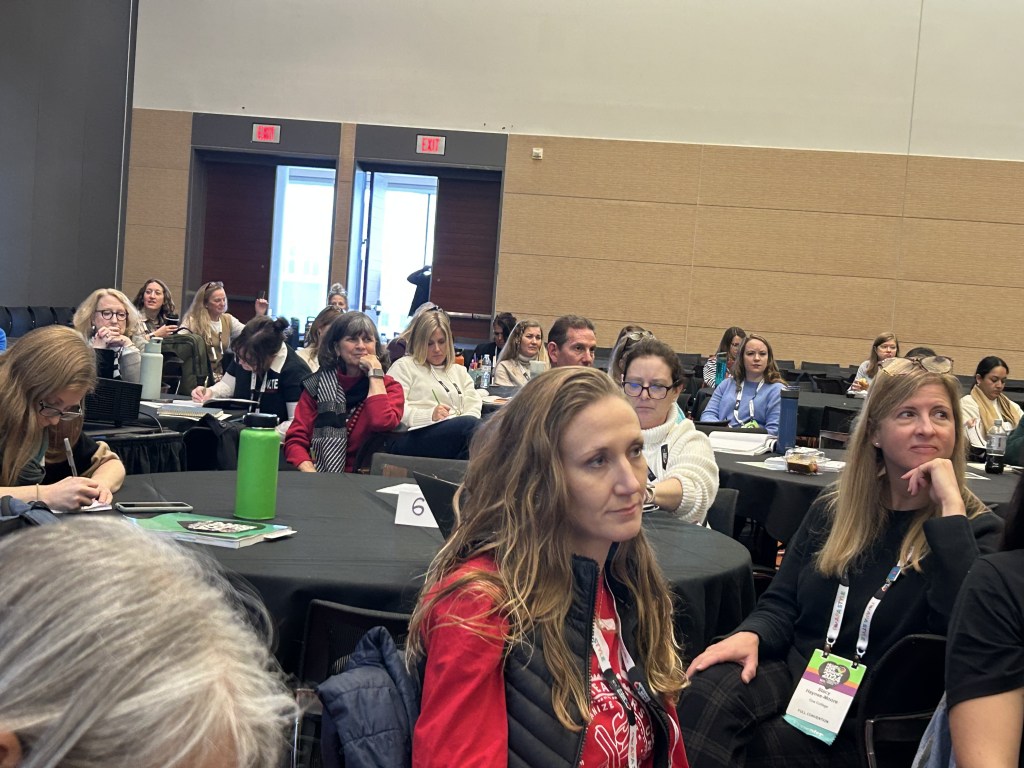
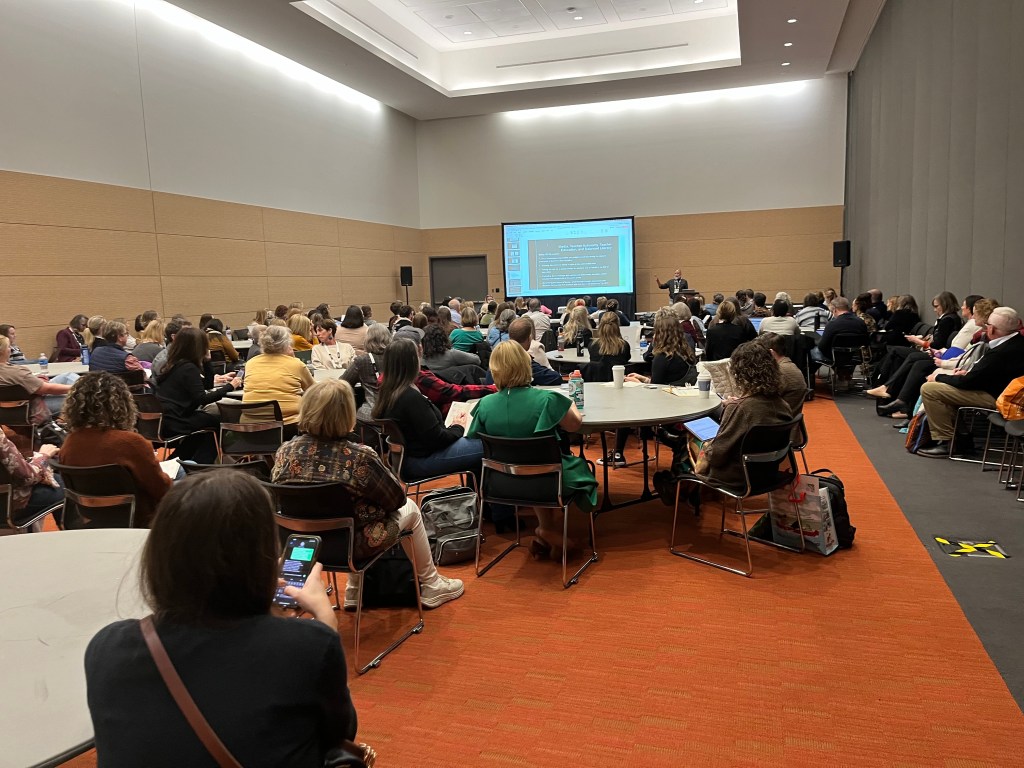
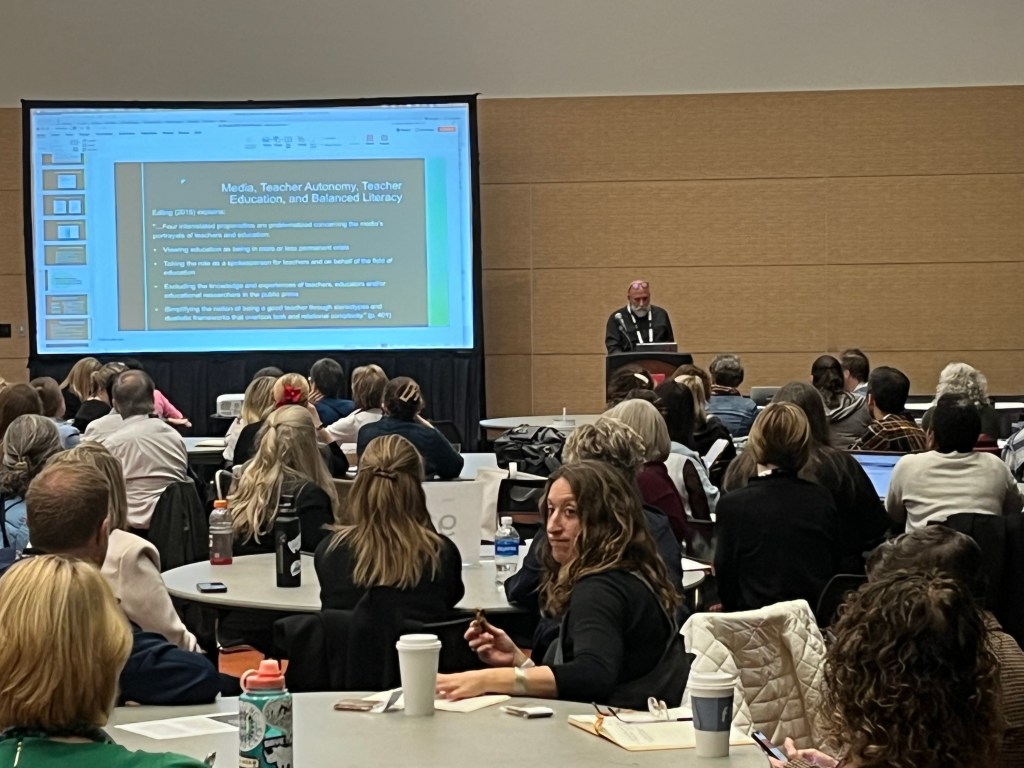
2024 NCTE Annual Convention

2024 NCTE Annual Convention

Please join the sessions below.

Also please support Proposed: NCTE Resolution Statement on Teacher Autonomy.

Voting: All NCTE members are invited to attend the Annual Business Meeting, scheduled this year for November 22, 2024, from 5:30–7:00 p.m. ET, and to take part in discussions and vote on resolutions about issues of concern to the profession! Membership must be verified before the start of the meeting.

Sense-of-the-House Motions: These statements reflect the opinion of the majority of members attending the Annual Business Meeting. They may be offered for discussion and action at the Annual Business Meeting. To be considered for deliberation, sense-of-the-house motions must be prepared in writing, must not exceed fifty words, and must be submitted to NCTECommittees@ncte.org, to the attention of the NCTE President or Parliamentarian, by noon ET on the day of the meeting. Such motions, if passed, are advisory to the Executive Committee or other appropriate Council bodies. They do not constitute official Council policy.


Also I am on Bluesky and will be posting there throughout the conference: https://bsky.app/profile/plthomasedd.bsky.social


Recommended

English Journal Series: We Teach English in Times of Perpetual Crisis


11/22/2024

12:30 PM – 1:45 PM EST

Resisting Scripted Curriculum as Erasure: Holding Onto the Heart, Hope, and Humanity of Reading

Room 210 B

Rountables Listing [click for PP]

Roundtable:

Paul Thomas

“Orange: Teaching Reading not Simply Black-and-White” [click HERE for PDF]


11/23/2024

2:45 PM – 4:00 PM EST

Standing for—Indeed, Fighting for—Teacher Professionalism and the Right to Teach Responsively

Room 205 A

Roundtables Listing [click for PP]

Opening Talk:

Paul Thomas

Attacks on Balanced Literacy Are Attacks on Teacher Professionalism [click title to access PP]

The “science of reading” movement has promoted a misleading story about reading through the media—reading proficiency is in crisis because teachers do not know how to teach reading and were not properly prepared by teacher education. This opening talk with argue that attacks on BL are grounded in efforts to deprofessionalize teachers.

Roundtable:

Paul Thomas

Reclaiming BL’s Commitment to Serving Individual Student Needs and Teacher Autonomy [click title to access PP]

Thomas will examine an authentic definition of BL as a reading philosophy that centers serving the individual needs of all students. He will examine also the caricatures of guessing and three cueing (MSV), providing attendees scholarly evidence for accurate characterizations of BL as well as deeper understanding of reading proficiency.

“Students Today…”: On Writing, Plagiarism, and Teaching

Posted at Maureen Downey’s Get Schooled, college instructor Rick Diguette offers a grim picture of first year college writing:

Once upon a time I taught college English at a local community college, but not any more.  Don’t get me wrong, I’m still on faculty and scheduled to cover three sections of freshman composition this fall.  But it has become obvious to me that I am no longer teaching “college” English.

Every semester many students in my freshman English classes submit work that is inadequate in almost every respect. Their sentences are thickets of misplaced modifiers, vague pronoun references, conflicting tenses, and subjects and verbs that don’t agree―when they remember, that is, that sentences need subjects.  If that were not bad enough, the only mark of punctuation they seem capable of using with any consistency is the period.

I read this just after I had been mulling Jessica Lahey’s What a 12 Year Old Has in Common With a Plagiarizing U.S. Senator, and I recognize in both pieces several overlapping concerns that deserve greater consideration as well as some warranted push back.

“Students Today…”

Let me first frame my response by noting that I taught high school English for 18 years in rural upstate South Carolina—where I focused heavily on student writing—and now have been in teacher education for an additional 13 years. My primary role is to prepare future English teachers, but I also serve as the university Faculty Director for First Year Seminars, and thus support the teaching of writing at my university.

In both Diguette’s and Lahey’s pieces, we must confront a problematic although enduring sense that “students today” are somehow fundamentally different than students in the past, and that difference is always that “students today” are worse. Students today can’t even write a complete sentence (Diguette), and students today are cheating like there is no tomorrow (Lahey).

This sort of “students today” crisis discourse fails us, I believe, because it is fundamentally skewed by our tendency to be nostalgic about the past as well as by shifting far too much focus on lamenting conditions instead of addressing them.

I offer, then, a broad response to both Diguette’s and Lahey’s central points: Let’s not address student writing and plagiarism/cheating as if these are unique or fundamentally worse concerns for teachers and education in 2014 than at any other point in modern U.S. education.

And for context, especially regarding students as writers, I offer the work of Lou LaBrant on teaching writing (see sources below) and my own examination of teaching writing built on LaBrant’s work; in short:

In “Writing Is More than Structure,” LaBrant (1957) says that “an inherent quality in writing is responsibility for what is said. There is therefore a moral quality in the composition of any piece” (p. 256). For LaBrant, the integrity of the content of a student’s writing outweighs considerably any surface features. In that same article, she offers a metaphor that captures precisely her view of the debate surrounding the teaching of writing—a debate that has persisted in the English field throughout this century: “Knowing about writing and its parts does not bring it about, just as owning a blueprint does not give you a house” (p. 256)….

…LaBrant sought ultimately through writing instruction the self-actualized literate adult, the sophisticated thinker. She never wavered in her demand that writing instruction was primarily concerned with making sincere and valuable meaning—not as a means to inculcate a set of arbitrary and misleading rules, rules that were static yet being imposed on a language in flux.

Lou LaBrant remained paradoxically rigid in her stance: The writing curriculum had to be open-ended and child-centered; the content of writing came first, followed by conforming to the conventions; and English teachers had to be master writers, master descriptive grammarians, and historians of the language. It all seemed quite obvious to her, since she personified those qualities that she demanded. LaBrant was one of many who embodied the debates that surround the field of teaching English, and she left writing teachers with one lingering question: Do we want our students drawing blueprints or building houses? The answer is obvious. (pp. 85, 89)

Instead of framing student writing and plagiarism, then, within crisis discourse, we must view the teaching of writing and the need to instill scholarly ethics in our students as fundamental and enduring aspects of teaching at every level of formal schooling. In other words, the problems in student work we encounter as teachers—such as garbled claims; shoddy grammar, mechanics, and usage; improperly cited sources; plagiarism—are simply the foundations upon which we teach.

Along with the essential flaw of viewing “students today” as inferior to students of the past, the urge to lament that students come to any of us poorly prepared by those who taught them before is also misleading and more distraction.

We certainly could and should do a better job moving students along through formal education (see my discussion of common experiences versus standards), but the simple fact is that each teacher must take every student where she/he is and then move that student forward as well as possible. Formal standards and implied expectations about where all students should be mean little in the real world where our job as teachers is bound to each student’s background, proclivities, and all the contexts that support or impede that student’s ability to grow and learn.

Now, before moving on, let me introduce another point about our perceptions of how and when students “learn” literacy. Consider the common view of children learning to read by third grade, for example. As reported at NPR, this widespread assumption that students acquire reading by third (or any) grade is flawed because children and adults continue to evolve as readers (and writers) in ways that defy neat linear categories.

As educator professor and scholar Peter Smagorinsky notes in his response to Diguette, “Education is very complex, and it’s rare that one problem has a single cause.”

On Writing, Plagiarism, and Teaching

None of what I have offered so far relieves teachers of this truth: All students need (deserve) writing instruction and that must include serious considerations of proper citations as well as focusing on the ethical implications of being a scholar and a writer (and citizen, of course).

And while I disagree with claims that “students today” are fundamentally worse writers or more prone to plagiarism than students in the past, I do recognize that we can expose why students perform as they do as writers and why students plagiarize and settle for shoddy citation.

Whether we are concerned about the claims or organization in a student writing sample, the surface features (grammar, mechanics, and usage), faulty attribution of citations, or outright plagiarism, a central root cause of those issues can be traced to the current thirty-years cycle of public school accountability built on standards and high-stakes testing.

As Smagorinsky does, I want to urge anyone concerned about student writing to consider the conclusions drawn by Applebee and Langer regarding the teaching of writing in middle and high school (see my review at Teachers College Record).

Applebee and Langer present a truly disheartening examination of the consequences related to the accountability era as they impact student writing: Although teachers are more aware than ever of best practices in the teaching of writing (due in no small part to the rise of the National Writing Project in the 1970s and 1980s), throughout middle and high school, students are not writing in ways that foster their abilities to generate original ideas; establish, support, and elaborate on credible claims; and polish writing that conforms to traditional conventions for language.

The primary reasons behind this failure are not “bad” teachers or lazy/stupid students, but the demands linked to high-stakes accountability. Just as one example, please consider Thomas Newkirk’s challenge to the unintended and corrosive consequences of writing being added to the SAT in 2005.

The writing section of the SAT has negatively impacted the teaching of writing in the following ways, all of which can be found in contexts related to preparing students for other high-stakes testing situations related to state-based accountability (although NCTE warned about these consequences from the beginning):

  • Writing (composition) is reduced to what can be tested in multiple-choice format. In other words, students are being taught and assessed for writing in ways that are not composing. Here we have the central failure of allowing testing formats to correlate with holistic performances, and thus, students are not invited or allowed to spend the needed time for developing those holistic performances (composing). See LaBrant (1953) “Writing Is Learned by Writing.”
  • Students write primarily or exclusively from detailed prompts and rubrics assigned by teachers or formulated by test designers. Ultimately, by college, few students have extended experiences with confronting the wide range of decisions that writers make in order to form credible and coherent ideas into a final written form. If many college students cannot write as well as professors would like, the reason is likely that many of those students have never had the opportunity to write in ways that we expect for college students. Students have been drilled in writing for the Advanced Placement tests, the SAT, and state accountability tests, but those are not the types of thinking and writing needed by young scholars.
  • Students have not experienced extended opportunities to draft original essays over a long period of time while receiving feedback from their teachers and peers; in other words, students have rarely experienced workshop opportunities because teachers do not have the time for such practices in a high-stakes environment that is complicated by budget cut-backs resulting in enormous class sizes that are not conducive to effective writing instruction.

The more productive and credible approach to considering why students write poorly or drift into plagiarism, then, is to confront the commitments we have made to education broadly. The accountability era put a halt to best practice in writing for our teachers and students so we should not be shocked about what college professors see when first year students enter their classes.

But another source of shoddy student writing must not be ignored.

Within that larger context of accountability, student writing that is prompted tends to have much weaker characteristics (content as well as surface features including proper citation) than writing for which students have genuine engagement (see the work of George Hillocks, for example). In other words, while students are not composing nearly enough in their K-12 experiences (and not receiving adequate direct instruction of writing at any formal level), when students do write, the assignments tend to foster the worst sorts of weaknesses highlighted by Diguette and Lahey.

Shoddy ideas and careless editing as well as plagiarism are often the consequences of assigned writing about which students do not care and often do not understand. (Higher quality writing and reducing plagiarism [Thomas, 2007] can be accomplished by student choice and drafting original essays over extended time with close monitoring by the teacher, by the way.)

And this leads back to my main argument about how to respond to both Diguette and Lahey: As teachers in K-12 and higher education, we have a moral obligation to teach students to be writers and to be ethical. Period.

To be blunt, it doesn’t matter why students struggle with writing or plagiarism at any level of formal education because we must address those issues when students enter our rooms, and we must set aside the expectation that students come to us “fixed.”

In other words, like most of education, learning to write and polishing ones sense of proper citation as well as the ethical demands of expression are life-long journeys, not goals anyone ever finishes.

However, in the current high-stakes accountability era of K-12 education—and the likelihood this is spreading to higher education—I must concur with Smagorinsky:

If you want kids to learn how to write, then put your money to work to provide teachers the kinds of conditions that enable the time to plan effective instruction, guide students through the process, and assess their work thoughtfully and considerately.

Otherwise, you may as well add yourself to the list of reasons that kids these days can’t write.

And I will add that if college professors want students who write well and ethically, they (we) must commit to continuing to teach writing throughout any students formal education—instead of lamenting when those students don’t come to us already “fixed.”

Writing and ethical expression have never been addressed in formal schooling in the ways they deserve; both have been mostly about technical details and domains of punishment. The current accountability era has reinforced those traditional failures.

I find Diguette’s and Lahey’s pieces both very important and seriously dangerous because they are likely to result in more misguided “blaming the victims” in that too many of the conclusions drawn about why students write poorly and often plagiarize remain focused on labeling teachers and students as flawed.

That students write poorly and often plagiarize is evidence of systemic failures, first and foremost. In order for the outcomes—effective and ethical student writers—to occur, then, we all must change the conditions and expectations of formal education, including understanding that all teachers are obligated to identify our students strengths and needs in order to start there and see how far we can go.

Final Thoughts: Adult Hypocrisy

Many of you may want to stop now. The above is my sanitized response, but it isn’t what I really want to say so here goes.

If you wonder why students write poorly and too often plagiarize, I suggest you stroll into whatever room has the biggest mirror and look for a moment.

As someone who is a writer and editor, I work daily with scholars and other writers who submit work far more shoddy than my students submit.

And as an increasingly old man, I witness the adult world that is nothing like the idealized and ridiculous expectations we level moment by moment on children.

Plagiarism? You too can become vice president of the U.S.!

Lazy student? You can become president of the U.S.!

Now, I absolutely believe we must have high expectations for our students, including a nuanced and powerful expectation for ethical behavior, but many of the reasons that children fail at their pursuit of ethical lives must be placed at our feet. The adults in the U.S. (especially if you are white, if you are wealthy, if you are a man) play a much different ethical game than what we tell children.

Children see through such bunkum and that teaches a much different lesson that doesn’t do any of us any good.

For Further Reading

The New Writing Assessments: Where Are They Leading Us?, Thomas Newkirk

On Children and Childhood

Advice to Students and Authors: Submitting Your Work

High and Reasonable Expectations for Student Writing

What do College Professors Want from Incoming High School Graduates?

References

LaBrant, L. (1949, May). Analysis of clichés and abstractions. English Journal, 38(5), 275-278.

LaBrant, L.L. (1934, March). The changing sentence structure of children. The Elementary English Review, 11(3),  59-65, 86

LaBrant, L. (1945, November). [Comment]. Our Readers Think: About IntegrationThe English Journal, 34(9), 497-502.

LaBrant, L. (1950, April). The individual and his writingElementary English27(4), 261-265.

LaBrant, L. (1955). Inducing students to write. English Journal, 44(2), 70-74, 116.

LaBrant, L. (1943). Language teaching in a changing world. The Elementary English Review, 20(3), 93–97.

LaBrant, L. (1936, April). The psychological basis for creative writingThe English Journal, 25(4), 292-301.

LaBrant, L. (1946). Teaching high-school students to write. English Journal, 35(3), 123–128.

LaBrant, L. (1953). Writing is learned by writing. Elementary English, 30(7), 417-420.

LaBrant, L. (1957). Writing is more than structure. English Journal, 46(5), 252–256, 293.

Thomas, P. L. (2000, January). Blueprints or houses?—Looking back at Lou LaBrant and the writing debate. English Journal, 89(3), pp. 85-89.

Thomas, P. L. (2007, May). Of flattery and thievery: Reconsidering plagiarism in a time of virtual information. English Journal, 96(5), 81-84.

Writing Is a Journey: Thoughts on Writing, College, and the SAT

A writer’s writer often ignored is James Baldwin, who examines his drive to write in the context of race:

INTERVIEWER

If you felt that it was a white man’s world, what made you think that there was any point in writing? And why is writing a white man’s world?

BALDWIN

Because they own the business. Well, in retrospect, what it came down to was that I would not allow myself to be defined by other people, white or black. It was beneath me to blame anybody for what happened to me. What happened to me was my responsibility. I didn’t want any pity. “Leave me alone, I’ll figure it out.” I was very wounded and I was very dangerous because you become what you hate. It’s what happened to my father and I didn’t want it to happen to me. His hatred was suppressed and turned against himself. He couldn’t let it out—he could only let it out in the house with rage, and I found it happening to myself as well. And after my best friend jumped off the bridge, I knew that I was next. So—Paris. With forty dollars and a one-way ticket. (The Paris Review interview)

Prompted by the announcement from the College Board that the SAT would be revamped in 2016, including dropping the writing section added in 2005, The New York Times has included a Room for Debate on Can Writing Be Assessed?

So, unlike the moment when the SAT added writing (one that heralded only doom for the field of composition), I want to take this moment to examine writing and the teaching of writing because dropping writing from the SAT may prove to be a positive watershed moment for both.

First, let me offer a few points of context.

I am 53 and have been teaching for 31 years, most of that life and career dedicated to writing and teaching writing. I read and write every day—much of that reading and writing is serious in that it is connected to my professional work. But I also read and write extensively for pleasure, including my life as a poet.

Two facts about my writing life: (1) I write because I must, not because I choose to, and (2) I am always learning to write because writing is a journey, not something one can acquire fully or finish.

As well, I strongly embrace the foundational belief that writing is an essential aspect of human liberty, autonomy, agency, and dignity; this is part of the grounding of my work as a critical educator. Living and learning must necessarily include reading, re-reading, writing, and re-writing the world (see Paulo Freire, bell hooks, and Maxine Greene, just to mention a few).

Writing is also integral to academics, in terms of learning and scholarship. Writing is part of the learning process, but it is also a primary vehicle for scholarly expression.

Next, considering the importance of writing in human agency and education, any effort to standardized the assessment of writing or to use writing assessments as gatekeepers for any child’s access to further education are essentially corrupt and corrupting.

Adding writing to the SAT in 2005, then, was one of several powerful contexts that have seriously crippled the teaching of writing in formal education; those forces include also:

All three of the above fail the fundamental value in writing because they distract from the process and act of writing as well as misread writing a a fixed skill that can be attained at some designated point along the formal education continuum.

As the Faculty Director of First Year Seminars at my university, I focus primarily on how we address the teaching of writing in those seminars (and throughout the curriculum). That role has highlighted for me a lesson I also learned while teaching high school English for 18 years: Many teachers, including English teachers, do not see themselves as writing teachers and often expect that students should come to their courses already proficient writers.

Essentially, then, using a writing assessment of some sort to identify students as college-ready as writers perpetuates the idea that we can and should have students demonstrating some fixed writing outcomes before we allow them access to higher education; this presumes in some ways that college will not be a place where people can and should learn to write.

In much the same way that the accountability paradigm is misguided in fixating on outcomes over conditions, seeing writing as a measurable skill useful for gatekeeping college entrance shifts our focus away from what experiences students need so that their continual learning to write in college can be better supported.

Yes, student outcomes matter, and samples of student writing in the right contexts may provide some powerful evidence of what students know as writers and what students need as writers. But something in the addition of writing to the 2005 SAT must not be forgotten: One-draft, timed, and prompted writing scored by rubrics, and even by computers, works against the important goals of writing [1].

Just as grading should be shunned for feedback when teaching writing (see my chapter here), the question is not if writing can be assessed, but how do we insure that all students have access to the common experiences necessary at all point along the formal education experience?

What, then, are those common experiences—and once we implement those, how do we document those experiences in order to support both students having equitable access to higher education and to the continual learning to write that must be central throughout higher education?

Some thoughts on common experiences:

  • Rich and multi-genre/media reading experiences that include choice and assigned reading. Students need to develop genre awareness and discipline-specific awareness as readers.
  • Rich and multi-genre/media writing experiences that include the following: choice and assigned writing, peer and teacher feedback and conferences, workshop experiences drafting short and extended multi-draft compositions, and discipline-specific writing experiences.
  • Analysis of and experiences with a wide range of citation and documentation style sheets for integrating primary and secondary sources in original writing.
  • Continual consideration of expectations for writing both in academic/school settings and real world settings—challenging school-based norms such as thesis sentences and template essay formats.

While this isn’t meant to be exhaustive, the point is that instead of seeking ways in which we can assess well test-based writing or continuing to explore tests and metrics that correlate strongly with actual writing proficiencies, we must commit ourselves to all students having the sorts of common experiences with writing necessary to grow as writers—both for their own agency and their academic pursuits.

Finally, if we can commit to these conditions of learning instead of outcomes, we should then find ways to gather artifacts of these common experiences to use instead of metrics as we guide students through—and not gatekeep them from—formal education.

INTERVIEWER

Did what you wanted to write about come easily to you from the start?

BALDWIN

I had to be released from a terrible shyness—an illusion that I could hide anything from anybody. (The Paris Review interview)

[1] See The New Writing Assessments: Where Are They Leading Us? (Newkirk)From Failing to Killing Writing: Computer-Based Grading, and More on Failing Writing, and Students.

NOTE: For a historical perspective on teaching writing see selected works by Lou LaBrant.

From Failing to Killing Writing: Computer-Based Grading

[Header Photo by Clément Hélardot on Unsplash]

In Ernest Hemingway’s The Sun Also Rises, Bill and Mike discuss Mike’s bankruptcy:

“How did you go bankrupt?” Bill asked.

“Two ways,” Mike said. “Gradually and then suddenly.”

Someday soon, two teachers of writing will be sitting and discussing the death of teaching writing, and the conversation will sound much the same.

Teaching writing came into its own in the 1970s and 1980s with great promise that the discipline of teaching composition would find its way into K-12 classrooms; this potential rested in the arms of the National Writing Project and its state affiliates across the U.S., often connected with universities.

However, we have sat silently and watched the accountability era dismantle that hope, and as a result, we have failed the teaching of writing [1].

Standards and high-stakes testing have slowly bled that promise dry, and then the addition of the writing section of the SAT kicked writing instruction while it was down. But the final nail in the coffin?

Calls for computer-based grading of writing:

Here is where leadership is needed from teachers and administrators.  Before some company comes up with a way to grade essays and boards of education become enamored with the idea, and legislators find new ways to require their use…let’s lead.  The technology is here….

We must lead the conversation by knowing and understanding how the technology can improve the educational process, which is based on the most important relationship between teacher and student. In educating our communities, it is essential to begin with the intention of improving teacher and student contact time, not replacing it.  We need to design the solution, not be given it.  First steps are opening our minds to the possibilities.

If you take the time, this is the same self-defeating fatalism that accompanies advocacy for Common Core: Let’s shoot ourselves in the foot before someone else does it!

The piece quoted above asks Will We Ever Allow Computers To Grade Students’ Writing?—to which I say, probably because we tend to do whatever is least credible in our education policy.

A better question is Should We Ever Allow Computers To Grade Students’ Writing?—to which the answer is an unequivocal No! 

And thus I offer a reader of resources for speaking that truth to such calls:

Apologies to Sandra Cisneros, Maja Wilson

NCTE Position Statement on Machine Scoring

Thomas, P.L. (2005, May). Grading student writing: High-stakes testing, computers, and the human touch. English Journal, 94 (5), 28-30:

As a writer, I cannot imagine composing without my trusted iMac and iBook. And as a writing teacher, I watched the value computers and word processors had for my students—particularly as the technology contributed to students’ ability to write more and to revise more efficiently. While computers and computer programs do offer a huge benefit for the teaching of writing, they must remain merely a tool; we cannot allow anyone to suggest that computers can substitute for humans in the ultimate evaluation of a composition.

Our students’ writing has “something the tests and machines will never be able to measure,” and it is now the duty of all writing teachers to make known the art of human assessment of writing. (pp. 29-30)

[1] Please see the following:

Why Are We (Still) Failing Writing Instruction?

More on Failing Writing, and Students

New Criticism, Close Reading, and Failing Critical Literacy Again

RECOMMENDED: Writing Instruction that Works, Applebee and Langer

For Additional Reading

Computer Writer Vs. Computer Grader

Critique of Mark D. Shermis & Ben Hammer, “Contrasting State-of-the-Art Automated Scoring of Essays: Analysis,” Les C. Perelman

Writing Instructor, Skeptical of Automated Grading, Pits Machine vs. Machine

Computerized Grading: Purloining the Analysis, the Most Fundamental Exposition of Humanity

Flunk the robo-graders

Advice to Students and Authors: Submitting Your Work

If someone asks me what I do, without hesitation, I can always offer, “I am a teacher and a writer.”

I am extremely fortunate because I am able to make my living as both a teacher and a writer, something afforded me as a university professor. Being a writer and a teacher, also, are not vocations I have chosen, but who I am at my core. In other words, I did not choose to be a teacher and a writer, but I did come to recognize and embrace both ways of being.

Over the past thirty years, I have taught writing to a wide range of students (from high school through graduate courses), addressing all types of writing from poetry and fiction to personal and scholarly essays. For more than thirty years, I have been a serious writer, working on my own original poetry, fiction, essays, blogs, and academic books. Also part of life as a writer has included working as an editor—co-editing a state journal, editing a column in English Journal, editing two series at two different publishers (Peter Lang USA and Sense), and editing/co-editing book-length volumes.

All of these experiences with being a student, a teacher, a writer, and an editor have provided me with a great deal of experience that has taught me some important guidelines for students and authors preparing and submitting work in courses or for publication. I want here to outline some of that advice, recognizing that advice is often futile; it is the act of writing and experiencing all that is connected with writing that ultimately teaches us what we need to know.

First, let me offer some general comments about writing and being a writer. Essentially, there are two types of writers: ones who are compelled to write (and thus refer to themselves as writers and write regardless of achieving publication) and ones whose situation (being a student or being an academic) include the necessity to write. Each situation creates unique advantages and disadvantages, but I believe it is key for any person submitting work for course credit or publication to recognize which category she/he fits within order to understand what strategies are needed to be a successful writer regardless.

Next, two strategies are incredibly important for students and authors submitting work. One is embracing the life of a purposeful and diligent reader. Reading often as well as reading deeply and widely are essential for writing well. Reading for pleasure is important, but reading like a writer is also key. Reading like a writer involves looking at not just what writers say but how writers craft their messages. For students and authors submitting work for publication, acquiring genre awareness is a primary goal of reading.

Genre awareness is identifying and then working purposefully within or against the conventions associated with different purposes for and types of writing. For example, the characteristics of text that shape poetry (crafting a piece in lines and stanzas) differ from the characteristics of text that shape journalism. Students must gain control over the various expectations for academic writing among disciplines; writing about a work of literature is a different type of writing than preparing a literature review for a research assignment in a sociology class. Authors, as well, soon realize that submitting an Op-Ed to a local newspaper is quite different than submitting an essay to a peer-reviewed scholarly journal.

A second strategy is to seek out avenues for learning about language and writing beyond the formal classroom. One important resource is Joseph Williams’s Style. But dozens of engaging and thoughtful books exist to supplement the type of learning about of writing done in formal school settings.

Now, let me outline some guidelines for submitting writing, whether as a student for course credit or an author seeking publication:

  • In our digital age, my strongest recommendation is learn how to use your word processor, such as Word. Writers must master word processing so that the application works for you, making the tedious tasks of formatting manuscripts less time consuming so you can focus on crafting good writing. For writers, issues of headers and footers, title pages, formatting fonts and margins, handling block quotes, and formatting reference lists can create unnecessary stress that distracts from time needed for drafting and revising. The short point is that word processors will do most of these tasks in ways that are simple and quick; thus, learn how to use the word processor to do anything you need to do with preparing a manuscript.
  • A related piece of advice is “less is always better when formatting a manuscript.” A strong caution I must offer is avoid unneeded returns and all tabs. Two problematic areas for formatting a manuscript are block quotes and preparing bibliographies that require hanging indents; in both cases, do not manually put in returns and do not use tabs to format bibliographies, but do use the formatting features of your word processor. Also, bold and italics should be used sparingly and only within guidelines of the required style sheet. Never use quote marks or bold for emphasis (use italics, but, again, do so sparingly).
  • Just as less is key to formatting, simplicity is central to basic choices about manuscripts. Use 12 pt. Times New Roman for your font. Period. No variety of fonts, no variety of font sizes. Make sure headers and footers also have the same font choices. As well, in most cases (however, please conform to the style sheet required), double spacing is also required throughout, as well as 1″ margins.
  • Honor word count or page number requirements. Noting above, do not manipulate font type or size to reach a page count.
  • Follow the style requirements and refer to the appropriate guides for preparing your manuscript. Many students and authors need to conform to style and citation guidelines provided by professional organizations, such as MLA, APA, or Chicago Manual of Style. Understanding how style sheets differ and why also helps most writers conform to those guidelines.
  • When submitting cited writing, note that the list of references (headed differently among citation style sheets) is a part of the manuscript, although separated by a page break. Be sure to include the references list as part of the submitted manuscript. [Also be sure to include all proper citations in drafts and first submissions whether you are a student or author submitting for publication. Do not submit a piece and state you plan to add your references later; no one can adequately respond to a work requiring citations without full and proper documentation and the necessary list of references.]
  • Take care to provide an interesting and relevant title for all writing and take equal care with subheads (works of 4-5 pages or longer generally benefit from subheads), noting the formatting guidelines needed depending on the style sheet required.
  • Most students and writers will submit their work electronically (please attach your manuscript when you send that email), and as a result, most students and authors will receive comments and editing on their manuscripts through review features on word processors. As noted above, knowing how to use advanced review features on your word processor is crucial. Understand how to navigate track changes as you revise, but most important of all, be able to produce a clean subsequent draft to resubmit. An effective strategy is to save two versions of the returned manuscript—one that maintains all comments and track changes and a second (from which you’ll revise) that accepts all track changes and deletes all comments. Opening both files but working from the clean version (be sure to cut OFF track changes in that version) insures you’ll submit a clean draft for the next round of feedback, for a grade, or for a decision about publication.

Success when writing as a student or writing for publication, ultimately, depends on the quality of the ideas and expression in the final piece, but the initial experience a teacher and editor has with a submitted work begins that process. Students and authors must make that first experience a positive one.

The appearance of a manuscript sends a message about the purposefulness and professionalism of the writer. Students and authors must not expect teachers and editors to take more care with their manuscripts than the student or author has herself/himself.